Surface-Quality Optimisation in Cobalt Ferrite Ultrasonic Elliptical Vibration Cutting of H62 Brass

Abstract
1. Introduction
2. Materials and Methods
2.1. UEVC Tool (Summary; Full Description in [19])
2.2. Cutting-Experiment Platform
2.3. Kinematic Framework: The Speed Ratio K
3. Effect of Feed Rate
4. Effect of Cutting Speed
5. Effect of Cutting Depth
6. Effect of Inter-Channel Phase Difference (Headline Result)
7. Mechanism Discussion and Design Rule
7.1. Why φ = 60° Is Optimal
7.2. Speed Ratio Threshold and Operating Window
7.3. Recommended Operating Point
8. Conclusions
- -
- A single-crystal diamond + CoFe2O4 dual-bending UEVC tool reduces the cutting direction Ra of H62 brass by 16%–45% across feed (0.5–20 μm/rev), 12.6%–38.7% across speed (50–375 mm/s), 22%–42% across depth (0.5–10 μm), and up to 57% via phase-angle optimisation, with respect to paired conventional cutting.
- -
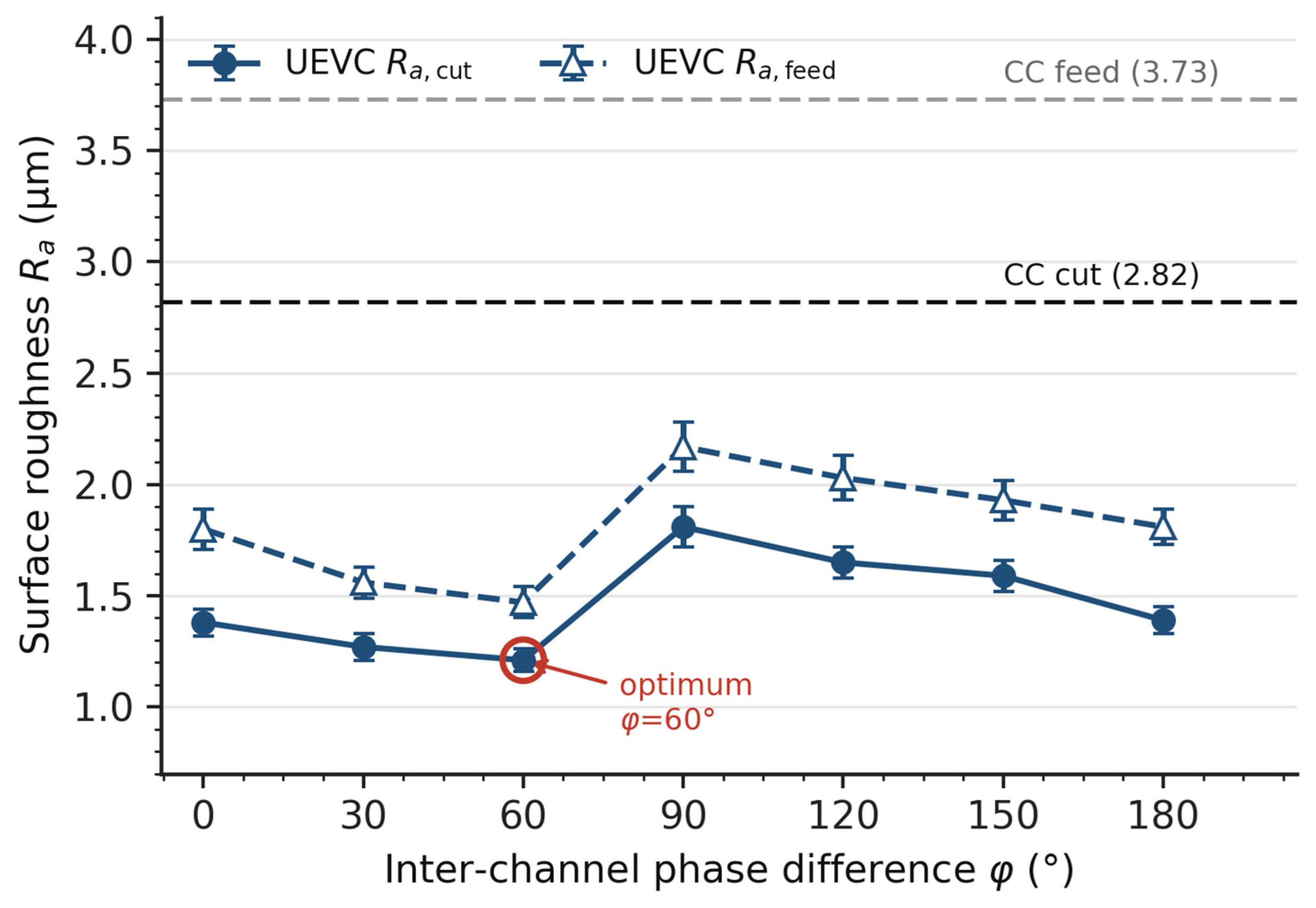
- The inter-channel phase difference is the strongest single lever; the optimum is phi = 60 deg, at which the tool-tip trajectory is an oblique ellipse whose major axis is tilted by approx 50–55 deg above the cutting direction.
- -
- The 60 deg optimum is explained kinematically by the minimisation of the cutting direction re-engagement velocity, which in turn minimises the normal force at the chip root.
- -
- The UEVC advantage is gated by the speed ratio K = Vc/(2 pi f_us A_y); for the present tool, the K = 1 threshold is at Vc approx 542 mm/s, so the productive operating window for finishing is Vc <= 100–200 mm/s.
- -
- The recommended operating point on H62 brass with the present tool is as follows: f = 1 μm/rev, Vc = 50–100 mm/s, ap = 1–2 μm, phi = 60 deg, giving Ra approx 1.21 μm (cut)/1.47 μm (feed) against 2.82/3.73 μm for paired CC (57/61% reduction).
- -
- Future work is as follows: extension to harder ductile alloys, brittle-mode trials, and factor-interaction Taguchi/response-surface study coupled with an on-line force-based closed-loop phase controller.
Author Contributions
Funding
Institutional Review Board Statement
Informed Consent Statement
Data Availability Statement
Conflicts of Interest
References
- Martins, H.; Puga, H. Ultrasonic Assisted Machining Overview: Accessing Feasibility and Overcoming Challenges for Milling Applications. Metals 2023, 13, 908. [Google Scholar] [CrossRef]
- Ning, F.; Cong, W. Ultrasonic vibration-assisted (UV-A) manufacturing processes: State of the art and future perspectives. J. Manuf. Process. 2020, 51, 174–190. [Google Scholar] [CrossRef]
- Yang, Z.; Zhu, L.; Zhang, G.; Ni, C.; Lin, B. Review of ultrasonic vibration-assisted machining in advanced materials. Int. J. Mach. Tools Manuf. 2020, 156, 103594. [Google Scholar] [CrossRef]
- Zheng, L.; Chen, W.; Huo, D. Review of vibration devices for vibration-assisted machining. Int. J. Adv. Manuf. Technol. 2020, 108, 1631–1651. [Google Scholar] [CrossRef]
- Ma, C.X.; Shamoto, E.; Moriwaki, T. Study of machining accuracy in ultrasonic elliptical vibration cutting. Int. J. Mach. Tools Manuf. 2004, 44, 1305–1310. [Google Scholar] [CrossRef]
- Nath, C.; Rahman, M.; Neo, K.S. Effect of tool nose radius in ultrasonic elliptical vibration cutting of tungsten carbide. J. Mater. Process. Technol. 2009, 209, 5830–5836. [Google Scholar] [CrossRef]
- Moriwaki, T.; Shamoto, E. Ultrasonic elliptical vibration cutting. CIRP Ann. 1995, 44, 31–34. [Google Scholar] [CrossRef]
- Shamoto, E.; Moriwaki, T. Ultraprecision diamond cutting of hardened steel by applying elliptical vibration cutting. CIRP Ann. 1999, 48, 441–444. [Google Scholar] [CrossRef]
- Saito, H.; Jung, H.; Shamoto, E. Elliptical vibration cutting of hardened die steel with coated carbide tools. Precis. Eng. 2016, 45, 44–54. [Google Scholar] [CrossRef]
- Zhang, J.; Suzuki, N.; Wang, Y.; Shamoto, E. Fundamental investigation of ultra-precision ductile machining of tungsten carbide by applying elliptical vibration cutting. J. Mater. Process. Technol. 2014, 214, 2644–2659. [Google Scholar] [CrossRef]
- Suzuki, N.; Haritani, M.; Yang, J.; Shamoto, E. Elliptical vibration cutting of tungsten alloy moulds for optical glass parts. CIRP Ann. 2007, 56, 127–130. [Google Scholar] [CrossRef]
- Kim, G.D.; Loh, B.G. An ultrasonic elliptical vibration cutting device for micro V-groove machining: Kinematical analysis and machining characteristics. J. Mater. Process. Technol. 2007, 190, 181–188. [Google Scholar] [CrossRef]
- Bai, Z.; Zhang, Z.; Wang, J.; Sun, X.; Hu, W. Numerical evaluation and experimental test on a giant magnetostrictive transducer with low heat-loss design. Micromachines 2021, 12, 1397. [Google Scholar] [CrossRef] [PubMed]
- Li, P.; Liu, Q.; Li, W.; Zhou, X.; Wang, L.; Wang, Q.; Yuan, Q. Structural study of giant-magnetostrictive ultrasonic transducers. J. Vib. Shock 2021, 40, 196–201. [Google Scholar]
- Huang, W.; Guo, P.; Guo, W.; Weng, L.; Zhou, Y. Influence of DC bias on high-frequency dynamic loss and magnetic properties of magnetostrictive materials. Trans. China Electrotech. Soc. 2022, 37, 5765–5775. [Google Scholar]
- Chen, Y.; Snyder, J.E.; Dennis, K.W.; McCallum, R.W.; Jiles, D.C. Temperature dependence of the magnetomechanical effect in metal-bonded cobalt-ferrite composites. J. Appl. Phys. 2000, 87, 5798–5800. [Google Scholar] [CrossRef]
- Mohaideen, K.K.; Joy, P.A. High magnetostriction and coupling coefficient for sintered cobalt ferrite from superparamagnetic nanoparticles. Appl. Phys. Lett. 2012, 101, 072405. [Google Scholar] [CrossRef]
- Nlebedim, I.C.; Snyder, J.E.; Moses, A.J.; Jiles, D. Dependence of magnetic and magnetoelastic properties of cobalt ferrite on processing parameters. J. Magn. Magn. Mater. 2010, 322, 3938–3942. [Google Scholar] [CrossRef]
- Qi, C.; Shen, Z.; You, S.; Jiang, T.; Pi, J.; Huang, J. Design and performance analysis of a dual-bending ultrasonic elliptical vibration cutting tool based on cobalt ferrite. Int. J. Adv. Manuf. Technol. 2025, 138, 3989–4004. [Google Scholar] [CrossRef]



| Feed (μm/rev) | CC Ra Cut (μm) | CC SD | UEVC Ra Cut (μm) | UEVC SD | Reduction Cut (%) | Reduction Feed (%) |
|---|---|---|---|---|---|---|
| 0.5 | 1.2 | 0.04 | 1.01 | 0.04 | 16 | 31 |
| 1 | 1.36 | 0.08 | 0.98 | 0.06 | 28 | 39 |
| 2 | 1.42 | 0.07 | 1.1 | 0.05 | 23 | 34 |
| 5 | 1.45 | 0.05 | 1.21 | 0.04 | 17 | 26 |
| 10 | 1.9 | 0.12 | 1.33 | 0.08 | 30 | 23 |
| 20 | 2.43 | 0.21 | 1.32 | 0.11 | 45 | 28 |
| Vc (mm/s) | K | CC Ra Cut (μm) | CC SD | UEVC Ra Cut (μm) | UEVC SD | Reduction (%) |
|---|---|---|---|---|---|---|
| 50 | 0.092 | 1.11 | 0.05 | 0.68 | 0.04 | 38.7 |
| 100 | 0.184 | 1.17 | 0.03 | 0.98 | 0.02 | 16.2 |
| 200 | 0.367 | 1.27 | 0.02 | 1.11 | 0.02 | 12.6 |
| 250 | 0.459 | 1.36 | 0.02 | 1.17 | 0.02 | 14 |
| 300 | 0.551 | 1.66 | 0.06 | 1.22 | 0.04 | 26.5 |
| 375 | 0.69 | 1.68 | 0.04 | 1.4 | 0.03 | 16.7 |
| Depth ap (μm) | CC Ra Cut (μm) | CC SD | UEVC Ra Cut (μm) | UEVC SD | Reduction Cut (%) | Reduction Feed (%) |
|---|---|---|---|---|---|---|
| 0.5 | 1.95 | 0.1 | 1.42 | 0.08 | 27.6 | 16.1 |
| 1 | 1.99 | 0.13 | 1.36 | 0.09 | 31.7 | 11.5 |
| 2 | 2.03 | 0.09 | 1.57 | 0.07 | 22.7 | 24.2 |
| 4 | 2.2 | 0.12 | 1.6 | 0.09 | 27.3 | 30.1 |
| 8 | 2.47 | 0.16 | 1.68 | 0.11 | 32 | 45.8 |
| 10 | 3.2 | 0.27 | 1.87 | 0.17 | 41.6 | 49.6 |
| Quantity | 0 | 30 | 60 | 90 | 120 | 150 | 180 |
|---|---|---|---|---|---|---|---|
| Ra cut (μm) | 1.38 | 1.27 | 1.21 | 1.81 | 1.65 | 1.59 | 1.39 |
| Ra cut SD | 0.06 | 0.06 | 0.05 | 0.09 | 0.07 | 0.07 | 0.06 |
| Ra feed (μm) | 1.80 | 1.56 | 1.47 | 2.17 | 2.03 | 1.93 | 1.81 |
| Ra feed SD | 0.09 | 0.07 | 0.07 | 0.11 | 0.10 | 0.09 | 0.08 |
Disclaimer/Publisher’s Note: The statements, opinions and data contained in all publications are solely those of the individual author(s) and contributor(s) and not of MDPI and/or the editor(s). MDPI and/or the editor(s) disclaim responsibility for any injury to people or property resulting from any ideas, methods, instructions or products referred to in the content. |
© 2026 by the authors. Licensee MDPI, Basel, Switzerland. This article is an open access article distributed under the terms and conditions of the Creative Commons Attribution (CC BY) license.
Share and Cite
He, Y.; Shen, Z.; You, S.; Zhang, X.; Huang, J.; Qi, C. Surface-Quality Optimisation in Cobalt Ferrite Ultrasonic Elliptical Vibration Cutting of H62 Brass. Coatings 2026, 16, 682. https://doi.org/10.3390/coatings16060682
He Y, Shen Z, You S, Zhang X, Huang J, Qi C. Surface-Quality Optimisation in Cobalt Ferrite Ultrasonic Elliptical Vibration Cutting of H62 Brass. Coatings. 2026; 16(6):682. https://doi.org/10.3390/coatings16060682
Chicago/Turabian StyleHe, Yajue, Zhihuang Shen, Shicong You, Xu Zhang, Junfeng Huang, and Chaoshuai Qi. 2026. "Surface-Quality Optimisation in Cobalt Ferrite Ultrasonic Elliptical Vibration Cutting of H62 Brass" Coatings 16, no. 6: 682. https://doi.org/10.3390/coatings16060682
APA StyleHe, Y., Shen, Z., You, S., Zhang, X., Huang, J., & Qi, C. (2026). Surface-Quality Optimisation in Cobalt Ferrite Ultrasonic Elliptical Vibration Cutting of H62 Brass. Coatings, 16(6), 682. https://doi.org/10.3390/coatings16060682