1. Introduction
Improving the reliability and service life of metallic components operating under severe wear, corrosion, and elevated-temperature conditions remains an important task in modern surface engineering. Since degradation processes usually start from the surface, protective ceramic coatings are widely used to improve wear resistance, corrosion resistance, thermal stability, and structural durability without significantly changing the bulk properties of the substrate. Among the ceramic oxide coatings, Al
2O
3- and Cr
2O
3-based systems are of particular interest due to their high hardness, chemical stability, and protective performance under aggressive operating conditions [
1,
2,
3].
Al
2O
3 coatings are widely used as protective layers because they provide high hardness, good chemical inertness, and resistance to abrasive wear. Recent studies have shown that plasma-sprayed Al
2O
3 coatings can significantly improve the corrosion and tribological behavior of metallic substrates, although their performance strongly depends on microstructure, porosity, adhesion, phase composition, and coating composition [
1,
4]. Cr
2O
3-based coatings are also considered promising for surface protection because they exhibit good corrosion resistance, relatively low friction, and high chemical stability in oxidizing environments [
2,
3]. Moreover, Al
2O
3–Cr
2O
3 and Cr
2O
3-containing ceramic systems are increasingly studied as functional protective coatings because the combination of oxide phases can improve the balance between hardness, corrosion resistance, and wear behavior [
2,
3,
5,
6].
However, the properties of ceramic coatings are determined not only by their chemical composition, but also by their architecture, thickness, phase state, porosity, and defect structure. Pores in oxide ceramics and thermally sprayed coatings may exist over a wide range of sizes, from nanoscale free-volume defects and nanopores to microscale pores, interlamellar voids, and cracks. These defects can act as stress concentrators, promote crack initiation and propagation, and create pathways for electrolyte penetration during corrosion. Klym et al. showed that nanoscale free-volume and positron–positronium trapping defects in MgAl
2O
4 spinel ceramics can be identified using positron annihilation methods, demonstrating the importance of defect structures in oxide ceramics [
7]. In Cr
2O
3 systems, point defects also play a significant role in oxi,dation, diffusion, and degradation processes. Auguste et al. demonstrated that point-defect behavior and void formation can influence the growth and degradation mechanisms of Cr
2O
3 layers [
8]. Therefore, both microstructural porosity and defect-related transport processes should be considered when evaluating the mechanical and corrosion behavior of Al
2O
3/Cr
2O
3 coatings.
In recent years, bilayer, multilayer, and gradient coating architectures have attracted increasing attention because they allow for the combination of different functional layers and reduce abrupt changes in mechanical and thermal properties across the coating thickness. Such architectures can improve adhesion, reduce residual stresses, suppress crack propagation, and enhance wear and corrosion resistance [
9,
10,
11,
12,
13]. Functional multilayer coatings are especially relevant for ceramic systems, where differences in thermal expansion coefficient, elastic modulus, and fracture toughness between the coating and substrate may lead to cracking or delamination. Recent works on hybrid and bilayer oxide coatings have shown that the sequence of layers, interlayer bonding, and distribution of dense and porous regions can significantly affect tribological and corrosion performance [
13,
14,
15].
Thermal spraying methods are widely used to produce ceramic and composite coatings with controlled thickness and functional properties. Recent reviews emphasize that thermal spraying is suitable not only for conventional protective coatings, but also for advanced ceramic, functional, smart, and graded coating systems designed for operation under severe mechanical, thermal, and corrosive conditions [
16,
17]. Among these methods, detonation spraying is of particular interest because powder particles are accelerated to high velocities and deposited under short-term thermal exposure. This promotes the formation of dense lamellar coatings with relatively high adhesion and allows for the partial control of phase composition and microstructure through technological parameters [
5,
10,
11,
12,
18,
19,
20,
21]. Recent studies have shown that detonation spraying can be successfully applied to obtain Al
2O
3-based, Cr
2O
3-based, and gradient ceramic coatings with improved mechanical and tribological properties [
5,
10,
18,
19,
20,
21].
The development of gradient and layer-gradient coatings obtained by detonation spraying is a promising approach for improving structural integrity and protective performance. Rakhadilov et al. showed that Al
2O
3-based gradient coatings produced by detonation spraying can improve the mechanical and tribological behavior due to changes in coating structure and layer arrangement [
10]. Buitkenov et al. demonstrated the possibility of forming multilayer gradient thermal protective coatings by detonation spraying, where a gradual transition between layers contributes to improved structural stability [
11,
12]. Previous studies on NiCr/NiCr–Al
2O
3/Al
2O
3 multilayer gradient coatings also confirmed that detonation spraying parameters, including the barrel filling volume, strongly affect the phase composition and microstructure of Al
2O
3-containing layers [
19,
20,
21]. These results indicate that controlled variation of spraying parameters can be used to design stepwise gradient coating architectures with improved properties.
Despite the growing number of studies on oxide ceramic coatings, the relationship between coating architecture, porosity, phase composition, adhesion, wear behavior, and corrosion resistance in detonation-sprayed Al2O3/Cr2O3 coatings remains insufficiently clarified. In particular, it is important to determine whether improved coating performance is mainly related to the gradient architecture, coating thickness, reduced porosity, higher density, or changes in the structural-phase state. This issue is especially relevant for bilayer and stepwise gradient multilayer Al2O3/Cr2O3 coatings, where the distribution of Cr2O3 and Al2O3 layers can significantly influence stress distribution, crack resistance, and electrolyte penetration.
Therefore, the objective of this study is to compare the structural-phase state, microstructure, porosity, mechanical properties, tribological behavior, adhesion strength, and corrosion resistance of bilayer and gradient Al2O3/Cr2O3 coatings obtained by detonation spraying on 316L stainless steel. Special attention is paid to the influence of coating architecture on coating density, defect formation, stress distribution, and protective performance under mechanical and corrosive conditions.
2. Materials and Methods
Samples of 316L austenitic stainless steel, widely used in the power and chemical engineering industries due to its high corrosion resistance, ductility, and resistance to high-temperature effects, were used as the substrate material. The samples were in the form of plates measuring 30 × 30 × 15 mm. Prior to coating application, the substrate surfaces underwent mechanical preparation, including grinding with abrasive materials of various grit sizes followed by cleaning. The chemical composition of the 316L substrate is shown in
Table 1.
Aluminum oxide (Al2O3) and chromium oxide (Cr2O3) with an average particle size of 15–45 μm were used as the starting powder materials.
Al
2O
3/Cr
2O
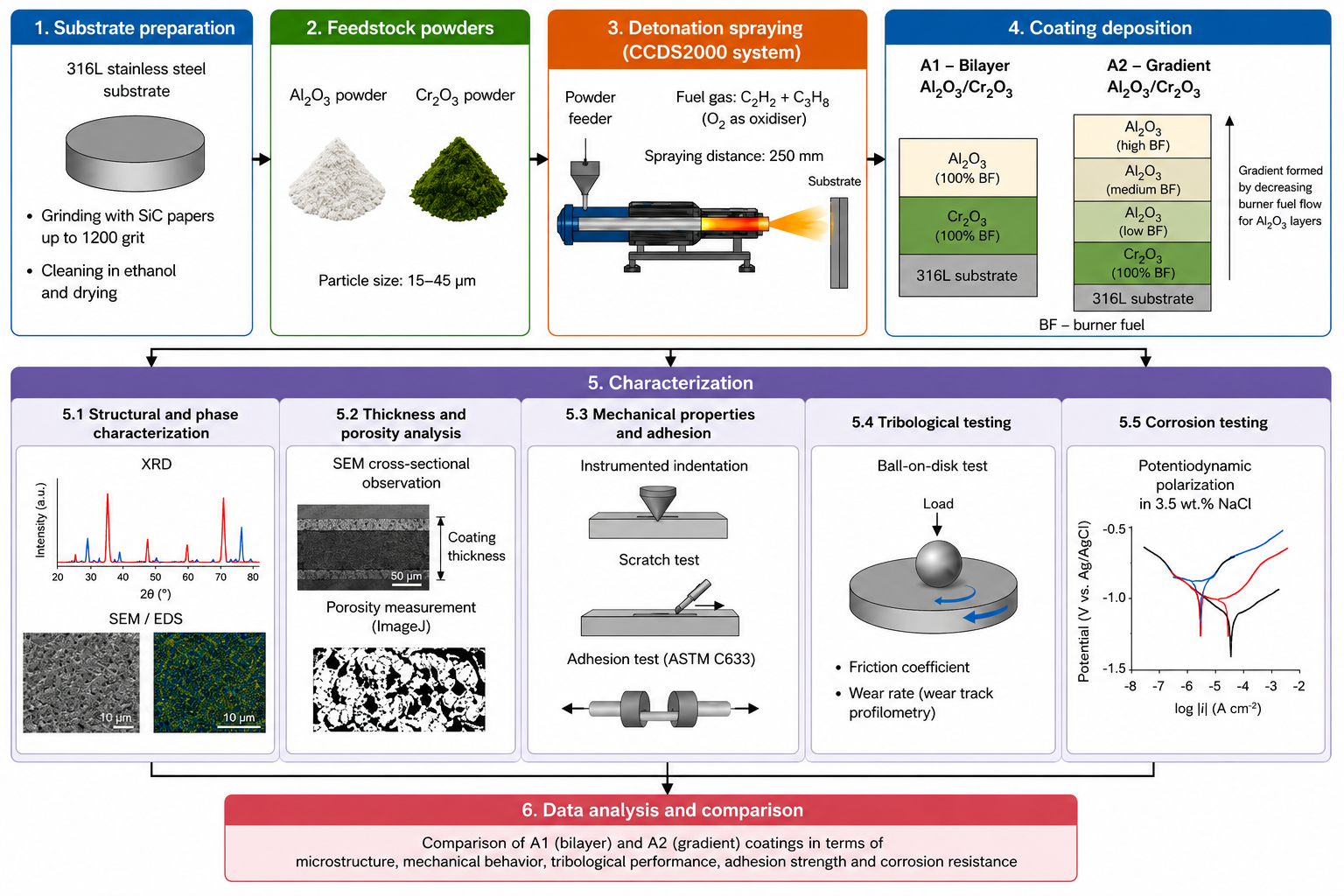
3 coatings were formed by detonation spraying using the CCDS2000 detonation system (
Figure 1). The method is based on the periodic initiation of a detonation reaction of a gas mixture in the barrel of the apparatus, as a result of which the powder particles are heated and accelerated to high velocities, after which they are deposited on the substrate surface, forming a dense coating with high adhesion.
Al
2O
3 and Cr
2O
3 powders with an average particle size of 15–45 μm were used as starting materials for coating deposition. Acetylene and propane were used as the working gas mixture. The distance from the nozzle of the detonation device to the substrate surface was 250 mm. To study the effect of coating architecture, two types of coatings were formed: a bilayer Al
2O
3/Cr
2O
3 coating (A1) and a gradient Al
2O
3/Cr
2O
3 coating (A2). The design of the A2 coating was based on the concept of a stepwise gradient architecture formed by detonation spraying. In our previous work, it was shown that the phase composition and structural characteristics of Al
2O
3-based coatings are strongly affected by the barrel filling volume and other detonation spraying parameters [
22]. Therefore, in the present study, the Al
2O
3 part of the A2 coating was divided into several sublayers deposited at different barrel filling values. This approach was intended to provide a gradual change in the thermal and kinetic conditions of particle deposition, which can influence the degree of particle melting, lamellar packing, porosity, and residual stress distribution through the coating thickness. The main process parameters for detonation spraying are presented in
Table 2.
In total, two coated specimens were prepared for the study: one specimen with the bilayer coating A1 and one specimen with the gradient coating A2. SEM analysis was performed on cross-sectional specimens. Hardness, scratch, tribological, and corrosion tests were carried out on representative areas of the corresponding coated specimens. For adhesion strength testing, separate specimens with a diameter of 25 mm were prepared. Where applicable, measurements were repeated at different points or areas of the same specimen to improve reproducibility.
After the coatings were obtained, their phase composition was investigated by X-ray diffraction (XRD) using an X’Pert Pro diffractometer (Philips Corporation, Amsterdam, The Netherlands). Diffraction patterns were recorded using Cu-Kα radiation at an accelerating voltage of 40 kV and a current of 30 mA. Scanning was performed in the 2θ range of 20–100° with a scan step of 0.05° and an exposure time of 1 s per step. Data processing and phase identification were performed using HighScore Plus 5.3.1.
(Bruker. The microstructure and elemental composition of the coatings were investigated using a SEM3200 scanning electron microscope (CIQTEK Co., Ltd., Hefei, China) equipped with a tungsten filament and an XFlash Detector 730M-300 energy-dispersive X-ray spectroscopy (EDS) system (Bruker Nano GmbH, Berlin, Germany).The apparent porosity of the coatings was quantified using ImageJ software (Version 1.54g, National Institutes of Health, Bethesda, MD, USA) based on SEM cross-sectional images. The analyzed coating regions were converted to 8-bit grayscale, and pores were segmented by thresholding. The porosity was calculated as the ratio of the total pore area to the analyzed coating area and expressed as a percentage. The thickness of the coatings and individual layers was determined from SEM cross-sectional images. Measurements were performed at several points along the coating cross-section, and the average values were used for a comparison of the A1 and A2 coatings.
The microhardness of the coatings was determined using the Vickers instrumental indentation method in accordance with the requirements of DIN EN ISO 14577-1 on a Fischerscope HM2000 instrument (Helmut Fischer GmbH, Sindelfingen, Germany). The tests were conducted at an indenter load of P = 100 mN and a dwell time of 15 s. The adhesion strength of the coatings was additionally evaluated using scratch testing on an Anton Paar RST 300 instrument (Anton Paar GmbH, Graz, Austria). The tests were conducted using a diamond indenter with a linearly increasing load ranging from 0.5 N to 75 N. The rate of load increase was 111.7 N/min, and the scratch length was 4 mm. During the tests, the critical loads corresponding to the onset of coating failure and its delamination from the substrate were recorded. The critical loads were determined from the combined analysis of the acoustic emission signal, coefficient of friction, penetration depth, and optical images of the scratch tracks. Lc1 was defined as the onset of microcracking, Lc2 as progressive cohesive damage and crack propagation, and Lc3 as severe coating failure or delamination. The surface roughness of the coatings was determined using an SSR300+ profilometer (Shenzhen, China). The Ra value, representing the arithmetic mean deviation of the surface profile, was used as the primary parameter for evaluating roughness.
Tribological tests were conducted on a TRB3 tribometer (Anton Paar, Graz, Austria) using the “ball-disc” configuration in accordance with international standards ASTM G133-95 and ASTM G99. A 6-mm-diameter ball made of 100Cr6 steel was used as the counterbody. The tests were conducted at a load of 10 N, a linear sliding speed of 3 cm/s, a friction track radius of 2 mm, and a total friction distance of 100 m.
The corrosion resistance of the coatings was investigated using the potentiodynamic polarization method with a CS300 potentiostat-galvanostat (CorrTest Instruments Corp., Wuhan, China). The tests were conducted at room temperature (25 °C) in a 3.5% NaCl solution. The open surface area of the sample was 7.98 cm2. A three-electrode electrochemical cell was used in the experiment, where the test sample served as the working electrode, an Ag/AgCl electrode served as the reference electrode, and a platinum electrode served as the counter electrode. The corrosion potential (Ecorr) and corrosion current density (Icorr) were determined from the polarization curves using the Tafel extrapolation method. The corrosion rate was calculated from the corrosion current density according to the following equation: rcorr = 0.00327 × Icorr × EW/ρ, where rcorr is the corrosion rate in mm/year, Icorr is the corrosion current density in µA/cm2, EW is the equivalent weight, and ρ is the density of the material. Here, EW is the equivalent weight of the corroding material, expressed in g/equiv, and represents the mass of material corresponding to one equivalent of electrochemical reaction. In this study, the EW value used for the corrosion rate calculation was 25.92 g/equiv. Corrosion measurements were performed on two coated specimens: one specimen with the bilayer coating A1 and one specimen with the gradient coating A2. The polarization curves were analyzed using Tafel extrapolation, and the obtained parameters were used to compare the corrosion behavior of the two coatings. The experimental data were processed using CS Studio6 software (version 6.3).
For adhesion strength testing, separate coated specimens with a diameter of 25 mm were prepared. The test was carried out on a WDW-100 kN universal testing machine (Jinan Time Testing Machine Co., Ltd., Jinan, China). The load was applied perpendicular to the coating–substrate interface until failure. The maximum load before failure was recorded and used to compare the adhesion strength of the A1 and A2 coatings. After testing, the failure mode was evaluated by visual inspection of the tested surface.
3. Results
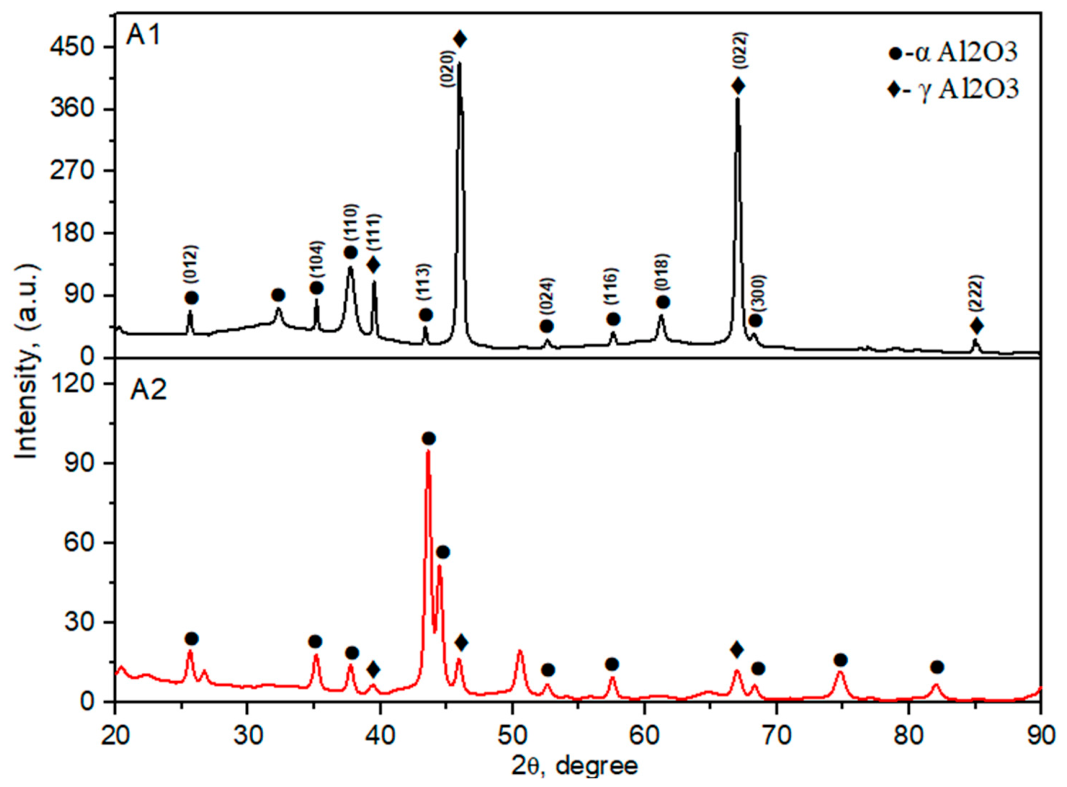
The structural and phase state of the obtained coatings was investigated by X-ray diffraction. The XRD patterns of coatings A1 and A2 are presented in
Figure 2.
The diffraction patterns indicate that both coatings mainly contain α-Al2O3 and γ-Al2O3 phases. The characteristic reflections of α-Al2O3 are observed in the 2θ range of approximately 25–83°, while the γ-Al2O3 phase is identified by reflections in the regions around 39–46°, 67°, and 89°. The presence of γ-Al2O3 can be attributed to the rapid heating and cooling of powder particles during detonation spraying, which promotes the formation of metastable alumina modifications.
For the A1 coating, the diffraction peaks were more intense and narrower, indicating a higher degree of crystallinity and a more ordered phase structure. In contrast, the A2 coating was characterized by lower peak intensity and broader reflections. This may be associated with a finer-grained structure, higher defect concentration, and partial formation of poorly crystalline or amorphous regions due to the repeated deposition of Al2O3 sublayers at different barrel filling values. Since quantitative phase analysis, crystallite size calculation, microstrain evaluation, and residual stress measurements were not performed in this study, the observed peak broadening in A2 is discussed only qualitatively. The broader and less intense peaks may be associated with a finer-grained or more defective structure and the partial formation of poorly crystalline regions; however, this interpretation should be considered as a possible explanation rather than as a quantitatively confirmed mechanism.
It should also be noted that Cr2O3 reflections are not clearly distinguished in the XRD patterns. This can be explained by the fact that conventional XRD mainly analyzes the near-surface region of the coating, where the Al2O3-rich layer dominates. Since the Cr2O3 layer is located closer to the substrate and has a smaller thickness, especially in the A2 coating, its diffraction contribution is weak. Therefore, Cr2O3 peaks may be partially overlapped with Al2O3 reflections or may be close to the detection limit of the XRD method.
Thus, the XRD results show that detonation spraying conditions and coating architecture significantly affect the phase composition and crystallinity of Al2O3/Cr2O3 coatings. The lower peak intensity and broader reflections in A2 indicate a more structurally refined coating, which is consistent with the SEM observations of a denser and more homogeneous microstructure.
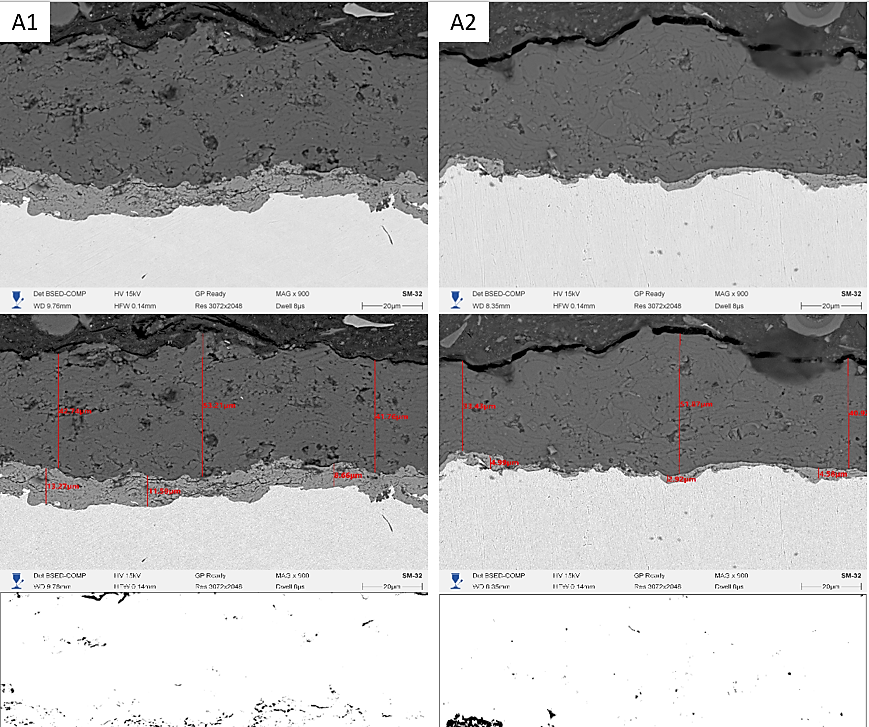
Figure 3 shows SEM cross-sectional images of coatings A1 and A2 obtained by detonation spraying, including direct thickness measurements. In both samples, continuous coatings were formed on the 316L stainless steel substrate, with no signs of macroscopic delamination at the coating–substrate interface.
Coating A1 exhibits a typical bilayer structure consisting of a Cr2O3 inner layer and an Al2O3 outer layer. According to the cross-sectional measurements, the thickness of the Cr2O3 layer is approximately 11.17 μm, while the thickness of the Al2O3 layer is approximately 45.90 μm. Thus, the total coating thickness of A1 is about 57.07 μm. The coating is characterized by a lamellar structure typical of detonation spraying, with visible interlamellar boundaries, isolated micropores, and local structural heterogeneities.
For coating A2, the measured thickness of the Cr2O3 inner layer is approximately 4.16 μm, while the total thickness of the Al2O3 region is approximately 42.07 μm. The total coating thickness of A2 is therefore about 46.23 μm. In A2, the Al2O3 region consists of several sublayers deposited at different barrel filling values. Since these sublayers have the same nominal chemical composition and differ mainly in spraying parameters, their boundaries are not sharply distinguishable in the SEM cross-section; therefore, the thickness is reported for the total Al2O3 region.
Compared with A1, coating A2 demonstrated a more compact and homogeneous structure. The lamellar boundaries were less pronounced, and the number of visible pores and defects was lower. Quantitative image analysis of SEM cross-sections using ImageJ software confirmed this observation. The apparent porosity of coating A1 was 1.285%, whereas for coating A2 it decreased to 0.934%. This indicates that A2 has a denser and more homogeneous structure. The reduced porosity of A2 is associated with the stepwise gradient multilayer architecture and modified deposition conditions, which promote more uniform particle packing and reduce interlamellar defects. Although A2 had a lower total thickness than A1, it exhibited improved structural integrity, indicating that the enhancement of its mechanical, tribological, and corrosion properties cannot be attributed only to the coating thickness. Instead, the improved performance is associated with the combined effect of the stepwise gradient multilayer architecture, higher density, reduced porosity, and more uniform stress distribution through the coating thickness.
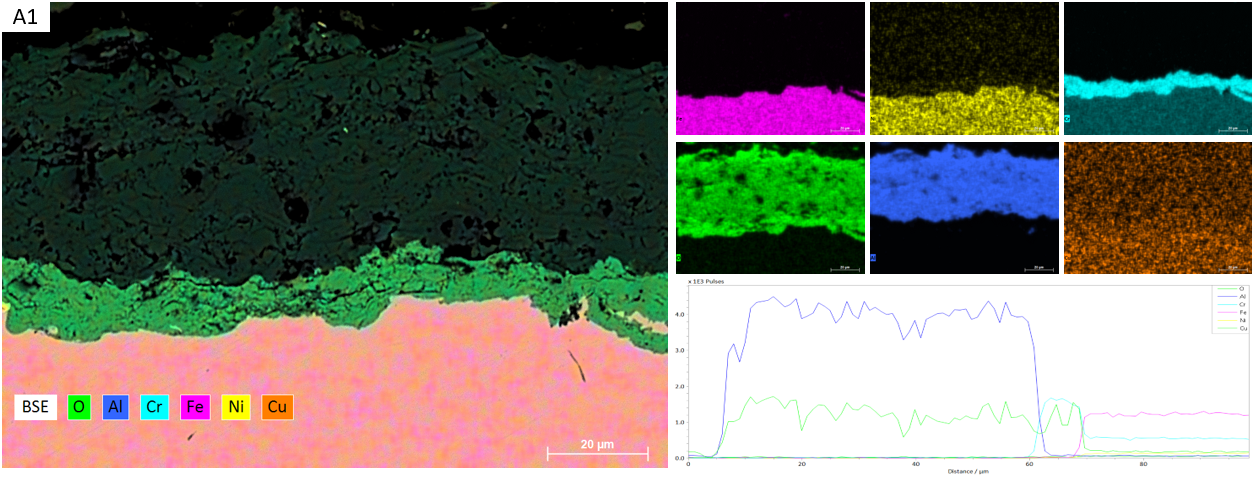
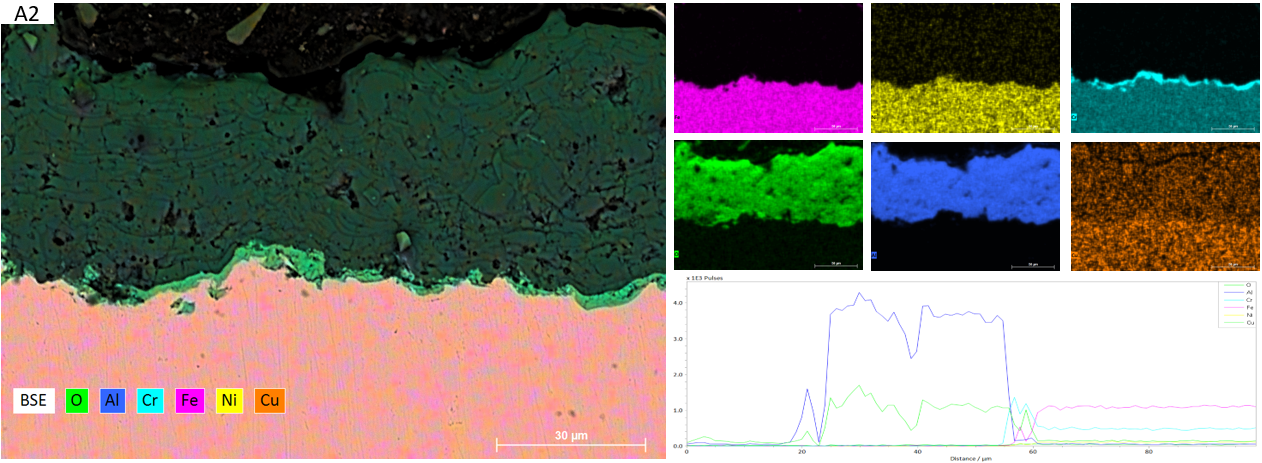
Figure 4 presents the EDS elemental maps and line profiles obtained from cross-sections of the A1 and A2 coatings. The results confirm the formation of Al
2O
3/Cr
2O
3 coatings on the 316L stainless steel substrate and show the distribution of the main elements across the coating thickness.
For the A1 coating, the elemental maps showed a clear layered structure. The Al- and O-rich region corresponded to the Al2O3 layer, while the Cr-enriched zone near the substrate corresponded to the Cr2O3 inner layer. Fe and Ni were mainly concentrated in the substrate region, confirming a clear boundary between the coating and the 316L steel substrate. The EDS line profile also showed a relatively sharp transition between the coating and substrate, which is typical for the bilayer architecture of A1.
For the A2 coating, the elemental distribution was more uniform across the coating thickness. The Al- and O-rich region was continuous, while the Cr-containing layer near the substrate was thinner and less sharply separated compared with A1. Since the Al2O3 region in A2 consisted of several sublayers deposited at different barrel filling values, their boundaries were not clearly visible in the EDS maps because they had the same nominal chemical composition. However, the smoother line-profile transitions indicate a more gradual structural transition through the coating thickness.
The EDS results support the SEM observations and confirm that A2 had a more homogeneous coating structure. The smoother elemental transition and more uniform distribution of Al, O, and Cr contributed to improved structural integrity, reduced stress concentration, and better mechanical and corrosion performance of the gradient coating.
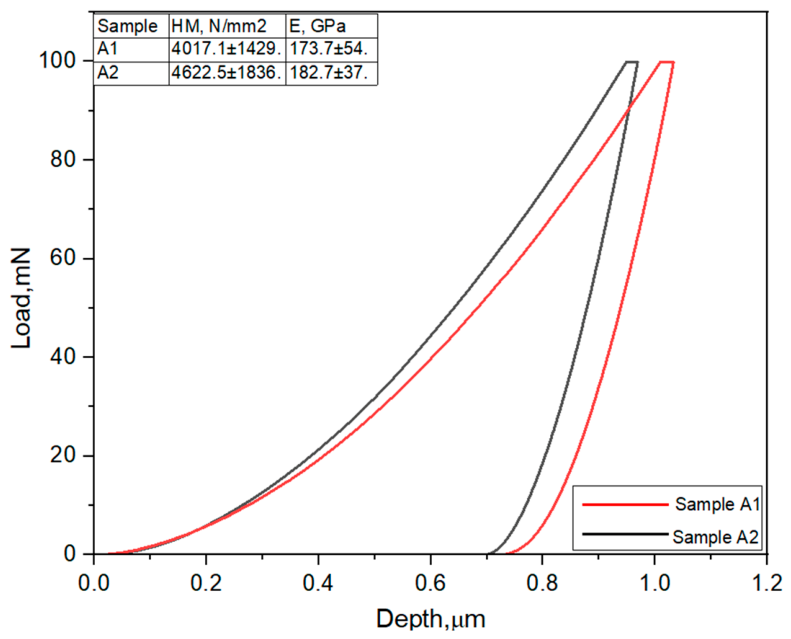
Figure 5 shows the loading–unloading indentation curves for coatings A1 and A2. The indentation results indicate that the gradient coating A2 had higher resistance to indenter penetration compared with the bilayer coating A1. At the maximum load of 100 mN, the penetration depth for A1 reached approximately 1.14 μm, whereas for A2, it decreased to about 1.00 μm. This corresponded to an approximately 12% reduction in penetration depth, indicating improved resistance to plastic deformation.
The measured indentation hardness increased from 4017.1 N/mm2 for A1 to 4622.5 N/mm2 for A2, which corresponded to an increase of about 15%. The elastic modulus also increased from 173.7 GPa for A1 to 182.7 GPa for A2, showing an improvement of approximately 5%. The steeper unloading branch of the A2 curve indicates higher elastic recovery and greater stiffness of the coating.
The improvement in hardness and elastic modulus is directly related to the microstructural differences between the coatings. As shown by SEM and porosity analysis, A2 had lower apparent porosity than A1, decreasing from 1.285% to 0.934%. A lower pore content reduces local stress concentration and limits the development of plastic deformation under the indenter. In addition, the gradient architecture of A2 promotes more uniform stress distribution through the coating thickness. Therefore, the higher hardness, lower penetration depth, and increased elastic modulus of A2 are attributed to its denser structure, reduced porosity, and improved structural integrity.
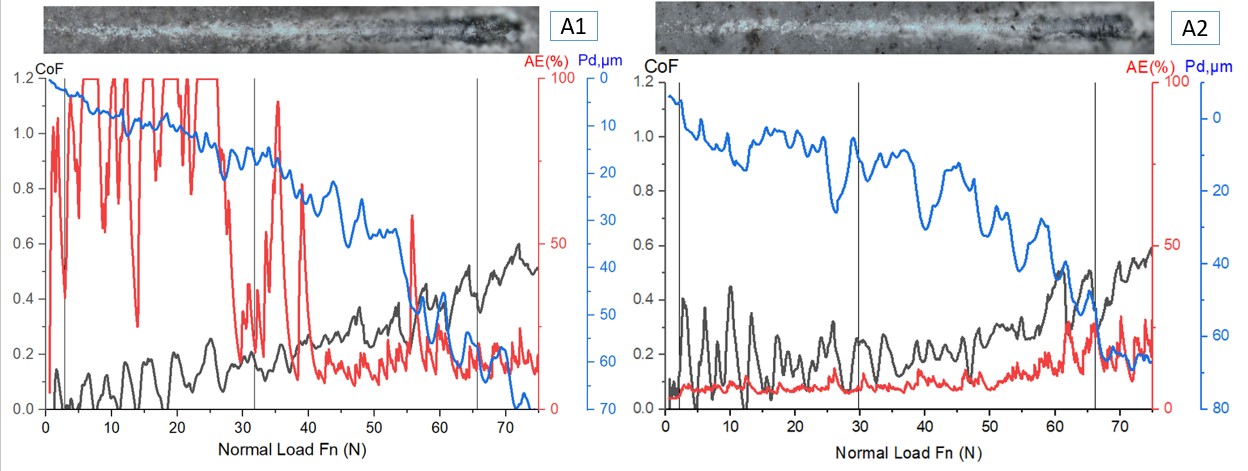
Figure 6 presents the results of scratch testing for coatings A1 and A2, including the dependencies of the coefficient of friction (CoF), the acoustic emission (AE) signal, and the indenter penetration depth (Pd) on the normal load Fn. Images of the scratch tracks obtained after the tests are also shown.
For coating A1, significant fluctuations in acoustic emission with pronounced peaks were observed during the initial loading stage (up to ~20–30 N), indicating the early formation of microcracks and local failures in the near-surface layers. The coefficient of friction in this range was unstable and reached high values (~1.1–1.2), which is associated with a heterogeneous structure and the presence of defects. In the range of ~30–50 N, a partial decrease in AE intensity was observed, although isolated spikes persisted, indicating progressive damage. The penetration depth began to increase more rapidly, indicating a decrease in the coating’s load-bearing capacity. At loads above ~60 N, there was a sharp increase in Pd, accompanied by an increase in CoF and the reappearance of AE peaks, which corresponded to the critical stage of coating failure and the onset of its delamination from the substrate.
The A2 coating was characterized by a more stable deformation behavior. In the initial stage (up to ~30 N), acoustic emission was virtually absent or of low intensity, indicating the absence of early defects and high structural integrity. The friction coefficient changed smoothly, without sharp jumps, remaining at a lower level compared to A1. In the load range of ~30–60 N, stable behavior persisted: AE remained low, and the increase in penetration depth occurred gradually, indicating effective resistance to plastic deformation. Only at loads above ~60 N did a noticeable increase in AE and Pd begin, indicating that the critical failure load had been reached. At the same time, the growth of the penetration depth remained smoother, without sharp jumps, indicating a delayed development of damage.
A comparison of the results shows that coating A1 is characterized by an early onset of damage and unstable mechanical behavior associated with the presence of interlamellar boundaries and pores. In contrast, coating A2 demonstrates a higher critical failure load, a stable coefficient of friction, and a delayed accumulation of damage (
Table 3). The improved scratch behavior of A2 may be related to its denser structure, lower apparent porosity, and stepwise gradient architecture. These factors can reduce local stress concentration and delay damage accumulation; however, detailed crack propagation mechanisms require additional microscopic analysis.
The obtained values show that coating A2 had higher critical loads than A1, indicating improved scratch resistance and stronger structural integrity. This behavior is associated with the denser structure, reduced porosity, and stepwise gradient multilayer architecture of A2.
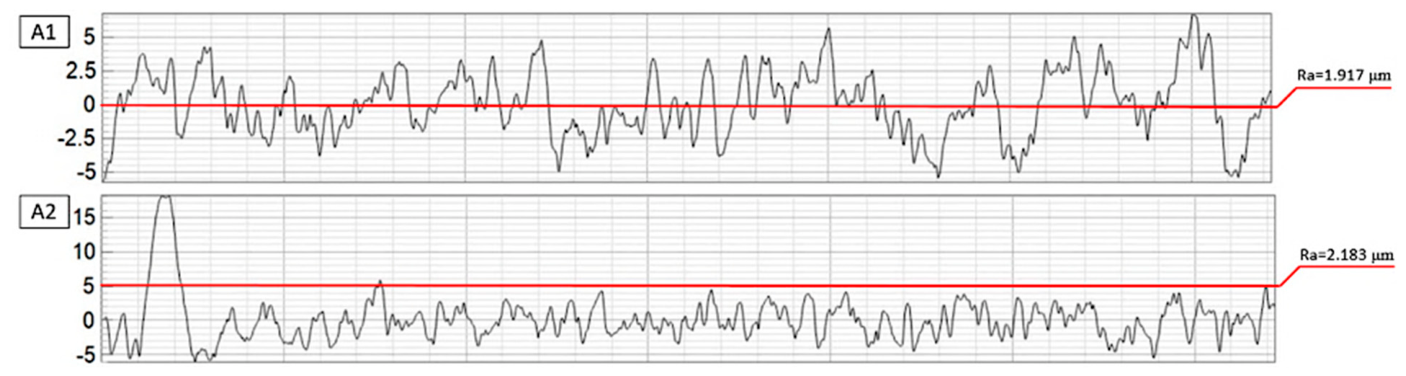
Figure 7 shows the surface roughness profiles of coatings A1 and A2 obtained using the profilometric method. Analysis of the surface profiles allows for the evaluation of the micro-relief of the coatings and the determination of the arithmetic mean deviation of the profile, Ra.
As can be seen from the presented profiles, coating A1 was characterized by significant fluctuations in surface height with the presence of sharp peaks and deep valleys. The amplitude of irregularities reached high values, indicating pronounced micro-relief heterogeneity. The arithmetic mean roughness was Ra ≈ 1.917 μm. The formation of such a relief is associated with the lamellar structure, the presence of partially melted particles, and interlamellar defects.
For coating A2, the surface profile was smoother. As can be seen from the graph, the height fluctuations had a smaller amplitude and a more uniform distribution along the length of the profile. The roughness value was Ra ≈ 2.183 μm. Despite the higher Ra value, the surface was characterized by fewer sharp local protrusions.
The results indicate a more uniform formation of the A2 coating surface, which is due to its gradient structure and more uniform distribution of material during the spraying process.
Although the A2 coating had a denser cross-sectional structure and lower apparent porosity, its Ra value was slightly higher than that of A1. This apparent contradiction can be explained by the fact that porosity and surface roughness characterize different structural features. Porosity reflects the internal compactness of the coating, whereas Ra describes the height variation of the outer surface.
In the A2 coating, the repeated deposition of several Al2O3 sublayers at different barrel filling values affects the thermal and kinetic state of the particles during spraying. The variation in particle melting and impact behavior can promote denser lamellar packing inside the coating, while the final deposited particles may form a more developed surface relief. Therefore, the higher Ra value of A2 is mainly associated with the surface build-up mechanism and splat stacking during the final stages of deposition, rather than with higher internal porosity.
Thus, A2 can simultaneously exhibit lower internal porosity and higher surface roughness. The denser internal structure contributes to improved mechanical and corrosion properties, while the increased Ra reflects the morphology of the outer deposited layer.
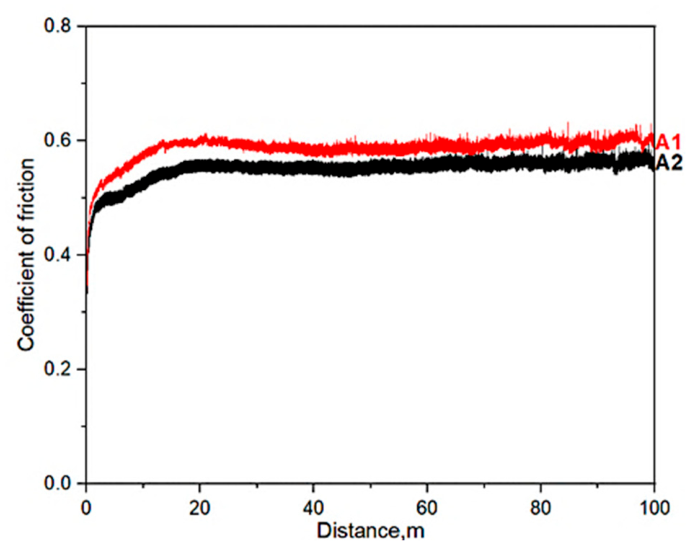
Figure 8 presents the results of the tribological tests of coatings A1 and A2, demonstrating the change in the coefficient of friction (CoF) as a function of the friction distance during ball-on-disk tests.
As can be seen from the curves presented, for both coatings, a sharp increase in the coefficient of friction was observed in the initial stage (up to ~10–15 m), associated with the running-in process. During this period, surface irregularities are smoothed out, the most prominent micro-irregularities are broken down, and a stable contact zone is formed.
For coating A1, after the running-in stage, the coefficient of friction stabilized at ~0.58–0.60. Subsequently, fluctuations of moderate amplitude were observed along the entire length of the sliding path. These fluctuations are associated with the periodic formation and removal of wear particles, as well as with local damage to the interlamellar boundaries. The presence of such fluctuations indicates a less stable nature of friction and heterogeneity in the coating structure.
Coating A2 demonstrated more favorable tribological behavior. After the running-in stage, the coefficient of friction stabilized at a lower level (~0.52–0.55). The curve had a smoother profile, and the amplitude of the fluctuations was noticeably lower compared to A1. This indicates a more stable friction regime and a uniform distribution of contact stresses across the surface.
Throughout the entire test, there were no sharp jumps in the coefficient of friction for A2, which indicates a reduction in the intensity of microdamage and a more stable formation of the tribological pair.
The observed differences are due to the microstructural characteristics of the coatings. The denser, more homogeneous, and less porous structure of the A2 coating, as well as the gradient phase distribution, contribute to a reduction in stress concentration in the contact zone, a decrease in the likelihood of local failure, and, consequently, a reduction in the coefficient of friction and wear.
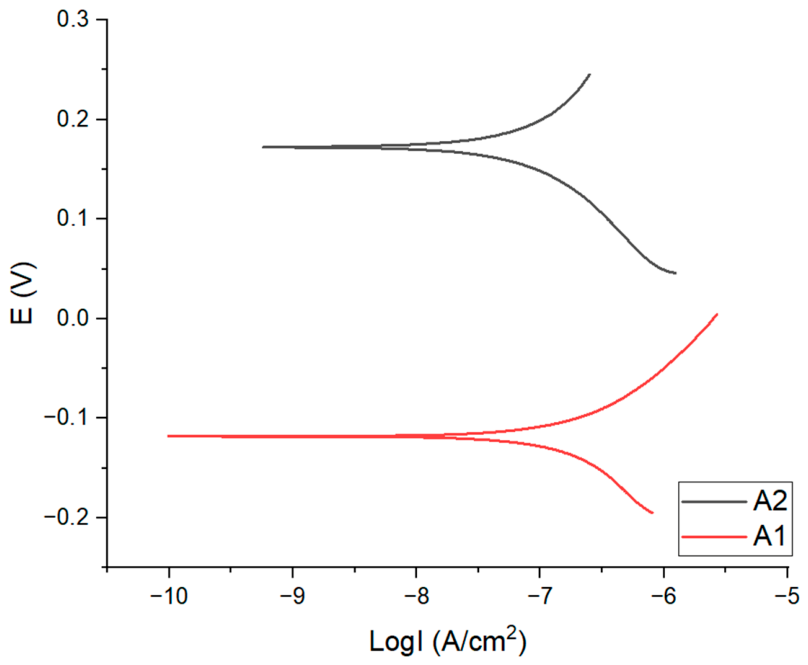
The results of the electrochemical tests of coatings A1 and A2 in a 3.5% NaCl solution are presented in
Figure 9, and the main corrosion parameters are given in
Table 4. The polarization curves allow for the evaluation of the corrosion potential and corrosion current characteristics, which describe the coatings’ resistance to electrochemical degradation.
As shown in
Figure 9, coating A2 exhibited more favorable electrochemical behavior compared with coating A1. The polarization curve of A2 shifted toward more positive potential values, indicating a more noble corrosion behavior. In addition, coating A2 demonstrated lower corrosion current values compared with A1.
According to
Table 4, the corrosion current decreased from 0.505 µA for coating A1 to 0.242 µA for coating A2. The corrosion current density also decreased from 0.842 µA/cm
2 for A1 to 0.402 µA/cm
2 for A2. This reduction indicates a lower rate of electrochemical corrosion processes.
This was confirmed by the corrosion rate values: for coating A1, the corrosion rate was 0.0089 mm/year, whereas for coating A2, it decreased to 0.0043 mm/year. Thus, coating A2 provided more effective protection of the substrate.
The improved corrosion resistance of coating A2 is attributed to its denser and more uniform structure, as well as its gradient architecture, which reduces coating permeability to aggressive ions and limits electrolyte penetration.
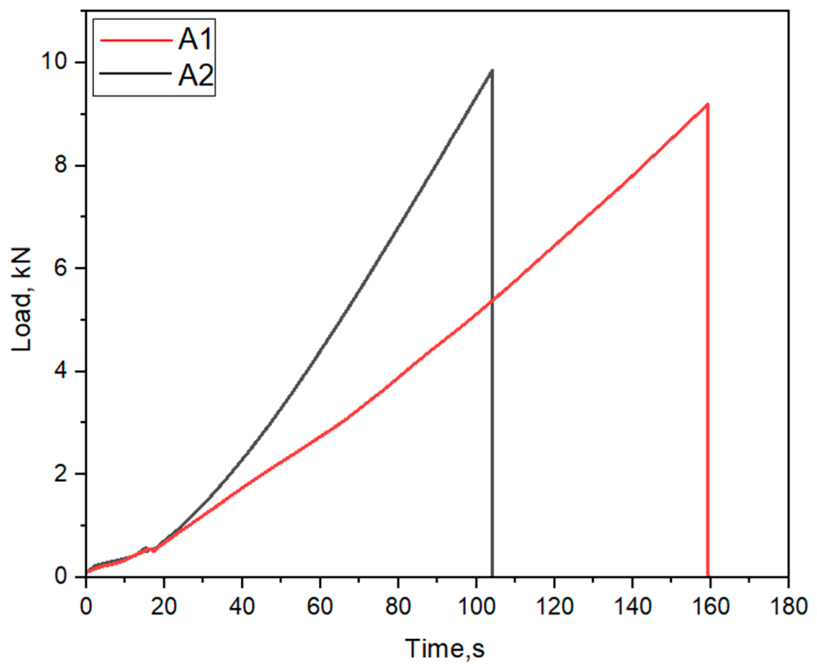
Figure 10 shows the load–time curves obtained during the adhesion strength testing of coatings A1 and A2 on a universal testing machine. The graphs reflect the process of a gradual increase in the applied load until the failure of the coating–substrate bond.
As can be seen from the presented curves, for coating A1, the load increase occurred more smoothly and continued up to ~160 s, with the maximum load reaching ~9.0–9.5 kN. After reaching the limit value, a sharp drop in load was observed, corresponding to the failure of the adhesive bond between the coating and the substrate.
Coating A2 was characterized by a more intense increase in load during the initial stage. The maximum load value was reached more quickly—at approximately ~100 s—and amounted to about ~10 kN. Failure occurred at a higher load, indicating the coating’s increased adhesive strength. The sharp decrease in load also indicates the brittle nature of the failure after reaching the critical state.
A comparison of the curves shows that coating A2 had higher adhesive strength compared to coating A1. The higher ultimate load and steeper curve indicate that coating A2 is better able to withstand mechanical stresses.
The increase in adhesive strength is associated with the denser and more uniform structure, as well as the gradient architecture of coating A2, which ensures a more effective distribution of stresses at the coating–substrate interface.