Article

Furanyl Hydrazone Schiff Base as a Corrosion Inhibitor for Carbon Steel in HCl: Experimental and Theoretical Study

1
Laboratory of Electrochemistry and Material (LEM), Department of Process Engineering, Faculty of Technology, University Ferhat ABBAS Setif-1, Setif 19000, Algeria
2
Laboratory of Electrochemical of Molecular Materials and Complex (LEMMC), Department of Process Engineering, Faculty of Technology, University Ferhat ABBAS Setif-1, Setif 19000, Algeria
3
Department of Science, Teacher Education College of Setif—Messaoud Zeghar, Setif 19000, Algeria
4
Laboratory of Analytical Sciences, Materials and Environmental (LSAME), Larbi Ben M’Hidi University, Oum El Bouaghi 04000, Algeria
5
Laboratory of Mineral Resources Valorisation and Environment (LAVAMINE), Mining Departement, Faculty of Earth Sciences, Badji Mokhtar University, Annaba 23000, Algeria
6
Innovative Durable Building and Infrastructure Research Center, Center for Creative Convergence Education, Hanyang University ERICA, 55 Hanyangdaehak-ro, Sangrok-gu, Ansan-si 15588, Gyeonggi-do, Republic of Korea
7
Laboratory of Energetic and Solid-State Electrochemistry (LEES), Department of Process Engineering, Faculty of Technology, University Ferhat ABBAS Setif-1, Setif 19000, Algeria
8
Teacher Education College of Constantine, Ali Mendjeli University City, Constantine 25000, Algeria
9
Department of Architectural Engineering, Hanyang University ERICA, 55 Hanyangdaehak-ro, Sangrok-gu, Ansan-si 15588, Gyeonggi-do, Republic of Korea
*
Authors to whom correspondence should be addressed.
Coatings 2026, 16(6), 678; https://doi.org/10.3390/coatings16060678
Submission received: 20 April 2026 / Revised: 23 May 2026 / Accepted: 1 June 2026 / Published: 4 June 2026

Abstract

This study aims to investigate the performance and mechanism of N′-[(E)-phenylmethylidene] furan-2-carbohydrazide (FNH), a hydrazone Schiff base, as a corrosion inhibitor for carbon steel in 1.0 M HCl. The research was conducted by coupling electrochemical testing (Tafel analysis and Impedance spectroscopy) with surface characterization (SEM and AFM) and advanced computational tools, including quantum-chemical modeling and classical molecular dynamics (MD) simulations. Tafel analysis revealed that FNH acts as a mixed-type inhibitor, concurrently slowing iron oxidation and hydrogen reduction. Impedance data showed that the Faradaic resistance grew monotonically with FNH dosage, reaching 95% protection at 1 × 10⁻⁴ M. Fitting the results to the Langmuir model indicated a joint physical–chemical anchoring pathway, further confirmed by SEM/AFM inspection which disclosed a uniform organic deposit. Quantum-chemical modeling revealed that protonated species broaden the molecule’s capacity for bidirectional electron exchange, while MD simulations on the Fe (110) slab confirmed a flat-lying geometry that maximizes heteroatom–metal contact. The consistency between laboratory observables and atomic-scale predictions provides a detailed, mechanism-oriented picture of how this organic protective layer curtails acid corrosion.

1. Introduction

Metallic materials and their alloys underpin virtually every sector of modern infrastructure and manufacturing [1,2,3]. Despite their widespread utility, these materials are inherently susceptible to electrochemical degradation when exposed to media rich in aggressive species such as chloride and sulfate ions [4,5]. The economic and structural toll of such degradation, ranging from equipment failure to unplanned shutdowns, has spurred sustained efforts to develop protective strategies, among which the addition of organic inhibitors to the corrosive medium stands out for its simplicity, affordability, and demonstrated effectiveness [6,7,8]. The protective action of organic inhibitors stems from their ability to anchor onto metallic substrates and form a molecular barrier between the metal and its environment [9,10,11]. Efficient anchoring typically requires a conjugated backbone capable of π electron overlap with surface orbitals, together with heteroatoms (N, O, S) whose lone-pair electrons can coordinate directly with the partially vacant d-band of the metal [12,13,14]. Within this broad family, nitrogen-bearing heterocycles and their derivatives, including azines, amino acids, imines, Schiff bases, and hydrazides, have attracted particular attention over the past decade [15,16,17]. Recent literature has showcased the versatility of these compounds; for instance, Naveenkumar et al. (2026) [18] demonstrated that Schiff bases can achieve high inhibition efficiency using potentiodynamic polarization and EIS. Similarly, the work of Ahmed et al. (2026) [19] and El Hamri et al. (2026) [20] emphasized the role of functionalized nitrogen-bearing groups in enhancing the adsorption stability on carbon steel surfaces in 1 M HCl. Furthermore, Elaraby et al. (2025) [21] highlighted the importance of multi-scale quantum insights to validate these protective effects, while Al-Amiery et al. (2024) [22] underscored the shift toward more sustainable, environmentally responsible corrosion control strategies. However, many of these studies still rely predominantly on static quantum-chemical calculations, often overlooking the complex dynamic behavior of the inhibitor–metal interface under real service conditions. Hydrazones, defined by the characteristic C=N–N linkage, occupy a noteworthy position in this landscape [23]. The –NH–N=CH– fragment imparts an unusual dual character: the carbon center is simultaneously electrophilic and nucleophilic, while both nitrogen atoms function as nucleophilic donors. This combination confers mixed hard–soft Lewis base behavior that favors strong, multisite coordination with iron and steel surfaces [24,25,26]. Despite these promising features, a significant research gap remains: the precise electronic influence of the furanyl moiety when coupled with a hydrazone bridge, particularly the impact of protonation in highly acidic (1.0 M HCl) environments, is not yet fully understood. Most existing computational models fail to account for how the transition from neutral to cationic forms, which is typical during industrial acid pickling and cleaning processes, alters the binding geometry and orbital interactions at the corroding interface. While gravimetric and electrochemical measurements remain indispensable for quantifying protection levels, they offer limited visibility into the atomic-scale events that dictate how an organic molecule settles onto and interacts with a corroding interface. Computational chemistry has filled this gap. In particular, quantum-mechanical modeling at the DFT level can map the electronic landscape of an inhibitor, frontier orbitals, charge distribution, and local reactivity, while MD simulations capture the time-dependent behavior of the adsorbed layer under conditions that approximate the real service environment. Against this backdrop, the present study introduces the synthesis and multiscale evaluation of a new furanyl hydrazone derivative, FNH, as a high-performance inhibitor for XC70 carbon steel. The novelty of this work lies in its integrated approach; we bridge the gap between macroscopic electrochemical observables (Tafel and EIS) and microscopic insights (DFT and MD) to elucidate the bidirectional electron exchange mechanism. By focusing on both neutral and protonated states, this research provides a mechanistic blueprint that explains how FNH achieves exceptional inhibition efficiency, offering a strategic framework for the future design of heteroatom-rich inhibitors in aggressive acidic media.

2. Methods and Materials

2.1. N′-[(E)-Phenylmethylidene] Furan-2-Carbohydrazide (FNH)

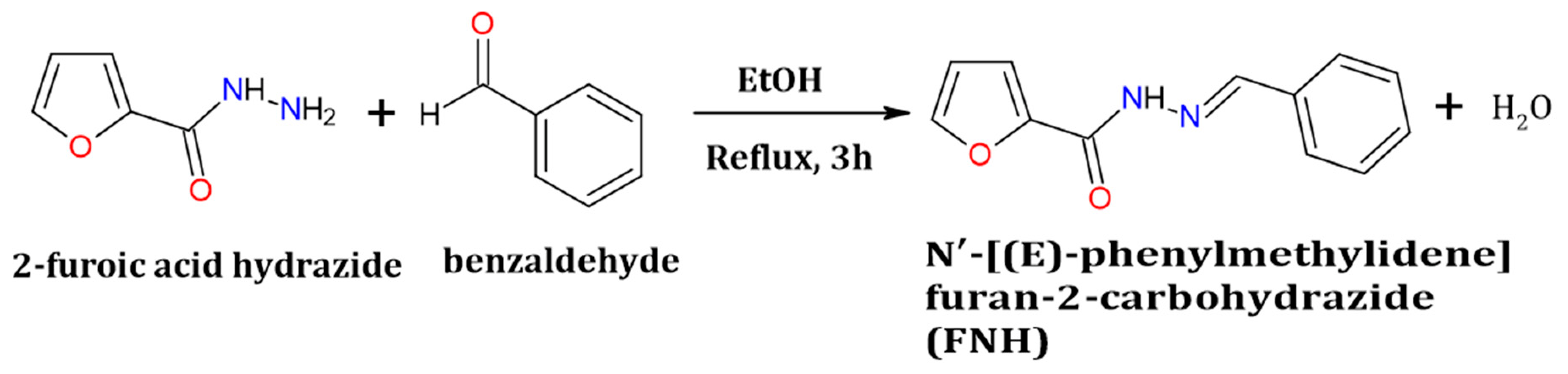
All chemicals used for the synthesis of FNH were of analytical grade, purchased from Sigma-Aldrich (St. Louis, MO, USA) and used without further purification. 2-furoic acid hydrazine (0.01 mol) was dissolved in 15 mL of heated ethanol. Benzaldehyde (0.01 mol) was then added, and the resulting mixture was refluxed for three hours. Thin layer chromatography with a CH2Cl2: MeOH (5:1) eluent system was used to track the progress of the reaction. After cooling, the precipitate was filtered out, cleaned with cold ethanol and purified by recrystallisation from a mixture of ethanol and water (Scheme 1).
Analytical and spectroscopic data for the synthesized compound are presented below: Yield: 1.85 g (86.3%); m.p: 226.8 °C. Anal. Calcd. for C12H10N2O2 (%): C, 67.28; H, 4.71; N, 13.08. Found (%): C, 67.12; H, 4.65; N, 13.19. UV-Vis (EtOH) λmax (nm): 219, 302. FT-IR (KBr, cm−1): ν N H (hydrazine: CO–NH–N=) 3175, ν C H (arom) 3103, ν C = O (CO–NH–) 1630, ν C = N (–NH–N=CH–) 1584, ν C N (CO–N–H) 1282, δ C H (arom. mono-substituted) 756 and 691. 1H NMR (DMSO-d6, δppm): 11.92 (s, 1H, NH), 8.50 (s, 1H, CH=N), 7.98–7.95 (m, 2H, Ar-H), 7.74–7.70 (m, 2H, Ar-H), 7.47–7.43 (m, 3H, Ar-H), 6.73 (dd, J = 3.5, 1.8 Hz, 1H, furyl-H); 13C NMR decoupled (DMSO-d6, δ (ppm): 148.3 (CH=N), 146.3 (CH-furyl), 130.6, 129.3, 127.5 (CH-phenyl), 115.4, 112.6 (CH-furyl). The SMILES code is O=C(N/N=C/c1ccccc1)c2ccco2.

2.2. Steel Coupons and Solutions

XC70 carbon steel, supplied by the mold-making unit of Setif, Algeria, was selected as the metallic substrate for all corrosion experiments. Its nominal composition, determined by optical emission spectrometry and expressed in weight percent, is: C 0.065, Si 0.245, Mn 1.685, Cr 0.042, Al 0.042, Ni 0.026, V 0.014, Cu 0.010, Mo 0.005, P 0.002, and S 0.001, with iron accounting for the remainder. The aggressive electrolyte consisted of 1 M hydrochloric acid, prepared by volumetric dilution of a 37% HCl stock solution (Sigma-Aldrich, St. Louis, MO, USA) with double-distilled water; the exact molarity was checked by acid–base titration before each experimental campaign. Inhibitor-containing media were prepared by dissolving weighed amounts of the synthesized FNH hydrazone directly in the 1 M HCl to yield a concentration series spanning four orders of magnitude, from 1 × 10⁻⁶ to 1 × 10⁻⁴ M.

2.3. Weight Loss Experiment

The effect of inhibitor concentration on corrosion protection performance was assessed through gravimetric measurements. XC70 carbon steel coupons of cylindrical geometry, presenting a total exposed area of 4 cm2, were abraded using successive grades of emery paper and subsequently degreased with acetone. Each coupon was then suspended in 50 mL of 1 M HCl maintained at ambient temperature for an exposure duration of 24 h, in the absence and presence of FNH at different concentrations. The mass of each coupon was determined before and after immersion on an analytical balance with a readability of 0.001 g. All trials were performed in triplicate, and the averaged values are reported.

2.4. Electrochemical Measurements

Electrochemical characterization was performed with a Bio-Logic SP-150 potentiostat/galvanostat controlled by EC-Lab software (version V11.42; Bio-Logic Science Instruments, Seyssinet-Pariset, France). The cell—a 100 mL double-walled Pyrex vessel connected to a thermostatic bath—housed three electrodes: a 2 cm2 platinum plate serving as the auxiliary electrode, a saturated Ag/AgCl half-cell as the reference, and the XC70 carbon steel specimen (exposed area 0.2 cm2) as the working electrode. Prior to data acquisition, the steel electrode was held in the test solution for 60 min until the open-circuit potential (EOCP) reached a stable value. EIS measurements followed: a 10 mV peak-to-peak sinusoidal signal was applied around EOCP while the excitation frequency was logarithmically swept from 100 kHz to 10 mHz. Once the impedance acquisition was complete, the electrode potential was ramped linearly at 1 mV s−1 across a ±250 mV interval centered on EOCP to record the potentiodynamic polarization response. Every measurement sequence was carried out three times on freshly prepared electrodes; the curves shown are representative of the triplicate set.

2.5. Surface Analysis Using AFM and SEM

To assess surface topography changes, AFM is frequently utilized alongside SEM. These techniques provide critical insights into the roughness of metal samples following immersion in corrosive electrolytes, both with and without the addition of inhibitors [27,28,29]. Carbon steel samples were immersed in 1 M HCl for 24 h at ambient temperature, both without inhibitor and with 1 × 10⁻⁴ mol L−1 FNH, which was identified from weight loss and electrochemical measurements as the concentration delivering the highest inhibition efficiencies. This optimal concentration was therefore selected for the surface roughness analysis in order to visualize the morphology of the steel under conditions where the protective film is most effective. Three-dimensional topographical images were captured using an Oxford Instruments AFM (Oxford Instruments plc, Oxford, UK), providing nanometric resolution. Additionally, SEM micrographs were obtained with a JOEL-JSM-7001F system (JEOL Ltd., Tokyo, Japan) to observe the adsorption of the hydrazone compound on the surface. The preparation and exposure conditions for the SEM samples were consistent with those applied for the AFM measurements.

2.6. DFT and MD Computations

The microspecies distribution of FNH as a function of pH was calculated using the MarvinSketch software package (ChemAxon, Budapest, Hungary, version 25.3.5), which predicts protonation equilibria based on calculated pKa values and the Henderson–Hasselbalch equilibrium formalism. The software determines the relative abundance of each protonation state through thermodynamic acid–base equilibria according to
PH = PK a + log   c o n j u g a t e   b a s e w e a k   a c i d
Quantum-chemical modeling of FNH was conducted within the DFT framework as implemented in Materials Studio. Geometry optimizations and single-point property evaluations employed the B3LYP functional with the DNP… basis set and the COSMO implicit solvation model [30,31,32]. Once a stationary point on the potential energy surface was confirmed, a suite of global descriptors was derived, specifically, the energies of the highest occupied and lowest unoccupied molecular orbitals, the gap separating them, Mulliken electronegativity, absolute hardness, and the fraction of transferred electrons ΔN and the back-donation energy, together with condensed Fukui indices derived from Hirshfeld charges [33,34].
The interfacial behavior of FNH on Fe (110) was examined using an MD simulation performed with the Forcite module. The simulation was carried out in a simulation box (24.82 × 24.82 × 44.20 Å3) with periodic boundary conditions, and the COMPASSIII force field (Condensed Phase Optimized Molecular Potentials for Atomistic Simulation Studies) was used to optimize the structures of all components of the system [35]. The Fe (110) surface was selected to simulate the adsorption process, since it is the most stable low-Miller-index iron surface and therefore the most abundant. First, the Fe crystal was imported and cleaved along the (110) plane, and a 9.93 Å slab thickness was employed. The Fe (110) surface was relaxed by minimizing its energy using the smart minimizer method, and then enlarged to a (10 × 10) supercell to provide a large surface area for inhibitor interactions. A vacuum slab with zero thickness was built. Two independent cells were built in this way—one with neutral FNH and one with the protonated FNH-H+ cation—to compare their adsorption. Each cell includes water (490 molecules), H3O+ (5 molecules), and Cl (5 molecules) for a more reliable system, and placed above the iron surface layer. All atoms in the Fe (110) surface were kept frozen during the simulation process; only the FNH and water molecules were allowed to contact the iron surface freely. Nonbonding, van der Waals, and electrostatic interactions were set as atom-based summations using the Ewald summation method, with a cutoff radius, spline width, and buffer width set to 15.5 Å, 1 Å, and 0.5 Å, respectively. The Andersen algorithm was employed to control the simulation temperature at different levels. The simulation was performed at 298 K in the NVT ensemble, with a time step of 1 fs and a simulation time of 100 ps. The dynamics were run until the entire system reached equilibrium, at which point both the temperature and the energy of the system were balanced. The strength of the inhibitor–surface association was quantified through the interaction energy and the corresponding binding energy, calculated according to Equations (2) and (3) [36]:
E i n t e r a c t i o n = E t o t a l ( E s u r f a c e + s o l u t i o n + E i n h i b i t o r )
E b i n d i n g = E i n t e r a c t i o n
In these expressions, Etotal denotes the energy of the complete system, E s u r f a c e + s o l u t i o n represents the combined energy of the Fe slab and the water phase, and E i n h i b i t o r is the energy of the free inhibitor molecule.

3. Results and Discussion

3.1. Gravimetric Measurements

Gravimetric data recorded after 24 h of immersion were used to quantify the protective action of FNH toward mild steel in 1 M HCl at ambient temperature. The corrosion rate, W (g cm−2 h−1), and the corresponding inhibition efficiency, IEW (%), were derived from Equations (4) and (5), respectively:
W = m 1 m 2 S . t
I E W = W 0 W W 0 × 100
Here, m1 and m2 (g) are the masses of the steel coupon before and after exposure, S (cm2) is the area in contact with the solution, and t (h) is the total immersion period. W0 and W denote the corrosion rates obtained in the uninhibited and inhibited media, respectively.
The resulting corrosion parameters are compiled in Table 1. A clear concentration-dependent trend is observed: IEW rises steadily with FNH concentration and attains 94.94 ± 1.2 at 1 × 10⁻⁴ mol L−1. Such pronounced protection originates from the adsorption of FNH molecules onto the steel substrate, where the nitrogen and oxygen heteroatoms supply lone-pair electrons to the partially filled d-orbitals of surface iron atoms. This electron donation facilitates the formation of a dense, adherent barrier film that effectively suppresses the corrosion process [37,38].

3.2. Potentiodynamic Polarization Curves

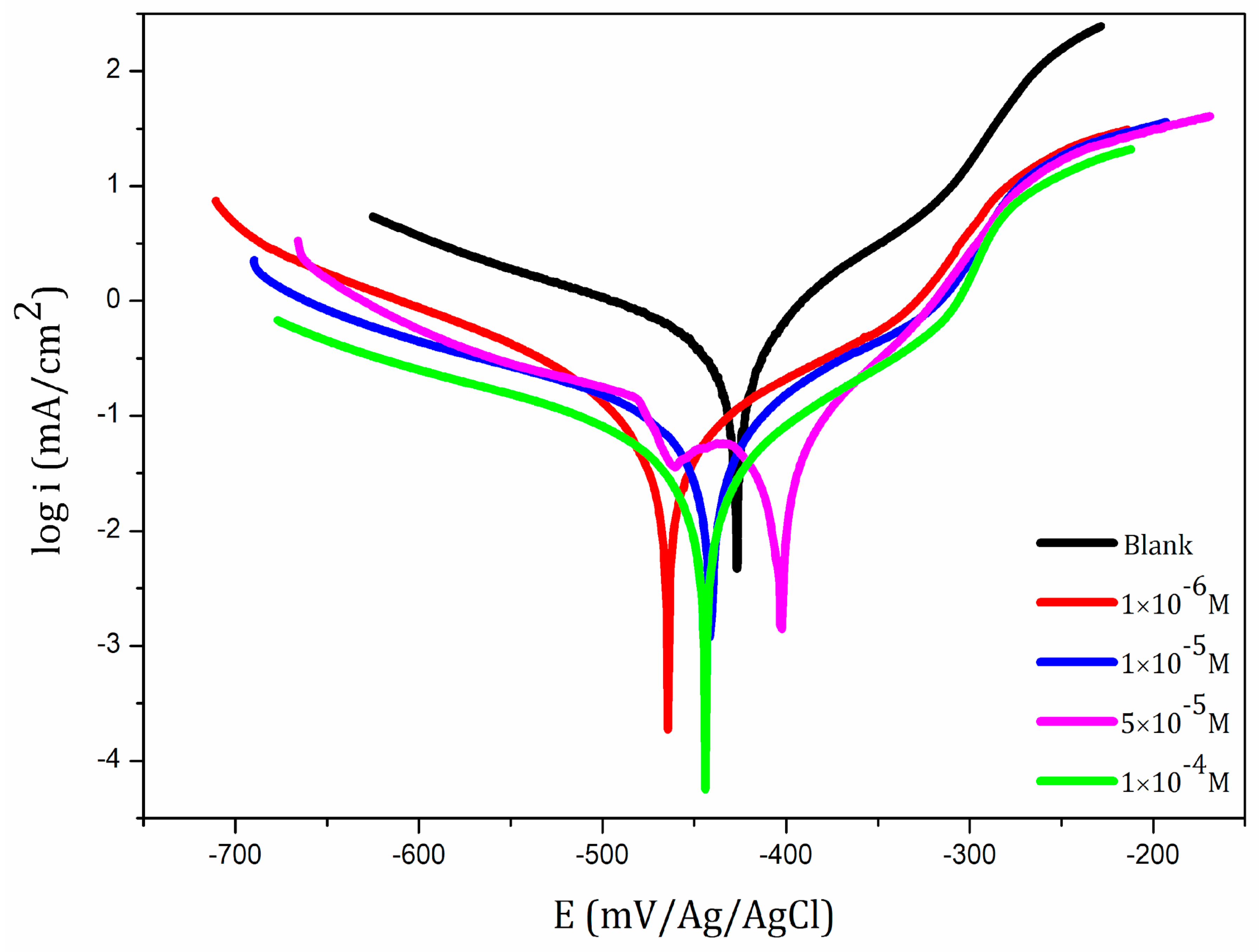
The influence of FNH on the anodic and cathodic half-reactions occurring at the steel surface was examined by potentiodynamic polarization. Prior to each scan, the carbon steel electrode was allowed to stabilize for 60 min in 1 M HCl containing FNH at concentrations between 1 × 10⁻⁶ and 1 × 10⁻⁴ M; a blank experiment without inhibitor was run under identical conditions. The recorded polarization curves are displayed in Figure 1.
Inspection of the curves shows that the addition of FNH over the entire concentration range produces a pronounced suppression of the corrosion current density relative to the uninhibited acid. Both the anodic and cathodic branches shift toward lower current values, whereas the corrosion potential undergoes only a modest displacement with respect to the blank. This dual retardation of metal dissolution and hydrogen evolution is characteristic of a mixed-type inhibitor. The gradual decline in current density at higher FNH concentrations reflects a progressive buildup of adsorbed molecules on the electrode surface, generating a protective film that restricts the access of chloride ions and protons to the underlying metal and, consequently, diminishes the overall dissolution rate [39].
The related electrochemical parameters, such as corrosion potential Ecorr, corrosion current density icorr, and Tafel slopes βa, βc, determined by extrapolation of the Tafel regions, surface coverage (θ) and the inhibitory effectiveness (IEp (%)) are listed in Table 2.
The inhibitory effectiveness was calculated using the following equation:
I E p = i c o r r ° i c o r r i n h i c o r r °
where i c o r r ° and i c o r r i n h , are the corrosion current density without and with inhibitor, respectively.
Quantitatively, icorr falls from 2.64 ± 0.05 mA cm−2 in the blank solution to 0.06 ± 0.0071 mA cm−2 at 1 × 10⁻⁴ M, confirming the strong corrosion-mitigating capacity of FNH in 1 M HCl. In parallel, IEp (%) (%) and the fractional surface coverage θ increase with concentration, reaching 97.59 ± 0.22% and 0.9759 at the highest dosage examined, which points to the establishment of a dense and well-organized adsorbed layer over the steel surface. The net shift in Ecorr does not exceed 85 mV (ranging from −403 to −444 mV), further corroborating the mixed inhibition character of FNH, with concurrent action on both the anodic and cathodic partial reactions [40]. The changes recorded in the anodic (βa) and cathodic (βc) Tafel slopes warrant a more detailed mechanistic interpretation. Two conceptually distinct inhibition mechanisms can be identified from the behavior of the Tafel slopes: (i) geometric site-blocking, in which the inhibitor physically occupies active surface sites without altering the intrinsic electrochemical reaction pathway, in this case, βa and βc remain essentially invariant with inhibitor concentration, and the suppression of icorr solely reflects a reduction in the effective electroactive area (θ → 1); and (ii) modification of the charge-transfer mechanism, in which the adsorbed inhibitor participates in the electrode reaction by modifying the intermediate steps of the iron dissolution sequence (Fe → Fe* → Fe2+ + 2e) or the hydrogen evolution mechanism (H3O+ + e → Hads → H2), resulting in a systematic variation in the Tafel slopes with inhibitor concentration [41].
Applying this framework to the FNH data in Table 2, the values of βa vary from 153.3 mV dec−1 (blank) to 40.4–91.9 mV dec−1 (inhibited), and βc varies from 101.1 mV dec−1 to 48.6–131.6 mV dec−1. The non-systematic variation in both Tafel slopes across the concentration series—rather than a clean invariance or a monotonic trend—indicates a mixed situation: FNH simultaneously reduces the accessible electroactive area (dominant effect, responsible for the large icorr suppression) and exerts a moderate reorganizing influence on the charge-transfer kinetics at the Fe/solution interface. The occasional increase in βc above the blank value is attributed to the partial blocking of cathodic hydrogen evolution sites by adsorbed FNH molecules, which modifies local proton availability and alters the apparent cathodic transfer coefficient. This behavior is consistent with the strong chemisorptive interaction of FNH with surface Fe atoms via its N and O donor centers. Consequently, FNH inhibits corrosion via a combination of geometric blocking of active sites and partial modification of the charge-transfer kinetics, with the former being the dominant mechanism [42].
The inhibition efficiency of FNH (IEp = 97.59% at 1 × 10⁻⁴ M) represents a significant advancement relative to contemporary benchmarks. Recent studies by Danyaro et al. [43] on benzoic acid-based Schiff bases reported an efficiency of 89.9%, while Satarkar and Dubey [44] achieved 91.2% with 5-aryl-furan derivatives. The comprehensive review by Koushik et al. [45] highlights that many green inhibitors plateau around 85%–88% in aggressive acidic media. Even compared with the eco-friendly systems reported by Chaouiki et al. [46], which reached 93%, and the furfural-derived Schiff bases studied by Ginting et al. [47] (78.6%), FNH provides a more robust protective layer. This superior performance underscores the critical role of the electronic synergy between the furanyl moiety and the hydrazone bridge, which ensures stable interfacial anchoring and superior surface coverage relative to these recently reported scaffolds.

3.3. Electrochemical Impedance Spectroscopy (EIS)

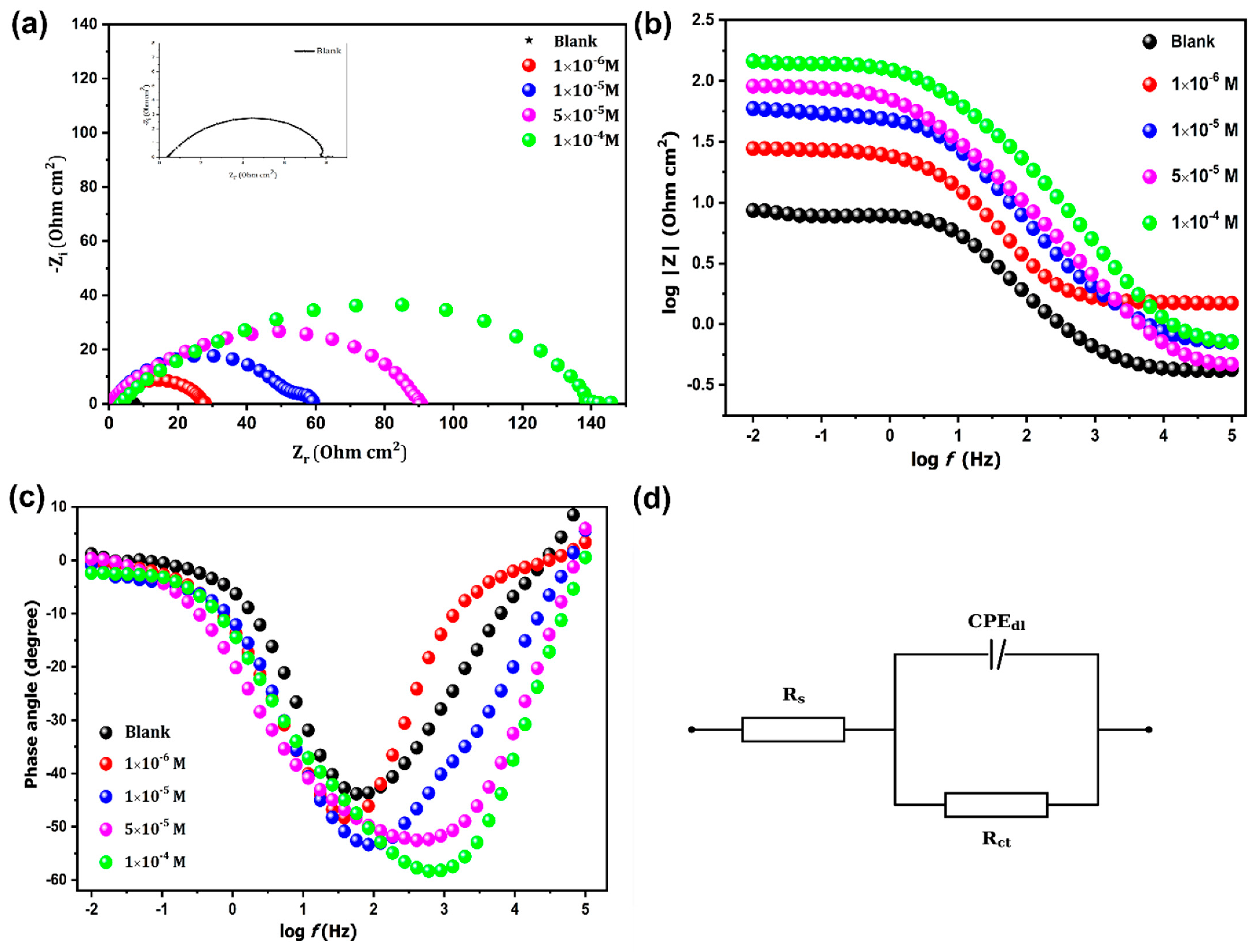
EIS was employed to probe the interfacial processes governing the corrosion of the steel electrode in 1 M HCl, both in the uninhibited acid and in the presence of FNH at concentrations spanning 1 × 10⁻⁶ to 1 × 10⁻⁴ M. The resulting Nyquist and Bode representations are collected in Figure 2.
The Nyquist diagrams (Figure 2a) consist of a single, depressed capacitive arc for every solution examined, pointing to a corrosion process governed predominantly by charge-transfer kinetics [48]. In the inhibitor-free acid, the arc diameter is comparatively small, consistent with a low charge-transfer resistance (Rct) and rapid metal dissolution. Upon successive introduction of FNH, the semicircle diameter expands considerably, with the enlargement becoming increasingly pronounced at higher concentrations [49]. This progressive growth in Rct provides direct evidence for the effective protective action of the compound under study. The departure of the experimental arcs from perfect semicircular geometry is a well-known consequence of frequency dispersion originating from surface roughness, microscopic heterogeneities, grain boundaries, dislocations, and the fractal character of real electrode surfaces [50].
The Bode modulus representation (Figure 2b) offers complementary insight: the low-frequency impedance modulus |Z| increases systematically with rising FNH concentration, corroborating the progressive buildup of an insulating adsorbed layer on the steel substrate [51]. In the corresponding phase-angle plots (Figure 2c), a single broad maximum is resolved for all systems, signifying a single relaxation time constant—fully consistent with the single capacitive loop in the Nyquist plane. The broadening and upward shift in the phase angle upon inhibitor addition reflect the displacement of water molecules from the metal–solution interface by adsorbed FNH species [52].
The collective impedance evidence leaves little doubt that FNH adsorption onto the steel substrate is the origin of the observed corrosion suppression. By occupying electrochemically active sites, the organic film raises the energetic cost of the interfacial charge-transfer step, which manifests experimentally as growing Rct and rising low-frequency |Z| values across the entire concentration series. Quantitative extraction of the kinetic parameters required fitting the measured Nyquist responses to an appropriate electrical analog. The equivalent circuit retained for this purpose (Figure 2d) couples Rs—representing the ohmic drop through the bulk electrolyte—in series with a parallel Rct/CPE element that captures the faradaic and capacitive contributions of the corroding interface. A constant phase element was chosen over an ideal capacitor because real electrode surfaces, with their inherent roughness, grain-boundary network, and compositional gradients, invariably produce a frequency-dependent capacitive response that a single Cdl value cannot reproduce. The CPE impedance takes the form:
Z C P E = 1 Q ( j ω ) n
Here Q carries units of sn Ω−1 cm−2 and sets the magnitude of the pseudo-capacitive response, j = √(−1), ω is the angular frequency, and the exponent n—bounded between 0 and 1—serves as a diagnostic of surface ideality. When n approaches unity the element collapses to a classical parallel-plate capacitor; progressive departure toward lower n values signals increasing dispersion of relaxation times, a fingerprint of microscopic heterogeneity across the electrode area.
The parameters extracted from the EIS fitting are listed in Table 3. The effective double-layer capacitance was evaluated from the CPE parameters using [53]:
C d l = Q   R c t 1 n 1 n
The inhibition efficiency was then determined according to [54]:
I E E I S % = R c t i n h R t c ° R c t i n h × 100
where R c t ° and R c t i n h are the charge-transfer resistances recorded in the absence and in the presence of FNH, respectively.
The quality of the equivalent circuit fitting was assessed through the normalized chi-squared values (χ2/ Z ) reported in Table 3. For all inhibited solutions, χ2/ Z values are satisfactorily low, ranging from 4.50 × 10⁻³ to 1.11 × 10⁻¹, confirming the excellent agreement between the experimental EIS spectra and the proposed Rs(Rct/CPE) equivalent circuit model and validating the reliability of the extracted impedance parameters. The slightly elevated χ2/ Z value observed for the blank solution (0.17) is attributed to the intrinsic complexity of the bare steel/HCl interface in the absence of an organic inhibitor film, where additional interfacial processes—including active pit initiation and oxide layer dissolution—contribute to deviations from the ideal circuit response. This behavior is well documented for bare carbon steel in aggressive acidic media [55] and does not affect the validity of the inhibited system analyses.
As seen in Table 3, Rct undergoes a substantial increase upon inhibitor addition, rising nearly 19-fold from the blank solution to 1 × 1 × 10−4 M FNH. This trend signals the gradual development of a surface film that increasingly impedes the interfacial charge-transfer step.
In parallel, Cdl drops markedly from 205 ± 04 to 1.89 ± 0.05 µF cm−2, a decrease that can be rationalized within the Helmholtz model (Equation (10)) by the substitution of adsorbed water—possessing a high dielectric constant—by organic inhibitor molecules of lower permittivity, and/or by an increase in the effective thickness of the electrical double layer [56].
C d l = ε 0 ε d S
In this expression, d represents the film thickness, S the electrode area, ε0 the vacuum permittivity, and ε the local dielectric constant of the adsorbed layer.
The CPE exponent n provides additional insight into surface heterogeneity. When n = 1, the interface behaves as a perfect capacitor on a flat, homogeneous surface; values of n < 1 reflect frequency dispersion arising from microscopic roughness, chemical non-uniformity, grain-boundary effects, and variations in local adsorption density—all characteristic features of polycrystalline carbon steel [57]. In the uninhibited acid, n = 0.734, consistent with the known heterogeneous microstructure of XC70 steel. Upon successive addition of FNH, n decreases slightly to values in the range 0.651–0.674. This modest decrease is attributed to the preferential adsorption of FNH molecules onto the most energetically active surface sites (grain boundaries, dislocations), which creates lateral heterogeneity at the interface arising from the coexistence of FNH-covered and bare domains with distinct local dielectric properties. This broadening of the relaxation-time distribution is reflected in the slight reduction in n. Importantly, this trend does not contradict the strong protective performance of FNH: the n parameter quantifies the geometric uniformity of the interface, not its corrosion-suppression capacity. The absolute values of n remaining below 0.75 throughout confirm that XC70 steel retains intrinsic heterogeneity inherent to its polycrystalline microstructure—a well-documented behavior for technical-grade carbon steels in acidic media—irrespective of inhibitor coverage [58].

3.4. Temperature Effect

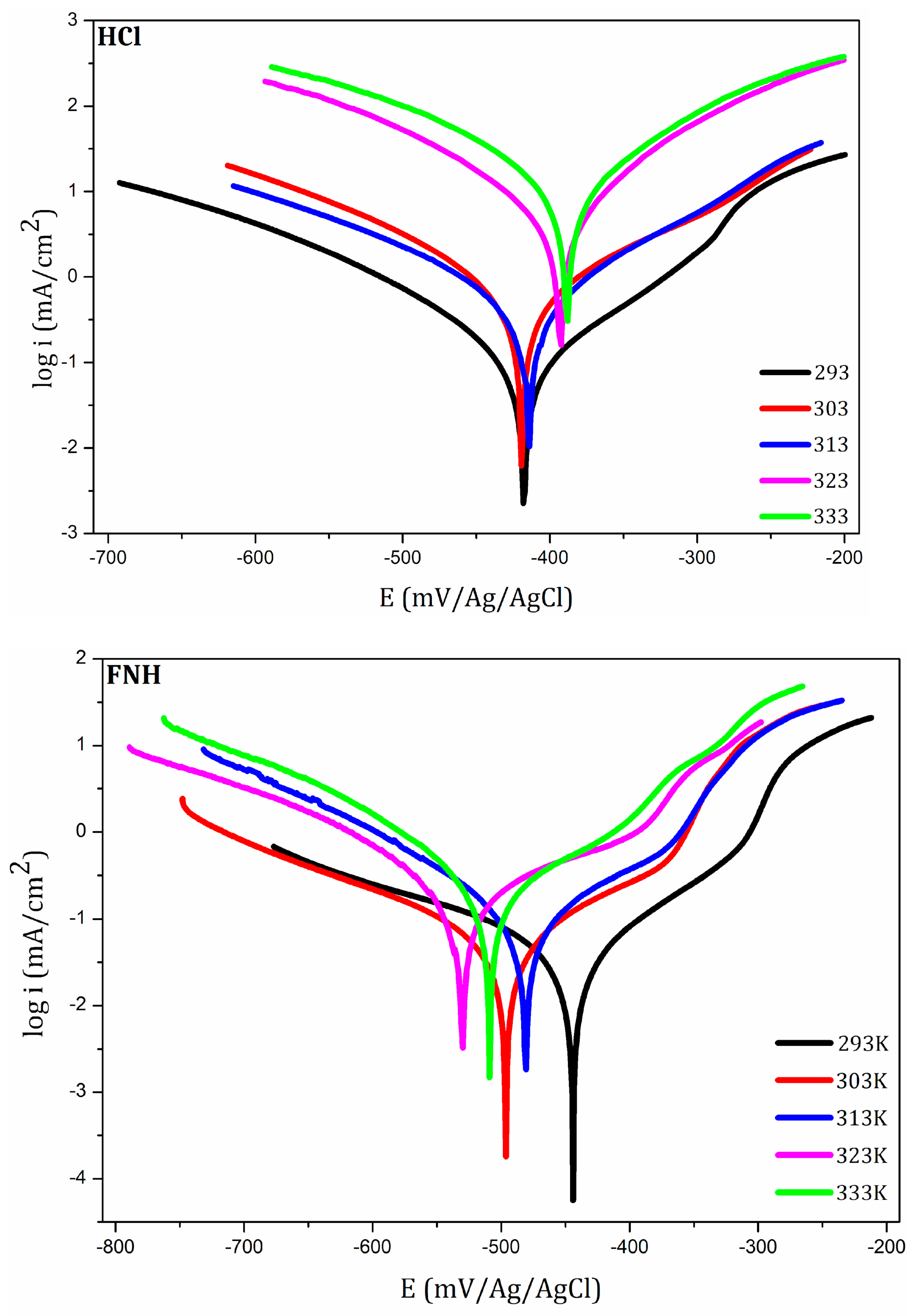
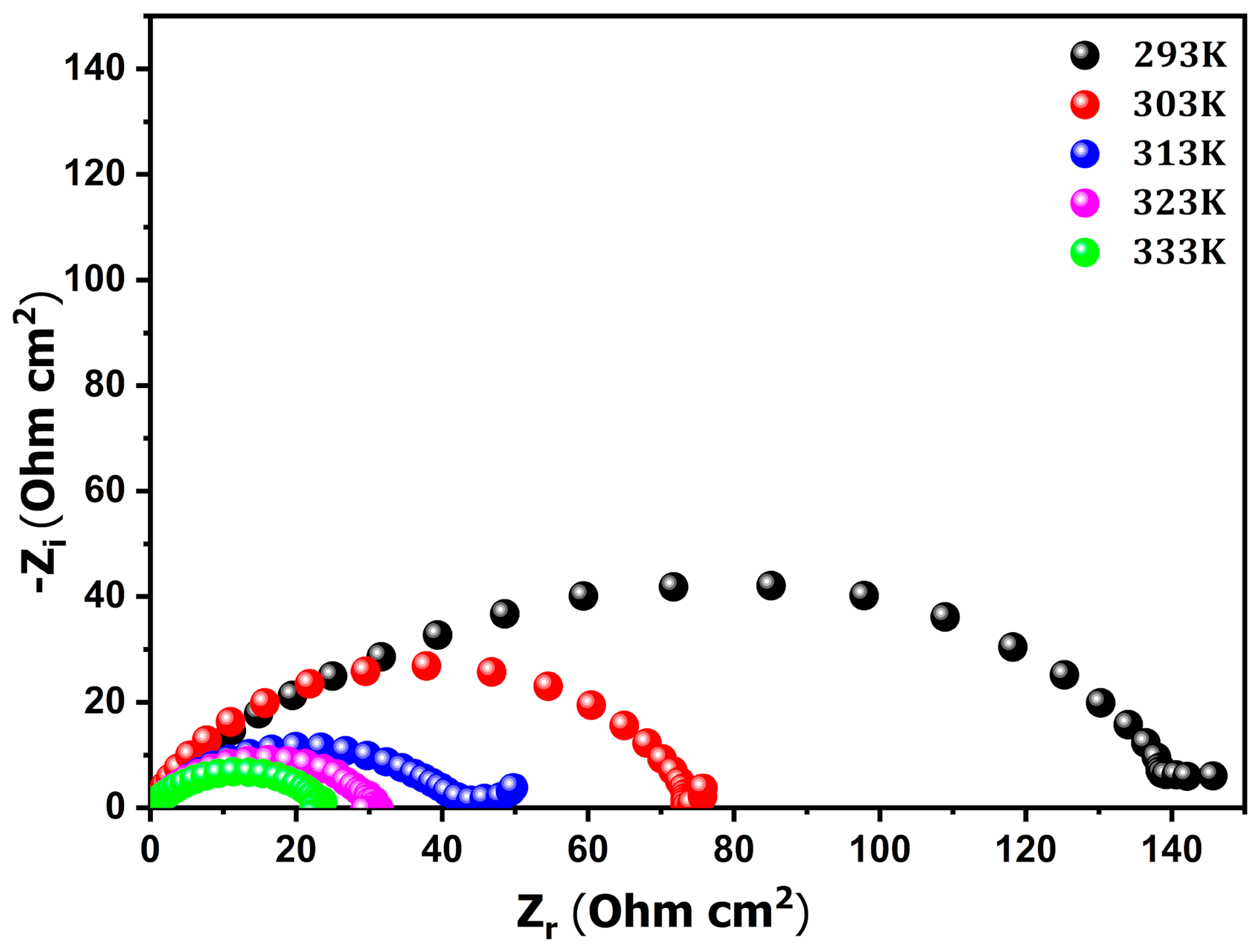
Temperature governs both the kinetics of electrochemical reactions and the stability of adsorbed inhibitor films, making it a key variable in evaluating corrosion inhibitor performance. To assess this influence, polarization and EIS measurements were carried out on XC70 steel in 1 M HCl containing the optimal FNH concentration (1 × 10⁻⁴ M) over the range 293–333 K; parallel experiments in the uninhibited acid served as reference (Figure 3 and Figure 4). With rising temperature, the polarization curves show a progressive increase in icorr accompanied by accelerated anodic and cathodic kinetics, while the Nyquist semicircle diameter contracts, indicating a decline in Rct.
The quantitative electrochemical parameters extracted from polarization and impedance measurements at temperatures between 293 and 333 K are compiled in Table 4 and Table 5, respectively, for the uninhibited acid and the solution containing the optimal FNH dosage.
A common feature across both media is the acceleration of corrosion kinetics at elevated temperatures, icorr rises and Rct contracts as the thermal energy input grows. However, the magnitude of these changes differs sharply between the two cases. In the plain acid, both trends are steep, icorr climbs rapidly while Rct undergoes a pronounced collapse, reflecting the increasingly aggressive dissolution of bare steel as the thermal barrier to charge transfer is progressively lowered. When FNH is present, the same trends persist but are substantially attenuated: icorr increases at a much slower pace, and Rct retains considerably higher values than those recorded in the blank at every temperature examined.
A noteworthy observation concerns Ecorr, which shifts to more negative potentials with heating in the inhibited solution relative to the blank, suggesting that the thermal activation preferentially enhances the cathodic-site blocking ability of the adsorbed FNH layer and thus reinforces its influence on the anodic partial reaction. More importantly, the calculated inhibition efficiency does not decline with temperature but instead rises steadily, culminating at 99% at 333 K, a trend confirmed independently by both PDP and EIS datasets. Such behavior departs from the pattern typically observed for physically adsorbed inhibitors, where thermal desorption erodes protection at higher temperatures. The positive temperature dependence recorded here points instead to specific, chemically driven interactions between the FNH molecule and the iron substrate that are strengthened as more thermal energy becomes available [59,60,61]. The capacity of FNH to maintain, and indeed improve, its protective action even at elevated temperatures, and at relatively low dosage, underscores both the robustness of the adsorbed film and the practical viability of this compound under thermally demanding service conditions.
A complete kinetic and thermodynamic analysis was performed to provide quantitative evidence for the adsorption mechanism. The Arrhenius activation energy (Ea = 47.23 kJ mol−1 in the presence of FNH vs. 66.60 kJ mol−1 for the blank), the transition-state parameters (ΔHa = +44.64 kJ mol−1, ΔSa = −81.93 J mol−1 K−1 for the inhibited system), and the standard Gibbs free energy of adsorption (ΔG°ads = −43.39 kJ mol−1) collectively confirm the chemisorptive nature of FNH adsorption on XC70 steel. It is noteworthy that the apparent activation energy Ea decreases from 66.60 kJ mol−1 in the uninhibited solution to 47.23 kJ mol−1 in the presence of 1 × 10⁻⁴ mol L−1 FNH. Similar behavior has been reported for strongly chemisorbing organic inhibitors and is commonly attributed to the formation of a stable adsorbed film that alters the rate-determining step and the effective reaction pathway, rather than to a simple uniform increase in the intrinsic rate of metal dissolution. In our case, despite the lower Ea, the corrosion current density and charge-transfer rate decrease markedly over the entire temperature range (Table 4 and Table 5), and the inhibition efficiency increases up to ~99%, indicating that the overall corrosion process is strongly retarded and that the inhibitory action cannot be assessed on the basis of Ea alone. The negative ΔG°ads value (|ΔG°ads| > 40 kJ mol−1) is consistent with spontaneous chemisorption involving charge transfer between FNH and surface Fe atoms. Full details, equations, and graphical representations (Arrhenius and Eyring plots, Langmuir isotherm) are provided in the Supplementary Materials (Table S1, Figures S1–S3).

3.5. Surface Characterization

3.5.1. Atomic Force Microscopy

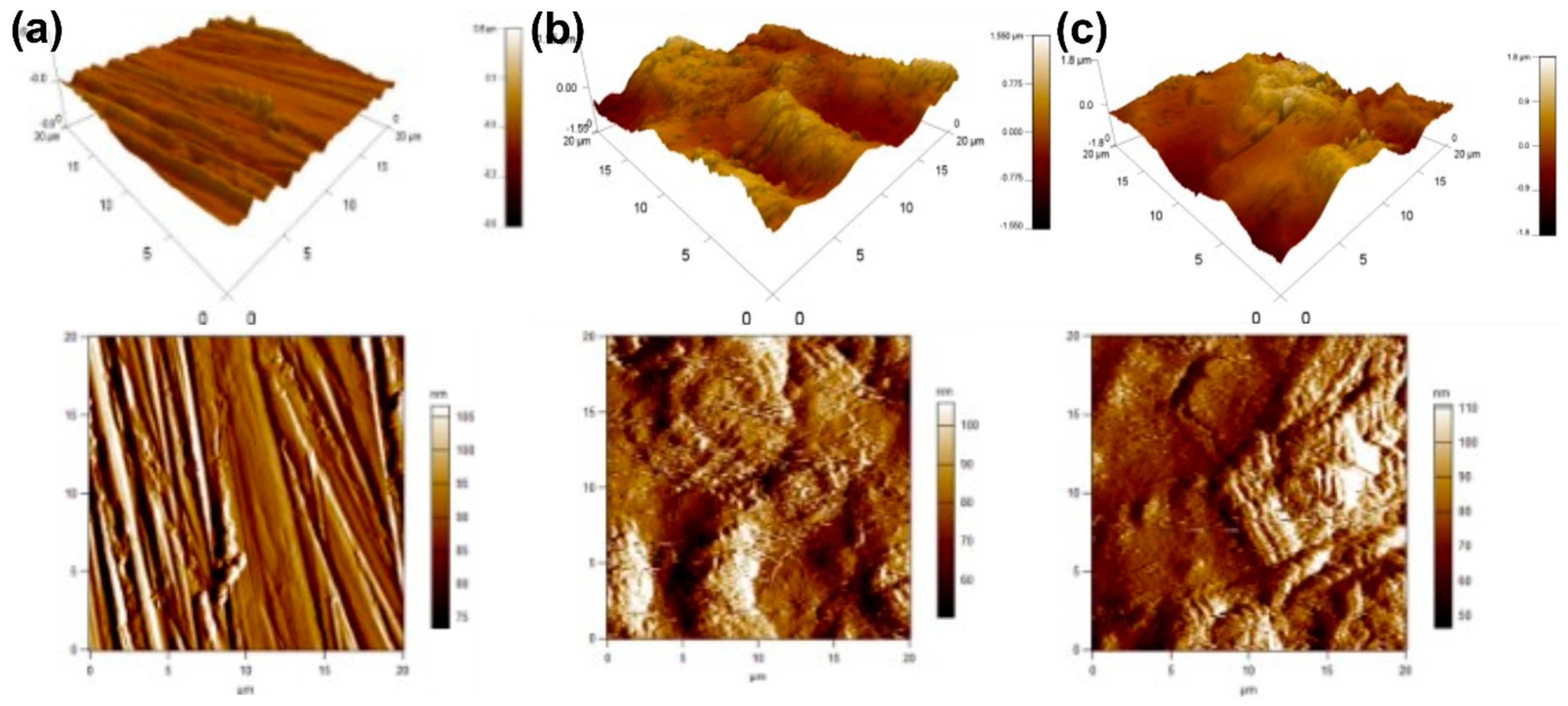
AFM was used to probe how FNH modifies the nanoscale landscape of the steel surface. XC70 coupons were retrieved after 24 h of contact with 1 M HCl at room temperature—one set from the plain acid, the other from a solution containing 1 × 10⁻⁴ M FNH—and scanned alongside a freshly polished reference specimen. The three-dimensional height maps are collected in Figure 5a–c; Table 6 lists the corresponding mean roughness data.
The coupon withdrawn from the inhibitor-free acid (Figure 5b) exhibits a cratered terrain densely populated with pits of irregular shape and depth, a morphology that reflects the sustained corrosive action of the HCl medium on the bare metal. A strikingly different picture emerges when FNH is present (Figure 5c): the topography is considerably flattened and the pit population is largely suppressed, pointing to effective mitigation of iron dissolution [62,63]. This leveling effect is consistent with the self-assembly of an organic barrier derived from adsorbed FNH molecules that shields the underlying substrate from direct acid contact. On a quantitative basis, the mean roughness drops from 419.981 nm for the unprotected surface to 356.186 nm under FNH coverage, numerically corroborating the visual evidence of surface preservation.
The interpretation of the residual roughness of 356 nm should be considered carefully. This value must be compared in relative, not absolute, terms: the uninhibited surface undergoes approximately a 10.7-fold increase in roughness relative to the polished reference (39.19 nm), while the inhibited surface shows only a 9.1-fold increase. Moreover, a 97.59% reduction in corrosion rate still permits 2.41% of the original dissolution rate to continue over 24 h in a highly aggressive 1 M HCl medium, which is sufficient to generate measurable surface damage. Additionally, AFM topography detects all surface features, including the texture of the deposited organic film itself, which contributes to the measured RMS value and is not a manifestation of corrosion damage.

3.5.2. Scanning Electron Microscopy

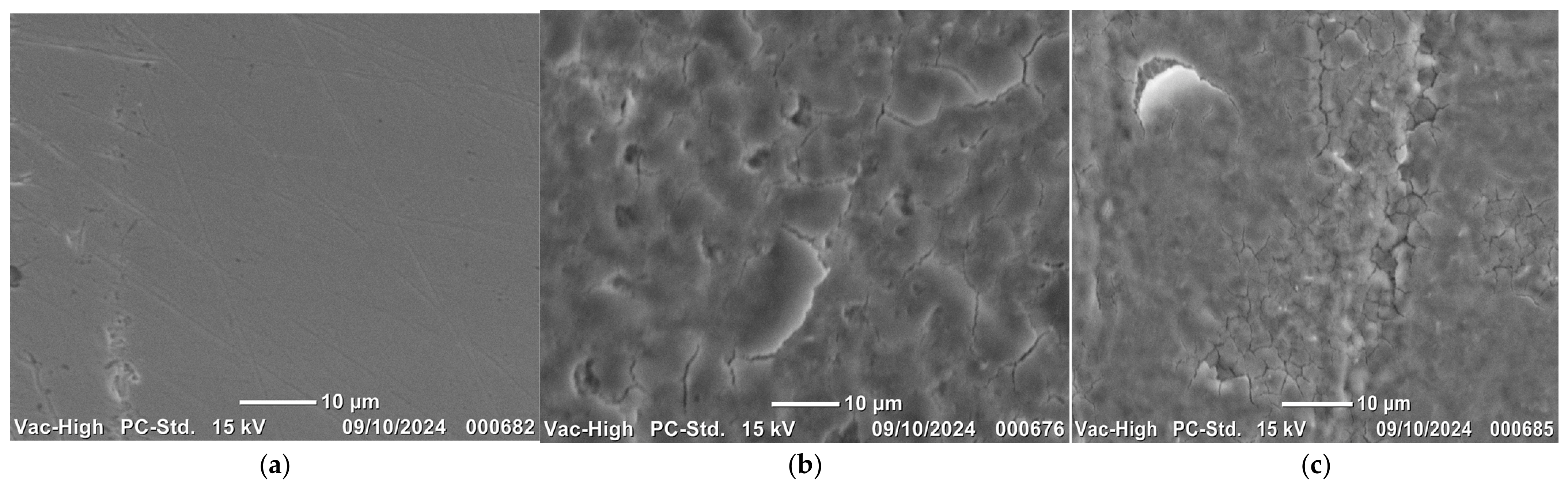
SEM micrographs of XC70 carbon steel after 24 h of exposure at ambient temperature to 1 M HCl, without and with 1 × 10⁻⁴ M FNH, are shown in Figure 6a–c. The coupon retrieved from the blank acid (Figure 6b) presents a heavily corroded surface characterized by deep attack features resulting from severe dissolution. In contrast, the specimen exposed to the inhibited solution (Figure 6c) is covered by a relatively continuous deposit exhibiting a platelet-like morphology, which is attributed to the chemisorption of hydrazone FNH molecules onto the active metallic sites. The resulting compact and adherent organic film restricts the transport of aggressive Cl and H+ ions toward the underlying steel, thereby suppressing both anodic dissolution and cathodic hydrogen evolution and confirming the protective action of FNH [27].

3.6. Computational Investigation

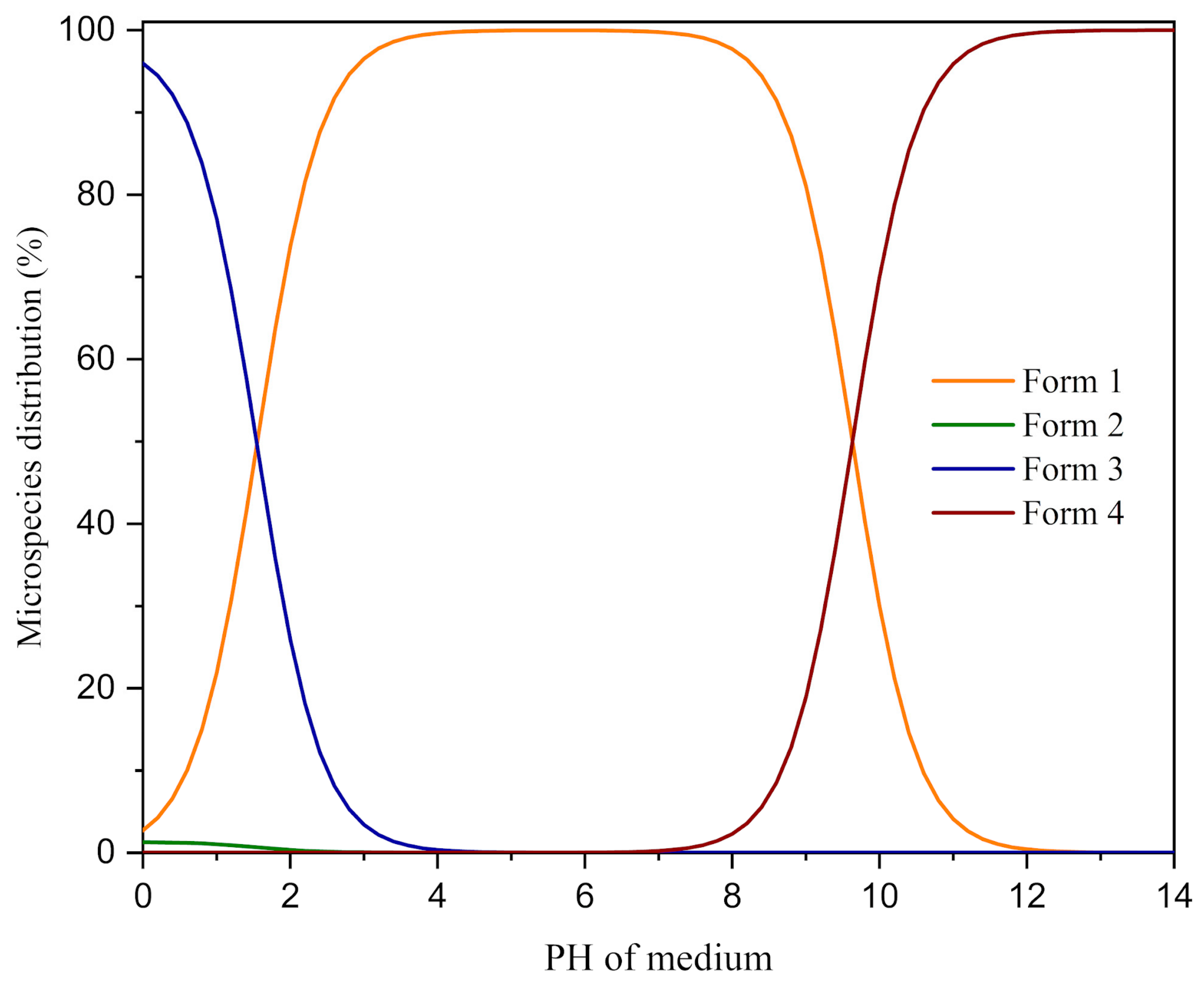
3.6.1. Prediction of the Major Micro Species in an Acidic Medium

The chemical behavior of a molecule in solution is fundamentally determined by the species it produces under aqueous conditions; therefore, a protonation study was carried out for FNH to clarify which microstates are relevant under the experimental conditions. This analysis, performed over a pH range of 0.0–14.0, allows identification of the major and minor microspecies of the inhibitor in aqueous medium. The speciation calculations were conducted with the Protonation module of the MarvinSketch package (ChemAxon, version 25.3.5) using the standard aqueous pKa prediction protocol, in which intrinsic pKa values are first estimated for each ionizable center and the corresponding microstate populations are then obtained by solving the set of acid–base equilibria together with the mass-balance and electroneutrality conditions as a function of pH. Within this framework, the four species labeled Forms 1–4 in Figure 7 and Figure 8 correspond to distinct protonation states of FNH (neutral and protonated forms) that share the same carbon skeleton but differ in the number and location of bound protons and in their total charge. Because the corrosive medium in this work is 1 M HCl (pH ≈ 0.0), the equilibrium distribution was evaluated by fixing pH = 0.0 in the Marvin “distribution of species” routine; under these conditions, Form 3, which is generated by protonation at the azomethine nitrogen (C=N), is overwhelmingly dominant and accounts for 95.98% of the total species population. This protonated form is expected to alter the electronic structure and enhance electrostatic attraction toward the negatively charged chloride-rich interface [64], and it was therefore selected as the representative microspecies for the subsequent DFT and MD calculations.

3.6.2. DFT Descriptors and Frontier Molecular Orbitals

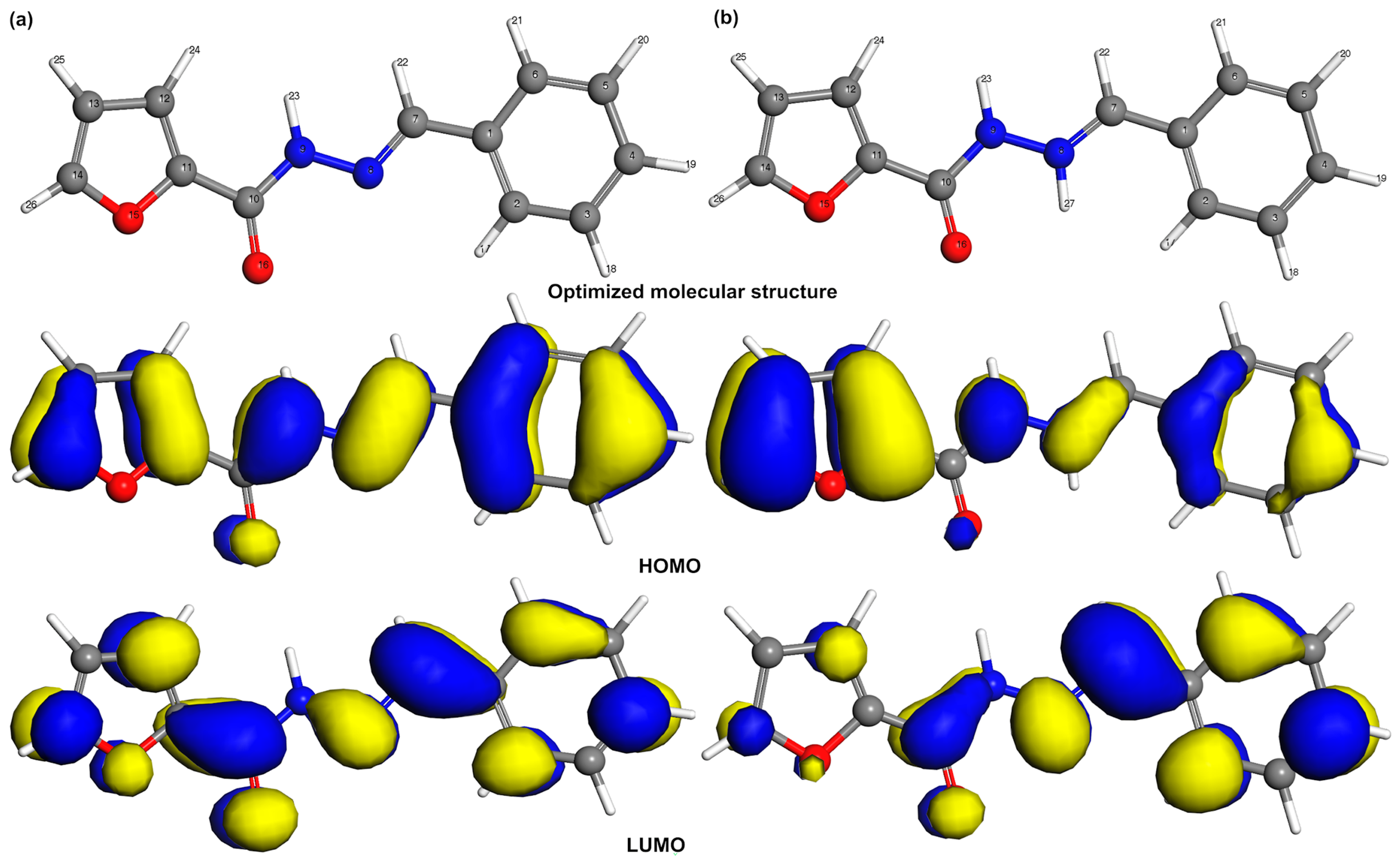
DFT calculations were performed on both the neutral (FNH) and protonated (FNH-H+) forms to relate molecular electronic structure to inhibition performance [65]. The optimized geometries and corresponding HOMO/LUMO isosurfaces are depicted in Figure 9, and the derived quantum-chemical descriptors are listed in Table 7.
In both forms the HOMO is delocalized over the conjugated backbone with appreciable amplitude on the furan ring, the carbonyl group and the hydrazone bridge, identifying these electron-rich regions as the primary donor sites for coordination with vacant Fe d-orbitals [66]. The LUMO topology, by contrast, differs between the two species: in neutral FNH it is broadly delocalized across the carbonyl, hydrazone and aromatic fragments, whereas in FNH-H+ it contracts onto the azomethine bridge (C7=N8) and the adjacent phenyl ring. These differences in acceptor topology are expected to affect how each form interacts with the metal surface.
Protonation produces a moderate narrowing of the HOMO–LUMO gap (from 4.293 eV in FNH to 3.855 eV in FNH-H+) which, together with a pronounced rise in electrophilicity, signals heightened electron-accepting reactivity and, by extension, stronger adsorption affinity for the protonated species. Both forms exhibit relatively low global hardness (η = 2.147 and 1.928 eV) and comparatively high softness, consistent with facile charge redistribution and favorable inhibitor–metal interaction [67]. The electrophilicity index follows the order ω(FNH-H+) > ω(FNH) (6.728 vs. 3.968 eV), confirming the superior electron-accepting character of the protonated form [68]. Positive ΔN values for both species (0.669 and 0.495) indicate a net electron-donation capability toward the Fe surface, while the negative back-donation energy (ΔEb-d) shows that synergistic charge transfer from the metal to the inhibitor is thermodynamically favorable, reinforcing the stability of the adsorbed complex.

3.6.3. Fukui Function Analysis

Condensed Fukui indices were computed for both FNH and FNH-H+ to pinpoint the atomic centers most actively involved in inhibitor–metal electron exchange. The local indices were evaluated within the finite-difference approximation as:
f k + = q k N + 1 q k N
f k = q k N q k N 1
where qk (N + 1),qk (N), and qk (N − 1)are the atomic charges of the anionic, neutral, and cationic species, respectively. The charge analysis was carried out using the Hirshfeld scheme.
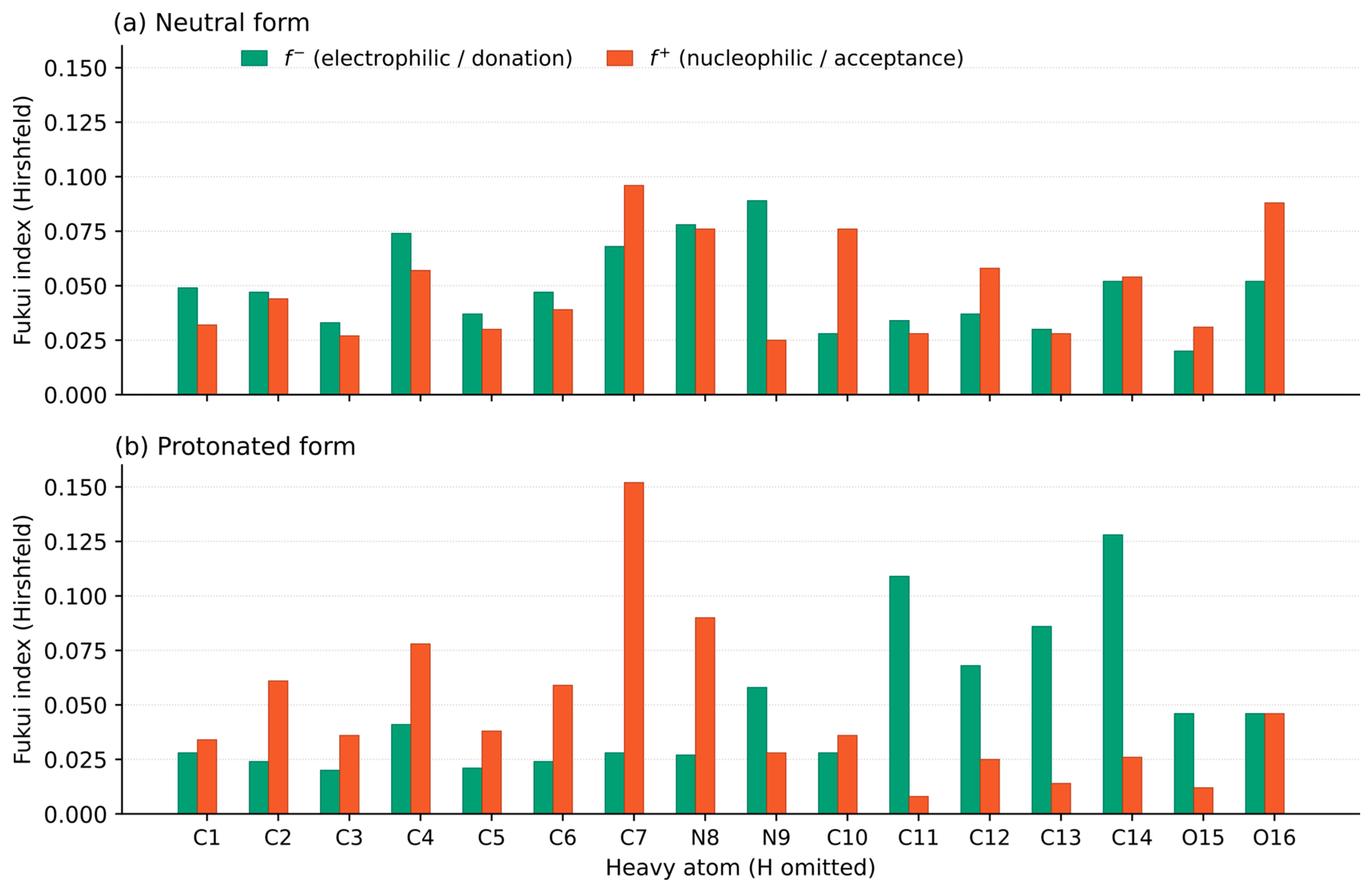
Local reactivity was resolved through the condensed Fukui functions. The electrophilic Fukui index ( f k ), which maps the electron-donating propensity of individual atoms, attains its largest values at the hydrazone nitrogens N8 and N9 together with the aromatic carbon C4 in neutral FNH, identifying this set as the dominant donor centers responsible for coordination with vacant Fe d-orbitals during surface attachment [69]. Protonation reshapes this landscape: while f k at the nitrogens drops sharply, the furan-ring carbons—C11, C13 and C14 in particular—gain appreciable donor character, reflecting a migration of the reactive electron density onto the heterocyclic ring. The net effect is a relocation of the molecular donor footprint available for metal binding, which is expected to sustain the anchoring of the adsorbed layer.
A complementary picture emerges from the nucleophilic Fukui index ( f k + ), which gauges the capacity of each atom to accommodate incoming electrons. In the neutral molecule the highest f k + values reside on the azomethine carbon C7 and the carbonyl group (C10, O16), confirming their role as acceptor sites through which metal-to-ligand back-donation can occur. After protonation, the azomethine carbon C7 becomes by far the strongest acceptor, while the protonated nitrogen N8 and the phenyl-ring carbons (C2, C4, C6) acquire substantially elevated f k + magnitudes relative to the neutral molecule, signaling a markedly enhanced electron-accepting ability redistributed toward the imine bridge and the aromatic framework.
Overall, the Fukui analysis shows that FNH already possesses multiple donor and acceptor centers suited to cooperative interaction with the steel surface, but protonation spatially reorganizes local reactivity—shifting electron-donating density toward the furan ring while concentrating electron-accepting density on the azomethine bridge and phenyl ring. This donor–acceptor partitioning within a single molecule is fully coherent with the frontier-orbital results discussed above, and rationalizes the superior adsorption strength and inhibition efficiency observed experimentally for the protonated form under acidic conditions (Figure 10).

3.6.4. MD Simulation

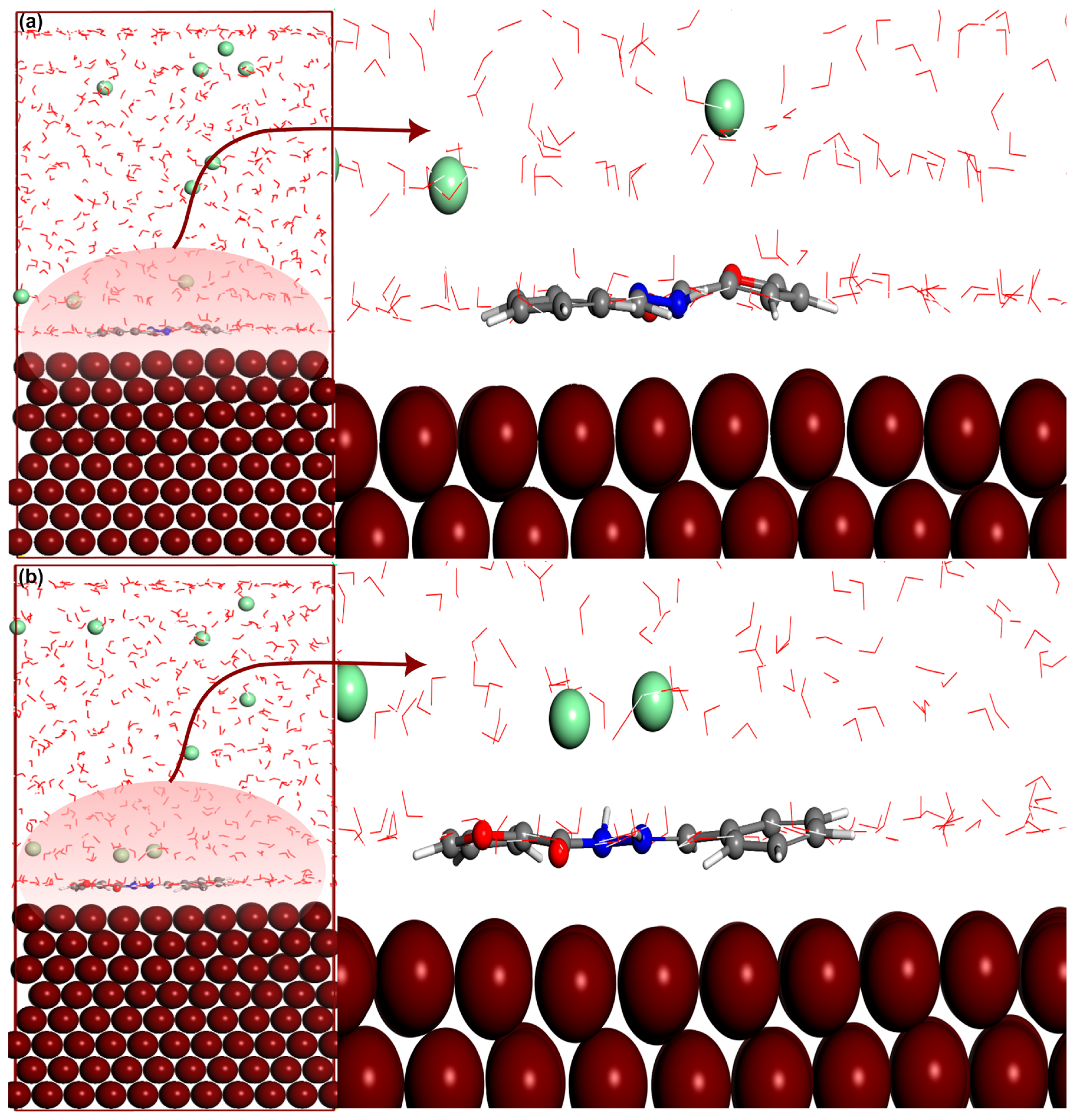
MD simulations were carried out to examine the adsorption of FNH and its protonated form FNH-H+ on the Fe(110) surface within a simulated corrosive aqueous environment at 298 K. Each inhibitor was initially positioned above the metal slab immersed in a solution box containing water molecules and chloride ions, and the system was allowed to evolve until the lowest-energy adsorption configuration was located. Equilibration was monitored through the temporal evolution of the total energy and temperature.
As shown in Figure 11, both the neutral and protonated forms adopt an almost flat, parallel orientation relative to the Fe(110) plane. This near-coplanar arrangement maximizes the contact area between the conjugated backbone—the furan ring, carbonyl, hydrazone bridge and phenyl ring—and the surface iron atoms, allowing the heteroatom lone pairs and the π-system to interact simultaneously with vacant Fe d-orbitals. Such a flat-lying geometry is characteristic of strong adsorption, since it enables a single molecule to shield the largest possible number of surface active sites from the aggressive electrolyte [36].
Small but discernible geometric differences distinguish the two species. In the protonated form the molecule lies slightly closer and flatter against the surface, with the protonated hydrazone segment tilting toward the metal, whereas the neutral form retains a marginally greater stand-off distance. These subtle reorientations illustrate how protonation modifies the local charge distribution and, in turn, the molecule–surface registry, without disrupting the favorable parallel adsorption mode.
The corresponding energetics reinforce the geometric picture. Both forms display large negative interaction energies (Table 8), confirming spontaneous and strong adsorption on Fe(110). The protonated species exhibits the more exothermic interaction energy and, equivalently, the larger binding energy, indicating a firmer attachment to the metal in the acidic medium. The magnitude of these energies is consistent with combined electrostatic and coordinative (donor–acceptor) bonding rather than weak physisorption alone, and supports the conclusion that the almost parallel adsorption of both molecules is energetically preferred and able to occupy a maximal fraction of surface sites [36].

4. Conclusions

This study establishes FNH as a highly effective and structurally robust inhibitor, bridging the gap between molecular design and industrial applicability for carbon steel protection in aggressive HCl environments. This work examined the anticorrosive properties of FNH, a hydrazone Schiff base whose structural integrity and chemical purity were verified to ensure the reliability of the subsequent multi-scale analysis. Beyond quantifying its high efficiency, the major contribution of this work lies in the synergistic integration of experimental and computational scales, providing a definitive blueprint for the adsorption mechanism. Electrochemical testing and impedance measurements revealed a superior protective capacity that remains resilient across the thermal range explored, reflecting an increasingly effective barrier at the metal–electrolyte boundary. A fundamental insight gained from this research is the critical role of the protonated species in acidic media. Contrary to traditional views, our theoretical analysis demonstrates that acid-induced protonation actually enhances the molecule’s electronic communication with the iron surface through a bidirectional electron exchange. This, combined with a confirmed ‘flat-lying’ geometry, ensures maximum surface coverage and explains the exceptional stability of the organic deposit observed by surface imaging. Ultimately, FNH represents more than just a potent inhibitor; it serves as a mechanistic model for the development of future eco-friendly, heteroatom-rich inhibitors. This study provides a strategic framework for designing sustainable corrosion mitigation solutions for infrastructure and manufacturing exposed to aggressive conditions. We note, however, that SEM/AFM offer only morphological insight into the protective film, and that the MD simulations employ an ideal Fe(110) slab with single-molecule adsorption, so the mechanistic picture should be regarded as a well-supported but still simplified representation of the real, heterogeneous steel–acid interface.

Supplementary Materials

The following supporting information can be downloaded at https://www.mdpi.com/article/10.3390/coatings16060678/s1, Figure S1: Arrhenius plots of the corrosion current density for X70 carbon steel in 1 M HCl solution in the absence and presence of FNH at different temperatures; Figure S2: Plot of ln(icorr/T) versus the reciprocal of temperature (1/T) for X70 carbon steel in the absence and presence of 10−4 M FNH; Figure S3: Adsorption isotherm plots of (a) Temkin, (b) Frumkin, and (c) Langmuir models for XC70 carbon steel in 1 M HCl in the presence of the FNH inhibitor, obtained using the three methods at 293 °C; Table S1: Activation parameters of the corrosion process for carbon steel in 1 M HCl solution in the absence and presence of the inhibitor FNH at its optimal concentration (1 × 10⁻⁴ M). References [70,71,72,73,74,75,76,77,78,79] are cited in the Supplementary Materials.

Author Contributions

Conceptualization, writing—original draft preparation, formal analysis, writing—review and editing, N.B., L.T., and I.S.; validation, investigation, methodology, software, data curation, visualization, supervision, project administration, H.L., A.D., and H.-S.L.; investigation, formal analysis, writing—review and editing, I.B., M.F., S.B., and K.D. All authors have read and agreed to the published version of the manuscript.

Funding

This research was funded by the National Research Foundation of Korea (NRF) grant funded by the Korea government (MSIT) (No. RS-2023–00217322).

Institutional Review Board Statement

Not applicable.

Informed Consent Statement

Not applicable.

Data Availability Statement

The original contributions presented in this study are included in the article. Further inquiries can be directed to the corresponding authors.

Acknowledgments

This work was supported by the National Research Foundation of Korea (NRF) grant funded by the Korea government (MSIT) (No. RS-2023–00217322).

Conflicts of Interest

The authors declare no conflicts of interest.

References

  1. Cutler, C.P. Use of Metals in Our Society. In Metal Allergy; Chen, J.K., Thyssen, J.P., Eds.; Springer International Publishing: Cham, Switzerland, 2018; pp. 3–16. [Google Scholar]
  2. Kherraf, S.; Djetoui, Z.; Foudia, M. Corrosion Inhibition Effect of Expired Fluticasone Propionate on API 5L Grade B Steel in A Sodium Chloride Medium. Anal. Bioanal. Electrochem. 2024, 16, 1072–1084. [Google Scholar]
  3. Recherache, A.; Benghanem, F.; Toukal, L.; Bounedjar, N.; Foudia, M.; Abebe, B.; Alam, M.W. Electrochemical, Quantum Chemical, and Thermodynamic Investigation of a Schiff Base Corrosion Inhibitor for XC70 Steel. Sci. Rep. 2025, 15, 19350. [Google Scholar] [CrossRef]
  4. Liu, J.; Alfantazi, A.; Asselin, E. The Pitting Corrosion of Titanium in Aggressive Environments: A Review. In Proceedings of the NACE International Annual Conference; NACE International: Houston, TX, USA, 2016; pp. 1–10. [Google Scholar]
  5. Parangusan, H.; Bhadra, J.; Al-Thani, N. A Review of Passivity Breakdown on Metal Surfaces: Influence of Chloride- and Sulfide-Ion Concentrations, Temperature, and pH. Emergent Mater. 2021, 4, 1187–1203. [Google Scholar] [CrossRef]
  6. Loto, R.T. Effect of SO42− and Cl Anionic Attack on the Localized Corrosion Resistance and Morphology of 409 Ferritic Stainless Steel. Results Phys. 2019, 12, 738–742. [Google Scholar] [CrossRef]
  7. Farh, H.M.H.; Seghier, M.E.A.B.; Zayed, T. A Comprehensive Review of Corrosion Protection and Control Techniques for Metallic Pipelines. Eng. Fail. Anal. 2023, 143, 106885. [Google Scholar] [CrossRef]
  8. Khan, M.A.A.; Irfan, O.M.; Djavanroodi, F.; Asad, M. Development of Sustainable Inhibitors for Corrosion Control. Sustainability 2022, 14, 9502. [Google Scholar] [CrossRef]
  9. Mekhiche, L.; Maouche, N.; Nessark, B.; Toukal, L.; Ayadi, H. Composites of Polyanine/CdTe for Corrosion Protection of Mild Steel XC 70 in a 3.5% NaCl Solution. J. Adhes. Sci. Technol. 2021, 35, 2602–2624. [Google Scholar] [CrossRef]
  10. Benabid, S.; Toukal, L. Inhibition Effect of Benzimidazole Derivatives on the Corrosion of Mild Steel in Acidic Medium: Experimental and Theoretical Studies. Acta Chim. Slov. 2024, 71, 668. [Google Scholar] [CrossRef] [PubMed]
  11. Awad, M.K.; Halim, W.A.; Atlam, F.M.; Fawzy, M.M. A Multiscale Computational Investigation for Protection of Carbon Steel Surface by Pyrazolo-Pyrimidine Derivatives. Sci. Rep. 2025, 15, 32576. [Google Scholar] [CrossRef]
  12. Goni, L.K.M.O.; Jafar Mazumder, M.A.; Quraishi, M.A.; Mizanur Rahman, M. Bioinspired Heterocyclic Compounds as Corrosion Inhibitors: A Comprehensive Review. Chem. Asian J. 2021, 16, 1324–1364. [Google Scholar] [CrossRef]
  13. Boukazoula, S.; Haffar, D.; Bourzami, R.; Toukal, L.; Dorcet, V. Synthesis, Characterizations, Crystal Structure, Inhibition Effects and Theoretical Study of Novel Schiff Base on the Corrosion of Carbon Steel in 1 M HCl. J. Mol. Struct. 2022, 1261, 132852. [Google Scholar] [CrossRef]
  14. Saha, S.K.; Murmu, M.; Murmu, N.C.; Banerjee, P. Synthesis, Characterization and Theoretical Exploration of Pyrene Based Schiff Base Molecules as Corrosion Inhibitor. J. Mol. Struct. 2021, 1245, 131098. [Google Scholar] [CrossRef]
  15. Deng, Y.; Liu, K.; Chen, R.; Wang, J.; Cui, Y.; Zhao, Y.; Ge, H. Study of the Adsorption Behavior of Schiff Base-Type Planar Conjugated Corrosion Inhibitors on Metal Surfaces Using DFT Calculations and MD Simulations. J. Mol. Struct. 2025, 1339, 142423. [Google Scholar] [CrossRef]
  16. Akrom, M.; Rustad, S.; Dipojono, H.K. Machine Learning Investigation to Predict Corrosion Inhibition Capacity of New Amino Acid Compounds as Corrosion Inhibitors. Results Chem. 2023, 6, 101126. [Google Scholar] [CrossRef]
  17. Sheetal; Batra, R.; Singh, A.K.; Singh, M.; Thakur, S.; Pani, B.; Kaya, S. Advancement of Corrosion Inhibitor System through N-Heterocyclic Compounds: A Review. Corros. Eng. Sci. Technol. 2023, 58, 73–101. [Google Scholar] [CrossRef]
  18. Naveenkumar, C.; Dileep, R.; Ranganatha, S. Development of Triazine Schiff Base as Corrosion Inhibitor for Industrially Important Steel Material: Experimental and Quantum Analysis. J. Mol. Struct. 2026, 1369, 146327. [Google Scholar] [CrossRef]
  19. Ahmed, M.I.; Abd-El-Raouf, M.; Migahed, M.A.; Ibrahim, M.A.; Rizk, S.A.; Basiony, N.E. Corrosion Inhibition Mechanism of a Functionalized Schiff Base–Derived Quaternary Ammonium Salt for Carbon Steel in 1 M HCl: Electrochemical, Adsorption, and Theoretical Studies. Sci. Rep. 2026, 16, 11618. [Google Scholar] [CrossRef]
  20. El Hamri, A.; Barrahi, A.; Marzaq, A.; Rouzi, K.; Bouatia, M.; Karrouchi, K.; Benhiba, F.; Al-Maswari, B.M.; Royani, A.; Zarrok, H. Experimental and Computational Analysis of a Novel Hydrazide-Based Corrosion Inhibitor for Carbon Steel in Acidic Media. Chem. Eng. Sci. 2026, 325, 123442. [Google Scholar] [CrossRef]
  21. Elaraby, A.; Qasim, K.F.; Mohamed, S.K.; El-Sharkawy, E.A.; Abdelhamed, S. Multi-Scale Quantum (DFT, MCs and MDs) Insights and Electrochemical Validation of Di-Imine Schiff Base Inhibitor for Carbon Steel Corrosion Control in 1 M HCl Solution. Appl. Mater. Today 2025, 42, 102615. [Google Scholar] [CrossRef]
  22. Al-Amiery, A.; Isahak, W.N.R.W.; Al-Azzawi, W.K. Sustainable Corrosion Inhibitors: A Key Step towards Environmentally Responsible Corrosion Control. Ain Shams Eng. J. 2024, 15, 102672. [Google Scholar] [CrossRef]
  23. Chafiq, M.; Chaouiki, A.; Lgaz, H.; Salghi, R.; Gaonkar, S.L.; Bhat, K.S.; Marzouki, R.; Ali, I.H.; Khan, M.I.; Shimizu, H.; et al. Synthesis and Corrosion Inhibition Evaluation of a New Schiff Base Hydrazone for Mild Steel Corrosion in HCl Medium: Electrochemical, DFT, and Molecular Dynamics Simulations Studies. J. Adhes. Sci. Technol. 2020, 34, 1283–1314. [Google Scholar] [CrossRef]
  24. Ma, D.; Zhao, J.; Huang, Q.; Li, G.; Liu, J.; Ren, T. Pyrazole Acylhydrazone Schiff Bases as Magnesium Alloy Corrosion Inhibitor: Synthesis, Properties and Mechanism Investigation. J. Mol. Struct. 2023, 1281, 135056. [Google Scholar] [CrossRef]
  25. Mishra, M.; Tiwari, K.; Mourya, P.; Singh, M.M.; Singh, V.P. Synthesis, Characterization and Corrosion Inhibition Property of Nickel (II) and Copper (II) Complexes with Some Acylhydrazine Schiff Bases. Polyhedron 2015, 89, 29–38. [Google Scholar] [CrossRef]
  26. Moustafa, A.H.E.; Abdel-Rahman, H.H.; Barakat, A.; Mohamed, H.A.; El-Kholany, A.S. An Exploratory Experimental Analysis Backed by Quantum Mechanical Modeling, Spectroscopic, and Surface Study for C-Steel Surface in the Presence of Hydrazone-Based Schiff Bases to Fix Corrosion Defects in Acidic Media. ACS Omega 2024, 9, 16469–16485. [Google Scholar] [CrossRef]
  27. Prajapati, K.G.; Desai, P.S. Corrosion Inhibition of Aluminum Alloy in HCl by SDS: Experimental, SEM/AFM Imaging, and Computational Insights (DFT and MD Simulations). J. Mol. Model. 2025, 31, 172. [Google Scholar] [CrossRef]
  28. Abdelshafi, N.S.; Farag, A.A.; Heakal, F.E.-T.; Badran, A.-S.; Abdel-Azim, K.M.; El Sayed, A.-R.M.; Ibrahim, M.A. In-Depth Experimental Assessment of Two New Aminocoumarin Derivatives as Corrosion Inhibitors for Carbon Steel in HCl Media Combined with AFM, SEM/EDX, Contact Angle, and DFT/MDs Simulations. J. Mol. Struct. 2024, 1304, 137638. [Google Scholar] [CrossRef]
  29. Ouakki, M.; Galai, M.; Benzekri, Z.; Aribou, Z.; Ech-chihbi, E.; Guo, L.; Dahmani, K.; Nouneh, K.; Briche, S.; Boukhris, S. A Detailed Investigation on the Corrosion Inhibition Effect of by Newly Synthesized Pyran Derivative on Mild Steel in 1.0 M HCl: Experimental, Surface Morphological (SEM-EDS, DRX& AFM) and Computational Analysis (DFT & MD Simulation). J. Mol. Liq. 2021, 344, 117777. [Google Scholar] [CrossRef]
  30. Klamt, A. The COSMO and COSMO-RS Solvation Models. WIREs Comput. Mol. Sci. 2011, 1, 699–709. [Google Scholar] [CrossRef]
  31. Becke, A.D. Density-Functional Thermochemistry. III. The Role of Exact Exchange. J. Chem. Phys. 1993, 98, 5648–5652. [Google Scholar] [CrossRef]
  32. Klamt, A.; Schüürmann, G. COSMO: A New Approach to Dielectric Screening in Solvents with Explicit Expressions for the Screening Energy and Its Gradient. J. Chem. Soc. Perkin Trans. 2 1993, 799–805. [Google Scholar] [CrossRef]
  33. Zerouni, B.; Kaabi, I.; Al-Noaimi, M.; Amamra, S.; Douadi, T.; Khelladi, M.R.; Lakikza, I.; Aouni, S.I.; Boublia, A.; Chafai, N. Hydrazonamide-Derived Schiff Bases as Corrosion Inhibitors for XC48 Steel in Acidic Media and Potent Antioxidants: Experimental and Theoretical Insights. J. Ind. Eng. Chem. 2025, 156, 666–698. [Google Scholar] [CrossRef]
  34. Saha, S.K.; Murmu, M.; Murmu, N.C.; Banerjee, P. Benzothiazolylhydrazine Azomethine Derivatives for Efficient Corrosion Inhibition of Mild Steel in Acidic Environment: Integrated Experimental and Density Functional Theory Cum Molecular Dynamics Simulation Approach. J. Mol. Liq. 2022, 364, 120033. [Google Scholar] [CrossRef]
  35. Al-Noaimi, M.; Benabid, S.; Hamani, H.; Salman, Q.F.; Binsabt, M.; Awwadi, F.F.; Douadi, K.; Douadi, T. Corrosion Inhibition of Carboxylate Substituted Amidrazone on Mild Steel in 3% NaCl Medium: Electrochemical, DFT and Molecular Dynamics Simulation Studies. Chem. Data Collect. 2022, 40, 100877. [Google Scholar] [CrossRef]
  36. Thakur, L.; Mohiuddin, I.; Singh, R.; Kaur, V. Adsorption and Corrosion Inhibition Mechanism of Schiff Base-Conjugated Oligoelectrolyte on Mild Steel in Acidic Media: Electrochemical and Surface Characterization Studies. New J. Chem. 2026, 50, 1670–1686. [Google Scholar] [CrossRef]
  37. Zarrouk, A.; Hammouti, B.; Lakhlifi, T.; Traisnel, M.; Vezin, H.; Bentiss, F. New 1H-Pyrrole-2, 5-Dione Derivatives as Efficient Organic Inhibitors of Carbon Steel Corrosion in Hydrochloric Acid Medium: Electrochemical, XPS and DFT Studies. Corros. Sci. 2015, 90, 572–584. [Google Scholar] [CrossRef]
  38. Salhi, A.; Tighadouini, S.; El-Massaoudi, M.; Elbelghiti, M.; Bouyanzer, A.; Radi, S.; El Barkany, S.; Bentiss, F.; Zarrouk, A. Keto-Enol Heterocycles as New Compounds of Corrosion Inhibitors for Carbon Steel in 1 M HCl: Weight Loss, Electrochemical and Quantum Chemical Investigation. J. Mol. Liq. 2017, 248, 340–349. [Google Scholar] [CrossRef]
  39. Zhang, J.; Gong, X.L.; Yu, H.H.; Du, M. The Inhibition Mechanism of Imidazoline Phosphate Inhibitor for Q235 Steel in Hydrochloric Acid Medium. Corros. Sci. 2011, 53, 3324–3330. [Google Scholar] [CrossRef]
  40. Riggs, O.L. Theoretical Aspects of Corrosion Inhibitors and Inhibition. In Corrosion Inhibitors; National Association of Corrosion Engineers: Houston, TX, USA, 1973; pp. 7–27. [Google Scholar]
  41. Douadi, T.; Hamani, H.; Daoud, D.; Al-Noaimi, M.; Chafaa, S. Effect of Temperature and Hydrodynamic Conditions on Corrosion Inhibition of an Azomethine Compounds for Mild Steel in 1 M HCl Solution. J. Taiwan Inst. Chem. Eng. 2017, 71, 388–404. [Google Scholar] [CrossRef]
  42. Benmahammed, I.; Douadi, K.; Hammoudi, N.-E.-H.; Issaadi, S.; Douadi, T.; Belhadj, H. Synthesis, Characterization, and Multifunctional Evaluation of a New Schiff Base: Corrosion Inhibition, Biological Activity, and Computational Studies. J. Dispers. Sci. Technol. 2026, 1–24. [Google Scholar] [CrossRef]
  43. Danyaro, Z.; Sabo, R.; Alhassan, I.; Garba, N.; Lurwanu, A.I. Experimental and Computational Analysis of the Corrosion Inhibition Performance of 2-[2-(Hydroxy Benzylidene) Amino] Benzoic Acid Schiff Base on Mild Steel in 1M Hydrochloric Acid. Mod. J. Health Appl. Sci. 2025, 2, 75–92. [Google Scholar]
  44. Satarkar, S.; Dubey, R.S. Study of 5-Aryl-Furan Derivatives as a Corrosion Inhibitor for Mild Steel in 0.1 N HCl Solution. J. Sci. Res. 2025, 17, 569–586. [Google Scholar] [CrossRef]
  45. Koushik, R.; Nayak, A.; Singh, M.K.; Kumar, V.; Rastogi, C.; Tyagi, P.; Mangla, B.; Ji, G. An Exploratory Review on Corrosion Inhibitors Derived from Natural Materials for Low-Carbon Steel in Acids: Mechanistic Insights, Applications, Challenges, and Future Strategies: A Review on Waste Materials-Derived Corrosion Inhibitors for Low Carbon Steel in Acids. Moroc. J. Chem. 2026, 14, 1–382. [Google Scholar]
  46. Chaouiki, A.; Chafiq, M.; Ko, Y.G.; Al-Moubaraki, A.H.; Thari, F.Z.; Salghi, R.; Karrouchi, K.; Bougrin, K.; Ali, I.H.; Lgaz, H. Adsorption Mechanism of Eco-Friendly Corrosion Inhibitors for Exceptional Corrosion Protection of Carbon Steel: Electrochemical and First-Principles DFT Evaluations. Metals 2022, 12, 1598. [Google Scholar] [CrossRef]
  47. Ginting, M.; Bulolo, D.; Sihotang, H.; Masmur, I. Corrosion Inhibitors Activity of Schiff Base from Condensation of Ethylenediamine with Furfural from Sugarcane Bagasse. In Proceedings of the 1st International MIPAnet Conference on Science and Mathematics (IMC-SciMath 2019); SciTePress: Setúbal, Portugal, 2022. [Google Scholar]
  48. Belakhdar, A.; Ferkous, H.; Djellali, S.; Lahbib, H.; Amor, Y.B. Thermodynamic and Electrochemical Studies of Corrosion Inhibition of Carbon Steel by Rosmarinus Officinalis Extract in Acid Medium. In Recent Advances in Environmental Science from the Euro-Mediterranean and Surrounding Regions, 2nd ed.; Ksibi, M., Ghorbal, A., Chakraborty, S., Chaminé, H.I., Barbieri, M., Guerriero, G., Hentati, O., Negm, A., Lehmann, A., Römbke, J., et al., Eds.; Environmental Science and Engineering; Springer International Publishing: Cham, Switzerland, 2021; pp. 1479–1483. [Google Scholar]
  49. Johnson, R.; Kakkassery, J.T.; Palayoor, V.R.; Kooliyat, R.; Kannanaikkal, V.T. Experimental and Theoretical Investigations on the Corrosion Inhibition Action of Thiadiazole Derivatives on Carbon Steel in 1M HCl Medium. Orient. J. Chem. 2020, 36, 1179–1188. [Google Scholar] [CrossRef]
  50. Fawzy, A.; Toghan, A. Inhibition Evaluation of Chromotrope Dyes for the Corrosion of Mild Steel in an Acidic Environment: Thermodynamic and Kinetic Aspects. ACS Omega 2021, 6, 4051–4061. [Google Scholar] [CrossRef]
  51. Hegazy, M.A.; Abdallah, M.; Awad, M.K.; Rezk, M. Three Novel Di-Quaternary Ammonium Salts as Corrosion Inhibitors for API X65 Steel Pipeline in Acidic Solution. Part I: Experimental Results. Corros. Sci. 2014, 81, 54–64. [Google Scholar] [CrossRef]
  52. Kaabi, I.; Douadi, T.; Daoud, D.; Amamra, S.; Chafaa, S. A New Synthesized Schiff Base as Corrosion Inhibitor for Mild Steel in a HCl Medium: Experimental, Density Functional Theory and Molecular Dynamics Simulation Studies. Electrochim. Acta 2021, 39, 349–379. [Google Scholar] [CrossRef]
  53. Pranamya, N.; Hassan, M.A.; Indiradevi, G.; Seth, S. Corrosion Inhibition Studies of Benzilic Acid-Tyrosine Ligand and Their Metal Complexes. Int. J. Res. Appl. Sci. Eng. Technol. 2021, 9, 337–343. [Google Scholar] [CrossRef]
  54. Onyeachu, I.B.; Obot, I.B.; Alamri, A.H.; Eziukwu, C.A. Effective Acid Corrosion Inhibitors for X60 Steel under Turbulent Flow Condition Based on Benzimidazoles: Electrochemical, Theoretical, SEM, ATR-IR and XPS Investigations. Eur. Phys. J. Plus 2020, 135, 129. [Google Scholar] [CrossRef]
  55. Brug, G.J.; van den Eeden, A.L.; Sluyters-Rehbach, M.; Sluyters, J.H. The Analysis of Electrode Impedances Complicated by the Presence of a Constant Phase Element. J. Electroanal. Chem. Interfacial Electrochem. 1984, 176, 275–295. [Google Scholar] [CrossRef]
  56. Deng, S.; Li, X. Inhibition by Ginkgo Leaves Extract of the Corrosion of Steel in HCl and H2SO4 Solutions. Corros. Sci. 2012, 55, 407–415. [Google Scholar] [CrossRef]
  57. Wu, C.; Zhu, B.; Kang, J.; Qiu, H.S.; Cui, J. EIS Response and Applicability Assessment of Equivalent Circuit Models for Reinforcement Corrosion in Chloride-Contaminated Concrete. World J. Eng. 2026, 1–20. [Google Scholar] [CrossRef]
  58. Darowicki, K.; Wysmułek, S.; Orlikowski, J.; Krakowiak, S. Dynamic Impedance-Based Evaluation of Inhibition Efficiency Using Benzimidazole as a Carbon Steel Corrosion Inhibitor. Corrosion 2025, 81, 598–608. [Google Scholar] [CrossRef]
  59. Deyab, M.A. Enhancement of Corrosion Resistance in MSF Desalination Plants during Acid Cleaning Operation by Cationic Surfactant. Desalination 2019, 456, 32–37. [Google Scholar] [CrossRef]
  60. Zhu, Y.; Free, M.L.; Woollam, R.; Durnie, W. A Review of Surfactants as Corrosion Inhibitors and Associated Modeling. Prog. Mater. Sci. 2017, 90, 159–223. [Google Scholar] [CrossRef]
  61. Zhou, T.; Yuan, J.; Zhang, Z.; Xin, X.; Xu, G. The Comparison of Imidazolium Gemini Surfactant [C14-4-C14im] Br2 and Its Corresponding Monomer as Corrosion Inhibitors for A3 Carbon Steel in Hydrochloric Acid Solutions: Experimental and Quantum Chemical Studies. Colloids Surf. A Physicochem. Eng. Asp. 2019, 575, 57–65. [Google Scholar] [CrossRef]
  62. Hachem, D.; Nguyen, D.; Bonnecaze, R.; Nguyen, Q. AFM Characterization of Corrosion Inhibitors and Nanoparticle Films. ACS Appl. Eng. Mater. 2025, 3, 750–760. [Google Scholar] [CrossRef]
  63. Ferkous, H.; Zerroug, M.; Radjai, M.; Chaouch, M.A.; Jebali, Z.; Majdoub, H. Electrochemical and Surface Morphological Studies of a Carbon Steel Corrosion by Natural Product in Acidic Solution. In Recent Advances in Environmental Science from the Euro-Mediterranean and Surrounding Regions; Kallel, A., Ksibi, M., Ben Dhia, H., Khélifi, N., Eds.; Advances in Science, Technology & Innovation; Springer International Publishing: Cham, Switzerland, 2018; pp. 1291–1292. [Google Scholar]
  64. Lamghafri, S.; Daoudi, W.; Naguib, I.A.; Idlahoussaine, N.; El Ibrahimi, B.; Nik, W.M.N.W.; Lamhamdi, A.; El Aatiaoui, A. Corrosion Inhibition Performance and Adsorption Properties of a Novel Imidazopyridine Derivative for Copper and Mild Steel in Acidic Medium. Mater. Today Commun. 2025, 49, 114090. [Google Scholar] [CrossRef]
  65. Selatnia, I.; Sid, A.; Benahmed, M.; Dammene Debbih, O.; Ozturk, T.; Gherraf, N. Synthesis and Characterization of a Bis-Pyrazoline Derivative as Corrosion Inhibitor for A283 Carbon Steel in 1M HCl: Electrochemical, Surface, DFT and MD Simulation Studies. Prot. Met. Phys. Chem. Surf. 2018, 54, 1182–1193. [Google Scholar] [CrossRef]
  66. Ettahiri, W.; Allah, A.E.M.A.; Lazrak, J.; Safir, E.-H.; Yadav, K.K.; Mansour, L.; Al-Tamimi, J.H.; Rais, Z.; Ramli, Y.; Taleb, M. Synthesis, Characterization, Theoretical, and Evaluation of Eco-Friendly Phenytoin-Based Corrosion Inhibitors for Mild Steel. Colloids Surf. A Physicochem. Eng. Asp. 2025, 707, 135816. [Google Scholar] [CrossRef]
  67. Abd El-Lateef, H.M.; Khalaf, M.M.; Abdou, A.; Abd El-Shafy Shilkamy, H. Corrosion Inhibition Effect of 2-([(1E)-(2-hydroxyphenyl)Methylene]Amino) Benzoic Acid on Nickel in Sulfuric Acid: Electrochemical, Charge-Discharge and Computational Studies. ChemElectroChem 2025, 12, e202400584. [Google Scholar] [CrossRef]
  68. Zgueni, H.; Mesky, M.E.; Idlahoussaine, N.; Ait Haddou, B.; Znini, M.; Oubair, A.; Mabrouk, E.H.; El Ibrahimi, B.; Chebabe, D. Synthesis of a New Benzimidazole Surfactant as a New Effective Corrosion Inhibitor for Carbon Steel in 1 M HCl Acid Medium: Experimental, Surface Morphological (SEM-EDX) and Computational Analysis. J. Mol. Struct. 2025, 1345, 143175. [Google Scholar] [CrossRef]
  69. Kareem, R.O. Multi-Method Study of Benzoylthiourea Corrosion Inhibitors: DFT, Monte Carlo Simulations, and Electron Density Analysis for Fe(110) Protection in Acidic and Dry Environment. ChemistrySelect 2026, 11, e06624. [Google Scholar] [CrossRef]
  70. Fouda, A.S.; Rashwan, S.M.; Shaban, S.M.; Ibrahim, H.E.; Elbhrawy, M.F. Evaluation of a Novel Cationic Surfactant Based on 2-(2-(Dimethylamino) Ethoxy) Ethanol as a Corrosion Inhibitor for Carbon Steel 1018 in 1.0 M HCl Solution. Egypt. J. Pet. 2018, 27, 295–306. [Google Scholar] [CrossRef]
  71. Benali, O.; Larabi, L.; Harek, Y. Adsorption and Inhibitive Corrosion Properties of Thiourea Derivatives on Cold Rolled Steel in 1 M HClO4 Solutions. J. Appl. Electrochem. 2009, 39, 769–778. [Google Scholar] [CrossRef]
  72. Benmahammed, I.; Douadi, T.; Issaadi, S.; Al-Noaimi, M.; Chafaa, S. Heterocyclic Schiff Bases as Corrosion Inhibitors for Carbon Steel in 1 M HCl Solution: Hydrodynamic and Synergetic Effect. J. Dispers. Sci. Technol. 2020, 41, 1002–1021. [Google Scholar] [CrossRef]
  73. Badr, E.A.; Hefni, H.H.; Shafek, S.H.; Shaban, S.M. Synthesis of Anionic Chitosan Surfactant and Application in Silver Nanoparticles Preparation and Corrosion Inhibition of Steel. Int. J. Biol. Macromol. 2020, 157, 187–201. [Google Scholar] [CrossRef] [PubMed]
  74. Benmahammed, I.; Douadi, T.; Issaadi, S.; Daoud, D.; Chafaa, S. Electrochemical, DFT and MD Simulation Investigations of the Corrosion Inhibition Properties of Heterocyclic Sulfide Derivatives for Mild Steel in Acidic Medium. Surf. Rev. Lett. 2020, 27, 1950165. [Google Scholar] [CrossRef]
  75. Mishrif, M.R.; El-Din, M.N.; Khamis, E.A. Utilization of Ethoxylated Pentamine Oleamide as New Gemini Surfactants for Corrosion Inhibition Effectiveness in 1 M HCl Solution. Egypt. J. Pet. 2018, 27, 1357–1370. [Google Scholar] [CrossRef]
  76. Benmahammed, I.; Issaadi, S.; Douadi, T.; Benyahia, S. Synthesis, Spectroscopic Characterization of a New Schiff Base Molecule, Investigation as an Efficient Corrosion Inhibitor for Copper in Sulfuric Acid Medium: Combination of Experimental and Theoretical Researches. J. Dispers. Sci. Technol. 2025, 46, 2198–2215. [Google Scholar] [CrossRef]
  77. Aslam, R.; Mobin, M.; Aslam, J.; Lgaz, H.; Chung, I.-M.; Zehra, S. Synergistic Inhibition Behavior between Rhodamine Blue and Cationic Gemini Surfactant on Mild Steel Corrosion in 1 M HCl Medium. J. Mol. Struct. 2021, 1228, 129751. [Google Scholar] [CrossRef]
  78. Şafak, S.; Duran, B.; Yurt, A.; Türkoğlu, G. Schiff Bases as Corrosion Inhibitor for Aluminium in HCl Solution. Corros. Sci. 2012, 54, 251–259. [Google Scholar] [CrossRef]
  79. Heydari, H.; Talebian, M.; Salarvand, Z.; Raeissi, K.; Bagheri, M.; Golozar, M.A. Comparison of Two Schiff Bases Containing O-Methyl and Nitro Substitutes for Corrosion Inhibiting of Mild Steel in 1 M HCl Solution. J. Mol. Liq. 2018, 254, 177–187. [Google Scholar] [CrossRef]
Scheme 1. General procedure of the synthesis of N’-[(E)-phenylmethylidene]furan-2-carbohydrazide.
Coatings 16 00678 sch001
Figure 1. Polarization curves of XC70 carbon steel in 1 M HCl in the absence and presence of various concentrations of FNH inhibitor at 293 K.
Coatings 16 00678 g001
Figure 2. EIS diagrams for XC70 carbon steel in 1 M HCl solution containing different concentrations of FNH: (a) Nyquist plots, (b) Bode modulus plots, (c) Bode phase angle plots, and (d) the equivalent electrical circuit (EEC) used to fit the impedance data.
Coatings 16 00678 g002
Figure 3. Temperature-dependent potentiodynamic polarization (PDP) profiles for XC70 carbon steel in 1 M HCl: (HCl) uninhibited solution and (FNH) solution containing 1 × 10⁻⁴ M FNH.
Coatings 16 00678 g003
Figure 4. Nyquist plots for XC70 mild steel in 1 M HCl solution in the absence (HCl) and presence of FNH inhibitor at different temperatures.
Coatings 16 00678 g004
Figure 5. Three-dimensional AFM topographies of XC70 carbon steel: (a) as-polished reference surface, (b) after 24 h immersion in 1 M HCl, and (c) after 24 h immersion in 1 M HCl with 1 × 10⁻⁴ M FNH inhibitor.
Coatings 16 00678 g005
Figure 6. SEM micrographs of XC70 carbon steel surfaces: (a) polished condition, (b) after 24 h exposure to 1 M HCl, and (c) after 24 h exposure to 1 M HCl in the presence of 1 × 10⁻⁴ M FNH.
Coatings 16 00678 g006
Figure 7. The percentage of microspecies of the investigated inhibitor at pH = 0 in acidic solution.
Coatings 16 00678 g007
Figure 8. Identified microspecies of FNH in the 0–14 pH range.
Coatings 16 00678 g008
Figure 9. Optimized structure, HOMO-LUMO distributions in (a) neutral and (b) protonated forms of FNH (isovalue = 0.03 a.u.).
Coatings 16 00678 g009
Figure 10. Condensed Fukui indices (f+ and f) illustrating the (a) neutral and (b) protonated states of FNH.
Coatings 16 00678 g010
Figure 11. MD-Equilibrium adsorption configurations of the studied inhibitor (a) FNH and (b) FNH-H+ on Fe (110) surface.
Coatings 16 00678 g011
Table 1. Corrosion parameters obtained from weight loss measurements for XC70 steel in 1 M HCl after 24 h at room temperature, in the absence and presence of various concentrations of FNH.
C (M)∆m (g) W c o r r (g cm−2 h−1)θIE (%)
1 × 10−60.0030 ± 0.00010.0146 ± 0.00050.697 ± 0.0269.70 ± 2.1
1 × 10−50.0014 ± 0.00010.0068 ± 0.00030.858 ± 0.0185.86 ± 1.5
5 × 10−50.0009 ± 0.00010.0044 ± 0.00020.909 ± 0.0190.91 ± 1.5
1 × 10−40.0005 ± 0.000050.0024 ± 0.00020.949 ± 0.0194.94 ± 1.2
Table 2. Electrochemical parameters obtained from Tafel plots at 293 K in 1 M HCl, in the absence and presence of various concentrations of FNH.
C (M)−Ecorr (mV/Ag/AgCl)icorr (mA/cm2)ßa (mV/dec)−ßc (mV/dec)RpθIEp (%)
Blank426.1 ± 0.82.64 ± 0.05153.3101.110.24//
1 × 10−6436.54 ± 0.40.75 ± 0.008143.748.5821.000.712771.27 ± 0.85
1 × 10−5440.99 ± 0.120.27 ± 0.00491.90131.686.920.897689.76 ± 0.52
5 × 10−5402.64 ± 0.450.12 ± 0.00540.4083.60100.160.952995.29 ± 0.35
1 × 10−4444.24 ± 0.150.06 ± 0.007148.6055.20187.030.975997.59 ± 0.22
Table 3. EIS fitting parameters and corresponding inhibition efficiencies for XC70 steel in acidic medium at 293 K.
C
(M)
Rs
(Ω.cm2)
Rct
(Ω.cm2)
Q μ F . s ( n 1 ) nCdl
(µF.cm−2)
χ 2 / Z IEEIS (%)
Blank0.4140 ± 0.0057.740 ± 0.081040 ± 150.7339 ± 1.05205 ± 040.17/
1 × 10−61.4124 ± 0.01526.26 ± 0.25540 ± 100.7464 ± 1.1083.5 ± 020.00449770.52 ± 0.95
1 × 10−50.5224 ± 0.00857.32 ± 0.45345 ± 080.6645 ± 0.958.96 ± 0.150.0728286.49 ± 0.72
5 × 10−50.6820 ± 0.01091.26 ± 0.62326 ± 070.6506 ± 0.904.80 ± 0.090.110591.51 ± 0.55
1 × 10−40.5668 ± 0.009143.66 ± 0.95124 ± 050.6740 ± 0.921.89 ± 0.050.0530494.61 ± 0.38
Table 4. Tafel polarization–derived electrochemical parameters and corresponding inhibition efficiencies (IE%) for XC70 carbon steel in 1 M HCl at different temperatures, evaluated at the optimal FNH concentration (1 × 10⁻⁴ M).
T (K)−Ecorr (mV)icorr (mA/cm2)βa (mV/dec)−βc (mV/dec)IEP (%)
HCl 1 M293426.1 ± 0.82.64 ± 0.05153.3101.1/
303419.1 ± 1.26.41 ± 0.11142.9165.8/
313412.3 ± 1.422.50 ± 0.38105.1115.1/
323393.2 ± 1.839.78 ± 0.62101.9129.7/
333388.6 ± 2.162.91 ± 0.95107.2118.9/
HCl 1 M + FNH 10−4 M293444.24 ± 0.150.060 ± 0.00748.655.297.59 ± 0.22
303496.31 ± 0.120.110 ± 0.00265.372.198.22 ± 0.25
313480.92 ± 0.250.180 ± 0.00456.752.499.16 ± 0.18
323529.94 ± 0.180.470 ± 0.01192.273.898.80 ± 0.28
333509.06 ± 0.310.560 ± 0.01385.164.899.09 ± 0.24
Table 5. EIS-derived parameters and corresponding inhibition efficiencies (IE%) for XC70 carbon steel in 1 M HCl, with and without 1 × 10⁻⁴ M FNH, evaluated across various temperatures.
T (K)Rs (Ω.cm2)Rc (Ω.cm2) Q   μ F . s ( n 1 ) nCdl (µF.cm−2)IE (%)
Blank293 K0.414 ± 0.027.74 ± 0.2110040.7339114.5/
303 K1.078 ± 0.052.168 ± 0.154910.7810148.4/
313 K0.672 ± 0.031.320 ± 0.114660.735374.6/
323 K0.366 ± 0.020.672 ± 0.083430.732559.8/
333 K0.182 ± 0.010.274 ± 0.053010.723560.2/
FNH 10−4 M293 K0.566 ± 0.03143.66 ± 0.52124 ± 80.6740 ± 0.450.331 ± 0.0294.61 ± 0.38
303 K0.453 ± 0.0274.28 ± 0.4288.1 ± 50.7892 ± 0.627.49 ± 0.2597.08 ± 0.31
313 K0.571 ± 0.0342.54 ± 0.38603 ± 350.6284 ± 0.581.58 ± 0.1296.86 ± 0.35
323 K0.393 ± 0.0230.84 ± 0.25351 ± 190.6713 ± 0.723.03 ± 0.1897.82 ± 0.28
333 K0.309 ± 0.0223.10 ± 0.19570 ± 240.7003 ± 0.6515.3 ± 0.3198.81 ± 0.22
Table 6. Average surface roughness of XC70 steel measured in 1 M HCl, reported for conditions with and without the addition of 1 × 10⁻⁴ M FNH inhibitor.
Polished XC70Uninhibited XC70Inhibited XC70/FNH
RMS (nm)39.192419.981356.186
Table 7. Global quantum-chemical reactivity descriptors for the neutral and protonated inhibitor (B3LYP/DMol3). Δ denotes the change on protonation (protonated − neutral).
ParameterFormulaNeutralProtonatedΔ
EHOMO (eV)−6.274−7.020−0.746
ELUMO (eV)−1.981−3.165−1.184
Energy gap, ΔE (eV) Δ E G A P =   E L U M O E H O M O 4.2933.855−0.438
Ionization potential, IP (eV) I P = −EHOMO6.2747.020+0.746
Electron affinity, EA (eV) E A = −ELUMO1.9813.165+1.184
Electronegativity, χ (eV) χ = ( I p + E A ) 2 4.1285.093+0.965
Chemical potential, μ (eV)−χ−4.128−5.093−0.965
Global hardness, η (eV) η = ( I p E A ) 2 2.1471.928−0.219
Global softness, σ (eV−1) σ = 1 η 0.4660.519+0.053
Electrophilicity, ω (eV) ω = μ 2 2 η 3.9686.728+2.760
Back-donation, ΔEb-d (eV)ΔEb-d =   η 4 −0.537−0.482+0.055
Fraction transferred, ΔN N = χ F e χ i n h 2 η F e + η i n h 0.6690.495−0.174
Initial Fe–inhibitor, ΔΨ (eV) Δ Ψ = ( χ F e χ i n h ) 2 4 η F e + η i n h 0.9600.472−0.488
Table 8. Interaction and binding energies for the adsorption of the neutral (FNH) and protonated (FNH-H+) inhibitor on the Fe(110) surface in the aqueous corrosive environment. Binding energy is defined as the negative of the interaction energy.
SystemEinteraction (kcal mol−1)Ebinding (kcal mol−1)
FNH (neutral)/Fe(110)−518518
FNH-H+ (protonated)/Fe(110)−612612
Disclaimer/Publisher’s Note: The statements, opinions and data contained in all publications are solely those of the individual author(s) and contributor(s) and not of MDPI and/or the editor(s). MDPI and/or the editor(s) disclaim responsibility for any injury to people or property resulting from any ideas, methods, instructions or products referred to in the content.