Article

Screening Aminated Fibrous Sorbents for Indoor CO2 Removal: Pore-Engineered PEI-Loaded Activated Carbon Fibre Felts

1
Faculty of Humanities and Arts, Macau University of Science and Technology, Avenida Wai Long N°S 100-460, Taipa, Macau 999078, China
2
School of Design, Royal College of Art, Kensington Gore, South Kensington, London SW7 2EU, UK
3
Departmental of Chemical Engineering, Imperial College London, Exhibition Road, London SW7 2AZ, UK
*
Authors to whom correspondence should be addressed.
Coatings 2026, 16(6), 646; https://doi.org/10.3390/coatings16060646
Submission received: 16 April 2026 / Revised: 15 May 2026 / Accepted: 21 May 2026 / Published: 26 May 2026

Highlights

What are the main findings?
  • Three aminated fibres were screened at 1000 ppm CO2 (27 °C, 50% RH) in breakthrough.
  • PEI-ACF delivered the highest uptake (97.0 mg g−1), above TEPA-AMVF and TEPA-PAN.
  • KOH activation (KOH/carbon = 1.25) created 26.1 nm pores; amine utilization 0.19 mmol CO2 mmol N−1.
  • PEI-ACF was robust to humidity/CO2 swings and showed stable partial regeneration at 60–70 °C.
What are the implications of the main findings?
  • Felt-form PEI-ACF supports filter-compatible integration with expected low-pressure drop.
  • Mesopore engineering, not BET area alone, governs polyamine accessibility and CO2 uptake.
  • Fast uptake (81.7% in 1 h; k = 1.77 h−1) supports recirculating indoor air applications.
  • Regeneration completeness and handling released CO2 are key constraints for product translation.

Abstract
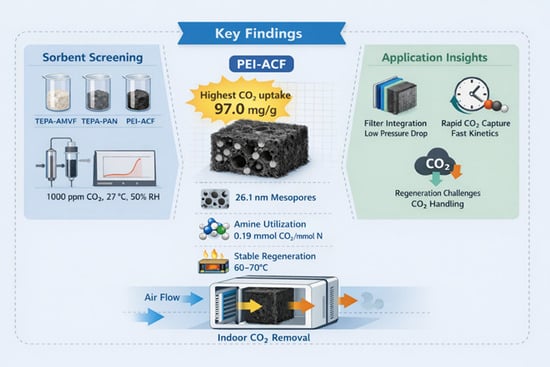
Solid amine adsorbents can capture CO2 at indoor-relevant concentrations (~1000 ppm), but many high-capacity adsorbents rely on granular or powdery supports that are difficult to integrate directly into air purification systems. Here, we applied three amination strategies to commercial fibrous substrates: bridge-grafting on viscose (TEPA-AMVF), direct grafting on polyacrylonitrile (TEPA-PAN), and physical impregnation on pore-engineered activated carbon fibre felt (PEI-ACF). These adsorbents were systematically screened under simulated indoor conditions (1000 ppm CO2, 27 °C, 50% RH). A significant capacity difference was observed: TEPA-AMVF (24.8 mg g−1) < TEPA-PAN (35.8 mg g−1) ≪ PEI-ACF (97.0 mg g−1). The superior performance of PEI-ACF was attributed to KOH activation, which produced a mesopore-rich structure (average pore diameter 26.1 nm at an optimal KOH/carbon ratio of 1.25) and enabled high nominal amine utilisation (0.19 mmol CO2 mmol N−1). PEI-ACF maintained high breakthrough-derived CO2 uptake across realistic indoor conditions (64.2–118.6 mg g−1 over 0%–100% RH; 71.6–124.5 mg g−1 over 400–5000 ppm CO2), exhibited rapid kinetics (pseudo-first-order rate constant k = 1.77 h−1; 81.7% of equilibrium uptake within 1 h), and showed stable but partial regeneration over four adsorption–desorption cycles at 60–70 °C under N2. Compared with granular or resin-based amine sorbents, the self-supporting PEI-ACF felt is expected to offer practical advantages for filter-integrated CO2 removal, including mechanical integrity under airflow, reduced risk of particle leakage, and compatibility with HVAC filter slots. Remaining challenges include direct pressure-drop validation, operation in O2-containing indoor air, long-term cycling, and management of CO2 released during regeneration.

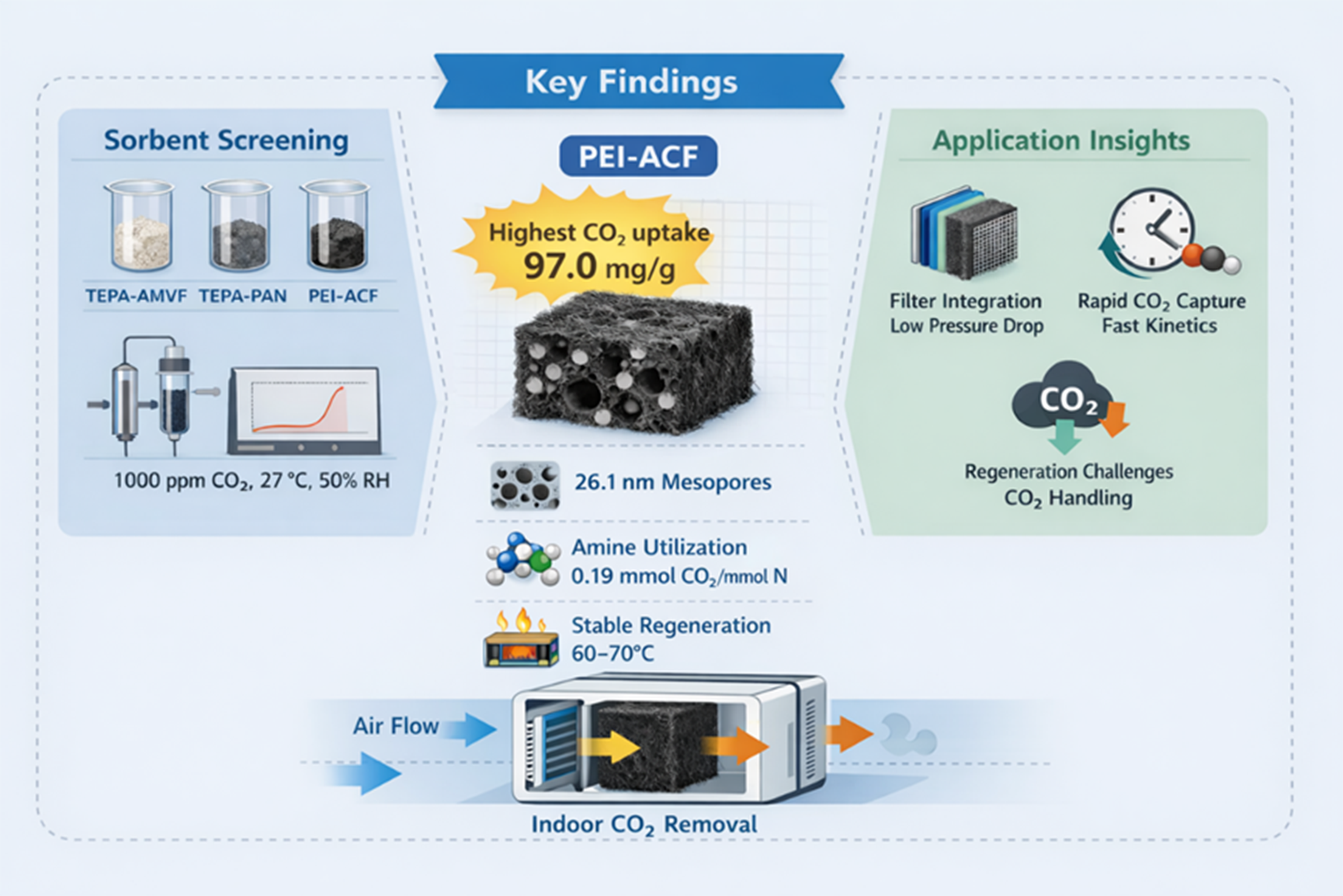
Graphical Abstract

1. Introduction

Indoor carbon dioxide (CO2) concentrations have attracted increasing attention not only as an indicator of ventilation adequacy but also as a factor with direct implications for occupant comfort, health, and cognitive performance. Maintaining indoor CO2 at or below 1000 ppm has been recommended or discussed in multiple ventilation standards and building codes [1,2,3,4]. A growing body of evidence indicates that CO2 concentrations exceeding 1000 ppm can impair complex cognitive tasks such as strategic decision-making, with effects becoming more pronounced at higher concentrations and longer exposure durations [5,6]. A systematic review and meta-analysis by Fan et al. [7] confirmed that complex cognitive task performance declined significantly at additional CO2 exposures of 1000–1500 ppm, supporting the recommendation for stricter indoor CO2 limits in workplaces requiring high cognitive demands. In practice, however, CO2 concentrations frequently exceed 1000 ppm in occupied classrooms, meeting rooms, and other enclosed or densely occupied spaces [3,8].
While ventilation with outdoor air remains the most straightforward mitigation strategy, increasing ventilation rates imposes higher building energy consumption, particularly in extreme climates. Also, its effectiveness may be constrained by outdoor air pollution, noise, or thermal comfort requirements. Active CO2 removal using solid sorbents represents a complementary approach that can operate within recirculating airflow paths without requiring additional outdoor air intake, thereby decoupling indoor CO2 control from ventilation energy penalties.
A wide variety of CO2-capture and conversion technologies have been developed for industrial and climate-mitigation contexts, including thermochemical absorption/adsorption [9,10], electrochemical swing processes [11], and photochemical or photocatalytic CO2 conversion [12]. Thermochemical methods are comparatively mature but often require heat input for regeneration; electrochemical approaches can in principle use electricity directly but are still being developed for durable, low-cost operation; and photochemical routes primarily convert CO2 into fuels or chemicals under illumination rather than remove ppm-level CO2 from recirculating indoor air. For enclosed indoor environments, the most relevant requirement is not only high capture capacity, but also a safe, modular, low-pressure-drop form factor that can operate near room temperature and under humid air. This requirement motivates the present focus on solid amine sorbents supported on commercial fibrous materials.
Among candidate sorbent chemistries, solid amine adsorbents are particularly attractive for low-concentration CO2 capture. CO2 reacts with amine sites at ambient temperature via carbamate or bicarbonate formation pathways [9,13]. Physical impregnation of polyamines (e.g., polyethyleneimine, PEI) into porous supports is a widely employed approach that provides high amine density; however, it often suffers from diffusion limitations and low amine utilisation when pores become blocked by the viscous polyamine phase [14,15]. Conversely, covalent grafting can immobilize amines and improve stability, but typically yields lower accessible amine density when the substrate is nonporous.
Despite significant advances in sorbent chemistry, the translation of these materials into practical indoor air quality devices has been impeded by a fundamental mismatch between sorbent form factor and air handling system requirements. The majority of reported high-capacity CO2 sorbents are prepared as powders, pellets, or granules [6,16]—forms that present several practical limitations when deployed in indoor air treatment systems. Packed beds of granular sorbents impose substantial pressure drops that increase fan energy consumption and may exceed the capacity of standard HVAC blowers. Powdered sorbents risk particle entrainment and downstream contamination of indoor air, necessitating additional containment measures that add system complexity [17]. Furthermore, granular and powdered media lack mechanical self-support under continuous airflow and vibration, leading to settling, channeling, and progressive performance degradation [18].
Fibre-form sorbents offer a structurally distinct alternative that is intrinsically compatible with indoor air-handling infrastructure. Commercial filtration media in HVAC systems are almost exclusively fibrous—nonwoven felts, pleated filter packs, and woven meshes—because fibrous architectures provide high surface-area-to-volume ratios, low pressure drop per unit thickness, mechanical integrity under sustained airflow, and modular replaceability within standard filter housings [19]. An ideal fibrous CO2 sorbent would therefore combine the chemical selectivity of amine-functionalized materials with the structural and aerodynamic advantages of established filter media, enabling direct, drop-in integration into existing air conditioning or air purification systems without hardware modification.
Recent studies have begun to explore fibrous supports for low-concentration CO2 capture. Wang et al. sequentially improved the textural and surface properties of activated carbon nanofibres (ANF) via KOH activation and TEPA doping, demonstrating enhanced selectivity for 0.3% CO2 [5]. Tao et al., prepared an epoxide-modified PEHA-loaded ACF felt (EB-PEHA-ACF) that achieved 60 mg g−1 at 1000 ppm CO2 with promising mild-temperature regeneration [20]. In parallel, PEI-loaded carbon nanofibre (CNF) nonwovens have been explored as distributed direct air capture (DAC) filters for building ventilation systems, taking advantage of low pressure drop and electrothermal regeneration [21]. Nevertheless, systematic comparisons of different amination strategies on fibrous substrates under indoor-relevant conditions remain scarce, and the relative merits of grafting versus impregnation approaches on fibres of varying porosity have not been systematically evaluated.
In this study, we compare grafting- and impregnation-based routes to prepare aminated fibrous sorbents from three types of commercial fibre substrates—viscose, polyacrylonitrile (PAN), and activated carbon fibre (ACF) felt—and screen them under indoor-level CO2 conditions. Based on this screening, we identify PEI-impregnated, pore-engineered ACF felt (PEI-ACF) as the best-performing candidate and then conduct a systematic investigation of its pore-structure tuning, adsorption behaviour under varying indoor conditions, kinetics, and low-temperature regeneration. The results are discussed in terms of their implications for integrating CO2 capture functionality into fibrous filter media for indoor air-quality management in enclosed environments such as offices, classrooms, vehicles, and other mechanically ventilated spaces.
The novelty of this work lies in three aspects. First, it provides a side-by-side comparison of three amination strategies on commercial fibre substrates under identical ppm-level breakthrough conditions, rather than optimising only one support. Second, it shows that mesopore engineering and amine accessibility, rather than BET surface area or gravimetric amine loading alone, govern uptake at 1000 ppm CO2. Third, it evaluates the best-performing felt-form sorbent not only in terms of capacity, but also under humidity/concentration fluctuations, kinetic constraints, and mild regeneration conditions relevant to filter-integrated indoor applications.

2. Materials and Methods

2.1. Preparation of Aminated Fibrous Sorbents

TEPA-AMVF was prepared using a bridge-grafting route. Viscose fibres were first grafted with acrylamide via a free-radical reaction initiated by ferrous ammonium sulfate (FAS, Shanghai Aladdin Biochemical Technology Co., Ltd., Shanghai, China) and hydrogen peroxide (Shanghai Aladdin Biochemical Technology Co., Ltd., Shanghai, China) under N2 (60 °C, 4 h, Beijing Huanyu Industrial Gas Co., Ltd., Beijing, China) to obtain polyacrylamide-modified viscose fibres (AMVF), Viscose fibres were acquired from Shandong Sunvim Group Co., Ltd. (Weifang, China). AMVF was then reacted with excess TEPA (typically as an 80% solution, Shanghai Macklin Biochemical Co., Ltd., Shanghai, China) in the presence of AlCl3 (110 °C, 8 h) to graft TEPA.
TEPA-PAN was prepared by reacting PAN fibres (with TEPA solution (including neat TEPA) under reflux in an oil bath at preset temperatures (120–140 °C) for 4–24 h, followed by washing to neutrality and drying. Polyacrylonitrile (PAN) fibres were purchased from Zibo Longen Fibre Co., Ltd. (Zibo, China).
PEI-ACF was prepared by wet impregnation using methanol as the solvent: PEI (Shanghai Macklin Biochemical Co., Ltd., Shanghai, China) was dissolved in methanol (Shanghai Macklin Biochemical Co., Ltd., Shanghai, China), mixed with activated ACF felts, shaken (160 rpm, 12 h), and the solvent was removed by rotary evaporation (≈60 °C, 16 h). Prior to impregnation, ACF felts (Jiangsu Kejing Carbon Fibre Co., Ltd., Nantong, China) were activated using KOH (Beijing Chemical Factory, Beijing, China) to tune the pore structure. Felts were soaked in KOH solution for 48 h at different KOH/carbon mass ratios, dried at 105 °C, and then activated in a tube furnace under N2 by heating to 700 °C (holding for 90 min). The activated felts were acid-washed (1 mol L−1 HCl) for 24 h, rinsed to neutrality, and dried. Ultrapure water applied throughout the experiments was produced by a Milli-Q water purification system (Millipore, Bedford, MA, USA).

2.2. Characterisation

N2 adsorption/desorption isotherms were measured at 77 K after degassing samples at 105 °C for 6 h. The Brunauer–Emmett–Teller (BET) method was used to estimate specific surface area, and pore size distributions were obtained using density functional theory (DFT).

2.3. Dynamic CO2 Adsorption Tests and Performance Metrics

Dynamic CO2 adsorption was evaluated using a self-assembled fixed-bed breakthrough setup. Three gas lines (two N2 and one 10% CO2 in N2) were mixed to obtain the target inlet concentration, and relative humidity was controlled via dry/wet gas mixing. CO2 concentration was monitored using an infrared CO2 analyser (GXH-3011N) from Beijing Huayun Analytical Instrument Research Institute Co., Ltd. (Beijing, China). The adsorbent (typically 1.0 g) was packed in an acrylic column (length 14 cm, inner diameter 2 cm) between quartz wool plugs.
Prior to adsorption, samples were pretreated at 110 °C under N2 (300 mL min−1, 3 h) to remove pre-adsorbed moisture and CO2. Unless otherwise stated, adsorption tests targeted an indoor-level inlet concentration of 1000 ppm CO2 and were conducted at 27 °C and 50% relative humidity. The total inlet flow rate during adsorption was 1.0 L min−1 unless otherwise stated. CO2 uptake (mg g−1) was calculated by integrating the difference between inlet and outlet CO2 concentrations over time (breakthrough curve), based on the gas flow rate and adsorbent mass. Amine utilisation was defined as the molar ratio of adsorbed CO2 to total nitrogen in the loaded amine phase; for PEI-ACF, this value was calculated on a nominal-loading basis from the known PEI loading and the nitrogen content of PEI. For regeneration tests, the CO2-saturated PEI-ACF bed was heated to 60 or 70 °C under N2 and then re-tested under the same adsorption conditions to evaluate cyclic performance.

3. Results and Discussion

3.1. “Bridge–Grafting” TEPA onto Viscose: TEPA-AMVF

To avoid oxidative damage to the viscose backbone while providing anchoring sites for amination, a bridge-grafting strategy was adopted: acrylamide was first grafted onto viscose fibres to introduce amine groups as intermediate anchoring sites, followed by TEPA grafting. Because the TEPA amination was conducted under excess-amine conditions, the amount of grafted acrylamide is the primary determinant of the final amine density.
Table 1 shows the mass gain of viscose fibres after acrylamide grafting and after subsequent TEPA grafting under different acrylamide concentrations and FAS dosages. The grafting yield exhibited a volcano-type trend with acrylamide concentration, peaking at 20% and decreasing at 25%, consistent with a shift from surface grafting to solution-phase self-polymerization at high monomer concentration. A similar non-monotonic trend was observed for FAS dosage.
CO2 adsorption tests were conducted for four TEPA-AMVF samples with post-amination mass gain > 100%. The CO2 uptakes for samples with different mass gains after amination are shown in Figure 1. Notably, samples prepared in 25% acrylamide solution (mass gains 161.7% and 124.7%) showed lower CO2 uptake than those prepared in 20% acrylamide, despite their higher grafting degrees. A plausible explanation is that a high acrylamide concentration favours solution-phase self-polymerisation and/or formation of a dense surface polymer layer, which can increase CO2 mass-transfer resistance and bury otherwise accessible amine sites. Because the chemical identity and distribution of the grafted phase were not independently quantified by Fourier-transform infrared spectroscopy, X-ray photoelectron spectroscopy, or elemental analysis in the present screening study, this interpretation should be regarded as a structure–performance inference rather than direct chemical proof. The best-performing TEPA-AMVF reached 24.8 mg g−1 at 1000 ppm CO2. Although this capacity demonstrates successful amination of a flexible fibrous substrate, it remains insufficient for practical indoor deployment, where rapid air-side CO2 removal requires higher uptake per unit sorbent mass. Nevertheless, TEPA-AMVF retained good flexibility and mechanical strength, suggesting that bridge grafting may be more effective when applied to a porous fibrous substrate that provides greater internal surface area for amine attachment.

3.2. Direct Grafting TEPA onto PAN Fibres: TEPA-PAN

PAN fibres contain abundant nitrile (–C≡N) groups that can react directly with amines through nucleophilic addition, enabling one-step grafting without a bridge polymer. Table 2 summarizes the mass gain of PAN fibres under different temperatures, TEPA concentrations, and reaction times. Increasing temperature and TEPA concentration generally increased grafting, while reaction time exhibited a non-monotonic effect. Mass gain increased as reaction time decreased from 24 h to 6 h, but decreased again upon further reduction to 4 h. This behavior suggests competing effects between grafting kinetics and potential backbone degradation under prolonged high-temperature alkaline conditions.
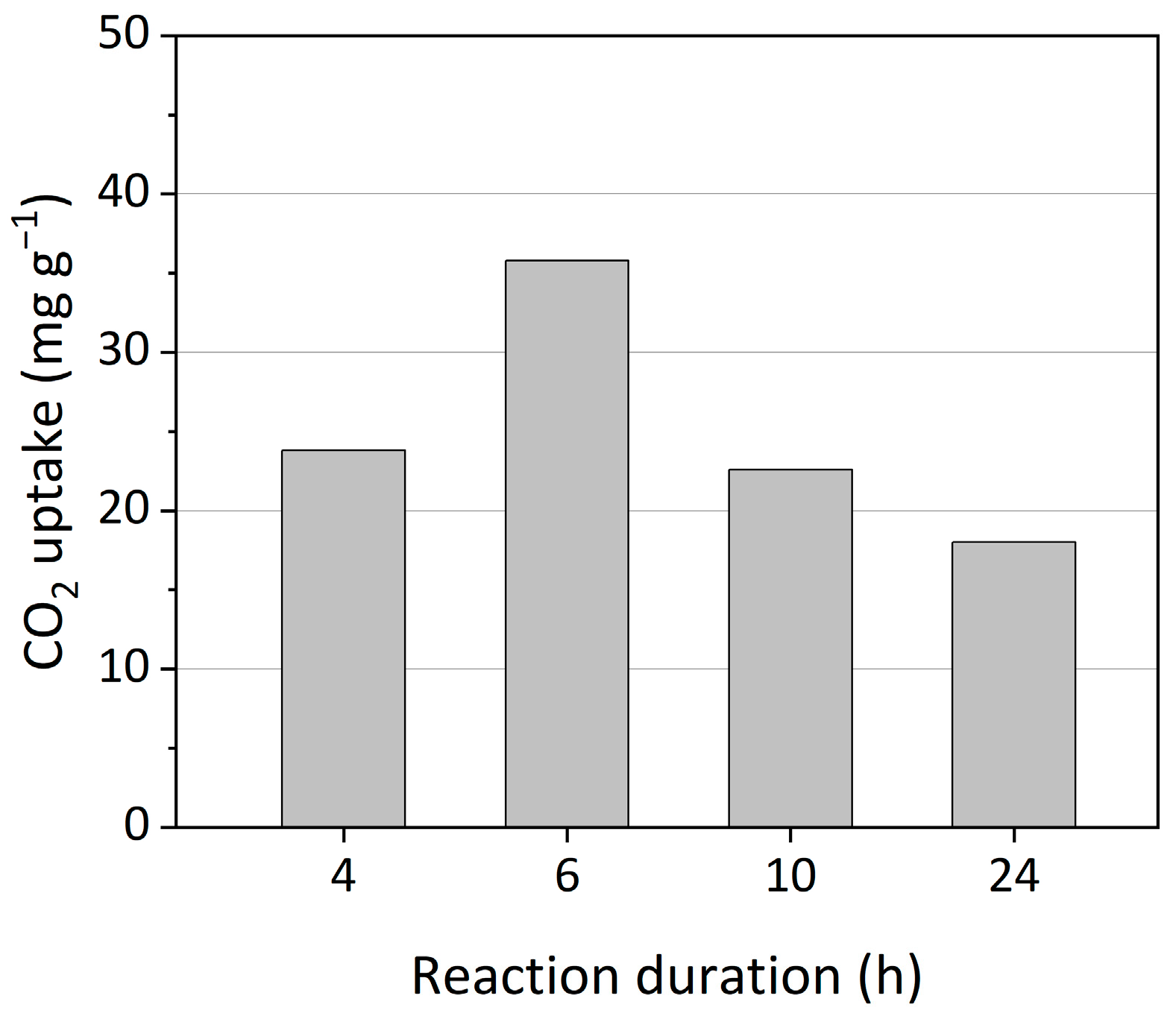
Adsorption tests focused on samples prepared at 140 °C with neat TEPA (Figure 2), where the highest CO2 uptake (35.8 mg g−1) was observed at a reaction time of 6 h. This result is broadly comparable to the uptake reported by Kuang et al. [22] for amine-functionalized PAN fibres, confirming that covalent amination of PAN can produce fibrous sorbents with moderate capacity. However, despite the relatively high grafting degree (mass gain 234%), the CO2 capacity of TEPA-PAN remains substantially lower than that of porous-support sorbents. This limitation arises because commercial PAN fibres are essentially nonporous (BET surface area typically <10 m2 g−1), restricting CO2 access to amine sites located exclusively on the fibre exterior. The contrast between high grafting yield and modest CO2 uptake underscores that amine density alone is not the governing factor for ultradilute CO2 capture—rather, accessible amine density and mass-transfer pathway architecture are the decisive determinants.

3.3. Pore-Engineered ACF Felts for High-Capacity Impregnation Sorbents

In contrast to the nonporous viscose and PAN fibres evaluated in Section 3.1 and Section 3.2, activated carbon fibre (ACF) felts provide a hierarchical porous network that is intrinsically suited for physical impregnation of viscous polyamines. The self-supporting felt morphology simultaneously satisfies the structural requirements for filter-type applications: ACF felts can be cut to arbitrary dimensions, installed as drop-in replacements within standard HVAC filter frames, and withstand continuous airflow without particle shedding—advantages that are unattainable with powdered or granular sorbent beds [18]. However, pristine carbon felts are often dominated by micropores and small mesopores (<3 nm), which are readily occluded by polymeric amines such as PEI. As demonstrated by Lin [15] and others, pore blockage by impregnated polyamines is the primary cause of low amine utilization in microporous supports. Therefore, KOH activation was employed to enlarge pores and tune the mesopore structure, with textural evolution quantified by N2 sorption (Table 3).
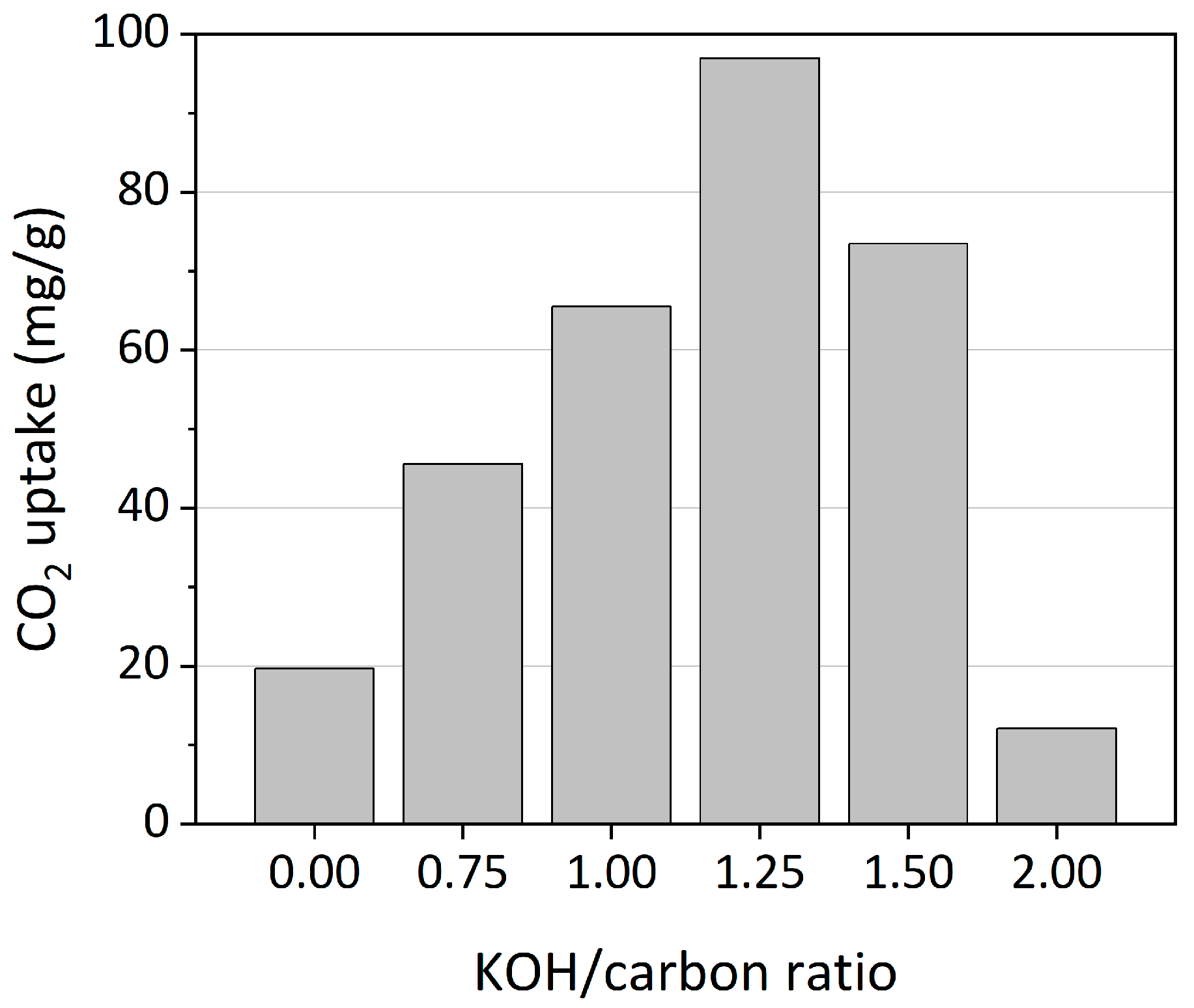
The influence of KOH activation (KOH/carbon ratio) was first examined. The CO2 uptakes of PEI-ACF at different KOH/carbon ratios are shown in Figure 3. The CO2 uptake of PEI-ACF increased from 19.6 mg g−1 on unactivated felt to 45.6 mg g−1 at a KOH/carbon ratio of 0.75, and reached a maximum of 97.0 mg g−1 at a ratio of 1.25. Over-activation (ratio = 2.0) reduced uptake to 12.1 mg g−1, even lower than the unactivated case. Table 3 shows that the average pore diameter increased from 2.6 nm (unactivated) to 26.1 nm at a KOH/carbon ratio of 1.25, which coincided with the maximum CO2 uptake. By contrast, BET surface area and total pore volume did not correlate monotonically with uptake. This trend is attributed to the excessive etching of the material by KOH at high KOH/carbon ratios. At lower KOH/carbon ratios, a small amount of KOH mainly enlarged existing pores and created new mesopores. Therefore, although the average pore size continues to increase, the specific surface area changes only slightly. When KOH was slightly excessive (KOH/carbon ratio = 1.50), the over-etching caused by excess KOH destroyed and collapsed some of the previously formed pores, leading to decreases in both specific surface area and average pore size. When the KOH dosage was further increased (KOH/carbon ratio = 2.0), the material surface was etched extensively, a large fraction of the original pore network was destroyed, and the structure reverted to being predominantly microporous. Consequently, both the specific surface area and pore volume drop sharply. The observation that mesopore formation, rather than total surface area or pore volume, governs performance for polymer-impregnated solid amines indicates that pore engineering should target a mesopore window that balances amine loading capacity against diffusion-pathway preservation.
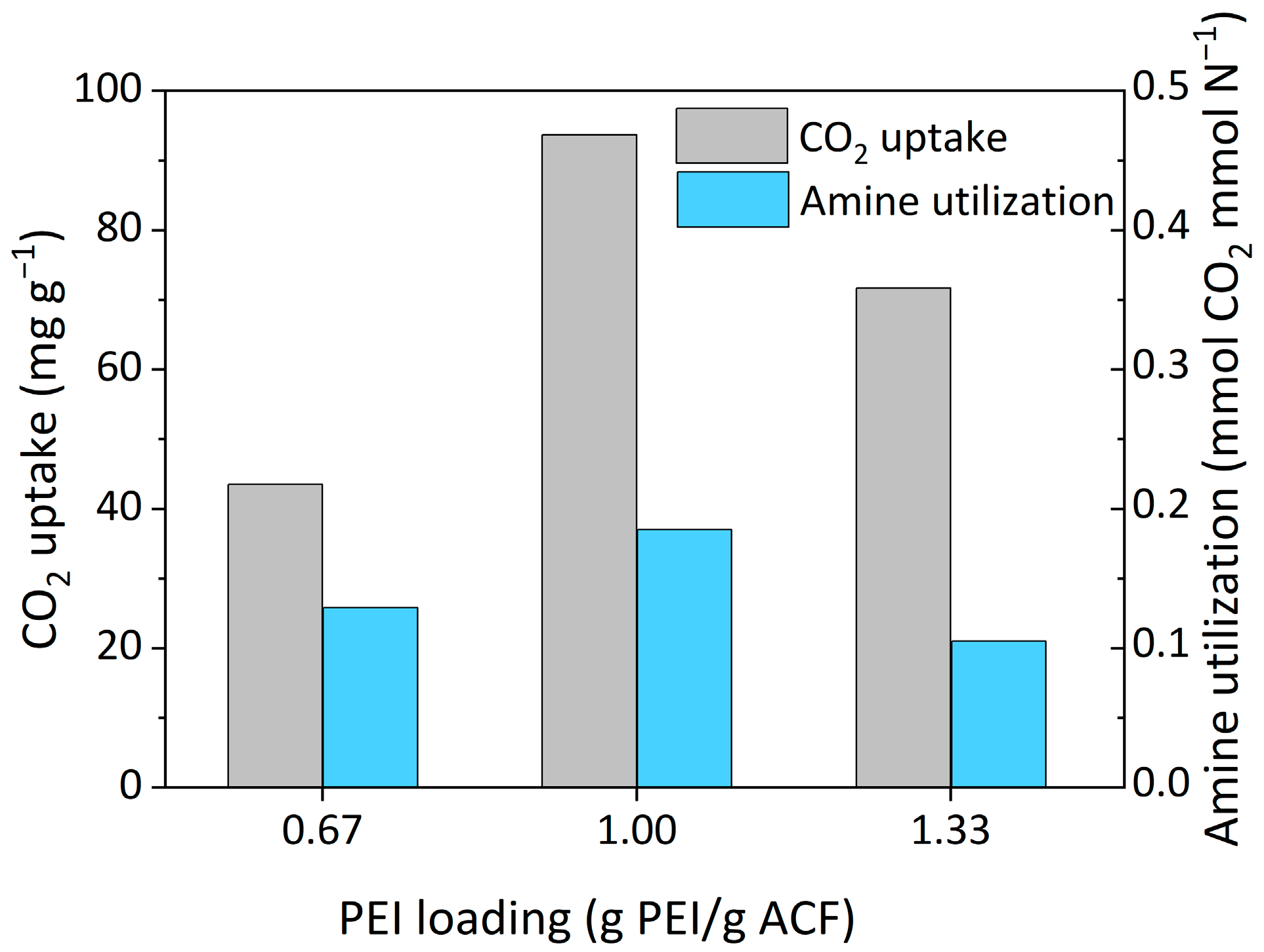
Subsequently, the effects of PEI loading on CO2 uptake and amine utilization were investigated (Figure 4). On the optimum activated felt (KOH/carbon = 1.25), PEI loading was varied from 0.67 to 1.33 g PEI g ACF−1. Both CO2 uptake and amine utilization increased and then decreased, peaking at 1.00 g g−1 with a capacity of 97.0 mg g−1 and an amine utilization of 0.19 mmol CO2 mmol N−1. This amine utilization represents a favorable performance level within the context of physically impregnated amine sorbents: reported values for PEI-loaded mesoporous supports typically range from approximately 0.025 to 0.20 mmol CO2 mmol N−1 [23], placing the present PEI-ACF near the upper bound of this range. The high amine utilization, achieved at a moderate PEI loading of 50 wt%, confirms that the mesopore-engineered ACF support provides highly accessible amine sites with mitigated pore blockage. By comparison, Tao et al. [20] reported an uptake of 60 mg g−1 at 1000 ppm CO2 for their epoxide-modified PEHA-loaded ACF felt (EB-PEHA-ACF) prepared using a similar KOH-activation strategy, indicating that the PEI-ACF in the present study offers approximately 62% higher capacity under comparable conditions. This improvement may be attributable to the higher molecular weight and branched architecture of PEI, which provides a higher density of primary and secondary amine sites per unit mass than linear PEHA.

3.4. Indoor-Condition Performance of PEI-ACF: Effects of Humidity and Inlet CO2 Concentration

Indoor CO2 levels and humidity fluctuate substantially across buildings, seasons, and occupancy patterns. For a fibrous sorbent intended for deployment in air conditioning or air purification systems, robustness to these fluctuations is essential: an adsorbent that performs well only under narrow conditions would offer limited practical value regardless of its peak capacity. To assess practical robustness, PEI-ACF was evaluated under varying relative humidity (RH) at a fixed inlet concentration (1000 ppm CO2) and under varying inlet CO2 concentrations at a representative indoor humidity (RH = 50%). All tests were conducted at 27 °C using dynamic fixed-bed breakthrough measurements in N2-balanced gas streams. Because O2, VOCs, NOx, SO2, and ozone were not included in these gas mixtures, the results should be interpreted as simulated indoor-condition screening data rather than as full validation in real indoor air.
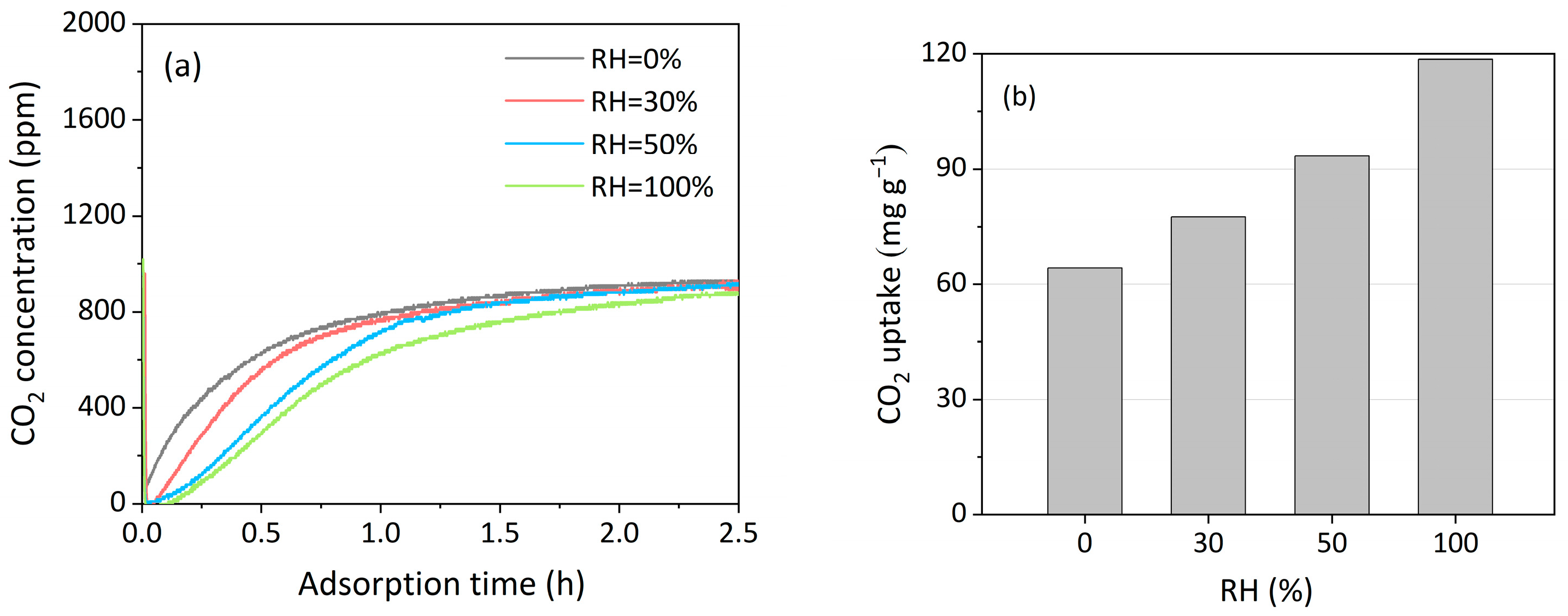
Because indoor air is inherently humid, the effect of moisture on PEI-ACF was evaluated. The breakthrough curves and CO2 uptakes for PEI-ACF at different moisture contents are shown in Figure 5. For PEI-ACF, increasing RH prolonged the breakthrough time and enhanced the breakthrough-derived apparent CO2 uptake. In the complete-removal stage, the bed could fully remove 3076 bed volumes (BV) of CO2 at RH = 0%, which increased to 4650 BV at RH = 30% and further to 5436 BV at RH = 100%. Accordingly, the integrated CO2 uptake increased from 64.2 mg g−1 (RH = 0%) to 118.6 mg g−1 (RH = 100%). Within the thermal-comfort humidity range (30%–70% RH), the uptake remained high (≥77.6 mg g−1) and reached 97.0 mg g−1 at RH = 50%. Complete-removal BV and integrated uptake describe different aspects of the breakthrough curve: the former depends on the first detectable breakthrough, whereas the latter reflects the total area between inlet and outlet curves up to saturation. Thus, local non-monotonic behaviour in BV can occur even when the integrated capacity increases. The positive humidity effect is consistent with the well-established role of water in facilitating zwitterion stabilization and bicarbonate formation on amine sorbents under ultradilute CO2 conditions [9,24]. Nevertheless, because the present values are derived from breakthrough integration, independent gravimetric measurements under controlled RH and direct water-uptake measurements would be valuable to separate CO2-specific uptake from water co-adsorption in future work.
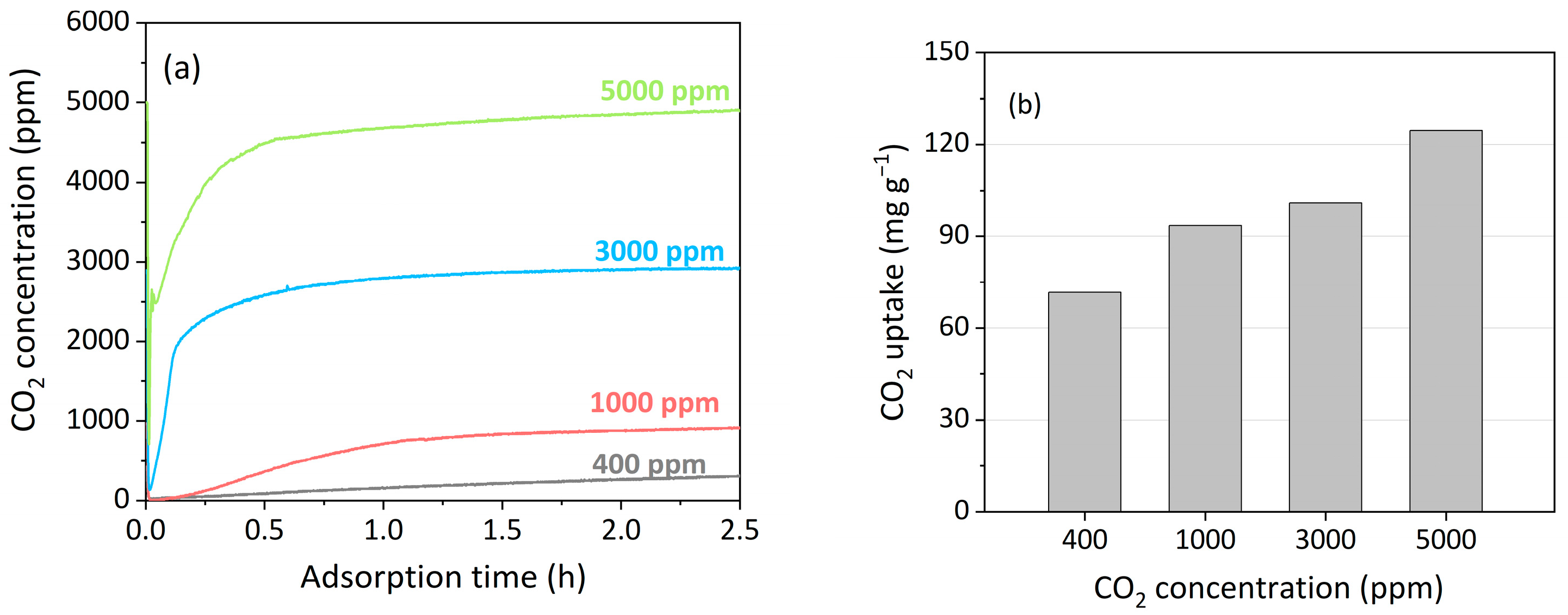
The effect of inlet CO2 concentration on the CO2 uptake of PEI-ACF was also investigated to evaluate performance across different enclosed environments. The breakthrough curves and CO2 uptakes for PEI-ACF at different inlet CO2 concentrations are shown in Figure 6. At 27 °C and RH = 50%, higher inlet CO2 concentrations shortened the complete-removal window but increased total uptake due to the larger thermodynamic driving force. Using 400, 1000, 3000, and 5000 ppm CO2 as representative indoor-to-occupancy extremes, the corresponding CO2 uptakes were 71.6, 97.0, 100.8, and 124.5 mg g−1, respectively. In terms of complete removal, the bed could fully remove 2886 BV at 400 ppm, 2903 BV at 1000 ppm, and 3515 BV at 5000 ppm. The retention of 71.6 mg g−1 at 400 ppm—corresponding to near-outdoor CO2 levels—is noteworthy because it demonstrates that PEI-ACF remains effective even in well-ventilated buildings where the CO2 increment above ambient is modest. Furthermore, the substantial uptake at 5000 ppm (124.5 mg g−1) indicates that PEI-ACF can also handle transient high-occupancy events such as crowded meeting rooms or lecture halls where CO2 can temporarily spike to several thousand ppm [3,8]. Overall, the broad concentration-response profile confirms that PEI-ACF can maintain high capture performance across the full range of indoor CO2 levels, from well-ventilated offices (~400 ppm) to densely occupied classrooms (~3000–5000 ppm), without requiring operational adjustment.

3.5. Adsorption Kinetics Under 1000 ppm CO2

Fast uptake kinetics are critical for indoor air treatment where contact times may be limited by filter geometry and airflow velocity. In a typical recirculating HVAC system, air passes through the filter element at face velocities of 0.5–2.5 m s−1, resulting in residence times of the order of milliseconds to seconds per pass [25]. Effective CO2 removal under such conditions requires that the sorbent reach a substantial fraction of its equilibrium capacity within the first few passes, thereby accumulating meaningful uptake over repeated recirculation cycles.
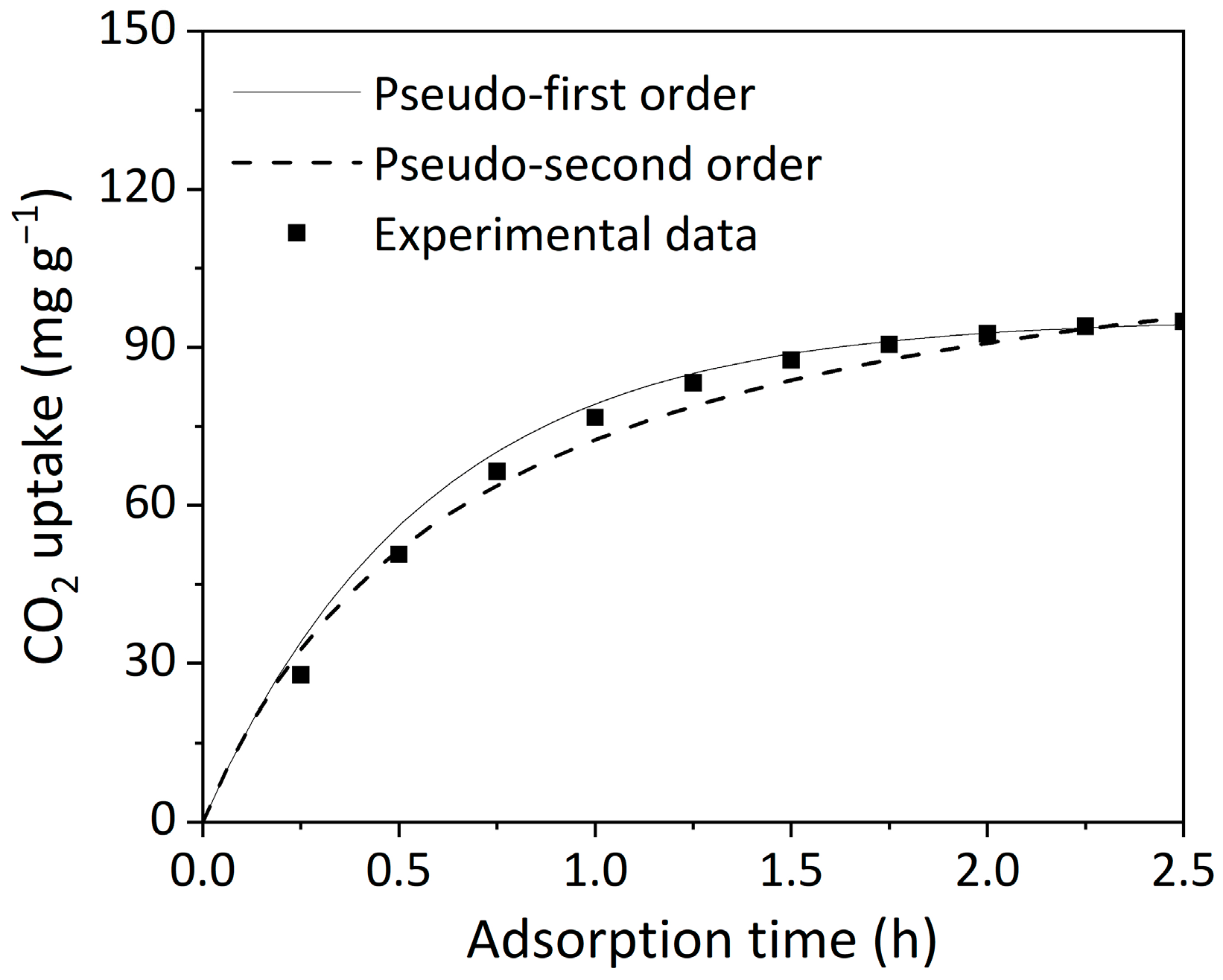
The adsorption kinetic curves and the corresponding model fits for PEI-ACF at 1000 ppm CO2 are shown in Figure 7. Under the fixed-bed test conditions, PEI-ACF reached 81.7% of its equilibrium uptake within 1 h and 92.8% within 1.5 h. Among the two lumped kinetic models tested, the pseudo-first-order model provided the better fit (R2 = 0.995), with a fitted rate constant of 1.77 h−1 (Table 4). These empirical fits are useful for comparing apparent uptake rates but do not by themselves distinguish external film transfer, intra-fibre diffusion, diffusion through the PEI phase, or surface reaction. The rapid apparent kinetics are consistent with the mesopore-engineered ACF support, which preserves gas-transport pathways even after PEI fills smaller pores (Section 3.3). Flow-rate-resolved and temperature-resolved kinetic tests, together with Boyd/Avrami or related diffusion analyses, would be needed to assign the rate-limiting step more rigorously.
It is instructive to compare these kinetics with those of non-fibrous sorbent forms. Granular or resin-based PEI sorbents generally rely on intraparticle diffusion through tortuous pore networks within each pellet or bead, which can introduce additional mass-transfer resistance at the particle scale [6,17,18]. In fibrous sorbents, the high aspect ratio of individual fibres and the open interfibrous void structure reduce external mass-transfer resistance and promote rapid gas–solid contact. Wang et al. [6] reported that a PEI-impregnated resin (PEI-MR10) could fully remove 1000 ppm CO2 for approximately 2 h before breakthrough; the PEI-ACF in the present study achieved a comparable complete-removal window while offering the additional structural advantage of a self-supporting felt that does not require containment in a packed-bed column.

3.6. Low-Temperature Regeneration and Cyclic Stability

Energy-efficient regeneration is a key requirement for indoor CO2 removal devices that must avoid high-temperature desorption for reasons of safety, energy cost, and compatibility with polymer-based system components. In occupied indoor environments, regeneration temperatures above 80–100 °C would pose burn hazards and could accelerate thermal degradation of PEI [6]; therefore, the ability to regenerate under mild conditions (≤70 °C) is a prerequisite for filter-integrated operation.
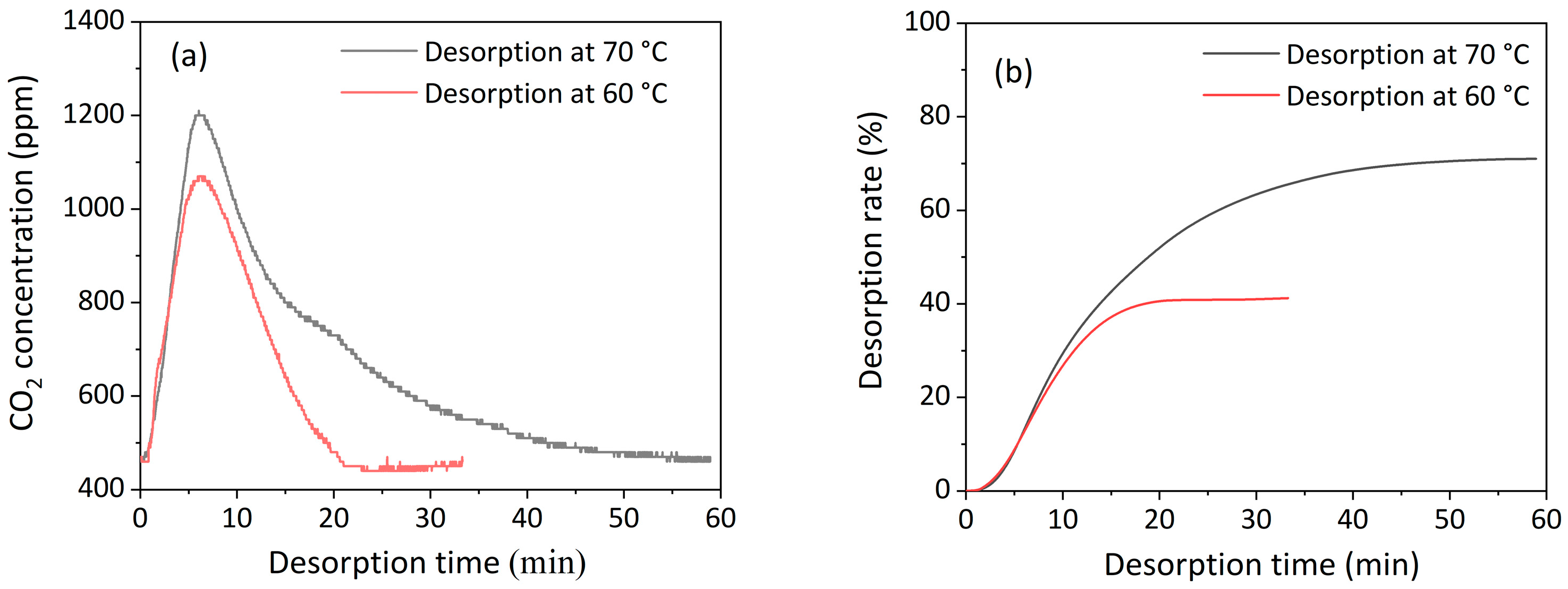
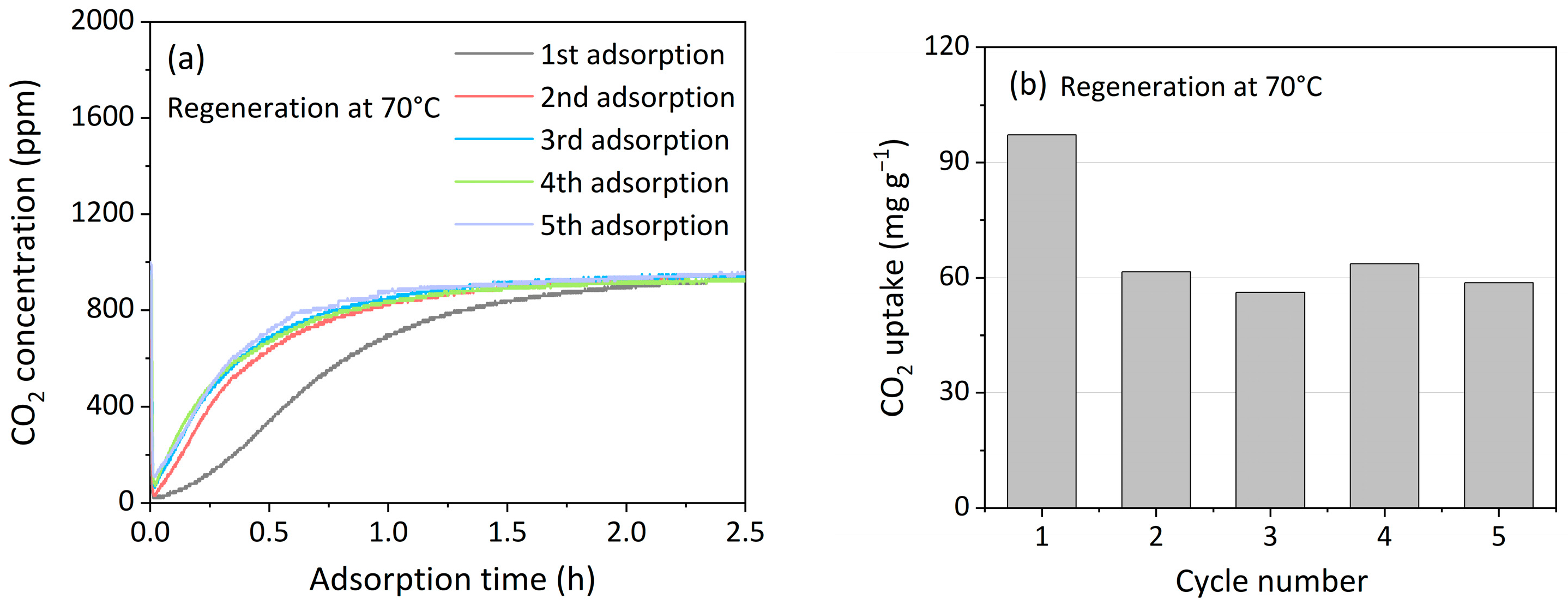
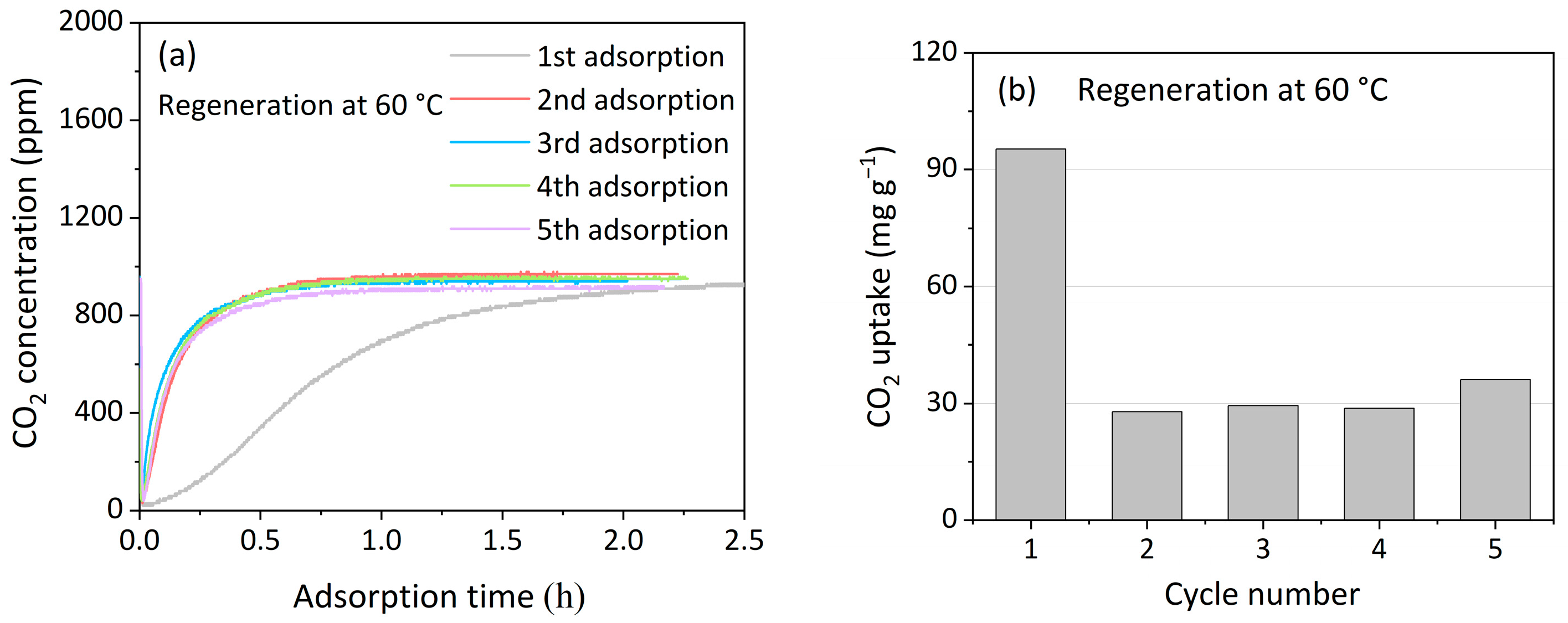
PEI-ACF was regenerated by flowing N2 at 60–70 °C and then re-tested under 1000 ppm CO2. The desorption curves and the regeneration performance under continuous adsorption–desorption cycles are shown in Figure 8, Figure 9 and Figure 10. Lower regeneration temperature resulted in lower recovered capacity: the regenerated uptake after one mild-temperature regeneration step was 61.6 mg g−1 at 70 °C and 27.9 mg g−1 at 60 °C, compared with 97.0 mg g−1 for the fresh sorbent. This corresponds to an initial loss of approximately 37% at 70 °C and 71% at 60 °C. Desorption profiles further showed that at 70 °C the sorbent reached a desorption ratio of 70.9% after 60 min, whereas at 60 °C a desorption ratio of 40.4% was achieved after 25 min. This incomplete desorption is consistent with strong CO2–amine interactions in PEI-based sorbents, which enable capture at ultradilute concentrations but penalise mild-temperature regeneration.
The cyclic data should therefore be interpreted as partial-swing regeneration rather than full recovery of the fresh-sorbent capacity. After the first mild-temperature regeneration step, the regenerated capacity remained nearly constant over the subsequent four adsorption–desorption cycles under both 60 and 70 °C protocols, suggesting that a reproducible weakly bound/cyclable fraction can be used repeatedly within the tested cycle window. However, the present data do not separate the contributions of strongly retained carbamate species, possible irreversible amine deactivation (e.g., urea formation), and water loss. Extended cycling (≥20 cycles), periodic high-temperature full regeneration (e.g., 110 °C), and operando TGA-MS or DRIFTS would be required to confirm whether the apparent partial-swing capacity remains stable over long-term operation. For comparison, Tao et al. [20] achieved nearly 100% desorption for EB-PEHA-ACF within 25 min at 60 °C, attributable to hydroxyl groups introduced by epoxide modification; however, this came at the expense of lower total capacity (60 mg g−1 vs. 97.0 mg g−1 for PEI-ACF). This comparison illustrates a general affinity–regeneration trade-off in amine sorbent design.
Strategies to improve low-temperature regeneration without sacrificing uptake capacity could be explored in future work, including vacuum-assisted desorption, humidity-swing regeneration, amine chemistry modifications (e.g., incorporation of secondary amine-rich co-monomers), or the use of embedded resistive heating elements within the conductive ACF felt substrate [21]. The inherent electrical conductivity of the carbon fibre substrate makes PEI-ACF particularly amenable to electrothermal regeneration, wherein Joule heating can be applied directly to the sorbent without external heaters—a feature that is unavailable in conventional silica-, alumina-, or resin-based sorbent supports.

3.7. Overall Comparison and Design Implications for Indoor Applications

Performance hierarchy and governing factors: Comparison across the screened fibrous sorbents reveals a clear performance hierarchy under indoor-level CO2 conditions: TEPA-AMVF (24.8 mg g−1) < TEPA-PAN (35.8 mg g−1) ≪ PEI-ACF (97.0 mg g−1) (Table 5). This hierarchy demonstrates that, for ultradilute CO2 capture, the combination of accessible amine density and well-designed mass-transfer pathways is far more important than the total quantity of grafted amine groups. Nonporous commercial fibres restrict the number of accessible amine sites even when gravimetric mass gain is high, whereas porous ACF felts enable high PEI loading while preserving gas transport. Critically, pore engineering via KOH activation was essential for maximizing uptake: enlarging pores to the mesopore regime (average diameter 26.1 nm at KOH/carbon = 1.25) mitigated amine-induced pore blockage and supported rapid CO2 diffusion to interior amine sites.
Benchmarking against representative sorbents: To contextualise the performance of PEI-ACF within the broader landscape of low-concentration CO2 sorbents, Table 6 compares this work with selected literature systems tested under indoor- or low-concentration CO2 conditions. The comparison shows that PEI-ACF offers a competitive balance between capacity and deployability: its uptake is lower than that of the highest-capacity PEI-impregnated resin under similar conditions, but its monolithic felt form factor avoids the containment, pressure-drop, and particle-entrainment issues associated with loose powders, pellets, and resin beads. The table also highlights the remaining limitation of PEI-ACF, namely incomplete mild-temperature regeneration compared with some modified amine systems.
Advantages of the fibrous form factor for indoor air quality systems: The self-supporting felt architecture of PEI-ACF confers several practical advantages that are critical for integration into real-world indoor air quality systems:
(i)
Low pressure drop potential: Fibrous filter media generally exhibit lower pressure drops than densely packed granular beds of comparable mass when operated at HVAC-relevant face velocities [15,18,25]. The open, interconnected void structure of ACF felt is therefore expected to be advantageous for integration into residential and commercial HVAC systems. However, pressure drop was not measured directly for PEI-ACF in this study; ΔP versus face velocity (0.5–2.5 m s−1) should be quantified in prototype-level tests.
(ii)
Elimination of particle entrainment: Unlike granular or powdered sorbents, which can undergo attrition and release fine particles into the treated airstream [18], the continuous fibre network of ACF felt is mechanically coherent and does not shed particulate matter downstream. This is essential for indoor air quality applications where the sorbent is positioned within an occupied-space air recirculation loop.
(iii)
Modular replaceability: ACF felts can be cut, folded, or pleated to conform to standard filter dimensions, enabling end-of-life replacement following established filter-change protocols without specialized equipment or personnel.
(iv)
Compatibility with electrothermal regeneration: Carbon fibres are inherently electrically conductive, which opens the possibility of in situ Joule heating for temperature-swing regeneration without external heating elements [21]. This capability could enable autonomous regeneration cycles managed by a simple electronic controller, thereby reducing maintenance burden and enabling closed-loop operation in smart building systems.
(v)
Potential multifunctionality: ACF is well established as an effective adsorbent for volatile organic compounds (VOCs) and other gaseous pollutants [26,27]. However, this work did not test co-fed VOCs, O2, NOx, SO2, or ozone. Therefore, simultaneous CO2/VOC removal should be regarded as a future research direction rather than a demonstrated capability of PEI-ACF in the present study.
Limitations and future directions: Several limitations must be addressed before PEI-ACF can be considered deployment-ready. First, the amine content and amine-site speciation were estimated from nominal loading rather than independently measured by CHN elemental analysis, Fourier-transform infrared spectroscopy/solid-state nuclear magnetic resonance, or XPS N 1s deconvolution. Second, the humidity-dependent capacities reported here are breakthrough-derived apparent CO2 uptakes; gravimetric CO2/H2O co-adsorption measurements under controlled RH would be needed to isolate CO2-specific capacity. Third, the incomplete regeneration observed at 60–70 °C means that fully closed-loop operation would require careful thermal management and controlled venting of released CO2. Fourth, the effects of O2, VOCs, NOx, SO2, ozone, and real indoor contaminants on PEI stability were not evaluated. Finally, direct measurements of pressure drop, bare-ACF baseline adsorption/cycling, SEM/TEM/EDX mapping of PEI distribution, extended cycling (≥20 cycles), and prototype airflow validation are needed to translate the material from a screening-level sorbent to a deployable indoor air-quality technology.

4. Conclusions

This study systematically screened aminated fibrous sorbents prepared from commercial fibre substrates for indoor-level CO2 capture (1000 ppm) and identified PEI-loaded, pore-engineered activated carbon fibre felt (PEI-ACF) as the best-performing candidate. Among covalently grafted nonporous fibres, the maximum uptake reached only 35.8 mg g−1 (TEPA-PAN), while PEI-ACF achieved 97.0 mg g−1 at 1000 ppm CO2 and 50% RH with a nominal amine utilisation of 0.19 mmol CO2 mmol N−1. KOH activation was essential for pore tuning: the optimal KOH/carbon ratio (1.25) produced a mesopore-rich support (average pore diameter 26.1 nm) that minimised PEI-induced pore blockage and enabled rapid uptake (k = 1.77 h−1). PEI-ACF maintained high breakthrough-derived capacities across simulated indoor environments (64.2–118.6 mg g−1 for 0%–100% RH at 1000 ppm; 71.6–124.5 mg g−1 for 400–5000 ppm at 50% RH), confirming robust performance under the N2-balanced test conditions used here. Low-temperature regeneration at 60–70 °C resulted in stable partial-swing cyclic performance over four cycles, but not full recovery of the fresh-sorbent capacity.
Compared with granular, powdered, and resin-based amine sorbents that can offer comparable or higher gravimetric capacities, PEI-ACF presents important form-factor advantages for practical indoor deployment. Its self-supporting felt structure is compatible with modular filter geometries, is expected to reduce the risk of particle entrainment, and may enable electrothermal regeneration via Joule heating of the conductive carbon fibre substrate. These attributes make PEI-ACF a promising material platform for filter-integrated CO2 capture in enclosed environments served by air conditioning or mechanical ventilation systems, while also highlighting the need for prototype-level engineering validation.
Future work should focus on (i) experimental nitrogen quantification and amine speciation, (ii) gravimetric humidity-controlled CO2/H2O co-adsorption, (iii) direct pressure-drop measurements at HVAC-relevant face velocities, (iv) bare-ACF and PEI-ACF cycling baselines, (v) long-term regeneration with periodic high-temperature full desorption, and (vi) operation in O2-containing and VOC-containing indoor-air mixtures. These studies would advance PEI-ACF from a promising material concept toward a validated indoor air-quality technology.

Author Contributions

Conceptualization, M.H. and L.T.; methodology, M.H. and L.T.; software, M.H. and L.T.; validation, M.H. and L.T.; formal analysis, M.H. and L.T.; investigation, M.H. and L.T.; resources, M.H. and L.T.; data curation, M.H. and L.T.; writing—original draft preparation, M.H., L.T. and Y.C.; writing—review and editing, M.H., L.T. and Y.C.; visualization, M.H. and L.T.; supervision, L.T. and Y.C.; project administration, L.T.; funding acquisition, Y.C. All authors have read and agreed to the published version of the manuscript.

Funding

This research was funded by the (1) Faculty Research Grants funded by Macau University of Science and Technology (FRG-MUST) (grant number: FRG-25-041-FA; FRG-25-067-FA); (2) Guangdong Provincial Department of Education’s key scientific research platforms and projects for general universities in 2023: Guangdong, Hong Kong, and Macau Cultural Heritage Protection and Innovation Design Team (grant number: 2023WCXTD042); (3) Guangdong Provincial Philosophy and Social Sciences Planning 2025 Lingnan Cultural Project (grant number: GD25LN30). The funders had no role in study conceptualization, data curation, formal analysis, methodology, software, decision to publish, or preparation of the manuscript. There was no additional external funding received for this study.

Institutional Review Board Statement

Not applicable.

Informed Consent Statement

Not applicable.

Data Availability Statement

The original contributions presented in this study are included in the article. Further inquiries can be directed to the corresponding author.

Conflicts of Interest

The authors declare no conflicts of interest.

Abbreviations

The following abbreviations are used in this manuscript:
ACFactivated carbon fibre
AMVFacrylamide-modified viscose fibre
BETBrunauer-Emmett-Teller
BVbed volume
CO2carbon dioxide
DACdirect air capture
DFTdensity functional theory
FASferrous ammonium sulfate
FTIRFourier transform infrared spectroscopy
HVACheating, ventilation, and air conditioning
PANpolyacrylonitrile
PEIpolyethyleneimine
RHrelative humidity
TEPAtetraethylenepentamine
VOCvolatile organic compound

References

  1. Abdul-Wahab, S.A.; En, S.C.F.; Elkamel, A.; Ahmadi, L.; Yetilmezsoy, K. A review of standards and guidelines set by international bodies for the parameters of indoor air quality. Atmos. Pollut. Res. 2015, 6, 751–767. [Google Scholar] [CrossRef]
  2. Azuma, K.; Kagi, N.; Yanagi, U.; Osawa, H. Effects of low-level inhalation exposure to carbon dioxide in indoor environments: A short review on human health and psychomotor performance. Environ. Int. 2018, 121, 51–56. [Google Scholar] [CrossRef]
  3. Fisk, W.J. The ventilation problem in schools: Literature review. Indoor Air 2017, 27, 1039–1051. [Google Scholar] [CrossRef]
  4. Satish, U.; Mendel, M.J.; Shekhar, K.; Hotchi, T.; Sullivan, D.; Streufert, S.; Fisk, W.J. Is CO2 an Indoor Pollutant? Direct Effects of Low-to-Moderate CO2 Concentrations on Human Decision-Making Performance. Environ. Health Perspect. 2012, 120, 1671–1677. [Google Scholar] [CrossRef] [PubMed]
  5. Wang, J.; Park, Y.K.; Jo, Y.M. Sequential improvement of activated carbon fiber properties for enhanced removal efficiency of indoor CO2. J. Ind. Eng. Chem. 2020, 89, 400–408. [Google Scholar] [CrossRef]
  6. Wang, W.; Liu, F.; Yu, G.; Deng, S. Efficient removal of CO2 from indoor air using a polyethyleneimine-impregnated resin and its low-temperature regeneration. Chem. Eng. J. 2020, 399, 125734. [Google Scholar] [CrossRef]
  7. Fan, Y.; Cao, X.; Zhang, J.; Lai, D.; Pang, L. Short-term exposure to indoor carbon dioxide and cognitive task performance: A systematic review and meta-analysis. Build. Environ. 2023, 237, 110331. [Google Scholar] [CrossRef]
  8. Allen, J.G.; Macnaughton, P.; Satish, U.; Santanam, S.; Vallarino, J.; Spengler, J.D. Associations of cognitive function scores with carbon dioxide, ventilation, and volatile organic compound exposures in office workers: A controlled exposure study of green and conventional office environments. Environ. Health Perspect. 2015, 124, 805. [Google Scholar] [CrossRef]
  9. Yu, C.-H.; Huang, C.-H.; Tan, C.-S. A review of CO2 capture by absorption and adsorption. Aerosol Air Qual. Res. 2012, 12, 745–769. [Google Scholar] [CrossRef]
  10. Keith, D.W.; Holmes, G.; Angelo, D.S.; Heidel, K. A process for capturing CO2 from the atmosphere. Joule 2018, 2, 1573–1594. [Google Scholar] [CrossRef]
  11. Voskian, S.; Hatton, T.A. Faradaic electro-swing reactive adsorption for CO2 capture. Energy Environ. Sci. 2019, 12, 3530–3547. [Google Scholar] [CrossRef]
  12. Li, X.; Yu, J.; Jaroniec, M.; Chen, X. Cocatalysts for selective photoreduction of CO2 into solar fuels. Chem. Rev. 2019, 119, 3962–4179. [Google Scholar] [CrossRef]
  13. Sayari, A.; Liu, Q.; Mishra, P. Enhanced adsorption efficiency through materials design for direct air capture over supported polyethylenimine. ChemSusChem 2016, 9, 2796–2803. [Google Scholar] [CrossRef] [PubMed]
  14. Zeleňák, V.; Badaničová, M.; Halamová, D.; Čejka, J.; Zukal, A.; Murafa, N.; Goerigk, G. Amine-modified ordered mesoporous silica: Effect of pore size on carbon dioxide capture. Chem. Eng. J. 2008, 144, 336–342. [Google Scholar] [CrossRef]
  15. Lin, L.; Han, S.; Meng, F.; Li, J.; Chen, K.; Hu, E.; Jiang, J. The influence of pore size and pore structure of silica-based material on the amine-modified adsorbent for CO2 capture. Sep. Purif. Technol. 2024, 340, 126735. [Google Scholar]
  16. Ouyang, J.; Gu, W.; Zheng, C.; Yang, H.; Zhang, X.; Jin, Y.; Chen, J.; Jiang, J. Polyethyleneimine (PEI) loaded MgO-SiO2 nanofibers from sepiolite minerals for reusable CO2 capture/release applications. Appl. Clay Sci. 2018, 152, 267–275. [Google Scholar]
  17. Marreiros, J.; Wang, Y.; Song, M.; Koros, W.J.; Realff, M.J.; Jones, C.W.; Lively, R.P. Fiber Sorbents—A Versatile Platform for Sorption-Based Gas Separations. Acc. Mater. Res. 2024, 6, 6–16. [Google Scholar] [CrossRef]
  18. Sujan, A.R.; Pang, S.H.; Zhu, G.; Jones, C.W.; Lively, R.P. Direct CO2 capture from air using poly (ethylenimine)-loaded polymer/silica fiber sorbents. ACS Sustain. Chem. Eng. 2019, 7, 5264–5273. [Google Scholar] [CrossRef]
  19. Liu, M.; Claridge, D.E.; Deng, S. An air filter pressure loss model for fan energy calculation in air handling units. Int. J. Energy Res. 2003, 27, 589–600. [Google Scholar] [CrossRef]
  20. Tao, L.; Zhang, Q.; Li, T.; Deng, S. Mild-temperature regenerable modified activated carbon fiber felt loaded with epoxide-modified aminating agents for efficient CO2 capture from simulated indoor air. J. Environ. Chem. Eng. 2022, 10, 108620. [Google Scholar] [CrossRef]
  21. Wu, R.; Delgado, H.E.; Xie, Y.; Chen, Y.; Yan, G.; Luo, E.; Li, Q.; Fan, Q.; Han, Y.; Higueros, G.M. Distributed direct air capture by carbon nanofiber air filters. Sci. Adv. 2025, 11, eadv6846. [Google Scholar] [CrossRef]
  22. Kuang, Y.; He, H.; Chen, S.; Wu, J.; Liu, F. Adsorption behavior of CO2 on amine-functionalized polyacrylonitrile fiber. Adsorption 2019, 25, 693–701. [Google Scholar] [CrossRef]
  23. Zhang, H.; Goeppert, A.; Kar, S.; Prakash, G.S. Structural parameters to consider in selecting silica supports for polyethylenimine based CO2 solid adsorbents. Importance of pore size. J. CO2 Util. 2018, 26, 246–253. [Google Scholar] [CrossRef]
  24. Schladt, M.J.; Filburn, T.P.; Helble, J.J. Supported amine sorbents under temperature swing absorption for CO2 and moisture capture. Ind. Eng. Chem. Res. 2007, 46, 1590–1597. [Google Scholar] [CrossRef]
  25. American Society of Heating, Refrigerating and Air-Conditioning Engineers. 2019 ASHRAE®: Handbook Heating Ventilating and Air-Conditioning Applications; American Society of Heating Refrigerating and Air-Conditioning Engineers Incorporated (ASHRAE): Peachtree Corners, GA, USA, 2019; Available online: https://www.ashrae.org/technical-resources/ashrae-handbook (accessed on 4 April 2026).
  26. Du, B.; Tandoc, M.C.; Mack, M.L.; Siegel, J.A. Indoor CO2 concentrations and cognitive function: A critical review. Indoor Air 2020, 30, 1067–1082. [Google Scholar] [CrossRef]
  27. Lorimier, C.; Subrenat, A.; Le Coq, L.; Le Cloirec, P. Adsorption of toluene onto activated carbon fibre cloths and felts: Application to indoor air treatment. Environ. Technol. 2005, 26, 1217–1230. [Google Scholar] [CrossRef]
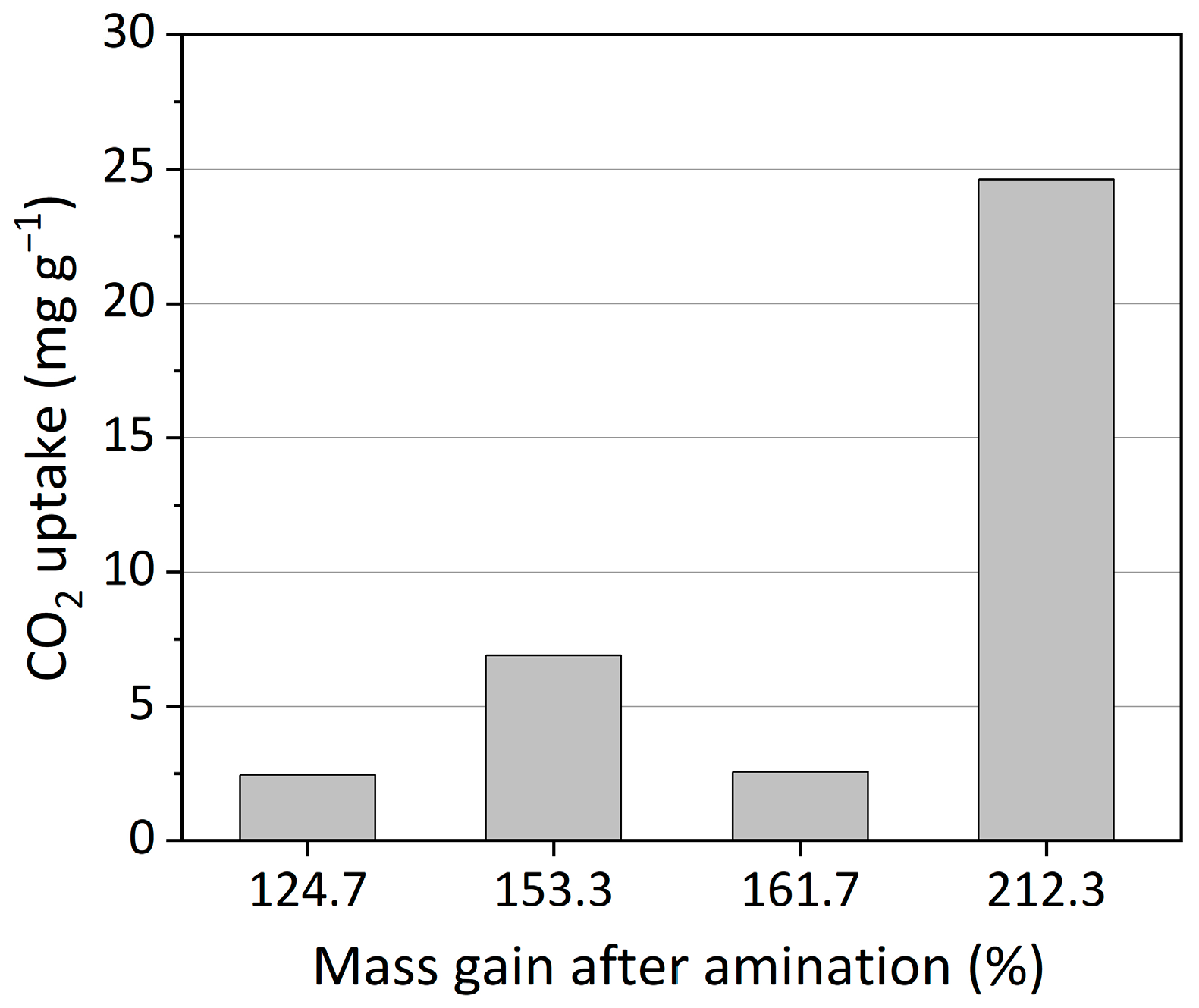
Figure 1. CO2 uptakes for TEPA-AMVFs with different mass gain after amination.
Coatings 16 00646 g001
Figure 2. CO2 uptakes for TEPA-PANs at different reaction durations.
Coatings 16 00646 g002
Figure 3. CO2 uptakes for PEI-ACFs at different KOH/carbon ratios.
Coatings 16 00646 g003
Figure 4. CO2 uptakes and amine utilisation for PEI-ACFs at different PEI loadings.
Coatings 16 00646 g004
Figure 5. Breakthrough curves (a) and CO2 uptake (b) for PEI-ACF at different moisture contents.
Coatings 16 00646 g005
Figure 6. Breakthrough curves (a) and CO2 uptake (b) for PEI-ACF at different inlet CO2 concentrations.
Coatings 16 00646 g006
Figure 7. Adsorption kinetic curves and model fits for PEI-ACF at 1000 ppm CO2.
Coatings 16 00646 g007
Figure 8. (a) CO2 release curves during desorption and (b) desorption curves of PEI-ACF regenerated at 60 °C and 70 °C.
Coatings 16 00646 g008
Figure 9. (a) Adsorption curves and (b) CO2 uptakes of PEI-ACF regenerated at 70 °C.
Coatings 16 00646 g009
Figure 10. (a) Adsorption curves and (b) CO2 uptakes of PEI-ACF regenerated at 60 °C.
Coatings 16 00646 g010
Table 1. Mass gain of viscose fibres during acrylamide grafting and TEPA amination under different reaction conditions (TEPA-AMVF).
Acrylamide Conc.
(%)
FAS Dosage
(g L−1)
Mass Gain After Grafting
(%)
Mass Gain After Amination
(%)
1055.15.1
15516.019.5
201020.526.5
20343.1153.3
20561.8212.3
25543.0161.7
25838.7124.7
Table 2. Mass gain of PAN fibres after TEPA grafting under different reaction conditions (TEPA-PAN).
Temperature
(°C)
TEPA Concentration
(%)
Reaction Duration
(h)
Mass Gain
(%)
1205024154
1206724162
12010024183
1406724213
14010024218
14010010206
1401006234
1401004220
Table 3. Textural properties of ACF felts activated at different KOH/carbon ratios (from N2 sorption) [20].
KOH/Carbon RatioBET Surface Area
(m2 g−1)
Total Pore Volume
(cm3 g−1)
Average Pore Diameter
(nm)
0.001193.80.672.6
0.751214.40.605.4
1.001380.90.7314.2
1.251223.60.7126.1
1.50832.20.8318.3
2.00655.90.451.7
Table 4. Kinetics parameters for PEI-ACF at 1000 ppm CO2.
Kinetics ModelParameters
CO2 Uptake
(mg/g)
kR2
Pseudo-first order95.461.770.995
Pseudo-second order121.860.0120.987
Table 5. Screening summary of CO2 uptake for the aminated fibrous sorbents under indoor-level CO2 (dynamic breakthrough; 1000 ppm CO2, 27 °C).
SorbentPreparation RouteCO2 Uptake at 1000 ppm
(mg g−1)
Key Notes
TEPA-AMVFBridge–grafting on viscose (polyacrylamide intermediate)24.8High mass gain, but capacity is limited by the nonporous structure and surface blockage from acrylamide self-polymerization.
TEPA-PANDirect grafting on PAN (nitrile–amine reaction)35.8Highest among grafted fibres; limited by nonporous PAN surface restricting accessible amine density.
PEI-ACFPhysical impregnation on pore-engineered ACF felt97.0Highest uptake; mesopore engineering + optimized PEI loading enable high amine utilization (0.19 mmol CO2 mmol N−1) and fast kinetics.
Table 6. Comparison of representative sorbents for low-concentration or indoor-level CO2 capture.
SorbentSupport/Form FactorReported ConditionCO2 Uptake at 1000 ppm
(mg g−1)
Key Notes
PEI-ACF (this work)Pore-engineered ACF felt1000 ppm CO2, 27 °C, 50% RH97.0Self-supporting felt; stable partial regeneration at 60–70 °C
TEPA-AMVF (this work)Bridge-grafted viscose fibre1000 ppm CO2, 27 °C, 50% RH24.8Flexible fibre but limited by nonporous substrate and accessible amine density
TEPA-PAN (this work)Direct-grafted PAN fibre1000 ppm CO2, 27 °C, 50% RH35.8Highest among grafted fibres; surface-only amination limits uptake
PEI-MR10 (Wang et al., 2020) [6]PEI-impregnated resin beads1000 ppm CO2, 25 °C, 50% RH116.2High capacity, but bead form requires packed-bed containment
EB-PEHA-ACF (Tao et al., 2022) [20]Modified polyamine on ACF felt1000 ppm CO2, simulated indoor air~60Felt form with stronger mild-temperature regeneration but lower capacity
Disclaimer/Publisher’s Note: The statements, opinions and data contained in all publications are solely those of the individual author(s) and contributor(s) and not of MDPI and/or the editor(s). MDPI and/or the editor(s) disclaim responsibility for any injury to people or property resulting from any ideas, methods, instructions or products referred to in the content.