Article

Atmospheric-Pressure Plasma Polymerization of Fluorosilane Coatings for Suppressing DC Surface Flashover on Polystyrene


State Key Laboratory of Power Transmission Equipment Technology, Chongqing University, Chongqing 400044, China
*
Author to whom correspondence should be addressed.
Coatings 2026, 16(5), 627; https://doi.org/10.3390/coatings16050627
Submission received: 21 April 2026 / Revised: 15 May 2026 / Accepted: 19 May 2026 / Published: 21 May 2026
(This article belongs to the Section Functional Polymer Coatings and Films)

Abstract

Direct current (DC) surface flashover on polystyrene (PS) remains a critical bottleneck that impedes its reliable application in high-voltage insulation apparatus. To circumvent the protracted processing durations and stringent film-forming conditions inherent in conventional surface modification techniques, this study proposes a novel “liquid-film-assisted in situ rapid plasma curing” strategy. By harnessing atmospheric-pressure dielectric barrier discharge (DBD) technology within an argon ambient, the rapid (<6 min) and efficient deposition of a fluorosilane (FAS-13) functional coating onto the substrate was achieved. Microscopic characterizations coupled with isothermal surface potential decay (SPD) measurements reveal that this coating substantially mitigates the detrapping and surface migration of charge carriers. Macroscopic DC flashover testing corroborates that, under the optimal modification ratio, the surface breakdown voltage of PS is elevated to 14.04 kV, yielding an insulation gain of 26.94%. To elucidate the underlying physical mechanisms, density functional theory (DFT) calculations were conducted, revealing that the energy band misalignment between the wide-bandgap fluorinated layer and the substrate facilitates the construction of a high-density deep trap network (with a depth of ~0.8 eV) at the coating–substrate interface. By robustly anchoring primary electrons and inducing the formation of a homopolar space charge shielding layer, these deep traps physically arrest the evolution of the secondary electron emission avalanche (SEEA). Consequently, this work not only establishes a viable engineering framework for the rapid, large-scale surface reinforcement of DC insulation equipment but also provides profound quantum chemical insights into interfacial trap regulation within all-organic dielectrics.

1. Introduction

Polystyrene (PS), distinguished by its exceptional dielectric properties and high optical transparency, is extensively utilized in microwave dielectric windows, high-frequency capacitors, and high-voltage support insulators. While PS is often blended into HVDC cables to mitigate space charge, pure PS components face severe reliability challenges at gas–solid interfaces—such as those found at cable terminations, insulating spacers, and triple junctions. Under extreme direct current (DC) electric field stresses, dielectric mismatch and localized surface charge accumulation at these exposed interfaces readily trigger surface flashover. This vulnerability remains a primary bottleneck for the long-term reliability of UHVDC equipment. To address this issue, various surface modification techniques have been developed. These methods reconstruct the dielectric surface states via physical or chemical interventions, introducing deep traps to anchor migrating free charges. Among conventional strategies, thermal treatment has been proven to markedly optimize the microscopic morphology and flashover resistance of PS and inorganic insulators through melt recrystallization processes [1,2]. Furthermore, surface oxidation (e.g., ozone exposure) [3], molecular self-assembly [4], and direct fluorination [5,6] have emerged as viable pathways to modulate surface charge dynamics and suppress secondary electron emission (SEE). Nevertheless, the practical engineering implementation of these traditional techniques is frequently hampered by protracted reaction cycles, the involvement of toxic gases, or the potential for thermal degradation of the substrates.
In contrast, atmospheric-pressure low-temperature plasma technology (such as dielectric barrier discharge, DBD), characterized by its non-thermal equilibrium nature and high reactive activity, exhibits superior material universality in the realm of in situ interfacial modification. This technology has not only been widely applied in regulating the wettability and anti-fogging properties of polymer surfaces [7,8] but has also demonstrated excellence in the functional grafting of biomedical films [9,10]. Moreover, it possesses distinct procedural advantages in fabricating substrate-independent, densely cross-linked nanocoatings [11,12]. Within the domain of electrical insulation reinforcement, the deployment of plasmas to deposit fluorine- and silicon-rich coatings represents a cutting-edge approach to suppressing surface charge distortion on insulators. For instance, dense anti-flashover coatings can be deposited onto polymer surfaces via plasma discharges utilizing gas-phase precursors (e.g., CHF3 or HMDSO) [13,14,15,16]. Yet, existing pure gas-phase deposition methodologies are often plagued by sluggish deposition rates, rendering them inadequate for the rapid coating of large-area insulation components.
Crucially, the majority of prior investigations have predominantly focused on the phenomenological description of macroscopic charge dissipation characteristics [17], leaving the nonlinear impact of plasma processing parameters (such as substrate temperature and discharge characteristics) on the coating’s cross-linked network insufficiently explored [18]. At the micro-mechanistic level, in particular, the quantum chemical origins of deep traps induced by coating/substrate energy band misalignment, as well as the mechanism by which these deep traps inhibit plasma evolution by altering multi-mobility distributions [19,20], still lack a systematic physical elucidation.
In light of these challenges, this paper proposes a novel “liquid-film-assisted in situ rapid curing” strategy grounded in DBD plasma technology. Utilizing methyl methacrylate (MMA) as a unified solvent, fluorosilane (FAS-13), tetraethoxysilane (TEOS), trehalose (Tre), and dodecafluoropentane (PFP) were coated onto PS surfaces and subsequently subjected to rapid curing and film formation under argon plasma irradiation. By integrating macroscopic surface flashover testing, isothermal surface potential decay (SPD) analysis, and density functional theory (DFT) calculations, this study systematically contrasts the microscopic effects of disparate functional groups on the physicochemical properties of the materials. Ultimately, from the perspective of molecular orbitals and energy band misalignment, this work aims to profoundly unravel the physical mechanism by which high-density deep traps suppress DC surface flashover.

2. Materials and Methods

2.1. Reagents and Liquid Film Preparation

The substrate employed in this study comprised polystyrene (PS) structural sheets with dimensions of 75 mm × 25 mm × 2 mm. To ensure solubility compatibility with the deposited materials, methyl methacrylate (MMA, CAS: 80-62-6) was selected as the universal solvent. Representative polar and fluorine-containing substances were chosen as modifying monomers: fluorosilane (FAS-13, CAS: 51851-37-7), tetraethoxysilane (TEOS, CAS: 78-10-4), trehalose (CAS: 6138-23-4), and dodecafluoropentane (PFP, CAS: 678-26-2).
Prior to preparation, the PS substrates were ultrasonically cleaned in anhydrous ethanol for 10 min and thoroughly desiccated. Under standard ambient temperature and pressure, the four aforementioned deposition reagents were individually admixed with MMA at mass fractions of 10 wt%, 20 wt%, 30 wt%, and 40 wt%. The mixtures were continuously agitated for 10 min using an ultrasonic disperser to achieve homogeneous dispersion. Subsequently, the four deposition reagents and a pure MMA control were uniformly applied onto the PS sheets via a roller mechanism. The coated samples were then transferred to a film applicator (doctor blade) to meticulously control the initial liquid film thickness to 5 μm prior to the plasma treatment. It should be noted that following solvent evaporation and plasma-induced polymerization, the final dry coating thickness is significantly reduced to the sub-micron scale, as discussed in Section 3.2.

2.2. Atmospheric-Pressure Plasma Polymerization and Deposition Process

The PS samples coated with the liquid film were positioned within a DBD plasma reactor (as depicted in Figure 1). To eliminate potential interference from atmospheric moisture and impurities, the chamber was repeatedly purged and evacuated with high-purity argon. Throughout the plasma polymerization and deposition process, a continuous flow of high-purity argon was maintained at a constant rate of 2.0 L/min. A nanosecond-pulsed high-voltage power supply was engaged, utilizing a bipolar square-wave pulse with a peak voltage of 7 kV, a pulse width of 500 ns, and a repetition frequency of 1 kHz to excite and sustain the atmospheric-pressure glow plasma. Under the bombardment of high-energy electrons generated by the low-temperature plasma, the MMA and monomer reagents rapidly underwent ring-opening and bond-cleavage reactions, polymerizing into a cross-linked network. The treatment duration was uniformly standardized to 6 min, thereby yielding modified PS samples with dense surface deposition layers. Furthermore, to evaluate the acceleration of coating solidification induced by plasma polymerization, the curing times of the liquid films on the PS surfaces were recorded under both plasma-treated and standard room-temperature conditions.

2.3. Surface Trap Distribution Measurement (SPD Method)

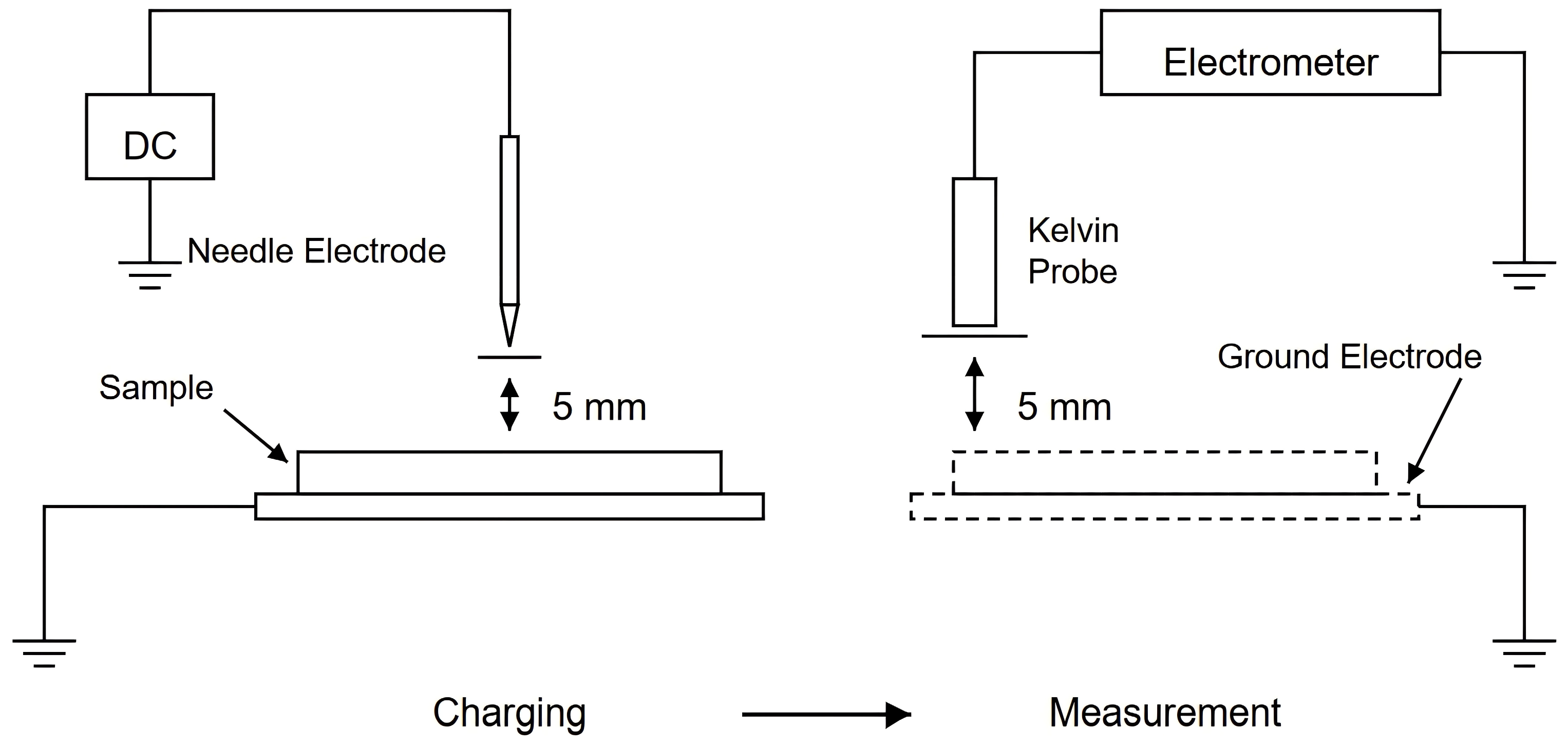
The trap energy level and density distribution of the insulating samples were quantified utilizing the isothermal surface potential decay (SPD) method. The measurement platform, illustrated in Figure 2, operated in two distinct phases: corona charging and potential measurement.
The characterization of surface trap distributions via the isothermal surface potential decay (SPD) method was conducted in two sequential stages: corona charging and potential measurement. In the charging stage, a needle electrode was coupled to a negative-polarity high-voltage direct current (HVDC) source to inject charges onto the specimen surface via tip-induced corona discharge. The needle tip was vertically aligned with the geometric center of the specimen, with the needle-to-surface gap strictly maintained at 5 mm. The charging process was performed at a constant voltage of −4.5 kV for a duration of 10 min. During the subsequent measurement stage, the specimen, together with the grounded plate electrode, was transferred beneath a non-contact Kelvin probe. The probe was coaxially positioned 5 mm above the specimen’s center and coupled to a surface electrometer to monitor and record the surface potential in real-time. The data acquisition phase persisted for over 20 min, and the recorded time-domain potential decay was subsequently utilized to calculate the trap energy level and density distribution.
According to the classical isothermal SPD theory proposed by J. G. Simmons [21] and the surface charge migration model [22], the current density J flowing through the insulating sample at time t is given by
J = e L k T 4 t N t E
Concurrently, the current density J at time t can be derived from the surface potential decay rate.
J = ϵ 0 ϵ r L d V s d t
where ϵ 0 denotes the vacuum permittivity (8.854 × 10⁻¹² F/m), ϵ r represents the relative permittivity, and V s signifies the surface potential (V) of the insulating sample at time t . By combining and manipulating these equations, the trap energy density distribution function N t E is obtained.
N t E = 4 ϵ 0 ϵ r e L 2 k T t d V s t d t
By calculating the product of the sample’s surface potential decay rate and time t , the relationship curve between the trap energy density function N t E and E t is acquired, thereby elucidating the charge trap distribution characteristics of the sample.
N t E E t = 4 ϵ 0 ϵ r e L 2 k 2 T 2 ln ν t t d V s t d t

2.4. DC Surface Flashover Voltage Testing

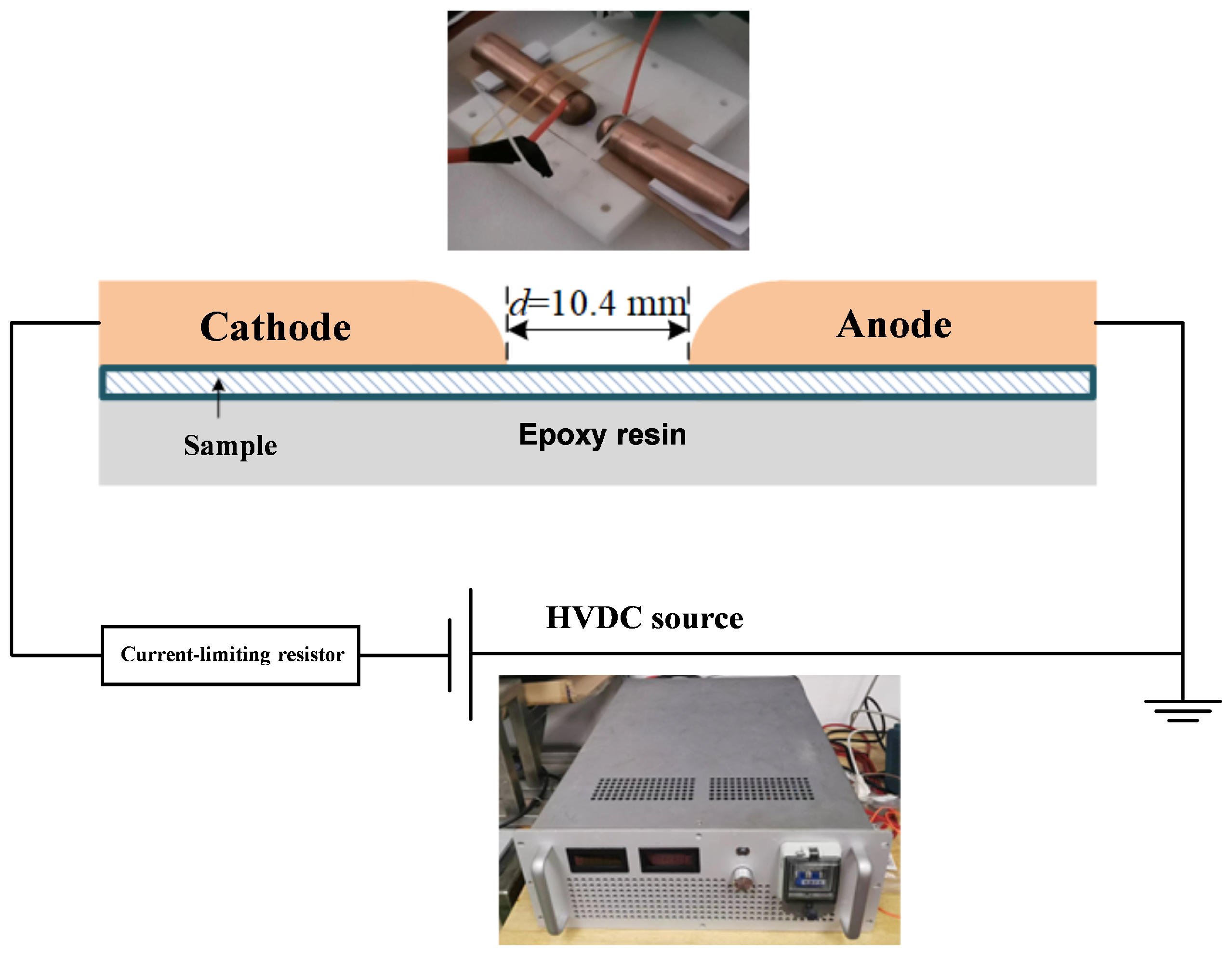
DC surface flashover evaluations were conducted using a pair of symmetrical finger-shaped brass electrodes (with a tip radius of curvature of 7 mm), separated by a strictly controlled gap of 10.4 mm (the testing platform is shown in Figure 3).
The electrodes were firmly pressed against the sample surface using insulating elastic cords. A negative-polarity DC high voltage was applied, increasing linearly at a constant rate of 0.3 kV/s. The occurrence of surface flashover was recorded at the instant of voltage breakdown, identified by the observation of a discharge glow accompanied by a precipitous voltage drop to near zero. For each experimental condition, the testing was repeated 20 times. The samples were replaced between consecutive tests, and the electrodes were wiped with anhydrous ethanol and air-dried. The flashover breakdown voltages were statistically evaluated using a two-parameter Weibull distribution model. To assess the reliability of the dielectric strength measurements, 95% confidence intervals (CIs) are provided for the scale parameter (α) [23].

3. Results

3.1. Effect of Plasma on Coating Curing Characteristics

To substantiate the high-efficiency nature of the plasma polymerization protocol, the solidification durations of four distinct monomeric liquid films (at a 10 wt% concentration) were meticulously compared under “plasma-treated” versus “ambient room-temperature” conditions, as summarized in Table 1.
The empirical data explicitly demonstrate the catalytic efficacy of the plasma environment. While the MMA-containing precursor films required an extensive duration exceeding 4 h (14,469.4 s to 14,826.6 s) to achieve complete solidification via slow solvent evaporation and natural polymerization under ambient conditions, the introduction of DBD plasma truncated this interval precipitously to less than 6 min (341.8 s to 346.2 s). This accelerated solidification is fundamentally driven by the high-energy electrons and reactive species (e.g., excited argon and residual oxygen species) generated within the plasma glow. These highly energetic particles efficiently bombard the liquid film, cleaving the C=C double bonds in the MMA and precursor monomers, thereby initiating a rapid, multi-centered free-radical polymerization that quickly constructs a densely cross-linked network.

3.2. Microscopic Morphology and Elemental Composition of the Coating

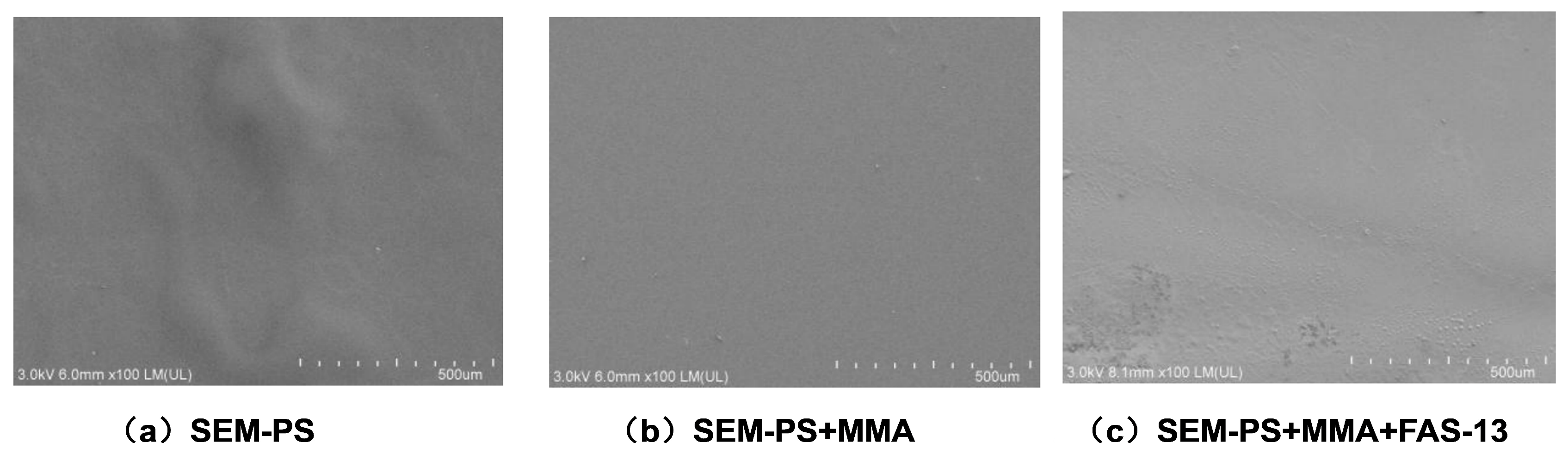
Given that the microscopic topography of solid dielectric surfaces is highly susceptible to inducing local electric field distortions—thereby significantly confounding the authentic assessment of the material’s intrinsic insulation properties during surface flashover—the surface uniformity across all specimen cohorts was initially subjected to rigorous scrutiny via scanning electron microscopy (SEM).
Although the initial liquid film thickness was controlled at 5 μm during the preparation stage, the subsequent evaporation of the MMA solvent and the rapid in situ polymerization of the monomers under high-energy plasma bombardment—accompanied by significant volumetric contraction—resulted in the formation of an ultra-thin coating in the sub-micron to nanometer range.
As depicted in Figure 4, SEM observations at a 500 μm scale corroborate the macroscopic surface uniformity of all specimen cohorts. Although localized nanoscale observations are not presented here, the structural integrity and high cross-linking density of the FAS-13 coating—free from severe microcracks or porosity—can be firmly corroborated by the subsequent electrical characterizations. Specifically, the presence of physical defects would inevitably introduce local electric field enhancements and charge leakage channels, leading to deteriorated flashover voltages and accelerated surface potential decay. Conversely, our plasma-polymerized samples exhibited substantially elevated breakdown thresholds and robust charge retention (as detailed in Section 3.3 and Section 3.4), strongly validating the conformal and dense nature of the modified interfacial layer. This uniformity effectively eliminates the possibility of enhanced flashover resistance arising from elongated creepage paths associated with increased macroscopic surface roughness.
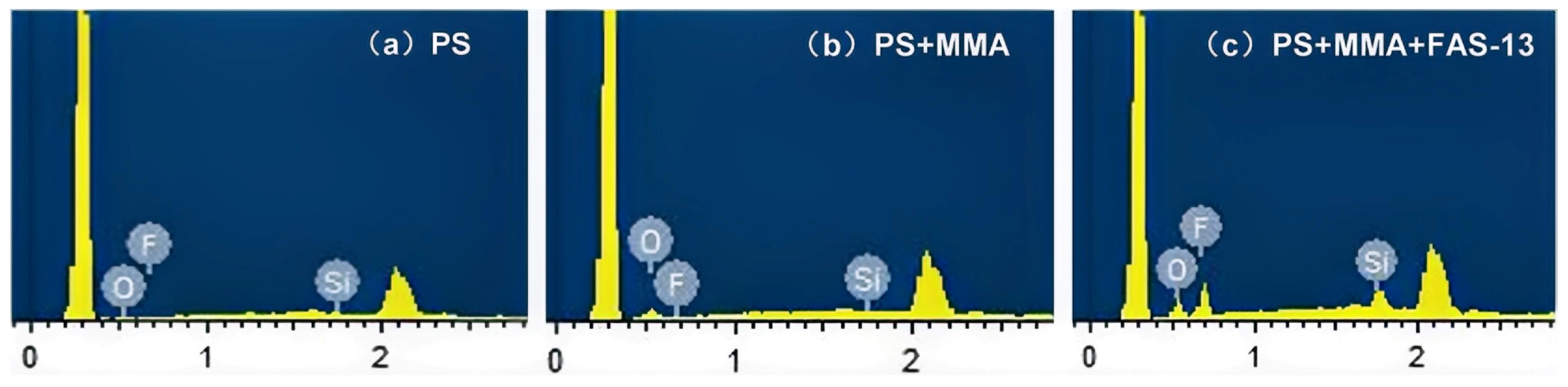
Furthermore, EDS energy spectrum analysis (Figure 5) confirms the elemental composition of the modified surfaces: while the pristine PS exhibited only carbon (C) peaks and the MMA-coated sample showed an oxygen (O) peak, the FAS-13-modified specimens distinctly displayed fluorine (F) and silicon (Si) peaks. This provides direct chemical evidence of the successful grafting and deposition of fluorosilane groups onto the PS matrix mediated by plasma induction, maintaining robust interfacial bonding throughout the experimental procedures.

3.3. Modulation of Surface Trap Distribution Characteristics by the Coating

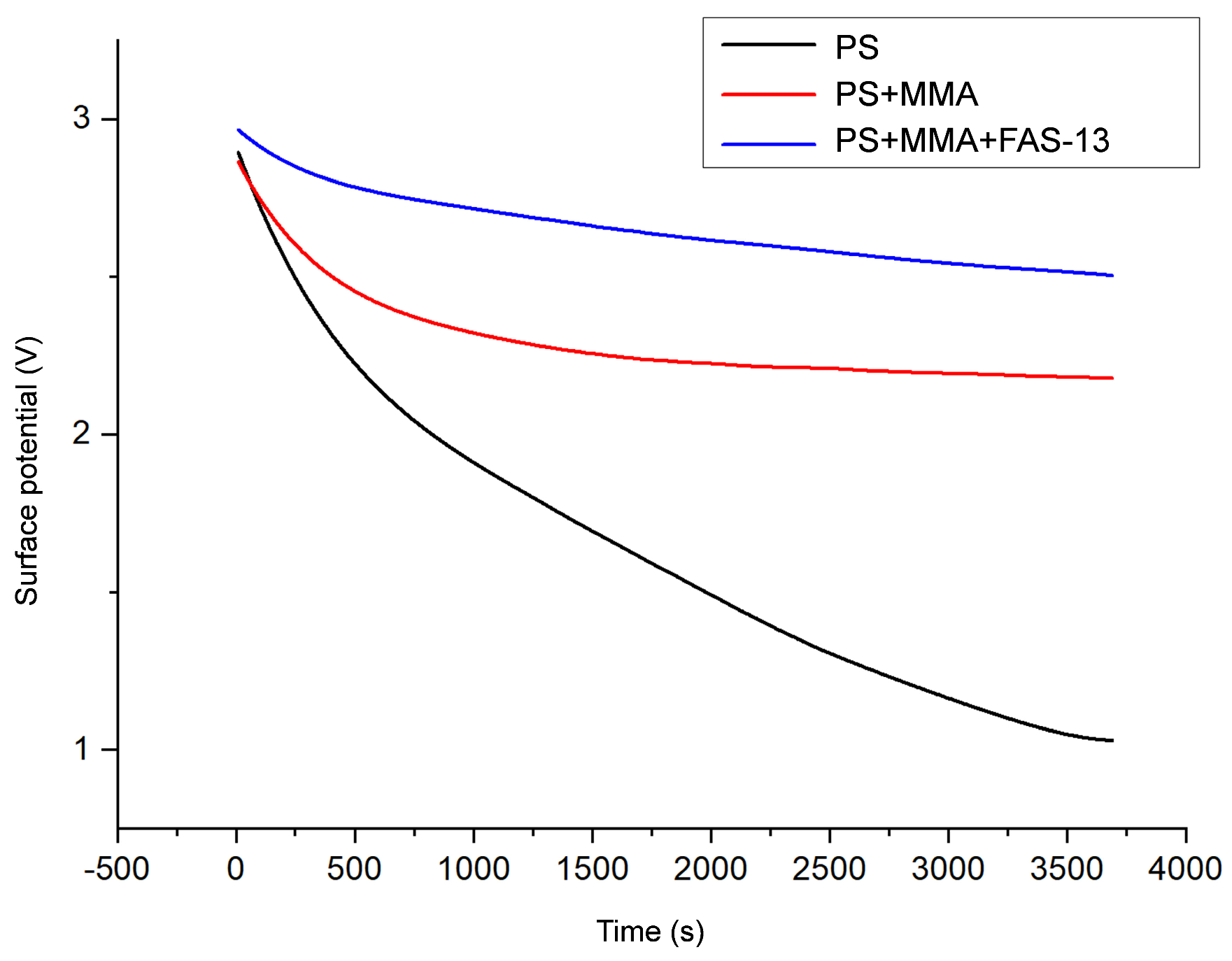
The time-domain decay of the surface potential on insulating specimens provides a critical reflection of the surface’s capacity for charge capture and storage, as well as the carrier migration capability along the interface. In the non-contact Kelvin probe electrometer measurements employed herein, the recorded surface potential values correlate positively with the average surface charge density in the proximity of the probe [24]. Comparative analysis of the initial surface potentials (at t = 0) reveals that the FAS-13-modified PS samples exhibited the highest initial charge density, whereas the pristine and MMA-coated PS specimens showed sequentially lower values. This implies an enhanced capacity for charge anchoring and storage in the FAS-13-modified surfaces.
Figure 6 illustrates the surface potential decay (SPD) curves for the various samples. During the decay phase—representing the migration of accumulated charges toward the ground electrode—the pristine PS exhibited the most rapid dissipation, whereas the FAS-13-deposited PS showed a markedly decelerated decay rate. Given the extremely low intrinsic bulk conductivity of polystyrene (typically < 10−16 S/m), charge dissipation through the material volume is negligible over the duration of the measurements. Therefore, according to the hopping conduction theory in polymeric dielectrics, the observed charge decay is overwhelmingly dominated by surface migration, which involves dynamic trapping and detrapping processes governed by the surface trap distribution.
The time-domain decay of surface potential on insulating specimens provides a critical reflection of the surface’s capacity for charge capture and storage, as well as the carrier migration capability along the interface. The recorded surface potential values correlate positively with the average surface charge density in the proximity of the probe, in accordance with the principles of non-contact potential measurement. Comparative analysis of the initial surface potentials (at t = 0) reveals that the FAS-13-modified PS samples exhibit the highest initial charge density at the cessation of the charging phase, whereas the pristine and MMA-coated PS specimens show sequentially lower values. This observation implies that the plasma-deposited fluorosilane coating effectively reconstructs the surface states, significantly enhancing the capacity for charge anchoring and storage.
During the decay phase—representing the migration of accumulated charges toward the ground electrode—the pristine PS exhibits the most rapid dissipation, whereas the FAS-13-modified PS shows a markedly decelerated decay rate. Within the framework of hopping conduction theory in polymeric dielectrics, surface charge transport is fundamentally a dynamic process of trapping and detrapping. The migration velocity is intrinsically governed by the energy distribution of surface traps; consequently, the trap energy level and density distribution can be quantitatively derived by analyzing the time-domain evolution of the surface potential.
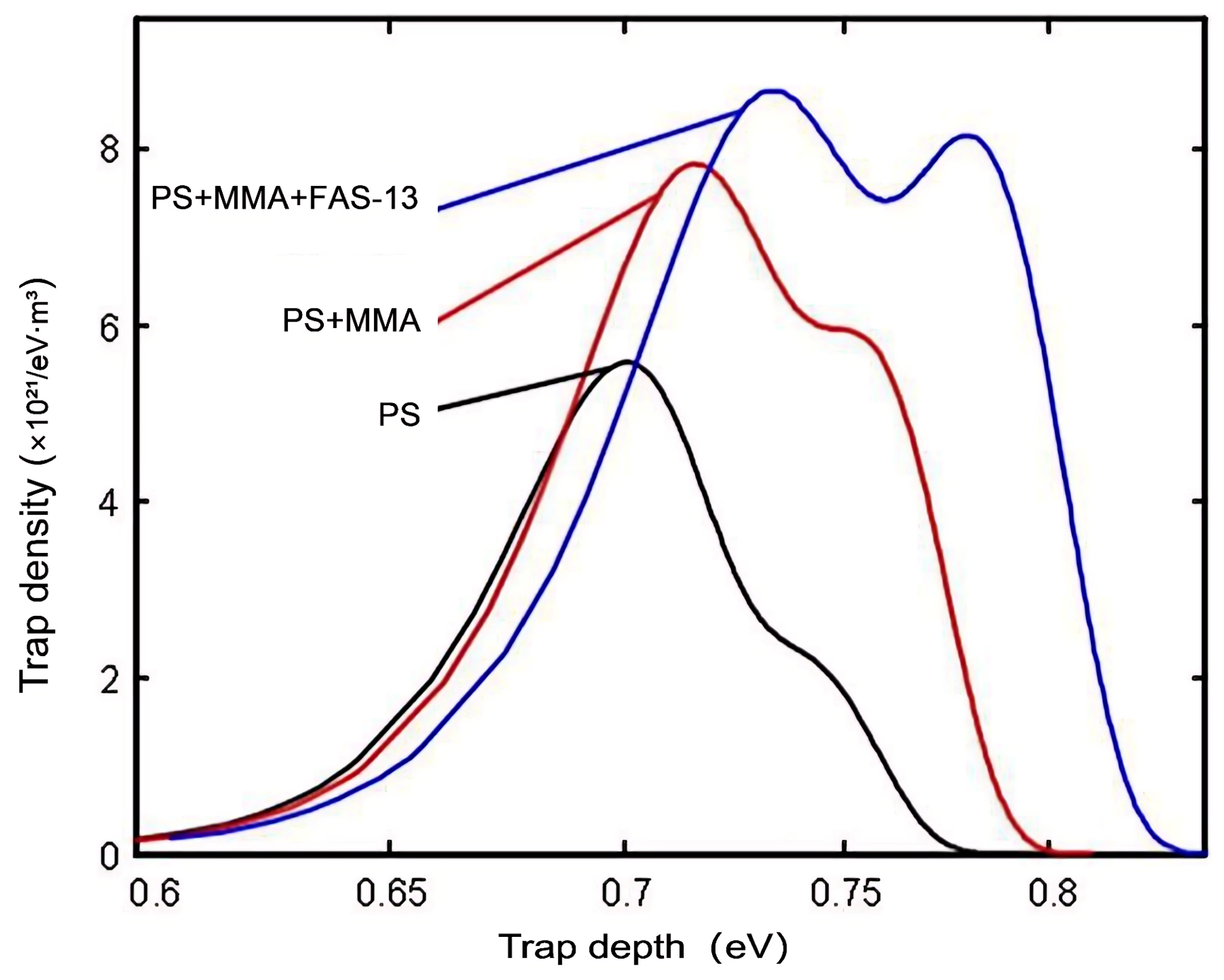
Consequently, the trap energy level density was derived based on the Simmons theory, as shown in Figure 7:
The calculations reveal a characteristic bimodal distribution consisting of “shallow” and “deep” traps for all specimens:
Pristine PS: Shallow and deep trap energy levels centered at approximately 0.70 eV and 0.74 eV, respectively.
MMA-coated PS: Shallow traps deepened to >0.70 eV, while deep traps shifted to approximately 0.75 eV.
FAS-13-modified PS: Significant energy level shifts were observed, with shallow traps deepening to >0.73 eV and deep traps approaching 0.80 eV, accompanied by the highest overall trap density among the three groups.
Within the framework of hopping conductivity, deep traps act as “energy wells” along the carrier migration path. Increased trap depth and density exert a stronger Coulombic attraction on trapped electrons, thereby increasing the activation energy required for detrapping and manifesting macroscopically as the observed suppression of surface potential decay.

3.4. Influence of Coating Materials and Concentration on DC Surface Flashover Voltage

Statistical analysis of the flashover breakdown voltages was performed using a two-parameter Weibull model, with the scale parameter alpha (representing the breakdown voltage at a 63.2% probability) and the shape parameter beta (representing data dispersion) serving as key performance indicators.
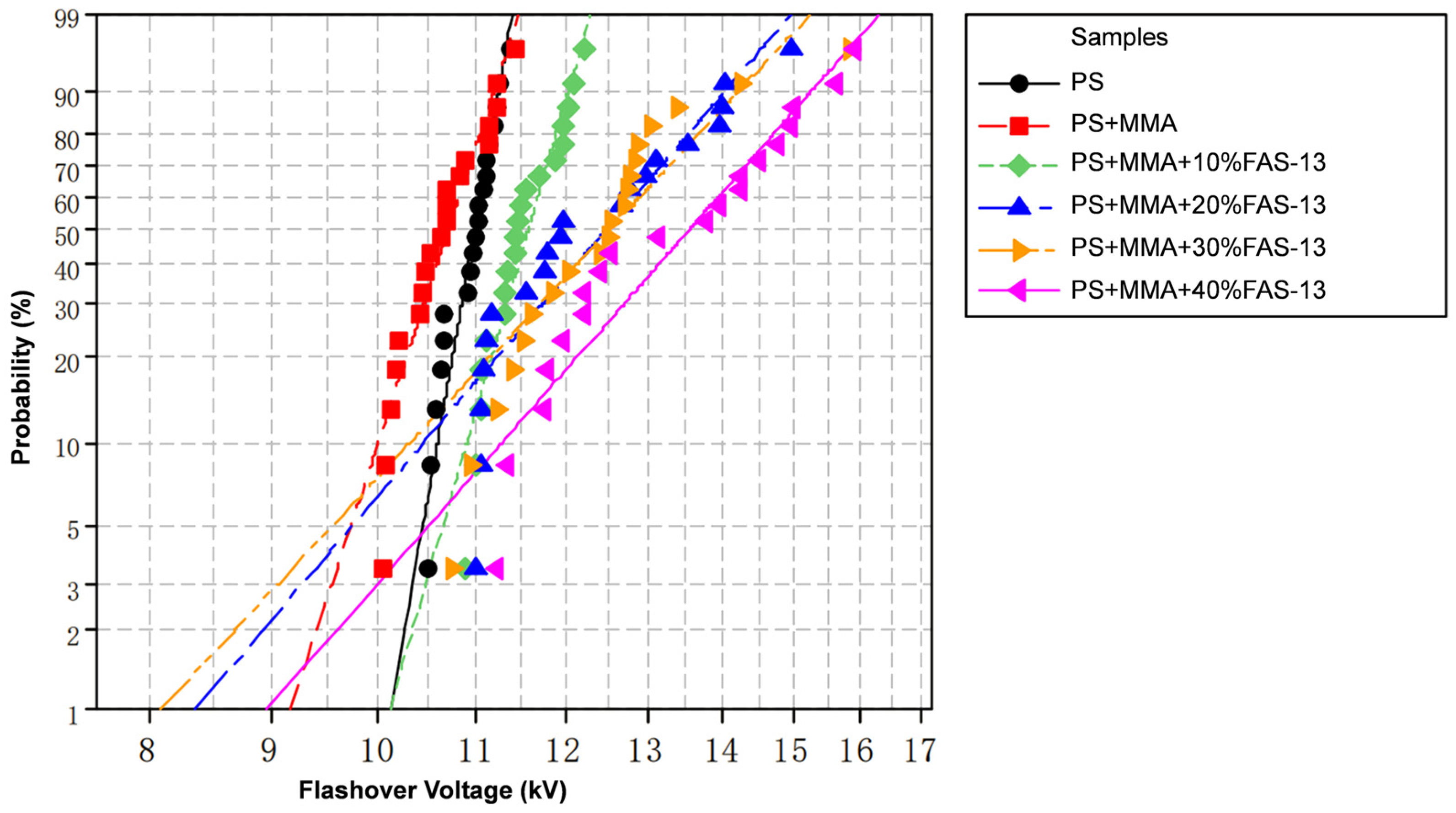
Fluorosilane (FAS-13): This material yielded the most prominent enhancement (Figure 8 and Table 2). The alpha value of the pristine PS was 11.06 kV. With the FAS-13 concentration increasing from 10 wt% to 40 wt%, the flashover voltage exhibited a steady ascent, reaching 14.04 kV at 40 wt%—a 26.94% improvement over the pristine specimen. Although a slight decrease in the shape parameter was observed, indicating increased dispersion, the absolute breakdown threshold was significantly bolstered.
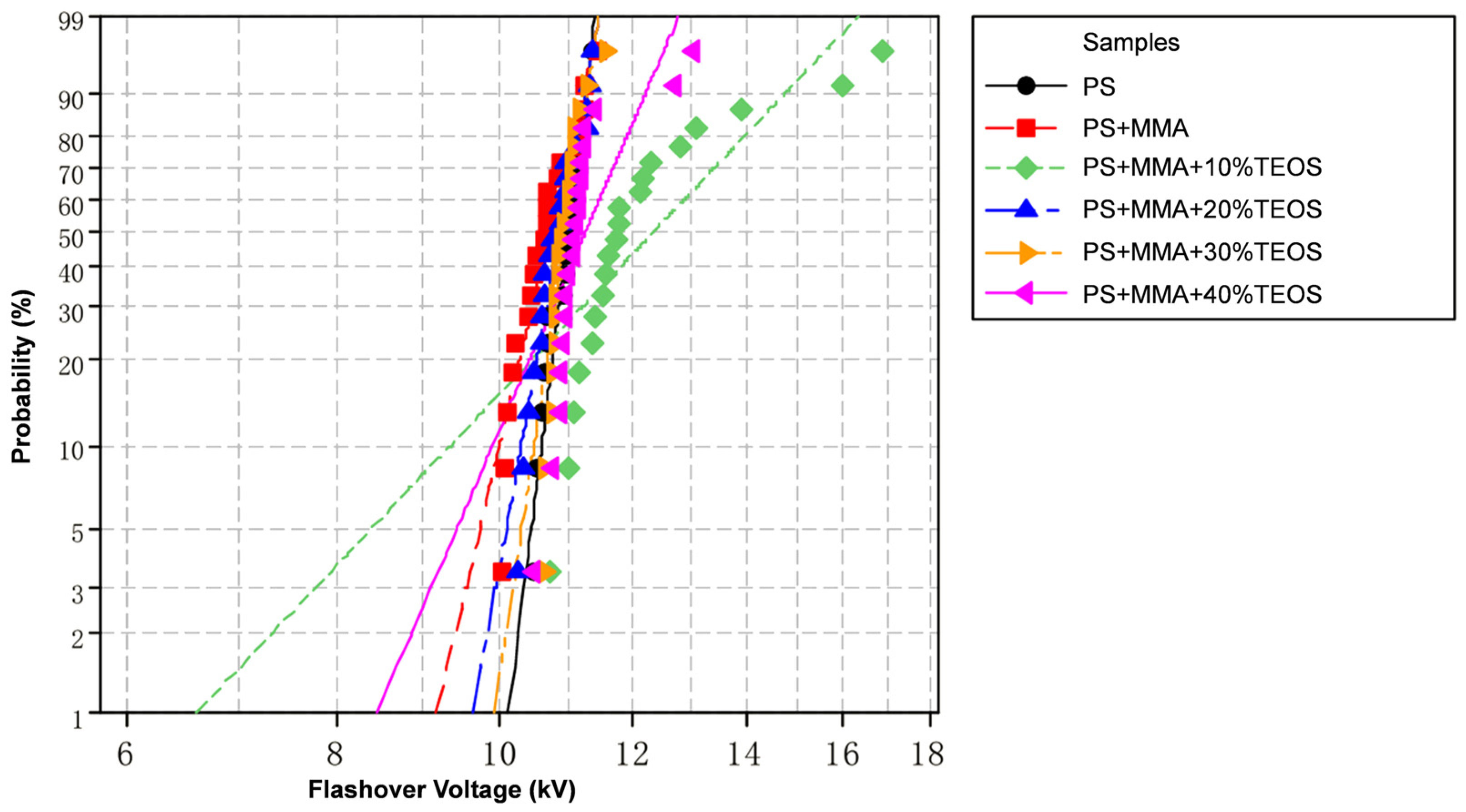
Tetraethoxysilane (TEOS): While 10 wt% TEOS increased the alpha value to 13.03 kV, the shape parameter beta plummeted to 6.785 (Figure 9 and Table 3). Such high dispersion in discharge phenomena poses significant risks in engineering applications, and higher concentrations of TEOS even led to a degradation in dielectric strength.
The pronounced statistical instability observed in TEOS-modified samples (characterized by a drastically reduced shape parameter β) can be attributed to differences in crosslinking density and trap distribution compared to FAS-13. While TEOS can form a silica-like network under plasma irradiation, it lacks the strongly electronegative fluorine groups present in FAS-13. From an industrial application perspective, a low shape parameter (β) dictates that the breakdown voltage at a 1% failure probability falls below the safety margin of pristine PS, rendering modifications like TEOS impractical despite isolated high-voltage breakdowns. This severe statistical variation is driven primarily by the physical nature of the modification mechanism rather than procedural inconsistency. Atmospheric-pressure DBD plasma fundamentally consists of micro-filamentary discharges. The interaction between these stochastic micro-discharges and the precursor film yields a spatially heterogeneous cross-linking network. Consequently, this generates a broadened, uneven spatial distribution of interfacial trap depths, creating unpredictable localized discharge paths during extreme DC stress. In contrast, the FAS-13 formulation successfully elevates the absolute breakdown threshold while mitigating this extreme dispersion, highlighting its engineering viability.
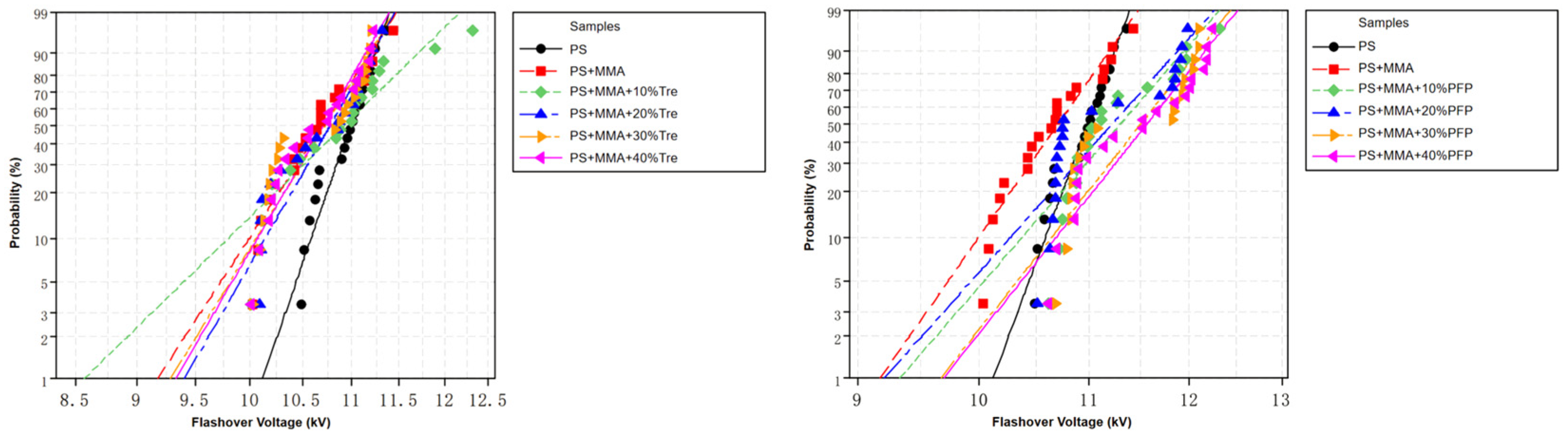
Trehalose and Dodecafluoropentane (PFP): Trehalose deposition yielded negligible improvements in flashover voltage (alpha remained between 10.84 and 11.15 kV). PFP provided a slight enhancement to 11.74 kV but was similarly plagued by high data dispersion (Figure 10 and Table 4).
In summary, the 40 wt% FAS-13 coating deposited via plasma polymerization constitutes the optimal formulation for suppressing DC surface flashover under ambient conditions.

3.5. Molecular Orbital Energy Band Structure Calculation

According to molecular orbital theory, the migration of charge carriers on the surface of insulating materials is restricted to discrete molecular orbitals or involves hopping between them. Thus, the energy of these carriers is quantized rather than continuous, and the hopping process inherently involves shifts in the carrier’s own energy state. Consequently, the impact of surface modification on flashover was analyzed from the perspective of molecular orbital energy levels.
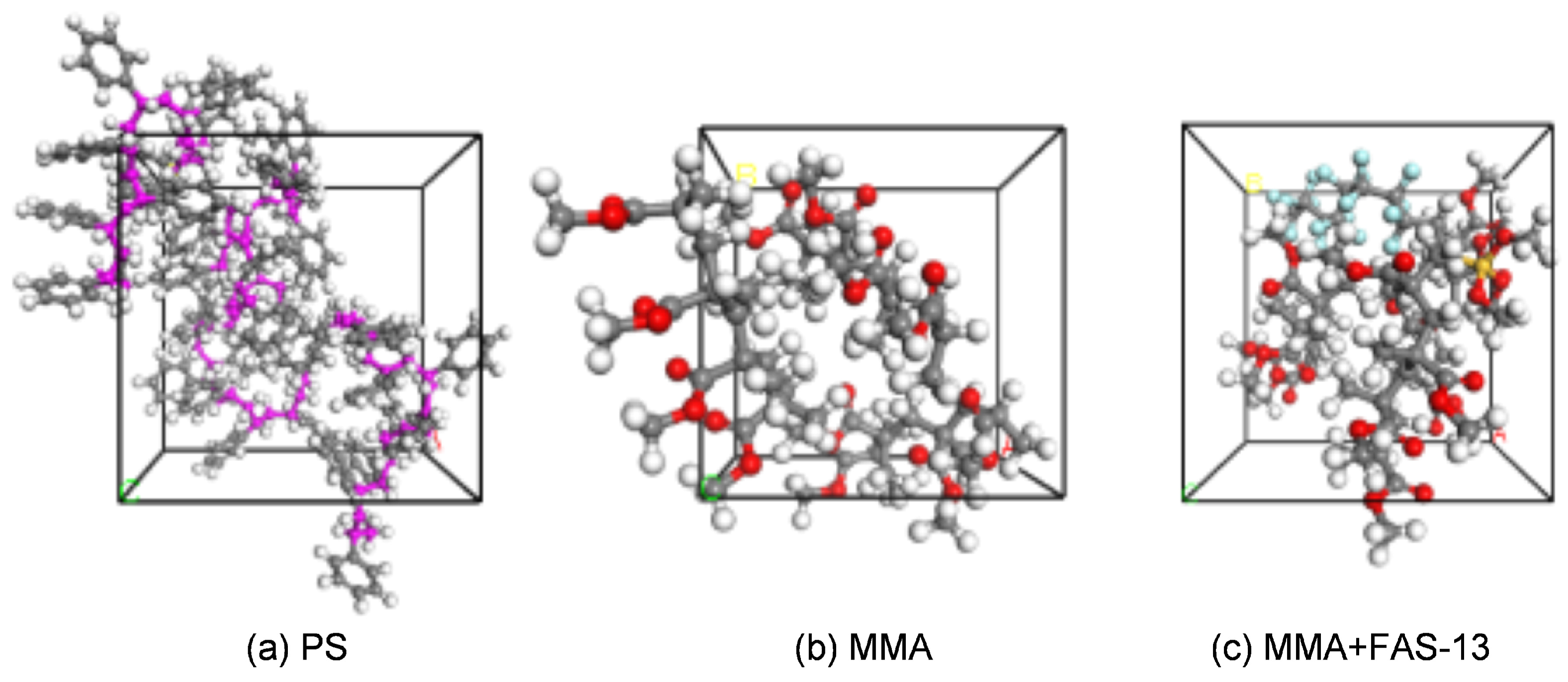
Molecular chain models for pristine PS, MMA solvent, and the MMA/FAS-13 mixture were established in the Gaussian 09 software (Figure 11):
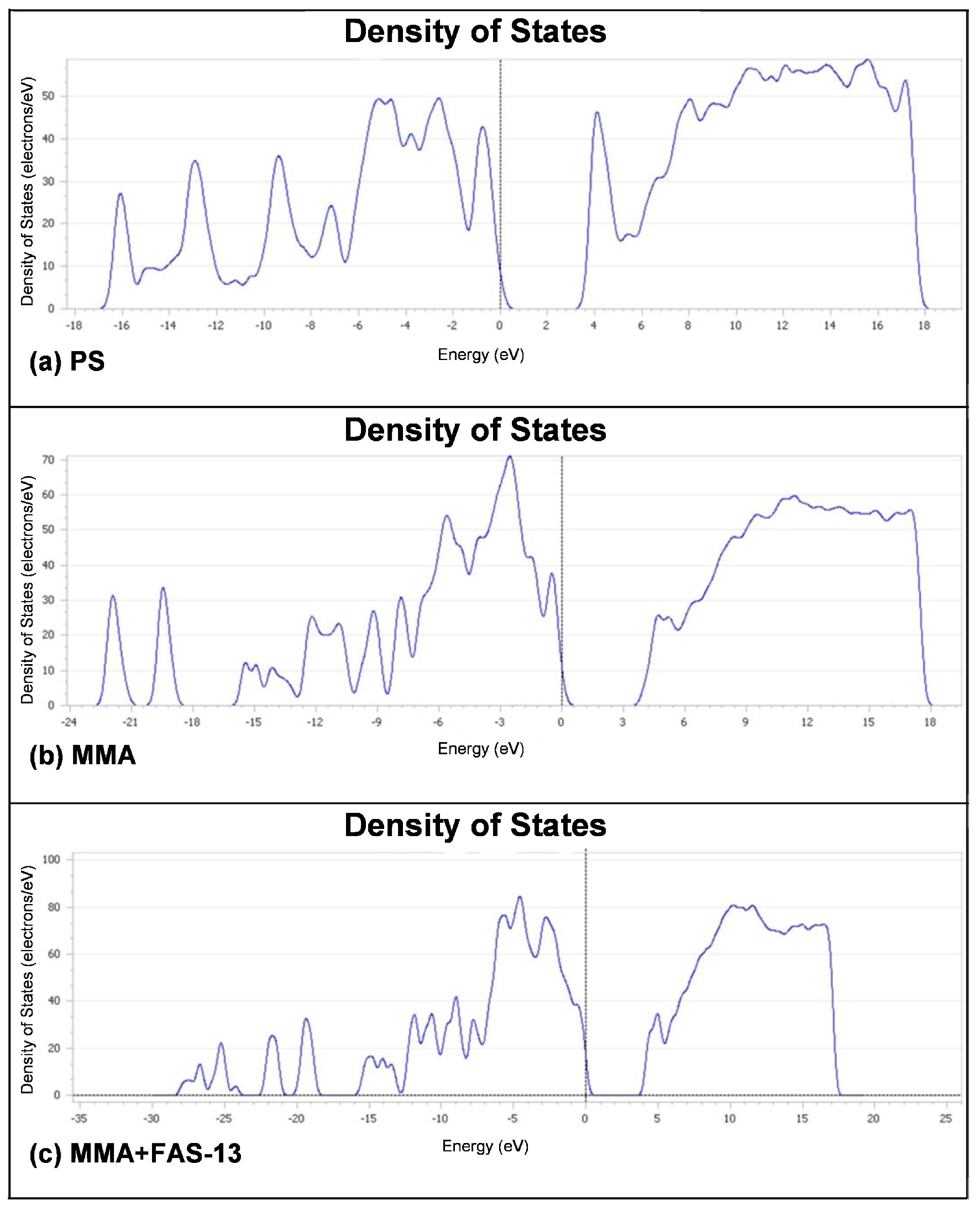
Following structural optimization at the B3LYP/3-21G level, the molecular orbital energies and the corresponding electron distributions were calculated using the B3LYP/6-31G basis set, with results shown in Figure 12.
The results indicate that for PS, the Highest Occupied Molecular Orbital (HOMO) and Lowest Unoccupied Molecular Orbital (LUMO) energy levels were 0.91 eV (valence band maximum) and 2.89 eV (conduction band minimum), respectively, yielding a bandgap of 1.98 eV. For MMA, the HOMO and LUMO levels were 0.92 eV and 3.12 eV, with a slightly wider bandgap of 2.20 eV. Crucially, the MMA/FAS-13 mixture exhibited a HOMO level of 0.91 eV and a LUMO level of 3.28 eV, resulting in a bandgap of 2.37 eV—significantly wider than that of the PS matrix. Therefore, the selection of MMA was not merely empirical for ensuring solubility compatibility but also theoretically advantageous for interfacial energy band alignment. As a transition layer, its intermediate bandgap properties assist in mitigating abrupt energy level mismatches, functioning synergistically with the deep traps introduced by the fluorosilane groups.

3.6. Coating–Substrate Interface Deep Trap Model and Charge Dynamic Behavior

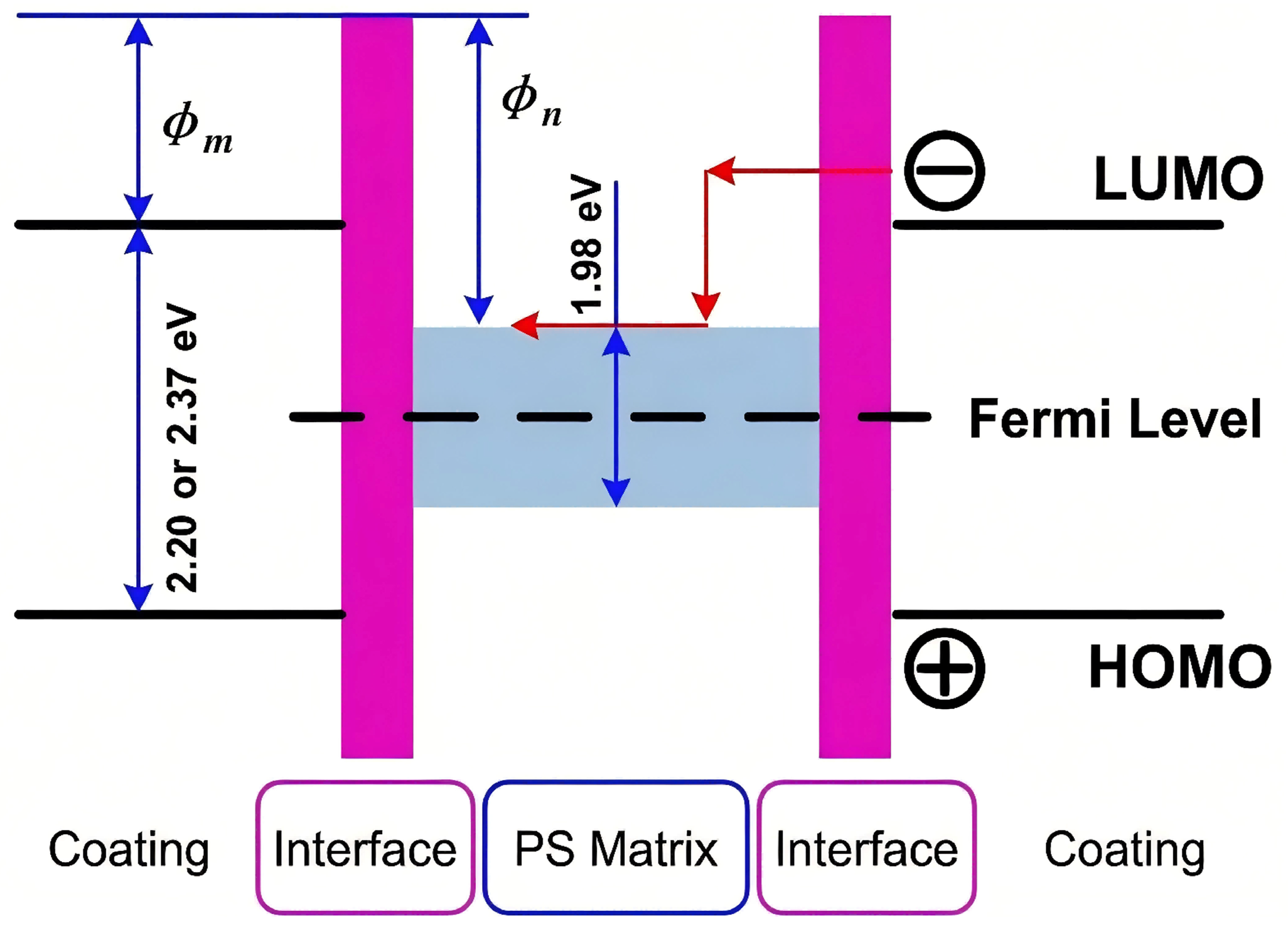
When the FAS-13/MMA coating is deposited onto the PS substrate via plasma treatment, an interfacial energy band structure is established, as depicted in Figure 13:
The potential barrier height at the coating/substrate interface is fundamentally governed by the discrepancy in the bandgaps of the two materials. Upon contact and the subsequent attainment of Fermi level equilibrium, the hopping migration of electrons across the micro-interface must surmount the corresponding barriers ( Φ m and Φ n ). While the MMA/PS interface forms only “shallow traps” with weak carrier confinement due to the minimal bandgap difference, the FAS-13/PS interface—characterized by a pronounced bandgap disparity—facilitates the construction of a “deep trap” network with a high potential barrier of approximately 0.8 eV. As fundamentally proposed in Niemeyer’s generalized partial discharge modeling [25], potential well trapping is a critical phenomenological mechanism for suppressing electron avalanches. However, modeling this effect has historically relied on idealized energetic assumptions due to interfacial complexity. Our energy band analysis adds theoretical sophistication to this understanding by bridging macroscopic trapping phenomenology with microscopic quantum chemical design. The wide-bandgap FAS-13 interface provides a deterministic molecular origin for the deep trap network. These deep traps effectively capture and anchor migrating surface charges, thereby depleting the primary electron sources available for gas-phase collision ionization and solid-phase secondary electron emission. Consequently, the plasma-deposited FAS-13 coating suppresses the evolution of the electron avalanche at the physical level, markedly enhancing the surface flashover voltage of DC insulating components.

4. Discussion

The experimental results demonstrate that atmospheric-pressure DBD plasma treatment significantly compresses the film-forming cycle of insulating coatings (<6 min), with the 40 wt% FAS-13-modified PS sample exhibiting the most exceptional anti-flashover performance: its DC surface breakdown voltage reached 14.04 kV, representing a 26.94% gain over the pristine PS substrate. Comparative analysis with pure MMA, TEOS, and PFP reveals that modifiers lacking strong electronegative elements or the ability to form dense cross-linked networks fail to fundamentally alter the dielectric resilience of the material. This insulation enhancement is primarily attributed to the synergistic effect of the strongly electron-withdrawing fluorine groups and the plasma-induced surface state reconstruction [26].
These findings align with the energy band misalignment analysis in Section 3.5. Specifically, the high-density deep trap network (~0.8 eV) at the FAS-13/substrate interface provides strong empirical support for the “U-shaped” flashover suppression model proposed by Li et al. [27]. Research indicates that within the optimal trap depth range of 0.7–0.9 eV, deep traps can capture primary electrons with a high probability, inducing the formation of a stable homopolar space charge layer on the insulator surface. According to isothermal SPD theory [21] and surface charge migration mechanisms [22], this space charge layer not only significantly reduces macroscopic carrier mobility [28] but also weakens the peak electric field at the Triple Junction via electrostatic shielding, effectively severing the evolution chain of the secondary electron emission avalanche (SEEA) [29,30].
Compared to conventional fluorocarbon films fabricated via gas-phase deposition [13], the “liquid-film-assisted plasma curing” process introduced in this study offers superior engineering feasibility. It not only achieves deep chemical passivation of carbon-fluorine vacancies on the polymer surface using FAS-13 [31] but also effectively mitigates local electric field distortions [32]. Furthermore, considering that charge transport and redistribution in practical insulation components are driven not only by strong DC fields but also by temperature fluctuations and thermal gradients [33], research by the team of Prof. He at Tsinghua University has identified electron migration under temperature gradients as a potentially neglected culprit of DC surface flashover [34]. The micro-intervention strategy proposed herein—anchoring such thermally driven carriers through the construction of high-density deep traps—provides a physical explanation for the superior performance of the modified PS samples and establishes a theoretical foundation for the large-scale insulation reinforcement of UHVDC materials.

5. Conclusions

This study proposes an atmospheric-pressure plasma curing strategy to deposit functional coatings on polystyrene (PS) substrates, aiming to suppress DC surface flashover. Based on macroscopic electrical evaluations and microscopic quantum chemical calculations, the principal conclusions are summarized as follows:
(1) Accelerated Interfacial Polymerization: Atmospheric-pressure DBD plasma irradiation significantly accelerates the cross-linking kinetics. It effectively truncates the curing cycle of the precursor films from over 4 h under ambient conditions to less than 6 min, demonstrating high engineering feasibility for large-scale applications.
(2) Optimal Insulation Enhancement: Among the investigated materials, the 40 wt% FAS-13 coating exhibits the most superior and statistically stable performance. It elevates the DC surface flashover voltage of PS to 14.04 kV, yielding a 26.94% improvement over the pristine substrate. Conversely, modifications lacking strongly electronegative groups or dense cross-linking networks (e.g., TEOS, trehalose) fail to provide reliable dielectric gains.
(3) Origin of Deep Traps: Isothermal SPD measurements and DFT calculations mutually corroborate the underlying suppression mechanism. The pronounced bandgap misalignment (an increase in the bandgap to 2.37 eV) between the fluorinated FAS-13 transition layer and the PS matrix facilitates the construction of a high-density deep trap network (~0.8 eV) at the solid–solid micro-interface.
(4) Flashover Suppression Mechanism: These interfacial deep traps physically arrest the evolution of the secondary electron emission avalanche (SEEA). By robustly anchoring migrating primary electrons, the deep traps induce the formation of a stable homopolar space charge shielding layer that mitigates local electric field distortion.
Consequently, this work not only establishes a highly efficient technical framework for the surface reinforcement of DC insulation equipment but also provides critical quantum chemical insights into multi-level trap regulation within all-organic dielectrics.

Author Contributions

Conceptualization, T.Z., P.Z., C.Y. and S.D.; Methodology, T.Z., P.Z., C.Y. and S.D.; Software, T.Z.; Validation, T.Z., Z.G. and S.D.; Formal analysis, T.Z., Z.G., C.Y. and S.D.; Investigation, T.Z., Z.G., P.Z. and S.D.; Resources, T.Z., C.Y. and S.D.; Data curation, T.Z.; Writing—original draft, T.Z.; Writing—review & editing, T.Z.; Visualization, T.Z.; Supervision, T.Z. and S.D.; Project administration, T.Z., C.Y. and S.D.; Funding acquisition, T.Z., C.Y. and S.D. All authors have read and agreed to the published version of the manuscript.

Funding

This research was funded by [Smart Grid-National Science and Technology Major], grant number [2024ZD0803100].

Data Availability Statement

The original contributions presented in this study are included in the article. Further inquiries can be directed to the corresponding author.

Conflicts of Interest

The authors declare no conflict of interest.

References

  1. Tsukamoto, Y.; Yamano, Y.; Kobayashi, S.; Saito, Y. Effect of in situ heat treatment on surface flashover characteristic and surface condition of alumina in vacuum. In Proceedings of the 21st International Symposium on Discharges and Electrical Insulation in Vacuum, Yalta, Ukraine, 27 September–1 October 2004; pp. 118–121. [Google Scholar]
  2. Zirnheld, J.; Olabisi, S.; Strzempka, P.; Burke, K.; Ali, Y.; Belkind, A.; Tompa, G. Laser Annealing Effects on DC Surface Flashover of PMMA and Polystyrene. In Proceedings of the 28th International Power Modulator Symposium/2008 High Voltage Workshop, Las Vegas, NV, USA, 27–31 May 2008; pp. 276–279. [Google Scholar]
  3. Nie, Y.; Liu, J.; Ke, J.; Zhao, X.; Li, S.; Zhu, Y. Investigation on AC and DC Breakdown Mechanism of Surface-Ozone-Treated LDPE Films under Varied Thicknesses. Polymers 2023, 15, 4490. [Google Scholar] [CrossRef] [PubMed]
  4. Huo, Y.; Liu, W.; Guo, Y.; Ke, C.; Cheng, J.; Chen, C. Molecule self-assembly on alumina ceramic insulator to enhance its vacuum surface voltage withstand strength. J. Appl. Phys. 2020, 127, 243304. [Google Scholar] [CrossRef]
  5. Du, B.X.; Li, X.L.; Jiang, J.P. Surface charge accumulation and decay on directfluorinated oil-impregnated paper. IEEE Trans. Dielectr. Electr. Insul. 2016, 23, 3094–3101. [Google Scholar] [CrossRef]
  6. Ruan, H.; Yu, X.; Liu, Y.; Zhang, Y.; Fan, S.; Lv, F. Fluorinated interface engineering targeting high-performance multifunctional composites of BN/aramid nanofibers. Compos. Part A 2024, 178, 107975. [Google Scholar] [CrossRef]
  7. Caceres-Ferreira, W.-M.; da Cruz Chiochetta, B.; Ramos Canabarra dos Santos, T.; Stolz Roman, L.; Laroche, G.; Profili, J. Anti-fog properties and aging of polyethylene terephthalate (PET) treated by atmospheric pressure plasma. Can. J. Chem. 2025, 103, 379–385. [Google Scholar] [CrossRef]
  8. Subedi, D.P.; Guragain, R.P.; Joshi, U.M. Surface modification of polymers by 50 Hz dielectric barrier discharge (DBD) plasma produced in air at 40 Torr. Fundam. Plasma Phys. 2024, 10, 100058. [Google Scholar] [CrossRef]
  9. Zadeh, A.P.; Siahpoush, V.; Arsalani, N. Atmospheric Pressure Plasma-Assisted Surface Modification of PLA Films via Acrylic Acid Polymerization. Polym. Adv. Technol. 2026, 37, e70454. [Google Scholar] [CrossRef]
  10. Zahedifar, P.; Aliakbarshirazi, S.; Morent, R.; Ghobeira, R.; De Geyter, N. Comprehensive study of plasma polymerization parameters on thiol-coated LDPE films for effective fibronectin adsorption targeting biomedical applications. Prog. Org. Coat. 2024, 196, 108771. [Google Scholar] [CrossRef]
  11. Caceres-Ferreira, W.-M.; Destrieux, A.; Profili, J.; Guay-Bégin, A.-A.; Ravichandran, S.; Laurent, M.; Nolan, M.; Smith, A.; Wang, H.; Laroche, G. Alternative Surface Treatment for the Enhanced Adhesion of Polytetrafluoroethylene Films via Atmospheric Pressure Nitrogen Plasma. ACS Appl. Polym. Mater. 2024, 6, 12585–12597. [Google Scholar] [CrossRef]
  12. Egghe, T.; Ghobeira, R.; Esbah Tabaei, P.S.; Morent, R.; Hoogenboom, R.; De Geyter, N. Silanization of Plasma-Activated Hexamethyldisiloxane-Based Plasma Polymers for Substrate-Independent Deposition of Coatings with Controlled Surface Chemistry. ACS Appl. Mater. Interfaces 2022, 14, 4620–4636. [Google Scholar] [CrossRef] [PubMed]
  13. Chang, X.; Sui, Y.; Li, C.; Yan, Z. Research and Analysis on Enhancement of Surface Flashover Performance of Epoxy Resin Based on Dielectric Barrier Discharge Plasma Fluorination Modification. Nanomaterials 2024, 14, 1382. [Google Scholar] [CrossRef] [PubMed]
  14. Ren, C.; Chen, Y.; Wang, H.; Zhang, C.; Zhang, C.; Shao, T. Improvement of surface insulating performance for polytetrafluoroethylene film by atmospheric pressure plasma deposition. J. Phys. D Appl. Phys. 2023, 56, 384004. [Google Scholar] [CrossRef]
  15. Zhang, P.; Yu, L.; He, D.; Tang, X.; Chen, S.; Dong, S.; Yao, C. All-organic modification coating prepared with large-scale atmospheric-pressure plasma for mitigating surface charge accumulation. Plasma Sci. Technol. 2023, 25, 084001. [Google Scholar] [CrossRef]
  16. Zhang, P.; Zhang, C.; Zhang, C.; Kong, F.; Yan, P.; Shao, T. Low-temperature plasma polymerized fluorocarbon coating promotes surface charge dissipation in polystyrene. Nanotechnology 2021, 32, 125703. [Google Scholar] [CrossRef] [PubMed]
  17. Shao, T.; Kong, F.; Lin, H.; Ma, Y.; Xie, Q.; Zhang, C. Correlation between surface charge and DC surface flashover of plasma treated epoxy resin. IEEE Trans. Dielectr. Electr. Insul. 2018, 25, 1267–1274. [Google Scholar] [CrossRef]
  18. Liu, C.; Mi, Y.; Deng, L.; Chen, Y.; Liu, W.; Peng, Y. Influence of substrate temperature on plasma-enhanced chemical vapor deposition to improve the surface flashover performance of epoxy resin. J. Phys. D Appl. Phys. 2024, 58, 035203. [Google Scholar] [CrossRef]
  19. Liu, H.; Wang, Y.; Liu, Y.; Feng, D.; Zhao, X.; Xing, Y.; Liao, R. The Initial Characteristics for DC Corona Discharge Considering the Effect of Space Charge Density. IEEE Trans. Dielectr. Electr. Insul. 2025, 32, 2806–2813. [Google Scholar] [CrossRef]
  20. Yao, C.; Chen, S.; Chang, Z.; Mu, H.-B.; Zhang, G.-J. Atmospheric pressure dielectric barrier discharge involving ion-induced secondary electron emission controlled by dielectric surface charges. J. Phys. D Appl. Phys. 2019, 52, 455202. [Google Scholar] [CrossRef]
  21. Simmons, J.G.; Tam, M.C. Theory of Isothermal Currents and the Direct Determination of Trap Parameters in Semiconductors and Insulators Containing Arbitrary Trap Distributions. Phys. Rev. B 1973, 7, 3706–3713. [Google Scholar] [CrossRef]
  22. Li, C.; Hu, J.; Lin, C.; Zhang, B.; Zhang, G.; He, J. Surface charge migration and dc surface flashover of surface-modified epoxy-based insulators. J. Phys. D Appl. Phys. 2017, 50, 065301. [Google Scholar] [CrossRef]
  23. Stone, G.C.; Lawless, J.F. Application of Weibull statistics to insulation aging tests. IEEE Trans. Electr. Insul. 1979, 14, 233–239. [Google Scholar] [CrossRef]
  24. Davies, D.K. Charge generation on dielectric surfaces. J. Phys. D Appl. Phys. 1969, 2, 1533. [Google Scholar] [CrossRef]
  25. Niemeyer, L. A generalized approach to partial discharge modeling. IEEE Trans. Dielectr. Electr. Insul. 1995, 2, 510–528. [Google Scholar] [CrossRef]
  26. Dong, M.; Yang, Z.; Xia, G.; Zhang, J.; Zhan, Z.; Xin, W.; Wang, Q.; Xu, B.; Zhang, Y.; Xie, J. Enhance the Surface Insulation Properties of EP Materials via Plasma and Fluorine-Containing Coupling Agent Co-Fluorinated Graphene. Nanomaterials 2024, 14, 2009. [Google Scholar] [CrossRef]
  27. Li, S.; Li, Z.; Huang, Y.; Xu, H.; Aslam, F.; Min, D.; Wang, W. Unraveling the “U-Shaped” Dependence of Surface Flashover Performance on the Surface Trap Level. IEEE Access 2019, 7, 180923–180934. [Google Scholar] [CrossRef]
  28. Shang, X.; Pang, L.; Bu, Q.; Zhang, Q. A multi-mobility model for polymer insulation: Role of high-mobility space charge on breakdown with high dv/dt voltages. J. Appl. Phys. 2024, 135, 064101. [Google Scholar] [CrossRef]
  29. Caceres, W.; Destrieux, A.; Profili, J.; Guay-Bégin, A.-A.; Ravichandran, S.; Laurent, M.; Smith, A.; Laroche, G. Homogeneity study of fluoropolymer films modified by atmospheric pressure nitrogen plasma discharges. Polym.-Plast. Technol. Mater. 2023, 63, 120–133. [Google Scholar] [CrossRef]
  30. Wang, W.; Li, S.; Min, D. Enhanced flashover strength in polyethylene nanodielectrics by secondary electron emission modification. AIP Adv. 2016, 6, 045022. [Google Scholar] [CrossRef]
  31. Wang, T.Y.; Li, X.F.; Jie, Z.; Liu, B.X.; Zhang, G.; Liu, J.B.; Dang, Z.M.; Wang, Z.L. Polymer Dielectrics with Outstanding Dielectric Characteristics via Passivation with Oxygen Atoms through C-F Vacancy Carbonylation. Nano Lett. 2023, 23, 8808–8815. [Google Scholar] [CrossRef]
  32. Wang, Q.; Wang, T.; Chi, H.; Zhao, D.; Yu, L.; Jiang, Z.; Zhang, Y. Scalable all-organic polymer dielectrics for high-temperature film capacitors with construction of deep-trap level and cross-linking network. Chem. Eng. J. 2025, 506, 160204. [Google Scholar] [CrossRef]
  33. Lv, Z.; Wang, B.; Wu, C.; Ma, Y.; Wu, K. Space charge transport and redistribution driven by temperature fluctuation in polymer insulation under constant DC voltage. J. Phys. D Appl. Phys. 2025, 58, 205503. [Google Scholar] [CrossRef]
  34. Li, C.; Hu, J.; Lin, C.; He, J. The potentially neglected culprit of DC surface flashover: Electron migration under temperature gradients. Sci. Rep. 2017, 7, 3271. [Google Scholar] [CrossRef] [PubMed]
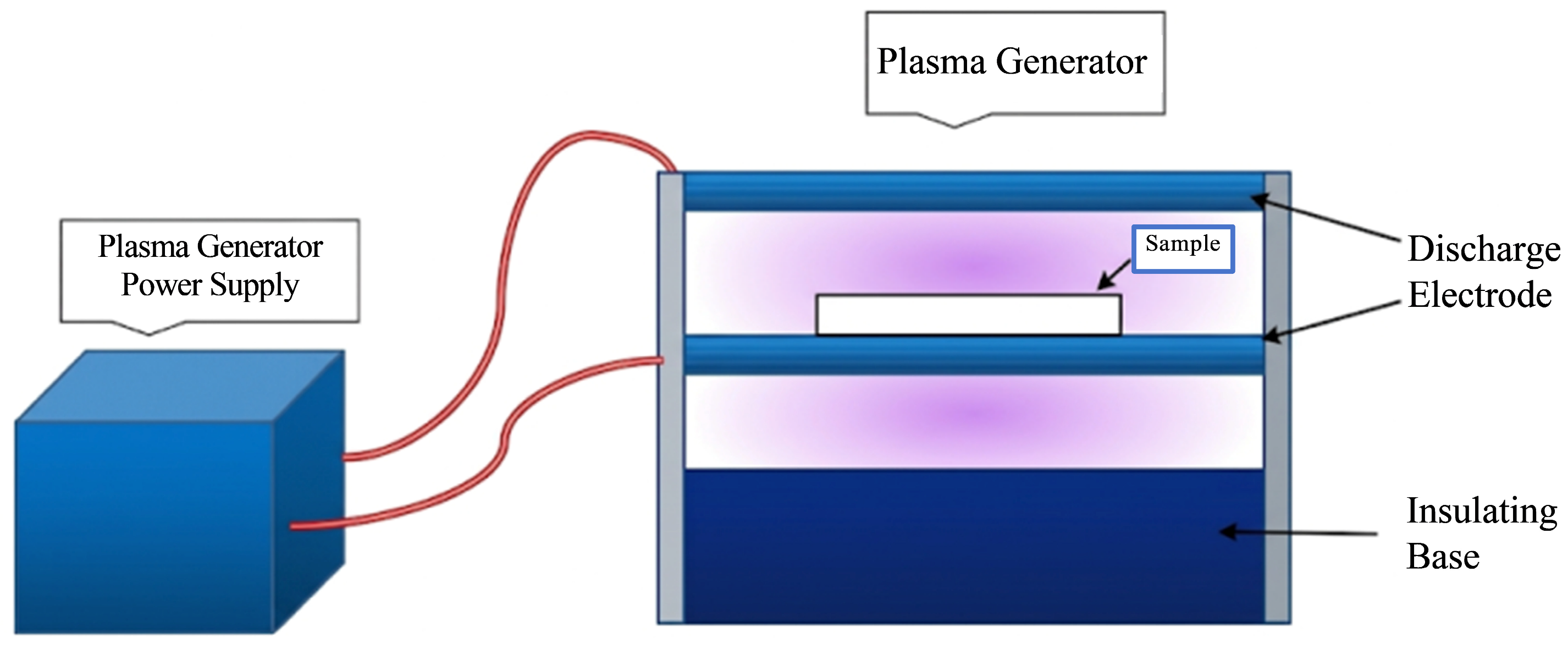
Figure 1. Schematic diagram of the dielectric barrier discharge (DBD) plasma reactor setup.
Coatings 16 00627 g001
Figure 2. Schematic representation of the isothermal surface potential decay (SPD) measurement platform, including corona charging and potential measurement phases.
Coatings 16 00627 g002
Figure 3. Configuration of the direct current (DC) surface flashover testing platform with finger-shaped brass electrodes.
Coatings 16 00627 g003
Figure 4. SEM micrographs showing the surface micro-morphology of (a) pristine PS, (b) MMA-coated PS, and (c) FAS-13-modified PS samples at a 500 μm scale. The consistent macroscopic smoothness across all samples confirms that the flashover enhancements are independent of physical creepage distance variations.
Coatings 16 00627 g004
Figure 5. EDS energy spectra of the sample surfaces: (a) pristine PS, (b) MMA-coated PS, and (c) FAS-13-modified PS.
Coatings 16 00627 g005
Figure 6. Isothermal surface potential decay (SPD) curves for pristine PS, MMA-coated PS, and FAS-13-modified PS samples.
Coatings 16 00627 g006
Figure 7. Calculated trap energy density distribution functions N t E as a function of trap depth for different specimens.
Coatings 16 00627 g007
Figure 8. Weibull distribution of DC surface flashover voltages for PS samples modified with various concentrations of fluorosilane (FAS-13).
Coatings 16 00627 g008
Figure 9. Weibull distribution of DC surface flashover voltages for PS samples modified with various concentrations of tetraethoxysilane (TEOS).
Coatings 16 00627 g009
Figure 10. Weibull distribution of DC surface flashover voltages for PS samples modified with trehalose (Tre) and dodecafluoropentane (PFP).
Coatings 16 00627 g010
Figure 11. Optimized molecular chain models for (a) pristine PS, (b) MMA solvent, and (c) the MMA/FAS-13 mixture.
Coatings 16 00627 g011
Figure 12. Calculated density of states (DOS) for (a) pristine PS, (b) MMA, and (c) the MMA/FAS-13 mixture.
Coatings 16 00627 g012
Figure 13. Proposed interfacial energy band structure model illustrating the bandgap misalignment and potential barrier heights between the coating and the PS matrix.
Coatings 16 00627 g013
Table 1. Comparison of curing times for different monomeric liquid films under plasma-treated and ambient-room-temperature conditions.
MonomerPlasma-Treated
Curing Time
(s)
Ambient-Room-Temperature Curing Time (s)
Fluorosilane (FAS-13)342.414,624.8
Tetraethoxysilane (TEOS)346.214,826.6
Trehalose (Tre)341.814,589.2
Dodecafluoropentane(PFP)344.214,469.4
Table 2. Weibull distribution parameters and goodness-of-fit statistics for the DC surface flashover voltages of FAS-13 modified samples.
SampleShape Parameter (β)Scale Parameter (α, kV)95% CI for α (kV)Sample Size (N)AD Statisticp-Value
PS51.8311.06[10.96, 11.16]200.337>0.250
PS + MMA27.4110.85[10.67, 11.03]200.5120.194
PS + MMA + 10 wt% FAS-1331.2811.71[11.54, 11.88]200.5980.111
PS + MMA + 20 wt% FAS-1310.5212.94[12.38, 13.52]200.7790.038
PS + MMA + 30 wt% FAS-139.65913.02[12.41, 13.66]201.084<0.010
PS + MMA + 40 wt% FAS-1310.2514.04[13.42, 14.69]200.5160.190
Table 3. Weibull distribution parameters and goodness-of-fit statistics for the DC surface flashover voltages of TEOS-modified samples.
SampleShape Parameter (β)Scale Parameter (α, kV)95% CI for α (kV)Sample Size (N)AD Statisticp-Value
PS51.8311.06[10.96, 11.16]200.337>0.250
PS + MMA27.4110.85[10.67, 11.03]200.5120.194
PS + MMA + 10 wt% TEOS6.78513.03[12.18, 13.91]202.242<0.010
PS + MMA + 20 wt% TEOS35.4910.97[10.83, 11.11]200.4720.232
PS + MMA + 30 wt% TEOS42.7911.05[10.93, 11.17]201.069<0.010
PS + MMA + 40 wt% TEOS14.8511.52[11.17, 11.88]203.274<0.010
Table 4. Weibull distribution parameters and goodness-of-fit statistics for the DC surface flashover voltages of Trehalose (Tre) and PFP-modified samples.
SampleShape Parameter (β)Scale Parameter (α, kV)95% CI for α (kV)Sample Size (N)AD Statisticp-Value
PS51.8311.06[10.96, 11.16]200.337>0.250
PS + MMA27.4110.85[10.67, 11.03]200.5120.194
PS + MMA + 10 wt% Tre17.4611.15[10.86, 11.45]200.6850.067
PS + MMA + 20 wt% Tre31.1310.91[10.75, 11.07]200.7210.051
PS + MMA + 30 wt% Tre29.3410.86[10.69, 11.03]201.406<0.010
PS + MMA + 40 wt% Tre30.6710.84[10.68, 11.00]200.5510.156
PS + MMA + 10 wt% PFP22.1211.49[11.25, 11.73]201.192<0.010
PS + MMA + 20 wt% PFP21.4111.41[11.17, 11.66]202.042<0.010
PS + MMA + 30 wt% PFP24.4211.68[11.46, 11.90]201.899<0.010
PS + MMA + 40 wt% PFP24.0011.74[11.52, 11.97]200.8210.029
Disclaimer/Publisher’s Note: The statements, opinions and data contained in all publications are solely those of the individual author(s) and contributor(s) and not of MDPI and/or the editor(s). MDPI and/or the editor(s) disclaim responsibility for any injury to people or property resulting from any ideas, methods, instructions or products referred to in the content.