Article

Tuning the Mechanical and Protective Properties of ZrYN Hard Coatings via Nitrogen Flow Ratio in Reactive Magnetron Sputtering

1
Key Laboratory of Functional Materials and Applications of Fujian Province, School of Materials Science and Engineering, Xiamen University of Technology, Xiamen 361024, China
2
Double Medical Technology Inc., Xiamen 361026, China
3
College of Transportation Engineering, Dalian Maritime University, Dalian 116026, China
*
Authors to whom correspondence should be addressed.
Coatings 2026, 16(5), 624; https://doi.org/10.3390/coatings16050624
Submission received: 30 April 2026 / Revised: 16 May 2026 / Accepted: 19 May 2026 / Published: 21 May 2026
(This article belongs to the Section Surface Characterization, Deposition and Modification)

Highlights

What are the main findings?
  • Nitrogen flow ratio tunes ZrYN coatings from metallic to sub-, near-, and over-stoichiometric.
  • Near-stoichiometric coating achieves highest hardness of 32.2 GPa and best corrosion resistance.
  • Dense and epitaxial t-ZrO2 oxide scale stabilized by Y2O3, suppressing t → m transformation.
What are the implications of the main findings?
  • Precise control of nitrogen flow ratio provides an effective strategy to optimize the stoichiometry, microstructure, and overall protective performance of ZrYN hard coatings.
  • Near-stoichiometric ZrYN coatings show strong potential for applications requiring simultaneous high hardness, corrosion resistance, and oxidation resistance.
  • Y-stabilized epitaxial t-ZrO2 oxide scales offer a promising route to improve the high-temperature durability of transition metal nitride coatings.

Abstract

Yttrium doping has been reported to be an effective approach to enhance the mechanical and protective properties of ZrN coatings by magnetron sputtering. Nitrogen (N2) flow ratio during reactive magnetron sputtering is known to critically influence the stoichiometry, defect structure, and microstructure of nitride coatings. However, its systematic effect on Y-doped ZrN (ZrYN) coatings has remained unexplored. In this work, ZrYN coatings with a fixed Y content were deposited by reactive magnetron sputtering under varying N2 flow ratios (0–10%). Their microstructure, mechanical properties, corrosion resistance in 3.5 wt% NaCl solution, and oxidation behavior at 650 °C were systematically investigated. Below 5% N2 flow ratio, the coatings are metallic ZrY, showing very low hardness, poor corrosion resistance, and catastrophic oxidation failure. At N2 flow ratio ≥ 5%, cubic ZrYN forms, with stoichiometry varying from sub-stoichiometric (5%) to near-stoichiometric (7.5%) to over-stoichiometric (10%). The near-stoichiometric coating at 7.5% exhibits the finest columnar grains and densest microstructure, leading to the highest hardness (32.2 ± 1.4 GPa) and an elastic modulus of (469.6 ± 24.5 GPa), as well as the best corrosion resistance (two orders of magnitude lower than bare 316 stainless steel). Upon oxidation, it forms a thin and dense epitaxial t-ZrO2 scale stabilized by Y2O3, suppressing the destructive tetragonal to monoclinic transformation. Off-stoichiometric coatings at 5% and 10% develop thicker, cracked oxide scales and show inferior properties. Precise control of N2 flow ratio is therefore essential to achieve a near-stoichiometric ZrYN coating with superior mechanical, anti-corrosion, and anti-oxidation performance.

1. Introduction

Transition metal nitride hard coatings, such as ZrN, TiN, CrN, etc., exhibit high hardness, excellent wear resistance, high oxidation resistance, and good chemical stability [1,2,3,4,5,6]. These properties have led to their widespread use in protecting cutting tools, molds, precision machinery parts, and other fields. In particular, ZrN coatings possess a golden appearance, a hardness of 20–30 GPa, and non-toxic characteristics, making them suitable for both industrial and decorative applications [7,8,9,10]. In many service environments, coated components are simultaneously exposed to mechanical abrasion, corrosive media (e.g., chloride-containing solutions), and elevated temperatures. For example, parts used in marine, chemical, or aerospace industries often require a combination of high hardness, corrosion resistance, and oxidation resistance [11,12]. Therefore, further improvement of the overall protective performance of ZrN-based coatings is highly desired [13,14].
Alloying with additional elements is another effective strategy to enhance performance. Adding Al or Si can improve hardness and oxidation resistance through the formation of dense Al2O3 or SiO2 oxide scales [15,16,17,18,19]. Yttrium has attracted particular interest because Y2O3 can stabilize the tetragonal phase of ZrO2. In situ studies on the oxidation of pure ZrN coatings have revealed that a metastable tetragonal t-ZrO2 initially forms but later transforms to monoclinic m-ZrO2 upon cooling, generating ~5% volume expansion and extensive microcracks that severely degrade oxidation resistance [20]. Y doping can address this issue: Y preferentially oxidizes to Y2O3, which dissolves into the ZrO2 lattice and stabilizes t-ZrO2 to room temperature, thereby preventing the destructive tetragonal to monoclinic transformation and maintaining a denser oxide scale [21]. In addition, Y doping can refine the columnar structure and reduce defect density, potentially improving mechanical properties and corrosion resistance [22]. According to the previous study [23], Y doping level Y/(Y + Zr) of around 5% endows ZrYN coatings with superior mechanical properties and adhesion strength.
Once the Y content is fixed, the next critical step is to control the deposition parameters during reactive magnetron sputtering, which is a versatile technique for depositing hard coatings. Among the deposition parameters, the nitrogen (N2) flow ratio (N2/(N2 + Ar)) plays a critical role because it directly determines the stoichiometry, the type and concentration of lattice defects, and the microstructure of the resulting nitride coatings [24,25,26,27,28]. Tuning N2 flow ratio, therefore, offers a direct route to control these structural features and, consequently, the mechanical and protective properties. While several studies have examined the effect of N2 flow rate on pure ZrN [29,30], the influence of N2 flow ratio on the comprehensive properties of ternary ZrYN coatings has not yet been systematically investigated.
To fill this gap, the present work fabricates ZrYN coatings (with a constant Y content) by reactive magnetron sputtering under N2 flow ratios of 0%, 2.5%, 5%, 7.5% and 10, and comprehensively characterizes their phase composition, microstructure, mechanical properties, electrochemical corrosion resistance in 3.5 wt% NaCl solution, and high-temperature oxidation resistance at 650 °C. The aim is to clarify how the N2 flow ratio affects the composition, phase structure, mechanical properties, and protective performance of ZrYN hard coatings, and to establish a clear composition–structure–property relationship.

2. Materials and Methods

2.1. Materials and Deposition of Coatings

The hard coatings were deposited in a high-vacuum reaction chamber using the reactive DC magnetron sputtering technique. The sputtering gas, argon (Ar, 99.999%), was mixed with the reaction gas, nitrogen (N2, 99.999%), to produce the ZrYN coatings. A composite Zr95Y5 target (diameter 60 mm × thickness 3 mm, 99.9%) was used for sputtering. Due to the enhanced target poisoning effect at higher N2/Ar and N2 flow ratios, the deposition rate gradually decreased with increasing nitrogen content. By controlling the deposition time, the thickness of the coatings was maintained at approximately 2.0 ± 0.2 μm to minimize the influence of thickness variation on the mechanical and oxidation properties. All substrates, including Si (110) and 316 stainless steels, were sequentially ultrasonically cleaned in acetone and absolute ethanol for 10 min each and then dried before the experiment. The chamber base pressure was controlled to be below 4.0 × 10⁻⁴ Pa before deposition. During the deposition process, the chamber pressure was maintained at 0.4 Pa. The target was initially pre-sputtered with Ar to remove surface oxides. Subsequently, the titanium target (Ti, 99.9%) was sputtered for 10 min in pure Ar atmosphere with an Ar flow rate of 50 sccm to form a transition layer on the substrate. Finally, the ZrYN coating was deposited by sputtering the ZrY alloy target with a mixture of N2 and Ar. The total gas flow (Ar + N2) was fixed at 50 sccm, while the N2 flow ratio was varied from 0 to 10%. No substrate bias or substrate heating was applied during deposition. Detailed deposition parameters are shown in Table 1.

2.2. Characterizations of Coatings

The chemical compositions of the coatings were determined by electron probe microanalysis (EPMA, JXA-8100, JEOL Ltd.: Akishima, Japan). The crystal structure of the coatings was characterized by grazing incidence X-ray diffraction (GIXRD, SmartLab 3 kW, Rigaku: Tokyo, Japan,) with Cu Kα radiation as the X-ray source, and the angle of incidence was fixed at 2°. The coatings were subjected to analysis via Raman spectroscopy (DXR2xi, Thermo Fisher Scientific: Waltham, MA, USA), which enabled the examination of the vibrational and rotational characteristics inherent to the molecular structure of the samples. An atomic force microscope (AFM, SPM-9700HT, Shimadzu: Kyoto, Japan) was used to observe the three-dimensional morphology of the sample surface. The elemental composition of the materials and their chemical states were characterized by X-ray photoelectron spectroscopy (XPS, AXIS SUPRA+, Shimadzu: Kyoto, Japan) with the following parameters: voltage 15 kV, X-ray source Al Kα, energy resolution 0.45 eV, and power 600 W. XPS spectra were charge-corrected using the C 1s peak at 284.8 eV from surface contamination, and fitted using Avantage software (version 5.9921). The cross-sectional morphologies of coatings deposited on silicon substrates were characterized before and after oxidation by scanning electron microscopy (SEM, Sigma, Zeiss: Oberkochen, Germany) and transmission electron microscopy (TEM, Talos F200s, Thermo Fisher Scientific: Waltham, MA, USA) coupled with energy dispersive spectroscopy (EDS, Oxford, Oxford Instruments: Abingdon, UK). For TEM observation, cross-sectional specimens were prepared by mechanical thinning, followed by ion milling with a precision ion polishing system (Gatan 691). Hardness and elastic modulus of the coatings were measured by nanoindentation testing (CSM Instrument SA: Anton Paar, Baden, Switzerland), with 20 indentations per sample to obtain the average results. Electrochemical corrosion tests were performed using an electrochemical workstation in 3.5 wt% NaCl solution. The as-coated 316 stainless steel served as the working electrode, a saturated calomel electrode (SCE) was used as the reference electrode, and Pt foil was used as the counter electrode. The electrochemical impedance spectra were tested after the open-circuit potential was stabilized for 1 h. The scanning rate was 1 mV/s, the frequency range was 10−2 Hz to 105 Hz, and the amplitude of the sinusoidal perturbation was 10 mA. For the potentiodynamic polarization test, the initial potential was −1.0 V, and the termination potential was 2.0 V. High-temperature oxidation resistance experiments were carried out in a tube furnace at 650 °C, with a heating rate of 5 °C/min and a holding time of 120 min. Notably, EPMA, GIXRD, Raman, XPS, AFM, SEM, TEM, nanoindentation, and oxidation measurements were performed on the coatings deposited on Si(110) substrates, while electrochemical corrosion tests were conducted on the coatings deposited on stainless steel substrates.

3. Results and Discussion

3.1. Chemical Composition and Microstructure

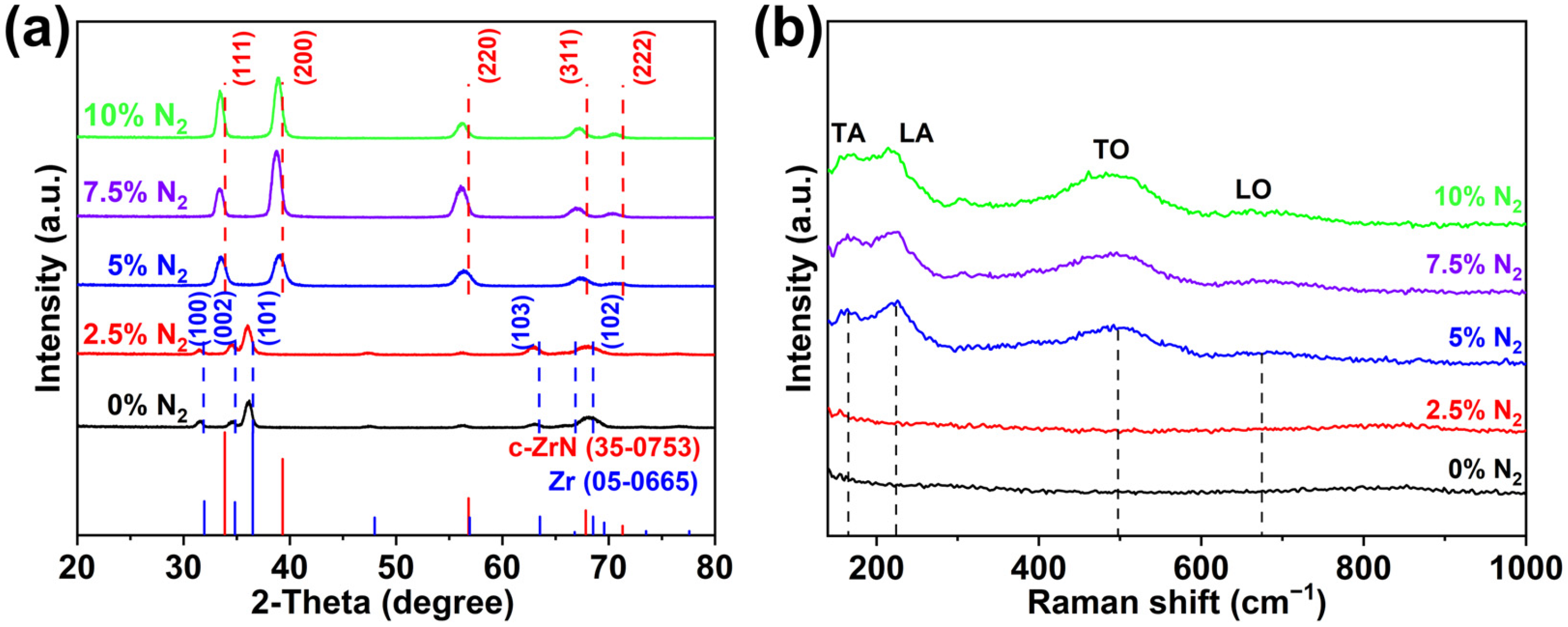
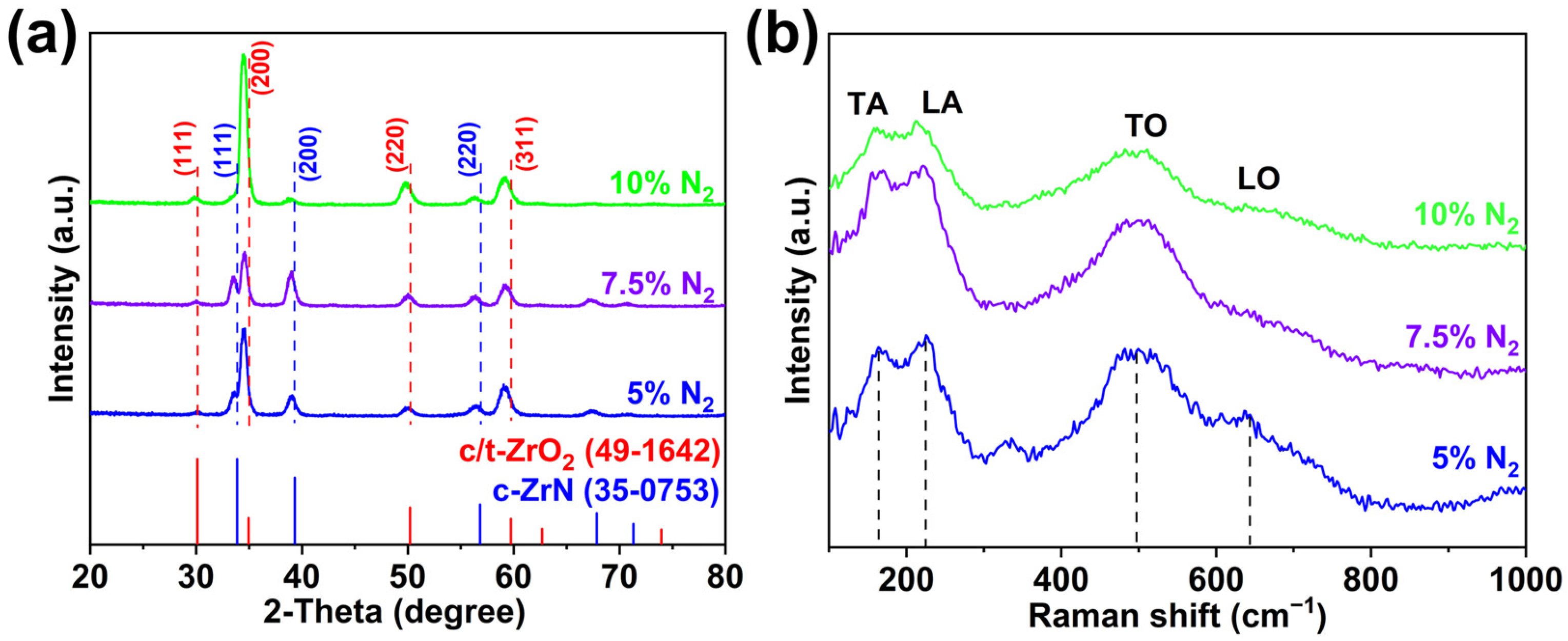
The chemical composition of the as-deposited coatings as a function of N2 flow ratio, determined by EPMA, is presented in Table 2. As N2 flow ratio rises from 0 to 10%, the N atomic content increases from 0 to 52.6 at.%, while the atomic content of metallic elements (Zr and Y) gradually drops. Consequently, the N/(Y + Zr) ratio grows from 0 to 1.11, indicating the transformation from pure alloy to transition metal nitride. Moreover, the coatings deposited at 7.5% are close to the stoichiometric ratio. The Y/(Y + Zr) ratio in the coatings is in agreement with that of the composite target, independent of the N2 flow ratio. The phase structure of the ZrYN coatings was characterized by GIXRD and Raman spectroscopy, as illustrated in Figure 1. The peaks of the coatings deposited at 0% match well with metallic Zr (JCPDS, No. 05-0665). The slight peak shifting to lower angles is due to the formation of ZrY solid solution coating, where the larger Y atoms substitute for Zr atoms. The coating at 2.5% shows similar XRD and Raman patterns with pure ZrY metallic coatings at N2 flow ratio of 0%. The coating shows clear N incorporation in Table 2, yet no XRD or Raman peaks belonging to nitrides are observed, indicating that N is likely interstitial in the ZrY alloy phase. Tuning the N2 flow ratio to the range of 5–10% during the coating sputtering process results in nitriding of the coating, leading to a transformation of the phase structure from metallic phase to cubic c-ZrN (JCPDS, No. 35-0753) [31]. Similarly, as compared with the standard ZrN patterns, the peaks shifting to lower angles demonstrate the formation of solid solution c-ZrYN coatings and the substitution of Zr by Y with larger atomic radius [23].
As shown in Figure 1b, for coatings deposited at N2 flow ratio ≥ 5%, the Raman spectra exhibit characteristic bands of c-ZrN: a peak at ~180 cm−1 and a secondary peak at ~240 cm−1 in the low-frequency region, attributed to the transverse acoustic (TA) and longitudinal acoustic (LA) modes, respectively; and two asymmetric bands centered at ~500 cm−1 and ~650 cm−1 in the high-frequency region, corresponding to the transverse optical (TO) and longitudinal optical (LO) modes [32,33]. These features are consistent with the expected vibrational modes of the ZrN lattice. No YN-related peaks are detected, confirming that YN is incorporated as a solid solution in the c-ZrN matrix, in agreement with the XRD results. In contrast, the coatings deposited at 0% and 2.5% show no Raman peaks, because metallic Zr(Y) does not exhibit any first-order Raman scattering. This further confirms the absence of nitride formation under these low nitrogen flow ratio conditions.
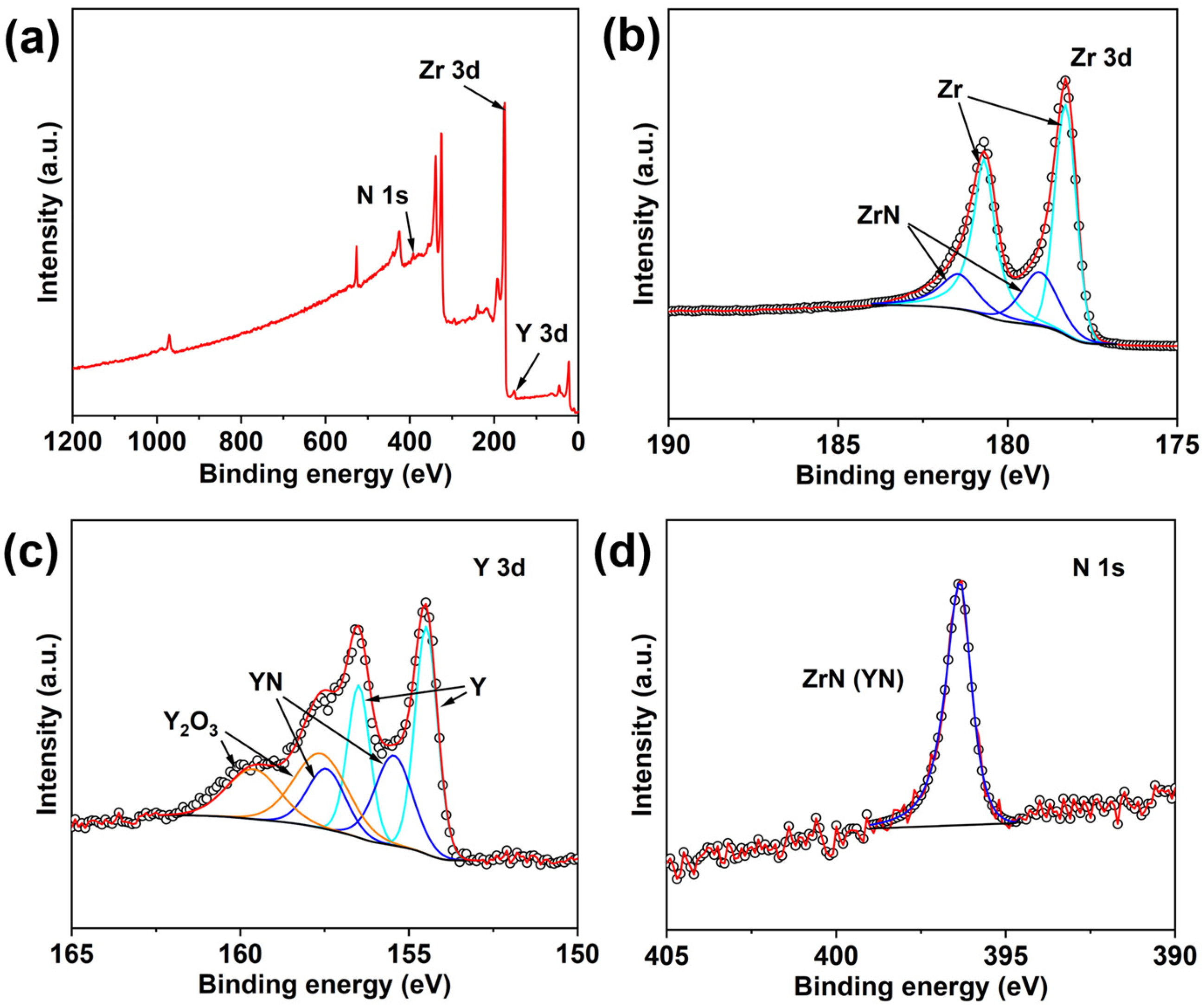
The surface chemical bonding states of the coatings deposited at N2 flow ratios of 2.5% (Figure 2) and 7.5% (Figure 3) were analyzed by XPS. Figure 2a shows the survey spectrum of the sample deposited at 2.5% N2 flow ratio. The presence of three elements, Zr, Y, N, is evident. The O signal is attributed to surface contamination or surface oxidation following air exposure of the coating. The Zr 3d peaks were fitted as pairs of spin–orbit split sub-peaks with a separation of 2.4 eV between the Zr 3d5/2 and Zr 3d3/2. Figure 2b confirms that the coating has a metallic composition (178.3 eV and 180.7 eV). Small amounts of N are present as interstitial solid solutions in the coating, forming Zr-N bonds (179.3 eV and 181.7 eV) [34]. The Y 3d peaks were also fitted as pairs of doublets with a separation of 2.0 eV between the Y 3d5/2 and Y 3d3/2. The rare-earth Y element is very reactive, making it more susceptible to reactive bonding with N and O elements. Figure 2c shows the metallic Y dominated in the coatings (154.5 eV and 156.5 eV) as well as Y bonding with N and O to form YN (155.5 eV and 157.5 eV) and Y2O3 (157.7 eV and 159.7 eV) [35]. As shown in Figure 2d, the weak N 1s peak at 396.7 eV reveals the existence of a small amount of transition metal nitrides (ZrN or YN) [34].
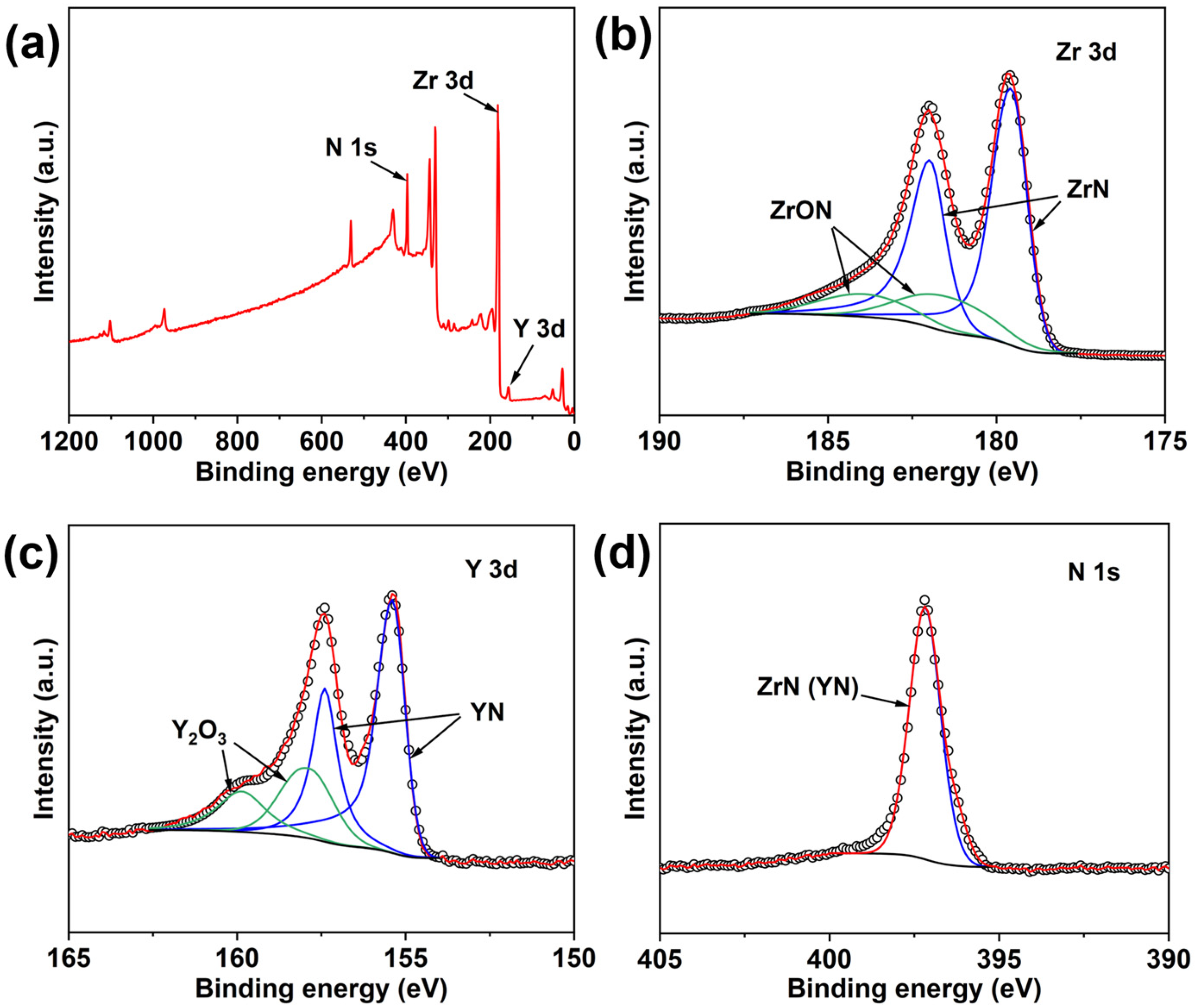
Figure 3 presents the XPS analysis of the ZrYN coating at 7.5%. The survey spectrum in Figure 3a shows Zr, Y and N elements, and the intensity of N 1s is markedly higher than that at 2.5% (Figure 2a), confirming substantial N incorporation. The Zr 3d spectrum (Figure 3b) exhibits a dominant doublet at 179.0 eV and 181.4 eV, corresponding to Zr-N bonds, with no detectable metallic Zr peaks [34]. The Y 3d spectrum (Figure 3c) shows Y-N (155.4 eV and 157.4 eV) and Y-O (157.8/159.8 eV) components [35]. The N 1s spectrum (Figure 3d) consists of a single sharp peak at 397.0 eV, characteristic of nitride bonding. These results confirm that the coating at 7.5% is fully nitrided, consistent with the XRD and Raman findings.
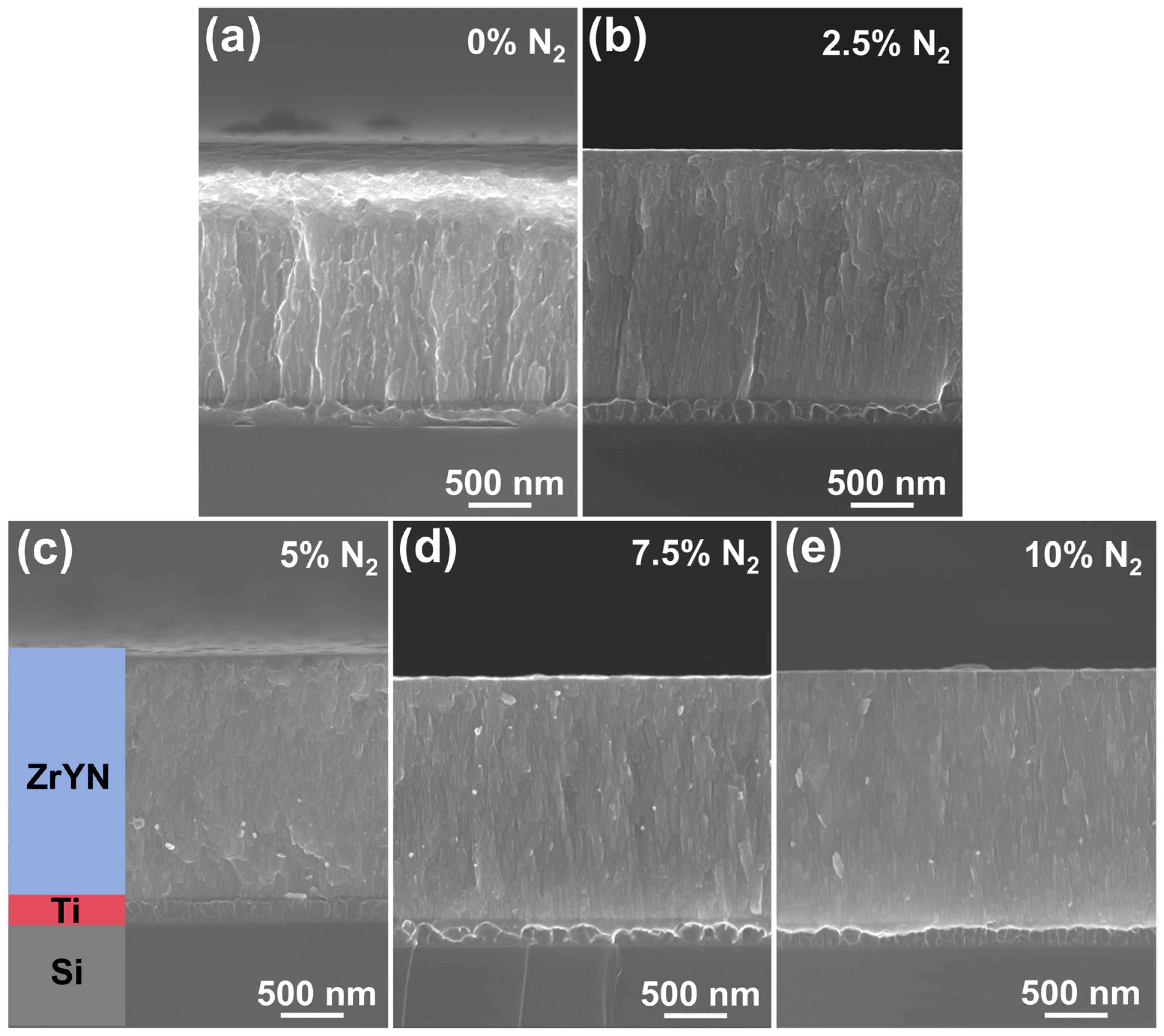
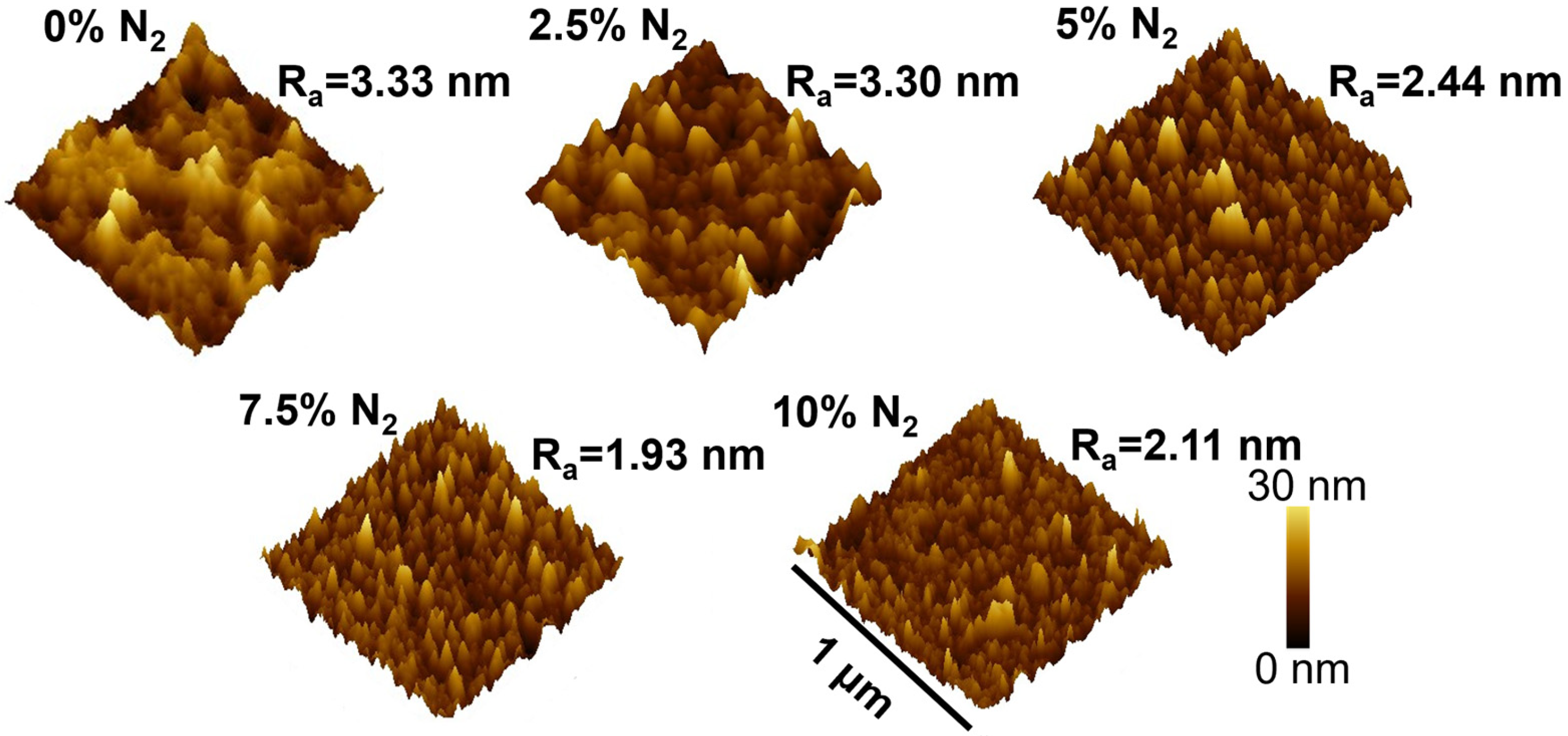
Figure 4 depicts three-dimensional AFM surface morphologies of the ZrYN coatings. As the N2 flow ratio increases, the surface roughness and the grain size of the coatings decrease, reaching the minimum values at N2 flow ratio of 7.5%. Figure 5 shows SEM morphologies of the cross-section of the as-deposited coating. These images reveal outer ZrYN coatings of approximately 2 μm thickness, inner Ti interlayers of about 250 nm, and silicon substrates underneath. All coatings exhibit a columnar structure, which is in agreement with the structure zone model. However, a systematic refinement is observed with increasing N2 flow ratio. This is primarily due to the reduced Ar fraction in the sputtering gas, which lowers the kinetic energy of sputtered Zr atoms arriving at the substrate. The reduced adatom mobility suppresses grain boundary migration, leading to finer and denser columnar grains. Beyond this kinetic effect, the increasing N2 flow ratio also induces target poisoning, wherein a compound layer forms on the target surface. This dramatically lowers the sputtering yield, resulting in a significantly reduced deposition rate and a lower flux of material to the substrate. In parallel, the formation of the nitride phase during deposition inherently limits the surface diffusion of the adsorbed species, forcing a higher nucleation density and further restricting grain growth. Consequently, this combination of reduced adatom mobility, lower deposition flux, and nitride-phase growth yields a progressively refined and highly compact columnar morphology [36]. This microstructural refinement is a key precursor to the enhanced mechanical properties discussed below.

3.2. Mechanical Properties and Electrochemical Corrosion

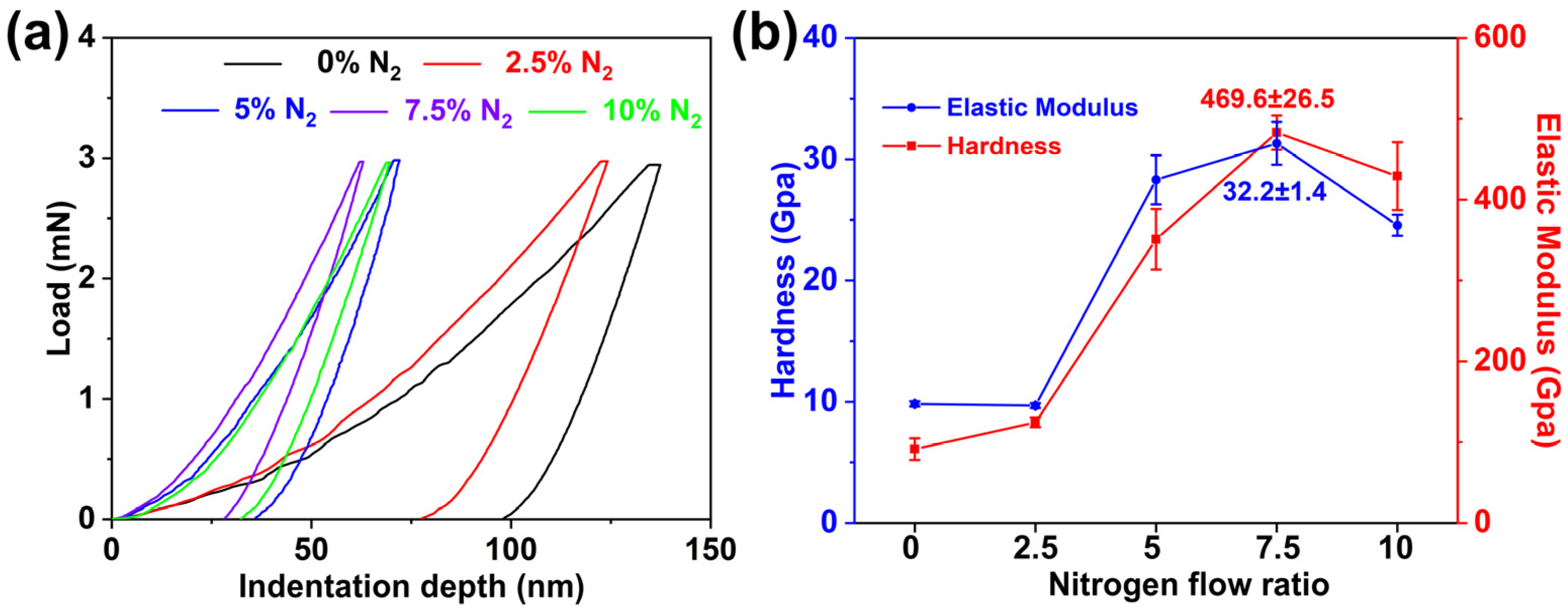
The nanoindentation load–depth curves of the ZrYN coatings (Figure 6a) deposited on silicon substrates show that the maximum indentation depth decreases progressively as N2 flow ratio increases from 0% to 7.5%, and then increases again at 10%, reflecting a clear variation in resistance to plastic deformation. The corresponding hardness and elastic modulus (Figure 6b) increase from the metallic level to a peak of 32.2 ± 1.4 GPa and 469.6 ± 26.5 GPa at 7.5%, followed by a decline at 10%. This trend is governed by the interplay between stoichiometry and microstructural refinement. Compared to the metallic coatings at 0% and 2.5% (hardness < 10 GPa), the formation of the cubic nitride phase at 5%, even though substoichiometric, already raises the hardness significantly to approximately 23.4 ± 2.5 GPa due to the emergence of strong Zr–N covalent bonding. The peak hardness of 32.2 ± 1.4 GPa and elastic modulus of 469.6 ± 24.5 GPa at 7.5% are attributed to the near-stoichiometric composition, which maximizes the density of nitride covalent bonds, and to the finest columnar grains, which provide Hall–Petch strengthening. At 5%, the coating is sub-stoichiometric with abundant nitrogen vacancies. These vacancies reduce the covalent bond density and disrupt the continuity of the covalent network, which collectively induce local lattice distortions and degrade the overall structural integrity of the coating [37]. As a result, both hardness and elastic modulus are reduced relative to the near-stoichiometric coating. Similarly, at 10%, the over-stoichiometric coating also introduces interstitial nitrogen and/or metal vacancies that weaken the overall structural integrity of the coating and reduce mechanical performance [38].
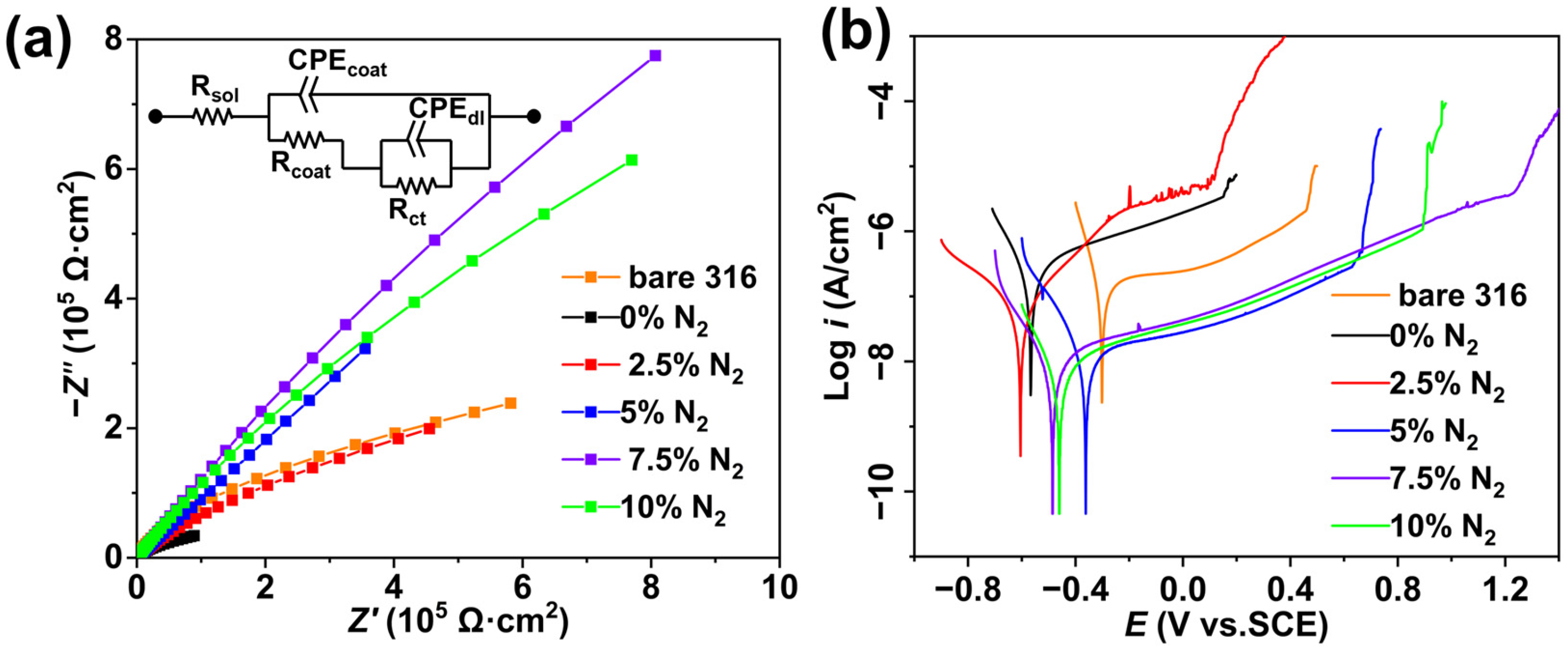
Electrochemical corrosion tests were conducted on the same coatings deposited on stainless steel substrates in a 3.5 wt% NaCl solution. The Nyquist plots from the EIS test and the equivalent circuit modeling are presented in Figure 7a. In the equivalent circuit, Rsol represents the solution resistance; CPEcoat and Rcoat correspond to the capacitance and resistance of the coating; while CPEdl and Rct represent the capacitance and charge transfer resistance of the double electric layer, respectively. Generally, a larger Rct value indicates greater difficulty for electron transfer during the corrosion reaction, corresponding to a lower corrosion rate and superior corrosion resistance [39,40]. Figure 7b depicts the potentiodynamic polarization test. The fitted results of charge transfer resistance (Rct), corrosion current density (icorr) and corrosion potential (Ecorr) are listed in Table 3. For the bare 316 stainless steel (ss) substrate, the Rct is 8.90 × 10⁵ Ω cm2 and icorr is 1.24 × 10⁻⁴ mA cm−2. Among all coated samples, the one deposited at 7.5% exhibits the best performance, with an Rct of 3.56 × 10⁶ Ω cm2 and an icorr of 6.28 × 10⁻⁶ mA cm−2. Compared to bare 316, the other coatings show the following trends: the samples at 5% and 10% have Rct values approximately 1.6 and 3.6 times higher, respectively, and icorr values about 13 and 19 times lower; the 2.5% N2 coating exhibits a slight improvement; whereas the metallic coating performs even worse than bare 316. It is worth noting that the Ecorr of all coated samples is more negative than that of bare 316; however, Ecorr is a thermodynamic parameter and does not determine the actual corrosion rate, which is governed by the kinetic parameters Rct and icorr [41].
The differences in corrosion resistance among these coatings arise from the same composition and microstructure that dictate mechanical properties. At 0%, the coating consists of a metallic ZrY solid solution, which is chemically active in chloride environments and prone to anodic dissolution. Moreover, this metallic coating grows with a porous columnar structure, allowing electrolyte penetration and establishing galvanic cells with the underlying 316 substrate. As a result, the coating exhibits even poorer corrosion resistance than bare 316. At 2.5%, only a small amount of nitrogen is incorporated, so the coating remains largely metallic and still lacks sufficient densification; thus, only marginal improvement is observed. Once the N2 flow ratio reaches 5%, the coating transforms into a dense ZrYN ceramic phase. This nitride phase is chemically inert, suppressing anodic dissolution, and acts as an effective barrier against charge transfer. Among the nitride coatings, 7.5% provides the best balance of stoichiometry and dense structure, leading to the highest corrosion resistance. Both the sub-stoichiometric coating at 5% (with nitrogen vacancies) and the over-stoichiometric coating at 10% (with interstitials or lattice distortion) exhibit slightly lower corrosion resistance compared to the coating at 7.5%, as the defects introduced by deviation from stoichiometry can act as energetically favorable sites for chloride adsorption and localized electrochemical reactions, thereby accelerating charge transfer and destabilizing the passive behavior of the nitride coating [39,42].

3.3. High-Temperature Oxidation Resistance

The oxidation resistance of the ZrYN coatings was evaluated at 650 °C in air for 120 min. The phase and chemical structures of the oxidized samples were subsequently examined through the use of GIXRD and Raman spectroscopy, as illustrated in Figure 8. The metallic ZrY coatings deposited at 0% and 2.5% completely oxidize into a non-protective, porous scale that disintegrates into particles, and thus are not shown in subsequent figures.
For all coatings deposited at N2 flow ratio ≥ 5%, the GIXRD patterns (Figure 8a) show the coexistence of c-ZrYN and tetragonal t-ZrO2 (JCPDS No. 49-1642), with no detectable monoclinic ZrO2 peaks. Importantly, no diffraction peaks corresponding to crystalline Y2O3 are observed. The absence of separate Y2O3 signals indicates that yttrium is dissolved into the ZrO2 lattice rather than forming a discrete oxide phase. This Y-doping, arising from the preferential oxidation of yttrium to Y2O3 and its subsequent incorporation into ZrO2, is responsible for stabilizing t-ZrO2 (YSZ). The ZrYN coating at 7.5% shows the lowest peak intensity of t-ZrO2 (200), indicating the least amount of oxide formation (i.e., the highest oxidation resistance) among three ZrYN coatings. The Raman spectra (Figure 8b) of the oxidized coatings exhibit significantly enhanced intensity compared to the as-deposited ZrYN (Figure 1b), which is probably attributed to the fact that the Raman bands of t-ZrO2 overlap with those of c-ZrYN. More conclusively, a distinct band at approximately 320 cm−1 is clearly ascribed to a characteristic feature of t-ZrO2 [43].
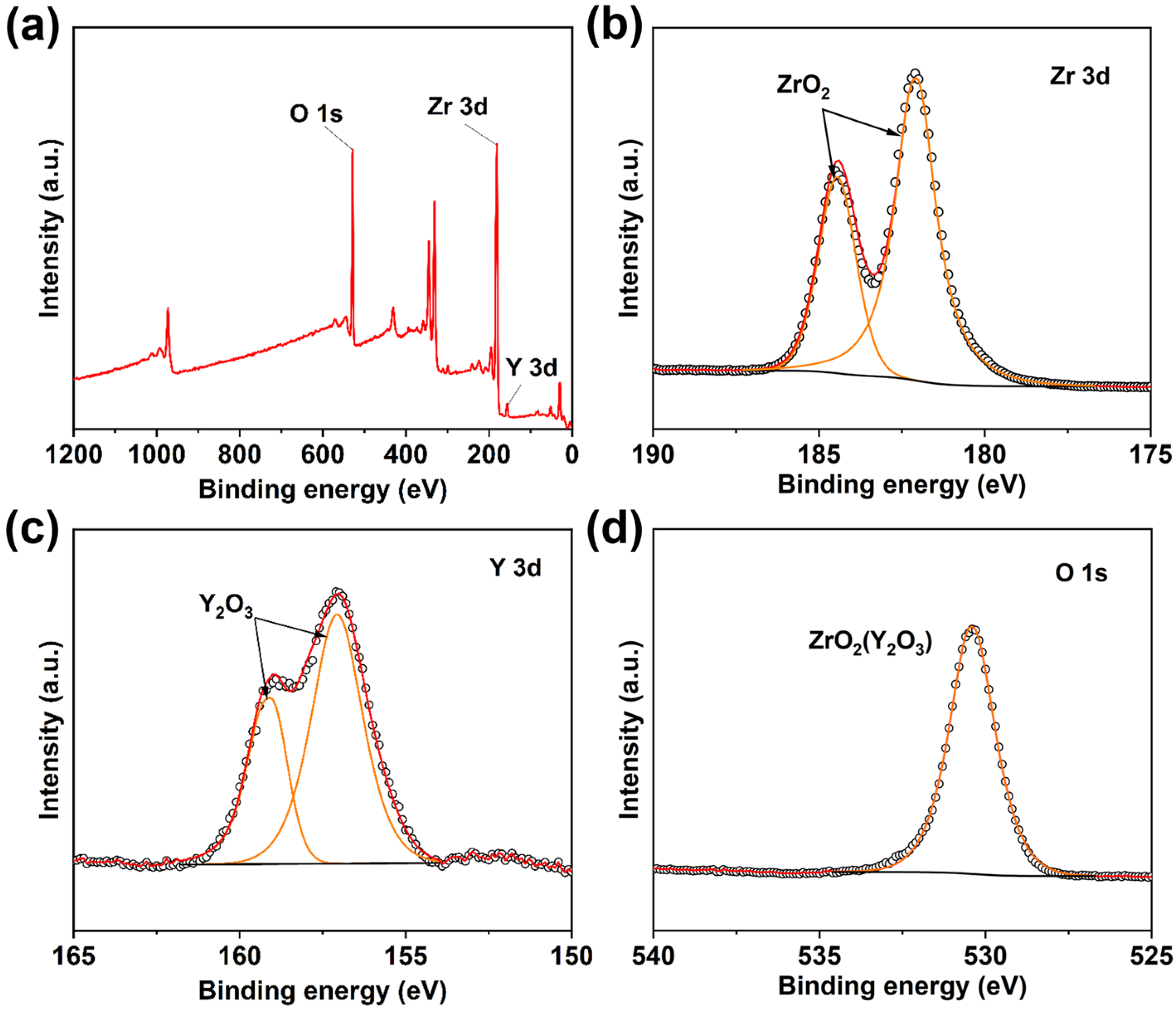
The chemical bonding states of the oxidized surface were investigated by XPS, as shown in Figure 9. The survey spectrum (Figure 9a) reveals Zr, Y, O, and a very small amount of N. The Zr 3d spectrum (Figure 9b) exhibits two doublets at 182.0 and 184.4 eV, characteristic of ZrO2, while the Y 3d spectrum (Figure 9c) shows two doublets at 157 and 159 eV corresponding to Y2O3 [34,35]. No signals of ZrN or YN nitrides are detected, confirming that the outermost surface is fully oxidized. The presence of Y2O3 is crucial because yttrium oxide dissolves into the ZrO2 lattice and stabilizes the tetragonal phase. Y3+ ions substitute for Zr4+, creating oxygen vacancies to maintain charge neutrality and locally expanding the lattice. This lattice distortion compensates the volumetric strain of the tetragonal-to-monoclinic transformation, effectively increasing the energy barrier for t → m transition and lowering the Gibbs free energy of the tetragonal phase, thereby stabilizing t-ZrO2 at high temperatures [44]. Consequently, the large volumetric expansion associated with the transformation is avoided, preventing crack formation in the oxide scale [21]. As a result, the t-ZrO2 layer remains dense and crack-free, which is critical for the superior oxidation resistance of the 7.5% N2 coating.
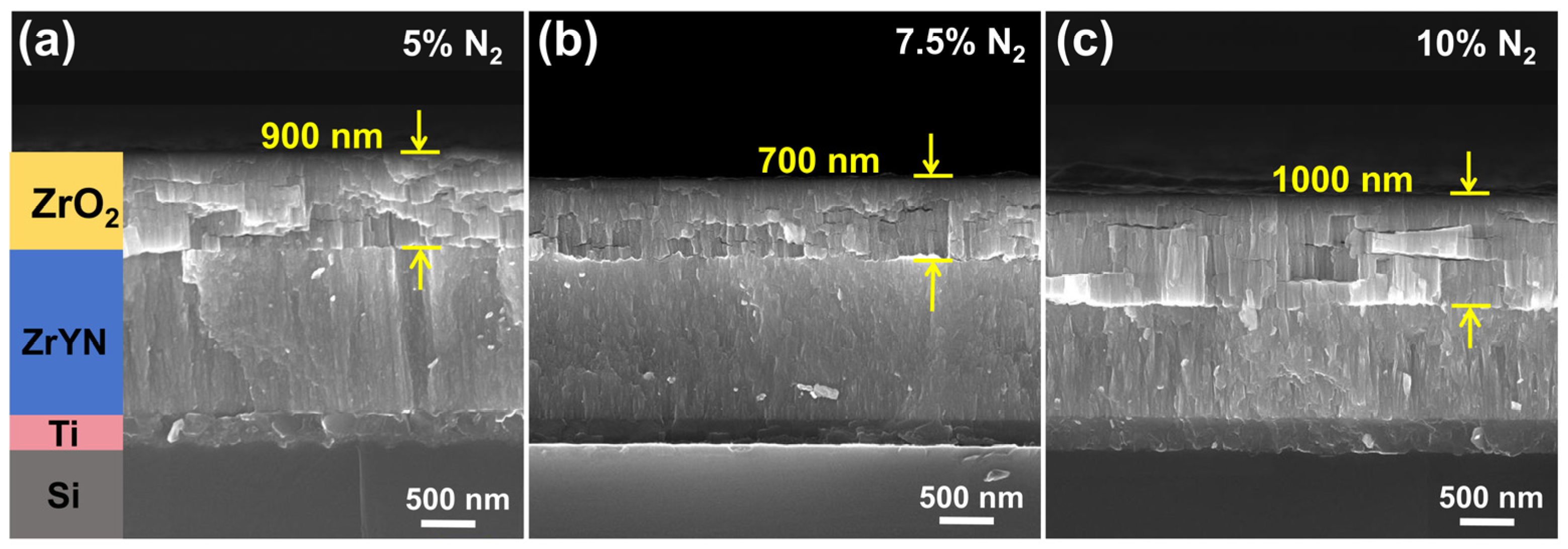
After confirming the phase and chemical composition, the SEM cross-sectional morphologies of the oxidized ZrYN coatings are shown in Figure 10. For the three c-ZrYN coatings, the oxide scale thickness first decreases and then increases, reaching a minimum at 7.5% (Figure 10b). The coating at 5% (Figure 10a) exhibits a thick oxide layer with multiple transverse cracks. This is attributed to its sub-stoichiometric composition, where a high density of nitrogen vacancies promotes inward oxygen diffusion by providing rapid diffusion paths and lowering the activation energy for oxygen migration [45]. In addition, the defective lattice cannot support the growth of a dense t-ZrO2 scale. The coating at 10% (Figure 10c) also shows a relatively thick and coarser oxide layer, which is attributed to the abundant lattice defects (interstitial nitrogen and/or metal vacancies). These defects locally distort the lattice and create defect-assisted diffusion channels, thereby further enhancing oxygen transport kinetics and promoting the formation of a less ordered, thicker oxide scale [46]. By contrast, the near-stoichiometric coating at 7.5% possesses the most perfect lattice and the densest structure. This ideal structure minimizes oxygen diffusion and promotes the epitaxial growth of a compact, protective t-ZrO2 layer, resulting in the thinnest and densest oxide scale and hence highest oxidation resistance.
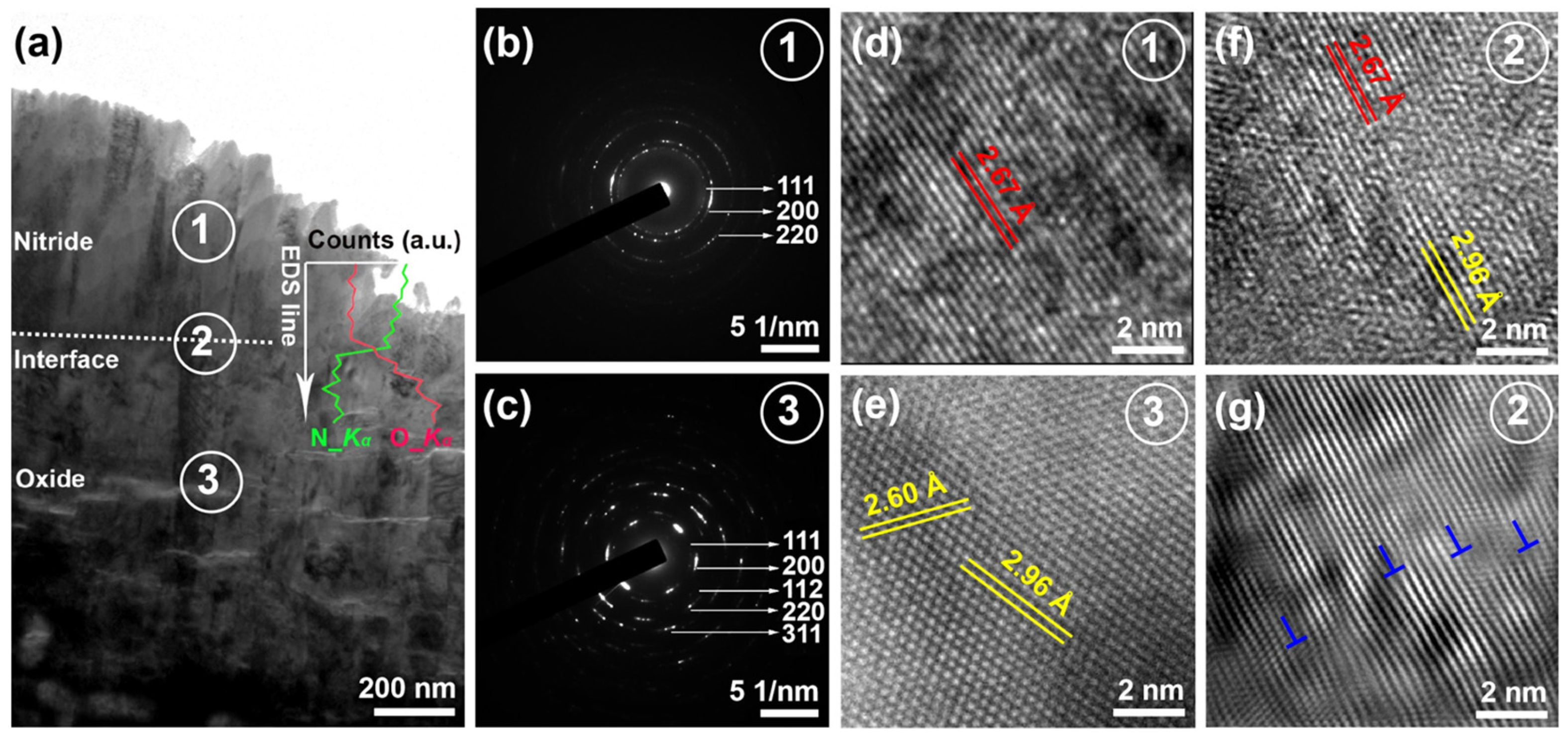
The elemental distribution and interfacial microstructure of the oxidized ZrYN coatings at 7.5% were further analyzed by TEM (Figure 11). The TEM images (Figure 11a) reveal a sharp, continuous interface between the unoxidized ZrYN and the oxide scale. The selected area electron diffraction (SAED) patterns confirm the cubic phase of ZrYN (Figure 11b) and tetragonal phase of ZrO2 (Figure 11c). High-resolution TEM (Figure 11d–g) demonstrates an epitaxial relationship between c-ZrYN and t-ZrO2, with a lattice mismatch of about 10% accommodated by misfit dislocations (Figure 11g). This epitaxial alignment, together with the Y2O3 solute, stabilizes the tetragonal phase even after cooling to room temperature, effectively preventing the volume expansion of tetragonal to monoclinic transformation that otherwise would create interconnected microcracks and pores, as reported for pure ZrN coatings [20].
It should be noted that although Y doping generally improves the oxidation resistance of ZrN by stabilizing t-ZrO2, the actual oxidation resistance strongly depends on the stoichiometry of the as-deposited ZrYN coating. In our previous study on pure ZrN (stoichiometric, oxidized at 650 °C for 2 h) [20], the oxide scale exhibited a bilayer structure with an inner t-ZrO2 layer and an outer m-ZrO2 layer, giving a total thickness of about 1.0–1.1 μm, and extensive microcracks were observed due to the tetragonal to monoclinic transformation. In the present work, the near-stoichiometric ZrYN coating at 7.5% shows a significantly thinner oxide scale (700 nm) with far fewer defects, indicating superior oxidation resistance thanks to Y-stabilized t-ZrO2. However, when the N2 flow ratio is not properly controlled, e.g., at 5% (sub-stoichiometric) or 10% (over-stoichiometric), the oxide scale becomes thicker and more cracked, and the overall oxidation resistance may even approach a pure stoichiometric ZrN coating. Therefore, achieving the best high-temperature oxidation resistance in ZrYN coatings requires not only the addition of yttrium but also precise control of the N2 flow ratio to obtain a near-stoichiometric composition and dense structure.

4. Conclusions

The influence of nitrogen flow ratio on the microstructure, mechanical properties, corrosion resistance and high-temperature oxidation behavior of ZrYN coatings has been systematically investigated. It is found that the N2 flow ratio critically determines the phase composition, microstructure, and properties of ZrYN coatings. At N2 flow ratio below 5%, the coatings remain metallic ZrY solid solution without a protective nitride phase, resulting in very low hardness, poor corrosion resistance (even worse than bare 316 stainless steel), and catastrophic oxidation failure at 650 °C. When N2 flow ratio reaches 5% or higher, the coatings transform into cubic ZrYN phase, but their performance strongly depends on stoichiometry. The sub-stoichiometric coating at 5% and the over-stoichiometric coating at 10% contain nitrogen vacancies or interstitial/metal vacancy defects, leading to coarser columnar grains, lower hardness, thicker and more cracked oxide scales after oxidation, and reduced corrosion resistance compared to the near-stoichiometric coating at 7.5%. The 7.5% coating exhibits the finest and densest columnar structure, the highest hardness (32.2 ± 1.4 GPa) and an elastic modulus of (469.6 ± 24.5 GPa), the best corrosion resistance (two orders of magnitude lower current density than bare 316 stainless steel), and a thin, dense epitaxial t-ZrO2 scale stabilized by Y2O3 after oxidation at 650 °C for 2 h.

Author Contributions

Conceptualization, H.Z.; methodology, Z.Q.; software, H.Z. and M.F.; validation, M.F., Q.C., J.C. and J.H.; formal analysis, H.Z., Q.C., J.C. and J.H.; investigation, H.Z., M.F., Q.C., J.C. and J.H.; resources, R.H.; data curation, H.Z. and M.F.; writing—original draft preparation, H.Z. and M.F.; writing—review and editing, B.W. and Z.Q.; visualization, H.Z.; supervision, Z.Q.; project administration, Z.Q.; funding acquisition, B.W. and Z.Q. All authors have read and agreed to the published version of the manuscript.

Funding

This work was supported by Natural Science Foundation of Xiamen, China (3502Z202372045), Fujian Provincial Guiding Program of Science and Technology (2025H01010138), Natural Science Foundation of Fujian Province (2024J011208), Young and Middle-aged Teacher Education Research Project of Fujian Province (Technology, JZ230047), Fujian Provincial Science and Technology Program for External Cooperation (2024I0001), National Natural Science Foundation of China (51601163), Research Project of Xiamen University of Technology (YKJ23012R) and China Scholarship Council (CSC, 202411020003).

Institutional Review Board Statement

Not applicable.

Informed Consent Statement

Not applicable.

Data Availability Statement

The original contributions presented in this study are included in the article. Further inquiries can be directed to the corresponding authors.

Conflicts of Interest

Author Minjie Fang was employed by Double Medical Technology Inc. The remaining authors declare that the research was conducted in the absence of any commercial or financial relationships that could be construed as a potential conflict of interest.

Abbreviations

The following abbreviations are used in this manuscript:
PVDPhysical Vapor Deposition
EPMAElectron Probe Microanalysis
GIXRDGrazing Incidence X-Ray Diffraction
AFMAtomic Force Microscope
XPSX-Ray Photoelectron Spectroscopy
SEMScanning Electron Microscopy
TEMTransmission Electron Microscopy
SCESaturated Calomel Electrode

References

  1. Richter, N.A.; Yang, B.; Barnard, J.P.; Niu, T.; Sheng, X.; Shaw, D.; Watanabe, M.; Rane, G.; Krause, U.; Dürrenfeld, P.; et al. Significant texture and wear resistance improvement of TiN coatings using pulsed DC magnetron sputtering. Appl. Surf. Sci. 2023, 635, 157709. [Google Scholar] [CrossRef]
  2. Blanco, D.; Viesca, J.L.; Mallada, M.T.; Ramajo, B.; González, R.; Hernández Battez, A. Wettability and corrosion of [NTf2] anion-based ionic liquids on steel and PVD (TiN, CrN, ZrN) coatings. Surf. Coat. Technol. 2016, 302, 13–21. [Google Scholar] [CrossRef]
  3. Kainz, C.; Schalk, N.; Saringer, C.; Czettl, C. In-situ investigation of the oxidation behavior of powdered TiN, Ti (C, N) and TiC coatings grown by chemical vapor deposition. Surf. Coat. Technol. 2021, 406, 126633. [Google Scholar] [CrossRef]
  4. Ibrahim, R.N.; Rahmat, M.A.; Oskouei, R.H.; Singh Raman, R.K. Monolayer TiAlN and multilayer TiAlN/CrN PVD coatings as surface modifiers to mitigate fretting fatigue of AISI P20 steel. Eng. Fract. Mech. 2015, 137, 64–78. [Google Scholar] [CrossRef]
  5. Chang, Y.; Chang, B.; Chen, C. Effect of CrN addition on the mechanical and tribological performances of multilayered AlTiN/CrN/ZrN hard coatings. Surf. Coat. Technol. 2022, 433, 128107. [Google Scholar] [CrossRef]
  6. Zhang, Z.; Rapaud, O.; Allain, N.; Mercs, D.; Baraket, M.; Dong, C.; Coddet, C. Microstructures and tribological properties of CrN/ZrN nanoscale multilayer coatings. Appl. Surf. Sci. 2009, 255, 4020–4026. [Google Scholar] [CrossRef]
  7. Zhu, F.; Zhu, K.; Hu, Y.; Ling, Y.; Wang, D.; Peng, H.; Xie, Z.; Yang, R.; Zhang, Z. Microstructure and Young’s modulus of ZrN thin film prepared by dual ion beam sputtering deposition. Surf. Coat. Technol. 2019, 374, 997–1005. [Google Scholar] [CrossRef]
  8. Singh, A.; Kuppusami, P.; Khan, S.; Sudha, C.; Thirumurugesan, R.; Ramaseshan, R.; Divakar, R.; Mohandas, E.; Dash, S. Influence of nitrogen flow rate on microstructural and nanomechanical properties of Zr–N thin films prepared by pulsed DC magnetron sputtering. Appl. Surf. Sci. 2013, 280, 117–123. [Google Scholar] [CrossRef]
  9. Singh, A.; Kumar, N.; Kuppusami, P.; Prasanthi, T.N.; Chandramohan, P.; Dash, S.; Srinivasan, M.P.; Mohandas, E.; Tyagi, A.K. Tribological properties of sputter deposited ZrN coatings on titanium modified austenitic stainless steel. Wear 2012, 280, 22–27. [Google Scholar] [CrossRef]
  10. Singh, A.; Geetha, M.; Kumar, N.; Kuppusami, P.; Thirumurugesan, R.; Mohandas, E.; Kamaraj, V. A comparative wear study of sputtered ZrN coatings on Si substrate. Trans. Indian Inst. Met. 2011, 64, 37–40. [Google Scholar] [CrossRef]
  11. Tripathi, U.; Kumar, A.; Kumar, A.; Mulik, R.S. Electrochemical characteristics of sputter deposited ZrN nanoflowers coating for enhanced wetting and anti-corrosion properties. Surf. Coat. Technol. 2022, 440, 128466. [Google Scholar] [CrossRef]
  12. Siow, P.C.; Ghani, J.A.; Ghazali, M.J.; Jaafar, T.R.; Selamat, M.A.; Che Haron, C.H. Characterization of TiCN and TiCN/ZrN coatings for cutting tool application. Ceram. Int. 2013, 39, 1293–1298. [Google Scholar] [CrossRef]
  13. Du, J.; Zhang, H.; Chen, L.; Kong, Y. Investigation into the change of structure, mechanical properties and thermal stability for ZrN coating by oxygen addition. Surf. Coat. Technol. 2024, 493, 131276. [Google Scholar] [CrossRef]
  14. Frank, F.; Tkadletz, M.; Czettl, C.; Schalk, N. Microstructure and mechanical properties of ZrN, ZrCN and ZrC coatings grown by chemical vapor deposition. Coatings 2021, 11, 491. [Google Scholar] [CrossRef]
  15. Silva Neto, P.C.; Freitas, F.G.R.; Fernandez, D.A.R.; Carvalho, R.G.; Felix, L.C.; Terto, A.R.; Hubler, R.; Mendes, F.M.T.; Silva Junior, A.H.; Tentardini, E.K. Investigation of microstructure and properties of magnetron sputtered Zr-Si-N thin films with different Si content. Surf. Coat. Technol. 2018, 353, 355–363. [Google Scholar] [CrossRef]
  16. Vereschaka, A.; Tabakov, V.; Grigoriev, S.; Aksenenko, A.; Sitnikov, N.; Oganyan, G.; Seleznev, A.; Shevchenko, S. Effect of adhesion and the wear-resistant layer thickness ratio on mechanical and performance properties of ZrN—(Zr,Al,Si)N coatings. Surf. Coat. Technol. 2019, 357, 218–234. [Google Scholar] [CrossRef]
  17. Vanegas, P.H.S.; Calderon, V.S.; Alfonso, O.J.E.; Olaya, F.J.J.; Ferreira, P.J.; Carvalho, S. Influence of silicon on the microstructure and the chemical properties of nanostructured ZrN-Si coatings deposited by means of pulsed-DC reactive magnetron sputtering. Appl. Surf. Sci. 2019, 481, 1249–1259. [Google Scholar] [CrossRef]
  18. Ferreira, C.P.; de Castro, M.D.M.R.; Tentardini, E.K.; De Freitas Cunha Lins, V.; Saliba, P.A. Silicon influence on corrosion resistance of magnetron sputtered ZrN and ZrSiN thin films. Surf. Eng. 2020, 36, 33–40. [Google Scholar] [CrossRef]
  19. El Garah, M.; Touaibia, D.E.; Achache, S.; Michau, A.; Sviridova, E.; Postnikov, P.S.; Chehimi, M.M.; Schuster, F.; Sanchette, F. Effect of nitrogen content on structural and mechanical properties of AlTiZrTaHf(-N) high entropy films deposited by reactive magnetron sputtering. Surf. Coat. Technol. 2022, 432, 128051. [Google Scholar] [CrossRef]
  20. Qi, Z.; Wu, Z.; Liang, H.; Zhang, D.; Wang, J.; Wang, Z. In situ and ex situ studies of microstructure. evolution during high-temperature oxidation of ZrN hard coating. Scr. Mater. 2015, 97, 9–12. [Google Scholar] [CrossRef]
  21. Wu, Z.; Qi, Z.; Zhang, D.; Wang, Z. Evolution of the microstructure and oxidation resistance in co-sputtered Zr–Y–N coatings. Appl. Surf. Sci. 2014, 321, 268–274. [Google Scholar] [CrossRef]
  22. Song, Q.; Li, Y.; Kimura, H.; Wang, G.; Zhang, S.; Guo, J.; Wang, W.; Du, S.; Li, Z.; Qiu, J.; et al. Simultaneous enhancement of hardness, lubrication and corrosion resistance of solid solution Zr-Y-N film. Surf. Coat. Technol. 2024, 477, 130315. [Google Scholar] [CrossRef]
  23. Qi, Z.; Zhu, F.; Wu, Z.; Liu, B.; Wang, Z.; Peng, D.; Wu, C. Influence of yttrium addition on microstructure and mechanical properties of ZrN coatings. Surf. Coat. Technol. 2013, 231, 102–106. [Google Scholar] [CrossRef]
  24. Maksakova, O.; Simoẽs, S.; Pogrebnjak, A.; Bondar, O.; Kravchenko, Y.; Beresnev, V.; Erdybaeva, N. The influence of deposition conditions and bilayer thickness on physical-mechanical properties of CA-PVD multilayer ZrN/CrN coatings. Mater. Charact. 2018, 140, 189–196. [Google Scholar] [CrossRef]
  25. Samim, P.M.; Fattah-alhosseini, A.; Elmkhah, H.; Imantalab, O. A study on the corrosion resistance of ZrN/CrN multilayer nanostructured coating applied on AISI 304 stainless steel using Arc-PVD method in 3.5 wt% NaCl solution. Mater. Res. Express 2019, 6, 126426. [Google Scholar] [CrossRef]
  26. Ke, Y.; Chen, Y. Effects of nitrogen flow ratio on structures, bonding characteristics, and mechanical properties of ZrNx films. Coatings 2020, 10, 476. [Google Scholar] [CrossRef]
  27. Kuznetsova, T.; Lapitskaya, V.; Khabarava, A.; Chizhik, S.; Warcholinski, B.; Gilewicz, A. The influence of nitrogen on the morphology of ZrN coatings deposited by magnetron sputtering. Appl. Surf. Sci. 2020, 522, 146508. [Google Scholar] [CrossRef]
  28. Silva Filho, J.M.C.D.; Borrero, N.F.V.; Viana, G.A.; Merlo, R.B.; Marques, F.C. Lead Iodide Thin Films via rf Sputtering. Cryst. Growth Des. 2020, 20, 1531–1537. [Google Scholar] [CrossRef]
  29. Zhang, Z.; Chen, M.; Gyawali, G.; Zhang, T.; Zhang, S. Effect of nitrogen pressure on the microstructure, conductivity, and corrosion resistance of ZrN-coated stainless steel as bipolar plate for proton exchange membrane fuel cell. Ceram. Int. 2024, 50, 44678–44688. [Google Scholar] [CrossRef]
  30. Xue, L.; Hu, X.; Xi, Y.; Qiu, L.; Pan, X.; Zhang, Y. Effect of N2 partial pressure on ZrN coating orientation and tribocorrosion behavior and mechanism. Ceram. Int. 2024, 50, 24847–24863. [Google Scholar] [CrossRef]
  31. Azibi, M.; Saoula, N.; Madaoui, N.; Aknouche, H. Effects of Nitrogen Content on the Structural, Mechanical, and Corrosion Properties of ZrN Thin Films Grown on AISI 316L by Radiofrequency Magnetron Sputtering. Cryst. Res. Technol. 2021, 56, 2100096. [Google Scholar] [CrossRef]
  32. Costantini, J.-M.; Gutierrez, G.; Lelong, G.; Guillaumet, M.; Rahman, M.M.; Yasuda, K. Raman spectroscopy study of damage in swift heavy ion-irradiated ceramics. J. Raman Spectrosc. 2022, 53, 1614–1624. [Google Scholar] [CrossRef]
  33. Prysiazhnyi, V.; Kratochvil, J.; Kaftan, D.; Ctvrtlik, R.; Stranak, V. Growth of hard nanostructured ZrN surface induced by copper nanoparticles. Appl. Surf. Sci. 2021, 562, 150230. [Google Scholar] [CrossRef]
  34. Muneshwar, T.; Cadien, K. Comparing XPS on bare and capped ZrN films grown by plasma enhanced ALD: Effect of ambient oxidation. Appl. Surf. Sci. 2018, 435, 367–376. [Google Scholar] [CrossRef]
  35. De La Cruz, W.; Díaz, J.A.; Mancera, L.; Takeuchi, N.; Soto, G. Yttrium nitride thin films grown by reactive laser ablation. J. Phys. Chem. Solids. 2003, 64, 2273–2279. [Google Scholar] [CrossRef]
  36. He, Z.; Liu, L.; Wang, J.; Geng, Z.; Guo, X.; Peng, J.; Li, W.; Xu, Z.; Wang, C. Nitrogen pressure significantly impacts microstructures and mechanical properties of CrAlN coatings prepared by pulsed laser deposition. Ceram. Int. 2025, 51, 6481–6495. [Google Scholar] [CrossRef]
  37. Glechner, T.; Mayrhofer, P.H.; Holec, D.; Fritze, S.; Lewin, E.; Paneta, V.; Primetzhofer, D.; Kolozsvári, S.; Riedl, H. Tuning structure and mechanical properties of Ta-C coatings by N-alloying and vacancy population. Sci. Rep. 2018, 8, 17669. [Google Scholar] [CrossRef] [PubMed]
  38. Liang, D.; Dai, W. Effect of nitrogen partial pressure on structure, mechanical property, and corrosion behavior of ZrNx films prepared by reactive DC magnetron sputtering. Scanning 2023, 2023, 3604077. [Google Scholar] [CrossRef]
  39. Pan, Y.; Zhu, L.; Dong, C.; Xiao, K. Corrosion and interfacial contact resistance of 316L stainless steel coated with magnetron sputtered ZrN and TiN in the simulated cathodic environment of a proton-exchange membrane fuel cell. Surf. Coat. Technol. 2019, 363, 198–202. [Google Scholar]
  40. Castro, J.D.; Lima, M.J.; Carvalho, S. Corrosion resistance of Cu-Zr(O) N films in a simulated seawater environment. Surf. Coat. Technol. 2022, 451, 129050. [Google Scholar] [CrossRef]
  41. Roscher, J.; Liu, D.; Holze, R. A comparison of methods for corrosion inhibitor assessment: Mild steel protected by disubstituted aromatics. Mater. Corros. 2022, 7, 254–258. [Google Scholar] [CrossRef]
  42. Pei, C.; Deng, L.; Liu, H.; He, Z.; Xiang, C.; Zhang, S.; Sun, D. Corrosion inhibition behaviors of ZrNx thin films with varied N vacancy concentration. Vacuum 2019, 162, 28–38. [Google Scholar] [CrossRef]
  43. Auxéméry, A.; Philippot, G.; Suchomel, M.R.; Testemale, D.; Aymonier, C. Stabilization of tetragonal zirconia nanocrystallites using an original supercritical-based synthesis route. Chem. Mater. 2020, 32, 8169–8181. [Google Scholar] [CrossRef]
  44. Shukla, S.; Seal, S. Mechanisms of room temperature metastable tetragonal phase stabilisation in zirconia. Int. Mater. Rev. 2005, 50, 45–64. [Google Scholar] [CrossRef]
  45. Bakulin, A.V.; Kulkova, S.E. Influence of Impurities on Defect Formation and Oxygen Diffusion in TiN. Russ. Phys. J. 2024, 67, 1114–1124. [Google Scholar] [CrossRef]
  46. Mayrhofer, P.H.; Clemens, H.; Fischer, F.D. Materials science-based guidelines to develop robust hard thin film materials. Prog. Mater. Sci. 2024, 146, 101323. [Google Scholar] [CrossRef]
Figure 1. (a) XRD patterns and (b) Raman spectra of ZrYN coatings with different N2 flow ratios.
Coatings 16 00624 g001
Figure 2. XPS spectra of (a) survey spectrum, (b) Zr 3d, (c) Y 3d, and (d) N 1s for the coatings deposited at N2 flow ratio of 2.5%.
Coatings 16 00624 g002
Figure 3. XPS spectra of (a) survey spectrum, (b) Zr 3d, (c) Y 3d, and (d) N 1s for coatings deposited at N2 flow ratio of 7.5%.
Coatings 16 00624 g003
Figure 4. Three-dimensional AFM surface morphologies of the ZrYN coatings.
Coatings 16 00624 g004
Figure 5. SEM cross-sectional morphologies of the ZrYN coatings.
Coatings 16 00624 g005
Figure 6. (a) Nanoindentation load–depth curves and (b) hardness and elastic modulus of coatings.
Coatings 16 00624 g006
Figure 7. Electrochemical testing of bare 316 SS and as-coated 316 SS at different N2 flow ratios: (a) Nyquist plots, and (b) Tafel polarization curves.
Coatings 16 00624 g007
Figure 8. (a) GIXRD patterns and (b) Raman spectra of the ZrYN coatings after high-temperature oxidation.
Coatings 16 00624 g008
Figure 9. XPS spectra of ZrYN coatings deposited at 7.5% after high-temperature oxidation: (a) survey spectrum, (b) Zr 3d, (c) Y 3d, (d) O 1s.
Coatings 16 00624 g009
Figure 10. SEM cross-sections of oxidized ZrYN coatings with different N2 flow ratios: (a) 5%, (b) 7.5%, and (c) 10%.
Coatings 16 00624 g010
Figure 11. TEM images of ZrYN coatings at 7.5% after oxidation: (a) cross-section topography (b,c) diffractograms of selected regions (dg) high-resolution images.
Coatings 16 00624 g011
Table 1. Deposition parameters of the ZrYN coatings.
No.TargetTarget Power (W)N2/Ar (sccm)N2 Flow RatioDeposition Time (min)Rotation Speed (r/min)
1Ti2100/50-103
2Zr95Y52100/500%403
31.75/48.252.5%42
42.5/47.55%45
53.75/46.257.5%60
65/4510%70
Table 2. The chemical composition of ZrYN coatings.
N2 Flow Ratio (%)Element Content (at.%)Y/(Y + Zr)N/(Y + Zr)
ZrYN
095.2 ± 0.564.8 ± 0.470.0480
2.577.7 ± 0.463.7 ± 0.3118.6 ± 0.660.0450.23
554.7 ± 0.552.7 ± 0.3542.6 ± 0.760.0470.74
7.548.8 ± 0.672.3 ± 0.2548.9 ± 0.530.0440.96
1045.3 ± 0.532.1 ± 0.2852.6 ± 0.830.0431.11
Table 3. Electrochemical fitting results (Rct, icorr, Ecorr) for bare 316 SS and as-coated 316 SS at different N2 flow ratios.
No.Sample DescriptionN2 Flow Ratio (%)Rct (Ω·cm2)icorr (mA·cm−2)Ecorr (V vs. SCE)
1Bare 316 SS-8.90 × 1051.24 × 10−4−0.3084
2As-coated 316 SS0%4.51 × 1051.70 × 10−4−0.5688
3As-coated 316 SS2.5%9.77 × 1054.57 × 10−5−0.6045
4As-coated 316 SS5%1.43 × 1069.20 × 10−6−0.3590
5As-coated 316 SS7.5%3.56 × 1066.28 × 10−6−0.4861
6As-coated 316 SS10%3.18 × 1066.56 × 10−6−0.4651
Disclaimer/Publisher’s Note: The statements, opinions and data contained in all publications are solely those of the individual author(s) and contributor(s) and not of MDPI and/or the editor(s). MDPI and/or the editor(s) disclaim responsibility for any injury to people or property resulting from any ideas, methods, instructions or products referred to in the content.