


Abstract
TiVZrTaHfx (x = 0, 0.1, 0.2, and 0.3, molar ratio) refractory high entropy alloys were prepared by vacuum arc melting. XRD, SEM and compression tests were employed to characterize the effects of minor Hf doping on microstructure and compressive mechanical properties of the TiVZrTa alloy. The results indicated that TiVZrTaHfx alloys gradually transform from a multiphase BCC structure to a single-phase BCC structure with increasing Hf content. Correspondingly, as-cast microstructure evolves from the coexistence of reticular morphology and dendrites into a relatively uniform dendritic structure, and elemental segregation was weakened. The compression results showed that the yield strength increases from 1139 MPa to 1253 MPa, while the compressive strain increases from 5.2% to 10.4%. In addition, the fracture mode changes from quasi-cleavage-dominated fracture to a brittle-ductile mixed fracture with more evident plastic tearing features. These results indicate that minor Hf addition can simultaneously improve the strength and compressive strain of the TiVZrTa alloy.
1. Introduction
In recent years, refractory high entropy alloys (RHEAs) have been regarded as promising nuclear structural materials because of their excellent oxidation resistance, corrosion resistance, irradiation resistance and high temperature stability [1,2,3,4]. In addition, the excellent thermal stability and compositional tunability of RHEAs provide greater flexibility for the design of nuclear materials [5,6]. However, most RHEAs still face the challenge of achieving high strength and high ductility simultaneously [7,8,9]. Senkov et al. reported that W and Mo rich alloy systems such as NbMoTaW and VNbMoTaW can achieve room temperature yield strengths of 1246 to 1390 MPa, while their compressive fracture strains generally remain below 2%, reflecting pronounced intrinsic brittleness [10]. Although such alloys can satisfy the requirement for high strength, their extremely low ductility makes them highly susceptible to cracking failure during fabrication [11]. Moreover, most of the currently reported RHEAs contain high-activation elements (e.g., Nb) and elements with high thermal neutron absorption cross-sections (e.g., Hf), whose excessive contents should be avoided as much as possible in nuclear applications [12].
To develop high performance and low activation RHEAs, the integrated improvement of strength and ductility can be achieved through the optimization of principal element and elemental doping. Ti, V, Zr and Ta were selected to construct the low activation alloy system. However, the TiVZrTa RHEA is currently characterized by a multiphase structure, and Zr-rich precipitates may adversely affect its overall ductility [13,14,15]. Therefore, further elemental modulation is still needed to optimize its properties. Among all refractory elements, Hf is an important constituent in RHEAs [16]. Owing to its relatively large atomic radius compared with most refractory elements, Hf exhibits significant atomic size mismatch in RHEAs, thereby generating pronounced lattice distortion. Tong et al. combined total scattering experiments with first principles calculations and found that severe local lattice distortion mainly appears in refractory multi principal element alloys containing Zr and/or Hf, indicating that Hf plays a unique role in regulating the local atomic structure [17]. Wang et al. showed through simulation that doping Hf into TiTaNbZr RHEAs can enhance the solid solution strengthening mechanism and thereby improve the yield strength [18]. Mo et al. found that Hf doping can effectively enhance atomic scale lattice distortion and improve phase stability in NbMoTaWHfx alloys, and that the alloy still shows a slight improvement in ductility relative to NbMoTaW even when the yield strength reaches 1773 MPa [19]. Wang et al. also reported that increasing Hf content raised the yield strength from 734 MPa for NbTaTiV to 1027 MPa for HfNbTaTiV without sacrificing good room temperature ductility in the HfxNbTaTiV system [20]. At present, most studies have focused on the improvement of microstructure and mechanical properties under equiatomic or relatively high Hf doping conditions. However, Hf (~104 barn) has a much higher thermal neutron absorption cross-section than Ti (~6 barn), V (~5 barn), Zr (~0.18 barn) and Ta (~21 barn), therefore, its doping level should be kept low in nuclear low-activation alloy design [21]. In the present TiVZrTaHfx alloys, Hf was introduced only in minor amounts to explore its effect on phase constitution, microstructure and mechanical properties while maintaining neutron economy [22].
In this study, low activation TiVZrTaHfx (x = 0, 0.1, 0.2, and 0.3, molar ratio) RHEAs were prepared. The effects of minor Hf addition on the as-cast microstructure, phase structure and room temperature compressive properties of TiVZrTa RHEAs were investigated. The relationship between microstructural characteristics and mechanical properties was discussed. This work is expected to provide useful insight into the compositional design and microstructural optimization of such TiVZrTaHfx alloys for potential nuclear applications.
2. Materials and Methods
Cast ingots of TiVZrTaHfx (Where x = 0, 0.1, 0.2 and 0.3 in molar ratio, denoted as Hf0, Hf1, Hf2 and Hf3, respectively) were prepared by vacuum arc melting (DHL 1250) under a high-purity argon atmosphere. The base vacuum was 2 × 10⁻³ Pa and the melting current was 450 A. V and Zr with a purity of 99.95%, together with Ta, Ti, and Hf with a purity of 99.99% were used as raw materials. Each ingot was remelted five times to ensure compositional homogeneity and was then slowly solidified to room temperature. The mass of each ingot was approximately 70 g. Table 1 presents the macroscopic thermal neutron absorption cross-sections (, where Ni is the atomic number density of the i-th element and σi is the thermal neutron absorption cross-section of the i-th element) of the TiVZrTaHfx alloys. The Hf3 alloy exhibited a value of 0.77 cm−1, which remains relatively low compared with those of reported high-entropy alloys for nuclear applications.
Table 1.
Macroscopic thermal neutron absorption cross-sections of TiVZrTaHfx alloys and other high-entropy alloys with potential nuclear applications.
To obtain homogeneous microstructures for phase stability investigation, the samples were cut from the ingot center by wire electrical discharge machining, followed by mechanical polishing using silicon carbide sandpapers and diamond pastes to achieve mirror-like surfaces. The phase structure of the alloys was characterized by X-ray diffraction (XRD, Bruker D8 Advanced, Karlsruhe, Germany), using a Cu target and λ = 0.1542 nm. XRD data were collected under the following conditions: incident angle of 5.4°, scanning range of 20–90° with a step size of 0.05° and a dwell time of 0.25 s per step. After etching for 15 s in a solution consisting of 10% hydrofluoric acid, 10% nitric acid, and 80% water, the microstructural morphology and compositional distribution were observed and analyzed using optical microscope (OM, BX53M, Hachioji-shi, Japan) and scanning electron microscope (SEM, Thermo Scientific Apreo 2C, Waltham, MA, USA). TEM samples of Hf0 alloy were prepared using a focused ion beam (FIB, Socaic Helos 5 CX, Brno, Czech Republic) system with a protective Pt layer. High-resolution transmission electron microscopy (HRTEM, Talos F200 S G2, Brno, Czech Republic) analysis was performed on Hf0 alloy samples. Vickers hardness measurements were performed using an MH-50 hardness tester under a load of 500 g for 15 s. For each alloy composition, 10 indentations were made on one polished sample surface, and the reported hardness value was taken as the average of these measurements. The error bars represent the standard deviation of the 10 indentation results. Compression samples with dimensions of 3 × 3 × 6 mm were tested under a uniaxial compression testing machine (WDW 20S, Jinan, China) at a strain rate of 10−3 s−1. For each alloy composition, 6 independent compression specimens were tested under the same conditions. The values of yield strength and compressive strain are given as mean and standard deviation. The density of TiVZrTaHfx alloys was measured by the Archimedes method (DX-1200). The porosity (P) was estimated according to P = (1 − pm/pt) × 100%, where pm is the measured density and pt is the theoretical density of the alloy.
3. Results and Discussion
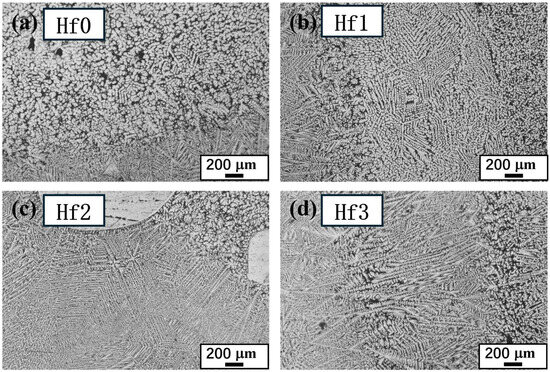
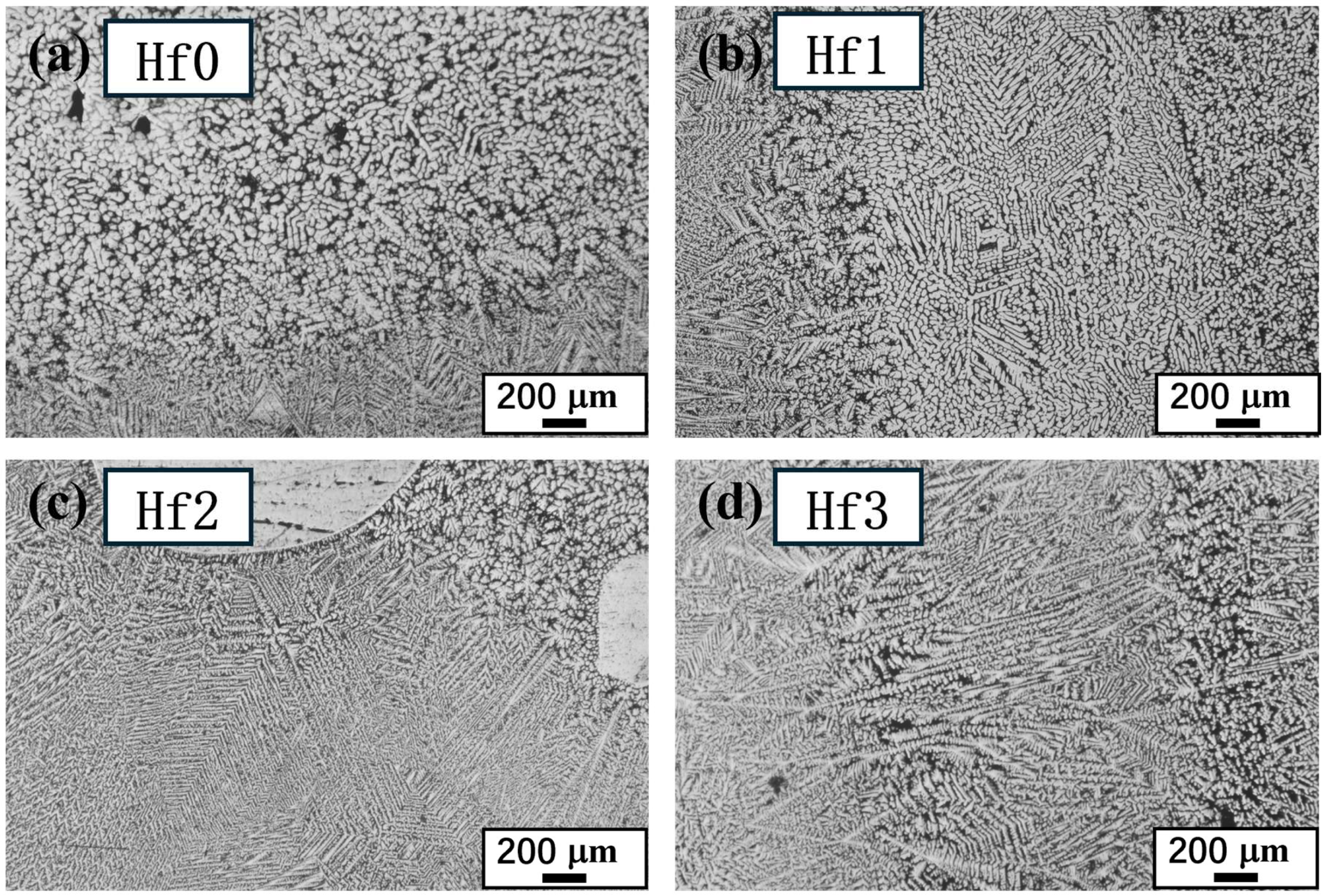
Figure 1 shows the OM images of the TiVZrTaHfx RHEAs. All four alloys exhibited typical solidification microstructures. Figure 1a,b show that relatively coarse reticular regions coexist with dendritic regions in the Hf0 alloy, indicating pronounced microstructural heterogeneity. In Hf1 alloy, reticular regions remain present and their morphology becomes more elongated and refined. As the Hf content is further increased to Hf2 and Hf3, the microstructure gradually became dominated by dendritic regions, while the reticular features are significantly reduced, as shown in Figure 1c,d. This evolution suggested that minor Hf doping altered the solidification morphology and is accompanied by a reduction in segregation contrast. It is well known that constitutional undercooling leads to the formation of dendritic structures [29]. An increase in Hf content intensified the undercooling effect, thereby promoting dendritic growth.
Figure 1.
Optical micrographs of TiVZrTaHfx RHEAs: (a) Hf0; (b) Hf1; (c) Hf2; (d) Hf3.
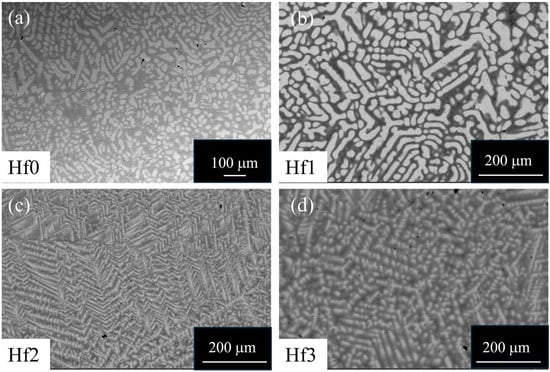
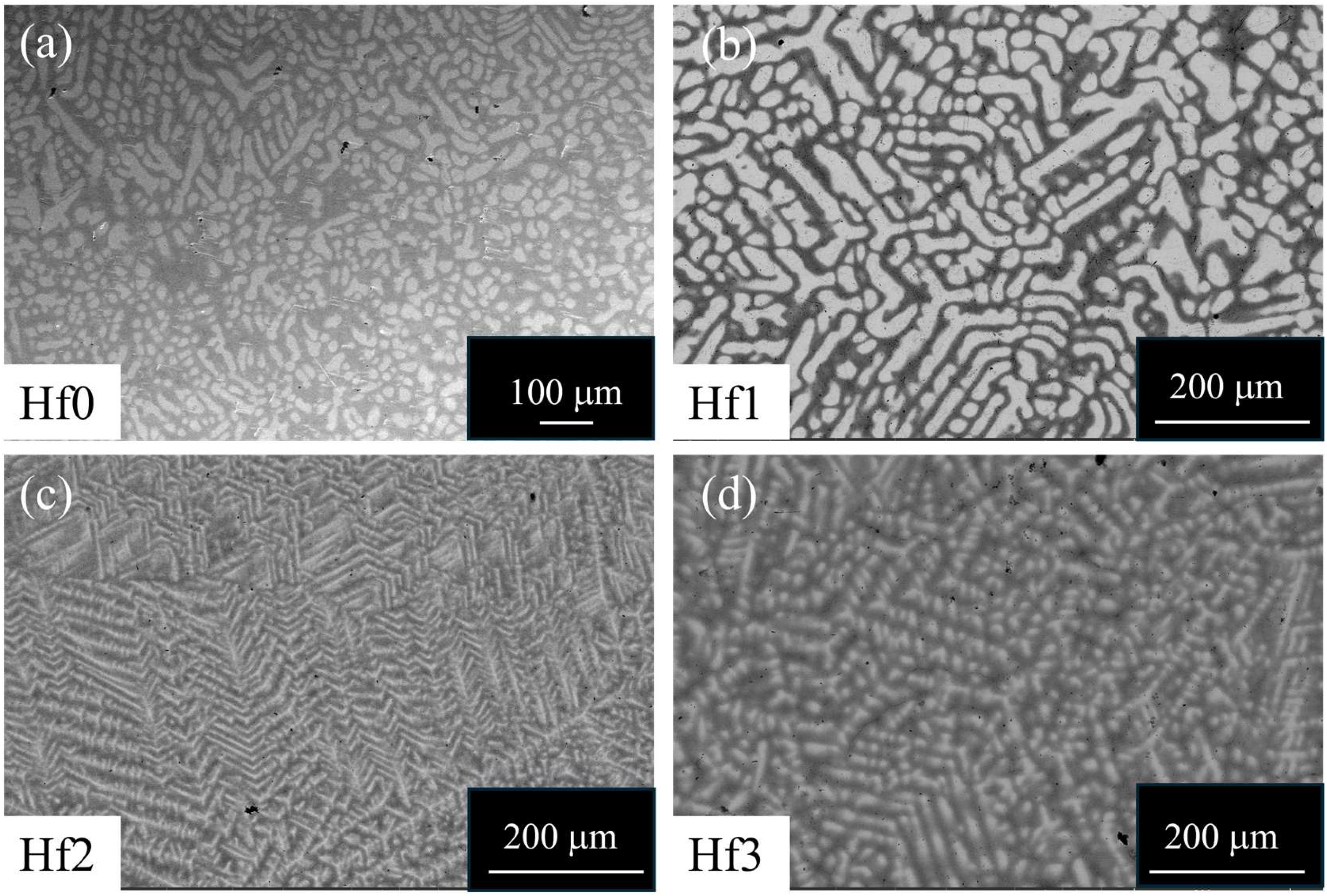
Figure 2a,b show the SEM images of the TiVZrTaHfx alloys. EDS analyses were further performed on multiple positions selected from representative bright and dark regions in Hf0 alloy and Hf3 alloy, the corresponding EDS results are listed in Table 2. The estimated average composition of the analyzed area (Caver), the average composition of the bright regions (Cb) and the average composition of the dark regions (Cd) are listed in Table 2. Based on these data, the partition coefficient of each element between the bright and dark regions was calculated as Ki = Cb/Cd to semi-quantitatively evaluate the local partitioning behavior. In the Hf0 alloy, KTi and KV are both approximately 1.1, indicating only weak partitioning of Ti and V between the two regions, whereas KTa = 2.1 and KZr = 0.4, demonstrating pronounced enrichment of Ta in the bright regions and Zr in the dark regions. In contrast, Hf3 alloy showed a different partitioning pattern. KTi = 1.1 and KHf = 1.0 suggesting that Ti and Hf are nearly uniformly distributed between the bright and dark regions, whereas KV = 1.4, KZr = 1.2 and KTa = 0.6, indicating that V and Zr are enriched in the bright regions while Ta is enriched in the dark regions. Overall, the local segregation contrast was weakened after Hf doping. Considering the relatively large positive mixing enthalpy between Ta and Zr (3 kJ/mol), it can be inferred that Ta and Zr tend to separate during melting [30].
Figure 2.
SEM images of (a) Hf0 alloy, (b) Hf1 alloy, (c) Hf2 alloy and (d) Hf3 alloy.
Table 2.
The estimated average composition of the analyzed area (Caver), the average composition of the bright regions (Cb), the average composition of the dark regions (Cd) and the partition coefficient (Ki) for Hf0 alloy and Hf3 alloy.
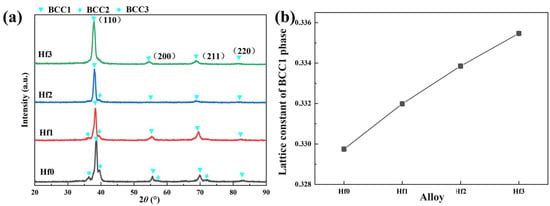
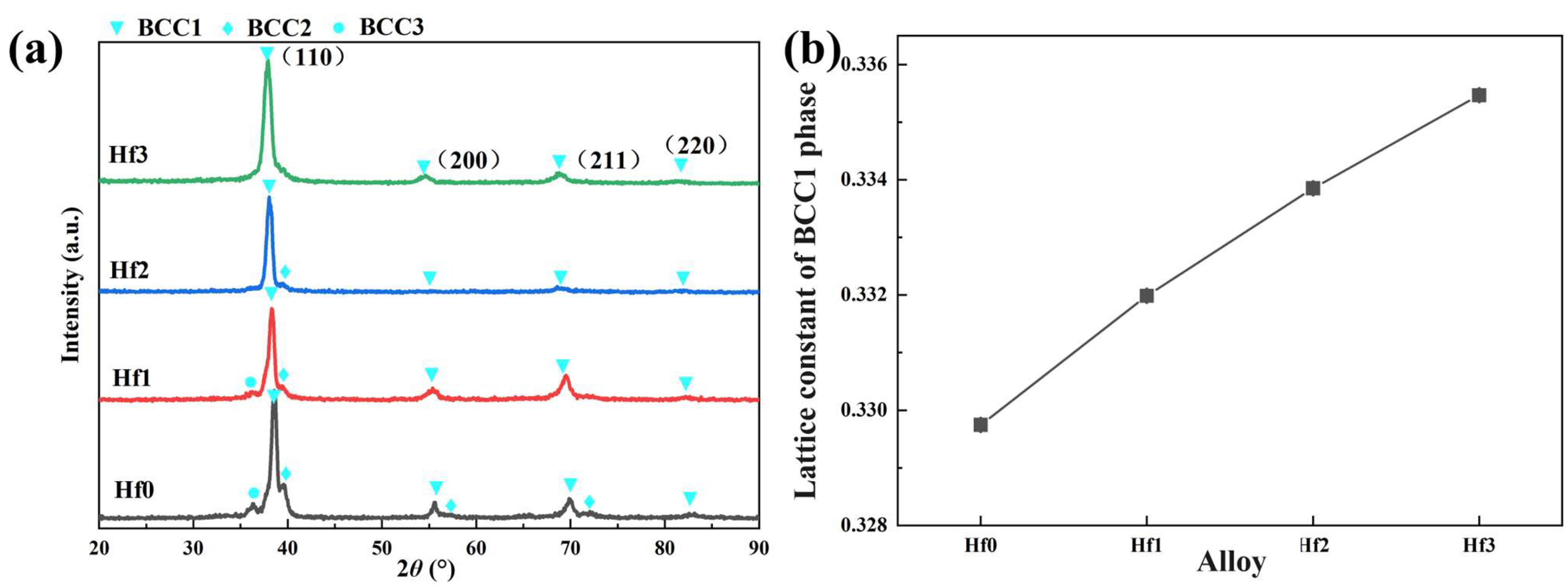
Figure 3a presents the XRD patterns of the TiVZrTaHfx alloys. In the Hf-free alloy (Hf0), the BCC diffraction peaks show obvious splitting, indicating the presence of three BCC phases with similar but not identical lattice constants, denoted as BCC1, BCC2, and BCC3. Because the volume fraction of the BCC3 phase is relatively low, its diffraction peak appears only at the main peak position of 36.33°. Based on the present XRD peak fitting results, together with literature reports on segregation features in TiVZrTa alloys [13], BCC1 is assigned as the near equiatomic matrix phase, while BCC2 and BCC3 are regarded as minor segregated BCC-related components. The formation of the BCC2 and BCC3 phases is mainly caused by the microstructure and the resulting elemental segregation. At lower Bragg angles, the (110) peak of the BCC2 phase appears as the right shoulder of the BCC1 phase, whereas the (110) peak of the BCC3 phase appears on the left side of the BCC1 phase, indicating that the lattice constant of BCC3 is slightly larger than that of BCC1, and that of BCC1 is slightly larger than that of BCC2. After a small amount of Hf is doped into the TiVZrTa alloy, the intensities of the diffraction peaks corresponding to the BCC2 and BCC3 phases decrease significantly. In the Hf2 alloy, the diffraction peak of the BCC3 phase is difficult to observe, and the alloy exhibits a dual phase BCC structure. With a further increase in Hf content, the Hf3 alloy exhibits a single BCC phase. These results indicated that Hf doping progressively weakens the BCC peak splitting and reduces the minor BCC-related components associated with segregation, so that the diffraction response evolves toward a single-BCC-like pattern at high Hf content.
Figure 3.
(a) XRD patterns; (b) Lattice constant variations of the TiVZrTaHfx alloys.
To further evaluate the phase evolution, the overlapped main BCC peaks were deconvoluted, and the relative fitted peak areas were calculated in Table 3. The results show that the relative fractions of BCC2 and BCC3 decrease progressively with increasing Hf content, whereas the fraction of BCC1 correspondingly increases. In Hf3 alloy, the diffraction pattern can be described by a single BCC component. These semi-quantitative results suggest that Hf doping suppresses the minor segregated BCC phases and promotes the formation of a single BCC solid solution.
Table 3.
The peak area ratio of different phase structures in TiVZrTaHfx RHEAs.
In addition, the lattice constant a of the BCC1 phase can be quantitatively determined as follows [31]:
where (hkl) denotes the crystal plane index corresponding to the diffraction peak, θ is the diffraction angle of the plane, and λ is the wavelength of the X-ray radiation (0.1542 nm). The variation in the lattice constant of the BCC1 phase for the four alloys is shown in Figure 3b, indicating that the lattice constant of the alloy matrix increases after Hf doping. This is because the atomic radius of Hf (0.158 nm) is larger than the average atomic radius of the Hf0 alloy system (0.147 nm), and its dissolution in the alloy causes lattice expansion. Meanwhile, Hf doping also promotes the dissolution of the Ta/V-rich phase and the Zr-rich phase into the matrix, and the reduction in segregated phases also affects the final change in lattice constant.
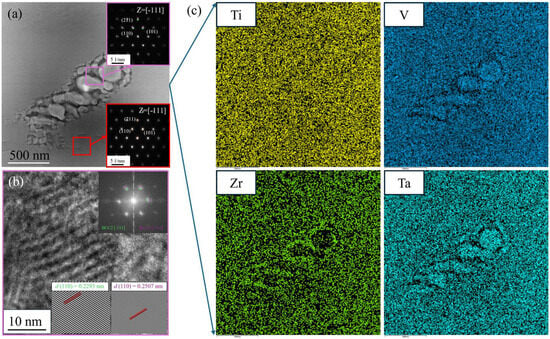
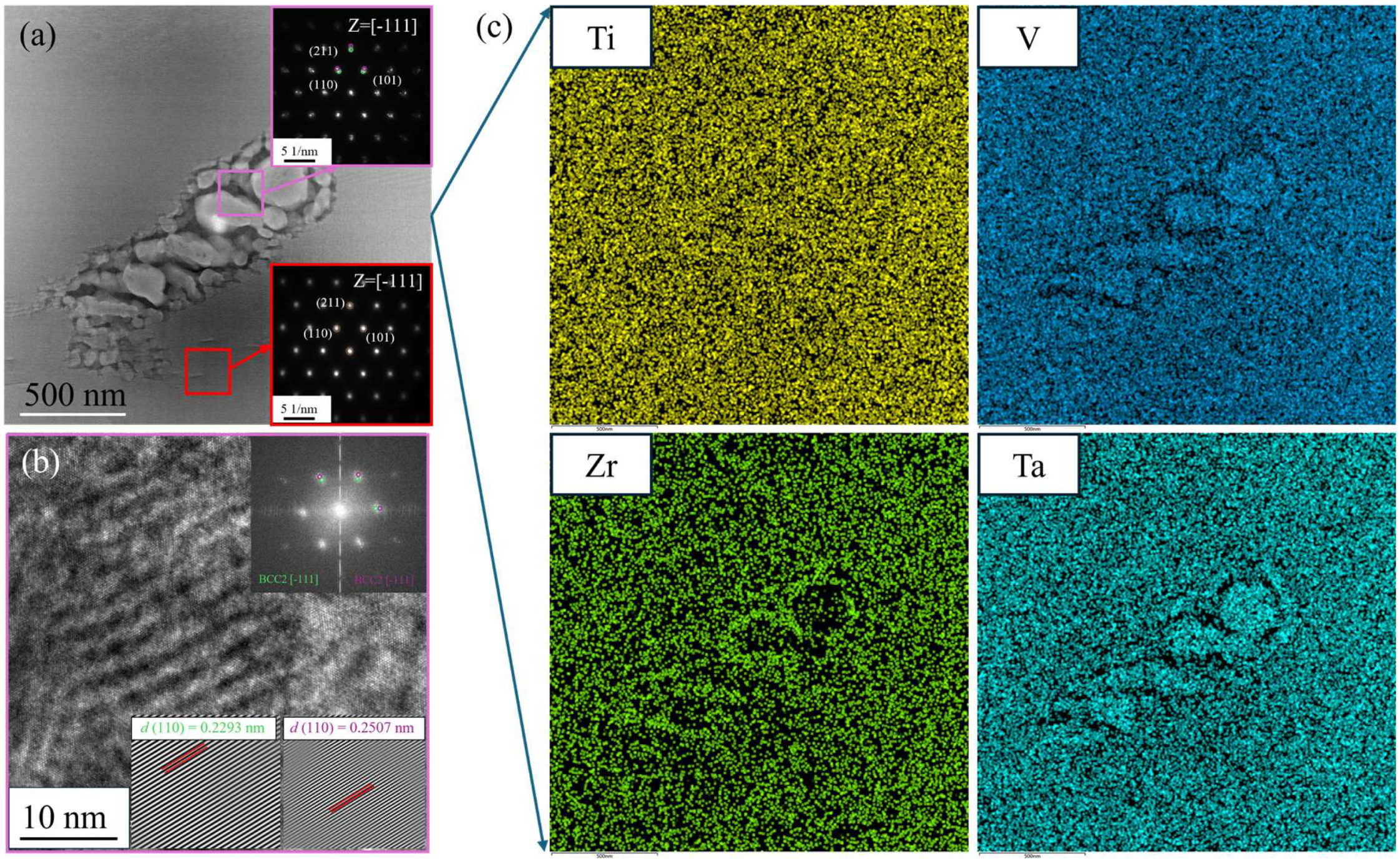
Figure 4a reveals local compositional inhomogeneity on Hf0 alloy. Combined with the TEM-EDS results shown in Figure 4c, Ti is found to be relatively uniformly distributed, while Ta/V-rich regions and Zr-rich regions are observed separately. The SAED patterns obtained from the element non-separation and element separation regions show distinct features. In the element non-separation region, the diffraction spots are standard, sharp and regularly arranged BCC diffraction spots, corresponding to the matrix phase, namely the BCC1 phase. In the element separation region, the SAED pattern still indicates a BCC structure; however, the diffraction spots exhibit obvious broadening and local overlap. Figure 4b shows the HRTEM image of the element separation region, where moire-like contrast can be observed. This contrast is generally attributed to the interference effect caused by the overlap of crystalline domains with similar but not identical lattice spacings, and similar phenomena have also been reported [32]. According to the XRD results, the interplanar spacings of the (110) planes for the BCC2 and BCC3 phases are 0.2289 nm and 0.2497 nm, respectively. FFT and IFFT analyses of the HRTEM image reveal two lattice spacings of 0.2293 nm and 0.2507 nm, which are close to those of the BCC2 and BCC3 phases determined by XRD. These results indicate that the BCC2 phase is mainly enriched in Ta/V/Ti, whereas the BCC3 phase is mainly enriched in Zr/Ti.
Figure 4.
(a) TEM image showing local elemental segregation in the Hf0 alloy, the purple and red boxes indicate the selected regions for SAED analysis. (b) HRTEM image of the purple-boxed region. (c) TEM-EDS characterization corresponding to (a).
The phase formation and phase transformation of the TiVZrTaHfx RHEAs were further interpreted in detail on the basis of the Hume Rothery rules and thermodynamic parameters [33,34]. In this study, the mixing entropy (ΔSmix), mixing enthalpy (ΔHmix) atomic size difference (δ), valence electron concentration (VEC) and thermodynamic parameter (Ω) of the TiVZrTaHfx alloys were calculated, and the results are listed in Table 4. With increasing Hf content, the ΔSmix of the alloys further increases. According to the high entropy effect of high entropy alloys, a higher mixing entropy can significantly reduce the Gibbs free energy of the system and strongly stabilize the random solid solution phase, making the elements more likely to dissolve into one another, thereby suppressing the precipitation of ordered second phases such as intermetallic compounds and promoting the transformation of the alloy from a multiphase state to a stable single BCC solid solution. When δ is less than 6.6%, the formation of intermetallic phases during the solidification of high entropy alloys is suppressed. The δ value of the TiVZrTaHfx alloys gradually increases with Hf doping, but the maximum value of 6.115% for the Hf3 alloy remains lower than the boundary criterion (6.6%). Meanwhile, the ΔHmix ranges from −0.750 kJ/mol to −0.588 kJ/mol, indicating that the formation of a stable solid solution phase is favored. The parameter Ω is helpful for evaluating the relationship between ΔHmix and ΔSmix. When Ω is greater than 1.1, the formation of a stable solid solution phase is more favorable [34]. The Ω value of the TiVZrTaHfx alloys increases gradually with Hf doping, indicating that Hf doping contributes to the stabilization of the solid solution phase in the TiVZrTaHfx alloys. It should be noted that the present thermodynamic discussion is based on empirical parameters and is intended to provide a qualitative interpretation of the experimentally observed phase evolution. These empirical parameters show a qualitatively consistent trend with the XRD-observed phase evolution.
Table 4.
Parameters (kJ/mol), J/(K∙mol), (%), , and VEC.
The evolution of the as-cast microstructure indicates that Hf doping significantly alters the solidification behavior of the alloy. In the undoped Hf0 alloy, the coexistence of reticular morphology and dendrites can be attributed to the competition between local variations in undercooling during solidification and elemental diffusion kinetics. It has been reported that the mixing enthalpy between Hf and V is −2 kJ/mol, whereas the values between Hf and Ti, Zr, Ta are 0, 0 and 3 kJ/mol, respectively [30]. The introduction of Hf therefore changes the characteristics of interatomic interactions in the alloy system. At the same time, the doping of Hf atoms increases the lattice distortion energy. According to the principle of Gibbs free energy minimization, the system tends to reduce the total interfacial energy through the formation of a single solid solution, thereby suppressing multiphase precipitation.
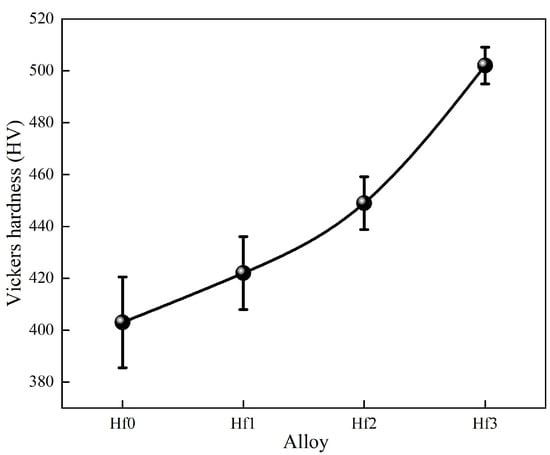
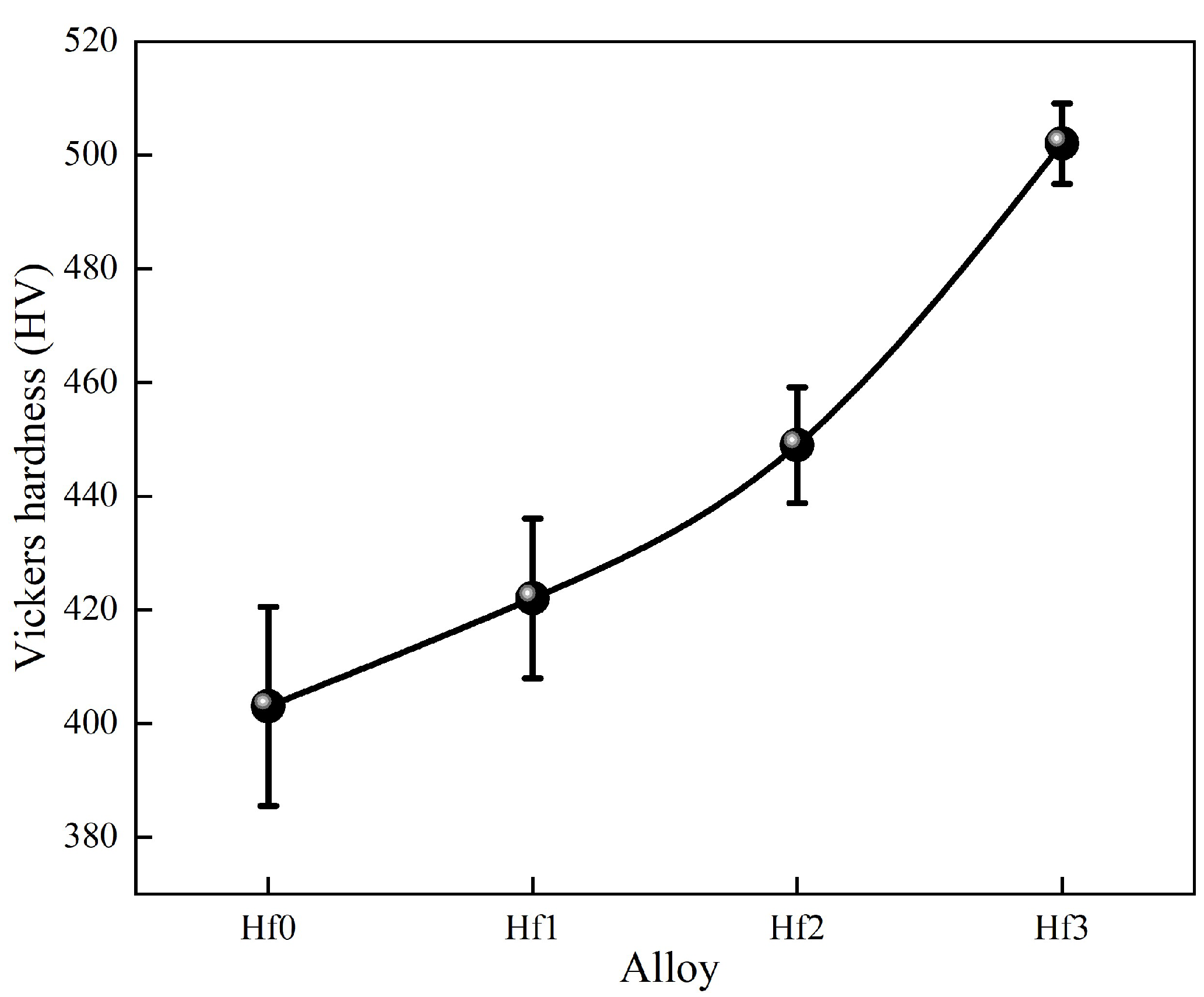
Figure 5 presents the Vickers hardness results of the as-cast TiVZrTaHfx alloys. The Vickers hardness increased progressively with increasing Hf doping. Meanwhile, the error bars became smaller. This behavior can be attributed to the solid solution strengthening induced by Hf doping which enhanced the hardness of the alloys. However, the presence of different segregation phases in the alloys may have affected the indentation measurements and led to greater data scatter. The scatter in the Vickers hardness data was the smallest because the Hf3 alloy exhibited a single-phase microstructure.
Figure 5.
Vickers hardness results of as-cast TiVZrTaHfx alloys.
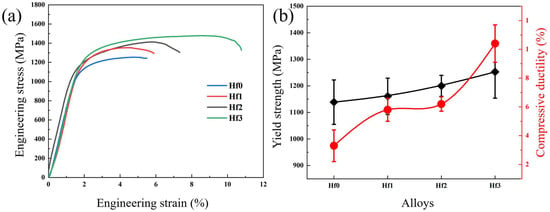
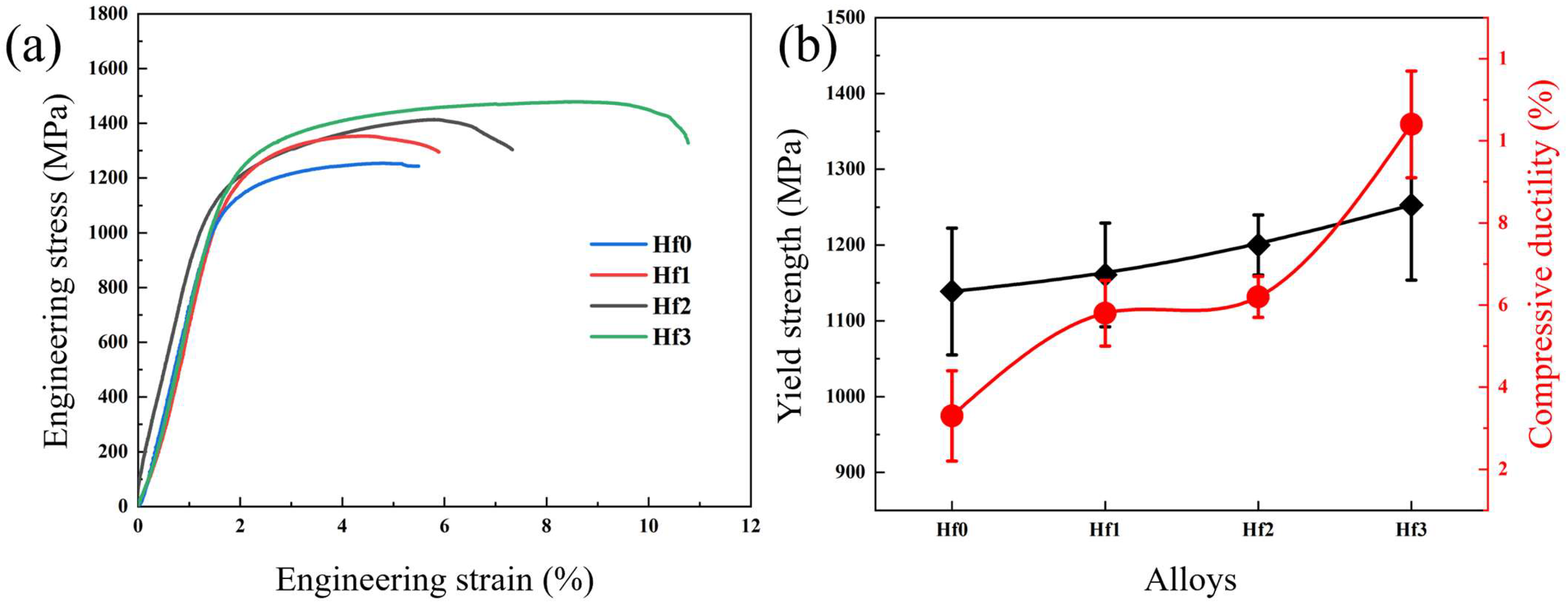
The compressive engineering stress-strain curves of the TiVZrTaHfx alloys are shown in Figure 6a. With increasing Hf doping, both the yield strength and the compressive strain of the alloys were enhanced. Specifically, the yield strength increased from 1139 MPa for Hf0 to 1253 MPa for Hf3, while the compressive strain increased from 5.2% for Hf0 to 10.4% for Hf3, as shown in Figure 6b. Compared with the brittle behavior of conventional RHEAs such as VNbTaMoW [10] and AlNbTiZr [35] under compression, the Hf3 alloy exhibited a favorable combination of yield strength and compressive strain. On the one hand, significant differences in atomic radius and elastic modulus exist between Hf atoms and the Ti, V, Zr, and Ta atoms in the matrix, which increase lattice distortion and suppress dislocation motion, thereby leading macroscopically to an increase in yield strength. On the other hand, second phases can act as sites for crack initiation and propagation. Hf doping significantly reduced the fractions of the minor segregated BCC phases, improved microstructural homogeneity, and is therefore expected to alleviate local stress concentration [36]. Meanwhile, the evolution toward a dendrite-dominated morphology, the weakening of residual segregation and the solid-solution strengthening induced by Hf doping may also contribute to the improvement in compressive properties.
Figure 6.
(a) Compressive stress-strain curves of the TiVZrTaHfx alloys; (b) Variation in yield strength and compressive strain of the TiVZrTaHfx alloys with Hf content.
The density and porosity of the alloys were evaluated, and the results are summarized in Table 5. Overall, all alloys exhibited relatively low porosity, indicating that the cast samples are generally dense. Although such pores may act as local stress concentrators and thus contribute to deformation and fracture behavior to some extent, the porosity variation was relatively limited and did not show a direct correlation with the mechanical-property trend.
Table 5.
The density and porosity of TiVZrTaHfx alloy.
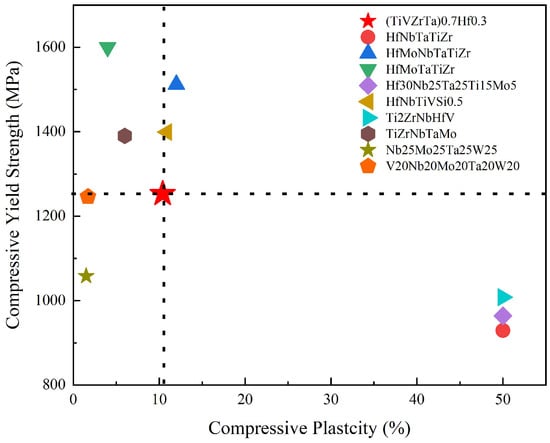
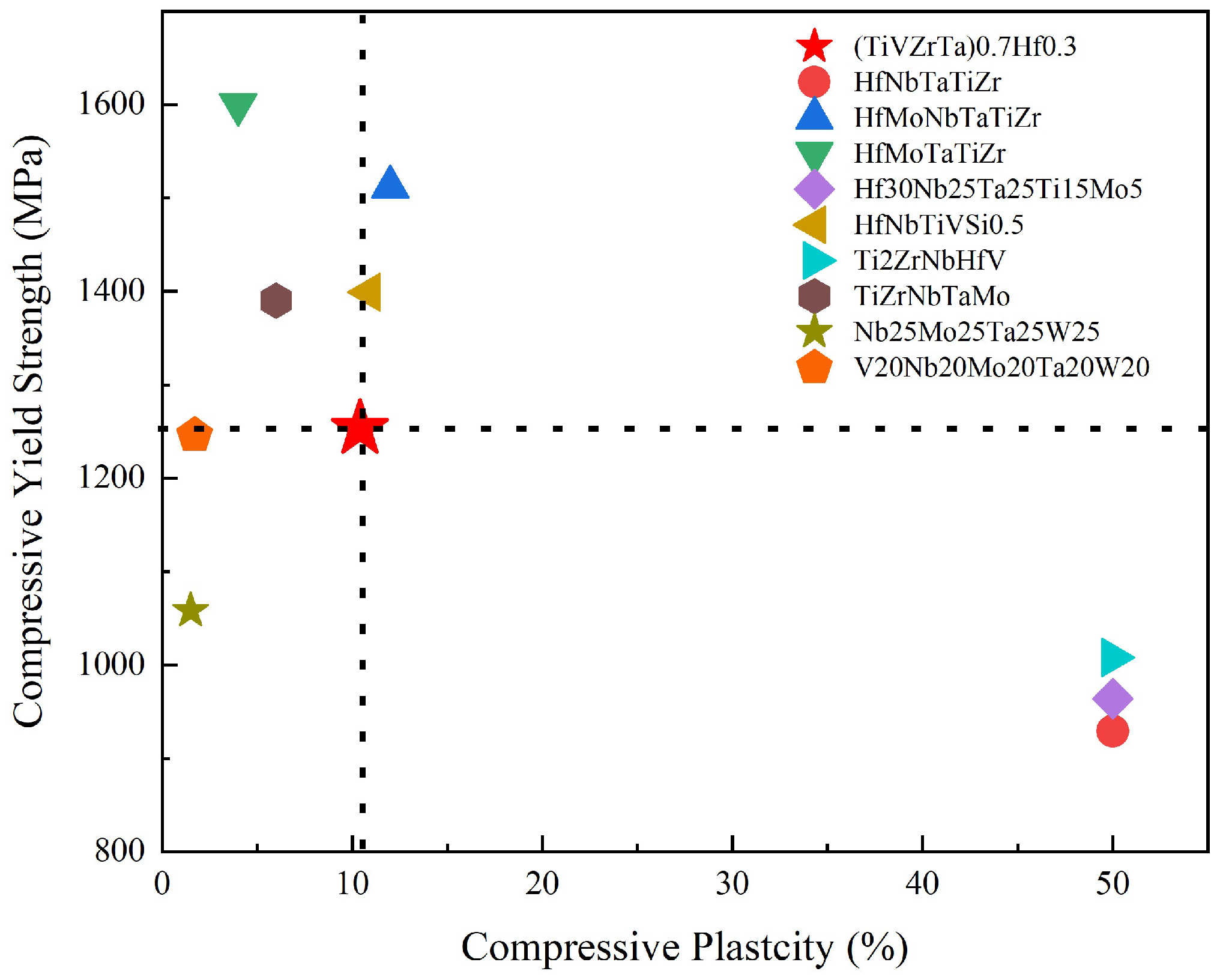
Figure 7 presents an Ashby map comparing the Hf3 alloy designed in this work with previously reported RHEAs [10,37,38,39,40,41,42]. The minor Hf doping adopted in this study improved both alloy strength and plasticity. The yield strength exceeded 1 GPa and the ductility exceeded 10%. Although the compressive mechanical properties fall within the typical range reported for compression-tested RHEAs, the Hf3 alloy exhibits a competitive strength–ductility combination within the range reported for RHEAs under compression.
Figure 7.
Qualitative comparison of the room-temperature compressive yield strength and compressive strain of the Hf3 alloy with reported refractory high-entropy alloys [10,37,38,39,40,41,42].
In most RHEAs, solid solution strengthening is regarded as the dominant strengthening mechanism. The effect originates from the elastic interaction between the local stress field of solute atoms and that of dislocations in metallic solid solutions. However, it is difficult to clearly distinguish solute atoms from solvent atoms in RHEAs. Senkov et al. proposed that the solid solution strengthening model can be applied to RHEAs [43,44]:
where denotes the total yield strength of the alloy, represents the yield strength calculated by the rule of mixtures. is the increase in yield stress provided by solid solution strengthening. is the solid solution strengthening contribution of the i-th element. A is a dimensionless constant on the order of 0.04 [44]. μ is the shear modulus of the alloy calculated by the rule of mixtures. with a BCC lattice is calculated using the following equation:
where and represent the shear-modulus mismatch and atomic-size mismatch, respectively, and β is a dimensionless constant, which is usually taken as 9 for alloys containing a random mixture of edge and screw dislocations. The theoretical yield strength of the TiVZrTaHfx alloy calculated using Equations (2)–(4) is listed in Table 6. The theoretical values were lower than the experimental results, which can be attributed to the absence of second phase strengthening in the theoretical calculation. As revealed by the XRD results, the alloy contained different phase structures (BCC1 phase, BCC2 phase and BCC3 phase). These phases interacted with each other, and a large number of dispersed phase domains hinder dislocation motion and thereby potentially enhance the yield strength of the alloy. In addition to second phase strengthening, the experimentally measured yield strength may also be influenced by Hf-induced local lattice distortion beyond the average-field approximation [45] and by the as-cast dendritic/interdendritic microstructural state [17], both of which are not explicitly included in the model. Therefore, the model was used here mainly to support the strengthening trend after Hf addition rather than to provide an exact prediction of the absolute yield strength.
Table 6.
Mechanical properties of as-cast TiVZrTaHfx alloys.
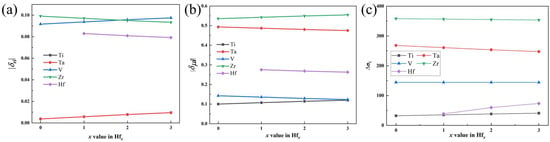
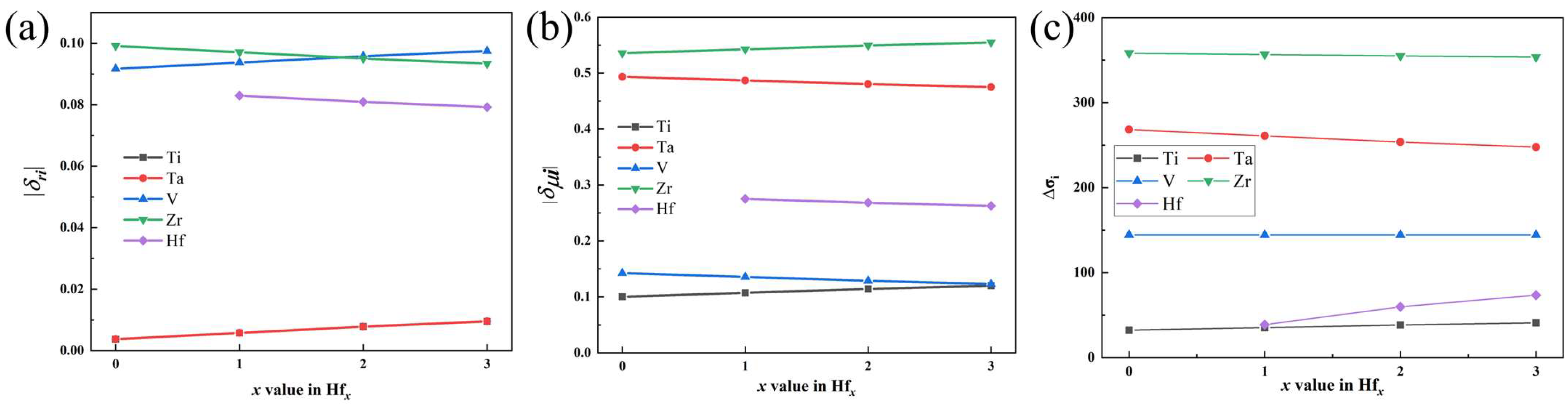
The variations in atomic radius mismatch and elastic modulus mismatch around each element are shown in Figure 8. As shown in Figure 8a, the || values of Hf, V and Zr are several times larger than those of Ti and Ta, indicating that these atoms introduce stronger local size distortion. With increasing Hf doping, the || values of Hf and Zr gradually decrease, whereas those of Ti, Ta and V increase, suggesting that the introduction of Hf modifies the overall atomic size distribution and leads to a redistribution of local size mismatch among different elements. Figure 8b presents the variation of || for each element. Zr, which has a relatively low shear modulus, exhibits the largest || value, followed by Ta. With Hf doping, the || values of V, Ta and Hf decrease, while those of Zr and Ti increase, further enhancing the elastic heterogeneity of the system. Within the framework of solid-solution strengthening, the local stress fields generated by the combined effects of size and modulus mismatches interact with the stress field of dislocation. As dislocations glide through the crystal, they must continuously traverse regions with varying strain states and elastic stiffness, resulting in persistent resistance to motion. This manifests as dislocation bowing, pinning and an overall increase in slip resistance. The theoretical framework proposed by Varvenne et al. [46] also indicates that stress fluctuations arising from the random distribution of multiple elements interact with dislocations, creating a heterogeneous energy landscape. As a result, dislocations are required to bypass or overcome local high-stress regions during glide, thereby significantly increasing the critical stress for dislocation motion. By combining the contributions of || and ||, Zr is found to dominate the overall solid-solution strengthening effect in TiVZrTaHfx alloys (Figure 8c). However, during minor Hf doping, the contributions from Ti, V, Zr and Ta change only slightly, whereas the contribution associated with Hf varies more significantly. This indicates that the doping of Hf provides an additional source of mismatch perturbation within the existing solid-solution matrix. Consequently, dislocations must overcome additional local stress barriers associated with the vicinity of Hf atoms during glide, which increases the resistance to dislocation motion and contributes to the enhancement of yield strength.
Figure 8.
Variations in size mismatch (a) and modulus mismatch (b) around each constituent element in the TiVZrTaHfx alloys with Hf doping. (c) the constituent part of calculated σi of TiVZrTaHfx RHEAs.
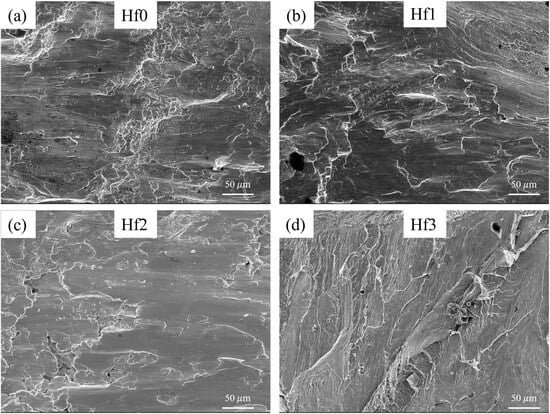
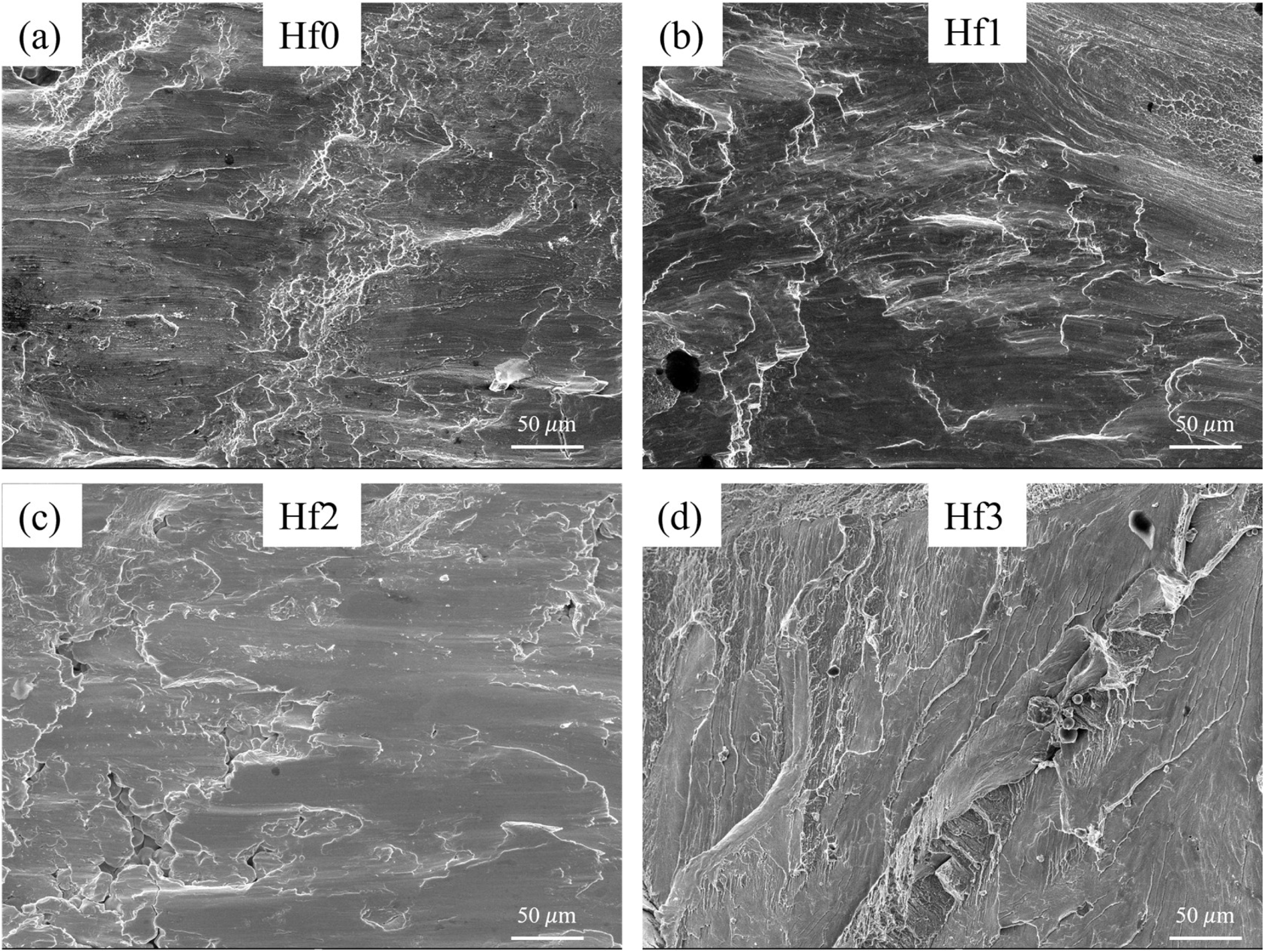
The compressive fracture images of the TiVZrTaHfx alloys are shown in Figure 9. All four alloys exhibited brittle-ductile mixed fracture. However, with increasing Hf content, the overall fracture characteristics gradually evolved from quasi-cleavage-dominated fracture toward a fracture mode with more pronounced plastic tearing, indicating a gradual improvement in alloy ductility. Figure 9a shows the fracture image of the Hf0 alloy. Its fracture surface was mainly characterized by large, relatively smooth quasi cleavage facets, cleavage steps and river patterns, with only a small number of shallow dimples observed locally, indicating that crack propagation was strongly directional and that brittle cracking dominates the fracture process. Figure 9b shows the fracture image of the Hf1 alloy. Although quasi-cleavage fracture features still dominated, the number of tearing ridges and local traces of microvoid coalescence was slightly greater than in the Hf0 alloy, indicating that more local plastic deformation occured before failure. Figure 9c shows the fracture image of the Hf2 alloy. Although quasi cleavage platforms and stepped fracture units can still be observed over a certain area, tearing ridges, local microvoid coalescence, and plastic tearing features in the boundary regions further increase, suggesting that more coordinated local plastic deformation occurs during crack propagation. Figure 9d shows the fracture image of the Hf3 alloy. The roughness of its fracture surface increases markedly, and fine dimples, tearing ridges, and shear flow traces are more fully developed, demonstrating a stronger capability for plastic energy dissipation. Its fracture mechanism can therefore be regarded as a brittle-ductile mixed fracture mode with a significantly enhanced ductile component. By combining the evolution of fracture morphology with the compression results, it can be concluded that Hf doping promoted the transition of the alloy from quasi cleavage dominated fracture with low plasticity to mixed fracture involving a higher degree of plastic participation. This is attributed to the progressive reduction of brittle segregated phases such as the Zr-rich phase and the Ta/V-rich phase with increasing Hf content. As a result, the microstructure becomes more homogeneous. Crack initiation sites were reduced and stress concentration at phase boundaries was mitigated. At the same time, the atomic size mismatch and lattice distortion induced by Hf in solid solution enhance solid-solution strengthening. Together with the reduction in minor segregated phases and the accompanying decrease in local stress concentration, these factors are likely to contribute to the improved compressive strain observed in the present alloys. Consequently, the fracture morphology exhibits progressively enhanced plastic features with increasing Hf content.
Figure 9.
SEM fracture images of the TiVZrTaHfx alloys after compression: (a) Hf0 alloy; (b) Hf1 alloy; (c) Hf2 alloy; (d) Hf3 alloy.
In the Hf0 alloy, the coexistence of three BCC phases readily gives rise to stress concentration at phase boundaries during deformation. When Hf doping induces the transformation of the alloy into a single BCC structure, the significant reduction of minor segregated BCC components and the corresponding decrease in phase-boundary density may mitigate local stress concentration during deformation. The simplification and refinement of the dendritic structure make the dislocation slip path more continuous during deformation, thereby preventing premature failure caused by dislocation pile-up at reticular grain boundaries. In BCC alloy, room-temperature plasticity is generally strongly affected by screw dislocation motion and slip localization. HCP-structured elements such as Hf may alter the screw dislocation core structure and slip-plane selection in BCC RHEAs. Tsuru et al. [47] pointed out that the higher fraction of HCP elements in TiZrHfNbTa can reduce the dislocation core energy, increase lattice distortion and lower the shear modulus in comparative study of TiZrHfNbTa and VNbMoTaW. As a result, the screw dislocation core becomes more extended, and the activated macroscopic slip planes differ from those in VNbMoTaW. Therefore, Hf may positively influence plastic deformation capability by enhancing local lattice distortion and modifying the local dislocation-motion environment.
4. Conclusions
In this study, TiVZrTaHfx (x = 0, 0.1, 0.2, and 0.3) RHEAs were prepared by vacuum arc melting, and the effects of minor Hf doping on as-cast microstructure, phase structure and room temperature compressive properties were systematically investigated. The main conclusions are as follows:
(1) With increasing Hf content, the phase structure of the alloy gradually transformed from Tri-BCC phase to Dual-BCC phases and finally to a single BCC phase, and the lattice constant of the BCC1 matrix correspondingly increases. The as-cast microstructure evolved from the coexistence of reticular morphology and dendrites into a relatively uniform single dendritic structure, indicating that the introduction of Hf tends to reduce local segregation contrast and improve the stability of the solid solution phase.
(2) Minor Hf doping can simultaneously improve the yield strength and compressive strain of the TiVZrTa alloy. The Hf3 alloy exhibits the best room temperature compressive performance, with a yield strength of 1253 MPa and a compressive strain of 10.4%. Correspondingly, the fracture morphology gradually evolved from quasi-cleavage-dominated fracture in the Hf0 alloy to brittle ductile mixed fracture with more pronounced plastic tearing features, indicating that deformation compatibility is improved.
(3) The increase in atomic size mismatch caused by Hf in solid solution enhanced lattice distortion and solid-solution strengthening. In addition, the reduction in multiphase segregated structures and the alleviation of brittle phase boundaries and local stress concentration made dislocation slip and plastic flow more continuous. The synergistic effect of these factors enabled the simultaneous improvement of strength and compressive strain in the TiVZrTa alloy.
Author Contributions
S.Y.: Investigation, Conceptualization, Data curation, Writing—original draft, Writing—review & editing. B.L.: Supervision, Funding acquisition, Writing—review & editing, Conceptualization. All authors have read and agreed to the published version of the manuscript.
Funding
This research received no external funding.
Institutional Review Board Statement
Not applicable.
Informed Consent Statement
Not applicable.
Data Availability Statement
Data are contained within the article.
Conflicts of Interest
The authors declare no conflicts of interest.
References
- Senkov, O.N.; Senkova, S.V.; Dimiduk, D.M.; Woodward, C.; Miracle, D.B. Oxidation behavior of a refractory NbCrMo0.5Ta0.5TiZr alloy. J. Mater. Sci. 2012, 47, 6522–6534. [Google Scholar] [CrossRef] [Scilit]
- Jayaraj, J.; Thinaharan, C.; Ningshen, S.; Mallika, C.; Kamachi Mudali, U. Corrosion behavior and surface film characterization of TaNbHfZrTi high entropy alloy in aggressive nitric acid medium. Intermetallics 2017, 89, 123–132. [Google Scholar] [CrossRef] [Scilit]
- Xia, S.-q.; Wang, Z.; Yang, T.-f.; Zhang, Y. Irradiation Behavior in High Entropy Alloys. J. Iron Steel Res. Int. 2015, 22, 879–884. [Google Scholar] [CrossRef] [Scilit]
- Wang, G.; Liu, Q.; Yang, J.; Li, X.; Sui, X.; Gu, Y.; Liu, Y. Synthesis and thermal stability of a nanocrystalline MoNbTaTiV refractory high-entropy alloy via mechanical alloying. Int. J. Refract. Met. Hard Mater. 2019, 84, 104988. [Google Scholar] [CrossRef] [Scilit]
- Bhardwaj, V.; Zhou, Q.; Zhang, F.; Han, W.; Du, Y.; Hua, K.; Wang, H. Effect of Al addition on the microstructure, mechanical and wear properties of TiZrNbHf refractory high entropy alloys. Tribol. Int. 2021, 160, 107031. [Google Scholar] [CrossRef] [Scilit]
- Ma, H.; Shek, C.H. Effects of Hf on the microstructure and mechanical properties of CoCrFeNi high entropy alloy. J. Alloys Compd. 2020, 827, 154159. [Google Scholar] [CrossRef] [Scilit]
- Hao, W.U.; Jiashi, Y.U.; Jia, Z.; Zhang, L.; Chen, H. Progress of refractory high entropy alloys. J. Aeronaut. Mater. 2024, 44, 45–59. [Google Scholar]
- Li, X. Negative enthalpy raises strength and ductility. Nat. Mater. 2024, 23, 178. [Google Scholar] [CrossRef] [Scilit]
- Huang, R.; Tang, S.; Kou, Z.; Yang, L.; Lan, S.; Wilde, G.; Qiang, X.; Feng, T. Strength-ductility synergy in refractory high entropy alloys: A review. Prog. Nat. Sci. Mater. Int. 2025, 35, 1055–1078. [Google Scholar] [CrossRef] [Scilit]
- Senkov, O.N.; Wilks, G.B.; Scott, J.M.; Miracle, D.B. Mechanical properties of Nb25Mo25Ta25W25 and V20Nb20Mo20Ta20W20 refractory high entropy alloys. Intermetallics 2011, 19, 698–706. [Google Scholar] [CrossRef] [Scilit]
- Kim, S.; Kim, Y.S.; Jeong, Y.J.; Mo, K.; Miao, Y.; Ye, B.; Oaks, A.; Bhattacharya, S.; Lee, K.H.; Kim, K.N.; et al. Effectiveness of the metal coating on U–7Mo dispersion fuel in Al during irradiation. J. Nucl. Mater. 2020, 529, 151945. [Google Scholar] [CrossRef] [Scilit]
- Ayyagari, A.; Salloom, R.; Muskeri, S.; Mukherjee, S. Low activation high entropy alloys for next generation nuclear applications. Materialia 2018, 4, 99–103. [Google Scholar] [CrossRef] [Scilit]
- Kareer, A.; Waite, J.C.; Li, B.; Couet, A.; Armstrong, D.E.J.; Wilkinson, A.J. Short communication: ‘Low activation, refractory, high entropy alloys for nuclear applications’. J. Nucl. Mater. 2019, 526, 151744. [Google Scholar] [CrossRef] [Scilit]
- Li, Y.; Qiang, W. Defect properties of a body-centered cubic equiatomic TiVZrTa high-entropy alloy from atomistic simulations. J. Phys. Condens. Matter 2023, 35, 345701. [Google Scholar] [CrossRef] [Scilit]
- Li, J.; Li, Y.; Hassani, M. Mechanically driven refractory high entropy alloy coatings: Phase formation and mechanical properties. Surf. Coat. Technol. 2025, 496, 131669. [Google Scholar] [CrossRef] [Scilit]
- Vlasák, T.; Čížek, J.; Melikhova, O.; Lukáč, F.; Preisler, D.; Janeček, M.; Harcuba, P.; Zimina, M.; Srba, O. Thermal Stability of Microstructure of High-Entropy Alloys Based on Refractory Metals Hf, Nb, Ta, Ti, V, and Zr. Metals 2022, 12, 394. [Google Scholar] [CrossRef] [Scilit]
- Tong, Y.; Zhao, S.; Bei, H.; Egami, T.; Zhang, Y.; Zhang, F. Severe local lattice distortion in Zr- and/or Hf-containing refractory multi-principal element alloys. Acta Mater. 2020, 183, 172–181. [Google Scholar] [CrossRef] [Scilit]
- Wang, Z.; Fang, Q.; Li, J.; Liu, B.; Liu, Y. Effect of lattice distortion on solid solution strengthening of BCC high-entropy alloys. J. Mater. Sci. Technol. 2018, 34, 349–354. [Google Scholar] [CrossRef] [Scilit]
- Mo, J.; Liang, X.; Shen, B.; Wan, Y.; Mao, H.; Zhang, Z.; Li, W.; Schönecker, S.; Vitos, L.; Li, X. Local lattice distortions, phase stability, and mechanical properties of NbMoTaWHfx alloys: A combined theoretical and experimental study. Comput. Mater. Sci. 2023, 217, 111891. [Google Scholar] [CrossRef] [Scilit]
- Wang, Y.; Xiong, K.; Li, W.; Jin, C.; Wu, H.; Dai, H.; Yang, Z.; Yang, H.; Zhang, S. Hf-induced strengthening and lattice distortion in HfxNbTaTiV refractory multi-principal element alloys. J. Mater. Res. Technol. 2025, 34, 2527–2538. [Google Scholar] [CrossRef] [Scilit]
- Wang, B.; Yang, C.; Shu, D.; Sun, B. A Review of Irradiation-Tolerant Refractory High-Entropy Alloys. Metals 2024, 14, 45. [Google Scholar] [CrossRef] [Scilit]
- Evans, J.A.; DeHart, M.D.; Weaver, K.D.; Keiser, D.D. Burnable absorbers in nuclear reactors—A review. Nucl. Eng. Des. 2022, 391, 111726. [Google Scholar] [CrossRef] [Scilit]
- Hu, M.; Shen, C.; Zhang, L. Corrosion Behavior of 304NG Austenitic Stainless Steel in Supercritical Water. Corros. Prot. 2016, 37, 565–571. [Google Scholar]
- Robson, J.D. Modelling Precipitate Amorphization in Zircaloys. J. Nucl. Mater. 2021, 551, 152944. [Google Scholar] [CrossRef] [Scilit]
- Zong, Y.; Hashimoto, N.; Oka, H. Study on irradiation effects of refractory bcc high-entropy alloy. Nucl. Mater. Energy 2022, 31, 101158. [Google Scholar] [CrossRef] [Scilit]
- Zong, Y.; Ikubo, R.; Hashimoto, N.; Oka, H. Irradiation behavior of HfNbTaTiV in comparison of HfNbTaTiZr and F82H. J. Nucl. Sci. Technol. 2023, 60, 859–865. [Google Scholar] [CrossRef] [Scilit]
- Zhang, H.; Wang, Q.; Li, C.; Zhu, Z.; Huang, H.; Lu, Y. He-ion Irradiation Effects on the Microstructures and Mechanical Properties of the Ti-Zr-Hf-V-Ta Low-Activation High-Entropy Alloys. Materials 2023, 16, 5530. [Google Scholar] [CrossRef] [Scilit]
- Pogrebnjak, A.D.; Yakushchenko, I.V.; Bondar, O.V.; Beresnev, V.M.; Oyoshi, K.; Ivasishin, O.M.; Amekura, H.; Takeda, Y.; Opielak, M.; Kozak, C. Irradiation resistance, microstructure and mechanical properties of nanostructured (TiZrHfVNbTa)N coatings. J. Alloys Compd. 2016, 679, 155–163. [Google Scholar] [CrossRef] [Scilit]
- Zhang, B.; Gao, M.C.; Zhang, Y.; Guo, S.M. Senary refractory high-entropy alloy Cr MoNbTaVW. Calphad 2015, 51, 193–201. [Google Scholar] [CrossRef] [Scilit]
- Takeuchi, A.; Inoue, A. Classification of Bulk Metallic Glasses by Atomic Size Difference, Heat of Mixing and Period of Constituent Elements and Its Application to Characterization of the Main Alloying Element (Overview). Mater. Trans. 2005, 46, 2817–2829. [Google Scholar] [CrossRef] [Scilit]
- Shi, J.; Zhang, Y.Z.; Wang, X.; Jiang, C.L.; Wang, M.; Ma, C.; Huang, H. Microstructure and mechanical properties of UNbTiHf1-xMox high-entropy alloys. Mater. Sci. Eng. A 2022, 860, 144239. [Google Scholar] [CrossRef] [Scilit]
- Heo, Y.U.; Lee, D.; Trang, T.T.T.; Hong, C. Effective elimination of Moire fringe at the nanoprecipitate/matrix interface. Appl. Microsc. 2026, 56, 1. [Google Scholar] [CrossRef] [Scilit] [PubMed]
- Wang, Z.; Guo, S.; Liu, C.T. Phase Selection in High-Entropy Alloys: From Nonequilibrium to Equilibrium. JOM 2014, 66, 1966–1972. [Google Scholar] [CrossRef] [Scilit]
- Yang, X.; Zhang, Y. Prediction of high-entropy stabilized solid-solution in multi-component alloys. Mater. Chem. Phys. 2012, 132, 233–238. [Google Scholar] [CrossRef] [Scilit]
- Chen, W.; Tang, Q.H.; Wang, H.; Xie, Y.C.; Yan, X.H.; Dai, P.Q. Microstructure and mechanical properties of a novel refractory AlNbTiZr high-entropy alloy. Mater. Sci. Technol. 2018, 34, 1309–1315. [Google Scholar] [CrossRef] [Scilit]
- Siemens, C.; Kang, J.; Wilkinson, D.S. In-situ investigation of damage mechanisms in duplex AlCoCrFeNi2.1 high entropy alloy. Mater. Sci. Eng. A 2023, 884, 145532. [Google Scholar] [CrossRef] [Scilit]
- Tseng, K.K.; Juan, C.C.; Tso, S.; Chen, H.C.; Tsai, C.W.; Yeh, J.W. Effects of Mo, Nb, Ta, Ti, and Zr on Mechanical Properties of Equiatomic Hf-Mo-Nb-Ta-Ti-Zr Alloys. Entropy 2018, 21, 15. [Google Scholar] [CrossRef] [Scilit] [PubMed]
- Juan, C.C.; Tsai, M.H.; Tsai, C.W.; Lin, C.M.; Wang, W.R.; Yang, C.C.; Chen, S.K.; Lin, S.J.; Yeh, J.W. Enhanced mechanical properties of HfMoTaTiZr and HfMoNbTaTiZr refractory high-entropy alloys. Intermetallics 2015, 62, 76–83. [Google Scholar] [CrossRef] [Scilit]
- Wei, Q.; Zhang, A.; Han, J.; Xin, B.; Su, B.; Wang, X.; Meng, J. A novel Hf30Nb25Ta25Ti15Mo5 refractory high entropy alloy with excellent combination of strength and ductility. Mater. Sci. Eng. A 2022, 857, 144035. [Google Scholar] [CrossRef] [Scilit]
- Zhang, Y.; Liu, Y.; Li, Y.; Chen, X.; Zhang, H. Microstructure and mechanical properties of a refractory HfNbTiVSi0.5 high-entropy alloy composite. Mater. Lett. 2016, 174, 82–85. [Google Scholar] [CrossRef] [Scilit]
- Xu, C.; Chen, D.; Yang, X.; Liu, T.; Chen, R. Achieving excellent strength and ductility of Ti2ZrNbHfVx refractory high-entropy alloys by V addition. Int. J. Refract. Met. Hard Mater. 2024, 121, 106681. [Google Scholar] [CrossRef] [Scilit]
- Wang, S.P.; Xu, J. TiZrNbTaMo high-entropy alloy designed for orthopedic implants: As-cast microstructure and mechanical properties. Mater. Sci. Eng. C 2017, 73, 80–89. [Google Scholar] [CrossRef] [Scilit] [PubMed]
- Senkov, O.N.; Scott, J.M.; Senkova, S.V.; Miracle, D.B.; Woodward, C.F. Microstructure and room temperature properties of a high-entropy TaNbHfZrTi alloy. J. Alloys Compd. 2011, 509, 6043–6048. [Google Scholar] [CrossRef] [Scilit]
- Li, T.; Miao, J.; Lu, Y.; Wang, T.; Li, T. Effect of Zr on the as-cast microstructure and mechanical properties of lightweight Ti2VNbMoZrx refractory high-entropy alloys. Int. J. Refract. Met. Hard Mater. 2022, 103, 105762. [Google Scholar] [CrossRef] [Scilit]
- Aranda, V.A.; Klyatskina, E.; Barba-Pingarrón, A.; Figueroa, I.A.; Amigó, V.; Gonzalez, G. Nanoindentation and orientation imaging analysis of high entropy Ti–Nb–Zr–Ta–Mo alloys exhibiting dendrite microstructure. J. Mater. Res. Technol. 2025, 35, 1732–1740. [Google Scholar] [CrossRef] [Scilit]
- Varvenne, C.; Luque, A.; Curtin, W.A. Theory of strengthening in fcc high entropy alloys. Acta Mater. 2016, 118, 164–176. [Google Scholar] [CrossRef] [Scilit]
- Tsuru, T.; Han, S.; Matsuura, S.; Chen, Z.; Kishida, K.; Iobzenko, I.; Rao, S.I.; Woodward, C.; George, E.P.; Inui, H. Intrinsic factors responsible for brittle versus ductile nature of refractory high-entropy alloys. Nat. Commun. 2024, 15, 1706. [Google Scholar] [CrossRef] [Scilit] [PubMed]

Disclaimer/Publisher’s Note: The statements, opinions and data contained in all publications are solely those of the individual author(s) and contributor(s) and not of MDPI and/or the editor(s). MDPI and/or the editor(s) disclaim responsibility for any injury to people or property resulting from any ideas, methods, instructions or products referred to in the content. |
© 2026 by the authors. Licensee MDPI, Basel, Switzerland. This article is an open access article distributed under the terms and conditions of the Creative Commons Attribution (CC BY) license.