Article

Deposition Temperature-Driven Structural Evolution and Wet-Oxygen Corrosion Behavior of a-SiOC Coatings on Optical Fibers

1
State Key Laboratory of Advanced Technology for Materials Synthesis and Processing, Wuhan University of Technology, Wuhan 430070, China
2
Hubei Technology Innovation Center for Advanced Composites, Wuhan University of Technology, Wuhan 430070, China
3
Hubei Longzhong Laboratory, Xiangyang 441000, China
4
New Industry Creation Hatchery Center, Tohoku University, Sendai 980-8579, Japan
*
Author to whom correspondence should be addressed.
Coatings 2026, 16(5), 623; https://doi.org/10.3390/coatings16050623
Submission received: 27 March 2026 / Revised: 12 May 2026 / Accepted: 14 May 2026 / Published: 21 May 2026
(This article belongs to the Section High-Energy Beam Surface Engineering and Coatings)

Highlights

  • Uniform and dense a-SiOC coatings were successfully prepared on optical fibers by PECVD, demonstrating the feasibility of direct amorphous ceramic coating deposition on silica fibers with good interfacial adhesion.
  • Revealed the temperature-driven evolution mechanism of a-SiOC coatings in a PECVD HMDS/Ar/O2 system.
  • Clarified the differentiated failure modes and mechanical property variations of a-SiOC coatings in 500–900 °C wet-oxygen.

Abstract

Optical fiber sensors deployed in harsh industrial fields, e.g., high-temperature wet-oxygen, face severe challenges in signal attenuation and mechanical degradation. While amorphous silicon oxycarbide (a-SiOC) coatings offer a promising solution due to their adjustable thermo-mechanical properties, balancing their structural density with environmental stability remains a critical technical bottleneck. In this study, a-SiOC coatings were deposited on optical fibers using hexamethyldisilane (HMDS) and trace oxygen via radio-frequency capacitively coupled plasma-enhanced chemical vapor deposition (PECVD). A systematic investigation was conducted to determine the impact of deposition temperature (70–420 °C) on the precursor dissociation kinetics, microstructural evolution, and corrosion resistance of the coatings. An elevation in temperature promotes the elimination of organic terminal groups (–CH3, –H) and enhances surface diffusion, driving the coating from a loose, carbon-rich “polymer-like” structure (dominated by Si–C bonds) to a dense, inorganic “silica-like” skeleton (dominated by Si–O–Si bonds). High-temperature corrosion tests in a wet-oxygen environment (500–900 °C) demonstrate that the failure mechanism is highly dependent on deposition temperature. Coatings deposited at low temperatures suffer catastrophic cracking due to pronounced oxidative shrinkage and the release of volatile species, whereas coatings deposited at 420 °C exhibit microcracking caused by severe carbon phase separation and stress concentration within the rigid inorganic network. In the present system, 350 °C is identified as the optimal deposition temperature, as it achieves the best balance of network densification and structural flexibility, while exhibiting the best mechanical performance.

1. Introduction

In recent years, cutting-edge fields such as deep geothermal seismic monitoring [1], fourth-generation nuclear reactor safety monitoring [2], and hypersonic vehicle thermal protection system verification [3] have created an urgent demand for optical fiber sensing technologies capable of long-term operation in extreme environments. These environments are typically characterized by high temperature, high pressure, corrosive media, and complex thermochemical coupling, all of which seriously threaten the stability of signal transmission in optical fibers. Quartz fiber is an ideal candidate for high temperature sensor networks because of its ultra-low intrinsic loss and excellent thermal stability [4]. However, hydrogen and water vapor can cause severe signal loss and mechanical strength degradation [5,6], making the optical fiber coating, which serves as the first protective barrier, critical to sensor lifetime.
However, existing coating systems still suffer from significant limitations. Traditional acrylate coatings undergo pyrolysis at around 250 °C [7], while modified polyimide coatings lose their protective capability at around 300 °C due to reactions with oxygen [8]. Metal coatings (e.g., Al and Au), although possessing strong high temperature resistance, usually require an intermediate layer to alleviate the thermal expansion mismatch with silica. This intermediate layer is generally a graphite-like amorphous carbon coating (GLC) containing a large number of sp2 bonds, which tends to undergo an sp2-to-sp3 bond transformation at high temperatures, leading to structural loosening and making it susceptible to oxidation [9,10]. The h-BN coating prepared by Luan et al. can remain stable at 700 °C [11], but its low deposition rate (100 nm/h) makes it unsuitable for large-scale fabrication.
It is worth noting that, in addition to h-BN coatings, other ceramic layers have also been directly introduced into optical fiber systems. For example, Luan et al. further constructed SiBCN single-layer and BN/SiBCN double-layer ceramic coatings on silica optical fibers, and the results showed that these structures not only improved the tensile strength at room temperature and 700 °C, but also effectively suppressed light leakage at high temperatures [12]. Chen et al. deposited an outer SiBCN layer on sapphire optical fibers to enhance their stability under high-temperature oxidizing conditions [13]. In addition, Bera et al. developed MgAl2O4 spinel-clad sapphire fibers, demonstrating the potential of ceramic cladding for sensing applications in harsh environments such as boilers and gas turbines [14]. Nevertheless, existing optical fiber ceramic coatings are primarily designed for sapphire optical fibers, aiming to enhance their high-temperature stability or to construct heat-resistant claddings [15]. These coatings generally exhibit significant thermal expansion mismatch with silica optical fibers, and research on protective barriers for silica optical fibers under extreme conditions remains entirely lacking.
Amorphous silicon carbide (a-SiC) shows great promise because of the high bond energy of Si–C bonds [16] and has been used as a hydrogen barrier layer [17,18,19]. Nevertheless, its thermal expansion coefficient (2.5–4 ppm/K) differs significantly from that of quartz (0.5 ppm/K), leading to interfacial stress accumulation. Amorphous silicon oxycarbon (a-SiOC) can adjust its thermal expansion coefficient through oxygen incorporation [20], but the introduction of oxygen reduces chemical stability, because water molecules can hydrolyze Si–O–Si bonds and thereby degrade the coating [21]. Therefore, balancing thermomechanical compatibility and high-temperature stability requires microstructural optimization, such as tuning the proportion of different types of Si–O–Si bonds, rather than simply adjusting the oxygen content. However, existing studies on SiOC materials in high-temperature environments have mainly focused on the oxidation behavior and structural evolution of bulk ceramics [22,23,24], so as to reveal their phase transformation and oxidation mechanisms at elevated temperatures. In contrast, systematic studies on the corrosion behavior of SiOC as a protective coating in extreme environments such as high-temperature wet-oxygen remain relatively limited.
Plasma-enhanced chemical vapor deposition (PECVD) offers significant advantages for optical fiber coatings because of its low-temperature and high-rate processing capabilities. As a key thermodynamic parameter in PECVD, deposition temperature fundamentally governs precursor dissociation pathways, surface diffusion kinetics, and the resulting coating structure. However, despite the promising potential of a-SiOC coatings, the deposition temperature-dependent structural evolution of a-SiOC coatings prepared by PECVD, as well as their corrosion behavior in high-temperature wet-oxygen environments, remain insufficiently understood. In this study, a-SiOC coatings were prepared by PECVD using hexamethyldisilane (HMDS) and trace oxygen over a deposition temperature range of 70–420 °C. Through systematic structural, chemical, and mechanical characterization, the effects of deposition temperature on precursor dissociation, microstructural evolution, network densification, wet-oxygen corrosion behavior, and failure characteristics were comprehensively investigated. This work aims to systematically elucidate the deposition temperature-driven structural evolution laws of a-SiOC coatings deposited by PECVD, reveal their high-temperature wet-oxygen corrosion behavior and underlying failure mechanisms at different deposition temperatures, and identify the optimal process window, thereby providing fundamental theoretical guidance for extending the upper service temperature limit of silica optical fibers under extreme conditions.

2. Experimental Procedures

To clarify the relationship between deposition temperature, microstructural evolution, and wet-oxygen corrosion behavior of a-SiOC coatings, a systematic experimental design was established. Deposition temperature was selected as the core variable to regulate precursor dissociation, surface diffusion, and network formation during the PECVD process. Meanwhile, the RF power was fixed at 200 W as a control parameter to ensure stable plasma generation and sufficient precursor activation while avoiding excessive ion bombardment. On this basis, a deposition temperature range of 70–420 °C was employed to capture the transition from organic-rich to inorganic-dominated structures, and a wet-oxygen corrosion conditions at high temperatures (500–900 °C) were introduced to evaluate the stability and failure behavior of the coatings, thereby systematically revealing the structure–property relationship and degradation mechanisms of the a-SiOC coatings.

2.1. Preparation of a-SiOC Coatings

a-SiOC coatings were prepared by 13.56 MHz capacitively coupled plasma enhanced chemical vapor deposition (PECVD). The substrates used are 10 × 10 × 0.5 mm single-polished fused silica glass, Si (100) and Si (111) substrates, and 15 × 15 × 0.5 mm double-polished Si (100) and fused silica glass. The bare fiber is mounted on two substrates for coating deposition.
All the substrates and the optical fiber are ultrasonically cleaned with acetone and alcohol (300 W, 40 Hz) for 15 min in turn. Then, they are purged with nitrogen to remove organic pollutants and particles that may exist on the surface of the substrate and ensure the uniformity and adhesion of the deposition.
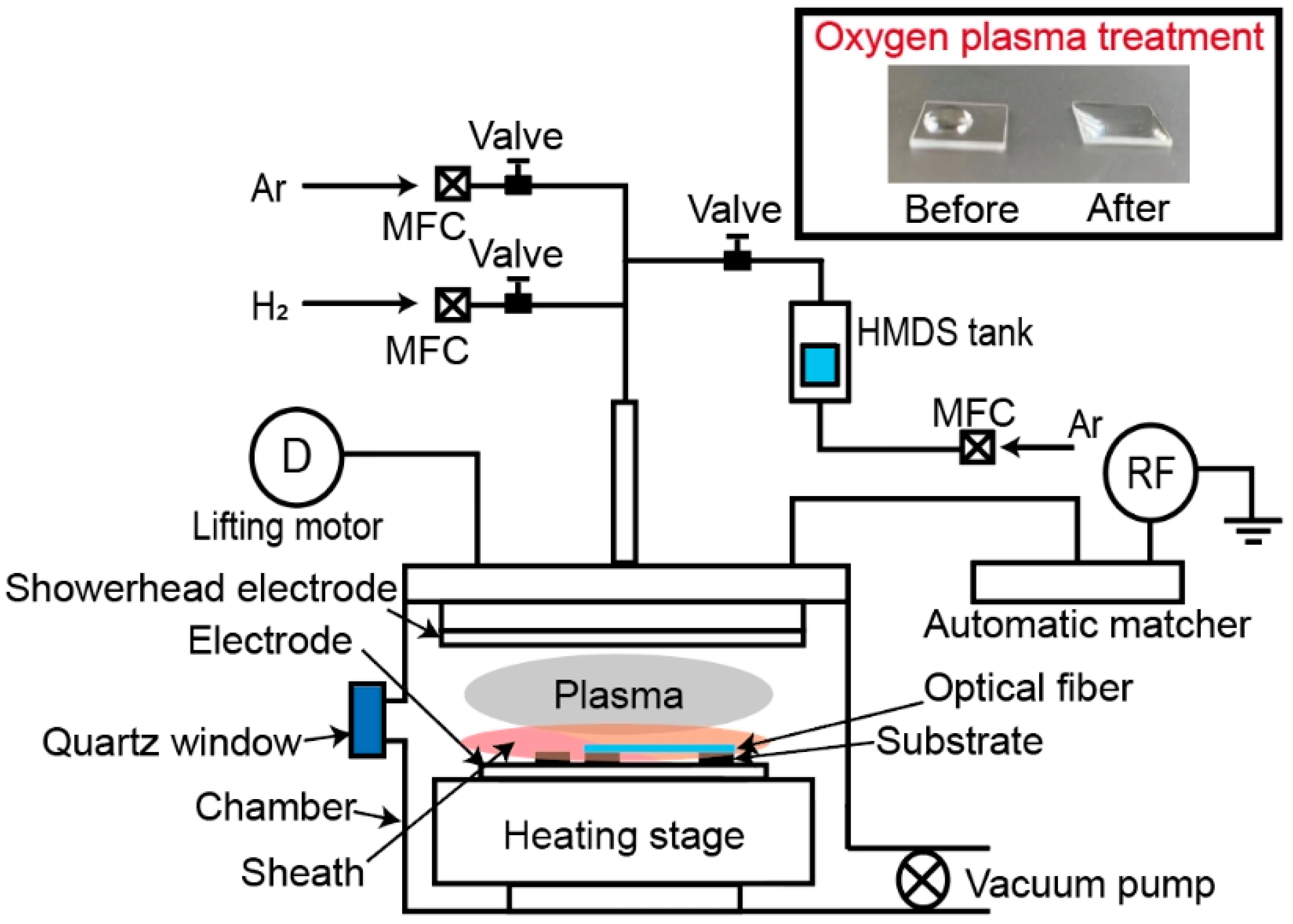
The coating was deposited using a 13.56 MHz capacitively coupled PECVD device produced by Jinsheng Micro-Nano Company (Beijing, China) (Figure 1). The upper plate (40 cm in diameter) of the device is grounded, and the reaction gas is uniformly introduced into the reaction chamber through the spray head on the upper plate to ensure uniform gas distribution. The lower plate is connected to the heating platform with a diameter of 28 cm, which is smaller than the upper plate. This design helps to form a sheath voltage, thereby improving the quality of the coating. The distance between the upper plate and the lower plate is 4 cm.
Before coating deposition, oxygen plasma was used to treat the substrate. The substrates were heated to the preset deposition temperatures, i.e., 70, 140, 210, 280, 350, 420 °C, then 120 sccm of oxygen was introduced. The pressure was controlled at 40 Pa, and the power was set to 60 W to generate oxygen plasma. Oxygen plasma may remove the organic matter and oxides that may exist on the substrate surface, and introduce -OH groups to significantly increase the surface energy of the substrate, thereby enhancing the adhesion of the coating [25]. After oxygen plasma treatment, the hydrophilicity is enhanced and the surface energy is increased, thus creating good conditions for film deposition. As shown in Figure 1, the hydrophobicity of the substrate surface after oxygen plasma treatment shows a significant change, reflecting the improvement of surface energy.
After oxygen plasma treatment, the precursor hexamethyldisilane (HMDS, Aladdin, Shanghai, China, 98% in purity) was carried into the reaction chamber through a 10 sccm argon gas (99.999% in purity) in the source bottle. Then, 3 sccm oxygen (99.999% in purity) and 60 sccm argon were introduced into the reaction chamber to maintain the stability of the reaction atmosphere. The RF power was set to 200 W, and the substrate temperature was fixed at a constant within 70–420 °C. The reaction pressure was maintained at 12 Pa to ensure the effective role of the plasma during the deposition process. In addition, in order to ensure good coating quality, the self-bias voltage should be higher than 240 V.

2.2. High-Temperature Corrosion in Wet-Oxygen

The high-temperature corrosion experiment in wet-oxygen of the sample was carried out in a tube furnace (TL1200 50X600MM, Boyuntong Instrument Technology Co., Ltd., Nanjing, China). The coating surface was placed vertically upward in parallel in a rectangular alumina crucible. In order to ensure that the humidity and temperature are consistent, the samples were placed in the positive center of the tube furnace and the distance between the left and right ends was less than 5 cm. The heating rate was set to 50 °C/min. After rising to the preset temperature, one side of the tube furnace was opened to air, and the other side used an ultrasonic atomizer to send the water mist into the furnace at a rate of 300 mL/h. After the water mist entered the furnace, it quickly evaporated into water vapor and flowed steadily in the furnace tube, thus obtaining a high-temperature wet-oxygen environment. After 5 h of high-temperature wet- oxygen treatment, the sample was cooled to room temperature and taken out.

2.3. Characterization of a-SiOC Coatings

The crystalline structure of the coatings was analyzed using an X-ray diffractometer (XRD, Empyrean, Malvern Panalytical (China), Shanghai, China) with a Cu-Kα radiation source on Si (111) substrates, operating at a scanning rate of 6°/min. The elemental composition and chemical bonding states were investigated via X-ray photoelectron spectroscopy (XPS, AXIS SUPRA+, Kratos Analytical Ltd., Manchester, UK) utilizing a monochromatic Al Kα source with an analysis area of 500 μm. Prior to data acquisition, all samples were subjected to argon ion sputtering for 240 s to remove the surface oxide layer and contaminants (approximately 10 nm in depth). Chemical bonding configurations and functional groups were characterized by micro-Fourier transform infrared spectroscopy (FTIR, iN10-iS50, Thermo Fisher Scientific, Waltham, MA, USA in transmission mode. Double-sided polished Si (100) wafers were used as substrates to minimize light scattering and background interference. Furthermore, a laser confocal micro-Raman spectrometer (Raman, LabRAM Odyssey, HORIBA France SAS, Palaiseau, France equipped with a 532 nm solid-state laser was utilized to evaluate the structural disorder and detect the free carbon phase. The exposure time was set to 30 s, and Si (100) substrates were employed to avoid signal interference.
The film thickness was precisely determined using a spectroscopic ellipsometer (M-2000V, J. A. Woollam Co., Inc., Lincoln, NE, USA by analyzing the polarization changes of the reflected light. For morphological inspection, the macroscopic surface quality and integrity of the coatings—particularly before and after corrosion tests—were initially observed using a high-resolution optical microscope (OM). Subsequently, the detailed surface microstructure and cross-sectional morphology were examined using a scanning electron microscope (SEM, Zeiss Ultra Plus, Carl Zeiss AG, Oberkochen, Germany). To prevent charging effects and enhance conductivity, the samples deposited on optical fibers and fused silica were coated with a thin gold layer via sputtering for 240 s prior to imaging at an accelerating voltage of 5 kV.
The mechanical properties, including hardness (H) and elastic modulus (E), were measured using a nanoindenter (HysitronTI980, Bruker Nano Surfaces, Eden Prairie, MN, USA) equipped with a standard Berkovich diamond indenter. The tests were conducted on Si-substrate samples using the Continuous Stiffness Measurement (CSM) mode. The unloading segment was set to 90% of the maximum load, followed by a 10 s dwell time at peak load to minimize creep effects and ensure data stability. The hardness and elastic modulus were calculated from the load–displacement curves based on the Oliver-Pharr method. For statistical reliability, at least five indentations were performed on each sample with a spacing of greater than 3 mm between indentation points. Finally, the adhesion between the coating and the quartz substrate was evaluated using the scratch testing method (MFT-4000, LuaHui Instrument Technology Co., Ltd., Lanzhou, China). The test was performed on a multi-functional surface tester equipped with a Rockwell C diamond indenter (tip radius: 100 μm). Prior to testing, the quartz substrate was mounted in resin to ensure mechanical stability during the procedure. A scratch length of 5 mm was applied under a continuously increasing load from 0 to 25 N, with a loading rate of 15 N/min and a constant scratch velocity of 3 mm/min.

3. Results and Discussion

3.1. Characterization of a-SiOC Coatings

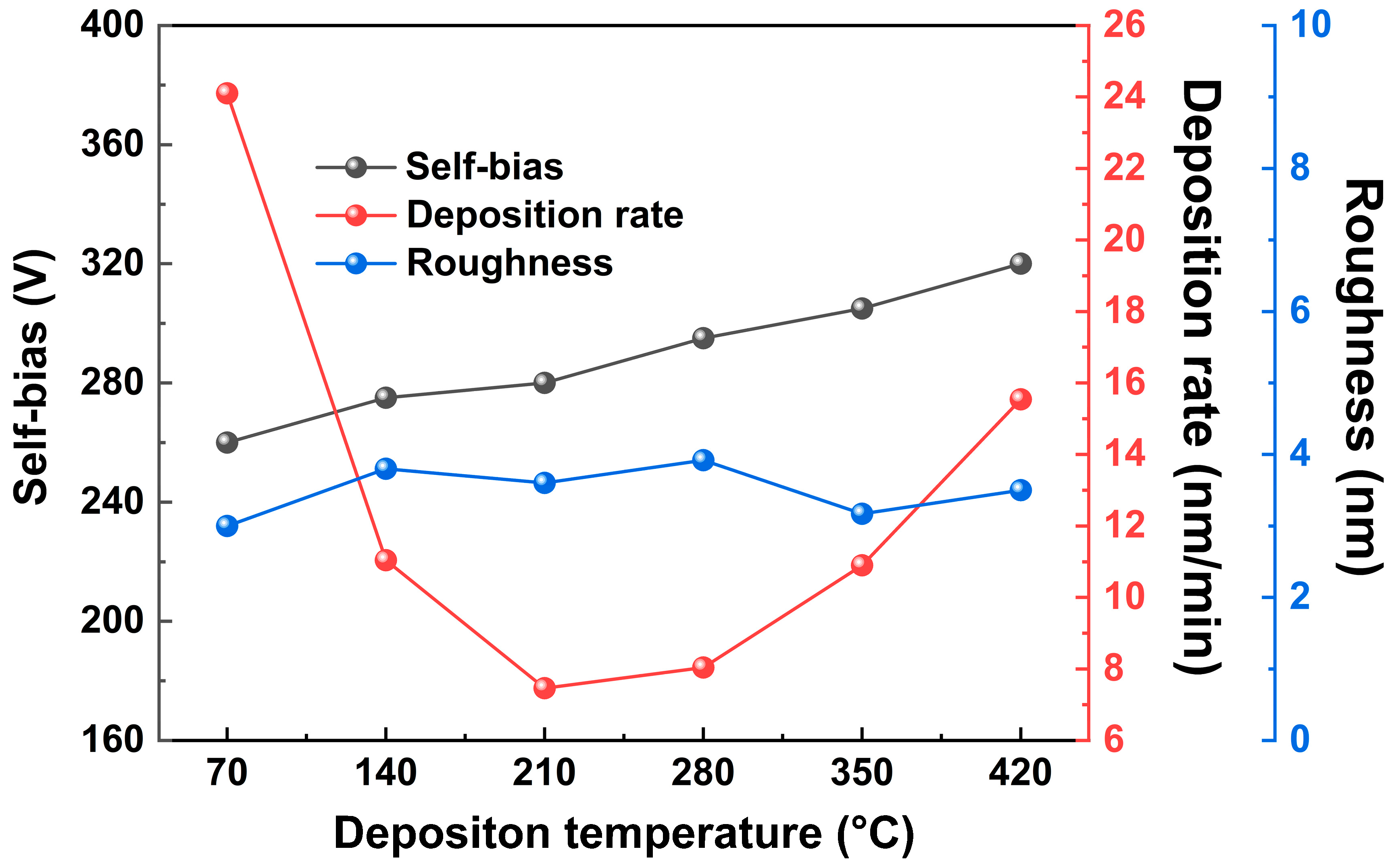
As illustrated in Figure 2, under the HMDS/O2/Ar atmosphere, the deposition temperature modulates the self-bias, deposition rate, and surface morphology by altering the plasma sheath dynamics and surface reaction kinetics. Here, the self-bias generally refers to the negative DC bias voltage formed on the electrode in a radio-frequency capacitively coupled plasma (RF-CCP) discharge, originating from the difference in electron and ion mobilities as well as the sheath rectification effect. Its absolute value approximates the sheath voltage, thereby characterizing the mean energy level of positive ions bombarding the substrate surface. Generally, a higher self-bias implies stronger ion bombardment, which intensifies effects such as densification, organic elimination, and re-sputtering [26]. As the deposition temperature rises from 70 to 420 °C, the self-bias exhibits an overall upward trend (increasing from 260 to 320 V), indicating an increase in the substrate sheath voltage and enhanced incident ion energy during deposition. The deposition rate displays a “U-shaped” variation, i.e., the highest value of 24 nm·min−1 at 70 °C, dropping to the minimum of 8 nm·min−1 at 210 °C, and subsequently rebounding to 16 nm·min−1 at 420 °C. This trend suggests a competitive mechanism between film growth and desorption/ablation during the a-SiOC deposition process. In the low-temperature stage, the fragmentation of HMDS is limited; however, the organosilicon fragments, retaining abundant organic components, possess a high sticking probability and polymerization tendency on the surface, resulting in a high deposition rate [27]. Upon entering the intermediate temperature zone, ion bombardment intensifies due to the elevated self-bias [26]. Simultaneously, the oxidative elimination pathway introduced by trace O2 becomes more active, facilitating the removal of organic groups as volatile by-products [28]. Consequently, the dominance of sputtering and thermal desorption leads to a significant decrease in the net deposition rate. Further increasing the temperature to the high temperature zone (280–420 °C) significantly enhances the chemisorption probability and surface diffusion capability of precursor fragments via thermal excitation [27]. The increment in film growth driven by thermal activation surpasses the material removal caused by ion sputtering. At this stage, the rapid construction of the inorganic Si–O–Si skeleton shifts the deposition process from being “ablation-dominated” in the intermediate zone to “network-formation-dominated,” leading to a recovery in the net deposition rate. Furthermore, the surface roughness of the coatings is maintained within a narrow range of approximately 3–4 nm, indicating stable morphological evolution within this process window.
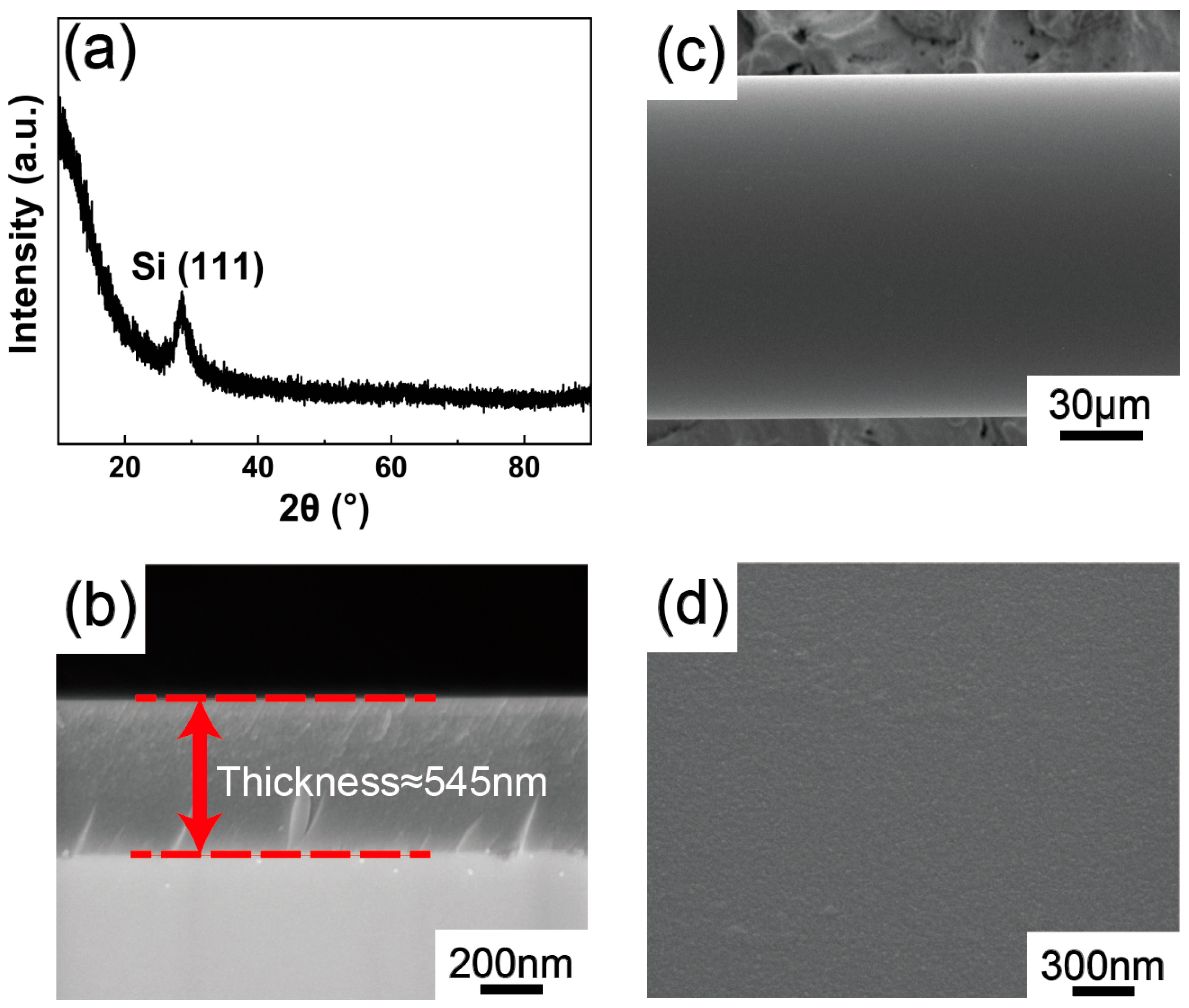
Figure 3a displays the typical XRD pattern of the a-SiOC coating deposited at 350 °C. Aside from the characteristic peak assigned to the Si (111) substrate, no other distinct diffraction peaks are detected, indicating that the coating possesses a typical amorphous structure devoid of long-range order. Morphological observations in Figure 3b–d reveal the structural characteristics of the as-deposited coating. As shown in Figure 3b, cross-sectional characterization confirms a distinct and firmly bonded interface between the coating and the optical fiber, as well as a dense and void-free internal structure. As shown in Figure 3c,d, the coating surface consists of uniformly accumulated fine particles, appearing smooth and defect-free, which demonstrates excellent uniformity in nucleation and growth. These results suggest that high-quality amorphous a-SiOC coatings with uniform thickness and strong adhesion were obtained on optical fiber surfaces using the PECVD method.
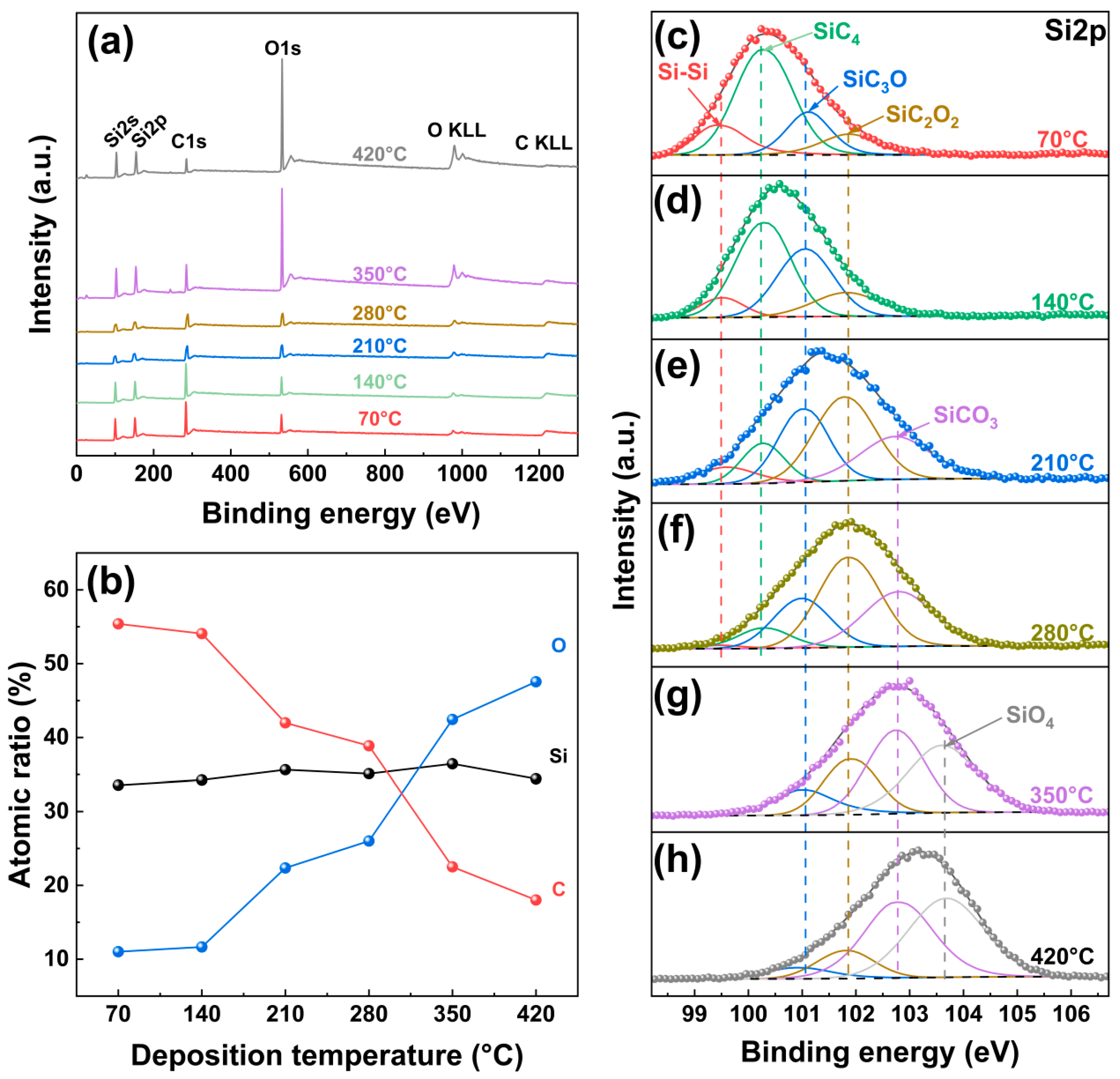
Figure 4 presents the XPS characterization results of a-SiOC coatings deposited at different temperatures. Figure 4a reveals that all coatings exhibit characteristic peaks of Si 2s, Si 2p, C 1s, and O 1s, indicating the successful formation of Si–O–C network structures across a broad temperature range. With increasing deposition temperature, the O 1s signal progressively intensifies while the C 1s signal relatively diminishes, suggesting an evolution of the coating surface from a carbon-rich to an oxygen-rich state. Quantitative analysis (Figure 4b) further corroborates this trend: the atomic fraction of O increases monotonically, whereas that of C declines significantly; in contrast, the Si atomic fraction fluctuates within a narrow range, implying that temperature variations primarily induce changes in the coordination environment around Si atoms (ratio of Si–C to Si–O) and the degree of the “organic–inorganic transition” of the film, rather than drastic variations in the total Si incorporation.
The deconvolution results of the Si 2p spectra demonstrate a continuous evolution of the Si coordination environment from “Si–C dominated” to “Si–O dominated” at different deposition temperatures [29]. For coatings deposited at low temperatures (70–140 °C), the main peak of the Si 2p spectrum is predominantly contributed by the SiC4 (100.3 eV) component, accompanied by minor signals of Si–Si (99.5 eV) and low-oxidation-state Si. This indicates that at lower surface temperatures, organosilicon fragments containing –CHx groups generated from HMDS cracking in the plasma are more likely to be retained and participate in network growth, while dehydrogenation, bond rearrangement, and oxygen insertion reactions remain relatively inactive, coupled with incomplete precursor dissociation. Consequently, films formed in this temperature zone are characterized by Si–C bonds, organic side groups, and a small amount of residual Si–Si bonds, exhibiting a high degree of organic nature and high carbon content [30].
When the deposition temperature rises to 210–280 °C, mixed coordination intermediates such as SiC3O (101.05 eV), SiC2O2 (101.8 eV), and SiCO3 (102.8 eV) are significantly enhanced, and the peak shape gradually evolves from a single Si–C main peak into a broad peak composed of multiple superimposed components [29]. This transition suggests that trace O2 can effectively participate in the film-forming reaction in this temperature range: oxygen-containing active species (e.g., O, O+/O, O* [26]) generated by plasma activation can insert and substitute during coating growth, leading to a gradual increase in the proportion of O in the near-neighbor coordination of Si and a corresponding decrease in the coordination number of C, thereby forming typical Si–O–C and partial Si–O–Si bridging structures [31,32]. Meanwhile, the elevated temperature further promotes the cracking and dehydrogenation of –CHx groups, as well as their removal in the form of volatile small molecules, reducing organic residues and improving network cross-linking [26,33]. Upon further increasing the temperature to 350–420 °C, the SiO4 (SiO2-like environment, 103.6 eV) component on the higher binding energy side becomes the primary contributor to the Si 2p spectrum, causing the overall peak position to shift toward higher binding energy and tend to be dominated by oxidation states. This demonstrates that under high-temperature conditions, oxygen introduction and Si–O bond formation prevail, and the coating gradually forms an inorganic network structure with SiO4 tetrahedra as the basic unit. Overall, the increase in deposition temperature promotes the removal of carbon-related organic groups and accelerates the oxygen insertion/substitution process by enhancing precursor cracking and surface reaction kinetics, thereby driving the a-SiOC film to evolve from a carbon-rich organosilicon structure to a highly inorganic network based on the Si–O tetrahedral skeleton.

3.2. Corrosion Behavior of a-SiOC Coatings in Wet-Oxygen

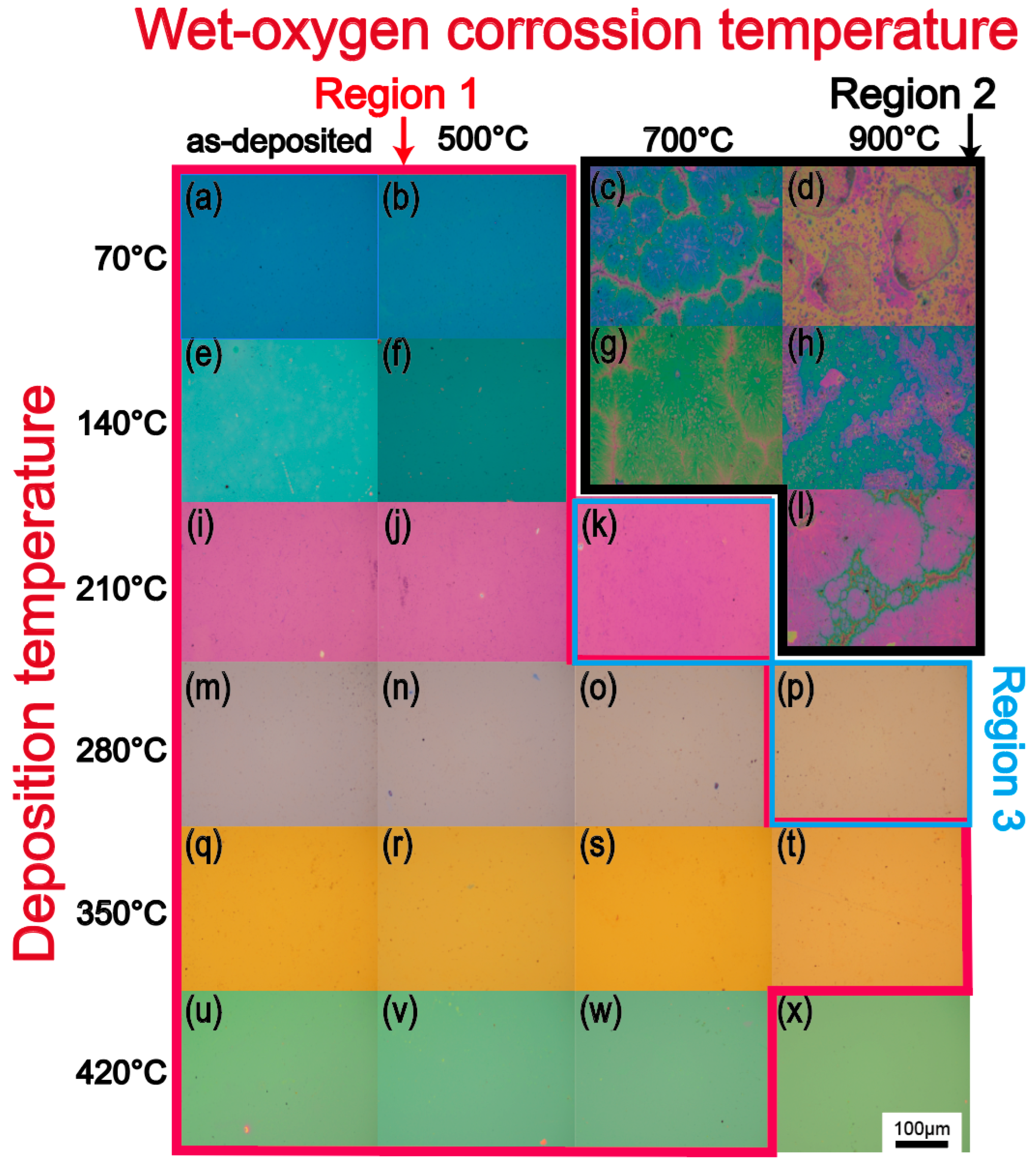
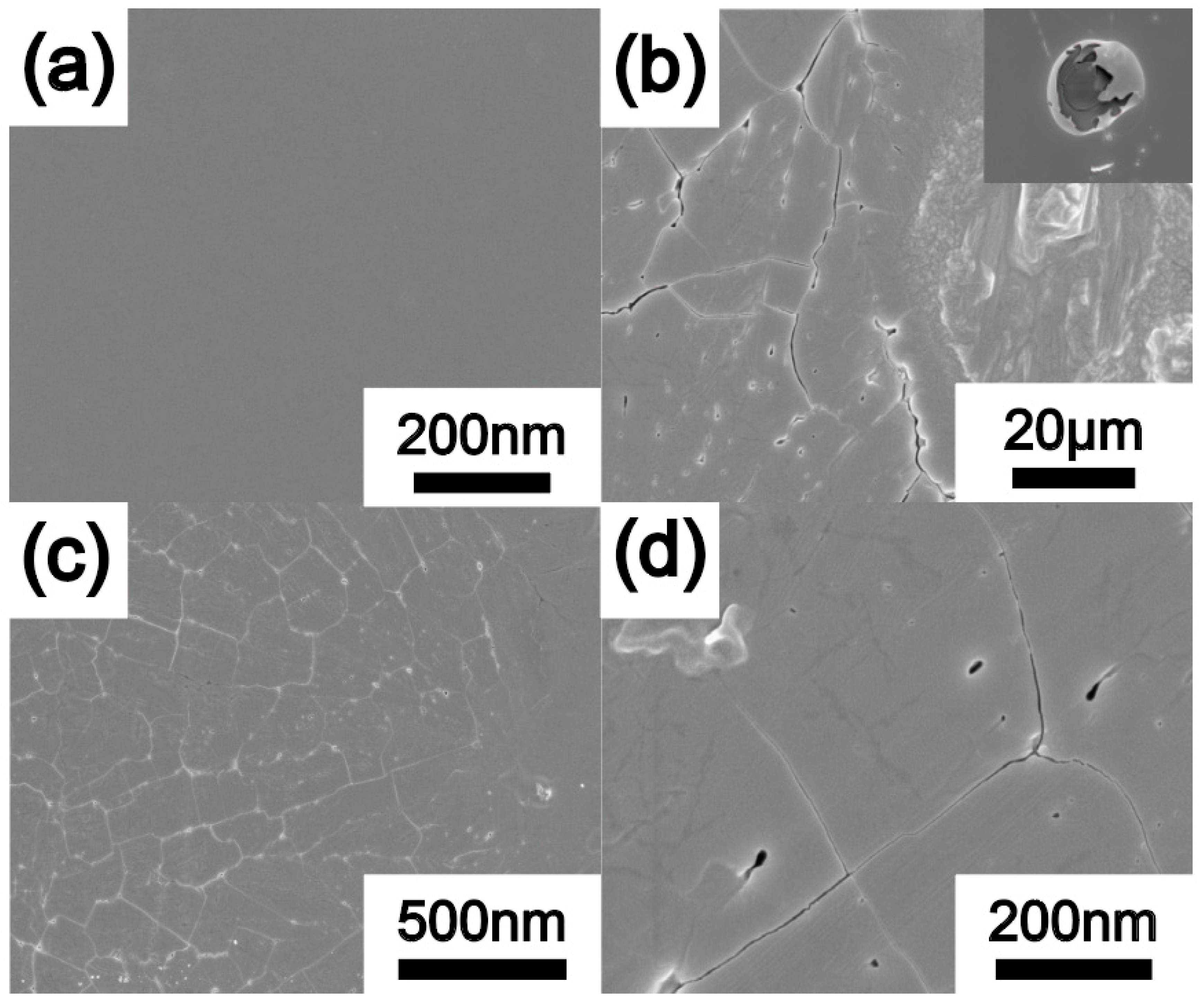
Figure 5 presents the optical micrographs of the a-SiOC coatings in the as-deposited state and after high-temperature wet-oxygen corrosion. All coatings in region 1 maintain excellent structural integrity, exhibiting smooth and defect-free surfaces under both optical microscopy and scanning electron microscopy (SEM) (Figure 6a). In contrast, all coatings in region 2 undergo catastrophic degradation, with large-area cracks and ruptured bubbles covering the entire surface (Figure 6b). Coatings in region 3 retain structural integrity under optical microscopy, but localized cracking is observed in SEM images (Figure 6c). After wet-oxygen corrosion at 900 °C, only a few microcracks are detected in limited regions of the coating deposited at 420 °C (Figure 6d). Notably, the coating deposited at 350 °C retains an almost pristine surface morphology even after exposure to 900 °C wet-oxygen, indicating its superior thermochemical stability and wet-oxygen corrosion resistance.
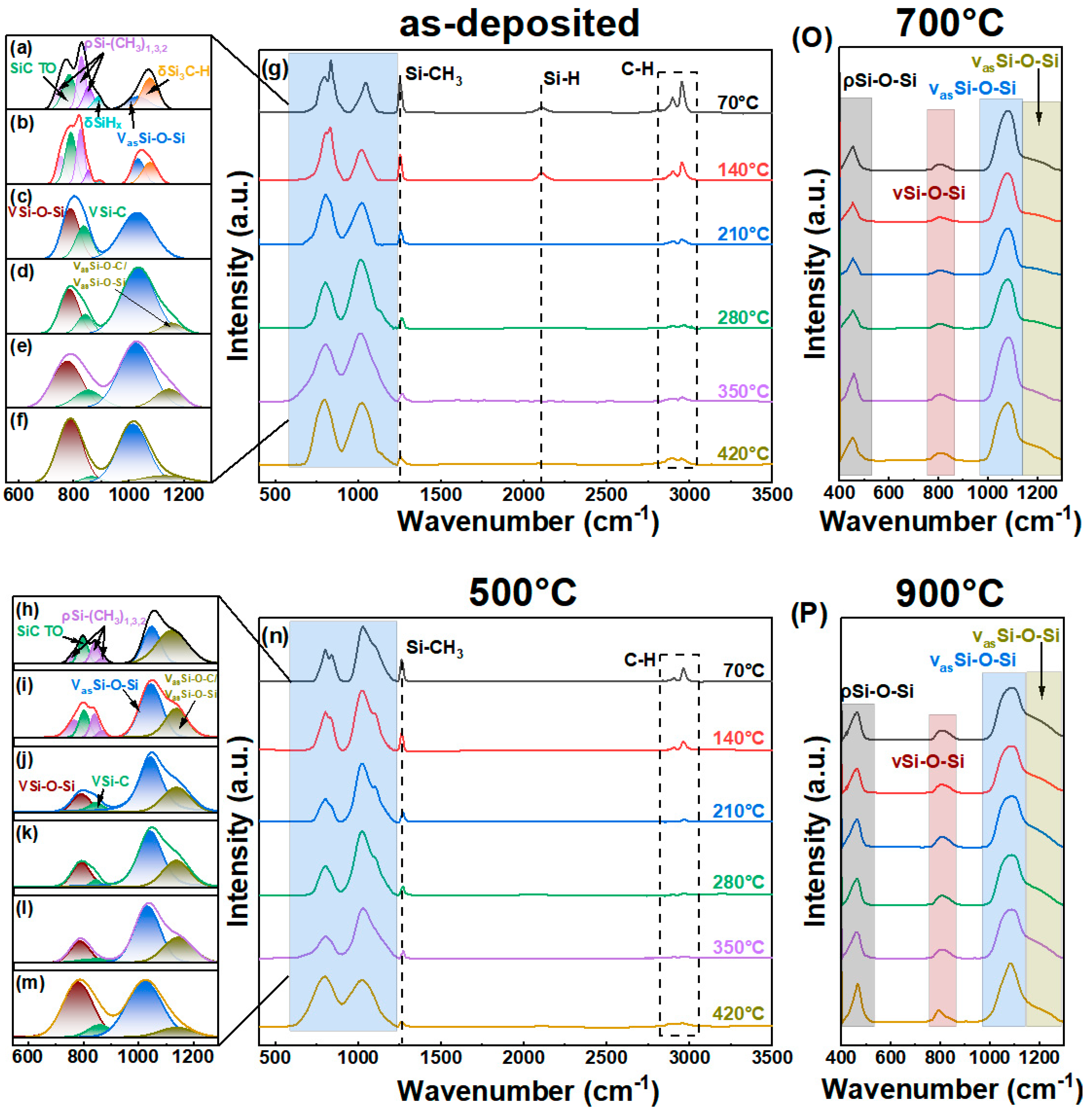
The FTIR spectra in Figure 7 reveal a systematic structural transition in the a-SiOC coatings from an organosilicon carbon-rich framework towards an inorganic Si–O network as the deposition temperature increases. In the full-range spectra, characteristic absorptions are observed: Si–CH3 bending at 1250–1270 cm−1 [34], Si–H stretching around 2100–2150 cm−1 [35], and –CHx (CH2/CH3) stretching in the range of 2800–3000 cm−1 [22]. At low temperatures (70–140 °C), these Si–CH3, Si–H, and C–H peaks are prominent, indicating that methyl-containing organosilicon precursors from plasma pyrolysis are readily incorporated into the growing film, imparting pronounced organic character. As temperature rises to 350–420 °C, these features nearly vanish, indicating efficient pyrolysis and removal of organic/hydrogen-containing groups, as shown in Figure 7g.
The 600–1260 cm−1 fingerprint region provides detailed insights into the framework evolution (Figure 7a–f). At 70–140 °C (Figure 7a,b), the band near 790 cm−1 has a significant contribution from the SiC transverse optical (TO) mode, pointing to a substantial fraction of short-range ordered SiC networks [30]. Concurrently, intense methyl rocking vibrations (766, 833, 855 cm−1) [30] and Si3C–H deformations (1035 cm−1) [35] are present. With rising temperature (70–140 °C), these peaks diminish while the relative contribution of the Si–C TO mode grows, suggesting enhanced cross-linking via elimination of –CHx and –H terminal groups. Concurrently, the Si–O–Si asymmetric stretching vibration (νas Si–O–Si) at ~1010 cm−1 intensifies [36], signaling the formation of an Si–O network. The continuous shift of the 1010 cm−1 feature to lower wavenumbers from 70 to 210 °C (Figure 7a–c) is attributed to the fading Si3C–H signal, validating the spectral deconvolution. Dividing the 600–1260 cm−1 region into two sub-regions (600–870, 870–1260 cm−1) clarifies the transition. The integrated intensity in the 600–870 cm−1 sub-region first decreases and then increases with temperature. Correlated with XPS data, this indicates a shift in dominant vibrational contribution from Si–C-related modes at low temperature to Si–O–Si bridging bonds at higher temperature, with a critical transition around 210–280 °C (Figure 7c,d). For the 210 °C coating, the main peak at 790 cm−1 is assignable to the Si–O–Si symmetric stretch (ν Si–O–Si) [37]. The intensified and broadened νas Si–O–Si peak at 1010 cm−1 confirms effective incorporation of trace oxygen, promoting network cross-linking. The incorporation of O atoms into the Si–C network forms Si–O–Si and Si–O–C bridges, causing the Si–C TO and organic terminal group peaks to fade. The Si–C stretching peak also blueshifts from 800 to 840 cm−1, indicating a reconfigured local environment where residual Si–C bonds are increasingly surrounded by Si–O structures. At 280 °C (Figure 7d), the Si–C bond fraction decreases further, and a shoulder emerges at 1110 cm−1. This feature signifies a more polymerized silicon-oxygen network, comprising contributions from Si–O–C bridging structures [38] and asymmetric stretches of Si–O–Si cage-like units [39,40], implying deeper cross-linking and a local structural shift from chains/networks to 3D cages. Between 280 and 420 °C (Figure 7d–f), the increasing proportion of the ν Si–O–Si mode near 790 cm−1 reflects enhanced atomic mobility, facilitating framework cross-linking and improved local ordering.
After 500 °C wet-oxygen corrosion (Figure 7n), all coatings show dehydrogenation/demethylation: the Si–H peak (2100 cm−1) vanishes, and Si–CH3-related peaks (1260 and 2800–3000 cm−1) weaken drastically. Structural changes in the 600–1260 cm−1 region, however, depend strongly on deposition temperature. For low-temperature coatings (70–140 °C, Figure 7h,i), the main peak intensity in the 700–870 cm−1 region drops sharply, indicating severe degradation of the dominant Si–C framework and organic moieties. This highlights their high organic content and low cross-linking density. The weak, overlapping signal near 790 cm−1 suggests limited formation of a well-developed, cyclic Si–O–Si network post-corrosion. In contrast, medium/high-temperature coatings (210–420 °C, Figure 7j–m) show basic framework retention with local reconstruction. The Si–C peak near 840 cm−1 attenuates more moderately, reflecting their denser, more cross-linked networks that resist deep wet-oxygen ingress. Their structural evolution involves embedding residual Si–C units into a strengthening Si–O network rather than causing massive overall loss. The νas Si–O–Si peak at 1010 cm−1 intensifies and broadens in all corroded samples, indicating wet-oxygen treatment generally fosters a more diverse Si–O–Si bonding environment. For coatings deposited at 70–280 °C, a resolvable Si–O–C contribution appears near 1100 cm−1 post-corrosion, indicating the formation of a heterogeneous Si–O–Si/Si–O–C network where oxygen bridges but does not fully replace carbon. High-temperature coatings (350–420 °C), with initially higher Si–O cross-linking, show a less prominent Si–O–C signal, and their ~1100 cm−1 shoulder is dominated by Si–O–Si cage structures.
After 700 °C corrosion (Figure 7o), all FTIR spectra converge. Si–C peaks vanish entirely, and a peak at 460 cm−1, characteristic of amorphous silica (a-SiO2) [40], appears. The shift of all peaks to higher wavenumbers after 500/700 °C treatment indicates carbon removal and structural densification [23], with the ~1100 cm−1 peak now mainly from Si–O–Si cages. During the 700 °C wet-oxygen corrosion process, abundant residual organic side groups and free carbon in the low-temperature-deposited coatings (70–140 °C) undergo violent oxidative decomposition reactions, generating high-pressure gaseous products including CO, CO2 and H2O. Owing to the absence of an initially continuous framework support and effective gas diffusion pathways in these coatings, the gaseous products accumulate rapidly within the film and form high-pressure expansion bubbles, ultimately resulting in catastrophic coating cracking accompanied by bubble rupture. For the coating deposited at 210 °C, which lies in the critical transition range of organic-inorganic structural transformation, a hybrid network with a moderate degree of crosslinking has been formed initially. However, due to the significant discrepancies in thermal expansion coefficients and shrinkage rates between the Si–O-bonded domains and residual carbon-rich domains in the heterogeneous network, pronounced localized stress concentration arises during the cooling process after high-temperature corrosion, thereby inducing radially distributed microcracks.
Following 900 °C corrosion (Figure 7p), the 420 °C coating exhibits the sharpest FTIR peaks, denoting highly uniform Si–O–Si bond lengths/angles. This results from severe phase separation, expelling residual carbon as sp2 clusters and purifying the inorganic framework. However, this highly ordered, low-disorder network lacks the ability to buffer thermal stress via bond-angle distortion, ultimately leading to microcrack initiation.
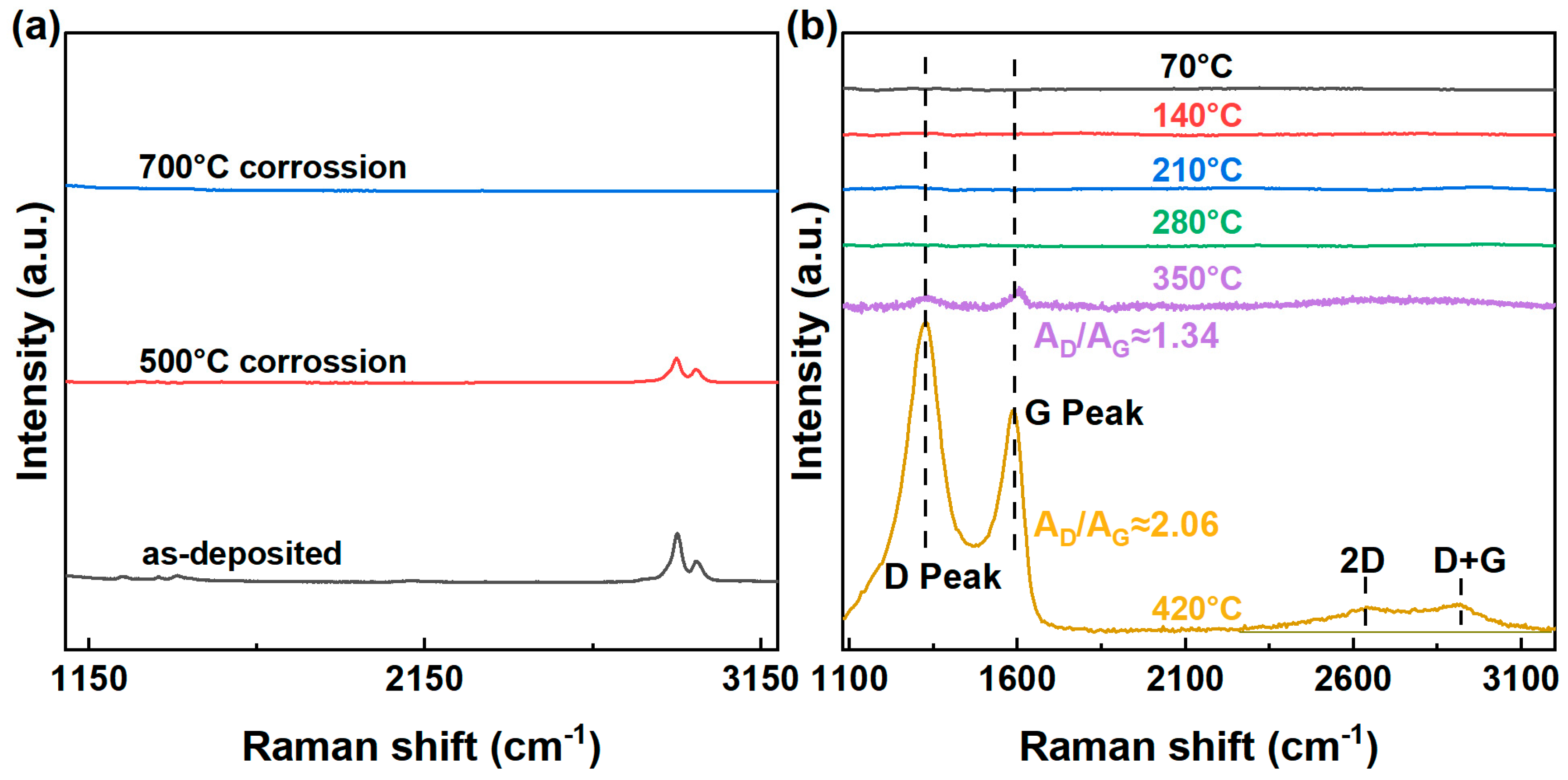
Raman spectra reveal that in the as-deposited state, none of the coatings exhibit distinct characteristic peaks of sp2 carbon around 1350 cm−1 and 1580 cm−1, indicating that carbon in the a-SiOC coatings is mainly embedded in the amorphous network in the form of Si–C/Si–CH3 moieties rather than as graphitized sp2 clusters. Meanwhile, the as-deposited coatings show relatively obvious C–H stretching vibration bands in the 2900–3100 cm−1 region [41], reflecting that the coatings retain organic terminal groups and hydrogen-related structures. After wet-oxygen corrosion at 500 °C, the signals in the 2900–3100 cm−1 region are overall weakened, while the D and G peaks remain inconspicuous at this stage. This suggests that no significant graphitization transformation of the carbon phase occurs under 500 °C wet-oxygen conditions, or the oxidation removal rate is faster than the graphitization transformation rate.
When the corrosion temperature increases to 700 °C, the spectra of all coatings become flat in the D, G and C–H regions, and basically no distinguishable carbon-related Raman features are observed. This indicates that the detectable carbon phase in the films is further oxidized and consumed or significantly reduced in this temperature range, and the films as a whole are closer to an Si–O-enriched inorganic framework state. Notably, after wet-oxygen corrosion at 900 °C (Figure 8b), severe phase separation occurs in the high temperature deposited coatings, especially the 420 °C coating, with clear D and G peaks observed, as well as the 2D peak around 2700 cm−1 and the D+G combination peak in the 2900–3000 cm−1 region [24,42]. Meanwhile, the AD/AG ratio increases from 1.34 for the 350 °C coating to 2.06 for the 420 °C coating, indicating that the sp2 carbon formed in the high-temperature coatings has a higher degree of disorder. Combined with the initial structural differences caused by deposition temperature, it can be inferred that the high temperature deposited coatings (350–420 °C), due to their denser network and more continuous Si–O framework, can still provide certain retardation to the deep diffusion and reaction of oxygen under extremely high temperature treatment. This allows a small amount of residual carbon to preferentially undergo phase separation and aromatization rearrangement, forming defect-rich sp2 carbon nanoclusters. This phenomenon is more pronounced inside the coating deposited at 420 °C, leading to local volume expansion and stress concentration and the generation of microcracks. In contrast, the low-temperature deposited coatings, due to their abundant organic terminal groups and loose structure, allow the carbon phase to be preferentially consumed by wet-oxygen at high temperatures, making it difficult to retain and form sp2 carbon signals after 900 °C.

3.3. Mechanical Properties of a-SiOC Coatings After Corrosion in Wet-Oxygen

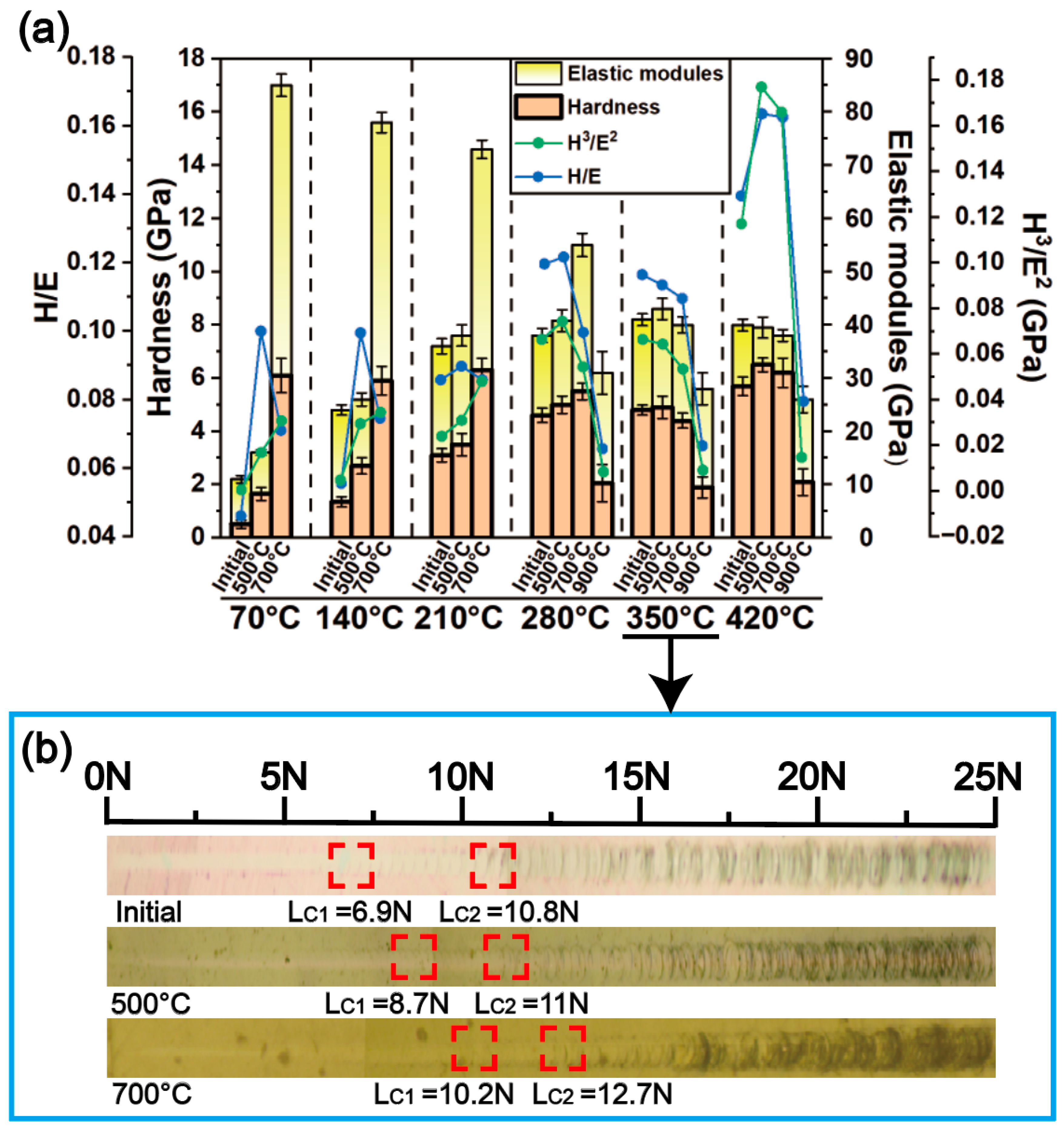
The nanoindentation results of the a-SiOC coatings (Figure 9a) indicate that the deposition temperature plays a decisive role in the initial mechanical properties of the coatings (“initial” denotes the as-deposited coating in Figure 9): as the deposition temperature increases, both hardness (H) and elastic modulus (E) exhibit a progressive upward trend. This trend can be attributed to the more complete cracking of precursors, the reduction in the content of organic terminal groups such as –CH3/–H, and the enhancement of Si–O–Si/Si–O–C bridging structures and network cross-linking degree during high-temperature deposition. Simultaneously, stronger ion-assisted densification promotes the reduction in pores and free volume within the film, ultimately driving the evolution of the coating from a relatively “organic and loose” network to an “inorganic and dense” silicon-oxycarbide skeleton.
After wet-oxygen corrosion at 500 °C, the H (Hardness) and E (Elastic modules) of coatings deposited at 70–350 °C show varying degrees of enhancement, indicating a significant oxidative densification effect in this temperature zone under the wet-oxygen environment. For the 420 °C coating, the hardness continues to rise while the modulus decreases slightly after corrosion, suggesting that while maintaining strong resistance to plastic deformation, local structural rearrangement or defect/stress release may have occurred, leading to a slight reduction in the overall elastic response; overall, these coatings maintain high structural stability under 500 °C wet-oxygen conditions.
When the wet-oxygen corrosion temperature is raised to 700 °C, coatings from different deposition temperature zones show stronger differentiation. The H and E of the 70–140 °C low-temperature deposition coatings show a drastic increase, but large-area interconnected cracks are simultaneously observed on the surface. This suggests that the mechanical “strengthening” is driven more by the combined effect of inorganic transformation and embrittlement caused by severe oxidation: during the rapid removal of terminal groups and the fast generation of the silicon-oxygen network, the film undergoes significant volume shrinkage and accumulation of thermal oxidative stress, leading to rapid crack propagation. coatings deposited at 210–280 °C also exhibit significant strengthening after 700 °C wet-oxygen exposure. In contrast, the hardness and modulus of the 350 °C and 420 °C coatings remain essentially constant after 700 °C wet-oxygen exposure.
When the wet-oxygen corrosion temperature is increased to 900 °C, the coatings deposited at 70–210 °C undergo catastrophic surface damage, making it impossible to obtain reliable nanoindentation data. Meanwhile, both H and E of the 350 °C and 420 °C coatings drop significantly, indicating that even the initially dense high temperature deposited coatings undergo severe oxidative reconstruction and defect evolution under 900 °C wet-oxygen, leading to the destruction of the load-bearing skeleton and a significant decline in mechanical properties. Furthermore, the H/E ratio (characterizing elastic strain tolerance and resistance to cracking) and the H3/E2 ratio (characterizing resistance to plastic indentation and wear resistance) of the high-temperature deposited a-SiOC coatings are significantly higher than those of the low-temperature deposited coatings, demonstrating superior mechanical performance.
Figure 9b presents the scratch test results of the a-SiOC coating deposited at 200 W and 350 °C before and after corrosion in a wet-oxygen environment. The critical loads obtained from the test, LC1 and LC2, correspond to the onset of initial microcracking and final large-scale delamination of the coating, respectively. Furthermore, the coating displays a characteristic “circular spallation” morphology under high load. This morphology originates from the plastic deformation and accumulation of the coating under continuous loading by the indenter, which induces periodic tensile stress at the edges of the scratch, leading to localized spallation of the coating in a “buckling” manner. This failure mode is distinctly different from the continuous scratch pattern formed by simple brittle fracture, strongly demonstrating that the coating not only possesses strong interfacial adhesion, effectively resisting immediate crack propagation, but also exhibits good toughness and plastic deformation capability. These properties enable the coating to avoid catastrophic overall failure through localized energy release under high load conditions. Following wet-oxygen corrosion at 500 and 700 °C, the a-SiOC coating exhibited a slight increase in both critical loads (LC1 and LC2), attributable to the formation of a dense surface SiO2 layer. More importantly, the coating maintained strong adhesion to the substrate without displaying characteristics of brittle spallation.


4. Conclusions

The formation process of amorphous SiOC coatings deposited on optical fiber by PECVD exhibits three distinct regimes: the low-temperature stage (70–140 °C) is dominated by the adhesion and polymerization of organic-containing fragments; the intermediate stage (210–280 °C) is characterized by the prevalence of ion bombardment and organic elimination, which leads to a reduction in the net deposition rate; and the high-temperature stage (350–420 °C) sees a rebound in deposition due to enhanced surface reactions and network-forming capabilities, resulting in the more sufficient construction of the Si–O–Si network. The elevation of deposition temperature drives a continuous transition of the a-SiOC coating from a “carbon-rich organosilicon network” to an “oxygen-rich inorganic Si–O skeleton” with a distinct structural transition zone. The transition from Si–C–H dominance to Si–O–Si dominance occurs in this temperature range of 210–280 °C. Wet-oxygen corrosion results indicate that the coating deposited at 350 °C exhibits the optimal structural stability and mechanical retention, and maintains good adhesion with the quartz substrate. Under wet-oxygen exposure at 500–700 °C, the coatings deposited at 280–420 °C primarily undergo progressive growth and limited densification of the Si–O–Si skeleton; their hardness and elastic modulus show minimal fluctuations and remain stable overall. These coatings avoid the macroscopic cracking induced by rapid terminal removal and severe network shrinkage observed in low-temperature coatings, demonstrating superior thermochemical stability and damage resistance. Upon further heating to 900 °C, the 420 °C coating, due to severe phase separation and the formation of a single silicon-oxygen network configuration, is unable to effectively buffer the volume shrinkage and stress concentration caused by oxidative densification, ultimately leading to the generation of microcracks.

Author Contributions

Methodology, Q.X. and T.G. (Tenghua Gao); Formal analysis, Q.X. and S.Z.; Investigation, H.H.; Resources, R.T. and T.G. (Takashi Goto); Data curation, H.H. and J.Y.; Writing—original draft, H.H.; Writing—review & editing, R.T.; Supervision, R.T. and Q.X.; Project administration, C.Z.; Funding acquisition, R.T., S.Z. and L.Z. All authors have read and agreed to the published version of the manuscript.

Funding

This work was supported by the project of National Natural Science Foundation of China (Nos. 51972244, 52002075 and 62204179). It was also supported by Independent Innovation Projects of the Hubei Longzhong Laboratory (2022ZZ-06).

Institutional Review Board Statement

Not applicable.

Informed Consent Statement

Not applicable.

Data Availability Statement

The original contributions presented in this study are included in the article. Further inquiries can be directed to the corresponding author.

Conflicts of Interest

The authors declare that they have no known competing financial interests or personal relationships that could have appeared to influence the work reported in this paper.

References

  1. Azzola, J.; Gaucher, E. Seismic Monitoring of a Deep Geothermal Field in Munich (Germany) Using Borehole Distributed Acoustic Sensing. Sensors 2024, 24, 3061. [Google Scholar] [CrossRef]
  2. Jacob, J.; Napora, A.; Anderson, M.H.; Sanders, S.T. Molten Sodium Impurity Detection: Investigation of a Fiber-Optic Sensor as a Plugging Meter Alternative. IEEE Sens. J. 2024, 24, 10076–10083. [Google Scholar] [CrossRef]
  3. Aissa, B.; McKenzie, I.; Guelhan, A.; Celinkin, M.; Barba, D.; Haddad, E.; Kruzelecky, R.V.; Tagziria, K.; Muylaert, J.-M. High temperature optical fiber sensor for atmospheric reentry. SPIE-Int. Soc. Opt. Eng. Sep. 2017, 10562, 200. [Google Scholar] [CrossRef][Green Version]
  4. Ma, S.; Xu, Y.; Pang, Y.; Zhao, X.; Li, Y.; Qin, Z.; Liu, Z.; Lu, P.; Bao, X. Optical Fiber Sensors for High-Temperature Monitoring: A Review. Sensors 2022, 22, 5722. [Google Scholar] [CrossRef]
  5. Noguchi, K.; Uesugi, N.; Negishi, Y. Loss Increase for Optical Fibers Exposed to Hydrogen Atmosphere. J. Light. Technol. 1985, 3, 236–243. [Google Scholar] [CrossRef]
  6. Ciccotti, M. Stress-corrosion mechanisms in silicate glasses. J. Phys. D. Appl. Phys. 2009, 42, 214006. [Google Scholar] [CrossRef]
  7. Lattimer, R.P. Pyrolysis mass spectrometry of acrylic acid polymers. J. Anal. Appl. Pyrolysis 2003, 68–69, 3–14. [Google Scholar] [CrossRef]
  8. Khazaka, R.; Diaham, S.; Locatelli, M.L.; Trupin, C.; Schlegel, B. Thermal and thermo-oxidative aging effects on the dielectric properties of thin polyimide films coated on metal substrate. In Proceedings of the 2011 Annual Report Conference on Electrical Insulation and Dielectric Phenomena, Cancun, Mexico, 16–19 October 2011; IEEE: New York, NY, USA, 2011; pp. 52–55. [Google Scholar] [CrossRef]
  9. Taylor, C.A.; Chiu, W.K.S. Characterization of CVD carbon films for hermetic optical fiber coatings. Surf. Coat. Technol. 2003, 168, 1–11. [Google Scholar] [CrossRef]
  10. Mangolini, F.; Rose, F.; Hilbert, J.; Carpick, R.W. Thermally induced evolution of hydrogenated amorphous carbon. Appl. Phys. Lett. 2013, 103, 161605. [Google Scholar] [CrossRef]
  11. Luan, X.; Xu, X.; Li, M.; Yu, R.; Zhang, Q.; Zhang, S.; Cheng, L. Design, preparation, and properties of a boron nitride coating of silica optical fiber for high temperature sensing applications. J. Alloys Compd. 2021, 850, 156782. [Google Scholar] [CrossRef]
  12. Luan, X.; Xu, X.; Yu, R.; Zhang, Q.; Zhang, S.; Cheng, L. BN/SiBCN light-leakage-proof coatings of silica optical fiber for long term sensors at high temperatures. Chin. J. Aeronaut. 2021, 34, 93–102. [Google Scholar] [CrossRef]
  13. Chen, S.; Zhang, Q.; Luan, X.; Yu, R.; Zhang, S.; Cheng, L. Sapphire optical fiber with SiBCN coating prepared by chemical vapor deposition for high-temperature sensing applications. Thin Solid Film. 2020, 709, 138242. [Google Scholar] [CrossRef]
  14. Bera, S.; Liu, B.; Picard, Y.N.; Howard, B.; Buric, M.; Ohodnicki, P. Fabrication and evaluation of sol-gel derived magnesium aluminate spinel-clad sapphire fiber. Opt. Fiber Technol. 2022, 68, 102801. [Google Scholar] [CrossRef]
  15. Chen, H.; Buric, M.; Ohodnicki, P.R.; Nakano, J.; Liu, B.; Chorpening, B.T. Review and perspective: Sapphire optical fiber cladding development for harsh environment sensing. Appl. Phys. Rev. 2018, 5, 011102. [Google Scholar] [CrossRef]
  16. Cowen, B.J.; El-Genk, M.S.; Hattar, K.; Briggs, S.A. Investigations of irradiation effects in crystalline and amorphous SiC. J. Appl. Phys. 2019, 126, 135902. [Google Scholar] [CrossRef]
  17. de la Cuerda-Velázquez, G.; Carella, E.; Monclús, M.; Mendez-González, Y.; Sánchez, F.J.; Gonzalez-Arrabal, R. Deposition of amorphous SiC coatings by RF sputtering and properties optimization for multifunctional barrier applications in the breeding blanket of nuclear fusion reactors. Surf. Coat. Technol. 2025, 499, 131897. [Google Scholar] [CrossRef]
  18. Kashkarov, E.B.; Syrtanov, M.S.; Murashkina, T.L.; Kurochkin, A.V.; Shanenkova, Y.; Obrosov, A. Hydrogen sorption kinetics of SiC-coated Zr-1Nb alloy. Coatings 2019, 9, 31. [Google Scholar] [CrossRef]
  19. Wu, Y.; Zhu, S.; Zhang, Y.; Liu, T.; Rao, Y.; Luo, L.; Wang, Q. The adhesion strength and deuterium permeation property of SiC films synthesized by magnetron sputtering. Int. J. Hydrog. Energy 2016, 41, 10827–10832. [Google Scholar] [CrossRef]
  20. Inde, H.; Kanezashi, M.; Nagasawa, H.; Nakaya, T.; Tsuru, T. Tailoring a Thermally Stable Amorphous SiOC Structure for the Separation of Large Molecules: The Effect of Calcination Temperature on SiOC Structures and Gas Permeation Properties. ACS Omega 2018, 3, 6369–6377. [Google Scholar] [CrossRef]
  21. Opila, E.J.; Hann, R.E. Paralinear Oxidation of CVD SiC in Water Vapor. J. Am. Ceram. Soc. 1997, 80, 197–205. [Google Scholar] [CrossRef]
  22. Guo, L.; Ma, Q.; Hu, Z.; Xu, C. High-temperature evolution behavior of MK silicon resin derived SiOC ceramics under different environments. Ceram. Int. 2021, 47, 21815–21821. [Google Scholar] [CrossRef]
  23. Sorarù, G.D.; Girardini, K.; Narisawa, M.; Biesuz, M. Effect of anionic substitution on the high temperature stability of polymer-derived SiOC glasses. J. Am. Ceram. Soc. 2021, 104, 3097–3104. [Google Scholar] [CrossRef]
  24. Mazo, M.A.; Palencia, C.; Nistal, A.; Rubio, F.; Rubio, J.; Oteo, J.L. Dense bulk silicon oxycarbide glasses obtained by spark plasma sintering. J. Eur. Ceram. Soc. 2012, 32, 3369–3378. [Google Scholar] [CrossRef]
  25. Liston, E.M.; Martinu, L.; Wertheimer, M.R. Plasma surface modification of polymers for improved adhesion: A critical review. J. Adhes. Sci. Technol. 1993, 7, 1091–1127. [Google Scholar] [CrossRef]
  26. Lieberman, M.A.; Lichtenberg, A.J. Principles of Plasma Discharges and Materials Processing; Wiley-Interscience: Hoboken, NJ, USA, 2005. [Google Scholar]
  27. Yasuda, H. Plasma Polymerization; Academic Press: Cambridge, MA, USA, 1985. [Google Scholar]
  28. de Freitas, A.S.M.; Maciel, C.C.; Rodrigues, J.S.; Ribeiro, R.P.; Delgado-Silva, A.O.; Rangel, E.C. Organosilicon films deposited in low-pressure plasma from hexamethyldisiloxane—A review. Vacuum 2021, 194, 110556. [Google Scholar] [CrossRef]
  29. Sorarù, G.D.; D’Andrea, G.; Glisenti, A. XPS characterization of gel-derived silicon oxycarbide glasses. Mater. Lett. 1996, 27, 1–5. [Google Scholar] [CrossRef]
  30. King, S.W.; French, M.; Bielefeld, J.; Lanford, W.A. Fourier transform infrared spectroscopy investigation of chemical bonding in low-k a-SiC:H thin films. J. Non. Cryst. Solids 2011, 357, 2970–2983. [Google Scholar] [CrossRef]
  31. Wavhal, D.S.; Zhang, J.; Steen, M.L.; Fisher, E.R. Investigation of Gas Phase Species and Deposition of SiO2 Films from HMDSO/O2 Plasmas. Plasma Process. Polym. 2006, 3, 276–287. [Google Scholar] [CrossRef]
  32. Goujon, M.; Belmonte, T.; Henrion, G. OES and FTIR diagnostics of HMDSO/O2 gas mixtures for SiOx deposition assisted by RF plasma. Surf. Coat. Technol. 2004, 188–189, 756–761. [Google Scholar] [CrossRef]
  33. Pantano, C.G.; Singh, A.K.; Zhang, H. Silicon Oxycarbide Glasses. J. Solgel Sci. Technol. 1999, 14, 7–25. [Google Scholar] [CrossRef]
  34. Hamdan, A.; Halim, R.A.; Anjum, D.; Cha, M.S. Synthesis of SiOC:H nanoparticles by electrical discharge in hexamethyldisilazane and water. Plasma Process. Polym. 2017, 14, e1700089. [Google Scholar] [CrossRef]
  35. Sorarù, G.D.; Karakuscu, A.; Boissiere, C.; Babonneau, F. On the shrinkage during pyrolysis of thin films and bulk components: The case of a hybrid silica gel precursor for SiOC glasses. J. Eur. Ceram. Soc. 2012, 32, 627–632. [Google Scholar] [CrossRef]
  36. Duan, W.; Yin, X.; Luo, C.; Kong, J.; Ye, F.; Pan, H. Microwave-absorption properties of SiOC ceramics derived from novel hyperbranched ferrocene-containing polysiloxane. J. Eur. Ceram. Soc. 2017, 37, 2021–2030. [Google Scholar] [CrossRef]
  37. Yang, N.; Lu, K. Porous and ultrahigh surface area SiOC ceramics based on perhydropolysilazane and polysiloxane. Microporous Mesoporous Mater. 2020, 306, 110477. [Google Scholar] [CrossRef]
  38. Yu, S.; Tu, R.; Goto, T. Preparation of SiOC nanocomposite films by laser chemical vapor deposition. J. Eur. Ceram. Soc. 2016, 36, 403–409. [Google Scholar] [CrossRef]
  39. Kuo, C.-C.; Li, M.-C.; Liao, S.-F.; Wei, C.-L.; Wei, H.-S.; Lee, C.-C. Improving the gas barrier property of SiOx:C thin films deposited by RF magnetron sputtering. Surf. Coat. Technol. 2015, 279, 161–165. [Google Scholar] [CrossRef]
  40. Mazo, M.A.; Tamayo, A.; Rubio, F.; Soriano, D.; Rubio, J. Effect of processing on the structural characteristics of sintered silicon oxycarbide materials. J. Non. Cryst. Solids 2014, 391, 23–31. [Google Scholar] [CrossRef]
  41. Kaspar, J.; Graczyk-Zajac, M.; Riedel, R. Lithium insertion into carbon-rich SiOC ceramics: Influence of pyrolysis temperature on electrochemical properties. J. Power Sources 2013, 244, 450–455. [Google Scholar] [CrossRef]
  42. Yang, N.; Lu, K. Effects of transition metals on the evolution of polymer-derived SiOC ceramics. Carbon 2021, 171, 88–95. [Google Scholar] [CrossRef]
Figure 1. Schematic diagram of PECVD device.
Coatings 16 00623 g001
Figure 2. Effect of deposition temperature on thickness, surface roughness, and self-bias voltage of a-SiOC coatings prepared at a power of 200 W.
Coatings 16 00623 g002
Figure 3. (a) XRD pattern, (b) SEM cross-sectional image; (c,d) SEM surface images of a-SiOC coating prepared at 350 °C on optical fiber.
Coatings 16 00623 g003
Figure 4. (a) XPS survey spectra, (b) elemental fraction; (ch) high-resolution XPS spectra of Si 2p for a-SiOC coatings deposited at 70–420 °C.
Coatings 16 00623 g004
Figure 5. Optical images of a-SiOC coatings deposited on quartz substrates before and after wet-oxygen corrosion at different temperatures.
Coatings 16 00623 g005
Figure 6. Representative SEM images for (a) region 1; (b) region 2; (c) region 3 and (d) x of Figure 5.
Coatings 16 00623 g006
Figure 7. FTIR spectra of as-deposited a-SiOC coatings and after wet-oxygen corrosion at 500 °C, 700 °C, and 900 °C.
Coatings 16 00623 g007
Figure 8. (a) Typical Raman spectra of a-SiOC coatings (deposited at 350 °C) in the as-deposited state and after wet-oxygen corrosion at 500–700 °C; (b) after wet-oxygen corrosion at 900 °C.
Coatings 16 00623 g008
Figure 9. (a) Mechanical properties of a-SiOC coatings, (b) Scratch test results of the 350 °C coatings on quartz substrates.
Coatings 16 00623 g009
Disclaimer/Publisher’s Note: The statements, opinions and data contained in all publications are solely those of the individual author(s) and contributor(s) and not of MDPI and/or the editor(s). MDPI and/or the editor(s) disclaim responsibility for any injury to people or property resulting from any ideas, methods, instructions or products referred to in the content.