Article

The Utilization of β-Hemihydrate Phosphogypsum Coating with Radiative Cooling and Superhydrophobic Properties for Outdoor Cooling Requirements


1
Hubei Provincial Engineering Research Center for Solar Energy High-Value Utilization and Green Conversion, College of Electrical Engineering & New Energy, China Three Gorges University, Yichang 443002, China
2
School of New Energy, Jingchu University of Technology, Jingmen 448000, China
3
College of Mechanical and Electrical Engineering, Hubei Three Gorges Polytechnic, Yichang 443000, China
4
Hubei Three Gorges Laboratory, Yichang 443007, China
*
Author to whom correspondence should be addressed.
Coatings 2026, 16(4), 498; https://doi.org/10.3390/coatings16040498
Submission received: 15 March 2026 / Revised: 14 April 2026 / Accepted: 17 April 2026 / Published: 20 April 2026
(This article belongs to the Section Environmental Aspects in Colloid and Interface Science)

Abstract

The inefficient utilization of industrial by-product phosphogypsum, coupled with the increasing global demand for cooling, has spurred the development of sustainable radiative cooling materials. Compared with conventional cooling coatings that primarily rely on expensive synthetic materials or complex fabrication processes, this study provides a promising cost-effective and sustainable route for integrating industrial solid waste valorization with zero-energy cooling technologies. In this study, we fabricated a composite coating (β-HPG@CA/SiO2@OTS) consisting of β-hemihydrate phosphogypsum (β-HPG), a derivative product of phosphogypsum, cellulose acetate (CA), SiO2 particles and octadecyltrichlorosilane (OTS) by a facile combination of blade coating and spraying, which exhibited strong solar reflectivity (90.9%), high mid-infrared emissivity (98.7%) and satisfactory superhydrophobicity (157°). The as-prepared composite achieved an ambient temperature drop of 18.7 °C under direct sunlight during sunny weather, achieving a net cooling power of 92.23 W/m2. Meanwhile, the composite coating exhibits excellent durability after prolonged immersion in strongly acidic and alkaline solutions, ultraviolet radiation and outdoor testing. Owing to its simple fabrication process and robust cooling performance, this coating shows promise for scalable production and practical outdoor applications, such as building envelopes and equipment enclosures.

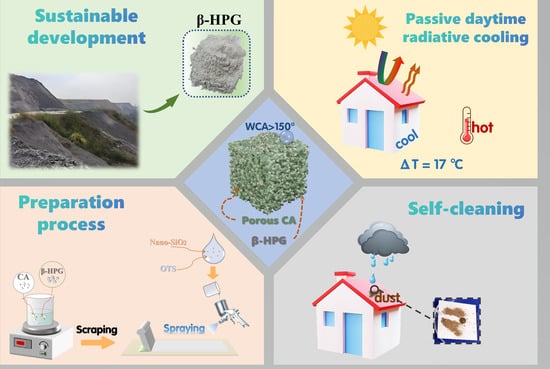
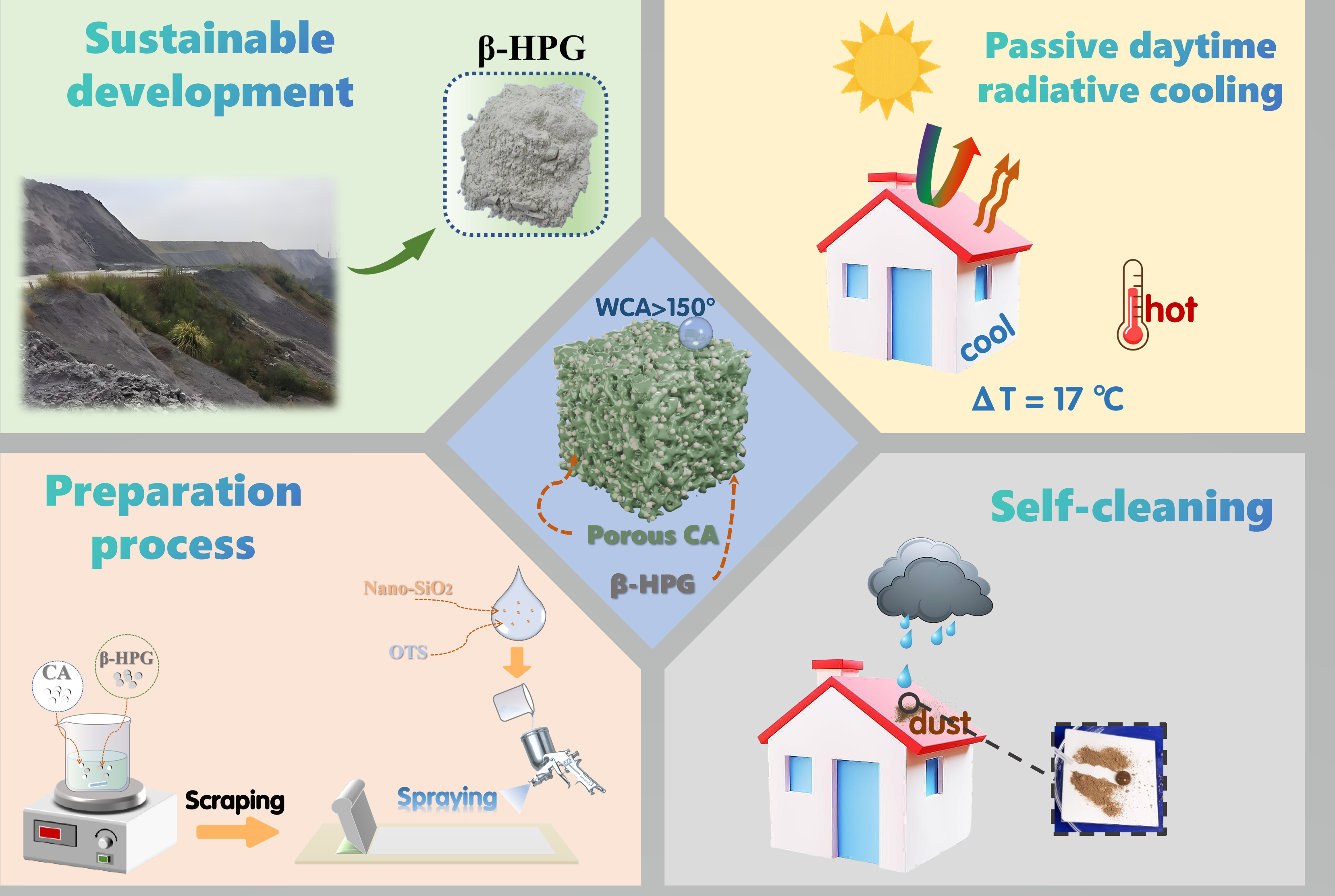
Graphical Abstract

1. Introduction

With the acceleration of global industrialization, the efficient utilization of industrial solid waste is a critical sustainability challenge. Phosphogypsum (PG), a major by-product of wet-process phosphoric acid production, currently has a comprehensive utilization rate that remains below 15% [1,2,3]. Conventional disposal methods cause severe environmental risks, including heavy metal leaching (e.g., Cd, U) and soil acidification [4,5]. To date, the utilization of PG is mainly limited to low-value applications, such as cement retarders, gypsum boards, and soil conditioners [6,7,8,9,10,11,12,13]. Although a few studies have explored its conversion into adsorbents [14,15], its potential in advanced optical and thermal management fields remains largely untapped.
Meanwhile, passive radiative cooling (PRC) has emerged as a promising zero-energy technology to combat the surging global cooling energy consumption [16]. By reflecting sunlight (0.3–2.5 μm) and emitting heat through the atmospheric window (8–13 μm), PRC enables sub-ambient cooling [17,18,19,20,21,22,23]. However, state-of-the-art PRC materials often rely on expensive metallic components or complex polymers, limiting their large-scale applicability [24,25,26]. To address this, recent efforts have shifted toward sustainable alternatives, including biomass (e.g., cellulose) [27,28,29,30] and recycled solid wastes [31], to replace conventional high-cost emitters.
Theoretically, PG possesses exceptional potential for radiative cooling. Its intrinsic white mineral characteristics provide a basis for solar reflection, while its inherent strong infrared activity, specifically the ν3 vibration of SO42− at 1100 cm−1, well matches the atmospheric window for thermal emission [32,33]. However, translating raw PG into a high-performance cooling material is hindered by its impurities and poor weatherability. Therefore, developing a synergistic design that combines PG with weather-resistant and functionally complementary materials is a highly desirable, yet challenging, approach to simultaneously achieve high-value solid waste utilization and low-cost radiative cooling.
Herein, we propose a novel and sustainable radiative cooling coating (β-HPG@CA/SiO2@OTS) using β-hemihydrate phosphogypsum (β-HPG) as the primary infrared-active substrate. By integrating it with cellulose acetate (CA) and modifying it with SiO2 nanoparticles and octadecyltrichlorosilane (OTS), we successfully established a connection between solid waste and advanced thermal management. The composite coating achieves a competitive solar reflectance of 90.9%, an exceptional mid-infrared emissivity of 98.7%, and an ambient temperature drop of up to 18.7 °C. Furthermore, the OTS modification endows the surface with superhydrophobicity (contact angle of 157°), ensuring robust self-cleaning and outstanding durability under UV, acid, and alkali exposure. Ultimately, this work provides a scalable, low-cost strategy for transforming hazardous industrial solid waste into high-performance, durable radiative cooling materials, offering a practical pathway for building energy efficiency.

2. Experimental Section

2.1. Materials

β-hemihydrate phosphogypsum (β-HPG) was supplied by Hubei Three Gorges Laboratory. Cellulose acetate and nanosilica (SiO2, particle size 7–40 nm) were purchased from Shanghai Aladdin Biochemical Technology Co., Ltd. Octadecyltrichlorosilane was obtained from Shanghai Maclean Biochemical Technology Co., Ltd. (Shanghai, China). Acetone was acquired from Chengdu Kelong Chemicals Co., Ltd. (Chengdu, China). Ethyl acetate and n-hexane were supplied by Tianjin Fuyu Fine Chemical Co., Ltd. (Tianjin, China). All reagents were used as received without further purification.

2.2. Fabrication of the β-HPG@CA/SiO2@OTS Composite Coating

Initially, powder pretreatment was performed. β-HPG powder was dispersed in anhydrous ethanol and placed in a planetary ball mill, using zirconia balls as the grinding media. The mixture was milled at a rotational speed of 400 rpm for 6 h, followed by drying, which resulted in β-HPG powder with a uniform particle size distribution.
Firstly, CA and β-HPG were added to a beaker at a certain mass ratio to regulate the composition of the precursor system. Subsequently, a mixed solvent composed of acetone and deionized water was introduced, together with a small amount of dispersant, to form a suspension with a controlled solid content. The resulting mixture was then subjected to ultrasonic treatment, followed by continuous magnetic stirring at a constant temperature of 45 °C under mild heating conditions to obtain a homogeneous and stable solution. This solution was then uniformly applied onto the surface of an acrylic or aluminum substrate via the blade coating method with a controlled wet thickness, and subsequently pre-cured under ambient temperature and ventilated conditions.
Secondly, OTS was dissolved in an organic solvent under stirring to form a transparent solution. Silica nanoparticles were then incorporated and dispersed via ultrasonic treatment to ensure uniform distribution. Afterward, a nonpolar solvent was added to adjust the dispersion state, followed by further stirring to obtain a stable modification suspension. The as-prepared solution was sprayed onto the pre-cured coating surface at a fixed distance, with multiple passes applied to achieve sufficient coverage. Finally, the coated substrate was subjected to thermal treatment under controlled conditions to obtain an integrated β-HPG@CA/SiO2@OTS composite coating with a porous structural layer and a hydrophobic functional layer. All the fabrication processes and parameters have been presented in Table 1.

2.3. Characterization

The morphology and microstructure of both the surface and cross-section were examined using a scanning electron microscope (SEM, JSM-7500F, JEOL, Tokyo, Japan), and elemental qualitative analysis was performed in conjunction with an EDS detector. The solar reflectance within the wavelength range of 0.3–2.5 μm was measured using a UV–Visible-near-infrared spectrophotometer (UV-3600 Plus, Shimadzu, Kyoto, Japan) equipped with an integrating sphere attachment. A Fourier Transform Infrared (FTIR) spectrometer (PerkinElmer, Waltham, MA, USA) was employed to determine the transmittance and reflectance within the wavelength range of 2.5–20 μm. Based on the equation ε(λ) = 1 − τ(λ) − ρ(λ), the emissivity ε(λ) was calculated, where τ(λ) and ρ(λ) represent the transmittance and reflectance, respectively. Temperature variations were recorded using a thermometer connected to two K-type 8-channel thermocouples (AT4208, Shenzhen Yongbei Machinery Industry Co., Ltd., Shenzhen, China). Solar irradiance data were collected using a compact weather station (TY025, Xiamen Tuanyi Electronic Technology Co., Ltd., Xiamen, China). Additionally, an ultraviolet accelerated aging test was conducted in a UV aging chamber (Model KJ-2029B, Guangdong Kejian Instrument Co., Ltd., Guangdong, China). The water contact angles were measured at five different locations on the sample surface, and the average values with standard deviations were recorded.

3. Results and Discussion

3.1. Morphological Analysis of β-HPG@CA Coating

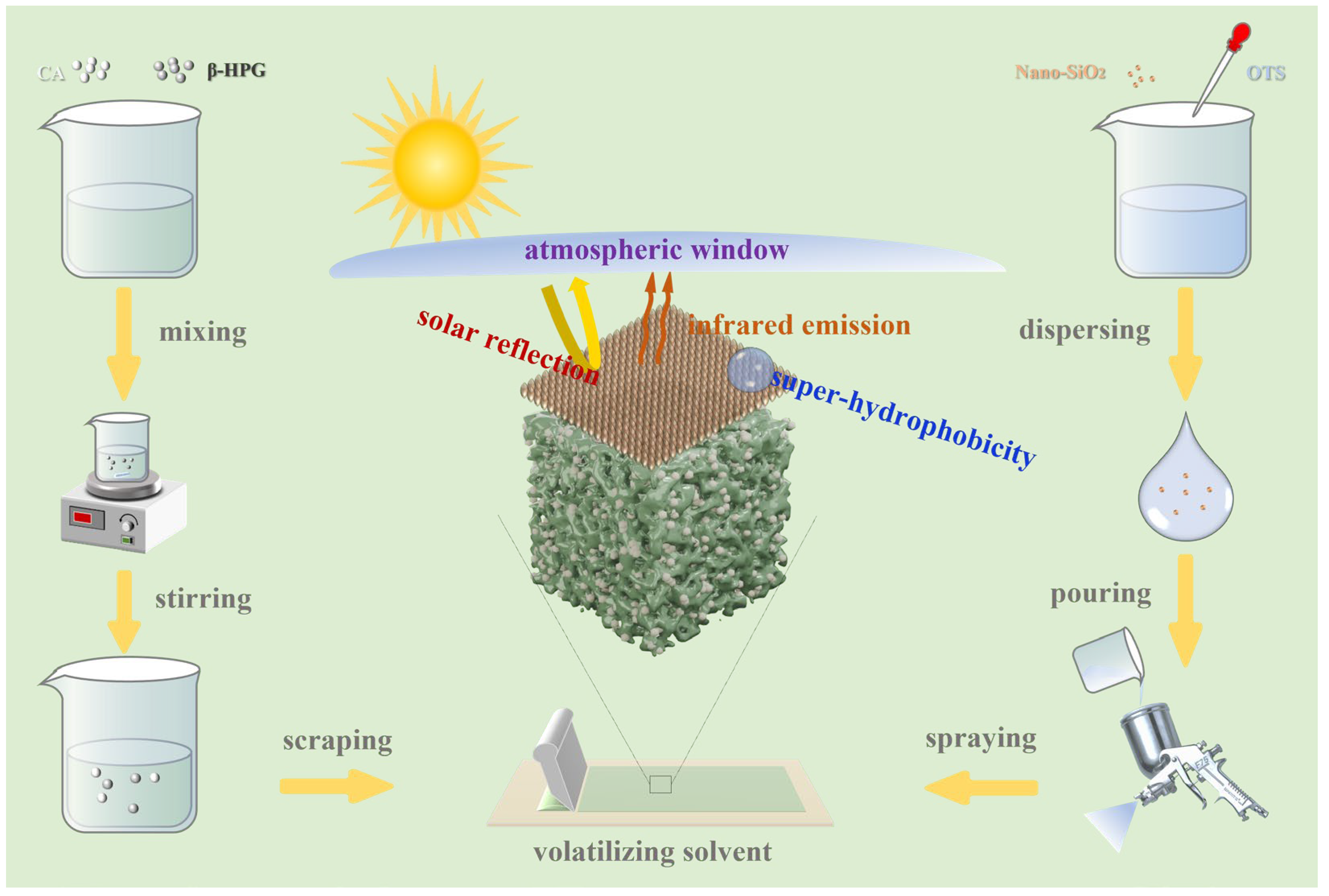
The preparation process of β-HPG@CA/SiO2@OTS composite coating was illustrated in Figure 1. Initially, CA and β-HPG were dispersed in a mixed solvent of acetone and deionized water. After phase separation of the acetone/water solvent system, a three-dimensional interpenetrating porous structure was thereby induced in CA [28]. Meanwhile, OTS and SiO2 were mixed completely to form the SiO2@OTS suspension. The β-HPG@CA suspension was then blade-coated onto the substrate and dried at room temperature to form the porous base layer. Finally, the SiO2@OTS suspension was then sprayed onto the surface to construct a hydrophobic top layer. As a result, a hierarchical composite coating consisting of a porous β-HPG@CA base and a SiO2@OTS-modified surface was obtained, endowing the material with both radiative cooling and superhydrophobic properties.
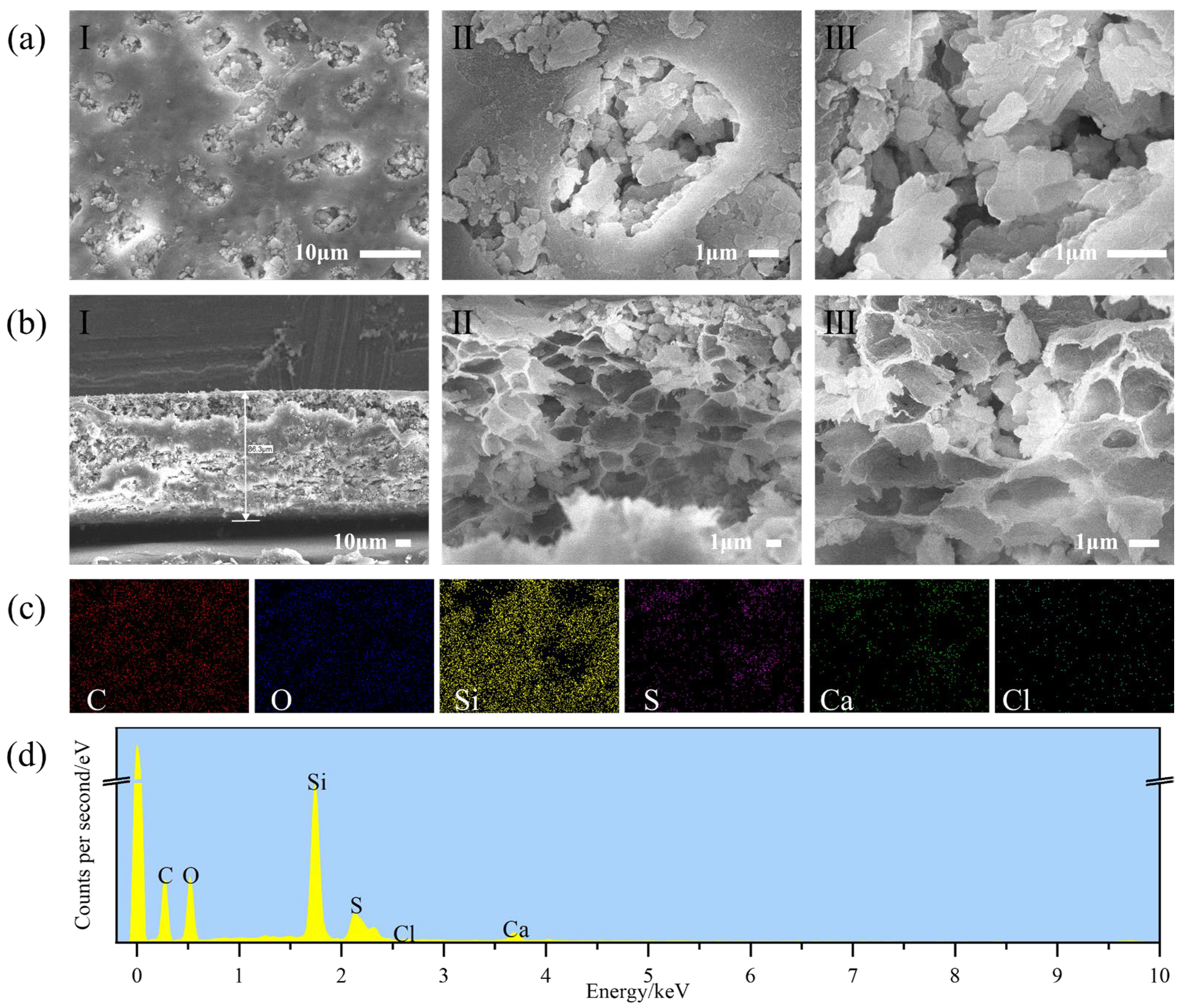
To analyze the internal microstructure characteristics of the prepared coating, scanning electron microscopy (SEM) was employed to examine its surface and cross-sectional morphology, as presented in Figure 2. Figure 2a reveals a typical porous morphology at different magnifications. At the low-magnification (Figure 2a(I)), micron-sized pores are uniformly distributed across the surface. Where granular materials are observed between the pore walls, producing a multi-scale rough morphology. This porous structure can be attributed to the solvent-induced phase separation process during coating formation [34]. Medium- and high-magnification images (Figure 2a(II,III)) further reveal intricate internal structures within the pores, where the surface is characterized by the stacking of plate-like crystals and densely arranged particle aggregates. These structures are primarily composed of β-HPG crystals, SiO2 nanoparticles and a CA skeleton. This multi-level rough morphology, on one hand, facilitates multiple scattering and reflection of incident sunlight, thereby enhancing light reflectance [27]. On the other hand, it provides a microstructural foundation for subsequent hydrophobic modification.
Figure 2b illustrates the cross-sectional structural features of the coating. The overall thickness measures approximately 86.3 μm, as shown in Figure 2b(I). The coating exhibits a strong interfacial bond with the substrate, with no evident signs of peeling or delamination, indicating favorable adhesion performance. Under higher magnification (Figure 2b(II,III)), the internal structure reveals a typical porous skeleton morphology. The pores are irregular in shape and highly interconnected, resulting in a complex three-dimensional network. This naturally formed honeycomb-like architecture contributes to enhanced surface emissivity within the atmospheric window (8–13 μm) [35], while simultaneously reducing the material’s overall density, thereby offering significant potential for thermal regulation applications. Furthermore, the presence of this porous network enhances the coating’s capacity for stress relief and environmental stability, providing a structural foundation that supports the favorable outcomes observed in subsequent weather resistance testing.
EDS elemental surface distribution mapping confirmed the uniform distribution of elements in the layer, as illustrated in Figure 2c. Specifically, the oxygen (O) element primarily originates from the organic chains present in β-HPG, SiO2, and CA. The carbon (C) element is attributed to the organic chains in CA, while the silicon (Si) element derives from SiO2 nanoparticles and the OTS silane coupling agent. Both sulfur (S) and calcium (Ca) elements originate from β-HPG, which is the main component of β-HPG powder. The minor presence of chlorine (Cl) further confirms the involvement of OTS in the surface modification of the coating. The EDS spectra and elemental distribution of the β-HPG@CA/SiO2@OTS coating are provided in the Figure 2d and Supplementary Data Table S1. Furthermore, the surface distribution map reveals that each element is uniformly distributed across the sample surface, with no significant enrichment or aggregation observed. This suggests that the β-type gypsum is effectively integrated with the CA matrix within the coating, while effectively incorporating nano-silica and OTS for surface modification, thereby endowing the coating with superhydrophobic and self-cleaning properties.
The β-HPG@CA/SiO2@OTS composite coating, fabricated via the aforementioned phase separation–scraping process, possesses a highly interconnected porous structure with lamellar stacking morphology, demonstrating significant microstructural advantages in optical properties, hydrophobic support modification, and weather resistance.

3.2. Optical Performance

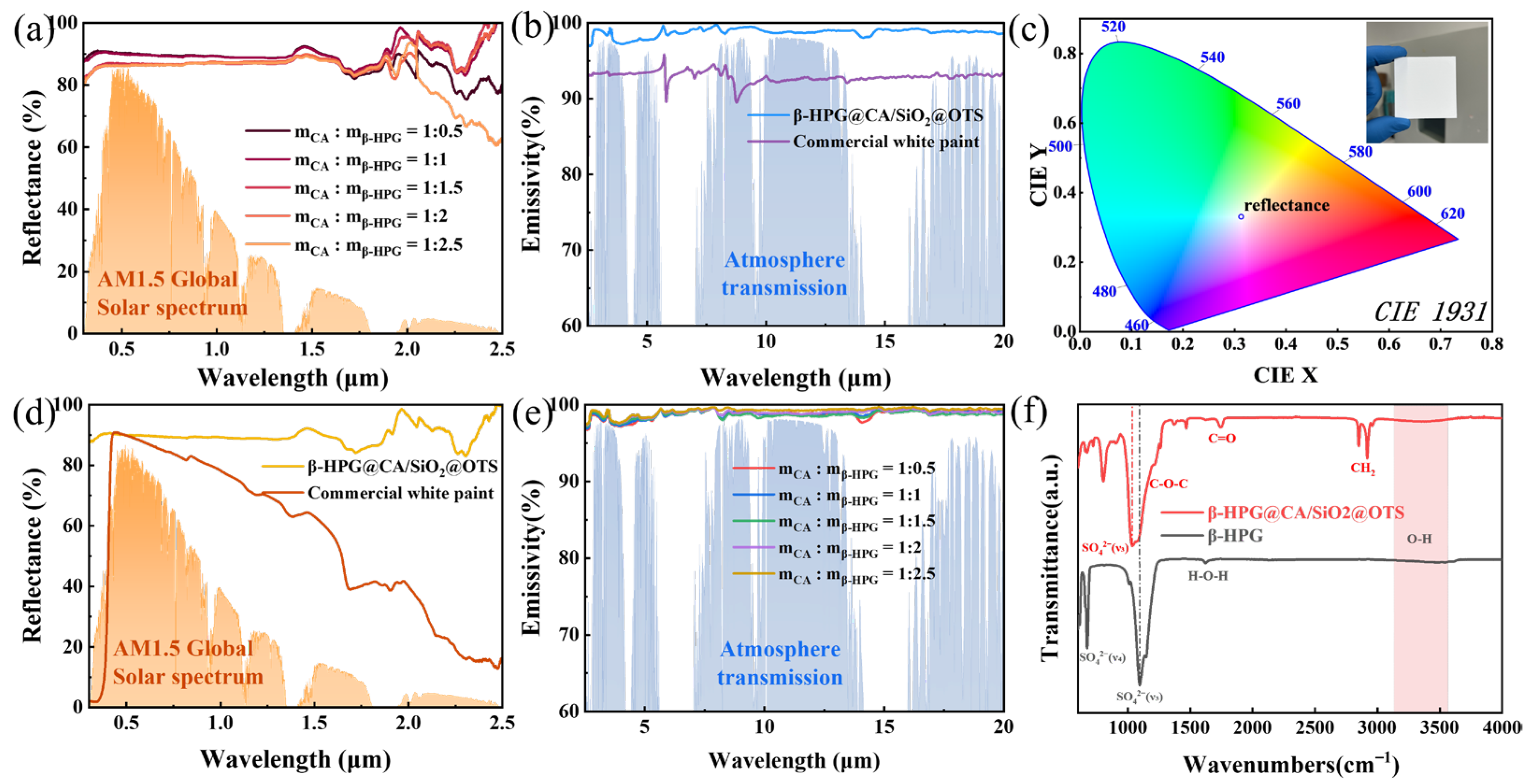
The optical properties of the coating play a critical role in enabling its radiative cooling functionality [36]. As shown in Figure 3a, the solar reflectance of the coating generally increases with the increasing β-HPG content. However, when the mass ratio of CA to β-HPG reaches 1:2 or lower, the reflectance curve becomes less uniform. This indicates that excessive β-HPG loading results in a less uniform surface morphology and uneven light scattering, which causes stronger wavelength-dependent variations in reflectance. At a mass ratio of 1:1, the coating exhibits relatively high and stable reflectance across the wavelength range of 0.3–2.5 μm. When combined with the AM1.5 standard solar spectrum, this ratio shows the best overall performance. Figure 3b further illustrates the emissivity of samples with different CA to β-HPG ratios within the 8–13 μm atmospheric window. The results show that the emissivity of all tested coatings remains above 95% within this window. To prevent uneven porosity and localized reductions in emissivity caused by an excessively high filling ratio, a 1:1 mass ratio was selected as the optimal formulation. This ratio ensures both high emissivity within the atmospheric window and strong solar reflectance across the solar spectrum band. The thickness of the coating also significantly influences its structural stability. An excessively thin coating is susceptible to surface irregularities caused by the substrate, thereby reducing its durability. Conversely, an overly thick coating is prone to internal pore accumulation and stress-induced cracking, which compromises structural integrity and increases both production costs and energy consumption. Through comparative experimentation, this study determined that a wet film thickness of 600 μm represents the optimal coating thickness. Outdoor temperature measurements of samples with varying ratios and thicknesses (see Supplementary Data Figures S2 and S3) further confirm that the selected mass ratio (1:1) and thickness (wet film 600 μm) yield the best performance.
The chemical composition, reflectivity, and emissivity of the optimal sample will be thoroughly analyzed in the following sections. Figure 3d presents the spectral reflectance of the β-HPG@CA/SiO2@OTS composite coating and commercial white paint within the solar wavelength range of 0.3–2.5 μm. Experimental results indicate that the average reflectivity of the composite coating in this wavelength range reaches approximately 90.9%, which is 65.8% higher than that of commercial white paint, whose average reflectivity is 54.5%. This improvement can be attributed to two main factors. First, the porous structure of the coating creates a gradient refractive index between the framework and the pores, leading to strong scattering of incident light across the solar spectrum. Second, particle accumulation within the pores enhances scattering in accordance with Mie scattering theory [37]. A reflectance exceeding 90% suggests that the coating is highly effective in preventing the absorption of solar radiant heat [26,38]. As illustrated in Figure 3c, the β-HPG@CA/SiO2@OTS composite coating exhibits a white appearance, indicating that it possesses a relatively high level of reflectivity.
According to Kirchhoff’s law of thermal radiation, the emissivity of an object is equivalent to its absorptivity under thermal equilibrium conditions. Emissivity refers to the capacity of a material to emit thermal radiation. Radiative cooling technology leverages materials with high emissivity to efficiently dissipate heat into the surrounding environment within the atmospheric transparent window (8–13 μm) [17,39,40]. As illustrated in Figure 3e, the material exhibits high emissivity within the atmospheric window, with an average emissivity of approximately 98.7%, enabling efficient thermal radiation to the sky. We analyzed the origin of the high emissivity of the β-HPG@CA/SiO2@OTS composite coating using Fourier transform infrared spectroscopy (FTIR), as illustrated in Figure 3f. The FTIR spectra of β-HPG and the β-HPG@CA/SiO2@OTS composite coating reveal distinct structural differences. A prominent absorption peak was identified in the β-HPG sample at 1100 cm−1, which corresponds to the asymmetric stretching vibration (ν3) of SO42− [32], and is associated with a wavelength of 9.1 μm, aligning closely with the atmospheric transparent window. A weak characteristic peak was detected at approximately 1620 cm−1, attributed to the H–O–H bending vibration of water molecules. Furthermore, a broad peak at 3400 cm−1 originates from the O–H stretching vibration of crystalline water in β-phosphogypsum. These spectral features confirm that β-HPG exhibits a typical β-type gypsum structure. In the β-HPG@CA/SiO2@OTS composite coating sample, in addition to retaining the aforementioned characteristic peaks, several new characteristic peaks were observed. The peak at 1730 cm−1 corresponds to the stretching vibration of the ester group C=O in cellulose acetate, while the peak at 1365 cm−1 corresponds to the vibration of C–CH3 [41], confirming the successful introduction of acetyl groups into the coating. The peaks at 1220 cm−1 and 1050 cm−1 were attributed to the asymmetric and symmetric stretching vibrations of the ether bond (C–O–C) in the cellulose acetate main chain, respectively, indicating that the integrity of the polymer chain was preserved. Notably, a slight redshift (Δν ≈ 5 cm−1) and broadening of the ν3 peak of SO42− were observed in the composite coating. This suggests that the introduction of cellulose acetate altered the local chemical environment of the sulfate groups, potentially enhancing their infrared active vibrations. These findings indicate that the two materials were successfully integrated, which is beneficial for further modulation of the coating’s microstructure and optical properties.

3.3. Hydrophobic Performance and Resistance Test

Although the successful integration of β-phosphogypsum, CA, SiO2 and OTS can effectively optimize the coating’s microstructure and optical properties, it still encounters challenges related to insufficient environmental durability in practical applications. Particularly in humid environments, β-PHG undergoes an irreversible hydration reaction upon contact with water, leading to volumetric expansion [42], which compromises the integrity of the pore structure. Furthermore, prolonged exposure to high levels of ultraviolet radiation can accelerate surface aging of the coating. These factors collectively have a significant adverse impact on the optical stability, as well as the cooling efficiency of the composite coating.
Constructing a superhydrophobic surface is therefore important for enhancing the outdoor applicability of the coating [43,44]. A hydrophobic surface can effectively reduce water retention and suppress the adsorption of moisture on the coating, thereby helping to maintain the porous structure and optical stability. In addition, self-cleaning behavior can reduce the accumulation of dust and surface contaminants, which is beneficial for preserving solar reflectance during long-term outdoor service. Therefore, hydrophobic modification is closely related to the maintenance of radiative cooling performance.
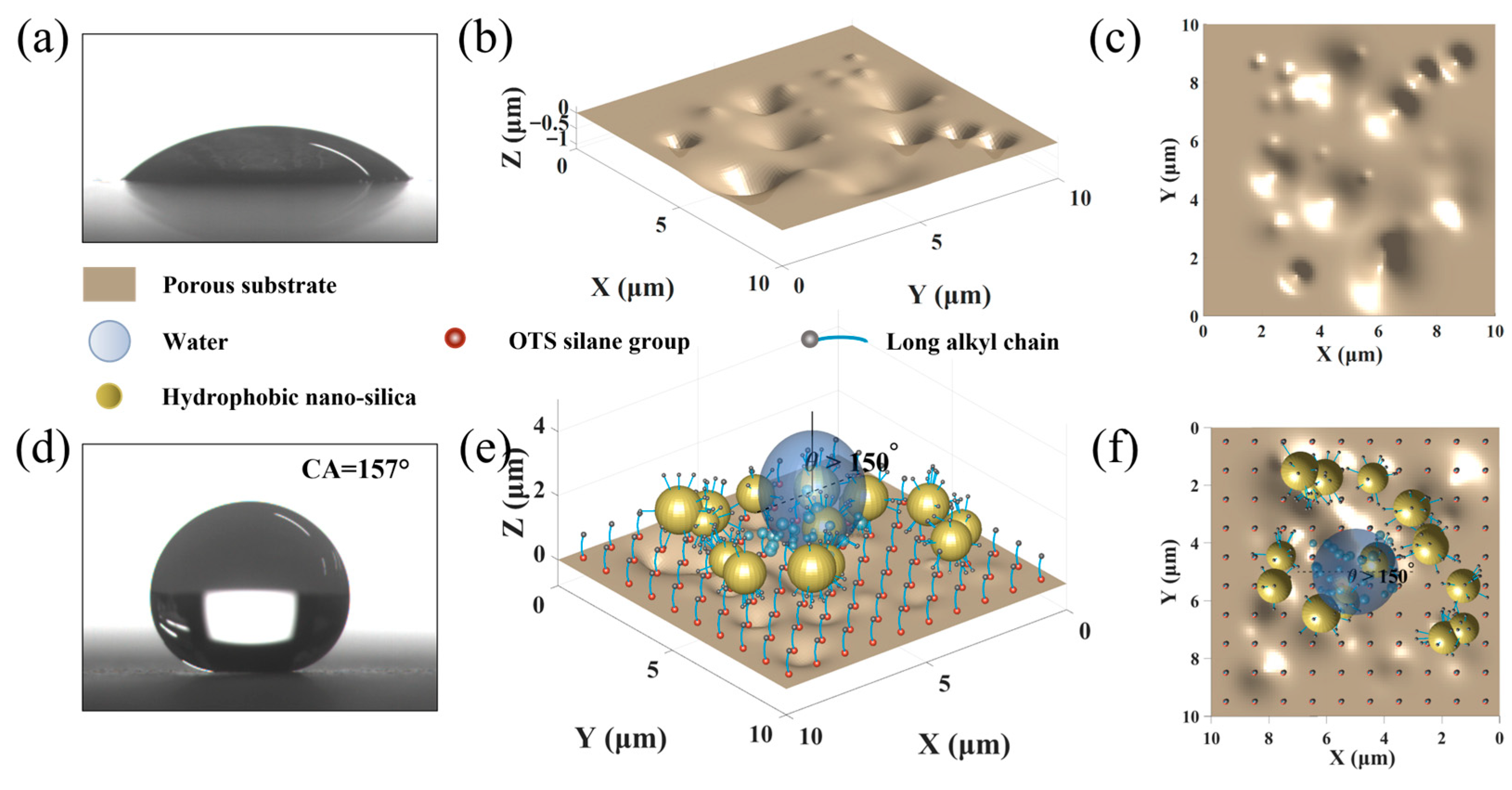
The hydrophobic modification principle of the β-HPG@CA/SiO2@OTS composite coating is illustrated in Figure 4. Before hydrophobic modification, the porous coating surface shows strong affinity to water, and water droplets can readily penetrate into the pores through capillary action, as shown in Figure 4a. The corresponding three-dimensional surface model of the coating is displayed in Figure 4b, and the top view is shown in Figure 4c. After incorporation of OTS, the silane undergoes a hydrolysis–condensation reaction, forming stable Si–O–Si covalent bonds with the hydroxyl groups (–OH) on the porous surface. Meanwhile, the C18 alkyl chains of OTS are oriented outward, forming a low-surface-energy layer [45,46]. In addition, the silanized silica nanoparticles further reduce the surface energy and increase the nanoscale roughness of the coating.
After spraying, the modified silica nanoparticles, with an average particle size of approximately 100 nm, are deposited on the coating surface and form nanoscale protrusions. When combined with the intrinsic micron-scale porous structure of the β-HPG@CA layer, these features create a hierarchical “micro-nano” dual-scale rough surface. Such a structure favors the Cassie-Baxter wetting state, in which air is trapped within the surface texture and direct liquid–solid contact is reduced. As a result, water droplets can easily roll off the surface, producing a water contact angle of 157° (Figure 4d), and a pronounced superhydrophobic effect. Based on this mechanism, a three-dimensional simulation model of the hydrophobically modified coating surface was established (Figure 4e–f).
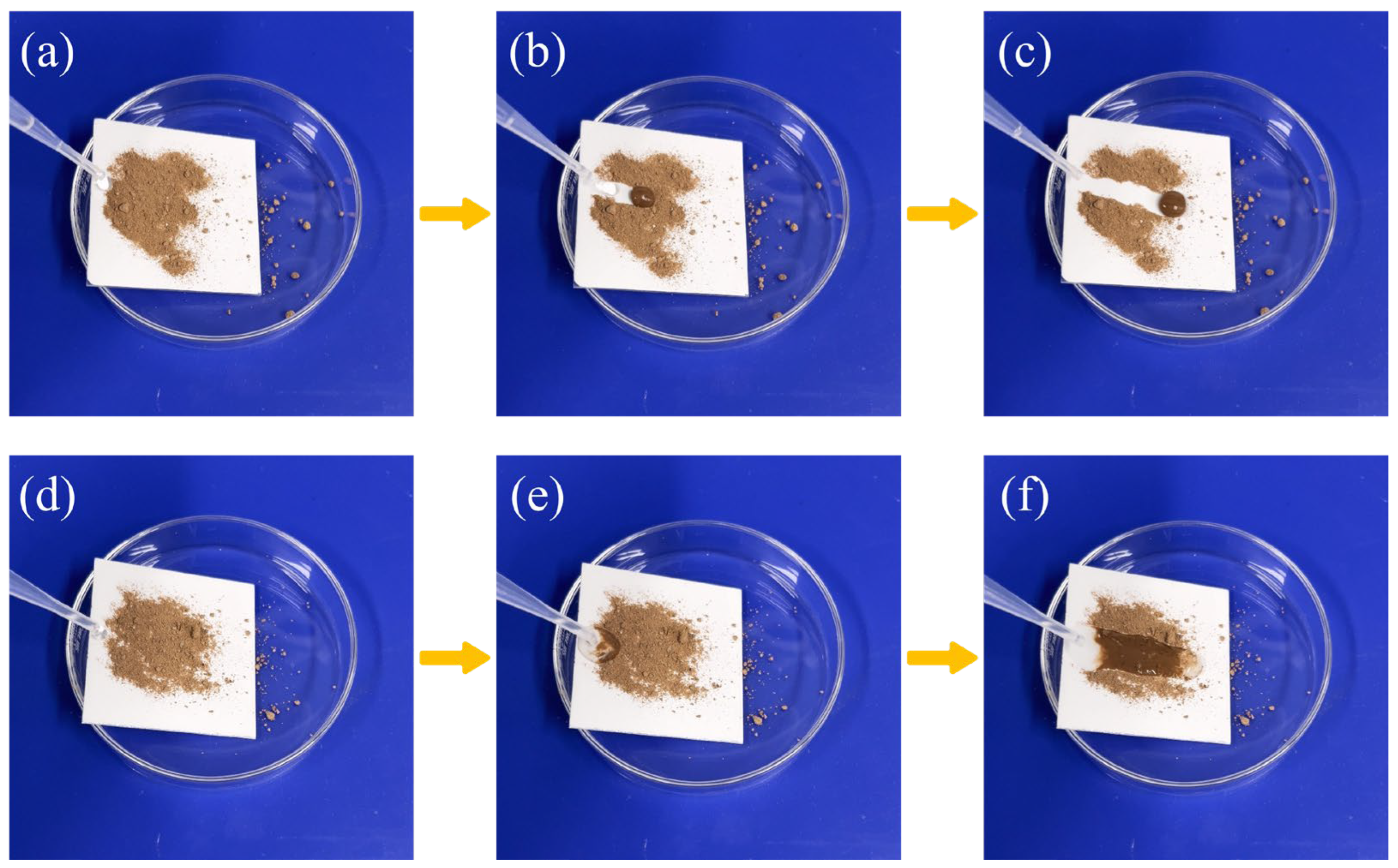
The successful hydrophobic modification imparts self-cleaning properties to the β-HPG@CA/SiO2@OTS composite coating. As illustrated in Figure 5a–c, the surface effectively removes deposited dirt after being rinsed with water droplets. In contrast, coatings without hydrophobic modification exhibit a significant accumulation of dirt (Figure 5d–f), thereby limiting their suitability for outdoor applications.
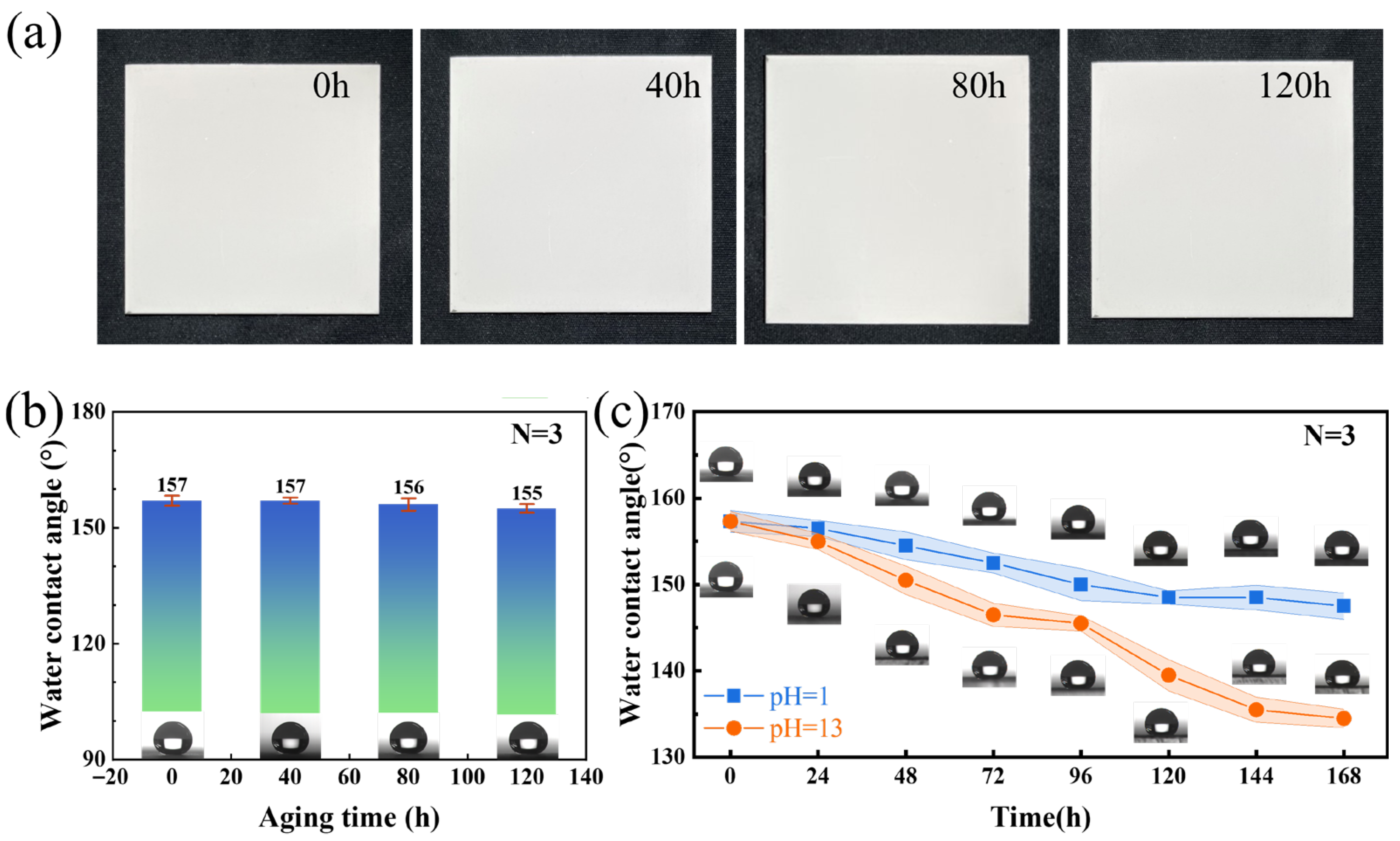
To examine the impact of aging factors on the hydrophobic performance of the β-HPG@CA/SiO2@OTS composite coating, ultraviolet accelerated aging tests and acid-base resistance tests were conducted. The results of these experiments are presented in Figure 6. To evaluate the long-term durability of the hydrophobic coating under simulated outdoor exposure conditions, the modified samples were subjected to accelerated aging in a UV chamber. Samples were collected at 0 h, 40 h, 80 h, and 120 h for testing. The corresponding macroscopic surface images are displayed in Figure 6a, and the variation in the contact angle during the aging process is illustrated in Figure 6b. The results indicate that after 120 h of continuous intense ultraviolet irradiation, equivalent to approximately three years of natural aging in Yichang, Hubei Province, China, no significant discoloration or cracking was observed on the coating surface. Moreover, the contact angle remained within the superhydrophobic range (>150°), demonstrating the coating’s excellent resistance to aging.
Meanwhile, to further verify the stability of superhydrophobic coatings in complex chemical environments, this study designed durability tests under strongly acidic and alkaline conditions. The hydrophobically modified samples were immersed in HCl solution with a pH of 1 and NaOH solution with a pH of 13 for seven consecutive days. At 24-h intervals, the samples were removed, naturally dried, and their water contact angles were measured to evaluate the retention of hydrophobic performance. The experimental results are presented in Figure 6c. During the long-term immersion of the sample in an acidic solution, the contact angle slightly decreased but remained within the hydrophobic range, reaching a water contact angle of 147°, which is close to the superhydrophobic threshold. After prolonged immersion in an alkaline solution, the water contact angle decreased to 134°, which, although below the superhydrophobic level, still demonstrates a significant degree of hydrophobicity. This behavior can be attributed to the relatively stable Si-O-Si network structure formed by OTS under acidic conditions, where strong acids are less likely to break the C-C and C-H bonds of the long-chain alkanes. In contrast, in an alkaline environment, the Si-O bonds hydrolyze more rapidly, leading to the formation of hydrophilic Si-OH groups. Importantly, none of the tested samples exhibited noticeable structural damage, such as discoloration, delamination, or bubble formation on their surfaces, indicating that the hydrophobic structure of the coating possesses excellent chemical stability.
The retention of hydrophobicity after UV irradiation and prolonged immersion in acidic or alkaline media is important not only for surface durability, but also for maintaining the cooling performance of the coating. A stable hydrophobic surface can reduce water retention, inhibit contamination accumulation, and mitigate moisture-induced structural degradation of β-HPG. These effects help preserve the porous microstructure and the associated optical properties, including high solar reflectance and high emissivity within the atmospheric window, thereby supporting long-term thermal regulation in outdoor environments.
Overall, these results demonstrate that the β-HPG@CA/SiO2@OTS coating possesses not only excellent superhydrophobicity and environmental durability, but also the ability to maintain the structural and optical conditions required for stable radiative cooling under outdoor service conditions.

3.4. Outdoor Cooling Test

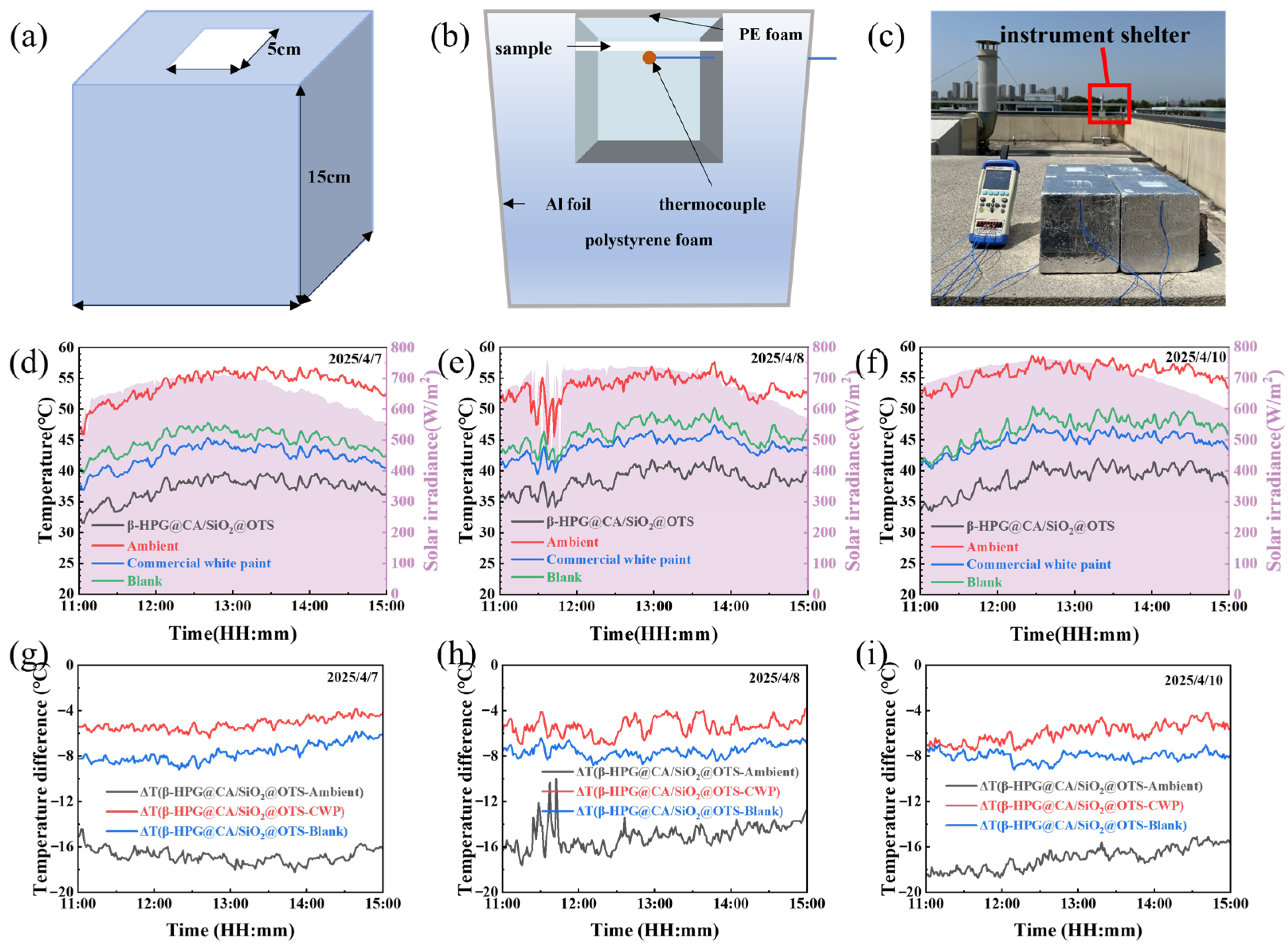
To further validate the passive cooling performance of the synthesized β-HPG@CA/SiO2@OTS composite coating in real-world conditions, a three-day outdoor cooling experiment was conducted on a field platform under typical summer sunny weather. The detailed environmental conditions during the test period, including average relative humidity and wind speed, are summarized in Table 2. Figure 7 presents the schematic diagram of the experimental setup, actual photographs, and temperature variation data of the different samples.
As illustrated in Figure 7a,b, the experimental setup comprises an insulated polystyrene foam box measuring 10 cm × 10 cm × 10 cm, with the outer surface covered by a highly reflective tin foil layer. The sample is positioned at the central opening located on the top of the box, and a thermocouple is mounted on the rear surface of the sample to monitor temperature variations in real time. All test samples have uniform dimensions of 5 cm × 5 cm. The testing was conducted on an open rooftop platform in Yichang, Hubei Province, China (longitude 111.32° E, latitude 30.72° N), which provides optimal conditions for solar irradiation and heat dissipation. The comparative samples used in the experiment include: blank substrate (Blank), commercial white paint (CWP), ambient structure (Ambient), and the β-HPG@CA/SiO2@OTS composite coating developed in this study. Figure 7c illustrates the test location of the sample and the placement of the small meteorological station, with an approximate distance of 12 m between the two positions.
Figure 7d–f present the solar irradiance intensity and the corresponding temperature variations in each sample over a three-day period. It is evident that the β-HPG@CA/SiO2@OTS composite coating sample exhibited a consistently significant cooling effect throughout the testing period. On April 10th, when the peak solar irradiance exceeded 750 W/m2, the β-HPG@CA sample achieved a maximum temperature drop of 18.7 °C relative to the sub-environment (cavity), with an average reduction of 17 °C. Compared to the blank substrate, the maximum temperature decrease was 9.2 °C, with an average of 8.0 °C. When compared to commercial white paint, the β-HPG@CA/SiO2@OTS composite coating sample also demonstrated a noticeable cooling effect, achieving a maximum temperature reduction of 7.5 °C and an average reduction of 5.9 °C. Furthermore, the β-HPG@CA/SiO2@OTS composite coating exhibits anti-aging properties, maintaining a consistent cooling performance before and after aging. For detailed data, please refer to Figure S3.

3.5. Infrared Imaging in Real-World Scenarios and Evaluation of Cooling Capacity

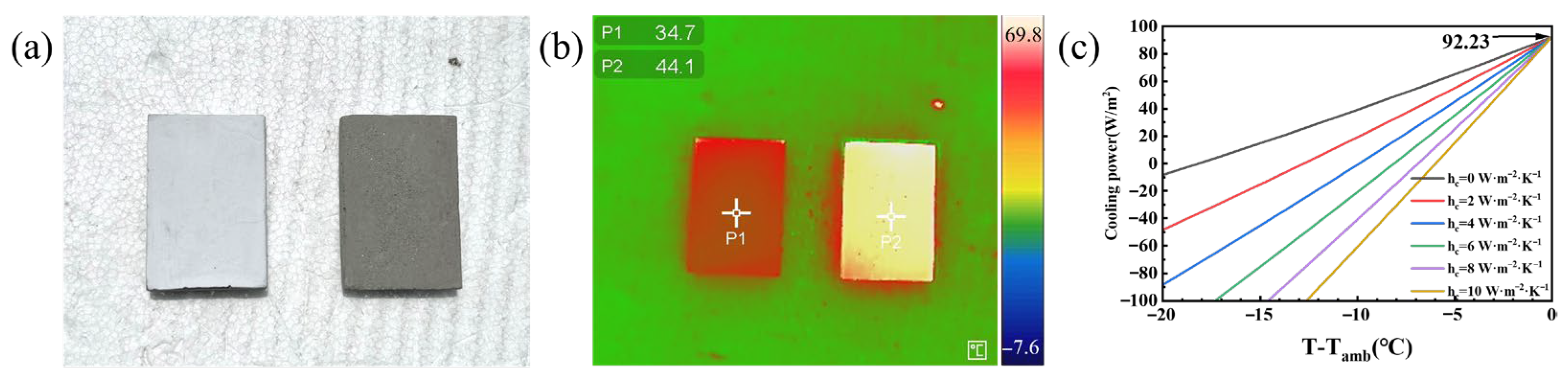
To further validate the refrigeration performance of the β-HPG@CA/SiO2@OTS composite coating in real-world application environments, we designed several simplified outdoor scenario tests. Figure 8a presents photographs of two cement block samples simulating outdoor building surfaces: one coated with the β-HPG@CA/SiO2@OTS composite coating (left) and one uncoated (right). Both samples were exposed to identical solar irradiation conditions at midday on a clear day for 15 min. The corresponding infrared thermal images are displayed in Figure 8b. The surface temperature of the coated sample was significantly lower than that of the uncoated sample. Specifically, the temperature in the P1 region (covered with β-HPG@CA/SiO2@OTS composite coating) was 34.7 °C, whereas the temperature in the P2 region (untreated sample) reached 44.1 °C, resulting in a temperature difference of 9.4 °C. Additionally, we conducted similar outdoor tests using aluminum boxes (see Figure S4). Due to the superior thermal conductivity of aluminum, the cooling effect was less pronounced compared to the cement samples. However, the β-HPG@CA/SiO2@OTS composite coating still reduced the surface temperature by approximately 4–5 °C. These results demonstrate the effective thermal insulation and cooling performance of the developed coating in real-world environmental conditions, as reflected by the macroscopic temperature distribution.
Furthermore, based on the optical parameters (reflectance and emissivity) of the tested samples, we developed a steady-state energy balance model to theoretically simulate and calculate the net radiative cooling power [47,48]. The detailed model configuration and computational procedures are provided in the Supplementary Data. The main energy balance equation is as follows:
P n e t ( T ) = P r a d ( T ) P s u n P a t m ( T a m b ) P c o n d + c o n v
The net radiative cooling power of the β-HPG@CA/SiO2@OTS composite coating was simulated under an irradiance of 710 W/m2 and an ambient temperature of 300 K, with non-radiative heat transfer coefficients (hc) set at 0, 2, 4, 6, 8, and 10 W/(m2·K). The simulation results are presented in Figure 7c, showing that the net cooling power of the β-HPG@CA/SiO2@OTS composite coating reaches approximately 92.23 W/m2, thereby confirming its outstanding daytime radiative cooling performance. These findings further demonstrate its practical applicability and engineering potential as an energy-efficient cooling material for outdoor applications.
To further evaluate the performance of the proposed coating, a comparison with representative radiative cooling materials reported in the literature is presented in Table 3.
As shown, most reported coatings exhibit high solar reflectance (>90%) and emissivity (>90%) to achieve efficient daytime radiative cooling. The β-HPG@CA/SiO2@OTS composite coating developed in this work demonstrates a solar reflectance of 90.9% and an emissivity of 98.7%, which are comparable to or higher than those of previously reported systems, particularly in terms of infrared emissivity.
In addition, the coating shows a high water contact angle of 157°, exceeding that of most reference materials, indicating superior surface hydrophobicity. This feature is beneficial for self-cleaning and long-term outdoor stability.
Overall, the proposed coating achieves a balanced performance in optical properties and surface wettability, making it competitive among current state-of-the-art radiative cooling coatings.

4. Conclusions

In this study, a superhydrophobic radiative cooling coating based on β-HPG and CA was successfully developed via a simple and scalable strategy. The coating exhibits a high solar reflectance of 90.9% and an infrared emissivity of 98.7%, enabling effective daytime radiative cooling with a net cooling power of up to 92.23 W/m2.
The formation of a micro-nano dual-scale rough structure, combined with OTS modification, endows the coating with excellent superhydrophobicity (water contact angle of 157°), providing enhanced self-cleaning capability and environmental resistance. Benefiting from the use of phosphogypsum as a raw material, this work also highlights a sustainable and cost-effective pathway for high-performance cooling coatings.
The developed coating shows strong potential for applications in building energy saving and outdoor thermal management. Future work will focus on further performance optimization, large-scale fabrication, and long-term durability under practical conditions.

Supplementary Materials

The following supporting information can be downloaded at: https://www.mdpi.com/article/10.3390/coatings16040498/s1, Figure S1: Outdoor temperature curves of β-HPG@CA/SiO2@OTS coatings doped with CA and β-HPG in different proportions; Figure S2: Outdoor temperature curves of β-HPG@CA/SiO2@OTS coatings with different thicknesses at a CA: β-HPG mass ratio of 1:1; Figure S3: Outdoor cooling performance curves of β-HPG@CA/SiO2@OTS coating prior to and following UV accelerated aging; Figure S4: Application of β-HPG@CA/SiO2@OTS coating on an Aluminum Switch Box and Corresponding Thermal Infrared Image; Table S1: EDS element distribution and content of β-HPG@CA/SiO2@OTS coating; Note S1: Mathematical model of the net radiative cooling power.

Author Contributions

Conceptualization, G.Q.; methodology, Y.Q.; software, S.C.; investigation, S.L.; data curation, M.W. and S.Q.; writing—original draft preparation, M.W.; writing—review and editing, X.T. and L.J.; visualization, W.H.; supervision, X.C.; project administration, X.T.; funding acquisition, X.T. All authors have read and agreed to the published version of the manuscript.

Funding

This research was funded by the Open Foundation of Hubei Three Gorges Laboratory Grant No. SK250004.

Data Availability Statement

Data will be made available on request.

Conflicts of Interest

The authors declare no conflicts of interest.

References

  1. Kuzmanović, P.; Todorović, N.; Mrđa, D.; Forkapić, S.; Petrović, L.F.; Miljević, B.; Hansman, J.; Knežević, J. The possibility of the phosphogypsum use in the production of brick: Radiological and structural characterization. J. Hazard. Mater. 2021, 413, 125343. [Google Scholar] [CrossRef]
  2. Silva, M.V.; de Rezende, L.R.; Mascarenha, M.M.D.A.; de Oliveira, R.B. Phosphogypsum, tropical soil and cement mixtures for asphalt pavements under wet and dry environmental conditions. Resour. Conserv. Recycl. 2019, 144, 123–136. [Google Scholar] [CrossRef]
  3. Zhang, W.; Zhao, L.; Xue, M.; Duan, X.; Feng, C.; Zhu, J. Efficient precipitation of soluble phosphorus impurities in the recycling of phosphogypsum to produce hemihydrate gypsum. J. Clean. Prod. 2023, 396, 136455. [Google Scholar] [CrossRef]
  4. Sengupta, I.; Dhal, P.K. Impact of elevated phosphogypsum on soil fertility and its aerobic biotransformation through indigenous microorganisms (IMO’s) based technology. J. Environ. Manag. 2021, 297, 113195. [Google Scholar] [CrossRef] [PubMed]
  5. Tayibi, H.; Choura, M.; López, F.A.; Alguacil, F.J.; López-Delgado, A. Environmental impact and management of phosphogypsum. J. Environ. Manag. 2009, 90, 2377–2386. [Google Scholar] [CrossRef]
  6. Campos, M.P.; Costa, L.J.P.; Nisti, M.B.; Mazzilli, B.P. Phosphogypsum recycling in the building materials industry: Assessment of the radon exhalation rate. J. Environ. Radioact. 2017, 172, 232–236. [Google Scholar] [CrossRef]
  7. Chen, Q.; Zhang, Q.; Qi, C.; Fourie, A.; Xiao, C. Recycling phosphogypsum and construction demolition waste for cemented paste backfill and its environmental impact. J. Clean. Prod. 2018, 186, 418–429. [Google Scholar] [CrossRef]
  8. Degirmenci, N. Utilization of phosphogypsum as raw and calcined material in manufacturing of building products. Constr. Build. Mater. 2008, 22, 1857–1862. [Google Scholar] [CrossRef]
  9. Ou, L.; Li, R.; Zhu, H.; Zhao, H.; Chen, R. Upcycling waste phosphogypsum as an alternative filler for asphalt pavement. J. Clean. Prod. 2023, 420, 138332. [Google Scholar] [CrossRef]
  10. Ou, L.; Zhang, X.; Zhu, H.; Shan, B.; Chen, R.; Yang, S.; Tan, Q.; Yang, X. Phosphogypsum as a warm mix asphalt additive: Preparation and performance. Constr. Build. Mater. 2025, 490, 142326. [Google Scholar] [CrossRef]
  11. Akın Altun, İ.; Sert, Y. Utilization of weathered phosphogypsum as set retarder in Portland cement. Cem. Concr. Res. 2004, 34, 677–680. [Google Scholar] [CrossRef]
  12. Wang, Q.; Jia, R. A novel gypsum-based self-leveling mortar produced by phosphorus building gypsum. Constr. Build. Mater. 2019, 226, 11–20. [Google Scholar] [CrossRef]
  13. Qi, J.; Zhu, H.; Zhou, P.; Wang, X.; Wang, Z.; Yang, S.; Yang, D.; Li, B. Application of phosphogypsum in soilization: A review. Int. J. Environ. Sci. Technol. 2023, 20, 10449–10464. [Google Scholar] [CrossRef]
  14. Huang, X.; Li, J.; Jiang, W.; Chen, Z.; Wan, Y.; Xue, Q.; Liu, L.; Poon, C.S. Recycling of phosphogypsum and red mud in low carbon and green cementitious materials for vertical barrier. Sci. Total Environ. 2022, 838, 155925. [Google Scholar] [CrossRef] [PubMed]
  15. Wang, C.; Chen, S.; Huang, D.; Huang, Q.; Li, X.; Shui, Z. Safe environmentally friendly reuse of red mud modified phosphogypsum composite cementitious material. Constr. Build. Mater. 2023, 368, 130348. [Google Scholar] [CrossRef]
  16. Liang, Y.; Liu, J.; Zhang, S.; Du, Y.; Yang, H.; Cui, H.; Yan, J. Rethinking the Role of Thermal Conductance in Radiative Sky Cooling: Materials and Applications. Adv. Energy Mater. 2025, 15, 2500869. [Google Scholar] [CrossRef]
  17. Catalanotti, S.; Cuomo, V.; Piro, G.; Ruggi, D.; Silvestrini, V.; Troise, G. The radiative cooling of selective surfaces. Sol. Energy 1975, 17, 83–89. [Google Scholar] [CrossRef]
  18. Cui, Z.; Guo, C.; Zhao, D. Energy-saving and economic analysis of passive radiative sky cooling for telecommunication base station in China. Build. Simul. 2022, 15, 1775–1787. [Google Scholar] [CrossRef]
  19. Raman, A.P.; Anoma, M.A.; Zhu, L.; Rephaeli, E.; Fan, S. Passive radiative cooling below ambient air temperature under direct sunlight. Nature 2014, 515, 540–544. [Google Scholar] [CrossRef]
  20. Wang, X.; Zhang, Q.; Wang, S.; Jin, C.; Zhu, B.; Su, Y.; Dong, X.; Liang, J.; Lu, Z.; Zhou, L.; et al. Sub-ambient full-color passive radiative cooling under sunlight based on efficient quantum-dot photoluminescence. Sci. Bull. 2022, 67, 1874–1881. [Google Scholar] [CrossRef]
  21. Xiong, L.; Wei, Y.; Chen, C.; Chen, X.; Fu, Q.; Deng, H. Thin lamellar films with enhanced mechanical properties for durable radiative cooling. Nat. Commun. 2023, 14, 6129. [Google Scholar] [CrossRef] [PubMed]
  22. Yin, H.; Fan, C. Realization of an efficient radiative cooling emitter with double layer inorganic SiO2 and TiO2 metamaterial. Results Phys. 2023, 45, 106216. [Google Scholar] [CrossRef]
  23. Zhou, X.; Xu, Y.; Zhang, D.; Huang, M.; Liu, M. Robust and wear-durable coating based on halloysite nanotubes/polymer composite for passive daytime radiative cooling. Compos. Sci. Technol. 2024, 251, 110566. [Google Scholar] [CrossRef]
  24. Alim, M.A.; Tao, Z.; Imran, H.M.; Rahim, M.A.; Malik, Z.; Rahman, A. A scoping review on reflective coatings with nanomaterials: Progress since 2000 and current challenges. J. Clean. Prod. 2025, 511, 145633. [Google Scholar] [CrossRef]
  25. Li, T.; Zhai, Y.; He, S.; Gan, W.; Wei, Z.; Heidarinejad, M.; Dalgo, D.; Mi, R.; Zhao, X.; Song, J.; et al. A radiative cooling structural material. Science 2019, 364, 760–763. [Google Scholar] [CrossRef]
  26. Mandal, J.; Fu, Y.; Overvig, A.C.; Jia, M.; Sun, K.; Shi, N.N.; Zhou, H.; Xiao, X.; Yu, N.; Yang, Y. Hierarchically porous polymer coatings for highly efficient passive daytime radiative cooling. Science 2018, 362, 315–319. [Google Scholar] [CrossRef]
  27. Qi, G.; Tan, X.; Jiao, Y.; Dai, Q.; Qiao, Y.; Yang, X.; Wang, Y.; Chen, S.; Shi, C.; Yan, K.; et al. A scalable and aging-resistant film for radiative cooling. Appl. Therm. Eng. 2024, 257, 124310. [Google Scholar] [CrossRef]
  28. Qi, G.; Tan, X.; Yang, X.; Qiao, Y.; Li, X.; Wang, Y.; Chen, S.; Tu, Y.; Nie, S.; Yan, K.; et al. Anti-aging and flexible-porous-array films for radiative cooling. Sol. Energy Mater. Sol. Cells 2024, 268, 112733. [Google Scholar] [CrossRef]
  29. Zhu, W.; Zhang, Y.; Mohammad, N.; Xu, W.; Tunc, S.; Shan, X.; Zhou, C.; Semple, K.; Dai, C.; Li, T. Large-scale industry-compatible sub-ambient radiative cooling pulp. Cell Rep. Phys. Sci. 2022, 3, 101125. [Google Scholar] [CrossRef]
  30. Cai, C.; Wei, Z.; Ding, C.; Sun, B.; Chen, W.; Gerhard, C.; Nimerovsky, E.; Fu, Y.; Zhang, K. Dynamically Tunable All-Weather Daytime Cellulose Aerogel Radiative Supercooler for Energy-Saving Building. Nano Lett. 2022, 22, 4106–4114. [Google Scholar] [CrossRef]
  31. Wang, H.; Sun, Y.; Liu, L.; Ji, R.; Wang, X. Integrated utilization of fly ash and waste glass for synthesis of foam/dense bi-layered insulation ceramic tile. Energy Build. 2018, 168, 67–75. [Google Scholar] [CrossRef]
  32. Ennaciri, Y.; Bettach, M.; Cherrat, A. Conversion of phosphogypsum to sodium sulfate and calcium carbonate in aqueous solution. J. Mater. Environ. Sci. 2016, 7, 1925–1933. [Google Scholar]
  33. Lei, Y.; Gong, Y.; He, M.; Li, L.; Qin, J.; Liu, Y. High-Efficiency Purification and Morphology Regulation of CaSO4·2H2O Crystals from Phosphogypsum. Molecules 2024, 29, 3910. [Google Scholar] [CrossRef] [PubMed]
  34. Zhang, X.; Wang, B.; Qin, X.; Ye, S.; Shi, Y.; Feng, Y.; Han, W.; Liu, C.; Shen, C. Cellulose acetate monolith with hierarchical micro/nano-porous structure showing superior hydrophobicity for oil/water separation. Carbohydr. Polym. 2020, 241, 116361. [Google Scholar] [CrossRef] [PubMed]
  35. Jin, C.; Zhang, W.; Ni, J.; Li, L.; Hao, Y.; Pei, G.; Zhao, B. Multi-interface porous coating for efficient sub-ambient daytime radiative cooling. Sol. Energy Mater. Sol. Cells 2025, 286, 113577. [Google Scholar] [CrossRef]
  36. Adibekyan, A.; Schumacher, J.; Pattelli, L.; Manara, J.; Meriç, S.; Bazkir, Ö.; Cucchi, C.; Sprengard, C.; Pérez, G.; Campos, J.; et al. Emissivity and Reflectivity Measurements for Passive Radiative Cooling Technologies. Int. J. Thermophys. 2025, 46, 66. [Google Scholar] [CrossRef]
  37. Fei, J.; Zhang, X.; Han, D.; Lei, Y.; Xie, F.; Zhou, K.; Koh, S.; Ge, J.; Zhou, H.; Wang, X.; et al. Passive cooling paint enabled by rational design of thermal-optical and mass transfer properties. Science 2025, 388, 1044–1049. [Google Scholar] [CrossRef]
  38. Wang, H.; Xue, C.; Guo, X.; Liu, B.; Ji, Z.; Huang, M.; Jia, S. Superhydrophobic porous film for daytime radiative cooling. Appl. Mater. Today 2021, 24, 101100. [Google Scholar] [CrossRef]
  39. Liang, J.; Wu, J.; Guo, J.; Li, H.; Zhou, X.; Liang, S.; Qiu, C.; Tao, G. Radiative cooling for passive thermal management towards sustainable carbon neutrality. Natl. Sci. Rev. 2023, 10, nwac208. [Google Scholar] [CrossRef]
  40. Peoples, J.; Hung, Y.; Li, X.; Gallagher, D.; Fruehe, N.; Pottschmidt, M.; Breseman, C.; Adams, C.; Yuksel, A.; Braun, J.; et al. Concentrated radiative cooling. Appl. Energy 2022, 310, 118368. [Google Scholar] [CrossRef]
  41. Wang, D.; Yue, Y.; Wang, Q.; Cheng, W.; Han, G. Preparation of cellulose acetate-polyacrylonitrile composite nanofibers by multi-fluid mixing electrospinning method: Morphology, wettability, and mechanical properties. Appl. Surf. Sci. 2020, 510, 145462. [Google Scholar] [CrossRef]
  42. Chen, X.; Wu, Q.; Gao, J.; Tang, Y. Hydration characteristics and mechanism analysis of β-calcium sulfate hemihydrate. Constr. Build. Mater. 2021, 296, 123714. [Google Scholar] [CrossRef]
  43. Hu, W.; Tan, X.; Yang, X.; Qi, G.; Chen, S.; Li, S.; Wang, Y.; Zhang, F.; Yan, K.; Kang, Z. A superhydrophobic transparent radiative cooling film exhibits excellent resistance to acid and alkali as well as remarkable robustness. Opt. Mater. 2024, 149, 114995. [Google Scholar] [CrossRef]
  44. Sun, W.; Tan, X.; Qi, G.; Yang, X.; Hu, W.; Jin, W.; Guo, Z.; Liang, J.; Wang, M.; Lin, X. A UV-resistant porous composite film for radiative cooling and enhanced hydrophobicity. Mater. Today Commun. 2024, 41, 110797. [Google Scholar] [CrossRef]
  45. Chen, J.; Wei, C.; Ran, J.; Su, X.; Wang, W.; Zhang, J. Functional hydrophobic coating for phosphogypsum via stoichiometric silanization, hydrophobic characterization, microstructure analysis, and durability evaluation. Constr. Build. Mater. 2022, 347, 128560. [Google Scholar] [CrossRef]
  46. Zhang, L.; Zhou, A.G.; Sun, B.R.; Chen, K.S.; Yu, H. Functional and versatile superhydrophobic coatings via stoichiometric silanization. Nat. Commun. 2021, 12, 982. [Google Scholar] [CrossRef]
  47. Yang, X.; Geng, J.; Tan, X.; Liu, M.; Yao, S.; Tu, Y.; Li, S.; Qiao, Y.; Qi, G.; Xu, R.; et al. A flexible PDMS@ZrO2 film for highly efficient passive radiative cooling. Inorg. Chem. Commun. 2023, 151, 110586. [Google Scholar] [CrossRef]
  48. Zhou, L.; Zhao, J.; Huang, H.; Nan, F.; Zhou, G.; Ou, Q. Flexible Polymer Photonic Films with Embedded Microvoids for High-Performance Passive Daytime Radiative Cooling. ACS Photonics 2021, 8, 3301–3307. [Google Scholar] [CrossRef]
  49. Tan, R.; Zhang, H.; Wang, L.; Li, Y.; Xue, P.; Xu, S.; Bai, G. Hierarchically structured superhydrophobic composite films for efficient radiative cooling and energy saving. J. Mater. Chem. A 2025, 13, 15941–15950. [Google Scholar] [CrossRef]
  50. Long, H.; Lei, S.; Wang, F.; Yang, S.; Ju, H.; Ou, J. Superhydrophobic daytime radiative cooling coating incorporated with phase change microcapsules for building thermal regulation. J. Mater. Sci. 2024, 59, 6459–6475. [Google Scholar] [CrossRef]
  51. Wang, Q.; Yang, F.; Wu, D.; Guo, Z. Radiative cooling layer boosting hydrophilic-hydrophobic patterned surface for efficient water harvesting. Colloids Surf. A Physicochem. Eng. Asp. 2023, 658, 130584. [Google Scholar] [CrossRef]
  52. Tu, H.; Hou, M.; Wang, J. Hierarchically structured composite with superhydrophobicity and radiative cooling for energy-saving buildings. Sol. Energy Mater. Sol. Cells 2024, 266, 112654. [Google Scholar] [CrossRef]
  53. Tan, Z.; Yang, H.; Cheng, X.; Yu, G.; Liu, H.; Zhang, B.; Gong, C. Superhydrophobic PVDF/SiO2 composite films with a hierarchical structure for highly stabilized radiative cooling. Chem. Commun. 2024, 60, 13710–13713. [Google Scholar] [CrossRef] [PubMed]
Figure 1. Preparation process and schematic diagram of β-HPG@CA/SiO2@OTS composite coating.
Coatings 16 00498 g001
Figure 2. SEM images and EDS analysis of the β-HPG@CA/SiO2@OTS composite coating: (a) surface SEM image, (IIII) represent different magnification levels, (b) cross-sectional SEM image, (IIII) represent different magnification levels, (c) elemental surface distribution mapping, and (d) EDS spectrum.
Coatings 16 00498 g002
Figure 3. Optical properties of the β-HPG@CA/SiO2@OTS composite coating: (a) reflectance and (b) emissivity of coatings with different doping ratios; (c) CIE chromaticity coordinates; (d) reflectance and (e) emissivity comparison between the coating and commercial white paint; (f) FTIR spectrum.
Coatings 16 00498 g003
Figure 4. Hydrophobic modification principle of the β-HPG@CA/SiO2@OTS composite coating: (a) water contact angle before hydrophobic modification; (b) front view of the 3D simulation model of the coating surface; (c) top view of the model; (df) represent the corresponding states after hydrophobic modification.
Coatings 16 00498 g004
Figure 5. Self-cleaning performance comparison: (ac) hydrophobic modified coating; (df) unhydrophobic modified coating.
Coatings 16 00498 g005
Figure 6. Resistance test of the hydrophobic function of the β-HPG@CA/SiO2@OTS composite coating: (a) surface morphology and (b) water contact angle of the coating surface after ultraviolet irradiation; (c) water contact angle of the sample after continuous immersion in environments with pH = 1 and pH = 13 for 168 h. All data points in (b,c) are presented as mean ± standard deviation derived from three independent measurements (N = 3).
Coatings 16 00498 g006
Figure 7. Daytime radiative cooling performance of the β-HPG@CA coating: (a) specific dimensions of the testing device; (b) schematic diagram of the custom-built testing apparatus; (c) photograph of the rooftop testing setup; (df) temperature variations and (gi) temperature differences in the test samples on 7, 8, and 10 April 2025.
Coatings 16 00498 g007
Figure 8. Outdoor cooling performance of the β-HPG@CA/SiO2@OTS composite coating: (a) application on concrete surfaces; (b) infrared imaging and (c) radiant cooling power.
Coatings 16 00498 g008
Table 1. Key fabrication parameters of the β-HPG@CA/SiO2@OTS composite coating.
Process StageKey ParametersValues
Powder pretreatmentMilling400 rpm, 6 h
Slurry preparation and coatingMass ratio (CA:β-HPG)1:0.5–1:2.5
Solid content10 wt%
Solvent ratio (acetone:H2O)8:1
Stirring condition45 °C, 800 rpm, 2 h
Wet coating thickness600 μm
Pre-curing6 h, ambient
Surface modificationOTS:EA:n-hexane1:3:35
SiO2 content2 wt%
Spraying15 cm, 3–5 cycles
Heat treatment60 °C, 2 h
Table 2. Outdoor cooling test conditions.
DateTimeAvg. Relative Humidity (%)Avg. Wind Speed (m/s)
7 April 202511:00–15:003.1336.5
8 April 202511:00–15:002.0132.5
10 April 202511:00–15:002.9134.0
Table 3. Comparison of optical properties and water contact angle of radiative cooling coatings.
MaterialsSolar Reflectance
(0.3–2.5 μm)
Emissivity
(8–13 μm)
Contact Angle
(°)
Ref.
PDMS/SiO294.295.6160[49]
PCMs-SiO2/PDMS>90>94145[50]
MgHPO4ꞏ0.78 H2O/P(VDF-HFP)80–8580–82145[51]
Al2O3/PDMS/Ag/SiO29197154[52]
PVDF/SiO2>90>90155[53]
β-HPG/CA/SiO290.998.7157This work
Disclaimer/Publisher’s Note: The statements, opinions and data contained in all publications are solely those of the individual author(s) and contributor(s) and not of MDPI and/or the editor(s). MDPI and/or the editor(s) disclaim responsibility for any injury to people or property resulting from any ideas, methods, instructions or products referred to in the content.