Article

High-Resolution Investigation of the Interfaces in Cathodic Arc Evaporated TiN/CrAlN Multilayer Coatings


1
Department of Materials Science, Montanuniversität Leoben, Franz Josef-Straße 18, 8700 Leoben, Austria
2
Christian Doppler Laboratory for Advanced Coated Cutting Tools, Department of Materials Science, Montanuniversität Leoben, Franz Josef-Straße 18, 8700 Leoben, Austria
3
Christian Doppler Laboratory for Sustainable Hard Coatings, Department of Materials Science, Montanuniversität Leoben, Franz Josef-Straße 18, 8700 Leoben, Austria
4
CERATIZIT Austria GmbH, Metallwerk-Plansee-Straße 71, 6600 Reutte, Austria
*
Author to whom correspondence should be addressed.
Coatings 2026, 16(4), 438; https://doi.org/10.3390/coatings16040438
Submission received: 27 February 2026 / Revised: 27 March 2026 / Accepted: 2 April 2026 / Published: 6 April 2026

Abstract

TiN/CrAlN multilayer coatings were synthesized by cathodic arc deposition using 2-fold substrate rotation and alternating targets. The effect of substrate rotation on the layer sequence, elemental fluctuations and interface quality was examined using high-resolution transmission electron microscopy and atom probe tomography. The layers exhibited semi-coherent growth across the interfaces. Minor interface roughness and elemental intermixing limited to below 2 nm at the interface could be observed. Further, the formation of a Ti-enriched sublayer in the Cr1−xAlxN as a result of the 2-fold rotation was identified.

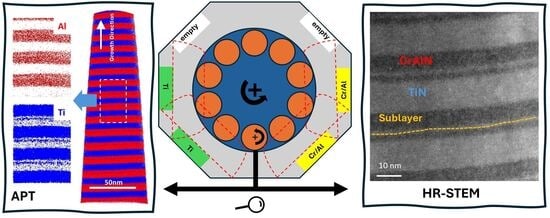
Graphical Abstract

1. Introduction

Since the 1980s, extensive research has focused on multilayer coatings due to their superior properties compared to single-layer coatings [1,2,3]. Combining two different materials can produce hard yet rather tough coatings, offering superior cutting performance [3]. The enhanced hardness of such multilayer coatings can be related to hindered dislocation movement at interfaces [3,4]. In addition, crack deflection at the interfaces facilitates increased toughness [3,4,5,6]. Multilayer architectures are also reported to result in increased thermal stability and oxidation resistance [7,8,9]. However, the extent of all these improvements depends on the interface quality [4,10,11,12]. Thobor et al. [12], Dorri et al. [13,14,15], and Raab et al. [16] observed that enhanced interfacial quality in DC magnetron-sputtered TiN/AlN and CrBx/TiBx, as well as cathodic arc-deposited (Al,Cr)N/(Al,Cr)2O3 multilayer coatings, led to higher hardness values. Multilayer coatings consisting of coherently stacked alternating nanometer-scale layers, known as superlattices, exhibit significantly higher hardness values than their individual constituents [5]. However, Shinn et al. [11] demonstrated that interdiffusion between the individual layers reduces the differences in shear moduli and shear strains, deteriorating the superlattice effect. Multilayers synthesized by cathodic arc deposition (CAD) can be grown by combining alternating targets with different compositions and rotating the substrate carrousel [17] or by employing computer-controlled shutter systems in front of the targets to modulate the material fluxes [18]. Different bilayer periods and layer thicknesses can be achieved by varying the velocity of the substrate rotation or the opening time of the mechanical shutters. While using shutters in front of the respective targets, rather sharp interfaces are typically expected, and different studies have shown that when using substrate rotation, the growing coating is exposed to different fluxes and plasma densities, resulting in a chemically modulated, layered structure—even in single-layer coatings [19,20,21]. Koller et al. [22] speculated that these chemical fluctuations may have a positive effect on the mechanical properties in multilayer coatings, as they form additional interfaces. Panjan et al. [23] reported that substrate rotation significantly influences the stoichiometry of nanolayered TiAlN/CrN coatings deposited using an industrial-scale magnetron sputtering system with planetary substrate rotation. In some cases, the variations were substantial enough to induce the growth of a hexagonal Cr2N phase within the cubic CrN phase. Their study demonstrated that the substrate’s rotation strongly affects the microstructure and consequently the mechanical properties of the coatings [24]. However, while layer formation and periodicity as a result of substrate rotation (velocity) and target arrangement have been investigated in great detail by Panjan et al. [25,26], especially for sputter-deposited multilayer coatings, a detailed study focusing on the local interfacial microstructure and composition of nitride multilayers synthesized by CAD using alternating targets and substrate rotation is lacking in the literature. Thus, TiN/CrAlN multilayer coatings were grown by CAD using alternating targets and 2-fold substrate rotation, and their elemental fluctuation and interface quality were studied at the nm scale using atom probe tomography (APT) and high-resolution scanning transmission electron microscopy (HR-STEM). TiN/CrAlN multilayers were chosen as model coatings due to the absence of peak overlaps in the APT mass spectrum, which ensures elemental and imaging accuracy in APT data analysis [27,28,29].

2. Materials and Methods

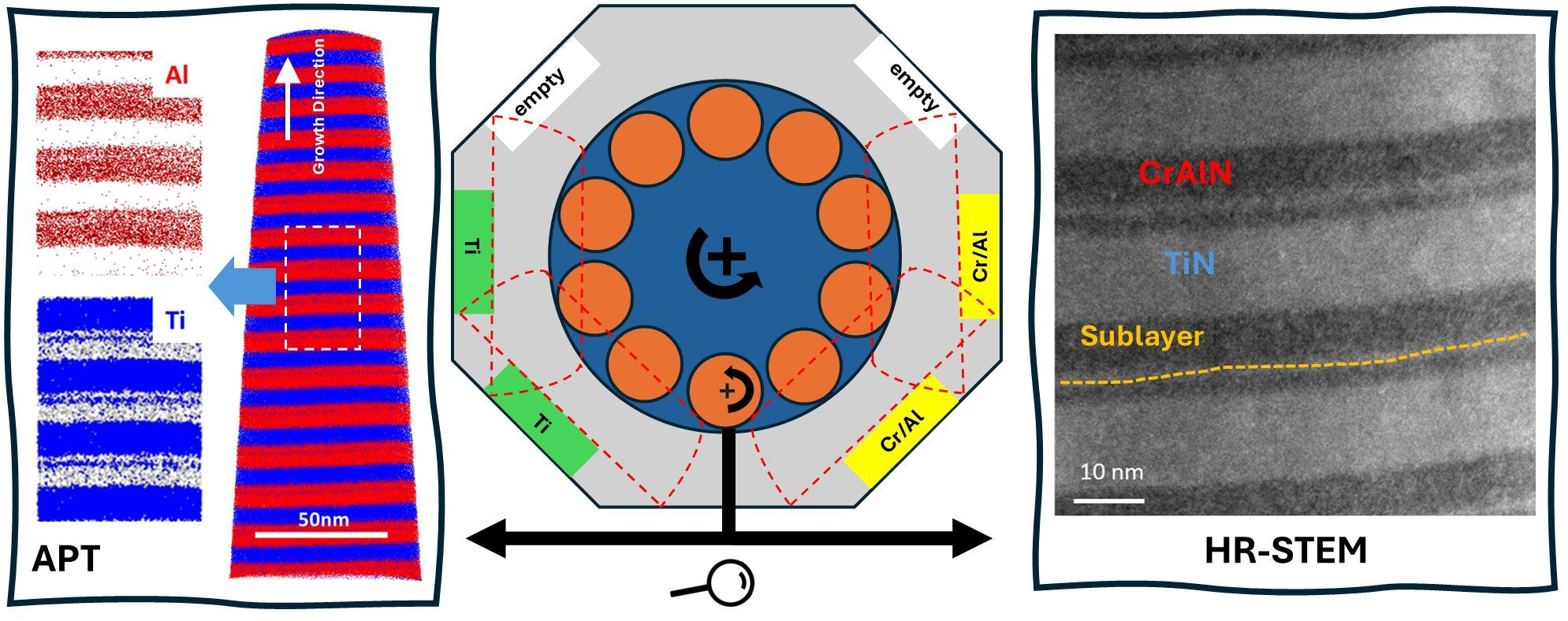
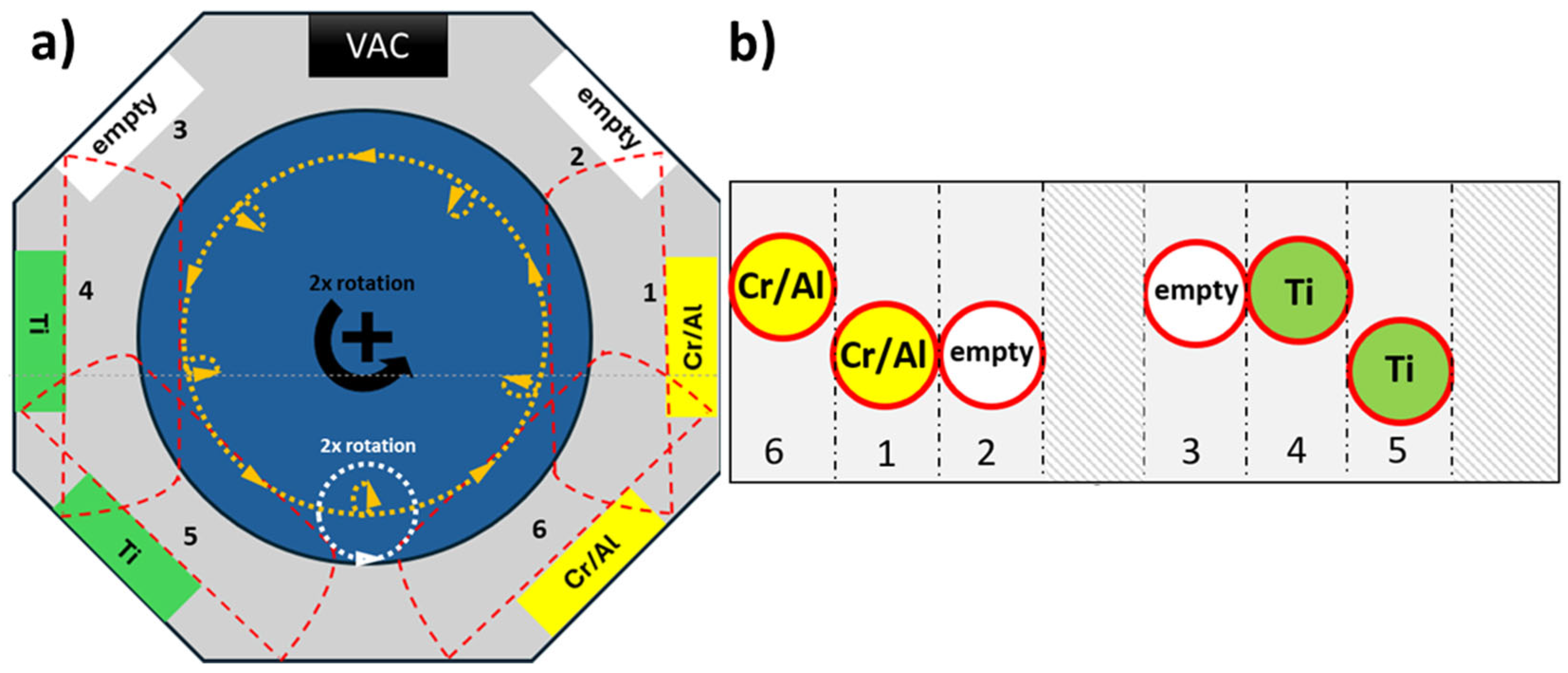
CAD TiN/CrAlN multilayer coatings with a total coating thickness of ~5.3 µm, including a TiN toplayer (~140 nm), were deposited on cemented carbide (92 wt% WC, 6 wt% Co and 2 wt% mixed carbides) and cutting inserts with an SNUN geometry (according to ISO 1832 [30]) in an industrial-scale Oerlikon Balzers Innova deposition system (Oerlikon Balzers Coating AG, Balzers, Liechtenstein) (Figure 1a). The total deposition time for the multilayer coatings was 170 min. Two Ti targets and two Cr/Al compound targets with an atomic ratio of 30/70 were used. The two Ti targets were mounted at source positions 4 and 5, while the two Cr/Al targets were placed at source positions 1 and 6. The arc sources are vertically arranged at two height levels, as indicated in Figure 1b. The coating was deposited in a pure nitrogen atmosphere. The substrate temperature was set to 550 °C, and the bias voltage was set to −40 V. The substrates were mounted on a rotatable sample tower to undergo 2-fold rotation. During deposition, the secondary rotation completes five revolutions for each full revolution of the primary axis, corresponding to a gear ratio of 5:1. The sample tower can hold up to seven substrates. For this study, samples from the top and middle positions were investigated. The top position is slightly above the upper target level. Before deposition, the substrates were etched using an Ar+ ion plasma [31].
The structure of the coatings was examined using a Bruker D8 Advance X-ray diffractometer (Bruker, Billerica, MA, USA) equipped with Cu-Kα radiation using offset coupled θ/2θ scans with an offset of 2° to avoid substrate influence. The diffractograms were captured within a range from 30 to 85° by utilizing a step size of 0.01° and a measurement duration of 1 s per step. A scanning electron microscope (SEM) of the Zeiss Gemini 450 type (Carl Zeiss Microscopy GmbH, Oberkochen, Germany) was used to investigate the coating surface and the microstructure of the coating’s cross-section. The cross-section was prepared by broad ion beam milling, which was conducted via a Hitachi IM4000+ system (Hitachi High-Tech Corporation, Tokyo, Japan). The STEM lamellas were prepared using focused ion beam (FIB) (FEI Nova200, FEI Company, Hillsboro, OR, USA) milling. High-resolution STEM was performed on a probe-corrected FEI Titan 3 G2 60–300 (S/TEM) microscope (FEI Company, Hillsboro, OR, USA) equipped with an X-FEG Schottky field-emission electron source operated at 300 kV with a beam current of 150 pA and a beam diameter of 1 Å. Spectrum imaging was carried out using a FEI Super-X detector (Chemi-STEM technology) comprising four separate silicon drift detectors. The APT specimens were prepared via either the standard lift-out technique [32] or by using a 3D-Micromac microPREP PRO FEMTO laser micromachining system (3D-Micromac AG, Chemnitz, Germany) [33], followed by annular FIB milling using a FEI Versa 3D dual-beam workstation (FEI Company, Hillsboro, OR, USA). The coatings were investigated by laser-assisted APT, utilizing a CAMECA LEAP 3000 XR (CAMECA, Madison, WI, USA) and a LEAP 5000 XR atom probe (CAMECA, Madison, WI, USA) with a green laser (λ = 532 nm) and an ultraviolet laser (λ = 355 nm), respectively. For the measurements with the LEAP 3000 XR probe, a laser pulse energy of 0.2 nJ was employed. The laser pulse frequency, base temperature, and detection rate were set to 250 kHz, 30 K, and 0.5%, respectively. For the measurements using the LEAP 5000 XR probe, the laser pulse energy was reduced to 0.05 nJ to comply with the higher energy density introduced by the UV laser [34,35]. The laser pulse frequency was variable throughout the measurement (200–333 kHz) and automatically adjusted to ensure proper detection up to 80 Da in the mass spectrum, while the base temperature and detection rate were set to 50 K and 1%, respectively. Data analysis was carried out with the IVAS module in the AP Suite 6.3.0 software package. The detection efficiency of LEAP 3000 XR and LEAP 5000 XR are specified as 37 and 52%, respectively. The image compression factor and K factor were set to 1.05 and 3.3, respectively.
The hardness and Young’s modulus of the TiN/CrAlN multilayers were evaluated by nanoindentation using a KLA G200 nanoindenter (KLA Corp., Milpitas, CA, USA) equipped with a diamond Berkovich tip (Synton-MDP, Nidau, Switzerland). A constant indentation strain rate of 0.05 s−1 was applied up to an indentation depth of 500 nm. Continuous stiffness measurements (CSMs) were performed with a 2 nm harmonic displacement at 45 Hz, enabling continuous assessment of Young’s modulus and hardness. The data were evaluated using the Oliver and Pharr method [36]. The reported values were averaged over an indentation depth range of 70–150 nm, in accordance with the 10% rule [37].

3. Results and Discussion

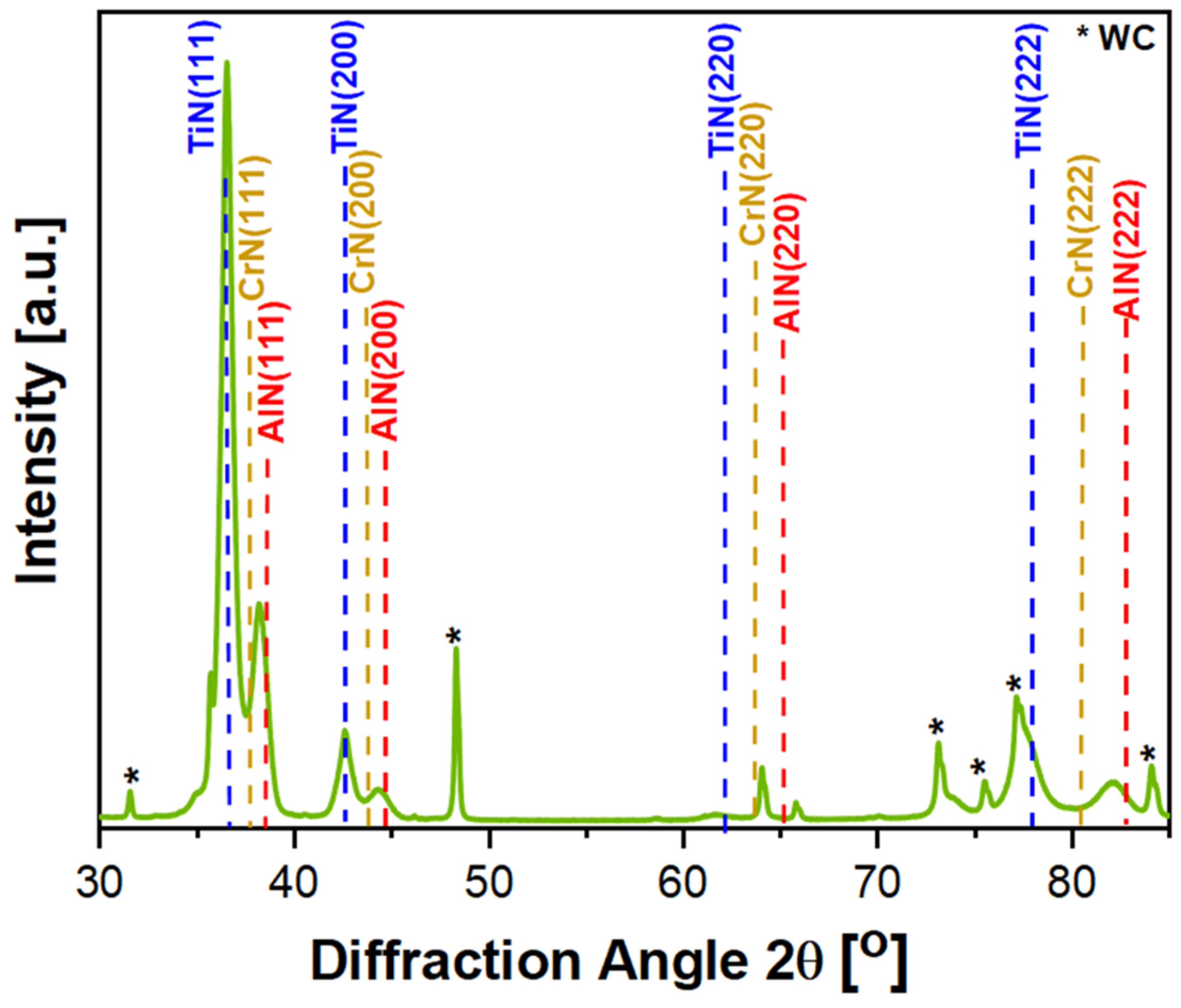
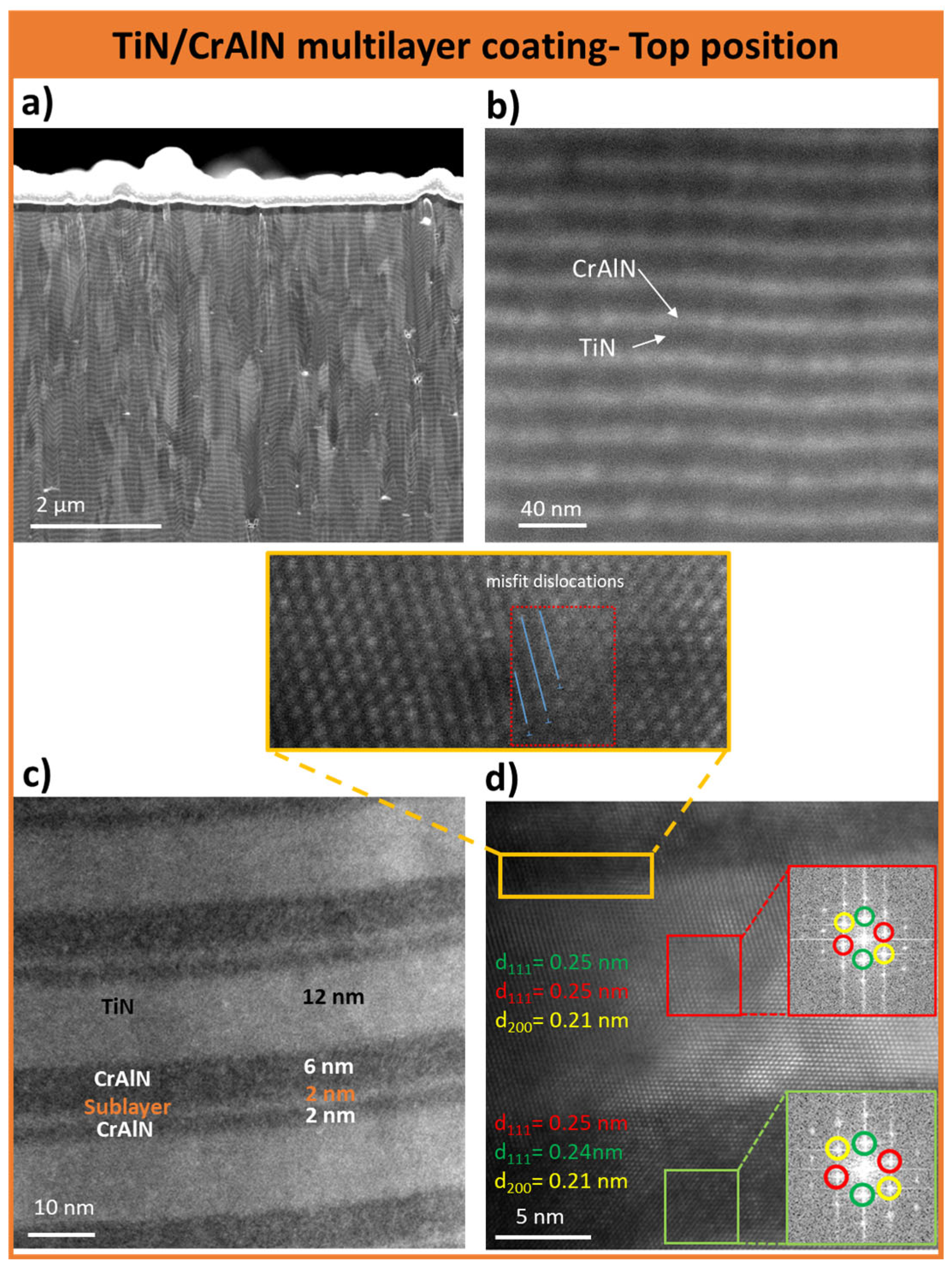
The X-ray diffractogram recorded for the TiN/CrAlN multilayer coating from the top position is shown in Figure 2. Standard peak positions for face-centered cubic (fcc)-AlN (PDF 00-046-1200 [38]), -CrN (PDF 01-076-2494 [38]), and -TiN (PDF 00-038-1420 [38]) are marked by dashed lines. The peak positions of WC (PDF 00-025-1047 [38]) stemming from the substrate are also indicated. The CrAlN peaks are situated between the reference positions of fcc-CrN and fcc-AlN, indicating the formation of an fcc-Cr1−xAlxN solid solution. The TiN layers exhibit a pronounced 111 peak, suggesting a (111) preferred orientation, which can be attributed to the applied bias voltage and consequently improved surface diffusion [39]. A strong dominance of the (111) orientation can also be seen for the Cr1−xAlxN layers. The lower peak intensity of the Cr1−xAlxN phase, compared to the TiN phase, can be attributed to its thinner individual sublayer thickness, as confirmed by HR-STEM investigations in the following section and the presence of a TiN toplayer. As a result, the Cr1−xAlxN layers exhibit lower scattering intensity compared to the TiN layers. The theoretical lattice parameter of Cr1−xAlxNcalculated assuming a Vegard’slike behavior [40] and interpolation between the standard lattice parameters of CrN [38] and AlN [38] that were weighted by Cr and Al atomic fractions obtained from the APT analysis (see the 1D compositional profile of the CrAlN/TiN coating from the top position ), is ~4.08 Å. For stoichiometric TiN, the theoretical lattice parameter is 4.24 Å [38]. Based on Bragg’s law, the d-spacings were calculated from the 2θ angles as dTiN,111= 2.47 Å, dTiN,200= 2.12, dCrAlN,111= 2.35, and dCrAlN,200= 2.04. These correspond to lattice parameters of ~4.07 Å for Cr1−xAlxN and ~4.25 Å for TiN, which is in good agreement with the theoretical values. The slightly lower lattice parameter of Cr1−xAlxN compared to that of TiN can be assumed to induce tensile stresses in Cr1−xAlxN and compressive stresses in the TiN at the very interface. The lattice misfit of ~4.4% between TiN and Cr1−xAlxN (based on measured XRD values) can be accommodated through a strained interface; the formation of misfit dislocations (interfacial defects), as shown in Figure 3d; or a combination of both mechanisms [41]. Lattice misfit and the isostructurality between fcc-TiN and fcc-Cr1−xAlxN [42] suggest that the layers grow semi-coherently on one another. This is further corroborated by the matching preferred orientations.
Cross-sectional SEM and STEM images of the TiN/CrAlN multilayer coating from the top position on the sample tower are displayed in Figure 3. The overview of the SEM image in Figure 3a reveals a dense coating with a periodic layered structure and a columnar microstructure with elongated grains along the growth direction. In the higher magnification in Figure 3b, the TiN and Cr1−xAlxN layers are clearly distinguishable due to their differences in elemental contrast, where the brighter layers correspond to Cr1−xAlxN, while the darker ones correspond to TiN. In Figure 3b, the average thicknesses of the Cr1−xAlxN (~12.6 ± 0.9 nm) and TiN (~10.7 ± 1.1 nm) layers appear roughly comparable and correspond to an average bilayer period of 23.3 nm. The reported standard deviations were determined from measurements of approximately 20 individual layers in the SEM images. The high-angle annular dark-field (HAADF) micrograph in Figure 3c provides further insight into the TiN/CrAlN multilayer coating. The bright layers correspond to TiN, while the darker ones belong to Cr1−xAlxN. With this higher resolution, it becomes obvious that the structure consists of more than just two alternating TiN and Cr1−xAlxN layers and that they are not of equal thickness. Within the Cr1−xAlxN layers, ~2 nm thick brighter (comparable to the TiN layers) sublayers can be observed, which were not visible in the SEM cross-section images. Similar sublayer features have been reported previously by other authors as well [23,26,43]. Accordingly, the microstructure consists of an alternating sequence of TiN (~12 nm) layers and Cr1−xAlxN (~8 nm) layers with a Ti-enriched sublayer (~2 nm) embedded within Cr1−xAlxN. It can be inferred that this sublayer forms when the substrate faces away from the Ti targets and toward the opposite targets (Cr/Al), as seen in Figure 1a. The Ti-enriched region is interpreted as a thin transition layer that is produced when the substrate moves from the plasma of one target to the next, i.e., during the short interval in which residual Ti flux is still present, while the substrate is already entering the Cr/Al deposition sector, as indicated by the white circle in Figure 1a. This interpretation is further supported by the angular plasma distribution: assuming an approximately cosine-like annular flux distribution [44], the plasma density and material flux decrease toward the edge of the target influence region. Hence, the Ti flux reaching the substrate under these conditions is weak, so only a small amount of Ti is incorporated, resulting in the observed ~2 nm Ti-enriched sublayer. The revolution time around the first axis is ~35 s. Considering a gear ratio of 5:1, this corresponds to a revolution time of about 7 s around the second axis. Using the deposition rate derived from the total coating thickness and deposition time, the corresponding sublayer thickness is estimated to be ~3.6 nm, which is in reasonable agreement with the TEM observations.
These findings are in agreement with observations by Hans et al. [20], who reported compositional modulation induced by substrate rotation in cathodic arc evaporated TiAlON coatings, and Panjan et al. [23,26], who observed the formation of intermediate layers induced by substrate rotation in sputter-deposited TiAlN/CrN multilayer coatings. To evaluate interface quality, the interface was studied in more detail using HR-STEM investigations. The high-resolution image shown in Figure 3d reveals that the interfaces between the individual layers exhibit slight roughness and are not atomically sharp. This slight roughness may arise from the arrangement of the deposition targets, which can influence the degree of intermixing between layers [25]. However, it should be noted that electron beam spreading and dechanneling within the specimen can affect the background intensity in HAADF-STEM images, potentially causing atomically sharp interfaces to appear diffuse [45]. Fast Fourier transformations (FFTs) performed in the two different layers in Figure 3d confirm the presence of fcc-TiN and fcc-Cr1−xAlxN with their corresponding (111) and (200) d-spacings. The average lattice parameters were determined to be ~4.18 ± 0.02 for Cr1−xAlxN and ~4.27 ± 0.07 Å for TiN, which differs from those obtained from XRD data. This discrepancy can be attributed to the localized nature of HR-STEM/FFT measurements, which analyzed a very small volume that may be affected by local strain fields and lattice distortions [46]. In contrast, XRD yields a volume-averaged lattice parameter.
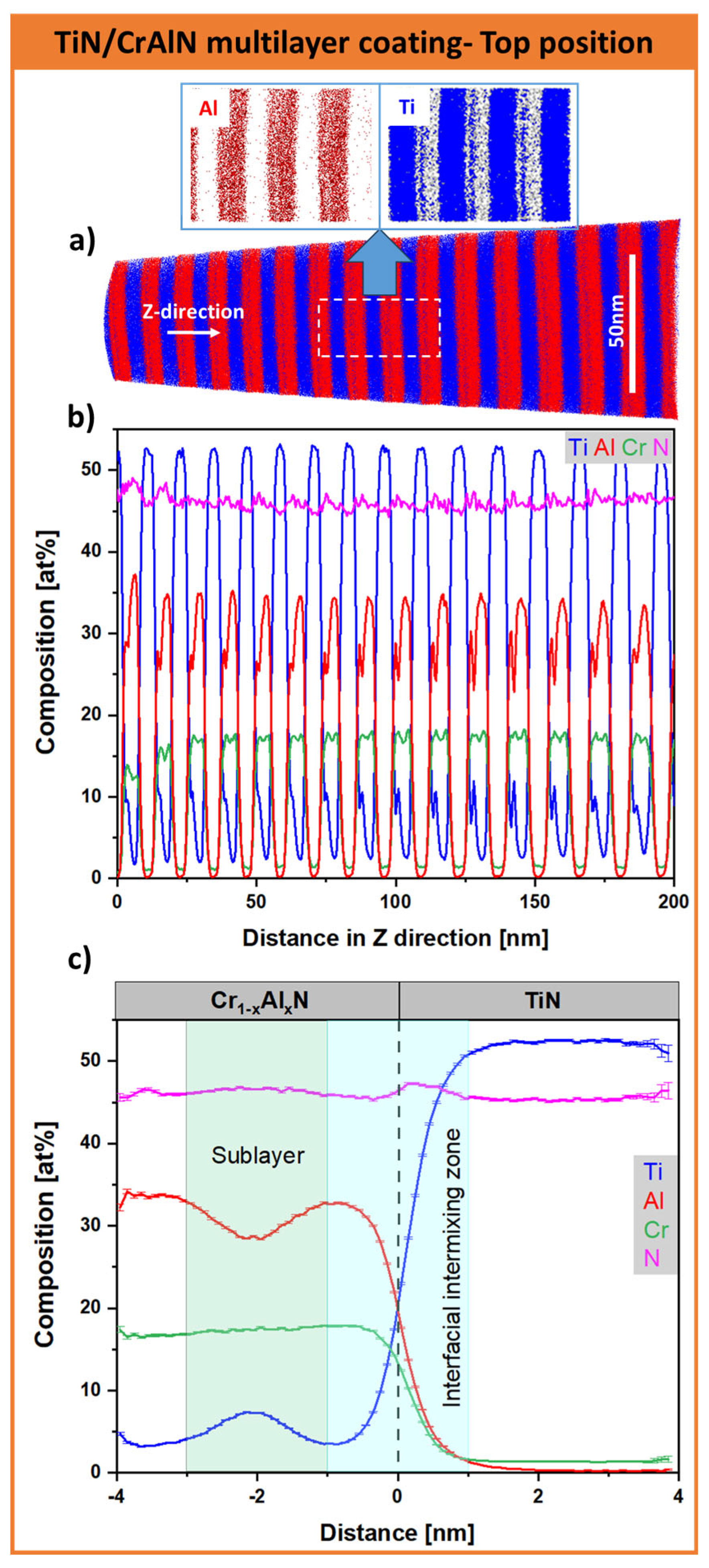
To obtain more information on the elemental composition of the sublayer and the local elemental distribution at the interfaces, APT measurements were conducted. The mass spectra of the TiN/CrAlN coating containing ∼20 million ions can be found in Figure S1 in the Supplementary Materials. In Figure 4a,b, the 3D reconstruction and the corresponding 1D compositional profile of the APT data of the TiN/CrAlN coating from the top position are shown. Alternating TiN and Cr1−xAlxN layers are evident in Figure 4a. The Ti-enriched sublayers within the Cr1−xAlxN layers are clearly visible in the magnified view in Figure 4a, consistent with HR-STEM observations. Based on the voltage curve in Figure S2 (Supplementary Materials), no noticeable voltage fluctuations are observed. Since TiN and CrAlN are expected to exhibit similar field evaporation strengths [27], potential APT reconstruction artifacts due to field evaporation variations are likely reduced [28], thereby enhancing the accuracy of the compositional analysis. The 1D compositional profile displayed in Figure 4b further corroborates the presence of a thin sublayer within the Cr1−xAlxN layer. Figure 4c shows a proximity histogram, which was calculated using an isoconcentration surface of 21 at% Ti; this value was selected to visualize the clear separation between the TiN and CrAlN layers in the APT reconstruction. Thus, it can be seen that the sublayer is characterized by reduced Al content accompanied by an increase in Ti, while the Cr content stays roughly constant. In contrast to the proximity histogram, the 1D compositional profile indicates a slight increase in Cr content within the sublayers. This discrepancy may arise due to the fact that the 1D concentration profile does not account for the curvature of the interface, which can lead to inaccurate statistics [29,47], and consequently errors in the estimated composition. A slight increase in the nitrogen content (~2 at%) is observed at the CrAlN-to-TiN interface, followed by a return to the average nitrogen level after the interface. Several studies have reported that quantifying N by means of APT is challenging due to multiple detection events and dissociation of N-containing molecular ions [48,49,50,51,52]; thus, this might be a measurement artifact. From the proximity histogram, a sublayer thickness of ~2 nm can be estimated, which agrees well with the HR-STEM image shown in Figure 3c. A qualitative estimate of the interface width of ~2 nm can be inferred from the proximity histogram in Figure 4c, indicating intermixing of elements at the interface and confirming that the interface is not atomically sharp but exhibits minor roughness as a result of the target configuration [25]. For a quantitative evaluation, the interface width was determined from the APT proximity histogram using the 10%–90% composition-change criterion, yielding a value of 0.83 ± 0.02 nm [53]. The reported standard deviation was obtained from three repeated evaluations of the same interface, each carried out using the 10%–90% composition-change criterion. HR-STEM results (Figure 3d) qualitatively support the presence of such a nm-scale transition region. It should be noted, however, that the interface width value is derived from the APT proximity histogram, whereas HR-STEM is only used as complementary evidence because image contrast alone does not allow for a quantitative determination of the compositional interface width.
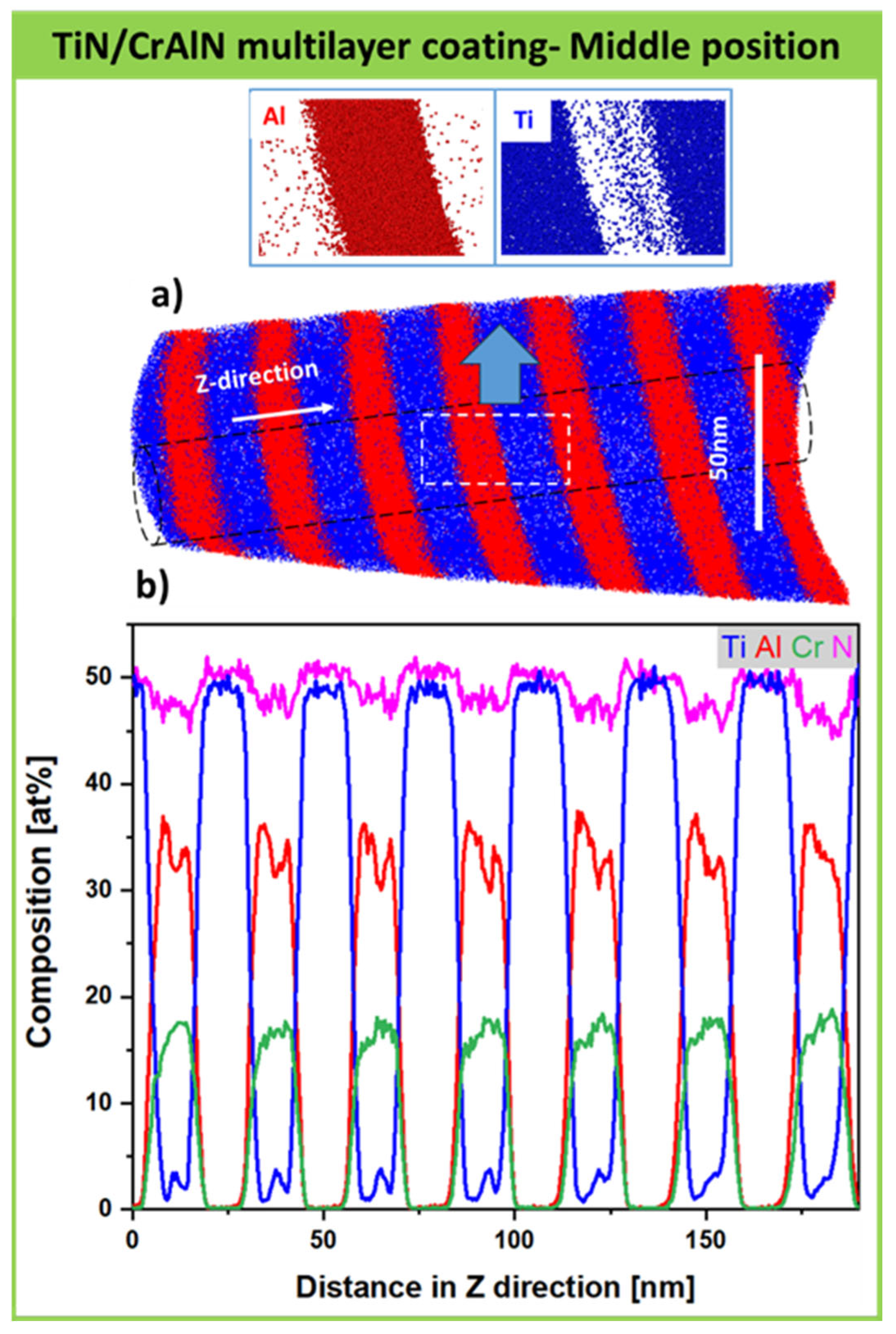
Analogous to the TiN/CrAlN coating from the top position, the 3D reconstruction of the TiN/CrAlN coating from the middle position, as depicted in Figure 5a, shows Ti-enriched sublayers within the Cr1−xAlxN layers. The 1D compositional profile shown in Figure 5b, corresponding to the ROI marked in the 3D reconstruction in Figure 5a, further corroborates that the sublayer also exhibits reduced Al content and increased Ti content. The reduced Al content in the sublayer can be attributed to preferential scattering of the lighter Al in the gas phase [54,55,56]. In addition, studies on CAD have shown that the effective sticking coefficient decreases at higher ion incidence angles, while self-sputtering on the substrate surface becomes more efficient under these conditions [21,57,58,59]. Therefore, a second contributing factor to Al depletion in the sublayer may be the re-sputtering of the lighter Al adatoms from the growing surface by energetic Ti and Cr ions, which occurs due to their low sticking probability at high incidence angles. Furthermore, the elevated Ti content in the sublayer can be explained by substrate rotation, during which the surface is alternately oriented away from the Ti targets and exposed to the opposing Cr/Al targets, as mentioned previously. The 1D compositional profiles in Figure 4b and Figure 5b show that the sublayer appears within all Cr1−xAlxN layers, and the positional difference results in no discernible effect in the layer sequence. With the chosen gear ratio and target arrangement, both positions experience very similar deposition conditions during each rotation cycle. As a result, the layer architecture is not noticeably affected by the top-to-middle positional difference. While Panjan et al. [23,26] report more asymmetric layer sequences in the 2-fold rotation of sputtered TiAlN/CrNx, they also explain that the layer sequence is a result of the gear ratio between the turntable and the sample tower. In the present study, it seems that the substrate trajectory repeats in each rotational cycle, with a gear ratio of 5:1, leading to the continuous formation of sublayers throughout the entire coating thickness. The absence of a sublayer in the TiN layers can be explained by the target arrangement. When the substrate leaves the Cr/Al plasma, it passes through an empty sector before reaching the Ti target, so no plasma overlap region is formed. Thus, in contrast to the Ti-to-Cr/Al transition, no equivalent residual flux overlap that could result in a distinct Cr/Al-enriched sublayer within TiN is present.
The mechanical properties of the coatings were evaluated by nanoindentation. For the coating deposited at the top position, the measured hardness and Young’s modulus were 32.34 ± 1.68 GPa and 319.15 ± 8.26 GPa, respectively. For the coating deposited at the middle position, the corresponding values were 33.08 ± 2.08 GPa and 339.78 ± 14.70 GPa, respectively. Thus, the values only differ within the standard deviation. Chen et al. [60] reported hardness values of ~27.3 GPa and 23.0–24.3 GPa, respectively, for monolithic CAD CrAlN and TiN coatings and a value of 30.3 GPa for CrAlN/TiN multilayer coatings. They attributed the higher hardness of the multilayer coatings compared to the monolithic coatings to the superlattice architecture of the (semi-)coherent interfaces [22]. The multilayer coating exhibited TiN- and CrAlN-layer thicknesses of 2 nm and 7 nm, respectively, and no sublayer formation was observed. The hardness values obtained in the present study are slightly higher, suggesting that the formation of sublayers may further enhance the hardness of the multilayer coating by providing further interfaces [22].

4. Conclusions

Within the present study, the layer sequence, elemental fluctuation and interface quality of the TiN/CrAlN multilayer coatings synthesized using cathodic arc deposition and 2-fold substrate rotation were investigated using high-resolution methods. A lattice misfit of 4.4% between the TiN and Cr1−xAlxN layers and a matching preferred orientation was obtained from X-ray diffraction, indicating semi-coherent growth of the layers, which was corroborated by transmission electron microscopy investigations. Transmission electron microscopy investigations of the interfacial structure evidenced that the interfaces between the TiN and Cr1−xAlxN layers exhibit minor roughness and are not atomically sharp. The atom probe tomography compositional profile further confirmed minor elemental intermixing at the very interface. Both transmission electron microscopy and atom probe tomography revealed the formation of a Ti-enriched sublayer within the Cr1−xAlxN layers in both coatings when taken from different vertical heights of the sample tower, indicating that the positional difference does not result in a distinct change in the layer sequence. Sublayer formation can be attributed to the 2-fold substrate rotation during deposition. During this process, the substrate periodically passes positions where it faces away from the Ti targets and toward the opposite targets (Cr/Al). The results demonstrate that, even in an industrial-scale deposition system operated without shutters, multilayers grown using 2-fold substrate rotation exhibit rather well-defined interfaces, with interface roughness in the range of only 1–2 nm. In addition, the hardness values obtained in the present study are slightly higher than those reported in the literature for comparable TiN/CrAlN multilayer coatings without a sublayer, suggesting that the presence of sublayers may contribute to additional strengthening of the multilayer system. The present study is of high industrial relevance, as the multilayer was deposited in an industrial-scale system and represents layer thickness regimes relevant for applications. For future work, a more quantitative analysis of the deposition kinematics and angular flux distribution would be valuable to describe the origin of the Ti-enriched sublayer in more detail.

Supplementary Materials

The following supporting information can be downloaded at: https://www.mdpi.com/article/10.3390/coatings16040438/s1, Figure S1: The assigned mass spectrum of the TiN/CrAlN multilayer coating; Figure S2: Voltage history of the TiN/CrAlN multilayer coating from the top position of the sample tower.

Author Contributions

Conceptualization, S.N.; methodology, S.N. and H.W.; validation, S.N.; formal analysis, S.N.; investigation, S.N. and H.W. and M.S.; resources, C.C. and M.P.; writing—original draft preparation, S.N.; writing—review and editing, N.S. and M.T.; visualization, S.N.; supervision, N.S.; project administration, N.S.; funding acquisition, N.S. and C.C. and M.P. All authors have read and agreed to the published version of the manuscript.

Funding

Financial support by the Austrian Federal Ministry of Labour and Economy; the National Foundation for Research, Technology and Development; and the Christian Doppler Research Association is gratefully acknowledged. Further, we thank the Austrian Research Promotion Agency (FFG) for their help with the framework of the SEC3T project (grant number: 896446).

Institutional Review Board Statement

Not applicable.

Informed Consent Statement

Not applicable.

Data Availability Statement

Data are available upon request due to restrictions (e.g., privacy, legal or ethical reasons).

Acknowledgments

The authors thank Bernhard Sartory from Materials Center Leoben for SEM/FIB work. During the preparation of this work, the authors used ChatGPT (openai.com, GPT-5.3) in order to enhance clarity and readability. After using this tool/service, the authors reviewed and edited the content as needed and take full responsibility for the content of the publication.

Conflicts of Interest

Authors Markus Pohler and Christoph Czettl were employed by the company CERATIZIT Austria GmbH. The remaining authors declare that the research was conducted in the absence of any commercial or financial relationships that could be construed as a potential conflict of interest.

References

  1. Cheng, W.; Wang, J.; Ma, X.; Liu, P.; Liaw, P.K.; Li, W. A review on microstructures and mechanical properties of protective nano-multilayered films or coatings. J. Mater. Res. Technol. 2023, 27, 2413–2442. [Google Scholar] [CrossRef]
  2. Liu, Y.; Yu, S.; Shi, Q.; Ge, X.; Wang, W. Multilayer Coatings for Tribology: A Mini Review. J. Nanomater. 2022, 12, 1388. [Google Scholar] [CrossRef]
  3. Wang, Y.X.; Zhang, S. Toward hard yet tough ceramic coatings. Surf. Coat. Technol. 2014, 258, 1–16. [Google Scholar] [CrossRef]
  4. Kainz, C.; Schalk, N.; Tkadletz, M.; Mitterer, C.; Czettl, C. Microstructure and mechanical properties of CVD TiN/TiBN multilayer coatings. Surf. Coat. Technol. 2019, 370, 311–319. [Google Scholar] [CrossRef]
  5. Hahn, R.; Bartosik, M.; Soler, R.; Kirchlechner, C.; Dehm, G.; Mayrhofer, P.H. Superlattice effect for enhanced fracture toughness of hard coatings. Scr. Mater. 2016, 124, 67–70. [Google Scholar] [CrossRef]
  6. Kutlesa, K.; Keckes, J.; Daniel, R.; Zitek, M.; Tkadletz, M.; Schiester, M.; Ziegelwanger, T.; Lassnig, A.; Burghammer, M.; Meindlhumer, M. Crack arrest in nanoceramic multilayers via precipitation-controlled sublayer design. Mater. Des. 2025, 255, 114159. [Google Scholar] [CrossRef]
  7. Riedl, H.; Koller, C.M.; Limbeck, A.; Kalaš, J.; Polcik, P.; Mayrhofer, P.H. Oxidation behavior and tribological properties of multilayered Ti-Al-N/Mo-Si-B thin films. J. Vac. Sci. Technol. A 2015, 33, 05E129. [Google Scholar] [CrossRef]
  8. Koller, C.M.; Glatz, S.A.; Kolozsvári, S.; Bolvardi, H.; Mayrhofer, P.H. Thermal stability and oxidation resistance of archi-tecturally designed Ti–Al–N- and Ti–Al–Ta–N-based multilayers. Surf. Coat. Technol. 2020, 385, 125444. [Google Scholar] [CrossRef]
  9. Koller, C.M.; Hollerweger, R.; Sabitzer, C.; Rachbauer, R.; Kolozsvári, S.; Paulitsch, J.; Mayrhofer, P.H. Thermal stability and oxidation resistance of arc evaporated TiAlN, TaAlN, TiAlTaN, and TiAlN/TaAlN coatings. Surf. Coat. Technol. 2014, 259, 599–607. [Google Scholar] [CrossRef]
  10. Barshilia, H.C.; Prakash, M.S.; Poojari, A.; Rajam, K.S. Corrosion behavior of nanolayered TiN/NbN multilayer coatings prepared by reactive direct current magnetron sputtering process. Thin Solid Film 2004, 460, 133. [Google Scholar] [CrossRef]
  11. Shinn, M.; Hultman, L.; Barnett, S.A. Growth, structure, and microhardness of epitaxial TiN/NbN superlattices. J. Mater. Res. 1992, 7, 901–911. [Google Scholar] [CrossRef]
  12. Thobor, A.; Rousselot, C.; Clement, C.; Takadoum, J.; Martin, N.; Sanjines, R.; Levy, F. Enhancement of mechanical properties of TiN/AlN multilayers by modifying the number and the quality of interfaces. Surf. Coat. Technol. 2000, 124, 210–221. [Google Scholar] [CrossRef]
  13. Dorri, S.; Ghafoor, N.; Palisaitis, J.; Stendahl, S.; Devishvili, A.; Vorobiev, A.; Eriksson, F.; Persson, P.O.Å.; Birch, J. Enhanced quality of single crystal CrBx/TiBy diboride superlattices by controlling boron stoichiometry during sputter deposition. Appl. Surf. Sci. 2024, 655, 159606. [Google Scholar] [CrossRef]
  14. Dorri, S.; Birch, J.; Eriksson, F.; Palisaitis, J.; Persson, P.O.Å.; Bakhit, B.; Hultman, L.; Ghafoor, N. Effects of stoichiometry and individual layer thickness ratio on the quality of epitaxial CrBx/TiBy superlattice thin films. Mater. Des. 2023, 228, 111842. [Google Scholar] [CrossRef]
  15. Greczynski, G.; Broekhuijsen, S.; Ghafoor, N.; Schell, N.; Eriksson, F.; Birch, J. Morphology control in Ni/Ti multilayer neutron mirrors by ion-assisted interface engineering and B4C incorporation. Opt. Mater. Express 2023, 13, 1424–1439. [Google Scholar] [CrossRef]
  16. Raab, R.; Koller, C.M.; Kolozsvári, S.; Ramm, J.; Mayrhofer, P.H. Interfaces in arc evaporated Al-Cr-N/Al-Cr-O multi-layers and their impact on hardness. Surf. Coat. Technol. 2017, 324, 236–242. [Google Scholar] [CrossRef]
  17. Frank, F.; Kainz, C.; Tkadletz, M.; Czettl, C.; Pohler, M.; Schalk, N. Microstructural and micro-mechanical investigation of cathodic arc evaporated ZrN/TiN multilayer coatings with varying bilayer thickness. Surf. Coat. Technol. 2022, 432, 128070. [Google Scholar] [CrossRef]
  18. Vladescu, A.; Braic, V.; Braic, M.; Balaceanu, M. Arc plasma deposition of TiSiN/Ni nanoscale multilayered coatings. Mater. Chem. Phys. 2013, 138, 500–506. [Google Scholar] [CrossRef]
  19. Tang, J.F.; Huang, C.H.; Lin, C.Y.; Yang, F.C.; Chang, C.L. Effects of Substrate Rotation Speed on Structure and Adhesion Properties of CrN/CrAlSiN Multilayer Coatings Prepared Using High-Power Impulse Magnetron Sputtering. Coatings 2020, 10, 742. [Google Scholar] [CrossRef]
  20. Hans, M.; Baben, M.T.; Chen, Y.-T.; Pradeep, K.G.; Holzapfel, D.M.; Primetzhofer, D.; Kurapov, D.; Ramm, J.; Arndt, M.; Rudigier, H.; et al. Substrate rotation-induced chemical modulation in Ti-Al-O-N coatings synthesized by ca-thodic arc in an industrial deposition plant. Surf. Coat. Technol. 2016, 305, 249–253. [Google Scholar] [CrossRef]
  21. Eriksson, A.O.; Zhu, J.Q.; Ghafoor, N.; Johansson, M.P.; Sjölen, J.; Jensen, J.; Odén, M.; Hultman, L.; Rosén, J. Layer for-mation by resputtering in Ti-Si-C hard coatings during large scale cathodic arc deposition. Surf. Coat. Technol. 2011, 205, 3923–3930. [Google Scholar] [CrossRef]
  22. Koller, C.M.; Glatz, S.A.; Riedl, H.; Kolozsvári, S.; Polcik, P.; Bolvardi, H.; Mayrhofer, P.H. Structure and mechanical prope- rties of architecturally designed Ti-Al-N and Ti-Al-Ta-N-based multilayers. Surf. Coat. Technol. 2020, 385, 125355. [Google Scholar] [CrossRef]
  23. Panjan, M.; Šturm, S.; Panjan, P.; Čekada, M. The influence of rotation during sputtering on the stoichiometry of TiAlN/CrNx multilayer coating. Surf. Coat. Technol. 2008, 203, 554–557. [Google Scholar] [CrossRef]
  24. Panjan, M.; Čekada, M.; Panjan, P.; Zupanič, F.; Kölker, W. Dependence of microstructure and hardness of TiAlN/VN hard coatings on the type of substrate rotation. Vacuum 2012, 86, 699–702. [Google Scholar] [CrossRef]
  25. Panjan, M. Influence of substrate rotation and target arrangement on the periodicity and uniformity of layered coatings. Surf. Coat. Technol. 2013, 235, 32–44. [Google Scholar] [CrossRef]
  26. Panjan, M.; Peterman, T.; Čekada, M.; Panjan, P. Simulation of a multilayer structure in coatings prepared by magnetron sputtering. Surf. Coat. Technol. 2009, 204, 850–853. [Google Scholar] [CrossRef]
  27. Tsong, T.T. Field ion image formation. Surf. Sci. 1978, 70, 211–233. [Google Scholar] [CrossRef]
  28. Brons, J.G.; Herzing, A.A.; Henry, K.T.; Anderson, I.M.; Thompson, G.B. Comparison of atom probe compositional fidelity across thin film interfaces. Thin Solid Films 2014, 551, 61–67. [Google Scholar] [CrossRef]
  29. Naghdali, S.; Schiester, M.; Waldl, H.; Terziyska, V.; Hans, M.; Primetzhofer, D.; Schalk, N.; Tkadletz, M. Improving the elemental and imaging accuracy in atom probe tomography of (Ti,Si)N single and multilayer coatings using isotopic substitution of N. Ultramicroscopy 2025, 276, 114200. [Google Scholar] [CrossRef] [PubMed]
  30. ISO 1832:2017; Indexable Inserts for Cutting Tools—Designation. International Organization for Standardization (ISO): Geneva, Switzerland, 2017. Available online: https://standards.iteh.ai/catalog/standards/iso/af10a357- (accessed on 30 October 2024).
  31. Sun, J.; Yu, Y.; Tang, J.; Zeng, Y.; Chen, J. Plasma Cleaning Technology: Mechanisms, Influencing Factors, and Applications. IEEE Access 2025, 13, 37221–37242. [Google Scholar] [CrossRef]
  32. Thompson, K.; Lawrence, D.; Larson, D.J.; Olson, J.D.; Kelly, T.F.; Gorman, B. In situ site-specific specimen preparation for atom probe tomography. Ultramicroscopy 2007, 107, 131–139. [Google Scholar] [CrossRef] [PubMed]
  33. Tkadletz, M.; Waldl, H.; Schiester, M.; Lechner, A.; Schusser, G.; Krause, M.; Schalk, N. Efficient preparation of microtip arrays for atom probe tomography using fs-laser processing. Ultramicroscopy 2023, 246, 113672. [Google Scholar] [CrossRef]
  34. Martin, T.L.; London, A.J.; Jenkins, B.; Hopkin, S.E.; Douglas, J.O.; Styman, P.D.; Bagot, P.A.J.; Moody, M.P. Comparing the consistency of atom probe tomography measurements of small-scale segregation and clustering between the LEAP 3000 and LEAP 5000 instruments. Microsc. Microanal. 2017, 23, 227–237. [Google Scholar] [CrossRef] [PubMed]
  35. Schiester, M.; Waldl, H.; Rice, K.P.; Hans, M.; Primetzhofer, D.; Schalk, N.; Tkadletz, M. Effects of laser wavelength and pulse energy on the evaporation behavior of TiN coatings in atom probe tomography: A multi-instrument study. Ultramicroscopy 2025, 270, 114105. [Google Scholar] [CrossRef]
  36. Oliver, W.C.; Pharr, G.M. An improved technique for determining hardness and elastic modulus using load and displacement sensing indentation experiments. J. Mater. Res. 1992, 7, 1564–1583. [Google Scholar] [CrossRef]
  37. Zak, S.; Trost, C.O.W.; Kreiml, P.; Cordill, M.J. Accurate measurement of thin film mechanical properties using nanoindentation. J. Mater. Res. 2022, 37, 1373–1389. [Google Scholar] [CrossRef]
  38. Gates-Rector, S.; Blanton, T. The Powder Diffraction File: A quality materials characterization database. Powder Diffr. 2019, 34, 352–360. [Google Scholar] [CrossRef]
  39. Abadias, G.; Tse, Y.Y.; Guérin, P.; Pelosin, V. Interdependence between stress, preferred orientation, and surface morphology of nanocrystalline TiN thin films deposited by dual ion beam sputtering. J. Appl. Phys. 2006, 99, 113519. [Google Scholar] [CrossRef]
  40. Vegard, L. The constitution of mixed crystal and the space occupied by atom. Z. Phys. 1921, 5, 17–26. [Google Scholar] [CrossRef]
  41. Frank, F.; Tkadletz, M.; Saringer, C.; Czettl, C.; Pohler, M.; Burghammer, M.; Todt, J.; Zalesak, J.; Keckes, J.; Schalk, N. Investigation of the microstructure of a graded ZrN/Ti0.33Al0.67N multilayer coating using cross-sectional characterization methods. Surf. Coat. Technol. 2023, 453, 129126. [Google Scholar] [CrossRef]
  42. Okumiya, M.; Griepentrog, M. Mechanical properties and tribological behavior of TiN–CrAlN and CrN–CrAlN multilayer coatings. Surf. Coat. Technol. 1999, 112, 123–128. [Google Scholar] [CrossRef]
  43. Panjan, M.; Čekada, M.; Panjan, P.; Zalar, A.; Peterman, T. Sputtering simulation of multilayer coatings in industrial PVD system with three-fold rotation. Vacuum 2007, 82, 158–161. [Google Scholar] [CrossRef]
  44. Kim, C.G.; Lee, W.J. An angular distribution function for the sputter-depositing atoms and general equations describing the initial thickness profile of a thin film deposited inside a via and trench by sputtering. Thin Solid Films 2010, 519, 74–80. [Google Scholar] [CrossRef]
  45. Bashir, A.; Gallacher, K.; Millar, R.W.; Paul, D.J.; Ballabio, A.; Frigerio, J.; Isella, G.; Kriegner, D.; Ortolani, M.; Barthel, J.; et al. Interfacial sharpness and intermixing in a Ge-SiGe multiple quantum well structure. J. Appl. Phys. 2018, 123, 035703. [Google Scholar] [CrossRef]
  46. Cherkashin, N.; Louiset, A.; Chmielewski, A.; Kim, D.J.; Dubourdieu, C.; Schamm-Chardon, S. Quantitative mapping of strain and displacement fields over HR-TEM and HR-STEM images of crystals with reference to a virtual lattice. Ultramicroscopy 2023, 253, 113778. [Google Scholar] [CrossRef]
  47. Bachmaier, A.; Aboulfadl, H.; Pfaff, M.; Mücklich, F.; Motz, C. Structural evolution and strain induced mixing in Cu–Co composites studied by transmission electron microscopy and atom probe tomography. Mater. Charact. 2015, 100, 178–191. [Google Scholar] [CrossRef] [PubMed]
  48. Waldl, H.; Hans, M.; Schiester, M.; Primetzhofer, D.; Burtscher, M.; Schalk, N.; Tkadletz, M. Decomposition of CrN induced by laser-assisted atom probe tomography. Ultramicroscopy 2023, 246, 113673. [Google Scholar] [CrossRef] [PubMed]
  49. Hans, M.; Schneider, J.M. On the chemical composition of TiAlN thin films—Comparison of ion beam analysis and laser-assisted atom probe tomography with varying laser pulse energy. Thin Solid Film 2019, 688, 137251. [Google Scholar] [CrossRef]
  50. Gault, B.; Saxey, D.W.; Ashton, M.W.; Sinnott, S.B.; Chiaramonti, A.N.; Moody, M.P.; Schreiber, D.K. Behavior of molecules and molecular ions near a field emitter*. New J. Phys. 2016, 18, 033031. [Google Scholar] [CrossRef]
  51. Hans, M.; Schneider, J.M. Electric field strength-dependent accuracy of TiAlN thin film composition measurements by laser-assisted atom probe tomography. New J. Phys. 2020, 22, 33036. [Google Scholar] [CrossRef]
  52. Schiester, M.; Waldl, H.; Hans, M.; Thuvander, M.; Primetzhofer, D.; Schalk, N.; Tkadletz, M. Influence of multiple detection events on compositional accuracy of TiN coatings in atom probe tomography. Surf. Coat. Technol. 2024, 477, 130318. [Google Scholar] [CrossRef]
  53. Keutgen, J.; London, A.J.; Cojocaru-Mirédin, O. Solving Peak Overlaps for Proximity Histogram Analysis of Complex Interfaces for Atom Probe Tomography Data. Microsc. Microanal. 2021, 27, 28–35. [Google Scholar] [CrossRef]
  54. Lorenz, R.; O’Sullivan, M.; Sprenger, D.; Lang, B.; Mitterer, C. Chemical composition and properties of MoAl thin films deposited by sputtering from MoAl compound targets. J. Vac. Sci. Technol. A 2017, 35, 04150. [Google Scholar] [CrossRef]
  55. Grančič, B.; Pleva, M.; Mikula, M.; Čaplovičová, M.; Satrapinskyy, L.; Roch, T.; Truchlý, M.; Sahul, M.; Gregor, M.; Švec, P.; et al. Stoichiometry, structure and mechanical properties of co-sputtered Ti1−xTaxB2±Δ coatings. Surf. Coat. Technol. 2019, 367, 341–348. [Google Scholar] [CrossRef]
  56. Hollerweger, R.; Zhou, L.; Holec, D.; Koller, C.M.; Rachbauer, R.; Polcik, P.; Mayrhofer, P.H. Controlling microstructure, preferred orientation, and mechanical properties of Cr-Al-N by bombardment and alloying with Ta. J. Appl. Phys. 2016, 119, 065304. [Google Scholar] [CrossRef]
  57. Shaginyan, L.R.; Mišina, M.; Kadlec, S.; Jastrabı, L.; Macková, A.; Peřina, V. Mechanism of the film composition formation during magnetron sputtering of WTi. J. Vac. Sci. Technol. A 2001, 19, 2554–2566. [Google Scholar] [CrossRef]
  58. Neidhardt, J.; Mráz, S.; Schneider, J.M.; Strub, E.; Bohne, W.; Liedke, B.; Möller, W.; Mitterer, C. Experiment and simulation of the compositional evolution of Ti-B thin films deposited by sputtering of a compound target. J. Appl. Phys. 2008, 104, 063304. [Google Scholar] [CrossRef]
  59. Wu, H.; Anders, A. Energetic deposition of metal ions: Observation of self-sputtering and limited sticking for off-normal angles of incidence. J. Phys. D Appl. Phys. 2010, 43, 065206. [Google Scholar] [CrossRef]
  60. Chen, L.; Xu, Y.X.; Zhang, L.J. Influence of TiN and ZrN insertion layers on the microstructure, mechanical and thermal properties of Cr–Al–N coatings. Surf. Coat. Technol. 2016, 285, 146–152. [Google Scholar] [CrossRef]
Figure 1. (a) Top-view schematic representation of the deposition system. Red lines indicate the plasma distribution, while orange lines indicate the trajectory of the substrate. (b) Cross-section schematic of the deposition chamber, illustrating the vertically mounted targets at two height levels.
Coatings 16 00438 g001
Figure 2. X-ray diffractogram of the TiN/CrAlN multilayer coating from the top position on the sample tower.
Coatings 16 00438 g002
Figure 3. SEM: (a) cross-section overview and (b) higher-magnification image of the TiN/CrAlN multilayer from the top position of the sample tower. HR-STEM: (c) HAADF image showing the layer sequence including the sublayer and (d) high-resolution HAADF image including two interfaces; the corresponding fast Fourier transformations (FFTs), providing structural information of both layers; and the inverse FFT of the ROI marked by the orange box, highlighting the formation of misfit dislocations.
Coatings 16 00438 g003
Figure 4. (a) 3D reconstruction of the APT data, showing Ti and Al and detail, showing only the Ti or Al distribution; (b) the 1D compositional profile corresponding to the 3D reconstruction in (a); and (c) the proximity histogram across the CrAlN/TiN interface, which also includes a sublayer of the CrAlN/TiN coating from the top position of the sample tower. The interfacial intermixing zone was defined as the distance over which the Ti concentration changes from its minimum value in the CrAlN layer to its maximum value in the adjacent TiN layer.
Coatings 16 00438 g004
Figure 5. (a) 3D reconstruction of the APT data, showing Ti and Al and detail, showing only Ti and Al distribution, and (b) the 1D compositional profile corresponding to the ROI marked in (a) for the CrAlN/TiN coating from the middle position of the sample tower.
Coatings 16 00438 g005
Disclaimer/Publisher’s Note: The statements, opinions and data contained in all publications are solely those of the individual author(s) and contributor(s) and not of MDPI and/or the editor(s). MDPI and/or the editor(s) disclaim responsibility for any injury to people or property resulting from any ideas, methods, instructions or products referred to in the content.