Acceptor-Enriched Charge-Transfer Engineering for Long-Life and High-Rate Organic Cathodes in Aqueous Proton Batteries
Highlights
- An acceptor-enriched PNZ–TCNQ charge-transfer complex was fabricated and exhibited stable, reversible Faradaic behavior in an acidic aqueous electrolyte solution.
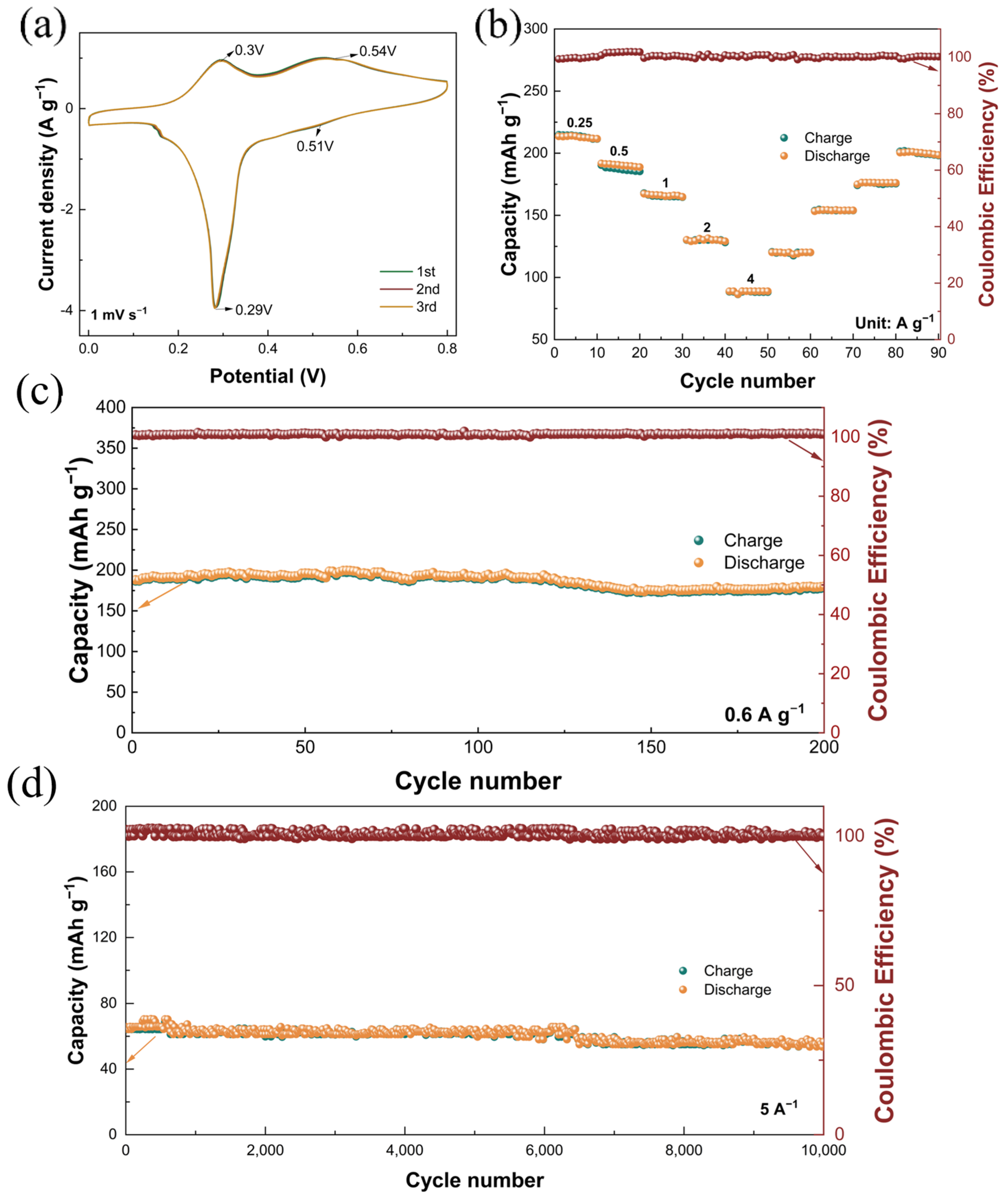
- The PNZ–TCNQ cathode delivered 10,000 cycles at 5 A g−1 with about 85% capacity retention, showing good high-rate and long-cycle performance.
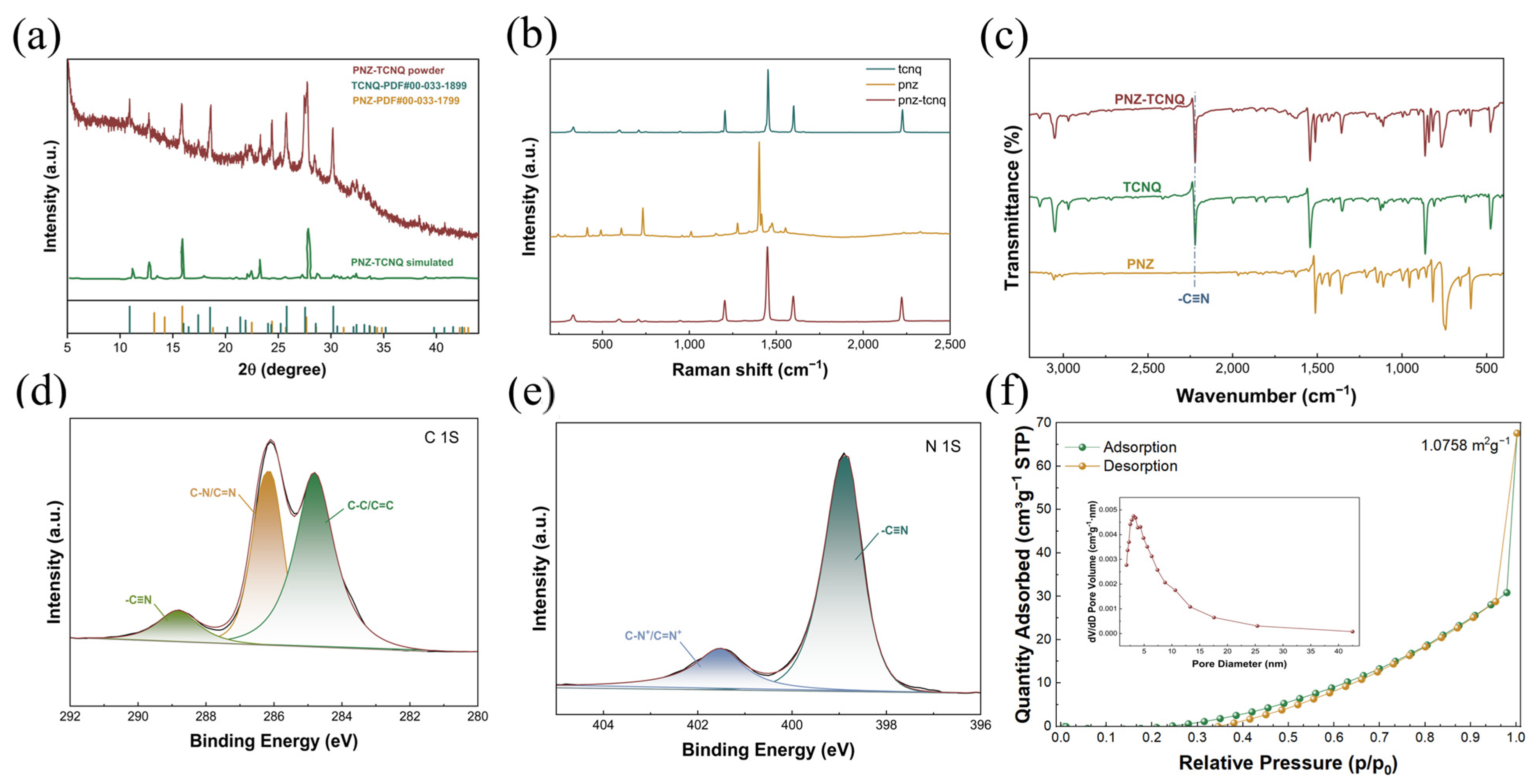
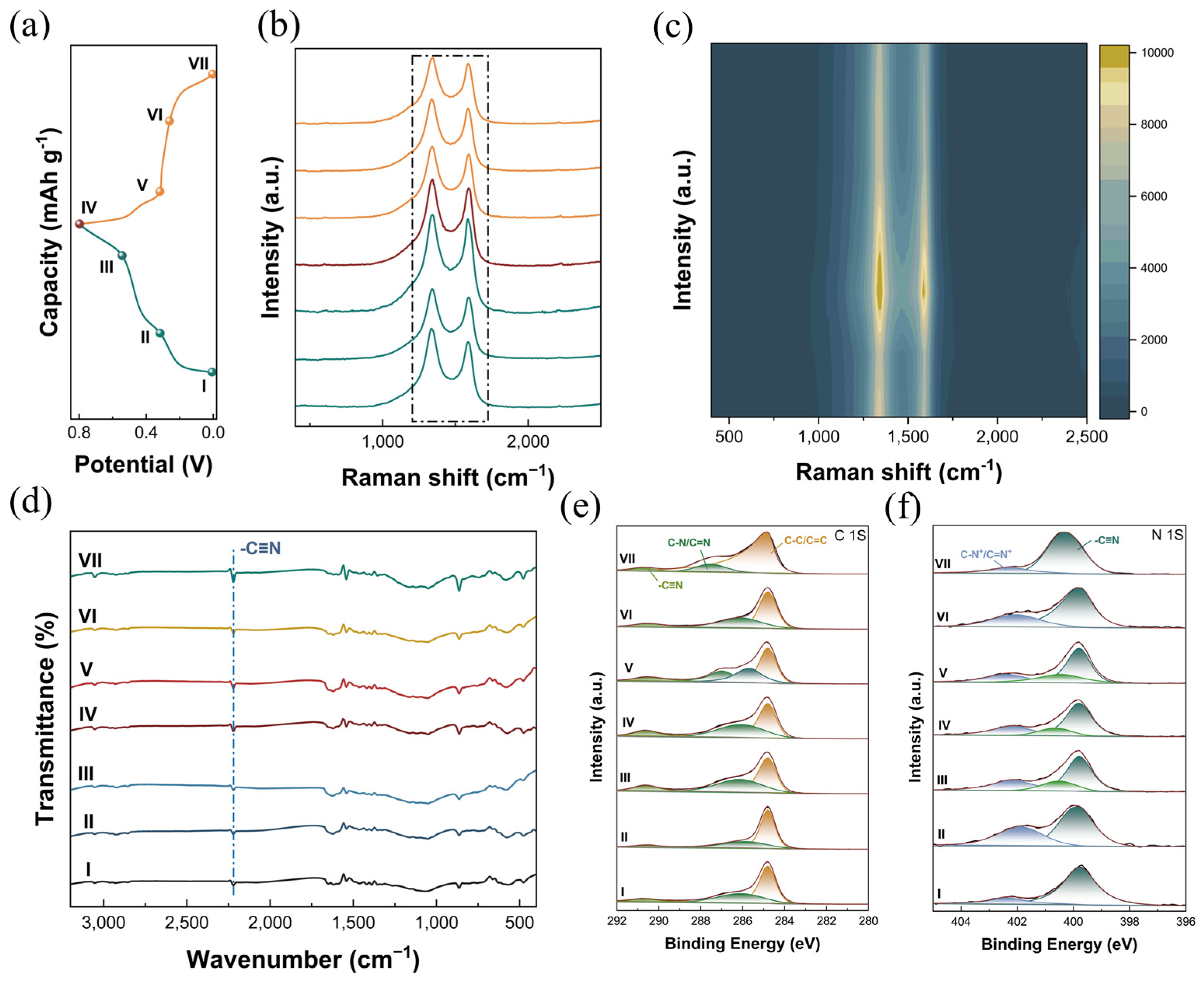
- Spectroscopic analyses indicate reversible redox evolution of the donor–acceptor complex while preserving the main molecular backbone.
- The acceptor-enrichment strategy is beneficial for improving the electrochemical stability of organic charge-transfer complexes.
- The present results provide insight into how donor–acceptor assembly can be used to regulate the electrochemical behavior of organic cathodes in acidic aqueous systems.
- This work provides a useful strategy for developing organic cathodes for acidic aqueous energy storage.
Abstract
1. Introduction
2. Materials and Methods
2.1. Material Preparation
2.2. Material Characterization
2.3. Electrochemical Measurements
3. Results and Discussion
3.1. Structure of PNZ-TCNQ
3.2. Morphology of PNZ-TCNQ
3.3. Electrochemical Performance
3.4. Kinetic Performance
3.5. Mechanistic Analysis
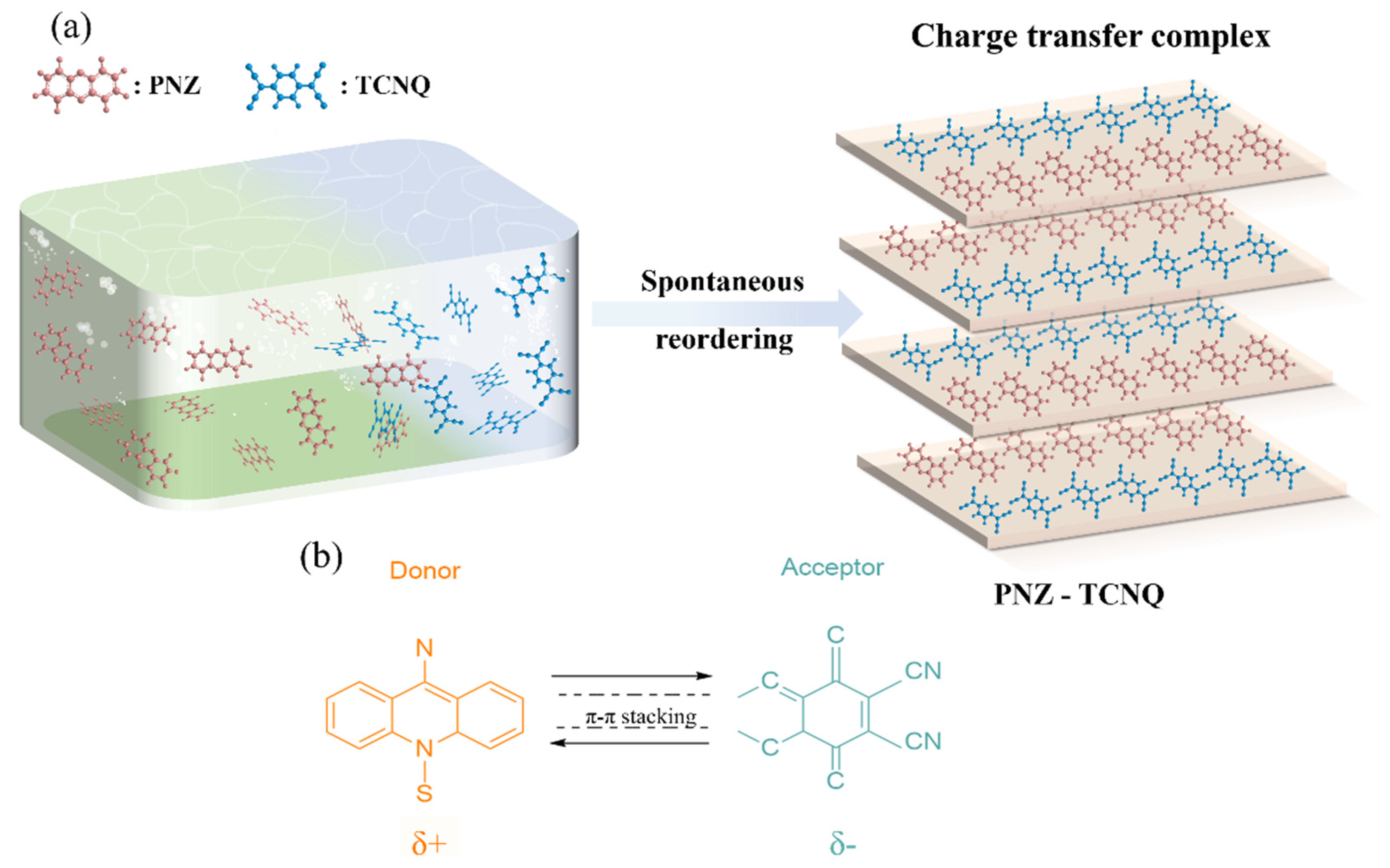
3.6. Schematic Illustration of the Construction and Mechanism of PNZ-TCNQ
4. Conclusions
Supplementary Materials
Author Contributions
Funding
Institutional Review Board Statement
Informed Consent Statement
Data Availability Statement
Conflicts of Interest
References
- Li, Y.; Song, J.; Yang, J. A Review on Structure Model and Energy System Design of Lithium-Ion Battery in Renewable Energy Vehicle. Renew. Sustain. Energy Rev. 2014, 37, 627–633. [Google Scholar] [CrossRef]
- Lei, Y. Advanced Energy Materials Research: Key to Sustainable Energy Future. Adv. Energy Mater. 2025, 16, e04339. [Google Scholar] [CrossRef]
- Zhang, W.; Zhang, F.; Ming, F.; Alshareef, H.N. Sodium-Ion Battery Anodes: Status and Future Trends. EnergyChem 2019, 1, 100012. [Google Scholar] [CrossRef]
- Wu, X.; Dai, Y.; Li, N.W.; Chen, X.C.; Yu, L. Recent Progress in Ionic Liquid-Based Electrolytes for Nonaqueous and Aqueous Metal Batteries. eScience 2024, 4, 100173. [Google Scholar] [CrossRef]
- Hu, Z.; Lin, L.; Jiang, Y.; Sun, L.; Liu, W.; Wang, Q.; Wang, F. Reveal the Source of Protons in Aqueous Hydrogen Proton Battery. Energy Storage Mater. 2024, 73, 103820. [Google Scholar] [CrossRef]
- Zhang, L.; Zhang, C.; Berg, E.J. Mastering Proton Activities in Aqueous Batteries. Adv. Mater. 2024, 37, e2407852. [Google Scholar] [CrossRef]
- Liang, G.; Mo, F.; Ji, X.; Zhi, C. Non-Metallic Charge Carriers for Aqueous Batteries. Nat. Rev. Mater. 2020, 6, 109–123. [Google Scholar] [CrossRef]
- Wang, F.; Xu, K.; Wang, C. Charge Carrier Unveiled. Nat. Sustain. 2022, 5, 818–819. [Google Scholar] [CrossRef]
- Schon, T.B.; McAllister, B.T.; Li, P.-F.; Seferos, D.S. The Rise of Organic Electrode Materials for Energy Storage. Chem. Soc. Rev. 2016, 45, 6345–6404. [Google Scholar] [CrossRef]
- Qiao, J.-Q.; Zuo, S.-W.; Li, Z.-F.; Li, G. Latest Progress in Proton-Conducting Hydrogen-Bonded Organic Frameworks. Inorg. Chem. Front. 2023, 10, 5856–5884. [Google Scholar] [CrossRef]
- Pal, S.C.; Mukherjee, D.; Sahoo, R.; Mondal, S.; Das, M.C. Proton-Conducting Hydrogen-Bonded Organic Frameworks. ACS Energy Lett. 2021, 6, 4431–4453. [Google Scholar] [CrossRef]
- Song, Z.; Miao, L.; Ruhlmann, L.; Lv, Y.; Li, L.; Gan, L.; Liu, M. Proton-Conductive Supramolecular Hydrogen-Bonded Organic Superstructures for High-Performance Zinc-Organic Batteries. Angew. Chem. Int. Ed. 2023, 62, e202219136. [Google Scholar] [CrossRef] [PubMed]
- Ogawa, T.; Ohashi, H.; Tamaki, T.; Yamaguchi, T. Proton Diffusion Facilitated by Indirect Interactions Between Proton Donors Through Several Hydrogen Bonds. Chem. Phys. Lett. 2019, 731, 136627. [Google Scholar] [CrossRef]
- Sun, Y.; Wei, J.; Fu, Z.; Zhang, M.; Zhao, S.; Xu, G.; Li, C.; Zhang, J.; Zhou, T. Bio-Inspired Synthetic Hydrogen-Bonded Organic Frameworks for Efficient Proton Conduction. Adv. Mater. 2022, 35, 2208625. [Google Scholar] [CrossRef] [PubMed]
- Arsenault, E.A.; Guerra, W.D.; Shee, J.; Cruz, E.A.R.; Yoneda, Y.; Wadsworth, B.L.; Odella, E.; Urrutia, M.N.; Kodis, G.; Moore, G.F.; et al. Concerted Electron-Nuclear Motion in Proton-Coupled Electron Transfer-Driven Grotthuss-Type Proton Translocation. J. Phys. Chem. Lett. 2022, 13, 4479–4485. [Google Scholar] [CrossRef]
- Zuo, D.; Tian, G.; Li, X.; Chen, D.; Shu, K. Recent Progress in Surface Coating of Cathode Materials for Lithium Ion Secondary Batteries. J. Alloys Compd. 2017, 706, 24–40. [Google Scholar] [CrossRef]
- Li, W.; Song, Q.; Dong, Q.; Zhang, J.; Wang, J.; Wu, Y.; Yu, Y.; Li, X. Proton Storage Chemistry in Aqueous Zinc-Inorganic Batteries with Moderate Electrolytes. Adv. Mater. 2024, 37, 2414019. [Google Scholar] [CrossRef]
- Fu, L.; Wang, X.; Zhang, R.; Li, R.; Wei, G.; Li, M. Proton Co-Intercalation Enabled High-Performance Aqueous Multivalent Metal-Ion Batteries. J. Mater. Chem. A 2025, 13, 24300–24319. [Google Scholar] [CrossRef]
- Yue, F.; Tie, Z.; Deng, S.; Wang, S.; Yang, M.; Niu, Z. An Ultralow Temperature Aqueous Battery with Proton Chemistry. Angew. Chem. Int. Ed. 2021, 60, 13882–13886. [Google Scholar] [CrossRef]
- Wang, Y.; Wang, C.; Wang, W.; Zhang, Y.; Guo, Z.; Huang, J.; Yan, L.; Ma, J.; Wang, Y. Organic Hydronium-Ion Battery with Ultralong Life. ACS Energy Lett. 2023, 8, 1390–1396. [Google Scholar] [CrossRef]
- Zhu, Y.; Yang, X.; Zhang, X. Hydronium Ion Batteries: A Sustainable Energy Storage Solution. Angew. Chem. Int. Ed. 2017, 56, 6378–6380. [Google Scholar] [CrossRef] [PubMed]
- Liu, J.; Guo, K.; Guo, W.; Chang, J.; Li, Y.; Bao, F. Superconjugated Anthraquinone Carbonyl-Based Covalent Organic Framework as Anode Material for High-Performance Aqueous Ammonium-Ion Batteries. Angew. Chem. Int. Ed. 2025, 64, e202424494. [Google Scholar] [CrossRef] [PubMed]
- Lu, C.; Zhao, F.; Tao, B.; Wang, Z.; Wang, Y.; Sheng, J.; Tang, G.; Wang, Y.; Guo, X.; Li, J.; et al. Anode-Free Aqueous Aluminum Ion Batteries. Small 2024, 20, 2402025. [Google Scholar] [CrossRef] [PubMed]
- Wang, H.; Wu, J.; Zheng, Z.; Qin, J.; Guo, Z.; Zhang, Z.; Wen, W. Surface Anion Effects in Aqueous Hydrogen Ion Batteries. J. Electron. Mater. 2024, 53, 3474–3481. [Google Scholar] [CrossRef]
- Han, W.; Li, M.; Ma, Y.; Yang, J. Dianhydride-Based Polyimide as Organic Electrode Materials for Aqueous Hydronium-Ion Battery. Electrochim. Acta 2022, 403, 139550. [Google Scholar] [CrossRef]
- Ma, Y.; Wei, Y.; Han, W.; Tong, Y.; Song, A.J.; Zhang, J.; Li, H.; Li, X.; Yang, J. Proton Intercalation/De-Intercalation Chemistry in Phenazine-Based Anode for Hydronium-Ion Batteries. Angew. Chem. Int. Ed. 2023, 62, e202314259. [Google Scholar] [CrossRef]
- Deng, X.; Sarpong, J.K.; Zhang, G.; Hao, J.; Zhao, X.; Li, L.; Li, H.; Han, C.; Li, B. Proton Storage Chemistry in Aqueous Zinc-Organic Batteries: A Review. InfoMat 2022, 5, e12382. [Google Scholar] [CrossRef]
- Hurlbutt, K.; Wheeler, S.; Capone, I.; Pasta, M. Prussian Blue Analogs as Battery Materials. Joule 2018, 2, 1950–1960. [Google Scholar] [CrossRef]
- Li, Y.; Zhao, J.; Hu, Q.; Hao, T.; Cao, H.; Huang, X.; Liu, Y.; Zhang, Y.; Lin, D.; Tang, Y.; et al. Prussian Blue Analogs Cathodes for Aqueous Zinc Ion Batteries. Mater. Today Energy 2022, 29, 101095. [Google Scholar] [CrossRef]
- Qiu, S.; Xu, Y.; Wu, X.; Ji, X. Prussian Blue Analogues as Electrodes for Aqueous Monovalent Ion Batteries. Electrochem. Energy Rev. 2021, 5, 242–262. [Google Scholar] [CrossRef]
- An, S.; Hu, L.; Li, X.; Zhao, S.; Shi, M.; Yan, C. A Solid-Diffusion-Free Hydronium-Ion Battery with Ultra-Long Cycle Life over 8000 Cycles. Energy Storage Mater. 2024, 64, 103076. [Google Scholar] [CrossRef]
- Chen, W.; Chen, T.; Fu, J. Pivotal Role of Organic Materials in Aqueous Zinc-Based Batteries: Regulating Cathode, Anode, Electrolyte, and Separator. Adv. Funct. Mater. 2023, 34, 2308015. [Google Scholar] [CrossRef]
- Yang, G.; Zhu, Y.; Hao, Z.; Lu, Y.; Zhao, Q.; Zhang, K.; Chen, J. Organic Electroactive Materials for Aqueous Redox Flow Batteries. Adv. Mater. 2023, 35, 2301898. [Google Scholar] [CrossRef]
- Hu, C.; Lu, Y.; Gu, H.; Zhang, W.; Li, Z. Multiple Redox Site π-Conjugated Materials for Aqueous Aluminum–Organic Battery Cathodes. ACS Energy Lett. 2024, 9, 4353–4360. [Google Scholar] [CrossRef]
- Goetz, K.P.; Vermeulen, D.; Payne, M.E.; Kloc, C.; McNeil, L.E.; Jurchescu, O.D. Charge-Transfer Complexes: New Perspectives on an Old Class of Compounds. J. Mater. Chem. C 2014, 2, 3065–3076. [Google Scholar] [CrossRef]
- Horiuchi, S.; Okimoto, Y.; Kumai, R.; Tokura, Y. Quantum Phase Transition in Organic Charge-Transfer Complexes. Science 2003, 299, 229–232. [Google Scholar] [CrossRef] [PubMed]
- Madhu, M.; Ramakrishnan, R.; Vijay, V.; Hariharan, M. Free Charge Carriers in Homo-Sorted π-Stacks of Donor–Acceptor Conjugates. Chem. Rev. 2021, 121, 8234–8284. [Google Scholar] [CrossRef]
- Yamane, H.; Kosugi, N. High Hole-Mobility Molecular Layer Made from Strong Electron Acceptor Molecules with Metal Adatoms. J. Phys. Chem. Lett. 2017, 8, 5366–5371. [Google Scholar] [CrossRef]
- Denis, P.A. Band Gap Opening in Bilayer Graphene by the Simultaneous Adsorption of Electron Donating and Electron Acceptor Molecules. Comput. Theor. Chem. 2017, 1120, 96–101. [Google Scholar] [CrossRef]
- Lee, S.; Hong, J.; Jung, S.-K.; Ku, K.; Kwon, G.; Seong, W.M.; Kim, H.; Yoon, G.; Kang, I.; Hong, K.; et al. Charge-Transfer Complexes for High-Power Organic Rechargeable Batteries. Energy Storage Mater. 2019, 20, 462–469. [Google Scholar] [CrossRef]
- Lee, S.; Kim, J.; Hong, J.; Kang, K. Unlocking the Full Redox Capability of Organic Charge-Transfer Complex in High-Loading Electrodes for Organic Rechargeable Batteries. Adv. Energy Mater. 2024, 15, 2404116. [Google Scholar] [CrossRef]
- Katkar, P.K.; Naikwade, M.B.; Lee, S.-W. A Synergistic Electrochemical Properties of 3D Marigold-like Fe-Cu-Ag Phosphate/MWCNTs Nanocomposite towards Hybrid Solid-State Supercapatteries. J. Alloys Compd. 2025, 1038, 182815. [Google Scholar] [CrossRef]


Disclaimer/Publisher’s Note: The statements, opinions and data contained in all publications are solely those of the individual author(s) and contributor(s) and not of MDPI and/or the editor(s). MDPI and/or the editor(s) disclaim responsibility for any injury to people or property resulting from any ideas, methods, instructions or products referred to in the content. |
© 2026 by the authors. Licensee MDPI, Basel, Switzerland. This article is an open access article distributed under the terms and conditions of the Creative Commons Attribution (CC BY) license.
Share and Cite
Song, X.; Yang, X.; Yang, J.; Zhang, W.; Shi, P. Acceptor-Enriched Charge-Transfer Engineering for Long-Life and High-Rate Organic Cathodes in Aqueous Proton Batteries. Coatings 2026, 16, 441. https://doi.org/10.3390/coatings16040441
Song X, Yang X, Yang J, Zhang W, Shi P. Acceptor-Enriched Charge-Transfer Engineering for Long-Life and High-Rate Organic Cathodes in Aqueous Proton Batteries. Coatings. 2026; 16(4):441. https://doi.org/10.3390/coatings16040441
Chicago/Turabian StyleSong, Xirui, Xinglin Yang, Jinlong Yang, Weichao Zhang, and Peixiang Shi. 2026. "Acceptor-Enriched Charge-Transfer Engineering for Long-Life and High-Rate Organic Cathodes in Aqueous Proton Batteries" Coatings 16, no. 4: 441. https://doi.org/10.3390/coatings16040441
APA StyleSong, X., Yang, X., Yang, J., Zhang, W., & Shi, P. (2026). Acceptor-Enriched Charge-Transfer Engineering for Long-Life and High-Rate Organic Cathodes in Aqueous Proton Batteries. Coatings, 16(4), 441. https://doi.org/10.3390/coatings16040441