Review

High-Temperature Carburization of Gear Steels: Grain Size Regulation, Microstructural Evolution, and Surface Performance Enhancement

1
Ansteel Beijing Research Institute Co., Ltd., Beijing 102200, China
2
Institute for Special Steel Research, Central Iron and Steel Research Institute, State Key Laboratory of Advanced Special Steel, Beijing 100081, China
*
Author to whom correspondence should be addressed.
Coatings 2026, 16(3), 386; https://doi.org/10.3390/coatings16030386
Submission received: 6 February 2026 / Revised: 25 February 2026 / Accepted: 2 March 2026 / Published: 21 March 2026
(This article belongs to the Special Issue Surface Treatment and Mechanical Properties of Metallic Materials)

Abstract

High-temperature carburization (HTC, 950–1050 °C) has emerged as a pivotal low-carbon, energy-efficient manufacturing technology for gear steels, accelerating carbon diffusion for reducing processing cycles by over 60% while achieving significant energy savings and emission reductions. However, the inherent contradiction between HTC efficiency and microstructural stability, specifically austenite grain coarsening, severely degrades mechanical properties (e.g., strength, toughness, fatigue resistance) and limits widespread application. This review systematically synthesizes recent advances in austenite grain size regulation during HTC of gear steels, focusing on the core scientific framework of “grain coarsening mechanism—regulation strategy—performance enhancement”. It elaborates on thermodynamic and kinetic mechanisms of austenite grain growth, ripening behavior of microalloying precipitates (Nb(C,N), Ti(C,N), AlN, etc.), and their synergistic grain-refining effects. Comprehensive coverage of regulatory strategies (microalloying design, pretreatment technologies, process optimization, and integrated regulation) and characterization techniques is provided, along with a quantitative correlation between grain size, microstructure, and surface performance (wear resistance, corrosion resistance, and fatigue life). Numerical simulation and predictive models (empirical, theoretical, multiphysics coupling, machine learning-based) are critically analyzed, and current challenges (temperature-grain stability trade-off, multifactor synergy understanding, industrial scalability) and future research directions (advanced microalloying systems, intelligent process optimization, cross-scale modeling, green technology integration) are proposed. This review aims to provide theoretical guidance and technical support for optimizing the HTC performance of gear steels, catering to the demands of high-power-density transmission systems in automotive, aerospace, and heavy machinery industries.

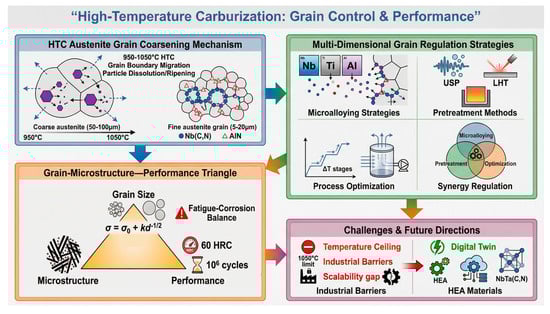
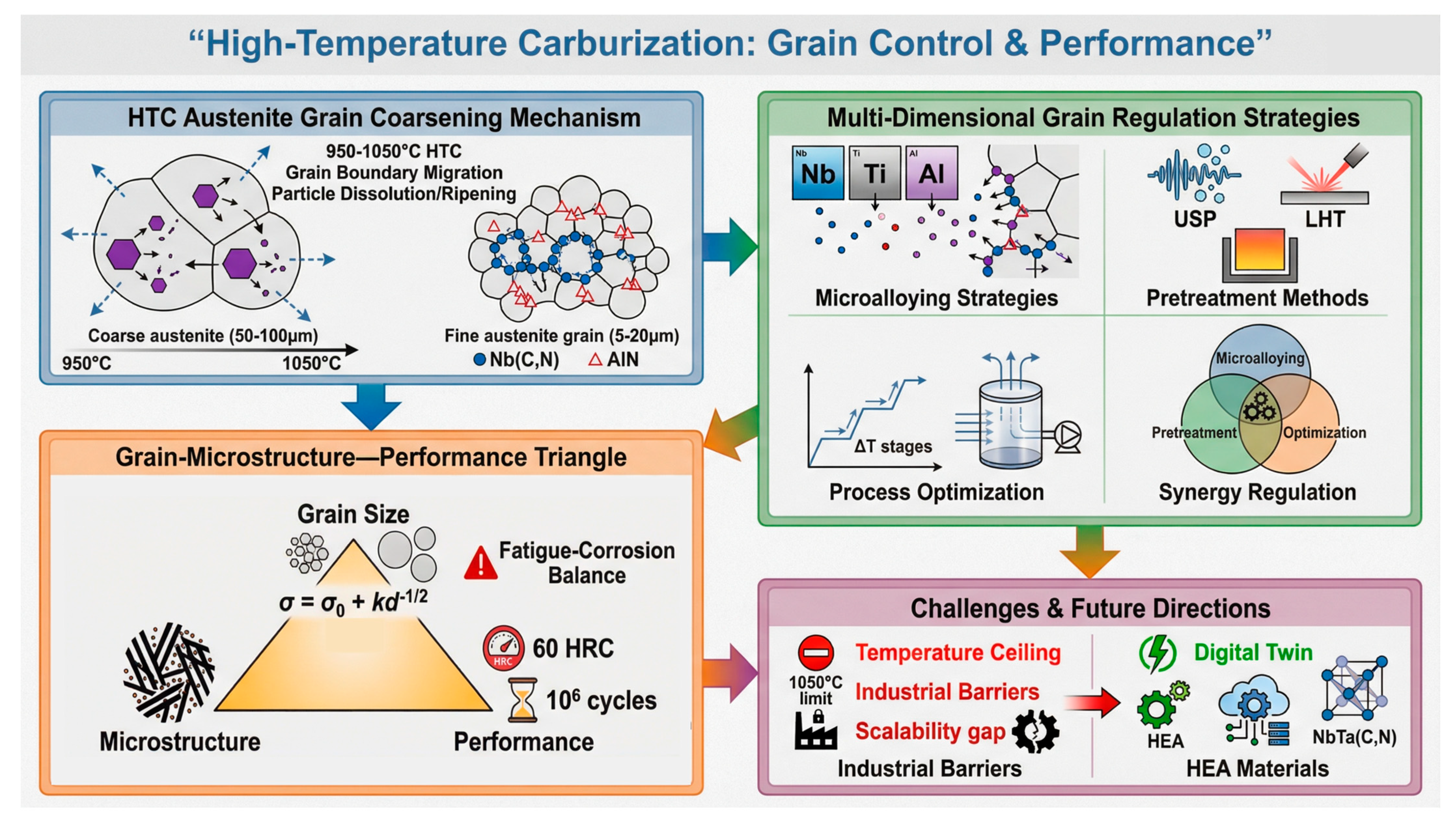
Graphical Abstract

1. Introduction

Gears are indispensable core transmission components in industrial systems such as the automotive, aerospace, and heavy machinery, with their operational reliability directly determining the efficiency and lifespan of the entire equipment [1,2]. Against the backdrop of global dual-carbon policies and escalating demands for high-power-density, low-noise transmission systems, traditional carburizing processes (e.g., 930 °C) for gear steels—characterized by long cycles (up to 139.5 h), high energy consumption, and substantial carbon emissions—can no longer meet the requirements of modern manufacturing [3,4,5]. While high-temperature carburization (HTC, typically conducted at 950–1050 °C) has been utilized in industrial practice since the mid-20th century, it has recently re-emerged as a transformative technology in the context of global dual-carbon policies and high-power-density transmission demands, primarily by drastically accelerating carbon diffusion: 18Cr2Ni4WA steel subjected to HTC at 970 °C shortens total processing time from 139.5 h to 46.5 h while maintaining balanced mechanical properties [5]; 20MnCr5 steel processed via HTC exhibits a 35% increase in carburized layer depth [6]; and 18CrNiMo7-6 steel at 970 °C reduces processing time by 67% compared to 930 °C [5]. These advancements verify HTC’s technical and economic advantages in energy conservation and emission reduction.
To verify HTC’s economic feasibility, we take the production of heavy-duty automotive gears (5 kg/piece, 18Cr2Ni4WA steel) as an example, roughly comparing traditional carburization (930 °C, 139.5 h) with HTC (970 °C, 46.5 h, 0.06 wt.% Nb microalloying, the minimum addition for grain coarsening inhibition):
Cost Savings from Time Reduction: (1) for a 500 kg batch (100 gears), industrial carburizing furnaces (¥120/h operational cost) yield savings of 139.5 h − 46.5 h = 93 h, translating to ¥120/h × 93 h = ¥11,160/batch (¥111.6/gear). (2) Despite higher temperature, HTC’s shorter cycle cuts energy consumption (consistent with [5]). With furnace energy consumption of 30 kWh/(m3·h) (10 m3 volume) and electricity at ¥0.8/kWh, savings reach ¥33,480 − ¥11,160 = ¥22,320/batch (¥223.2/gear).
Additional Costs of HTC: (1) no incremental cost for Elevated Temperature—industrial carburizing furnaces designed for 930 °C inherently support 1050 °C. (2) As for microalloying (Nb ~¥300/kg), the 0.06 wt.% addition adds only ¥0.9/gear (¥90/batch), negligible compared to savings.
Total savings per batch can be calculated as ¥11,160 + ¥22,320 = ¥33,480 and the net benefit is ¥33,480 − ¥90 = ¥33,390/batch (¥333.9/gear), reducing carburization-related costs by ~40%. This confirms HTC’s time/energy savings far offset microalloying and temperature-related costs, solidifying its industrial application value.
The rapid development of electric vehicles (EVs) and aerospace engineering has further raised the bar for gear steel performance: EV drivetrains demand higher fatigue resistance and lower noise [7,8]. While aerospace gears demand materials with stable high-temperature performance (e.g., resistance to thermal degradation and fatigue at elevated temperatures up to 500 °C under extreme or unlubricated conditions), even though conventional gearboxes operate at temperatures below 200 °C due to lubricant limitations [9]. However, the inherent contradiction between HTC efficiency and microstructural stability has become a bottleneck restricting its widespread application. Elevated carburizing temperatures inevitably activate austenite grain boundary migration, coupled with redissolution and ripening of second-phase particles (e.g., AlN, (Ti,Mo)(C,N)), leading to abnormal grain coarsening [10,11,12]. This coarsening phenomenon severely degrades comprehensive performance: 20CrMnTi steel undergoes accelerated austenite grain growth at 980 °C with a growth rate of 2.34 μm/min in the initial stage due to rapid redissolution of (Ti,Mo)(C,N) precipitates [11]; SCr420H steel experiences abnormal grain growth when carburized at 1050 °C for over 2 h due to AlN coarsening [13]; and coarse grains reduce wear resistance by 30% and fatigue life by 40% compared to fine-grained counterparts [14,15]. Thus, regulating austenite grain size during HTC to reconcile process efficiency with material performance is critical.
In recent years, extensive research has focused on grain size control during HTC, yielding diverse strategies including microalloying modification (Nb, Te, Al, V, Mo, B, Zr, Si, Cu, etc.) [7,10,15,16,17,18,19,20], pretreatment technologies (normalizing, ultrasonic shot peening (USP), scanning electron beam pretreatment (SEBP), pre-shot peening, laser heat treatment (LHT)) [14,21,22,23,24,25,26], and process optimization (stage carburization (SC), solid-solution carburization, vacuum carburization, thermomechanical processing (TMP)) [8,27,28,29]. However, existing studies are scattered across specific steel grades or single technical routes: Nb microalloying effectively suppresses grain growth in SAE8620H and 20MnCr5 steels [10,17], Te addition modifies MnS inclusions in 20MnCrS5 steel [16,18], and USP pretreatment enhances carbon diffusion in 20CrMnTi steel [24], but synergistic effects of multi-element microalloying and integrated strategies remain inadequately explored [7,24]. Additionally, debates persist regarding trade-offs: AlN-induced grain refinement deteriorates thermoplasticity [30], B addition improves wear resistance but reduces corrosion performance [31], and excessively fine grains decrease thermal conductivity [32].
Numerical simulation and predictive models have become indispensable for HTC optimization, with advancements in empirical kinetic models [3], theoretical pinning force models [33], multiphysics coupling simulations [29], and machine learning (ML)-based predictions [25,34]. However, limitations remain: simplification of microstructural mechanisms, limited industrial scalability, lack of cross-scale integration, and data dependence of ML models [3,12,25].
This review addresses these gaps by comprehensively synthesizing recent studies. Focusing on “grain coarsening mechanism-regulation strategy-performance enhancement,” it systematically analyzes key factors influencing grain growth, clarifies microstructural mechanisms, establishes performance correlations, and discusses challenges and future directions. The review aims to provide a holistic reference for the development of high-performance, low-carbon gear steel manufacturing technologies, catering to the evolving demands of automotive, aerospace, and heavy machinery industries.

2. Effects of High-Temperature Carburization on Austenite Grain Size of Gear Steels

HTC fundamentally alters the austenite grain structure of gear steels by regulating the balance between thermal activation of grain boundary migration and the pinning effect of second-phase particles [3,12]. This section elaborates on the intrinsic mechanism of austenite grain coarsening, the influence of key process parameters, and steel grade-dependent grain size sensitivity, integrating recent experimental and simulation findings to build a cohesive understanding of HTC-induced grain evolution.

2.1. Grain Coarsening Mechanism

Austenite grain coarsening during HTC is a synergistic result of thermal activation of grain boundary migration and degradation of grain boundary pinning effects caused by second-phase particle redissolution or ripening [11,12,35]. At elevated temperatures (950–1050 °C), thermal energy enhances austenite grain boundary mobility, driving high-energy grain boundaries to migrate toward low-energy regions to reduce total interfacial energy [35]. This process is accelerated by the gradual loss of pinning forces from second-phase particles, which are critical for inhibiting grain boundary movement under conventional carburizing conditions [3,36].
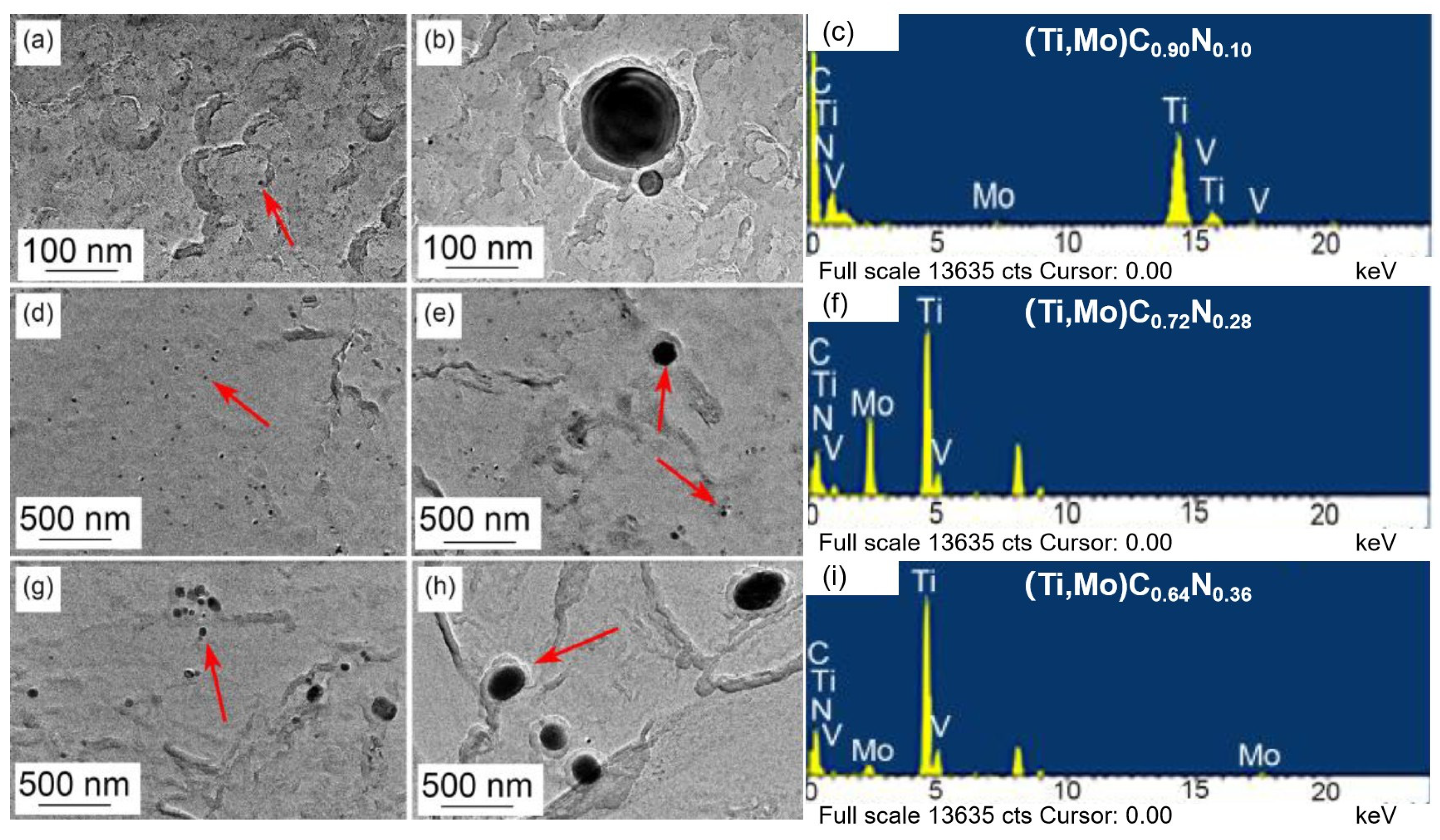
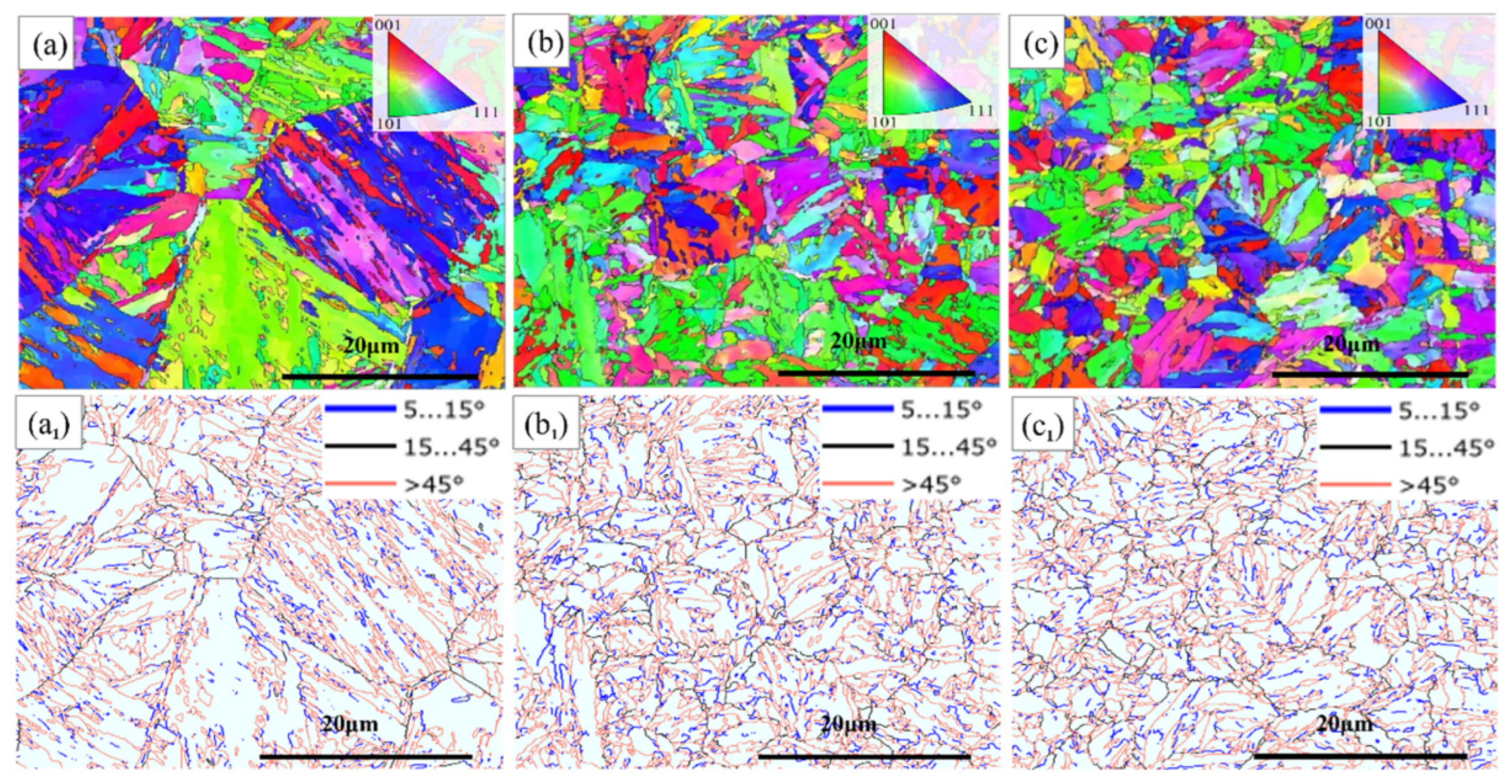
The thermal stability of second-phase particles directly determines their pinning effectiveness. (Ti,Mo)(C,N) exhibits relatively low thermal stability: in 20CrMnTi steel, (Ti,Mo)(C,N) particles pre-formed in the α phase undergo rapid redissolution during pseudo-carburization, with area density decreasing from 0.389% (as-hot rolled) to 0.279% at 980 °C [11], as shown in Figure 1. This eliminates the pinning effect, leading to a grain growth rate of 2.34 μm/min in the initial 1 min of carburization at 980 °C, nearly three times higher than at 970 °C [11]. AlN particles, widely used for grain refinement, undergo Ostwald ripening above 1000 °C: in SCr420H steel, AlN particles grow from 27.8 nm (0.5 h at 1050 °C) to 64.2 nm (2.5 h at 1050 °C), with 14.3% exceeding 100 nm and losing pinning capacity [13]. Researchers have identified 1050 °C as the critical coarsening temperature for AlN in SCr420H steel, above which abnormal grain growth is inevitable [12].
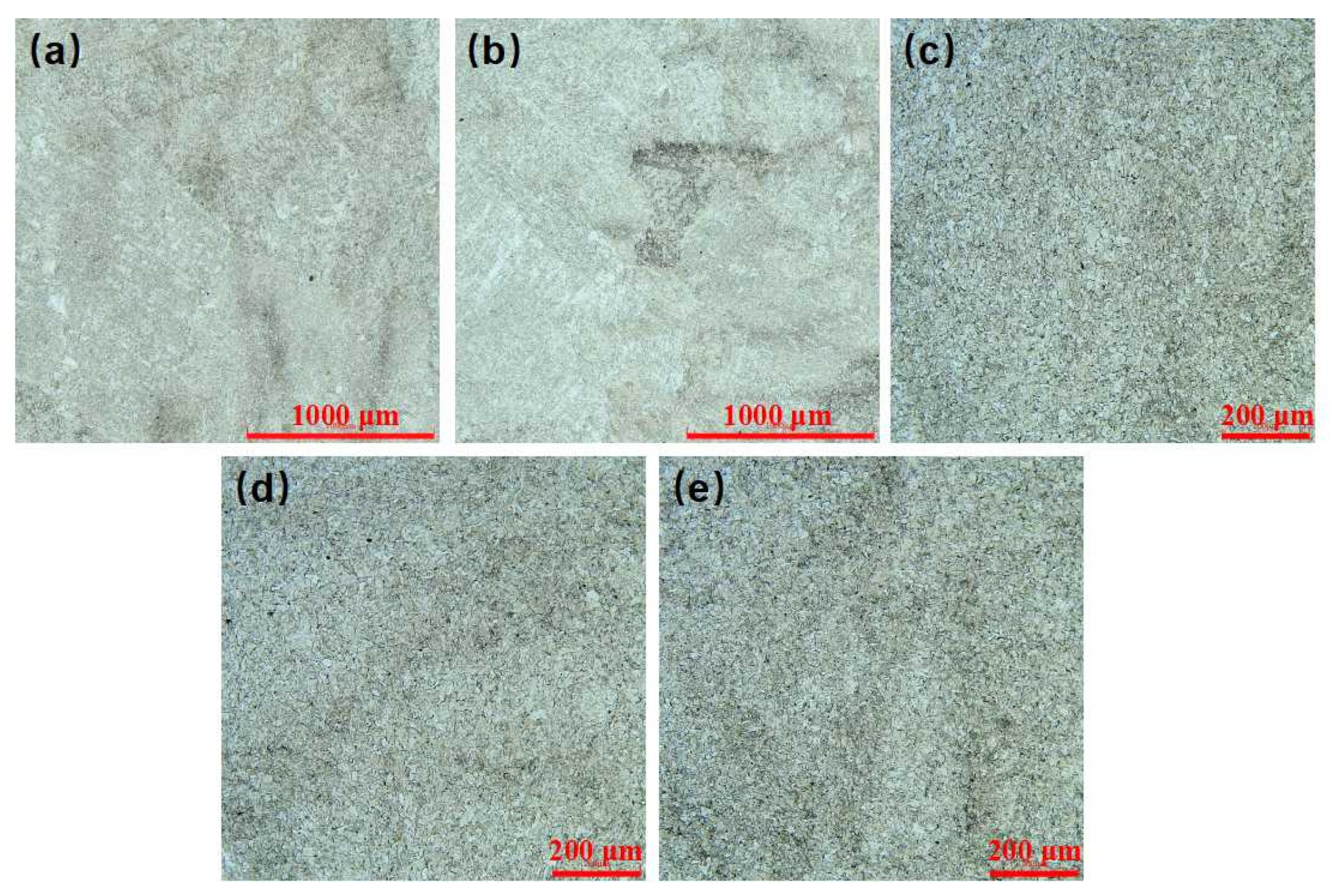
In contrast, Nb-containing precipitates (Nb(C,N), NbC) exhibit superior thermal stability (solution temperature > 1200 °C) [3,10]. Zhang et al. [10] demonstrated in Figure 2 that a Nb content exceeding 0.053 wt.% completely inhibits grain coarsening of SAE8620H steel during carburization at 1050 °C for 2 h, attributed to uniform dispersion of Nb(C,N) particles. Composite precipitates such as AlN-Nb(C,N) follow the Shoji-Nishiyama orientation relationship, promoting Nb(C,N) nucleation and growth while inhibiting isolated Nb(C,N) ripening [37], leading to a more persistent pinning effect than single-phase precipitates. Further verification shows that NbC precipitates maintain pinning effects in both carburized case (1.0 wt.% C) and core (0.20 wt.% C) of gear steels after 1253 K HTC, with solid solubility products of [Nb] [C] lower than reported values in high-carbon regions [38].
The pinning effect follows the Zener pinning model, where pinning force (Pz) is proportional to particle number density and volume fraction [3,33]. However, during HTC, thermal driving force for grain boundary migration may exceed Pz, triggering depinning and rapid coarsening [12,36]. A new analytical model for 2D polycrystals quantifies particle effects on both grain growth inhibition and grain disappearance prevention, identifying particle surface fractions (0.01–0.05) and sizes (50–200 nm) that maximize grain size heterogeneity.
MnS inclusions in sulfur-containing gear steels exhibit strong pinning when spheroidized and dispersed [36]. In situ observations via high-temperature confocal microscopy show that MnS inclusions at or near grain boundaries in 20MnCrS5 steel effectively hinder boundary migration, but this effect weakens above 950 °C due to MnS deformation and partial dissolution [36]. Oxide-core MnS composite inclusions show more uniform dispersion and spheroidization across slab positions, providing more stable pinning than irregular MnS inclusions—highlighting the importance of inclusion morphology and distribution, not just volume fraction [3,39].
Grain boundary migration during HTC is also influenced by disconnection structures and mechanisms [35]. A continuum model demonstrates that multiple disconnection modes nucleate and move along grain boundaries under competing driving forces (shear stress, chemical potential jumps), with coupling between modes governing complex migration behavior in polycrystalline microstructures. This adds a new dimension to understanding grain coarsening beyond traditional pinning models, enriching the mechanistic framework of HTC-induced grain evolution.

2.2. Influence of Key Process Parameters

Austenite grain size during HTC is highly sensitive to carburization temperature and holding time, with their synergistic effect governing thermal activation and second-phase particle degradation [4,5]. Other parameters, such as heating rate, thermomechanical processing strain, and pretreatment, also play critical roles, collectively shaping the final grain structure.
Temperature is the dominant driver. It enhances grain boundary mobility and accelerates particle redissolution/ripening [11,12]. Different steel grades exhibit distinct critical temperatures for abnormal grain growth: 950 °C for 20MnCrS5 [36], 1050 °C for SCr420H [12], and 970 °C for 18Cr2Ni4WA [4]. These differences stem from alloy composition and particle types: Nb-containing steels (SAE8620H, 20MnCr5Nb) have higher critical temperatures [10,17], while AlN-dependent grades (SCr420H, 20Cr) have lower ones [13,40]. Initial microstructure also affects temperature sensitivity: 20CrMnTi steel normalized at 940 °C exhibits a higher critical carburization temperature than that normalized at 800 °C, due to microstructure heredity generating fine, uniform austenite grains [22]. Laser heat treatment (LHT) with energy density 80–130 J/mm2, applied after HCT, further refines grains of carburized 21NiCrMo2 steel, avoiding melting or cracking and optimizing grain size uniformity [26].
Holding time effects are coupled with temperature. Below the critical temperature, grain growth is slow and stabilizes with time; above it, rapid initial growth is followed by a steady state after depinning [4,11]. For 20CrMnTi steel at 980 °C, the grain growth rate is 2.34 μm/min in the first 1 min, decreasing to 0.003 μm/min afterward [11]. Industrial optimization examples include 18Cr2Ni4WA steel: 950 °C and 970 °C carburization reduces holding time by 37.2% and 53.5% vs. 930 °C without severe coarsening [4], but SCr420H steel at 1050 °C for over 2 h undergoes abnormal growth due to complete AlN ripening [13]. The temperature-time relationship follows modified Sellars or Arrhenius models [3], with austenite grain growth rate exponentially increasing with temperature and following a power-law relationship with time. For 20MnCr5 steel, 950 °C × 5 h achieves a similar carburized layer depth as 900 °C × 8 h but with ~20% grain coarsening, underscoring the need for parameter balance [17].
Heating rate influences grain size distribution. For Ti-Nb-modified SAE8620 steel, faster heating through the intercritical region yields a more uniform austenite grain size and finer mean diameter [41]. Controlled rolling produces a more uniform grain size than conventional hot rolling, as it optimizes initial precipitate distribution [41]. Thermomechanical processing (TMP) strain also affects grain refinement: greater strain leads to finer post-carburized prior austenite grains (PAG) in Al, V, Nb microalloyed 1045 steel, with Nb-V steel exhibiting the finest grains [8]. However, V steel shows higher abnormal grain growth tendency at intermediate strains, indicating the need for precise strain control in TMP-integrated HTC processes [8].

2.3. Steel Grade-Dependent Grain Size Sensitivity

Grain size response to HTC varies significantly among gear steel grades, governed by alloy composition, precipitate thermal stability, and initial microstructure [7,10,12,42,43]. A sensitivity spectrum ranges from high stability to high sensitivity, with each grade exhibiting unique characteristics that guide HTC process design.
At the high-stability end, Nb-microalloyed SAE8620H steel (>0.053 wt.% Nb) forms stable Nb(C,N) precipitates, resisting grain coarsening at 1050 °C × 2 h [10]. SAE4320 steel with 0.45 wt.% Nb maintains grain size < 20 μm at 1150 °C × 4 h [44]. These grades are suitable for ultra-high-temperature carburization. Moderately sensitive grades such as 18Cr2Ni4WA steel benefit from high Cr and Ni content that enhances austenite stability, with fine carbide precipitation providing supplementary pinning. Carburization temperature can increase from 930 °C to 970 °C with only ~30% grain growth [4,5], and dual-medium quenching further increases core bainite content, improving toughness without compromising grain stability [45].
Highly sensitive grades include 20MnCr5 steel, which exhibits 15%–20% grain coarsening from 900 °C to 950 °C without microalloying [17]. Additions of Nb (0.04–0.061 wt.%) refine PAG to <20 μm and enhance impact toughness [6,17], while Nb-V-Mo combinations further improve grain refinement [7]. Al addition (0.02–0.05 wt.%) forms AlN precipitates, increasing surface residual compressive stress and extending contact fatigue life [15]. SCr420H steel, reliant on AlN for refinement, shows AlN coarsening at ~1050 °C, leading to abnormal grain growth [12,13,37]. Solution treatment (1210 °C × 10 min) improves AlN dispersion, extending stable carburization at 1050 °C to 8 h [13], and pre-normalizing above 900 °C induces AlN reprecipitation, improving grain size to grade 7.0 or above in cold-forged SCr420H three-pins shafts [23].
Other grades show unique sensitivity: 20MnCrS5 steel’s critical carburization temperature is 950 °C [36], while 22CrMoH steel benefits from SEBP pretreatment, forming a 110 μm thermally deformed layer that promotes carbon diffusion and grain refinement [21]. High-strength low-alloy (HSLA) steels exhibit more stable grains under moderate HTC conditions compared to advanced high-strength steel (AHSS) and ultra-high-strength steel (UHSS), due to differences in final microstructural components and strengthening mechanisms [43].
Grade-dependent sensitivity is dictated by three interlinked factors: precipitate thermal stability (Nb(C,N) > AlN > (Ti,Mo)(C,N)) [3], austenite-stabilizing element content (Cr, Ni, Mo) [5,42], and initial microstructure (fine, uniform prior structure reduces growth driving force) [22,46]. Sulfur content and MnS inclusion morphology also alter pinning behavior [17,36], emphasizing that sensitivity is not intrinsic to grade name but to chemical formulation and inclusion characteristics. This grade-specific understanding provides a foundation for tailored HTC process design across different gear steel applications.

3. Key Strategies for Grain Size Regulation During High-Temperature Carburization

To address grain coarsening and reconcile efficiency with performance, extensive research has focused on four interconnected strategies: microalloying modification, pretreatment technologies, process optimization, and integrated regulation. Each strategy targets the core mechanisms of grain growth from distinct perspectives, and their synergistic integration offers the most effective path to fine-grain control.

3.1. Microalloying Modification

Microalloying is a cost-effective, industrially scalable strategy, where trace elements form stable second-phase particles or modify inclusions to pin grain boundaries [3,47]. Both single-element and multicomponent synergistic effects have been extensively explored, with each approach offering unique advantages for specific application scenarios.
Niobium (Nb) remains the most widely studied element, forming Nb(C,N) or NbC with high thermal stability [3,10]. Nb content >0.053 wt.% fully inhibits grain coarsening of SAE8620H steel at 1050 °C × 2 h [10], while additions of 0.04–0.061 wt.% in 20MnCr5 steel refine PAG to <20 μm and enhance impact toughness from 45.9 J to 84 J [6,17]. SAE4320 steel with 0.45 wt.% Nb maintains grain size < 20 μm at 1150 °C × 4 h [44], demonstrating its superiority in ultra-high-temperature carburization. The underlying mechanisms include Nb’s solute drag effect and Nb-containing precipitates’ pinning effect, which jointly hinder grain boundary migration [17,38].
Tellurium (Te), acting as a surfactant, modifies MnS inclusions in sulfur-containing steels to enhance grain stability. Adding 0.034 wt.% Te to 20MnCrS5 steel induces spheroidization and refinement of MnS, reducing rolling deformation and enhancing pinning uniformity [16,18]. In situ observations confirm that Te-modified sulfides exhibit stronger pinning, enabling carburization temperature increase from 930 °C to 980 °C [18]. Notably, Te addition is feasible via the EAF-LF-VD-CC process without disrupting steelmaking, making it a promising green regulation strategy for industrial applications [16].
Aluminum (Al) forms AlN precipitates to pin grain boundaries, but requires balancing the pinning effect and thermoplasticity. Optimizing [Al] [N] concentration product (2.9 × 10⁻⁴–5.1 × 10⁻⁴) balances AlN pinning and thermoplasticity of 20Cr steel [40], while excessive AlN deteriorates hot ductility [30]. Solution treatment (1210 °C × 10 min) improves AlN dispersion in SCr420H steel, extending stable carburization at 1050 °C to 8 h [13]. Al addition (0.02–0.05 wt.%) in 20MnCr5 steel increases surface residual compressive stress (200–280 μm depth) and reduces non-metallic inclusions, further improving contact fatigue life [15].
Copper (Cu) enables ultrafine-grain (UFG) structure via intragranular nanoprecipitation, offering a new route for grain refinement. Minor Cu alloying in Fe-22Mn-0.6C TWIP steel forms coherent disordered Cu-rich phases within 30 s, preventing recrystallized grain growth via Zener pinning [20]. The resulting UFG structure (800 ± 400 nm) doubles yield strength to ~710 MPa with 45% uniform ductility [20], resolving the traditional strength-ductility trade-off and providing insights for high-performance gear steel design.
Multicomponent synergistic microalloying outperforms single-element addition by optimizing precipitate characteristics and microstructure. Combinations such as Nb-V-Mo in 20MnCr5 steel promote Nb(C,N) precipitation and inhibit ripening, resulting in finer grain size after 950 °C pseudo-carburization [7]. For SCr420H steel, AlN-Nb(C,N) composite precipitates follow the Shoji–Nishiyama orientation relationship, exhibiting stronger pinning than single-phase particles due to favorable lattice matching [37]. Other combinations address trade-offs: Nb-B in 20MnCr5 steel reduces residual austenite and improves wear resistance but requires careful control to avoid martensite coarsening-induced corrosion degradation [31]; Al-Zr in 20Cr steel avoids ZrN-induced AlN reduction if N content is strictly controlled [30]; Si/Al alloying forms superfine bainitic ferrite + martensite + retained austenite microstructure, achieving excellent mechanical properties and wear resistance for heavy-duty gear applications [19].

3.2. Pretreatment Technologies

Pretreatments modify the initial microstructure or surface state of gear steels, laying a foundation for grain stability during HTC. Thermal pretreatments focus on refining initial grain size and optimizing precipitate dispersion, while surface mechanical pretreatments enhance carbon diffusion and promote in situ grain refinement, complementing each other to improve HTC performance.
Thermal pretreatments such as normalizing, cyclic quenching-tempering, and annealing have proven effective for grain refinement. High-temperature normalizing (940 °C) of 20CrMnTi steel generates fine, uniform austenite grains via microstructure heredity, reducing grain size and mixed grain degree during HTC (<970 °C, ≤4 h) [22]. For SCr420H steel with severe mixed crystals, pre-normalizing above 900 °C induces AlN reprecipitation and grain boundary segregation, improving grain size to grade 7.0 or above [23]. Reducing the normalizing temperature from 1070 °C to 900 °C increases AlN number density and volume fraction in Al-Nb microalloyed steel, eliminating abnormal grain growth during subsequent HTC [46].
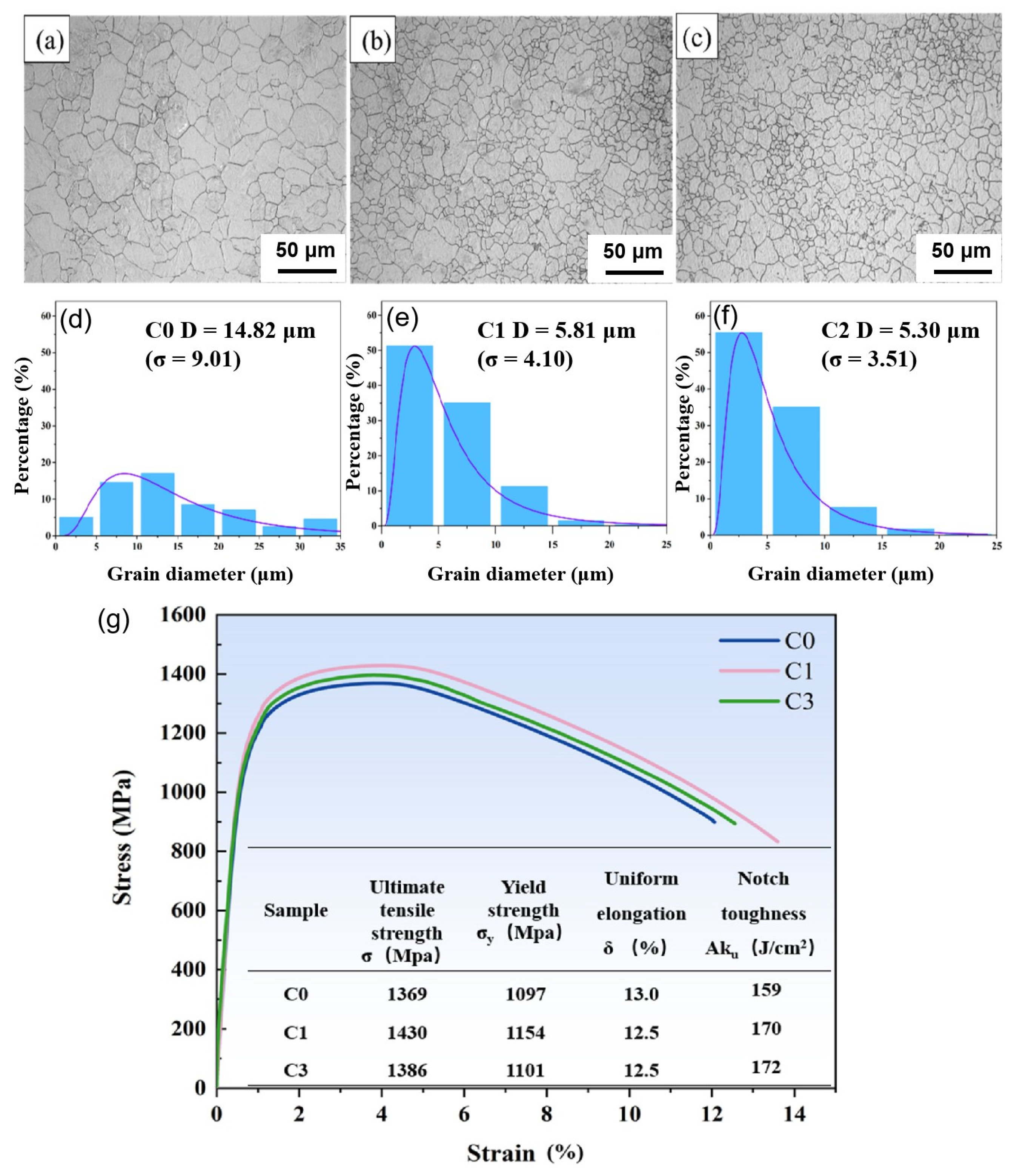
Cyclic quenching-tempering further refines grains by leveraging phase transformation energy: Liu et al. confirmed in Figure 3 that 3 cycles reduce the austenite grain size of 18CrNiMo7-6 steel from 14.8 μm to 5.0 μm, improving grain uniformity [14]. Energy stored during martensite-austenite transformation drives recrystallization, but residual stress release limits further refinement after multiple cycles [14]. The resulting grain refinement enhances toughness to 172 J/cm2 due to increased grain boundary density, which effectively hinders crack propagation [14]. Optimized annealing (910 °C × 8 h) improves grain uniformity of M50 bearing steel by mitigating furnace temperature inhomogeneity-induced mixed crystals [48], and annealing at 700 °C × 1 h after solution treatment of SCr420H steel enables 1050 °C × 8 h carburization without abnormal growth [13].
Surface mechanical pretreatments such as scanning electron beam pretreatment (SEBP), ultrasonic shot peening (USP), pre-shot peening, and laser heat treatment (LHT) enhance HTC efficiency and grain stability by modifying surface microstructure. SEBP forms a 110 μm thermally deformed layer on 22CrMoH steel, promoting carbon adsorption and diffusion [21]. Under the same gas carburization conditions, carburized layer thickness increases from 0.78 mm to 1.09 mm, surface hardness from 615 to 638 HV0.05, and wear amount reduces by 52.3% [21]. Carbide particles refine, and residual austenite content decreases, further improving surface performance [21].
USP creates a gradient nanostructured (GN) surface layer on 20CrMnTi steel, doubling surface carbide density and reducing carbide/martensite size by ~10% [24]. The integrated USP-carburizing process increases surface hardness by 50 HV and hardened layer depth by 50 μm, as carbon preferentially diffuses into high-angle grain boundaries (HAGBs) of the GN layer [24]. Pre-shot peening of AISI 9310 steel enhances effective hardening depth (EHD) and surface hardness (SH) by 36.4 HV, with shot peening intensity identified as the most critical factor (importance score 0.62) via random forest (RF) algorithm [25]. LHT of carburized 21Ni4CrMo2 steel with 450–1050 W power, 1.7–2.5 mm/s scanning speed, and 2.0–2.3 mm beam diameter refines grains and improves surface microhardness, with energy density 80–130 J/mm2, achieving martensitic transformation without defects [26].
In addition to bulk pretreatment methods, surface-specific pre-treatments such as plasma hardening, laser surface treatment, surface self-quenching, and normalizing have also emerged as effective strategies to tailor surface microstructures. These techniques introduce localized plastic deformation and rapid thermal cycling, which promote grain-boundary diffusion and induce surface grain refinement through dynamic recrystallization. Notably, surface quenching can further refine precipitates at grain boundaries, enhancing grain boundary pinning and improving the mechanical performance of the carburized surface layer.

3.3. Multidimensional Strategies for HTC Process Optimization

Innovating carburization processes and optimizing parameters directly regulate thermal and diffusion conditions during HTC, suppressing grain coarsening while improving efficiency and performance. For the context of this review, HTC optimization is defined by two core, often synergistic, objectives: (1) efficiency maximization through the reduction in processing time and energy consumption; and (2) performance enhancement by refining microstructures to increase surface hardness, wear resistance, and fatigue life, while maintaining core toughness. Key approaches include stage carburization (SC), solid-solution carburization, vacuum carburization, thermomechanical processing (TMP), and temperature-time window optimization, each tailored to address specific challenges in HTC and achieve these optimization goals.
Stage carburization (SC) involves stepwise heating from low to target temperature, increasing high-temperature strength via pre-carburization [27]. Compared to traditional vacuum carburization at a constant temperature (CTC), SC reduces retained austenite content by ~45% and gear tooth deformation, attributed to uniform stress distribution and enhanced austenite yield strength [27]. This process is particularly suitable for critical components requiring high-dimensional accuracy, such as aerospace gears, where precise shape control is paramount [27].
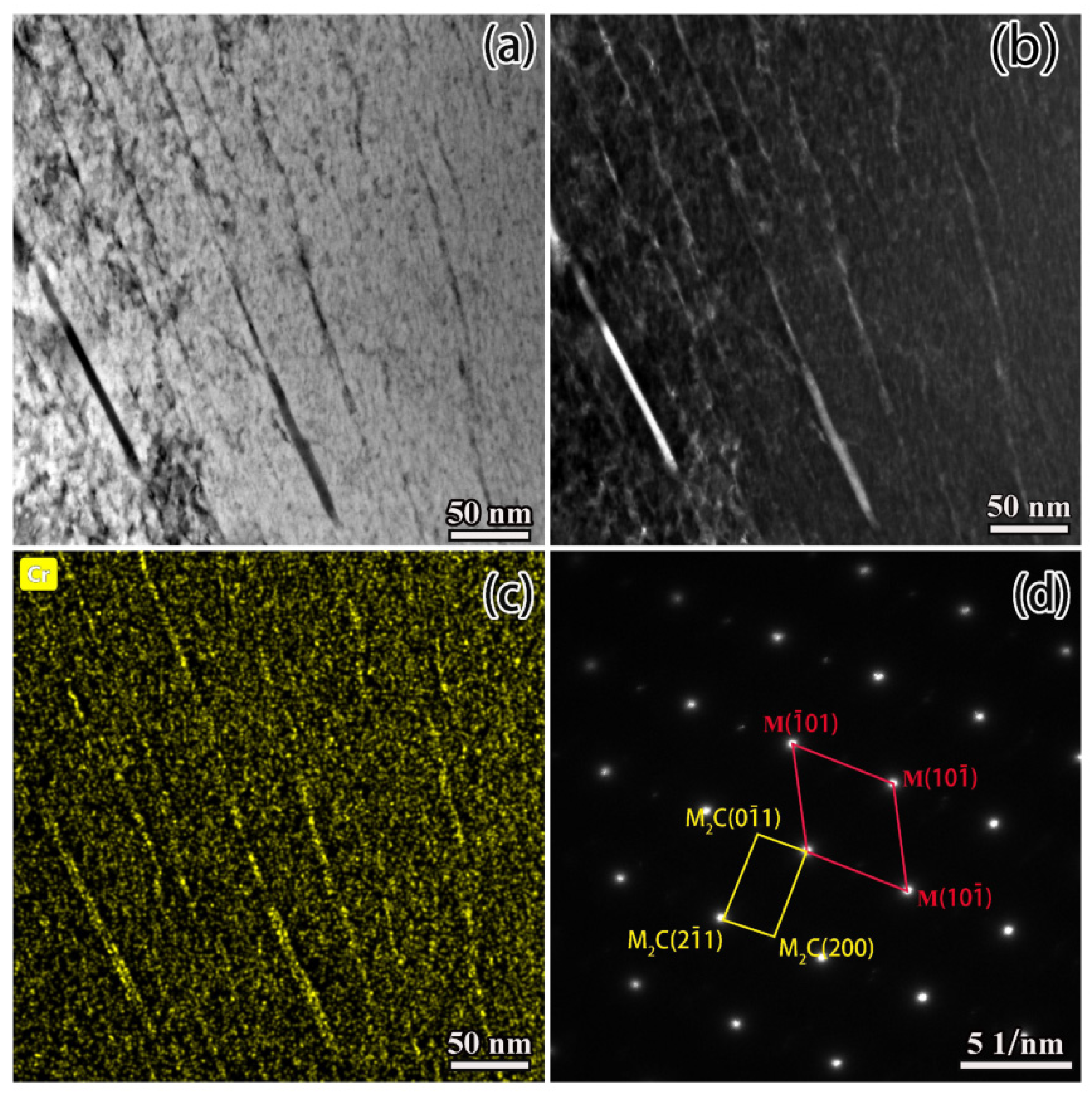
Solid-solution carburization addresses the problem of coarse reticulated carbides in conventional high-carbon-potential carburization. At 1100 °C, this novel process transforms coarse reticulated carbides into nano-dispersed M2C (as seen in Figure 4), increasing surface carbon content (1.07%) and microhardness (875 HV) by 17.7% and 2.4% vs. conventional processes [28]. Surface ultimate tensile strength reaches 1900 MPa, with core strength-toughness balance maintained, making it suitable for advanced gear steel C61. The refined M2C carbides enhance surface strength and inhibit crack initiation, further improving contact fatigue life [28].
Vacuum carburization enables precise control of carbon potential and atmosphere, avoiding oxidation and improving grain uniformity [29]. A multi-field coupled model (temperature-diffusion-phase transformation-stress) validated via COSMAP software (version not specified in the original study [29]) achieves carburized layer depth error < 6% and surface hardness error < 5% for 20CrMo steel [29]. The optimal process parameters (42 min carburizing + 1050 min diffusion) provide a reference for industrial application, with vacuum carburization suppressing grain coarsening by reducing residual oxygen-induced particle oxidation and degradation [29].
Thermomechanical processing (TMP) integrated with HTC optimizes grain size by leveraging strain-induced refinement. Hot torsion tests at 800 °C create a strain gradient in microalloyed 1045 steel, with greater strain leading to finer post-carburized PAG [8]. Nb-V steel exhibits the finest grains, while V steel shows abnormal growth at intermediate strains, highlighting the need for precise strain control [8]. TMP-induced grain refinement synergizes with microalloying to enhance HTC stability, providing a pathway for high-efficiency, fine-grain carburization.
Temperature-time window optimization, based on modified Sellars/Arrhenius models, balances efficiency and grain stability [3]. For 18Cr2Ni4WA steel, 950 °C and 970 °C reduce time by 37.2% and 53.5% vs. 930 °C without severe coarsening [4]; for 20MnCrS5 steel, 950 °C is identified as the critical temperature, requiring strict time control (<4 h) above it [36]. Thermo-Calc and DICTRA simulations accurately predict grain growth and optimize parameters, reducing reliance on costly experimental trials and accelerating process development [12,29].
To summarize, these optimization strategies offer complementary solutions to the challenges of HTC. Stage carburization and vacuum carburization excel in controlling dimensional accuracy and surface quality, respectively, making them ideal for high-precision applications. Solid-solution carburization is superior for maximizing surface hardness through nano-precipitation, while TMP provides a fundamental solution to grain coarsening via strain-induced refinement. Temperature-time window optimization, often supported by computational modeling, serves as a universal framework for balancing speed and microstructural integrity. The most promising future direction lies in the synergistic integration of these methods, such as combining TMP pretreatment with vacuum carburization within an optimized temperature-time window, to simultaneously achieve the maximum efficiency gains and performance enhancements demanded by next-generation gear manufacturing.

3.4. Integrated Regulation

Single regulation strategies have inherent limitations: microalloying introduces trade-offs between performance metrics, thermal pretreatments increase production cycles, and novel processes such as USP and solid-solution carburization face industrial scalability challenges. Integrated regulation—combining multicomponent microalloying, surface mechanical pretreatment, and optimized carburization—emerges as a promising direction to overcome these limitations and achieve synergistic grain refinement and performance enhancement.
Successful integrated approaches include Nb-V microalloying + USP pretreatment + solid-solution carburization, which synergistically enhances precipitate pinning, carbon diffusion, and carbide refinement to achieve ultra-fine grains (<10 μm) [7,24,28]. This combination results in a hardness of ~850 HV, 60% wear rate reduction, and 0.05 V corrosion potential increase for 20MnCr5 steel, balancing strength, wear resistance, and corrosion resistance. Te microalloying + stage carburization leverages Te-modified MnS for stable pinning and SC for deformation reduction, validated in industrial production to improve grain stability and dimensional accuracy [16,27].
Al-Nb microalloying + solution annealing + vacuum carburization combines AlN-Nb(C,N) composite precipitates for coarsening inhibition, solution annealing for precipitate dispersion optimization, and vacuum carburization for uniform grain growth, achieving consistent fine-grain structures across complex gear geometries [12,29]. Si/Al alloying + austempering + HTC forms superfine bainitic ferrite + martensite + retained austenite microstructure, meeting heavy-duty gear requirements for strength, toughness, and wear resistance [19].
Industrial applicability is prioritized in integrated regulation. Te microalloying, stage carburization, and normalizing are already validated in industrial production [16,23,27], while USP and solid-solution carburization require targeted equipment upgrades to scale. Future research should focus on quantifying synergistic effects of multiple strategies, developing cost-effective, scalable integrated solutions, and establishing process-microstructure-performance relationships to guide industrial implementation.

4. Correlation Between Grain Size, Microstructure, and Surface Performance

The surface performance of gear steels after HTC is inherently determined by the synergistic effect of grain size and derived microstructural evolution, including carbide precipitation, martensite morphology, residual austenite content, and grain boundary characteristics [17,24,49,50]. Grain refinement not only directly enhances mechanical properties via the Hall-Petch effect but also optimizes second-phase particle distribution and internal stresses, thereby improving wear resistance, corrosion resistance, and fatigue life [14,15,36].

4.1. Mechanical Properties

Grain size is a key factor governing the hardness of carburized gear steels. Finer austenite grains promote the formation of finer martensite laths during quenching, increasing grain boundary density and hindering dislocation motion [14,50]. Case-hardened steel exhibits a nano-hardness gradient from ~12 GPa (surface) to ~7 GPa (core), with a constant nano-hardness/microhardness ratio (~15), attributed to fine, uniformly distributed retained austenite (2–3 μm) that does not degrade nano-hardness [50]. It can be seen in Figure 5 that for 18CrNiMo7-6 steel, cyclic quenching-tempering reduces austenite grain size from 14.8 μm to 5.0 μm, leading to a toughness increase to 172 J/cm2 while maintaining acceptable tensile strength [14].
Microalloying-induced grain refinement further enhances hardness. Nb-microalloyed 20MnCr5 steel exhibits a ~30 HV hardness increase after 950 °C carburization, due to Nb(C,N) precipitation strengthening and grain boundary strengthening [6,17]. The generalized equation describing yield stress dependence on grain size across wide ranges reveals two critical grain sizes (dcr1, dcr2) that delineate changes in strengthening mechanisms: for d > dcr1, the Hall-Petch relation holds; for dcr1 > d > dcr2, the exponent varies from −1/2 to −1; and for d < dcr2, either softening (weak boundaries) or significant strengthening (strong boundaries) occurs [51]. This explains why ultra-fine grains (<10 μm) in 20CrMnTi steel achieve both high strength and toughness [22].
Austenitizing temperature also modulates mechanical properties. Vacuum-carburized 16CrMnH steel austenitized at 840 °C exhibits the highest fracture stress (1919 MPa) due to fine microstructure and optimal retained austenite-to-martensite transformation [52]. For high-grade pipeline steel, redefined effective grain size (misorientation > 15°) correlates with Charpy impact energy and DWTT shear area—finer effective grains reduce ductile-to-brittle transition temperature [53]. Additionally, dual-medium quenching of 18Cr2Ni4WA steel increases core bainite content from 20.5% to 45.7%, improving transition layer and core toughness without compromising surface hardness [45]. Si/Al-alloyed gear steel forms superfine bainitic ferrite + martensite + retained austenite microstructure after carburizing and austempering, achieving excellent mechanical properties that meet heavy-duty gear requirements [19].

4.2. Wear Resistance

Wear resistance is determined by grain size, carbide characteristics, and residual austenite content—all regulated by grain refinement [24,31,49]. Deep cold treatment reduces retained austenite content and precipitates tiny carbides, improving wear resistance of 20Cr2Ni4A and 17Cr2Ni2MoVNb steels, though wear mechanisms differ between grades [54]. Solid carburization parameters also influence wear resistance: for JIS S45C steel, pack carburization with finer carbon mesh (15 mesh) and higher temperature (900 °C) increases Vickers hardness, reducing wear rate [55]. Belt finishing of carburized 27MnCr5 steel shows that an optimal abrasive grain size (20–30 μm) balances material removal rate and surface roughness, indirectly enhancing wear resistance [56].
USP pretreatment of 20CrMnTi steel doubles surface carbide density and reduces carbide size by ~10%, decreasing the friction coefficient from 0.87 to 0.46 μ and wear amount by 52.3% [24]. Cu-alloyed TWIP steel achieves an ultrafine-grain (UFG) structure with doubled yield strength (~710 MPa) and 45% uniform ductility, resolving the traditional strength-ductility trade-off while maintaining good wear resistance [20]. For advanced gear steel C61, solid-solution carburization transforms reticulated carbides into nano-dispersed M2C, increasing surface microhardness to 875 HV and significantly improving wear resistance [28].

4.3. Corrosion Resistance

Corrosion resistance of carburized gear steels is mainly governed by grain size, microstructural evolution (e.g., martensite morphology, residual austenite), and surface state, regulated by high-temperature carburization (HTC) and auxiliary processes [31,57,58,59,60]. Grain refinement enhances corrosion resistance by optimizing passive film formation and reducing the galvanic corrosion driving force.
For conventional HTC, fine austenite grains (≤Grade 6) promote dense martensite and Cr-rich passive films. Nb microalloying refines prior austenite grains of 20MnCr5 steel to <20 μm at 950 °C, increasing corrosion potential to 0.627 V, while Nb-B synergistic addition coarsens martensite, reducing it to 0.675 V [31]. For carburized martensitic stainless steel, nanograin-boundary networks accelerate corrosion via ion transport, mitigable by optimizing grain uniformity and Al2O3 coatings [58].
Composite processes like carburization + wet shot peening (WSP) for 18CrNiMo7-6 steel reduce equivalent grain size by 13.9% and cut corrosion current density by 55.4% [57]. Laser carburization refines 20CrMnTi grains via interstitial carbon doping, improving corrosion resistance [59]. Notably, excessive grain refinement may increase surface roughness [57], promote martensite coarsening [31], or induce hydrogen embrittlement in fine-grained steels due to grain boundary segregation of hydrogen/oxygen [60]. Balancing grain size, martensite morphology, and residual stress via integrated regulation is critical for harsh service environments.

4.4. Fatigue Performance

Fatigue failure (tooth root bending fatigue, contact fatigue) is the primary failure mode of gears, and grain size plays a critical role in suppressing crack initiation and propagation [15,61]. Ultra-clean gear steels with fine grains exhibit higher tooth root bending strength, as grain refinement reduces stress concentration at non-metallic inclusions (fisheye failure sites) [47]. Pre-shot peening of AISI 9310 steel refines surface grains and increases residual compressive stress, enhancing effective hardening depth (EHD) and extending fatigue life by ~35% [25].
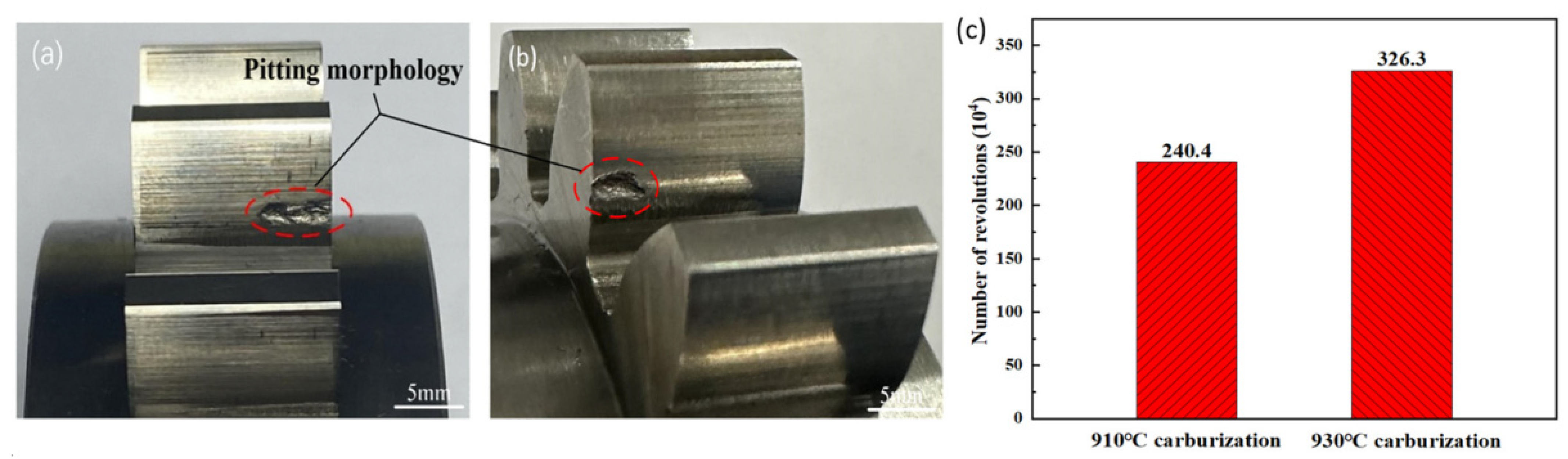
Grain size uniformity and thermal damage also affect fatigue performance. Grinding burns on carburized AISI 9310 steel cause over-tempering or re-hardening, reducing fatigue durability, which damage can be effectively detected by MBN (magnetic Barkhausen noise) measurements [62]. Al addition to 20MnCr5 steel forms AlN precipitates, increasing surface residual compressive stress (200–280 μm depth) and reducing non-metallic inclusions, thereby decreasing the stress intensity factor of fatigue crack propagation and improving contact fatigue life [15], which is proved in Figure 6. The contact fatigue mechanism involves subsurface crack growth induced by Hertzian shear stresses, with grain size influencing crack propagation resistance—finer grains increase the number of grain boundaries that hinder crack growth [61]. Nano-dispersed M2C carbides formed via solid-solution carburization enhance surface strength and inhibit crack initiation, improving contact fatigue life of C61 steel by ~50% [28].

4.5. Performance Synergy and Trade-Offs

While grain refinement is widely recognized for enhancing the mechanical properties, wear resistance, and fatigue performance of gear steels, it inherently introduces intricate trade-offs that demand deliberate optimization to balance overall performance. These trade-offs arise from microstructural modifications and their cascading effects on material functionalities, which are critical to address for high-temperature carburization (HTC) applications.
A key trade-off exists between strength and thermal conductivity: sub-micrometer-grained twinning-induced plasticity (TWIP) steels exhibit a 30% reduction in thermal conductivity compared to their coarse-grained counterparts, which impairs gear heat dissipation efficiency during service. At room temperature, the thermal conductivity of TWIP steel (~13 W/m·°C) is substantially lower than that of plain carbon steels (~45 W/m·°C), though this discrepancy diminishes gradually with increasing temperature [32]. Another critical trade-off involves wear resistance and corrosion resistance: Nb-B microalloying of 20MnCr5 steel enhances wear resistance but induces martensite coarsening, thereby compromising corrosion resistance [31]. Similarly, AlN-induced grain refinement improves fatigue performance but degrades hot ductility, posing challenges for thermomechanical processing [30].
The strength-ductility balance remains a classic challenge, which can be tailored via microstructural design. Si/Al-alloyed gear steels achieve a synergistic balance of strength and wear resistance through a microstructure composed of superfine bainitic ferrite and martensite [19]. Cu-alloyed TWIP steel forms an ultrafine-grained (UFG) structure, doubling the yield strength to ~710 MPa while retaining 45% uniform ductility, effectively alleviating the inherent strength-ductility trade-off [20]. Ultra-fine-grained duplex steels further leverage stress-assisted martensite transformation to enhance plasticity; an austenite grain size of ~300 nm promotes transformation-induced plasticity (TRIP), thereby optimizing ductility without sacrificing strength [63].
Grain size distribution also correlates with void formation behavior: a bimodal ferrite grain distribution in low-carbon steel minimizes the discrepancies in elastic modulus and Schmid factor among grains, reducing the tendency for void nucleation compared to uniformly ultrafine or coarse-grained microstructures [64]. This bimodal distribution enhances elasto-plastic compatibility between grains, ultimately improving both ductility and fatigue resistance—key performance metrics for carburized gears.
These trade-offs can be mitigated through integrated regulation strategies combining microalloying, pretreatment, and heat treatment. For instance, 20MnCr5 steel processed via Nb-V-Mo microalloying, ultrasonic shot peening (USP) pretreatment, and solid-solution carburization achieves a hardness of ~850 HV, a 60% reduction in wear rate, and a 0.05 V increase in corrosion potential, balancing wear resistance and corrosion performance [7,24]. Similarly, Si/Al alloying combined with austempering tailors the strength, toughness, and wear resistance of heavy-duty gear steel, meeting the technical requirements of high-power-density transmission systems [19].

5. Numerical Simulation and Predictive Models

Numerical simulation and predictive models have become indispensable tools for optimizing HTC of gear steels, enabling quantitative prediction of austenite grain growth, carbon diffusion, phase transformation, and mechanical properties [29,33]. These models not only reduce reliance on costly experimental trials but also provide in-depth insights into multi-scale grain size regulation mechanisms, facilitating the design of efficient, stable HTC processes [3,12]. This section systematically summarizes core models, simulation methods, industrial applications, and existing limitations.

5.1. Grain Growth Modeling

Grain growth models describe austenite grain size evolution during HTC by integrating thermal activation, second-phase particle pinning, and diffusion kinetics [3,33], with empirical and theoretical frameworks complementing each other. Empirical models, derived from experimental data and statistical fitting, focus on quantitative relationships between grain size, temperature, and holding time. The Beck equation (dnd0n = Kt) serves as the foundation, while modified Sellars and Arrhenius models are more suitable for HTC due to their ability to incorporate thermal activation effects [3]. Dai et al. [3] summarized that austenite grain growth in gear steels follows the Arrhenius equation: dnd0n = K0t exp(−Q/RT), where d is final grain size, d0 is initial grain size, K0 is pre-exponential factor, Q is activation energy, R is gas constant, and n (grain growth exponent) ranges from 2 to 4 for gear steels. For specific grades, Zhang et al. [11] derived a grain growth equation for 20CrMnTi steel, determining n = 3 and Q = 320 kJ/mol by fitting data at 970–980 °C, while Mo et al. [22] established critical carburization parameters for normalized 20CrMnTi steel based on modified Sellars models, ensuring industrial applicability [3,4].
Theoretical models focus on the Zener pinning effect of second-phase particles, with the classic Zener equation (dlim = 4r/(3fv)) (where dlim is limiting grain size, r is particle radius, and fv is particle volume fraction) modified to account for particle coarsening, dissolution, and non-uniform distribution during HTC [3,7,12]. Dai et al. [3] adjusted the dimensionless constant A (from 0.8 to 1.2) to improve prediction accuracy for Nb(C,N)/AlN-containing steels, while Bignon et al. [33] developed a 2D polycrystal model quantifying grain size heterogeneity induced by pinning, identifying optimal particle surface fractions (0.01–0.05) and sizes (50–200 nm) [33]. For composite precipitates (e.g., AlN-Nb(C,N)), Gong et al. [12] integrated the Zener model with DICTRA simulations to predict AlN coarsening kinetics and abnormal grain growth initiation time [12]. Advanced theoretical frameworks further enable cross-scale integration: finite element level-set formulations for 316L stainless steel reveal that anisotropic grain boundary (GB) energy (considering misorientation and inclination) predicts more realistic morphologies than heterogeneous GB energy models [65], and a continuum multi-disconnection-mode model explains complex GB migration via competing modes and driving forces [35]. Experimental validation is enhanced by electromagnetic acoustic resonance (EMAR) for dual-phase steel grain size detection [66] and atom probe tomography (APT) combined with transmission Kikuchi diffraction (TKD) for misorientation-dependent GB segregation in medium Mn steel, refining DFT calculations [67].

5.2. Multiphysics Coupled Simulations

Multiphysics simulations integrate temperature, carbon diffusion, phase transformation, and stress fields to capture complex HTC interactions, enabling comprehensive prediction of microstructural evolution and macroscopic properties [29,52]. Guo et al. [29] established a four-field coupled model validated via COSMAP software (version not specified in the original study [29]): 20CrMo steel vacuum carburization (42 min carburizing + 1050 min diffusion) achieves carburized layer depth error < 6% and surface hardness error < 5%. For high-carbon-potential carburization, Dai et al. [28] simulated reticulated carbide transformation to nano-dispersed M2C, revealing a 5.0 × 10⁻⁷ cm2/s carbon diffusion coefficient at 1100 °C (enhanced by grain boundary diffusion).
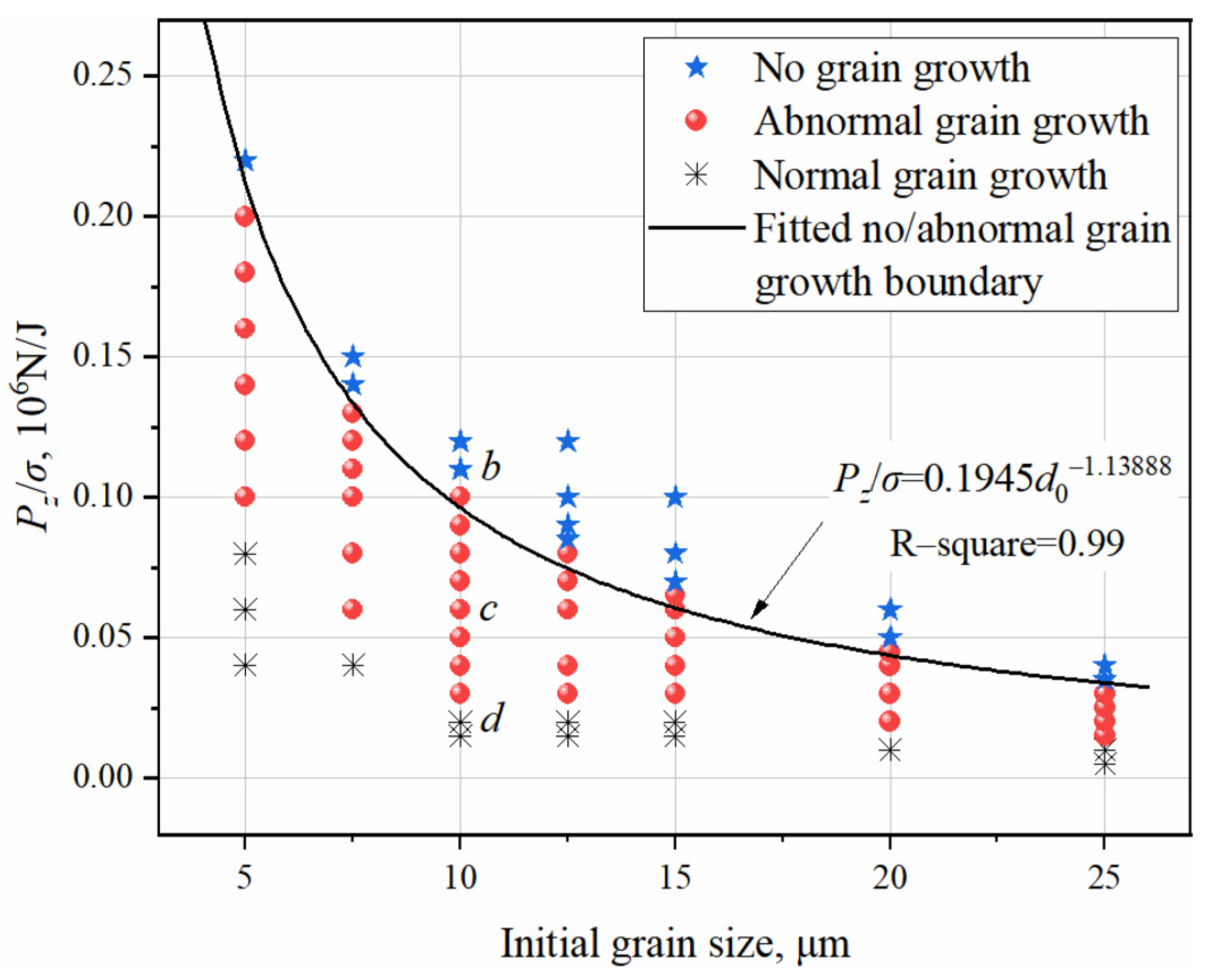
Phase field simulation is pivotal for mesoscopic abnormal grain growth studies. Liu et al. [40] developed a multiple phase-field model for Al-containing 20Cr steel, incorporating AlN precipitation kinetics and GB migration, with 92% accuracy in predicting critical abnormal growth conditions (shown in Figure 7). Gong et al. [12] confirmed via Thermo-Calc/DICTRA-coupled phase field simulation that AlN particles > 100 nm lose pinning effect, triggering rapid grain growth in SCr420H steel. Stress deformation regulation is critical for precision gears: Liu et al. [68] reduced radial shrinkage by 30% via inner hole-die quenching simulation, attributing deformation to carbon-induced phase transformation inconsistency, while Atraszkiewicz et al. [27] showed stage carburization reduces residual stress by 45% and tooth deformation by 30%. Novel techniques expand applications, such as ultrasound-assisted AM simulation for 316L grain refinement [69] and GBS-integrated frameworks for 316 stainless steel creep stress prediction [70].

5.3. Mechanical Property Prediction Models

Mechanical property models establish quantitative links between microstructure and performance, with empirical and machine learning (ML) approaches advancing in tandem. Empirical models integrate multiple strengthening mechanisms: Chen et al. [52] proposed an area-weighted stress–strain model for vacuum carburized steel, identifying 840 °C as optimal for maximum fracture stress (1919 MPa), while Wu et al. [49] derived a wear rate model for 18Cr2Ni4WA steel (W = 0.002Vcar−0.8·Vr0.5), showing 6% wear reduction with adjusted Vcar (3.4%→6.3%) and Vr (40.6%→4.8%).
ML models excel in capturing non-linear relationships with large datasets. Wu et al. [25] used random forest (RF) to optimize AISI 9310 shot peening parameters, identifying intensity as the key factor (importance score 0.62) and increasing effective hardening depth (EHD) by 15%. Tobie et al. [34,50] developed an ML model based on FZG test data, predicting contact fatigue life with ~85% accuracy. Neural network models further integrate process parameters and microstructure to predict HTC gear steel wear resistance, with a mean absolute error < 5% for wear rate.

5.4. Critical Challenges and Future Perspectives in Numerical Simulation and Predictive Models

Existing models face unresolved limitations: (1) Microstructural simplification ignores multi-element synergies (Nb-V-Mo-Te) [7] and inclusion-precipitate-GB interactions (Te-modified MnS [36], AlN-Nb(C,N) [37]); (2) Idealized boundary conditions deviate from industrial reality (furnace inhomogeneity, slab segregation [3,29]), with few digital twin models integrating real-time data [29]; (3) Cross-scale integration deficiency disconnects atomic (DFT), mesoscopic (phase field), and macroscopic (FEA) simulations [12,40]; (4) ML models lack datasets for novel processes (USP-carburization [25,34]) and high-entropy alloy (HEA) gears [71].
Future research should: (1) Incorporate grain size distribution and microalloying synergies [7,24]; (2) Develop data-driven digital twins for closed-loop control [29]; (3) Establish DFT-phase field-FEA coupling frameworks [12,40]; (4) Build industrial datasets for novel processes and HEAs to enhance ML generalization [25,34].

6. Challenges and Future Perspectives

Driven by the dual demands of low-carbon manufacturing and high-power-density transmission systems, HTC of gear steels has made remarkable progress in grain size regulation, process optimization, and performance enhancement. Nevertheless, inherent contradictions between process efficiency, microstructural stability, and performance synergy, coupled with constraints in industrial applications, remain unresolved, posing bottlenecks for further advancement.

6.1. Current Challenges

A primary challenge lies in the temperature ceiling of HTC (~1050 °C for most gear steel grades), which restricts efficiency improvements. Exceeding this temperature triggers rapid redissolution or ripening of most second-phase particles (e.g., AlN, (Ti,Mo)(C,N)) [12,13]. Even Nb-microalloyed steels have limitations: SAE4320 steel containing 0.45 wt.% Nb maintains a grain size < 20 μm at 1150 °C but undergoes partial Nb(C,N) dissolution at ≥1200 °C [44]. High-nitrogen steels exhibit increased fracture strain sensitivity to precipitates when grain size exceeds 51 μm, limiting their application in ultra-high-temperature HTC [59]. This temperature constraint hinders HTC’s potential to reduce processing time and carbon emissions.
Systematic exploration of cross-scale synergistic effects is lacking, manifesting in three key aspects: first, the interactions among chemical composition (multicomponent microalloying), processing (pretreatment + HTC), and microstructure (grain size + precipitates + inclusions) are insufficiently quantified. For example, the synergistic effects of Te-modified MnS inclusions, Nb-V-Mo precipitates, and ultrasonic shot peening (USP) pretreatment on grain stability and performance remain understudied [7,21,24]. Second, the synergy of grain size distribution, residual stress, and carbide characteristics on fatigue life is unclear; while bimodal grain distribution reduces void nucleation, its influence on contact fatigue crack propagation has not been fully elucidated [53,64]. Third, interactions between environmental factors (corrosive media, temperature cycling) and grain size are underinvestigated, particularly the effect of fine grains on corrosion-fatigue synergy in marine gear applications.
Conflicting research results persist due to incomplete parameter control. Heating rate affects the kinetics of Nb-rich precipitates in Ti-Nb-modified SAE 8620 steel—faster heating yields finer grains, but this effect is inconsistent across different Nb contents [41]. The role of grain boundary (GB) segregation in austenite nucleation and grain growth is also debated, with density functional theory (DFT) calculations and experimental data showing varying effects of Mn segregation on interface energy [67]. These inconsistencies impede the development of universal regulation strategies.
Promising laboratory-scale strategies face significant industrial barriers. Surface mechanical pretreatments (e.g., USP, surface mechanical attrition peening (SEBP)) require high-power equipment, increasing production costs and limiting adoption in medium-sized enterprises [21,25]. Solid-solution carburization at 1100 °C demands strict temperature control and high-purity atmospheres, exceeding the capacity of most existing industrial furnaces [28]. Te microalloying requires precise content control (0.034 wt.% as optimal) to avoid steel cleanliness issues, which is challenging in large-scale EAF-LF-VD-CC processes due to Te volatility [16]. Additionally, continuous integration of pretreatment-HTC-post-treatment (e.g., USP + HTC + subzero tempering) lacks industrial validation, with no established process chain for mass production [21,49].
Current strategies also lack a holistic framework to balance multi-performance requirements under complex service conditions. Aerospace gears require high fatigue resistance (>107 cycles) and high-temperature stability (>500 °C), but conventional alloy systems (e.g., 18CrNiMo7-6) exhibit rapid strength decay above 500 °C [5]. Electric vehicle (EV) drivetrain gears demand low noise (facilitated by fine grains) and high fatigue resistance, yet fine grains reduce thermal conductivity, impairing heat dissipation during high-speed operation [32]. Marine gears require both corrosion and wear resistance, but Nb-B microalloying improves wear resistance at the cost of corrosion performance [31].

6.2. Future Research Directions

Advanced microalloying system design is pivotal for addressing temperature bottlenecks and performance trade-offs. High-stability precipitate engineering involves combining Nb, Ta, and Hf to form ultra-stable carbides/nitrides (e.g., NbTa(C,N)) resistant to dissolution at 1200 °C [38,44]. Adding 0.02–0.05 wt.% Ta to Nb-microalloyed SAE8620H steel can extend the critical carburization temperature to 1150 °C, enabling ultra-high-temperature HTC. Zr-Nb synergistic microalloying is also promising for forming ZrNb(C,N) composite precipitates with higher thermal stability than single-phase precipitates. Multifunctional alloying aims for performance synergy: integrating Te (for MnS modification) with Nb-V-Mo (for precipitate pinning) dual-regulates inclusions and precipitates, improving grain stability and wear resistance while preserving corrosion performance [18]. Si-Al-Nb alloying systems for heavy-duty gears form superfine bainitic ferrite + martensite + nano-carbides to balance strength, toughness, and wear resistance [19], while Cu alloying enables ultrafine-grained (UFG) structures in EV gear steels, achieving high strength (>1500 MPa) and low noise (<60 dB) via grain refinement [20]. Low-cost and green alternatives include rare-earth elements (Ce, La) as substitutes for Nb/V (forming stable oxide-carbide precipitates) [15] and optimizing the [Al] [N] concentration product (2.9 × 10⁻⁴–5.1 × 10⁻⁴) in 20Cr steel to balance AlN pinning and thermoplasticity [30,40].
Intelligent process optimization and digital transformation will bridge the laboratory-industry gap. Data-driven parameter optimization relies on large datasets integrating process parameters (temperature, time, atmosphere, pretreatment), microstructural features, and performance metrics to develop machine learning (ML) models (random forest, neural networks) for real-time optimization, reducing trial-and-error costs by 40%–60% [25,34]. Digital twin models of HTC furnaces, coupling real-time temperature/atmosphere monitoring with multiphysics simulations (phase field + finite element analysis (FEA)), integrate sensor data to update models dynamically, improving carburized layer depth prediction accuracy to <3% and enabling closed-loop control of grain size and performance [29]. Continuous and green process integration combines low-energy pretreatment (ultrasonic-assisted shot peening, reducing energy consumption by 20%–30%), HTC, and post-treatment into a continuous line, eliminating intermediate steps and cutting carbon emissions, while renewable carbon sources and closed-loop atmosphere systems align with dual-carbon policies [21,49].
Cross-scale coupled modeling and advanced characterization will clarify unresolved synergistic mechanisms. An atomistic-mesoscopic-macroscopic coupling framework integrating DFT (nano-precipitate formation energy) [67], phase field (mesoscopic grain growth and precipitation) [40], and FEA (macroscopic stress deformation) [68] enables simultaneous prediction of nano-precipitate evolution, grain size, and residual stress, validated via in situ techniques (high-temperature confocal microscopy [36], in situ TEM [24], electromagnetic acoustic resonance (EMAR) [66]). Inclusion-precipitate-GB interaction modeling incorporates Te-modified MnS inclusions [16,18,36], AlN-Nb(C,N) composite precipitates [37], and misorientation-dependent GB segregation [67] into grain growth models, quantifying the effect of inclusion morphology and precipitate lattice matching on pinning force. Correlative characterization techniques (TKD-APT, EBSD-SEM, GIXRD-XANES) and non-destructive methods (EMAR, magnetic Barkhausen noise (MBN)) facilitate multi-scale microstructural analysis and industrial-scale model validation.
Novel materials and application expansion will broaden HTC’s scope. High-entropy alloy (HEA) gears, such as CoCrFeMnNi and CoCrNi, exhibit excellent mechanical properties and corrosion resistance [71]. Cold-rolled fine-grain (~1 μm) CoCrFeMnNi HEAs have 100% deeper carburized layers than coarse-grain counterparts, with Nb/V microalloying enhancing grain stability during HTC [71]. Targeted applications include ultra-high-temperature aerospace gears (based on third-generation carburized steels) [9], optimized EV drivetrain gears (18CrNiMo7-6 with cyclic quenching-tempering, achieving 172 J/cm2 toughness and low noise) [14], and corrosion-resistant marine gears (Nb-Al-Mo microalloying + Al2O3 coatings) [31].

7. Conclusions

High-temperature carburization (HTC) stands as a pivotal low-carbon manufacturing technology for gear steels, effectively reconciling production efficiency, energy conservation, and emission reduction to cater to the demands of the automotive, aerospace, and heavy machinery industries. This review systematically synthesizes recent advances in HTC of gear steels, centered on the core framework of “austenite grain coarsening mechanism, grain size regulation strategy, microstructure-performance correlation,” thereby providing a holistic theoretical and technical reference for industrial optimization.
The inherent contradiction between HTC efficiency and microstructural stability, which takes austenite grain coarsening as the core, remains the primary bottleneck. Elevated temperatures (950–1050 °C) accelerate carbon diffusion but trigger grain boundary migration and degradation of second-phase particles, with critical coarsening temperatures varying by steel grade—950 °C for 20MnCrS5 and 1050 °C for SCr420H. Precipitate thermal stability (Nb(C,N) > AlN > (Ti,Mo)(C,N)), alloy composition, and initial microstructure jointly govern grain growth behavior. Unresolved cross-scale synergistic effects and parameter control inconsistencies impede the development of universal regulation strategies.
To more clearly clarify the key structural properties that dominate the austenite grain growth behavior during HTC and provide a direct reference for the formulation of grain size regulation strategies, the core properties that counteract and contribute to austenite grain growth are systematically sorted and ranked in Table 1.
Four interrelated strategies enable effective grain size control, among which integrated regulation emerges as the most promising approach. Microalloying (Nb, Te, Al, Cu) forms stable precipitates or modifies inclusions; thermal and surface mechanical pretreatments optimize the initial microstructure; process innovation (stage carburization, solid-solution carburization) tailors thermal-diffusion conditions. Synergizing these strategies, such as Nb-V-Mo microalloying combined with USP pretreatment and solid-solution carburization, achieves ultra-fine grains (<10 μm) and balances multi-performance trade-offs, including those between wear resistance and corrosion resistance, as well as strength and ductility.
Grain size serves as the core link bridging HTC processes and gear surface performance. Finer grains enhance hardness, fatigue life, and wear resistance via the Hall-Petch effect and optimized carbide precipitation, yet they inherently induce trade-offs, such as reduced thermal conductivity. These trade-offs can be mitigated through multifunctional microalloying and integrated process design, ultimately enabling synergistic enhancement of mechanical properties, wear resistance, corrosion resistance, and fatigue performance.
Numerical simulations and predictive models, covering empirical/theoretical frameworks, multiphysics coupling, and machine learning-based approaches, provide indispensable support for HTC process optimization. Nevertheless, limitations persist in microstructural complexity simplification, cross-scale integration, and industrial scalability, necessitating the development of atomistic-to-macroscopic coupled models and real-time data-driven frameworks.
Future advancement of HTC hinges on five key directions: advanced microalloying system design (focused on high-stability composite precipitates), intelligent process optimization using digital twins and data-driven ML, cross-scale coupled modeling, green technology integration, and novel material exploration, such as high-entropy alloys. Addressing these areas will break existing temperature limitations, achieve finer grain sizes, and promote the widespread industrial application of HTC, driving the global gear manufacturing industry toward low-carbon, high-efficiency, and high-reliability development.

Author Contributions

Conceptualization, X.Z., Y.Z. and Y.C.; data curation, X.Z., Z.L. and K.W.; writing—original draft preparation, X.Z.; writing—review and editing, X.Z., D.P. and K.W.; visualization, X.Z., D.P. and L.L.; supervision, Y.C.; project administration, Y.Z.; funding acquisition, Y.Z. All authors have read and agreed to the published version of the manuscript.

Funding

This study was supported by Ansteel Beijing Research Institute Co., Ltd. under the project “Data-driven Hardenability Prediction Method of Gear Steel” (Grant No. 2025BJB-07).

Institutional Review Board Statement

Not applicable.

Informed Consent Statement

Not applicable.

Data Availability Statement

Data are contained within the article. Further inquiries can be directed at the corresponding author due to institutional policy.

Conflicts of Interest

Authors Xiangyu Zhang, Yu Zhang, Dong Pan, Kunyu Wang and Zhihui Li were employed by the company Ansteel Beijing Research Institute Co., Ltd. The remaining authors declare that the research was conducted in the absence of any commercial or financial relationships that could be construed as a potential conflict of interest. The authors declare that this study received funding from Ansteel Beijing Research Institute Co., Ltd. The funder was not involved in the study design, collection, analysis, interpretation of data, the writing of this article or the decision to submit it for publication.

References

  1. Davis, J.R. Gear Materials, Properties, and Manufacture; ASM international: Materials Park, OH, USA, 2005. [Google Scholar]
  2. Zaretsky, E.V. Rolling bearing steels–a technical and historical perspective. Mater. Sci. Technol. 2012, 28, 58–69. [Google Scholar] [CrossRef]
  3. Dai, Z.; Yang, J.; Zhang, Q.; Bai, Y.; Wu, X. Research progress on austenite grain growth and second-phase particle control technology in automotive gear steel. Chin. J. Eng. 2023, 45, 1878–1895. [Google Scholar]
  4. Du, Z.; Wu, Z.; Chen, X.; Chen, Q.; Yuan, Y.; Wang, X.; Chen, J. Evolution of microstructure and hardness during carburization heat treatment of heavy-duty Gear Steels: Numerical Prediction and Experimental Study. J. Phys. Conf. Ser. 2024, 2884, 012007. [Google Scholar] [CrossRef]
  5. Yuan, Y.; Yang, J.; Xue, Y.; Chen, Q.; Du, Z.; Chen, K.; Zhang, G.; Wang, X. Effect of the carburizing process on the microstructure and properties of 18CrNiMo7-6 steel. In Advances in Machinery, Materials Science and Engineering Application X, Proceedings of the 10th International Conference on Machinery, Materials Science and Engineering Application (MMSE 2024), 2024; IOS Press: Amsterdam, The Netherlands, 2024. [Google Scholar]
  6. He, G.; Zhang, N.; Wan, S.; Zhao, H.; Jiang, B.; Liu, Y.; Wu, C. The carburizing behavior of higg-Temperature short-time carburizing gear steel: Effect of Nb microalloying. Steel Res. Int. 2022, 93, 2200427. [Google Scholar] [CrossRef]
  7. Carrillo, L.; Wallace, D.; Pottore, N.; Findley, K.O.; Klemm-Toole, J. The Design of Nb, V and Mo microalloyed gear steels for grain size control during carburizing. In Microalloying’25: International Symposium on Microalloying, Proceedings of the Microalloying’25; International Symposium on Microalloying: Vail, CO, USA, 2025. [Google Scholar]
  8. Carrillo, L.; Findley, K.O.; Klemm-Toole, J.; Wallace, D. Effect of strain applied during thermomechanical processing on austenite grain size after carburizing in microalloyed steels. In Heat Treating 2025: Proceedings from the 33rd Heat Treating Society Conference and Exposition, Proceedings of Heat Treating 2025: 33rd Heat Treating Society Conference and Exposition, Detroit, MI, USA, 21–23 October 2025; ASM International: Materials Park, OH, USA, 2025. [Google Scholar]
  9. Yi, Z.; He, P.; Li, N.; Sun, Z. Material iterative development of aero carburizing gear steels. J. Aeronaut. Mater. 2023, 43, 60–69. [Google Scholar]
  10. Zhang, X.; Liu, H.; Lu, B.; Zhang, Y.; Zhao, Q.; Yan, Z.; Gong, S.; Guo, X.; Pan, D.; Wang, K. Nb Microalloying enhances the grain stability of SAE8620H gear steel during high-temperature carburizing. Coatings 2025, 15, 423. [Google Scholar] [CrossRef]
  11. Zhang, R.; Yuan, Q.; Tang, E.; Mo, J.; Zhang, Z.; Hu, H.; Xu, G. Role of precipitates on the grain coarsening of 20CrMnTi gear steel during pseudo-carburizing. Metals 2023, 13, 1422. [Google Scholar] [CrossRef]
  12. Gong, S.; Su, L.; Wang, F. Nucleation and coarsening behavior of aluminum nitride and its effect on abnormal grain growth in high-temperature carburizing process. Metall. Mater. Trans. A 2024, 55, 910–922. [Google Scholar] [CrossRef]
  13. Liang, S.; Gong, S.; Wang, F. Effect of preheat treatment process on austenite grain growth behavior in gear steel SCr420H for high temperature carburization. Special Steel 2023, 44, 74. [Google Scholar]
  14. Liu, X.; Yu, W.; Che, H.; Zhang, J.; Zhu, J.; Jiang, Q.; Zhang, C.; Wang, M. The effect of cyclic heat treatment on the microstructure and mechanical properties of 18CrNiMo7-6 gear steel. Materials 2024, 17, 5855. [Google Scholar] [CrossRef] [PubMed]
  15. Chen, Y.; Luo, L.; Zhang, Y.; Zhou, X.; Zeng, D.; Yu, F. Effect of Al element on retained austenite, residual compressive stress, and contact fatigue life of carburized and quenched 20MnCr5 steel gear. Materials 2024, 17, 5764. [Google Scholar] [CrossRef]
  16. Wang, J.; Bai, Y.; Liu, W.; Xu, H.; Zhang, Q.; Wang, G.; Yang, S.; Li, J. Prospect of tellurium in high-temperature carburizing gear steels: An industrial study. Materials 2025, 18, 2162. [Google Scholar] [CrossRef] [PubMed]
  17. He, G.; Wan, S.; Jiang, B.; Wang, Z.; Liu, Y.; Wu, C. Enhanced toughness of high-temperature carburizing gear steel via refining twin martensite and retained austenite by Nb microalloying. Steel Res. Int. 2022, 93, 2200425. [Google Scholar] [CrossRef]
  18. Bai, Y.; Wang, J.; Liu, W.; Wang, M.; Zhang, J.; Yang, S.; Zhang, Q.; Li, J. Tellurium-induced reduction in heat susceptibility of gear steel during high-temperature carburizing. Metall. Mater. Trans. B 2024, 55, 4829–4840. [Google Scholar] [CrossRef]
  19. Wang, Y.; He, Q.; Yang, Q.; Xu, D.; Yang, Z.; Zhang, F. Microstructure characteristics and wear performance of a carburizing Bainitic ferrite + martensite Si/Al-rich gear steel. Metals 2022, 12, 822. [Google Scholar] [CrossRef]
  20. Gao, J.; Jiang, S.; Zhang, H.; Huang, Y.; Guan, D.; Xu, Y.; Guan, S.; Bendersky, L.; Davydov, A.; Wu, Y.; et al. Facile route to bulk ultrafine-grain steels for high strength and ductility. Nature 2021, 590, 262–267. [Google Scholar] [CrossRef] [PubMed]
  21. Jiang, W.; Qu, J.J.; Liu, F.; Yue, G.; Zhou, L.; Luo, Y.C.; Ning, H.W. Effect of scanning electron beam pretreatment on gas carburization of 22CrMoH gear steel. Coatings 2024, 14, 611. [Google Scholar] [CrossRef]
  22. Mo, J.; Yuan, Q.; Liang, W.; Zhang, Z.; Hu, H.; Xu, G. Effect of the normalizing temperature on the size and homogeneity of austenite grain in 20CrMnTi carburized gear steel. Arab. J. Sci. Eng. 2025, 50, 13593–13604. [Google Scholar] [CrossRef]
  23. Zheng, X.; Yang, H.; Liu, Z. Exploration and process optimization of mixed crystal reasons in steel SCR420H for cold forging three-pins shaft. Special Steel 2025, 46, 133. [Google Scholar]
  24. Wang, H.; Yi, Y.; Wang, G.; Zhao, X.; Yin, F. Effect of ultrasonic shot peening pretreatment on carburizing heat treatment process of 20CrMnTi gear steel. ACS Appl. Mater. Interfaces 2025, 17, 25934–25950. [Google Scholar] [CrossRef]
  25. Wu, J.; Wei, P.; Liu, H.; Zhang, X.; He, Z.; Deng, G. Evaluation of pre-shot peening on improvement of carburizing heat treatment of AISI 9310 gear steel. J. Mater. Res. Technol. 2022, 18, 2784–2796. [Google Scholar] [CrossRef]
  26. Kluczyński, J.; Jasik, K.; Łuszczek, J.; Pokropek, J. Laser surface hardening of carburized steels: A review of process parameters and application in gear manufacturing. Materials 2025, 18, 3623. [Google Scholar] [CrossRef]
  27. Atraszkiewicz, R.P.; Dybowski, K. Minimizing deformations in high-temperature vacuum carburizing. Materials 2023, 16, 7630. [Google Scholar] [CrossRef]
  28. Dai, Y.; Kang, L.; Han, S.; Li, Y.; Liu, Y.; Lei, S.; Wang, C. Surface hardening behavior of advanced gear steel C61 by a novel solid-solution carburizing process. Metals 2022, 12, 379. [Google Scholar] [CrossRef]
  29. Guo, J.; Deng, X.; Wang, H.; Zhou, L.; Xu, Y.; Ju, D. Modeling and simulation of vacuum low pressure carburizing process in gear steel. Coatings 2021, 11, 1003. [Google Scholar] [CrossRef]
  30. Yao, F.; Xue, H.; Gao, H.; Jiang, C.; Deng, G. Effect of AlN and Zr microalloying on thermoplasticity and grain size of carburized gear steel. Special Steel 2023, 44, 94. [Google Scholar]
  31. He, G.; Feng, Y.; Jiang, B.; Wu, H.; Wang, Z.; Zhao, H.; Liu, Y. Corrosion and abrasion behavior of high-temperature carburized 20MnCr5 gear steel with Nb and B microalloying. J. Mater. Res. Technol. 2023, 25, 5845–5854. [Google Scholar] [CrossRef]
  32. Hwang, J.K. Effect of grain size on thermophysical properties in twinning-induced plasticity steel. Materials 2025, 18, 890. [Google Scholar] [CrossRef] [PubMed]
  33. Bignon, M.; Bernacki, M. Particle pinning during grain growth—A new analytical model for predicting the mean limiting grain size but also grain size heterogeneity in a 2D polycrystalline context. Acta Mater. 2024, 277, 120174. [Google Scholar] [CrossRef]
  34. Tobie, T.; Hippenstiel, F.; Mohrbacher, H. Optimizing gear performance by alloy modification of carburizing steels. Metals 2017, 7, 415. [Google Scholar] [CrossRef]
  35. Wei, C.; Thomas, S.L.; Han, J.; Srolovitz, D.J.; Xiang, Y. A continuum multi-disconnection-mode model for grain boundary migration. J. Mech. Phys. Solids 2019, 133, 103731. [Google Scholar] [CrossRef]
  36. Wang, J.; Bai, Y.; Zhen, A.; Liu, W.; Yang, S.; Yang, S.; Li, J. Synergistic control strategy for sulfur-containing gear steel inclusions and carburized grain stability: An industrial production analysis. Metall. Mater. Trans. B 2025, 57, 1171–1181. [Google Scholar] [CrossRef]
  37. Gong, S.; Wang, F.; Chen, K. AlN and Nb (C, N) composite precipitation behaviors and their effects on austenite grain growth in SCr420H high-temperature carburized gear steel. Steel Res. Int. 2024, 95, 2400080. [Google Scholar] [CrossRef]
  38. Xue, Y.; Yan, Y.; Yu, W.; He, X.; Shi, J.; Wang, M. Determination of solid solubility products of [Nb] [C] in the case and the core of high-temperature carburizing steel by extraction phase analysis method. Mater. Lett. 2022, 310, 131519. [Google Scholar] [CrossRef]
  39. Doane, D.V. Carburized steel-update on a mature composite. J. Heat Treat. 1990, 8, 33–53. [Google Scholar] [CrossRef]
  40. Liu, H.; Dong, Y.; Zheng, H.; Liu, X.; Lan, P.; Tang, H.; Zhang, J. Precipitation criterion for inhibiting austenite grain coarsening during carburization of Al-containing 20Cr gear steels. Metals 2021, 11, 504. [Google Scholar] [CrossRef]
  41. AlOgab, K.A. Austenite Grain-Size Control at Elevated Temperature in Microalloyed Carburizing Steels. Ph.D. Dissertation, Colorado School of Mines, Golden, CO, USA, 2004. [Google Scholar]
  42. Zhang, Z.; Wu, Z.; Yuan, Y.; Wang, X.; Tian, Y. Microstructure evolution and mechanical properties of high-Temperature carburized 18Cr2Ni4WA steel. Materials 2024, 17, 4820. [Google Scholar] [CrossRef]
  43. Kvackaj, T.; Bidulská, J.; Bidulský, R. Overview of HSS steel grades development and study of reheating condition effects on austenite grain size changes. Materials 2021, 14, 1988. [Google Scholar] [CrossRef]
  44. An, X.; Cao, W.; Zhang, X.; Yu, J. Suppress austenite grain coarsening by Nb alloying in high-temperature-pseudo-carburized bearing Steel. Materials 2024, 17, 2962. [Google Scholar] [CrossRef]
  45. Yuan, Y.; Jiang, Y.; Zhang, G.; Wang, X.; Du, Z.; Liu, K.; Zhang, Q. Numerical simulation of microstructure and hardness distributions during dual-medium quenching of high-temperature carburized 18Cr2Ni4WA steel. In Second International Conference on Frontiers of Applied Optics and Computer Engineering (AOCE 2025), Proceedings of the Second International Conference on Frontiers of Applied Optics and Computer Engineering (AOCE 2025); SPIE: Bellingham, WA, USA, 2025. [Google Scholar]
  46. Saito, G.; Sakaguchi, N.; Matsuura, K.; Sano, T.; Yamaoka, T. Effects of normalizing temperature on the precipitation of fine particles and austenite grain growth during carburization of Al-and Nb-microalloyed case-hardening steel. ISIJ Int. 2023, 63, 727–736. [Google Scholar] [CrossRef]
  47. Fuchs, D.; Fiederling, E.; Tobie, T.; Stahl, K. Investigations on the hardness and grain size of gears made out of ultra-clean gear steels after case-hardening. HTM J. Heat Treat. Mater. 2022, 77, 53–69. [Google Scholar] [CrossRef]
  48. Xu, L.; Li, T.; Ma, Y.; Zhou, Q.; Bai, P. Effect of Annealing Process on Grain Size of High Temperature Bearing Steel M50. Special Steel 2022, 43, 50. [Google Scholar]
  49. Wu, Z.; Li, Z.; Zhang, Q.; Jiang, Y.; Liu, Z.; Yuan, Y.; Wang, X. Effect of microstructure on wear resistance during high temperature carburization heat treatment of heavy-duty gear steel. Mater. Today Commun. 2024, 40, 109486. [Google Scholar] [CrossRef]
  50. Chen, W.; He, X.; Yu, W.; Shi, J.; Wang, M.; Yao, K. Characterization of the microstructure and hardness of case-carburized gear steel. Micron 2021, 144, 103028. [Google Scholar] [CrossRef] [PubMed]
  51. Firstov, S.A.; Rogul, T.R.; Shut, O.A. Critical grain sizes and generalized flow stress—Grain size dependence. arXiv 2013, arXiv:1304.7865. [Google Scholar]
  52. Chen, W.; He, X.; Yu, W.; Wang, M.; Yao, K. Microstructure, hardness, and tensile properties of vacuum carburizing gear steel. Metals 2021, 11, 300. [Google Scholar] [CrossRef]
  53. Niu, Y.; Jia, S.; Liu, Q.; Tong, S.; Li, B.; Ren, Y.; Wang, B. Influence of effective grain size on low temperature toughness of high-strength pipeline steel. Materials 2019, 12, 3672. [Google Scholar] [CrossRef]
  54. Yan, Y.; Liu, K.; Luo, Z.; Wang, M.; Wang, X. Effect of cryogenic treatment on microstructure, mechanical properties and distortion of carburized gear steels. Metals 2021, 11, 1940. [Google Scholar] [CrossRef]
  55. Ekaputra, I.M.W.; Wibisono, Y.A.; Haryadi, G.D. Carbon size and temperature effects to JIS S45C carburized steel. J. Rekayasa Mesin 2024, 15, 297–303. [Google Scholar] [CrossRef]
  56. Cherguy, O.; Elicegui, U.; Cabanettes, F.; Han, S.; Cici, M.; Pascal, H.; Rech, J. Effect of abrasive grains size on surface integrity during belt finishing of a 27MnCr5 carburized steel. Procedia CIRP 2022, 108, 305–310. [Google Scholar] [CrossRef]
  57. Wang, G.; Sang, X.; Wang, S.; Zhang, Y.; Xu, G.; Zhao, M.; Peng, Z. Surface integrity and corrosion resistance of 18CrNiMo7-6 gear steel subjected to combined carburized treatment and wet shot peening. Surf. Coat. Technol. 2024, 484, 130862. [Google Scholar] [CrossRef]
  58. Boonruang, C.; Thong–on, A.; Kidkhunthod, P. Effect of Nanograin–boundary networks generation on corrosion of carburized martensitic stainless steel. Sci. Rep. 2018, 8, 2289. [Google Scholar] [CrossRef]
  59. Tiantian, X.; Shi, W.; Chengrui, Z.; Yiyang, Z.; Yaochen, S. Study on mechanism of improving wear and corrosion properties of 20CrMnTi ring gear surface by laser carburizing. Mater. Today Commun. 2022, 32, 104029. [Google Scholar] [CrossRef]
  60. Ramlee, E.B.; Hussain, P.B.; Shaik, N.B. Enhancing the lifetime and corrosion resistance of gears made of carbon steel. Mater. Werkstofftech. 2020, 51, 774–779. [Google Scholar] [CrossRef]
  61. Hyde, R.S. Contact Fatigue of Hardened Steels; ASM International: Materials Park, OH, USA, 1996; pp. 691–703. [Google Scholar]
  62. Dychtoń, K.; Gradzik, A.; Kolek, Ł.; Raga, K. Evaluation of thermal damage impact on microstructure and properties of carburized AISI 9310 gear steel grade by destructive and non-destructive testing methods. Materials 2021, 14, 5276. [Google Scholar] [CrossRef] [PubMed]
  63. Yen, H.W.; Ooi, S.W.; Eizadjou, M.; Breen, A.; Huang, C.Y.; Bhadeshia, H.K.D.H.; Ringer, S.P. Role of stress-assisted martensite in the design of strong ultrafine-grained duplex steels. Acta Mater. 2015, 82, 100–114. [Google Scholar] [CrossRef]
  64. Karmakar, A.; Barat, K. Effect of elasto-plastic compatibility of grains on void-initiation criteria in low-carbon steel. Philos. Mag. Lett. 2019, 99, 261–273. [Google Scholar] [CrossRef]
  65. Murgas, B.; Flipon, B.; Bozzolo, N.; Bernacki, M. Level-set modeling of grain growth in 316L stainless steel under different assumptions regarding grain boundary properties. Materials 2022, 15, 2434. [Google Scholar] [CrossRef]
  66. Wang, B.; Wang, X.; Hua, L.; Li, J.; Xiang, Q. Mean grain size detection of DP590 steel plate using a corrected method with electromagnetic acoustic resonance. Ultrasonics 2017, 76, 208–216. [Google Scholar] [CrossRef]
  67. Varanasi, R.S.; Waseda, O.; Syed, F.W.; Thoudden-Sukumar, P.; Gault, B.; Neugebauer, J.; Ponge, D. Temperature and misorientation-dependent austenite nucleation at ferrite grain boundaries in a medium manganese steel: Role of misorientation-dependent grain boundary segregation. Acta Mater. 2025, 296, 121242. [Google Scholar] [CrossRef]
  68. Liu, H.M.; Zhao, J.Y.; Tang, J.Y.; Shao, W.; Sun, B.E. Simulation and experimental verification of die quenching deformation of aviation carburized face gear. Materials 2023, 16, 690. [Google Scholar] [CrossRef] [PubMed]
  69. Todaro, C.J.; Easton, M.A.; Qiu, D.; Brandt, M.; StJohn, D.H.; Qian, M. Grain refinement of stainless steel in ultrasound-assisted additive manufacturing. Addit. Manuf. 2021, 37, 101632. [Google Scholar] [CrossRef]
  70. Petkov, M.P.; Elmukashfi, E.; Tarleton, E.; Cocks, A.C. Evaluation of local stress state due to grain-boundary sliding during creep within a crystal plasticity finite element multi-scale framework. Int. J. Mech. Sci. 2021, 211, 106715. [Google Scholar] [CrossRef]
  71. Nam, H.; Kim, J.; Kim, N.; Song, S.; Na, Y.; Kim, J.H.; Kang, N. Effect of grain size on carburization characteristics of the high-entropy equiatomic CoCrFeMnNi alloy. Materials 2021, 14, 7199. [Google Scholar] [CrossRef] [PubMed]
Figure 1. Precipitates in (ac) as-hot rolled and pseudo-carburized steels at (df) 970 °C and (gi) 980 °C with corresponding energy spectrum analysis (Typical carbides were shown by red arrows) [11].
Coatings 16 00386 g001
Figure 2. Grain morphology of the test steels with different niobium contents under the pseudocarburizing regime of 1050 °C × 2 h after preheating. (a) Nb 0.02%; (b) Nb 0.04%; (c) Nb 0.053%; (d) Nb 0.08%; (e) Nb 0.10% [10].
Coatings 16 00386 g002
Figure 3. EBSD IPF + GB micrographs (ac) and IPF color map (a1c1) of the tested steel under different heat treatment cycles (a1c1). C0 (a,a1); C1 (b,b1); C3 (c,c1); the blue lines are low-angle boundaries with misorientation angles between 5° and 15°, whereas the black and red lines indicate the high-angle boundaries with misorientation angles of 15–45° and higher than 45°, respectively [14].
Coatings 16 00386 g003
Figure 4. Carbides in 0.1 mm depth of carburizing layer for novel solid-solution carburizing process: (a,b) bright- and dark-field image of carbides; (c) Cr elemental mapping analysis; (d) calibration of (a) [28].
Coatings 16 00386 g004
Figure 5. Micrographs showing the microstructures and prior austenite grains of the tested steels under different cycles. (a,d) C0; (b,e) C1; (c,f) C3; (g) Tensile properties and impact toughness test of C0, C1, and C3 samples [14].
Coatings 16 00386 g005
Figure 6. Macroscopic pitting morphology of gear after experiment: (a) carburizing and quenching at 910 °C, (b) carburizing and quenching at 930 °C, and (c) fatigue life [15].
Coatings 16 00386 g006
Figure 7. Various grain growth regimes as functions of initial grain size and pinning force [40].
Coatings 16 00386 g007
Table 1. Ranking of Structural Properties Governing Austenite Grain Growth During HTC.
Properties Counteracting Grain Growth (Inhibitory)Properties Contributing to Grain Growth (Promotive)
1. Thermal stability of microalloy precipitates (Nb(C,N) > AlN > composite precipitates like AlN-Nb(C,N)) [3,10,37]1. Exceeding critical carburization temperature (e.g., 1050 °C for SCr420H, 950 °C for 20MnCrS5) [12,36]
2. Fine and uniform initial grain size (via normalizing, cyclic quenching-tempering) [14,22]2. Degradation of second-phase particles (redissolution of (Ti,Mo)(C,N) or Ostwald ripening of AlN) [11,13]
3. Spheroidized/dispersed inclusions (Te-modified MnS, oxide-core MnS) [16,36]3. Coarse or heterogeneous initial grain structure [22,46]
4. Gradient nanostructured surface layer (via USP/SEBP pretreatment) [21,24]4. Lack of microalloying elements (insufficient Nb/Te/Al) [7,10]
5. Optimized process parameters (stage carburization, controlled heating rate) [27,41]5. Prolonged holding time above critical temperature [11,13]
6. Nano-dispersed carbides (via solid-solution carburization) [28]6. Excessive stored energy without effective pinning (e.g., incomplete precipitate formation after pretreatment) [24]
Disclaimer/Publisher’s Note: The statements, opinions and data contained in all publications are solely those of the individual author(s) and contributor(s) and not of MDPI and/or the editor(s). MDPI and/or the editor(s) disclaim responsibility for any injury to people or property resulting from any ideas, methods, instructions or products referred to in the content.