Article

Superhydrophobic Nanocomposite of Paraloid B72 and Modified Calcium Carbonate Nanoparticles for Cultural Heritage Conservation


by
Eirini Gkrava
1,
Nikoletta Florini
2,
Panagiotis Manoudis
1,
Anastasia Rousaki
1,
Christina P. Pappa
1,
Vasilios Tsiridis
3,
Maria Petala
3,
Eleni Pavlidou
2,
Philomela Komninou
2,
Konstantinos S. Triantafyllidis
4,5,
Thodoris D. Karapantsios
1,
Panagiotis K. Spathis
1 and
Ioannis Karapanagiotis
1,*
1
School of Chemistry, Aristotle University of Thessaloniki, 54124 Thessaloniki, Greece
2
School of Physics, Aristotle University of Thessaloniki, 54124 Thessaloniki, Greece
3
School of Civil Engineering, Aristotle University of Thessaloniki, 54124 Thessaloniki, Greece
4
Department of Chemistry, King Fahd University of Petroleum and Minerals, Dhahran 31261, Saudi Arabia
5
Interdisciplinary Research Center for Refining and Advanced Chemicals, King Fahd University of Petroleum & Minerals, Dhahran 31261, Saudi Arabia
*
Author to whom correspondence should be addressed.
Coatings 2026, 16(3), 347; https://doi.org/10.3390/coatings16030347

Submission received: 1 February 2026 / Revised: 5 March 2026 / Accepted: 6 March 2026 / Published: 10 March 2026
(This article belongs to the Special Issue Superhydrophobic Coatings, 2nd Edition)

Abstract

Superhydrophobic materials have clear potential for mitigating rain/humidity-induced damage to cultural heritage. In the present study, the wetting properties of Paraloid B72 were tailored to achieve superhydrophobicity by incorporating modified calcium carbonate (CaCO3) nanoparticles (NPs). B72 is a well-established conservation product while CaCO3 is chemically compatible with calcareous materials commonly found in cultural heritage buildings and objects. Initially, the wettabilities of CaCO3 NPs, functionalised with caproic (C6), caprylic (C8), lauric (C12), myristic (C14), palmitic (C16), and stearic (C18) acid, were evaluated by measuring water contact angles (CAs) on NP pellets. For NPs with short hydrocarbon chains, CA increased with chain length, from 66.3° for CaCO3-C6 to 118.0° for CaCO3-C12 NPs. For NPs with longer chains, CA remained stable and around 118°. Based on these results, CaCO3-C12 NPs were selected for further investigation and subjected to transmission electron microscopy analysis, which revealed chain-like agglomerates of aggregated nanocrystallites (5–10 nm) forming 40–150 nm polycrystalline NPs. Scanning transmission electron microscopy combined with elemental mapping revealed a homogeneous distribution of Ca, C, and O within the NPs. Next, CaCO3-C12 NPs were dispersed in B72 solutions and sprayed onto limestone, which was employed as a model calcite-rich substrate. At optimal NP concentration, the resulting composite coating exhibited superhydrophobicity (CA > 150°), while it induced minimal colour alteration to limestone and effective resistance to capillary water absorption. The fluorine-free coating also demonstrated good durability against UV exposure, drop impact, salt attack, freeze–thaw cycles, tape peeling, drop pH variations, and thermal treatment.

1. Introduction

The application of superhydrophobic, lotus-like, coatings for the protection of cultural heritage is an appealing strategy to mitigate the deteriorative direct (e.g., freeze–thaw cycles) and indirect (e.g., pollutant deposition) effects induced by atmospheric moisture and water [1,2,3,4,5,6,7,8,9,10]. With regard to the protection against water-induced effects, superhydrophobic coatings are, in principle, advantageous over typical hydrophobic coatings, used for heritage protection [11,12,13,14,15,16]. Despite the extensive research conducted over the past two decades on superhydrophobic coatings in general, their preparation and application on inorganic substrates (e.g., stone, mortar, metal, etc.) in cultural heritage conservation remain challenging [3,5,7]. Any conservation treatment must comply with strict requirements, established by conservation science principles and theory [17,18], such as, for instance, the need to ensure minimal colour alteration of the heritage object or structure. Furthermore, the coating application method should be suitable for use under ambient environmental conditions. Moreover, from a practical point of view the use of an entirely new conservation material always carries the risk of unforeseen negative long-term effects, especially after prolonged exposure to the environmental conditions. Hence, in real-world applications, conservators tend to favour reliable materials that have been extensively tested in relevant studies and whose performance has been critically evaluated over time by multiple research groups. One of these materials is certainly Paraloid B72, which is a methyl acrylate/ethyl methacrylate (MA/EMA) copolymer containing a small fraction of butyl methacrylate (BMA) units [19].
Over the years, B72 has received criticism, particularly due to its poor compatibility with inorganic materials [20,21], its limited penetration depth, which is an important factor when used for stone consolidation [21,22], and its susceptibility to significant degradation under prolonged exposure to atmospheric conditions [23,24]. Nevertheless, B72 continues to be widely employed in conservation treatments and remains an active subject of research, as demonstrated by the numerous related studies. For example, it has been applied as consolidant for natural stone [25,26,27,28,29], stabiliser for wood and wall paintings [30,31,32], protective coating for wooden objects [33] and adhesive for ceramics [34,35,36,37,38], metals [39,40,41] and enamelled goldware [42].
B72 is inherently hydrophilic, exhibiting a relatively low water contact angle (CA < 90°) [43], which is well below the threshold for superhydrophobicity (CA = 150°). The latter is typically achieved by introducing sufficient micro/nano-scale surface roughness, while in some cases the incorporation of low-surface-energy components is also required to obtain extreme non-wetting properties [5]. It should be noted that surface roughness plays a dual role in amplifying the intrinsic wettability of a material, as described by the classical models of Wenzel [44] and Cassie–Baxter [45]. According to the Wenzel model, increasing roughness enhances the solid–liquid contact area, thereby intensifying the inherent hydrophilic or hydrophobic character of the solid surface. According to the Cassie–Baxter model, in which air pockets are trapped between the water drop and the micro/nano-structures of the surface, roughness enhances the hydrophobic character of any (either inherently hydrophilic or hydrophobic) material.
Incorporating silica (SiO2) nanoparticles (NPs) into B72 coatings has proven to be an effective strategy to impart sufficient surface roughness, thereby producing superhydrophobic (CA > 150°) B72-based nanocomposites [43,46]. This approach was further developed by Zhou et al. [47] and Manoudis et al. [48], who produced superhydrophobic coatings by incorporating into B72 not only SiO2 NPs but also low-surface-energy-agents, such as polydimethylsiloxane (PDMS) [47] and a fluororesin [48]. It is worth noting that in other studies a similar approach was followed (i.e., incorporating NPs into B72), which yielded highly hydrophobic B72-based coatings. However, the reported CAs did not exceed the threshold of superhydrophobicity, i.e., CA < 150° [49,50,51]. In these studies, the employed NPs were titanium oxide (TiO2) [49], SiO2 [34], functionalised SiO2 [50] and TiO2 NPs, which were wrapped with SiO2 shells and functionalised with methyl groups [51].
In heritage conservation, calcium hydroxide (Ca(OH)2) holds particular significance because of its natural tendency to react with atmospheric CO2 and form calcium carbonate (CaCO3). This transformation ensures chemical affinity with calcite-rich stones and mortars which are frequently encountered in objects and buildings of the cultural heritage [20]. Chemical compatibility between conservation products and cultural heritage materials is of great importance. Therefore, Ca(OH)2 in the form of aqueous solutions or colloidal sols is frequently used for the conservation and consolidation of natural stones [52,53,54,55]. It should be noted that beyond its chemical affinity with calcareous materials, nanocalcite offers several additional advantages, including high stability, effective penetration into stone microporosities for consolidation purposes and low toxicity [56]. From the perspective of chemical compatibility, it is reasonable to substitute the frequently used SiO2 or other NPs, which were described in the previous paragraph, with CaCO3 NPs when attempting to develop superhydrophobic coatings for heritage carbonate substrates. Yet, only a handful of investigations have actually pursued this research route [57,58,59]. Chatzigrigoriou et al. synthesised Ca(OH)2 NPs and dispersed them into silane/siloxane emulsions that were immediately sprayed onto marble [57]. By adjusting the NP loading, the coatings achieved CA above 150°, thus demonstrating superhydrophobicity [57]. Burgos-Cara et al. produced CaCO3 NPs and introduced them into alkoxysilane formulations, which were applied to substrates including marble, calcarenite and gypsum plaster [58]. Although the treated specimens exhibited hydrophobicity, the measured CAs did not reach the threshold for superhydrophobic performance [58]. In a recent study, Gkrava et al. produced CaCO3 NPs which were functionalised with dodecanoic acid and dispersed in solutions of a silicic acid ester base product (KSE 100) [59]. The dispersions were deposited on limestone and marble specimens which obtained superhydrophobic properties [59]. Notably, modified CaCO3 NPs have also been employed in applications beyond the field of cultural heritage where superhydrophobicity was the primary objective. For example, Atta et al. prepared two types of modified CaCO3 NPs using oleic acid and epoxidized oleic acid, which were subsequently incorporated into a commercial epoxy resin system with a curing agent [60]. The resulting dispersion was applied onto steel substrates which exhibited superhydrophobic properties and enhanced resistance to seawater humidity [60]. Arbatan et al. prepared superhydrophobic CaCO3 powder modified with stearic acid [61]. The powder was successfully used to absorb diesel and crude petroleum oil out of a water–oil mixture [61]. Finally, Hu and Deng produced superhydrophobic CaCO3 NPs modified with either oleic or stearic acid. The produced NPs were deposited on a double pressure-sensitive adhesive tape with one side sticking on a glass slide [62].
In this study, the goal is to produce a superhydrophobic and water-repellent coating based on B72, a material widely employed in conservation practice, combined with CaCO3 NPs, which are chemically compatible with calcareous materials. Initially, CaCO3 NPs are synthesised and functionalised with fatty acids of various chain lengths. CA measurements are performed on pellets, made of NPs, to examine the influence of chain length on their wetting properties. The results show that NPs, functionalised with dodecanoic acid (DA), are a suitable choice as they yield high CA values. These selected NPs are thoroughly characterised using microscopic and spectroscopic techniques and subsequently dispersed in B72 solutions at various concentrations. The resulting dispersions are then sprayed onto calcite-rich specimens. Limestone was used as a model calcite-rich substrate. The effects of NP concentration on both the CA of the deposited coatings and the colour of the underlying limestone are systematically investigated. An optimal NP concentration is determined, which achieved superhydrophobicity while inducing only minor colour change to the stone. The resulting composite coating, consisting of B72 and DA-functionalised CaCO3 NPs, is then subjected to a series of tests to evaluate various properties, including its mechanical, chemical, and thermal stability.

2. Experimental

2.1. Materials

Hexanoic (caproic, C6), octanoic (caprylic, C8), hexadecanoic (palmitic, C16) and octadecanoic (stearic, C18) acids were purchased from Sigma-Aldrich (St Louis, MI, USA). Dodecanoic (lauric, C12) and tetradecanoic (myristic, C14) acids were obtained from Alfa Aesar (Haverhill, MA, USA) and Acros-Organics (Geel, Belgium), respectively. Carbon dioxide (CO2) was purchased from Buse Gas S.A. (Thessaloniki, Greece), calcium oxide (CaO) and ethanol were supplied by VWR Chemicals (Vienna, Austria) and limestone samples were obtained from K-Stones (Athens, Greece). Paraloid B72 was purchased from In Situ (Thessaloniki, Greece) and toluene from Alfa Aesar.

2.2. Production of Functionalised CaCO3 NPs

Calcium carbonate (CaCO3) nanoparticles (NPs) were produced and modified with fatty acids (C6, C8, C12, C14, C16 and C18) according to the following procedure [59,63]. Initially, 2.5 g of CaO was dissolved in 50 mL of deionized water and maintained under continuous stirring at 80 °C overnight. Another solution was prepared by dissolving 2 g of fatty acid in 100 mL of ethanol which was mixed with 2 mL of the aqueous solution of CaO. The resulting mixture was stirred magnetically for 2 h. CO2 was introduced into the mixture at a flow rate of 1 L/min, with the pH monitored throughout. The pH, which was initially around 12, decreased steadily and reached neutrality (pH = 7) after approximately 45 min. The resulting precipitate was washed sequentially with deionised water and ethanol, and then dried at 60 °C for 24 h to yield powdered CaCO3 NPs functionalised with the corresponding fatty acids. These powders were subsequently pressed into pellets for contact angle (CA) measurements. In addition, CaCO3 NPs modified with dodecanoic acid (hereafter referred to as CaCO3-C12) were incorporated into B72 solutions for further investigation, as described in the following section.

2.3. Production of Superhydrophobic Coatings

Paraloid B72 was dissolved in toluene to prepare a stock solution of 3% w/w. Toluene is an effective solvent for B-72 [64,65,66], although its use requires appropriate safety precautions. CaCO3-C12 NPs were introduced to the B72 solution to prepare dispersions with NP concentrations of 1, 2, 3 and 4% w/v. The dispersions were magnetically stirred for 30 min and were applied onto limestone specimens using an airbrush system (Paasche Airbrush, Kenosha, WI, USA) operated with a nozzle diameter of 733 μm and positioned 20 cm away from the stone surfaces. Spraying time was approximately 2 s. For control experiments, limestone samples were treated with the B72 stock solution without NPs using the same spraying system. Following deposition, all coated specimens were subjected to thermal treatment at 60 °C for 1 h to accelerate solvent evaporation and curing. The wettability of the coated limestone samples was evaluated through CA measurements and, based on the results, the composite coating consisting of B72 and 3% w/v CaCO3-C12 NPs (hereafter referred to as B72-3Ca) was selected for further studies.

2.4. Material Characterisation

B72 was characterised using Fourier transform infrared spectroscopy (FTIR). The Carry 670 FTIR Spectrometer (Agilent Technologies, Santa Clara, CA, USA) employed was equipped with an attenuated total reflectance (ATR) device using a diamond crystal (Gladi-ATR, Pike Technologies, Madison, WI, USA). The spectrum was collected at a spectral region from 6000 to 400 cm−1, with 32 scans and a resolution of 4 cm−1, in absorbance mode. The FTIR Spectrometer was employed to characterise also the B72-3Ca coating before and after UV treatment. For this study, samples were prepared as follows: small amounts of material were carefully scraped from the surfaces of the two coated limestone specimens (non-aged and UV-aged specimen) and investigated using ATR-FTIR spectroscopy. Limestone was characterised by X-ray diffraction (XRD) and nitrogen (N2) sorption measurements. XRD analysis was performed in a Rigaku Ultima+ diffractometer (Rigaku, Tokyo, Japan) with CuKa radiation (λKa = 0.15406 nm), operating at 40 kV and 30 mA. X-ray counts were collected within the range of 2θ = 5–85°, a step size of 0.05° and a step time of 2 s. The N2 sorption measurements (−196 °C) were conducted with an Automatic Volumetric Sorption Analyzer (Autosorb-1 MP, Quantachrome, Boynton Beach, FL, USA). Limestone was outgassed, prior to nitrogen adsorption, at 250 °C for 19 h under 5 × 10⁻⁹ Torr vacuum. The total surface area was determined by the multipoint BET method, and the total pore volume was determined from adsorbed nitrogen at P/Po = 0.99.
The morphology, microstructure, and chemistry of CaCO3-C12 NPs were investigated using transmission electron microscopy (TEM) and scanning transmission electron microscopy (STEM) combined with energy-dispersive X-ray spectroscopy (EDXS). TEM specimens were prepared by dispersing a small amount of powder in ethanol and ultrasonically treating it for 30 min. A few drops of the suspension were deposited onto 300-mesh carbon-coated copper grid and air-dried at room temperature. Analyses were performed on a JEOL JEM F200 CFEG TEM/STEM (JEOL Ltd., Tokyo, Japan) operated at 200 kV, with a high-resolution TEM (HRTEM) point-to-point resolution of 0.19 nm, equipped with a bottom-mounted 9 Mpixel RIO GATAN CMOS camera (Gatan, Inc., San Diego, CA, USA) and an Oxford Instruments T-max 65 EDX detector (Oxford Instruments, Oxfordshire, UK). HRTEM, STEM, selected area electron diffraction (SAED), and EDXS were employed to investigate NP morphology, size, crystalline structure, and chemical composition.

2.5. Coating Performance

Wettability studies were conducted using a mobile surface analyzer (MSA, Krüss GmbH, Hamburg, Germany) according to the sessile drop method. Contact angles (CAs) of distilled water drops (5 μL) on pellets, prepared with NPs, and on coated limestone specimens (blocks of 2 × 2 × 2 cm), were carried out at room temperature. Three drops were placed on different areas of the solid surfaces and average values were calculated. CA measurements were performed immediately after drop deposition on the surfaces of the solid samples. Surface structures of deposited coatings were revealed using a JEOL JSM-6390LV (JEOL Ltd., Tokyo, Japan) scanning electron microscope (SEM).
Colour measurements were performed on uncoated limestone specimens and limestone samples (blocks of 5 × 5 × 2 cm) coated with B72 and B72-3Ca using a PCE-CSM 1 spectrophotometer (PCE Instruments, Hamble-le-Rice, UK), and the data were analysed according to the CIE 1976 [67] L * , a * , b * colour space. In particular, the changes in the lightness ( Δ L * ), the red–green component ( Δ a * ) and the yellow–blue ( Δ b * ) component were calculated as follows: Δ L *   =   L c *     L u * ;   Δ a *   =   a c *   a u * ; Δ b *   =   b c   *   b u * . The “c” and “u” subscripts indicate the coated and uncoated samples, respectively. Using the changes in the colour coordinates, the overall colour changes ( Δ E ) induced to the limestone specimens by the applications of the coatings were calculated using the following equation:
Δ E   =   ( Δ L * 2   +   Δ a * 2   +   Δ b * 2 )
Surface roughness measurements were carried out on uncoated and coated limestone samples (blocks of 5 × 5 × 2 cm) using a confocal microscope (Leica DCM8, Leica Microsystems CMS, Wetzlar, Germany) at profilometer mode.
The capillary water absorption test was conducted using uncoated and coated limestone samples (blocks of 2 × 2 × 2 cm). The procedure was adopted from EN 15801 (CEN, 2009) [68]. In particular, samples were positioned so that their coated faces rested on a pad of filter paper (Whatman No. 4) and were immersed in distilled water to a depth of approximately 0.2 cm. To prevent lateral water uptake, the sides of each sample were sealed with waterproof Teflon tape. Water uptake was quantified by monitoring the weight gain of the samples at regular intervals over a 4 h period. The capillary water absorption test was performed on uncoated and coated (B72 and B72-3Ca) limestone samples.
Coated limestone samples (blocks of 2 × 2 × 2 cm) were subjected to artificially accelerated ageing conditions, using a custom-built irradiation chamber which was equipped with an Osram Dulux S Blue (Munich, Germany) UV lamp (9W/78V, UVA range 300–400 nm). The samples were positioned 32 cm from the light source, the radiation intensity was 1.064 W/m2 and the temperature was maintained at 27.7 °C. The UV ageing test was performed on limestone samples coated with B72 and B72-3Ca. The effects of the UV radiation on the two coatings were evaluated through CA measurements, which were performed periodically for 15 weeks in total.
In the drop impact test, cubic samples (2 × 2 × 2 cm) coated with B72 and B72-3Ca were positioned beneath a water container fitted with four small openings at its base, enabling the release of fine drops that struck the sample surface. One simulated rain cycle was defined as the release of 1 L of distilled water over approximately 1 h. The vertical distance between the container and the sample surface was fixed at 50 cm. Each specimen was subjected to four consecutive cycles, corresponding to a total of 4 L of water. Following each cycle, the samples were oven-dried at 60 °C for 2 h. The performances of the tested coatings were evaluated through CA measurements.
The salt crystallisation resistance was evaluated following the EN 12370 standard [69]. In this test, uncoated limestone specimens and samples coated with B72 and B72-3Ca (blocks of 5 × 5 × 2 cm) were immersed for 2 h at room temperature in an aqueous solution of sodium sulphate decahydrate (Na2SO4·10H2O) at a concentration of 14% w/w. After soaking, the specimens were removed from the solution, dried in an oven at 100 °C for 16 h, cooled to room temperature, and subsequently weighed. The process was carried out over 10 consecutive cycles.
Additional tests were conducted to evaluate the stability of the B72-3Ca coating through CA measurements. Aqueous drops with pH ranging from 1 to 14 were deposited on the coated limestone surface samples (blocks of 2 × 2 × 2 cm) and CAs were measured. The test solutions were prepared using hydrochloric acid (HCl, ChemLab) and sodium hydroxide (NaOH, ChemLab). The durability of coated limestone samples (blocks of 2 × 2 × 2 cm) was evaluated against freeze–thaw cycles. Samples were exposed to −22 °C for 15 min, followed by thawing at ambient temperature inside a silica desiccator. The process was carried out over 10 consecutive cycles. The tape-peeling test was conducted using Scotch Tape 600 (3M, Maplewood, MN, USA) and following the ASTM D3359-97, Method A [70]. The coated faces (5 × 5 cm) of limestone (blocks of 5 × 5 × 2 cm) specimens were repeatedly subjected to sequential application and removal of the tape and the procedure was repeated for 40 peeling cycles in total. In a separate set of experiments, limestone-coated samples (blocks of 2 × 2 × 2 cm) were annealed at 100, 200, 300, 400, 500 and 600 °C for 1 h to investigate the effect of the thermal treatment on the wetting properties of the coatings.

3. Results and Discussion

3.1. Characterisation of Paraloid B72, Limestone and NPs

The ATR-FTIR spectrum for B72 is shown in Figure S1 of the Supplementary Materials. The characteristic absorptions of B72 can be detected as follows [26,71,72]: at the spectral region 2900–3000 cm−1 the C–H stretching vibrations; the strong absorption of C=O carbonyl stretching at 1722 cm−1; C–H bending vibrations at the spectral region 1375–1475 cm−1; absorption due to C–O stretching at 1234 cm−1; C–C=O–O functional groups from polymethacrylate at 1150–1140 cm−1; C–O vibration at 1024 cm−1.
Limestone samples were analysed using XRD to determine and identify the mineral phases. The results are shown in Figure S2 of the Supplementary Materials. From the XRD pattern, phase and quantification (Rietveld) analysis, it was determined that calcite was the major mineral phase found in the limestone samples (97.7 wt%) with intense peaks found at 2θ: 23.08°, 29.44°, 39.36°, 43.15°, 47.55°, 48.52° and 56.53–65.64°. Additionally, low intensity 2θ peaks corresponding to aragonite (2.2 wt%) and silica phase present as quartz (0.1 wt%) were also identified. Finally, according to N2 sorption measurements (Figure S3 of the Supplementary Materials), limestone did not contain micro- or mesopores and exhibited a very low specific surface area (~2 m2/g), which can be attributed mainly to macropores and external surface area. The total pore volume (at P/Po = 0.99) was calculated to be 0.017 cm3/g.
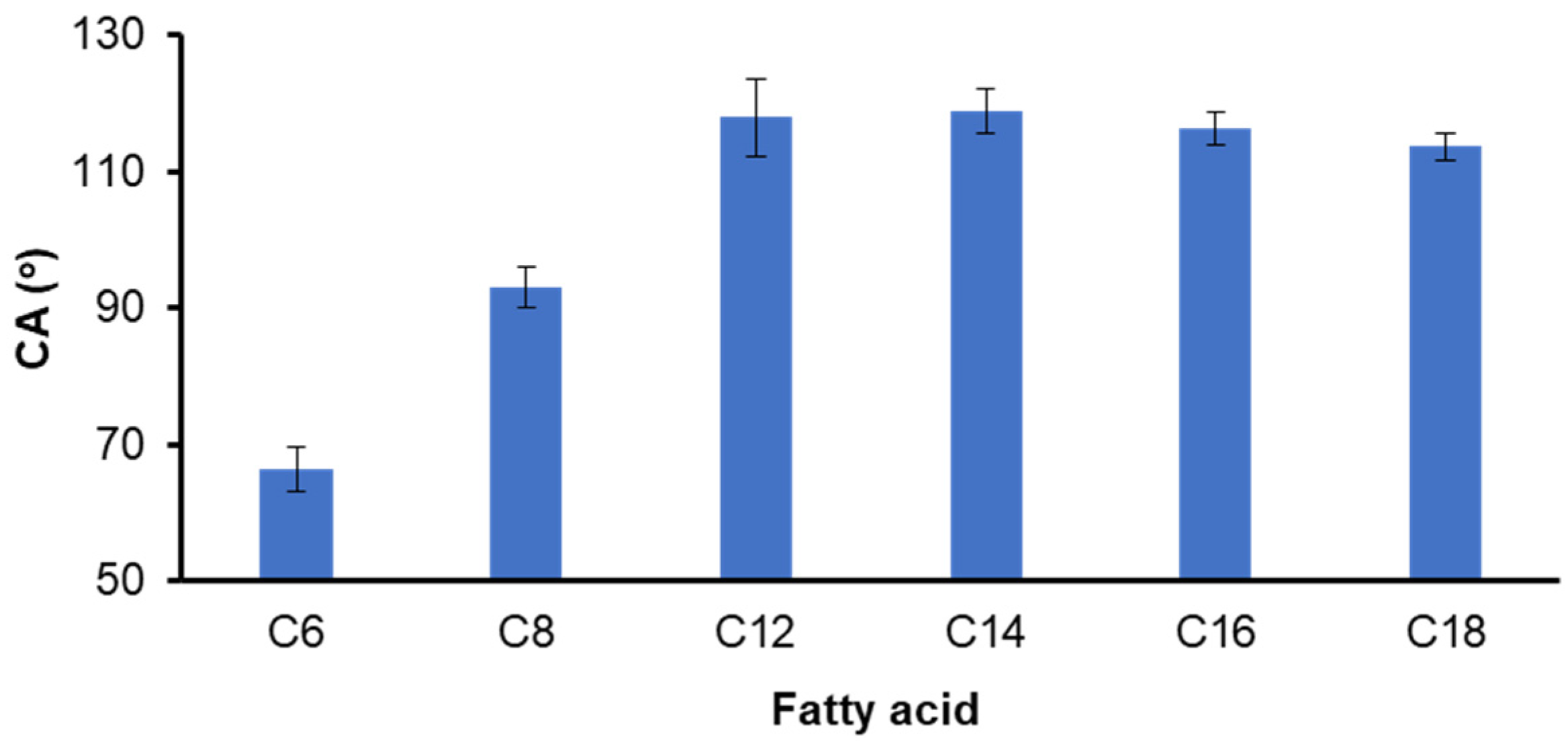
Figure 1 shows CA measurements on the surfaces of pellets which were prepared using NPs with different fatty acids. For short hydrocarbon chains, the CA shows a strong dependence on chain length, increasing from 66.3° for hexanoic (C6) to 118.0° for dodecanoic acid (C12). For longer hydrocarbon chains, however, this dependence disappears, as the CA remains nearly constant at around 118° for dodecanoic (C12), tetradecanoic (C14) and hexadecanoic (C16) acids, with only a slight and almost negligible decrease observed for octadecanoic acid (C18). Notably, both the trend and the CA values reported in Figure 1 are in excellent agreement with previous measurements obtained on calcite surfaces treated with fatty acid vapours [73]. As the primary objective of this investigation is to achieve the maximum possible hydrophobisation of limestone, the results presented in Figure 1 are particularly useful for selecting the most suitable type of NPs. In principle, any NP corresponding to the plateau region of the curve in Figure 1, where the maximum CA is obtained, could be employed in the subsequent studies. For the present work, NPs functionalised with dodecanoic acid (CaCO3-C12) were selected.
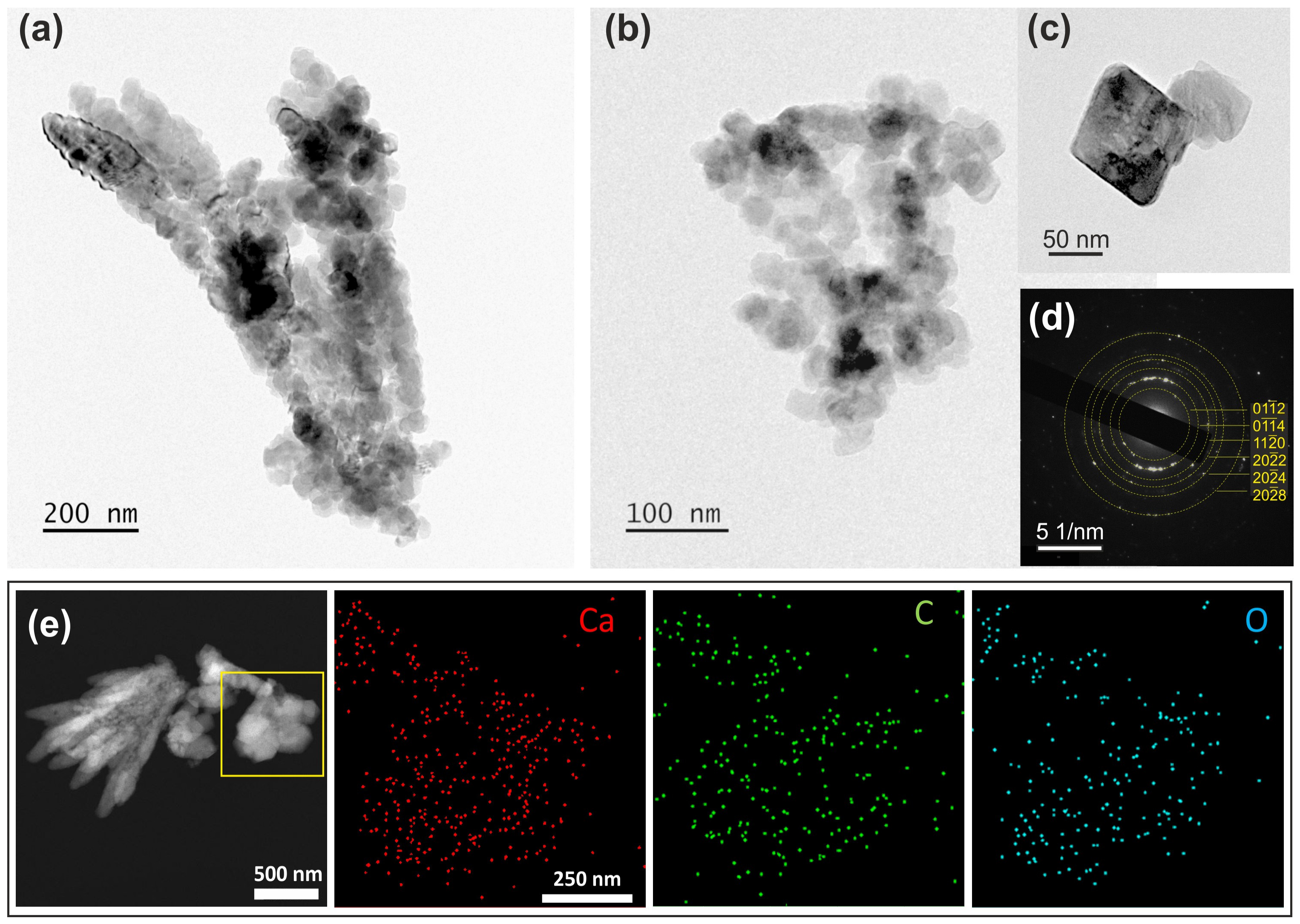
Analytical TEM techniques were employed to investigate the morphology, size, crystalline structure, and chemical composition of the selected CaCO3-C12 NPs. Representative bright-field (BF) TEM images shown in Figure 2a,b reveal that the NPs predominantly form agglomerated ensembles, often arranged in chain-like configurations. Individual NPs exhibit a mainly rhombic morphology, with sizes ranging from approximately 40 to 150 nm, as observed in Figure 2c. Their crystalline structure was determined by selected area electron diffraction (SAED). The SAED pattern shown in Figure 2d, recorded from the NP of Figure 2b, consists of multiple concentric diffraction rings, indicating aggregated nanocrystals randomly orientated, forming the NP. The sequence of the diffraction rings, from the inner to the outer, corresponds to the interplanar spacing of {01 1 ¯ 2}, {0 11 ¯ 4}, {11 2 ¯ 0}, {20 2 ¯ 2}, {20 2 ¯ 4}, and {20 2 ¯ 8} lattice planes of rhombohedral calcite structure, corresponding to the space group R 3 ¯ c. These results confirm that calcite is the dominant crystalline phase of the synthesised NPs. The chemical composition and elemental distribution were further investigated by STEM–EDXS. Figure 2e presents a high-angle-annular-dark-field (HAADF), otherwise called Z-contrast, STEM image showing a “hand-like” agglomerate of aggregated CaCO3 NPs. The uniform elemental distributions of calcium (Ca), carbon (C), and oxygen (O) confirm the chemical homogeneity of the CaCO3-C12 NPs and support the phase identification obtained from SAED analysis.
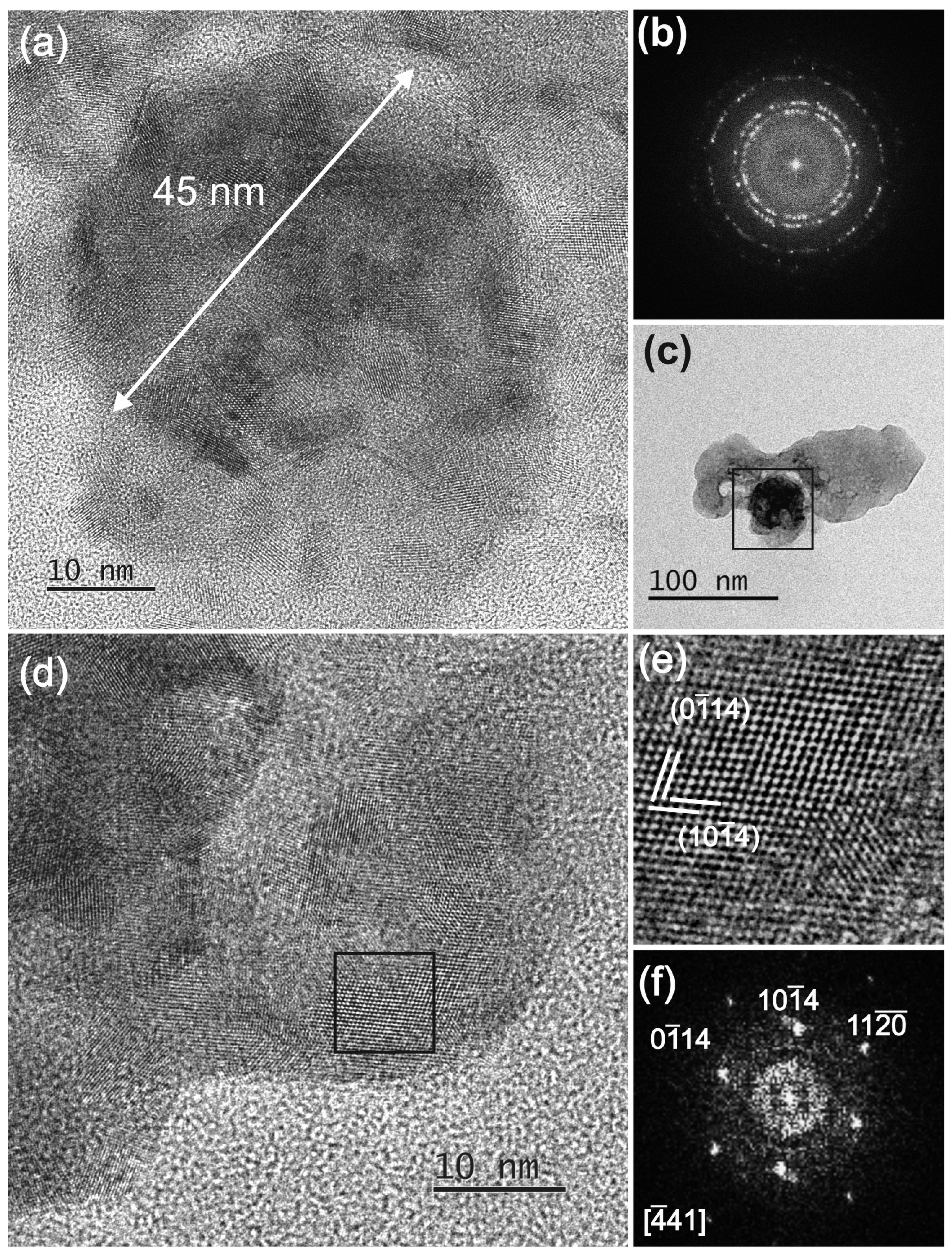
HRTEM image analysis provides further insight into the NPs’ crystal structure. The HRTEM image presented in Figure 3a, acquired from the area delineated by the black square in Figure 3c, clearly resolves lattice fringes originating from several misoriented nanocrystallites. The corresponding Fast Fourier Transform (FFT) shown in Figure 3b, calculated from the HRTEM image of Figure 2a, exhibits sequential diffraction rings, confirming the polycrystalline nature of the CaCO3-C12 NPs. Moreover, in the HRTEM image shown in Figure 3d, the projected atomic structure of several aggregated, misoriented nanocrystallites is revealed. A magnified part of a single nanocrystal, delimited by the black square, is shown in Figure 3e, along with the corresponding calculated FFT (Figure 3f). The resolved {0114}-type lattice fringes of the rhombohedral calcite structure are indicated, while the orientation of the FFT is consistent with the [ 4 ¯ 401] zone axis. This analysis further demonstrates that the observed NPs consist of aggregated nanocrystallites with typical sizes of 5–10 nm.

3.2. Selection of NP Concentration

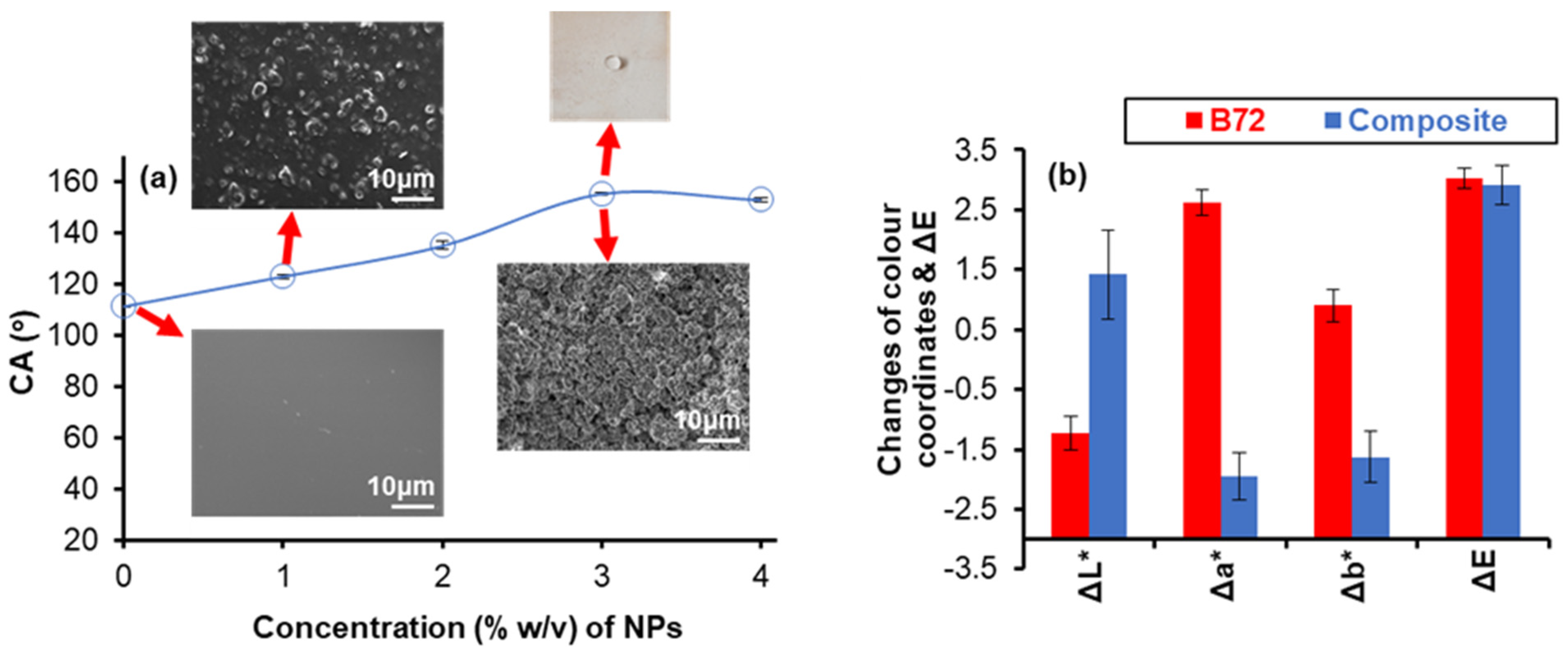
CaCO3-C12 NPs were incorporated in various concentrations into solutions of B72 and the dispersions were sprayed on limestone specimens. The CA measurements on the coated surfaces are provided in Figure 4a which shows that the CA increases rapidly with the NP concentration until it reaches a maximum value of around 155°. Superhydrophobicity (CA > 150°) is achieved for the two coatings, which were prepared using 3 and 4% w/v NP concentration. Both coatings correspond to comparable CAs. The variation in the CA with respect to the CaCO3-C12 NP concentration (Figure 4a) follows a trend consistent with several previously reported results for various polymer-NP composites applied to natural stone [5,6,43,48]. The variation in the CA results originates from the evolution of the surface structure, as revealed in the SEM images of Figure 4a, which show the surface structures of B72 (without NPs) and two composite coatings prepared with low (1% w/v) and high (3% w/v) NP concentration. At the examined magnification, the surface of the deposited B72 coating appears to be relatively smooth. When NPs are incorporated, protruding microscale clusters form. At low NP concentrations (e.g., 1% w/v) these clusters appear as distinct features separated by smooth regions. At higher NP concentrations (e.g., 3% w/v), the clusters enlarge and merge, producing a markedly rough surface. The effect of the NPs in the surface structures of polymer-NP composites has been discussed in detail in numerous studies, e.g., [5,6,43,48].
The wettability of a superhydrophobic surface is described by the Cassie–Baxter equation [45]:
cos CA   =   1   +   f s ( cos CA sm   +   1 )
The equation relates the contact angle measured on a rough ( CA ) superhydrophobic surface to the corresponding contact angle measured on an atomically smooth surface ( CA sm ). The parameter f s represents the fraction of the solid surface that is actually in contact with the water drop. Smooth polymer surfaces can be prepared by spin coating. For this reason, a B72 solution was spin-coated onto a silicon wafer, yielding a CA sm of 78°. The composite coating produced with 3% w/v NPs exhibits a CA of 155.3° (Figure 4a). Using Equation (2), the f s value is calculated to be 0.08. As shown in Table S1 of the Supplementary Materials, this result is consistent with f s values reported in previous studies which investigated the surface structures of superhydrophobic materials [48,74,75,76,77].
Based on the CA results of Figure 4a, NP concentrations of either 3 or 4% w/v could have been selected for further investigation. It was decided to select the superhydrophobic coating with the lowest NP concentration (i.e., 3% w/v) for three reasons. First, the aim of the study was to develop a B72-based coating using the minimum possible amount of additive (i.e., NP), thereby deviating as little as possible from the original B72 formulation, which is widely employed in conservation practice. Second, it has been shown that the incorporation of NPs into a polymer matrix can adversely affect the mechanical stability of the resulting composite coating [6] and, moreover, it tends to increase the colour alteration of the original substrate [6,57,59]. Finally, as NPs may be associated with potential health and environmental risks [78], it is preferable to keep their concentration as low as possible. In the following, the selected composite coating, consisting of B72 and 3% w/v CaCO3-C12 NPs, is referred to as B72-3Ca.
Attention is now directed to colourimetric measurements, which are of particular importance in the field of cultural heritage conservation. The B72-3Ca coating was tested to determine whether it meets the criteria established by conservation science and the performance of the composite coating was compared with the results obtained for the B72 coating (control sample). Figure 4b shows the changes in the CIE 1976-scale components, which were induced to limestone by the applications of the B72-3Ca and B72 coatings. The results indicate that the NPs promoted lightness. While the application of B72 alone resulted in a negative Δ L * value, the incorporation of the whitish NPs into the coating increased lightness, leading to a positive Δ L * value for the composite B72-3Ca coating. Likewise, the addition of the NPs altered the signs of the variations of the a * and b * coordinates. Specifically, the incorporation of the NPs reduced the reddish and yellowish shifts induced by B72 ( Δ a * > 0   and   Δ b * > 0 ) driving the changes of a * and b * toward negative values for B72-3Ca, thereby promoting greenish and bluish hues in the sample. It should be noted, however, that all these represent only minor changes in the colour coordinates.
According to the results of Figure 4b, the colour change ( Δ E ) induced to limestone by the B72 coating was Δ E = 3.03 ± 0.17, whereas the corresponding colour change caused by the application of the B72-3Ca coating was Δ E = 2.91 ± 0.32. The two results are practically the same, suggesting that the effect of the NPs on the colourimetric results was negligible. Moreover, both treatments resulted in Δ E values < 5 and, therefore, can be considered as acceptable in conservation practice [79]. In conclusion, the results presented in Figure 4b showed that the selected B72-3Ca coating induced an acceptable colour change in pristine limestone ( Δ E ≈ 3) [79], comparable to that caused by B72, which is widely used in conservation practice.

3.3. Other Properties of the Selected B72-3Ca Superhydrophobic Coating

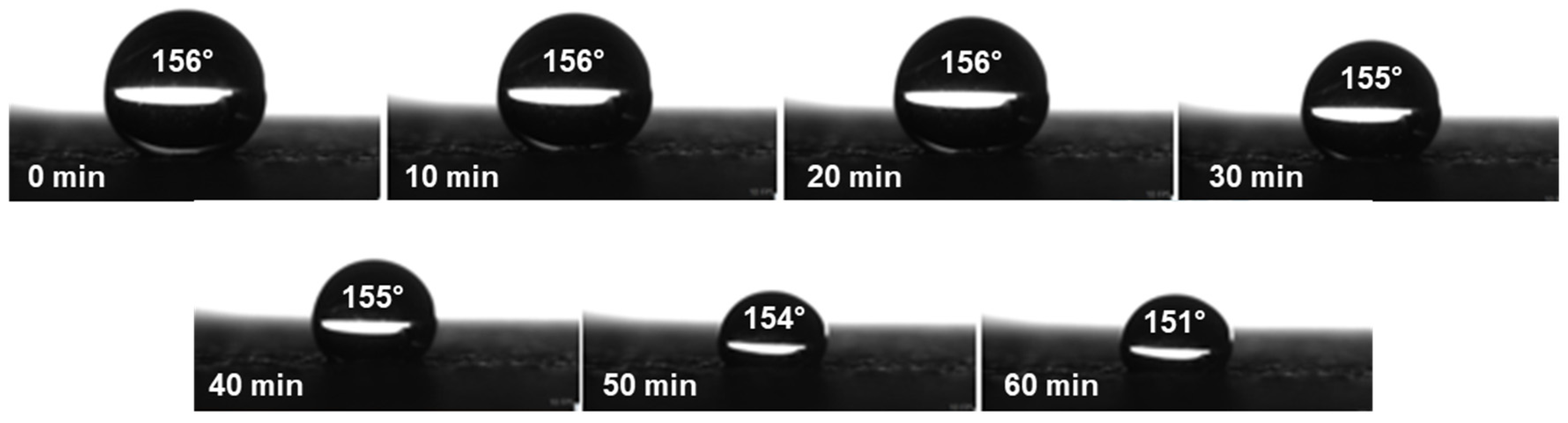
Figure 5 shows successive photographs and CA measurements of a water drop (8 μL) which was left on the surface of the B72-3Ca coating for 1 h. The CA decreases only slightly over time and remains at high values (>150°), demonstrating the stability of the superhydrophobic character of the composite coating. Furthermore, it is reported that the B72-3Ca coating exhibits low contact angle hysteresis (CAH), defined as the difference between the advancing (ACA) and receding (RCA) contact angles. In particular, ACA and RCA were measured as 154.2° and 145.5°, respectively, resulting in a CAH of 8.7°. To further discuss the wettability of the B72-3Ca coating, the Chibowski equation was applied to calculate the apparent surface energy ( γ s ) [80]:
γ s = γ L ( 1 + cos ACA ) 2 2 + cos RCA + cos ACA
Using Equation (3), it is calculated that γ s = 2.6 mJ/m2. This low value of γ s is consistent with previously reported data for other water repellent surfaces [6,81].
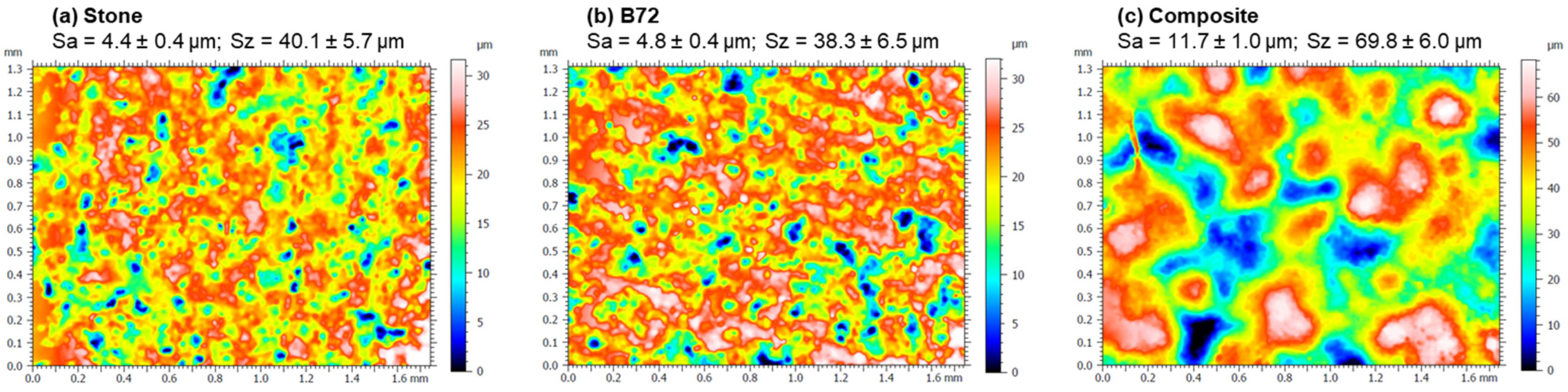
Roughness parameters of the surface of the B72-3Ca composite coating were measured using optical profilometry and compared with those obtained for the surfaces of the B72 coating and uncoated limestone. In Figure 6, the arithmetic mean height (Sa) and the maximum height (Sz) parameters [82] are reported and representative profilometry images are provided. According to the results reported in Figure 6, The surface roughness parameters (Sa and Sz) of the uncoated stone samples and those coated with B72 are nearly identical. This result is consistent with previously reported findings, which indicated that polymer coatings sprayed onto natural stone surfaces tend to follow the morphology of the underlying substrates [5]. However, the incorporation of NPs into the polymer matrix led to a marked increase in surface roughness. As reported in Figure 6, for the composite coating, both Sa and Sz values were approximately twice those measured for the B72-coated and uncoated stone samples. This enhanced roughness is responsible for the superhydrophobic properties of the B72-3Ca composite coating.
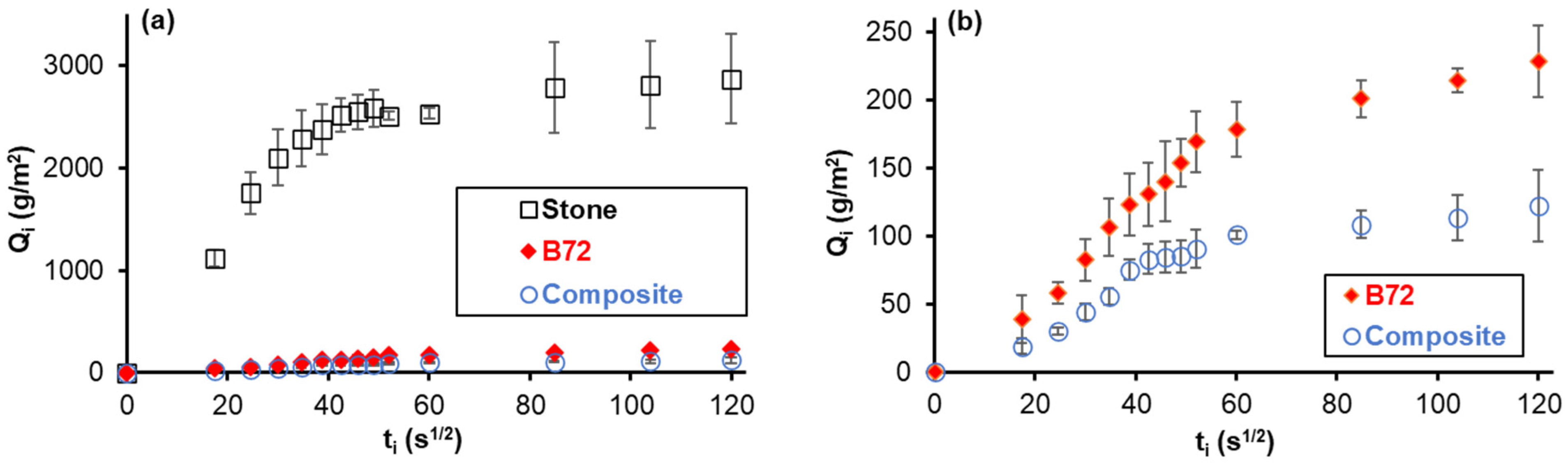
Figure 7 shows the amounts of the absorbed water per unit area (Qi) after leaving the uncoated and coated limestone samples in contact with water for time ti. In Figure 7a, the results for uncoated limestone are included, while Figure 7b highlights only the coated samples to better distinguish the performance of the B72-3Ca coating compared to B72. According to the results of Figure 7, initially, the samples quickly absorb large amounts of water, but after being in prolonged contact with water (around 50 min), samples become saturated, as evidenced by the plateaus of the curves. Similar capillary water uptake patterns for both coated and uncoated natural stones have been widely documented in previous studies, e.g., [59,83]. As illustrated in Figure 7a, the uncoated sample shows markedly higher water absorption rates prior to saturation and, moreover, retains significantly larger amounts of water once saturation is reached, relative to the coated specimens. Consequently, Figure 7a indicates that both superhydrophobic B72-3Ca and hydrophobic B72 coatings effectively reduce capillary water absorption and that the performances of the two coatings are roughly comparable. This finding aligns with earlier reports showing that both superhydrophobic and hydrophobic coatings on natural stones can provide roughly comparable protection against water capillary absorption [5,59,84]. However, a closer examination of the coated samples (Figure 7b) reveals small yet distinct differences between the two coatings. The sample treated with B72-3Ca exhibits lower water absorption rate before reaching saturation. Specifically, using the results of Figure 7b it is calculated that the capillary water absorption coefficient (AC) of limestone samples coated with B72-3Ca and B72 are equal to 1.98 ± 0.24 g/m2s1/2 and 3.23 ± 0.77 g/m2s1/2, respectively. Moreover, the sample treated with B72-3Ca retains only about half the amount of water at saturation compared to the sample that was coated with B72 (Figure 7b).

3.4. Durability Studies

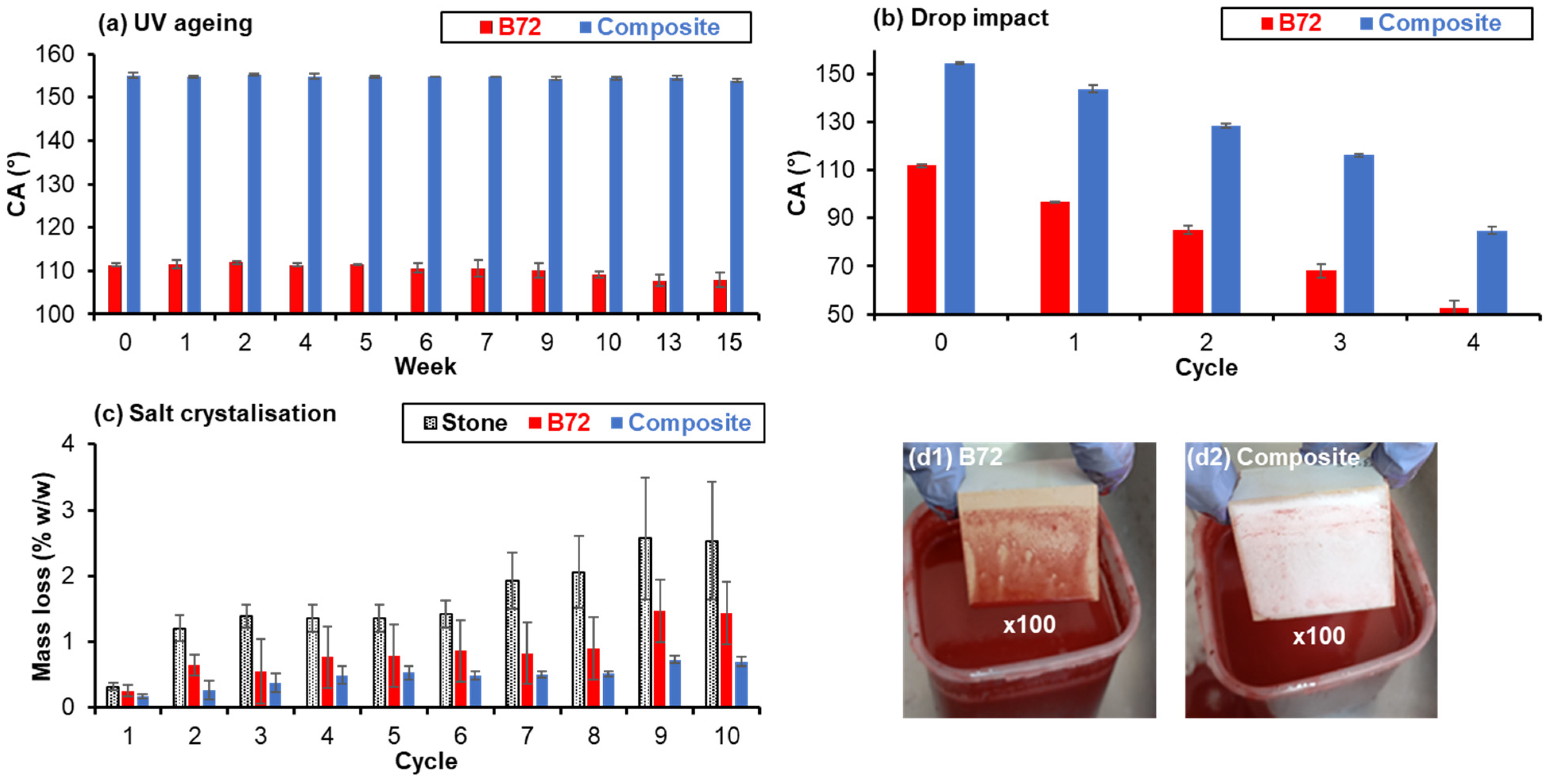
Objects and buildings of the cultural heritage are often exposed outdoors. Consequently, effective conservation treatments must demonstrate strong durability against the various environmental factors present in outdoor conditions. In Figure 8, the effects of the UV radiation (Figure 8a), rain (Figure 8b) and salt (Figure 8c) on the stability of the B72-3Ca coating are investigated in comparison with the B72 coating. Moreover, the anti-smudge performance of the superhydrophobic composite coating is demonstrated (Figure 8(d1,d2)).
The results in Figure 8a show that the composite B72-3Ca coating exhibits excellent resistance to UV-induced ageing. Even after 15 weeks of exposure in the conditions of the UV chamber, the wettability of the composite-coated samples remained unchanged. Stable performance was also observed for the B72 coating. Consequently, incorporating CaCO3-C12 NPs into B72 did not have any negative impact, as the composite coating consistently retained its superhydrophobic properties throughout the experiment. The stability of the composite B72-3Ca coating against UV ageing was further investigated with ATR-FTIR studies. Figure S4 in the Supplementary Materials shows the ATR-FTIR spectra collected from the fresh (non-aged) and UV-aged composite coatings. The two spectra share strong resemblance (Figure S4), suggesting that the applied UV treatment did not induce any significant change in the chemical composition of the composite coating. In particular, the spectrum collected from the fresh composite displays characteristic bands assigned to B72, dodecanoic acid and CaCO3, as follows [26,71,72,85,86,87,88,89]. B72: 2981, 2954 (overlaps with a band of dodecanoic acid), 1726, 1236, 1163, 1144 and 1024 cm−1; dodecanoic acid: 2954, 2920, 2875 and 2850 cm−1 (CH3 asymmetric, CH2 asymmetric, CH3 symmetric and CH2 symmetric stretching C-H vibrations, respectively); CaCO3: 2511 cm−1 combination band (ν1 + ν3), 1795 cm−1 combination band (ν1 + ν4), 1404 cm−13, asymmetric C–O stretching vibration of the CO32− ion), 872 cm−12, out-of-plane bending vibration of the CO32− ion) and 712 cm−14, in-plane bending vibration). The spectrum collected from the aged composite exhibits similar band positions, as summarised next. B72: 2979, 2954, 1728, 1236, 1163, 1146 and 1026 cm−1; dodecanoic acid: 2954, 2918, 2877 and 2850 cm−1; CaCO3: 2513, 1795, 1400, 872 and 712 cm−1 [26,71,72,85,86,87,88,89].
The water drop impact test demonstrated a pronounced reduction in the CAs of both B72 and B72-3Ca coatings (Figure 8b). After four treatment cycles, the wettabilities of both coatings shifted to the hydrophilic regime (CA < 90°), with final values of 52.6° for B72 and 84.9° for B72-3Ca coatings (Figure 8b). As the initial CA for the B72-3Ca coating was 154.7°, it is calculated that the relative reduction after the completion of the test is 45%. This decline is in line with earlier findings, where a TEOS-based composite coating incorporating CaCO3-C12 NPs was subjected to the same test and exhibited a comparable reduction in CA of about 40% [59]. Moreover, according to the results shown in Figure 8b, the 45% decrease observed for the B72-3Ca coating is comparable to the corresponding reduction recorded for the B72 coating (53%). Consequently, the performance of the composite coating is comparable to, if not slightly better than, that of the control sample (B72 coating).
In addition, it should be noted that the drop impact test employed in this study is considerably more severe than comparable protocols [90,91], as the four cycles correspond to a substantially large volume (10,000 L m−2) of falling water. In other investigations that employed the drop impact test to evaluate the stability of composite coatings on cultural heritage building materials, the amounts of falling water were 2500 L m−2 [90] and 5000 L m−2 [91]. These quantities correspond to one and two cycles in Figure 8b and, therefore, they correspond to CA reductions of 7% and 17%, respectively. In the aforementioned studies, no measurable decrease in CA was reported after exposure to 2500 L m−2 of water [90], while a 7% reduction in CA was observed after 5000 L m−2 [91]. Notably, in both studies, the nanocomposite coatings consisted of polysiloxane matrices incorporating SiO2 NPs.
In summary, the results reported in Figure 8b for the B72-3Ca on limestone are comparable with previously published data of water drop impact tests which were performed on composite coatings deposited on cultural heritage building materials [59,90,91].
Figure 8c shows the results of the salt crystallisation test. The % relative mass losses of uncoated and coated limestone samples after each treatment cycle are presented. The results serve as indicators of material degradation due to salt attack [92,93]. At every cycle, the uncoated limestone exhibited the highest degree of deterioration, followed by the B72-coated samples, while the composite-coated samples showed the least degradation. Overall, after 10 cycles, the average relative mass losses were <1% w/w for the composite-coated sample, around 1.5% w/w for the B72-coated sample and around 2.5% w/w for the uncoated sample. Although the differences among the three samples are not very pronounced and the error bars are relatively large, the results in Figure 8c suggest that the B72-3Ca composite coating demonstrated slightly higher resistance to salt attack compared to the B72 coating.
The anti-smudge performance of the B72-3Ca coating is illustrated in Figure 8(d2) and compared with that of B72 (Figure 8(d1)). Both coated samples were immersed in mud for approximately two seconds and then removed. The process was repeated more than 100 times and the composite-coated surface showed only minimal, nearly imperceptible, traces of contamination because of its repellent character (Figure 8(d2)). In contrast, mud adhered readily to the B72-coated limestone, leaving the surface visibly soiled (Figure 8(d1)).
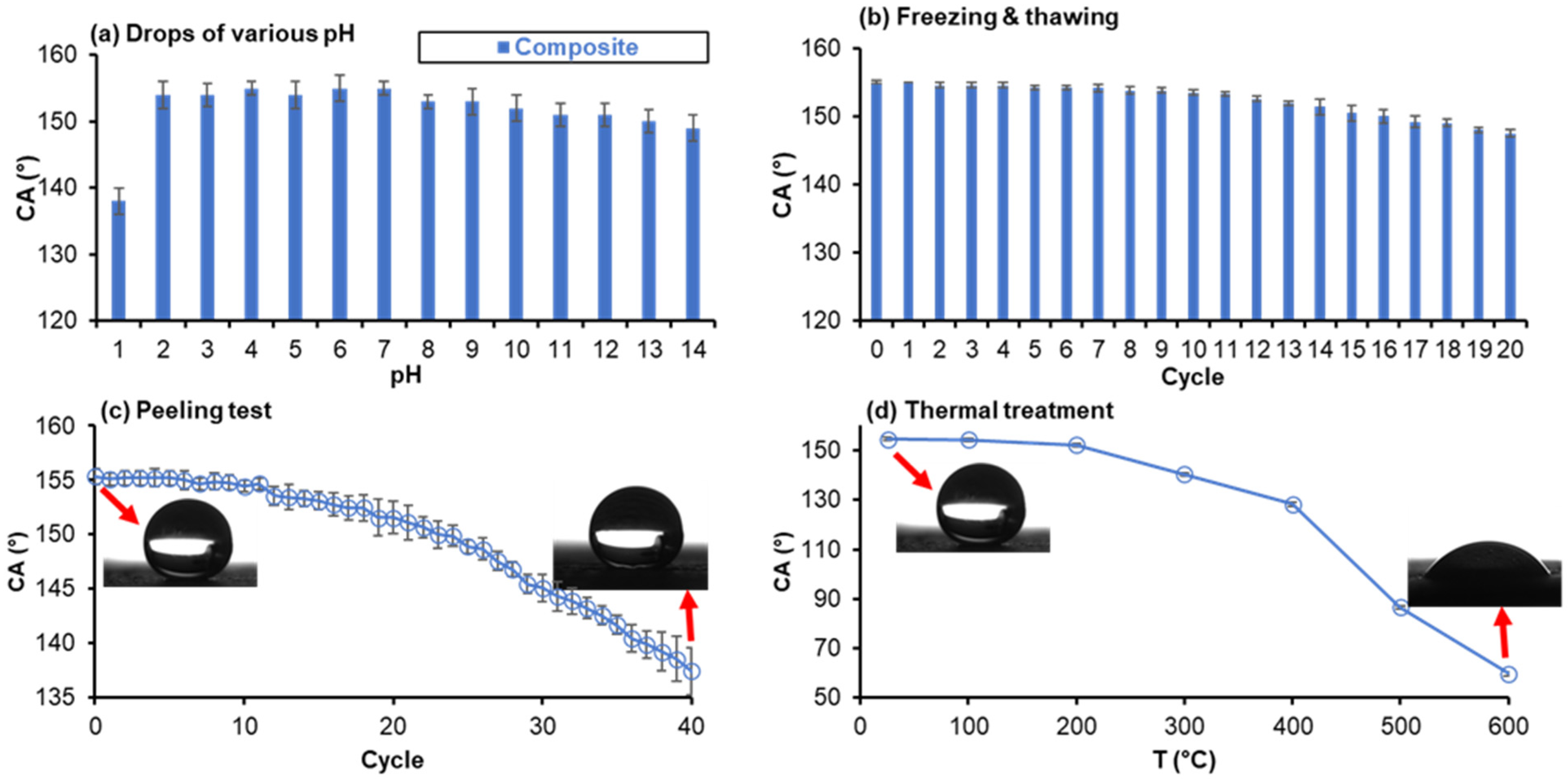
The performance of the B72-3Ca composite coating was further evaluated through four additional tests and the corresponding results are presented in Figure 9. In particular, Figure 9a shows the variation in CA with the pH of the drop. With the exception of the highly acidic drop (pH = 1), where a CA of 138° was measured and the highly alkaline drop (pH = 14), where CA = 149°, all other drops corresponding to a pH range of 2–13 yielded very high CAs (>150°), confirming the chemical stability of the B72-3Ca coating. According to the results of Figure 9b, the superhydrophobic character (CA > 150°) of the B72-3Ca coating was maintained for 16 freezing and thawing cycles. After 20 cycles, however, the CA dropped to 147.6°. The relative reduction in CA recorded for the whole duration of the test is 4.9%, which is nearly half of the corresponding reduction (9.3%) that was previously reported for a TEOS-based composite enriched with CaCO3-C12 NPs [59]. As shown in Figure 9c, the B72-3Ca coating exhibited good mechanical stability, as superhydrophobicity (CA > 150°) was preserved for up to 23 attachment-detachment cycles, while even after 40 cycles the contact angle remained high, exceeding 135°. Finally, the influence of annealing temperature on the wettability of the B72-3Ca coating was investigated and the results are included in Figure 9d. The latter shows that the superhydrophobic character (CA > 150°) of the coating was preserved up to 200 °C. At higher annealing temperatures, the CA progressively decreased, receiving a very low value (=59.7°) at 600 °C. For temperatures above 600 °C, it was not possible to assess the wettability of the composite material due to disintegration of the limestone substrate [94].

4. Conclusions

Calcium carbonate (CaCO3) nanoparticles (NPs) were produced through an easy carbonation process of calcium oxide (CaO) and were functionalised with caproic (C6), caprylic (C8), lauric (C12), myristic (C14), palmitic (C16), and stearic (C18) acid. Pellets of the aforementioned NPs were produced and water contact angles (CAs) were measured. Initially, the length of the hydrocarbon chain promoted the hydrophobic character of the pellets as the CA increased from 66.3° for pellets with the C6-modified NPs up to 118.0° for the pellets with C12-modified NPs (Figure 1). Pellets prepared with NPs modified with C12, C14, C16 and C18 showed comparable hydrophobicity with a stable CA of around 118° (Figure 1).
Based on these results, CaCO3-C12 NPs were selected for further investigation and characterised using advanced electron microscopy techniques. TEM analysis revealed agglomerations of NPs with predominantly rhombic morphology ranging from 40 to 150 nm, consisting of aggregated nanocrystallites (Figure 2). HRTEM and SAED revealed the calcite crystal structure of the aggregated nanocrystallites with a size of 5–10 nm, while STEM-EDX demonstrated a homogeneous distribution of Ca, C, and O elements (Figure 2 and Figure 3).
CaCO3-C12 NPs were incorporated in various concentrations into solutions of Paraloid B72 and the dispersions were sprayed on calcite-rich (limestone) specimens. It was shown that the CA on coated limestones increased rapidly with the NP concentration, reaching a maximum value of approximately 155° for coatings prepared with NP concentrations ≥ 3% w/v (Figure 4a). The selected B72-3Ca coating (prepared using 3% w/v NP concentration) induced only minimal colour alteration to pristine limestone (Figure 4b), exhibited stable superhydrophobic behaviour (Figure 5) and provided effective resistance to capillary water absorption (Figure 7). Moreover, the rough (Figure 6) fluorine-free B72-3Ca coating demonstrated anti-smudge performance (Figure 8(d1,d2)) and showed good durability against UV exposure (Figure 8a), drop impact (Figure 8b), salt attack (Figure 8c), drop pH variations (Figure 9a), freeze–thaw cycles (Figure 9b), tape peeling test (Figure 9c), and thermal treatment (Figure 9d).
The main advantage of the B72-3Ca coating lies in its composition, which consists of a well-established conservation material (Paraloid B72) and CaCO3-based NPs that are chemically compatible with calcareous substrates commonly found in cultural heritage buildings and objects.
Finally, it should be noted that further studies are required to comprehensively assess the actual applicability and long-term performance of the B72-3Ca coating under field conditions. In particular, the coating should be subjected to multiple ageing protocols and prolonged exposure to natural atmospheric conditions in order to thoroughly evaluate its durability and effectiveness.

Supplementary Materials

The following supporting information can be downloaded at: https://www.mdpi.com/article/10.3390/coatings16030347/s1, Figure S1: ATR-FTIR spectrum of Paraloid B72. Figure S2: XRD patterns of (a) limestone sample and reference mineral phases of (b) calcite, (c) aragonite and (d) quartz. The table lists the relative concentration (wt%) of mineral phases identified in the limestone sample, as were calculated from the Rietveld analysis. Figure S3: Nitrogen (a) adsorption and (b) desorption isotherms of limestone. Figure S4: ATR-FTIR spectra of the fresh (non-aged) and UV-aged composite B72-3Ca coatings. Table S1: Fraction of the solid surface that is actually in contact with the water drop (fs) for the superhydrophobic surface investigated in the present study (herein) and for several other superhydrophobic surfaces reported in the literature.

Author Contributions

Conceptualization, I.K.; Methodology, P.K., K.S.T. and I.K.; Investigation, E.G., N.F., P.M., A.R., C.P.P., V.T. and E.P.; Resources, M.P., P.K., K.S.T. and T.D.K.; Writing—original draft, E.G., N.F., C.P.P., P.K. and I.K.; Writing—review and editing: P.K.; K.S.T. and I.K.; Supervision, P.K., K.S.T., P.K.S. and I.K.; Project administration, P.K.S.; Funding acquisition, T.D.K. and P.K.S. All authors have read and agreed to the published version of the manuscript.

Funding

Research was supported by the programme “Diagnostic and Preservation Open Lab of Pella’s Palace” funded by EPAnEK–ESPA 2014–2020 Special Actions “Aquaculture–Industrial Materials–Open Innovation in Culture” (Programme code: T6ΥBΠ–00069).

Data Availability Statement

The raw data supporting the conclusions of this article will be made available by the authors on request.

Acknowledgments

The authors gratefully acknowledge the Laboratory of Advanced Materials and Devices (AMDeLab), School of Physics, Faculty of Sciences, Aristotle University of Thessaloniki for the FTIR measurements. The authors also gratefully acknowledge the Laboratory of Engineering Mechanics (ETEM), School of Civil Engineering, Aristotle University of Thessaloniki for the profilometry measurements.

Conflicts of Interest

The authors declare no conflict of interest.

References

  1. Cao, Y.; Salvini, A.; Camaiti, M. Superhydrophobic fluorinated oligomers as protective agents for outdoor stone artworks. J. Cult. Herit. 2020, 44, 90–97. [Google Scholar] [CrossRef]
  2. Adamopoulos, F.G.; Vouvoudi, E.C.; Pavlidou, E.; Achilias, D.S.; Karapanagiotis, I. TEOS-based superhydrophobic coating for the protection of stone-built cultural heritage. Coatings 2021, 11, 135. [Google Scholar] [CrossRef]
  3. Cao, Y.; Salvini, A.; Camaiti, M. Current status and future prospects of applying bioinspired superhydrophobic materials for conservation of stone artworks. Coatings 2020, 10, 353. [Google Scholar] [CrossRef]
  4. Hosseini, M.; Karapanagiotis, I. (Eds.) Extreme Wetting Properties of Materials: Methods and Emerging Industrial Applications; Springer: Cham, Switzerland, 2021. [Google Scholar]
  5. Karapanagiotis; Manoudis, P.N. Superhydrophobic and superamphiphobic materials for the conservation of natural stone: An overview. Constr. Build. Mater. 2022, 320, 126175. [Google Scholar] [CrossRef]
  6. Manoudis, P.N.; Zuburtikudis, I.; Konstantopoulos, G.; Khalifeh, H.A.; Kottaridi, C.; Karapanagiotis, I. Superhydrophobicity, photocatalytic self-cleaning and biocidal activity combined in a siloxane-ZnO composite for the protection of limestone. Biomimetics 2024, 9, 573. [Google Scholar] [CrossRef]
  7. Chen, H.; Cao, Y.; Wang, C.; Tie, F.; Dong, W.; Camaiti, M.; Baglioni, P. Superhydrophobic surfaces for the sustainable maintenance of building materials and stone-built heritage: The challenges, opportunities and perspectives. Adv. Colloid Interface Sci. 2025, 335, 103343. [Google Scholar] [CrossRef] [PubMed]
  8. Kumari, P.; Kumar, A. Towards the fabrication of a mussel-inspired transparent anti-wetting coating for the protection of cultural artefacts. J. Cult. Herit. 2025, 73, 524–535. [Google Scholar] [CrossRef]
  9. Bergamonti, L.; Verza, E.; Magnani, R.; Michelini, E.; Ferretti, D.; Lottici, P.P.; Graiff, C. Protection of gypsum artifacts by Mg(OH)2 based super-hydrophobic nanocomposite. Constr. Build. Mater. 2025, 490, 142532. [Google Scholar] [CrossRef]
  10. Liu, Y.; Chang, Y.; Zhang, Y.; Li, Y.; Hou, W.; Zhu, S.; Hang, K.; Han, G. Environmentally stable superhydrophobic coating via FAS-SiO2/resin hybridization for multi-barrier protection of outdoor sandstone heritage. Constr. Build. Mater. 2025, 494, 143376. [Google Scholar] [CrossRef]
  11. Rizzarelli, P.; La Rosa, C.; Torrisi, A. Testing a fluorinated compound as a protective material for calcarenite. J. Cult. Herit. 2001, 2, 55–62. [Google Scholar] [CrossRef]
  12. Toniolo, L.; Poli, T.; Castelvetro, V.; Manariti, A.; Chiantore, O.; Lazzari, M. Tailoring new fluorinated acrylic copolymers as protective coatings for marble. J. Cult. Herit. 2002, 3, 309–316. [Google Scholar] [CrossRef]
  13. Castelvetro, V.; Aglietto, M.; Ciardelli, F.; Chiantore, O.; Lazzari, M.; Toniolo, L. Structure control, coating properties and durability of fluorinated acrylic-based polymer. J. Coat. Technol. 2002, 74, 57–66. [Google Scholar] [CrossRef]
  14. Sbardella, F.; Bracciale, M.P.; Santarelli, M.L.; Asua, J.M. Waterborne modified-silica/acrylates hybrid nanocomposites as surface protective coatings for stone monuments. Prog. Org. Coat. 2020, 149, 105897. [Google Scholar] [CrossRef]
  15. Lettieri, M.; Masieri, M.; Aquaro, M.; Dilorenzo, D.; Frigione, M. Eco-friendly protective coating to extend the life of art-works and structures made in porous stone materials. Coatings 2021, 11, 1270. [Google Scholar] [CrossRef]
  16. Zucchelli, M.; Mazzon, G.; Bertolacci, L.; Carzino, R.; Zendri, E.; Athanassiou, A. Stone sustainable protection and preservation using a zein-based hydrophobic coating. Prog. Org. Coat. 2021, 159, 106434. [Google Scholar] [CrossRef]
  17. ICOMOS. International Charter for the Conservation and Restoration of Monuments and Sites (The Venice Charter), 1964. Available online: https://www.icomos.org/images/DOCUMENTS/Charters/venice_e.pdf (accessed on 2 March 2026).
  18. Muñoz Viñas, S. Contemporary theory of conservation. Rev. Conserv. 2002, 3, 25–34. [Google Scholar]
  19. Chiantore, O.; Lazzari, M. Characterization of acrylic resins. Int. J. Polym. Anal. Charact. 1996, 2, 395–408. [Google Scholar] [CrossRef]
  20. Artesani, A.; Di Turo, F.; Zucchelli, M.; Traviglia, A. Recent advances in protective coatings for cultural heritage–An overview. Coatings 2020, 10, 217. [Google Scholar] [CrossRef]
  21. Masi, G.; Pozzo, A.D.; Ugolotti, G.; Tugnoli, A.; Sassoni, E. Choosing the consolidant for carbonate substrates: Technical performance and environmental sustainability of selected inorganic and organic products. Constr. Build Mater. 2023, 407, 133599. [Google Scholar] [CrossRef]
  22. Wheeler, G. Alkoxysilanes and the Consolidation of Stone; Getty Publications: Los Angeles, CA, USA, 2005. [Google Scholar]
  23. Melo, M.J.; Bracci, S.; Camaiti, M.; Chiantore, O.; Piacenti, F. Photodegradation of acrylic resins used in the conservation of stone. Polym. Degrad. Stab. 1999, 66, 23–30. [Google Scholar] [CrossRef]
  24. Kotlík, P.; Doubravová, K.; Horálek, J.; Kubáč, L.; Akrman, J. Acrylic copolymer coatings for protection against UV rays. J. Cult. Herit. 2014, 15, 44–48. [Google Scholar] [CrossRef]
  25. Brugnara, M.; Degasperi, E.; Volpe, C.D.; Maniglio, D.; Penati, A.; Siboni, S.; Toniolo, L.; Poli, T.; Invernizzi, S.; Castelvetro, V. The application of the contact angle in monument protection: New materials and methods. Colloid. Surf. A 2004, 241, 299–312. [Google Scholar] [CrossRef]
  26. Favaro, M.; Mendichi, R.; Ossola, F.; Russo, U.; Simon, S.; Tomasin, P.; Vigato, P.A. Evaluation of polymers for conservation treatments of outdoor exposed stone monuments. Part I: Photo-oxidative weathering. Polym. Degrad. Stab. 2006, 91, 3083–3096. [Google Scholar] [CrossRef]
  27. Sadat-Shojai, M.; Ershad-Langroudi, A. Polymeric coatings for protection of historic monuments: Opportunities and challenges. J. Appl. Polym. Sci. 2009, 112, 2535–2551. [Google Scholar] [CrossRef]
  28. Pedna, A.; Giuntoli, G.; Frediani, M.; Frediani, P.; Rosi, L. Synthesis of functionalized polyolefins with novel applications as protective coatings for stone cultural heritage. Prog. Org. Coat. 2013, 76, 1600–1607. [Google Scholar] [CrossRef]
  29. Pinna, D.; Galeotti, M.; Perito, B.; Daly, G.; Salvadori, B. In situ long-term monitoring of recolonization by fungi and lichens after innovative and traditional conservative treatments of archaeological stones in Fiesole (Italy). Int. Biodeterior. Biodegrad. 2018, 132, 49–58. [Google Scholar] [CrossRef]
  30. Fu, P.; Teri, G.L.; Chao, X.L.; Li, J.; Li, Y.H.; Yang, H. Modified graphene-FEVE composite coatings: Application in the repair of ancient architectural color paintings. Coatings 2020, 10, 1162. [Google Scholar] [CrossRef]
  31. Han, K.; Teri, G.; Cheng, C.; Tian, Y.; Huang, D.; Ge, M.; Fu, P.; Luo, Y.; Li, Y. Evaluation of commonly used reinforcement materials for color paintings on ancient wooden architecture in China. Herit Sci. 2024, 12, 122. [Google Scholar] [CrossRef]
  32. Milanesi, C.; Baldi, F.; Borin, S.; Brusetti, L.; Ciampolini, F.; Iacopini, F.; Cresti, M. Deterioration of medieval painting in the chapel of the Holy Nail, Siena (Italy) partially treated with Paraloid B72. Int. Biodeterior. Biodegrad. 2009, 63, 844–850. [Google Scholar] [CrossRef]
  33. Mitani, A.; Kamperidou, V.; Terzopoulou, P. Surface treatment of oak wood with silica dioxide nanoparticles and Paraloid B72. Forests 2024, 15, 1842. [Google Scholar] [CrossRef]
  34. Koob, S.P. The use of Paraloid B-72 as an adhesive: Its application for archaeological ceramics and other materials. Stud. Conserv. 1986, 31, 7–14. [Google Scholar] [CrossRef]
  35. Giacomucci, L.; Bertoncello, R.; Salvadori, O.; Martini, I.; Favaro, M.; Villa, F.; Sorlini, C.; Cappitelli, F. Microbial deterioration of artistic tiles from the façade of the Grande Albergo Ausonia & Hungaria (Venice, Italy). Microb. Ecol. 2011, 62, 287–298. [Google Scholar] [CrossRef]
  36. Cultrone, G.; Madkour, F. Evaluation of the effectiveness of treatment products in improving the quality of ceramics used in new and historical buildings. J. Cult. Herit. 2013, 14, 304–310. [Google Scholar] [CrossRef]
  37. Vaz, M.F.; Pires, J.; Carvalho, A.P. Effect of the impregnation treatment with Paraloid B-72 on the properties of old Portuguese ceramic tiles. J. Cult. Herit. 2008, 9, 269–276. [Google Scholar] [CrossRef]
  38. Ibrahim, M.M.; Mohamed, W.S.; Mohamed, H.M. Experimental study for evaluation of Paraloid® B72 and its nanocomposite with nano TiO2 and nano ZnO for consolidation of pottery samples. Sci. Cult. 2021, 7, 101–111. [Google Scholar]
  39. Vázquez, A.E.; Figueroa, I.A.; Molina, D.S.; Rodríguez-Gómez, F.J.; Beltrán, D.A. Effects of corrosion inhibition with xanthines in gray cast iron protection with Paraloid B-72 in a saline medium. Prog. Org. Coat. 2021, 154, 106200. [Google Scholar] [CrossRef]
  40. Balbas, D.Q.; Fovo, A.D.; Porcu, D.; Chaban, A.; Porcinai, S.; Fontana, R.; Striova, J. Non-invasive evaluation of polymeric protective coatings for metal surfaces of cultural heritage objects: Comparison of optical and electromagnetic methods. Appl. Sci. 2022, 12, 7532. [Google Scholar] [CrossRef]
  41. Mikić, D.; Ćurković, H.O. Protection of patinated bronze with long-chain phosphonic acid/organic coating combined system. Materials 2023, 16, 1660. [Google Scholar] [CrossRef] [PubMed]
  42. Phukeaw, T.; Limpathompipop, T.; Chumwong, T.; Girdthep, S. Study of alternatives for preserving enamelled goldware using thermoplastic acrylic resin via scientific examination. Sci. Eng. Health Stud. 2024, 18, 24020004. [Google Scholar] [CrossRef]
  43. Ntelia, E.; Karapanagiotis, I. Superhydrophobic Paraloid B72. Prog. Org. Coat. 2020, 139, 105224. [Google Scholar] [CrossRef]
  44. Wenzel, R.N. Resistance of solid surfaces to wetting by water. Eng. Chem. 1936, 28, 988–994. [Google Scholar] [CrossRef]
  45. Cassie, A.B.D.; Baxter, S. Wettability of porous surfaces. Trans. Faraday Soc. 1944, 40, 546–951. [Google Scholar] [CrossRef]
  46. He, W.; Ou, J.; Wang, F.; Lei, S.; Fang, X.; Li, W.; Amirfazli, A. Transparent and superhydrophobic coating via one-step spraying for cultural relic protection against water and moisture. Colloid. Surf. A 2023, 662, 130949. [Google Scholar] [CrossRef]
  47. Zhou, X.; He, W.; Ou, J.; Hu, Y.; Wang, F.; Fang, X.; Li, W.; Amirfazli, A. Translucent superhydrophobic coating for murals protection. Colloid. Surf. A 2024, 689, 133750. [Google Scholar] [CrossRef]
  48. Manoudis, P.N.; Zuburtikudis, I.; Permathouli, S.; Konstantinidis, A.; Khalifeh, H.A.; Kottaridi, C.; Karapanagiotis, I. Tuning the wetting properties of Paraloid B72 from hydrophilicity to superamphiphobicity combined with antibacterial properties. Colloid. Surf. A 2026, 732, 139168. [Google Scholar] [CrossRef]
  49. D’Amato, R.; Caneve, L.; Giancristofaro, C.; Persia, F.; Pilloni, L.; Rinaldi, A. Development of nanocomposites for conservation of artistic stones. Proc. Inst. Mech. Eng. Part. N J. Nanoeng. Nanosyst. 2014, 228, 19–26. [Google Scholar] [CrossRef]
  50. Li, T.; Fan, Y.; Wang, K.; Song, S.; Liu, X.; Bu, N.; Li, R.; Zhen, Q.; Bashir, S. Methyl-modified silica hybrid fluorinated Paraloid B-72 as hydrophobic coatings for the conservation of ancient bricks. Constr. Build. Mater. 2021, 299, 123906. [Google Scholar] [CrossRef]
  51. Bai, X.; Yang, S.; Tan, C.; Jia, T.; Guo, L.; Song, W.; Jian, M.P.; Zhang, X.; Zhang, Z.; Wu, L.; et al. Synthesis of TiO2 based superhydrophobic coatings for efficient anti-corrosion and self-cleaning on stone building surface. J. Clean. Prod. 2022, 380, 134975. [Google Scholar] [CrossRef]
  52. Arizzi, A.; Gomez-Villalba, L.S.; Lopez-Arce, P.; Cultrone, G.; Fort, R. Lime mortar consolidation with nanostructured calcium hydroxide dispersions: The efficacy of different consolidating products for heritage conservation. Eur. J. Mineral. 2015, 27, 311–323. [Google Scholar] [CrossRef]
  53. Niedoba, K.; Slížková, Z.; Frankeová, D.; Nunes, C.L.; Jandejsek, I. Modifying the consolidation depth of nanolime on Maastricht limestone. Constr. Build. Mater. 2017, 133, 51–56. [Google Scholar] [CrossRef]
  54. Gherardi, F.; Otero, J.; Blakeley, R.; Colston, B. Application of nanolimes for the consolidation of limestone from the medieval Bishop’s Palace, Lincoln, UK. Stud. Conserv. 2020, 65, 90–97. [Google Scholar] [CrossRef]
  55. Gherardi, F.; Maravelaki, P.N. Advances in the application of nanomaterials for natural stone Conservation. RILEM Tech. Lett. 2022, 7, 20–29. [Google Scholar] [CrossRef]
  56. Coltelli, M.-B.; Paolucci, D.; Castelvetro, V.; Bianchi, S.; Mascha, E.; Panariello, L.; Pesce, C.; Weber, J.; Lazzeri, A. Preparation of water suspensions of nanocalcite for cultural heritage applications. Nanomaterials 2018, 8, 254. [Google Scholar] [CrossRef]
  57. Chatzigrigoriou, A.; Karapanagiotis, I.; Poulios, I. Superhydrophobic coatings based on siloxane resin and calcium hydroxide nanoparticles for marble protection. Coatings 2020, 10, 334. [Google Scholar] [CrossRef]
  58. Burgos-Cara, A.; Rodríguez-Navarro, C.; Ortega-Huertas, M.; Ruiz-Agudo, E. Bioinspired alkoxysilane conservation treatments for building materials based on amorphous calcium carbonate and oxalate nanoparticles. ACS Appl. Nano Mater. 2019, 2, 4954−4967. [Google Scholar] [CrossRef]
  59. Gkrava, E.; Tsiridis, V.; Manoudis, P.; Zorba, T.; Pavlidou, E.; Konstantinidis, A.; Karapantsios, T.D.; Spathis, P.K.; Karapanagiotis, I. A robust superhydrophobic coating of siloxane resin and hydrophobic calcium carbonate nanoparticles for limestone protection. Mater. Today Commun. 2024, 38, 108393. [Google Scholar] [CrossRef]
  60. Atta, A.M.; El-Newehy, M.H.; Abdulhameed, M.M.; Wahby, M.H.; Hashem, A.I. Seawater absorption and adhesion properties of hydrophobic and superhydrophobic thermoset epoxy nanocomposite coatings. Nanomaterials 2021, 11, 272. [Google Scholar] [CrossRef]
  61. Arbatan, T.; Fang, X.; Shen, W. Superhydrophobic and oleophilic calcium carbonate powder as a selective oil sorbent with potential use in oil spill clean-ups. Chem. Eng. J. 2011, 166, 787–791. [Google Scholar] [CrossRef]
  62. Hu, Z.; Deng, Y. Superhydrophobic surface fabricated from fatty acid-modified precipitated calcium carbonate. Ind. Eng. Chem. Res. 2010, 49, 5625–5630. [Google Scholar] [CrossRef]
  63. Chen, Y.; Ji, X.; Zhao, G.; Wang, X. Facile preparation of cubic calcium carbonate nanoparticles with hydrophobic properties via a carbonation route. Powder Technol. 2010, 200, 144–148. [Google Scholar] [CrossRef]
  64. Vincotte, A.; Beauvoit, E.; Boyard, N.; Guilminot, E. Effect of solvent on PARALOID® B72 and B44 acrylic resins used as adhesives in conservation. Herit. Sci. 2019, 7, 42. [Google Scholar] [CrossRef]
  65. Mohamed, E.H. Effectiveness assessment of Paraloid B-72 enhanced with nanomaterials to improve completion mortars properties for conservation of Seti I temple in el-Qurna, Thebes west bank, Egypt. Multiscale Multidiscip. Model. Exp. Des. 2023, 6, 371–387. [Google Scholar] [CrossRef]
  66. Avram, A.; Ionescu, C.S.; Lunguleas, A. Consolidation of degraded lime wooden support from heritage objects using two types of consolidant. BioResources 2023, 18, 4580–4597. [Google Scholar] [CrossRef]
  67. ISO/CIE 11664-4; Colorimetry—Part 4: CIE 1976 L*a*b* Colour Space. International Organization for Standardization: Geneva, Switzerland, 2019.
  68. EN 15801:2009; Conservation of Cultural Property–Test Methods–Determination of Water Absorption by Capillarity. European Committee for Standardization (CEN): Brussels, Belgium, 2009.
  69. EN 12370:1999; Natural Stone Test Methods–Determination of Resistance to Salt Crystallization. European Committee for Standardization (CEN): Brussels, Belgium, 1999.
  70. ASTM D3359-97; Standard Test Methods for Measuring Adhesion by Tape Test. ASTM International: Geneva, Switzerland, 1997.
  71. Ion, R.M.; Grigorescu, R.M.; David, M.E.; Iancu, L. B72 vs. Paraloid B67 materials for conservation of wood artifacts. Sci. Bull. Valahia Univ.-Mater. Mech. 2023, 19, 33–37. [Google Scholar] [CrossRef]
  72. Iancu, L.; Grigorescu, R.M.; Ion, R.-M.; David, M.E.; Slamnoiu-Teodorescu, S. The effect of UV irradiation on the stability of coated fir wood samples. Sci. Bull. Valahia Univ.-Mater. Mech. 2022, 18, 8–14. [Google Scholar] [CrossRef]
  73. Wojas, N.A.; Tyrode, E.; Corkery, R.; Ernstsson, M.; Wallqvist, V.; Järn, M.; Swerin, A.; Schoelkopf, J.; Gane, P.A.C.; Claesson, P.M. Calcite surfaces modified with carboxylic acids (C2 to C18): Layer organization, wettability, stability, and molecular structural properties. Langmuir 2023, 39, 14840–14852. [Google Scholar] [CrossRef]
  74. Manoudis, P.N.; Karapanagiotis, I.; Tsakalof, A.; Zuburtikudis, I.; Kolinkeová, B.; Panayiotou, C. Surface properties of superhydrophobic coatings for stone protection. J. Nano Res. 2009, 8, 23–33. [Google Scholar] [CrossRef]
  75. Basu, B.J.; Kumar, V.D. Fabrication of superhydrophobic nanocomposite coatings using polytetrafluoroethylene and silica nanoparticles. ISRN Nanotechnol. 2011, 2011, 803910. [Google Scholar] [CrossRef]
  76. Schutzius, T.M.; Bayer, I.S.; Jursich, G.M.; Das, A.; Megaridis, C.M. Superhydrophobic-superhydrophilic binary micropatterns by localized thermal treatment of polyhedral oligomeric silsesquioxane (POSS)—silica films. Nanoscale 2012, 4, 5378–5385. [Google Scholar] [CrossRef]
  77. Karapanagiotis, I.; Grosu, D.; Aslanidou, D.; Aifantis, K.E. Facile method to prepare superhydrophobic and water repellent cellulosic paper. J. Nanomater. 2015, 2015, 219013. [Google Scholar] [CrossRef]
  78. Jeevanandam, J.; Barhoum, A.; Chan, Y.S.; Dufresne, A.; Danquah, M.K. Review on nanoparticles and nanostructured materials: History, sources, toxicity and regulations. Beilstein J. Nanotechnol. 2018, 9, 1050–1074. [Google Scholar] [CrossRef]
  79. Rodrigues, J.D.; Grossi, A. Indicators and ratings for the compatibility assessment of conservation actions. J. Cult. Herit. 2007, 8, 32–43. [Google Scholar] [CrossRef]
  80. Chibowski, E. Surface free energy of a solid from contact angle hysteresis. Adv. Colloid Interface Sci. 2003, 103, 149–172. [Google Scholar] [CrossRef] [PubMed]
  81. Terpiłowski, K.; Rymuszka, D.; Goncharuk, O.V.; Sulymb, I.Y.; Gun’ko, V.M. Wettability of modified silica layers deposited on glass support activated by plasma. Appl. Surf. Sci. 2015, 353, 843–850. [Google Scholar] [CrossRef]
  82. ISO 25178-2:2012; Geometrical Product Specifications (GPS)—Surface Texture: Areal—Part 2: Terms, Definitions and Surface Texture Parameters. International Organization for Standardization: Geneva, Switzerland, 2021.
  83. Lettieri, M.; Masieri, M.; Morelli, A.; Pipoli, M.; Morelli, A.; Frigione, M. Oleo/hydrophobic coatings containing nano-particles for the protection of stone materials having different porosity. Coatings 2018, 8, 429. [Google Scholar] [CrossRef]
  84. De Ferri, L.; Lottici, P.P.; Lorenzi, A.; Montenero, A.; Salvioli-Mariani, E. Study of silica nanoparticles–polysiloxane hydrophobic treatments for stone-based monument protection. J. Cult. Herit. 2011, 12, 356–363. [Google Scholar] [CrossRef]
  85. Osman, M.A.; Suter, U.W. Surface treatment of calcite with fatty acids: Structure and properties of the organic monolayer. Chem. Mater. 2002, 14, 4408–4415. [Google Scholar] [CrossRef]
  86. Rodriguez-Blanco, J.D.; Shaw, S.; Benning, L.G. The kinetics and mechanisms of amorphous calcium carbonate (ACC) crystallization to calcite, via vaterite. Nanoscale 2011, 3, 265–271. [Google Scholar] [CrossRef]
  87. Gupta, A.; Upadhyaya, S.K.; Kishore, K. Infrared absorption spectra, X-rays diffraction studies and thermal behavior of cerium and thorium laurate. Int. J. Theor. Appl. Sci. 2012, 4, 1–5. [Google Scholar]
  88. Hirlekar, S.; Ray, D.; Aswal, V.K.; Prabhune, A.A.; Nisal, A. Lauric acid sophorolipid: Accelerating the gelation of silk fibroin. ACS Omega 2020, 5, 28571–28578. [Google Scholar] [CrossRef]
  89. Bawa, A.S.; Ousmane, M.S.; Mamane, O.S.; Yacoubai, A.C.; Natatou, I. XRD and infrared study of limestone from Chadawanka (Tahoua, Niger). J. Mater. Environ. Sci. 2021, 12, 664–672. [Google Scholar]
  90. Mosquera, M.J.; Carrascosa, L.A.M.; Badreldin, N. Producing superhydrophobic/oleophobic coatings on cultural heritage building materials. Pure Appl. Chem. 2018, 90, 551–561. [Google Scholar] [CrossRef]
  91. Manoudis, P.N.; Chughtai, Z.; Tsiridis, V.; Evgenidis, S.P.; Spathis, P.K.; Karapantsios, T.D.; Karapanagiotis, I. Tuning the wettability of a commercial silane product to induce superamphiphobicity for stone protection. Coatings 2023, 13, 700. [Google Scholar] [CrossRef]
  92. Ruffolo, S.A.; La Russa, M.F.; Ricca, M.; Belfiore, C.M.; Macchia, A.; Comite, V.; Pezzino, A.; Crisci, G.M. New insights on the consolidation of salt weathered limestone: The case study of Modica stone. Bull. Eng. Geol. Environ. 2017, 76, 11–20. [Google Scholar] [CrossRef]
  93. Sierra-Fernandez, A.; Gomez-Villalba, L.S.; Rabanal, M.E.; Fort, R. New nanomaterials for applications in conservation and restoration of stony materials: A review. Mater. Constr. 2017, 67, 107. [Google Scholar] [CrossRef]
  94. Ingham, J.P. Application of petrographic examination techniques to the assessment of fire-damaged concrete and masonry structures. Mater. Charact. 2009, 60, 700–709. [Google Scholar] [CrossRef]
Figure 1. Contact angle (CA) of water drops on pellets prepared from NPs functionalised with different fatty acids.
Coatings 16 00347 g001
Figure 2. TEM bright-field (BF) images (ac) showing agglomerated ensembles of CaCO3-C12 NPs with chain-like and irregular morphologies in (a,b), and an individual rhombic NP in (c). SAED pattern (d) recorded from the NP in (c), exhibiting sequential concentric diffraction rings, corresponding to the {01 1 ¯ 2}, {0 11 ¯ 4}, {11 2 ¯ 0}, {20 2 ¯ 2}, {20 2 ¯ 4}, and {20 2 ¯ 8} lattice planes of rhombohedral calcite (space group R 3 ¯ c), indicating randomly oriented aggregated nanocrystallites. (e) HAADF STEM image showing a “hand-like” agglomerate of aggregated CaCO3-C12 NPs, together with the corresponding elemental maps of calcium (Ca), carbon (C), and oxygen (O), respectively, demonstrating a homogeneous elemental distribution throughout the NP agglomerates delimited in the yellow boxed area in (e).
Coatings 16 00347 g002
Figure 3. (a) HRTEM image recorded from the CaCO3-C12 NP indicated by the black square in (c). Lattice fringes from several aggregated nanocrystallites forming the NP are resolved, while the corresponding FFT (b), calculated from (a), shows the ring pattern of the spatial frequencies contributing to the HRTEM image formation. (d) Lattice fringes of several misoriented aggregated nanocrystallites, 5–10 nm in size, are clearly resolved in the HRTEM image. (e) Magnified image of a nanocrystal indicated by a black square in (d) and (f) the corresponding calculated FFT showing the rhombohedral calcite structure of the nanocrystal projected along the [ 4 ¯ 401] zone axis (z.a).
Coatings 16 00347 g003
Figure 4. (a) Contact angle (CA) of water drops on coated limestone samples vs. the CaCO3-C12 NP concentration. SEM images of limestone samples coated with B72 (without NPs) and composites which were prepared with B72 blended with 1 and 3% w/v NPs are included. A photograph of a water drop on coated (3% w/v NPs) limestone is shown. (b) Changes in the colour coordinates of samples coated with B72 and the selected composite coating which was prepared using B72 and 3% w/v NPs. The calculated colour changes ( Δ E ) are included.
Coatings 16 00347 g004
Figure 5. Successive photographs and CA measurements of a water drop which was left on the surface of the B72-3Ca composite coating for 1 h.
Coatings 16 00347 g005
Figure 6. Profilometry images and roughness parameters measured for the surfaces of (a) uncoated limestone, (b) B72 coating on limestone and (c) B72-3Ca (composite) coating on limestone.
Coatings 16 00347 g006
Figure 7. (a) Results for the test of water absorption by capillarity: amount of water absorbed per unit area (Qi) vs. the square root of time (ti), for uncoated and coated limestone samples. (b) Results are shown exclusively for the coated samples to emphasise the relative performance differences between the B72-3Ca (composite) and the B72 coatings.
Coatings 16 00347 g007
Figure 8. CA results on coated limestone samples subjected to the (a) UV ageing and (b) drop impact tests, shown as a function of exposure time (weeks) and number of cycles, respectively. (c) Relative mass loss (% w/w) of uncoated and coated limestone samples after immersion to salt-solution over multiple cycles. (d1) Limestone coated with B72 picks up mud, (d2) while the composite-coated sample remains almost clean, after immersing them into a mud bath more than 100 times.
Coatings 16 00347 g008
Figure 9. CA results on composite-coated limestone samples vs. (a) the pH of water drops, (b) freezing and thawing cycles, (c) tape peeling cycles and (d) annealing temperature (T).
Coatings 16 00347 g009
Disclaimer/Publisher’s Note: The statements, opinions and data contained in all publications are solely those of the individual author(s) and contributor(s) and not of MDPI and/or the editor(s). MDPI and/or the editor(s) disclaim responsibility for any injury to people or property resulting from any ideas, methods, instructions or products referred to in the content.