
Article

PTFE-Enhanced Tribocatalytic Degradation of High-Concentration (100–500 mg/L) Rhodamine B Solutions Using TiO2 Nanoparticles

1
School of Physics and Electronic Information and Key Lab Electromagnet Transformat & Detect Henan, Luoyang Normal College, Luoyang 471022, China
2
Henan International Joint Laboratory of Intelligent Optoelectronic Micro-Nano Materials and Technology, Luoyang Normal College, Luoyang 471022, China
3
Research Center for Novel Solar-Blind Ultraviolet and Infrared Photoelectronic Detectors of Henan Province, Luoyang Normal College, Luoyang 471022, China
4
School of Materials Science and Engineering, Nanjing University of Science and Technology, Nanjing 210094, China
5
School of Physics and Technology, Wuhan University, Wuhan 430072, China
*
Author to whom correspondence should be addressed.
Coatings 2026, 16(1), 111; https://doi.org/10.3390/coatings16010111
Submission received: 17 December 2025 / Revised: 7 January 2026 / Accepted: 10 January 2026 / Published: 14 January 2026

Abstract

Dye wastewaters are produced in huge amounts every year world-widely and they pose serious threats to ecosystems and human health if not treated properly. High-concentration organic dye wastewaters are usually treated through multiple steps including pretreatment and advanced treatment. In this work, TiO2 nanoparticles suspended in high-concentration rhodamine B (Rh B) solutions up to 500 mg/L have been subjected to magnetic stirring to initiate tribocatalytic degradation of Rh B. While 100 and 200 mg/L Rh B solutions can be rather thoroughly degraded in beakers with four kinds of bottom/coatings (glass, Al2O3, Ti, and PTFE), 300 mg/L Rh B solutions can only be degraded effectively in a beaker with PTFE coating. Even 400 and 500 mg/L Rh B solutions can also be degraded rather thoroughly by TiO2 nanoparticles in a PTFE-coated beaker. EPR analyses revealed that PTFE coating enhanced the formation of both hydroxyl radicals and superoxide radicals by magnetic stirring-stimulated TiO2 nanoparticles. These findings highlight the importance of the synergism between materials in friction pairs for tribocatalysis and demonstrate a one-step tribocatalytic degradation of Rh B solutions with concentrations of real Rh B wastewaters.

1. Introduction

The contamination of water resources, caused by industrial effluents, agricultural runoff (loaded with fertilizers and pesticides), municipal wastewater, and plastic pollution (notably marine microplastics), is a major environmental challenge of the 21st century, jeopardizing both drinking water security and aquatic ecosystem integrity [1,2,3,4]. This has made water pollution control and remediation a subject of extensive global concern. Textile dye effluent constitutes a major environmental pollutant [5,6,7]. The complex matrix of this wastewater, characterized by highly toxic and non-biodegradable organic compounds, demands sophisticated treatment solutions. While some highly efficient green technologies like specialized enzymes and advanced oxidations are available, considerable capital and operational expenditures associated with them hinder their widespread implementation [8,9,10,11].
The treatment of high-concentration organic dye wastewater is a complex and challenging industrial issue [12,13,14]. Single conventional wastewater treatment methods are often inadequate for effective remediation, necessitating the adoption of integrated multi-technology process routes [15,16] and adhering to the principle of “stepwise treatment and gradual reduction”. First, pretreatment: initially remove suspended solids, adjust pH, and reduce toxicity to create favorable conditions for subsequent treatment stages. Second, main treatment: Focus on the core degradation or separation of dye molecules and auxiliaries, significantly reduce chemical oxygen demand (COD) and color intensity. Finally, advanced treatment: Perform a “finishing process” on the effluent from the main treatment to ensure compliance with discharge standards or facilitate water reuse [17,18]. The treatment of high-concentration dye wastewater poses significant challenges, where photocatalysis, as a green and clean energy technology, is often hindered by the intense coloration of dyes at elevated concentrations [19,20]. This coloration impedes the effective utilization of photogenerated electrons, thereby substantially limiting the efficiency of photocatalytic degradation in such contexts [21]. Mechanical energy, as another abundant and clean energy source in nature, has gained intensive research attention in recent years. In particular, tribocatalysis that converts mechanical energy into chemical energy through friction has emerged as a promising approach for treating wastewater of low transparency [22,23,24,25,26].
Rhodamine B (Rh B) is an important member of a highly significant family of fluorescent dyes with extensive applications in life sciences and industrial sectors [27,28,29]. Notably, Rh B has been substantiated to exhibit certain toxicity and carcinogenic properties. Recent research findings indicate that TiO2 nanoparticles (P25) achieve photocatalytic Rh B degradation at concentrations around 10~20 mg/L under visible light irradiation [11,23,30,31,32,33]. As for tribocatalysis, Rh B solutions of much higher concentrations have been degraded, such as 40 mg/L Rh B by P25 [23,34], and 50 mg/L RhB by BaTiO3 [35,36,37] and CdS [38,39] nanoparticles. However, these concentrations are still much lower than that of practical Rh B wastewaters. As a matter of fact, as high as 100 mg/L MO solutions have been successfully degraded by BaTiO3 nanoparticles in beakers with PTFE coatings through magnetic stirring recently, which suggests that the synergism between catalysts and vessel bottoms is effective for enhancing tribocatalytic degradation of high-concentration organic dyes [40]. In this context, an exploration has been conducted to degrade high-concentration Rh B solutions by TiO2 nanoparticles through magnetic stirring in beakers with glass bottom, Al2O3, Ti, and PTFE coatings, separately. While 100 and 200 mg/L Rh B solutions can be rather thoroughly degraded in all the four kinds of beakers, 300 mg/L Rh B solution can only be degraded efficiently in a PTFE-coated beaker. Moreover, even 400 and 500 mg/L Rh B solutions have also been degraded rather thoroughly in the PTFE-coated beaker. These results represent a significant breakthrough and advancement compared to previous photocatalytic and tribocatalytic degradation of organic dyes, and highlight the vital role of the synergism between catalysts and vessel bottoms in tribocatalysis. And to the best of our knowledge, this is the first time that organic dyes with concentrations as high as 500 mg/L are rather thoroughly degraded via a single catalytic technology using a green energy source, which may bring a reform to current wastewater treatment strategies.

2. Materials and Methods

2.1. Materials and Characterization

TiO2 nanoparticles used in the experiments were procured commercially from Shanghai Macklin Biochemical Technology Co., Ltd. (Shanghai, China). XRD measurements were conducted to determine the crystal structure using a Bruker AXS D8 ADVANCE diffractometer (Karlsruhe, Germany) equipped with a Cu Kα source. The microstructure and morphology of the TiO2 nanoparticles were further examined using an FEI Tecnai G2 F30 high-resolution transmission electron microscope (HRTEM) (Jena, Germany). The specific surface area of the TiO2 nanoparticles was measured through a high throughput surface area and porosity analyzer (TriStar II 3020, Micromeritics, USA) and calculated with the Brunauer–Emmett–Teller (BET) equation.

2.2. Formation of Coatings on the Bottoms of Glass Beakers

Coating disk-shaped materials on vessel bottoms has emerged as an effective method to enhance tribocatalysis through regulating friction pairs [41]. Commercial flat-bottom glass beakers with a diameter of 45 mm and a height of 60 mm were employed as reaction vessels. The beakers were divided into four groups based on substrate treatment: the first group was left untreated with the original glass bottom; Disks of Ti, Al2O3, and PTFE (40 mm in diameter, 1 mm thick) served as modified substrates for the other three groups and were bonded to the beaker bottoms using a strong adhesive. This procedure yielded experimental beakers with four distinct substrate surfaces: glass, titanium, alumina, and PTFE.

2.3. Rh B Degradation Tests

In this study, TiO2 nanoparticles were employed as the catalytic material for the degradation of Rh B solutions. The experimental procedure was as follows: Rh B solutions with concentrations of 100, 200, 300, 400, and 500 mg/L were prepared, each with a volume of 30 mL, and placed in separate beakers. To each beaker, 0.30 g of TiO2 nanoparticles was added [23].
A custom-made PTFE magnetic rotary disk, which was described in detail in a previous paper [20], was immersed in a suspension. When a beaker with a magnetic rotary disk in the suspension in it was placed on an ordinary magnetic stirrer, this disk was driven to rotate at 400 rpm in the beaker through the magnetic stirrer. The beaker was kept in dark and room temperature was kept at 25 °C. The groove structure in the disk surface facilitated TiO2 nanoparticles into the interface between the disk surface and the beaker bottom in the course of magnetic stirring, thereby subjecting the TiO2 nanoparticles to friction.
At predetermined time intervals, 3 mL aliquots were extracted from the reaction mixture. These samples were centrifuged at 8000 rpm for 5 min to separate the TiO2 nanoparticles. The resulting supernatant was then analyzed using a UV-Shimadzu 2550 ultraviolet–visible spectrophotometer (Kyoto, Japan). The measurement parameters were set as follows: wavelength range from 200 to 800 nm, wavelength interval of 2.0 nm, and a slit width of 2 nm. The degradation efficiency of organic dyes is typically defined by the following equation:
D = 1 − A/A0,
where A and A0 represent the temporal and initial concentrations, respectively, as determined from the characteristic absorption peak of the dye.

2.4. Detection of Active Species

For the detection of hydroxyl radicals (•OH), beakers (45 mm diameter × 60 mm height) with four different substrate materials (glass, alumina-coated, titanium-coated, and PTFE-coated) were used. Each experimental system comprised 10 mL of deionized water, 0.15 g of TiO2 nanoparticles, and 50 μL of DMPO (a spin-trapping agent) in individual beakers. Detection of superoxide radicals (•O2) was carried out using the same four-beaker setup, where the 10 mL deionized water was substituted with methanol, keeping the amounts of DMPO and TiO2 nanoparticles constant. Under dark conditions at room temperature, each beaker was stirred using a PTFE magnetic rotary disk at 400 rpm for 15 min. Detection of the generated hydroxyl (•OH) and superoxide radicals (•O2) was performed on a Bruker A300-10/12 model EPR spectrometer (Karlsruhe, Germany).

3. Results and Discussion

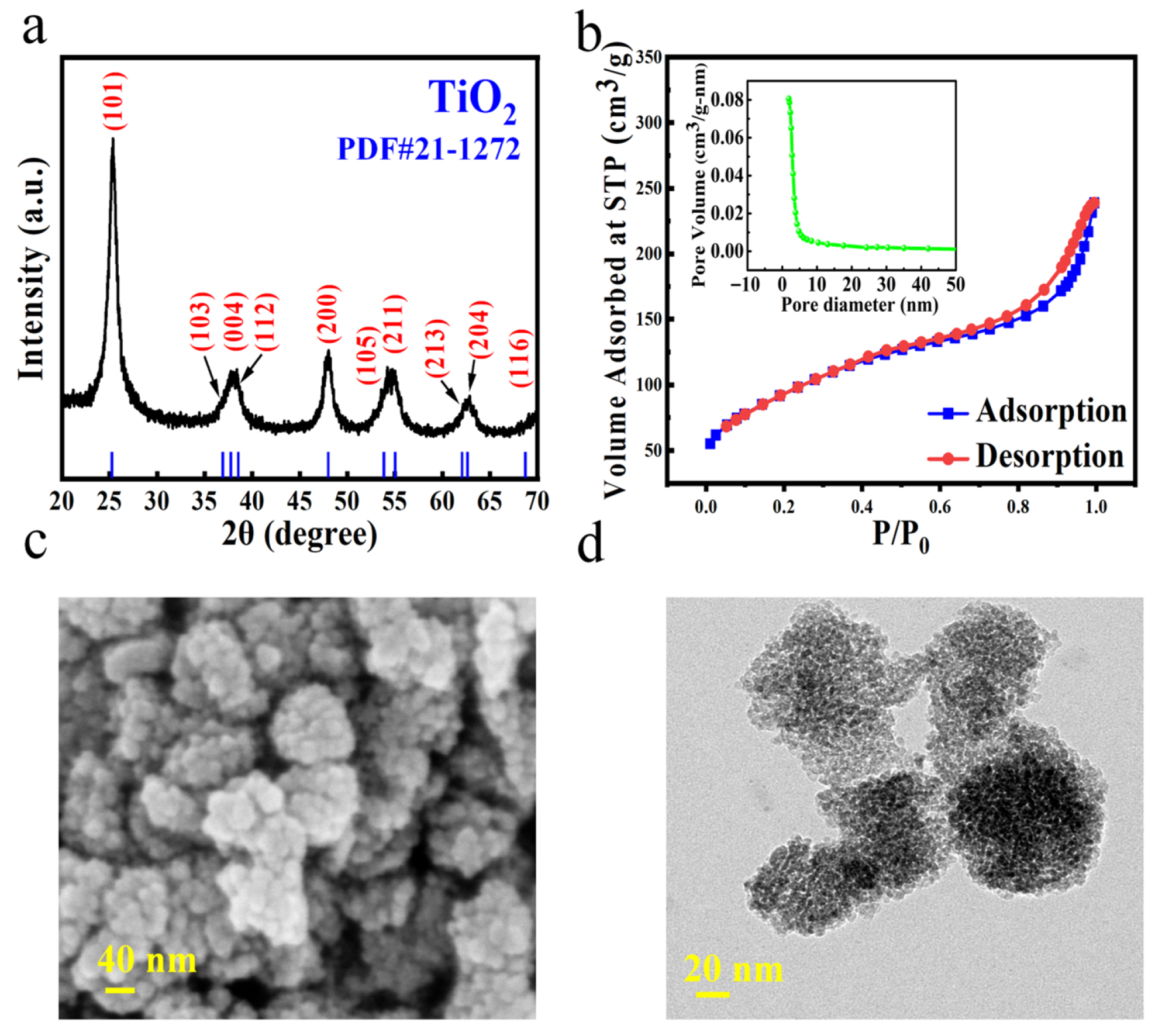
An XRD pattern of the TiO2 nanoparticles used in this tribocatalytic study is presented in Figure 1a. By comparing with the standard diffraction peaks from the TiO2 XRD reference database (PDF#21-1272), it is clear that the TiO2 is of anatase phase [21]. The most intense diffraction peak in the sample appears at 25°, corresponding to the (101) crystal plane. Other prominent peaks are observed at approximately 48° and 37°, which are indexed to the (200) and (004) planes, respectively [42,43]. The N2 adsorption–desorption isotherm of the TiO2 nanoparticles at 77 K is displayed in Figure 1b. Analysis of the curve’s variation trend reveals that the isotherm conforms to the classical Type IV model, indicating a mesoporous structure of the material [39]. Calculation results demonstrate that the specific surface area is 338 m2/g, the average pore size is 4.36 nm, and the pore volume is 0.33 cm3/g. The large specific surface area is consistent with the broad full width at half maximum observed in XRD patterns (shown in Figure 1a). The TEM micrograph presented in Figure 1c reveals significant agglomerations of the powder, which could not be effectively dispersed even with ultrasonication. Nevertheless, some discrete TiO2 nanoparticles can be observed in Figure 1d, showing a size below 5 nm.
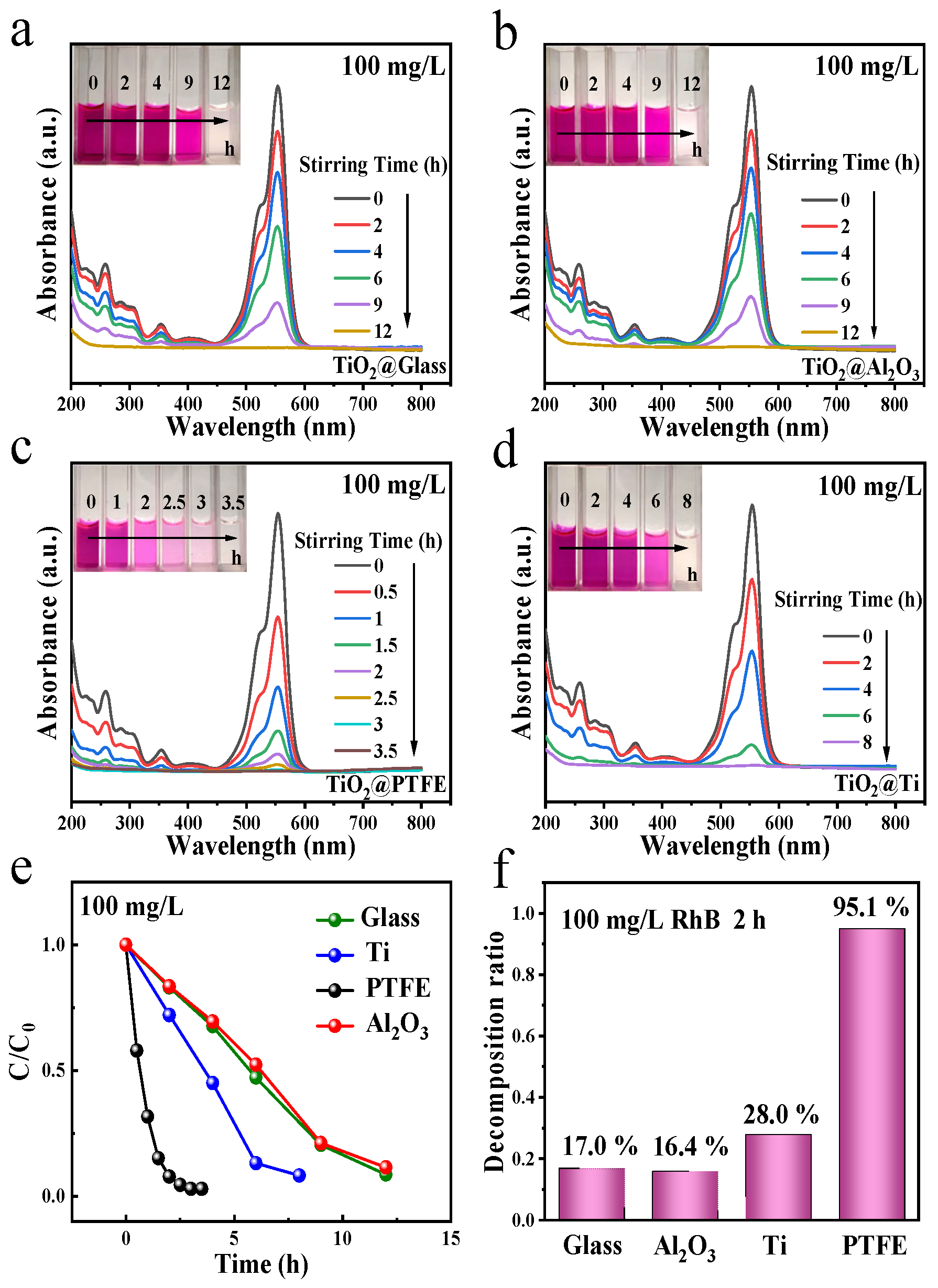
Figure 2 presents the UV-Vis absorption spectra illustrating the tribocatalytic degradation of 100 mg/L Rh B solutions in beakers with glass bottom, titanium, alumina, and PTFE coatings separately. Nearly 100% degradation efficiency was achieved for the glass substrate after 12 h of magnetic stirring (Figure 2a). A direct and visually apparent color change, demonstrating the degradation process, is presented in the inset. Similarly, complete degradation (close to 100%) was also observed for alumina (Figure 2b) and titanium substrates (Figure 2d), requiring approximately 12 and 8 h of magnetic stirring, respectively. Surprisingly, for the PTFE substrate the RhB solution was almost completely degraded within just 3.5 h of magnetic stirring (Figure 2c). This represents a significant reduction in processing time by 8 h and 6 h compared to alumina and glass substrates, respectively. These results clearly indicate that the PTFE substrate plays a significant modulating role in enhancing the tribocatalytic process of TiO2 nanoparticles.
Figure 2e graphically compares the degradation efficiencies attained by TiO2 nanoparticles when deposited on the four different substrate materials. For a more direct performance comparison, a histogram summarizing the degradation efficiencies after 2 h of magnetic stirring is presented in Figure 2f. The measured efficiencies on glass, Teflon, titanium, and alumina substrates are 17%, 95.1%, 28%, and 16.4%, respectively. These results unequivocally demonstrate that the PTFE substrate exerts a significant modulating effect, markedly enhancing the tribocatalytic degradation of Rh B by TiO2 nanoparticles.
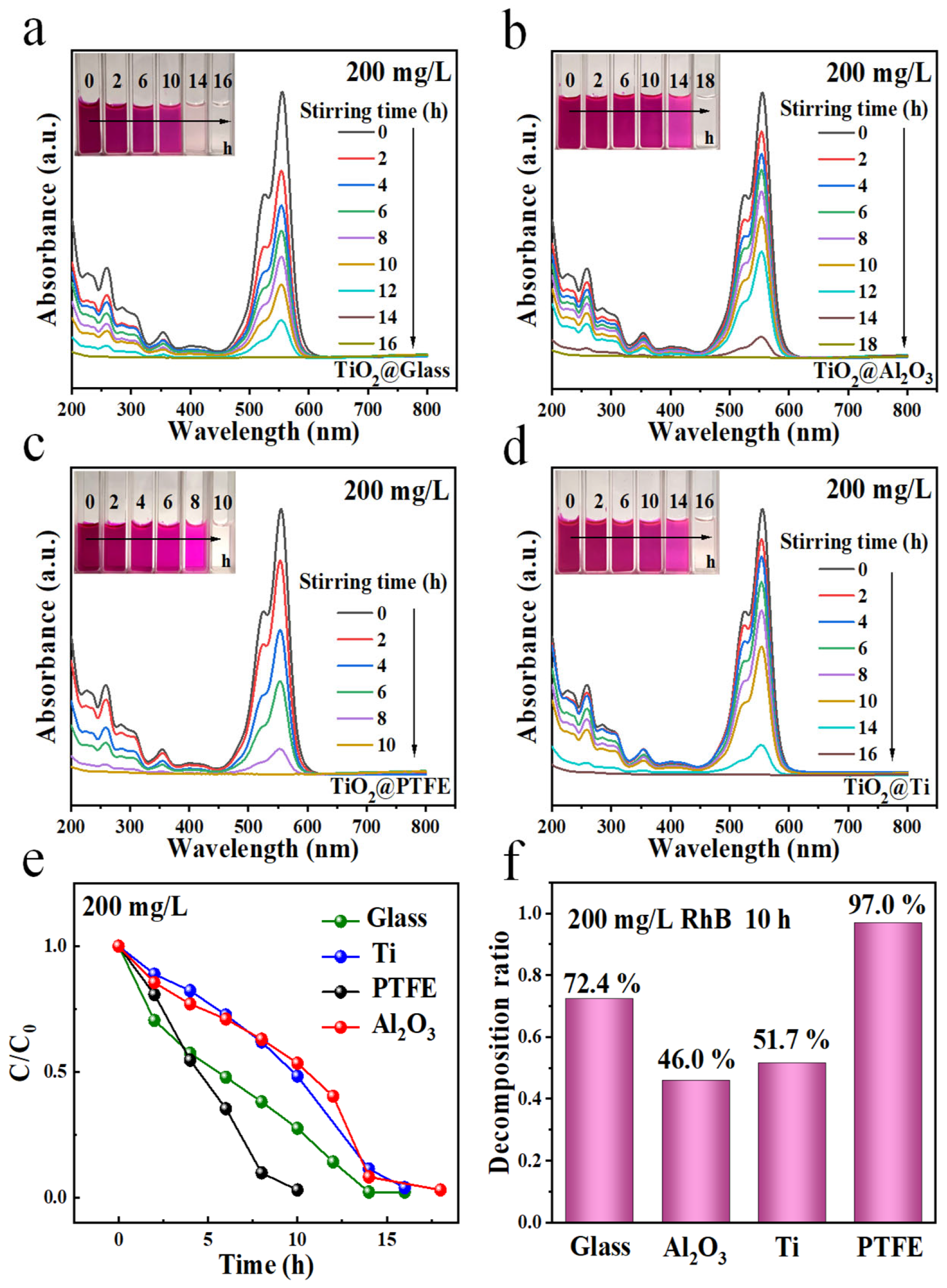
To further validate the efficacy of the PTFE substrate in the tribocatalytic degradation of high-concentration Rh B solutions using TiO2 nanoparticles, experiments were conducted under identical conditions with an initial concentration of 200 mg/L. As illustrated in Figure 3, with the increased dye concentration, the time required for complete degradation on glass, PTFE, Ti, and Al2O3 substrates was 16, 10, 16, and 18 h, respectively. Direct visual evidence of the color change associated with the dye degradation is presented in the corresponding inset images. Photocatalysis faces inherent limitations in Rh B dye degradation due to decreased light penetration efficiency at elevated dye concentrations, with typical optimum degradation concentrations only around 10 mg/L [27,31]. It is surprising that TiO2, being an Earth-abundant oxide material, demonstrates such an exceptional tribocatalytic performance to degrade 200 mg/L Rh B for all the four substrates. A comparative analysis of the degradation efficiencies is clearly presented in Figure 3e. The histogram in Figure 3f displays the degradation rates achieved after 10 h of magnetic stirring, which were 72.4% for glass, 97% for PTFE, 51.7% for Ti, and 46.0% for Al2O3. These results consistently re-affirm the superior and significant enhancing effect of the PTFE substrate on the tribocatalytic process.
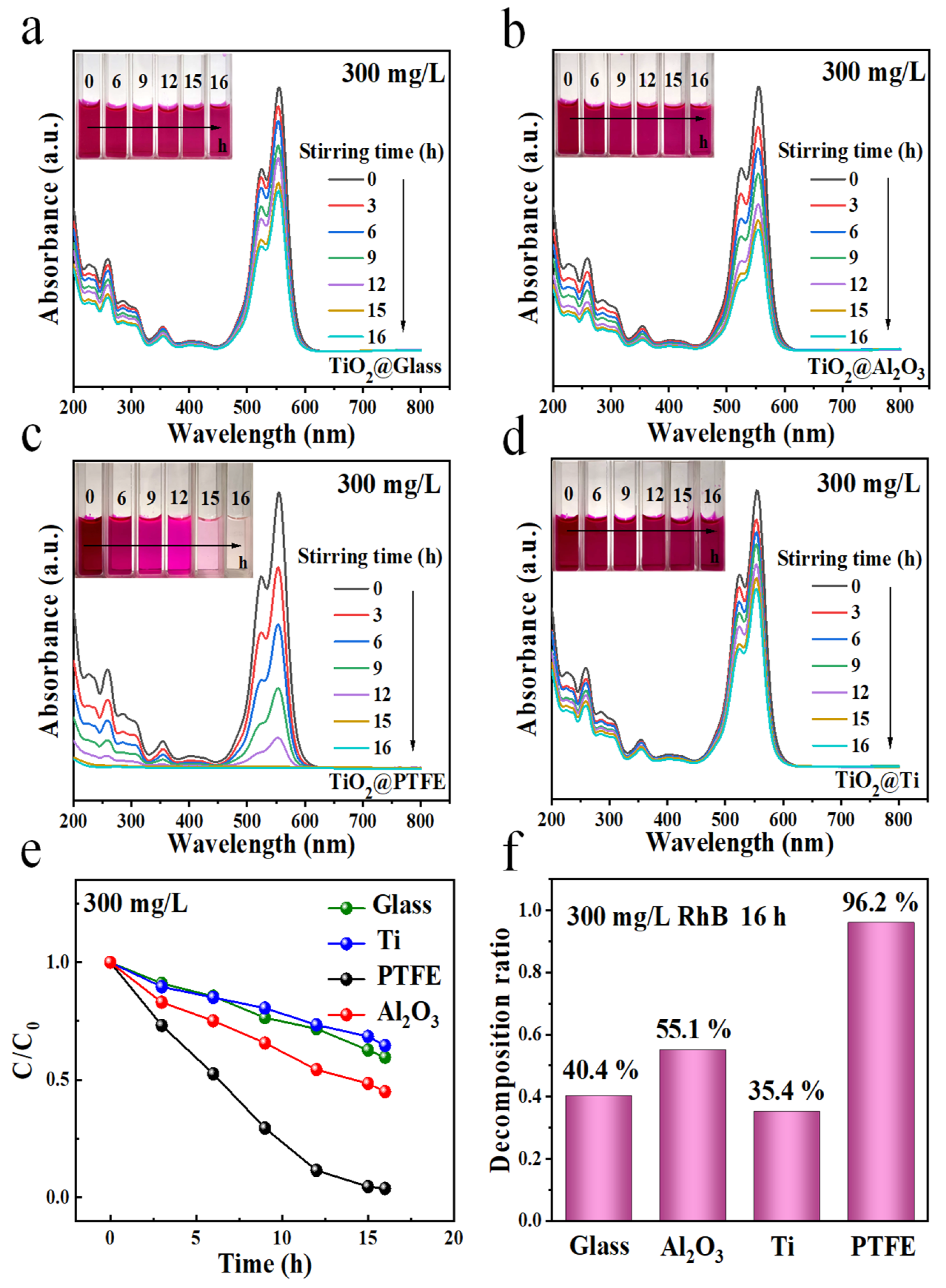
For 300 mg/L Rh B solutions, the tribocatalytic degradation became much more difficult for substrates of glass, Al2O3, and Ti. In contrast to the higher efficiencies observed in Figure 3, the degradation rates for glass, titanium, and alumina substrates after 16 h of magnetic stirring (Figure 4) were considerably lower, reaching only 40.4%, 35.4%, and 55.1%, respectively. Fortunately, a rather thorough degradation, 96.2%, was observed for PTFE substrate, suggesting that 300 mg/L RhB can still be effectively degraded by TiO2 with the help of PTFE. It seems that for Rh B solution with a higher concentration, PTFE coating shows a more decisive effect on its tribocatalytic degradation by TiO2 nanoparticles than glass, Ti, or Al2O3. Much attention should be paid to coating material optimization on vessel bottoms in future tribocatalytic degradation of high-concentration organic dyes.
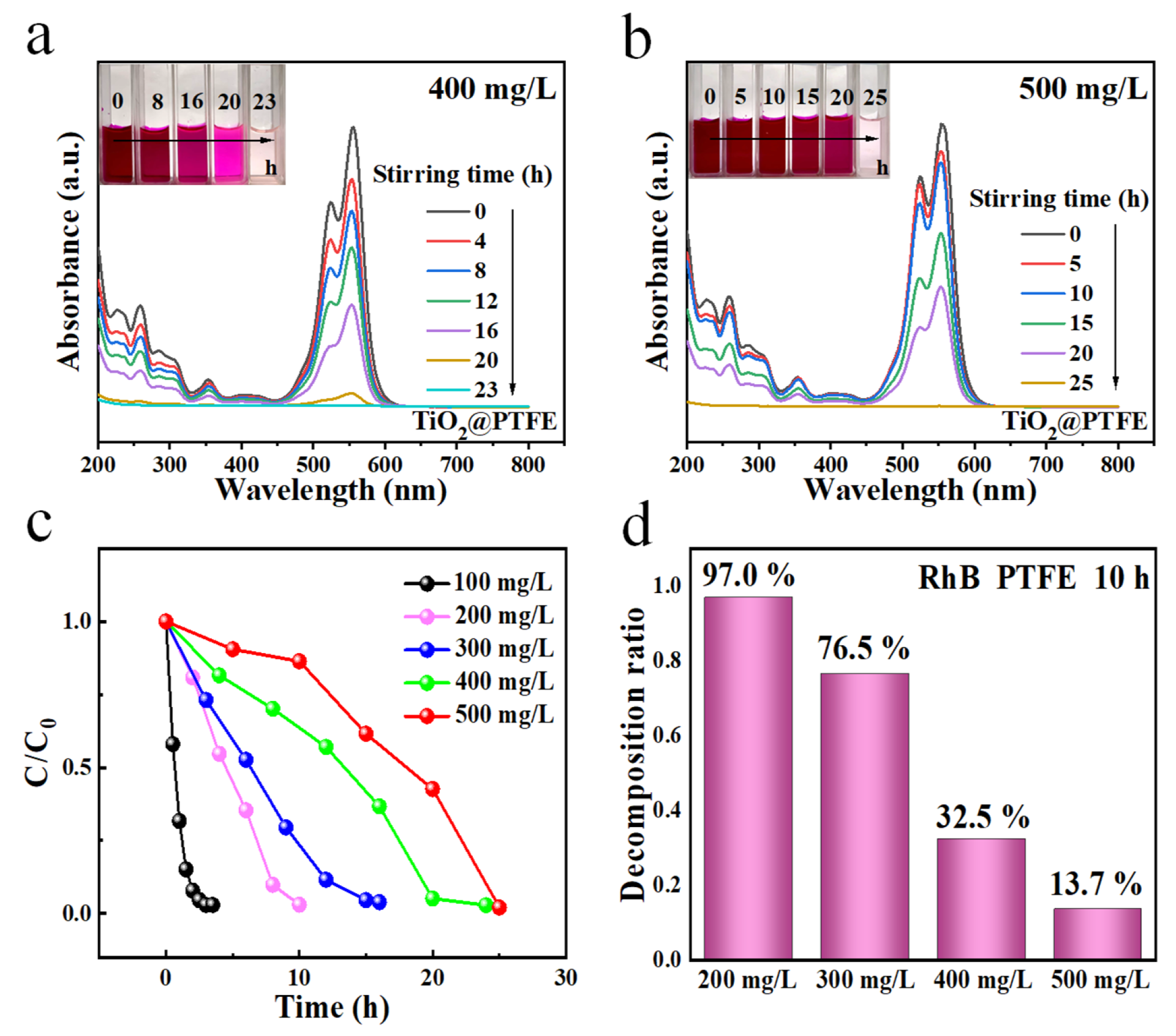
For the beaker with PTFE coating, tribocatalytic degradation of 400 and 500 mg/L Rh B by TiO2 nanoparticles had been further conducted, and the results are shown in Figure 5a,b. It is highly impressive that 400 and 500 mg/L Rh B were degraded by nearly 100% after 23 and 25 h of magnetic stirring, respectively. Figure 5c presents curves of C/C0 versus magnetic stirring time for tribocatalytic degradation of 100, 200, 300, 400, and 500 mg/L Rh B solutions by TiO2 nanoparticles in a PTFE-coated beaker. It is clear that all these solutions can be rather thoroughly degraded, though the magnetic stirring time needed increases with the initial concentration of Rh B solutions. In particular, the 500 mg/L Rh B solution was degraded much more slowly in the first 10 h than the other four solutions, as shown in Figure 5d. Remarkably, it still has been thoroughly degraded in 25 h. It is worthy to note that the power of magnetic stirring under this condition was below 10 W [40], which suggests that such a treatment of Rh B solutions with a concentration as high as 500 mg/L is not only simple but also energy-efficient.
It should be pointed out that a concentration of 500 mg/L actually approximates the levels encountered in practical textile industry effluent of Rh B wastewaters. As shown in Figure 5, Rh B solutions around 500 mg/L are highly opaque, for which the photocatalysis by TiO2 nanoparticles is obviously impotent. Magnetic stirring alone, in the presence of TiO2 nanoparticles, effectively degraded these solutions to a colorless state. This directly demonstrates the considerable potential of harnessing mechanical energy for environmental remediation. And as pointed out previously, high-concentration organic dye wastewaters are currently being treated step by step, with different technologies adopted in different steps. For example, in a previous investigation on treatment of 160 mg/L methylene blue (MB) solution [44], such multiple procedures have been suggested: Ag2O-modified TiO2-based nanosheets were first immersed in the solution to absorb MB, then they were collected through centrifugal treatment, and finally were placed in clear water to have absorbed MB molecules degraded through UV irradiation. The results obtained in this study should be the first time for organic dyes around 500 mg/L to be rather thoroughly treated in a single step, which should be meaningful for simplifying wastewater treatment strategies in future.
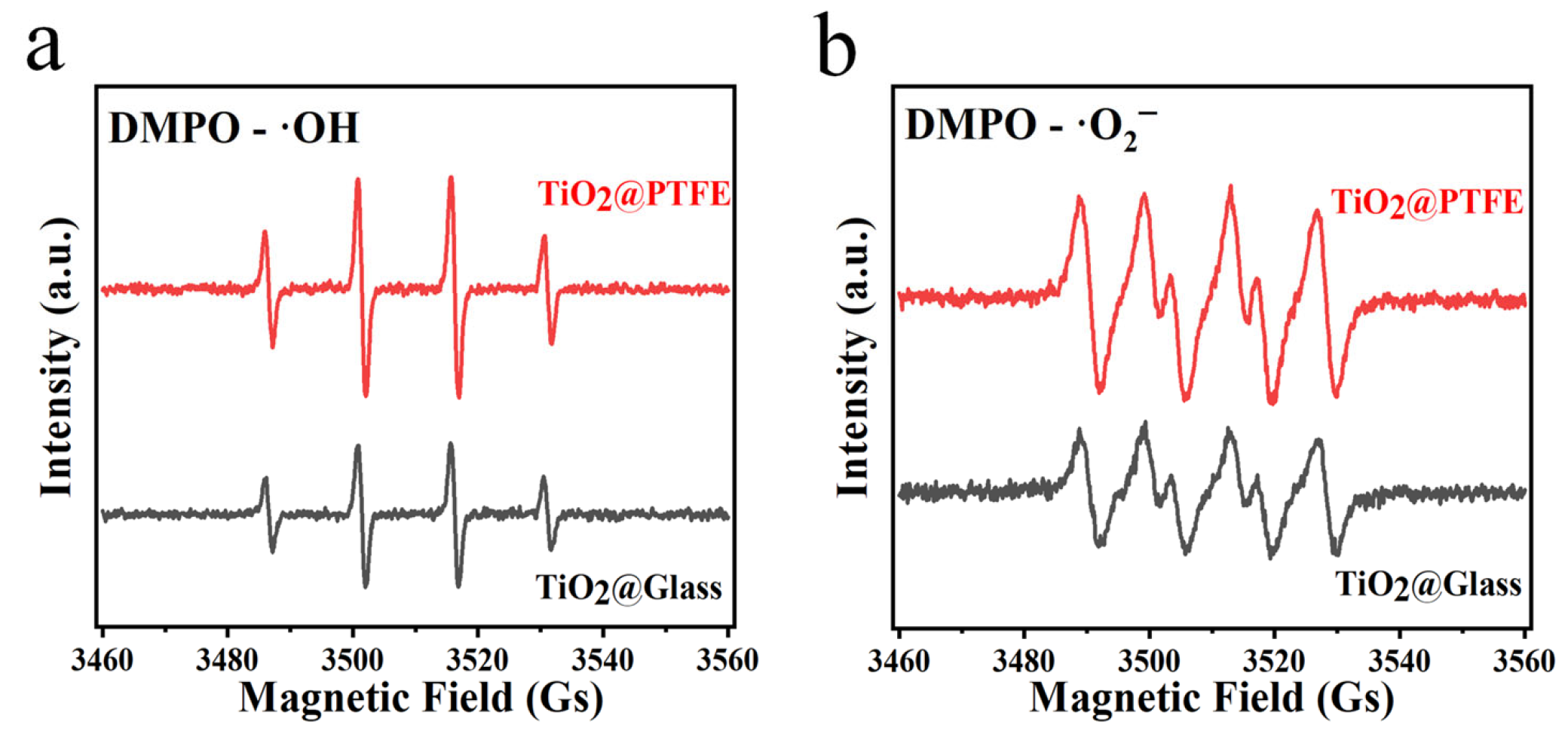
EPR tests have been widely used to reveal radicals formed in tribocatalysis [24]. Some EPR results obtained in this study are presented in Figure 6. The hydroxyl radical EPR signal intensity for the glass substrate was approximately 63.4% of the intensity observed for the PTFE coating, and the peak intensity of superoxide radical for the glass substrate was about 62.4% of that for the PTFE coating. These results clearly demonstrate that the synergistic effect between TiO2 and PTFE in the course of magnetic stirring promotes the generation of more reactive species such as superoxide and hydroxyl radicals, which accounts for the vital role that PTFE coating plays in the tribocatalytic degradation of high-concentration Rh B solutions.
A mechanism for tribocatalytic degradation of organic dye by TiO2 nanoparticles has been well established in some previous papers, which can be outlined as follows [20,22]:
T i O 2 N P   +   F r i c t i o n     T i O 2 N P   +   h +   +   e
O H +   h +     0 H
O 2 + e     O 2
O H   ( o r · O 2 ) + D y e     D e c o m p o s i t i o n
As the tribocatalytic degradation by TiO2 nanoparticles has been greatly enhanced through PTFE coating, and this enhanced performance is attributed to the particularly effective friction between TiO2 and PTFE, which promotes the generation of electron–hole pairs in TiO2. It is well known that PTFE has an extremely strong affinity for electron. Given the enhancement observed for PTFE coating, we would like to revise the processes for tribocatalytic degradation of organic dye by TiO2 nanoparticles as follows to take the effect of PTFE into consideration when it forms friction with TiO2 nanoparticles:
T i O 2 N P   F r i c t i o n   T i O 2 N P · h + · e                            
T i O 2 N P · h + · e + P T F E         F r i c t i o n           T i O 2 N P · h + + P T F E · e      
T i O 2 N P · h + + O H       T i O 2 N P + · O H      
· O H   ( o r · O 2 ) + D y e     D e c o m p o s i t i o n
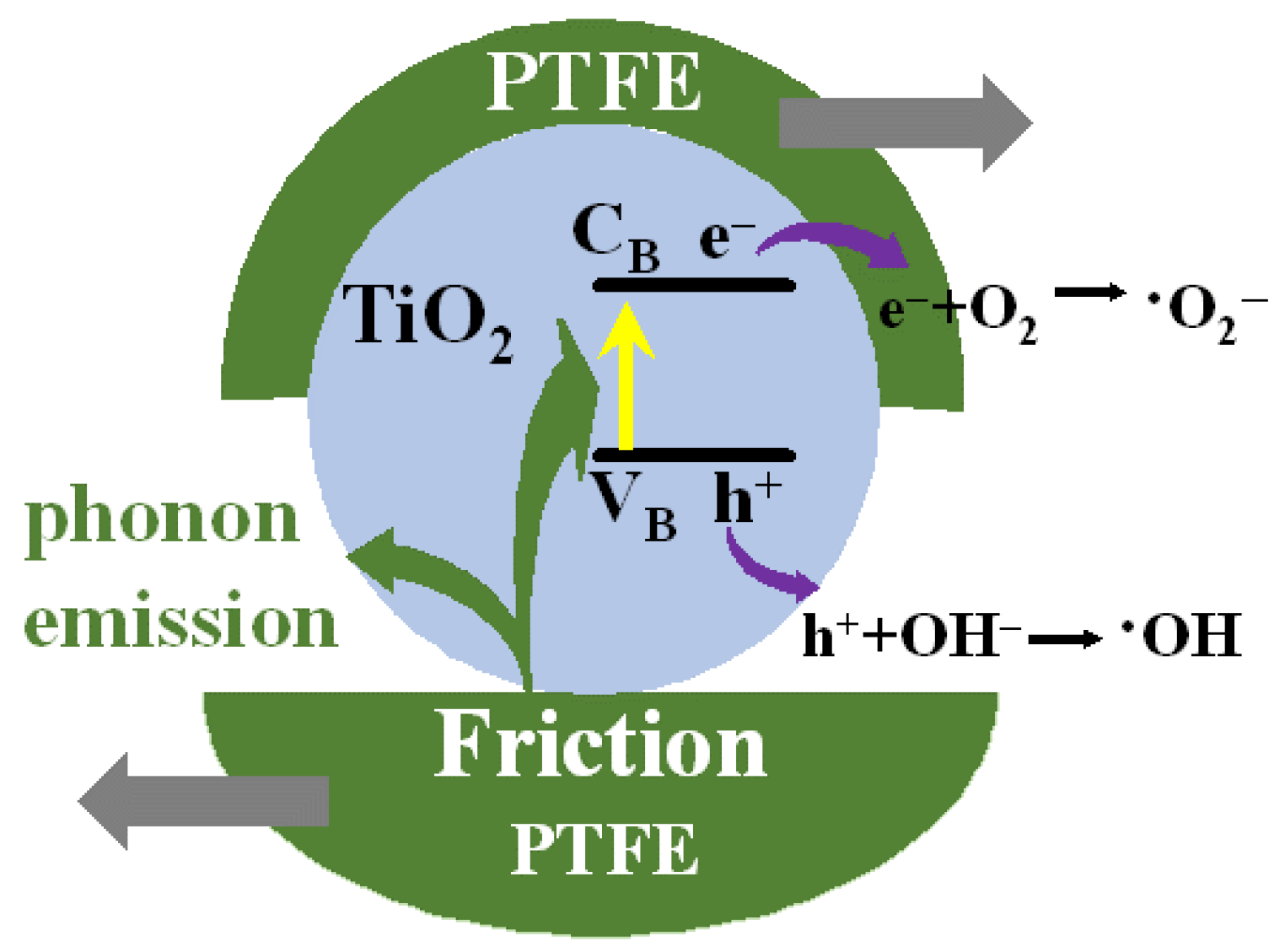
Namely, electrons are first attached to PTFE, in this way the recombination of excited electrons and holes can be greatly suppressed, and subsequent degradation of organic dyes is efficiently enhanced. The underlying tribocatalytic degradation mechanism within the PTFE-coated beaker system is schematically presented in Figure 7, which illustrates the interaction between catalysts and coatings on vessel bottoms in tribocatalysis.

4. Conclusions

Tribocatalytic experiments employed a series of concentrated Rh B solutions and TiO2 nanoparticles in beakers with glass, Ti, Al2O3, and PTFE bottoms to assess substrate-dependent performance. While 100 and 200 mg/L Rh B solutions can be rather thoroughly degraded in beakers featuring the four distinct substrates/coatings, 300 mg/L Rh B solution can only be effectively degraded in a PTFE-coated beaker. Moreover, 400 and 500 mg/L Rh B solutions can also be degraded by nearly 100% in the PTFE-coated beaker after 23 and 25 h of magnetic stirring, respectively. EPR study revealed that much more hydroxyl and superoxide radicals were generated by magnetic stirring-stimulated TiO2 in a PTFE-coated beaker than in a glass-bottomed beaker. This work demonstrates that the synergistic effect between materials in friction pairs is vital for enhancing tribocatalysis. This study reports, for the first time, the complete degradation of Rh B solutions with concentrations as high as 500 mg/L via a one-step tribocatalytic process, which should be meaningful for simplifying the complex and multi-step integrated treatment steps in current high-concentration dye wastewater treatment.

Author Contributions

Conceptualization, Y.G. and W.C.; methodology, X.C., R.W. and Y.Z.; validation, Y.G., W.C. and J.Z.; formal analysis, Y.H., P.G. and F.C.; investigation, Y.G. and W.C.; data curation, Y.G., X.C. and P.G.; writing—original draft preparation, Y.G.; writing—review and editing, Y.G. and W.C.; Visualization, X.C., R.W. and F.C.; supervision, W.C.; project administration, W.C.; Funding acquisition, Y.H. and J.Z. All authors have read and agreed to the published version of the manuscript.

Funding

This research was supported by the Basic Research Project of Key Research Projects in Higher Education Institutions in Henan Province (23ZX019) and Program for Young Core Teachers of Colleges and Universities in Henan Province (2019GGJS197). The Higher Education Undergraduate Innovation Training Program in Henan Province (202410482041).

Institutional Review Board Statement

Not applicable.

Informed Consent Statement

Not applicable.

Data Availability Statement

The data underlying this article will be shared upon reasonable request to the corresponding author.

Conflicts of Interest

The authors declare no conflicts of interest.

References

  1. Shen, Q.; Wang, F.; Liao, K.; Liu, Y.; Mei, Z.; Zhang, S.; Wang, H.; Ma, S.; Wang, L. Self-powered electroassisted photocatalysis for wastewater treatment. Nano Energy 2025, 133, 110463. [Google Scholar] [CrossRef]
  2. Bai, Y.; Xu, A.; Wu, Y.; Xue, S.; Chen, Z.; Hu, H. Portrait of municipal wastewater of China: Inspirations for wastewater collection, treatment and management. Water Res. 2025, 277, 123321. [Google Scholar] [CrossRef]
  3. Meena, V.; Swami, D.; Chandel, A.; Joshi, N.; Prasher, S.O. Selected emerging contaminants in water: Global occurrence, existing treatment technologies, regulations and associated risk. J. Hazard. Mater. 2025, 483, 136541. [Google Scholar] [CrossRef]
  4. Yang, D.; An, Z.; Huo, J.; Chen, L.; Dong, H.; Duan, W.; Zheng, Y.; Wang, M.; He, M.; Gao, S. Ultrastable cobalt-based chainmail catalyst for degradation of emerging contaminants in water. Appl. Catal. B 2025, 363, 124768. [Google Scholar] [CrossRef]
  5. Nishmitha, P.; Akhilghosh, K.A.; Aiswriya, V.P.; Ramesh, A.; Muthuchamy, M.; Muthukumar, A. Understanding emerging contaminants in water and wastewater: A comprehensive review on detection, impacts, and solutions. J. Hazard. Mater. Adv. 2025, 18, 100755. [Google Scholar] [CrossRef]
  6. Cao, X.; Chen, S.; Liu, Y.; Long, G.; Xu, Y.J. Domestic wastewater is an overlooked source and quantity in global river dissolved carbon. Nat. Commun. 2025, 16, 7522. [Google Scholar] [CrossRef]
  7. Abbas, S.; Ahmad, K.; Naseem, K.; Kashif, M.; Majeed, H.; Qureshi, K.; Rehman Shah, H.U.; Ahmad, I.; Khalid, A.; Awais, S. Cutting-edge metal-organic frameworks: Revolutionizing the adsorptive removal of pharmaceutical contaminants from water. Rev. Inorg. Chem. 2025, 45, 885–905. [Google Scholar] [CrossRef]
  8. Liu, Z.; Yu, X.; Wang, K.; Zhang, J.; Niu, J. Introducing oxygen cacancies to tune Cu2O by Sn ion-doped for high-effective photocatalytic degradation of norfloxacin in wastewater. Sep. Purif. Technol. 2025, 356, 129810. [Google Scholar] [CrossRef]
  9. Saha, H.; Dastider, A.; Anik, M.J.F.; Mim, S.R.; Talapatra, S.; Das, U.; Jamal, M.; Billah, M.M. Photocatalytic performance of CuO NPs: An experimental approach for process parameter optimization for Rh B dye. Results Mater. 2024, 24, 100614. [Google Scholar] [CrossRef]
  10. Wang, M.; Li, C.; Liu, B.; Qin, W.; Xie, Y. Facile Synthesis of Nano-Flower β-Bi2O3/TiO2 Heterojunction as Photocatalyst for Degradation RhB. Molecules 2023, 28, 882. [Google Scholar] [CrossRef] [PubMed]
  11. Sun, J.; Liu, H.; Wang, S.; Zhang, Y.; Bie, C.; Zhang, L. In situ irradiated XPS investigation on S-scheme ZnIn2S4@ COF-5 photocatalyst for enhanced photocatalytic degradation of RhB. J. Mater. 2025, 11, 100975. [Google Scholar]
  12. Deng, D.; Lamssali, M.; Aryal, N.; Ofori-Boadu, A.; Jha, M.K.; Samuel, R.E. Textiles wastewater treatment technology: A review. Water Environ. Res. 2020, 92, 1805–1810. [Google Scholar] [CrossRef]
  13. Li, J.; Cao, Y.; Ding, K.; Ye, J.; Li, F.; Ma, C.; Lv, P.; Xu, Y.; Shi, L. Research progress of industrial wastewater treatment technology based on solar interfacial adsorption coupled evaporation process. Sci. Total Environ. 2024, 931, 172887. [Google Scholar] [CrossRef]
  14. Bikerchalen, S.; Akhsassi, B.; Bakiz, B.; Villain, S.; Taoufyq, A.; Guinneton, F.; Gavarri, J.; Benlhachemi, A. Photocatalytic degradation of Rhodamine B dye over oxygen-rich bismuth oxychloride Bi24O31Cl10 photocatalyst under UV and visible light irradiation: Pathways and mechanism. J. Phys. Chem. Solids 2025, 196, 112342. [Google Scholar] [CrossRef]
  15. Shamshad, J.; Rehman, R.U. Innovative approaches to sustainable wastewater treatment: A comprehensive exploration of conventional and emerging technologies. Environ. Sci. Adv. 2025, 4, 189–222. [Google Scholar] [CrossRef]
  16. Senthil Rathi, B.; Senthil Kumar, P.; Sanjay, S.; Prem Kumar, M.; Rangasamy, G. Artificial intelligence integration in conventional wastewater treatment techniques: Techno-economic evaluation, recent progress and its future direction. Int. J. Environ. Sci. Technol. 2025, 22, 633–658. [Google Scholar] [CrossRef]
  17. Ding, S.; Li, X.; Qiao, X.; Liu, Y.; Wang, H.; Ma, C. Identification and screening of priority pollutants in printing and dyeing industry wastewater and the importance of these pollutants in environmental management in China. Environ. Pollut. 2024, 362, 124938. [Google Scholar] [CrossRef] [PubMed]
  18. Liang, P.; Zhang, X.; Yang, B.; Dong, X.; Zhao, Y.; Chen, J.; Chen, K.; Ge, L.; Li, Y. N-doped three-dimensional carbon nanosheets: Facile synthesis and high-concentration dye adsorption. Sep. Purif. Technol. 2025, 359, 130621. [Google Scholar] [CrossRef]
  19. Gu, Y.; Zhang, W.; Li, Y.; Wang, K.; Ge, L.; Zhang, X.; Zhao, J.; Shen, Z.; Chen, W.; Hu, Y. Tribocatalytic degradation of concentrated methyl orange solutions by BiFeO3 nanoparticles prepared through a sol–gel method. RSC. Adv. 2025, 15, 23089–23096. [Google Scholar] [CrossRef]
  20. Gu, Y.; Li, Y.; Wang, K.; Ge, L.; Mao, C.; Zhang, W.; Zhao, J.; Hu, Y.; Zhang, X.; Chen, W. Greatly enhanced tribocatalytic purification of concentrated dye wastewater by TiO2 nanoparticles through Ti and Al2O3 coatings. Colloid Interface Sci. Commun. 2025, 67, 100851. [Google Scholar]
  21. Li, Y.; Gao, Y.; Li, X.; Zhang, J.; Zhang, X.; Zhang, D. Surface-dominated sodium storage enabled by TiO2 nanosheets with 84% exposure of (0 0 1) facets for high-performance Na-ion battery anodes. Mater. Lett. 2025, 380, 137737. [Google Scholar] [CrossRef]
  22. Li, P.; Wu, J.; Wu, Z.; Jia, Y.; Ma, J.; Chen, W.; Zhang, L.; Yang, J.; Liu, Y. Strong tribocatalytic dye decomposition through utilizing triboelectric energy of barium strontium titanate nanoparticles. Nano Energy 2019, 63, 103832. [Google Scholar] [CrossRef]
  23. Cui, X.; Li, P.; Lei, H.; Tu, C.; Wang, D.; Wang, Z.; Chen, W. Greatly enhanced tribocatalytic degradation of organic pollutants by TiO2 nanoparticles through efficiently harvesting mechanical energy. Sep. Purif. Technol. 2022, 289, 120814. [Google Scholar] [CrossRef]
  24. Ke, S.; Mao, C.; Luo, R.; Zhou, Z.; Hu, Y.; Zhao, W.; Chen, W. Surprising effects of Al2O3 coating on tribocatalytic degradation of organic dyes by CdS nanoparticles. Coatings 2024, 14, 1057. [Google Scholar] [CrossRef]
  25. Zhang, S.; Yang, H.; Song, L. Study on the performance and mechanism of tribocatalysis-based multifunctional TiB2 without sacrificial agent for highly selective hydrogen evolution from pure water splitting. Int. J. Hydrogen Energy 2025, 106, 129–137. [Google Scholar] [CrossRef]
  26. Cui, X.; Wang, H.; Lei, H.; Jia, X.; Jiang, Y.; Fei, L.; Jia, Y.; Chen, W. Surprising tribo-catalytic conversion of H2O and CO2 into flammable gases utilizing frictions of copper in water. Chem. Select. 2023, 8, e202204146. [Google Scholar] [CrossRef]
  27. Zeng, Z.; Wu, J.; Xia, C.; Yuan, S.; Ren, X.; Zhao, L.; Zhuang, L.; He, Y. Boosting photocatalytic efficiency with ohmic contact: A novel Bi/BaTiO3 composite for nitrogen fixation and RhB degradation. J. Alloys Compd. 2025, 1010, 178312. [Google Scholar]
  28. Bukhari, S.N.U.S.; Shah, A.A.; Liu, W.; Channa, I.A.; Chandio, A.D.; Chandio, I.A.; Ibupoto, Z.H. Activated carbon based TiO2 nanocomposites (TiO2@ AC) used simultaneous adsorption and photocatalytic oxidation for the efficient removal of Rhodamine-B (Rh–B). Ceram. Int. 2024, 50, 41285–41298. [Google Scholar] [CrossRef]
  29. Halim, O.M.A.; Mustapha, N.H.; Fudzi, S.N.M.; Azhar, R.; Zanal, N.I.N.; Nazua, N.F.; Nordin, A.H.; Azami, M.S.M.; Ishak, M.A.M.; Ismail, W.I.N.W. A review on modified ZnO for the effective degradation of methylene blue and rhodamine B. Surf. Interfaces 2025, 18, 100408. [Google Scholar] [CrossRef]
  30. Xu, N.; Xia, W.; Yang, X.; Jin, C.; Zhang, W. Simple synthesis of Au modified dual-Bi based heterojunction and its photocatalytic activity for high concentration RhB. Mater. Lett. 2025, 403, 139489. [Google Scholar] [CrossRef]
  31. Liang, H.; Zhao, J.; Brouzgou, A.; Wang, A.; Jing, S.; Kannan, P.; Chen, F.; Tsiakaras, P. Efficient photocatalytic H2O2 production and photodegradation of RhB over K-doped g-C3N4/ZnO S-scheme heterojunction. J. Colloid Interface Sci. 2025, 677, 1120–1133. [Google Scholar] [CrossRef] [PubMed]
  32. Barveen, N.R.; Parasuraman, B.; Wang, P.; Zeng, C.; Cheng, Y.; Thangavelu, P. Facile construction of ZnWO4/g-C3N4 heterojunction for the improved photocatalytic degradation of MB, RhB and mixed dyes. Surf. Interfaces 2024, 53, 105039. [Google Scholar] [CrossRef]
  33. Afshari, Z.; Ramazani, A.; Teymourinia, H. Magnetic based g-C3N4 nanocomposite: Synthesis, characterization, and Z-scheme based photocatalytic properties. Inorg. Chem. Commun. 2025, 172, 113709. [Google Scholar] [CrossRef]
  34. He, Y.; Jin, Z.; Wu, S.; Jiang, C.; Hu, C.; Liu, L. Enhanced Tribocatalytic CO2 Reduction by TiO2 Nanoparticles. ACS omega 2025, 10, 32339–32347. [Google Scholar] [CrossRef]
  35. Geng, L.; Qian, Y.; Song, W.; Bao, L. Enhanced tribocatalytic pollutant degradation through tuning oxygen vacancy in BaTiO3 nanoparticles. Appl. Surf. Sci. 2023, 637, 157960. [Google Scholar] [CrossRef]
  36. Mao, C.; Zhang, Y.; Lei, H.; Jia, X.; Chen, F.; Yao, W.; Liu, P.; Chen, W. Boosting tribo-catalytic degradation of organic pollutants by BaTiO3 nanoparticles through metallic coatings. Appl. Surf. Sci. 2024, 663, 160172. [Google Scholar] [CrossRef]
  37. Liu, S.; Yang, Y.; Hu, Y.; Rao, W. Effect of strontium substitution on the tribocatalytic performance of barium titanate. Materials 2023, 16, 3160. [Google Scholar] [CrossRef]
  38. Yang, B.; Chen, H.; Guo, X.; Wang, L.; Xu, T.; Bian, J.; Yang, Y.; Liu, Q.; Du, Y.; Lou, X. Enhanced tribocatalytic degradation using piezoelectric CdS nanowires for efficient water remediation. J. Mater. Chem. C 2020, 8, 14845–14854. [Google Scholar] [CrossRef]
  39. Zheng, M.; Guo, M.; Ma, F.; Li, W.; Shao, Y. Recent advances in graphitic carbon nitride-based composites for enhanced photocatalytic degradation of rhodamine B: Mechanism, properties and environmental applications. Nanoscale Adv. 2025, 7, 4780–4802. [Google Scholar] [CrossRef]
  40. Zhu, M.; Zhou, Z.; Gu, Y.; Bing, L.; Xie, Y.; Shen, Z.; Chen, W. Powerful tribocatalytic degradation of methyl orange solutions with concentrations as high as 100 mg/L by BaTiO3 nanoparticles. Nanomaterials 2025, 15, 1135. [Google Scholar] [CrossRef]
  41. Mao, C.; Guo, Z.; Chen, W. Coating disk-shaped materials on the bottoms of vessels: A convenient while marvelous practice for tribocatalysis. Surf. Interfaces 2025, 60, 106106. [Google Scholar] [CrossRef]
  42. Aliaga, J.; Chamorro, N.; Alegría, M.; Araya, J.; Paraguay-Delgado, F.; Alonso-Núñez, G.; González, G.; Benavente, E. Rhenium-doped MoS23D-flower-like nanosheets on 2D-TiO2 core-shell for synergistic photocatalytic degradation of RhB under visible light. Mater. Today Commun. 2025, 44, 111961. [Google Scholar] [CrossRef]
  43. Peng, B.; Xie, H.; Tao, B.; Wang, Y.; Ning, Z.; Song, Q.; Pei, L. Novel photocatalytic SrTiO3@ TiO2/SrSO4 heterojunction and its high performance in RhB degradation. Nanoscale 2025, 17, 21803–21809. [Google Scholar] [CrossRef] [PubMed]
  44. Chen, F.; Liu, Z.; Liu, Y.; Fang, P.; Dai, Y. Enhanced adsorption and photocatalytic degradation of high-concentration methylene blue on Ag2O-modified TiO2-based nanosheet. Chem. Eng. J. 2013, 221, 283–291. [Google Scholar] [CrossRef]
Figure 1. Characterization of the TiO2 nanoparticles used in this study: (a) XRD; (b) N2 adsorption–desorption isotherm at 77 K; (c) a TEM micrograph showing agglomerations; (d) a TEM micrograph showing some discrete TiO2 nanoparticles.
Coatings 16 00111 g001
Figure 2. 100 mg/L Rh B solutions suspended with TiO2 nanoparticles subjected to magnetic stirring: UV-Vis absorption spectra and color evolutions in the course of magnetic stirring in beakers with (a) glass bottom; (b) Al2O3 coating; (c) PTFE coating; (d) Ti coating. (e) C/C0 versus magnetic stirring time; (f) Bar chart of the degradation efficiencies after 2 h of magnetic stirring.
Coatings 16 00111 g002
Figure 3. 200 mg/L Rh B solutions suspended with TiO2 nanoparticles subjected to magnetic stirring: UV-Vis absorption spectra and color evolutions in the course of magnetic stirring in beakers with (a) glass bottom; (b) Al2O3 coating; (c) PTFE coating; (d) Ti coating. (e) C/C0 versus magnetic stirring time; (f) Bar chart of the degradation efficiencies after 10 h of magnetic stirring.
Coatings 16 00111 g003
Figure 4. 300 mg/L Rh B solutions suspended with TiO2 nanoparticles subjected to magnetic stirring: UV-Vis absorption spectra and color evolutions in the course of magnetic stirring in beakers with (a) glass bottom; (b) Al2O3 coating; (c) PTFE coating; (d) Ti coating. (e) C/C0 versus magnetic stirring time; (f) Bar chart of the degradation efficiencies after 16 h of magnetic stirring.
Coatings 16 00111 g004
Figure 5. In PTFE-coated beakers Rh B solutions suspended with TiO2 nanoparticles subjected to magnetic stirring: (a) 400 mg/L Rh B solution; (b) 500 mg/L Rh B solution; (c) C/C0 versus magnetic stirring time for Rh B solutions of 100–500 mg/L; (d) Bar plot comparing the 10 h degradation percentage for Rh B solutions of 200–500 mg/L.
Coatings 16 00111 g005
Figure 6. For TiO2 nanoparticles under magnetic stirring in beakers with glass bottom and PTFE coating separately, EPR detection with DMPO as a probe in: (a) de-ionized water for ·OH; (b) in CH3OH for ·O2.
Coatings 16 00111 g006
Figure 7. A schematic drawing for the excitation of electron–hole pairs in TiO2 nanoparticles by the friction between TiO2 and PTFE in the course of magnetic stirring in a PTFE-coated beaker.
Coatings 16 00111 g007
Disclaimer/Publisher’s Note: The statements, opinions and data contained in all publications are solely those of the individual author(s) and contributor(s) and not of MDPI and/or the editor(s). MDPI and/or the editor(s) disclaim responsibility for any injury to people or property resulting from any ideas, methods, instructions or products referred to in the content.