


Abstract
This study aims to investigate the effects and underlying mechanisms of recycled sand replacement rate, additional water compensation factor, and recycled powder content on the strength, volumetric water absorption, and impermeability of recycled sand concrete. A total of 12 groups of concrete specimens with different mixtures were tested for their mechanical properties, volumetric water absorption, and chloride ion penetration. Furthermore, NMR and SEM analyses were conducted to reveal the microstructural mechanisms by which the additional water level and recycled sand content influence the mechanical performance and durability of the concrete. The results indicate that although recycled sand particles inherently contain numerous micro cracks, adhered porous cement paste, and pre-existing interfaces that enhance capillary water absorption and lead to reductions in strength and durability, these shortcomings can be mitigated by compensating for the additional water and controlling the recycled powder content. Increasing the additional water slightly reduces the strength of the recycled sand concrete. More importantly, appropriate amounts of additional water can reduce water absorption and improve the penetration resistance of recycled sand concrete. Furthermore, with an increase in recycled sand content, the strength, and impermeability of the concrete first increase and then decrease, reaching their maximum values at a recycled powder content of 4%. The water absorption of recycled sand concrete gradually increases with higher recycled powder content. Overall, recycled sand concrete can achieve satisfactory performance by optimizing the additional water amount and recycled powder content. It is recommended that the pre-saturation water compensation factor of recycled sand be maintained at 70%–80% of its 24 h saturated water absorption, and that the recycled powder content be controlled within 4%–8%.
1. Introduction
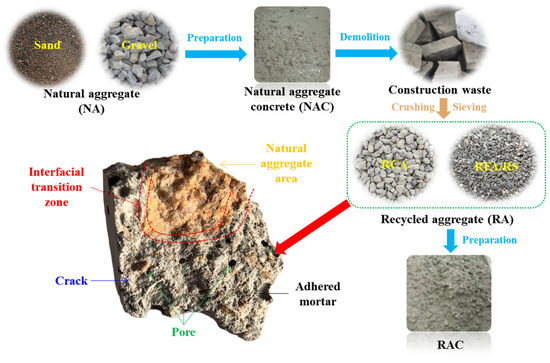
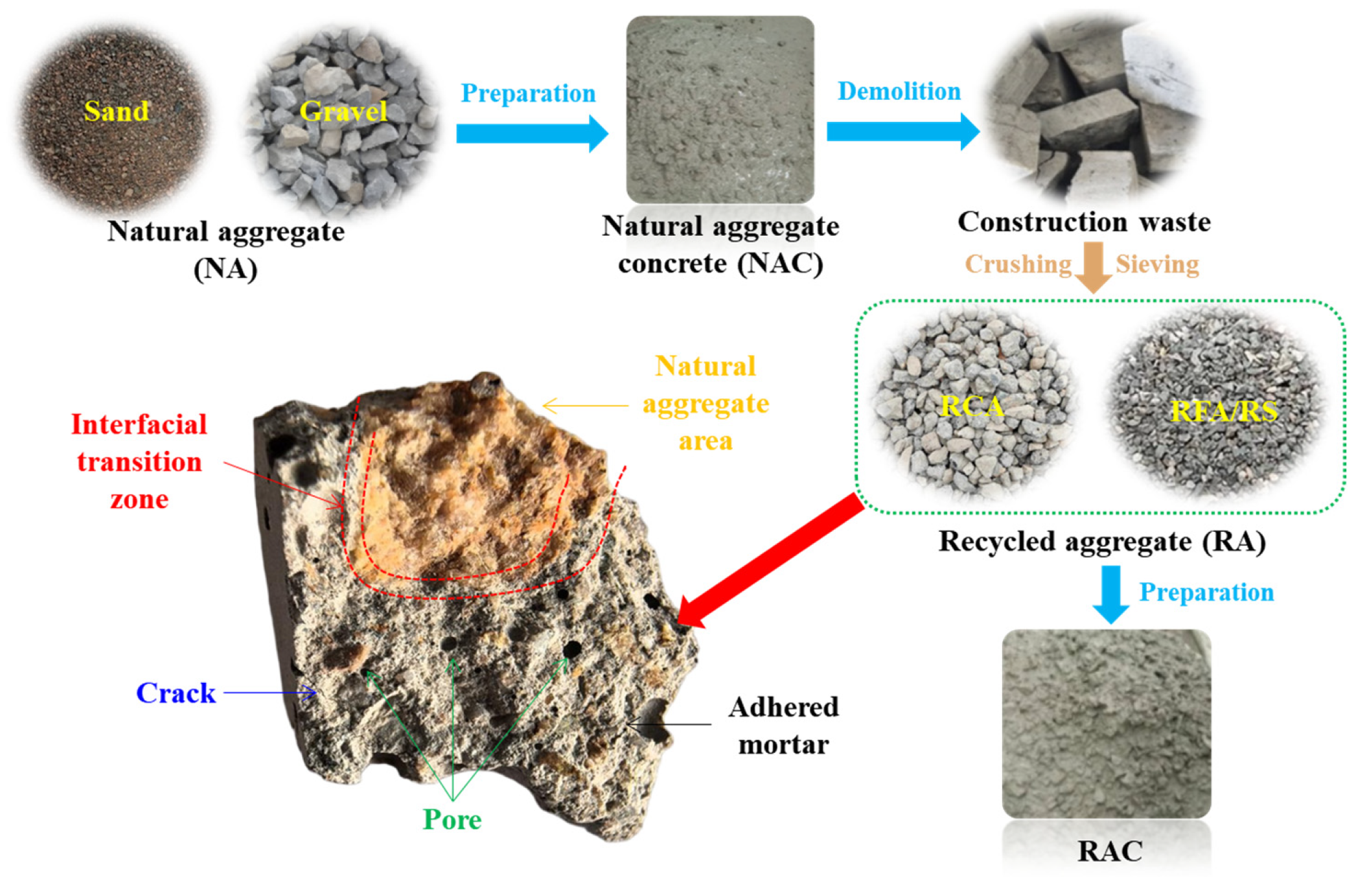
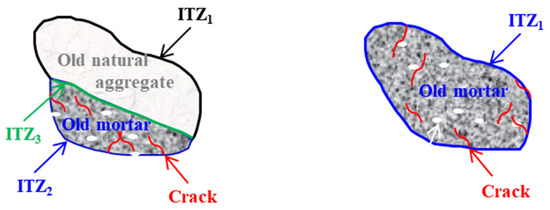
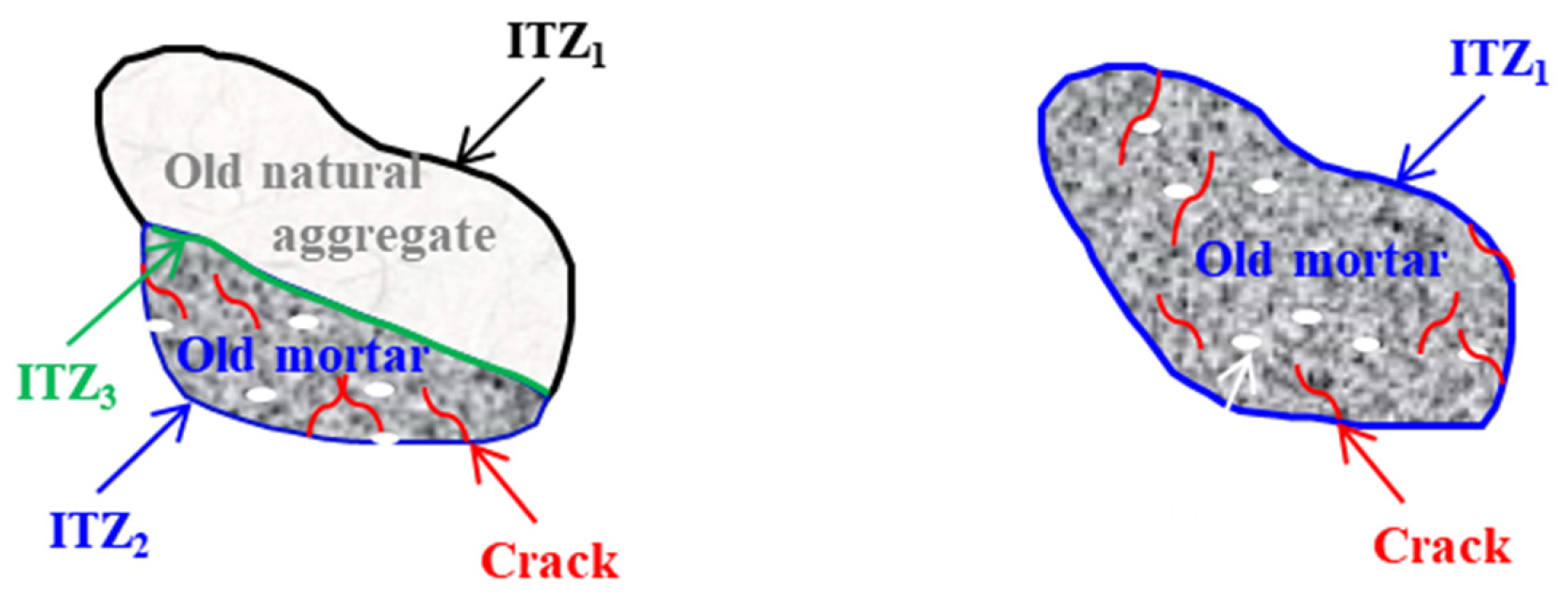
Different from natural aggregates, some micro-cracks are formed inside the recycled aggregates during the process of crushing waste concrete to prepare recycled aggregates. In addition, the surface of some recycled aggregates adheres to the old cement paste with a loose structure, which leads to the low density and high water absorption characteristics of recycled aggregates [1,2], as shown in Figure 1. High water absorption brings more external impurity ions to corrosion concrete and reduces the durability of recycled aggregate concrete [3,4]. Recycled sand (RS) is a byproduct of the production of recycled coarse aggregates, typically containing a large amount of mortar-aggregate particles (containing natural coarse aggregates) and pure hardened cement mortar particles (excluding natural coarse aggregates), as shown in Figure 2. Therefore, the structural composition and types of RS are more complex than those of recycled coarse aggregate, and its water absorption and compactness are also relatively worse. Due to the influence of these defects, more capillary pores are formed inside the recycled sand concrete (RSC), which accelerates the penetration of water molecules and corrosive ions, making the durability of RSC particularly prominent [5,6,7]. Exploring and optimizing the high water absorption and permeability of RS is the key to improving its durability, and it is also the only way to promote RS in the concrete industry [8,9,10].
Figure 1.
The RCA and RS.
Figure 2.
The different types of RS.
Evangelista et al. [11] studied the effect of the RS replacement rate (0, 30%, 100%) on the chloride ion and water absorption unsteady diffusion coefficient of recycled concrete. The results show that the water absorption rate and chloride ion unsteady diffusion coefficient of recycled concrete increase with the increase in the replacement rate of RS. When the replacement rate reaches 100%, the water absorption rate increases by 46% and the chloride ion unsteady diffusion coefficient increases by 33.8%. Sim et al. [12] studied the effect of the RS replacement rate and fly ash on the resistance to chloride ion penetration (CIP) of recycled concrete. The results show that the replacement level of RS does not significantly affect the CIP without fly ash. The chloride ion flow decreases by more than 50% when the content of fly ash reaches 30%. Zhuang et al. [13] studied the resistance to CIP of concrete prepared by RS with different water content. It was found that under the same conditions of total water–binder ratio and RS content, the CIP of concrete prepared by RS in dry state was the highest, and the CIP of concrete prepared by RS in saturated state was the lowest. At the same time, some scholars have carried out attempts to improve the performance of RSC by adding some additional water. Vazquez et al. [14] and Poon et al. [15] suggested that the additional water consumption should not reach the saturation point (such as the amount of water required to absorb water to the saturated state of surface dry). Due to the risk of water then migrating from the recycled aggregate to the cement paste, this migration will change the water–cement ratio of the interfacial transition zone between the recycled coarse aggregate and the cement paste, thereby affecting their bond strength. Leite et al. [16] prepared recycled coarse and fine aggregate concrete with different additional water content. The additional water content was 60%~90% of the amount of water absorbed by the recycled aggregate to the saturated state. They found that the workability indexes such as slump, slump-flow and consistency of recycled concrete were improved with the additional water content but the compressive strength was reduced.
In the study of free water content in mortar with different water–cement ratios and different RS content, Li et al. [17] found that the water absorption of RS after soaking in cement paste for 30 min accounted for 64%~71% of its 24 h saturated water absorption. After 60 min, it increased to 72%–78%, and the water absorption in a high water–binder ratio was high, and the water absorption in a low water–binder ratio was low. De et al. [18] used 80% of the dry water absorption of the 24 h saturated of RS as additional water consumption to make the RS saturated when the concrete was stirred, and considered that this value was the best value for the saturation of the RS. Other studies have shown that although the introduction of some additional water will reduce the strength of recycled concrete, the appropriate amount of additional water has a significant improvement on its durability [19,20,21,22]. In addition, some studies have shown that except the additional water, an appropriate amount of recycled powder also seems to be beneficial for improving the mechanical properties [23,24], durability [25,26,27], and microstructure [28,29,30] of RSC. This is because although the recycled powder has low activity and a loose structure, its micro particles have filling and chemical effects, and the addition of appropriate additional water seems to promote the recycled powders to further participate in the secondary hydration of cement, which can improve the density of concrete [31,32,33,34].
Although some specific studies have been carried out on the additional water consumption of recycled concrete and some results have been achieved [16,17,18], there is no clear general method or formula for calculating the additional water consumption of recycled concrete with strong applicability and high precision; the value of additional water consumption is also controversial. In addition, although some specific studies have been carried out on the permeability of RSC [13,14,15,25,26,27], few scholars have studied the capillary water absorption characteristics and impermeability of RSC, and there are few reports on these mechanisms. To solve this problem, the idea of using the compensation factor of additional water consumption as a factor to regulate the additional water consumption is proposed in the test. The compensation coefficient is defined as the percentage of the 24 h saturated water absorption of recycled aggregate, which is expressed as the ratio of the additional water consumption per unit volume of recycled aggregate concrete to the 24 h saturated water absorption of recycled aggregate. The effects of RS content, additional water consumption, and recycled powder content on the strength, volume water absorption, and impermeability of RSC were further studied. The influence and influence mechanism of RS on the pore structure and interface microstructure of concrete are revealed, to provide reference for improving the durability of RSC.
2. Experiment
2.1. Materials
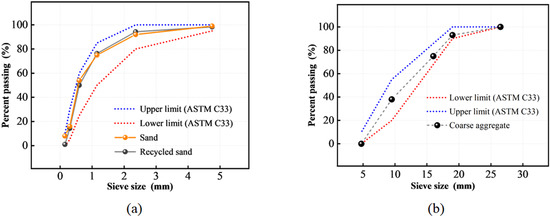
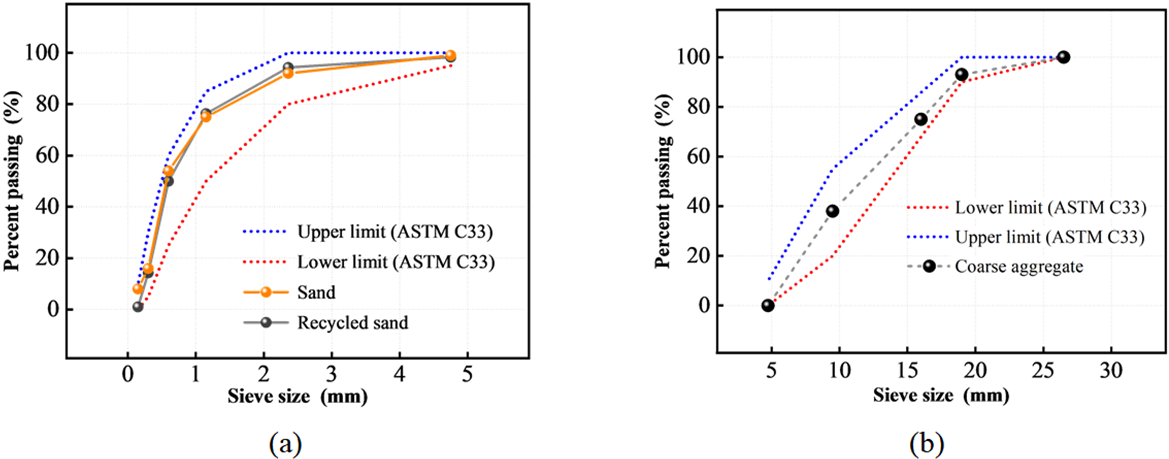
The 42.5 grade Chinese Conch brand commercial Portland cement (for Shaanxi, China) was used in this test, and the various indicators provided by the merchant are shown in Table 1. The natural fine aggregate is natural river sand, the fineness modulus is 2.7, the mud content is 2.1%, and other indicators are shown in Table 2. RS is made by coarse crushing, medium crushing, and shaping of C40 concrete test block discarded in the laboratory (the measured 90 d compressive strength is 58.6 MPa), and the indexes are shown in Table 2. To minimize the impact of test errors caused by variations in fine aggregate gradation, the gradation curves of natural sand and the RS should be adjusted to be similar before the test. The adjusted gradation curve of natural sand and RS is shown in Figure 3a. The coarse aggregate is limestone continuous graded crushed stone of 5~25 mm, which was prepared from three particle size ranges (5~10 mm, 10~20 mm, 16~31.5 mm) according to the mass ratio of 1:6:3. The gradation curve is shown in Figure 3b. The measured water reduction rate of superplasticizer in the laboratory was 30% and ordinary tap water from the laboratory was used.
Table 1.
Cement index.
Table 2.
Fine aggregate performance index.
Figure 3.
Particle dimension distributions of aggregates. (a) Fine aggregate. (b) Coarse aggregate.
2.2. Method and Mix
Table 2 presents twelve mix proportions of fresh RSC with varying RS contents, additional water amounts, recycled powder contents (particles smaller than 150 μm in recycled sand), as well as reference mix (RS0W0P0) in which natural sand is used exclusively as the fine aggregate. The RSC were derived from the reference mix by replacing natural sand with RS on an equal mass basis. The test program consisted of three main parts. First, under the conditions of the additional water compensation factor (kwa) of 0.9 and a recycled powder content of 8%, the effect of RS contents (0%, 25%, 50%, 75%, and 100%) on concrete performance was investigated. Second, with a RS replacement ratio of 100% and a recycled powder content of 8%, the influence of different kwa (0.6, 0.7, 0.8, 0.9, and 1.0 corresponding to 60%, 70%, 80%, 90%, and 100% of the water absorbed by RS when reaching a saturated state after 24 h) on concrete performance was examined. Third, at a RS replacement ratio of 100% and a kwa of 0.9, the effect of recycled powder contents as part of the replacement of recycled sand (0%, 4%, 8%, 12%, and 16%) on concrete performance was studied. To ensure that the test results were reasonable and reliable, the dosage of the superplasticizer was adjusted so that the workability (slump within 200 ± 20 mm) of concrete mixtures with different RS contents were comparable prior to casting, vibration, and curing. The mix for each test group of recycled concrete is presented in Table 3, where the superplasticizer dosage is expressed as a percentage of the cementitious materials.
Table 3.
Mixture proportions of RCA concrete.
The amount of coarse and fine aggregate in Table 3 should be the amount of dry state in theory. In the actual test, natural gravel and natural sand are used after drying, and the water content is very low and can be ignored. However, the RS dried on the surface is actually in an air-dried state due to the high porosity of RS, and the measured moisture content is 3.0%. Therefore, the amount of additional water actually added during concrete mixing is the total additional water minus the amount of water brought into the concrete by the RS in the air-dried state. In other words, the amount of pre-absorbed water in Table 3 is the sum of water content and additional water content of recycled aggregate. The actual additional water consumption during the mixing of RSC can be calculated:
where
- mwa is the total amount of additional water associated with RS in air-dry condition per unit volume of concrete, kg/m3.
- αwa is the RS replacement ratio in concrete, %.
- MFA is the total mass of fine aggregates of per unit volume concrete, kg/m3.
- Kwa is the water compensation coefficient or additional water compensation factor, typically taken as a percentage of the water absorbed by RS when it reaches a saturated state after 24 h, dimensionless.
- wcs,ssw is the RS 24 h saturated water absorption, %.
- wcs is the moisture content of the RS in air-dry condition, %. When wcs = 0, the calculated mwa corresponds to the additional water required for RS in an oven-dry condition per unit volume of concrete.
2.3. Testing
2.3.1. Strength and Permeability
The HYE-2000 concrete pressure testing machine (for Shaanxi, China) was used, with a loading speed controlled between 0.5 Mpa/s and 0.8 Mpa/s. According to GB/T 50081-2019 [35], the compressive and splitting tensile strength (σc and fst) of hardened concrete were evaluated using cubic specimens 100 mm in side. The σc was tested at 7 and 28 days, while the fst was measured at 28 days. The rapid chloride ion permeability (CIP) test was conducted in accordance with the procedure specified in GB/T 50082-2009 [36]. Cylindrical specimens with a height of 50 mm and a diameter of 100 mm were used. After curing under standard conditions for 28 days, the specimens were subjected to vacuum saturation followed by electrical testing. For each testing condition, three specimens were prepared, and the reported strength was taken as the average value of the three measurements, accurate to 0.1 Mpa. It should be noted that if either the highest or lowest measurement differs from the median value by more than 15% of the median, both the maximum and minimum readings must be discarded, and only the median is taken as the strength result for that group. If both the maximum and minimum differ from the median by more than 15%, the test results for that group of specimens are considered invalid.
2.3.2. Volumetric Water Absorption Test
The volumetric water absorption (waw) test is relatively straightforward and was performed in accordance with the procedure specified in GB/T 50081-2019. Cubic specimens 100 mm in side were used. The waw of concrete was calculated using the following equation:
where
- waw denotes the volumetric water absorption of concrete specimen, %.
- Ms is the surface-dry mass of the specimen after full saturation, g.
- md is the mass of the specimen in the oven-dry state, g.
2.3.3. NMR and SEM Tests
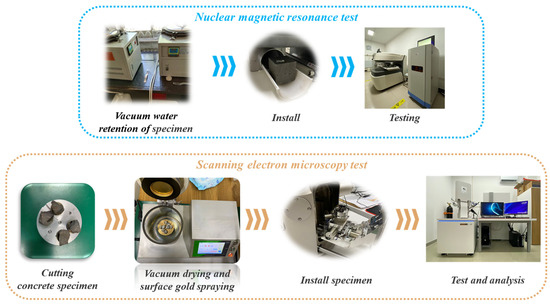
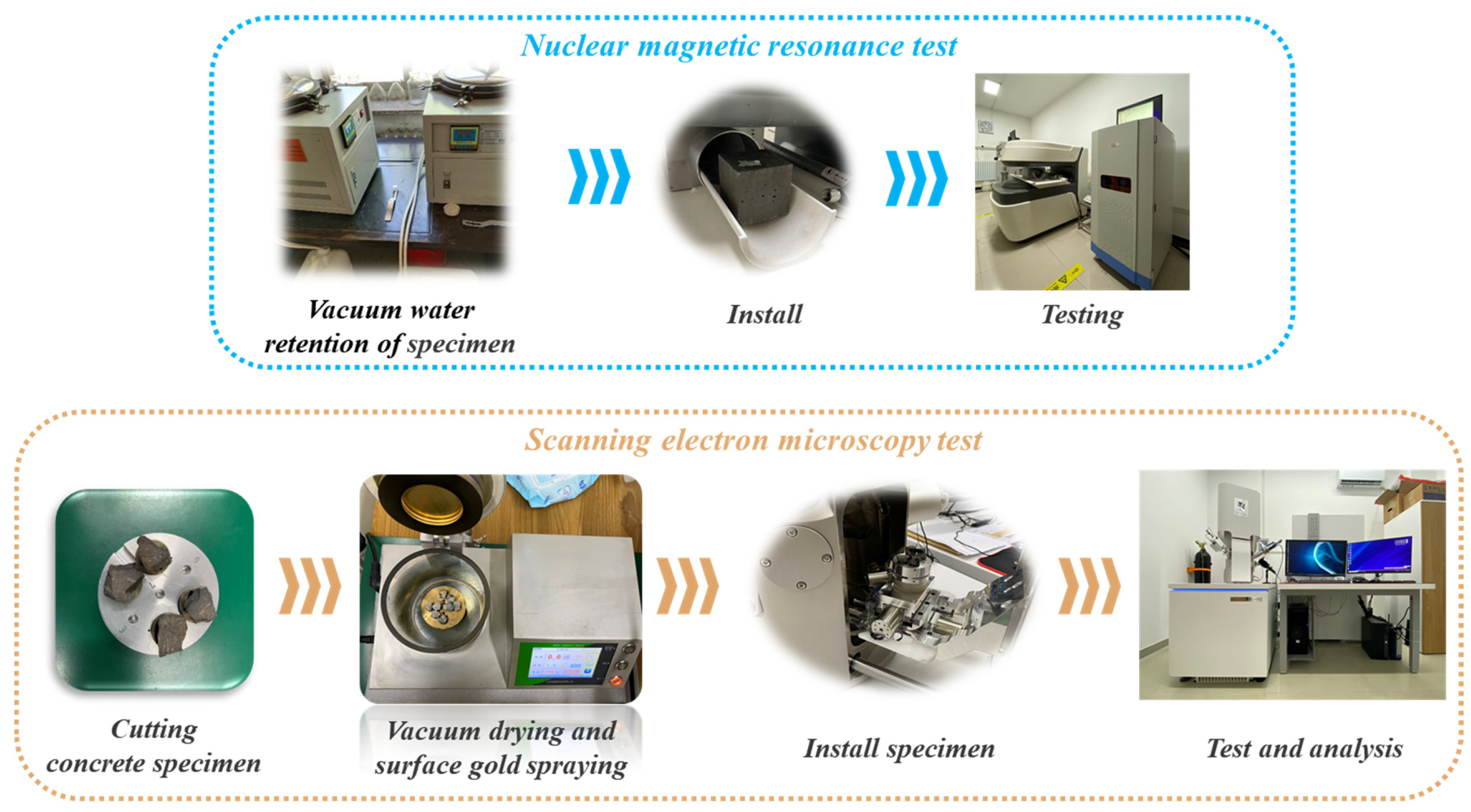
The nuclear magnetic resonance (NMR) measurements were carried out using a MacroMR12-150H-I microstructure analyzer. Concrete specimens with 100 mm in side were used. The samples were saturated with water under a vacuum and then wrapped in plastic film to avoid moisture evaporation before the NMR analysis. The testing process and mapping calculation between relaxation time and pore size was conducted following the procedures reported in reports [4,25], and the corresponding experimental configuration is presented in Figure 4.
Figure 4.
Test equipment and step of NMR and SEM.
The microstructure of the concrete was further examined through scanning electron microscopy (SEM). A TESCAN CLARA field-emission SEM (Czech Republic) was utilized, offering a secondary electron resolution of 0.9 nm, an accelerating voltage range between 200 V and 30 kV, and a magnification capability spanning from ×2 to ×2,000,000. After the completion of strength testing, small fragments of roughly 0.5 cm × 0.5 cm were collected. These fragments were immersed in absolute ethanol for seven days to halt hydration, subsequently dried under a vacuum at (60 ± 5) °C until reaching constant mass, coated with a thin gold film, and then observed under a 20 kV accelerating voltage. The SEM testing apparatus is shown in Figure 4.
3. Results and Analysis
3.1. Mechanical Strength
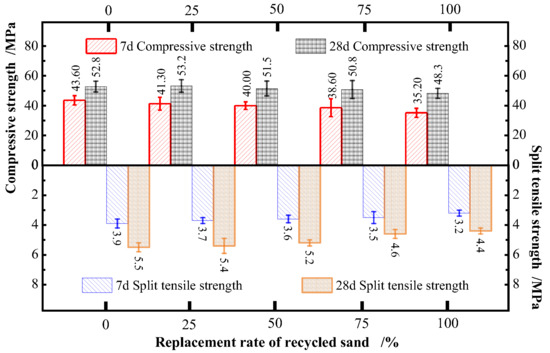
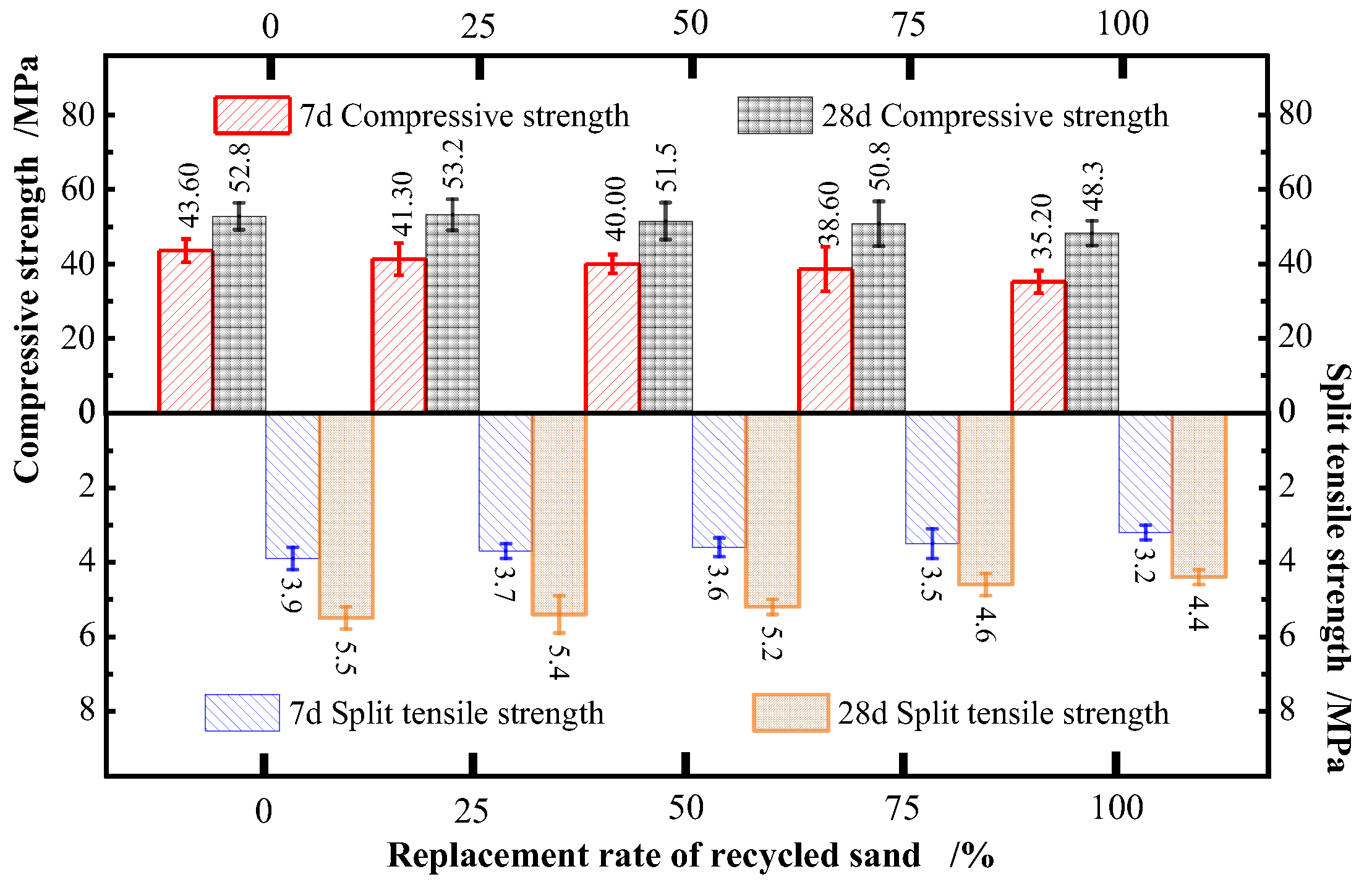
Figure 5, Figure 6 and Figure 7 illustrates the effects of RS content, additional water amount, and micro powder content on the σc and fst of concrete. As shown in Figure 5, increasing the proportion of RS results in a noticeable reduction in σc. When the RS content reaches 100%, the σc decreases by 19.3% and 8.5% at 7 and 28 days, while the fst decreases by 17.9% and 20.0% at the same ages. This reduction can be attributed to two main factors: first, incorporating RS necessitates additional water, which raises the effective water-to-cement ratio and consequently weakens the concrete. Second, the lower intrinsic strength of RS combined with the presence of interfaces between new and old mortar further diminishes the overall strength of recycled concrete. Together, these factors explain the observed monotonic decline in strength with increasing RS content.
Figure 5.
Effect of RS content on concrete strength.
Figure 6.
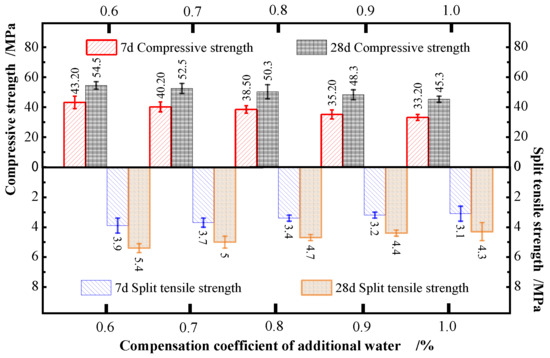
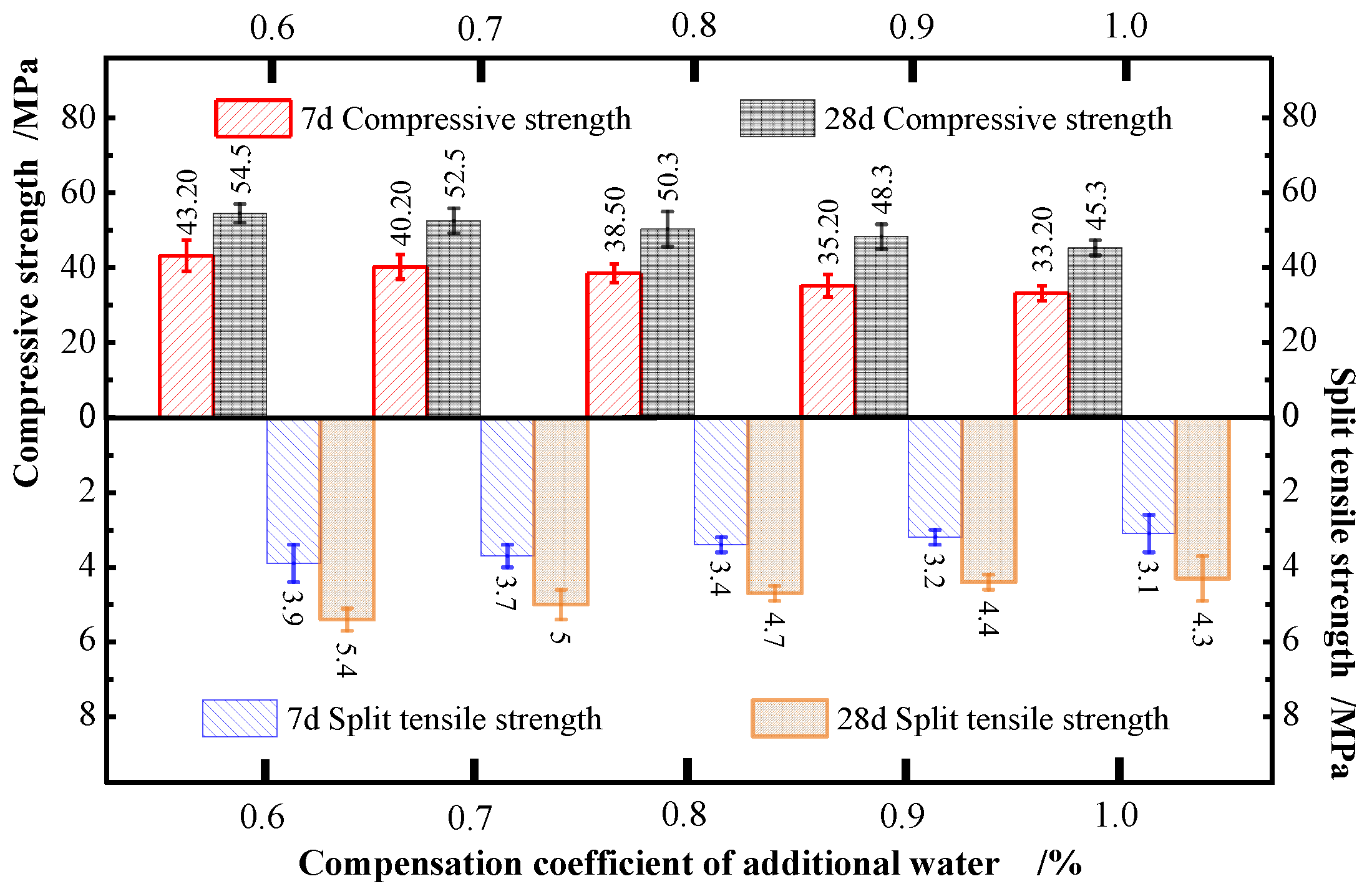
Effect of kwa of RS on concrete strength.
Figure 7.
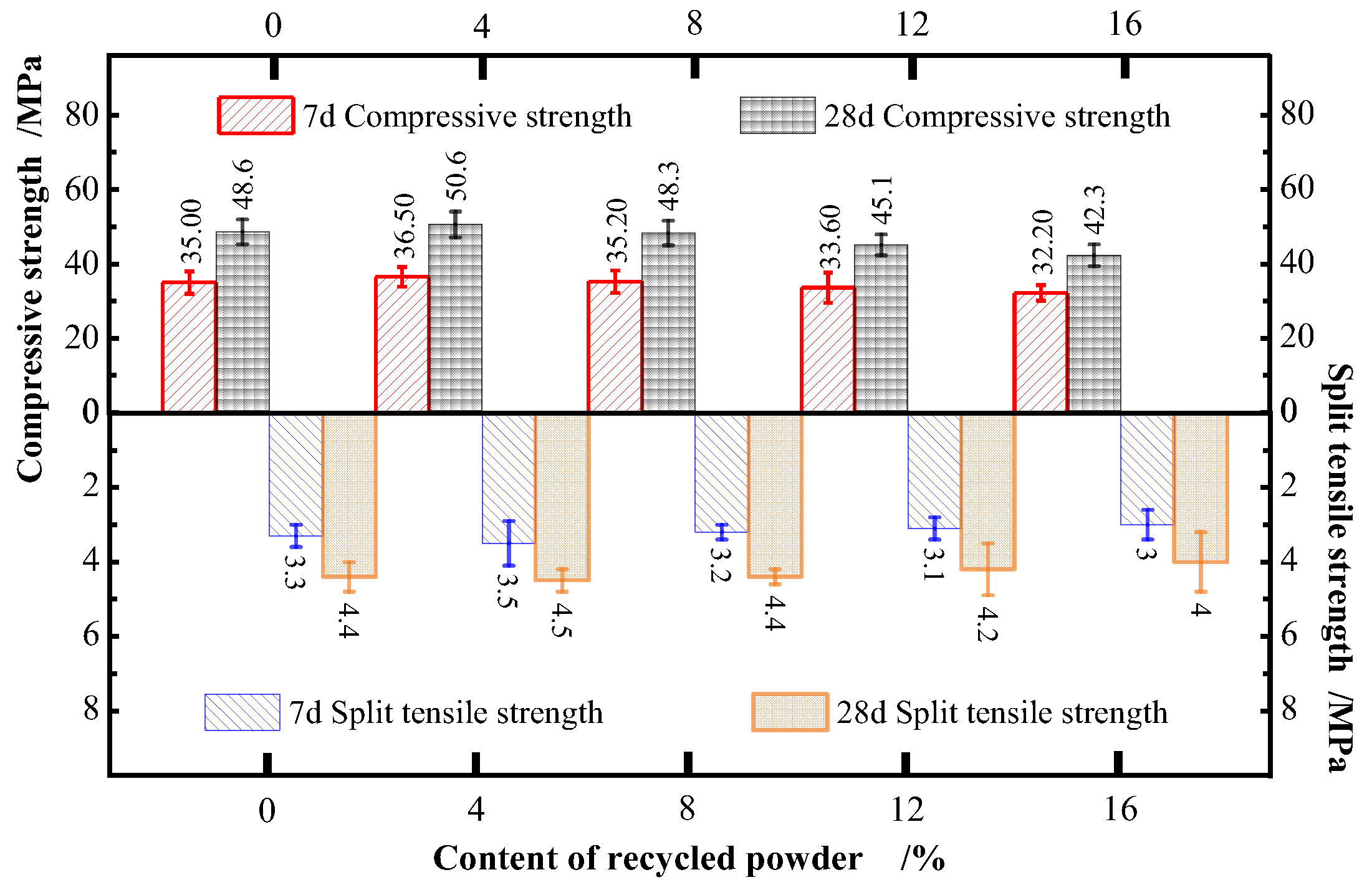
Effect of RP content on concrete strength.
The total water-to-cement ratio of the concrete increases with the increase in the kwa, and the σc of RSC at 7 and 28 days exhibits a gradual decreasing trend as shown in Figure 6. The data indicate that when the kwa is 0.6, 0.7, 0.8, 0.9, and 1.0, the σc on day seven are 43.2, 40.2, 38.5, 35.2, and 33.2 Mpa, while the σc on day 28 are 54.5, 52.5, 50.3, 48.3, and 45.3 Mpa. Meanwhile, the fst on day seven are 3.9, 3.7, 3.4, 3.2, and 3.1 Mpa, and the fst on day 28 are 5.4, 5.0, 4.7, 4.4, and 4.3 Mpa. This indicates that the effect of the kwa on fst follows a similar trend to that observed for σc. The reason is that when concrete is prepared with oven-dried RS, the sand typically does not reach a fully saturated condition during mixing due to its intrinsic water absorption rate and the blockage of pores by cement paste. As a result, a portion of the additional water remains in the mix as free water, leading to actual free water content in the paste that is higher than the theoretical value. With the kwa increased, both the actual free water content in the paste and the effective water-to-binder ratio continue to rise, which consequently results in a lower strength of the hardened concrete.
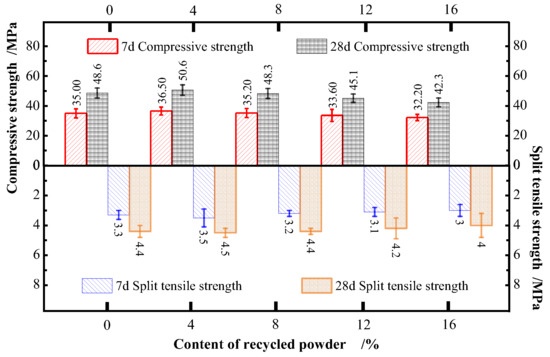
As shown in Figure 7, both the σc and fst of concrete exhibit a trend of initially increasing and then decreasing with the increase in the recycled powder content in RS. Compared with concrete containing 0% RS, the concrete achieves its highest strength when the recycled powder reaches 4%, with σc on day seven and day 28 increasing by 4.3% and 4.1% and fst increasing by 6.1% and 2.3%. Conversely, the concrete exhibits the lowest strength when the recycled powder content reaches 16%, with σc on day seven and day 28 decreasing by 8.0% and 13.0%, and fst decreasing by 9.1%. The main components of recycled powder are fine particles generated during the crushing of waste concrete, which have a similar composition to the sand and gravel, along with some remnants of hardened cement paste and small amounts of unhydrated cement particles. These recycled powder generally have low reactivity and a loose structure. A small replacement of RS with recycled powder can optimize the particle packing and pore structure of the mortar matrix (through both filler and nucleation effects), enhancing the overall compactness of the concrete. Moreover, recycled powder exhibit pozzolanic activity, participating in the hydration of composite cementitious materials and generating additional hydration products such as C-S-H [37], which is beneficial for improving the mechanical performance of concrete. However, excessive incorporation of recycled powder not only compromises the concrete’s density but also, absorbs mix water due to their porosity and high specific surface area, leaving insufficient water for cement hydration. As a result, with increasing recycled powder content in RS, the overall structure of the concrete becomes progressively more porous and less compact [38].
3.2. Volumetric Water Absorption
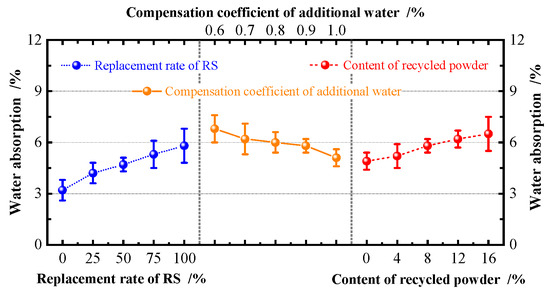
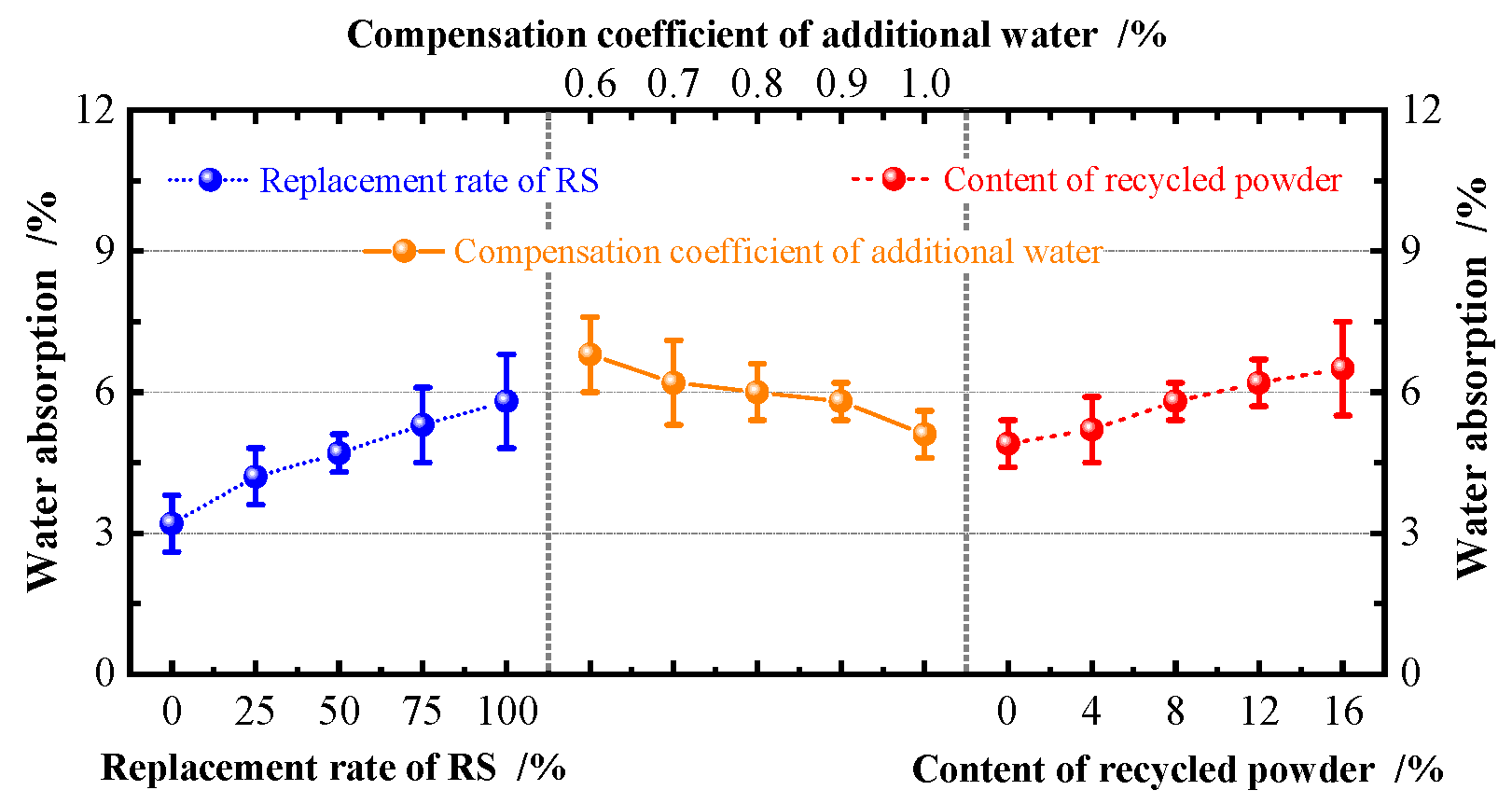
The effects of RS content, kwa, and RP content on the waw of concrete are shown in Figure 8. With the increase in RS content, the waw of concrete gradually increases. Compared with natural sand concrete, the waw of concrete containing 25%, 50%, 75%, and 100% RS increases by 31.3%, 46.9%, 65.6%, and 81.3%. This can be attributed to the inherent porosity and micro cracks of RS, which increase the overall porosity of the concrete and facilitate the formation of connected capillary pores, allowing water to penetrate more easily. Therefore, higher RS content significantly elevates the water absorption of concrete. In addition, with the increase in the kwa, the waw of concrete shows a noticeable decrease. This is because the pre-wetted RS has its internal pores filled with water prior to mixing. After the concrete hardens, this pre-absorbed water in internal samples effectively reduces the concrete specimen water absorption. Moreover, as the internal moisture of the concrete decreases due to cement hydration during subsequent hydration, water stored within the RS is gradually released along the moisture gradient, promoting further hydration. This continuous formation of hydration products fills the inter-particle voids and densifies the concrete structure, achieving an internal curing effect [29,30], thereby reducing the overall water absorption of the concrete.
Figure 8.
Effect of RS content, kwa, and RP content on concrete waw.
As shown in Figure 8, the waw of RSC with 4%, 8%, 12%, and 16% recycled powder increases by 6.1%, 18.4%, 26.5%, and 32.7%, compared with concrete containing 0% recycled powder. The data indicate that the cumulative waw of RSC gradually increases with the recycled powder content in RS. This is because recycled powder primarily consist of fine particles generated during the crushing of waste concrete, which have similar composition to sand and gravel aggregates, along with remnants of old cement paste. These recycled powder have low reactivity and a loose structure, and their incorporation not only reduces the compactness of the concrete but also absorbs mix water, leaving insufficient water for cement hydration and resulting in drier concrete specimens. Therefore, as the recycled powder content in RS increases, the water absorption of concrete increases. However, compared with the effects of RS content and pre-saturation, the influence of recycled powder content on water absorption is relatively minor.
3.3. Charge Flow
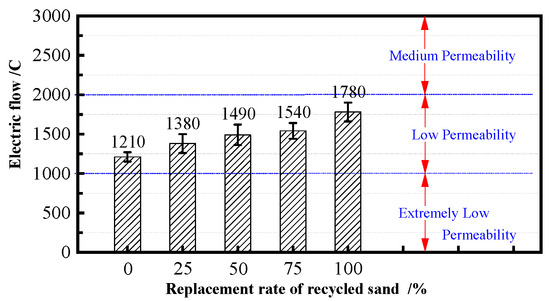
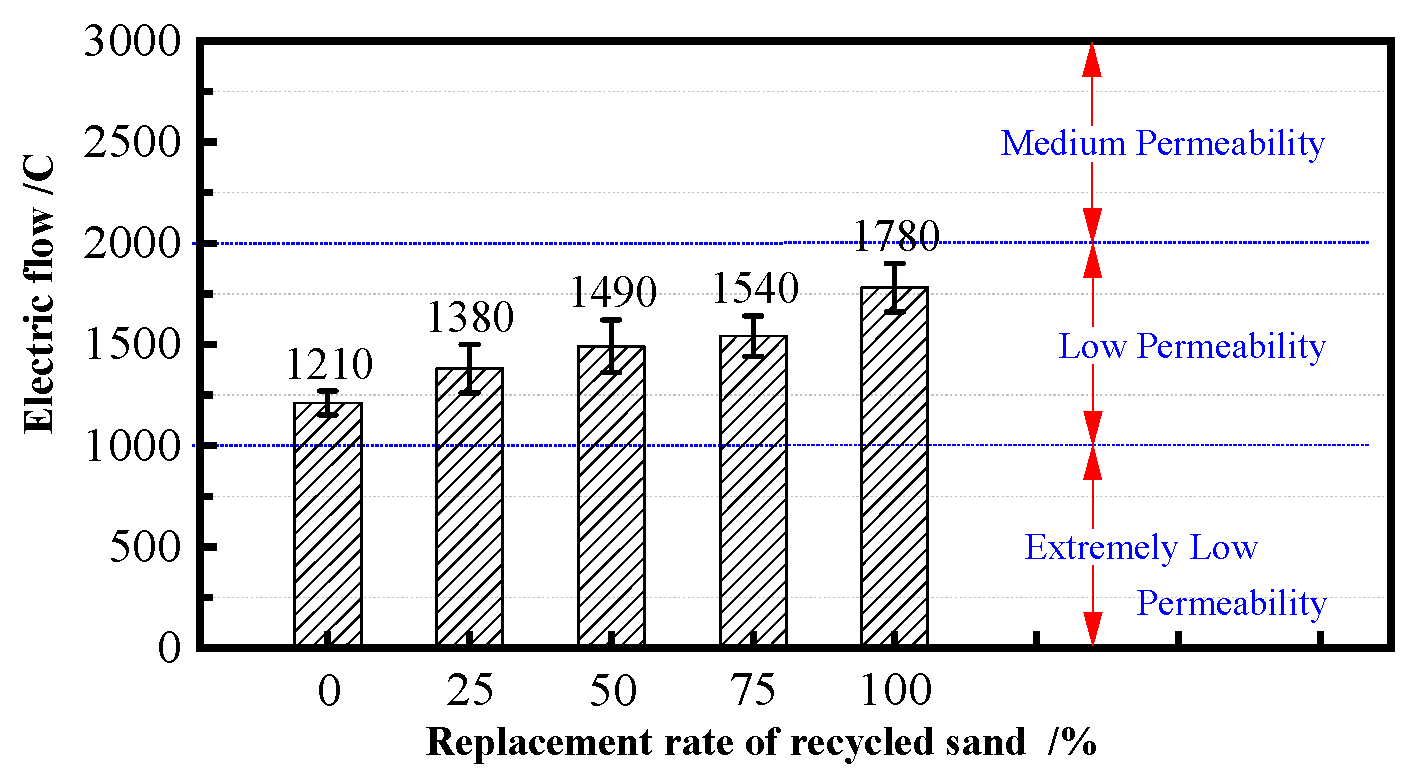
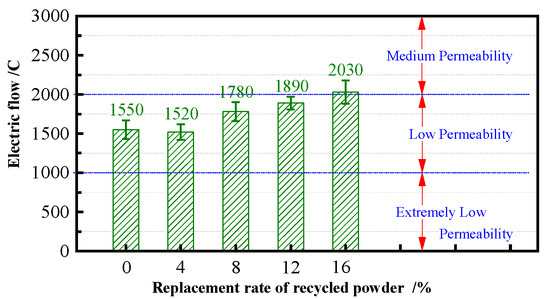
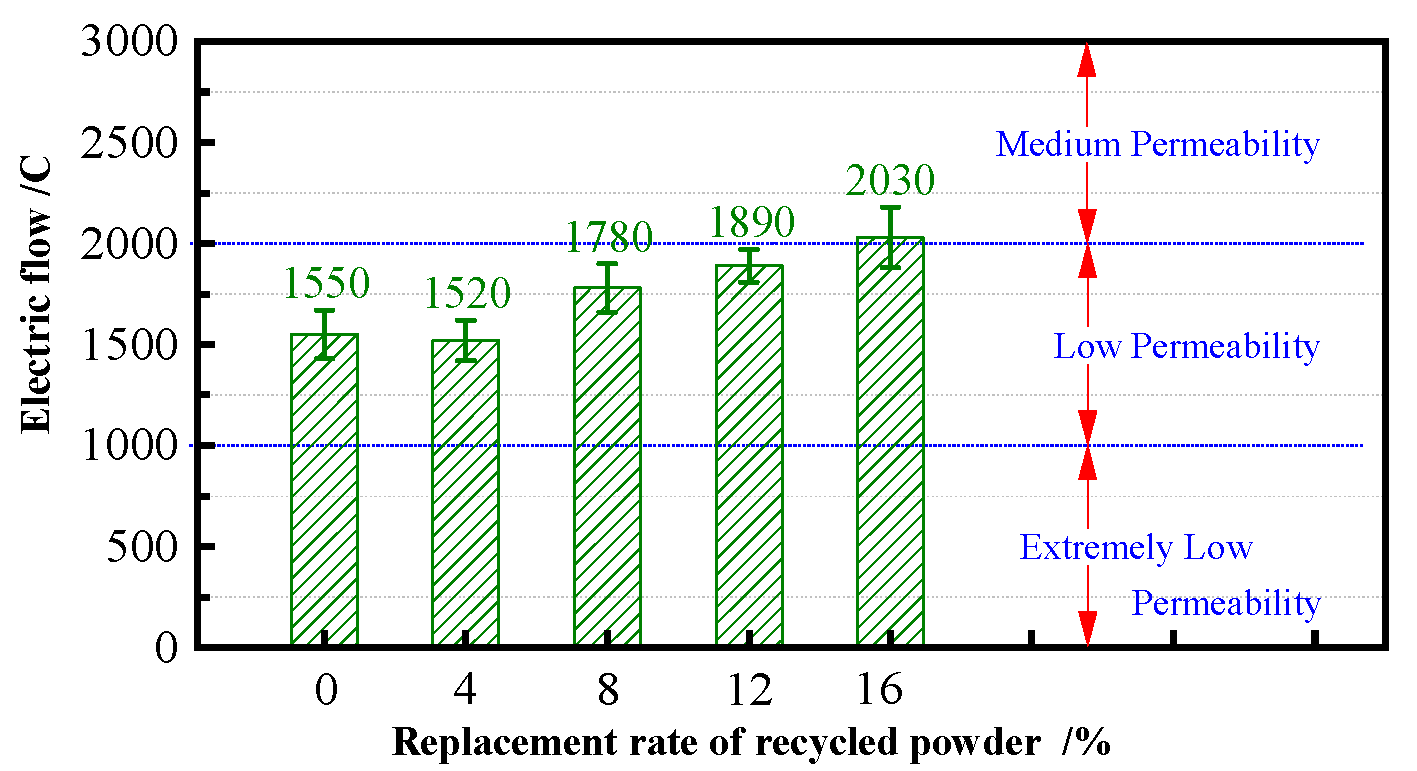
Figure 9, Figure 10 and Figure 11 illustrate the effects of RS content, kwa, and RP content on the charge flow of concrete. As the RS content increases, the CIP resistance of concrete shows a distinct decreasing trend. When the RS content reaches 100%, the charge flow value is the highest, increasing by 47.1% compared with natural sand concrete. With increasing RP content, the CIP resistance first exhibits a slight improvement and then decreases significantly. At a RP content of 4%, the concrete shows the lowest electric flow value, which is 2.0% lower than that of natural sand concrete. However, the electric flow reaches its maximum when the RP content increases to 16%, showing an increase of 31.0% compared with natural sand concrete. These results indicate that the influence of RS content and RP content on the CIP resistance of concrete follows a pattern similar to that observed for compressive strength, and the underlying mechanisms are consistent with those previously discussed.
Figure 9.
Effect of RS content on concrete charge flow.
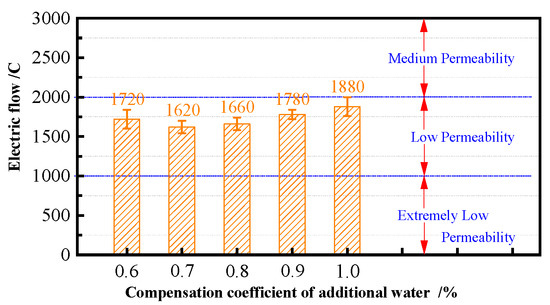
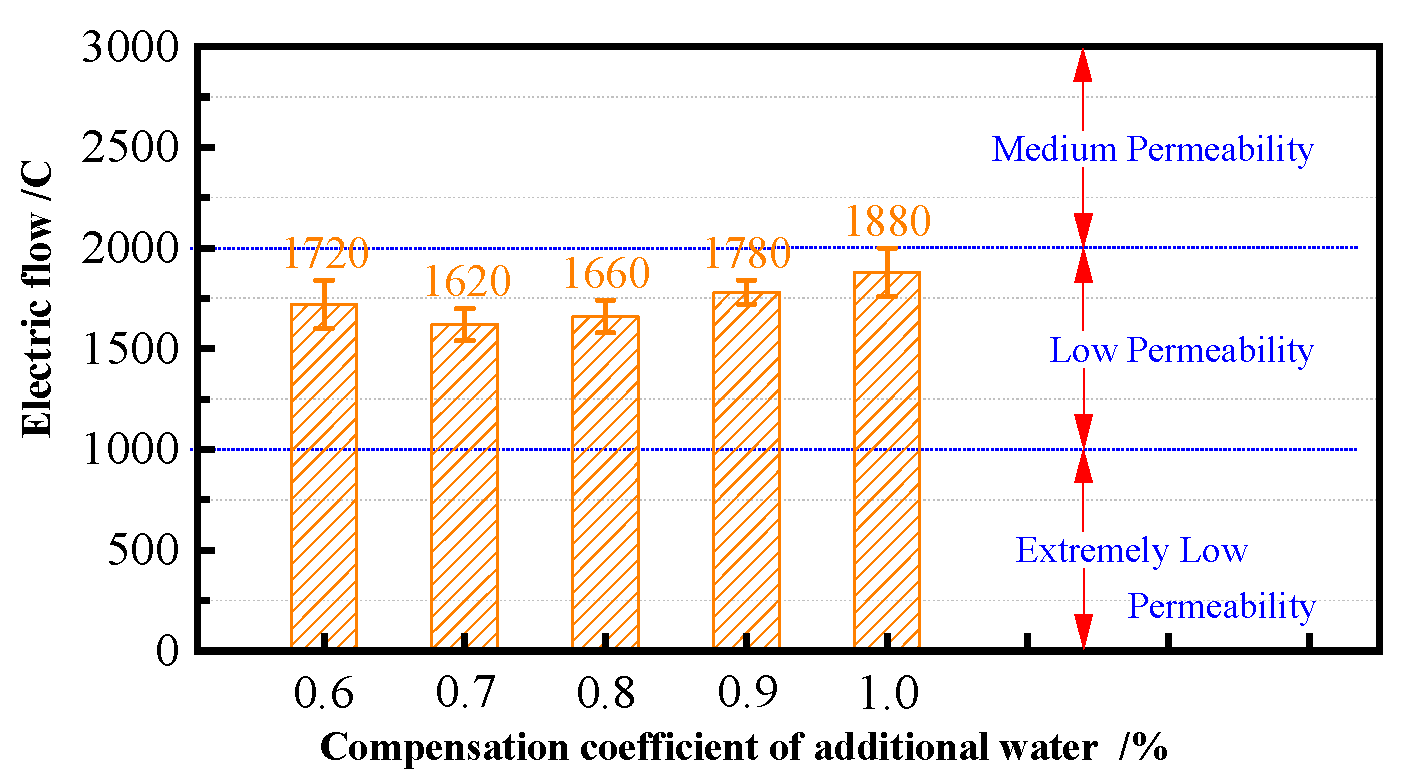
Figure 10.
Effect of kwa of RS on concrete charge flow.
Figure 11.
Effect of RP content on concrete charge flow.
It is particularly noteworthy that although both the strength and water absorption of RSC exhibit a decreasing trend with increasing kwa, its resistance to CIP shows an opposite pattern of initially improving and then decreasing. When the compensation factor is within the range of 0.7–0.8, the RSC exhibits the lowest electric flow value. This phenomenon can be explained as follows: when the compensation water amount is low or absent, the RS absorbs a large portion of the free water in the concrete mixture, thereby reducing the effective water-to-binder ratio. Although this may enhance the strength of concrete within a certain range, the associated high autogenous shrinkage can cause further propagation of microcracks in the RS, which is detrimental to improving the resistance to CIP. When the compensation water amount is moderate, the RS absorbs only part of the free water in the mixture, resulting in a slight reduction in the effective water-to-binder ratio and improved compactness of the hardened concrete. Furthermore, its internal pores are filled with water prior to mixing when RS is pre-wetted. During subsequent hydration, as the internal humidity of the concrete decreases due to cement hydration, the water stored within the RS is gradually released through the moisture gradient, promoting continuous hydration and the formation of hydration products that fill inter-particle voids and densify the concrete microstructure. However, theoretically the RS is capable of absorbing all the additional water when an excessive amount of compensation water (kwa = 0.9–1.0) is added, but its fails to reach a fully saturated state during mixing due to its limited absorption rate and blockage by the cement paste. Consequently, part of the added water remains in the mixture as free water, resulting in an actual free-water content higher than the theoretical value, that is, a higher effective water-to-binder ratio. The hardened concrete contains more capillary pores, thereby reducing its resistance to CIP.
3.4. NMR
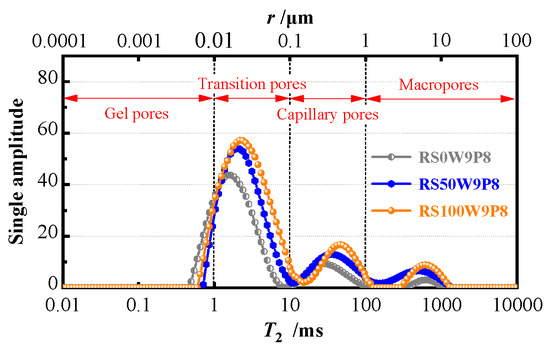
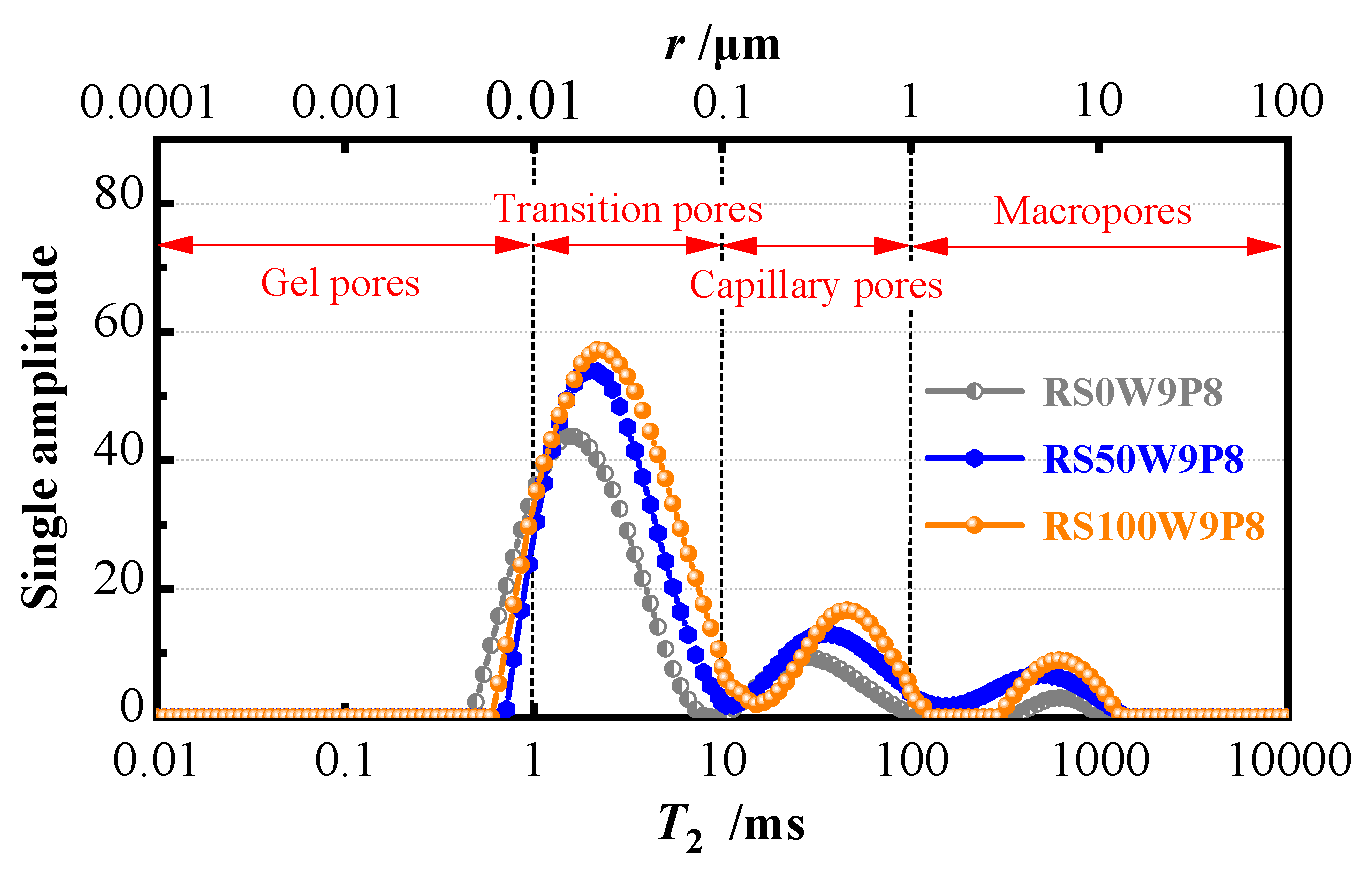
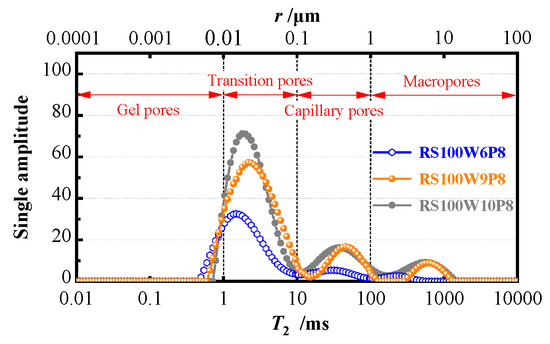
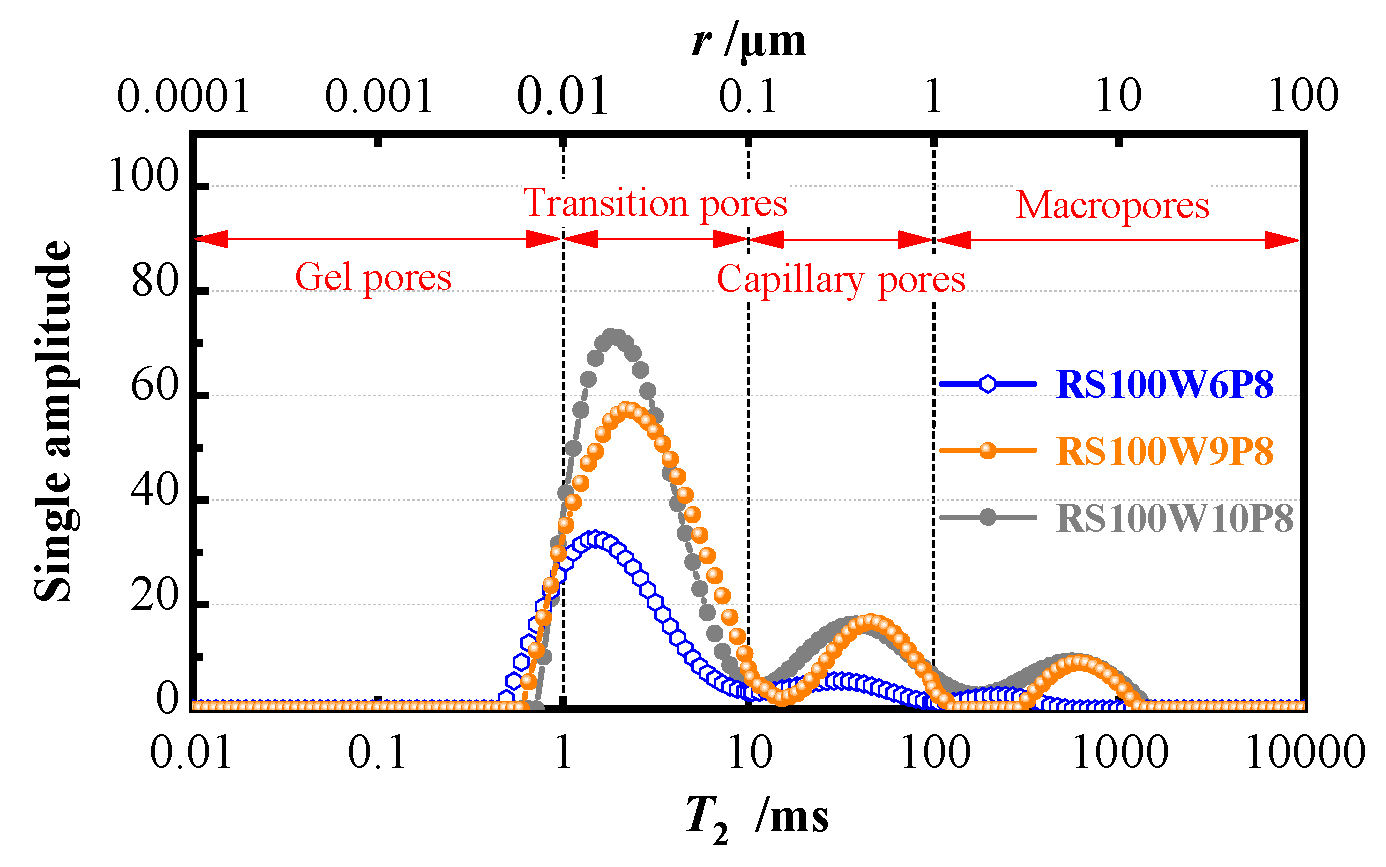
Figure 12, Figure 13 and Figure 14 illustrate the T2 spectrum distributions and comparative results of concretes incorporating different RS content, kwa, and RP content; the division of aperture size is determined by references [4,25]. As shown in Figure 12, the total area of the T2 spectrum and the areas of each peak increase noticeably with higher RS contents. In addition, the first and second peaks shift significantly toward longer relaxation times. This indicates that the overall porosity of the concrete increases, and the pore sizes corresponding to transition pores and capillary pores exhibit a tendency to enlarge. The underlying mechanisms are as follows: RS inherently possesses high porosity and numerous micro cracks, more structural defects are introduced into the concrete when its replacement ratio increases, resulting in a progressive increase in bulk porosity. Moreover, the use of RS requires the addition of extra mixing water during batching. Although part of this water participates in cement hydration, some portion may remain unconsumed or un-evaporated at 28 days and continue to be retained within the pores of the RS. This retained water may constitute another major reason for the increased T2 total area and peak areas observed with higher RS contents.
Figure 12.
Effect of RS content on concrete T2 spectrum distributions.
Figure 13.
Effect of kwa of RS on concrete T2 spectrum distributions.
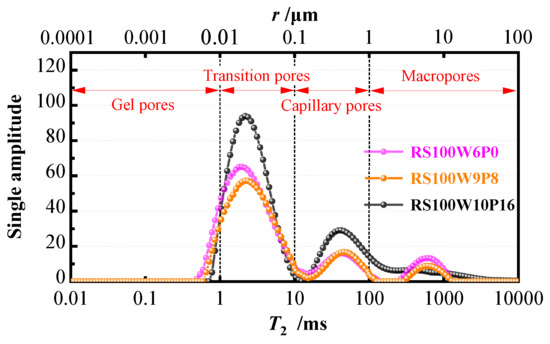
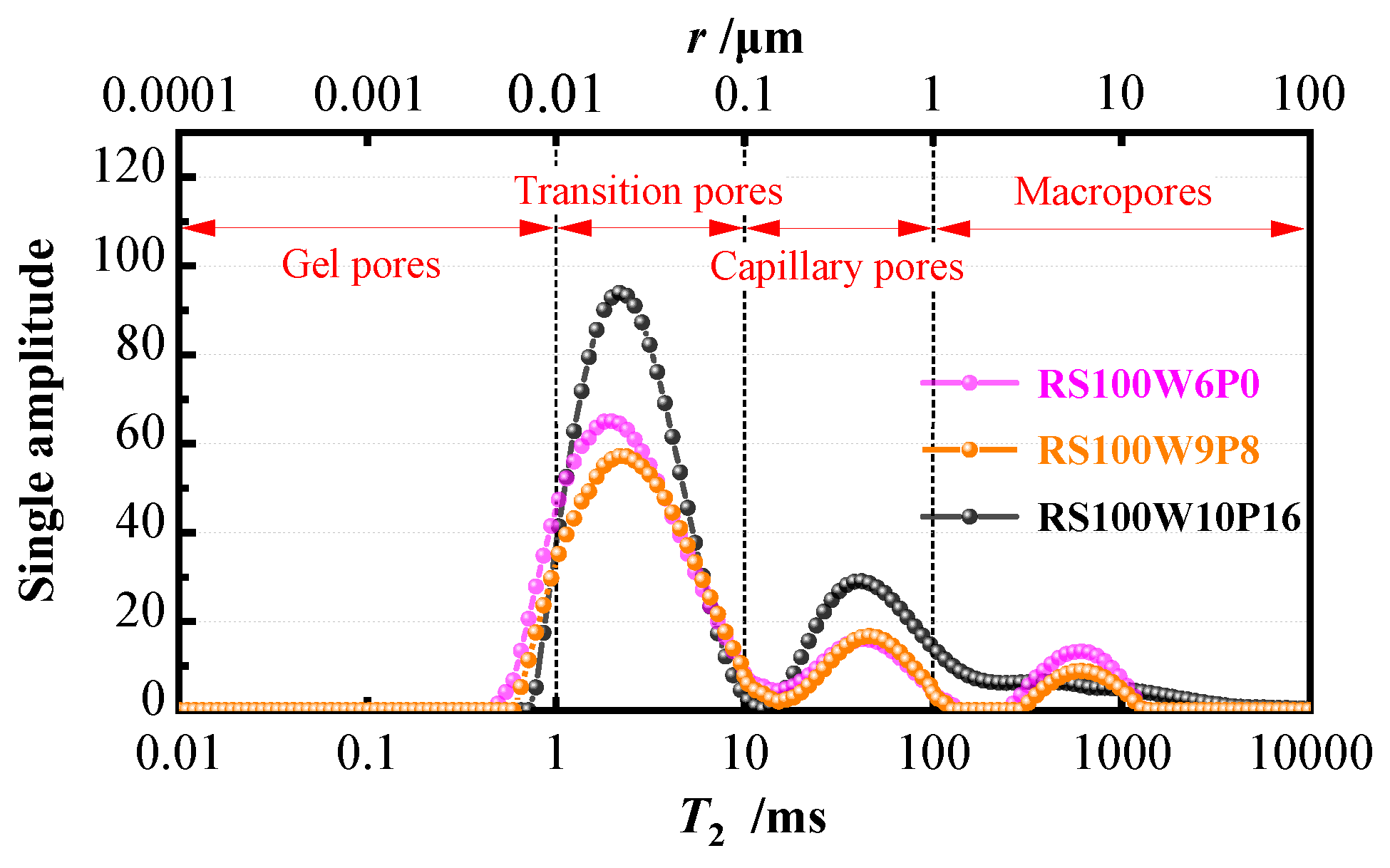
Figure 14.
Effect of RP content on concrete T2 spectrum distributions.
As shown in Figure 13, with the increase in the additional water amount, both the total area of the T2 spectrum and the areas of each peak increase significantly, and the peak positions of the first and second peaks shift distinctly toward the right. This phenomenon can be attributed to the fact that, under a fixed total water content and total water-to-binder ratio, the RS in an oven-dry state cannot reach full saturation during mixing due to its intrinsic water-absorption rate and the blockage of its pores by cement paste. As a result, a portion of the added water remains as free water in the concrete mixture, leading to a higher actual free-water content in the paste than the theoretical value. This effectively increases the effective water-to-binder ratio and consequently produces more pores in the hardened concrete, thereby reducing its resistance to CIP. On the other hand, part of the additional water absorbed into the pores of the RS may neither evaporate nor participate in hydration but instead remain trapped within the RS particles at 28 days. This retained water is another major factor contributing to the increase in both the total T2 spectrum area and the peak areas.
As shown in Figure 14, both the total area of the T2 spectrum and the areas of each peak exhibit a pronounced decrease when the RP content is 8%. This is because a small amount of RP replacing RS can optimize the particle size distribution and pore structure of the mortar matrix through filling and nucleation effects, thereby improving the compactness of the concrete. In addition, the RP possess pozzolanic activity and can participate in the hydration of the blended cementitious system, forming C-S-H and other hydration products [37], which further enhances the mechanical performance of the concrete. However, when the RP content becomes excessive, the densification of the concrete matrix is adversely affected. Due to their high porosity and large specific surface area, RP can absorb part of the mixing water, resulting in insufficient water available for cement hydration. As the RP content increases, the overall microstructure of the concrete consequently becomes more porous and less compact [38]. Therefore, both the total T2 spectrum area and the peak areas show a notable increase when the RP content reaches 16%.
3.5. SEM
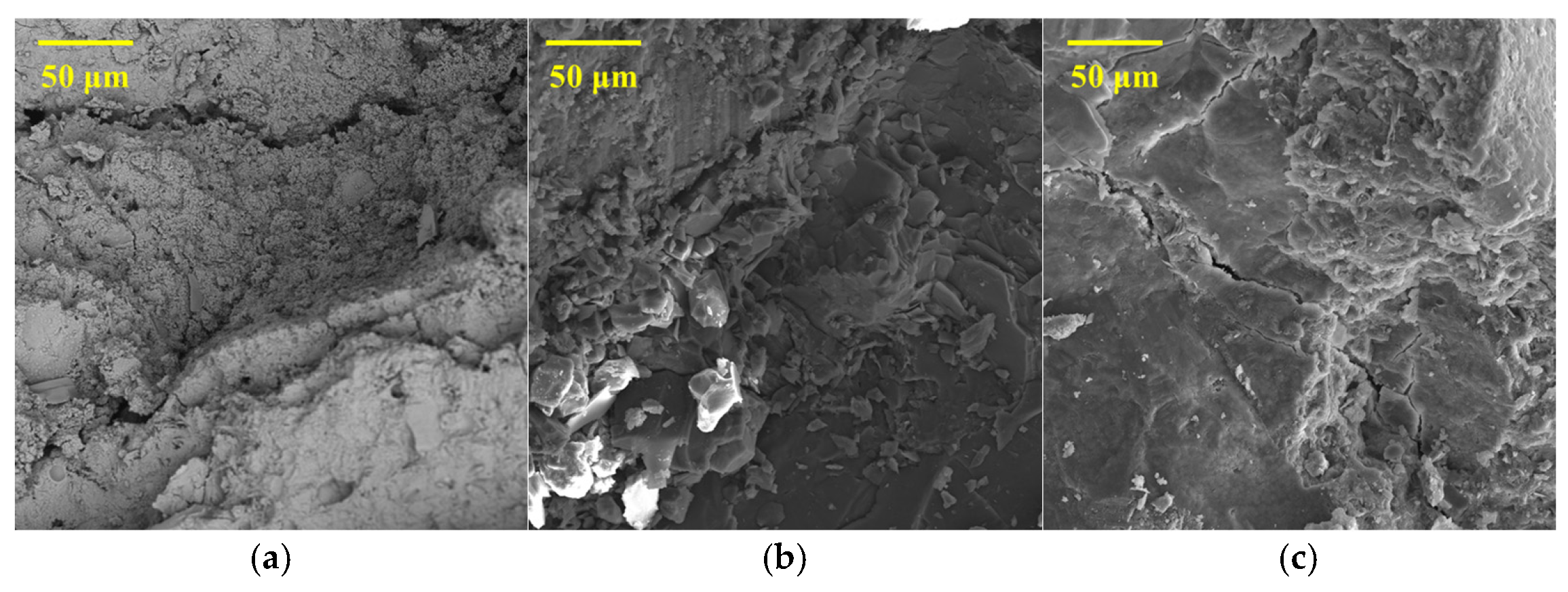
Figure 15 and Figure 16 present the SEM images of the interfacial regions of fully RSC (RS100) and natural sand concrete (RS0). As shown in Figure 15a, a large number of micro cracks are present within the RS particles, and porous residues of old cement paste remain adhered to their surfaces. The old cement paste is further connected to the newly formed interfacial transition zone, creating a continuous network of pores that significantly compromises the impermeability of the concrete. In addition, Figure 15b clearly reveals the presence of a RS particle–old cement paste–new cement paste composite interface. Although these regions contain abundant hydration products, their morphology and assemblage are poor, resulting in a weak and discontinuous interfacial structure. Since the interfacial transition zone is typically the weakest link in concrete, the introduction of multiple interfaces further exacerbates deterioration in concrete performance. Figure 15c also distinctly shows micro cracks on the surface of the RS particles, along with residual old cement paste and complex interfacial regions. These defects substantially increase the porosity of the concrete and facilitate the formation of capillary pores that promote the ingress of water and harmful ions.
Figure 15.
SEM images of RS100 specimens. (a) Microstructure; (b) Hydration products; (c) Interface transition area.
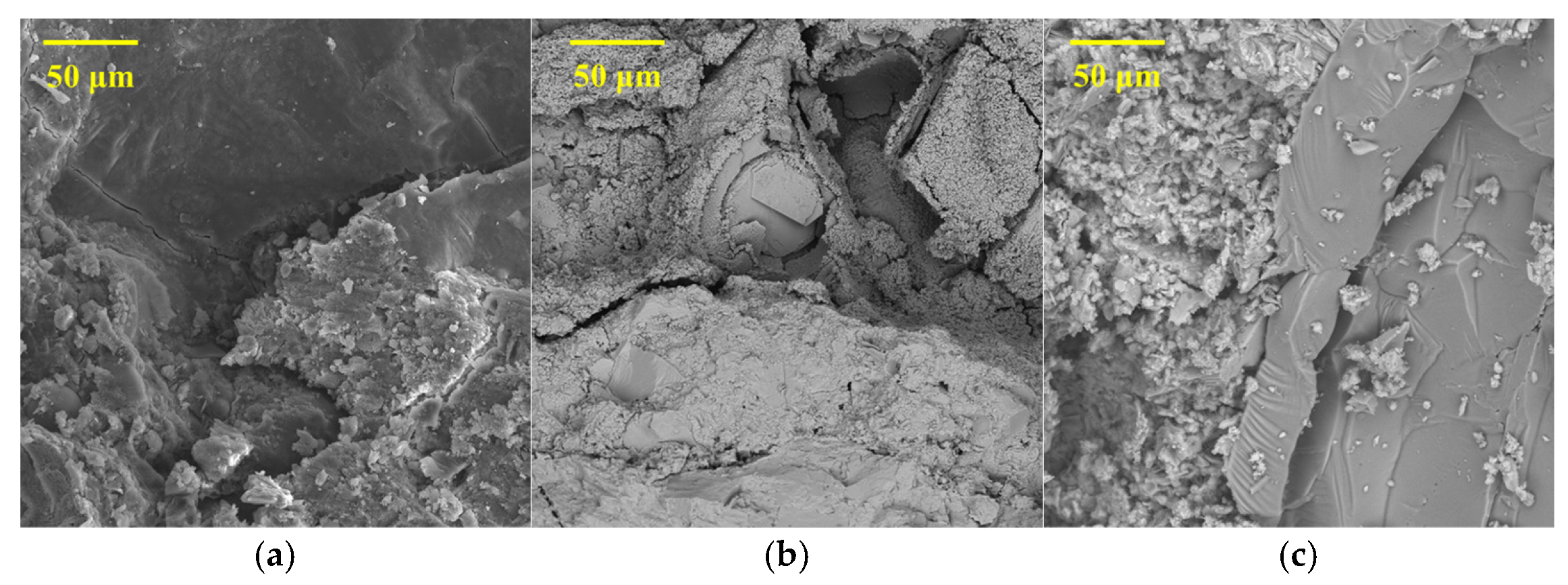
Figure 16.
SEM images of natural sand concrete (RS0) specimens. (a) Interface transition area 1; (b) Hydration products; (c) Interface transition area 2.
In Figure 16a–c, it can be observed that the natural sand particles are covered by hydration products such as C-S-H gel. However, the hydration products around the natural sand particles are relatively rare compared with the new cement paste near the RS in Figure 15; there are also more voids before these hydration products, which are not as dense as the cement paste around the RS particles. It can be seen that the water absorption of the RS does improve the microstructure of the surrounding new cement paste to a certain extent, so as to achieve the purpose of improving the strength. However, due to the existence of a large number of micro cracks, a large number of porous cement pastes and the old interface introduced by the RS particles, the existence of these defects will increase the porosity of the concrete, increase the harmful pores, and then enhance the capillary water absorption capacity of the concrete, and therefore the durability will deteriorate.
4. Conclusions
This study investigated the effects of RS content, additional water compensation factor, and RP content on the strength, water absorption, and chloride ion penetration of RSC. Furthermore, the underlying mechanisms of RS on the mechanical and durability performance of concrete were revealed from a microstructural perspective using NMR and SEM analyses. The main conclusions are as follows:
- (1)
- It is evident that RS particles inherently contain numerous micro cracks, a substantial amount of adhered porous cement paste, and pre-existing interfaces. The presence of these defects increases the porosity and the volume of harmful capillary pores in the concrete, thereby enhancing capillary water absorption and resulting in a reduction in both strength and durability.
- (2)
- Although increasing the additional water compensation factor slightly reduces the strength of RSC, appropriate additional water compensation of RS can reduce the water absorption of concrete, improving its water and chloride ion penetration resistance. It is recommended that the additional water compensation factor of RS be controlled within 70%–80% of its 24 h saturated water absorption.
- (3)
- With the increase in RP content, the compressive strength, splitting tensile strength, and impermeability of the concrete first increase and then decrease, reaching their maximum values at a RP content of 4%. Meanwhile, the volumetric water absorption of RSC gradually increases as the RP content rises.
- (4)
- Microstructural analyses indicate that although the appropriate water absorption compensation of RS and an appropriate amount of RP can improve the microstructure and compactness of the surrounding new cement paste to some extent, the inherent defects of RS—including abundant micro cracks, adhered porous cement paste, and pre-existing interfaces—still enhance capillary water absorption and cause deterioration in durability.
- (5)
- RSC can achieve good overall performance by optimizing the RS replacement ratio, additional water compensation factor, and RP. It is recommended that the additional water compensation factor of RS is limited to 70%–80% of its 24 h saturated water absorption and the RP content to be maintained between 4% and 8%.
Author Contributions
Methodology, M.Z. and W.Z.; Validation, D.L.; Resources, M.Z.; Data curation, M.Z. and D.L.; Writing—original draft, M.Z.; Writing—review & editing, W.Z. and Q.W.; Supervision, Q.W.; Project administration, W.Z.; Funding acquisition, Q.W. All authors have read and agreed to the published version of the manuscript.
Funding
The authors gratefully acknowledge the financial support from the Major Provincial-Level Project of Wenzhou Polytechnic (WZY2025002).
Institutional Review Board Statement
Not applicable.
Informed Consent Statement
Not applicable.
Data Availability Statement
No new data were created or analyzed in this study.
Conflicts of Interest
The authors declare that there are no conflicts of interest related to this work.
References
- Silva, R.V.; de Brito, J.; Dhir, R.K. The influence of the use of recycled aggregates on the compressive strength of concrete: A review. Eur. J. Environ. Civ. Eng. 2015, 19, 825–849. [Google Scholar] [CrossRef] [Scilit]
- Silva, R.V.; de Brito, J.; Dhir, R.K. Properties and composition of recycled aggregates from construction and demolition waste suitable for concrete production. Constr. Build. Mater. 2014, 65, 201–217. [Google Scholar] [CrossRef] [Scilit]
- Verian, K.P.; Ashraf, W.; Cao, Y. Properties of recycled concrete aggregate and their influence in new concrete production. Resour. Conserv. Recycl. 2018, 133, 30–49. [Google Scholar] [CrossRef] [Scilit]
- Li, W.G.; Xiao, J.Z.; Sun, Z.H.; Kawashima, S.; Shah, S.P. Interfacial transition zones in recycled aggregate concrete with different mixing approaches. Constr. Build. Mater. 2012, 35, 1045–1055. [Google Scholar] [CrossRef] [Scilit]
- Nedeljkovic, M.; Visser, J.; Savija, B.; Valcke, S.; Schlangen, E. Use of fine recycled concrete aggregates in concrete: A critical review. J. Build. Eng. 2021, 38, 102196. [Google Scholar] [CrossRef] [Scilit]
- Kim, J. Influence of quality of recycled aggregates on the mechanical properties of recycled aggregate concretes: An overview. Constr. Build. Mater. 2022, 328, 127071. [Google Scholar] [CrossRef] [Scilit]
- Kim, J.; Jang, H. Closed–loop recycling of C&D waste: Mechanical properties of concrete with the repeatedly recycled C&D powder as partial cement replacement. J. Clean. Prod. 2022, 343, 130977. [Google Scholar]
- Likes, L.; Markandeya, A.; Haider, M.M.; Bollinger, D.; McCloy, J.S.; Nassiri, S. Recycled concrete and brick powders as supplements to Portland cement for more sustainable concrete. J. Clean. Prod. 2022, 364, 132651. [Google Scholar] [CrossRef] [Scilit]
- Tang, Q.; Ma, Z.; Wu, H.; Wang, W. The utilization of eco–friendly recycled powder from concrete and brick waste in new concrete: A critical review. Cem. Concr. Compos. 2020, 114, 103807. [Google Scholar] [CrossRef] [Scilit]
- Xiao, J.; Ma, Z.; Sui, T.; Akbarnezhad, A.; Duan, Z. Mechanical properties of concrete mixed with recycled powder produced from construction and demolition waste. J. Clean. Prod. 2018, 188, 720–731. [Google Scholar] [CrossRef] [Scilit]
- Evangelista, L.; De Brito, J. Durability performance of concrete made with fine recycled concrete aggregates. Cem. Concr. Compos. 2010, 32, 9–14. [Google Scholar] [CrossRef] [Scilit]
- Sim, J.; Park, C. Compressive strength and resistance to chloride ion penetration and carbonation of recycled aggregate concrete with varying amount of fly ash and fine recycled aggregate. Waste Manag. 2011, 31, 2352–2360. [Google Scholar] [CrossRef] [Scilit]
- Zhuang, Y.; Liang, Y.; Nabizadeh, A. Influence of the moisture state of recycled fine aggregate on the impermeability of concrete. Mater. Test. 2019, 61, 991–998. [Google Scholar] [CrossRef] [Scilit]
- de Oliveira, M.B.; Vazquez, E. The influence of retained moisture in aggregates from recycling on the properties of new hardened concrete. Waste Manag. 1996, 16, 113–117. [Google Scholar] [CrossRef] [Scilit]
- Poon, C.S.; Shui, Z.H.; Lam, L.; Fok, H.; Kou, S.C. Influence of moisture states of natural and recycled aggregates on the slump and compressive strength of concrete. Cem. Concr. Res. 2004, 34, 31–36. [Google Scholar] [CrossRef] [Scilit]
- Leite, M.B.; Figueire do Filho, J.G.L.; Lima, P.R.L. Workability study of concretes made with recycled mortar aggregate. Mater. Struct. 2013, 46, 1765–1778. [Google Scholar] [CrossRef] [Scilit]
- Li, Z.; Liu, J.; Xiao, J.; Zhong, P. A method to determine water absorption of recycled fine aggregate in paste for design and quality control of fresh mortar. Constr. Build. Mater. 2019, 197, 30–41. [Google Scholar] [CrossRef] [Scilit]
- de Andrade, G.P.; de Castro Polisseni, G.; Pepe, M.; Toledo Filho, R.D. Design of structural concrete mixtures containing fine recycled concrete aggregate using packing model. Constr. Build. Mater. 2020, 252, 119091. [Google Scholar] [CrossRef] [Scilit]
- Zhang, M.; Liu, T.; Yang, H.; Xu, J.; Wang, Y. Crack resistance, permeability, and microstructural analysis of recycled aggregate concrete with SAP. Constr. Build. Mater. 2024, 430, 136479. [Google Scholar] [CrossRef] [Scilit]
- Kumar, B.M.V.; Ananthan, H.; Balaji, K.V.A. Experimental studies on utilization of recycled coarse and fine aggregates in high performance concrete mixes. Alex. Eng. J. 2018, 57, 1749–1759. [Google Scholar] [CrossRef] [Scilit]
- Chen, Y.; Chen, C.; Cai, Z.; Zhu, P.; Liu, R.; Liu, H. Effect of strength of parent concrete on utilization of recycled aggregate concrete: A review. J. Build. Eng. 2025, 103, 112187. [Google Scholar] [CrossRef] [Scilit]
- Chen, X.; Hao, H.; de Brito, J.; Liu, G.; Wang, J. Discussion of the implementation of water compensation methods for recycled aggregate concrete: A critical review. Cem. Concr. Compos. 2025, 161, 106080. [Google Scholar] [CrossRef] [Scilit]
- Gupta, T.; Siddique, S.; Sharma, R.K.; Chaudhary, S. Behaviour of waste rubber powder and hybrid rubber concrete in aggressive environment. Constr. Build. Mater. 2019, 217, 283–291. [Google Scholar] [CrossRef] [Scilit]
- Singh, A.; Arora, S.; Sharma, V.; Bhardwaj, B. Workability retention and strength development of self–compacting recycled aggregate concrete using ultrafine recycled powders and silica fume. J. Hazard. Toxic Radioact. Waste 2019, 23, 04019016. [Google Scholar] [CrossRef] [Scilit]
- Ann, M.S.; Abin, T. Experimental studies on brick powder replaced concrete exposed to elevated temperature. In Proceedings of SECON’19; Lecture Notes in Civil Engineering; Springer: Cham, Switzerland, 2020; Volume 46, pp. 41–52. [Google Scholar]
- Hou, S.; Hu, R.; Xu, L.; Zhang, Y.; Ma, Z. Understanding the chloride migration in recycled powder concrete: Effects of recycled powder type, replacement rate and substitution pattern. Constr. Build. Mater. 2024, 436, 136825. [Google Scholar] [CrossRef] [Scilit]
- Guan, X.; Li, F.; Hao, X.; Ji, H.; Hou, P. Study on chloride ion penetration performance of recycled composite micro powder concrete under freeze-thaw environment. J. Build. Eng. 2024, 98, 111289. [Google Scholar] [CrossRef] [Scilit]
- Ge, Z.; Gao, Z.; Sun, R.; Zheng, L. Mix design of concrete with recycled clay-brick-powder using the orthogonal design method. Constr. Build. Mater. 2012, 31, 289–293. [Google Scholar] [CrossRef] [Scilit]
- Qiu, J.; Niu, G.; Li, L.; Li, L.; Hu, X.; Li, X. Study on damage evolution law and pore structure deterioration of recycled composite micro-powder concrete under freeze-thaw action. J. Build. Eng. 2024, 96, 110662. [Google Scholar] [CrossRef] [Scilit]
- Ren, X.; Yang, J.; Chen, W.; Huang, Y.; Wang, G.; Niu, J.; Wu, J. Effect of recycled concrete powder-cement composite coating modification on the properties of recycled concrete aggregate and its concrete. Constr. Build. Mater. 2024, 444, 137860. [Google Scholar] [CrossRef] [Scilit]
- Wang, D.H.; Shi, C.J.; Farzadnia, N.; Shi, Z.G.; Jia, H.F.; Ou, Z.H. A review on use of limestone powder in cement-based materials: Mechanism, hydration and micro-structures. Constr. Build. Mater. 2018, 181, 659–672. [Google Scholar] [CrossRef] [Scilit]
- Yang, H.; Jiao, Y.; Xing, J.; Liu, Z. Statistical model and fracture behavior of manufactured sand concrete with varying replacement rates and stone powder contents. J. Build. Eng. 2024, 95, 110102. [Google Scholar] [CrossRef] [Scilit]
- Zhou, A.; Miao, G.; Zhang, Y.; Qian, R.; Zhang, Y.; Shi, J.; Yang, Y.E. Effects of stone powder on microstructure of manufactured-sand concrete and its gas permeability. J. Build. Eng. 2024, 91, 109539. [Google Scholar] [CrossRef] [Scilit]
- Zhou, S.; Kong, D.; Wang, L.; Han, Y.; Hu, N.; Feng, J. Influence and mechanism analysis of different parent rock stone powders on the properties of manufactured sand high-strength concretes. J. Mater. Civ. Eng. 2025, 37, 04025101. [Google Scholar] [CrossRef] [Scilit]
- GB/T 50081-2019; Standard for Test Methods of Concrete Physical and Mechanical Properties. Ministry of Housing and Urban-Rural Development of the PRC: Beijing, China, 2019.
- GB/T 50082-2009; Standard for Test Methods of Long-Term Performance and Durability of Ordinary Concrete. Ministry of Housing and Urban-Rural Development of the PRC: Beijing, China, 2009.
- Sakai, E.; Miyahara, S.; Ohsawa, S.; Lee, S.H.; Daimon, M. Hydration of fly ash cement. Cem. Concr. Compos. 2005, 35, 1135–1140. [Google Scholar] [CrossRef] [Scilit]
- Hou, D.; Wu, D.; Wang, X. Sustainable use of red mud in ultra-high performance concrete (UHPC): Design and performance evaluation. Cem. Concr. Compos. 2021, 115, 103862. [Google Scholar] [CrossRef] [Scilit]

Disclaimer/Publisher’s Note: The statements, opinions and data contained in all publications are solely those of the individual author(s) and contributor(s) and not of MDPI and/or the editor(s). MDPI and/or the editor(s) disclaim responsibility for any injury to people or property resulting from any ideas, methods, instructions or products referred to in the content. |
© 2026 by the authors. Licensee MDPI, Basel, Switzerland. This article is an open access article distributed under the terms and conditions of the Creative Commons Attribution (CC BY) license.