Article

P-Type Emitter Thin-Film Fabrication by a Dry–Wet–Dry Mixed Oxidation in TOPCon Solar Cells

1
School of Energy Science and Engineering, Central South University, Changsha 410083, China
2
Hunan Red Solar Photoelectricity Science and Technology Co., Ltd., Changsha 410221, China
3
School of Mechanical and Electrical Engineering, Guangdong University of Science and Technology, Dongguan 523083, China
*
Author to whom correspondence should be addressed.
Coatings 2026, 16(2), 157; https://doi.org/10.3390/coatings16020157
Submission received: 24 December 2025 / Revised: 20 January 2026 / Accepted: 21 January 2026 / Published: 25 January 2026
(This article belongs to the Special Issue Innovative Thin Films and Coatings for Solar Cells)

Abstract

To address the high-temperature and high-cost challenges of the conventional dry oxidation process in boron diffusion for n-type tunnel oxide passivated contact solar cells, this study proposes a dry–wet–dry mixed oxidation drive-in process for fabricating p-type emitters in TOPCon solar cells. Through systematic investigation of oxidation temperature, O2/H2O flow ratio, and oxidation time effects on emitter performance, it is found that mixed oxidation at 1000 °C achieves comparable sheet resistance and doping profiles to dry oxidation at 1050 °C. For our newly developed mixed oxidation process, in which the oxidation temperature is 1000 °C, oxidation time is 80 min with O2/H2O flow ratio of 20:1, the same photoelectric conversion efficiency has been achieved. Comparing the data, the mixed oxidation process forms a dry/wet/dry three-layer SiO2 structure, reducing the oxidation temperature by 50 °C while achieving an average efficiency of 26.02%, comparable to high-temperature dry oxidation. This process not only reduces the thermal budget of quartz tubes and extends equipment service life but also provides a feasible solution for the low-temperature manufacturing of high-efficiency TOPCon solar cells, showing significant industrial application prospects.

1. Introduction

In recent years, tunnel oxide passivated contact (TOPCon) solar cells have attracted considerable attention due to excellent passivation performance and extremely high efficiency [1]. A TOPCon solar cell is a type of photovoltaic cell fabricated on the principle of selective carrier transport with a tunneling oxide layer for passivated contacts. The cell structure, based on an n-type silicon substrate, comprises an ultra-thin tunnel oxide layer and a phosphorus-doped polysilicon layer. These layers collectively form the rear passivated contact structure, which effectively mitigates both surface recombination and metal contact recombination. They have been widely adopted in the solar cell industry owing to their superior electrical performance [2,3,4,5]. The photoelectric conversion efficiency of TOPCon solar cells in the laboratory has exceeded 26.1% [6], and JinkoSolar’s 182 mm n-type TOPCon solar cells have obtained the top conversion efficiency of 26.89%.
Boron diffusion doping is commonly employed for fabricating the p-type emitter in n-type TOPCon solar cells [7,8]. Boron tribromide (BBr3) [8,9,10,11] or boron trichloride (BCl3) [12,13,14] are typically utilized as dopant sources for high temperature diffusion in industry, while boron ion implantation [15] and other methods are also used for forming p-type emitters. Research has demonstrated that the use of chlorine (Cl2) generated in the diffusion process of BCl3 can enhance the electrical stability of oxides [16], and that Cl2 can clean the quartz tube, thereby significantly extending its service life. Consequently, BCl3 is extensively utilized as a dopant in the photovoltaic industry. The formation of p-type emitter via BCl3 diffusion involves two critical stages: the pre-deposition process and high temperature oxidation drive-in process. The following reactions occur during the pre-deposition process [12]:
B C l 3   ( g ) + 3 2 O 2   ( g ) B 2 O 3   ( s ) + C l 2   ( g )
Si (s) + O2 (g)→SiO2 (s)
The borosilicate glass layer (BSG) is composed of silicon dioxide (SiO2) and boron oxide (B2O3), and serves as a boron doping source on the substrate surface [12,17]. The reaction of the high-temperature oxidation drive-in process is as follows:
2B2O3(s) + 6Si(s)→ 4B + 3SiO2(s)
Boron atoms rapidly diffuse into the silicon substrate in the high temperature oxidation drive-in process. The high temperature oxidation drive-in process can improve the quality of the oxide layer, reduce the density of the defect state, and promote the interface passivation between the oxide layer and the silicon substrate [10,17]. Currently, the industrial high-temperature oxidation drive-in process includes dry oxidation [12,17,18] and wet oxidation [19]. The dry oxidation drive-in process involves dry oxygen (O2) that is injected into the high temperature environment of 1040–1050 °C. The SiO2 film generated by dry oxidation has high quality and low intensity of interface defects, which is suitable for precision applications of high quality and thin oxide layer [20]. However, the dry oxidation exhibits a low growth rate, resulting in prolonged process duration. Furthermore, quartz tubes are prone to deformation in a long-term high temperature environment, and problems such as vacuum sealing will appear [21]. To decrease the drive-in temperature and reduce the process time, wet oxidation is often employed as an alternative to dry oxidation. The wet oxidation drive-in process involves the injection of high purity water vapor (H2O) and O2 into a relatively low temperature environment, with the SiO2 growth rate via wet oxygen oxidation being higher than that achieved via dry oxidation, which is suitable for applications with less stringent oxide layer quality requirements. However, the wet oxygen oxide layer has a loose structure, and the resulting oxide film may contain numerous pinholes, leading to degraded passivation performance. The presence of Si-H bonds in the film adversely affects the interface quality, thereby reducing the film quality and ultimately impacting the solar cell efficiency [19,21,22].
In this work, we propose an oxidation drive-in method based on a mixture of dry oxygen and wet oxygen. This method employs a dry–wet–dry mixed oxide layer structure in the high temperature drive-in process in boron diffusion, which provides an effective method to improve the quality of oxidation layer and to reduce both drive-in temperature and process duration. Mixed oxidation demonstrates a faster oxidation rate when compared with dry oxidation and superior passivation performance relative to wet oxygen oxidation. The novelty of this work lies in the systematic investigation of a multi-stage mixed oxidation process (dry–wet–dry), designed to synergistically leverage the benefits of both oxidation modes for boron emitter formation in TOPCon cells. The first layer of dry oxygen establishes the foundation, where a thin and dense SiO2 layer grows on the silicon wafer surface. This high-quality initial oxide layer effectively passivates the silicon surface and provides an excellent SiO2/Si interface for subsequent processing steps. The second layer of wet oxygen serves as an accelerator. During the core stage of the process, a mixture of water vapor and oxygen is purged. The water vapor significantly enhances the oxidation rate, enabling rapid growth of the oxide layer to the desired thickness at relatively low temperatures. The third layer of dry oxygen functions as a capping layer, where another dense dry oxide layer is formed on top of the wet oxide layer. This layer repairs any potential structural deficiencies caused by the wet oxide and further enhances the insulation and stability of the entire oxide stack. The design of this multi-stage mixed oxidation process aims to leverage the speed of wet oxidation and the quality of dry oxidation to achieve overall process optimization.
In this work, the influence of different oxidation processes on the surface doping concentration and doping depth is investigated via an electrochemical capacitance voltage (ECV) tester. The variations in sheet resistance (Rsheet) under different oxidation processes are measured by four-point probe meter. Subsequently, the passivation performance of the solar cell structure is evaluated using a quasi-steady-state photoconductance (QSSPC) system, and the relationships between passivation performance and oxidation drive-in process are systematically examined. Finally, the impact of mixed oxidation process on the efficiency of TOPCon cells is comprehensively investigated.

2. Experimental Methods

2.1. Preparation of B-Doped Emitter Through BCl3 Diffusion and a Mixed Oxidation Drive-In Process

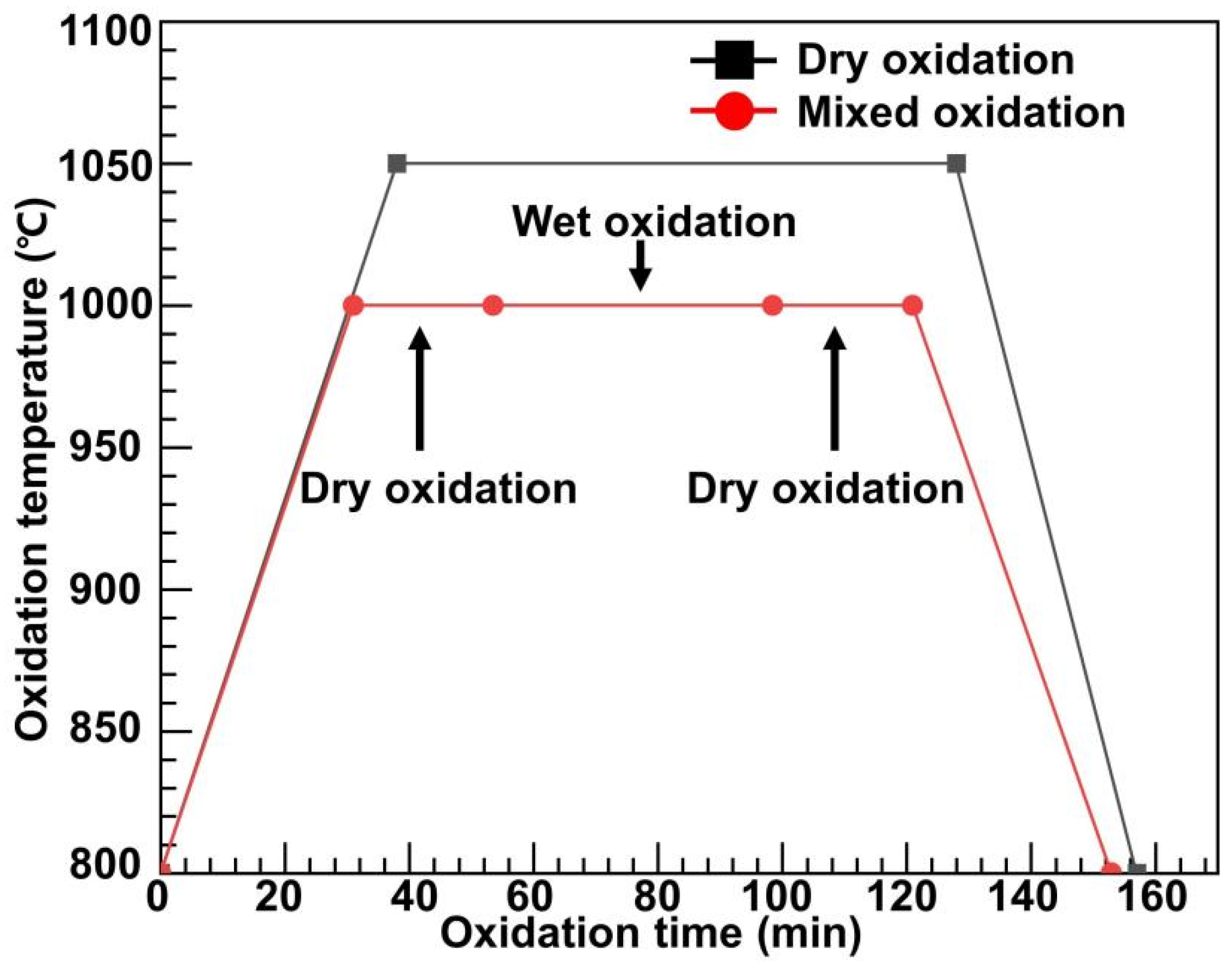
N-doped 182×182 mm2 commercial Czochralski (Cz) silicon wafers (1–2 Ω·cm) with thicknesses of 150 ± 10 μm were used as substrates. After a saw damage etching step, the substrates were textured in KOH solution. Subsequently, the substrates were placed in a tubular furnace for diffusion at 850 °C for 10 min with BCl3 and O2 flows to form B2O3. After the deposition, the samples were annealed in a separate tubular furnace at temperatures ranging from 950–1050 °C for varying durations with nitrogen (N2) and O2 flows to activate the B dopants and drive-in B atoms into the crystalline silicon (c-Si) substrate to form a p–n junction. Figure 1 illustrates the specific oxidation process following boron diffusion. N2 was purged into furnace while the temperature was increased from 800 °C to 1050 °C (for dry oxidation) and 800 °C to 1000 °C (for mixed oxidation). Once the temperature was stabilized at the target value, N2 flow was terminated and then O2 or a H2O vapor/O2 mixture was purged for approximately 30–120 min. The B atoms diffused into the silicon substrate in the high temperature environment. Finally, N2 was purged to ramp down the temperature to 800 °C. As can be seen from Figure 1, the mixed oxidation process steps are as follows (total duration: 90 min): (1) dry O2 was purged for 22.5 min; (2) wet oxygen with O2 and H2O were purged for 45 min; and, finally, (3) dry O2 was purged for 22.5 min to form a three-layer structure of dry oxide layer/wet oxide layer/dry oxide layer after reaching the target temperature.
Dry oxidation performed at 1050 °C yielded the highest cell efficiency in industrial applications. Given that temperature serves as a key parameter in the mixed oxidation process, multiple groups of temperature-based experiments are designed. In this study, the experiments were divided into four groups, Group 1 served as a reference with a 1050 °C dry oxidation process, Groups 2–4 employed mixed oxidation processes under different conditions. Each group included 2640 experimental wafers. For uniformity assessment, 10 silicon wafers were sampled from identical positions within each group to measure the same position and thus test the uniformity, Rsheet values, and doping profiles after completion of the oxidation process and BSG removal. Additionally, 10 silicon wafers were sampled from the production line to test passivation performance after the completion of the front and back passivation. The cell efficiency and contact resistance were measured after fabrication of the complete solar cell structure. The process conditions of each group are shown in Table 1.
It should be noted here that it was easy to etch the SiO2 layer formed in the oxidation process by hydrofluoric acid (HF). The etching selectivity between SiO2 and c-Si substrate was high, and when the SiO2 layer was removed by HF, the etching ceased with no further etching and with no damage occurring to the c-Si substrate. After the etching and cleaning, the Rsheet and the surface boron doping concentration were characterized as functions of oxidation parameters as well as the oxidation method, which were directly impacting passivation quality and cell performance. Passivation properties can be characterized by surface saturation current density (J0S), effective minority carrier lifetime (τeff) and implied open-circuit voltage (iVoc), the test data presented herein not only characterize the diffusion doping performance but also indirectly reflect cell efficiency.

2.2. TOPCon Solar Cell Fabrication Procedure

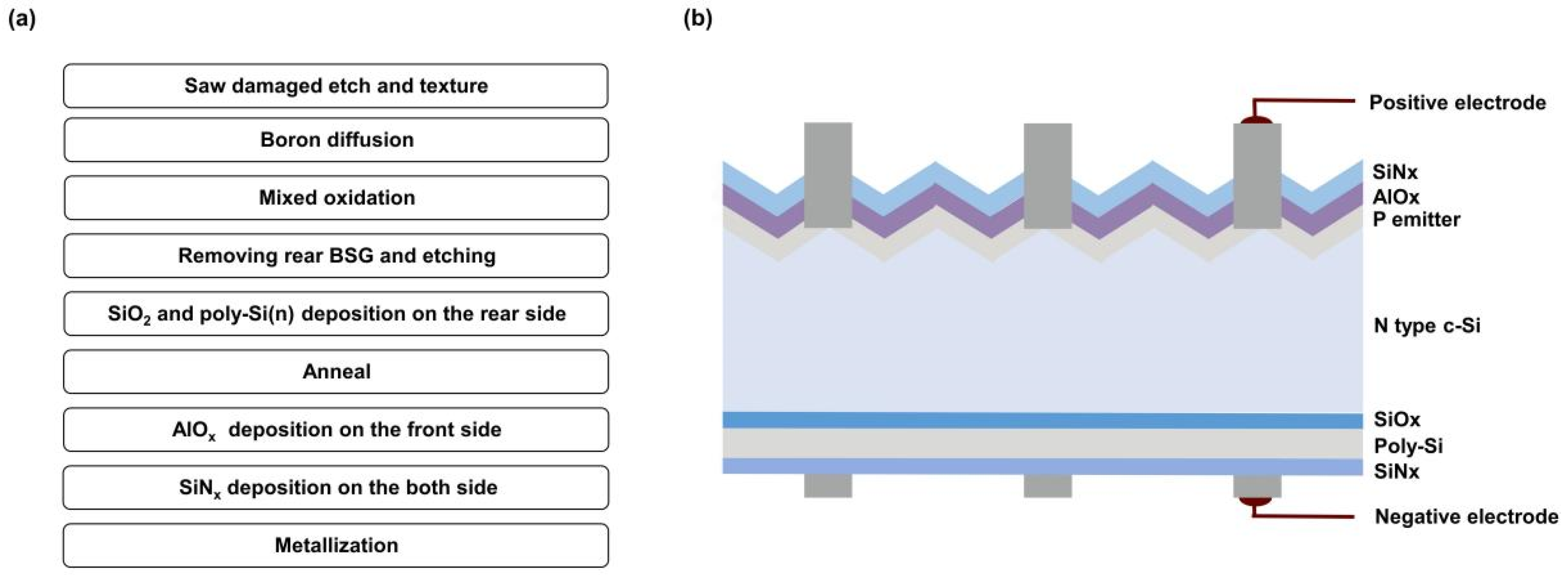
Figure 2 illustrates the preparation process and specific structure of TOPCon solar cells. The manufacturing sequence is illustrated in Figure 2a, and a schematic cross-section of the TOPCon solar cells is presented in Figure 2b. N-doped CZ c-Si wafers were used as the substrates of the solar cells. The front surface was textured by KOH etching, and then the substrates were diffused in a tubular furnace at 850 °C. Subsequently, the substrates were transferred to another tubular furnace for drive-in at temperatures ranging from 950–1050 °C for 76–88 min to activate the B dopants and diffuse B atoms into the c-Si substrate to form the p-type emitter. Next, the BSG was single side etched in a diluted HF solution, the rear side was polished by KOH alkaline solution. On the rear side, a 1.5 nm ultrathin SiOx layer was grown on the alkaline-polished surface by a N2O plasma assistant oxidation and a 150 nm thick P-doped and hydrogenated amorphous silicon (a-Si:H) thin film was deposited in the same plasma enhanced chemical vapor deposition (PECVD) system as the n-type poly-Si contact layer. Subsequently, the samples underwent tube-furnace annealing for crystallization of the a-Si:H and the activation of P dopants. For the front p-type emitter passivation, an Al2O3 layer was deposited on the front surface using the atomic layer deposition (ALD) system, followed by PECVD deposition of SiNx layer to form an antireflective coating. Finally, Ag paste was screen-printed onto the surface and fired at high temperature to metallize and complete the solar cell fabrication.

2.3. Testing Instruments

The thickness of SiO2 films deposited under different oxidation temperatures and methods was measured by full spectral ellipsometry (Elitop ES01, Ellitop Scientific Co., Ltd., Beijing, China). The Rsheet of the B-diffused emitter was measured using a four-point probe meter (280SI, 4 Dimensions) after the complete removal of the BSG layer. The active B distribution profile of the emitter was measured using an ECV system (WEP Wafer Profile CVP21). The τeff spectra as a function of carrier injection intensity was measured using a quasi-steady-state photoconductance (QSSPC) setup (Sinton WCT-120), from which the iVoc and J0S were extracted. The solar cell performance was characterized by the current versus voltage (I–V) measurements under a solar simulator (Sofn, 7-SCSpec, China) with one-sun illumination intensity (100 mW/cm2) AM1.5 spectrum at 25 °C and external quantum efficiency (EQE) measurements with an EQE system (Vision, PVE300-IVT210). The contact resistivity (ρcontact) was extracted using the transmission line method (TLM, Pvtools, TLM-SCAN).

2.4. Mixed Oxidation System

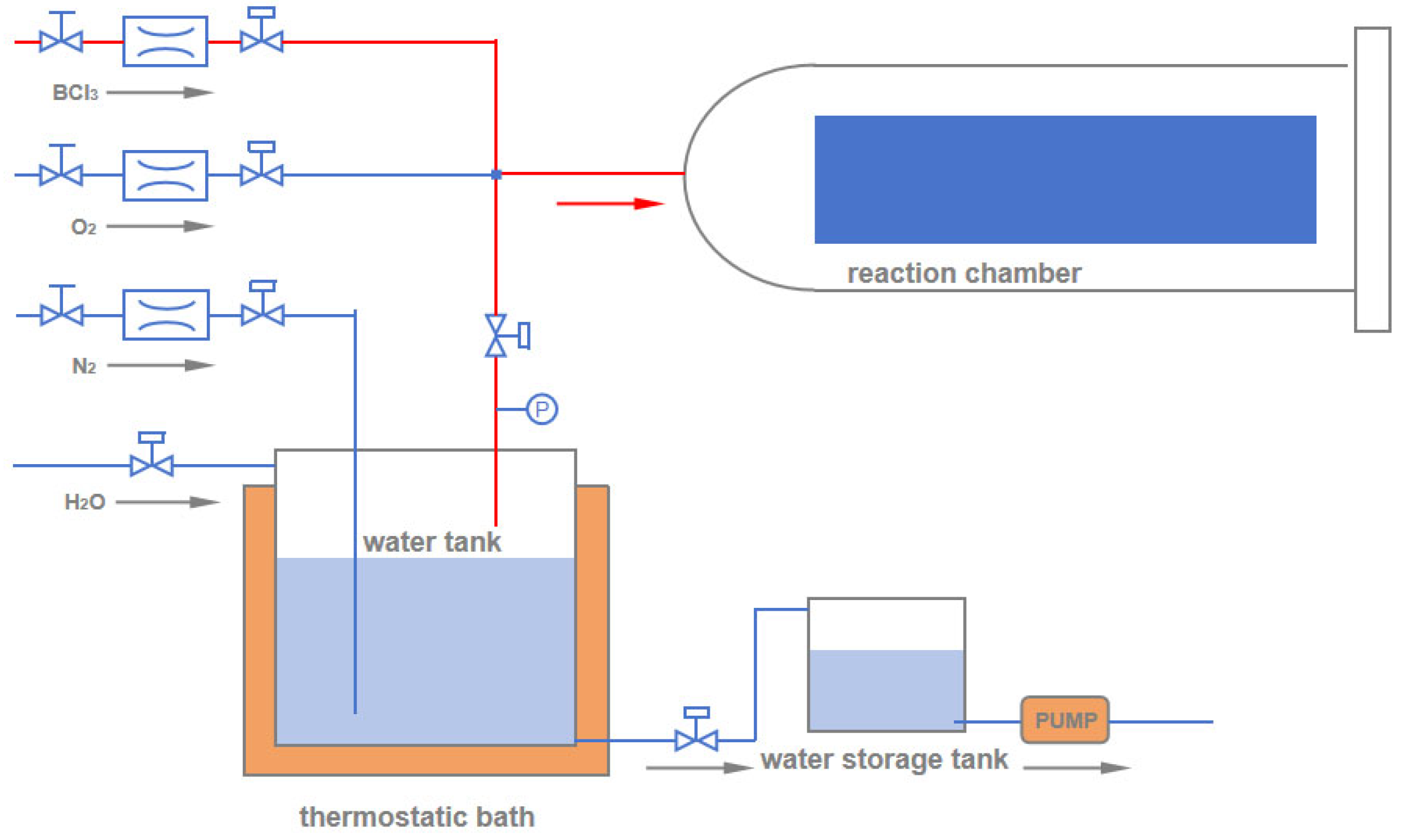
Figure 3 illustrates the mixed oxidation system illumination in this study. N2 was purged into a container with pure water, with the N2 carrying water vapor into the reaction chamber through bubbling. The wet oxygen system comprised gas supply pipelines, water supply pipelines, a water tank, a thermostatic bath, drainage pipelines, a water storage tank, mass flow controllers, pneumatic valves, pressure gauges, a pump and other components. The water tank was placed in a thermostatic bath maintained at a constant temperature of 70 °C. In order to ensure water purity, the water in the tank was regularly discharged to the water storage tank through the drainage pipeline and valve. When the water storage tank exceeded the warning value, the pump was automatically turned on and the wastewater was discharged to the peripheral water pipe. N2 was purged into the water tank and this carried water vapor into the reaction chamber by bubbling, where it mixed with dry oxygen to accelerate the oxidation process. In order to achieve better process results, the gas supply pipeline of N2 carrying water vapor was equipped with an 80 °C heat tracing device.

3. Results and Discussion

3.1. Effect of Oxidation Temperature on the B Emitter Formed by Mixed Oxidation

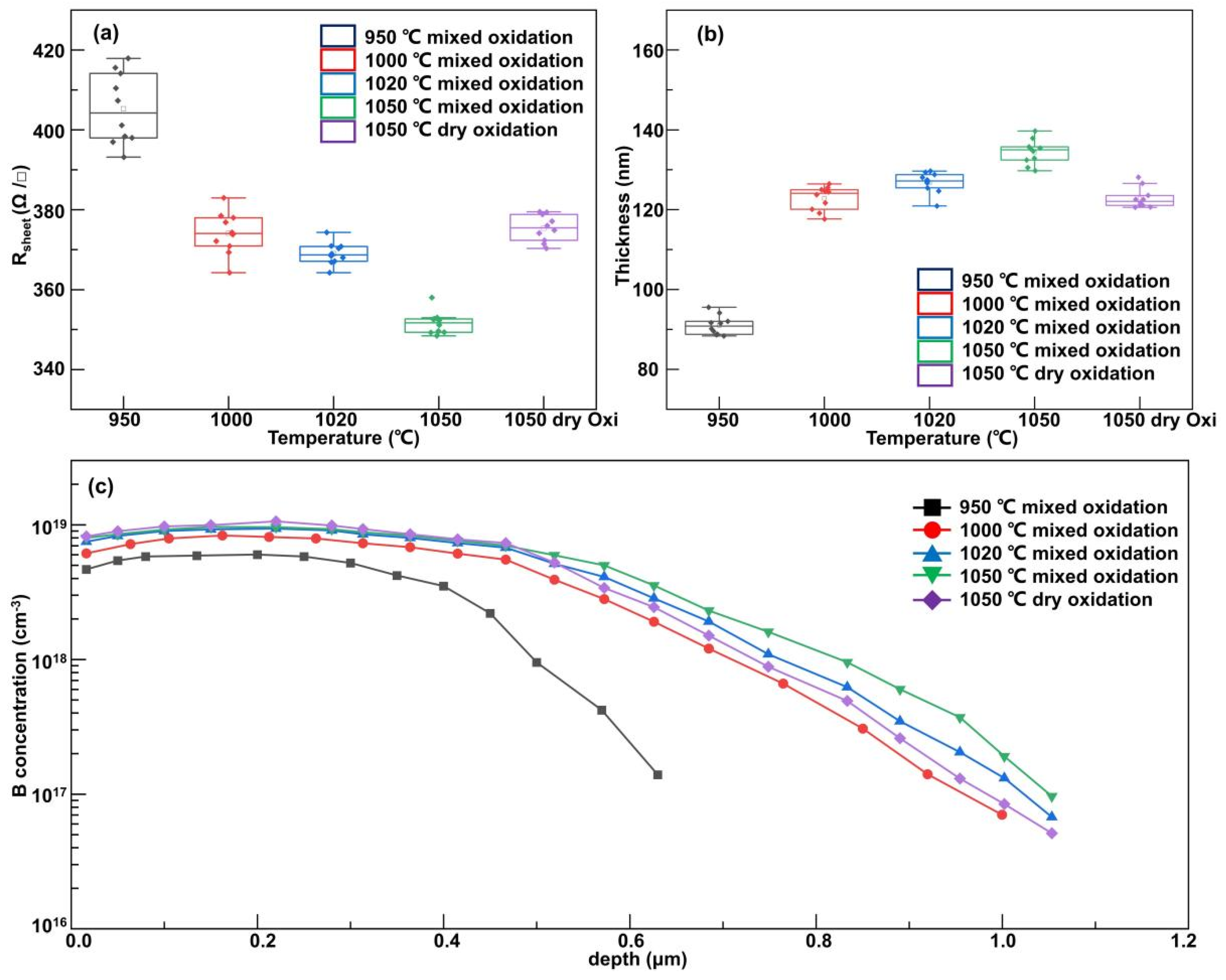
First, different post-oxidation temperatures (Toxidation) were adopted in the mixed oxidation process while maintaining identical diffusion processes and process parameters (oxidation time = 90 min, O2/H2O flow ratio = 10:1); then, Rsheet, the thickness of SiO2, B diffusion profiles, J0S, iVoc and τeff were tested, with the results presented in Figure 4. As depicted in Figure 4a, the average Rsheet decreases from 405.5 Ω/sq to 351.6 Ω/sq as the Toxidation increases from 950 °C to 1050 °C for mixed oxidation, indicating that the Rsheet is related to Toxidation. The average Rsheet is 375.4 Ω/sq when dry oxidation is performed at 1050 °C, which is equivalent to the average Rsheet of 374.1 Ω/sq at 1000 °C mixed oxidation. This phenomenon may be attributed to the following factors: (1) The oxidation rate of wet oxidation is faster than that of dry oxidation, thus the film thickness of SiO2 grown by mixed oxidation is greater than that by dry oxidation at the same temperature. As shown in Figure 4b, the average thickness of SiO2 increases from 91 nm to 134.44 nm as the Toxidation increases from 950 °C to 1050 °C under mixed oxidation conditions, but the average thickness is only 122.85 nm at 1050 °C under dry oxidation conditions, which is equivalent to the average thickness of 122.83 nm at 1000 °C under mixed oxidation condition. (2) The doping concentration of B atoms increases with the increase of Toxidation in the mixed oxidation process, thus increasing the carrier concentration conductivity of the silicon wafer, resulting in the decrease of Rsheet [23]. (3) The decreases of Rsheet can also be explained by a deeper diffusion of boron into the silicon substrate [24,25], which will be subsequently confirmed and discussed by ECV measurements. Additionally, Figure 4a,b reveal that the uniformity of the SiO2 thickness and Rsheet gradually increase with increasing Toxidation in the case of mixed oxidation.
As the objective of this study is to diffuse B into the c-Si substrates to form the emitter of TOPCon solar cells, we investigated the B diffusion profiles formed by the B-doped layers fabricated using different oxidation methods. Figure 4c illustrates the influence of mixed oxidation and dry oxidation environments on the ECV of boron diffusion under different oxidation temperatures. The diffusion profiles exhibit a similar tendency in wafers prepared by different oxidation methods, with surface doping concentration initially increasing and subsequently decreasing with the increase of junction depth. Junction depth is the depth of the PN junction, which primarily refers to the thickness of the P-type doping region. Both junction depth and surface doping concentration increase as Toxidation rises from 950 °C to 1050 °C for depth mixed oxidation. This behavior may be attributed to the fact that the solid solubility and diffusion coefficient of boron in silicon increase with elevated temperature, enabling more B atoms dissolve into silicon and rapidly diffuse, resulting in increased surface B-doping concentration and junction depth [23,24]. Furthermore, mixed oxidation at 1050 °C results in greater junction depth and lower surface boron doping concentration when compared with dry oxidation at the same temperature. This phenomenon is primarily attributed to the higher impurity segregation coefficient of B under wet oxygen oxidation compared with dry oxidation at identical temperature [26]. This indicates that more non-equilibrium intrinsic interstitials may be generated in the oxidation environment with water vapor due to the faster oxidation rate, which can promote impurity separation at the interface, resulting in a relatively high impurity segregation coefficient. B atoms are more likely to be distributed on the SiO2 side of the SiO2/Si interface, so the surface doping concentration of mixed oxidation is lower than that of dry oxygen oxidation at the same temperature. Temperature also affects the SiO2, and wet oxygen oxidation exhibits an obvious accelerated growth phenomenon at the initial oxidation stage compared with dry oxidation. This may be attributed to the fact that water molecules adsorbed on the Si surface will form -OH and -H groups, which can passivate the Si surface and accelerate the oxidation reaction [27]. Additionally, the mixed oxidation can achieve a smaller interfacial stress on the surface of the silicon wafer, thereby facilitating enhanced interfacial reactions. Interfacial reactivity and diffusion represent the two main parameters in the silicon oxidation process. Wet oxidation produces thicker and denser oxides than dry oxidation at high temperatures (≥1000 °C) [28]. The rapidly growing SiO2 layer may generate more non-equilibrium intrinsic interstitials in the silicon lattice, which can act as a carrier for boron diffusion and promote boron diffusion within silicon, resulting in deeper diffusion depth [26]. In summary, the above results demonstrate that mixed oxidation achieves lower surface doping concentration, greater doping depth and faster growth rate when compared with dry oxidation. These advantages can effectively reduce both oxidation time and temperature in the manufacture procedure of TOPCon solar cells.
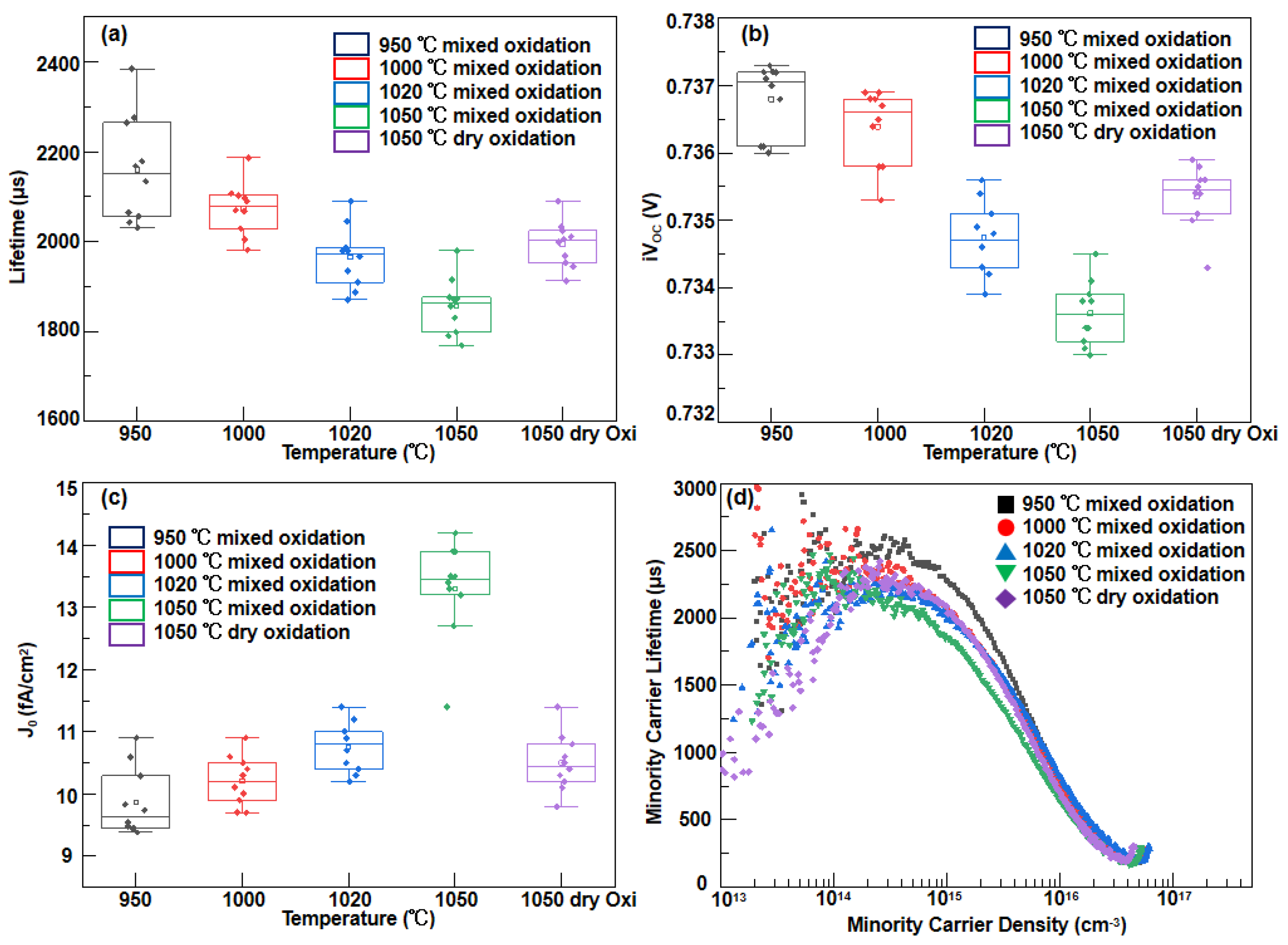
The performance of solar cells is strongly influenced by the passivation quality at the front and rear surfaces, especially J0S, iVoc and τeff. The structure of SiNx/Al2O3/p-type emitter/c-Si/SiO2/n+-polySi/SiNx was employed to test the passivation performance of dry oxidation and mixed oxidation at different temperatures. Figure 5a–c illustrate the extracted passivation parameters of τeff, iVoc and J0S as a function of oxidation temperature, Figure 5a illustrates the average τeff values at the injection level of 1 × 1015 cm−3, while Figure 5d displays the τeff spectra of the top five samples from Figure 5c as a function of injection intensity. Figure 5c illustrates that the average J0S values increase from 9.864 fA/cm2 to 13.3 fA/cm2 as the oxidation temperature rises from 950 °C to 1050 °C for mixed oxidation. It can also be observed from Figure 5a,b that average iVoc and τeff values decrease from 2160.1μs and 736.8 mV to 1855.5 μs and 733.8 mV with mixed oxidation temperature increase from 950 °C to 1050 °C, indicating a degradation of the passivation quality with the increase of oxidation temperature, which is consistent with the conclusions reported by [29]. However, the average iVoc and τeff values of samples prepared by dry oxidation at 1050 °C are 2041.7 μs and 735.4 mV, respectively, which are higher than those of the samples prepared by mixed oxidation at 1050 °C, indicating that the passivation quality of mixed oxidation is inferior to that of dry oxidation at identical oxidation temperature. This phenomenon can be attributed to three primary factors: (1) The increase in boron doping concentration leads to enhanced Auger recombination [29]. It can be observed from Figure 5 that the increase in boron doping concentration may lead to the enhancement of Auger recombination, which results in the decreases in iVoc and τeff. (2) The activated B concentration in silicon and the surface doping concentration increase with the increase of the mixed oxidation temperature, as shown in Figure 5c, while an excessively high surface doping concentration may introduce more B-O pair defects on the surface of the silicon wafer, and these B-O pair defects will become the recombination center for charge carriers, will increase surface recombination, and will lead to a degradation of the passivation quality [29]. (3) The quality of the SiO2 layer prepared by dry oxidation is superior to that prepared by mixed oxidation, resulting in reduced carrier recombination at the Si–SiO2 interface and higher passivation quality. Conversely, mixed oxidation employs an alternating dry oxygen and wet oxygen processes to decrease the Si–SiO2 interfacial strain, resulting in decline of Si–SiO2 interfacial quality and thus reduce passivation quality. Figure 5d plots the relationship between τeff and injection intensity under different oxidation temperatures for both dry oxidation and mixed oxidation conditions [30]. First, the lifetime spectra exhibits a mountain-like shape with lower lifetime values at the low and high injection regions. The decrease of τeff with the decrease of carrier density at the low injection region is the signature of recombination through B-O pair defects and the decrease with the increase of carrier density in the high injection region is typically attributed to enhanced Auger recombination in the B diffused layer [31,32,33]. Furthermore, the figure clearly shows that the minority carriers lifetime decreases with the increase of the oxidation temperature. In summary, iVoc decreases and J0S increases with the increase of oxidation temperature, indicating a degradation in passivation quality with the increase of oxidation temperature. Notably, the passivation quality of the mixed oxidation sample at 1000 °C is superior to that of the dry oxidation sample at 1050 °C, indicating that the mixed oxidation method can be implemented in the industrial production of solar cells to decrease the temperature without affecting the solar cell performance, thereby reducing the thermal budget and improving the service lifetime of quartz tubes.

3.2. Effect of O2/H2O Flow Ratio on B Emitter Formed by Mixed Oxidation

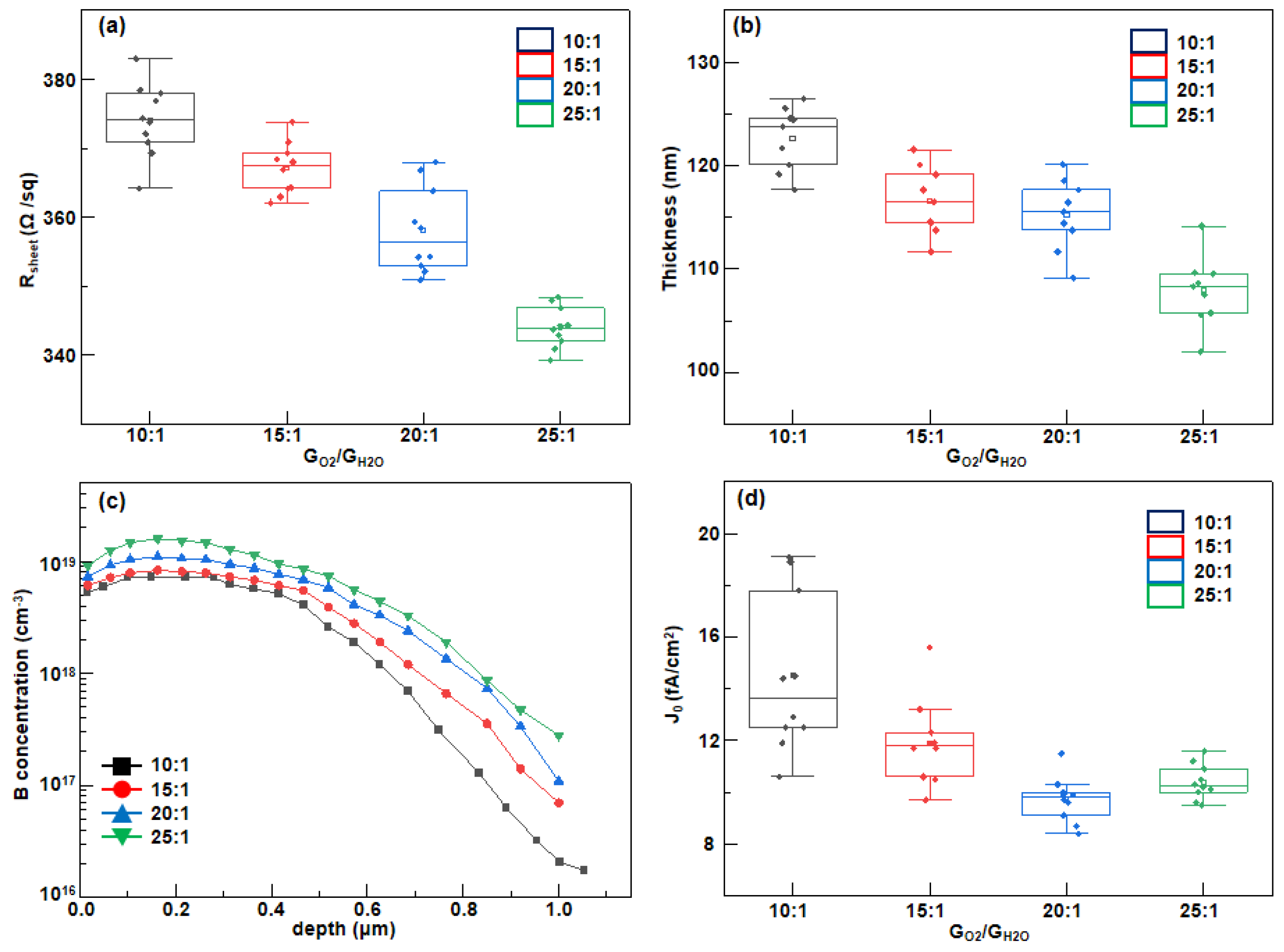
Subsequently, different O2/H2O flow ratios were employed in the mixed oxidation process (Toxidation = 1000 °C, oxidation time = 90 min). Subsequently, the SiO2 thickness, Rsheet and B doping profiles were measured, with the results presented in Figure 6. As depicted in Figure 6a,b, the average Rsheet decreases from 374 Ω/sq to 344 Ω/sq, and the average thickness of SiO2 decrease from 122.83 nm to 108.1 nm as the O2/H2O flow ratio increases from 10:1 to 25:1 for mixed oxidation. This trend can be attributed to two key factors: (1) The growth rate of wet oxygen oxidation decreases with reducing H2O gas flow, consequently reducing the SiO2 film thickness as illustrated in Figure 6b. (2) The doping concentration of B atoms increases with the decrease in film thickness, resulting in reduced Rsheet. Figure 6c illustrates the influence of O2/H2O flow ratio on the diffusion profiles under mixed oxidation conditions. Both surface doping concentration and the junction depth decrease as the H2O flow increases due to the segregation effect, where boron dopants migrate into the oxide layer, thus resulting in a lower surface doping concentration [18]. As shown in Figure 6d, when the O2/H2O flow ratio increases, J0S decreases from 15.51 fA/cm2 to 7.99 fA/cm2. This indicates that the H2O flow rate during high-temperature oxidation has a significant impact on J0S, which is primarily related to the quality of SiO2, specifically the wet oxide component. When the H2O flow increases, the thickness of the wet oxygen oxide layer increases, resulting in poor oxide layer quality and consequently affecting its passivation performance. However, when the O2/H2O flow ratio reaches 25:1, due to the excessively high surface doping concentration, the number of carrier recombination centers increases and the passivation performance deteriorates. Finally, an O2/H2O flow ratio of 20:1 was selected as the optimal flow ratio.

3.3. Effect of Oxidation Time on B Emitter Formed by Mixed Oxidation

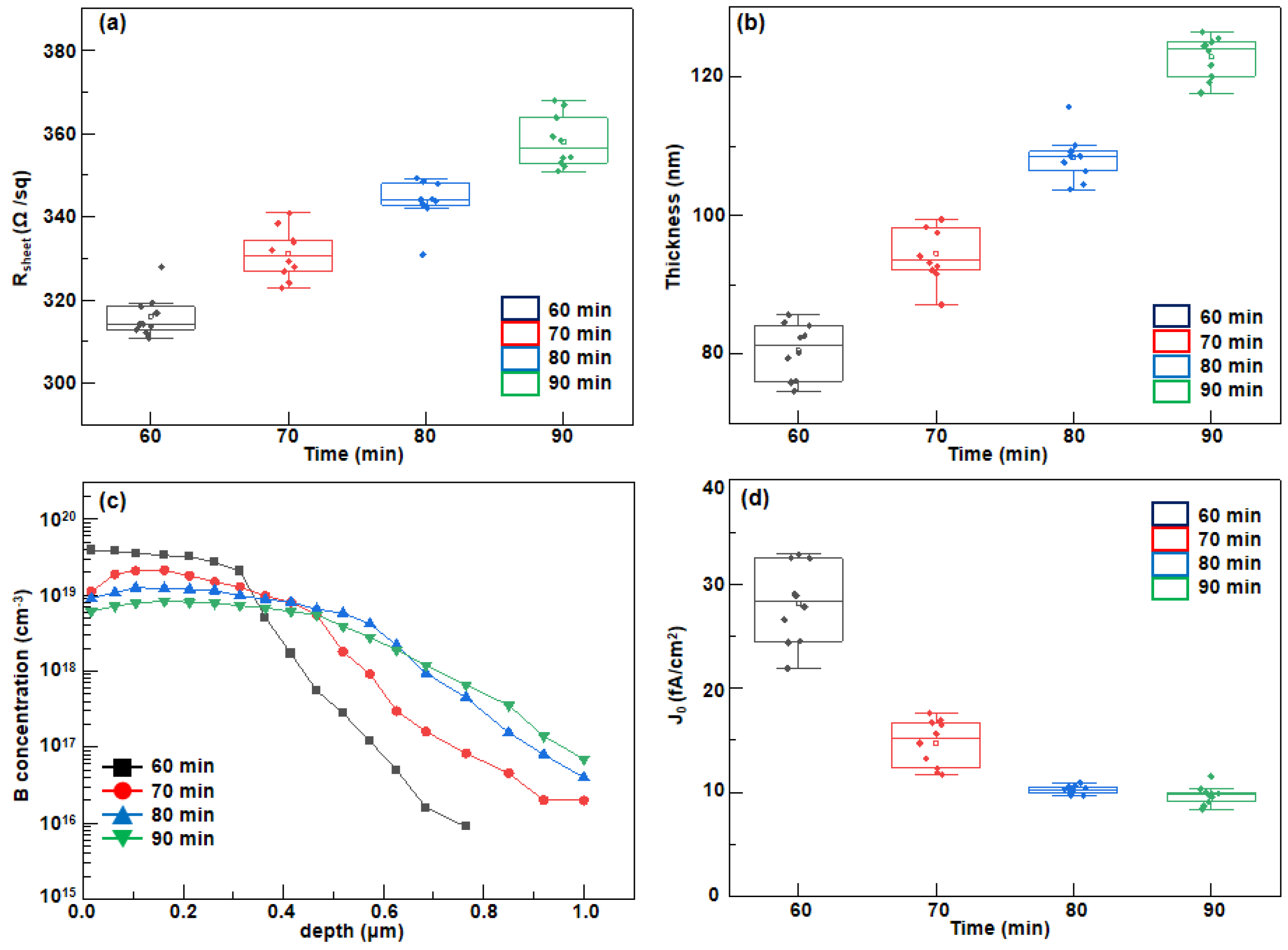
Additionally, different oxidation times were employed in the mixed oxidation process (Toxidation = 1000 °C, O2/H2O flow ratio = 20:1) and the oxide layer thickness, the sheet resistance (Rsheet) and the doping curve were measured. The results are shown in Figure 7. As depicted in Figure 7a,b we see that both Rsheet and the film thickness increase with the increase of toxidation in the mixed oxidation process. When toxidation increases from 60 min to 90 min, the average Rsheet increases from 316 Ω/sq to 358 Ω/sq, and the average film thickness increases from 80 nm to 123 nm. This phenomenon is primarily attributed to be increased oxide layer thickness resulting from extended oxidation time. Boron atoms migrate into the oxide layer under high temperature, and the thicker silicon oxide film leads to a decrease in the surface boron doping concentration and an increase in the Rsheet. Meanwhile, under the longer high-temperature oxidation time, boron atoms continuously diffuse deeper into the silicon substrate, resulting in a greater junction depth. Furthermore, the ECV curve in Figure 7c demonstrates that the surface doping concentration in the mixed oxide layer decreases with the increase of oxidation time, and the junction depth becomes deeper. This is because, when the toxidation increases, the thickness of the surface oxide layer increases. At high temperatures, boron dopants segregate into the oxide layer, thereby reducing the surface doping concentration. As shown in Figure 7d, we find that, when the toxidation increases, J0S decreases from 28.11 fA/cm2 to 9.71 fA/cm2, with the improvement in passivation performance becoming negligible when the toxidation exceeds 80 min. During high-temperature oxidation, the toxidation has a significant impact on J0S. The longer the oxidation time, the better the passivation effect. This is primarily because, under long-term oxidation, the thickness of the oxide layer increases and a larger amount of boron atoms diffuse into the silicon oxide layer. The boron-rich layer (BRL) becomes relatively thin with a lower surface doping concentration, leading to reduced surface recombination and J0S. Considering the balance between process duration and passivation performance, 80 min was selected as the optimal oxidation time. Finally, the optimal process conditions were determined for mixed oxidation through the above experiments, where Toxidation = 1000 °C, O2/H2O flow ratio = 20:1, oxidation time = 80 min.

3.4. Effects of Mixed Oxidation on Electrical Performance of TOPCon Solar Cells

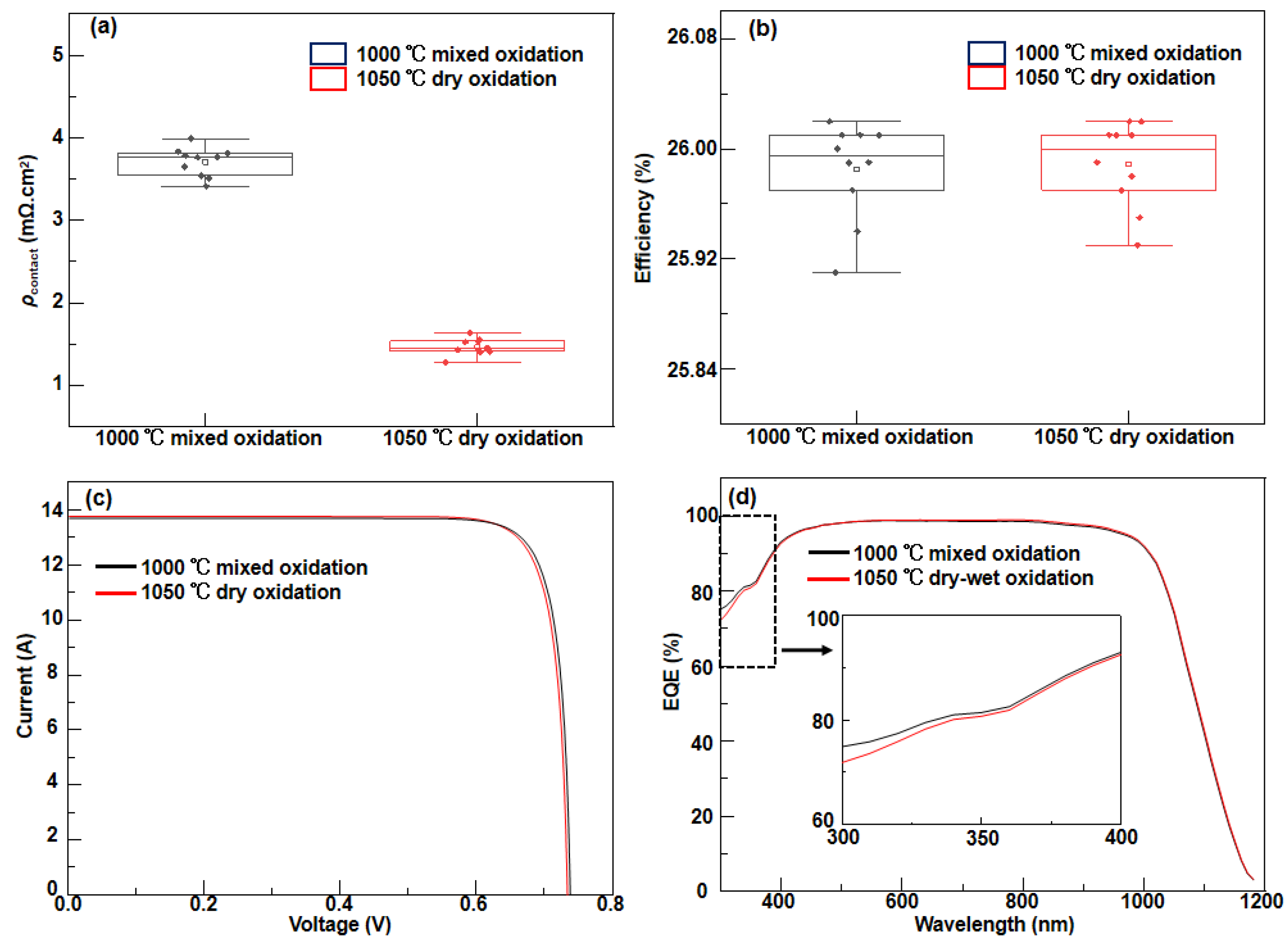
The structure of TOPCon solar cells is given in Figure 2a. Passivation quality and ρcontact are critical parameters in TOPCon solar cells, which significantly influence the efficiency. Figure 8a illustrates the front ρcontact of TOPCon solar cells under different oxidation methods. It is observed that the ρcontact of dry oxidation is smaller than that of mixed oxidation, which may be attributed to the higher surface doping concentration achieved with dry oxidation. Figure 8b illustrates the average efficiency of the samples. It can be found that the average efficiency of mixed oxidation is similar between mixed oxidation and dry oxidation. This is primarily because efficiency depends not only on contact resistance but also on passivation performance. Under the mixed oxidation conditions, an optimal balance between passivation performance and ρcontact is achieved, with the best average efficiency reaching 26.02%, which is comparable to that obtained with dry oxidation at 1050 °C. To further compare performance, champion solar cells prepared under the mixed oxidation conditions at 1000 °C and dry oxidation at 1050 °C were selected, as shown in Figure 8c,d, where we find the current and voltage (I–V) characteristics under the one sun illumination in Figure 8c and the external quantum efficiency (EQE) profiles in Figure 8d, for which the performance parameters are shown in Figure 8c. As shown in Table 2, the open-circuit voltage (Voc) of mixed oxidation at 1000 °C is higher than that of dry oxidation at 1050 °C, primarily because higher junction depth and lower surface doping concentration can be achieved even at a lower oxidation temperature under mixed oxidation conditions, thereby improving passivation quality. Short circuit current (Isc) and fill factor (FF) are lower under 1000 °C mixed oxidation conditions, which may be attributed to the influence of ρcontact. Under the combined influence of passivation performance and ρcontact, the efficiency of TOPCon solar cells with emitters formed by mixed oxidation at 1000 °C and dry oxidation at 1050 °C is comparable. Additionally, the EQE curve reveals that the emitter prepared by mixed oxidation exhibits superior light absorption performance. Finally, we also statistically analyzed the service life of quartz tubes and energy consumption in industrial production, with results presented in Table 3. It is demonstrated that the thermal budget can be reduced and the service life of quartz tubes can be increased by using mixed oxidation. These results demonstrate the feasibility and broad application prospects of mixed oxidation in the manufacture of high-efficiency TOPCon solar cells.

4. Conclusions

A “dry–wet–dry” mixed oxidation process was successfully developed and optimized for the fabrication of the boron emitters of high-efficiency n-type TOPCon solar cells. The mixed oxidation process with optimized parameters (Toxidation = 1000 °C, toxidation = 80 min, O2/H2O flow ratio = 20:1) achieved a cell efficiency of 26.02%. This performance is comparable to that of the conventional dry oxidation process, conducted at 1050 °C for 90 min in the absence of H2O. This study demonstrates the feasibility of reducing the process temperature by 50 °C and shortening the toxidation by 10 min without compromising performance. Compared with the dry oxidation process, the mixed oxidation process yields lower surface boron doping concentration, which reduces Auger recombination and recombination of B-O pair defects. As a result, enhanced passivation performance is achieved at reduced temperatures. Additionally, this extends the service life of quartz tubes by more than double and reduces the single-process energy consumption by approximately 10%, significantly lowering production costs and thermal budget. These advantages establish a solid technical foundation for the large-scale, low-cost manufacturing of TOPCon technology. Looking forward, the mixed oxidation technology can be integrated with advanced structures, such as selective emitters, to further synergistically optimize the balance between passivation quality and contact resistance. This integration has the potential to elevate the efficiency and cost competitiveness of TOPCon cells to a new benchmark.

Author Contributions

Conceptualization, Y.G. and J.Z.; Methodology, Y.G.; Software, J.H.; Validation, X.Z.; Formal analysis, X.Z., C.X. and J.H.; Investigation, Y.G. and J.Z.; Data curation, C.X.; Writing—original draft, Y.G.; Writing—review & editing, X.Z. and J.Z.; Supervision, J.Z. All authors have read and agreed to the published version of the manuscript.

Funding

This research was funded by China Science and Technology Exchange Center grant number 2020YFE0203100.

Institutional Review Board Statement

Not applicable.

Informed Consent Statement

Not applicable.

Data Availability Statement

The data that support the findings of this study are available from the corresponding author upon reasonable request.

Acknowledgments

We thank Zengchao Zhao from the National Engineering Research Center of Photovoltaic Equipment (NCPVE) for the test of TOPCon solar cells.

Conflicts of Interest

Yan Guo, Cheng Xie and Jiabing Huang were employed by the company Hunan Red Solar Photoelectricity Science and Technology Co., Ltd. The remaining authors declare that the research was conducted in the absence of any commercial or financial relationships that could be construed as a potential conflict of interest.

Abbreviations

TOPConTunnel oxide passivated contact solar cells
BSGBorosilicate glass layer
ECVElectrochemical capacitance voltage 
RsheetSheet resistance 
ToxidationPost-oxidation temperature. 
GO2The O2 gas flow rate at high temperature.
GH2OThe H2O gas flow rate at high temperature.
toxidationOxidation time, toxidation = (1/4) tdry oxidation + (1/2) twet oxidation + (1/4) tdry oxidation
a-Si:HHydrogenated amorphous silicon plasma enhanced chemical vapor deposition (PECVD) 
ALDAtomic layer deposition
τeffEffective minority carrier lifetime
iVocImplied open-circuit voltage 
J0SSurface saturation current density
EQEExternal quantum efficiency
ρcontactContact resistivity
BRLBoron-rich layer
VocOpen-circuit voltage
IscShort circuit current
FFFill factor
Ω/sq Ohms per square

References

  1. Feldmann, F.; Bivour, M.; Reichel, C.; Hermle, M.; Glunz, S.W. A passivated rear contact for high-efficiency n-type Si solar cells enabling high Vocs and FF > 82%. In Proceedings of the 28th European Photovoltaic Solar Energy Conference, Paris, France, 30 September–4 October 2013; pp. 988–992. [Google Scholar]
  2. Feldmann, F.; Bivour, M.; Reichel, C.; Hermle, M.; Glunz, S.W. Passivated rear contacts for high-efficiency n-type Si solar cells providing high interface passivation quality and excellent transport characteristics. Sol. Energy Mater. Sol. Cells 2014, 120, 270–274. [Google Scholar] [CrossRef]
  3. Wang, Q.Q.; Peng, H.; Gu, S.; Guo, K.; Wu, W.; Li, B.; Li, L.; Yuan, N.; Ding, J. High-efficiency n-TOPCon bifacial solar cells with selective poly-Si based passivating contacts. Sol. Energy Mater. Sol. Cells 2023, 259, 112458. [Google Scholar] [CrossRef]
  4. Ghosh, D.K.; Bose, S.; Das, G.; Acharyya, S.; Nandi, A.; Mukhopadhyay, S.; Sengupta, A. Fundamentals, present status and future perspective of TOPCon solar cells: A comprehensive review. Surf. Interfaces 2022, 30, 101917. [Google Scholar] [CrossRef]
  5. Xiong, Y.; Abdul Fattah, T.O.; Okamoto, K.; Bonilla, R.S. A Failure Mode Affecting the Reliability of LECO-Treated High-Efficiency TOPCon Solar Cells. Sol. RRL 2025, 9, e2500151. [Google Scholar] [CrossRef]
  6. Haase, F.; Hollemann, C.; Schäfer, S.; Merkle, A.; Rienäcker, M.; Krügener, J.; Brendel, R.; Peibst, R. Laser contact openings for local poly-Si-metal contacts enabling 26.1%-efficient POLO-IBC solar cells. Sol. Energy Mater. Sol. Cells 2018, 186, 184–193. [Google Scholar] [CrossRef]
  7. Komatsu, Y.; Mihailetchi, V.; Geerligs, L.; van Dijk, B.; Rem, J.; Harris, M. Homogeneous p+ emitter diffused using boron tribromide for record 16.4%-efficient screen-printed large-area n-type mc-Si solar cells. Sol. Energy Mater. Sol. Cells 2009, 93, 750–752. [Google Scholar] [CrossRef]
  8. Silva, J.A.; Silva, R.A.E.; Peral, A.A. One Step Method to Produce Boron Emitters. Phys. Status Solidi A Appl. Mater. Sci. 2018, 215, 1701076. [Google Scholar] [CrossRef]
  9. Teppe, A.; Gong, C.; Zhao, K. Progress in the industrial evaluation of the mc-Si PERCT technology based on boron diffusion. Energy Procedia 2015, 77, 208–214. [Google Scholar] [CrossRef]
  10. Armand, J.; Oliver, C.; Martinez, F. Modeling of the boron emitter formation process from BCl3 diffusion for n-type silicon solar cells processing. Adv. Mater. Res. 2011, 324, 261–264. [Google Scholar] [CrossRef]
  11. Cabal, R.; Veschetti, Y.; Sanzone, V.; Manuel, S.; Gall, S.; Barbier, F.; Ozanne, F.; Bettinelli, C.; Gillot, B. Industrial process leading to 19.8% efficiency on n-type Cz silicon. Energy Procedia 2013, 33, 11–17. [Google Scholar] [CrossRef]
  12. Zhou, Y.; Tao, K.; Liu, A.; Jia, R.; Jiang, S.; Bao, J.H.; Yang, S.C.; Cao, Y.J.; Qu, H. Study of boron diffusion for p+ emitter of large-area n-type TOPCon silicon solar cells. Appl. Phys. A Mater. Sci. Process. 2020, 126, 671. [Google Scholar] [CrossRef]
  13. Richter, A.; Benick, J.; Feldmann, F.; Fell, A.; Hermle, M.; Glunz, S.W. N-type Si solar cells with passivating electron contact: Identifying sources for efficiency limitations by wafer thickness and resistivity variation. Sol. Energy Mater. Sol. Cells 2017, 173, 96–105. [Google Scholar] [CrossRef]
  14. Lohmüller, S.; Lohmüller, E. Advanced BBr3 diffusion with second deposition step for selective emitter formation by laser doping. Phys. Status Solidi-Rapid Res. Lett. 2018, 12, 1700442. [Google Scholar] [CrossRef]
  15. Ok, Y.W.; Upadhyaya, V.D.; Upadhyaya, A.D.; Tam, A.M.; Huang, Y.Y.; Carter, D.; Rohatgi, A. Screen-printed, large-area bifacial selective emitter N-PERT cells using single-step implantation through laser-patterned dielectric layer. In Proceedings of the 43rd IEEE Photovoltaic Specialists Conference (PVSC), Washington, DC, USA, 5–10 June 2016. [Google Scholar]
  16. Kriegler, R.J.; Cheng, Y.C.; Colton, D.R. The effect of HCl and Cl2 on the thermal oxidation of silicon. J. Electrochem. Soc. 1972, 119, 388–392. [Google Scholar] [CrossRef]
  17. Monna, R.; Sanzone, V.; Diaz, J.; Veschetti, Y. Influence of the BCl3 diffusion process homogeneity on the surface passivation of n-type PERT solar cells. Energy Procedia 2016, 92, 479–485. [Google Scholar] [CrossRef][Green Version]
  18. Wang, Q.; Guo, K.; Yuan, L. Boron tube diffusion process parameters for high-efficiency n-TOPCon solar cells with selective boron emitters. Sol. Energy Mater. Sol. Cells 2023, 253, 112231. [Google Scholar] [CrossRef]
  19. Schultz, O.; Glunz, S.W.; Willeke, G.P. Multicrystalline Silicon Solar Cells Exceeding 20% Efficiency. Prog. Photovolt. Res. Appl. 2004, 12, 553–558. [Google Scholar] [CrossRef]
  20. Rochet, F.; Rigo, S.; Froment, M. The thermal oxidation of silicon: The special case of the growth of very thin films. Adv. Phys. 1986, 35, 237–274. [Google Scholar] [CrossRef]
  21. Benick, J.; Zimmermann, K.; Spiegelman, J. Rear side passivation of PERC-type solar cells by wet oxides grown from purified steam. Prog. Photovolt. Res. Appl. 2011, 19, 361–365. [Google Scholar] [CrossRef]
  22. Chen, H.; Hou, X.; Li, G.; Zhang, F.; Yu, M.; Wang, X. Passivation of porous silicon by wet thermal oxidation. J. Appl. Phys. 1996, 79, 3282. [Google Scholar] [CrossRef]
  23. Liu, X.; Sun, J.; Huang, Y.; Jiang, L.; Liu, S.; Qian, F.; Shen, H.; Yang, Y.; Chen, R.; Song, G.; et al. High-efficiency TOPCon solar cell with superior P+ and P++ layer via one-step processing. Sol. Energy 2024, 271, 112448. [Google Scholar] [CrossRef]
  24. Abdelghani, B.; Abdelkader, E.; Hakima, T. Investigation of p+ emitter formation for n-type silicon solar cells application. Mater. Res. Express 2019, 6, 125905. [Google Scholar] [CrossRef]
  25. Yang, S.W.; Kim, Y.K. Boron diffusion into silicon crystal with SiNx layer as a reaction barrier. Sol. Energy Mater. Sol. Cells 2010, 94, 2187–2190. [Google Scholar] [CrossRef]
  26. Aleksandrov, O.V.; Afonin, N.N. Effect of oxidizing environments on the diffusion–segregation boron distribution in the thermal silicon dioxide–silicon system. Tech. Phys. 2003, 48, 580–586. [Google Scholar] [CrossRef]
  27. Rossi, M.; Mun, B.S.; Enta, Y. In situ observation of wet oxidation kinetics on Si(100) via ambient pressure x-ray photoemission spectroscopy. J. Appl. Phys. 2008, 103, 044104. [Google Scholar] [CrossRef]
  28. Mun, B.S.; Rossi, M.; Enta, Y. Effect of interfacial strain in wet oxidation kinetics on Si(100). J. Korean Phys. Soc. 2011, 58, 920–923. [Google Scholar] [CrossRef]
  29. Cheng, H.; Liu, W.; Liu, Z. Emitter formation with boron diffusion from PECVD deposited boron-doped silicon oxide for high-efficiency TOPCon solar cells. Sol. Energy Mater. Sol. Cells 2022, 240, 111713. [Google Scholar] [CrossRef]
  30. Noaki, J.; Numazawa, S.; Jeon, J.; Kochi, S. Development of the reactive force field and silicon dry/wet oxidation process modeling. npj Comput. Mater. 2024, 9, 161. [Google Scholar] [CrossRef]
  31. Bothe, K.; Sinton, R.; Schmidt, J. Fundamental boron–oxygen-related carrier lifetime limit in mono- and multicrystalline silicon. Prog. Photovolt. Res. Appl. 2005, 13, 287–296. [Google Scholar] [CrossRef]
  32. Schmidt, J.; Bothe, K. Structure and transformation of the metastable boron- and oxygen-related defect center in crystalline silicon. Phys. Rev. B 2004, 69, 024107. [Google Scholar] [CrossRef]
  33. Rui, Z.; Zeng, Y.; Guo, X. On the passivation mechanism of poly-silicon and thin silicon oxide on crystal silicon wafers. Sol. Energy 2019, 194, 18–26. [Google Scholar] [CrossRef]
Figure 1. Process of dry oxidation and mixed oxidation.
Coatings 16 00157 g001
Figure 2. The preparation process and specific structure of TOPCon solar cell. (a) TOPCon solar cell preparation process flow chart and (b) TOPCon solar cell structure diagram.
Coatings 16 00157 g002
Figure 3. Schematic diagram of mixed oxidation system.
Coatings 16 00157 g003
Figure 4. Effects of mixed oxidation temperature on Rsheet, thickness and ECV profiles. (a) Effect of oxidation temperature on Rsheet; (b) the effect of oxidation temperature on the thickness of SiO2; (c) the ECV of boron diffusion under different oxidation conditions.
Coatings 16 00157 g004
Figure 5. Effects of mixed oxidation temperature on passivation quality. (a) Effect of oxidation temperature on τeff at 1 × 1015 cm−3 injection level; (b) iVoc under varied oxidation temperatures; (c) J0S under varied oxidation temperatures; (d) injection-dependent τeff spectra of champion samples under varied oxidation temperatures.
Coatings 16 00157 g005
Figure 6. Effects of O2/H2O flow ratio on Rsheet, film thickness and ECV profiles. (a) Rsheet versus O2/H2O flow ratio at 1000 °C for 90 min; (b) SiO2 thickness as a function of O2/H2O flow ratio; (c) boron doping profiles under varied O2/H2O flow ratios; (d) J0S versus O2/H2O flow ratio.
Coatings 16 00157 g006
Figure 7. Effects of toxidation on Rsheet, film thickness and ECV profiles. (a) Sheet resistance Rsheet versus toxidation at 1000 °C (O2:H2O = 20:1); (b) SiO2 thickness as a function of toxidation; (c) boron doping profiles for different toxidation; (d) J0S versus toxidation.
Coatings 16 00157 g007
Figure 8. (a) ρcontact of TOPCon solar cells under different oxidation methods; (b) the average efficiency under different oxidation methods; (c) the current density and voltage (J–V) characteristics under one sun illumination; (d) the EQE curves under 1000 °C mixed oxidation and 1050 °C dry oxidation.
Coatings 16 00157 g008
Table 1. The process conditions of dry oxidation and mixed oxidation.
GroupConditionsToxidation (°C)toxidation (min)GO2 (sccm)GH2O (sccm)Pressure/mbar
1Dry oxygen10509025,000-800
2Mixed oxidation9509025,0002500800
1000
1020
1050
3Mixed oxidation10009025,0001000800
1250
1666
2500
4Mixed oxidation10006025,0001250800
70
80
90
Table 2. Electrical parameters of cells fabricated under various oxidation conditions.
Cell EmitterTemperature (°C)Voc (V)Isc (m2)FF (%)η (%)A (m2)Wp (W/m2)
Mixed oxidation10000.738913.671485.3226.020.182 × 0.1821000
Dry oxidation10500.734513.738885.4126.020.182 × 0.1821000
Wp: The power density of AM1.5 light is 1000 W/m2.
Table 3. Statistics of service life of quartz tubes and thermal budget.
Cell EmitterTemperature (°C)Oxidation Time (min)Service Life of Quartz Tubes (month)Power Consumption (kWh)
Mixed oxidation100080>1077
Dry oxidation105090<485
Disclaimer/Publisher’s Note: The statements, opinions and data contained in all publications are solely those of the individual author(s) and contributor(s) and not of MDPI and/or the editor(s). MDPI and/or the editor(s) disclaim responsibility for any injury to people or property resulting from any ideas, methods, instructions or products referred to in the content.