Article

Organic Pyridinium Salts as Corrosion Inhibitors for Mild Steel in Acidic Wastewater: Experimental and DFT Study


1
Engineering and Applied Physics Laboratory (EAPL), Superior School of Technology, Sultan Moulay Slimane University, Beni Mellal 23000, Morocco
2
The Moroccan Association of Sciences and Techniques for Sustainable Development, Beni Mellal 23000, Morocco
3
ERCI2A, FSTH, Abdelmalek Essaadi University, Tetouan 93000, Morocco
*
Author to whom correspondence should be addressed.
Coatings 2026, 16(2), 148; https://doi.org/10.3390/coatings16020148
Submission received: 17 December 2025 / Revised: 19 January 2026 / Accepted: 21 January 2026 / Published: 23 January 2026
(This article belongs to the Special Issue Novel Application of Films and Coatings for Wastewater Treatment)

Abstract

Heterocyclic organic compounds, namely 1,1′-methylenebis(pyridinium) bromide (Inhibitor I) and 1,1′-ethylenebis(pyridinium) bromide (Inhibitor II), were investigated as corrosion inhibitors for mild steel in acidic wastewater (0.5 M H2SO4). The inhibition performance was evaluated using gravimetric weight-loss measurements and electrochemical techniques. The results show that increasing inhibitor concentration significantly reduces the corrosion rate and enhances the inhibition efficiency, reaching maximum values of 90.42% for Inhibitor I and 87.85% for Inhibitor II at 7.5 × 10⁻³ M. This improvement is associated with a notable decrease in corrosion current density, indicating adsorption of inhibitor molecules at the steel/electrolyte interface. Adsorption studies reveal that both inhibitors follow the Langmuir adsorption isotherm, suggesting a mixed physisorption–chemisorption mechanism. Density functional theory (DFT) calculations and molecular dynamics simulations provide qualitative insight into the adsorption behavior, emphasizing the contribution of heteroatoms and π-electron systems to inhibitor–metal interactions. Overall, Inhibitor I exhibits superior inhibition performance, which can be attributed to its higher molecular reactivity, lower HOMO–LUMO energy gap, and higher dipole moment. The combined experimental and theoretical results demonstrate that the investigated compounds exhibit high corrosion inhibition efficiency under the studied conditions for mild steel in acidic wastewater environments.

1. Introduction

Corrosion is among the most important and costly physical–chemical phenomena that metallic materials used in industrial sectors suffer from [1,2]. It involves the progressive deterioration of a metal because of its interaction with the environment, where mechanical, chemical, and functional properties are lost [3,4,5]. Such processes may take place in many environments: aqueous solutions, humid atmospheres, marine environments, and industrial acidic and alkaline environments [6,7,8]. Controlling corrosion is hence one of the most important challenges, which goes beyond extending equipment life but extends into ensuring safety, lowering maintenance costs, and preserving the integrity of critical infrastructure [9,10,11]. The losses related to corrosion are huge, running into several billion dollars per year in many countries [12,13]. These losses result from replacement of parts, maintenance of facilities, loss of efficiency in energy use, and discontinuation of production [14,15]. In the oil and gas industries, chemicals, power generation, transportation, and food processing industries, corrosion remains an issue that is yet to be aggressively and properly tackled [12,16]. Management requires an appropriate strategy of prevention based on adequate knowledge of the basic electrochemical mechanisms [17].
Metal corrosion is primarily controlled by parallel oxidation and reduction reactions that occur on the surface of the material [18,19]. Metal in an electrolytic environment tends to oxidize by releasing electrons, while dissolved oxygen, hydrogen ions, or aggressive ions such as chlorides present in the environment undergo reduction reactions [20,21,22,23]. The balance established between the two reactions, and the nature of whatever protective layer is formed, controls the rate of corrosion and, hence, the behavior of the metal in its environment [24,25]. Many protection methods can be implemented to limit corrosion [26]. These include organic or metallic coatings, cathodic protection, the design of resistant materials, and control of the chemical environment [27]. However, the use of corrosion inhibitors remains one of the most effective, simple, and inexpensive strategies to reduce the rate of corrosion in systems exposed to aggressive environments [28,29,30]. Added generally in low concentrations, these compounds are capable of modifying electrochemical reactions at the metal–solution interface [31,32]. Corrosion inhibitors act through different mechanisms, including adsorption onto the metal surface, the formation of a protective film, complexation with metal ions, or modification of the composition of the electrochemical double layer [33,34,35,36]. They may act as anodic, cathodic, or mixed inhibitors depending on the mode of action [37].
The efficiency of these inhibitors is linked to a number of factors: molecular structure, nature of the metal, composition of the environment, temperature, and concentration of the added compound. For several decades, organic inhibitors have been increasingly studied. These are rich in heteroatoms such as nitrogen, oxygen, sulfur, or phosphorus, thus possessing a high adsorption capacity on the metal surfaces through the presence of electron doublets and conjugated π systems. Their structure enables them to form stable layers that limit access by corrosive species to metals. As such, several studies highlight that quantum parameters such as the energy of the HOMO and LUMO, electronegativity, chemical softness, and dipole moment are theoretically correlated with inhibitory efficiency. Simultaneously, research is increasingly turning toward environmentally friendly inhibitors because of growing concern over the toxicity and ecological impact of conventionally used compounds. Natural extracts, plant-derived molecules, and biodegradable compounds are promising alternatives. However, their efficiency needs to be confirmed experimentally and supplemented by theoretical studies to understand their interaction with the metal surface at the molecular level. Combined electrochemical experimentation and quantum chemistry calculations (DFT) now enable an integrated understanding of corrosion processes and the effect of inhibitors. Such methods allow one to predict inhibitory properties and rationalize adsorption mechanisms, designing new, more effective compounds. Thus, corrosion and its inhibitors represent a multidisciplinary domain involving physical chemistry, materials science, modeling, and engineering. These compounds protect the metal surface through adsorption, forming an interfacial inhibitor layer that limits charge transfer. Unlike conventional corrosion inhibitors, these compounds act by forming adsorbed organic films that behave as adsorbed inhibitor layers at the metal/electrolyte interface, creating an effective barrier between the metal surface and corrosive species. Such organic films are particularly relevant for acidic wastewater generated in industrial processes, where mild steel components are continuously exposed to harsh chemical conditions. In this context, the development of new inhibitors that are effective, stable, ecologically friendly, and economically viable has become a priority for the scientific community. The progress made so far paves the way for more reliable applications in various corrosive environments. Evaluation of such inhibitors is, therefore, an essential step toward optimizing their industrial use and better understanding the mechanisms that control their efficiency.

2. Materials and Methods

2.1. Materials

The mild steel used in this study corresponds approximately to AISI 1020 carbon steel according to ASTM standards. Its chemical composition (wt%) is Iron 98.11, Carbon 0.27, Manganese 0.62, Silicon 0.09, Sulfur 0.0448, Chromium 0.23, Copper 0.20, Nickel 0.08, tin 0.14, while phosphorus was below the detection limit.
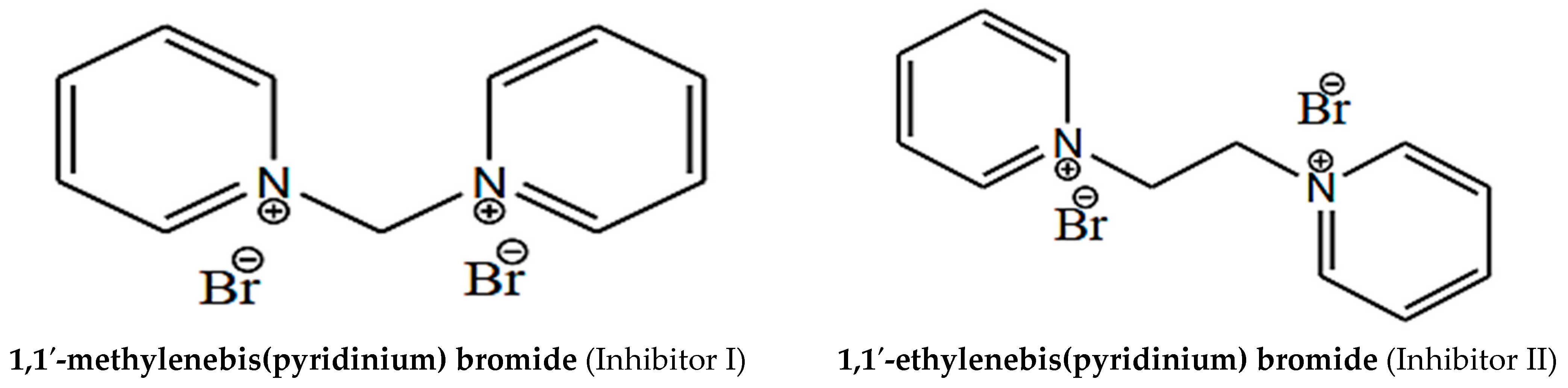
The heterocyclic organic inhibitors 1,1′-methylenebis(pyridinium) bromide (Inhibitor I) and 1,1′-ethylenebis(pyridinium) bromide (Inhibitor II) (see Figure 1) were synthesized and purified according to standard procedures or purchased with analytical purity. All solutions were prepared using 0.5 M H2SO4 obtained by dilution of concentrated sulfuric acid with double-distilled water.

2.2. Preparation of Inhibitor Solutions

Stock solutions of each inhibitor were prepared at a concentration of 1 × 10⁻² M and subsequently diluted to obtain the desired working concentrations ranging from 5 × 10⁻⁴ M to 7.5 × 10⁻³ M. All solutions were freshly prepared before each experiment to ensure accuracy and reproducibility.

2.3. Weight Loss Measurements

The protective efficacy of the two quaternary salts on the corrosion resistance of mild steel in 0.5 M sulfuric acid was assessed using gravimetric measurements of mild steel in the presence and absence of different inhibitor concentrations. Following a 4 h immersion period at 298 K, the corrosion rate (V), coverage rate (θ), and inhibitory efficiency (EI%) were measured. The following relationship can be used to estimate the inhibitory efficiency (EI%).
EI   ( % ) = V 0 V i n h V 0 × 100
  • V0: Corrosion rate of mild steel in H2SO4.
  • Vinh: Corrosion rate of mild steel after the addition of various inhibitor concentrations.

2.4. Electrochemical Measurements

Electrochemical measurements were performed using a conventional three-electrode cell connected to a potentiostat. The mild steel specimen served as the working electrode. A saturated calomel electrode (SCE) was used as the reference electrode, while a platinum sheet was employed as the counter electrode. Before each electrochemical test, the working electrode was immersed in the test solution and allowed to stabilize at open circuit potential (OCP) for 34 min to ensure a steady-state condition. Potentiodynamic polarization measurements were conducted by scanning the potential from −456 versus OCP at a scan rate of 1 m·V·s−1. All experiments were carried out at a controlled temperature of 298 ± 1 K.

2.5. Computational Studies (DFT)

Density Functional Theory (DFT) calculations were performed using the B3LYP exchange–correlation functional combined with the 6-31G(d,p) basis set to evaluate the electronic properties of the investigated inhibitors, including the energies of the highest occupied and lowest unoccupied molecular orbitals (EHOMO and ELUMO), the energy gap (ΔE), and the dipole moment. These quantum chemical descriptors were employed to assess the reactivity of the inhibitor molecules and their potential interaction with the metal surface.
From the optimized structures, the energies of the highest occupied molecular orbital (EHOMO) and the lowest unoccupied molecular orbital (ELUMO) were extracted. The energy gap (ΔE = ELUMO − EHOMO) was calculated as an indicator of molecular reactivity, where a smaller ΔE generally reflects higher chemical reactivity and a greater tendency to interact with the metal surface. In addition, global reactivity descriptors, including electronegativity (χ), global hardness (η), and global softness (σ), were derived from the frontier orbital energies using standard relationships. The dipole moment (μ) was obtained directly from the DFT output and used as an indicator of molecular polarity.
The combined DFT results indicate that strong inhibitor–surface interactions favor the formation of a stable adsorbed inhibitor layer on the mild steel surface. This adsorbed layer can effectively hinder charge transfer processes and reduce the accessibility of corrosive species to the metal surface, thereby enhancing corrosion protection. The computational findings are in good agreement with the experimental observations and provide molecular-level insight into the inhibition mechanism.

3. Results and Discussion

3.1. Gravimetric Study

Table 1 compiles the values of corrosion rate, V; inhibitory efficiency, EI%; and coverage rate, θ. From the results of Table 1, it is evident that both quaternary salts are effective corrosion inhibitors for mild steel in a 0.5 M H2SO4 solution. We find that the corrosion rate falls and the protection efficacy rises as the inhibitor concentration rises, reaching maximum values of 87.85% for Inhibitor II and 90.42% for Inhibitor I.

3.2. Open Circuit Potential (OCP) Measurements

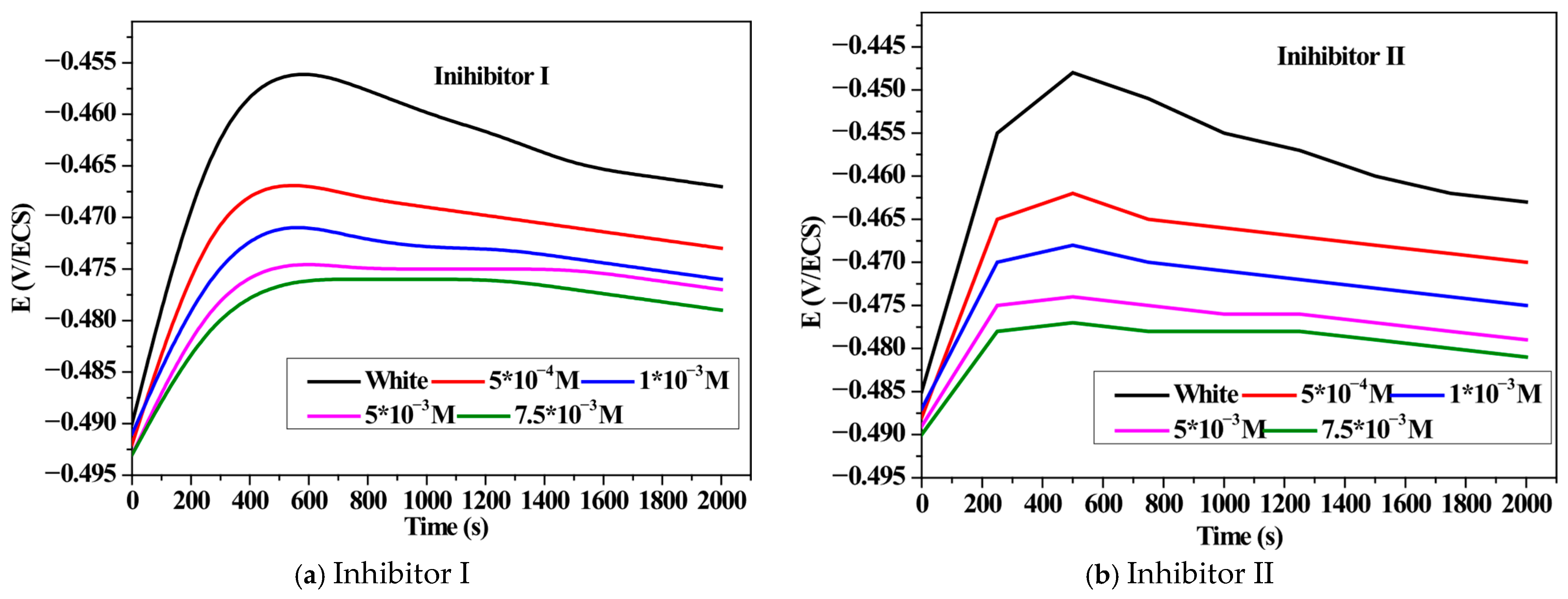
Figure 2 presents the open circuit potential (OCP) evolution of mild steel in 0.5 M H2SO4 solution in the absence and presence of inhibitors. All potentials are reported in millivolts (mV) versus the Ag/AgCl reference electrode. After immersion, the OCP initially shifts toward more negative values and stabilizes after approximately 260 s, indicating the establishment of a quasi-equilibrium at the metal/electrolyte interface.
The stabilized OCP value in the uninhibited solution is approximately −456 mV vs. Ag/AgCl. In the presence of inhibitors, the steady-state OCP values exhibit only small and non-systematic shifts (|ΔE| < 85 mV), indicating that the inhibitors act as mixed-type inhibitors without preferential anodic or cathodic control.

3.3. Polarization Curves

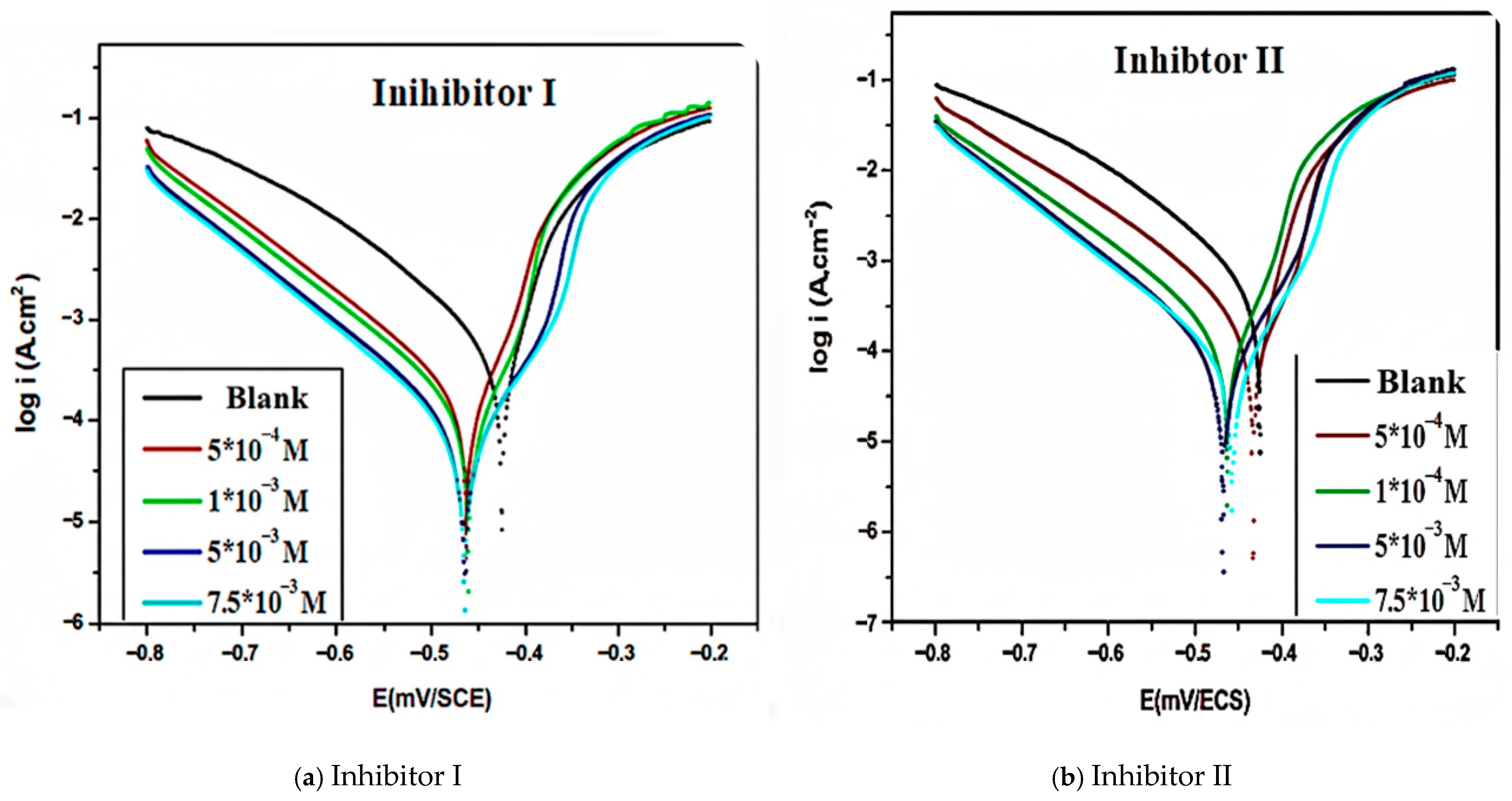
Figure 3 shows the cathodic and anodic polarization curves of mild steel in 0.5 M H2SO4 with and without different inhibitor doses [38,39,40,41]. These were acquired following a 25 min immersion at 298 K. The inclusion of the two organic salts decreases the anodic dissolution of the mild steel and delays the reduction of hydrogen ions, as seen in Figure 3, where both the anodic and cathodic curves shift towards lower current densities. This decrease rises as the salt concentration rises, perhaps as a result of the salts’ adsorption on the mild steel surface [42]. Tafel’s law is confirmed, and hydrogen reduction is taking place in the cathodic domain [43], where the curves are parallel and show a broad linear portion [44]. An inhibitory impact from the anodic branch was seen at low anodic overpotentials [45], indicating that the adsorption of the salts and the development of a protective layer on the mild steel surface are connected to the inhibition of the salts [46,47]. However, as the polarization potential moves towards more positive values, inhibitor desorption becomes evident, and the corrosion current density increases significantly compared to the initial phase of the anodic scan [48]. This could result from substantial mild steel dissolution, leading to the desorption of the inhibitor from the electrode surface [49]. Nevertheless, inhibitor desorption becomes apparent as the polarization potential shifts toward higher positive values, and the corrosion current density rises noticeably in comparison to the anodic scan’s first phase. The inhibitor may desorb from the electrode surface as a result of significant mild steel breakdown [50,51].
From Table 2, it can be observed that the addition of various concentrations of two salts to the corrosive environment randomly shifts the corrosion potential (ECorr) values in the negative direction [52,53]. This suggests that these inhibitors act as mixed inhibitors. It is also noted that inhibitory efficiency and coverage rate increase with increasing organic salt concentration, reaching 90.20% for Inhibitor I and 91.06% for Inhibitor II at 7.5 × 10⁻³ M. Furthermore, the inhibitory efficiencies obtained from the polarization curves are in good agreement with those obtained by the mass loss method.

3.4. Temperature Effect

Temperature generally has a significant impact on the corrosion rate, which increases as the temperature rises, which alters how inhibitors work [3]. Studying the impact of temperature is crucial to comprehending how a material behaves in an aggressive environment and the nature of the metal inhibitor interaction in this setting. We used gravimetric measurements in the temperature range of 298 to 349 K to investigate the effect of this factor on the inhibitory power of organic salts on mild steel. Table 3 presents the corrosion rates (Vcorr) and inhibitory efficiency values as a function of temperature in H2SO4, both with and without the addition of 7.5 × 10⁻³ M of organic salts. We find that when the temperature rises by ten kelvins, the corrosion rate in the corrosive solution alone increases dramatically. When inhibitors are present, this increase is less noticeable [54]. It is clear that these inhibitors have strong inhibitory qualities at every temperature under investigation, and the EI (%) value marginally rises with temperature [55,56]. The rise in inhibitory efficacy with temperature indicates that inhibitor molecules interact with the mild steel surface more chemically than physically.

3.5. Corrosion Process Thermodynamic Activation Parameters

By figuring out the corrosion process’s thermodynamic activation variables, we may understand the nature of the mild steel inhibitor interactions. The corrosion process’s thermodynamic activation parameters, such as the activation energy Ea, activation enthalpy ∆Ha°, and activation entropy ∆Sa° [57], were determined using the Arrhenius equations and their alternate form [58].
L n V c o r r = L n k E a R T
L n   V c o r r T = R T N h + Δ S a ° R Δ H a ° R T
  • Vcorr: Corrosion rate (mg·cm−2·h−1).
  • K: Arrhenius constant (same units as Vcorr).
  • Ea: Activation energy (J·mol−1).
  • R: Ideal gas constant (8.314 J·mol−1 K−1).
  • T: Temperature (K).
  • h: Planck’s constant (6.626 × 10⁻³⁴ J·s).
  • N: Avogadro’s number (6.022 × 10²³ mol−1).
  • Δ H a ° : Activation enthalpy (J·mol−1).
  • Δ S a ° : Activation entropy (J·mol−1).
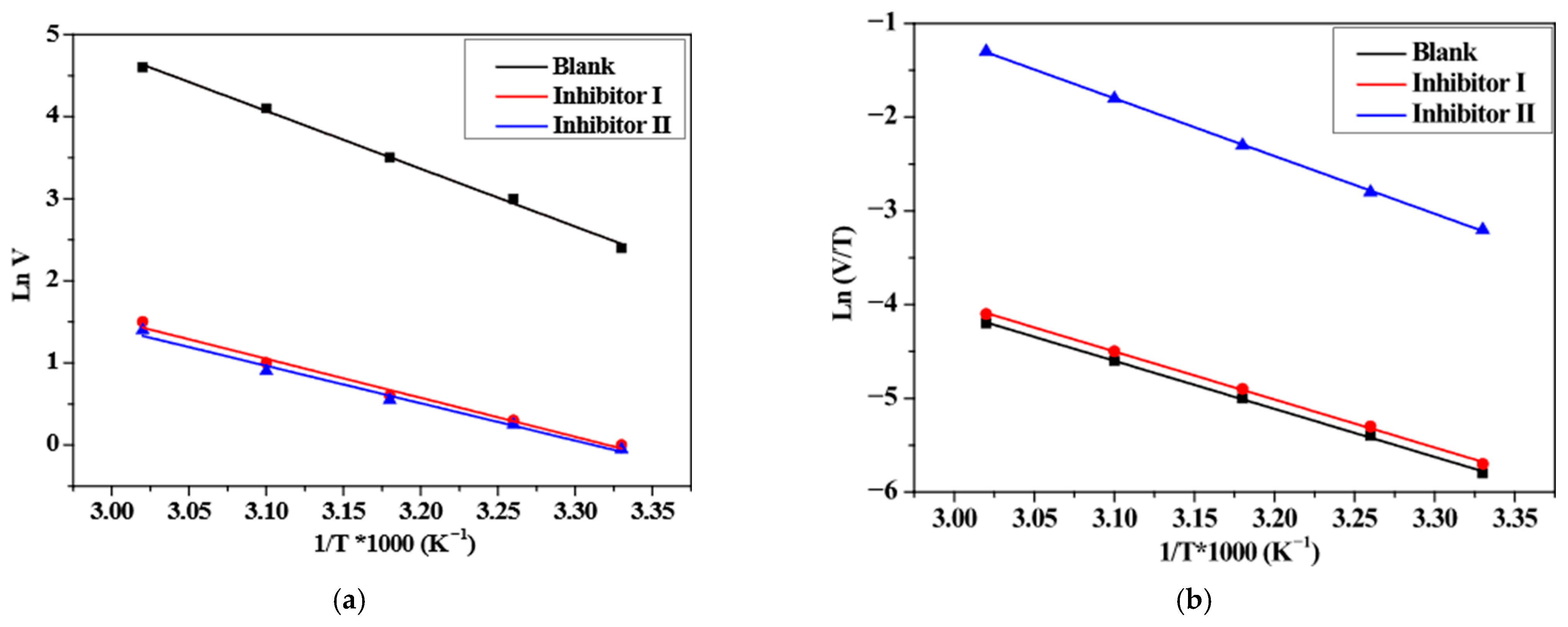
Figure 4 presents the Arrhenius diagrams for the mild steel immersed in a 0.5 M H2SO4 solution in the absence and in the presence of the inhibitors I and II. The first graph shows the evolution of Ln V according to 1/T, while the second represents Ln (V/T) according to 1/T [59]. The obtained curves are linear with a downward slope, which is characteristic of behavior in accordance with Arrhenius’ law [60]. The points associated with the blank appear systematically above those of the solutions containing inhibitors [61]. Both inhibitors shift the curves downward, indicating a significant decrease in the corrosion rate on the surface [49]. Overall, Inhibitor I exhibits superior inhibition performance compared to Inhibitor II, as confirmed by gravimetric measurements and theoretical calculations. These diagrams confirm that the corrosion of mild steel in a sulfuric environment obeys Arrhenius’ law. This means that the corrosion rate should increase with temperature. Blank curves that are higher in both graphs confirm that mild steel corrodes faster when no inhibitor is introduced. The addition of inhibitors I and II leads to a significant decrease in Ln V and Ln (V/T), reflecting a marked reduction in the corrosion rate. A decrease in Ln V and Ln (V/T) shows that the inhibitors increase the apparent activation energy of the corrosion process, probably by forming a barrier on the surface of the metal. Also, the linearity of the curves suggests the stability of the corrosion mechanism in the presence and absence of inhibitors [62]. The gap between the lines also evidences that inhibitor I is more efficient since values are systematically lower. This means that this inhibitor was adsorbed better onto mild steel, further limiting the access of the acid to the surface. Moreover, the greater decrease in Ln (V/T) obtained in the case of inhibitor II reflects a more pronounced thermal effect. In fact, these results confirm that both inhibitors act according to an energy barrier mechanism with the net superiority of inhibitor I.
This shows that the variation in ln V = f (1/T) and ln (V/T) = f (1/T) yields straight lines, whether or not 7.5 × 10⁻³ M inhibitors are added. Consequently, the activation energies and the values of ΔHa° and ΔSa° can be found using the Arrhenius relationships. Table 4 displays the activation parameters Ea, ΔHa°, and ΔSa° for the mild steel corrosion process in 0.5 M H2SO4 with and without 7.5 × 10⁻³ M inhibitors I and II. The activation energies in the presence of inhibitors are higher than that of the blank solution, indicating the formation of an adsorbed inhibitor layer that increases the energy barrier for the corrosion process. This behavior suggests a mixed physisorption–chemisorption mechanism. The positive signals of enthalpies ∆Ha° indicate that the mild steel dissolving process is endothermic. The elevated negative values of entropy ∆Sa° suggest that the activated complex in the rate-determining stage is an association rather than a dissociation. This suggests that when reactants transform into the activated complex, disorder is reduced.

3.6. Adsorption Isotherm

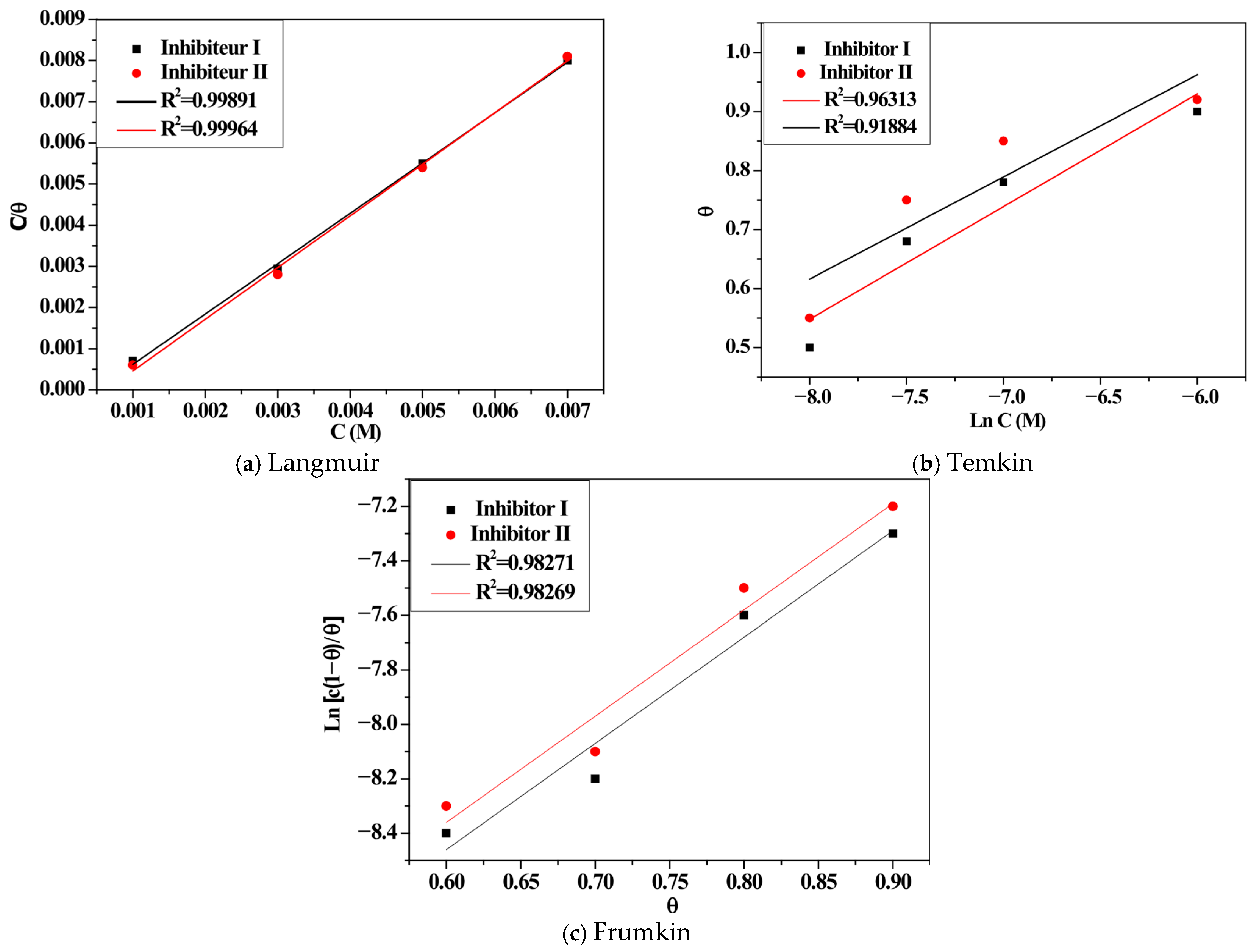
The inhibition of metal corrosion by organic compounds is explained by their adsorption, which occurs in two main forms: physical and chemical adsorption. In the course of this study, and in order to determine the most appropriate adsorption isotherm, different isotherms were tested. Langmuir [63], Temkin [64], and Frumkin isotherms represent adsorption isotherms plotted at a temperature of 298 K based on θ values obtained using the gravimetric method.
According to these isotherms, the coverage rate (θ) is related to the inhibitor concentration (Cinh) by the following equations:
Langmuir isotherm:
C inh θ = 1 K ads +   C inh
Temkin isotherm:
Exp ( 2 α θ ) = K ads C inh
Frumkin isotherm:
( θ 1 θ ) Exp ( 2 α θ ) = K ads C inh
where Cinh is the inhibitor concentration in the solution, α is the surface covering rate, Kads is the equilibrium constant of the adsorption process, and α is the parameter for the interaction of adsorbed molecules. The appropriate isotherm represented graphically as a straight line was selected using the coefficient of determination R2. The adsorption process can be described using the Langmuir adsorption isotherm.
The study of the figures (Figure 5a–c) shows that the adsorption of inhibitors I and II on the mild steel surface in 0.5 M H2SO4 obeys the Langmuir adsorption isotherm, with the coefficient of determination R2 for the Langmuir adsorption isotherm being close to 1 (>0.999). Therefore, the corrosion inhibition is attributed to the Langmuir-type adsorption behavior suggests predominantly monolayer-like adsorption on the mild steel surface, consistent with the Langmuir adsorption model, which limits the access of the electrolyte [65].
Adsorption behavior was analyzed using the Langmuir adsorption isotherm, as shown in Figure 5a. The linear plots of C/θ versus C exhibit excellent correlation coefficients (R2 ≈ 0.999), confirming the applicability of the Langmuir model. The adsorption equilibrium constants (Kads) were calculated from the intercepts of the plots and found to be approximately 4.0 × 10³ and 5.0 × 10³ L·mol−1 for inhibitors I and II, respectively.
ΔG°ads = −RTln(55.5 Kads)
where R is the gas constant, T is the absolute temperature, and 55.5 represents the molar concentration of water in solution. The negative values of ΔG°ads confirm that the adsorption process is thermodynamically spontaneous. yielding values of −30.8 kJ·mol−1 for inhibitor I and −32.1 kJ·mol−1 for inhibitor II (see Table 5). The negative values confirm the spontaneous nature of adsorption, while their magnitude suggests a mixed physisorption–chemisorption mechanism. These results now provide thermodynamic support for the adsorption mechanism, addressing the reviewer’s concern.
The formation of a Langmuir-type adsorption layer indicates the development of a compact and uniform organic film on the mild steel surface. This adsorbed layer behaves as a thin adsorbed inhibitor species providing corrosion protection that isolates the metal from the acidic wastewater environment, thereby reducing charge transfer processes and corrosion reactions.

3.7. Quantum Chemistry Calculations

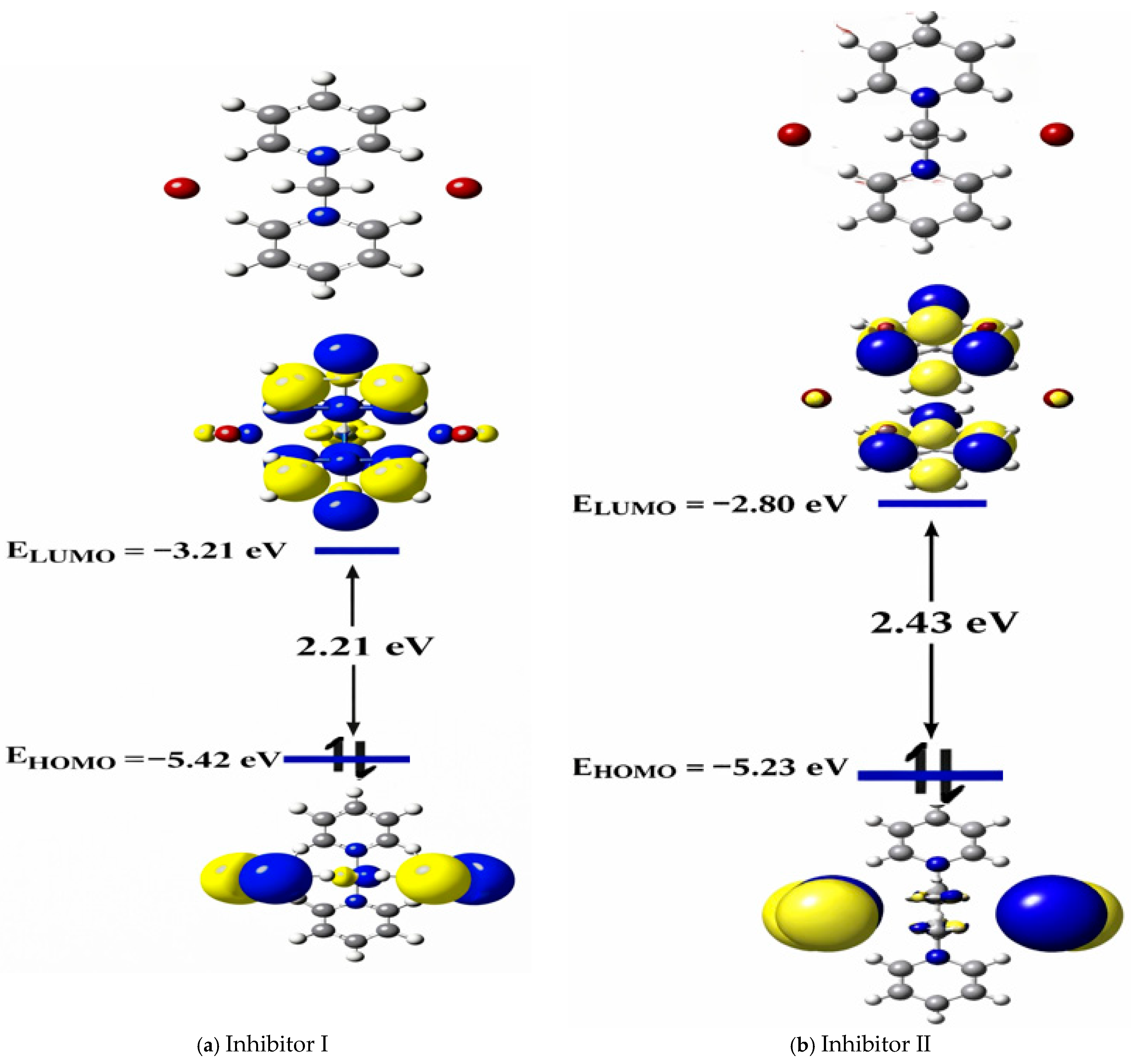
The optimized geometric structures and electron distribution in the Highest Occupied Molecular Orbital, HOMO, and Lowest Unoccupied Molecular Orbital, LUMO, energy levels are presented in Figure 6 [66,67,68], while the calculated quantum chemistry parameters, including EHOMO, ELUMO, ∆E, EI, AE, η, σ, χ, and the dipole moment μ [69,70], are compiled in Table 6. The Figure shows the HOMO and LUMO frontier orbitals of two inhibitors, labeled Inhibitor I and Inhibitor II, along with their energy values in eV. The diagrams show the electronic distribution of each orbital at different energy levels. The table on the right lists the quantum parameters: EHOMO, ELUMO, ΔE, ionization energy (EI), electron affinity (EA), hardness (η), softness (σ), electronegativity (χ), and dipole moment (μ). The colors on the electron clouds indicate the orbital’s phase (positive or negative). The energy gap ΔE is indicated between the HOMO and LUMO for each inhibitor. The comparative values show notable differences in the potential reactivity of the two molecules [71].

3.7.1. EHOMO and ELUMO

The values of these two descriptors, EHOMO and ELUMO, are obtained using Gaussian (09 version) software. The Highest Occupied Molecular Orbital, HOMO, reflects the electron-donating character of the molecule [69]. The higher the energy of this molecular orbital (MO), the more easily the molecule will donate electrons. Molecules with the ability to donate electrons (such as molecules with heteroatoms, lone pairs of electrons, and aromatic functional groups) are favored for interaction with metal surfaces. EHOMO values refer to the ability of each inhibitor to donate electrons [70]. Inhibitor II shows a slightly higher EHOMO value, indicating a better electron-donating ability toward the metal surface. On the other hand, Inhibitor II has a slightly higher EHOMO that can donate electrons more easily to metals [71].
The lowest unoccupied molecular orbital designates the ability of a molecule to accept electrons. If the energy of this MO is low, the molecule will gain electrons easily. In the case of ELUMO, it is evident that more electrons can be gained by Inhibitor I because its value is low. Whereas a low value of ELUMO shows the greater possibility of electron absorption by a molecule, the donation of electrons by a molecule usually increases with an increase in its EHOMO value. Hence, a low energy gap ΔE, a low value of ELUMO, and high value of EHOMO characterize the adsorption and corrosion inhibition performance of an inhibitor [72].

3.7.2. Energy Gap ΔE

A crucial metric for comprehending molecular reactivity is the energy difference between the Highest Occupied Molecular Orbital (HOMO) and the Lowest Unoccupied Molecular Orbital (LUMO) ∆E = ELUMO − EHOMO [73]. In chemical interactions, such as inhibitor/metal interactions, a narrow energy gap indicates a molecule’s high reactivity. One crucial metric of reactivity is the energy differential ΔE. In fact, Inhibitor I exhibits a lower HOMO–LUMO energy gap (ΔE), indicating higher molecular reactivity and stronger adsorption on the mild steel surface. This pattern is supported by the EI and AE parameters, where lower values indicate easier participation in electron exchanges [71].

3.7.3. Ionization Energy (EI) and Electron Affinity (AE)

El is the energy needed to extract an electron from the outermost orbital of a gaseous atom (X(g) → X(g) + e). When a neutral atom or molecule (in the gaseous phase) receives an electron from the outside, the energy released is known as AE (X(g) + e → X(g) + energy). Koopmans’ theorem states that the electron affinity AE and ionization energy EI can be stated in terms of EHOMO and ELUMO as follows [74]:
EI = −EHOMO
AE = −ELUMO
Absolute hardness (η, eta) expresses the molecule’s resistance to charge transfer, whether it be gain or loss; therefore, it measures both the stability and reactivity of an inhibiting molecule [75].
η = E I A E 2
The inverse of hardness is known as global softness (σ, sigma). In contrast to a soft entity, a hard entity has a high energy ∆E [75]:
σ =   1 η
The hardness η of Inhibitor I is slightly lower, which implies higher softness (σ), reflecting better interaction with the metal surface. Electronegativity (χ) is the chemical property that describes the ability of an electron-donating molecule to attract electrons toward itself [76]:
Χ   =   A E + E I 2
Furthermore, for a reaction involving two systems with different electronegativities, the electron flow will occur from the molecule with lower electronegativity (the organic inhibitor) to the one with higher electronegativity (the metallic surface). The higher electronegativity χ indicates that Inhibitor I has a higher ability to attract electrons, therefore enhancing its adsorption on the surface. Inhibitor I has a much higher value of dipole moment, μ, which in turn enhances the alignment and adsorption of the molecule to the metal, leading to better inhibitory efficiency [77].

3.7.4. Dipole Moment (μ)

One of the characteristics used to discuss and explain molecular structure is the dipole moment (μ), which is a measure of the electronic distribution within a molecule. Inhibition may rise in response to an increase in the dipole moment and vice versa [78]. The dipole–dipole interaction between molecules and the metal surface could be connected to this.
The corrosion inhibition mechanism was further elucidated by correlating the DFT-derived molecular orbital diagrams with the experimental findings. The HOMO distributions are mainly localized on the heteroatoms and π-conjugated regions of the inhibitor molecules, indicating a strong ability to donate electrons to the vacant d-orbitals of iron atoms on the mild steel surface. Conversely, the LUMO distributions suggest the possibility of back-donation from the metal surface to the inhibitor molecules. This donor–acceptor interaction facilitates strong adsorption of the inhibitors onto the mild steel surface, leading to the formation of a stable adsorbed protective layer. The relatively small HOMO–LUMO energy gap further supports the high reactivity of the inhibitors, which is consistent with their observed corrosion inhibition efficiency.

4. Conclusions

This study demonstrates the effectiveness of two bis(pyridinium) heterocyclic compounds as corrosion inhibitors for mild steel in acidic media. The combined experimental and theoretical approach provides consistent evidence that corrosion mitigation arises from the adsorption of the inhibitors onto the mild steel surface, leading to the formation of a protective adsorbed film. Adsorption behavior consistent with the Langmuir isotherm suggests a mixed physisorption–chemisorption mechanism. Quantum chemical calculations and molecular dynamics simulations offer molecular-level insight into the inhibition process and explain the superior performance of Inhibitor I in terms of its electronic properties and stronger interaction with the mild steel surface. These findings highlight the importance of molecular structure in controlling adsorption strength and corrosion protection efficiency. Overall, the results underline the potential of bis(pyridinium) derivatives as efficient, low-cost organic inhibitors for acidic environments relevant to wastewater treatment and industrial applications. The structure–performance relationships identified in this work may serve as a useful basis for the rational design of improved corrosion inhibitors for practical corrosion protection systems.

Author Contributions

A.K.: Writing—original draft, Visualization, Validation, Investigation, Formal analysis, Data curation, Conceptualization. Y.Z.: Supervision, Visualization, Validation. H.B.: Visualization, Validation, Formal analysis. C.L.: Visualization, Validation. All authors have read and agreed to the published version of the manuscript.

Funding

The authors are warmly grateful to the support of “The Moroccan Association of Sciences and Techniques for Sustainable Development (MASTSD), Beni Mellal, Morocco”.

Institutional Review Board Statement

Not applicable.

Informed Consent Statement

Not applicable.

Data Availability Statement

Data will be made available on request.

Acknowledgments

The authors are warmly grateful to the support of “The Moroccan Association of Sciences and Techniques for Sustainable Development (MASTSD), Beni Mellal, Morocco,” and to its president, Charaf Laghlimi, for the valuable proposals. The authors would like to thank the Mohammed V Technical High School Bookstore, Hay Atlas, Beni Mellal, Morocco.

Conflicts of Interest

The authors declare that they have no known competing financial interests or personal relationships that could have appeared to influence the work reported in this paper.

References

  1. Dagdag, O. An overview of corrosion. In Anticorrosive Nanomaterials: Future Perspectives; Royal Society of Chemistry: London, UK, 2022; Volume 56, p. 44. [Google Scholar]
  2. Kamma, C.M. The Science, Technology and Economic Implications of Corrossion; University of Lagos Library and Information Service: Lagos, Nigeria, 2006. [Google Scholar]
  3. Solanki, A.S.; Sharma, A.; Sharma, S.; Thakur, A.; Sharma, S.K. Mechanistic investigation of mild steel corrosion inhibition by Codiaeum variegatum extract: Weight loss, EIS, and DFT perspectives. RSC Adv. 2025, 15, 24202–24222. [Google Scholar] [CrossRef] [PubMed]
  4. Pavlovic, A.; Valzania, L.; Minak, G. Effects of moisture absorption on the mechanical and fatigue properties of natural fiber composites: A review. Polymers 2025, 17, 1996. [Google Scholar] [CrossRef] [PubMed]
  5. Olowonigba, J.K. Interface chemistry tailoring in basalt fiber–polypropylene composites for enhanced thermal stability and recyclability in automotive crash structures. Int. Res. J. Mod. Eng. Technol. Sci. 2025, 7, 1041. [Google Scholar] [CrossRef]
  6. Emenike, E.C.; Adeleke, J.A.; Iwuozor, K.O.; Egbemhenghe, A.; Bello-Hassan, M.T.; Adu, A.O.; Okoro, H.K.; Eletta, O.A.A.; Adeniyi, A.G. Application of rice husks-based biochar for removal of pollutants from water and wastewater. Sep. Purif. Rev. 2025, 1–22. [Google Scholar] [CrossRef]
  7. Khamis, E.; Reyad, T.E.; Abd-El-Khalek, D.E. Corrosion assessment and mitigation in wastewater systems: A comprehensive review. npj Mater. Degrad. 2025, 9, 95. [Google Scholar] [CrossRef]
  8. Osta, M.O.; Azeem, A.; Rashid, S.; Harun, M.; Hanif, A. Marine Resilience: Understanding the Durability and Effects on Concrete Structures—A Comprehensive Review. Arab. J. Sci. Eng. 2025, 1–26. [Google Scholar] [CrossRef]
  9. Aslam, R.; Yan, Z.; Wang, Q.; Aslam, J. (Eds.) Architectural Corrosion and Critical Infrastructure; Royal Society of Chemistry: London, UK, 2025. [Google Scholar]
  10. Rios, M.P.; Kaiser, B.S.; Caiado, R.G.G.; Ivson, P.; Roehl, D. Decision Framework for Asset Criticality and Maintenance Planning in Complex Systems: An Offshore Corrosion Management Case. Appl. Sci. 2025, 15, 10407. [Google Scholar] [CrossRef]
  11. Shanaghi, A.; Farrokhi, A. Investigation of atmospheric corrosion risk mitigation processes for urban structures: Effective strategies for sustainable development. Int. J. Hum. Cap. Urban Manag. 2025, 10, 581–598. [Google Scholar] [CrossRef]
  12. Assad, H.; Lone, I.A.; Sharma, P.K.; Kumar, A. Corrosion in the Oil and Gas Industry. In Industrial Corrosion: Fundamentals, Failure, Analysis and Prevention; Wiley: Hoboken, NJ, USA, 2025; pp. 39–63. [Google Scholar] [CrossRef]
  13. Gedik, A. A Holistic Approach Weighing Up the Pros and Cons of Winter Road Maintenance Operations: A State-of-Art Review. Arab. J. Sci. Eng. 2025, 50, 16333–16356. [Google Scholar] [CrossRef]
  14. Sobirov, K. Overall Equipment Effectiveness (OEE) Analysis in Solar Panel Manufacturing. Ph.D. Thesis, Politecnico di Torino, Torino, Italy, 2025. [Google Scholar]
  15. Rouf, I.A.; Donoriyanto, D.S. Optimization of Preventive maintenance with Downtime and Setup Time Using Goal Programming Method at XY Sugar Factory. Tekmapro 2025, 20, 149–156. [Google Scholar]
  16. Boldyryev, S.; Ivashchuk, O.S.; Krajačić, G.; Atamanyuk, V.M. Review of Challenges in Heat Exchanger Network Development for Electrified Industrial Energy Systems. Energies 2025, 18, 3685. [Google Scholar] [CrossRef]
  17. Adarakatti, P.S. Fundamentals of electrochemistry. In Agricultural Electrochemistry; American Chemical Society: Washington, DC, USA, 2025; pp. 17–46. [Google Scholar] [CrossRef]
  18. Cheng, Y.; Xu, Y.; Qiu, J.; Liu, R.; Wang, A.; Chen, F.; Zhu, S.; Fan, W.; Tang, J.; Macdonald, D. Electrochemical Corrosion Behavior and Passivation Mechanism of Tantalum in Simulated Human Body Fluid Environment. Electrochim. Acta 2025, 536, 146765. [Google Scholar] [CrossRef]
  19. Sotoodeh, K. Failure Modes and Prevention Strategies for Amine-Induced Corrosion in Absorbers of Post-Combustion Carbon Capture Units. J. Fail. Anal. Prev. 2025, 25, 2478–2490. [Google Scholar] [CrossRef]
  20. Moyo, O.; Ding, J.; Yang, J.; Sun, M.; He, J.; Zhang, Y.; Zhang, J.; Sun, H. Advances in Corrosion-Resistant Metal-Based Oxide Electrocatalysts for Seawater Electrolysis: Focus on Chlorine Mitigation Strategies. Small 2025, 21, e08973. [Google Scholar] [CrossRef] [PubMed]
  21. Dagdag, O.; Haldhar, R.; Thakur, A.; Daoudi, W.; Berisha, A.; Berdimurodov, E.; Kim, H. Types of Industrial Corrosive Environments. In Industrial Corrosion: Fundamentals, Failure, Analysis and Prevention; Wiley: Hoboken, NJ, USA, 2025; pp. 17–37. [Google Scholar] [CrossRef]
  22. Oreko, B.U.; Okuma, S.O. Recent Advances in Nanoparticle-Based Corrosion Inhibition of Metals: A Review. NIPES—J. Sci. Technol. Res. 2025, 7, 245–265. [Google Scholar] [CrossRef]
  23. Boutarbouch, M.; Azoulay, K.; Bencheikh, I.; Alsayer, I.; Mabrouki, J.; Slaoui, M. Optimization of electrocoagulation for green hydrogen production and sustainable wastewater treatment: A critical review. Environ. Technol. Rev. 2025, 14, 1018–1039. [Google Scholar] [CrossRef]
  24. Awan, T.I.; Afsheen, S.; Kausar, S. Emerging trends and issues related to thin films. In Thin Film Deposition Techniques: Thin Film Deposition Techniques and Its Applications in Different Fields; Springer: Cham, Switzerland, 2025; pp. 241–278. [Google Scholar] [CrossRef]
  25. Poni, S.; Frioni, T.; Gatti, M. Vineyard “Naturalness”: Principles and Challenges. Aust. J. Grape Wine Res. 2025, 2025, 3247228. [Google Scholar] [CrossRef]
  26. Manu, K.C.; Madhushree, C.; Chandini, M.S.; Shree, N.; Hemanth, S.; Jeevan, T.P. Corrosion in Steel Structures: A Review. J. Mines Met. Fuels 2025, 73, 189–198. [Google Scholar] [CrossRef]
  27. Velasco, D.C.R.; Gonçalves, V.P.D.; Oliveira, M.P.; Simonassi, N.T.; Lopes, F.P.D.; Vieira, C.M.F. Industrial piping system: Design and corrosion protection. Surfaces 2025, 8, 18. [Google Scholar] [CrossRef]
  28. Barbu, C.A.; Fierascu, I.; Semenescu, A.; Cotrut, C.M. Critical Review Regarding the Application of Plant Extracts as Eco-Friendly Corrosion Inhibitors—A Sustainable Interdisciplinary Approach. Molecules 2025, 30, 3722. [Google Scholar] [CrossRef]
  29. Yeganeh, M.; Heydarie, Y.; Shahryari, Z.; Asadi, N.; Kahkesh, H.; Ramezanalizadeh, H. Corrosion inhibitor of API pipeline steels: A review. J. Bio-Tribo-Corros. 2025, 11, 44. [Google Scholar] [CrossRef]
  30. Sangtam, T.; Longkumer, L.; Venuh, V.; Rutsa, V.; Yimchunger, A.K.; Singh, A. Eco-friendly corrosion inhibition: A review on the extraction and testing of plant-based inhibitors. Chem. Pap. 2025, 79, 8253–8280. [Google Scholar] [CrossRef]
  31. Alamiery, A. Advancements in corrosion inhibitors for steel in corrosive solutions: A comprehensive review. Vietnam J. Chem. 2025, 1. [Google Scholar] [CrossRef]
  32. Tiozzo, A. Synthesis, Processing and Modification of NMC811 Cathodes for High-Performance and More Sustainable Lithium-Ion Batteries. Ph.D. Thesis, Politecnico di Torino, Torino, Italy, 2025. Available online: https://hdl.handle.net/2318/2098693 (accessed on 5 November 2025).
  33. Okon, K.; Ekeke, I.C.; Maduabuchi, C.A.; Ayogu, I.I.; Taofik, O.A.; Akalezi, C.O. Recent advances in the use of metal oxides as corrosion inhibitors: A review. Koroze A Ochr. Mater. 2025, 69, 14–33. [Google Scholar] [CrossRef]
  34. Bairagi, H.; Vashishth, P.; Sehrawat, R.; Mangla, B. Advanced applications of chitosan and derivative based bioinspired, sustainable corrosion inhibitor for metal surface protection. Can. Metall. Q. 2025, 64, 1999–2038. [Google Scholar] [CrossRef]
  35. Yadav, L.; Sihmar, A.; Kumar, S.; Dhaiya, H.; Vishwakarma, R. Review of nano-based smart coatings for corrosion mitigation: Mechanisms, performance, and future prospects. Environ. Sci. Pollut. Res. 2025, 32, 17032–17058. [Google Scholar] [CrossRef]
  36. Kellal, R.; Wang, Q.; Safi, Z.S.; Wazzan, N.A.; Zhou, X.; Zertoubi, M.; Benmessaoud Left, D. Rosa Damascena Extract as a Green Corrosion Inhibitor for Carbon Steel in Acidic Solutions: Experimental Findings and Computational Insights. J. Bio-Tribo-Corros. 2026, 12, 7. [Google Scholar] [CrossRef]
  37. Puzikova, D.; Khussurova, G.; Leontyeva, X.; Kholkin, O.; Kenzin, N.; Zhurinov, M.; Peshaya, S. Review of organic corrosion inhibitors: Application with respect to the main functional group. J. Saudi Chem. Soc. 2025, 29, 20. [Google Scholar] [CrossRef]
  38. Ziat, Y.; Hammi, M.; Zarhri, Z.; Ifguis, O. Surface analysis, mechanical and corrosion behavior of welded steel in 1M HCl corrosive media with epoxy/alumina coating. Biointerface Res. Appl. Chem. 2021, 12, 3559–3571. [Google Scholar] [CrossRef]
  39. Hammi, M.; Ziat, Y.; Zarhri, Z.; Laghlimi, C.; Moutcine, A. Epoxy/alumina composite coating on welded steel 316L with excellent wear and anticorrosion properties. Sci. Rep. 2021, 11, 12928. [Google Scholar] [CrossRef]
  40. Ziat, Y.; Abbas, N.; Hammi, M.; Echihi, S. An experimental evaluation of inhibiting corrosion effect of phosphate glass on mild steel in acidic solution. Mater. Res. Express 2019, 6, 086567. [Google Scholar] [CrossRef]
  41. Ziat, Y.; Hammi, M.; Laghlimi, C.; Moutcine, A. Investment casting of leaded brass: Microstructure micro-hardness and corrosion protection by epoxy coating. Materialia 2020, 12, 100794. [Google Scholar] [CrossRef]
  42. Khazaal, S.H.; Makki, H.F. Characterization of Corrosion Behavior of ST37-2 Low-Carbon Steel in a Cooling Tower Using Seawater as the Working Media. J. Bio-Tribo-Corros. 2025, 11, 97. [Google Scholar] [CrossRef]
  43. Yang, T.; Yang, M.; Huang, Z.; Wang, R.; Ji, W.; Lu, P.H.; Zeng, T.; Li, Z.; Wang, J.; Dunin-Borkowski, R.E.; et al. Twinning mediated intralayer frustration governs structural degradation in layered Li-rich oxide cathode. Nat. Commun. 2025, 16, 6589. [Google Scholar] [CrossRef] [PubMed]
  44. Su, H.L.; Liao, W.; Mo, S.X.; Wang, H.; Cao, Y.; Yu, H.; Wang, H.F. Decoupling Volmer and Tafel Steps via Dual-Site Interface Engineering in Ni/MoBTx for Efficient Hydrogen Electrocatalysis. Adv. Funct. Mater. 2025, e18373. [Google Scholar] [CrossRef]
  45. Jian, H.; Peng, Y.; Yi, X.; Yang, L.; Yi, X.; Li, H.; Wang, X.; Gao, F. Hydrogen bond based molecular self-clustering of a hyper-dendritic molecule for boosting ultra-long reversible zinc anode. J. Mater. Chem. A 2025, 13, 40055–40074. [Google Scholar] [CrossRef]
  46. Monaci, S.; Mezzetta, A.; Guazzelli, L.; Mecerreyes, D.; Forsyth, M.; Somers, A. Lignin-Based Bio Ionic Liquids for Enhanced Corrosion Protection of Metals. ACS Sustain. Chem. Eng. 2025, 13, 2023–2037. [Google Scholar] [CrossRef]
  47. Suliman, A.E.; Mangood, A.H.; Yehia, N.S.; Abdelraouf, M.; Batakoushy, H.A.; Abdou, M.M.; Zaki, E.G. Gallic acid based green corrosion inhibitor for mild steel in 1 M HCl electrochemical and microbial assessment with theoretical validation. Sci. Rep. 2025, 15, 15156. [Google Scholar] [CrossRef]
  48. Zeng, S.; Liu, J.; Zhou, J. Effect of F− on the Corrosion Resistance of CF/Ti/β-PbO2 Anode for Zinc Electrowinning. J. Electron. Mater. 2025, 54, 7346–7360. [Google Scholar] [CrossRef]
  49. Adel, O.; Mohamed, M.E.; Khamis, E. Thermodynamic, electrochemical and surface characterization of copper corrosion inhibition in acidic solution using rice straw extract. Sci. Rep. 2025, 15, 27753. [Google Scholar] [CrossRef]
  50. Chen, Z.; Guo, Z.; Fadhil, A.A. Understanding How Rebar steel Surface Anisotropy Affects Corrosion Inhibitor Adsorption and Performance: From Experimental to Theoretical Studies. J. Build. Eng. 2025, 112, 113815. [Google Scholar] [CrossRef]
  51. Guo, X.; Ma, L.; Fu, Z.; Wang, J.; Li, Z.; Shi, B.; Li, Y.; Yang, G.; Lu, L.; Zhang, D. Molecular understanding of the effects of electrode potential and electric double layer on the adsorption process of two azole-based corrosion inhibitors. Corros. Sci. 2025, 253, 112991. [Google Scholar] [CrossRef]
  52. Vaghefinazari, B.; Scharnagl, N.; Lamaka, S.V.; Zheludkevich, M.L. Corrosion and Volta Potential Evolution of High Purity Mg Treated in Chloride Solutions of Bi-Valent Cu, Mn, Ni, and Zn Cations. Corros. Sci. 2025, 257, 113360. [Google Scholar] [CrossRef]
  53. Zhang, M.; Wang, J.; Peng, L.; Zhao, T.; Chen, B.; Zhao, Z.; Dang, N. Synergistic Corrosion Inhibition and Antimicrobial Effects of Ionic Liquid MC-B on L245 Carbon Steel in Artificial CO 2-Saturated Oilfield Water. SSRN 2025. [Google Scholar] [CrossRef]
  54. Fu, W.; Sun, L.; Zhang, X.; Xu, H.; Cao, M. Enhancing metal corrosion inhibition with xanthan gum: The synergistic role of anionic surfactants. Colloids Surf. A Physicochem. Eng. Asp. 2025, 711, 136364. [Google Scholar] [CrossRef]
  55. Toghan, A.; Fakeeh, M.; Fawzy, A.; Gadow, H.S. Identification of interaction, surface species and anticorrosion potency for adsorption of myrrh extract on 330 stainless steel in 1 M HCl solution. RSC Adv. 2025, 15, 42272–42298. [Google Scholar] [CrossRef]
  56. El Amri, A.; El-Aouni, N.; Dagdag, O.; Kim, H.; Berisha, A.; Haldhar, R.; Ouakki, M.; Rafik, M.; El Mabrouk, K.; Ebn-Touhami, M.; et al. Novel sulfur epoxy-based protection of aluminum alloy in marine conditions: A combined electrochemical and computational study. J. Mater. Sci. 2025, 60, 13705–13729. [Google Scholar] [CrossRef]
  57. Zhang, H.H.; Wang, X.; Yang, B.Q.; Zhang, X.; Zhang, Y. Corrosion inhibition of mild steel by an eco-friendly effective chitosan ortho-vanillin Schiff base in hydrochloric acid. Int. J. Electrochem. Sci. 2025, 20, 101228. [Google Scholar] [CrossRef]
  58. Rzaij, D.R.; Khadom, A.A.; Rashid, K.H.; Al-Amiery, A.A. Influence of chloride ions, temperature, and pressure on boiler tubes corrosion: Experimental, mathematical, and kinetics perspective. React. Kinet. Mech. Catal. 2025, 138, 3705–3724. [Google Scholar] [CrossRef]
  59. Ding, W.; Zheng, J.; Pan, H.; Cheng, J.; Tong, J. Two-dimensional multi-scale graph direction dispersion entropy and its application in mechanical fault diagnosis. Mech. Syst. Signal Process. 2026, 242, 113635. [Google Scholar] [CrossRef]
  60. Gao, H.; Zhou, C.; Liu, C.; Zheng, R. The time-dependent of rubber bearings under the synergistic action of thermal oxygen and ultraviolet rays. Constr. Build. Mater. 2025, 501, 144345. [Google Scholar] [CrossRef]
  61. Echem, O.G.; Chukwuike, V.I.; Tubonemi, T.; Anadebe, V.C.; Abeng, F.E.; Barine, L.G. Rubber leaf extract: A green inhibitor for mild steel corrosion in 1.0 M HCl medium, response surface analyzer and electrochemical approach. Results Surf. Interfaces 2025, 20, 100607. [Google Scholar] [CrossRef]
  62. Chen, J.; Li, X.; Xiao, X.; Zhu, C. Influence of corrosion inhibitors on aging mechanism of epoxy resin coatings for copper 62 alloy in simulated marine environment. Corros. Rev. 2025, 43, 457–467. [Google Scholar] [CrossRef]
  63. Ghosal, P.S.; Gupta, A.K. Determination of thermodynamic parameters from Langmuir isotherm constant-revisited. J. Mol. Liq. 2017, 225, 137–146. [Google Scholar] [CrossRef]
  64. Olsen, S.R.; Watanabe, F.S. A method to determine a phosphorus adsorption maximum of soils as measured by the Langmuir isotherm. Soil Sci. Soc. Am. J. 1957, 21, 144–149. [Google Scholar] [CrossRef]
  65. Taghavikish, M.; Dutta, N.K.; Roy Choudhury, N. Emerging corrosion inhibitors for interfacial coating. Coatings 2017, 7, 217. [Google Scholar] [CrossRef]
  66. Yoshizawa, K. An orbital rule for electron transport in molecules. Acc. Chem. Res. 2012, 45, 1612–1621. [Google Scholar] [CrossRef]
  67. Huang, Y.; Rong, C.; Zhang, R.; Liu, S. Evaluating frontier orbital energy and HOMO/LUMO gap with descriptors from density functional reactivity theory. J. Mol. Model. 2017, 23, 3. [Google Scholar] [CrossRef]
  68. Zhao, X.; Chen, C.; Sun, Q.; Li, Y.; Yu, H. Molecular structure optimization design of inhibitors based on frontier orbitals theory. Appl. Surf. Sci. 2019, 494, 895–907. [Google Scholar] [CrossRef]
  69. Fergachi, O.; Benhiba, F.; Rbaa, M.; Ouakki, M.; Galai, M.; Touir, R.; Lakhrissi, B.; Oudda, H.; Touhami, M.E. Corrosion inhibition of ordinary steel in 5.0 M HCl medium by benzimidazole derivatives: Electrochemical, UV–visible spectrometry, and DFT calculations. J. Bio-Tribo-Corros. 2019, 5, 21. [Google Scholar] [CrossRef]
  70. Charki, T.; Barrahi, A.; Laabaissi, T.; Missioui, M.; Hsissou, R.; Benhiba, F.; Ramli, Y.; Zarrouk, A.; El Hezzat, M. Inhibitory properties of new oxoquinoxaline schiff bases against acid corrosion of carbon steel: An overview of the research, both experimental, and theoretical. Can. Metall. Q. 2025, 1–19. [Google Scholar] [CrossRef]
  71. Hsissou, R.; Benhiba, F.; El Aboubi, M.; Abbout, S.; Benzekri, Z.; Safi, Z.; Rafik, M.; Bahaj, H.; Kaba, M.; Galai, M.; et al. Synthesis and performance of two ecofriendly epoxy resins as a highly efficient corrosion inhibition for carbon steel in 1 M HCl solution: DFT, RDF, FFV, and MD approaches. Chem. Phys. Lett. 2022, 806, 139995. [Google Scholar] [CrossRef]
  72. Berrissoul, A.; Ouarhach, A.; Benhiba, F.; Romane, A.; Guenbour, A.; Dikici, B.; Bentiss, F.; Zarrouk, A.; Dafali, A. Assessment of corrosion inhibition performance of origanum compactum extract for mild steel in 1 M HCl: Weight loss, electrochemical, SEM/EDX, XPS,, DFT and molecular dynamic simulation. Ind. Crops Prod. 2022, 187, 115310. [Google Scholar] [CrossRef]
  73. Ergan, E.; Akbas, E. Investigation of Electronic Properties of Substituted Pyrimidine Derivatives with Density Functional Theory. Eurasia Proc. Sci. Technol. Eng. Math. 2019, 6, 68-73. [Google Scholar]
  74. Berrissoul, A.; Ouarhach, A.; Benhiba, F.; Romane, A.; Guenbour, A.; Outada, H.; Dafali, A.; Zarrouk, A. Exploitation of a new green inhibitor against mild steel corrosion in HCl: Experimental, DFT and MD simulation approach. J. Mol. Liq. 2022, 349, 118102. [Google Scholar] [CrossRef]
  75. Zhou, Z.; Parr, R.G. New measures of aromaticity: Absolute hardness and relative hardness. J. Am. Chem. Soc. 1989, 111, 7371–7379. [Google Scholar] [CrossRef]
  76. El Faydy, M.; Benhiba, F.; Warad, I.; Saoiabi, S.; Alharbi, A.; Alluhaybi, A.A.; Lakhrissi, B.; Abdallah, M.; Zarrouk, A. Bisquinoline analogs as corrosion inhibitors for carbon steel in acidic electrolyte: Experimental, DFT, and molecular dynamics simulation approache. J. Mol. Struct. 2022, 1265, 133389. [Google Scholar] [CrossRef]
  77. Hsissou, R.; Benassaoui, H.; Benhiba, F.; Hajjaji, N.; El Harfi, A. Application of a new trifunctional epoxy prepolymer, triglycidyl ethylene ether of bisphenol A, in the coating of E24 steel in 3.5% NaCl. J. Chem. Technol. Metall. 2017, 52, 431–443. [Google Scholar]
  78. Benhiba, F.; Serrar, H.; Hsissou, R.; Guenbour, A.; Bellaouchou, A.; Tabyaoui, M.; Boukhris, S.; Oudda, H.; Warad, I.; Zarrouk, A. Tetrahydropyrimido-Triazepine derivatives as anti-corrosion additives for acid corrosion: Chemical, electrochemical, surface and theoretical, studies. Chem. Phys. Lett. 2020, 743, 137181. [Google Scholar] [CrossRef]
Figure 1. Molecular structures of the two inhibitors under investigation.
Coatings 16 00148 g001
Figure 2. Evolution of OCP versus time in 0.5 M H2SO4 without and with the addition of various concentrations of inhibitors I and II at 298 K.
Coatings 16 00148 g002
Figure 3. PDP curves of mild steel in 0.5 M H2SO4, in the absence and presence of different concentrations of inhibitors I and II at 298 K.
Coatings 16 00148 g003
Figure 4. Arrhenius diagrams for mild steel in 0.5 M H2SO4, in the absence and presence of (a) inhibitor I; (b) inhibitor II.
Coatings 16 00148 g004
Figure 5. Adsorption isotherm of mild steel in 0.5 M H2SO4 in the presence of inhibitors I and II at 298 K (a) Langmuir; (b) Temkin; (c) Frumkin.
Coatings 16 00148 g005
Figure 6. EHOMO, ELUMO, and calculated quantum parameters of Inhibitors I and II.
Coatings 16 00148 g006
Table 1. Corrosion rates, inhibitory efficiencies, and coverage rates of mild steel in 0.5 M H2SO4 without and with the addition of various concentrations of inhibitors I and II at 298 K.
Concentration
(M)
Corrosion Rates (g·m−2·h−1)Inhibitory Efficiencies (%) Coverage   Rates   ( θ )
Blank -8.56--
Inhibitor I5 × 10−43.0464.480.64
10−31.7979.080.79
5 × 10−30.9089.480.89
7.5 × 10−30.8590.420.90
Inhibitor II5 × 10−42.9865.180.65
10−31.8878.030.78
5 × 10−31.4083.640.83
7.5 × 10−31.0487.850.87
Table 2. Electrochemical parameters and inhibitory efficiency of mild steel corrosion at 298 K in a 0.5 M H2SO4 environment in the absence and presence of different concentrations of inhibitors I and II obtained through polarization curve analysis.
T (298 K)C (M)−E (mV)I (µA)Bc (mV/dec)Ba (mV/dec)EI (%) θ
Blank-427871.69178.1100.1--
Inhibitor I5 × 10−4463229.05146.187.7070.720.70
1 × 10−3462160140.381.578.640.78
5 × 10−346675.09128.177.785.380.85
7.5 × 10−346670.56128.5077.690.200.90
Inhibitor II5 × 10−4436226.4114780.6072.020.72
1 × 10−3465198.49147.187.9079.220.79
5 × 10−347090.1812879.2090.650.90
7.5 × 10−345978.11131.7075.5091.060.91
Table 3. Corrosion rates and inhibitory efficiency of mild steel in the H2SO4 environment, without and with the addition of 7.5 × 10⁻³ M of inhibitors I and II at different temperatures.
Compound TemperatureBlank V (g·h−1·m−2)Inhibitor I
V (g·h−1·m−2)
Efficacy
EI (%)
Inhibitor II
V (g·h−1·m−2)
Efficacy
EI (%)
298 9.200.8490.860.8790.54
31517.71.2093.221.3092.09
33234.42.1693.722.4492.90
34964.33.9693.844.1093.62
Table 4. Corrosion rates and inhibitory efficiency of mild steel in H2SO4 medium without and with the addition of 7.5 × 10⁻³ M of inhibitors I and II at different temperatures.
R 2 (Arrhenius) E a (KJ·mol−1) Δ H a ° (KJ·mol−1) Δ S a ° (J·mol−1K−1)
Blank 0.99852.3949.80−55.99
Inhibitor I0.99978.5975.90−98.29
Inhibitor II0.99982.0879.41−91.62
Table 5. Langmuir adsorption parameters for inhibitors I and II on mild steel in 0.5 M H2SO4 solution at 298 K.
Intercept Kads (L·mol−1)ΔG°ads (KJ·mol−1)
Inhibitor I 2.5 × 10−44 × 103−30.8 
Inhibitor II2 × 10−45 × 103−32.1 
Table 6. Quantum chemical parameters were calculated for inhibitors I and II using DFT.
EHOMO (eV)ELUMO (eV) Δ E   ( e V ) E   ( e V ) η (eV)χ (eV) σ (eV−1) μ   ( D e b y e )
Inhibitor I−5.425−3.2162.2093.2161.1044.3200.90510.994
Inhibitor II−5.235−2.7552.485.2352.7551.240.8060.044
Disclaimer/Publisher’s Note: The statements, opinions and data contained in all publications are solely those of the individual author(s) and contributor(s) and not of MDPI and/or the editor(s). MDPI and/or the editor(s) disclaim responsibility for any injury to people or property resulting from any ideas, methods, instructions or products referred to in the content.