Article

Preparation and Properties of Ellagic Acid-Modified Single-Walled Carbon Nanotube/Aramid Nanofiber Composite Films


1
Center for Engineering Internship and Training, Tiangong University, Tianjin 300387, China
2
Tianjin Key Laboratory of Advanced Fibers and Energy Storage, School of Material Science and Engineering, Tiangong University, Tianjin 300387, China
3
School of Optometry Engineering, Tianjin Vocational Institute, Tianjin 300400, China
4
Tianji Zhencai Technology (Hebei) Co., Ltd., Cangzhou 061000, China
*
Authors to whom correspondence should be addressed.
Coatings 2026, 16(2), 147; https://doi.org/10.3390/coatings16020147
Submission received: 29 December 2025 / Revised: 20 January 2026 / Accepted: 21 January 2026 / Published: 23 January 2026
(This article belongs to the Section Thin Films)

Abstract

To combat the critical hurdles of thermal buildup and low-temperature shutdown events in 5G-enabled smart wearables, a high-performance flexible composite film based on ellagic acid-modified single-walled carbon nanotubes (EA-SWCNTs) and aramid nanofibers (ANF) was designed and developed. The influence mechanism of the loading amount of the conductive network on the electrothermal properties of the composite material was focused on. The results show that through the π-π stacking non-covalent modification strategy, the uniform dispersion of EA-SWCNTs on the layer of ANF substrate and the construction of an ordered layered structure were successfully achieved. The prepared composite film could reach a steady-state temperature of 171 °C under a driving voltage of 3.5 V. In addition, it exhibits excellent electrothermal response characteristics and cyclic stability. It could reach the steady-state voltage within 10 s and shows no obvious performance degradation after multiple cycles. This composite film shows broad application prospects in fields such as intelligent wearable devices and flexible electronic protection.

1. Introduction

Electrothermal materials have been widely employed in critical fields such as indoor heating, pipeline insulation, automotive defrosting, heaters, and flexible wearable electronic devices. Traditional electrothermal materials are primarily categorized into two classes: metal resistance wires (e.g., nickel–chromium alloys, iron–chromium–aluminum alloys) and ceramic heating materials. Metal resistance wires exhibit limitations such as high density, susceptibility to oxidation, and relatively low electrothermal conversion efficiency [1]. Ceramic heating materials, on the other hand, suffer from drawbacks like high brittleness and poor vibration resistance [2]. Carbon nanotubes (CNTs), owing to their excellent electrical properties, thermal conductivity, mechanical strength, and good flexibility, demonstrate promising application potential in flexible composite electrothermal materials [3,4,5]. Single-walled carbon nanotubes (SWCNTs) consist of a tubular structure formed by rolling a single layer of graphene. The unique geometric configuration provides its key advantages for heating materials: excellent current-carrying capacity, structural stability in high-temperature environments, and an ultra-high aspect ratio [6,7,8]. Based on these properties, SWCNTs can achieve high electrical-to-thermal energy conversion efficiency. This efficient Joule heating effect has sparked a wave of innovative research in fields such as energy conversion and nanodevices. However, pristine SWCNTs exhibit a significant tendency to agglomerate, necessitating the introduction of interfacial agents to effectively enhance their dispersibility in solvent systems.
As a novel one-dimensional nanomaterial, Aramid nanofibers’ (ANF) molecular structure is composed of directionally arranged polyphenylene diamine (PPTA), which can be synthesized through the deprotonation of Kevlar fabric [9,10]. Benefiting from the pronounced anisotropy and multiple strong interactions of the PPTA (including hydrogen bonding, π-π stacking, and van der Waals forces), ANF, especially para-aramids, exhibits exceptional mechanical properties and thermal stability, and so, ANF has become an ideal high-performance polymer substrate [11,12].
In this study, single-walled carbon nanotubes (SWCNTs) were employed as the conductive material. We leveraged the natural polyphenolic compound ellagic acids (EAs) as a modifier to enhance their surface characteristics, achieving stable SWCNT dispersion while effectively preserving their pristine intrinsic structure. Employing aramid nanofibers (ANF) as the substrate material, a flexible EA-SWCNTs/ANF composite film was fabricated through vacuum-assisted filtration (VAF), achieving orderly, layer-by-layer assembly of EA-modified SWCNTs (EA-SWCNTs) and ANF. This process fully integrates the characteristic advantages of both nanomaterials: EA-SWCNTs provide an efficient conductive network, while the ANF substrate endows the composite with excellent flexibility and structural stability. By systematically adjusting the component ratios, the electrothermal performance of the films was thoroughly investigated, including the heating rate, steady-state temperature, and cyclic stability under different voltage conditions. This work provided important experimental evidence for the development of novel flexible electrothermal materials. The research significantly broadens the application scope of plant-derived polyphenols in nanomaterial modification and pioneers a novel technical avenue for fabricating high-performance intelligent electrothermal materials.

2. Experimental Section

2.1. Preparation of EA-Modified SWCNTs

Firstly, 1.2 g ellagic acid (EA) was added into NaOH solution with a pH of 8–9 until complete dissolution. Then, 0.3 g single-walled carbon nanotubes (SWCNTs) were introduced. The mixture was subjected to ultrasonic treatment for 1 h at 180 W and 4 °C. Subsequently, the mixture was magnetically stirred at 55 °C and 500 rpm for 8 h to complete the adsorption process. After stirring, it was repeatedly centrifuged and washed (10,000 rpm, 20 min per cycle) with a NaOH–ethanol aqueous solution (1:1 volume ratio, pH 8–9) to remove unabsorbed ellagic acid and hydrophobic impurities. The pH was kept stable to prevent EA desorption. Then, the precipitate collected after centrifugation was vacuum-dried and ground to obtain EA-SWCNT powder. Next, 20 mg EA-SWCNTs and 200 mg of the surfactant sodium dodecylbenzenesulfonate (SDBS) were added to 40 mL of deionized water. Therefore, the mixture was ultrasonicated for 1 h at 180 W and 4 °C, and centrifuged for 20 min at 8000 rpm. Lastly, the top 80% of the supernatant was collected as the uniformly EA-SWCNT suspensions.

2.2. Preparation of ANF

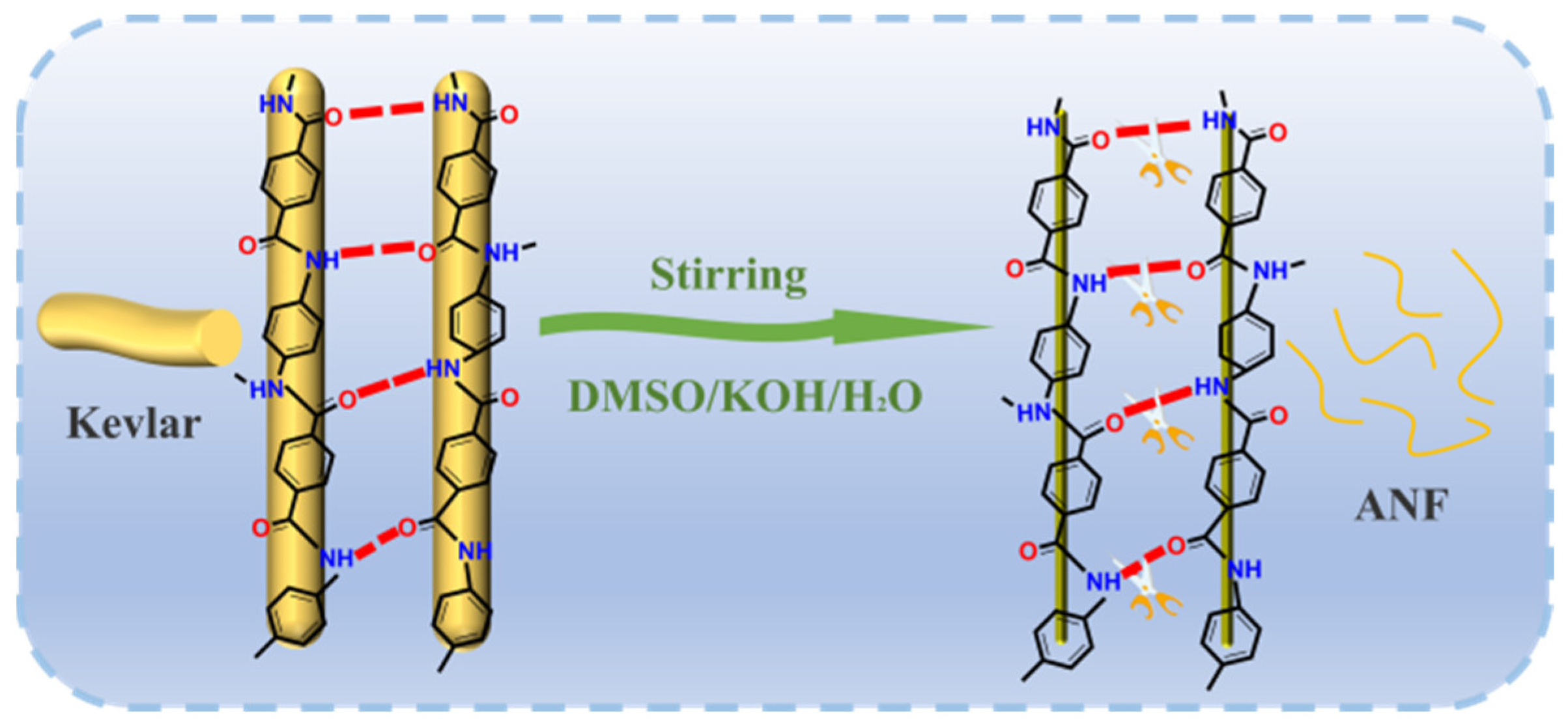
Figure 1 shows the process of preparing aramid nanofibers (ANF) using the proton donor-assisted deprotonation method [11]. PPTA was ultrasonically washed with anhydrous ethanol and dried. Then, 1.0 g PPTA, 1.5 g KOH, and 20 mL deionized water were added to a 500 mL dimethyl sulfoxide (DMSO) solution. The mixture was continuously magnetically stirred at room temperature for 4 h to obtain a homogeneous suspension. Subsequently, deionized water was added to the ANF/DMSO suspensions at a volume ratio of 2:1 (deionized water to ANF/DMSO suspensions) and stirred for 1 h; absorption with deionized water and vacuum filtration were performed in triplicate to remove residual KOH and DMSO from the ANF. Finally, the obtained ANF was redispersed in deionized water to prepare the ANF suspensions.

2.3. Preparation of EA-SWCNTs/ANF Composite Films

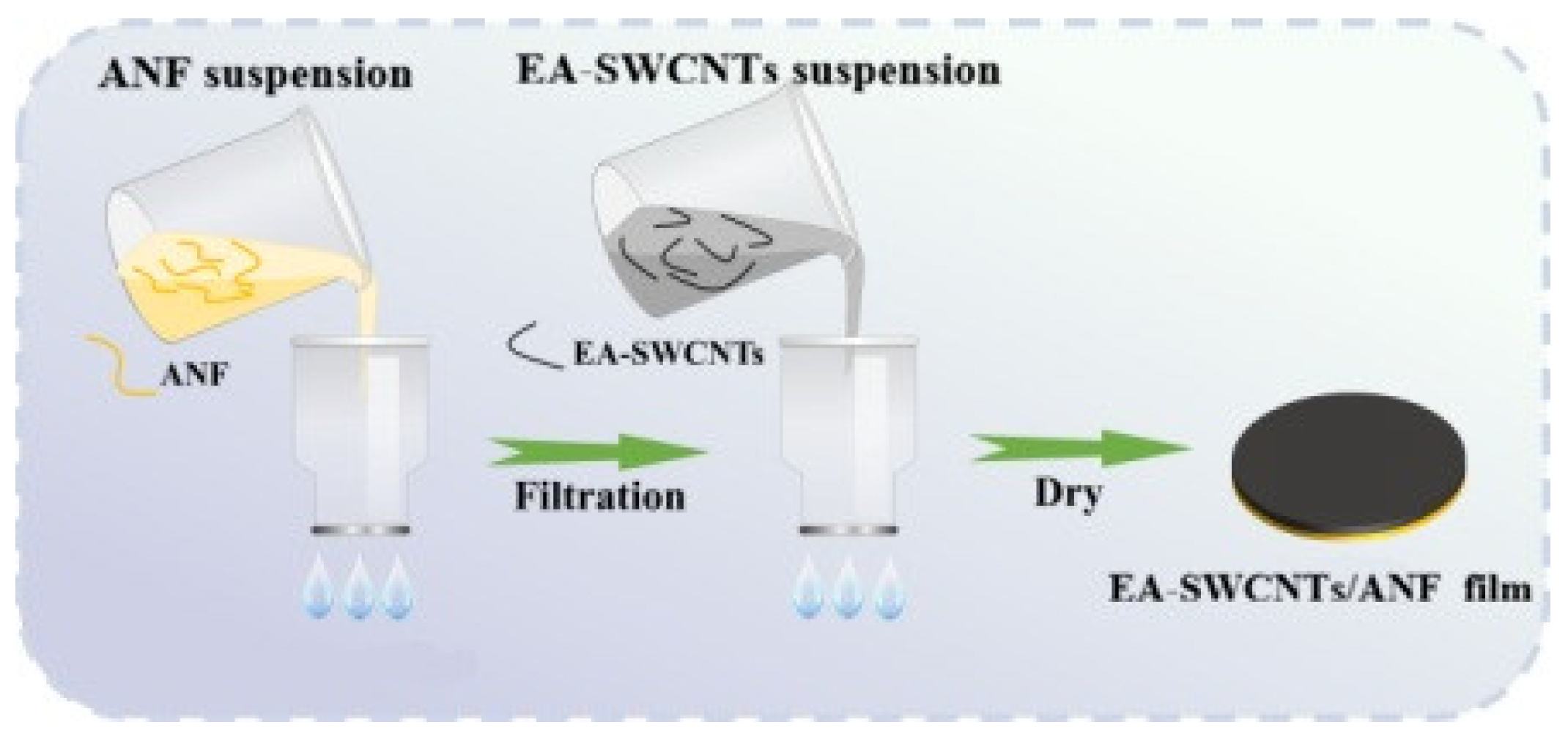
The preparation process of the EA-SWCNTs/ANF composite films is illustrated in Figure 2. The film was fabricated via vacuum-assisted filtration. Initially, the ANF suspensions were filtered as the bottom substrate layer. Subsequently, varying volumes (4 mL, 6 mL, 8 mL, and 10 mL) of EA-SWCNTs suspensions were filtered. Then, the resulting filter cake was dried in a vacuum oven at 60 °C and allowed to detach naturally; the prepared EA-SWCNTs/ANF composite films were labeled as ES4A, ES6A, ES8A, and ES10A, respectively.

2.4. Methods Section

The chemical bond types and structures of SWCNTs, EA-SWCNTs, and ANF were meticulously analyzed using Fourier transform infrared spectroscopy (Thermo Fisher Nicolet iS50, FTIR, Madison, WI, USA), while their chemical composition and structure underwent detailed examination via Raman spectroscopy (HORIBA HR Evolution, Kyoto, Japan). The dispersion state of EA-SWCNTs was carefully assessed using transmission electron microscopy (TEM, Tecnai G2 F20, FEI, Hillsboro, OR, USA). Field-emission scanning electron microscopy (FE-SEM, Hitachi S8100, Tokyo, Japan) operating at an accelerating voltage of 5 kV vividly characterized both the surface and cross-sectional morphology of the EA-SWCNTs/ANF composite films. For electrothermal performance testing, a DC power supply (MS-605D, MEAN WELL, Shanghai, China) was connected directly to both ends of the film via thermocouples; this setup was seamlessly linked to a computer through an isolated signal converter, recording the film’s voltage, current, and measuring real-time surface temperature by infrared camera (FLIR UTi220A PRO, FLIR Systems, Wilsonville, OR, USA).

3. Discussion

3.1. Structural Analysis of EA-SWCNTs

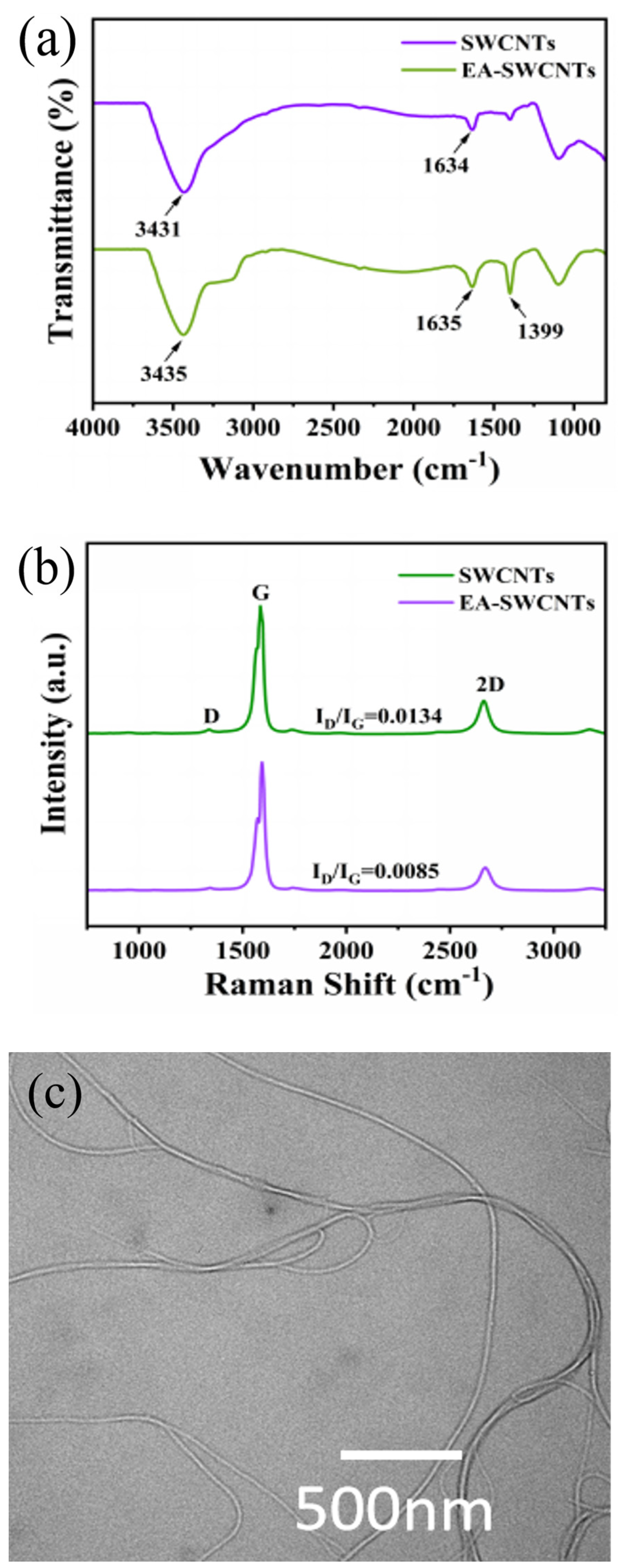
Figure 3a shows FT-IR spectra of SWCNTs and EA-SWCNTs. After modification, the absorption peak of C=C at 1635 cm−1 is enhanced; it can be attributed to the superposition of aromatic ring vibrations. The electron cloud interaction of ester groups with SWCNTs [13]. The medium-intensity peak at 1399 cm−1 corresponds to the C-O-H vibration of ellagic acid [14], and no new covalent bond peaks appear in the spectrum. It was confirmed that ellagic acid adsorbs onto the SWCNTs’ surface via non-covalent π-π stacking, which helps maintain their intrinsic structure while improving dispersibility.
Figure 3b presents the Raman spectra of SWCNTs and EA-SWCNTs. The D band corresponds to the defect characteristic peak of sp3 hybridized carbon, while the G band represents the graphitic characteristic peak reflecting the ordered lattice vibrations of sp2 hybridized carbon [15,16]. The intensity ratio (ID/IG) slightly decreased from 0.0134 for SWCNTs to 0.0085 for EA-SWCNTs. This minor change indicates that the modification process did not disrupt the original sp2 carbon atomic structure or the conjugated system of the single-walled carbon nanotubes. Ellagic acid molecules adsorb firmly onto carbon nanotube surfaces via non-covalent π-π interactions, while preserving their structural integrity without introducing covalent bonds or defects. The SWCNTs without EA modification undergo birdnesting, but they show better dispersion after EA modification, as shown in Figure 3c.

3.2. Structural Analysis of ANF

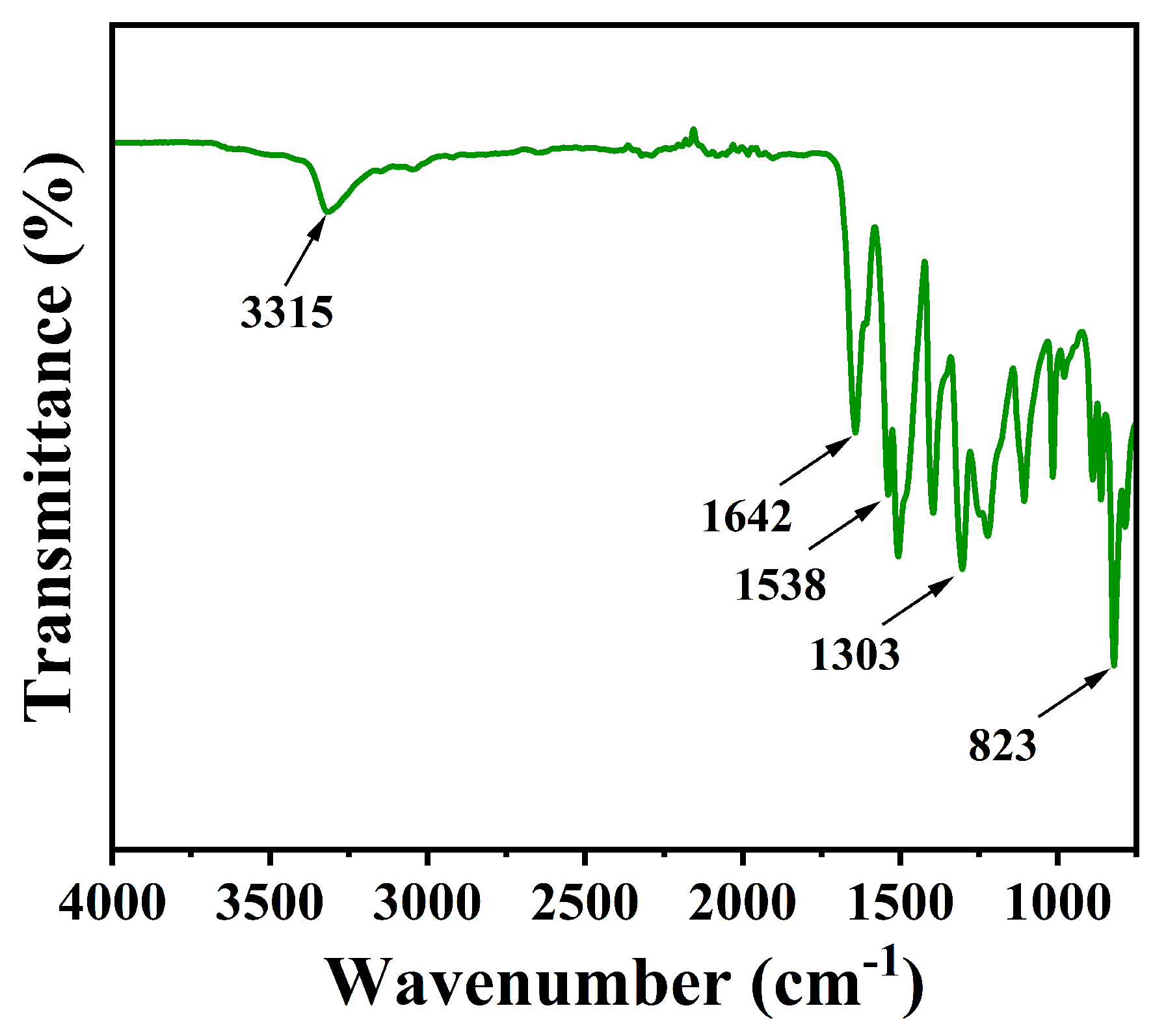
Figure 4 shows the FTIR spectrum of ANF. Here, the characteristic peak at 3315 cm−1 corresponds to the N-H stretching vibration of the amide bonds. The strong absorption peak at 1642 cm−1 is attributed to the C=O stretching vibration of the amide I band [17], confirming that the ANF retains the amide bond structure of the aramid backbone. The characteristic peak at 1538 cm−1 arises from the coupling of the N-H bending vibration of the amide II band with C-N stretching vibrations, further verifying the presence of amide bonds. Peaks at 1303 cm−1 (Ph-N vibration) and 823 cm−1 (C-H bending vibration of para-substituted benzene rings) [18] mean the backbone structure of the aramid. Thus, no anomalous peaks appear in the ANF spectrum, indicating the chemical structure of ANF remained intact throughout the preparation process.
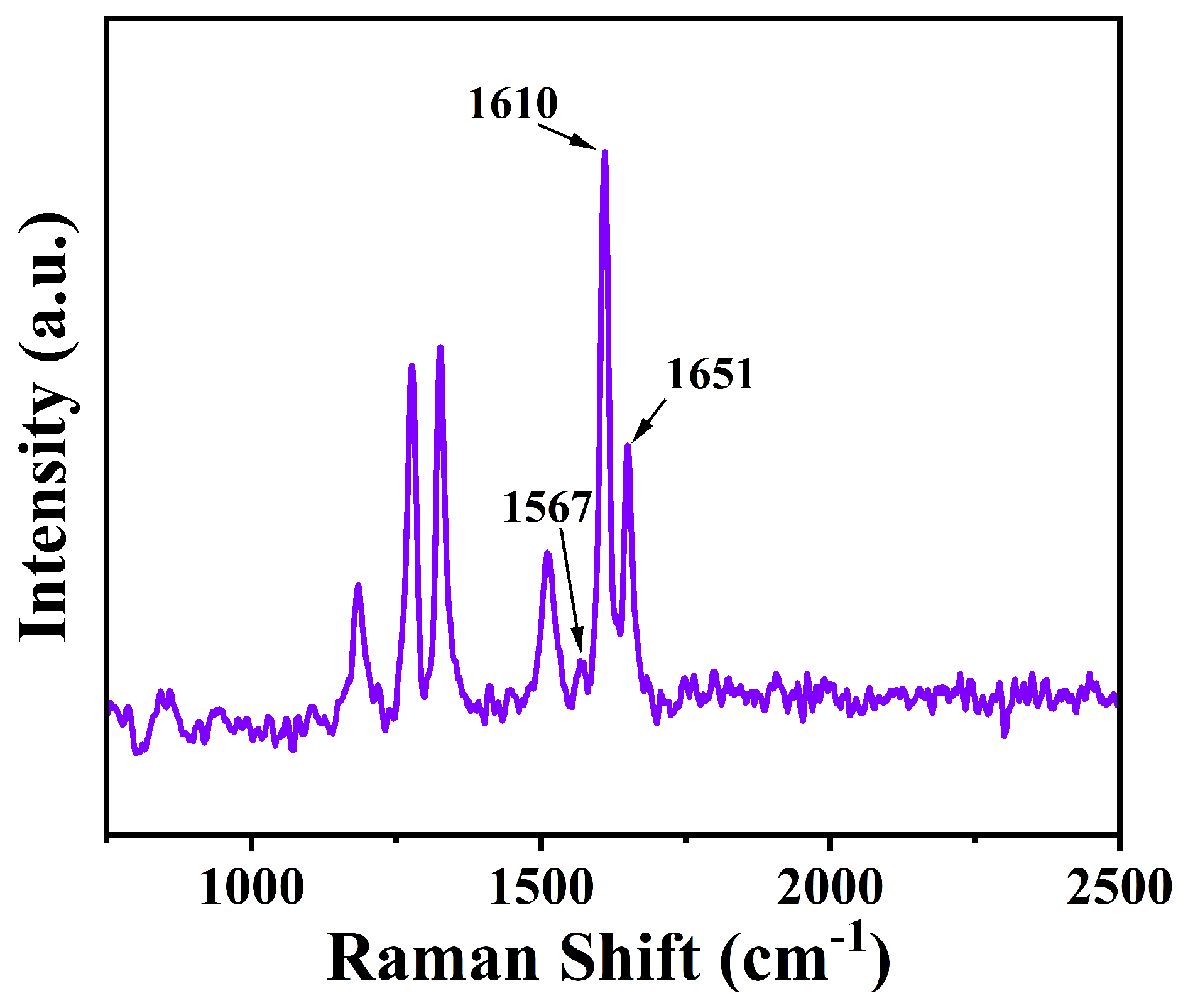
The Raman spectrum of ANF is shown in Figure 5. The characteristic peaks at 1567 cm−1, 1610 cm−1, and 1651 cm−1 correspond to distinct vibrational modes within the molecular structure of ANF. Among these features, the peak observed at 1567 cm−1 is assigned to the N-H in-plane bending vibration coupled with the C-N stretching vibration characteristic of the amide II band, signifying the presence of intermolecular hydrogen bonding. The peak appearing at 1610 cm−1 corresponds to the C=C skeletal stretching vibration within the benzene ring (G-band), reflecting the conjugated structural nature of the aromatic rings integral to the aramid backbone. Meanwhile, the peak located at 1651 cm−1 belongs to the C=O stretching vibration, further coupled with C-N stretching and N-H bending vibrations of the amide I band, representing the specific bonding state of the amide groups along the aramid molecular chains [19]. The simultaneous emergence of these peaks validates the distinct rigid molecular configuration of alternating benzene rings and amide linkages within ANF, underpinning its outstanding mechanical and thermal properties.

3.3. Electrothermal Effect of EA-SWCNTs/ANF Films

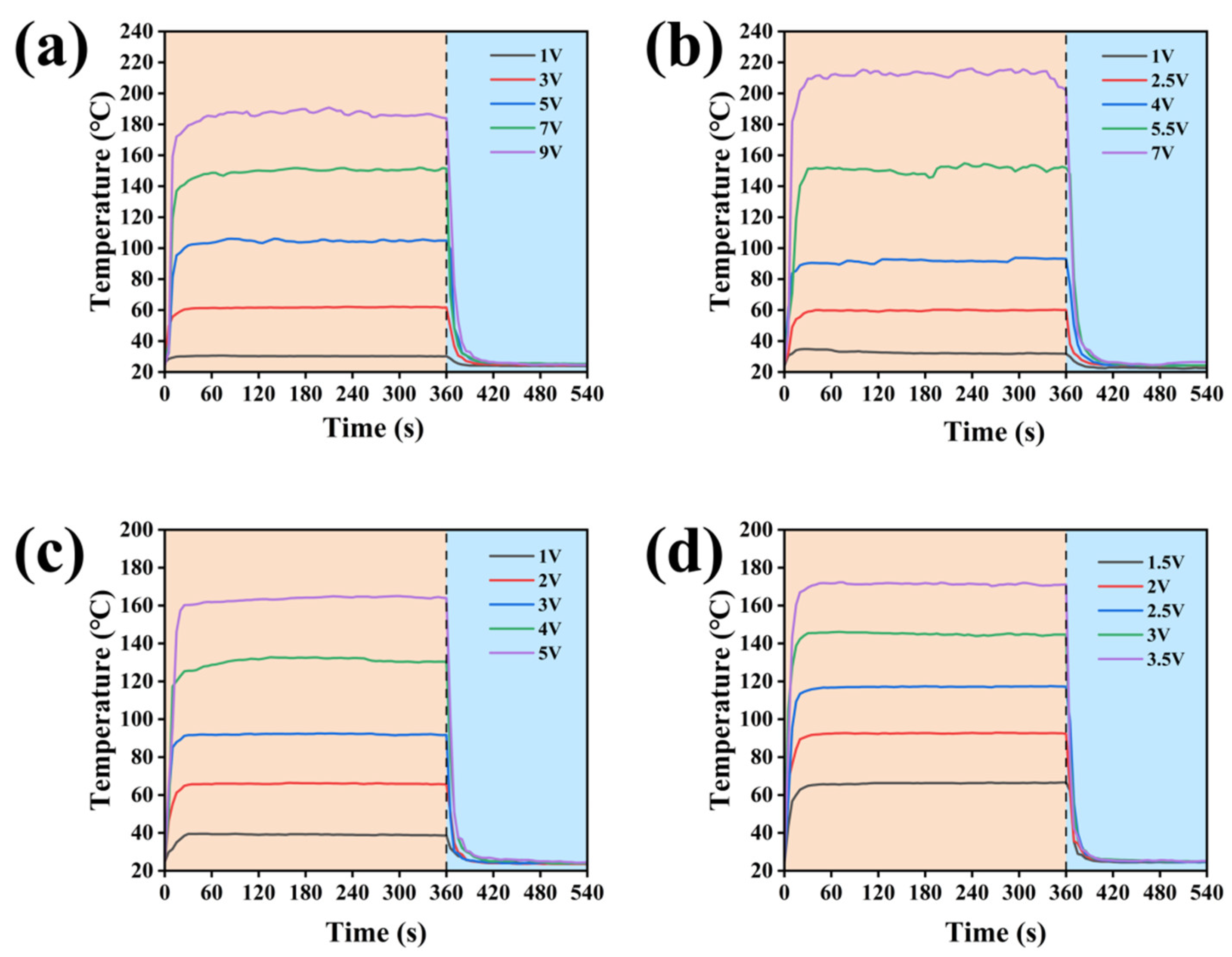
Figure 6 shows the time-temperature curves of EA-SWCNTs/ANF films. Figure 6a presents the steady-state temperature of ES4A film increased from 32 °C to 184 °C under voltages ranging from 1 V to 9 V. Accordingly, ES6A film, as Figure 6b shows, exhibited a more balanced response in the 1 V–7 V test range. At 5.5 V, its steady-state temperature reached 150 °C and maintained a linear increase, suggesting that the increased conductive material improved carrier migration efficiency. ES8A, as Figure 6c shows, achieved a significant temperature rise within a narrow voltage window of 1 V–5 V, and its steady-state temperature reached 90 °C at 3 V. The time–temperature curve depicts a robust conductive network that facilitated Joule heating, swiftly achieving thermal equilibrium. As shown in Figure 6d, ES10A also exhibited the outstanding responsiveness at ultra-low voltages of 1.5 V–3.5 V. The film temperature surged to 171 °C at 3.5 V within 10 s. For all films, a pronounced synergistic effect emerges between the conductive material content and the driving voltage, jointly governing the steady-state temperature and heating behavior of the films. The cooling curves exhibited rapid decay characteristics (returning to room temperature within 10 s), confirming the truly excellent heat dissipation capability of the aramid nanofiber substrate.

3.4. Thermal Stability Test of EA-SWCNTs/ANF Films

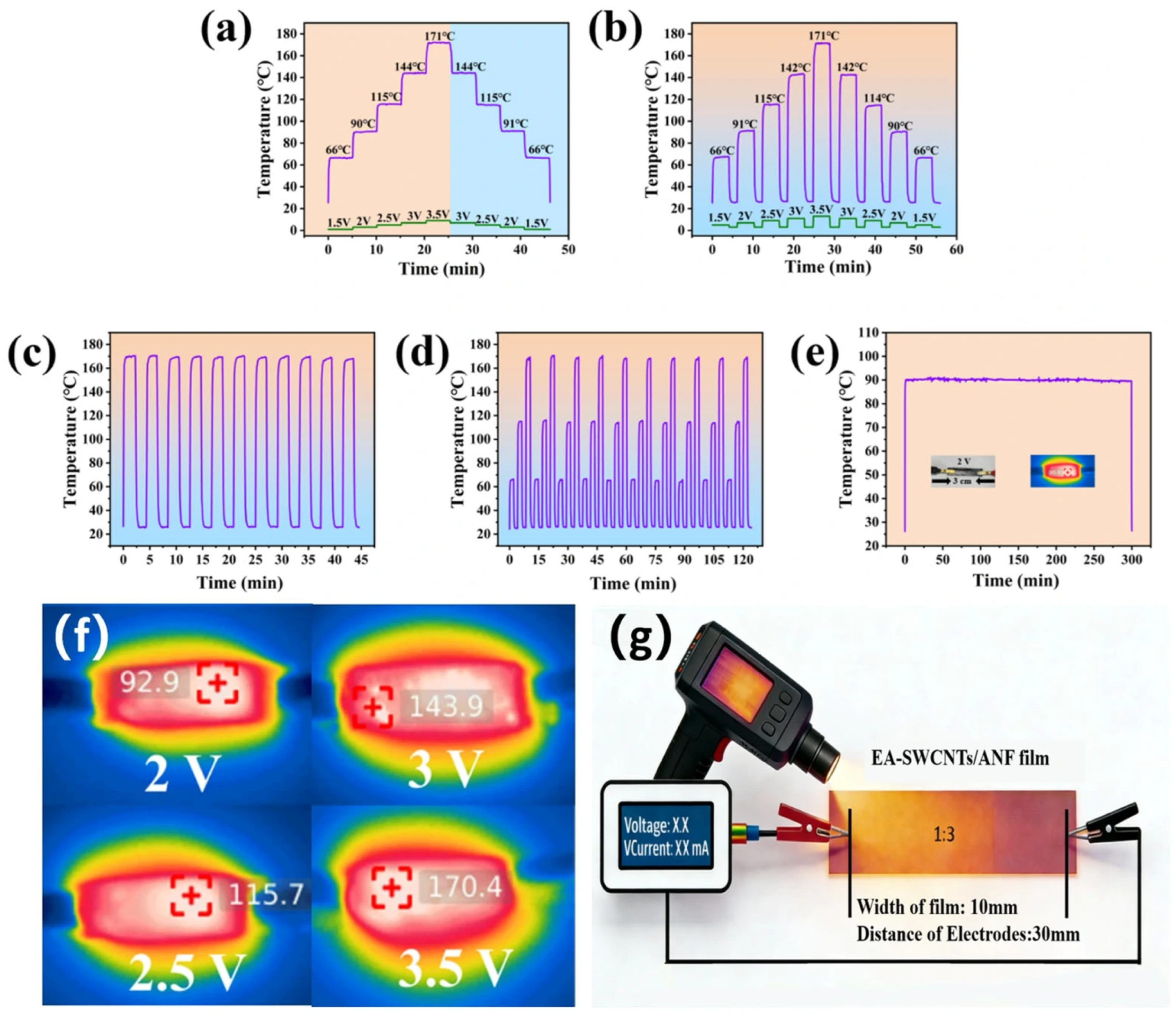
The thermal response performance and durability of the EA-SWCNTs/ANF composite film “ES10A” were assessed through cycling stability testing. Figure 7a displays the variation in surface temperature under stepwise voltage cycling between 1.5 V and 3.5 V. The results demonstrate that the surface temperature increases nearly linearly as the voltage rises incrementally, exhibiting a swift thermal response during voltage ramp-up. This underscores the material’s remarkable electrothermal conversion efficiency. Figure 7b explores the impact of repeated heating/cooling cycles within the identical voltage range (1.5 V–3.5 V) on thermal behavior. During the heating phase, the film’s temperature rises steadily and stabilizes at the anticipated steady-state value. Upon cooling, the temperature rapidly returns to its baseline. This efficient thermal recovery can be attributed to the porous structure of the aramid nanofibers, enabling superior heat dissipation, thus preventing performance degradation from thermal accumulation. These findings confirm that the composite film sustains a robust conductive network and demonstrates highly effective interfacial heat transfer throughout repeated thermal cycling.
Regarding long-term stability under high voltage, Figure 7c records the temperature response over 10 consecutive cycles at a constant voltage of 3.5 V. The maximum temperature in each cycle held steady at approximately 171 °C with 498 mA, and consistently achieved a steady state within 10 s. This consistent performance under constant voltage demonstrates that the ES10A film does not exhibit significant structural degradation or resistance increase even under a high electric field. The results also confirmed that the ellagic acid modification can prevent carbon nanotube agglomeration effectively under elevated current densities. Figure 7d examines the film’s adaptability under the voltage cycles of a sequence stepwise. The results show that the temperature rises rapidly and stabilizes quickly upon each voltage increase. And when the voltage returns to 0 V, the temperature promptly drops to the corresponding steady-state level with no baseline shift due to residual heat. Notably, within 10 voltage cycles, the deviation in steady-state temperature at each voltage step was less than 3%. Figure 7e further confirms the exceptional stability of the ES10A film under constant-temperature testing. With 2 V and 282 mA, the film’s surface average temperature was 90 °C (with a maximum of 92.9 °C), which remained remarkably steady for 5 h with temperature fluctuations tightly controlled within ±0.5 °C. Figure 7f shows the uniformity of temperature under the different voltages. It shows that the temperature uniformity on the film surface is good. The temperature reached 143.9 °C with 3 V and 420 mA. The measurement diagram of the cyclic stability test is shown in Figure 7g, in which the sample width is 10 mm, and the distance between electrodes is 30 mm. These findings collectively demonstrate that the electrothermal film of EA-SWCNTs/ANF shows exceptional cyclic stability, swift thermal response, and highly precise temperature control capability.

3.5. Structural Stability of EA-SWCNTs/ANF Film

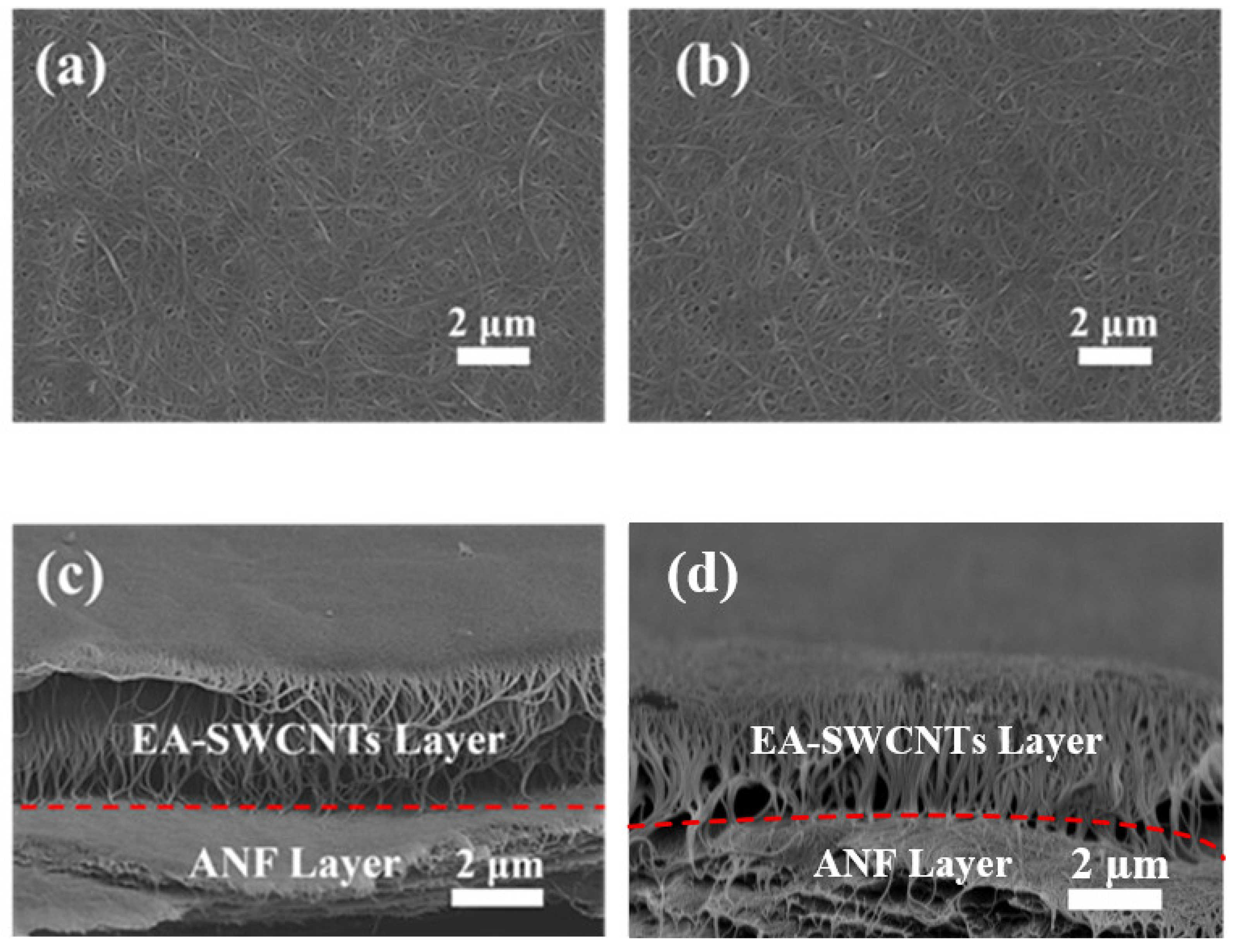
Figure 8 shows the SEM images of the ES10A film before and after heating, revealing highly consistent characteristics in its microstructure. Figure 8a,b both clearly show EA-SWCNTs as filamentous structures firmly adhered to the ANF surface, exhibiting no significant difference between them. This means that the overall network structure reveals no signs of collapse or contraction, and the original porous morphology remains well-preserved after heating. Figure 8c,d further reveal that no aggregation or breakage of EA-SWCNTs occurs, and the interfacial transition region between EA-SWCNTs and ANF remains seamless and continuous after heating, with no cracks or voids generated, indicating excellent thermal structural stability of the EA-SWCNTs/ANF film.

4. Conclusions

This study successfully developed a flexible electrothermal film using ANF and EA-SWCNTs. The key conclusions are as follows:
(1)
Ellagic acid non-covalently binds onto the surface of SWCNTs via π-π stacking, significantly enhancing their dispersibility without altering the intrinsic structure of the SWCNTs. The modified EA-SWCNTs further strengthen interfacial adhesion with ANF through hydrogen bonding. The rigid molecular architecture of ANF, characterized by alternating benzene rings and amide linkages, grants the EA-SWCNTs/ANF composite film exceptional structural stability.
(2)
In the electric heating experiment of EA-SWCNTs/ANF composite films, EA-SWCNTs guarantee the integrity of the conductive network, while the ANF substrate boasts excellent heat dissipation capability. The electrothermal performance of the composite film can be precisely controlled by adjusting the density of its conductive network. Specifically, the ES10A film rapidly reaches 171 °C within 10 s at 3.5 V. The cycling tests confirm its outstanding electrothermal stability, with no observable structural degradation even after prolonged high-temperature operation.
(3)
The EA-SWCNTs/ANF composite film successfully integrates superior electrical conductivity, rapid electrothermal response, and outstanding thermal stability, and demonstrates immense potential for applications within emerging flexible electronics and intelligent heating systems.

Author Contributions

Conceptualization: H.-Z.G.; data curation: X.H. and Y.W.; formal analysis: X.H. and Y.W.; funding acquisition: X.F.; project administration: W.C.; resources: X.F. and H.-Z.G.; supervision: W.C. and H.-Z.G.; validation: X.H. and X.F.; writing—original draft preparation: X.H. and Y.W.; writing—review and editing: X.F. All authors have read and agreed to the published version of the manuscript.

Funding

This research was funded by Tianjin Municipal Education Commission’s Scientific Research Plan Project of 2023 (2023KJ283, X.W. Fan.).

Institutional Review Board Statement

Not applicable, not involving humans or animals.

Informed Consent Statement

Informed consent was obtained from all subjects involved in the study.

Data Availability Statement

The original contributions presented in this study are included in the article. Further inquiries can be directed to the corresponding authors.

Conflicts of Interest

Author Hong-Zhang Geng was employed by the company Tianji Zhencai Technology (Hebei) Co., Ltd. The remaining authors declare that the research was conducted in the absence of any commercial or financial relationships that could be construed as a potential conflict of interest.

References

  1. Bae, J.J.; Lim, S.C.; Han, G.H.; Jo, Y.W.; Doung, D.L.; Kim, E.S.; Chae, S.J.; Huy, T.Q.; Van Luan, N.; Lee, Y.H. Heat dissipation of transparent graphene defoggers. Adv. Funct. Mater. 2012, 22, 4819–4826. [Google Scholar] [CrossRef]
  2. Pang, S.; Hernandez, Y.; Feng, X.; Müllen, K. Graphene as transparent electrode material for organic electronics. Adv. Mater. 2011, 23, 2779–2795. [Google Scholar] [CrossRef] [PubMed]
  3. Kinloch, I.A.; Suhr, J.; Lou, J.; Young, R.J.; Ajayan, P.M. Composites with carbon nanotubes and graphene: An outlook. Science 2018, 362, 547–553. [Google Scholar] [CrossRef] [PubMed]
  4. Thamaraiselvan, C.; Wang, J.; James, D.K.; Narkhede, P.; Singh, S.P.; Jassby, D.; Tour, J.M.; Arnusch, C.J. Laser-induced graphene and carbon nanotubes as conductive carbon-based materials in environmental technology. Mater. Today 2020, 34, 115–131. [Google Scholar] [CrossRef]
  5. Xiang, R.; Inoue, T.; Zheng, Y.; Kumamoto, A.; Qian, Y.; Sato, Y.; Liu, M.; Tang, D.; Gokhale, D.; Guo, J.; et al. One-dimensional van der Waals heterostructures. Science 2020, 367, 537–542. [Google Scholar] [CrossRef] [PubMed]
  6. Hada, M.; Hasegawa, T.; Inoue, H.; Takagi, M.; Omoto, K.; Chujo, D.; Iemoto, S.; Kuroda, T.; Morimoto, T.; Hayashi, T.; et al. One-minute joule annealing enhances the thermoelectric properties of carbon nanotube yarns via the formation of graphene at the interface. ACS Appl. Energy Mater. 2019, 2, 7700–7708. [Google Scholar] [CrossRef]
  7. Yao, Z.; Kane, C.L.; Dekker, C. High-field electrical transport in single-wall carbon nanotubes. Phys. Rev. Lett. 2000, 84, 2941–2944. [Google Scholar] [CrossRef] [PubMed]
  8. Baloch, K.H.; Voskanian, N.; Bronsgeest, M.; Cumings, J. Remote Joule heating by a carbon nanotube. Nat. Nanotechnol. 2012, 7, 315–318. [Google Scholar] [CrossRef] [PubMed]
  9. Xie, F.; Jia, F.; Zhuo, L.; Lu, Z.; Si, L.; Huang, J.; Zhang, M.; Ma, Q. Ultrathin MXene/aramid nanofiber composite paper with excellent mechanical properties for efficient electromagnetic interference shielding. Nanoscale 2019, 11, 23382–23391. [Google Scholar] [CrossRef] [PubMed]
  10. Xie, C.; He, L.; Shi, Y.; Guo, Z.X.; Qiu, T.; Tuo, X. From monomers to a lasagna-like aerogel monolith: An assembling strategy for aramid nanofibers. ACS Nano 2019, 13, 7811–7824. [Google Scholar] [CrossRef] [PubMed]
  11. Ma, Z.; Kang, S.; Ma, J.; Shao, L.; Wei, A.; Liang, C.; Gu, J.; Yang, B.; Dong, D.; Wei, L.; et al. Timesaving, high-efficiency approaches to fabricate aramid nanofibers. ACS Nano 2019, 13, 7886–7897. [Google Scholar] [CrossRef] [PubMed]
  12. Guan, Y.; Li, W.; Zhang, Y.; Shi, Z.; Tan, J.; Wang, F.; Wang, Y. Aramid nanofibers and poly (vinyl alcohol) nanocomposites for ideal combination of strength and toughness via hydrogen bonding interactions. Compos. Sci. Technol. 2017, 144, 193–201. [Google Scholar] [CrossRef]
  13. Wang, T.; Jing, L.C.; Zhu, Q.; Ethiraj, A.S.; Fan, X.; Liu, H.; Tian, Y.; Zhu, Z.; Meng, Z.; Geng, H.Z. Tannic acid modified graphene/CNT three-dimensional conductive network for preparing high-performance transparent flexible heaters. J. Colloid Interface Sci. 2020, 577, 300–310. [Google Scholar] [CrossRef] [PubMed]
  14. Guadagno, L.; De Vivo, B.; Di Bartolomeo, A.; Lamberti, P.; Sorrentino, A.; Tucci, V.; Vertuccio, L.; Vittoria, V. Effect of functionalization on the thermo-mechanical and electrical behavior of multi-wall carbon nanotube/epoxy composites. Carbon 2011, 49, 1919–1930. [Google Scholar] [CrossRef]
  15. Fantini, C.; Pimenta, M.A.; Dantas, M.S.S.; Ugarte, D.; Rao, A.M.; Jorio, A.; Dresselhaus, G.; Dresselhaus, M.S. Micro-Raman investigation of aligned single-wall carbon nanotubes. Phys. Rev. B 2001, 63, 161405. [Google Scholar] [CrossRef]
  16. Li, H.; Geng, H.Z.; Meng, Y.; Wang, Y.; Xu, X.B.; Ding, E.X.; Gao, J.; Chen, L.T.; Ma, S. Fabrication and test of adhesion enhanced flexible carbon nanotube transparent conducting films. Appl. Surf. Sci. 2014, 313, 220–226. [Google Scholar] [CrossRef]
  17. Yuan, X.T.; Xu, C.X.; Geng, H.Z.; Ji, Q.; Wang, L.; He, B.; Jiang, Y.; Kong, J.; Li, J. Multifunctional PVDF/CNT/GO mixed matrix membranes for ultrafiltration and fouling detection. J. Hazard. Mater. 2020, 384, 120978. [Google Scholar] [CrossRef] [PubMed]
  18. Xie, F.; Jia, F.; Zhuo, L.; Jin, Z.; Wang, D.; Lu, Z. Comparative study on pyrolytic transformation mechanism of ANFs-derived carbon membrane for electromagnetic interference shielding application. J. Mater. Sci. Mater. Electron. 2021, 32, 7090–7105. [Google Scholar] [CrossRef]
  19. Jia, F.; Lu, Z.; Liu, Y.; Li, J.; Xie, F.; Dong, J. Carboxylate-decorated multiwalled carbon nanotube/aramid nanofiber film for tunable electromagnetic interference shielding performance and rapid electric heating capacity. ACS Appl. Polym. Mater. 2022, 4, 6342–6353. [Google Scholar] [CrossRef]
Figure 1. Flowchart of preparation of aramid nanofibers.
Coatings 16 00147 g001
Figure 2. Flowchart of the fabrication process for EA-SWCNTs/ANF composite film.
Coatings 16 00147 g002
Figure 3. The structural analysis of SWCNTs and EA-SWCNTs: (a) FT-IR spectra; (b) Raman spectra; and (c) TEM of EA-SWCNTs.
Coatings 16 00147 g003
Figure 4. FT-IR spectra of ANF.
Coatings 16 00147 g004
Figure 5. Raman spectra of ANF.
Coatings 16 00147 g005
Figure 6. Time–temperature curves for films with different concentrations of (a) ES4A, (b) ES6A, (c) ES8A, and (d) ES10A.
Coatings 16 00147 g006
Figure 7. Cyclic stability test of ES10A: (a) surface temperature distribution at 1.5 V, 2 V, 2.5 V, 3 V and 3.5 V increments/decreases and (b) heating/cooling cycles; (c) surface temperature distribution of heating/cooling for 10 cycles at 3.5 V and (d) 1.5 V, 2.5 V and 3.5 V cycle voltages; (e) constant temperature test at the constant voltage of 2 V; (f) thermal imaging of ES10A; and (g) measurement diagram of cyclic stability test of ES10A.
Coatings 16 00147 g007
Figure 8. SEM images of EA-MWCNTs/ANF composite film: (a) surface images before heating test; (b) surface images after heating test; (c) cross-sectional images before heating test; and (d) cross-sectional images after heating test.
Coatings 16 00147 g008
Disclaimer/Publisher’s Note: The statements, opinions and data contained in all publications are solely those of the individual author(s) and contributor(s) and not of MDPI and/or the editor(s). MDPI and/or the editor(s) disclaim responsibility for any injury to people or property resulting from any ideas, methods, instructions or products referred to in the content.