Article

Optical Properties at 1550 nm of Ion-Beam Sputtered Silicon Nitride Thin Films

1
Department of Gravitational Waves and Fundamental Physics, Faculty of Science and Engineering, Maastricht University, P.O. Box 616, 6200 MD Maastricht, The Netherlands
2
Nikhef, Science Park 105, 1098 XG Amsterdam, The Netherlands
3
Dipartimento di Fisica e Astronomia “G. Galilei”, Università di Padova, Via Marzolo 8, 35121 Padova, Italy
4
Laboratori Nazionali di Legnaro, Istituto Nazionale di Fisica Nucleare, Viale dell’Università 2, 35020 Legnaro, Italy
5
Laboratoire des Matériaux Avancés—IP2I, CNRS, Université Claude Bernard Lyon 1, 69100 Villeurbanne, France
6
SUPA, School of Physics and Astronomy, University of Glasgow, Glasgow G12 8QQ, UK
*
Author to whom correspondence should be addressed.
Coatings 2025, 15(12), 1465; https://doi.org/10.3390/coatings15121465
Submission received: 12 November 2025 / Revised: 4 December 2025 / Accepted: 6 December 2025 / Published: 10 December 2025
(This article belongs to the Section Thin Films)

Abstract

Coating Brownian thermal noise is a major limitation to the sensitivity of gravitational-wave detectors. To reduce it, future detectors are planned to operate at cryogenic temperatures. This implies a change of their mirror coating materials and the use of a longer laser wavelength, such as 1550 nm. A stack of amorphous silicon and silicon nitride layers has previously been proposed as a promising combination of low- and high-refractive index materials to realize low-noise highly-reflective coatings. An essential step towards such coatings is the production of both materials via ion-beam sputtering. In this paper, for the first time, we present a study of the optical properties at 1550 nm of silicon nitride thin films deposited via ion beam sputtering. The refractive index and optical absorption as a function of post-deposition heat treatment temperature are investigated using a spectrophotometer and a photo-thermal common-path interferometer. Finally, we discuss the prospect of combining this material with amorphous silicon.

Graphical Abstract

1. Introduction

In 1916, Albert Einstein predicted the existence of gravitational waves [1,2]. These waves provide a unique means to study distant astrophysical events, such as binary systems involving black holes [3], neutron stars [4], supernovae [5], and processes from the early Universe [6]. The observations of these events open a new window into the Universe, allowing us to investigate sources and environments that are otherwise inaccessible through observation of electromagnetic waves [7].
The detection of gravitational waves is only possible using highly precise instruments known as gravitational-wave detectors. Since the first direct detection of gravitational waves in 2015, attributed to the merger of two black holes [8], detector facilities such as the Laser Interferometer Gravitational-Wave Observatory (LIGO) [9] and Virgo [10] have enabled the observation of multiple gravitational-wave events [11,12,13,14]. These detectors are large-scale Michelson interferometers that incorporate Fabry–Perot cavities in each arm, spanning several kilometers [15]. The cavities employ suspended mirrors made of a large substrate and a highly reflective coating. A major limitation of the detector sensitivity arises from the Brownian thermal noise of the highly-reflective mirror coatings. Ongoing research aims to improve these mirrors and their coatings, which are thickness-optimized Bragg reflectors. Enhancing mirror performance is crucial for extending the sensitivity of detectors to lower frequencies, thereby enabling the observation of a wider range of gravitational-wave sources.
The coating thermal noise amplitude spectral density x ( f ) can be approximated as follows [16,17]:
x ( f ) T d ϕ w
where T is the mirror temperature, d is the coating thickness, ϕ is the coating mechanical loss angle, and w is the laser beam radius on the mirror. Consequently, next-generation detectors, such as the low-frequency Einstein Telescope (ET-LF) [18,19] and LIGO Voyager [20], aim to reduce thermal noise by lowering the operating temperature of the mirrors. As a result, there is a growing focus on research and development related to cryogenic operation [21].
Current coating stacks composed of alternating layers of titania mixed with tantala ( TiO 2 -Ta 2 O 5 ) and silica ( SiO 2 ), which are used in current detectors, show excellent optical performance as well as low thermal noise at room temperature [22]. However, they are unsuitable for cryogenic applications, as they show pronounced mechanical loss peaks at low temperatures [23,24,25]. Thus, it is important to find new coating materials which show low mechanical loss at low temperatures. Amorphous silicon (aSi) and silicon nitride are promising candidates for these low-temperature detectors as they show low mechanical loss [26,27,28,29].
While aSi is characterized by a high refractive index (≈3.5) [30,31,32], silicon nitride provides lower refractive index values (≈2.0) [33,34,35], and they can be combined to create a Bragg mirror for future detectors. Due to the high contrast in refractive indices, fewer and thinner layers are required to get the same reflectivity as compared to TiO 2 -Ta 2 O 5 and SiO 2 layers [36]. As a consequence, the overall mirror coating will be thinner compared to the current TiO 2 -Ta 2 O 5 /SiO 2 stack, and the thermal noise will be further reduced.
In addition to thermal noise, optical absorption is another property that can significantly affect the performance of the mirrors [37]. To preserve the low operating temperature and prevent thermal distortions, the mirror must have extremely low absorption, on the order of ppm at the operating wavelength of the detector. State-of-the-art mirrors use fused silica as substrates, which are transparent at the current operating wavelength of 1064 nm but are not suitable for cryogenic temperatures. The current baseline as substrate material for future detectors like ET-LF is silicon, which is opaque at 1064 nm, potentially shifting the operational wavelengths to 1550 nm or 2000 nm.
Coatings for current gravitational-wave detectors have been produced at the Laboratoire des Matériaux Avancés (LMA) by ion beam sputtering (IBS), which is the preferred method for such coatings due to the high homogeneity and low optical loss (absorption and scattering) of the resulting material [38]. While aSi produced by IBS has shown promising performance [27,39], silicon nitride has primarily been fabricated using chemical vapor deposition [40,41]. Investigations of silicon nitride produced via ion beam depositions focused on non-stoichiometric material and 1064 nm [35].
In this paper, we present characterization results of the extinction coefficient and refractive index at 1550 nm as well as the energy gap of a silicon nitride single layer produced by IBS for the first time. The refractive index and optical absorption are obtained using a spectrophotometer and a photo-thermal common-path interferometer. This study correlates the evolution of these optical properties with the post-deposition heat treatment temperatures of the coating. Investigating the optical properties of silicon nitride at 1550 nm paves the way for assessing its suitability for use in multilayer coatings produced by IBS, particularly in combination with amorphous silicon.

2. Materials and Methods

2.1. Substrates and Coatings

The silicon nitride ( SiN x ) thin film was deposited on a silica substrate made of high- purity-fused silica (HPFS) Corning glass code 7980 using a Veeco SPECTOR IBS system (Veeco Instruments Inc., Plainview, NY 11803, USA), at the LMA. Before deposition, the base pressure inside the vacuum chamber was in the range of 10 6 10 5 mbar; during deposition, the total pressure was of the order of 10 4 mbar. Ar and N 2 were fed to the sputtering source in a ratio of 6/5 ( Ar/N 2 ), which was set to yield a beam energy and current of 0.7 keV and 0.3 A, respectively. The sputtering target was made of polycrystalline silicon with 99.99% purity. A secondary source was used to bombard the growing film, set to yield a N 2 beam of 0.15 keV and 0.1 A. Substrates were heated up to a temperature between 100 and 150 °C while rotating at a speed of 300 rpm.
Post-deposition, the samples were heat-treated in air at a ramp rate of 3 °C per minute with a dwell time of 10 h, in steps of 100 °C from as deposited to 1000 °C. At each step, the optical properties of the film were measured.
Rutherford backscattering measurements were performed to investigate the composition of the film after heat treatment at 1000 °C. Measurements were carried out using He + 4 ion beam at 2.0 MeV with a scattering angle of 160 ° . The film composition was obtained by matching the simulation done using a custom-developed code based on the SRIM database [42] to the experimental spectrum. The film composition was found to be Si 1 N 1.35 ± 0.05 Ar 0.015 ± 0.001 . No elements heavier than argon were detected. In the following, the coating will be referred to as SiN 1.35 . Oxygen ( 6.5 × 10 16 atoms · cm 2 ) was detected on the film’s surface, and the thickness of silicon nitride affected by oxidation extends to less than 4% of the total thickness from the surface inwards. In the rest of the film, the oxygen concentration is so low that the oxygen signal cannot be distinguished from the silicon signal.

2.2. Spectrophotometry

To investigate the optical properties, the transmission spectra of the coating were measured using a Cary 5000 UV–Vis-NIR Spectrophotometer (Agilent Technologies Inc., Santa Clara, CA, USA). Data were acquired from 300 nm to 2000 nm with a step of 1 nm. To fit our transmission spectra, we used a software called SCOUT (version: 4.9300) from WTheiss Hardware and Software using optical models to obtain the refractive index, thickness, and energy gap of our coatings.
First, the optical properties of the substrate were modeled using Sellmeier equations [43,44] with additional harmonic oscillators to account for the OH content in the substrate [45].
In a second step, the coatings were analyzed by using the O’Leary–Johnson–Lim (OJL) [46], Tauc Lorentz (TL) [47] and Cauchy [48] models available in the SCOUT software. These models are widely used to analyse various amorphous coatings [30,35,49]. The Cauchy model was used to fit the transparent region of the spectra to obtain a preliminary value for the refractive index and thickness of our coating. In order to investigate the whole wavelength region, the TL model has been used to describe the optical absorption of the film. However, while the TL model accounts for the parabolic behavior of the density of states in amorphous materials, it does not account for the Urbach tails [50], which are related to the structural disorder of amorphous materials [51,52], extended inside the energy gap. Both OJL and TL models are valid to obtain the thickness of the coating, the refractive index at 1064 and 1550 nm and the energy gap, which are the relevant parameters for the scope of this work. The results obtained from the optical models were in agreement within the uncertainty based on the accuracy of the instrument.
While several Kramers–Kronig-consistent models have been developed to describe the dielectric function of materials across a broad spectral range—including both Urbach-tail and interband-transition contributions [53,54,55]—our film exhibits appreciable absorption only in the limited 300–500 nm region, with absorption further reduced after heat treatment. Although these models may differ slightly in their description of the extinction coefficient within this range, both the OJL and the Tauc–Lorentz models produce comparable results in the near-infrared, which is the focus of this study, indicating that more detailed models are primarily needed when the onset of absorption is of central interest.
A confidence interval of 1% on the investigated parameters was estimated based on the accuracy of our instrument and variability found on other amorphous samples with similar optical properties and thickness. This confidence interval has been applied to the results unless otherwise mentioned.

2.3. Determination of Extinction Coefficient

A non-destructive technique known as photo-thermal common-path interferometry (PCI) [56] was used for the optical absorption measurements. PCI is based on two lasers: a high-power pump laser operating at 1550 nm for which the absorption is measured, and a probe laser operating at a different wavelength of 1310 nm and at a lower power. The measurement principle is based on the thermal lensing effect. The pump beam, with a 2–3× smaller diameter than the probe beam, heats the sample in a small region creating a thermal lens, which can be sensed by using the probe beam crossing it. An optical interference pattern is created with the help of the distorted central part of the beam and the undistorted part from the surrounding area. As the pump beam is chopped/modulated at a certain frequency using a chopper, the probe beam is perturbed periodically. This periodic change can be detected by the photodetector as an AC signal. The absorption is then determined by comparing it to the signal of a calibration sample of known absorption.
To account for the inhomogeneities of absorption across the sample, several measurements at 10 randomly chosen points across the surface were measured for each heat treatment step. The average of the multiple measurements was considered as the absorption result. The standard deviation of the multiple absorption values was calculated to obtain the error bars for the measurements. One potential source of error is misalignment during measurements. To reduce this, the setup was calibrated regularly. If the calibration deviations exceeded 10%, the measurements were repeated. Therefore, the maximum error was assumed to be 10%. In cases where the standard deviation from multiple measurements exceeded this value, a higher standard deviation was considered as the error.
In the final step, the TFcalc software (version: 3.5.15, HULINKS Inc., Tokyo, Japan) was used to determine the extinction coefficient, which is an underlying fundamental material property, from the measured absorption values. To do this, we incorporated the refractive index and thickness values measured with the spectrophotometer.

3. Results

3.1. Refractive Index, Thickness and Energy Gap

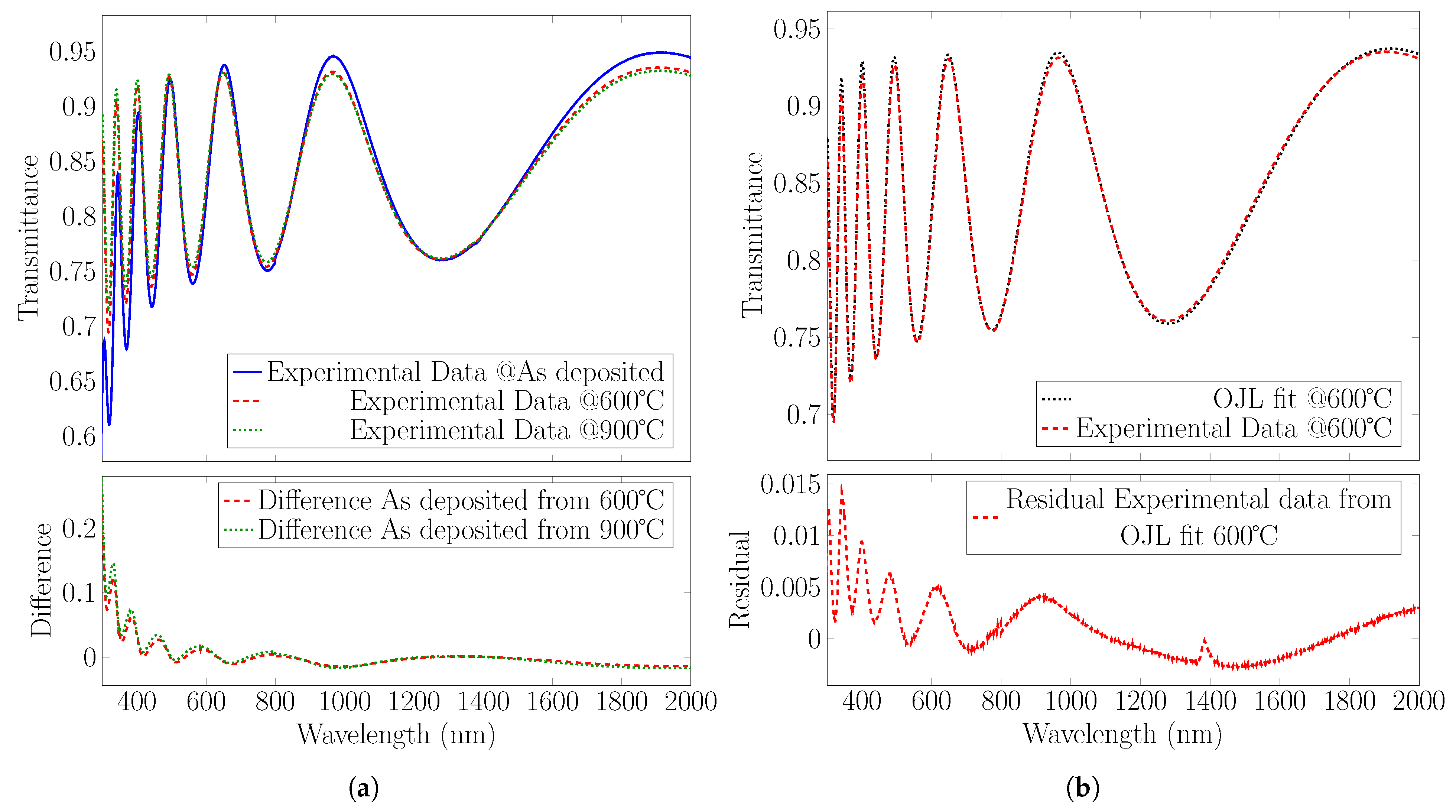
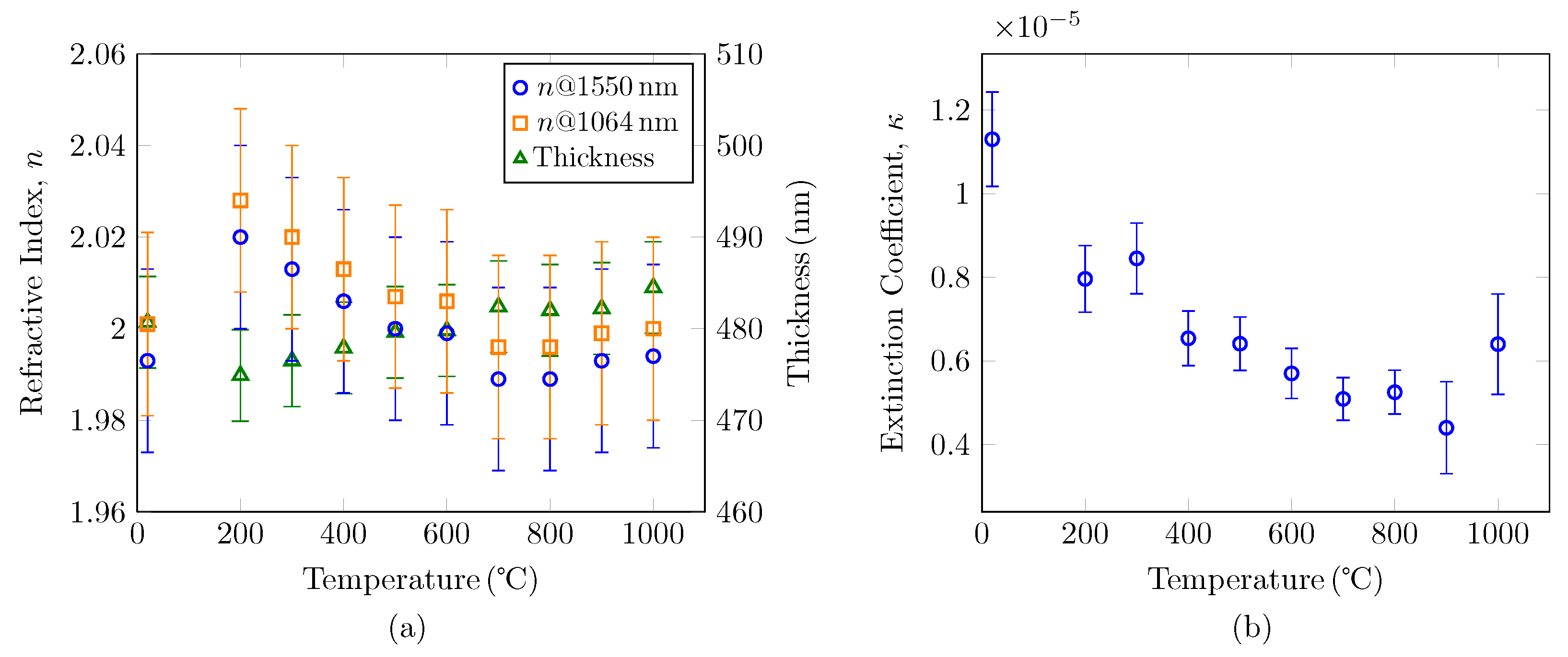
In Figure 1a, a comparison between transmission spectra at as-deposited and at different heat temperatures of 600 °C and 900 °C is represented. The experimental data showed that there was little change between spectra at 600 °C and 900 °C, although the coating had changed significantly from its as-deposited condition. In Figure 1b, the experimental fits and corresponding OJL fits are shown. The experimental and corresponding OJL fit is shown for spectra at 600 °C. In Figure 2a we show our sample’s refractive index and thickness evolution with heat treatment temperature, obtained using the procedure described in Section 2.2.
Dark blue solid data points represent a wavelength of 1550 nm, whereas the orange solid square ones represent a wavelength of 1064 nm. At 1550 nm, the refractive index of the as-deposited material was approximately 1.99. It increased to 2.02 after heat treatment at 200 °C then gradually decreased with further heat treatments, reaching a minimum at slightly below 1.99 between 700 °C and 800 °C. A slight increase was observed beyond this range, continuing up to 1000 °C. A similar trend was also observed at 1064 nm, which is as expected.
The thickness of the as-deposited sample was found to be 481 nm. It initially decreases to approximately 475 nm at the first heat treatment of 200 °C, after which it begins to increase again, reaching around 485 nm following heat treatment at 1000 °C. However, plateaus were observed between 500 °C and 600 °C and again between 700 °C and 900 °C.
The energy gap obtained from the TL and OJL models did not show a visible trend with heat treatments, and the values were comparable within uncertainties. An average value was found at 4.62 ± 0.62 eV, where the total variation was considered as the confident interval. Previous studies on SiN x prepared using various deposition methods have reported energy gap values ranging approximately from 4.5–5.3 eV, depending on the specific deposition technique [57]. Another study finds the energy gap of a stoichiometric SiN 1.33 film to be 4.2 eV using ion beam sputtering [33].

3.2. Optical Absorption

The optical absorption of the SiN 1.35 film was measured using PCI, after every heat treatment step. The absorption value measured was converted to the extinction coefficient using the corresponding refractive index and thickness obtained from spectrophotometry. The results are listed in Table 1 and presented in Figure 2b.
The extinction coefficient shows a constant decrease from the as deposited state to the heat treatment of 700 °C, with a deviation at 300 °C. From 700 °C to 800 °C no further reduction is observed. Although the 900 °C value shows a reduction in the mean absorption, this measurement shows a larger error from variations across the sample compared to the previous measurements so that the error bar includes the 800 °C value. After heat treatment at 1000 °C, the absorption clearly increased. However, similar to the 900 °C measurement, this measurement shows a larger error bar. The minimum of the extinction coefficient in the 700–900 °C region was 5 × 10 6 for a wavelength of 1550 nm.

4. Discussion and Prospect of Using IBS SiN 1 . 35 in Gravitational- Wave Detectors

The refractive index values of our sample are within the range of values measured for IBS SiN 1.35 thin films produced under different sputtering conditions, ranging from 1.98 to 2.05 [34]. Another study found the value of the refractive index of non-stoichiometric SiN x in the range of 1.91 and 2.01 for ion beam deposited thin films with varying beam current and beam energy values [35].
The change in thickness and refractive index with respect to heat treatment are likely related to relaxation of internal stress of the deposited film. The contrasting behaviors reported for SiN films deposited by different techniques clearly demonstrate how strongly the film properties depend on the deposition method and on the energetic conditions involved. For example, plasma-enhanced chemical vapor deposition (PECVD) SiN with low hydrogen content shows no significant change in density upon heat treatment [58], whereas low-pressure chemical vapor deposition (LPCVD) SiN undergoes densification when furnace heat treated in an N 2 atmosphere [59], in direct contrast to our observations. However, sputtering deposition process are highly energetic and typically yields dense and mechanically stressed films. Previous investigations on SiN films produced by ion-beam sputtering (IBS) have shown that heat treatment reduces both the internal stress and the refractive index [60], consistent with the behavior we observe in our sputtered films.
The averaged value of the energy gap found in our sample is comparable with what found in previous studies on SiN x prepared using various deposition methods, for which the energy gap ranges approximately from 4.5–5.3 eV, depending on the specific deposition technique [57]. Another study finds the energy gap of a stoichiometric SiN 1.33 film to be 4.2 eV using ion beam sputtering [33].
The extinction coefficient at 1550 nm has previously been evaluated for SiN x coatings produced through plasma-enhanced chemical vapour deposition (PECVD) by comparing various NH 3 /SiH 4 ratios. Extinction coefficients for all the films fell within the 10 5 range [40], which is comparable to our finding. Furthermore, the trend of the absorption with respect to the heat treatment with increasing variation at high temperatures has been previously observed for other materials [61] and might be a sign of beginning crystallization.
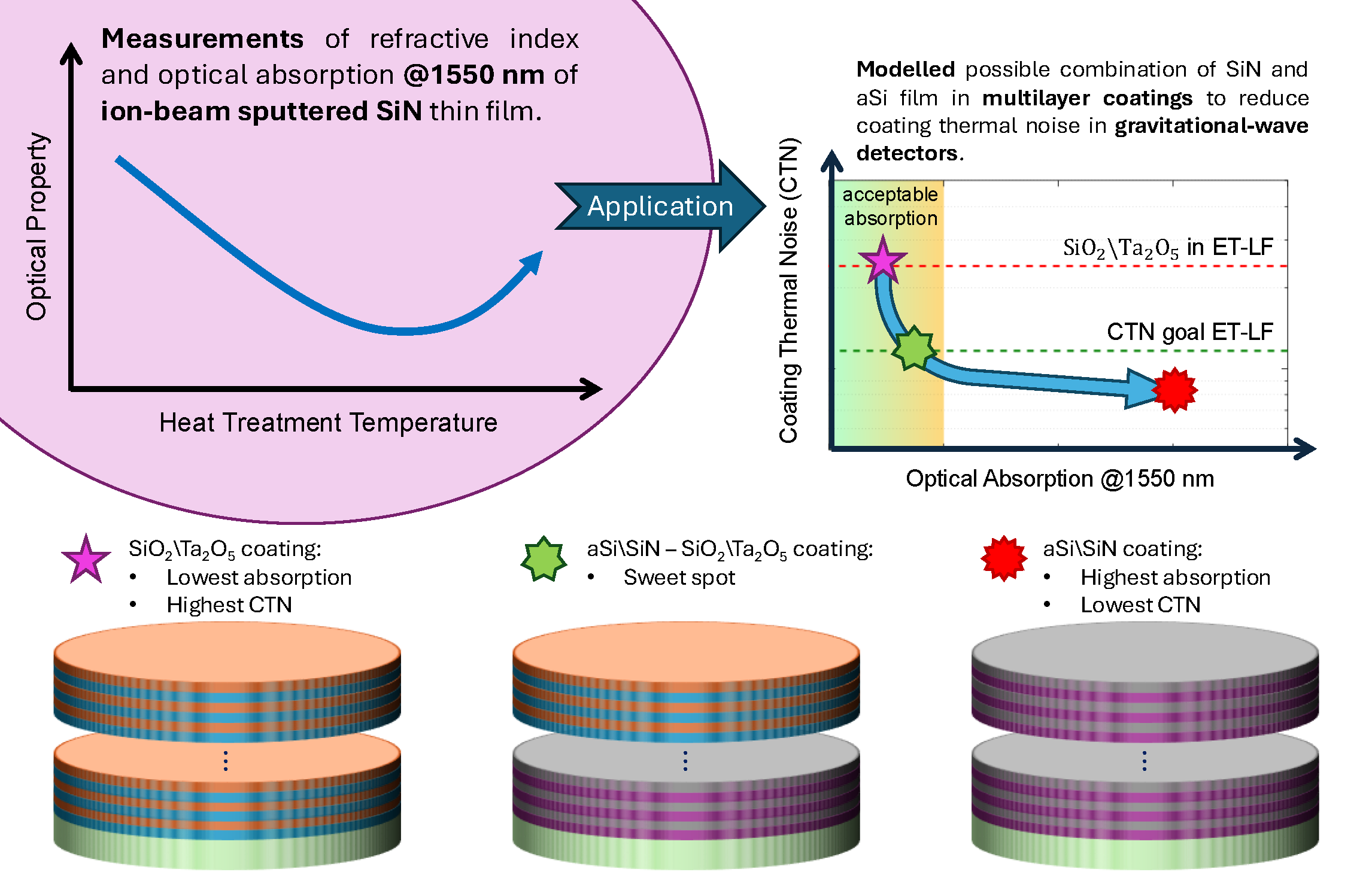
Considering the obtained results, in the following, a possible application of SiN x in gravitational-wave astronomy is discussed. While SiN x combined with SiO 2 is a promising coating option for gravitational-wave detectors operating at room temperature [34], combining it with aSi instead, makes it an interesting low thermal noise coating option for future detectors planned to operate at cryogenic temperatures. Due to a low mechanical loss, which even reduces towards low temperatures [28], this material combination is favorable compared to currently-used materials such as SiO 2 and Ta2O5, often additionally mixed with TiO 2 , which show a significant increase in mechanical loss when being cooled [25,62,63]. Investigating SiN x produced via IBS at a wavelength of 1550 nm, at which the cryogenic part of the Einstein Telescope is planned to operate, for the first time is a significant step forward for coating development for future gravitational-wave detectors.
In this section, we will (A) make simulations of the optical absorption of such a multilayer coating based on the results presented in this work, will (B) calculate coating thermal noise using the optical design from (A), and (C) will explore the trade-off between achieving the lowest possible absorption and the lowest possible coating thermal noise. For all estimates presented in this section, crystalline silicon—proposed for the cryogenic Einstein Telescope—was used as a substrate material.

4.1. Optical Absorption of an aSi and SiNx Coating

The lowest extinction coefficient shown for an aSi coating deposited via IBS to date is κ = 1.22 × 10 5 at 1550 nm [64], after heat treatment at 400 °C. For a coating deposited in the same deposition system, but at a deposition temperature of 400 °C, a refractive index of n = 3.39 was found. For SiN 1.35 , the parameters found for heat treatment at 400 °C in the study presented in this article are used. While the absorption of SiN 1.35 only minimizes at a higher temperature, the optimum heat-treatment temperature for aSi was chosen, as the absorption of aSi dominates over that of SiN 1.35 . Table 2 summarizes the parameters.
The Software Tfcalc was used for calculating the absorption and reflectivity of a multilayer coating made of alternating layers of aSi and SiN 1.35 from the refractive indices and extinction coefficients. For simplicity, all layers were assumed to have an optical thickness of a quarter of the laser wavelength of 1550 nm, resulting in 114 nm per aSi layer, and 193 nm per SiN 1.35 layer. As for monitoring or locking, the coatings of the highly-reflective end mirrors (ETMs) in gravitational-wave detectors transmit a small fraction laser light, and the target transmission was set to ≤5 ppm—with the value being as close to 5 ppm as achievable with full quarter wave layers. With these requirements, a number of 12 double layers of alternating aSi and SiN 1.35 , where the outermost layer is made of aSi, are required to achieve a reflectivity of 99.998 % with a transmission of 4 ppm. The optical absorption of such a coating would be 16 ppm. Possible scattering was omitted for the purpose of these considerations. The design reflectivity of the lower reflective arm cavity input mirrors (ITMs) is ≈99.4%. A coating with a reflectivity closest to this value, but achievable with full quarter layers, would require eight double layers of aSi and SiN 1.35 , resulting in an optical absorption identical to that of the more highly-reflective ETM.
In the past, the optical absorption of aSi was found to reduce towards lower temperatures [32,36]. Therefore, the absorption of 16 ppm may pose an upper limit when considering these coating use at cryogenic temperatures.

4.2. Thermal Noise of an aSi and SiN Coating

Coating thermal noise was calculated using the multimaterial model by Yam et al. [72], with the coating thermal noise amplitude spectral density being
x ( f ) = 2 k B T π 2 f 1 w 2 1 σ sub 2 σ sub 2 Y sub j b j d j ϕ j ,
with
b j = ( 1 2 σ j ) ( 1 + σ j ) ( 1 2 σ sub ) ( 1 + σ sub ) 1 1 σ j × 1 n j θ coat θ j 2 Y sub Y j + ( 1 σ sub 2 σ sub 2 ) 2 ( 1 + σ j ) 2 ( 1 2 σ j ) Y j Y sub .
In these equations, k B is the Boltzmann constant, T the temperature of the mirror, f the frequency and w the radius of the laser beam on the coating. The subscript ‘sub’ refers to the Young’s modulus and Poisson ratio of the mirror substrate. d is the coating thickness and ϕ j , Y j , σ j and θ j are the mechanical loss, the Young’s modulus, the Poisson ratio and the round-trip phase of the j th layer in the coating, starting from the outermost layer, respectively.
For SiN 1.35 , the mechanical loss was previously measured on a coating from the same deposition run as the coating investigated for optical properties in our study [65]. However, the loss was not measured for heat treatment at 400 °C, at which the optical absorption of aSi minimizes, but heat treatment at 500 °C was the closest temperature measured; therefore, the mechanical loss for this temperature was used. Also, the mechanical loss presented in [65] shows a frequency dependency. The data in was therefore extrapolated to our reference frequency of 100 Hz, and a loss of ϕ = 4.15 × 10 4 was used.
For aSi, the mechanical loss was investigated as part of the same study from which the absorption value was used. The loss of this coating after heat treatment at 400 °C: was ϕ = 1.7 × 10 5 [27]. The Young’s modulus Y and Poisson ratio σ for SiN were only available for the coating as deposited, while, for aSi and cSi, the literature values were used—see Table 2. The coating thickness was based on the number of layers determined from the target transmission. All parameters are also summarized in Table 2. The laser beam radius used for calculations was 9 cm as envisioned for the Einstein Telescope.
The resulting coating thermal noise amplitude spectral density at a detector temperature of 10 K, which is the envisioned mirror temperature for the Einstein Telescope, would be 5.3 × 10 22 m / Hz for the ETM and 3.4 × 10 22 m / Hz for the ITM, at a reference frequency of 100 Hz. The total coating thermal noise for both detector arms calculates as 2 × ( CTN ETM ) 2 + 2 × ( CTN ITM ) 2 = 0.82 × 10 21 m / Hz or a strain sensitivity of 0.82 × 10 25 / Hz at 100 Hz when normalized to the 10 km arm length of the Einstein Telescope. This is below the design value of ≈ 1.1 × 10 25 / Hz [19].
As the mechanical loss of both, aSi and SiN 1.35 , is known to reduce towards lower temperatures [28,29], these results are an upper limit for the thermal noise expected if using such a coating in the cryogenic Einstein Telescope.

4.3. Absorption and Thermal Noise Trade Off

While coating thermal noise as calculated in Section 4.2 would meet the requirements of the Einstein Telescope at 10 K [19], an optical absorption of 16 ppm would almost certainly be too high. While the exact tolerable absorption of the coatings depends on many factors such as the ability of the suspensions to extract heat and the absorption of the mirror substrates, it is expected to be of the order of ≤5 ppm or even ≤1 ppm.
A way to reduce the optical absorption further is to use a few low-absorption layers, made of other materials such as SiO 2 and Ta2O5, on top of the coating stack, which reduce the laser light field before it reaches the more highly-absorbing layers [68,72] (Note that SiO 2 and Ta2O5 were chosen as they are extremely well known materials with excellent optical properties. However, at cryogenic temperatures other materials with better mechanical properties may be considered. With a different choice of materials for the upper layers and a more elaborate layer design, deviating from quarter wavelength thick layers, further optimisation is possible [73]). However, such a multimaterial design poses a trade-off, by reducing the optical absorption, while increasing coating thermal noise instead, due to the use of materials with higher mechanical loss.
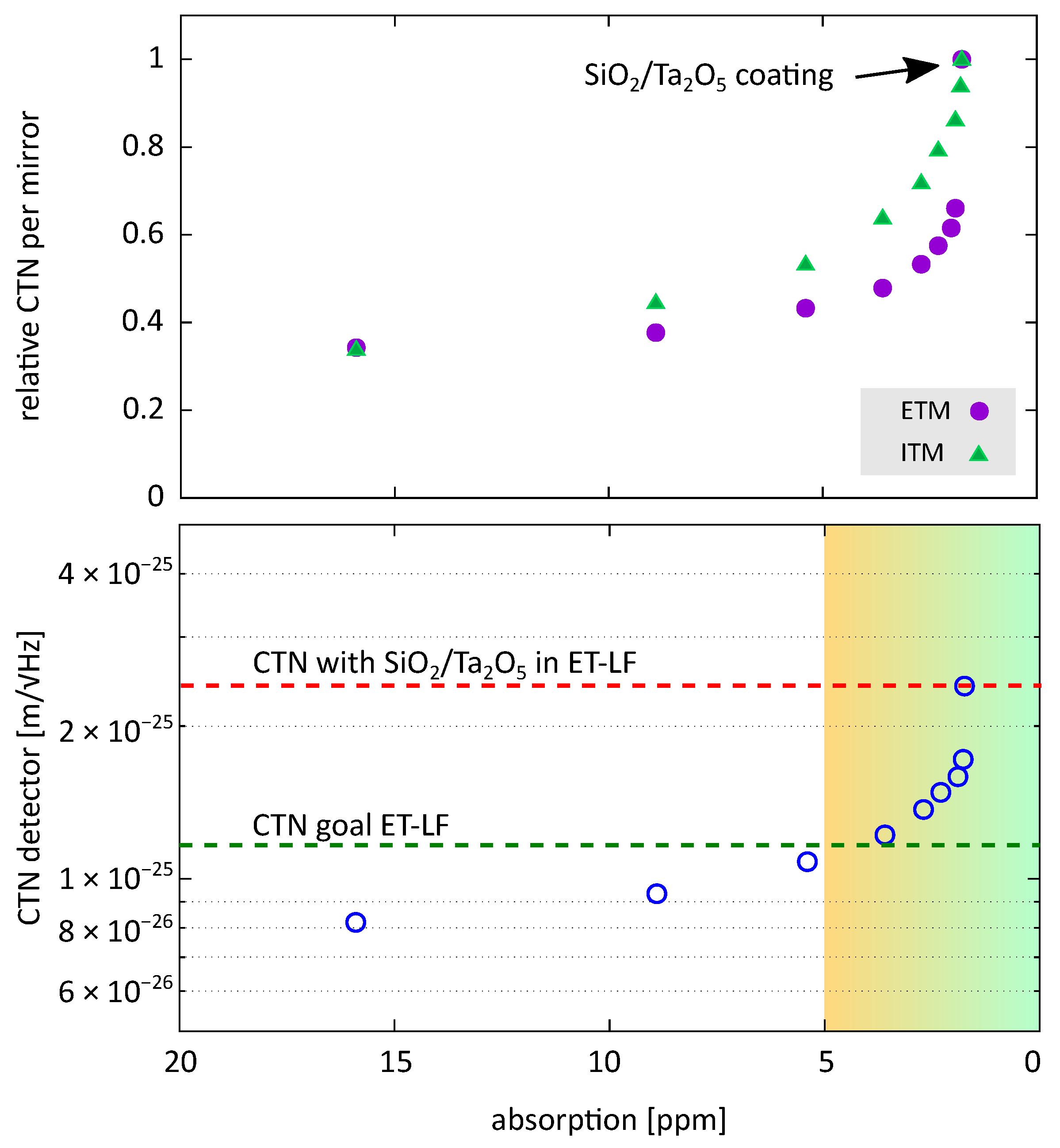
Figure 3 (top) shows the relative coating thermal noise ranging from aSi/SiN 1.35 only (very left), to various multimaterial scenarios, to SiO 2 /Ta 2 O 5 (very right), as a function of optical absorption. Coating thermal noise is normalized to that of SiO 2 /Ta 2 O 5 coatings. The purple dots represent a highly-reflective ETM coating, while the green triangles represent an ITM coating lower in reflectivity. The parameters used for the SiO 2 /Ta 2 O 5 layers can be found in Table 2.
With every point from left to right, one more bilayer of SiO 2 /Ta 2 O 5 was added to the top of the coating (starting from 0), reducing the absorption, but adding to coating thermal noise. The number of aSi/SiN 1.35 bilayers underneath was reduced accordingly, adjusting it in a way that kept the ETM transmission below 5 ppm, but as close to 5 ppm as possible and the ITM transmission below 4000 ppm. Coating thermal noise of the ITM, which consists of fewer layers, is impacted more by every bilayer of SiO 2 /Ta 2 O 5 added than the ETM.
Adding the first few bilayers of SiO 2 /Ta 2 O 5 significantly reduces the optical absorption of the coating while only adding slightly to coating thermal noise. After adding 3–4 bilayers, this trend inverts: coating thermal noise starts converging rapidly towards that of a SiO 2 /Ta 2 O 5 coating while further absorption reduction is minimal. After adding seven bilayers of SiO 2 /Ta 2 O 5 (second point from the right), the optical absorption of the aSi/SiN 1.35 layers is reduced to <10% of the overall coating absorption (which for a SiO 2 /Ta 2 O 5 coating was assumed to be 1.7 ppm [68], but lower absorption may be possible). For adding eight or more bilayers of SiO 2 /Ta 2 O 5 at the top of the ETM, the absorption would not further improve, while, with every bilayer added, coating thermal noise would converge towards that of a SiO 2 / Ta 2 O 5 coating. These points were omitted in the plot.
Figure 3 (bottom) shows coating thermal noise for the whole ET-LF detector calculated from the ETM and ITM noise levels shown in Figure 3 (top). The dashed, red line shows coating thermal noise achievable f using SiO 2 / Ta 2 O 5 coatings in ET-LF, while the dashed, green line shows the ET-LF goal. The shaded area indicates the absorption level, which is likely tolerable in ET-LF.

5. Summary and Conclusions

In this paper for the first time, properties such as energy gap, refractive index and extinction coefficient at 1550 nm of an IBS SiN 1.35 coating have been investigated.
Refractive Index: The sample underwent heat treatments from the as-deposited state to 1000 °C, in increments of 100 °C. The refractive index values exhibited a minimum between 700–800 °C, with n = 1.99 at 1550 nm and n = 2.00 at 1064 nm. These values were consistent with the literature for 1064 nm.
Oxidation: After the last heat treatment at 1000 °C, RBS measurements were performed to check the composition of the film. These measurements highlighted the presence of oxygen at the sample’s surface. The oxidation, which may likely have occurred only at higher heat treatment temperatures, affected only 4% of the total film thickness.
Optical Absorption: The sample was characterized for optical absorption at 1550 nm, and the values were converted into the extinction coefficient using the refractive index and thickness. The extinction coefficient was found in the range of 10 6 with a minimum of ( 4.4 ± 1.08 ) × 10 6 observed at 900 °C.
Highly-Reflective Coatings using SiN 1.35 : A possible mirror coating for future gravitational-wave detectors like the Einstein Telescope was discussed, combining SiN 1.35 as low refractive index material, with high refractive index aSi. Assuming a quarter-wavelength thicknesses, the requirement of high reflectivity in case of an ETM with a target transmission of ≤5 ppm can be met by employing 12 doublets of aSi/ SiN 1.35 , having a transmission of 4 ppm. The absorption of such a stack was estimated to be 16 ppm. To meet the typical less stringent ITM reflectivity, only eight doublets would be required. The coating thermal noise amplitude spectral density of such a coating was calculated considering a detector temperature of 10 K, which is the envisioned mirror temperature for the Einstein Telescope. The total coating thermal noise for both detector arms would be 0.82 × 10 21 m / Hz or a strain sensitivity of 0.82 × 10 25 / Hz when normalized to the 10 km arm length of the Einstein Telescope. As the absorption of aSi and mechanical loss of both aSi and SiN 1.35 are known to reduce towards lower temperatures, these results can be assumed as an upper limit in case this mirror coating is considered for future cryogenic detectors, like the Einstein Telescope.
Absorption Optimization of Highly-Reflective Coatings: A possible optimization of the absorption for proposed mirror coating design was discussed. In particular aSi/ SiN 1.35 doublets were replaced by SiO 2 / Ta 2 O 5 at the top of the stack while keeping the transmission ≤5 ppm. The replacement of three doublets would reduce the overall absorption by almost a factor of 3 while keeping coating thermal noise below the ET-LF goal. When replacing more than four doublets, the absorption reduces to <5 ppm, while coating thermal noise increases to slightly above the ET-LF goal. Previously, it has also been shown that the optical properties of SiN x can be tuned by changing the N/Si ratio in the layer composition [74], providing further possible mirror coating design optimizations.
Final Conclusion: In conclusion, this study enhanced our understanding of SiN 1.35 as a promising candidate material for future cryogenic gravitational-wave detectors, notably in combination with aSi. Possible optimization of the mirror coating design was discussed with the aim to decrease the absorption of the stack.

Author Contributions

Conceptualization, D., A.A., G.M., C.M., D.H., M.G. and J.S.; methodology, D. and A.A.; validation, D., A.A., G.M. and J.S.; formal analysis, D., A.A. and G.M.; investigation, D. and G.M.; resources, C.M., D.H., M.G. and J.S.; data curation, D., A.A. and G.M.; writing—original draft preparation, D., A.A., G.M., M.G. and J.S.; writing—review and editing, D., A.A., G.M., C.M., D.H., M.G. and J.S.; project administration, A.A. and J.S.; funding acquisition, J.S. All authors have read and agreed to the published version of the manuscript.

Funding

We acknowledge support by ETpathfinder (Interreg Vlaanderen-Nederland), E-TEST (Interreg Euregio Meuse-Rhine), the Dutch Research Council (NWO) Project No. VI.Vidi.203.062, and the Province of Limburg.

Institutional Review Board Statement

Not applicable.

Informed Consent Statement

Not applicable.

Data Availability Statement

All data collected as part of this project was made publicly available on https://zenodo.org once the article was accepted for publication.

Acknowledgments

We acknowledge the support of our colleagues within the LIGO Scientific Collaboration and the Virgo Collaboration. This paper has LIGO Document number LIGO-P2500569.

Conflicts of Interest

The authors declare no conflicts of interest.

References

  1. Trageser, W. Näherungsweise Integration der Feldgleichungen der Gravitation. In Das Relativitätsprinzip: Eine Sammlung von Originalarbeiten zur Relativitätstheorie Einsteins; Trageser, W., Ed.; Springer: Berlin/Heidelberg, Germany, 2018; pp. 149–158. [Google Scholar] [CrossRef]
  2. Einstein, A. Über Gravitationswellen. In Albert Einstein: Akademie-Vorträge; John Wiley & Sons, Ltd.: Hoboken, NJ, USA, 2005; pp. 135–149. [Google Scholar] [CrossRef]
  3. Centrella, J.; Baker, J.G.; Kelly, B.J.; van Meter, J.R. Black-hole binaries, gravitational waves, and numerical relativity. Rev. Mod. Phys. 2010, 82, 3069–3119. [Google Scholar] [CrossRef]
  4. Lasky, P.D. Gravitational Waves from Neutron Stars: A Review. Publ. Astron. Soc. Aust. 2015, 32, e034. [Google Scholar] [CrossRef]
  5. Ott, C.D. The gravitational-wave signature of core-collapse supernovae. Class. Quantum Gravity 2009, 26, 063001. [Google Scholar] [CrossRef]
  6. Roshan, R.; White, G. Using gravitational waves to see the first second of the Universe. Rev. Mod. Phys. 2025, 97, 015001. [Google Scholar] [CrossRef]
  7. Cai, R.G.; Cao, Z.; Guo, Z.K.; Wang, S.J.; Yang, T. The gravitational-wave physics. Natl. Sci. Rev. 2017, 4, 687–706. [Google Scholar] [CrossRef]
  8. Abbott, B.P.; Abbott, R.; Abbott, T.D.; Abernathy, M.R.; Acernese, F.; Ackley, K.; Adams, C.; Adams, T.; Addesso, P.; Adhikari, R.X.; et al. Observation of Gravitational Waves from a Binary Black Hole Merger. Phys. Rev. Lett. 2016, 116, 061102. [Google Scholar] [CrossRef]
  9. Aasi, J.; Abbott, B.; Abbott, R.; Abbott, T.; Abernathy, M.; Ackley, K.; Adams, C.; Adams, T.; Addesso, P.; Adhikari, R.; et al. Advanced LIGO. Class. Quantum Gravity 2015, 32, 074001. [Google Scholar] [CrossRef]
  10. Acernese, F.; Agathos, M.; Agatsuma, K.; Aisa, D.; Allemandou, N.; Allocca, A.; Amarni, J.; Astone, P.; Balestri, G.; Ballardin, G.; et al. Advanced Virgo: A second-generation interferometric gravitational wave detector. Class. Quantum Gravity 2015, 32, 024001. [Google Scholar] [CrossRef]
  11. Abbott, B.P.; Abbott, R.; Abbott, T.D.; Abraham, S.; Acernese, F.; Ackley, K.; Adams, C.; Adhikari, R.X.; Adya, V.B.; Affeldt, C.; et al. GWTC-1: A Gravitational-Wave Transient Catalog of Compact Binary Mergers Observed by LIGO and Virgo during the First and Second Observing Runs. Phys. Rev. X 2019, 9, 031040. [Google Scholar] [CrossRef]
  12. Abbott, R.; Abbott, T.D.; Abraham, S.; Acernese, F.; Ackley, K.; Adams, A.; Adams, C.; Adhikari, R.X.; Adya, V.B.; Affeldt, C.; et al. GWTC-2: Compact Binary Coalescences Observed by LIGO and Virgo during the First Half of the Third Observing Run. Phys. Rev. X 2021, 11, 021053. [Google Scholar] [CrossRef]
  13. Abbott, R.; Abbott, T.D.; Acernese, F.; Ackley, K.; Adams, C.; Adhikari, N.; Adhikari, R.X.; Adya, V.B.; Affeldt, C.; Agarwal, D.; et al. GWTC-2.1: Deep extended catalog of compact binary coalescences observed by LIGO and Virgo during the first half of the third observing run. Phys. Rev. D 2024, 109, 022001. [Google Scholar] [CrossRef]
  14. Abbott, R.; Abbott, T.D.; Acernese, F.; Ackley, K.; Adams, C.; Adhikari, N.; Adhikari, R.X.; Adya, V.B.; Affeldt, C.; Agarwal, D.; et al. GWTC-3: Compact Binary Coalescences Observed by LIGO and Virgo during the Second Part of the Third Observing Run. Phys. Rev. X 2023, 13, 041039. [Google Scholar] [CrossRef]
  15. Saulson, P.R. Fundamentals of Interferometric Gravitational Wave Detectors, 2nd ed.; World Scientific: Singapore, 2017. [Google Scholar] [CrossRef]
  16. Harry, G.M.; Armandula, H.; Black, E.; Crooks, D.R.M.; Cagnoli, G.; Hough, J.; Murray, P.; Reid, S.; Rowan, S.; Sneddon, P.; et al. Thermal noise from optical coatings in gravitational wave detectors. Appl. Opt. 2006, 45, 1569–1574. [Google Scholar] [CrossRef] [PubMed]
  17. Hong, T.; Yang, H.; Gustafson, E.K.; Adhikari, R.X.; Chen, Y. Brownian thermal noise in multilayer coated mirrors. Phys. Rev. D 2013, 87, 082001. [Google Scholar] [CrossRef]
  18. Punturo, M.; Abernathy, M.; Acernese, F.; Allen, B.; Andersson, N.; Arun, K.; Barone, F.; Barr, B.; Barsuglia, M.; Beker, M.; et al. The Einstein Telescope: A third-generation gravitational wave observatory. Class. Quantum Gravity 2010, 27, 194002. [Google Scholar] [CrossRef]
  19. ET Design Report Update 2020. ET Docs Code: ET-0007C-20. Available online: https://apps.et-gw.eu/tds/?r=18715 (accessed on 1 September 2025).
  20. Adhikari, R.X.; Arai, K.; Brooks, A.F.; Wipf, C.; Aguiar, O.; Altin, P.; Barr, B.; Barsotti, L.; Bassiri, R.; Bell, A.; et al. A cryogenic silicon interferometer for gravitational-wave detection. Class. Quantum Gravity 2020, 37, 165003. [Google Scholar] [CrossRef]
  21. Puppo, P.; Ricci, F. Cryogenics and Einstein Telescope. Gen. Relativ. Gravit. 2011, 43, 657–669. [Google Scholar] [CrossRef]
  22. Granata, M.; Amato, A.; Balzarini, L.; Canepa, M.; Degallaix, J.; Forest, D.; Dolique, V.; Mereni, L.; Michel, C.; Pinard, L.; et al. Amorphous optical coatings of present gravitational-wave interferometers. Class. Quantum Gravity 2020, 37, 095004. [Google Scholar] [CrossRef]
  23. Martin, I.; Armandula, H.; Comtet, C.; Fejer, M.M.; Gretarsson, A.; Harry, G.; Hough, J.; Mackowski, J.M.M.; MacLaren, I.; Michel, C.; et al. Measurements of a low-temperature mechanical dissipation peak in a single layer of Ta2O5 doped with TiO2. Class. Quantum Gravity 2008, 25, 055005. [Google Scholar] [CrossRef]
  24. Martin, I.W.; Chalkley, E.; Nawrodt, R.; Armandula, H.; Bassiri, R.; Comtet, C.; Fejer, M.M.; Gretarsson, A.; Harry, G.; Heinert, D.; et al. Comparison of the temperature dependence of the mechanical dissipation in thin films of Ta2O5 and Ta2O5 doped with TiO2. Class. Quantum Gravity 2009, 26, 155012. [Google Scholar] [CrossRef]
  25. Martin, I.W.; Bassiri, R.; Nawrodt, R.; Fejer, M.M.; Gretarsson, A.; Gustafson, E.; Harry, G.; Hough, J.; MacLaren, I.; Penn, S.; et al. Effect of heat treatment on mechanical dissipation in Ta2O5 coatings. Class. Quantum Gravity 2010, 27, 225020. [Google Scholar] [CrossRef]
  26. Tsai, D.S.; Huang, Z.L.; Chang, W.C.; Chao, S. Amorphous silicon nitride deposited by an NH3-free plasma enhanced chemical vapor deposition method for the coatings of the next generation laser interferometer gravitational waves detector. Class. Quantum Gravity 2022, 39, 15LT01. [Google Scholar] [CrossRef]
  27. Murray, P.G.; Martin, I.W.; Craig, K.; Hough, J.; Robie, R.; Rowan, S.; Abernathy, M.R.; Pershing, T.; Penn, S. Ion-beam sputtered amorphous silicon films for cryogenic precision measurement systems. Phys. Rev. D 2015, 92, 062001. [Google Scholar] [CrossRef]
  28. Liu, X.; White, B.E., Jr.; Pohl, R.O.; Iwanizcko, E.; Jones, K.M.; Mahan, A.H.; Nelson, B.N.; Crandall, R.S.; Veprek, S. Amorphous Solid without Low Energy Excitations. Phys. Rev. Lett. 1997, 78, 4418–4421. [Google Scholar] [CrossRef]
  29. Liu, X.; Metcalf, T.H.; Wang, Q.; Photiadis, D.M. Elastic Properties of Several Silicon Nitride Films. MRS Online Proc. Libr. 2007, 989, 1946–4274. [Google Scholar] [CrossRef]
  30. Terkowski, L.; Martin, I.W.; Axmann, D.; Behrendsen, M.; Pein, F.; Bell, A.; Schnabel, R.; Bassiri, R.; Fejer, M.M.; Hough, J.; et al. Influence of deposition parameters on the optical absorption of amorphous silicon thin films. Phys. Rev. Res. 2020, 2, 033308. [Google Scholar] [CrossRef]
  31. Molina-Ruiz, M.; Markosyan, A.; Bassiri, R.; Fejer, M.M.; Abernathy, M.; Metcalf, T.H.; Liu, X.; Vajente, G.; Ananyeva, A.; Hellman, F. Hydrogen-Induced Ultralow Optical Absorption and Mechanical Loss in Amorphous Silicon for Gravitational-Wave Detectors. Phys. Rev. Lett. 2023, 131, 256902. [Google Scholar] [CrossRef]
  32. Steinlechner, J.; Martin, I.W.; Bassiri, R.; Bell, A.; Fejer, M.M.; Hough, J.; Markosyan, A.; Route, R.K.; Rowan, S.; Tornasi, Z. Optical absorption of ion-beam sputtered amorphous silicon coatings. Phys. Rev. D 2016, 93, 062005. [Google Scholar] [CrossRef]
  33. Ray, S.K.; Das, S.; Maiti, C.K.; Lahiri, S.K.; Chakraborti, N.B. Effect of reactive-ion bombardment on the properties of silicon nitride and oxynitride films deposited by ion-beam sputtering. J. Appl. Phys. 1994, 75, 8145–8152. [Google Scholar] [CrossRef]
  34. Amato, A.; Bazzan, M.; Cagnoli, G.; Canepa, M.; Coulon, M.; Degallaix, J.; Demos, N.; Di Michele, A.; Evans, M.; Fabrizi, F.; et al. Development of ion-beam sputtered silicon nitride thin films for low-noise mirror coatings of gravitational-wave detectors. Phys. Rev. D 2025, 111, 042003. [Google Scholar] [CrossRef]
  35. Wallace, G.S.; Yaala, M.B.; Tait, S.C.; Vajente, G.; McCanny, T.; Clark, C.; Gibson, D.; Hough, J.; Martin, I.W.; Rowan, S.; et al. Non-stoichiometric silicon nitride for future gravitational wave detectors. Class. Quantum Gravity 2024, 41, 095005. [Google Scholar] [CrossRef]
  36. Steinlechner, J.; Martin, I.W.; Bell, A.S.; Hough, J.; Fletcher, M.; Murray, P.G.; Robie, R.; Rowan, S.; Schnabel, R. Silicon-Based Optical Mirror Coatings for Ultrahigh Precision Metrology and Sensing. Phys. Rev. Lett. 2018, 120, 263602. [Google Scholar] [CrossRef] [PubMed]
  37. Winkler, W.; Danzmann, K.; Rüdiger, A.; Schilling, R. Heating by optical absorption and the performance of interferometric gravitational-wave detectors. Phys. Rev. A 1991, 44, 7022–7036. [Google Scholar] [CrossRef] [PubMed]
  38. Pinard, L.; Michel, C.; Sassolas, B.; Balzarini, L.; Degallaix, J.; Dolique, V.; Flaminio, R.; Forest, D.; Granata, M.; Lagrange, B.; et al. Mirrors used in the LIGO interferometers for first detection of gravitational waves. Appl. Opt. 2017, 56, C11–C15. [Google Scholar] [CrossRef] [PubMed]
  39. Fang, S.; Lu, Z.; Ji, X.; Jiao, H.; Cheng, X.; Wang, Z.; Zhang, J. High-performance hydrogenated amorphous silicon deposited by ion-beam sputtering for gravitational-wave detectors. Phys. Rev. D 2023, 108, 062002. [Google Scholar] [CrossRef]
  40. Pan, H.W.; Kuo, L.C.; Huang, S.Y.; Wu, M.Y.; Juang, Y.H.; Lee, C.W.; Chen, H.C.; Wen, T.T.; Chao, S. Silicon nitride films fabricated by a plasma-enhanced chemical vapor deposition method for coatings of the laser interferometer gravitational wave detector. Phys. Rev. D 2018, 97, 022004. [Google Scholar] [CrossRef]
  41. Southworth, D.R.; Barton, R.A.; Verbridge, S.S.; Ilic, B.; Fefferman, A.D.; Craighead, H.G.; Parpia, J.M. Stress and Silicon Nitride: A Crack in the Universal Dissipation of Glasses. Phys. Rev. Lett. 2009, 102, 225503. [Google Scholar] [CrossRef]
  42. Ziegler, J.F. SRIM-2003. Nucl. Instruments Methods Phys. Res. Sect. Beam Interact. Mater. Atoms 2004, 219–220, 1027–1036. [Google Scholar] [CrossRef]
  43. Sellmeier. Zur Erklärung der abnormen Farbenfolge im Spectrum einiger Substanzen. Ann. Phys. 1871, 219, 272–282. [Google Scholar] [CrossRef]
  44. Malitson, I.H. Interspecimen Comparison of the Refractive Index of Fused Silica. J. Opt. Soc. Am. 1965, 55, 1205–1209. [Google Scholar] [CrossRef]
  45. Humbach, O.; Fabian, H.; Grzesik, U.; Haken, U.; Heitmann, W. Analysis of OH absorption bands in synthetic silica. J.-Non-Cryst. Solids 1996, 203, 19–26. [Google Scholar] [CrossRef]
  46. O’Leary, S.K.; Johnson, S.R.; Lim, P.K. The relationship between the distribution of electronic states and the optical absorption spectrum of an amorphous semiconductor: An empirical analysis. J. Appl. Phys. 1997, 82, 3334–3340. [Google Scholar] [CrossRef]
  47. Tauc, J. Amorphous and Liquid Semiconductors; Springer Science & Business Media: Berlin/Heidelberg, Germany, 2012. [Google Scholar]
  48. Cauchy, A.L. Sur la réfraction et la réflexion de la lumière. In Oeuvres Complètes: Series 2; Cambridge Library Collection—Mathematics; Cambridge University Press: Cambridge, UK, 2009; pp. 151–157. [Google Scholar] [CrossRef]
  49. Amato, A.; Terreni, S.; Dolique, V.; Forest, D.; Gemme, G.; Granata, M.; Mereni, L.; Michel, C.; Pinard, L.; Sassolas, B.; et al. Optical properties of high-quality oxide coating materials used in gravitational-wave advanced detectors. J. Phys. Mater. 2019, 2, 035004. [Google Scholar] [CrossRef]
  50. Urbach, F. The Long-Wavelength Edge of Photographic Sensitivity and of the Electronic Absorption of Solids. Phys. Rev. 1953, 92, 1324. [Google Scholar] [CrossRef]
  51. Pan, Y.; Inam, F.; Zhang, M.; Drabold, D.A. Atomistic Origin of Urbach Tails in Amorphous Silicon. Phys. Rev. Lett. 2008, 100, 206403. [Google Scholar] [CrossRef]
  52. Robertson, J. Electronic Structure of Defects in Amorphous Silicon Nitride. MRS Online Proc. Libr. 1992, 284, 65–76. [Google Scholar] [CrossRef]
  53. Franta, D.; Nečas, D.; Ohlídal, I.; Giglia, A. Dispersion model for optical thin films applicable in wide spectral range. In Proceedings of the Optical Systems Design 2015: Optical Fabrication, Testing, and Metrology V, Jena, Germany, 7–10 September 2015; Duparré, A., Geyl, R., Eds.; International Society for Optics and Photonics, SPIE: Bellingham, WA, USA, 2015; 9628, p. 96281U. [Google Scholar] [CrossRef]
  54. de Marcos, L.V.R.; Larruquert, J.I. Analytic optical-constant model derived from Tauc-Lorentz and Urbach tail. Opt. Express 2016, 24, 28561–28572. [Google Scholar] [CrossRef]
  55. Ferlauto, A.S.; Ferreira, G.M.; Pearce, J.M.; Wronski, C.R.; Collins, R.W.; Deng, X.; Ganguly, G. Analytical model for the optical functions of amorphous semiconductors from the near-infrared to ultraviolet: Applications in thin film photovoltaics. J. Appl. Phys. 2002, 92, 2424–2436. [Google Scholar] [CrossRef]
  56. Alexandrovski, A.; Fejer, M.; Markosian, A.; Route, R. Photothermal common-path interferometry (PCI): New developments. In Proceedings of the Solid State Lasers XVIII: Technology and Devices, San Jose, CA, USA, 24–29 January 2009; Clarkson, W.A., Hodgson, N., Shori, R.K., Eds.; International Society for Optics and Photonics, SPIE: Bellingham, WA, USA, 2009; 7193, p. 71930D. [Google Scholar] [CrossRef]
  57. Bauer, J. Optical properties, band gap, and surface roughness of Si3N4. Phys. Status Solidi A 1977, 39, 411–418. [Google Scholar] [CrossRef]
  58. Bruyere, J.C.; Savall, C.; Reynes, B.; Brunel, M.; Ortega, L. Density of as-deposited and annealed thin silicon nitride films. J. Phys. Appl. Phys. 1993, 26, 713. [Google Scholar] [CrossRef]
  59. Jiang, W.; Xu, D.; Yao, S.; Xiong, B.; Wang, Y. Effect of hyperthermal annealing on LPCVD silicon nitride. Mater. Sci. Semicond. Process. 2016, 43, 222–229. [Google Scholar] [CrossRef]
  60. Fourrier, A.; Bosseboeuf, A.; Daniel Bouchier, D.B.; Guy Gautherin, G.G. Annealing Effect on Mechanical Stress in Reactive Ion-Beam Sputter-Deposited Silicon Nitride Films. Jpn. J. Appl. Phys. 1991, 30, 1469. [Google Scholar] [CrossRef]
  61. Abernathy, M.R.; Reid, S.; Chalkley, E.; Bassiri, R.; Martin, I.W.; Evans, K.; Fejer, M.M.; Gretarsson, A.; Harry, G.M.; Hough, J.; et al. Cryogenic mechanical loss measurements of heat-treated hafnium dioxide. Class. Quantum Gravity 2011, 28, 195017. [Google Scholar] [CrossRef]
  62. Robie, R.R. Characterisation of the Mechanical Properties of Thin-Film Mirror Coating Materials for Use in Future Interfero-Metric Gravitational Wave Detectors. Ph.D. Thesis, University of Glasgow, Glasgow, UK, 2018. Available online: https://theses.gla.ac.uk/30645/ (accessed on 1 September 2025).
  63. Granata, M.; Craig, K.; Cagnoli, G.; Carcy, C.; Cunningham, W.; Degallaix, J.; Flaminio, R.; Forest, D.; Hart, M.; Hennig, J.S.; et al. Cryogenic measurements of mechanical loss of high-reflectivity coating and estimation of thermal noise. Opt. Lett. 2013, 38, 5268–5271. [Google Scholar] [CrossRef] [PubMed]
  64. Birney, I.A.; Steinlechner, J.; Tornasi, Z.; MacFoy, S.; Vine, D.; Bell, A.S.; Gibson, D.; Hough, J.; Rowan, S.; Sortais, P.; et al. Amorphous Silicon with Extremely Low Absorption: Beating Thermal Noise in Gravitational Astronomy. Phys. Rev. Lett. 2018, 121, 191101. [Google Scholar] [CrossRef] [PubMed]
  65. Amato, A. Low Thermal Noise Coating for New Generation Gravitational-Wave Detectors. Ph.D. Thesis, Université de Lyon, Lyon, France, 2019. [Google Scholar]
  66. Abernathy, M.R. Mechanical Properties of Coating Materials for Use in the Mirrors of Interferometric Gravitational Wave Detectors. Ph.D. Thesis, University of Glasgow, Glasgow, UK, 2012. [Google Scholar]
  67. Freund, L.; Suresh, S. Thin Film Materials: Stress, Defect Formation and Surface Evolution; Cambridge University Press: Cambridge, UK, 2004. [Google Scholar]
  68. Steinlechner, J.; Martin, I.W.; Hough, J.; Krüger, C.; Rowan, S.; Schnabel, R. Thermal noise reduction and absorption optimization via multimaterial coatings. Phys. Rev. D 2015, 91, 042001. [Google Scholar] [CrossRef]
  69. Bamber, M.; Cooke, K.; Mann, A.; Derby, B. Accurate determination of Young’s modulus and Poisson’s ratio of thin films by a combination of acoustic microscopy and nanoindentation. Thin Solid Films 2001, 398–399, 299–305. [Google Scholar] [CrossRef]
  70. Frey, B.J.; Leviton, D.B.; Madison, T.J. Temperature-dependent refractive index of silicon and germanium. In Proceedings of the Optomechanical Technologies for Astronomy, Orlando, FL, USA, 24–31 May 2006; Atad-Ettedgui, E., Antebi, J., Lemke, D., Eds.; International Society for Optics and Photonics, SPIE: Bellingham, WA, USA, 2006; 6273, p. 62732J. [Google Scholar] [CrossRef]
  71. Cho, C.H. Characterization of Young’s modulus of silicon versus temperature using a “beam deflection” method with a four-point bending fixture. Curr. Appl. Phys. 2009, 9, 538–545. [Google Scholar] [CrossRef]
  72. Yam, W.; Gras, S.; Evans, M. Multimaterial coatings with reduced thermal noise. Phys. Rev. D 2015, 91, 042002. [Google Scholar] [CrossRef]
  73. Pierro, V.; Fiumara, V.; Chiadini, F.; Granata, V.; Durante, O.; Neilson, J.; Di Giorgio, C.; Fittipaldi, R.; Carapella, G.; Bobba, F.; et al. Ternary quarter wavelength coatings for gravitational wave detector mirrors: Design optimization via exhaustive search. Phys. Rev. Res. 2021, 3, 023172. [Google Scholar] [CrossRef]
  74. Charifi, H.; Slaoui, A.; Stoquert, J.P.; Chaib, H.; Hannour, A. Opto-Structural Properties of Silicon Nitride Thin Films Deposited by ECR-PECVD. World J. Condens. Matter Phys. 2016, 6, 7–16. [Google Scholar] [CrossRef]
Figure 1. Transmission spectra measured by spectrophotometry: (a) Top: The blue line represents the experimental data for the sample in its as-deposited state, the dashed, red line shows the data after the sample was heat-treated at 600 °C, and the dotted, green line corresponds to the data after heat treatment at 900 °C. Bottom: Difference in transmittance between the as-deposited and heated coatings, with the dashed, red line representing the change at 600 °C and the dotted, green line representing the change at 900 °C. (b) OJL fits for the treatment at 600 °C (black dots) and the corresponding experimental transmission spectrum (dashed, red line). Bottom: The residuals of the fit and the corresponding experimental data.
Coatings 15 01465 g001
Figure 2. Panel (a): Evolution of the refractive indices at 1064 nm (orange squares) and 1550 nm (blue circles) and thickness (green triangles) obtained from optical models as a function of heat temperature. Panel (b): Extinction coefficient κ at 1550 nm as a function of heat treatment temperature.
Coatings 15 01465 g002
Figure 3. Coating thermal noise (CTN) as a function of optical absorption: (Top): Relative CTN for ETM and ITM coatings: The points to the very left represent coatings made of aSi/ SiN 1.35 . Then, going from left to right, every point represents one more SiO 2 / Ta 2 O 5 bilayer added at the top up to 7 bilayers of SiO 2 / Ta 2 O 5 , while aSi/ SiN 1.35 layers are removed, keeping R > 99.4 % . CTN is normalized to that of a SiO 2 / Ta 2 O 5 coating (points at the very right). (Bottom): Total CTN in the ET-LF detector. The dashed, red line shows CTN, if currently-used SiO 2 / Ta 2 O 5 were used in ET-LF. The dashed, green line represents the ET-LF CTN goal. The shaded area indicates an absorption level between 0 (green) and 5 ppm (orange).
Coatings 15 01465 g003
Table 1. Properties of the SiN 1.35 thin film as a function of heat treatment temperature T, Refractive indices n and thickness t obtained from optical models, and extinction coefficient κ @1550 nm measured via PCI.
Tn (1550 nm) an (1064 nm) at a κ (1550 nm)
°Cnm × 10 6
201.992.0048111.30 ± 1.13
2002.022.034757.96 ± 0.79
3002.012.024768.45 ± 0.85
4002.012.014786.54 ± 0.65
5002.002.014806.41 ± 0.64
6002.002.014805.70 ± 0.62
7001.992.004825.09 ± 0.51
8001.992.004825.25 ± 0.52
9001.992.004824.40 ± 1.08
10001.992.004856.40 ± 1.19
a Uncertainties in the refractive indices and thickness are approximately 1% of their values.
Table 2. Silicon nitride and a-Si properties used for simulations. In particular, extinction coefficient κ , refractive index n measured at 1550 nm, mechanical loss angle ϕ , post-deposition heat treatment temperature T heat treatm . , Young’s modulus Y and Poisson’s ratio σ are listed for the different materials.
Material κ n 1550 nm ϕ T heat treatm . Y σ
× 10 6 × 10 4 (°C)(GPa)
SiN6.54 a2.01 a4.15 b [65]400250 [65]0.24 [65]
a-Si12.2 [64]3.39 c0.17 [64]400147 [66]0.22 [67]
SiO 2 0.28 d [68]1.45 [49]8.5 [62]50072 [69]0.17 [69]
Ta 2 O 5 0.28 d [68]2.05 [54]5.0 [25]500121 [22]0.29 [22]
cSi3.45 [70]130 [71]0.28 [71]
a this work; b for heat treatment to 500 °C, extrapolated to 100 Hz; c coating deposited at 400 °C; d calculated from measured stack absorption, assuming SiO 2 and Ta 2 O 5 to contribute equally.
Disclaimer/Publisher’s Note: The statements, opinions and data contained in all publications are solely those of the individual author(s) and contributor(s) and not of MDPI and/or the editor(s). MDPI and/or the editor(s) disclaim responsibility for any injury to people or property resulting from any ideas, methods, instructions or products referred to in the content.