Article

Pulse-Controlled Electrodeposition of Ni/ZrO2 with Coumarin Additive: A Parametric Study

by
Maria Myrto Dardavila
* and
Constantina Kollia
Laboratory of General Chemistry, School of Chemical Engineering, National Technical University of Athens, 15780 Zografou, Greece
*
Author to whom correspondence should be addressed.
Coatings 2025, 15(12), 1400; https://doi.org/10.3390/coatings15121400
Submission received: 3 November 2025 / Revised: 21 November 2025 / Accepted: 26 November 2025 / Published: 1 December 2025
(This article belongs to the Section Surface Characterization, Deposition and Modification)

Abstract

Ni/ZrO2 composite coatings are increasingly employed, yet the influence of organic additives under a pulse current regime on their electrodeposition remains insufficiently addressed. This study investigates the combined effect of pulse frequency (0.01–100 Hz) and coumarin concentration (0–2 mmol L−1) on the co-deposition behavior, microstructure, and properties of Ni/ZrO2 coatings electrodeposited from a Watts-type bath. The structural, morphological, and compositional features were analyzed through SEM/EDS, FE-SEM, and XRD, while microhardness and surface roughness were determined to establish processing–structure–property correlations. The results revealed that coumarin acts as an effective levelling agent, promoting smoother and finer-grained coatings while modifying ZrO2 incorporation and Ni crystallographic orientation. Increasing coumarin concentration led to a notable refinement of nickel crystallites and a rise in hardness, reaching values close to 650 HV under optimal PC conditions. Pulse frequency was found to strongly influence the microstructural characteristics and particle co-deposition rates, particularly at low frequencies, where a balance between additive adsorption and current modulation favored particle incorporation and enhanced the microhardness. It was demonstrated that the synergistic control of pulse parameters and coumarin concentration enables the design of Ni/ZrO2 composite coatings with tailored microstructure, low roughness, and superior hardness for demanding applications.

1. Introduction

Nickel-based electrodeposited coatings are widely employed in mechanical, automotive, and energy sectors owing to their high hardness, good wear resistance, and corrosion protection, particularly on steel substrates that can be susceptible to corrosion in harsh environments [1,2]. Embedding ceramic nano- or micron-sized particles (e.g., ZrO2, TiO2, Al2O3, SiC) into the nickel matrix further improves durability and may even impart unique properties to the coatings like hydrophobicity [1,3,4,5]. Ni/ZrO2 composites in particular show enhanced hardness, wear, and corrosion resistance relative to pure Ni [1,6,7,8]. Electrodeposition offers a convenient, cost-effective, and scalable route to such metal–matrix composites (MMCs), with easy control of thickness and composition, even on complex substrate shapes [1,9].
Within electrodeposition methods, pulse current (PC) electrodeposition modulates on/off times (Ton and Toff) to influence nucleation and growth, restore the interfacial concentration of the metal cations during off-time, influence the adsorption–desorption phenomena taking place at the cathode/electrolyte (catholyte) interface, refine grains, improve particle distribution, and even impart higher incorporation rates of the embedded ceramic particles; numerous studies report smoother morphology and better mechanical and/or corrosion performance for pulse-plated Ni composites versus their DC plated counterparts [1,10,11].
The use of organic additives (brighteners/levelers/surfactants) that adsorb at active cathodic sites, modify overpotential, suppress hydrogen evolution, control texture, and impose considerable crystalline refinement, is a common practice in the electroplating industry [12]. In nickel plating, coumarin (1,2-benzopyrone,) is a well-known semi-bright leveler that produces smooth deposits, affects the crystallographic orientation, and induces tensile stress due to the incorporation of hydrogen in the Ni coating [6,13,14]; the action of coumarin is attributed to preferential adsorption at cathodic high-energy growth sites and subsequent inhibition of their growth [13,15,16]. Industrial guidance also lists coumarin among standard leveling agents in semi-bright Ni electrolytes [17].
Although the effects of coumarin on nickel electrodeposition have been widely investigated, studies examining its role in Ni-based composite coatings are comparatively scarce. Walsh et al. [18] reported that adding up to 5 g dm−3 of coumarin to a SiC-containing Watts bath reduced the microhardness of the resulting Ni/SiC composites while improving their abrasive wear resistance. For Ni/ZrO2 systems, our previous work demonstrated that even a low concentration of coumarin (0.5 mmol L−1) under direct current conditions significantly modified the crystallographic texture, reduced surface roughness, enhanced microhardness, and affected zirconia incorporation [6]. These observations underline the important interplay between additives, suspended particles, and the evolving nickel matrix in defining the properties of composite coatings.
Pulse current electrodeposition offers a versatile route for producing Ni-based composite coatings with enhanced functional performance when the pulse parameters are properly controlled. Key PC parameters such as the duty cycle ( γ = Ton/(Ton + Toff)) and pulse frequency (f = 1/Ton + Toff) strongly affect the resulting coating characteristics. The influence of these parameters is system-dependent; hence, the correlation between pulse plating conditions, microstructural evolution, and the final properties of Ni matrix composites has been frequently examined [4,10,11,19,20]. Regarding the role of pulse frequency, Liu et al. [11] demonstrated that increasing f from 10 Hz to 50 Hz promoted SiC nanoparticle incorporation within the Ni matrix, resulting in coatings with superior wear and corrosion resistance but reduced microhardness. In the case of Ni/TiO2 composites, a frequency increase from 0.1 Hz to 10 Hz enhanced both TiO2 particle co-deposition and microhardness, whereas a further rise to 100 Hz led to a decline in these values. Additionally, higher f values favored the development of the [211] crystallographic orientation over the [100] one [19]. Similarly, Li Chen et al. [21] observed that elevating the pulse frequency from 10 Hz to 1000 Hz modified the texture of Ni/Al2O3 composite coatings from a (111) preferred orientation toward a random structure and increased the embedment of Al2O3 particles. However, this increase in f adversely affected the microhardness and wear resistance of the coatings under dry sliding conditions.
The synergistic influence of pulse electrodeposition and organic additives on the formation and properties of nickel matrix composites remains largely unexplored [22]. This research gap arises from the complexity introduced under PC conditions when both additives and suspended particles are present in the electrolyte. Organic additives such as coumarin may exhibit strong, frequency-dependent adsorption–desorption behavior at the cathode surface, complicating the interpretation of pulse-controlled deposition processes. At the same time, composite electrodeposition imposes additional challenges related to particle dispersion stability, pulsed mass-transport, and colloidal interactions that govern particle attachment to the growing metal matrix [10,22].
To the best of our knowledge, the combined effects of pulse frequency and coumarin concentration on nanoparticle incorporation, nucleation, and growth behavior, crystallographic texture, and the resulting mechanical properties of Ni-based composites have not yet been addressed. To fill this gap, the present study conducts a systematic parametric investigation of pulse-controlled electrodeposition of Ni/ZrO2 composites in the presence of coumarin. The work evaluates the simultaneous influence of pulse frequency (0.01, 0.1, 1, 10, and 100 Hz) and coumarin concentration (0, 1, and 2 mmol L−1) on the microstructural, morphological, and compositional characteristics of the resulting coatings and correlates these features with their microhardness and surface roughness, thereby establishing clear processing–structure–property relationships for the design of high-performance composite electrocoatings.

2. Materials and Methods

2.1. Electrolyte Composition

Ni/ZrO2 composite coatings were electrodeposited from a Watts-type electrolyte, prepared using analytical-grade reagents and deionized water. The bath contained NiSO4·6H2O (Alfa Aesar, Heysham, Lancashire, UK, 98% min, 300 g L−1), NiCl2·6H2O (Alfa Aesar, 93%, 35 g L−1), and H3BO3 (Penta, Prague, Czech Republic, 99.5% min, 40 g L−1) as the main constituents. Zirconia (ZrO2) particles (Sigma-Aldrich, Darmstadt, Germany, 99%, <5 μm) were added at a concentration of 40 g L−1 to produce composite coatings. Coumarin (C9H6O2, Sigma-Aldrich, 98%) was introduced into the electrolyte as an organic additive at concentrations of Ccoum = 0, 1, and 2 mmol L−1. The pH of the electrolyte was adjusted to 4.4 ± 0.1 using aqueous solutions of sulfuric acid or sodium hydroxide. During deposition, the bath temperature was maintained at 50 ± 1 °C using a thermostated water jacket. Continuous agitation throughout the electrodeposition process was achieved with a high-shear homogenizer (IKA, Staufen, Germany, T25, 12,000 rpm) to ensure homogeneous dispersion of ZrO2 particles and prevent their sedimentation or agglomeration [6]. Between experiments, the Watts bath remained under constant magnetic stirring (Table 1).

2.2. Electrodeposition Procedure

Electrodeposition was performed in a three-electrode double-walled glass cell using a BANK Electronik Wenking potentiostat/galvanostat (Model ST 88) connected to a BANK Electronik Wenking pulse generator (Model DPC 72 BANK). A pure nickel plate (Ni foil; Sigma-Aldrich, 99.9%) served as the anode, a saturated calomel electrode (SCE) as the reference, and brass cylinders (active area 0.049 dm2) as the cathodes. The brass cylinders were thoroughly polished to a mirror-like finish using rotating fiber polishing brushes mounted on an automatic polishing machine to ensure perfect adhesion of the coatings. After polishing, their surface roughness was measured as Ra ≈ 0.022 ± 0.001 μm. Prior to electrodeposition, the polished substrates were then ultrasonically cleaned and degreased in acetone and deionized water, air-dried and insulated circumferentially with thermoplastic tube of proper diameter.
Coatings were obtained under PC conditions with a 70% duty cycle and pulse frequencies of 0.01, 0.1, 1, 10, and 100 Hz at a peak current density of 5 A dm−2. Hence, three series of composite coatings were produced under PC conditions for Ccoum = 0, 1, and 2 mmol L−1 (series A, B, C). A duty cycle of 70% was selected based on our previous work on Ni/ZrO2 pulse electrodeposition from an additive-free bath [10], which demonstrated that this Ton/Toff ratio provides a suitable balance between instantaneous current density, mass-transport recovery, and surface relaxation processes. Lower duty cycles resulted in excessively slow deposition, while higher duty cycles approached DC-like behavior. Maintaining a constant duty cycle allowed the isolated evaluation of pulse frequency and additive concentration, which are the primary variables investigated in this study. After deposition, the coatings were rinsed in deionized water and ultrasonically cleaned for 5 min to remove any loosely adherent particles. The samples were then dried at room temperature prior to characterization.
In Table 2, the Ni/ZrO2 composite coatings’ abbreviations and their electrodeposition parameters values (coumarin concentration and pulse frequency) are shown.

2.3. Characterization Techniques

The surface morphology of the coatings was observed using scanning electron microscopy (SEM, FEI Quanta 200) and the ZrO2 incorporation rate within the Ni matrix was quantified via energy-dispersive X-ray spectroscopy (EDS; EDAX) coupled to the utilized setup, based on the atomic percentage of zirconium. Field emission scanning electron microscopy (FE-SEM; JEOL FE-SEM JSM7401F) was employed to acquire high-resolution images, allowing investigation of the surface microstructural features of the electrodeposited coatings and the dispersion and distribution of embedded zirconia particles.
The X-ray diffraction (XRD) analyses of the deposits were performed by a SIEMENS X-Ray Diffractometer 5000 with Cu radiation (λ = 0.154 nm), applying a 0.1° per minute scanning rate from 2θ 20° to 160°.
With the resulting XRD data, the mean crystallite size (d) was estimated using the Debye–Scherrer Equation (1):
d = K · λ B · c o s θ · 180 π
where K = 0.94, λ is the X-ray wavelength, and B represents the peak broadening at FWHM of each diffraction peak [10].
The relative texture coefficients, RTC(hkl), were calculated to assess preferred orientations, according to Equation (2):
R T C ( h k l ) = I h k l / I h k l 0 1 6 I h k l / I h k l 0
Where Ihkl and I h k l 0 correspond to the measured and standard relative intensities of a randomly oriented nickel powder sample, respectively. Ihkl and I h k l 0 were considered for the six first-ordered planes (hkl) of Ni, namely (111), (200), (220), (311) (331) and (420), which span between 2θ 20° and 160° [10].
The microhardness of the coatings was measured using a Vickers microhardness tester (Wilson 402 MVD) under a 100 g load and a 15 s dwell time. Reported values represent the average of at least 10 measurements taken across different positions of each sample.
The surface roughness (Ra) of the electrodeposited coatings was determined with a Hommel T1000 digital profilometer, averaging five independent measurements at random surface positions.

3. Results

3.1. Microscopical Investigation and Compositional Analysis

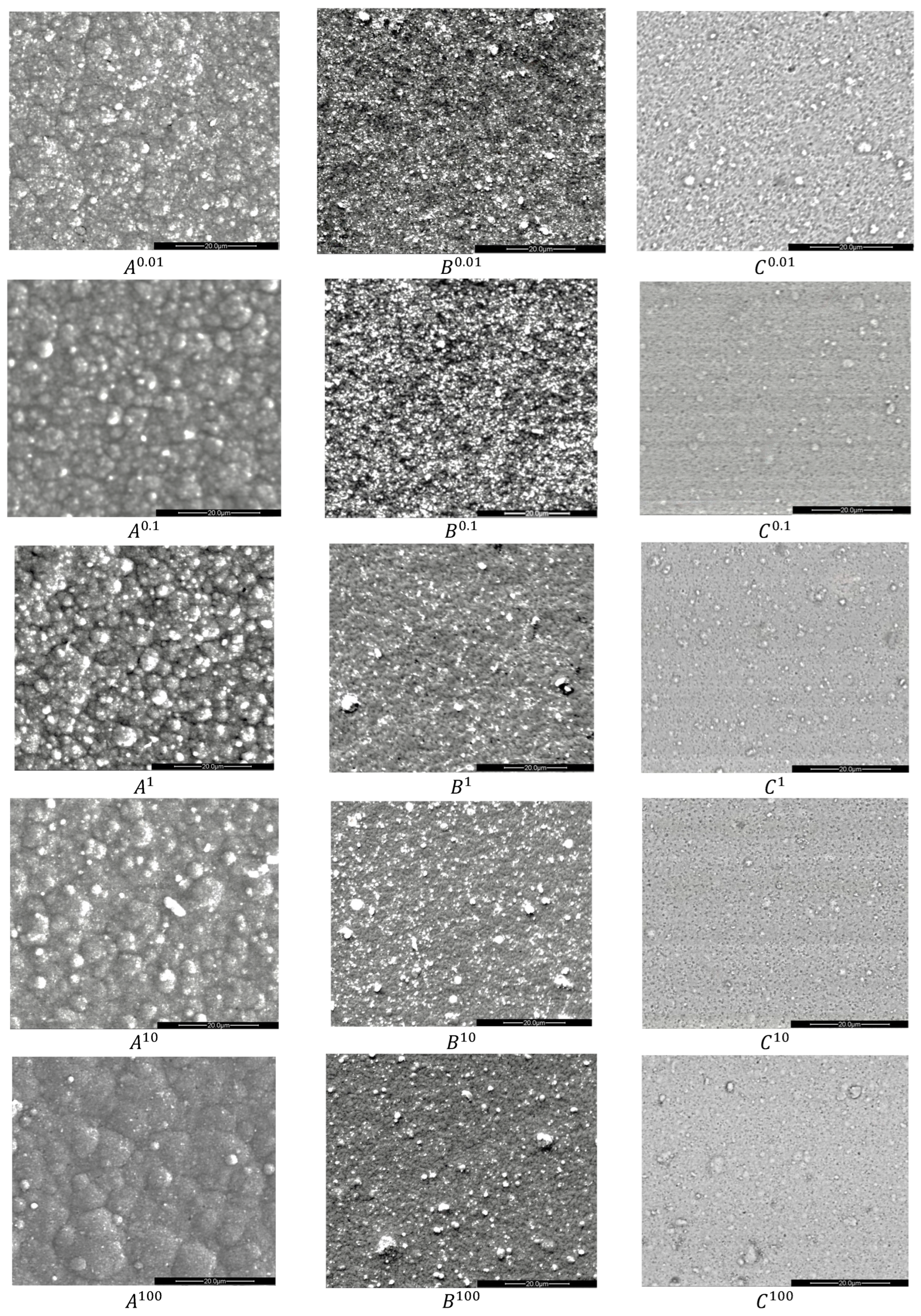
To assess how coumarin concentration and pulse frequency jointly affect the surface features of Ni/ZrO2 coatings, SEM observations were performed for all deposited samples. The resulting SEM micrographs for PC coatings with Ccoum = 0, 1, and 2 mmol L−1 are presented in Figure 1.
The PC composite coatings of series A exhibit the characteristic cauliflower-like surface morphology [10], as shown in the SEM micrographs of Figure 1. Upon the addition of coumarin at Ccoum = 1 mmol L−1, corresponding to the PC coatings of series B, the surface becomes noticeably smoother and finer, with this effect further intensified in the PC coatings of series C obtained at Ccoum = 2 mmol L−1. In these composites, the cauliflower-like morphology characteristic of series A is substantially suppressed. Furthermore, the effect of coumarin under PC conditions appears to be independent of the applied pulse frequency, as no significant morphological differences are observed among the PC Ni/ZrO2 coatings within series B and C.
Spot EDS analyses confirmed that the ZrO2 particles in the Ni/ZrO2 composite coatings correspond to the lighter grey, rounded features visible on the composites’ surfaces in the SEM micrographs of Figure 1 [10]. This finding verifies the successful incorporation of ZrO2 particles into the Ni matrix under PC deposition regimes, with the presence of coumarin. Furthermore, a sufficiently uniform distribution of the particles across the coatings’ surfaces can be observed.
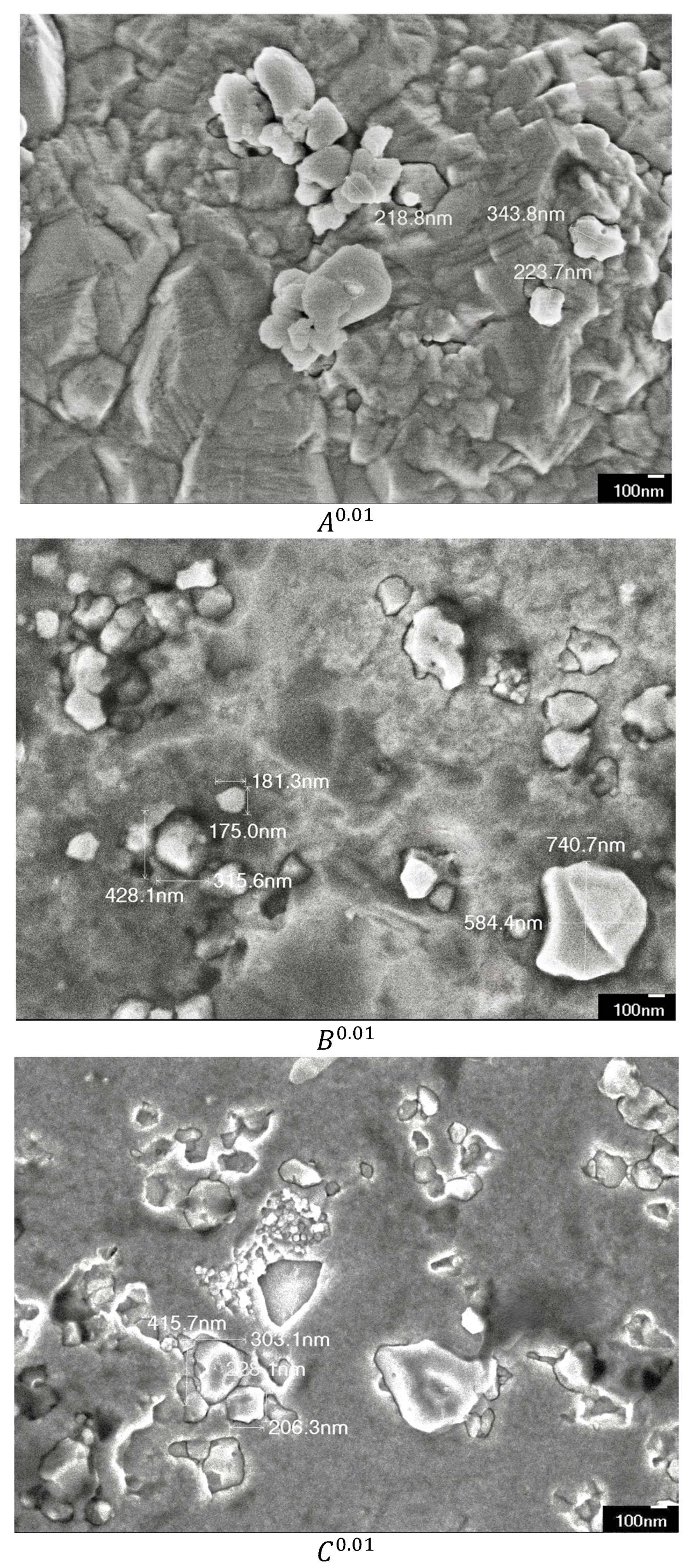
The FE-SEM micrographs of PC electrodeposited coatings under pulse frequency f = 0.01 Hz ( A 0.01 , B 0.01 , C 0.01 ) are included in Figure 2. These high-resolution FE-SEM images (30,000×) provide a clearer insight into the dispersion of the co-deposited ZrO2 particles and reveal the effect of coumarin concentration on the microstructural characteristics of the nickel matrix, particularly in terms of grain refinement and surface smoothing. It is evident that, irrespective of the coumarin concentration, the zirconia particles—appearing as lighter grey, pebble-like features—are incorporated within the nickel matrix either individually, close to one another, or even piled, thus forming micro-sized clusters.
Measurements of particle diameters show that their size ranges from approximately 200 nm to 800 nm, placing them within the submicron scale. It should be noted that, although the commercial ZrO2 powder used in the electrolyte is specified as <5 μm, the supplied material is polydispersed and contains both micron-sized and submicron-sized particles. Under strong agitation (12,000 rpm), larger agglomerates break down, while the smaller and more mobile submicron particles preferentially co-deposit within the Ni matrix [6]. Similar preferential entrapment of finer particle fractions during composite electrodeposition is widely reported in the literature [18,23,24,25]. The 200–800 nm entities observed in the FE-SEM images therefore correspond to the actual co-deposited particle size distribution rather than the nominal powder specification.
In the FE-SEM images of the coumarin-free PC coating ( A 0.01 ) the microstructural details of the nickel matrix, particularly its crystalline structure, are distinctly visible. In contrast, for the coatings deposited in the presence of coumarin ( B 0.01 , C 0.01 ), these microstructural features are obscured, reflecting the pronounced effect of the additive on the surface morphology.
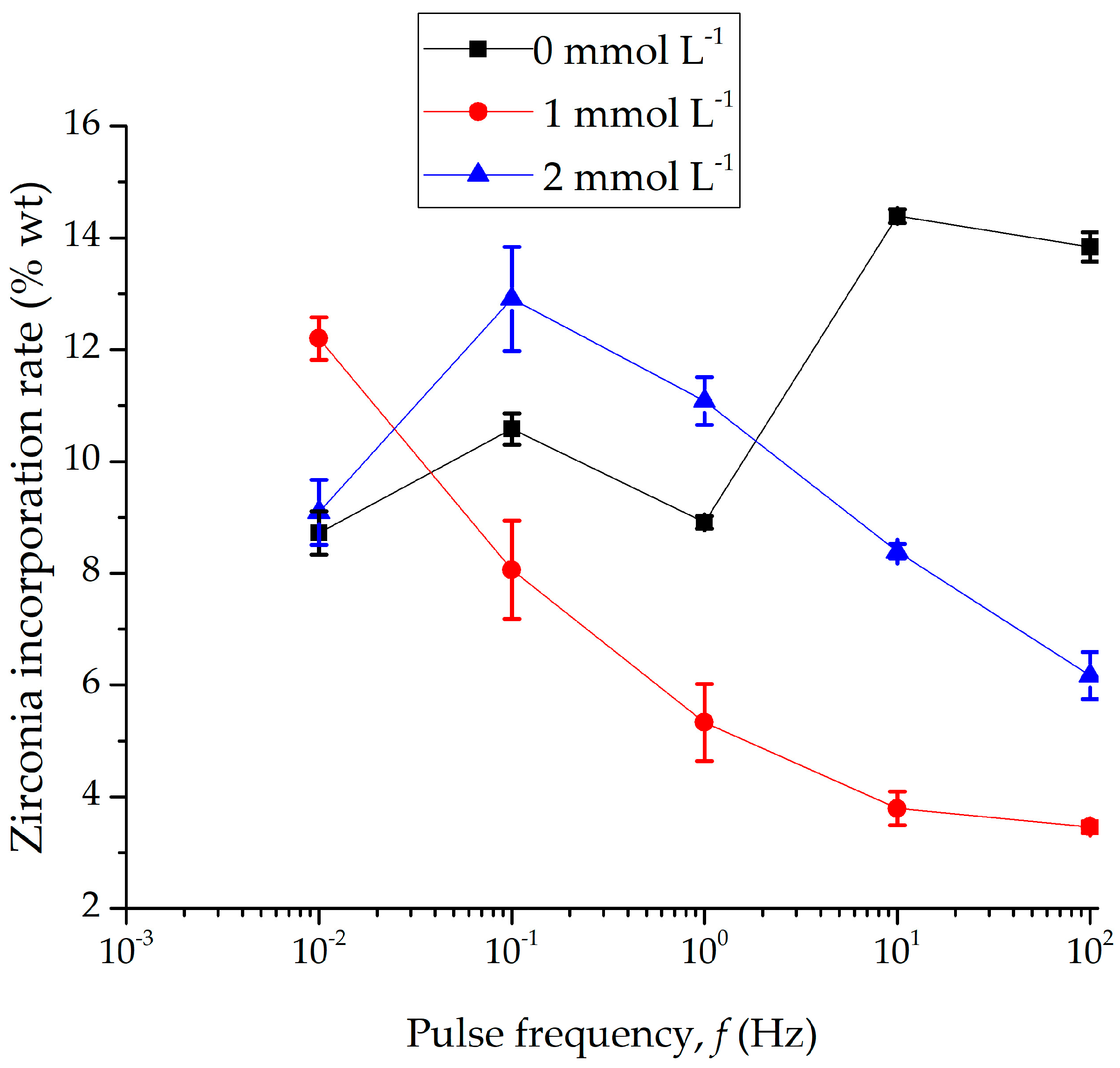
The full-frame EDS analyses that were performed at randomly selected areas across the coating surfaces during the SEM investigation allowed quantification of the zirconia incorporation within the nickel matrix for each composite. These results are presented in Figure 3.
Zirconia co-deposition appears to be enhanced under the PC regime at pulse frequencies of 10 and 100 Hz for series A coatings, as shown in Figure 3. Under these electrodeposition conditions, the highest incorporation rates were achieved, reaching approximately 14.40 wt% in samples A 10 , A 100 . When 1 mmol L−1 coumarin is introduced into the Watts bath, particle co-deposition appears to increase with decreasing pulse frequency, reaching the value 12.20 wt% in deposit B 0.01 . For the pulsed composite coatings of series C, particle co-deposition is enhanced at pulse frequencies of 0.1 Hz and 1 Hz, where incorporation rates of 12.91 wt% and 11.08 wt% are observed, respectively. The dependence of particle incorporation on pulse frequency differs between the additive-free and coumarin-containing electrolytes, reflecting the competitive adsorption of coumarin molecules on active cathodic sites. At higher pulse frequencies, faster switching enhances additive adsorption during Ton and limits particle entrapment, whereas at low frequencies the longer Toff period favours particle incorporation. This behaviour is consistent with the adsorption-controlled mechanism governing composite electroplating [10].

3.2. XRD Analyses, Crystallographic Orientation and Mean Crystalline Diameter Size

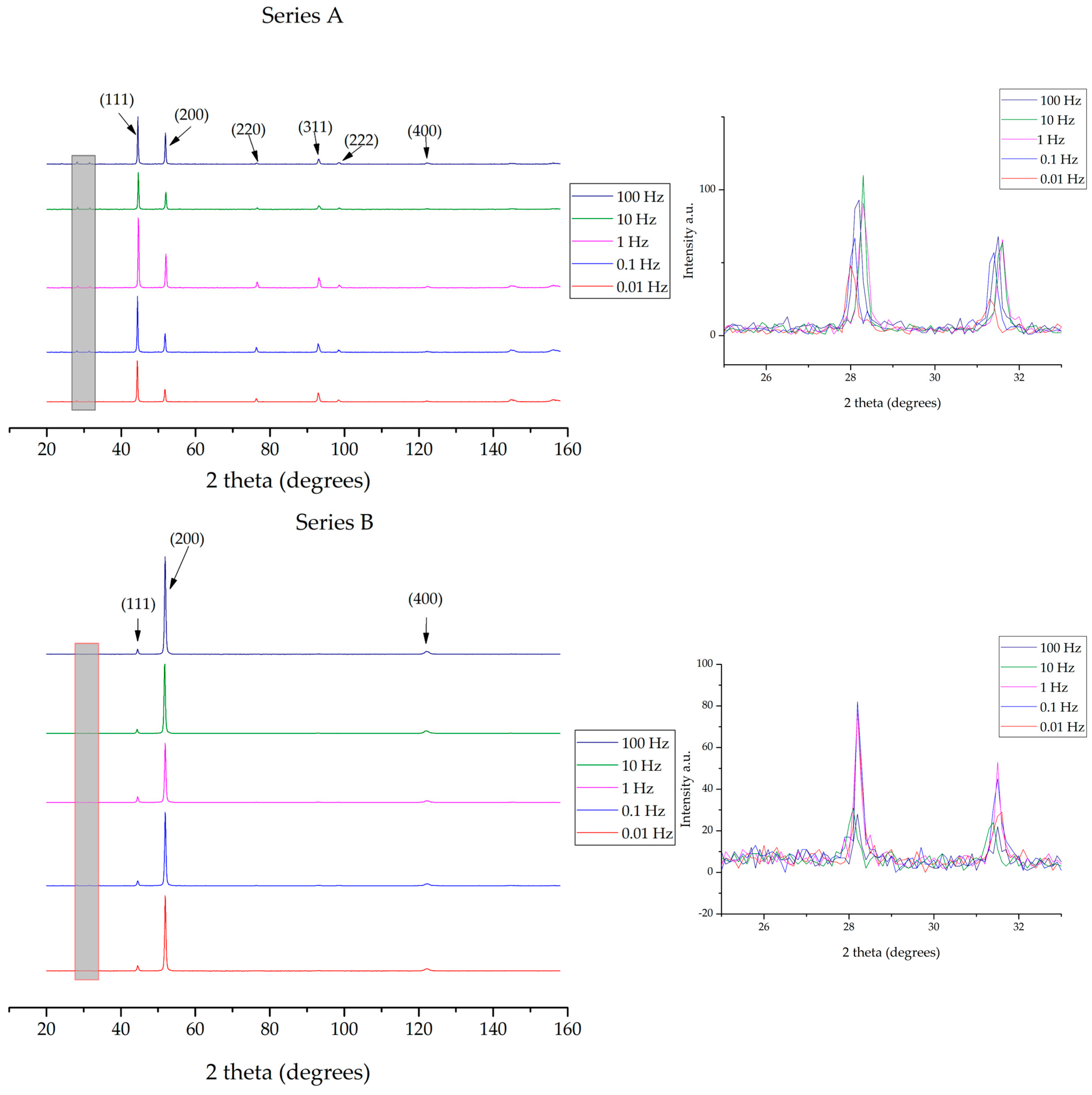
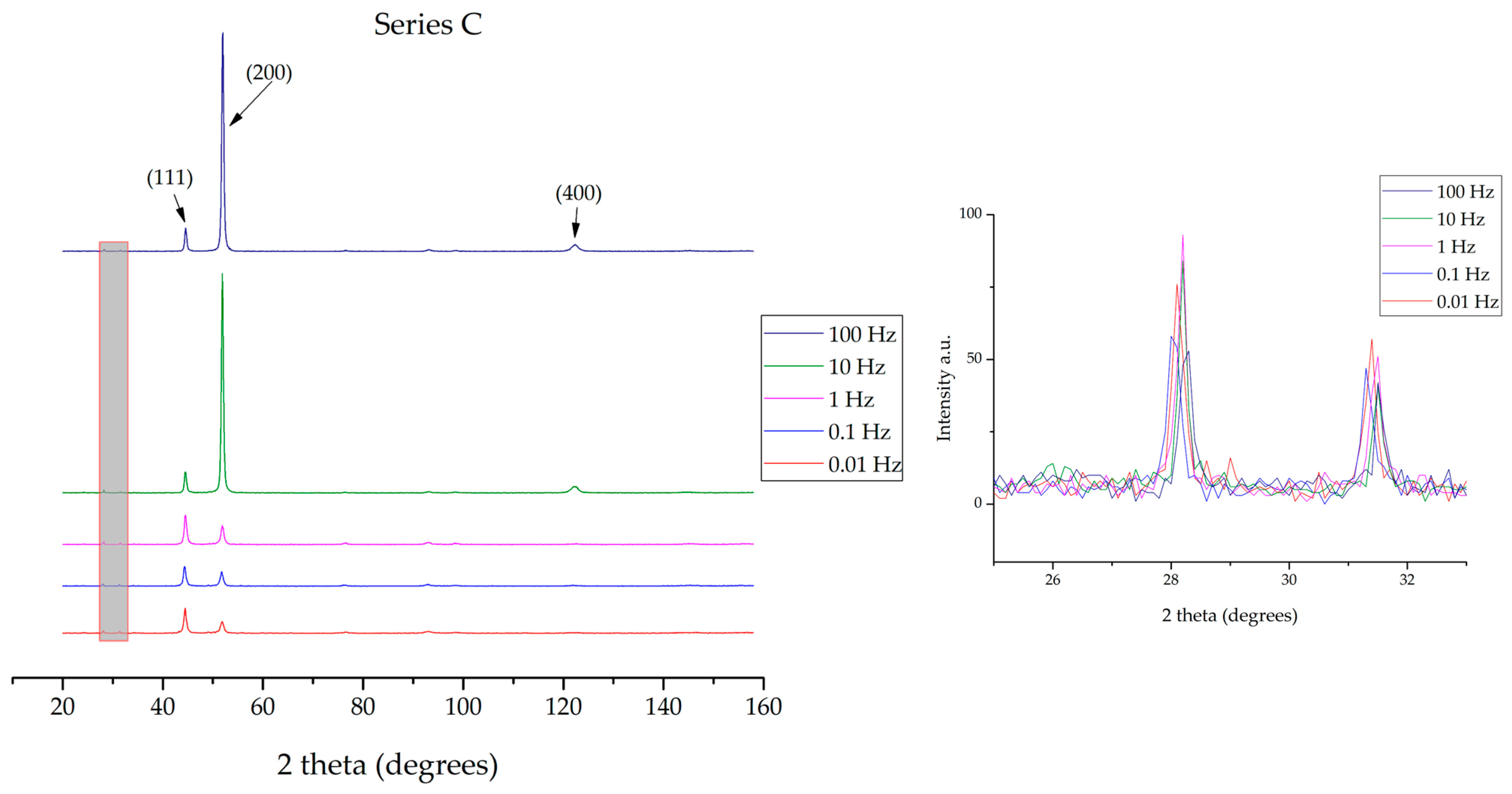
XRD analyses were carried out for all Ni/ZrO2 composite coatings, and the resulting diffractograms are presented in Figure 4. The XRD patterns are organized by series (A, B, and C). For each series, the region of 2θ = 25–33°—highlighted by a grey-shaded rectangle—corresponding to the two principal diffraction peaks of the co-deposited ZrO2 phase [10], is magnified and displayed separately on the right of the respective XRD diagram.
As shown in Figure 4, the XRD diffractograms of series A exhibit the characteristic diffraction peaks of nickel corresponding to the (111), (200), (220), (311), (222) and (400) crystallographic planes [10]. For all these coatings, the (111) reflection displays the highest intensity. The differences observed in the XRD spectra of the PC coatings within series A as a function of pulse frequency are not significant. The incorporation of 1 mmol L−1 coumarin for the fabrication of the Ni/ZrO2 composite coatings of series B results in a pronounced alteration of the XRD patterns. In this series, the (200) plane becomes the predominant reflection. Similarly to series A, variations in pulse frequency appear to have little influence on the XRD characteristics of series B. Similar trends to those observed in series B are found for the PC coatings of series C deposited at pulse frequencies of 10 and 100 Hz ( C 10 ,   C 100 ), where the (200) plane is clearly dominant in the corresponding XRD diffractograms. However, at lower pulse frequencies, the intensity of the (200) reflection decreases significantly, and the (111) crystallographic plane becomes predominant in the coatings C 0.01 , C 0.1 and C 1 .
The RTC(hkl) values (see Table S1 in Supplementary Material) of the Ni/ZrO2 composite coatings were determined using Equation (2), based on the raw data obtained from the XRD analyses. Considering that a crystallographic direction [hkl] is regarded as a preferred orientation when its corresponding RTC(hkl) ≥ 16.67 [6], and that the concurrent diffraction of the (111) and (311) planes of nickel is indicative of a [211] texture [26], the predominant crystallographic orientations for all deposited coatings were determined and are summarized in Table 3. The same table also presents the mean crystallite size d (nm) for each coating, as calculated using Equation (1). For consistency and to enable direct comparison among the PC coatings of the three series, the reported d values correspond to the Ni crystallites oriented parallel to the (200) plane.
The strongly inhibited [211] crystallographic orientation is predominant in all composite coatings of series A, appearing either exclusively (in A 0.01 , A 0.1 ) or in combination with the uninhibited crystal growth mode [100], forming a mixed texture ([211]+[100] or [100]+[211]) in the coatings deposited at pulse frequencies of 1, 10, and 100 Hz. As already evidenced by the XRD patterns in Figure 4, the composite coatings of series B exhibit a strong [100] crystallographic texture, irrespective of the applied pulse frequency. As far as series C is concerned, the coatings deposited at pulse frequencies of 0.01, 0.1, and 1 Hz exhibit a preferred [211] orientation coexisting with [100], whereas at higher frequencies (10 and 100 Hz), the [100] texture becomes exclusively dominant.
The mean crystallite size values presented in Table 3 show that, within series A, the d values range approximately between 26 and 28 nm, indicating that variations in pulse frequency have a limited effect. A noticeable refinement of nickel crystallites is observed upon the addition of 1 mmol L−1 coumarin for the preparation of the series B composite coatings, with d values around 22 nm for all samples. Further increasing the coumarin concentration to 2 mmol L−1 for the fabrication of the series C coatings leads to an even more pronounced reduction in crystallite size; within series C, d values range from 11.41 nm to 19.30 nm, making these deposits the most nanocrystalline among all coatings produced in this study. Notably, C 0.01 , C 0.1 , and C 1 coatings exhibit the finest Ni crystallites.

3.3. Determination of Coatings’ Vickers Microhardness and Roughness

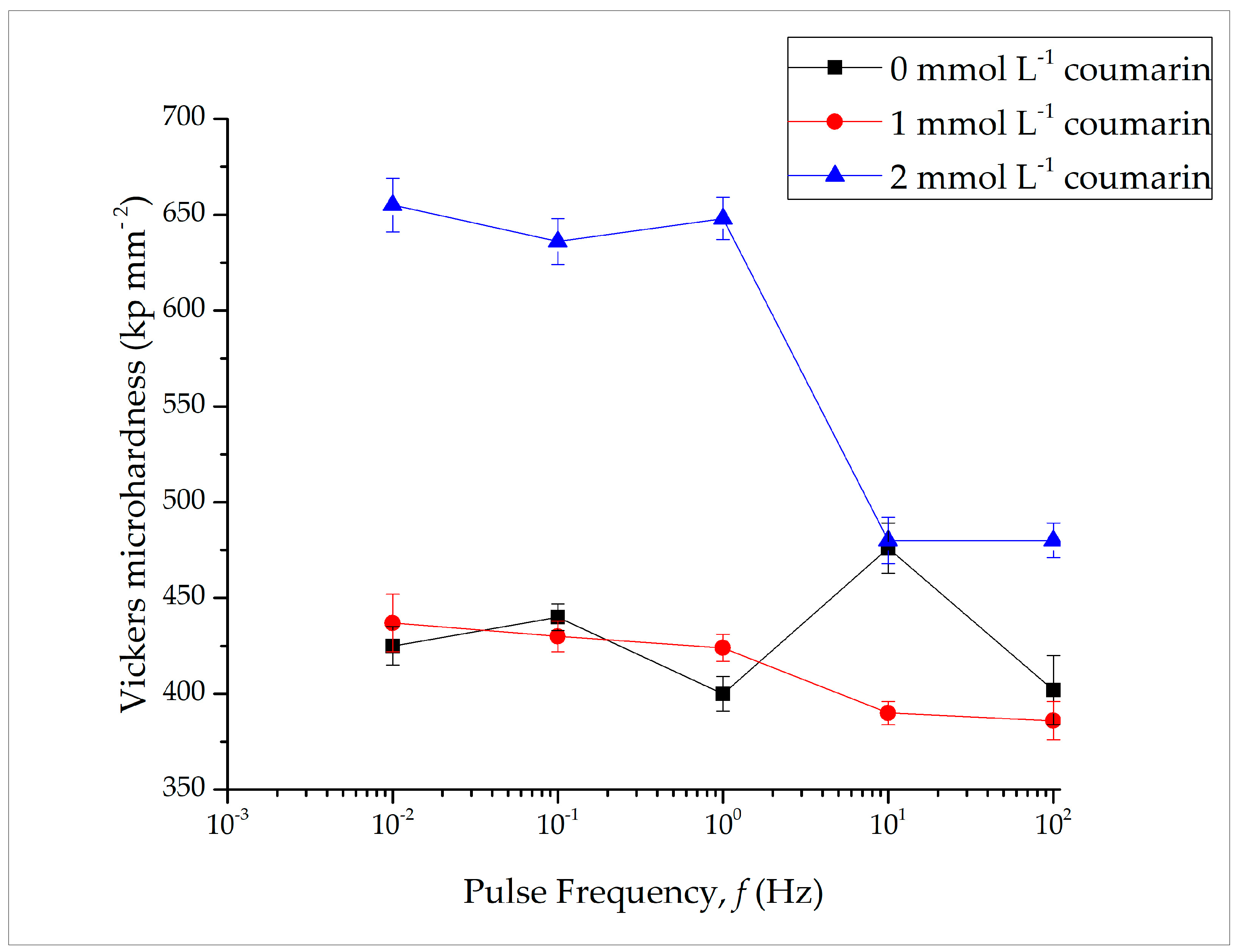
The Vickers microhardness results for the Ni/ZrO2 composite coatings are presented in Figure 5. It is evident that the coatings of series C exhibit the highest hardness values across all pulse frequencies and coumarin concentrations examined in this study. Coating C 0.01 showed the maximum Vickers microhardness (HV) of 648 kp mm−2, while the lowest values were recorded for C 100 and C 10 , at approximately 480 kp mm−2. In series B, the variation in hardness is less pronounced: the highest HV value (437 kp mm−2) was obtained for B 0.01 , and the lowest (386 kp mm−2) for B 100 . The coatings of both series B and C clearly follow a decreasing hardness trend with increasing pulse frequency. In contrast, no such correlation is observed for the coatings of series A, where the highest HV values were recorded for A 10 (476 kp mm−2) and A 0.1 (440 kp mm−2).
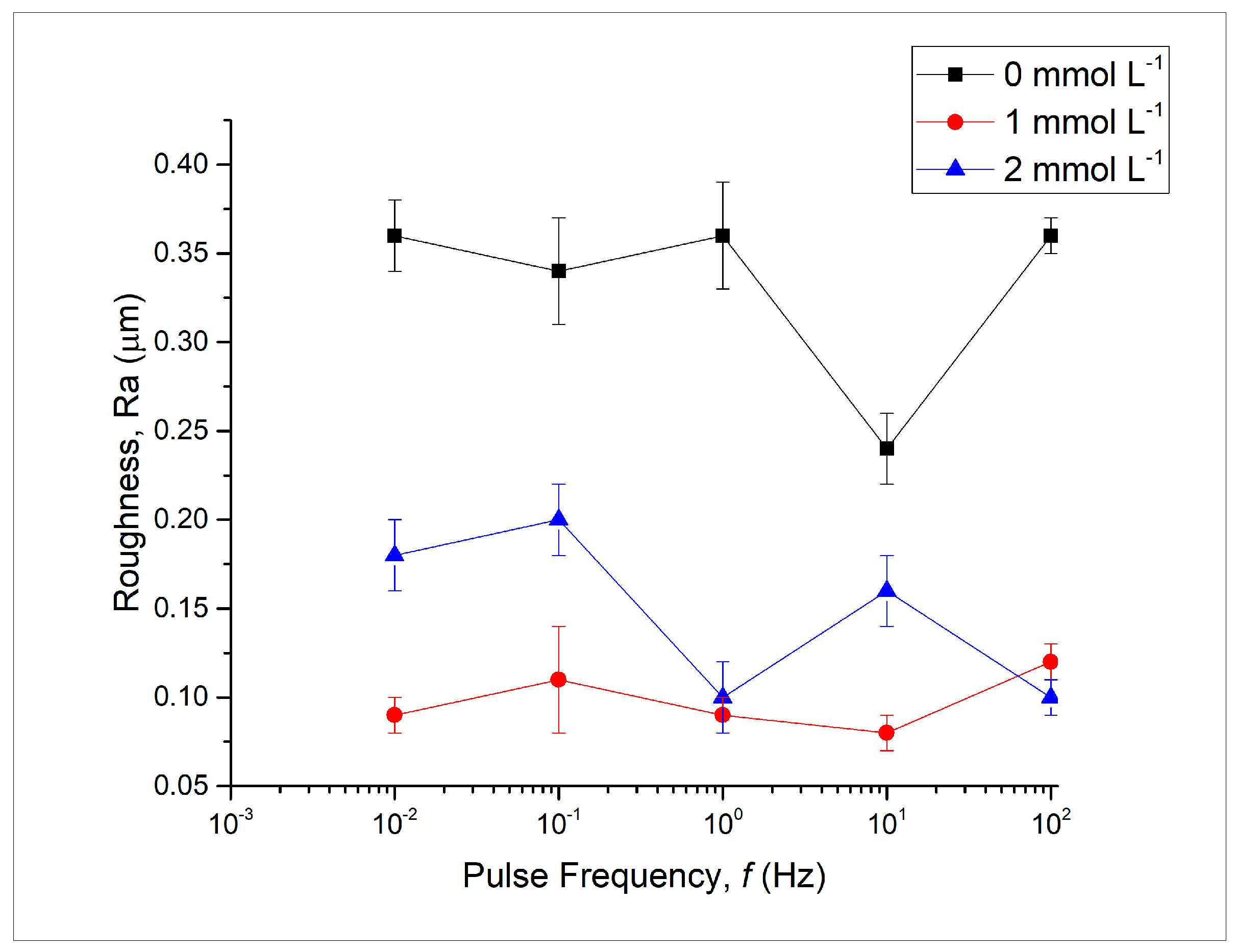
The roughness data illustrated in Figure 6 represent the average surface roughness (Ra) values determined through profilometric measurements. It is evident that the addition of coumarin to the electrolyte (series B and C) leads to a significant smoothing of the PC Ni/ZrO2 composite coatings, as reflected in the reduced Ra values. Specifically, for series B, the coatings exhibit an average Ra of approximately 0.01 μm, whereas the coatings of series A show a much higher roughness, around 0.35 μm—more than three times greater. The series C coatings display intermediate roughness values between those of series A and B, and a notable dependence on pulse frequency is observed, with Ra values varying from about 0.10 μm to 0.20 μm.

4. Discussion

4.1. Discussion on Microscopical Investigation and Compositional Analysis Findings

The observations from the SEM (Figure 1) and FE-SEM (Figure 2) micrographs indicate that coumarin molecules preferentially adsorb onto high-energy cathodic sites, thereby inhibiting their growth. This action results in the smoother and finer surface morphology characteristic of all PC Ni/ZrO2 composite coatings of series B and C produced from coumarin-containing Watts electrolytes [6,15,27]. These microscopic results align well with the semi-bright macroscopic appearance of the coatings from series B and C, in contrast to the fully matte finish of the coumarin-free coatings in series A. This consistency between microstructural and visual observations confirms that coumarin acts as an efficient levelling agent during the pulse-controlled electrodeposition of Ni/ZrO2 composites. The levelling effect is further supported by the surface roughness measurements, as all coatings from series B and C exhibited significantly lower Ra values than those from series A across all investigated pulse frequencies.
The EDS analysis results presented in Figure 3 confirm the successful incorporation of zirconia particles into the nickel matrix. Combined with the relatively homogeneous particle dispersion observed in the SEM micrographs of Figure 1, these findings indicate that particle co-deposition under the applied electrodeposition conditions was effective. However, the FE-SEM observations (Figure 2) reveal that, in certain cases, zirconia particles are co-deposited not only as individual entities but also in the form of clusters. Such aggregation within the metal matrix is generally undesirable, as it may adversely affect the composite’s functional properties. Therefore, in future studies on pulse-controlled Ni/ZrO2 composite coatings, the use of suitable additives that inhibit particle agglomeration will be explored to further enhance coating uniformity and performance [28].
Regarding the zirconia incorporation rates, relatively high particle contents were achieved, reaching approximately 14.40 wt% in samples A 10 and A 100 , even though no chemical dispersants or surfactants were added to the Watts electrolyte to facilitate particle co-deposition [26,27,28,29,30]. For series B and C, Figure 3 shows a clear trend of decreasing particle incorporation with increasing pulse frequency, whereas no such dependence is observed for series A. The different behavior observed between the coumarin-free electrolyte (series A) and the coumarin-containing electrolytes (series B and C) can be attributed to the distinct mechanisms governing particle entrapment during pulse electrodeposition. In the absence of coumarin, it seems that particle incorporation is dictated primarily by hydrodynamic transport and nucleation frequency. Higher pulse frequencies (10–100 Hz) increase the number of Ton events per unit time, thereby enhancing the probability that suspended particles are captured at the growing metal surface. This explains why ZrO2 incorporation increases at higher frequency in series A. When coumarin is present, however, particle co-deposition becomes strongly influenced by the additive’s frequency-dependent adsorption behavior. Coumarin molecules preferentially adsorb on high-energy growth sites, and at higher frequencies the rapid Ton/Toff switching regenerates fresh active sites more frequently, allowing faster re-adsorption of the additive. This results in a progressively higher effective surface coverage of coumarin with increasing f, which in turn blocks potential sites where ZrO2 particles would otherwise be trapped. Consequently, particle incorporation decreases with increasing frequency in series B and C. At low frequencies (0.01–1 Hz), the extended Toff duration allows partial desorption or rearrangement of the additive layer, exposing more active sites for particle entrapment and enabling higher ZrO2 incorporation. Thus, the opposite frequency-dependence phenomenon observed in the presence and absence of coumarin originates from the competition between particle attachment and coumarin adsorption at the cathode surface.

4.2. Discussion on XRD Analyses, Crystallographic Orientation and Mean Crystalline Diameter Size Findings

To analyze the crystallographic texture of the PC Ni/ZrO2 composite coatings provided in Table 3, it is important to consider that the preferred orientation of electrodeposited nickel is strongly influenced by the adsorption and desorption of inhibiting chemical species within the metallic lattice [26,31,32]. These species originate in the catholyte region because of hydrogen reduction processes [32], and their formation depends on the electrolysis parameters [6,31]. The [100] texture corresponds to uninhibited crystal growth, as its development is not affected by the adsorption of inhibiting species within the lattice. In contrast, the [211] preferred orientation represents an inhibited crystal growth mode, associated with the adsorption of colloidal dispersion Ni(OH)2 formed at the electrolyte–cathode interface due to local pH increase during electrodeposition [26,32]. In our previous study on the pulsed electrodeposition of Ni/ZrO2 composites from an additive-free Watts electrolyte [10], it was shown that the electrolysis conditions imposed by the pulse current, combined with the simultaneous co-deposition of zirconia particles, lead to increased local alkalization of the catholyte during the Τon period due to enhanced hydrogen reduction. This localized pH rise promotes the formation of colloidal dispersion Ni(OH)2, which is subsequently adsorbed onto the growing metal matrix during Toff, giving rise to the predominance of the [211] crystallographic orientation. Consequently, in the composite coatings A 1 ,   A 10 , and A 100 , the [100] axis coexists with [211]. This mechanism becomes even more pronounced when longer Toff durations are applied—as in coatings A 0.01 ,   A 0.1 —since the extended relaxation time allows for greater adsorption of colloidal nickel hydroxide, leading to the exclusive development of the [211] texture. Interestingly, this mechanism does not seem to take place when 1 mmol L−1 is added to the electrolyte, since all the Ni/ZrO2 composite coatings of series B follow the [100] orientation regardless of the applied pulse frequency. It could be suggested that, in this case, a competitive interaction occurs between coumarin and pulse current during the electrodeposition process, which ultimately leads to the observed effect. Thus, due to the presence of coumarin, the different inhibiting species either do not form in the catholyte region during pulse application or are not adsorbed onto the deposit during the pulse-off period. The influence of adding 2 mmol L−1 coumarin to the Watts bath on the preferred orientation of the series C Ni/ZrO2 composite coatings should be interpreted in conjunction with the applied pulse frequency. As shown in Table 3, when f 1 Hz, all PC composite coatings display a mixed crystallographic orientation of [100]+[211]. However, at pulse frequencies above 1 Hz, the [100] orientation becomes exclusively dominant. The increase in pulse switching rate at higher frequencies restricts the adsorption of inhibiting chemical species formed in the catholyte onto the growing metallic surface [10]. In the present case, this effect appears to be further enhanced by the presence of coumarin at a concentration of 2 mmol L−1. This is likely due to the stronger adsorption and subsequent reduction of the additive on the cathode under these conditions. Consequently, the PC composite coatings C 10 and C 100 exhibit a crystallographic orientation exclusively along the [100] axis.
According to the data in Table 3, it is generally observed that the PC Ni/ZrO2 composite coatings exhibit a nanocrystalline structure. The use of pulse current leads to the development of very high instantaneous current densities, resulting in strongly negative electrode overpotentials [33]. These high overpotentials substantially increase the nucleation rate by supplying additional energy to the system, which promotes the formation of new nuclei rather than the growth of existing ones. Consequently, the application of pulse current conditions facilitates the deposition of nanocrystalline coatings [10]. Furthermore, consistent with literature reports that coumarin acts as a grain-refining leveler in Ni electrodeposition and that higher additive levels can drive further refinement of Ni crystallites [6,34], our coatings show decreasing Ni crystallite size with increasing coumarin concentration. Furthermore, it is evident that the crystallite size of the Ni matrix is influenced by its crystallographic orientation: series B composite coatings display a [100] growth orientation and exhibit comparable mean crystallite sizes of around 22 nm, independent of the applied pulse frequency. In contrast, series C coatings show variations in crystallite size that correspond to changes in preferred orientation with pulse frequency. Specifically, coatings C 0.01 , C 0.1 , and C 1 , which develop a mixed [100]+[211] growth mode, present a mean crystallite size of approximately 13 nm, being slightly more nanocrystalline than C 10 and C 100 , which are exclusively oriented along the [100] axis and have a mean crystallite size of about 19 nm. This behavior can be attributed to the presence of colloidal Ni(OH)2, which promotes the [211] orientation and is strongly adsorbed within the metallic lattice, introducing structural defects leading to the fragmentation of nickel crystallites [10].

4.3. Discussion on the Determination of Coatings’ Vickers Microhardness and Roughness Findings

The examination of Figure 5 clearly shows that coumarin concentration has a decisive influence on the microhardness of the Ni/ZrO2 composite coatings. The coatings of series C consistently exhibit the highest hardness values, even though their ZrO2 incorporation rate is not always the highest among all samples. This behavior cannot be explained by particle content alone and instead reflects the combined action of several strengthening mechanisms. First, series C coatings possess the smallest Ni crystallite sizes (down to ~11 nm), which enhances hardness through pronounced grain-refinement strengthening. Second, their crystallographic texture, which varies between mixed [100]+[211] and fully [100] orientations depending on pulse frequency, introduces elevated lattice defect densities and internal stresses associated with the adsorption of colloidal dispersion Ni(OH)2 species—factors that further impede dislocation motion [6,10]. Third, the stronger adsorption of coumarin at 2 mmol L−2 suppresses the crystal growth, increases nucleation density, and yields a highly fragmented, defect-rich nanocrystalline matrix. These microstructural features collectively dominate over the modest variations in ZrO2 wt%, providing a comprehensive explanation for the superior hardness of series C coatings.
The influence of pulse frequency further supports this interpretation. For both series B and C, Vickers microhardness decreases with increasing frequency, a trend that correlates with the corresponding reduction in ZrO2 incorporation at higher f. Lower particle contents are typically associated with reduced dispersion strengthening [6,10,27,29,34]. Series B coatings generally display hardness values comparable to those of series A, with noticeable differences arising only between B 10 and A 10 , where ZrO2 incorporation diverges significantly.
Overall, these observations demonstrate that the hardness of the Ni/ZrO2 composite coatings is governed by the interplay between particle incorporation, grain size, crystallographic texture, and additive-induced inhibition effects. Under optimized conditions—low pulse frequencies (0.01–1 Hz) combined with 2 mmol L−1 coumarin—the series C coatings achieve extremely fine-grained microstructures, high ZrO2 contents (>11 wt%), and inhibited crystal growth modes, resulting in remarkably high microhardness values approaching ~650 kp mm−2.
As far as the surface roughness of the PC Ni/ZrO2 composite deposits is concerned, it is noticed by Figure 6 that coatings of series B are characterized by remarkably smooth surfaces. These coatings exhibit very low surface roughness (Ra) values, ranging from 0.09 to 0.12 µm, that are practically unaffected by variations in pulse frequency. The composite coatings of series C show slightly higher roughness, with Ra values between 0.1 and 0.18 µm. No clear correlation is identified between the microstructural features of series C coatings and their relatively increased roughness.
Although SEM micrographs in Figure 1 show that series C coatings appear microscopically smoother than those of series B, the profilometric Ra values do not follow the same trend. This discrepancy arises from the different spatial scales probed by each technique: SEM captures fine micro- and submicron features, whereas profilometry records height variations over larger lateral distances. Coumarin does act as a leveling agent, but its effect is concentration-dependent. At 1 mmol L−1 (series B), its adsorption uniformly suppresses high-energy growth sites, yielding the lowest Ra values. At 2 mmol L−1 (series C), the stronger inhibition increases nucleation density and grain fragmentation, which can introduce mesoscale surface undulations not captured in SEM investigation. These longer-wavelength irregularities lead to slightly higher Ra values despite the smoother microscopic appearance. Thus, SEM and profilometry reflect different aspects of surface topology, and both are consistent with the concentration-dependent leveling action of coumarin.
These results confirm the pronounced leveling effect of coumarin during the electrodeposition of Ni/ZrO2 composites under pulse current conditions. Nevertheless, no systematic relationship is observed between surface roughness and pulse frequency.
It should be noted that all composite coatings had a thickness between 87 and 93 μm (average 90 ± 3 μm). This range is sufficiently narrow to exclude thickness as a variable influencing microhardness or roughness.

5. Conclusions

The present study systematically investigated the combined influence of pulse frequency and coumarin concentration on the microstructural, compositional, and mechanical characteristics of pulse-electrodeposited Ni/ZrO2 composite coatings. The results clearly demonstrate that both parameters play a decisive role in determining the evolution of structure and, consequently, the properties of the deposits.
Coumarin acts as an efficient levelling and grain-refining additive, significantly modifying the nucleation and growth behavior of the nickel matrix and promoting the production of significantly smoother surfaces. Increasing its concentration from 1 to 2 mmol L−1 led to a progressive reduction in mean crystallite size from ~22 nm to as low as ~11 nm. The texture of the Ni matrix was also strongly affected: In the absence of coumarin, coatings predominantly exhibited inhibited [211] or mixed [211]+[100] orientations, whereas the introduction of coumarin stabilized the [100] growth mode. At the higher concentration of 2 mmol L−1, the preferred orientation depended on the applied pulse frequency—mixed [100]+[211] textures formed at f 1 Hz, while exclusively [100] orientations prevailed at f 10 Hz—indicating that additive adsorption and pulse switching frequency jointly govern crystal growth inhibition.
The incorporation of ZrO2 particles was found to depend on both pulse frequency and coumarin concentration. In the additive-free electrolyte, particle entrapment increased at high frequencies (10–100 Hz), whereas in coumarin-containing baths, it followed the opposite trend, being enhanced at low frequencies and declining with increasing f. For the coumarin-containing deposits, the highest zirconia contents, above 11 wt%, were obtained for 2 mmol L−1 coumarin at 0.1–1 Hz, reflecting a favorable balance between additive adsorption and particle co-deposition.
These structural variations translated directly into the coatings’ Vickers microhardness. The HV of the composites increased markedly with increasing coumarin concentration and decreasing pulse frequency, reaching ~650 kp mm−2 for the C 0.01 coating. The enhanced hardness results from the combined effects of grain refinement, higher ZrO2 incorporation, and texture evolution, which together suppress nickel’s free electrocrystallization and strengthen the composite through dispersion and grain-boundary mechanisms. In contrast, at higher frequencies, reduced particle incorporation and coarser grain structures led to lower hardness values.
The surface-roughness analysis demonstrated that coumarin acts as an effective levelling additive in PC electrodeposited Ni/ZrO2 composites, though its influence is strongly concentration-dependent. Coatings produced with 1 mmol L−1 coumarin consistently exhibited the lowest Ra values (0.09–0.12 µm) and the smoothest surfaces, regardless of pulse frequency. Increasing the coumarin concentration to 2 mmol L−1 resulted in slightly higher roughness (0.10–0.18 µm), a behavior attributed to enhanced nucleation and grain fragmentation that generates mesoscale height variations not captured in the microscopically smoother SEM morphology. These findings highlight the complementary nature of SEM and profilometric analysis and confirm that the levelling action of coumarin is maximized at moderate concentrations under pulse-current deposition. No systematic correlation between pulse frequency and surface roughness was observed.
Overall, the findings establish a clear processing–structure–property relationship for Ni/ZrO2 composites deposited under pulse current. Coumarin concentration and pulse frequency operate as synergistic control parameters that tune the microstructural refinement, particle co-deposition, and crystallographic orientation of the coatings, thereby determining their final hardness and surface finish. Optimum properties—nanocrystalline texture, smooth morphology, high ZrO2 incorporation, and maximum hardness—were achieved at low pulse frequencies (0.01–1 Hz) with 2 mmol·L−1 coumarin, providing valuable guidelines for the design of high-performance Ni-based composite electrocoatings.

Supplementary Materials

The following supporting information can be downloaded at: https://www.mdpi.com/article/10.3390/coatings15121400/s1, Table S1: Relative Texture Coefficient, RTC(hkl), values of the six first-order nickel crystallographic planes.

Author Contributions

Formal analysis, investigation, resources, data curation, writing—original draft preparation, funding acquisition, data curation, visualization, M.M.D.; Conceptualization, methodology, validation, resources, writing—review and editing, supervision, C.K. All authors have read and agreed to the published version of the manuscript.

Funding

This research was funded by EMPIRIKION FOUNDATION, Award for Financial Support for Scientific Research 2021–2023.

Institutional Review Board Statement

Not applicable.

Informed Consent Statement

Not applicable.

Data Availability Statement

The original contributions presented in this study are included in the article/Supplementary Material. Further inquiries can be directed to the corresponding author(s).

Conflicts of Interest

The authors declare no conflicts of interest.

Abbreviations

The following abbreviations are used in this manuscript:
DCDirect Current
PCPulse Current
γ Duty Cycle
fPulse Frequency
dMean crystallite diameter size
RTC(hkl)Relative Texture Coefficient (hkl)
HVVickers Microhardness
RaAverage Surface Roughness

References

  1. Zellele, D.M.; Yar-Mukhamedova, G.S.; Rutkowska-Gorczyca, M. A Review on Properties of Electrodeposited Nickel Composite Coatings: Ni-Al2O3, Ni-SiC, Ni-ZrO2, Ni-TiO2 and Ni-WC. Materials 2024, 17, 5715. [Google Scholar] [CrossRef]
  2. Kondaiah, P.; Pitchumani, R. Electrodeposited nickel coatings for exceptional corrosion mitigation in industrial grade molten chloride salts for concentrating solar power. Renew. Sustain. Energy Rev. 2024, 189, 113848. [Google Scholar] [CrossRef]
  3. Salehi, M.; Mozammel, M.; Emarati, S.M.; Alinezhadfar, M. The role of TiO2 nanoparticles on the topography and hydrophobicity of electrodeposited Ni-TiO2 composite coating. Surf. Topogr. Metrol. Prop. 2020, 8, 025008. [Google Scholar] [CrossRef]
  4. John, A.; Saeed, A.; Khan, Z.A. Influence of the Duty Cycle of Pulse Electrodeposition-Coated Ni-Al2O3 Nanocomposites on Surface Roughness Properties. Materials 2023, 16, 2192. [Google Scholar] [CrossRef] [PubMed]
  5. Calderón, J.A.; Henao, J.E.; Gómez, M.A. Erosion–corrosion resistance of Ni composite coatings with embedded SiC nanoparticles. Electrochim. Acta 2014, 124, 190–198. [Google Scholar] [CrossRef]
  6. Dardavila, M.M.; Hamilakis, S.; Loizos, Z.; Kollia, C. Ni/ZrO2 composite electrodeposition in the presence of coumarin: Textural modifications and properties. J. Appl. Electrochem. 2015, 45, 503–514. [Google Scholar] [CrossRef]
  7. Kim, M.J.; Kim, J.S.; Kim, D.J.; Kim, H.P. Electro-deposition of oxide-dispersed nickel composites and the behavior of their mechanical properties. Met. Mater. Int. 2009, 15, 789–795. [Google Scholar] [CrossRef]
  8. Tirlapur, P.; Muniprakash, M.; Srivastava, M. Corrosion and Wear Response of Oxide-Reinforced Nickel Composite Coatings. J. Mater. Eng. Perform. 2016, 25, 2563–2569. [Google Scholar] [CrossRef]
  9. Walsh, F.C.; Wang, S.; Zhou, N. The electrodeposition of composite coatings: Diversity, applications and challenges. Curr. Opin. Electrochem. 2020, 20, 8–19. [Google Scholar] [CrossRef]
  10. Dardavila, Μ.M.; Sofianos, M.V.; Rodriguez, B.J.; Bekarevich, R.; Tzanis, A.; Gyftou, P.; Kollia, C. A comprehensive investigation of the effect of pulse plating parameters on the electrodeposition of Ni/ZrO2 composite coatings. Results Surf. Interfaces 2025, 18, 100421. [Google Scholar] [CrossRef]
  11. Liu, H.; Wang, H.; Ying, W.; Liu, W.; Wang, Y.; Li, Q. Influences of Duty Cycle and Pulse Frequency on Properties of Ni-SiC Nanocomposites fabricated by Pulse Electrodeposition. Int. J. Electrochem. Sci. 2020, 15, 10550–10569. [Google Scholar] [CrossRef]
  12. Mohanty, U.S.; Tripathy, B.C.; Singh, P.; Keshavarz, A.; Iglauer, S. Roles of organic and inorganic additives on the surface quality, morphology, and polarization behavior during nickel electrodeposition from various baths: A review. J. Appl. Electrochem. 2019, 49, 847–870. [Google Scholar] [CrossRef]
  13. Costavaras, T.A.; Froment, M.; Hugot-Le Goff, A.; Georgoulis, C. The influence of unsaturated organic molecules in the electrocrystallization on nickel. J. Electrochem. Soc. 1973, 120, 867–874. [Google Scholar] [CrossRef]
  14. Kima, S.-M.; Jina, S.-H.; Leea, Y.-J.; Lee, M.H. Design of Nickel Electrodes by Electrodeposition: Effect of Internal Stress on Hydrogen Evolution Reaction in Alkaline Solutions. Electrochim. Acta 2017, 252, 67–75. [Google Scholar] [CrossRef]
  15. Rogers, G.T.; Taylor, K.J. The effects of coumarin in the electrodeposition of nickel. Electrochim. Acta 1963, 8, 887–904. [Google Scholar] [CrossRef]
  16. Rogers, G.T.; Taylor, K.J. The reactions of coumarin, cinnamyl alcohol, butynediol and propargyl alcohol at an electrode on which nickel is depositing. Electrochim. Acta 1966, 11, 1685–1695. [Google Scholar] [CrossRef]
  17. Lo, W. Nickel Plating Handbook; Nickel Institute: Toronto, ON, Canada, 2022; pp. 16, 17, 64. [Google Scholar]
  18. Walsh, F.C.; Low, C.T.J.; Bello, J.O. Influence of surfactants on electrodeposition of a Ni-nanoparticulate SiC composite coating. Trans. IMF 2015, 93, 147–156. [Google Scholar] [CrossRef]
  19. Lajevardi, S.A.; Shahrabi, T. Effects of pulse electrodeposition parameters on the properties of Ni–TiO2 nanocomposite coatings. Appl. Surf. Sci. 2010, 256, 6775–6781. [Google Scholar] [CrossRef]
  20. Natarajan, P.; Mohanraj, M.; Sathish Kumar, R.; Thirumoorthy, A.; Prabhakaran, S. Evaluation on the microhardness of Ni-TiO2 nanocomposite coatings on AISI 1022 substrate. Mater. Today Proc. 2022, 62, 811–817. [Google Scholar] [CrossRef]
  21. Chen, L.; Wang, L.; Zeng, Z.; Xu, T. Influence of pulse frequency on the microstructure and wear resistance of electrodeposited Ni–Al2O3 composite coatings. Surf. Coat. Technol. 2006, 201, 599–605. [Google Scholar] [CrossRef]
  22. Giannopoulos, F.; Chronopoulou, N.; Bai, J.; Zhao, H.; Pantelis, D.I.; Pavlatou, E.A.; Karantonis, A. Nickel/MWCNT-Al2O3 electrochemical co-deposition: Structural properties and mechanistic aspects. Electrochim. Acta 2016, 207, 76–86. [Google Scholar] [CrossRef]
  23. Borkar, T.; Harimkar, S.P. Effect of electrodeposition conditions and reinforcement content on microstructure and tribological properties of nickel composite coatings. Surf. Coat. Technol. 2011, 205, 4124. [Google Scholar] [CrossRef]
  24. Bostani, B.; Parvini Ahmadi, N.; Yazdani, S.; Arghavanian, R. Co-electrodeposition and properties evaluation of functionally gradient nickel coated ZrO2 composite coating. Trans. Nonferrous Met. Soc. China 2018, 28, 66. [Google Scholar] [CrossRef]
  25. Sknar, Y.E.; Sknar, I.V.; Savchuk, O.O.; Hrydnieva, T.V.; Butyrina, O.D. Electrodeposition of Ni-zirconia or Ni-titania composite coatings from a methanesulfonic acid bath. Surf. Coat. Technol. 2023, 452, 129120. [Google Scholar] [CrossRef]
  26. Amblard, J.; Froment, M.; Spyrellis, N. Origine de textures dans les depot electrolytiques de nickel. Surf. Technol. 1977, 5, 205–234. [Google Scholar] [CrossRef]
  27. Cheng, C.-C.; West, A.C. Nickel Deposition in the Presence of Coumarin An Electrochemical Impedance Spectroscopy Study. J. Electrochem. Soc. 1997, 144, 3050–3056. [Google Scholar] [CrossRef]
  28. Kan, H.; Wang, W.; Meng, Y. Effect of Polyethyleneimine Cationic Surfactant on Morphology and Corrosion Resistance of Electrodeposited Ni-Co-SiC Composite Coatings. Coatings 2023, 13, 1232. [Google Scholar] [CrossRef]
  29. Arghavanian, R.; Parvini Ahmadi, N.; Yazdani, S.; Bostani, B. Investigations on corrosion proceeding path and EIS of Ni–ZrO2 composite coating. Surf. Eng. 2012, 28, 508. [Google Scholar] [CrossRef]
  30. Zhang, K.F.; Ding, S.; Wang, G.F. Different superplastic deformation behavior of nanocrystalline Ni and ZrO2/Ni nanocomposite. Mater. Lett. 2008, 62, 719. [Google Scholar] [CrossRef]
  31. Kollia, C.; Spyrellis, N.; Amblard, J.; Froment, M.; Maurin, G. Nickel plating by pulse electrolysis: Textural and microstructural modifications due to adsorption/desorption phenomena. J. Appl. Electrochem. 1990, 20, 1025. [Google Scholar] [CrossRef]
  32. Amblard, J.; Epelboin, I.; Froment, M.; Maurin, G. Inhibition and nickel electrocrystallization. J. Appl. Electrochem. 1979, 9, 233. [Google Scholar] [CrossRef]
  33. Ibl, N. Some theoretical aspects of pulse electrolysis. Surf. Technol. 1980, 10, 81. [Google Scholar] [CrossRef]
  34. Nam, D.-H.; Hong, K.-S.; Kim, J.-S.; Lee, J.-L.; Kim, G.-E.; Kwon, H.-S. Synergistic effects of coumarin and cis-2-butene-1,4-diol on high speed electrodeposition of nickel. Surf. Coat. Technol. 2014, 248, 30–37. [Google Scholar] [CrossRef]
Figure 1. SEM micrographs (2000×) of PC Ni/ZrO2 composite coatings produced with Ccoum = 0, 1, 2 mmol L−1 under f = 0.01, 0.1, 1, 10, 100 Hz.
Coatings 15 01400 g001
Figure 2. FE-SEM micrographs of PC Ni/ZrO2 composite coatings A 0.01 , B 0.01 , C 0.01 .
Coatings 15 01400 g002
Figure 3. Zirconia incorporation rate in the Ni matrix for Ccoum = 0, 1, 2 mmol L−1 (series A, B, and C, respectively) versus the applied pulse frequency.
Coatings 15 01400 g003
Figure 4. XRD diffractograms of PC Ni/ZrO2 coatings produced with Ccoum = 0, 1, 2 mmol L−1 (series A, B, and C, respectively) under f = 0.01, 0.1, 1, 10, 100 Hz.
Coatings 15 01400 g004aCoatings 15 01400 g004b
Figure 5. Vickers microhardness of PC Ni/ZrO2 coatings produced with Ccoum = 0, 1, 2 mmol L−1 (series A, B, and C, respectively) versus the applied pulse frequency.
Coatings 15 01400 g005
Figure 6. Roughness (Ra values) of PC Ni/ZrO2 coatings produced with Ccoum = 0, 1, 2 mmol L−1 (series A, B, and C, respectively) versus the applied pulse frequency.
Coatings 15 01400 g006
Table 1. Summary of bath composition and electrolysis conditions.
ParameterValue/Range
NiSO4·6H2O300 L−1
NiCl2·6H2O35 g L−1
H3BO340 g L−1
ZrO240 g L−1
Coumarin, Ccoum0, 1, 2 mmol L−1
pH4.4 ± 0.1
Temperature, Θ50 ± 1 °C
Peak current density, Jp5 A dm−2
Duty cycle, γ 70%
Pulse frequency, f (Hz)0.01, 0.1, 1, 10, 100
Ton (s)70, 0.7, 0.07, 7 × 10⁻³, 7 × 10⁻⁴
Toff (s)30, 0.3, 0.03, 3 × 10⁻³, 3 × 10⁻⁴
Deposition timeAdjusted to ~90 µm coating
AgitationHomogenizer, 12,000 rpm
Table 2. Coatings’ abbreviation and their electrodeposition parameters.
SeriesDeposits’ AbbreviationCcoum (mmol L−1)Pulse Frequency (Hz)
A A 0.01 00.01
A 0.1 00.1
A 1 01
A 10 010
A 100 0100
B B 0.01 10.01
B 0.1 10.1
B 1 11
B 10 110
B 100 1100
C C 0.01 20.01
C 0.1 20.1
C 1 21
C 10 210
C 100 2100
Table 3. Coatings’ crystallographic texture and mean crystalline diameter size d (nm).
DepositTextured (nm)
A 0.01 [211]27.76
A 0.1 [211]27.11
A 1 [211]+[100]25.99
A 10 [100]+[211]27.46
A 100 [100]+[211]27.44
B 0.01 [100]22.49
B 0.1 [100]22.55
B 1 [100]21.50
B 10 [100]21.53
B 100 [100]22.22
C 0.01 [100]+[211]11.41
C 0.1 [100]+[211]13.49
C 1 [100]+[211]13.25
C 10 [100]19.66
C 100 [100]19.30
Disclaimer/Publisher’s Note: The statements, opinions and data contained in all publications are solely those of the individual author(s) and contributor(s) and not of MDPI and/or the editor(s). MDPI and/or the editor(s) disclaim responsibility for any injury to people or property resulting from any ideas, methods, instructions or products referred to in the content.