
Article

The Impact of Humic Acid Coating on the Adsorption of Radionuclides (U-232) by Fe3O4 Particles

by
Paraskevi Beza
1,
Ioannis Anastopoulos
1,*,
Michael Arkas
2,*,
Theofanis Bompotis
2,
Konstantinos Giannakopoulos
2,
Ioannis Ioannidis
3,* and
Ioannis Pashalidis
3
1
Department of Agriculture, University of Ioannina, UoI Kostakii Campus, 47100 Arta, Greece
2
National Centre for Scientific Research “Demokritos”, Institute of Nanoscience and Nanotechnology, 15310 Athens, Greece
3
Department of Chemistry, University of Cyprus, P.O. Box 20537, 1678 Nicosia, Cyprus
*
Authors to whom correspondence should be addressed.
Coatings 2025, 15(12), 1399; https://doi.org/10.3390/coatings15121399
Submission received: 18 October 2025 / Revised: 22 November 2025 / Accepted: 24 November 2025 / Published: 30 November 2025
(This article belongs to the Section Environmental Aspects in Colloid and Interface Science)

Abstract

This study investigates the interaction of humic acid (HA) with magnetite nanoparticles and its impact on the adsorption behavior of the HA-coated magnetite (Fe3O4) nanoparticles towards uranium (U-232) in aqueous solutions. The particle surface modification was performed using HA solutions of varying concentrations (0.01, 0.1, and 1.0 g/L). Zeta potential measurements revealed a significant shift in surface charge—from positive values (+13 mV) for unmodified particles to negative values (down to −30 mV) due to the presence of carboxylic moieties on the particle surface. Batch adsorption experiments at pH 5.6 demonstrated that increasing HA coating markedly improves the U-232 adsorption, with Kd values rising by up to an order of magnitude compared to unmodified Fe3O4 nanoparticles. The enhanced performance is linked to both the greater number of surface-active sites and the increased negative surface charge introduced by the HA layer. Despite the HA coating, the hydrodynamic diameter of the particles remains largely unaffected, preserving colloidal stability. The latter is also corroborated by SEM-EDX analysis. Overall, this work highlights the role of HA in the adsorption behavior of magnetite particles towards (radio)toxic metal ions, which is of particular interest regarding their mobility in the geosphere and their removal from contaminated waters.

1. Introduction

Minerals like the reactive FeO(OH) (goethite, lepidocrocite, ferrihydrite) species are among the most important constituents of soil. During their residence in the environment, they are transformed into a more thermodynamically stable crystalline magnetite Fe2O3 mineral. Iron oxide minerals are considered efficient sorbents for inorganic and organic compounds binding on their surface, inorganic and organic pollutants, including natural organic matter (NOM) [1]. Kim et al. (2009) confirmed that iron-coated sand exhibited greater affinity to humic acid (HA) compared to bare sand, which strongly depends on the solution pH [2]. Generally, increasing pH reduces HA adsorption, indicating that coulombic interactions play a cardinal role in HA adsorption by mineral surfaces. Increased affinity to HA by iron oxides is associated with surface charge changes and higher chemical affinity of iron oxides towards HA, particularly under acidic-to-neutral pH conditions. Moreover, iron oxide particles are generally stabilized upon HA coating [3].
HA, which comprises a specific component and is the main fraction of NOM, is a complex mixture of polyelectrolyte macromolecules containing a large number of ionizable groups (e.g., carboxylic groups, phenols, etc.). These groups provide a generally negative charge to the macromolecule, increasing its affinity towards cationic species, including metal ions and radionuclides [4,5]. HA may have a positive or negative impact on the adsorption behavior of anthropogenic contaminants, including radionuclides [6,7]. Generally, dissolved humic acid, which is mainly the case in alkaline solutions, stabilizes the contaminants in solution and hence favors their mobility in the geosphere [8,9]. On the contrary, solid phase (mineral or microplastic)-bound humic acid enhances the adsorption capacity of the associated solid phase and inhibits the contaminant mobility in the geosphere [1,6,10,11,12]. Studies on the interplay between iron minerals and NOM/HA regarding their adsorption affinity towards (radio)toxic metal ions are fundamental to understanding and describing their chemical behavior and mobility in the geosphere, including soil environments [13,14]. Moreover, magnetic adsorbents are of particular interest in wastewater treatment technologies due to their ease and efficient separation from the aqueous matrix [15].
Radionuclides as anthropogenic pollutants are of particular interest because of their radioactivity and often their chemotoxicity. Widespread radionuclide contamination has occurred because of nuclear bomb testing, as well as nuclear accidents such as the Chernobyl accident [16]. In addition, long-term radionuclide release and migration are key issues regarding the performance assessment of nuclear waste repositories [17]. Among those radionuclides, uranium isotopes are of particular interest due to their abundance and their complex chemical behavior, which is attributed to the formation of a large number of stable aqueous complexes [18].
Studies regarding the impact of HA coating on inorganic solids, particularly magnetite particles, and on the adsorption and consequently the chemical behavior and mobility of uranium (hexavalent uranium, U(VI)) have shown that in the presence of HA, the adsorption capacity for U(VI) is reduced, and its release from the solid phase is accelerated [8,9]. This is somehow in contradiction with other studies that use HA-coated sand particles as a reactive barrier for the remediation of copper and cadmium ion-polluted groundwater [11]. This apparent contradiction could be attributed to the fact that in the studies, which show reduced adsorption affinity in the presence of HA, the magnetite particles were prepared by co-precipitation in the presence of Dissolved Organic Matter (DOM)/HA under alkaline conditions. Presumably, the excess DOM/HA redissolves in solution, complexes, and stabilizes U(VI), leading to reduced radionuclide adsorption.
Hence, in this study, commercially available magnetite (Fe3O4) particles were coated with humic acid solutions of different concentrations, and the resulting vacuum-dried HA-coated magnetite particles were used for adsorption studies. To evaluate the impact of HA coating on the affinity of the inorganic particles towards radionuclides, the adsorption behavior of U-232 by HA-coated Fe3O4 particles has been investigated. The investigations have been carried out in laboratory solutions, using commercially obtained HA and magnetite, and U-232 radionuclide tracer solutions. To evaluate the adsorption affinity (e.g., %-relative removal, Kd), the U-232 analysis was performed via alpha-spectroscopy. As far as we are aware, this is the first study to investigate the impact of surface modification of commercial Fe3O4 nanoparticles by humic acid and its impact on the adsorption affinity for radionuclides at ultra-trace levels. Such studies offer basic knowledge regarding the role of HA-coated inorganic particles, which is fundamental with respect to radionuclide migration in the geosphere and the development of modified magnetic particles as attractive adsorbents in wastewater treatment technologies.

2. Materials and Methods

2.1. Materials

The experiments were conducted in 30 mL polyethylene vials using deionized water as a solvent. Reference and test solutions were prepared using standard U-232 tracer solutions (12.05 kBq/g activity concentration) obtained from the National Physical Laboratory (Teddington, UK). Fe3O4 (Fe3O4 nanopowder (50–100 nm, spherical, 97% trace metals basis, Sigma-Aldrich cat. no. 637106)) and HA (Humic acid sodium salt, Sigma-Aldrich, St. Louis, MO, USA) have been obtained commercially. HA salt has been dissolved in deionized water to prepare HA solutions of three different concentrations (0.01 g/L, 0.1 g/L, and 1.0 g/L).

2.2. Preparation of HA Decorated Fe3O4 and Instrumentation

Surface modification of the Fe3O4 particles was achieved by immersing a defined amount of the oxide particles (10 g) in 100 mL of humic acid solutions with different initial HA concentrations (0.01 g/L, 0.1 g/L, and 1 g/L). Following a two-week contact time under ambient conditions and continuous shaking (SK-R1807, DLAB, Beijing, China), the resulting solid phase was separated by decantation, washed two times with deionized water, and dried at 70 °C in a vacuum furnace for about 24 h. The dried solids have been characterized by Sigma-Aldrich (EU), Dynamic Light Scattering (DLS, AXIOS-150/EX, Τriton Hellas, Thessaloniki, Greece), z-potential measurements (ZetaPlus, Brookhaven Instruments Corporation, Holtsville, NY, USA), low-vacuum scanning electron microscopy (SEM), and energy-dispersive X-ray spectroscopy (EDX) (FEI Quanta Inspect, featuring a tungsten filament (FEI, Hillsboro, OR, USA)). Those materials have also been used as adsorbents to investigate the impact of HA coating on the adsorption affinity of magnetite particles towards U(VI).

2.3. Adsorption Experiments

Adsorption studies were carried out by immersing 0.2 g of the magnetite particles prior to and after coating with 10 mL of U-232 solution ([U-232] = 8.6 × 10⁻¹⁴ mol/L radioactivity concentration = 25 Bq/L) in screw-cap polyethylene vials. The suspensions were allowed to reach equilibrium conditions for 10 days (240 h) under ambient conditions and continuous shaking. The contact time of 240 h has been selected based on previous experiments using ultra-trace amounts of radionuclides, which have shown that after 168 h, a steady-state/equilibrium condition was achieved [6,12], and the equilibrium pH in the solutions was self-adjusted at pH 5.6. Subsequently, a tiny amount of the test solution was removed for the alpha-spectroscopic analysis of U-232 after electrodeposition of the radionuclide onto a stainless steel disc. The alpha-spectroscopic analysis was performed using Alpha Analyst (Mirion Technologies Inc., San Ramon, CA, USA), an integrated alpha spectrometer (Canberra), as described elsewhere [6,12].
The relative removal of the radionuclide of U-232 (%) was calculated using the following equation:
% removed = 100 × (C0 − Caq)/C0
Here, C0 and Caq represent the initial and equilibrium radionuclide concentrations in the solution.
The linear distribution coefficient, Kd, was used to evaluate the adsorption affinity of the magnetic particles. This is possible because of the extremely low uranium concentrations in the solutions and the far superior number of surface active sites on the particle surface.
Kd = Cads/Caq (L/kg)
where Cads (Bq/kg) represents the activity concentration of U-232 adsorbed per mass adsorbent, while Caq (Bq/L) is the U-232 concentration in solution.
The calculations of the Kd have been performed using the corrected adsorption data (e.g., considering the amount of the radionuclide adsorbed onto the flask walls) because the experiments were performed at ultra-trace radionuclide levels, and the adsorption on the container walls was not negligible. In addition, each experiment was carried out three times, and the mean values have been used for data analysis and presentation. Moreover, the uncertainty for the experimental data, which is given as the standard deviation of the mean value calculated from the repeated measurements.

3. Results and Discussion

3.1. HA Functionalization of Fe3O4 and Characterization

The HA coating of the Fe3O4 particles was carried out by contacting the oxide particles with HA solutions of different concentrations (0.01 g/L, 0.1 g/L, and 1.0 g/L). After two weeks of contact time, the solid phase was separated, and the remaining HA amount in solution was determined spectrophotometrically, as described elsewhere [12]. Subsequently, the amount of HA adsorbed by the Fe3O4 particles was calculated by subtracting the amount of non-adsorbed/remaining HA from the initial/total HA amount added in solution. Figure 1 summarizes the amount of HA adsorbed by the Fe3O4 particles as a function of the initial HA concentration in the solution and indicates that the amount of HA adsorbed strongly depends on the initial HA concentration.
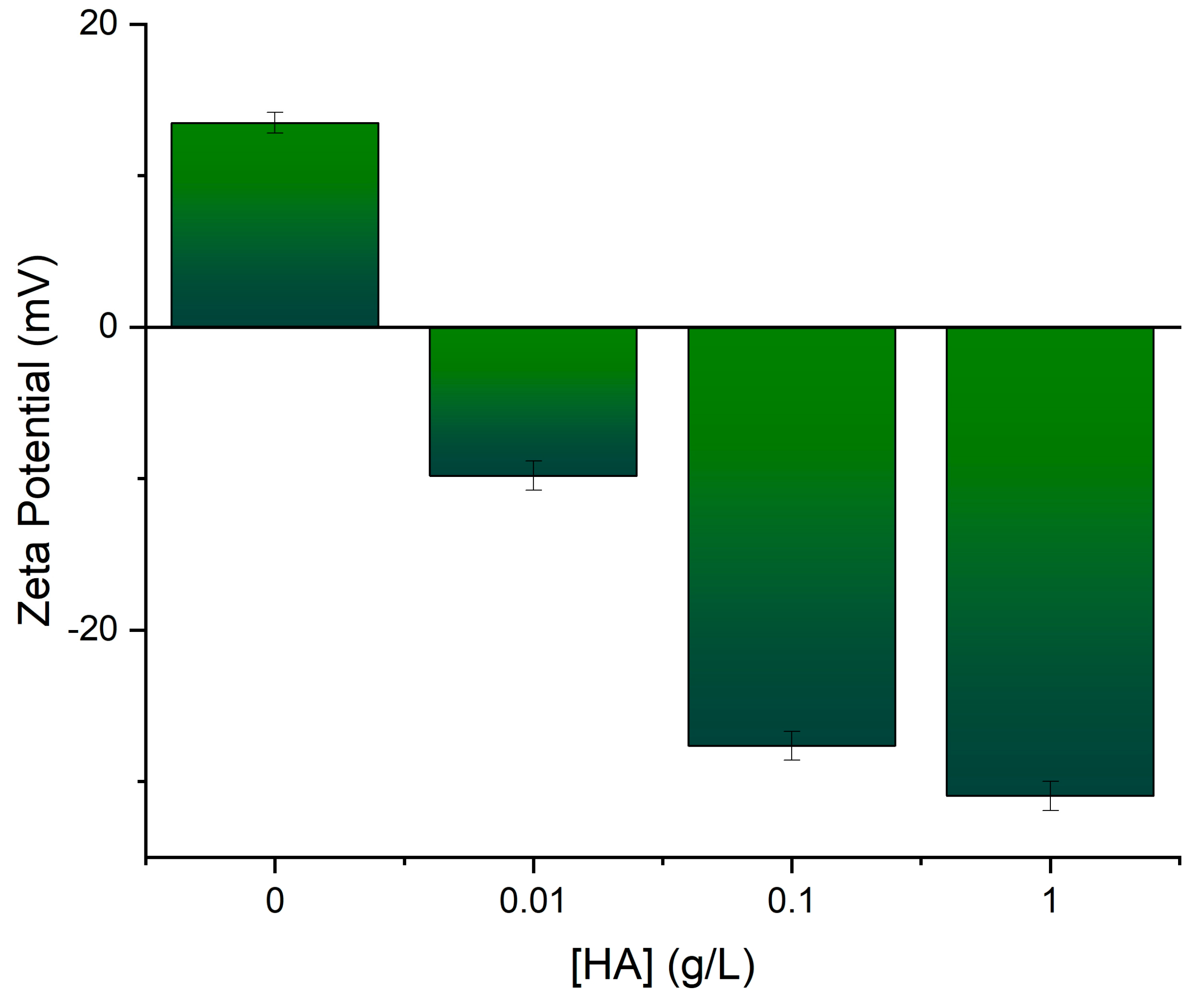
In order to evaluate the impact of the HA adsorption on the surface properties of the Fe3O4 particles, zeta potential measurements were carried out, and the corresponding data are graphically summarized in Figure 2. According to the data shown in Figure 2, the zeta potential of the Fe3O4 particles changes dramatically depending on the HA amount adsorbed on the particle surface. Specifically, after HA coating of the particles, the zeta potential values change from positive (+13 mV) to negative, reaching values as low as -30 mV for the particles with the highest HA amount adsorbed. This dramatic change in the surface properties, which is related to the surface acidity, has also been observed in previous studies [3] and may affect not only their stability but also their affinity towards cationic species (metal ions) in aqueous solutions, particularly in the acidic pH range. The increase inFe3O4 particle affinity towards cationic species, even in the acidic pH range, is related to the carboxylic moieties present in the HA structure, which are deprotonated (pKa ~ 3.5) even in the acidic pH range, providing the surface with a negative net charge. On the other hand, the non-modified Fe3O4 particles have a pzc ~6.5, assuming that the surface becomes, overall, negatively charged and attracts cations in the alkaline pH range [3,19]. Regarding the effect of the HA coating on the surface charge of the inorganic particle, as well as the increased affinity of the carboxylic moieties of HA towards metal ions, including U(VI), several studies have been published [20,21].
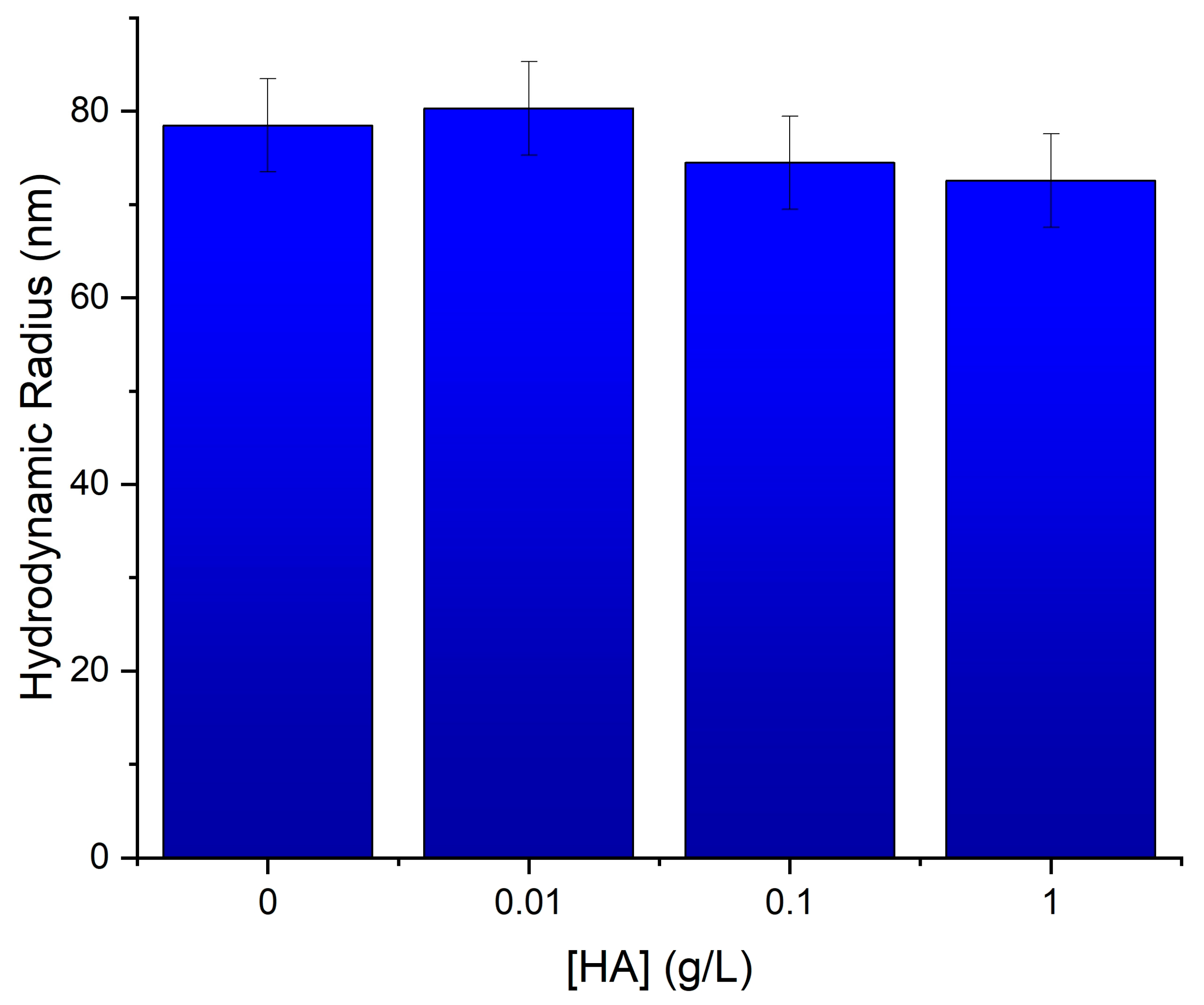
Nevertheless, despite the dramatic changes in the surface properties, the size of the particles does not change significantly. DLS measurements carried out using the non-treated and HA-coated particles indicate that the average hydrodynamic radius of the particles prior to and after HA coating varies between 75 nm and 80 nm (Figure 3), and there is no statistically significant difference between the evaluated radii.
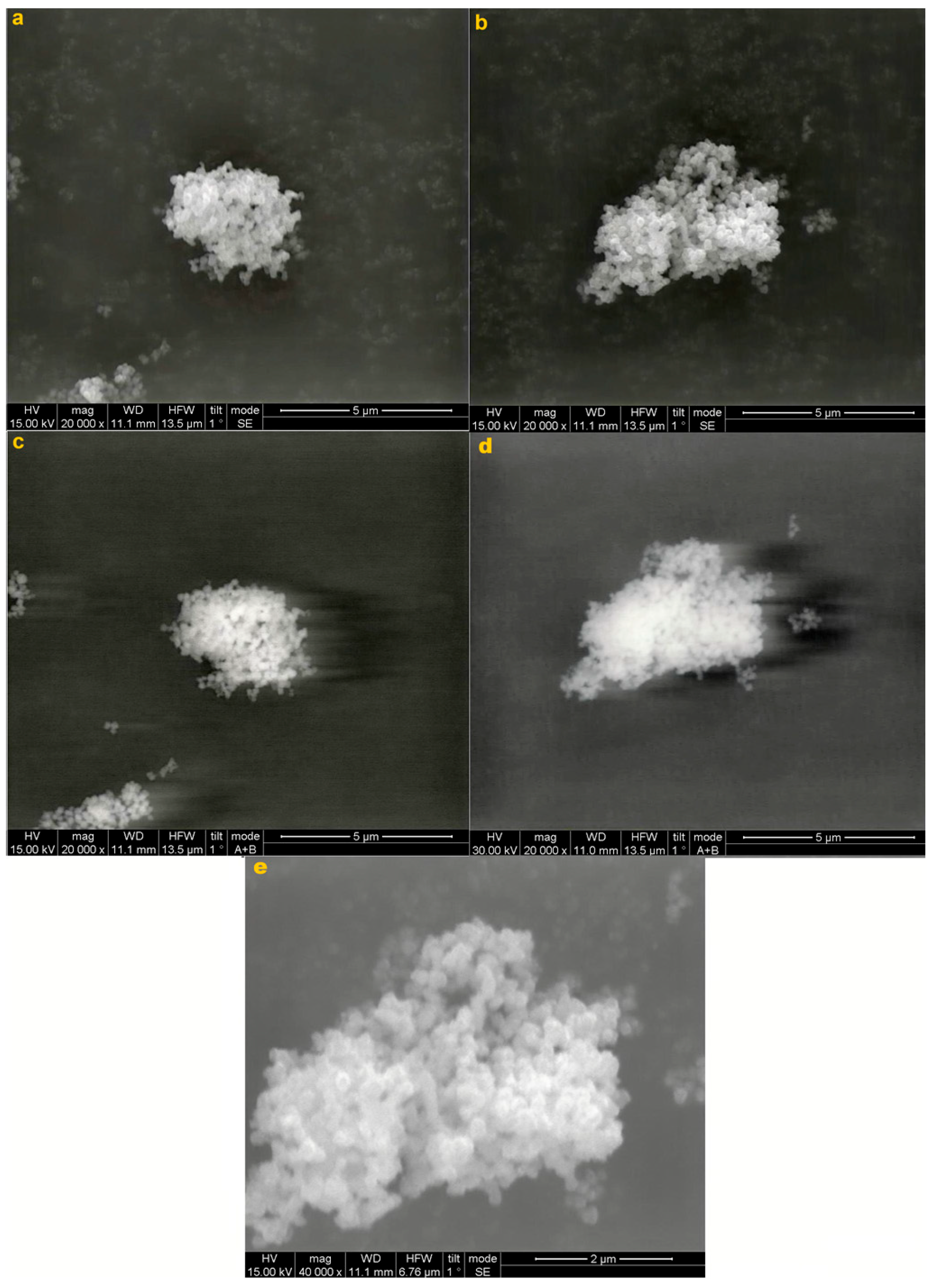
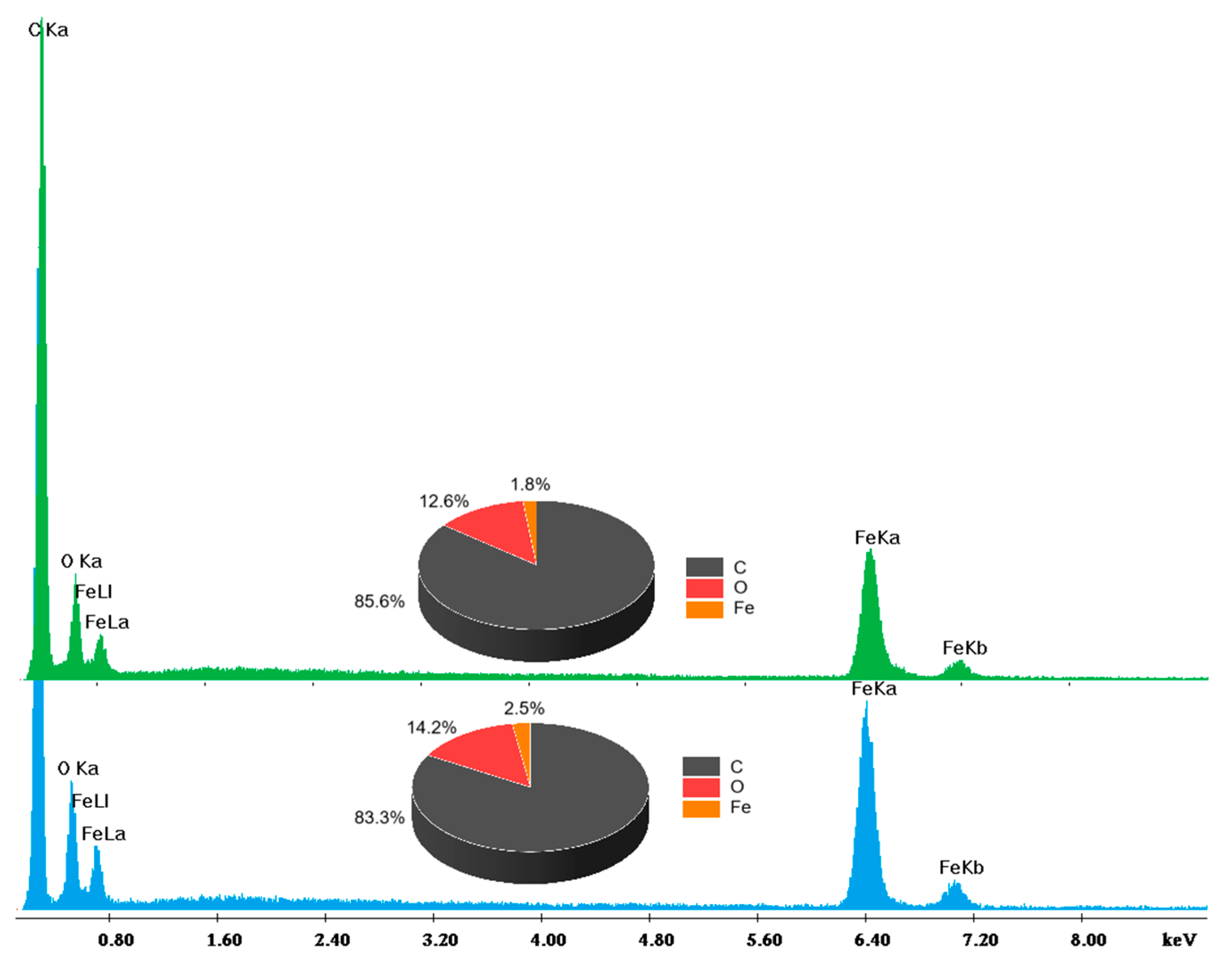
As expected, the proximity of the hydrodynamic radius sizes of treated and untreated magnetite results in analogous small differences in the particle diameters of the dry samples, as established by SEM (Figure 4). In general, both in conventional and backscattered micrographs, the specimens appear as assemblies of quasispheroidal nanoparticles with no significant differences. The same tendency is observed with respect to the composition of coated and uncoated samples, as assessed by EDX (Figure 5). The atomic percentages of carbon, iron, and oxygen are only slightly different. The large percentage of carbon is mostly due to the organic substrate employed for the immobilization of the samples, and its small variation does not permit us to draw any conclusions. There is, however, a notable increase in the O/Fe atomic ratio from 5.7 in the pure magnetite to 7 in the HA-coated counterparts, indicating a greater density of oxygen atoms provided by the external organic layer.

3.2. Adsorption Studies

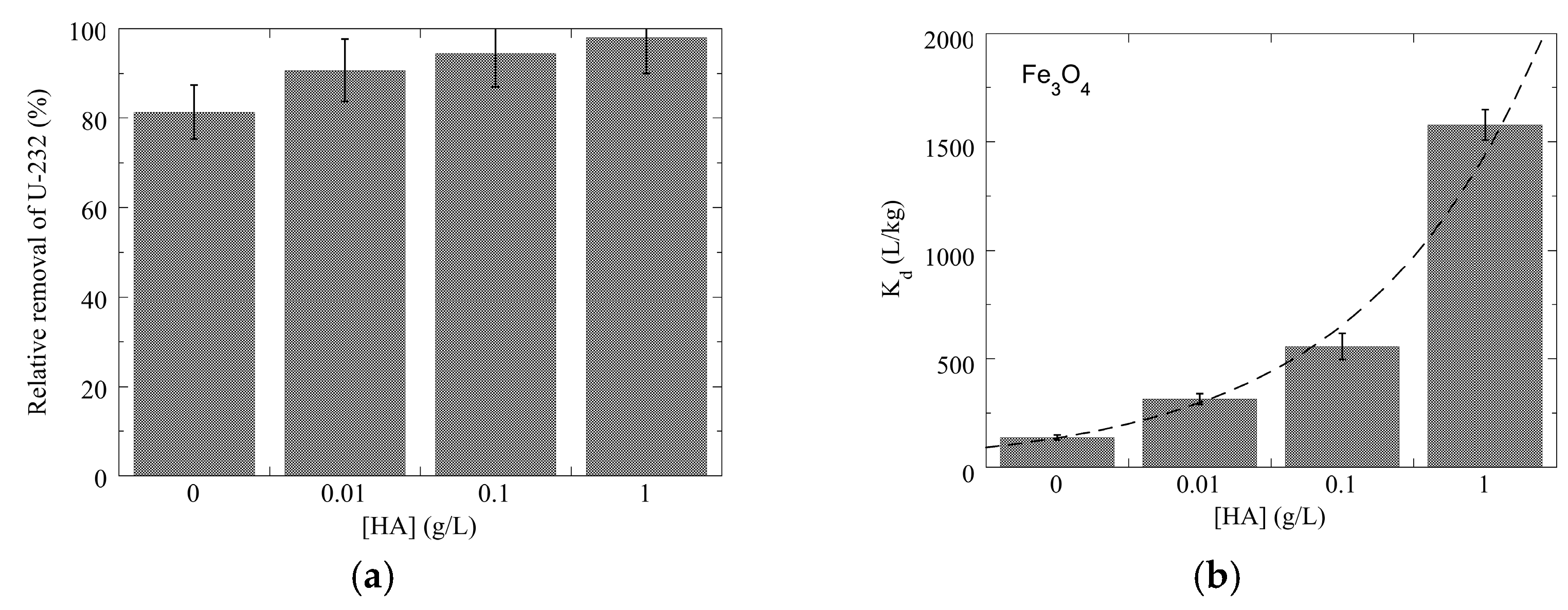
The impact of the HA coating on the adsorption behavior of magnetite towards uranium has been studied at a given pH (pH 5.6), constant radionuclide concentration, and variable surface coating. According to Figure 6a, the relative removal (%) increases with the surface coating and is generally high (80%–100%). The latter is associated with a relatively low radionuclide concentration and an absence of competing cations (e.g., Fe3+, Ca2+) and complexing anions (e.g., CO32−) in the solution. On the other hand, the Kd values for the U-232 adsorption increase exponentially (Figure 6b), indicating the strong impact of the HA coating of the inorganic particles with respect to uranium adsorption. The Kd values after HA coating are significantly higher than the Kd values determined for minerals and similar to those determined for organic matter-containing soils [22].
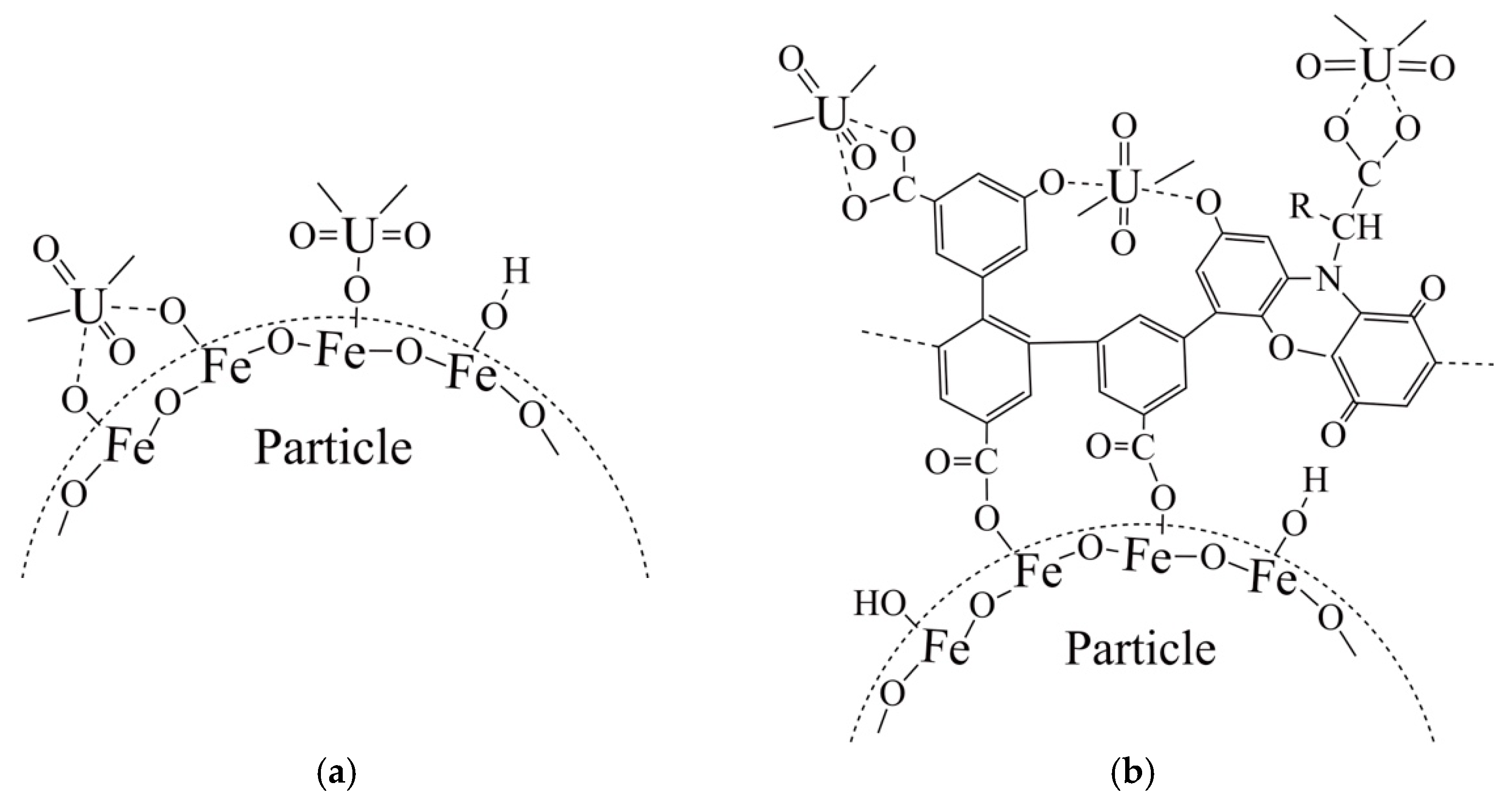
The enormous increase in the adsorption capacity of HA-coated particles could be associated with both the change in the surface charge of the inorganic particles and the increased number of surface active sites (e.g., carboxylic moieties) after HA coating. Moreover, the chemical affinity of the carboxylate moieties towards the uranyl cations, which are the predominant species under the given pH conditions, is expected to be higher compared to the hydroxy moieties on the magnetite surface [5]. In addition, HA coating protects the inorganic particles from dissolution, particularly in the acidic pH range, and shifts the range of negative surface charge towards lower pH values due to the presence of the carboxylic moieties. On the contrary, the negative surface charge of the non-coated magnetite particles is expected to dominate at pH values above the pzc of magnetite (pH 6.5) [12]. The stabilization of the magnetite particles in the acidic pH range and the shift in the negative surface charge to lower pH values are of particular interest for the treatment of acidic waters. The interaction of the uranyl cations, which are the predominant species under the given conditions, is schematically shown in Figure 7.
Surprisingly, the results of the present study are apparently in contradiction to previous studies [8,9], which have shown reduced uranium adsorption and its release from the solid phase in the presence of HA. However, as already mentioned in the introduction, this apparent contradiction is can be accounted for by the experimental design and performance. In previous studies, the formation of the iron oxide solid phases was carried out via coprecipitation in the presence of HA and under alkaline conditions, resulting in the release of excess HA during the adsorption studies and stabilization of U(VI) in the aqueous phase, hence the reduced adsorption affinity. In the present methodology, commercial magnetite nanoparticles have been interacted with HA solution, and the coated particles have been separated, vacuum-dried, and then used as adsorbents under weak acidic conditions (pH 5.6). Hence, the present study focuses on and solely investigates the adsorption reaction, excluding any interferences related to surface precipitation, polynucleation reactions, and the HA complexation of the U(VI) in solution. It should also be noted that the enhanced adsorption affinity of the coated magnetite nanoparticles is in agreement with previous studies in which HA-coated sand particles have been investigated as a reactive barrier for the remediation of copper- and cadmium-ion-polluted groundwater [11].

4. Conclusions

This research provides novel insights into the influence of natural organic matter (NOM)—specifically humic acid (HA)—on the adsorption behavior of Fe3O4 particles toward U-232 in aqueous environments. SEM-EDX analysis confirmed the successful adsorption of HA, while zeta potential measurements highlighted the significant impact of surface modification on the particles’ surface properties. Specifically, the zeta potential measurements showed that unmodified Fe3O4 particles, which have a pzc of around 6.5, become, overall, negatively charged after HA coating in both acidic and alkaline conditions, thereby increasing their affinity for various cations.
The adsorption studies indicate that increasing the amount of adsorbed HA strongly enhances the affinity of these inorganic particles for uranium adsorption. Consequently, the Kd values for U-232 adsorption by HA-coated particles increased by up to an order of magnitude when the Fe3O4 particles adsorb the highest amount of HA. This effect is attributed to the fact that the greater amount of adsorbed HA significantly alters the surface charge from positive to negative, which is driven by the presence of carboxylic functional groups. This modification improves the affinity of the coated particles for cationic uranyl species, even at mildly acidic pH. The highest adsorption affinity of the coated inorganic particles indicates that the presence of such particles in the near field of nuclear repositories is expected to inhibit the radionuclide migration. On the other hand, the application of such HA-coated inorganic particles to adsorption-based water treatment technologies will positively affect the removal of radionuclide from contaminated waters.
These findings demonstrate that HA-coated Fe3O4 particles exhibit enhanced stability and uranium adsorption under mildly acidic conditions. Although U-232 was used as a model radionuclide, the observed behavior provides insight into the mechanisms governing uranium–organic–mineral interactions. This study contributes to a better understanding of how humic coatings influence uranium mobility in aqueous systems and may inform the design of sorbent materials for future environmental applications.

Author Contributions

Conceptualization, I.P., I.A., M.A., and I.I.; methodology, I.P., M.A., I.A., and I.I.; software, I.P.; validation, I.P., M.A., I.A., and I.I.; formal analysis, I.P., M.A., T.B., K.G., and I.I.; investigation, M.A., T.B., and K.G.; resources, M.A. and I.P.; data curation, P.B., M.A., and I.I.; writing—original draft preparation, I.P., I.A., M.A., I.I., and P.B.; writing—review and editing, I.P., I.A., M.A., P.B., and I.I.; visualization, I.P. and I.I.; supervision, I.P.; project administration, I.P. All authors have read and agreed to the published version of the manuscript.

Funding

This research received no external funding.

Institutional Review Board Statement

Not applicable.

Informed Consent Statement

Not applicable.

Data Availability Statement

The original contributions presented in this study are included in the article. Further inquiries can be directed to the corresponding authors.

Conflicts of Interest

The authors declare no conflicts of interest.

References

  1. Yi, S.; Chen, X.; Cao, X.; Yi, B.; He, W. Influencing factors and environmental effects of interactions between goethite and organic matter: A critical review. Front. Environ. Sci. 2022, 10, 1023277. [Google Scholar] [CrossRef]
  2. Kim, H.C.; Park, S.Y.; Lee, C.G.; Han, Y.U.; Park, J.A.; Park, S.B. Humic Acid Removal from Water by Iron-coated Sand: A Column Experiment. Environ. Eng. Res. 2009, 14, 41–47. [Google Scholar] [CrossRef]
  3. Hu, J.D.; Zevi, Y.; Kou, X.M.; Xiao, J.; Wang, X.J.; Jin, Y. Effect of dissolved organic matter on the stability of magnetite nanoparticles under different pH and ionic strength conditions. Sci. Total Environ. 2010, 408, 3477–3489. [Google Scholar] [CrossRef]
  4. Spark, K.M.; Wells, J.D.; Johnson, B.B. The interaction of a humic acid with heavy metals. Soil Res. 1997, 35, 89–102. [Google Scholar] [CrossRef]
  5. Schmeide, K.; Sachs, S.; Bubner, M.; Reich, T.; Heise, K.H.; Bernhard, G. Interaction of uranium(VI) with various modified and unmodified natural and synthetic humic substances studied by EXAFS and FTIR spectroscopy. Inorg. Chim. Acta 2003, 351, 133–140. [Google Scholar] [CrossRef]
  6. Ioannidis, I.; Antoniou, E.; Pashalidis, I. Enhanced radionuclide (U-232) adsorption by humic acid-coated microplastics. J. Environ. Chem. Eng. 2025, 13, 115064. [Google Scholar] [CrossRef]
  7. Galamboš, M.; Suchánek, P.; Rosskopfová, O. Sorption of anthropogenic radionuclides on natural and synthetic inorganic sorbents. J. Radioanal. Nucl. Chem. 2012, 293, 613–633. [Google Scholar] [CrossRef]
  8. Helal, A.A.; Ahmed, I.M.; Gamal, R.; Abo-El-Enein, S.A.; Helal, A.A. Sorption of uranium(VI) from aqueous solution using nanomagnetite particles; with and without humic acid coating. J. Radioanal. Nucl. Chem. 2022, 331, 3005–3014. [Google Scholar] [CrossRef]
  9. Ding, Y.; Huang, X.; Zhang, H.; Ma, J.; Li, F.; Zeng, Q.; Hu, N.; Wang, Y.; Dai, Z.; Ding, D. Coupled variations of dissolved organic matter distribution and iron (oxyhydr)oxides transformation: Effects on the kinetics of uranium adsorption and desorption. J. Hazard. Mater. 2022, 436, 129298. [Google Scholar] [CrossRef]
  10. Lin, P.; Xu, C.; Xing, W.; Sun, L.; Kaplan, D.I.; Fujitake, N.; Yeager, C.M.; Schwehr, K.A.; Santschi, P.H. Radionuclide uptake by colloidal and particulate humic acids obtained from 14 soils collected worldwide. Sci. Rep. 2018, 8, 4795. [Google Scholar] [CrossRef]
  11. Faisal, A.A.A.H.; Abdul-Kareem, M.B.; Mohammed, A.K.; Naushad, M.; . Ghfar, A.A.; Ahamad, T. Humic acid coated sand as a novel sorbent in permeable reactive barrier for environmental remediation of groundwater polluted with copper and cadmium ions. J. Water Process Eng. 2020, 36, 101373. [Google Scholar] [CrossRef]
  12. Ioannidis, I.; Antoniou, E.; Kinigopoulou, V.; Giannakoudakis, D.A.; Triantafyllidis, K.S.; Anastopoulos, I.; Pashalidis, I. Interaction of humic acids with PN6 microplastics and increased affinity for radionuclides (U-232). J. Radioanal. Nucl. Chem. 2025, 334, 4875–4883. [Google Scholar] [CrossRef]
  13. Singh, B.K.; Jain, A.; Kumar, S.; Tomar, B.S.; Tomar, R.; Manchanda, V.K.; Ramanathan, S. Role of magnetite and humic acid in radionuclide migration in the environment. J. Contam. Hydrol. 2009, 106, 144–149. [Google Scholar] [CrossRef] [PubMed]
  14. Bondareva, L.; Fedorova, N. The effect of humic substances on metal migration at the border of sediment and water flow. Environ. Res. 2020, 190, 109985. [Google Scholar] [CrossRef] [PubMed]
  15. Shen, Z.; Kuang, Y.; Zhou, S.; Zheng, J.; Ouyang, G. Preparation of magnetic adsorbent and its adsorption removal of pollutants: An overview. TrAC Trends Anal. Chem. 2023, 167, 117241. [Google Scholar] [CrossRef]
  16. Chernysh, Y.; Chubur, V.; Ablieieva, I.; Skvortsova, P.; Yakhnenko, O.; Skydanenko, M.; Plyatsuk, L.; Roubík, H. Soil Contamination by Heavy Metals and Radionuclides and Related Bioremediation Techniques: A Review. Soil Syst. 2024, 8, 36. [Google Scholar] [CrossRef]
  17. Baik, M.H.; Lee, S.Y.; Lee, J.K.; Kim, S.S.; Park, C.K.; Choi, J.W. Review and compilation of data on radionuclide migration and retardation for the performance assessment of a HLW repository in Korea. Nucl. Eng. Technol. 2008, 40, 593–606. [Google Scholar] [CrossRef]
  18. Georgiou, E.; Raptopoulos, G.; Anastopoulos, I.; Giannakoudakis, D.A.; Arkas, M.; Paraskevopoulou, P.; Pashalidis, I. Uranium Removal from Aqueous Solutions by Aerogel-Based Adsorbents—A Critical Review. Nanomaterials 2023, 13, 363. [Google Scholar] [CrossRef]
  19. Milonjić, S.K.; Kopečni, M.M.; Ilić, Z.E. The point of zero charge and adsorption properties of natural magnetite. J. Radioanal. Chem. 1983, 78, 15–24. [Google Scholar] [CrossRef]
  20. Kretzschmar, R.; Sticher, H.; Hesterberg, D. Effects of Adsorbed Humic Acid on Surface Charge and Flocculation of Kaolinite. Soil Sci. Soc. Am. J. 1997, 61, 101–108. [Google Scholar] [CrossRef]
  21. Sachs, S.; Brendler, V.; Geipel, G. Uranium(VI) complexation by humic acid under neutral pH conditions studied by laser-induced fluorescence spectroscopy. Radiochim. Acta 2007, 95, 103–110. [Google Scholar] [CrossRef]
  22. Ramírez-Guinart, O.; Kaplan, D.; Rigol, A.; Vidal, M. Deriving probabilistic soil distribution coefficients (Kd). Part 1: General approach to decreasing and describing variability and example using uranium Kd values. J. Environ. Radioactiv. 2020, 222, 106362. [Google Scholar] [CrossRef] [PubMed]
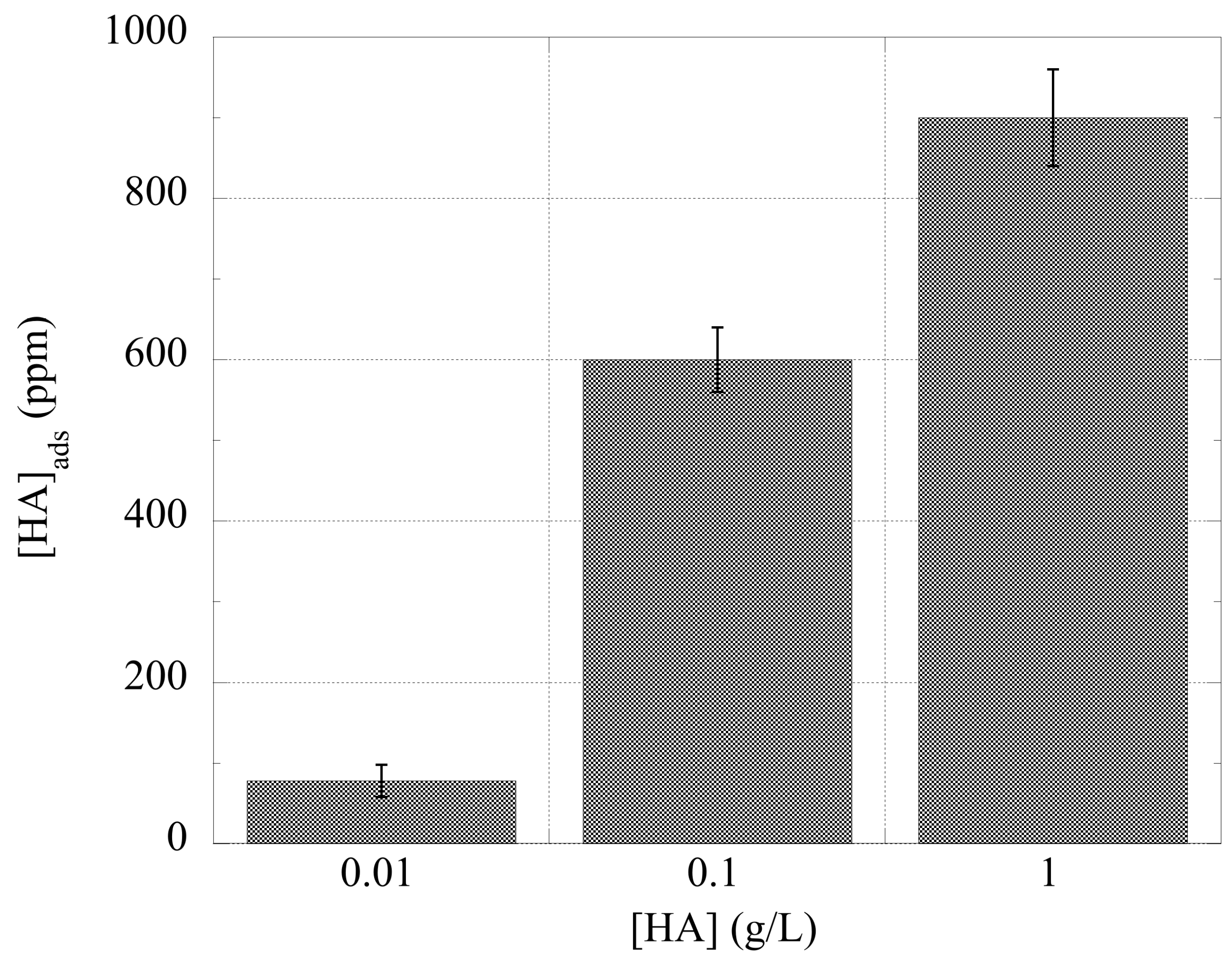
Figure 1. Amount of HA adsorbed by Fe3O4 particles as a function of the initial HA concentration in the solution.
Coatings 15 01399 g001
Figure 2. Zeta-potential values of Fe3O4 particles prior to and after HA coating using solutions of different HA concentrations.
Coatings 15 01399 g002
Figure 3. Fe3O4 average particle size without and with an HA coating obtained using solutions of different HA concentrations, determined by DLS.
Coatings 15 01399 g003
Figure 4. SEM micrographs (20K magnification) of (a) untreated Fe3O4 particles, (b) Fe3O4 particles after coating in 1 g/L HA solution. Respective backscattered pictures of uncoated (c) and HA-coated (d) specimens. (e) HA-coated Fe3O4 particles at 40K magnification.
Coatings 15 01399 g004
Figure 5. EDX spectra of uncoated (blue) and HA coated (green) magnetite samples, along with their atomic percentage compositions.
Coatings 15 01399 g005
Figure 6. (a) Relative adsorption and (b) distribution coefficients (Kd) for the U-232 adsorption by Fe3O4 particles treated with humic acid solutions of different concentrations (0.01 g/L, 0.1 g/L, and 1.0 g/L). The adsorption experiments were conducted under ambient atmospheric conditions at pH 5.6.
Coatings 15 01399 g006
Figure 7. Schematic illustration of the interaction of U(VI) with (a) magnetite and (b) HA-coated magnetite surface active moieties.
Coatings 15 01399 g007
Disclaimer/Publisher’s Note: The statements, opinions and data contained in all publications are solely those of the individual author(s) and contributor(s) and not of MDPI and/or the editor(s). MDPI and/or the editor(s) disclaim responsibility for any injury to people or property resulting from any ideas, methods, instructions or products referred to in the content.