Article

Perception of Structural Colors in Nanostructured Anodic Aluminum Oxide Films

1
Materials-Nano and Manufacturing Convergence and Open Sharing System, Kangwon National University, Chuncheon 24341, Republic of Korea
2
Department of Smart Health Science and Technology, Kangwon National University, Chuncheon 24341, Republic of Korea
3
Department of Mechanical and Biomedical, Mechatronics Engineering, Kangwon National University, Chuncheon 24341, Republic of Korea
*
Author to whom correspondence should be addressed.
Coatings 2025, 15(11), 1260; https://doi.org/10.3390/coatings15111260
Submission received: 9 September 2025 / Revised: 6 October 2025 / Accepted: 20 October 2025 / Published: 1 November 2025
(This article belongs to the Section Thin Films)

Abstract

This study investigates the fabrication of anodic aluminum oxide (AAO)/Al bilayer films using a two-step aluminum anodization process and explores the perception and prediction of structural colors through these films. A composite AAO film with an AAO/Ni/Al structure was fabricated by electroplating an AAO/Al bilayer film with an AAO/Al structure. The fabricated composite AAO film was used to produce structural colors through changes in optical characteristics caused by Ni nanoplugs. Constructive-interference wavelengths resulting from variations in the pore diameter and interpore distance of AAO/Al bilayer films and composite AAO films were predicted using the Bragg–Snell law, with a maximum error margin of 9%. Additionally, the composite AAO film exhibited RGB colors within the predicted constructive-interference wavelength range. These results demonstrate that structural colors can be reliably predicted by estimating the constructive-interference wavelengths of composite AAO films. The approach provides a practical design rule for target colors in AAO-based coatings under normal incidence. The key advance is a single closed-form rule that links Dt, Dint, DP, and Dni to λ_peak at normal incidence, enabling forward and inverse color design without numerical optimization.

1. Introduction

Anodic aluminum oxide (AAO) films fabricated via aluminum anodization consist of alumina with a nanoporous structure on an aluminum surface [1,2,3,4]. The two-step aluminum anodization process is widely used to form aligned nanoporous structures [5,6,7]. The aluminum anodization process employs acidic electrolytes, such as sulfuric [8,9,10], oxalic [9,10], and phosphoric acids [9,10,11,12]. The pore diameter and interpore distance in AAO films can be controlled by adjusting the applied voltage during the formation of aligned nanoporous alumina via electrochemical reactions. The thickness of the nanoporous alumina formed during aluminum anodization is proportional to the amount of available charge [13,14,15]. The high oxidation resistance of nanoporous alumina films formed on aluminum surfaces and the ease of realizing structural colors enable their application in several electronic devices [16,17]. Recent reviews emphasize large-area scalable fabrication and geometric control, positioning AAO as an optical dielectric, a nanoscale template, and a functional membrane [18,19]. In optics, AAO enables structural color via thin-film interference guided by effective-medium theory [20]. Maxwell–Garnett-type models have been benchmarked against numerical and experimental data for dense cylindrical-pore media under normal incidence (or polarization orthogonal to the pore axis) [21]. Applications span optical and chemical sensing and SERS, anti-counterfeiting, membranes/filtration, and template growth of one-dimensional nanostructures [22]. Coloring aluminum involves the use of dyes based on organic chemicals [23,24] or the nanoporous alumina structure formed through aluminum anodization [25,26,27,28,29,30]; however, the former method is rarely used because dyes exhibit discoloration when exposed to direct sunlight. The perception of colors by modifying the structural characteristics of the nanopores formed after aluminum anodization can address this discoloration issue. Structural characteristics of nanopores significantly affect the nature of light reflected from their surface [4]. Recent studies optimized structural color in Al/AAO/metal stacks by coupling effective-medium modeling with thickness tuning [20]. These reports motivate a closed-form link from nano-geometry to visible reflectance for rapid design [31]. Here, “closed-form” denotes an explicit design formula that analytically combines the effective refractive index and the interference condition from AAO pore geometry and material constants, yielding optical responses such as λ_peak directly without iterative numerical procedures.
Constructive and destructive interference occur in AAO/Al bilayer films with a nanoporous structure after aluminum anodization owing to the refraction and reflection of incident light at the AAO/Al interface [32]. The wavelength of the reflected light that produces constructive interference in the visible-light region of an AAO/Al bilayer film can be predicted using Bragg’s law [33,34,35]. Significantly, Ag [36,37,38], Cu [39], and Ni [40,41,42] nanoplugs can be produced by electroplating AAO/Al bilayer films [43]. Composite AAO films with AAO/metal/Al structures fabricated using nanostructured metals exhibit optical properties that are different from those of the existing AAO/Al bilayer film structures, including the production of specific colors [32,44,45]. Therefore, predicting the light reflected in the visible-light region from the composite AAO films will facilitate the prediction of structural colors of the composite AAO film.
Therefore, we fabricated an AAO/Al bilayer film with an AAO/Al structure via a two-step anodization process using sulfuric and phosphoric acids. A composite AAO film with an AAO/metal/Al structure was subsequently formed by electroplating the as-developed AAO/Al bilayer film. Furthermore, we analyzed the optical properties of AAO/Al bilayer films and composite AAO films in the visible-light region and predicted their structural colors. This work provides a closed-form design map linking Dt (pore depth), DP (pore diameter), Dint (interpore distance), and Dni (Ni filling depth) to λ_peak (peak reflectance wavelength), reducing trial-and-error in structural-color fabrication [46]. Unlike prior AAO color studies that relied on effective-medium modeling with case-by-case thickness tuning, our contribution is a closed-form mapping applicable to both AAO/Al bilayer and AAO/Ni/Al, which removes iterative fitting.

2. Fabrication and Measurement Theory

2.1. Fabrication of AAO and Composite AAO Films

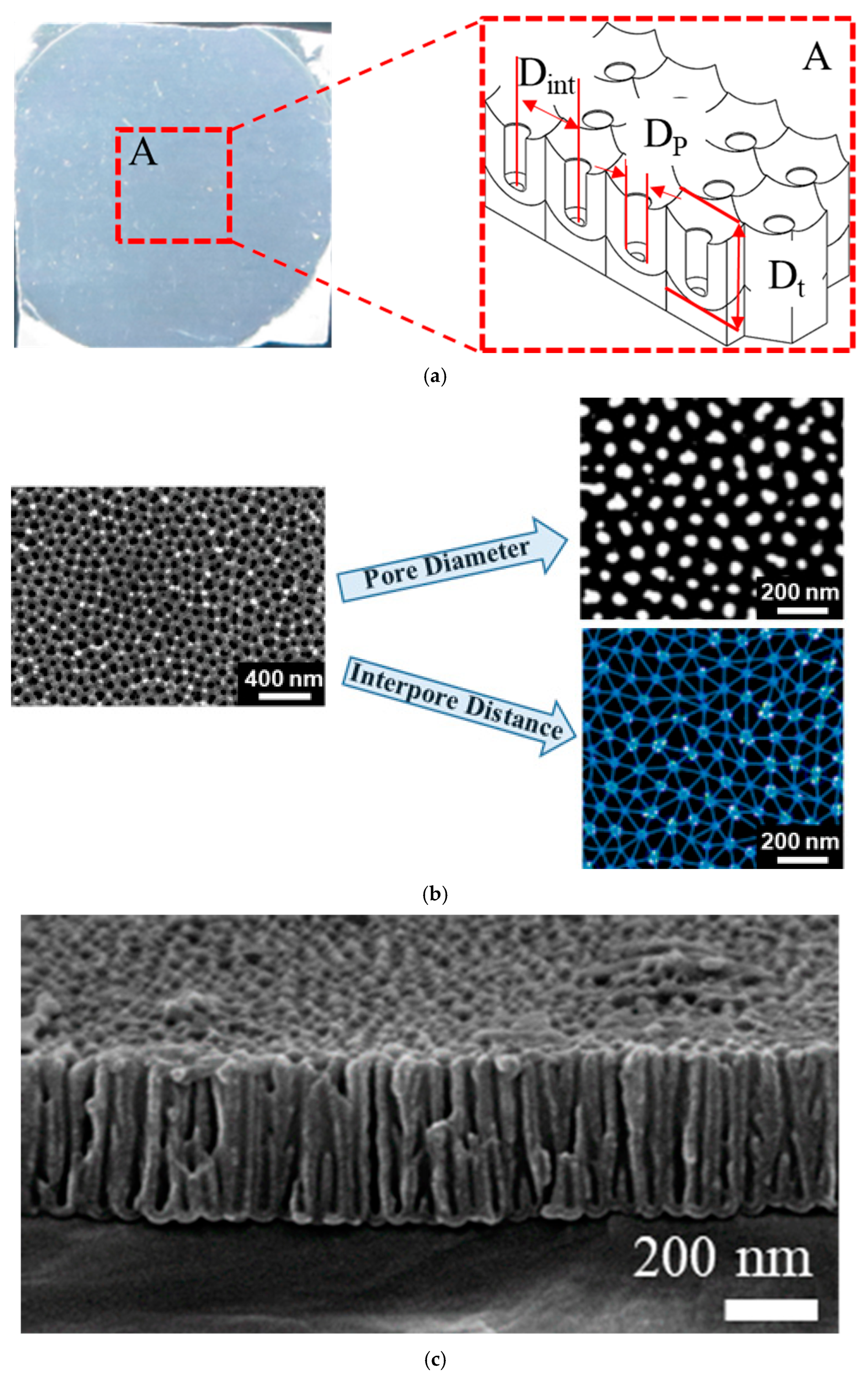
A two-step aluminum anodization process was used to fabricate an AAO/Al bilayer film using 0.1 M sulfuric acid and 0.5 M phosphoric acid as the electrolytes. The aluminum plates used herein were composed of 70xx aluminum alloys (thickness: 1 mm), the exact composition per the supplier certificate, including those with aluminum, magnesium, and chromium as constituent elements. In the first step of aluminum anodization, constant voltages of 20 V in sulfuric acid (0.1 M, pH 0.3) and 30 V in phosphoric acid (0.5 M, pH 1.7) were applied for 15 min at 0 °C, respectively. Thereafter, the formed alumina was removed through chemical etching in a mixed solution of 1.8 wt% chromic acid and 6 wt% phosphoric acid at 65 °C for 2 h. The second step was conducted under the same temperature, electrolyte, and voltage conditions as the first step of the aluminum anodization process. Subsequently, to achieve the target pore diameter of the AAO layer, a chemical widening process was performed by etching the pore walls and barrier layer: the AAO/Al bilayer film was immersed in 0.1 M phosphoric acid at 35 °C for approximately 10 min. Figure 1 shows the scanning electron microscopy (SEM, Carl Zeiss(Supra 55VP), Oberkochen, Germany) image and image processing used for AAO structural analysis. Figure 1a shows the actual and three-dimensional (3D) cross-sectional images of the as-fabricated AAO/Al bilayer film. After the second step of the aluminum anodization process, the AAO/Al bilayer film exhibits a honeycomb-like aligned nanostructure, as shown in the 3D cross-section in Figure 1a. The optical properties of the AAO film structure were determined using the pore diameter (DP), interpore distance (Dint), and pore depth (Dt) of the formed porous alumina. Computer-graphic techniques were used to measure the shape of the porous nanostructures. Surface and cross-sectional SEM images of the AAO films were obtained using a scanning electron microscope Ultra-High-Resolution(UHR)-SEM (Carl Zeiss(Supra 55VP), Oberkochen, Germany). The DP and Dint of the AAO films were determined using the SEM images by employing a Python 3.10.0-code-based OpenCV computer-graphic library. The method used to determine these parameters was as follows: From top-view SEM images of AAO films, pores were enhanced as dark features (grayscale → CLAHE → Gaussian blur), binarized by Otsu thresholding, and denoised via morphological cleaning. Touching pores were separated using a distance-transform-based watershed. The resulting masks were analyzed in Python 3.10.0-code-based OpenCV to extract each pore’s area and centroid, from which the equivalent circular diameter was computed as ( D = 2 A / π ). Pore pitch was then obtained by applying a KD-tree nearest-neighbor search to the centroid coordinates. Figure 1b shows the results for the DP and Dint of the AAO film nanostructure obtained using a computer-graphic library, and the processing steps are summarized as follows:
Step 1: Input the scale information as marked on the SEM image.
Step 2: Extract the circular section (gray area) of the AAO film pores.
Step 3: Calculate DP based on the radius of the extracted circular pore.
Step 4: Determine Dint in the AAO film based on the length of the line connecting the center points of the extracted circular pores.
Figure 1c shows the SEM image used to measure the Dt of the as-formed AAO film. The Dt was measured based on the scale information provided on the corresponding SEM image.
Next, electroplating was performed to convert the AAO/Al bilayer film into a composite AAO film. Electroplating was performed with an alternating-current power supply at 50 Hz, for sulfuric-acid AAO/Al bilayer films at 10 V for 20 sec and for phosphoric-acid AAO/Al bilayer films at 15 V for 120 sec, and electrolytes (pH 4.5) based on nickel sulfate (150 g/L), nickel chloride (40 g/L), and boric acid (40 g/L) were used at room temperature.

2.2. Optical Modeling and Theory

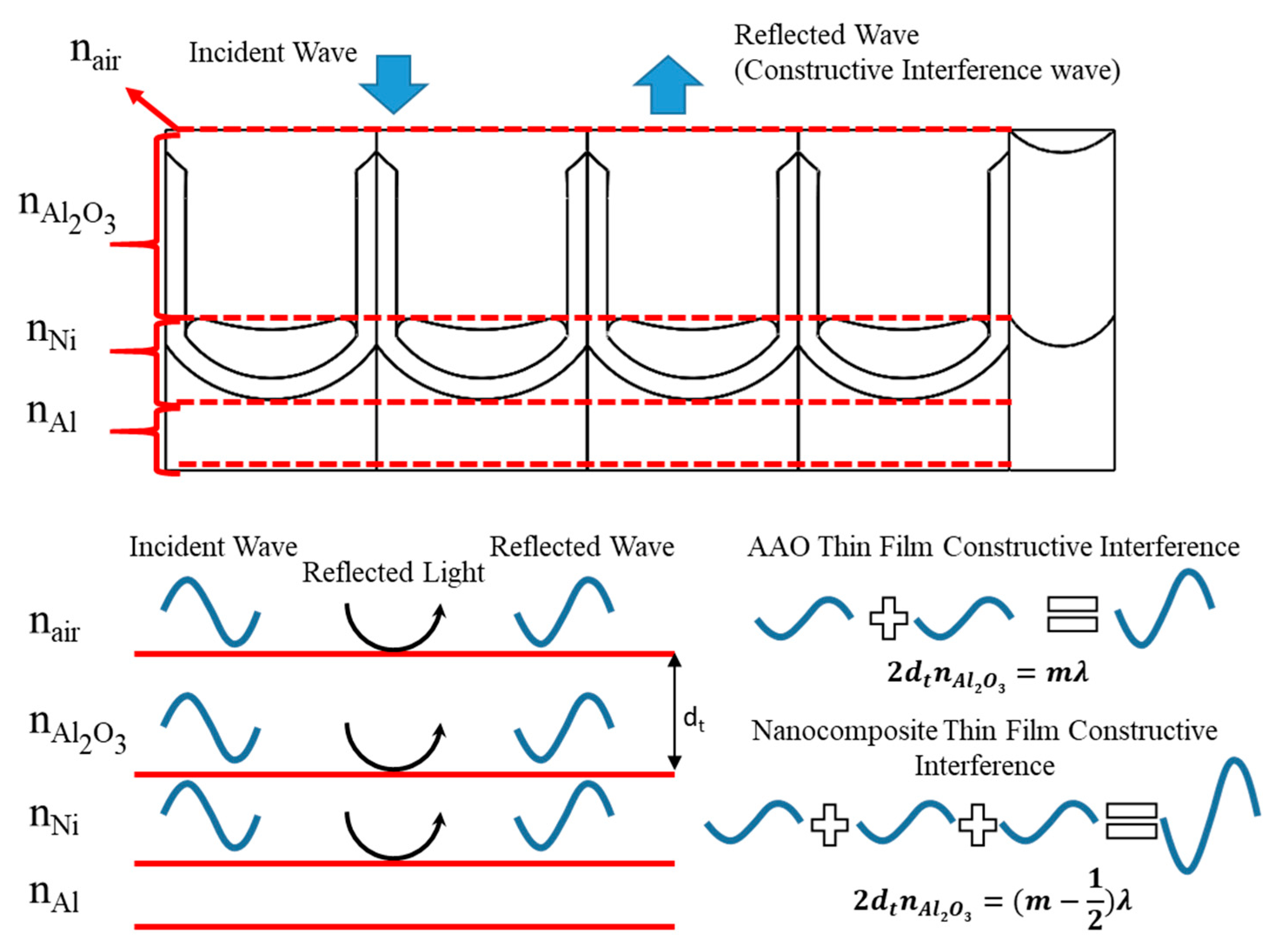
The thin-film effect can be used to explain the optical properties of AAO/Al bilayer films and composite AAO films. Figure 2 presents the optical properties of AAO/Al bilayer films and composite nano AAO films. In AAO/Al bilayer films, incident light on the porous alumina surface is refracted after encountering a dense medium. The refracted incident light causes re-reflection at the alumina interface, which results in constructive and destructive interference, owing to the different refractive index of the interface. The wavelength of the reflected light caused by constructive interference in the AAO/Al bilayer film can be determined using the Bragg–Snell law [35]:
2 d t n A l 2 O 3 = m λ
where d t indicates the pore depth at the interface and n A l 2 O 3 is the refractive index of alumina, m is the interference order, and λ is the free-space wavelength.
In composite nanostructure AAO films, constructive and destructive interferences occur owing to the difference in the refractive index of the air/AAO, AAO/Ni, and Ni/Al interfaces. The wavelength of the reflected light due to constructive interference is calculated as follows:
2 d t n e f f , A l 2 O 3 = ( m 1 2 ) λ
where n e f f , A l 2 O 3 indicates the effective refractive index of the AAO film, which can be calculated by applying the Maxwell–Garnett theory and depends on DP (pore diameter) and Dint (interpore distance). The effective permittivity was evaluated using the Maxwell–Garnett model within the long-wavelength approximation for orthogonal polarization under normal incidence in a cylindrical-pore system. Under these conditions, Maxwell–Garnett quantitatively matches numerical eigenmode analyses and experiments up to high porosities and is more accurate than the Bruggeman model [21]. Its applicability to other material combinations comparable to the present AAO system has also been verified [21]. The effective refractive index is expressed as follows [21,35]:
ε e f f , A l 2 O 3 ε A l 2 O 3 ε e f f , A l 2 O 3 + 2 ε A l 2 O 3 = f ε a i r ε A l 2 O 3 ε a i r + 2 ε A l 2 O 3
Equation (3) shows the calculation formula of the effective dielectric constant ( ε e f f , A l 2 O 3 ). Based on a previous study, the specific dielectric constants of air ( ε a i r ) and the AAO film ( ε A l 2 O 3 ) were 1 and 2.31, respectively [47]. The term ‘ f ’ in Equation (3) indicates the porosity of the AAO film, which is expressed as follows:
f = 2 π 3 ( D P D i n t ) 2
ε e f f , A l 2 O 3 = n e f f , A l 2 O 3 2
Equation (5) shows the relationship between the effective dielectric constant ( ε e f f , A l 2 O 3 ) and effective refractive index ( n e f f , A l 2 O 3 ). The effective refractive index ( n e f f , A l 2 O 3 ) of the AAO film was calculated based on the above equations and applied to determine the wavelength of the constructive interference.
The estimated wavelength (λ) was calculated using the following equation.
2 n a d a + 2 n b d b = m + 1 2 λ
Here, n a and d a denote the refractive index and thickness of the AAO/Al bilayer film, respectively, while n b and d b denote the refractive index and thickness of the composite AAO film. The refractive index of the composite AAO films was set to n = 1.72 based on the literature, and the diffraction order was taken as m = 1.
For each condition, N = 5 specimens were measured; data are reported as mean ± s.d.

3. Results and Discussion

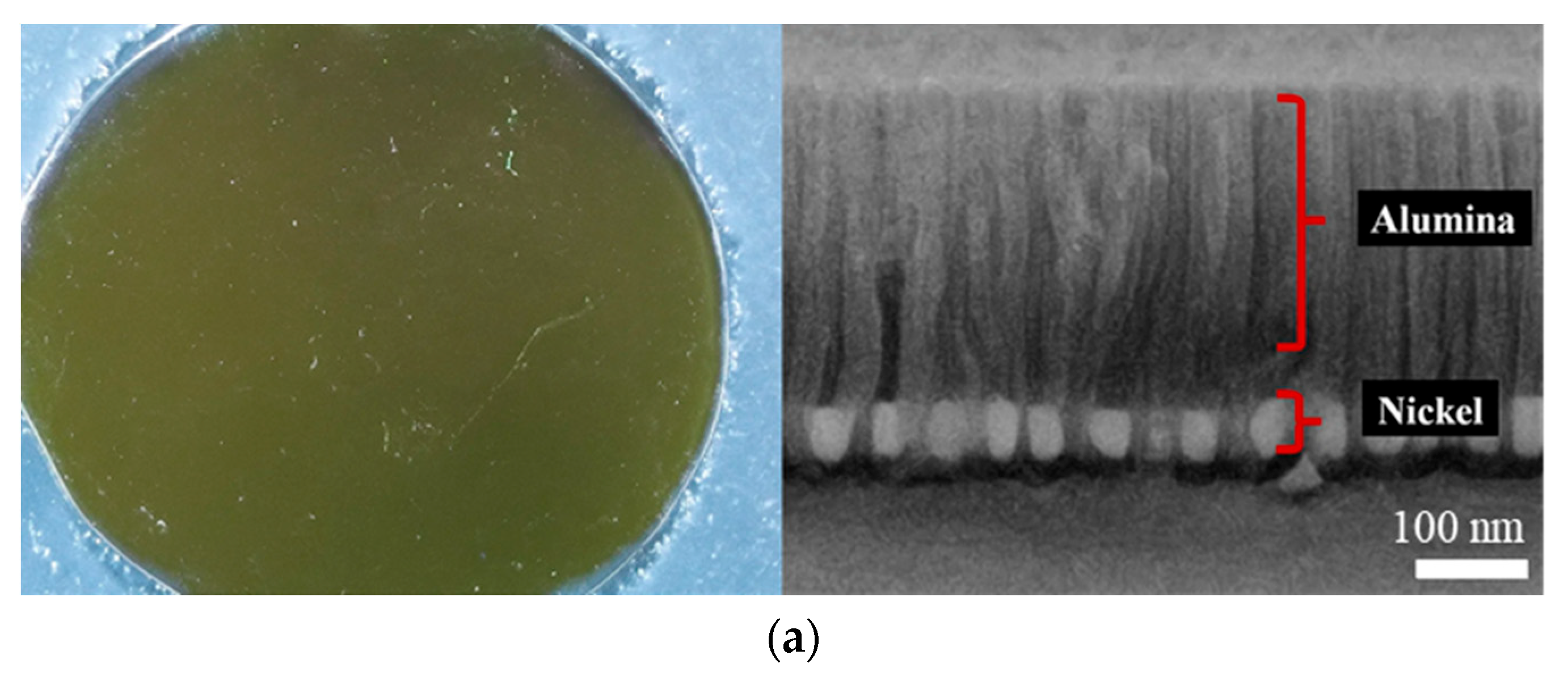
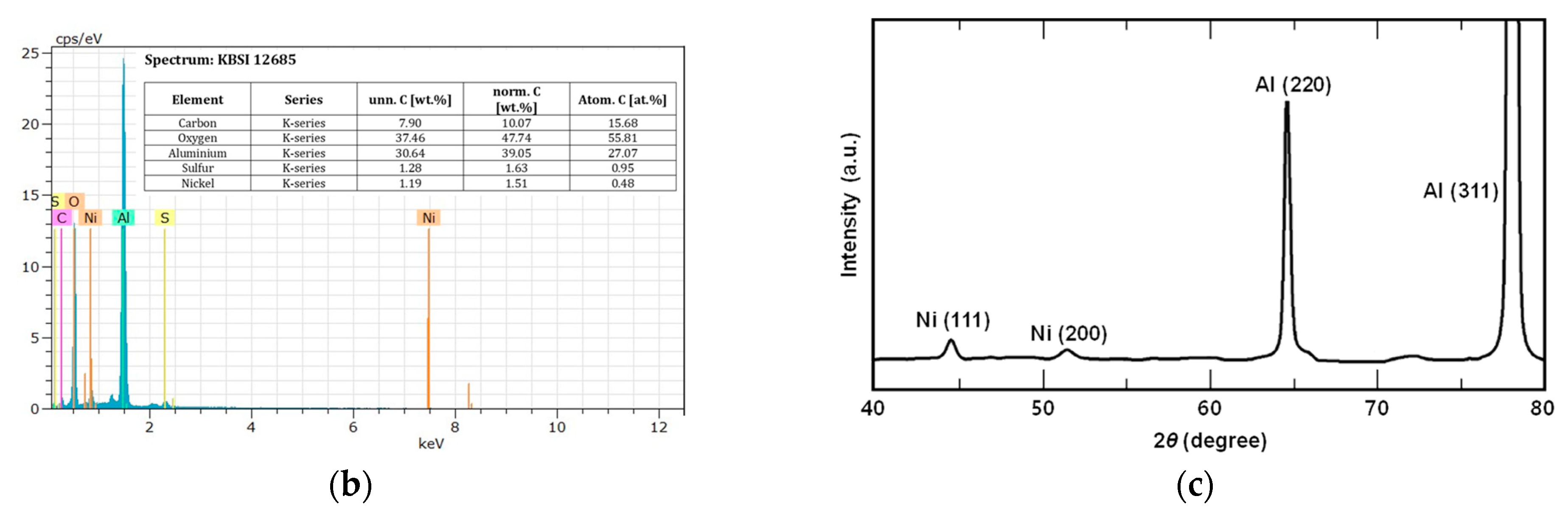
Figure 3a shows the resulting composite AAO film and corresponding SEM cross-sectional image. The SEM image confirms that nickel nanoplugs are formed inside the pores of the AAO/Al bilayer film after electroplating (Figure 3b). Crystal structure of Ni nanoplugs in composite AAO film is analyzed from XRD spectra shown in Figure 3c. We observe two peaks at 2θ at 44.8° and 52° which are congruent with (111) and (200) planes. These XRD data confirm that the crystal structure of Ni nanoplugs is face-centered cubic (FCC) based on the peaks. The high peaks at 64.7° and 78.2° represent Al (220) and Al (311) structures, respectively. No peak of Al2O3 structure is found; thus, we suggest that the structure of AAO template is amorphous [48]. The results show that gray and vivid colors are optical in the AAO/Al bilayer films and composite AAO films.
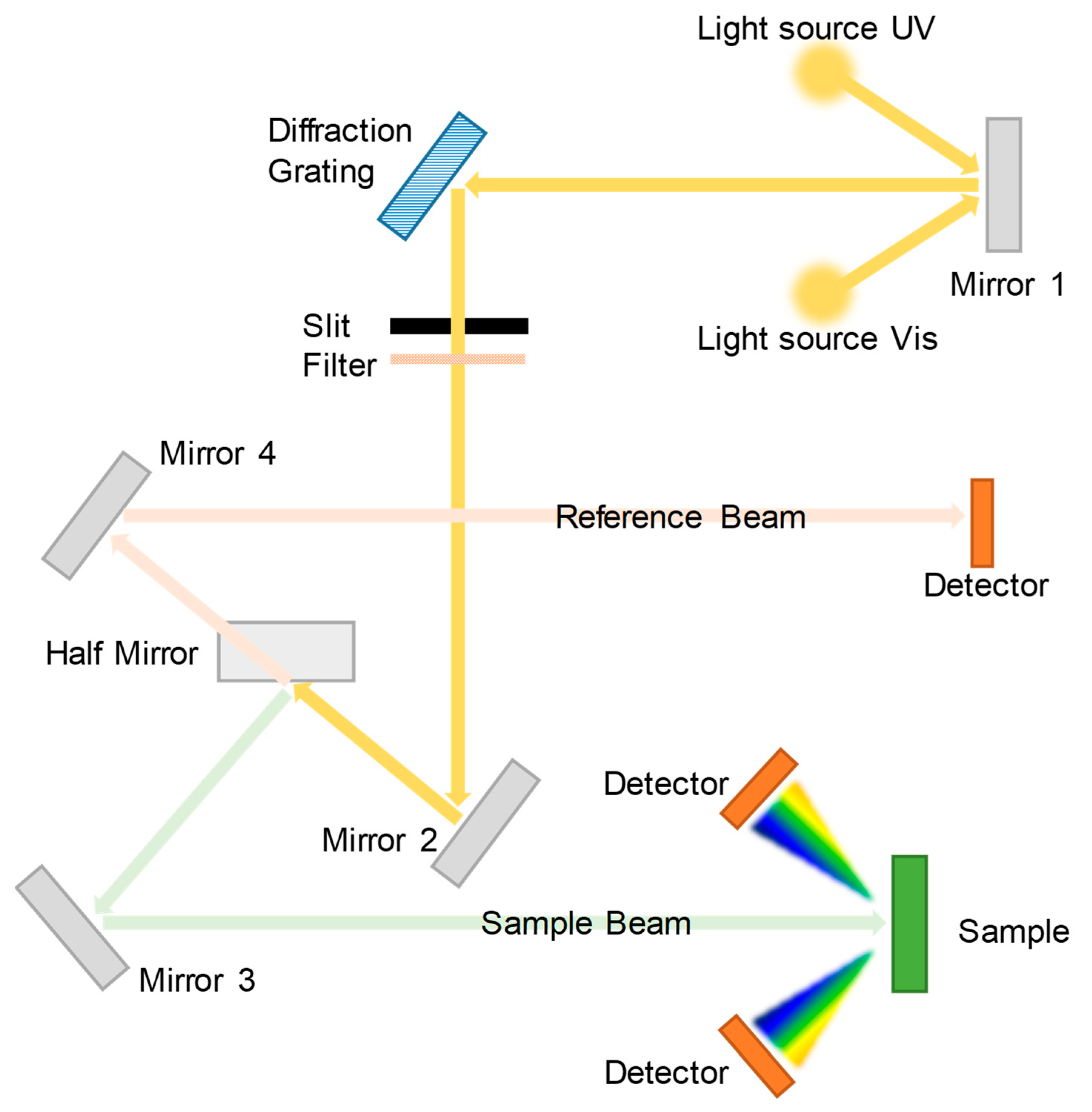
Reflectance spectra were measured under normal incidence using a UV–Vis–NIR spectrophotometer equipped with a deuterium lamp (UV) and a tungsten–halogen lamp (visible–NIR). The beam was collimated and the sample was mounted at 0° on a goniometric stage; alignment ensured | θ i | ≤ 1°. Specular reflectance was recorded against a calibrated reference. The light source automatically switched between deuterium (UV) and tungsten–halogen (visible–NIR). See the normal-incidence setup in Figure 4.

3.1. Characteristics of the Reflected Light in AAO/Al Bilayer Films

The change in the reflected light in the visible-light region was analyzed and predicted based on the structural characteristics of the AAO/Al bilayer film in the AAO/Al structure. Table 1 presents the results obtained for each AAO structure using SEM images of the AAO/Al bilayer films and the measurement and prediction results for the light reflected in the visible-light region. AAO/Al bilayer films with a DP of approximately 25 nm and Dint of 55 nm (AAO#1–AAO#3) and those with a DP of approximately 55 nm and Dint of 85 nm (AAO#4–AAO#6) were produced with Dt values of approximately 300–550 nm. The effective refractive index of the AAO/Al bilayer films was higher for smaller DP and Dint values. These high values are obtained because the porosity of the AAO film, f in Equation (4), is proportional to DP and Dint and affects the effective refractive index calculated using Equations (3) and (5). The effective refractive index of AAO/Al bilayer films AAO#1–AAO#3 was determined to be approximately 1.417 and that for AAO#4–AAO#6 was approximately 1.322, which is close to that of air. We confirmed that the DP and Dint of the AAO structure affect the effective refractive index of AAO/Al bilayer films.
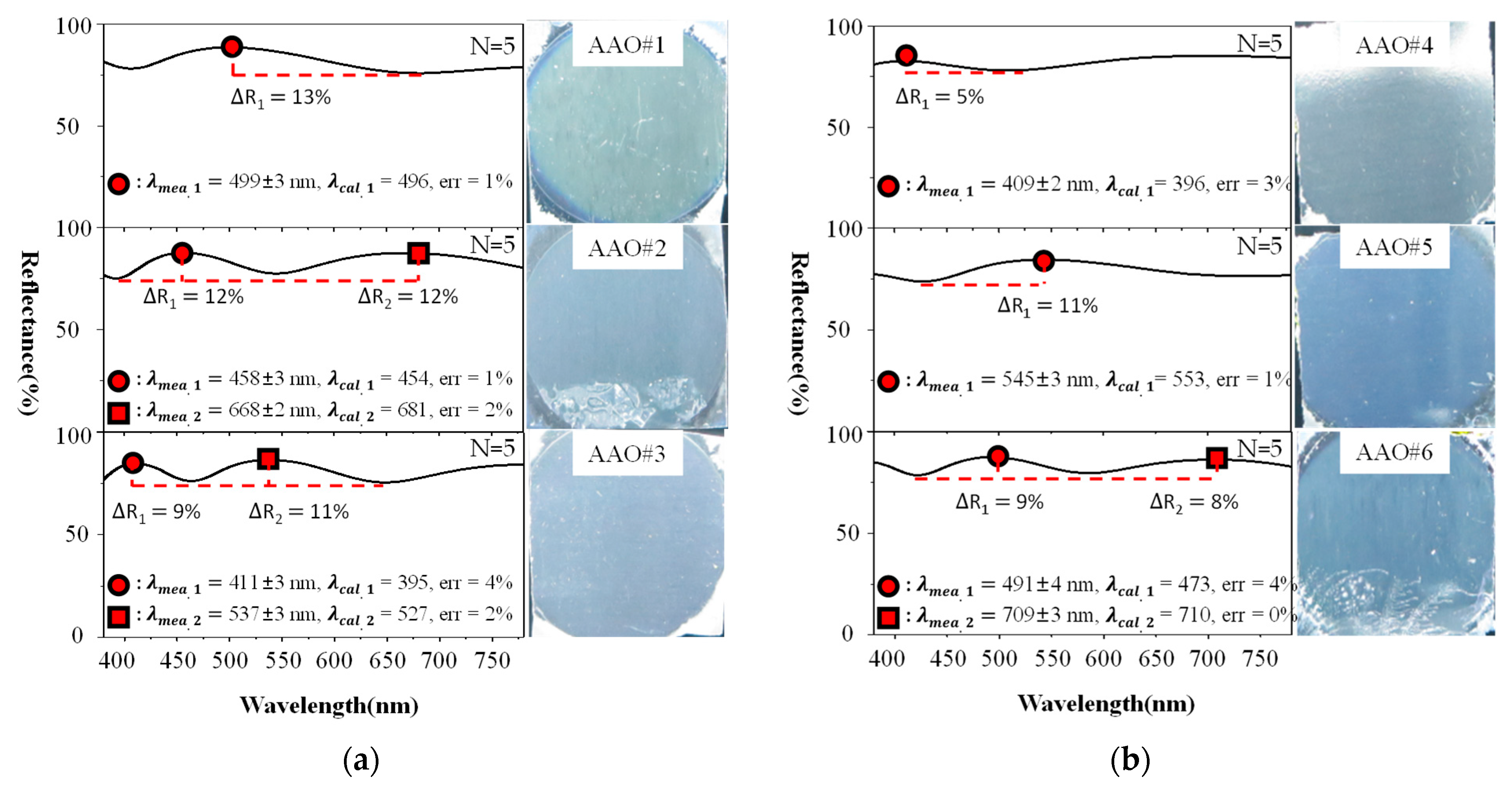
Figure 5 shows the optical properties of AAO/Al bilayer films in the visible-light region. Figure 5a shows the visible-light reflectance spectra measurement and prediction results based on the thickness of the AAO/Al bilayer films with DP and Dint values of approximately 25 and 55 nm, respectively (AAO#1–AAO#3). The wavelength of the reflected light from AAO/Al bilayer films can be calculated using Equation (1), and this value is predicted to be within a maximum error of 4% from the peak value of reflection due to constructive interference under the corresponding conditions. However, gray colors were observed owing to the light-reflecting effect of the aluminum substrate. Figure 5b shows the visible-light measurement and prediction results based on the thickness of the AAO/Al bilayer films with DP and Dint values of approximately 55 and 85 nm, respectively (AAO#4–AAO#6). The wavelength of the reflected light in the visible-light region was calculated using Equation (1), and the measured reflected light wavelength is predicted to be within a maximum error of 4%. However, AAO/Al bilayer films also exhibit greyish colors because most of the light is reflected in the visible-light region, similar to the case of AAO#1–AAO#3.
We validated the accurate prediction of the wavelength of constructive interference by analyzing the optical properties of AAO/Al bilayer films in the visible-light region. However, vivid colors could not be realized, owing to the reflection from the aluminum plate and the substrate component of the AAO/Al bilayer film. For AAO/Al bilayer, the mean relative error was 3.8% (n = 5; error definition: |λ_meas − λ_calc|/λ_meas).

3.2. Characteristics of the Reflected Light in Composite AAO Films

Changes in visible reflectance was analyzed and predicted based on the structural characteristics of the composite AAO film in the AAO/Ni/Al structure [49]. Table 2 presents the results obtained for each AAO structure using the SEM images of the composite AAO films and the measurement and prediction results for the light reflected in the visible-light region. Composite AAO (C.AAO) films with DP and Dint values of approximately 25 and 55 nm, respectively (C.AAO#1–C.AAO#3), and those with a pore diameter of 55 nm and Dint of 85 nm (C.AAO#4–C.AAO#6) were produced with a Dt of approximately 300–550 nm and a nickel nanorod height of 50 nm. The structure of the composite AAO films was the same as that of the AAO/Al bilayer films, yielding effective refractive indices of 1.423 and 1.261 for the C.AAO#1–C.AAO#3 and C.AAO#4–C.AAO#6 films, respectively.
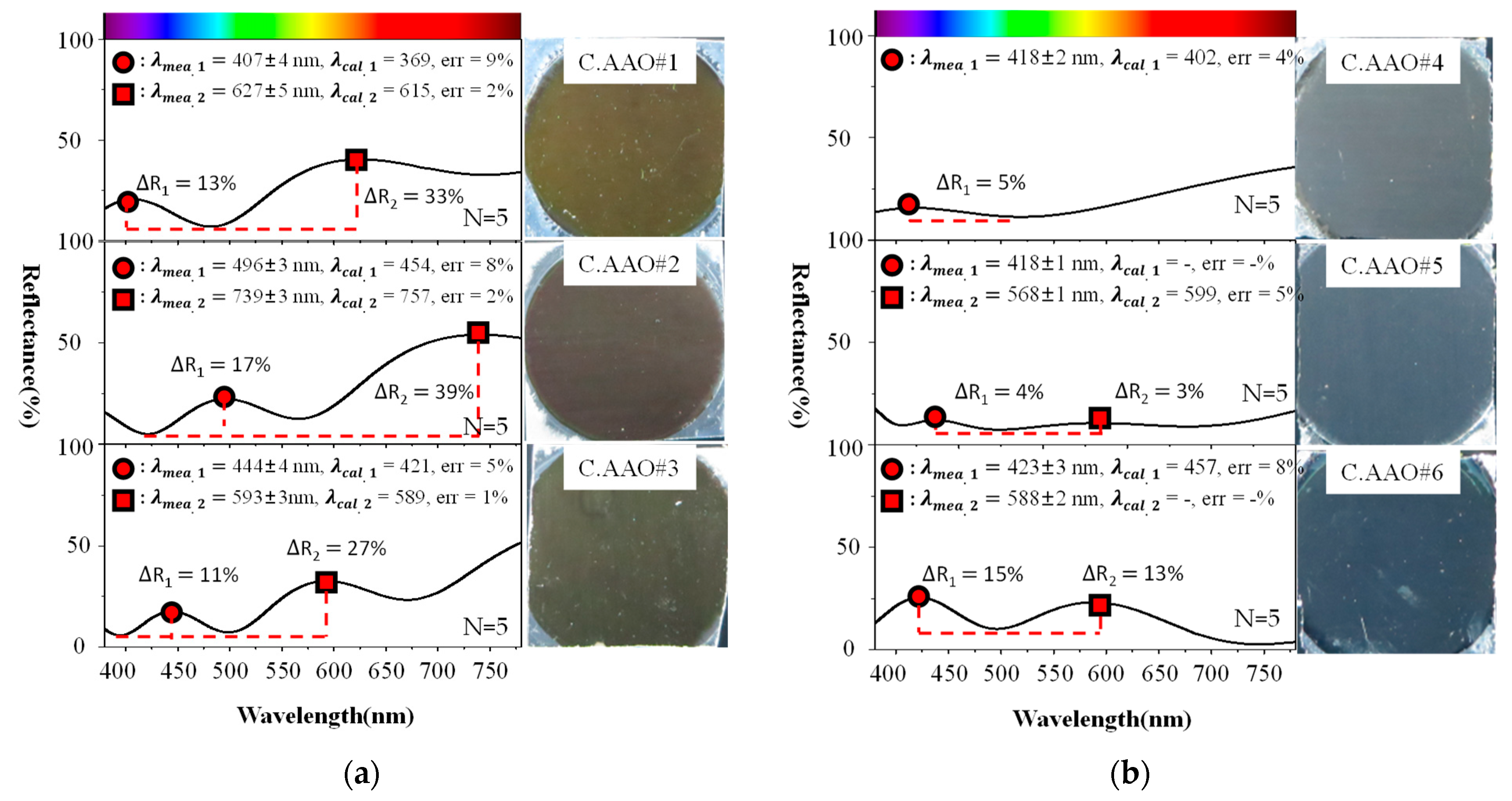
Figure 6 presents the optical properties of the composite AAO films in the visible-light region. Figure 6a shows the visible-light reflectance spectra measurement and prediction results based on the thickness of the composite AAO films with a DP of approximately 25 nm, Dint of approximately 55 nm, and nickel nanorod height of 50 nm (C.AAO#1–C.AAO#3). The reflected light wavelength of the composite AAO films was calculated using Equation (2) and was predicted to be within a maximum error of 9% from the peak value of reflection due to constructive interference under the corresponding conditions. Vivid colors are realized in the composite AAO films (C.AAO#1–C.AAO#3), as shown in Figure 6a. This is because the Ni nanoplugs in the AAO/Ni/Al structure block the reflection from the aluminum base plate, absorb a specific wavelength of light, and cause destructive interference. The colors implemented in the composite AAO films based on the RGB spectrum in the visible-light region were orange, red, and green for C.AAO#1, C.AAO#2, and C.AAO#3 with maximum peak wavelengths of 627, 757, and 593 nm, respectively. These results confirm that a composite AAO film with an effective refractive index higher than 1.4 can exhibit vivid colors. The desired vivid colors can be achieved by creating a specific composite AAO film structure using the predicted maximum peak wavelength.
Figure 6b shows the visible-light reflectance spectra measurement and prediction results based on the thickness of the composite AAO films (C.AAO#4– C.AAO#6) with a DP of approximately 55 nm, Dint of 85 nm, and nickel nanorod height of 50 nm. The peak point of reflection due to the constructive interference of the corresponding sample was predicted to be within a maximum error of 8%. Vivid colors are not generally realized in these composite AAO films (C.AAO#4–C.AAO#6), as shown in Figure 6b. Additionally, the difference in reflectivity between the highest and lowest wavelengths of the composite AAO films (C.AAO#4–C.AAO#6) was up to 15%, indicating that the reflectivity was insufficient for identifying the colors of the peak wavelengths. The change in porosity, f, determined using the DP and Dint values, causes the effective refractive index of the AAO film to approach 1, and this phenomenon is not optimal for realizing vivid colors. For composite AAO, the mean relative error was 8.7% (n = 5; same definition). Here, the reported errors validate the rule; the novelty is the closed-form, stack-agnostic design expression linking nano-geometry to λ_peak.

4. Conclusions

We produced porous alumina films with aligned nanostructures using a two-step aluminum anodization process. Ni nanoplugs were fabricated via electroplating to modify the optical properties of AAO/Al bilayer films with an AAO/Al structure. The optical properties in the visible-light region were analyzed for the nanostructures of AAO/Al bilayer films with an AAO/Al structure and composite AAO films with an AAO/Ni/Al structure. For AAO/Al bilayer films, we compared the predicted results of the reflected light caused by constructive interference with the measured values and estimated the wavelength of the constructive interference within a maximum error of 4%. Similarly, for composite AAO films, we predicted the wavelength of the constructive interference within a maximum error of 9% by comparing the predicted results of the reflected light caused by constructive interference with the measured values. The gray color was realized in AAO/Al bilayer films, whereas RGB colors were realized in the measured wavelength region of the constructive interference in the composite AAO films. These results indicate that aluminum alloy materials of various colors can be produced using the predicted wavelength of constructive interference and the structural colors of the composite AAO films. Also, we derived a closed-form design rule that mapped AAO nano-geometry and interface phase to λ_peak; this rule was validated at normal incidence for AAO/Al and AAO/Ni/Al and enables forward and inverse color targeting without numerical optimization. The present validation is limited to normal-incidence optics, a Maxwell–Garnett effective-medium model for neff, and a single fill metal (Ni); angular dispersion, EMT validity bounds, and cross-metal comparisons require further quantification. Accordingly, the closed-form, non-iterative design rule proposed for AAO/Al and AAO/Ni/Al platforms could enable rapid perception of chip-free, material-integrated structural-color coatings with outdoor durability [50]. Leveraging AAO as a template for plasmonic and sensing metals could also enable applications including Ni-filled surface-enhanced Raman scattering (SERS) and plasmonic color elements. Potential practical uses could include tamper-evident or brand-specific color markings, passive colorimetric sensors in which λ_peak shifts with pore filling or environmental changes, long-life architectural and consumer finishes, and printable high-resolution color features [51]. The model can guide target-color design in the visible range under normal incidence with a mean absolute error of ≈21 nm.

Author Contributions

Conceptualization, Y.H.S. and B.H.K.; methodology, Y.H.S. and B.H.K.; software, W.K.J. and Y.S.K.; validation, W.K.J., Y.H.S. and B.H.K.; formal analysis, W.K.J.; investigation, W.K.J. and Y.S.K.; resources, W.K.J. and Y.S.K.; data curation, Y.S.K.; writing—original draft preparation, W.K.J. and Y.S.K.; writing—review and editing, W.K.J., Y.H.S. and B.H.K.; visualization, W.K.J.; supervision, W.K.J. and Y.S.K.; project administration, W.K.J. and Y.S.K.; funding acquisition, Y.H.S. and B.H.K. All authors have read and agreed to the published version of the manuscript.

Funding

This research was funded by the National Research Foundation of Korea (NRF) grant funded by the Korea Government (MSIT) (RS-2023-00252219) and by the National R&D Program through the National Research Foundation of Korea (NRF) funded by the Ministry of Science and ICT (RS-2024-00431718).

Institutional Review Board Statement

Not applicable.

Informed Consent Statement

Not applicable.

Data Availability Statement

All data generated or analyzed during this study are included in this published article. If there are other data requirements, answers can be obtained from the corresponding author.

Acknowledgments

This work was supported by the National Research Foundation of Korea (NRF) grant funded by the Korea government (MSIT) (RS-2023-00252219) and by the National R&D Program through the National Research Foundation of Korea (NRF) funded by the Ministry of Science and ICT (RS-2024-00431718).

Conflicts of Interest

The authors declare no conflicts of interest.

Abbreviations

The following abbreviations are used in this manuscript:
AAOAnodic Aluminum Oxide
SEMScanning Electron Microscopes
DPPore Diameter
DintInterpore Distance
DtPore Depth
DniNi filling Depth
λ_peakPeak reflectance wavelength
n e f f , A l 2 O 3 Effective refractive index o
ε e f f , A l 2 O 3 Effective dielectric constant
ε a i r Specific dielectric constants of air
ε A l 2 O 3 Specific dielectric constants of AAO film
n a The refractive index of the AAO/Al bilayer film
d a Thickness of the AAO/Al bilayer film
n b The refractive index of the composite AAO film
d b Thickness of the composite AAO film

References

  1. Keller, F.; Hunter, M.S.; Robinson, D.L. Structural Features of Oxide Coatings on Aluminum. J. Electrochem. Soc. 1953, 100, 411–419. [Google Scholar] [CrossRef]
  2. Furneaux, R.C.; Rigby, W.R.; Davidson, A.P. The formation of controlled-porosity membranes from anodically oxidized aluminium. Nature 1989, 337, 147–149. [Google Scholar] [CrossRef]
  3. Thompson, G.E.; Wood, G.C. Porous anodic film formation on aluminium. Nature 1981, 290, 230–232. [Google Scholar] [CrossRef]
  4. Choudhari, K.S.; Choi, C.-H.; Chidangil, S.; George, S.D. Recent Progress in the Fabrication and Optical Properties of Nanoporous Anodic Alumina. Nanomaterials 2022, 12, 444. [Google Scholar] [CrossRef]
  5. Masuda, H.; Fukuda, K. Ordered Metal Nanohole Arrays Made by a Two-Step Replication of Honeycomb Structures of Anodic Alumina. Science 1995, 268, 1466–1468. [Google Scholar] [CrossRef]
  6. Masuda, H.; Satoh, M. Fabrication of Gold Nanodot Array Using Anodic Porous Alumina as an Evaporation Mask. Jpn. J. Appl. Phys. 1996, 35, L126. [Google Scholar] [CrossRef]
  7. Li, Y.; Ling, Z.Y.; Chen, S.S.; Wang, J.C. Fabrication of novel porous anodic alumina membranes by two-step hard anodization. Nanotechnology 2008, 19, 225604. [Google Scholar] [CrossRef]
  8. Masuda, H.; Hasegwa, F.; Ono, S. Self-Ordering of Cell Arrangement of Anodic Porous Alumina Formed in Sulfuric Acid Solution. J. Electrochem. Soc. 1997, 144, L127–L130. [Google Scholar] [CrossRef]
  9. Li, A.P.; Müller, F.; Birner, A.; Nielsch, K.; Gösele, U. Hexagonal pore arrays with a 50–420 nm interpore distance formed by self-organization in anodic alumina. J. Appl. Phys. 1998, 84, 6023–6026. [Google Scholar] [CrossRef]
  10. Nielsch, K.; Choi, J.; Schwirn, K.; Wehrspohn, R.B.; Gösele, U. Self-ordering Regimes of Porous Alumina: The 10 Porosity Rule. Nano Lett. 2002, 2, 677–680. [Google Scholar] [CrossRef]
  11. Masuda, H.; Yada, K.; Osaka, A. Self-Ordering of Cell Configuration of Anodic Porous Alumina with Large-Size Pores in Phosphoric Acid Solution. Jpn. J. Appl. Phys. 1998, 37, L1340. [Google Scholar] [CrossRef]
  12. Sun, C.; Luo, J.; Wu, L.; Zhang, J. Self-Ordered Anodic Alumina with Continuously Tunable Pore Intervals from 410 to 530 nm. ACS Appl. Mater. Interfaces 2010, 2, 1299–1302. [Google Scholar] [CrossRef]
  13. Siejka, J.; Ortega, C. An O18 Study of Field-Assisted Pore Formation in Compact Anodic Oxide Films on Aluminum. J. Electrochem. Soc. 1977, 124, 883–891. [Google Scholar] [CrossRef]
  14. Parkhutik, V.P.; I Shershulsky, V. Theoretical modelling of porous oxide growth on aluminium. J. Phys. D Appl. Phys. 1992, 25, 1258–1263. [Google Scholar] [CrossRef]
  15. Lee, W.; Park, S.-J. Porous Anodic Aluminum Oxide: Anodization and Templated Synthesis of Functional Nanostructures. Chem. Rev. 2014, 114, 7487–7556. [Google Scholar] [CrossRef]
  16. Anicai, L.; Meghea, A.; Sirean, C.; Dima, L. Analysis of Electrochemically Coloured Aluminum Anodic Films by Diffuse Reflectance Spectra. Mater. Sci. Forum 1995, 185–188, 489–496. [Google Scholar] [CrossRef]
  17. Han, K.; Fang, J. Decorative-protective coatings on aluminium. Surf. Coat. Technol. 1997, 88, 178–182. [Google Scholar] [CrossRef]
  18. Eessaa, A.K.; El-Shamy, A. Review on fabrication, characterization, and applications of porous anodic aluminum oxide films with tunable pore sizes for emerging technologies. Microelectron. Eng. 2023, 279, 112061. [Google Scholar] [CrossRef]
  19. Ku, C.-A.; Yu, C.-Y.; Hung, C.-W.; Chung, C.-K. Advances in the fabrication of nanoporous anodic aluminum oxide and its applications to sensors: A review. Nanomaterials 2023, 13, 2853. [Google Scholar] [CrossRef]
  20. Li, Y.; Hu, J.; Zeng, Y.; Song, Q.; Qiu, C.-W.; Xiao, S. Recent progress on structural coloration. Photonics Insights 2024, 3, R03. [Google Scholar] [CrossRef]
  21. Brandt, J.; Dittrich, G.; Thelen, M.; Renner, H.; Huber, P.; Eich, M.; Petrov, A. On the applicability of the Maxwell Garnett effective medium model to media with a high density of cylindrical pores. Opt. Mater. Express 2024, 14, 871–879. [Google Scholar] [CrossRef]
  22. Dong, J.; Li, C.; Wang, Y.; Fan, Y.; Han, Q.; Gao, W.; Wang, Y.; Ren, K.; Qi, J.; He, E. Fabrication of complexed nanostructure using AAO template for ultrasensitive SERS detection. Spectrochim. Acta Part A Mol. Biomol. Spectrosc. 2024, 312, 124044. [Google Scholar] [CrossRef]
  23. Donahue, C.J.; Exline, J.A. Anodizing and Coloring Aluminum Alloys. J. Chem. Educ. 2014, 91, 711–715. [Google Scholar] [CrossRef]
  24. Mirzaei, M.; Bahrololoom, M. Influence of pulse currents on the nanostructure and color absorption ability of colored anodized aluminum. Vacuum 2014, 99, 277–283. [Google Scholar] [CrossRef]
  25. De Graeve, I.; Laha, P.; Goossens, V.; Furneaux, R.; Verwimp, D.; Stijns, E.; Terryn, H. Colour simulation and prediction of complex nano-structured metal oxide films: Test case: Analysis and modeling of electro-coloured anodized aluminium. Surf. Coat. Technol. 2011, 205, 4349–4354. [Google Scholar] [CrossRef]
  26. Liu, Y.; Chang, Y.; Ling, Z.; Hu, X.; Li, Y. Structural coloring of aluminum. Electrochem. Commun. 2011, 13, 1336–1339. [Google Scholar] [CrossRef]
  27. Bae, K.; Lee, J.; Kang, G.; Yoo, D.-S.; Lee, C.-W.; Kim, K. Refractometric and colorimetric index sensing by a plasmon-coupled hybrid AAO nanotemplate. RSC Adv. 2015, 5, 103052–103059. [Google Scholar] [CrossRef]
  28. Jang, W.K.; Kang, Y.S.; Seo, Y.H.; Kim, B.H. Optical Properties of Nanohole Arrays with Various Depths. Int. J. Precis. Eng. Manuf. 2018, 19, 1837–1842. [Google Scholar] [CrossRef]
  29. Manzano, C.V.; Ramos, D.; Pethö, L.; Bürki, G.; Michler, J.; Philippe, L.V. Controlling the Color and Effective Refractive Index of Metal-Anodic Aluminum Oxide (AAO)–Al Nanostructures: Morphology of AAO. J. Phys. Chem. C 2017, 122, 957–963. [Google Scholar] [CrossRef]
  30. Lee, K.; Kim, H.; Kim, J.H.; Choi, D. Structural color and near-infrared tunability of ruthenium-coated anodic aluminum oxide by atomic layer deposition. Scr. Mater. 2020, 187, 125–129. [Google Scholar] [CrossRef]
  31. Feng, W.-J.; Paik, J.; Guo, L.J. Solution-processed structural colors and their applications. Mater. Chem. Front. 2024, 8, 3474–3508. [Google Scholar] [CrossRef]
  32. Wang, H.; Huang, L.; Zhang, Y.; Cai, Y.; Cheng, L.; Zhai, L.; Liu, Y.; Zhang, X.; Zhu, J. Vivid reflective color generation mechanism in Al/AAO/Al configuration. Opt. Mater. Express 2022, 12, 2270–2282. [Google Scholar] [CrossRef]
  33. Xu, Q.; Yang, Y.; Gu, J.; Li, Z.; Sun, H. Influence of Al substrate on the optical properties of porous anodic alumina films. Mater. Lett. 2012, 74, 137–139. [Google Scholar] [CrossRef]
  34. Kwak, H.; Jung, I.; Kim, D.; Ju, S.; Choi, S.; Kang, C.; Kim, H.; Baac, H.W.; Ok, J.G.; Lee, K.-T. Resonant-mode engineering for additive reflective structural colors with high brightness and high color purity. Sci. Rep. 2024, 14, 1–9. [Google Scholar] [CrossRef]
  35. Pyatnov, M.V.; Sokolov, M.; Kiselev, I.; Bikbaev, R.G.; Pankin, P.S.; Volkova, I.; Gunyakov, V.A.; Volochaev, M.N.; Ryzhkov, I.y.I.; Vetrov, S.Y. Determination of the refractive indices of photonic crystal layers from anodic alumina. Zhurnal Tekhnicheskoi Fiz. 2024, 94, 278–283. [Google Scholar]
  36. Zong, R.-L.; Zhou, J.; Li, Q.; Du, B.; Li, B.; Fu, M.; Qi, X.-W.; Li, L.-T.; Buddhudu, S. Synthesis and Optical Properties of Silver Nanowire Arrays Embedded in Anodic Alumina Membrane. J. Phys. Chem. B 2004, 108, 16713–16716. [Google Scholar] [CrossRef]
  37. Zhou, Z.-K.; Su, X.-R.; Peng, X.-N.; Zhou, L. Sublinear and superlinear photoluminescence from Nd doped anodic aluminum oxide templates loaded with Ag nanowires. Opt. Express 2008, 16, 18028–18033. [Google Scholar] [CrossRef]
  38. Hu, X.; Pu, Y.; Ling, Z.; Li, Y. Coloring of aluminum using photonic crystals of porous alumina with electrodeposited Ag. Opt. Mater. 2009, 32, 382–386. [Google Scholar] [CrossRef]
  39. Tang, H.J.; Wu, F.Q.; Wang, H.L.; Wei, Y.H.; Li, Q.S. Microstructure and optical properties of Cu/Al2O3 nanoarray composite structure. J. Appl. Phys. 2006, 100, 064316. [Google Scholar] [CrossRef]
  40. Wäckelgård, E. A study of the optical properties of nickel-pigmented anodic alumina in the infrared region. J. Phys. Condens. Matter 1996, 8, 5125–5138. [Google Scholar] [CrossRef]
  41. Chen, H.M.; Hsin, C.F.; Liu, R.-S.; Hu, S.-F.; Huang, C.-Y. Controlling Optical Properties of Aluminum Oxide Using Electrochemical Deposition. J. Electrochem. Soc. 2007, 154, K11–K14. [Google Scholar] [CrossRef]
  42. Arurault, L.; Zamora, G.; Vilar, V.; Winterton, P.; Bes, R. Electrical behaviour, characteristics and properties of anodic aluminium oxide films coloured by nickel electrodeposition. J. Mater. Sci. 2010, 45, 2611–2618. [Google Scholar] [CrossRef][Green Version]
  43. Ni, H.; Wang, Y.; Shen, Y.; Cai, T.; Wu, W.; Han, J.; Ni, B.; Ge, Y.; Wang, T.; Chang, J. Research and fabrication of color filters based on porous anodic alumina. J. Opt. Soc. Am. B 2024, 41, 2764–2772. [Google Scholar] [CrossRef]
  44. Cai, Y.; Hou, S.; Zhou, H. Research on reflection properties of Ag-AAO-Al microstructures. Optoelectron. Adv. Mater.-Rapid Commun. 2023, 17, 317–322. [Google Scholar]
  45. Yu, Z.; Zhao, K.; Li, L.; Ye, C.; Dong, Y.; Song, Y. A vivid Au-porous anodic alumina composite film with the inverted taper structure for label-free detection. Nano Res. 2023, 16, 9997–10003. [Google Scholar] [CrossRef]
  46. Toadere, F.; Farcău, C. Plasmonic structurally colored surfaces with metal film over microsphere lattices. Opt. Mater. 2024, 156, 115936. [Google Scholar] [CrossRef]
  47. Hierro-Rodriguez, A.; Rocha-Rodrigues, P.; Valdés-Bango, F.; Alameda, J.M.; Jorge, P.A.S.; Santos, J.L.; Araujo, J.P.; Teixeira, J.M.; Guerreiro, A. On the anodic aluminium oxide refractive index of nanoporous templates. J. Phys. D Appl. Phys. 2015, 48, 455105. [Google Scholar] [CrossRef]
  48. Manikandan, M.; Gopal, J.; Chun, S. Sonophysical cost effective rapid indigenous preparation of aluminium particles via exfoliation of aluminium foil. RSC Adv. 2016, 6, 32405–32413. [Google Scholar] [CrossRef]
  49. Wei, H.; Xu, Q.; Chen, D.; Chen, M.; Chang, M.; Ye, X. Easy preparation of anodic aluminum oxide photonic crystal films with tunable structural colors. Opt. Mater. 2021, 122, 111722. [Google Scholar] [CrossRef]
  50. Feng, L.; Wang, F.; Luo, H.; Qiu, B. Review of recent advancements in the biomimicry of structural colors. Dye. Pigment. 2022, 210, 111019. [Google Scholar] [CrossRef]
  51. Cencillo-Abad, P.; Franklin, D.; Mastranzo-Ortega, P.; Sanchez-Mondragon, J.; Chanda, D. Ultralight plasmonic structural color paint. Sci. Adv. 2023, 9, eadf7207. [Google Scholar] [CrossRef] [PubMed]
Figure 1. Structure analysis of AAO using image processing: (a) optical image of AAO and schematic of the 3D cross-section view of the AAO structure, (b) calculation of pore diameter and interpore distance via OpenCV analysis using SEM image, and (c) measurement of AAO thickness using the SEM image.
Coatings 15 01260 g001
Figure 2. Optical characteristics of AAO/Al bilayer and composite AAO films.
Coatings 15 01260 g002
Figure 3. Results of composite AAO film: (a) optical and SEM images, (b) EDX spectra of the composite AAO films, (c) X-ray diffraction spectra of Ni nanoplugs.
Coatings 15 01260 g003aCoatings 15 01260 g003b
Figure 4. Schematic of the normal-incidence reflectance setup.
Coatings 15 01260 g004
Figure 5. Optical characteristics of the AAO/Al bilayer film: (a) results for AAO formed using sulfuric acid with an average pore diameter of 25 nm and depths of 350, 480, and 559 nm, (b) results of AAO formed using phosphoric acid with an average pore diameter of 55 nm and depths of 300, 423, and 529 nm.
Coatings 15 01260 g005
Figure 6. Optical characteristics of the composite AAO film: (a) results of AAO formed using sulfuric acid with an average pore diameter of 25 nm, nickel rod diameter of 50 nm, and depths of 382, 453, and 562 nm; (b) results of AAO formed using phosphoric acid with an average pore diameter of 55 nm, nickel rod diameter of 50 nm, and depths of 273, 382, and 511 nm.
Coatings 15 01260 g006
Table 1. Structural characteristics of the as-fabricated AAO/Al bilayer films.
AAO/Al Bilayer Film
I.D.AAO#1AAO#2AAO#3AAO#4AAO#5AAO#6
SEM images
of front view
Coatings 15 01260 i001Coatings 15 01260 i002Coatings 15 01260 i003Coatings 15 01260 i004Coatings 15 01260 i005Coatings 15 01260 i006
SEM images
of cross-section
Coatings 15 01260 i007Coatings 15 01260 i008Coatings 15 01260 i009Coatings 15 01260 i010Coatings 15 01260 i011Coatings 15 01260 i012
Pore diameter
(DP, nm)
25 ± 825 ± 825 ± 857 ± 1956 ± 1950 ± 17
Inter pore distance
(Dint, nm)
57 ± 1157 ± 1156 ± 1091 ± 2087 ± 2085 ± 19
Pore depth
(Dt, nm)
350480559300423529
Effective refractive
index ( n e f f , A l 2 O 3 )
1.4181.4181.4141.3191.3081.341
Wavelength
(nm)
λ _ c a l . 1 496454395396553473
λ _ c a l . 2 -681527--710
Table 2. Structural characteristics of the as-fabricated composite AAO films.
AAO/Al Bilayer Film
I.D.AAO#1AAO#2AAO#3AAO#4AAO#5AAO#6
SEM images
of front view
Coatings 15 01260 i013Coatings 15 01260 i014Coatings 15 01260 i015Coatings 15 01260 i016Coatings 15 01260 i017Coatings 15 01260 i018
SEM images
of cross-section
Coatings 15 01260 i019Coatings 15 01260 i020Coatings 15 01260 i021Coatings 15 01260 i022Coatings 15 01260 i023Coatings 15 01260 i024
Pore diameter
(DP, nm)
25 ± 726 ± 820 ± 551 ± 2048 ± 1855 ± 16
Inter pore distance
(Dint, nm)
53 ± 1155 ± 1151 ± 1181 ± 1885 ± 2078 ± 18
Pore depth
(Dt, nm)
382453562273382511
Nickel thickness
(Dni, nm)
534850445061
Effective refractive
index ( n e f f , A l 2 O 3 )
1.4301.4021.4381.3171.3541.112
Wavelength
(nm)
λ _ c a l . 1 369454421402599457
λ _ c a l . 2 615757589---
Disclaimer/Publisher’s Note: The statements, opinions and data contained in all publications are solely those of the individual author(s) and contributor(s) and not of MDPI and/or the editor(s). MDPI and/or the editor(s) disclaim responsibility for any injury to people or property resulting from any ideas, methods, instructions or products referred to in the content.