Understanding the Relations between Surface Stress State and Microstructure Feature for Enhancing the Fatigue Performance of TC6 Titanium Alloy

Abstract
1. Introduction
2. Experiments and Simulations
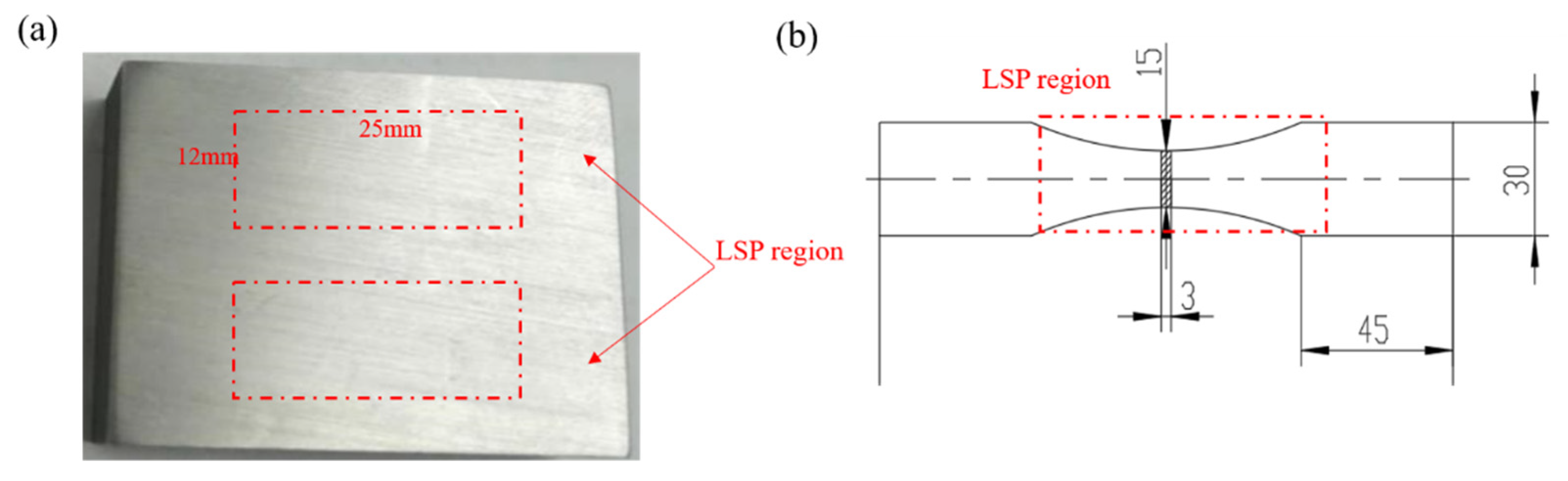
2.1. Materials and Components
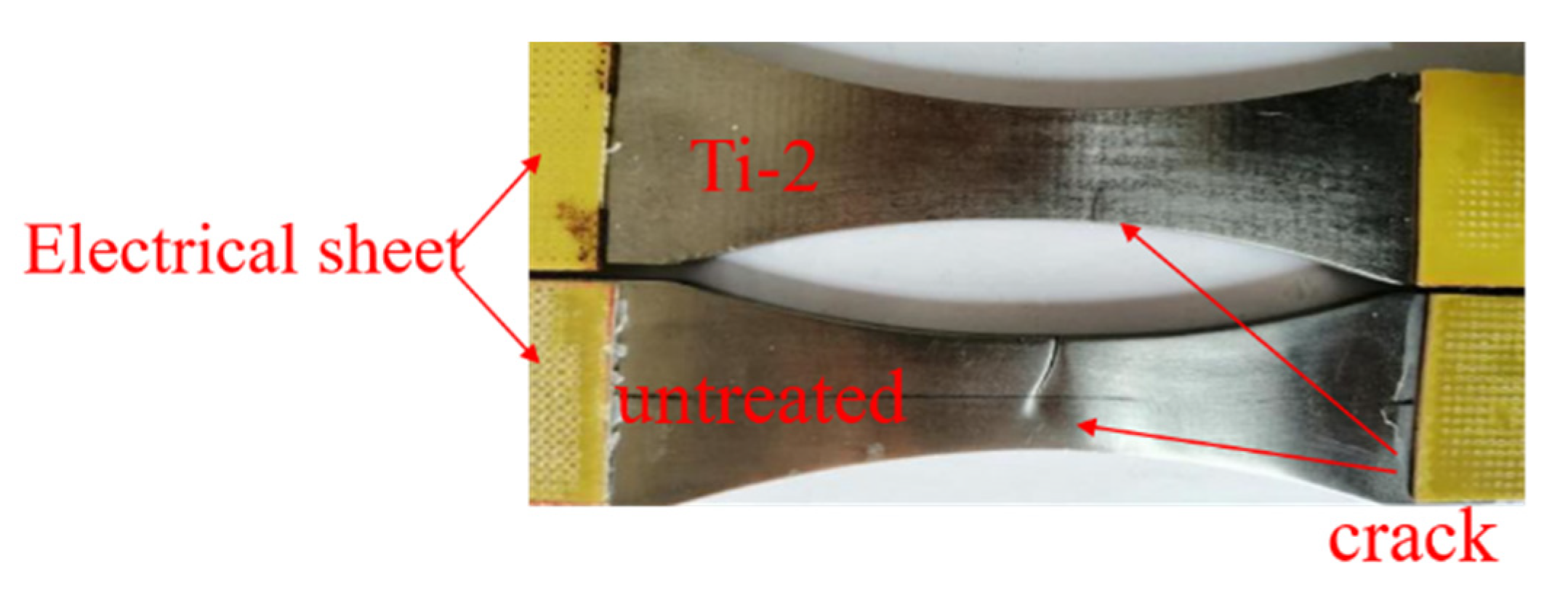
2.2. Experimental Procedures
2.3. Measurement Apparatuses and Methods
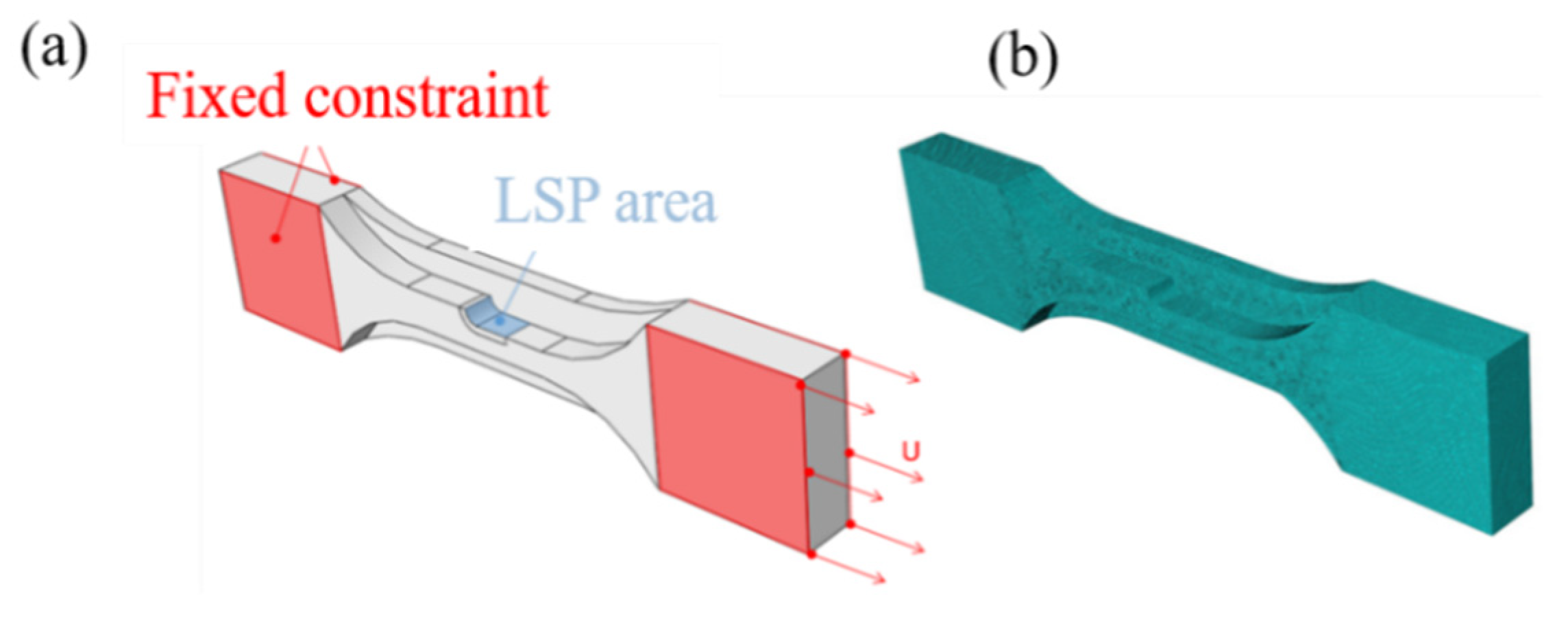
2.4. Finite Element Simulations
3. Results and Discussion
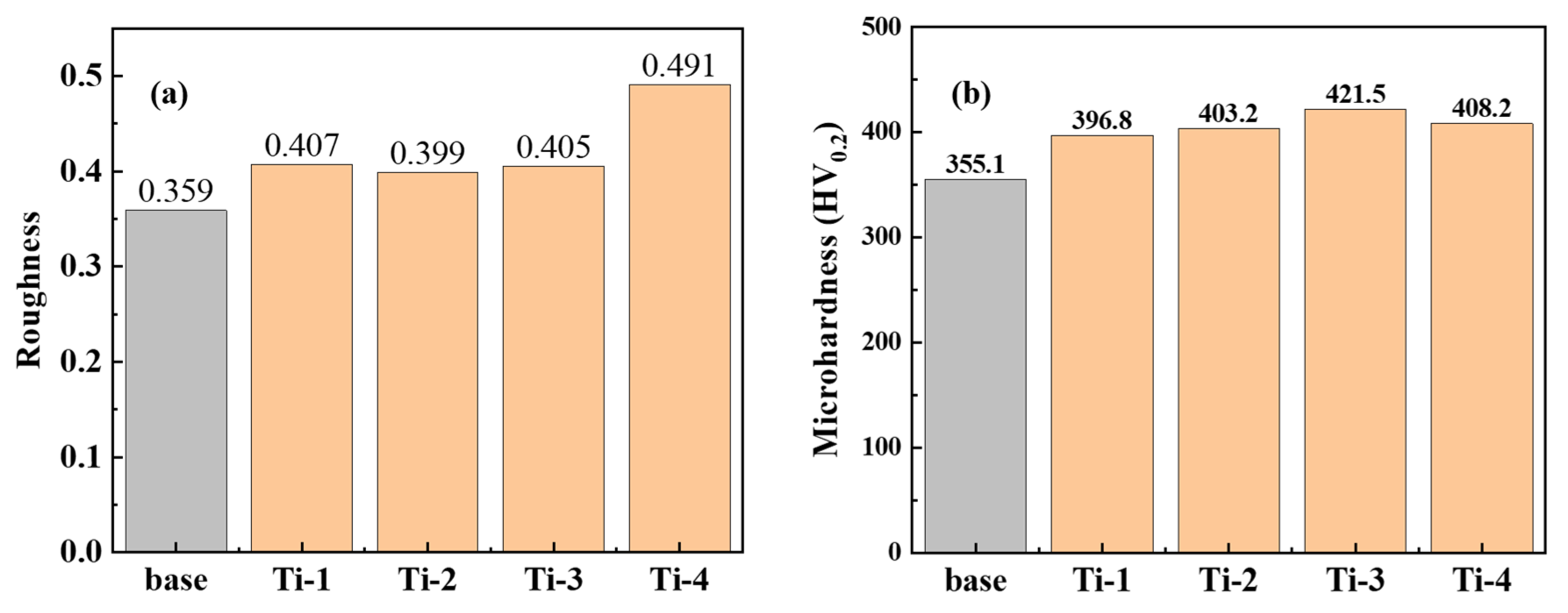
3.1. Surface Roughness and Microhardness
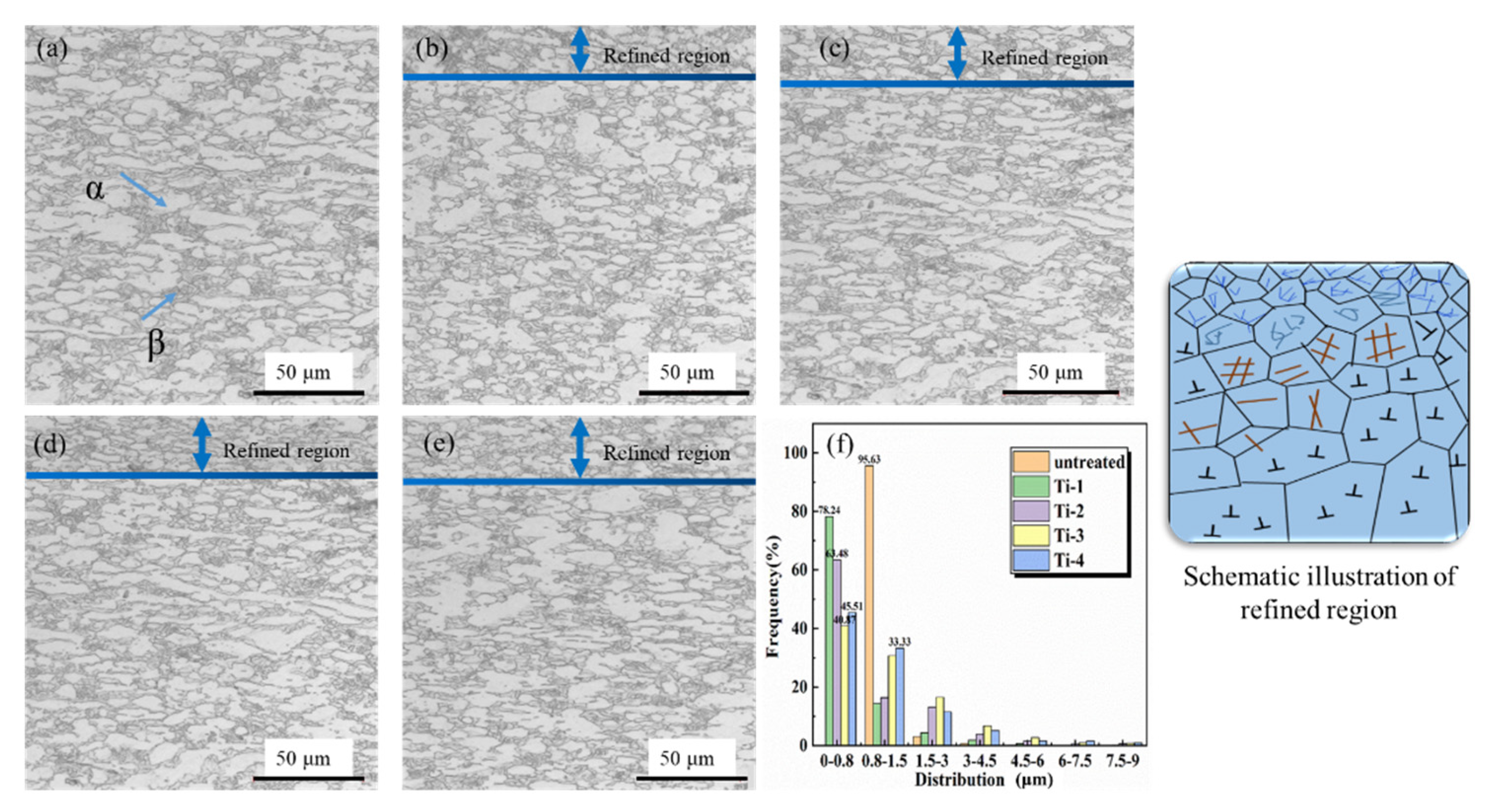
3.2. Microstuctures
3.3. Residual Stress
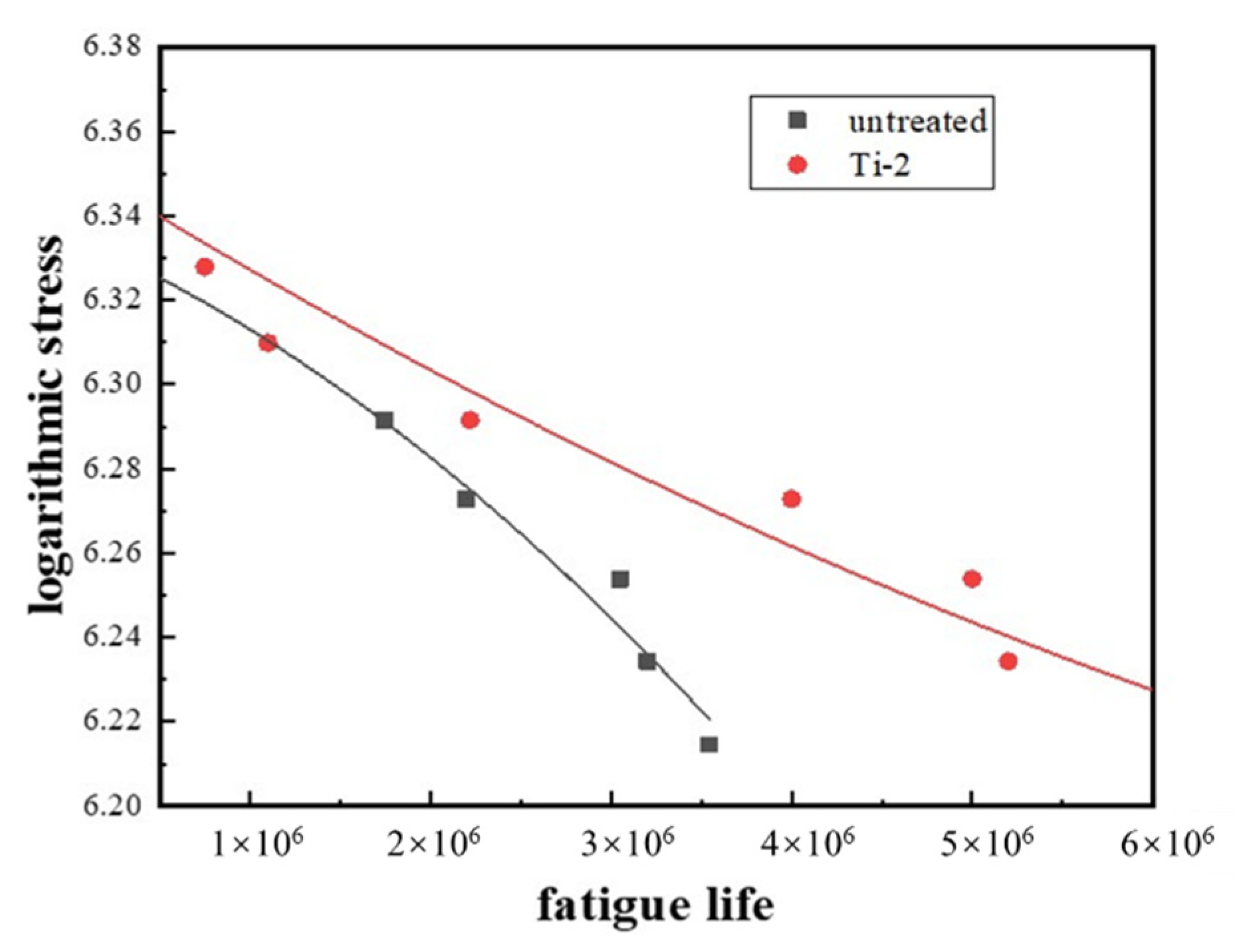
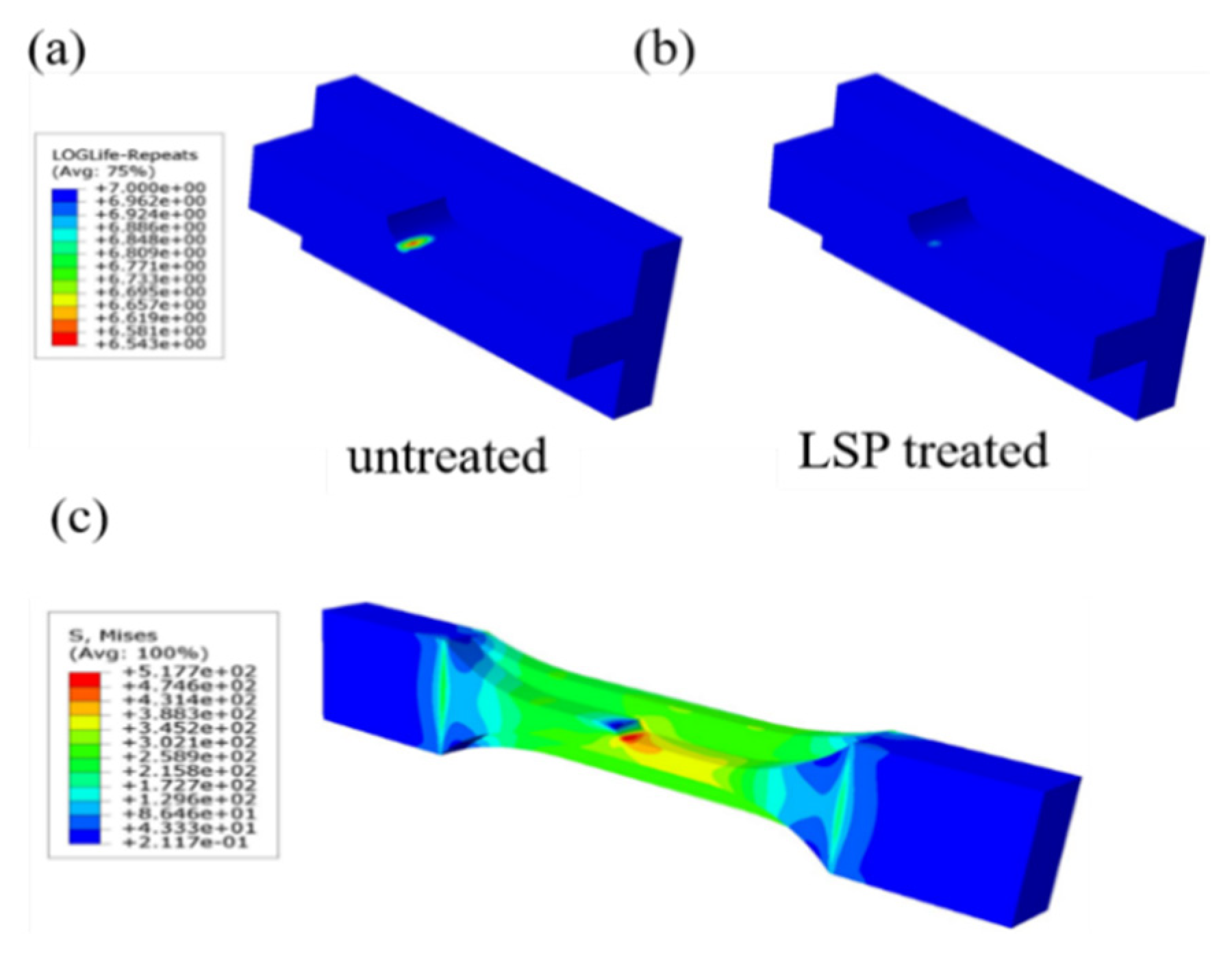
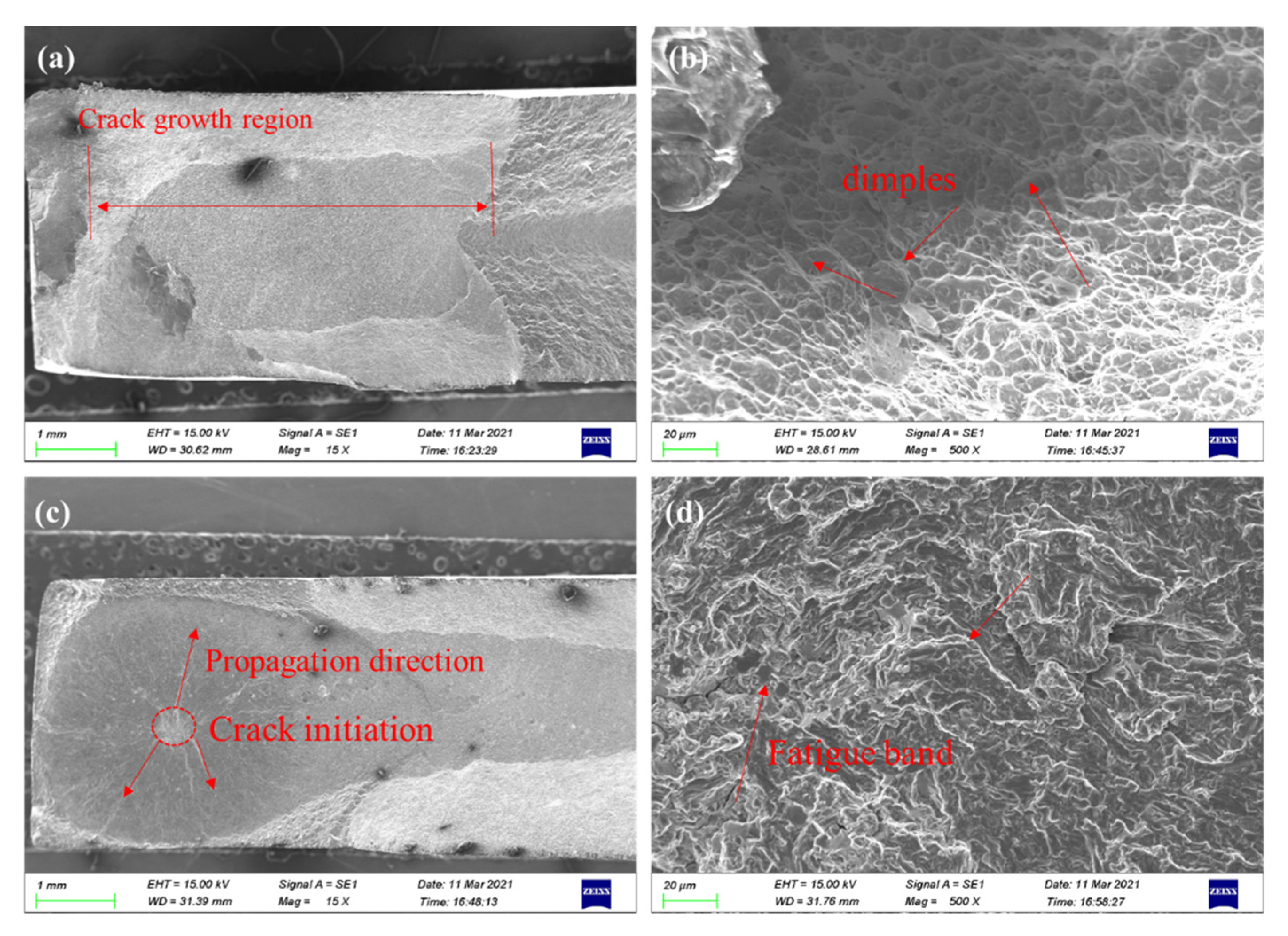
3.4. Failure Mechanism
4. Conclusions
Author Contributions
Funding
Institutional Review Board Statement
Informed Consent Statement
Data Availability Statement
Conflicts of Interest
References
- Zheng, C.; Tian, Z.; Zhao, X.; Tan, Y.; Zhang, G.; Zhao, G.; Ji, Z. Effect of pulsed laser parameters on deformation inhomogeneity in laser shock incremental forming of pure copper foil. Opt. Laser Technol. 2020, 127, 106205. [Google Scholar] [CrossRef] [Scilit]
- Zhou, J.; Li, J.; Xu, S.; Huang, S.; Meng, X.; Sheng, J.; Zhang, H.; Sun, Y.; Feng, A. Improvement in fatigue properties of 2024-T351 aluminum alloy subjected to cryogenic treatment and laser peening. Surf. Coat. Technol. 2018, 345, 31–39. [Google Scholar] [CrossRef] [Scilit]
- Zhou, L.; Li, Y.; He, W.; He, G.; Nie, X.; Chen, D.; Lai, Z.; An, Z. Surface integrity and fatigue lives of Ti17 compressor blades subjected to laser shock peening with square spots. Surf. Coat. Technol. 2018, 347, 398–406. [Google Scholar] [CrossRef] [Scilit]
- Yang, Y.; Zhou, W.; Chen, B.; Tong, Z.; Chen, L.; Ren, X. Fatigue behaviors of foreign object damaged Ti-6Al-4V alloys under laser shock peening. Int. J. Fatigue 2020, 136, 105596. [Google Scholar] [CrossRef] [Scilit]
- Cao, S.; Zhang, X.; Lu, J.; Wang, Y.; Shi, S.; Ritchie, R. Predicting surface deformation during mechanical attrition of metallic alloys. NPJ Comput. 2019, 5, 36. [Google Scholar] [CrossRef] [Scilit]
- Li, Y.; Lei, L.; Zeng, P. Shot stream finite element model for shot peening numerical simulation and its experiment study. J. Mech. Eng. Sci. 2011, 47, 43–48. [Google Scholar] [CrossRef] [Scilit]
- Chamgordani, S.A.; Miresmaeili, R.; Aiofkhazraei, M. Improvement in tribological behavior of commercial pure titanium (CP-Ti) by surface mechanical attrition treament (SMAT). Tribol. Int. 2018, 119, 744–752. [Google Scholar] [CrossRef] [Scilit]
- Zhang, R.; Zhou, X.; Gao, H.; Mankoci, S.; Liu, Y.; Sang, X.; Qin, H.; Hou, X.; Ren, Z.; Doll, G.L.; et al. The effects of laser shock peening on the mechanical properties and biomedical behavior of AZ31B magnesium alloy. Surf. Coat. Technol. 2018, 339, 48–56. [Google Scholar] [CrossRef] [Scilit]
- Hwang, Y.; Tsai, W.; Tsai, F.; Her, I. Analytical and experimental study on the spiral marks of the rolled product during three-roll planetary rolling processes. Int. J. Mach. Tools Manuf. 2006, 46, 1555–1562. [Google Scholar] [CrossRef] [Scilit]
- Dai, F.Z.; Zhang, Y.K.; Lu, J.Z.; Wen, D.P.; Hua, X.J.; Ren, X.D.; Zhou, J.Z. A method to decrease surface roughness in laser shock processing. Surf. Coat. Technol. 2015, 261, 35–40. [Google Scholar] [CrossRef] [Scilit]
- Jin, X.; Lan, L.; Gao, S.; He, B.; Rong, Y. Effects of laser shock peening on microstructure and fatigue behavior of Ti–6Al–4V alloy fabricated via electron beam melting. Mater. Sci. Eng. A. 2020, 780, 139199. [Google Scholar] [CrossRef] [Scilit]
- Koo, S.J.; Kim, H.S. The homogeneity of multi-textured micro-pattern arrays in a laser shock surface patterning process and its effect on the surface properties of aluminum alloy. Surf. Coat. Technol. 2020, 382, 125149. [Google Scholar] [CrossRef] [Scilit]
- Sapardanis, H.; Maurel, V.; Köster, A.; Duvinage, S.; Borit, F.; Guipont, V. Influence of macroscopic shear loading on the growth of an interfacial crack initiated from a ceramic blister processed by laser shock. Surf. Coat. Technol. 2016, 291, 430–443. [Google Scholar] [CrossRef] [Scilit]
- Sun, R.; Li, L.; Guo, W.; Peng, P.; Zhai, T.; Che, Z.; Li, B.; Guo, C.; Zhu, Y. Laser shock peening induced fatigue crack retardation in Ti-17 titanium alloy. Mater. Sci. Eng. A 2018, 737, 94–104. [Google Scholar] [CrossRef] [Scilit]
- Tong, Z.; Jiao, J.; Zhou, W.; Yang, Y.; Chen, L.; Liu, H.; Sun, Y.; Ren, X. Improvement in cavitation erosion resistance of AA5083 aluminium alloy by laser shock processing. Surf. Coat. Technol. 2019, 377, 124799. [Google Scholar] [CrossRef] [Scilit]
- Pan, X.; Guo, S.; Tian, Z.; Liu, P.; Dou, L.; Wang, X.; An, Z.; Zhou, L. Fatigue performance improvement of laser shock peened hole on powder metallurgy Ni-based superalloy labyrinth disc. Surf. Coat. Technol. 2021, 409, 126829. [Google Scholar] [CrossRef] [Scilit]
- Sihai, L.; Weifeng, H.; Liucheng, Z.; Xiangfan, N.; Yinghong, L. Aluminizing mechanism on a nickel-based alloy with surface nanostructure produced by laser shock peening and its effect on fatigue strength. Surf. Coat. Technol. 2018, 342, 29–36. [Google Scholar] [CrossRef] [Scilit]
- Luo, X.; Dang, N.; Wang, X. The effect of laser shock peening, shot peening and their combination on the microstructure and fatigue properties of Ti-6Al-4V titanium alloy. Int. J. Fatigue 2021, 153, 106465. [Google Scholar] [CrossRef] [Scilit]
- Nie, X.; He, W.; Zhou, L.; Li, Q.; Wang, X. Experiment investigation of laser shock peening on TC6 titanium alloy to improve high cycle fatigue performance. Mater. Sci. Eng. A 2014, 594, 161–167. [Google Scholar] [CrossRef] [Scilit]
- Zhang, X.; Li, H.; Duan, S.; Yu, X.; Feng, J.; Wang, B.; Huang, Z. Modeling of residual stress field induced in Ti–6Al–4V alloy plate by two sided laser shock processing. Surf. Coat. Technol. 2015, 280, 163–173. [Google Scholar] [CrossRef] [Scilit]
- Zhang, Y.; You, J.; Lu, J.; Cui, C.; Jiang, Y.; Ren, X. Effects of laser shock processing on stress corrosion cracking susceptibility of AZ31B magnesium alloy. Surf. Coat. Technol. 2010, 204, 3947–3953. [Google Scholar] [CrossRef] [Scilit]
- Moore, M.; Evans, W. Mathematical Correction for Stress in Removed Layers in X-Ray Diffraction Residual Stress Analysis. SAE Tech. Pap. 1958, 66, 340–345. [Google Scholar]
- Zhao, J.; Wu, J.; Hu, X.; Yang, Y.; Qiao, H. Effect of laser shock processing on mechanical properties of Ti-45.5Al-2Cr-2Nb-0.15B alloy. Optik 2020, 217, 164715. [Google Scholar] [CrossRef] [Scilit]
- Wu, J.; Zou, S.; Zhang, Y.; Gong, S.; Sun, G.; Ni, Z.; Cao, Z.; Che, Z.; Feng, A. Microstructures and mechanical properties of β forging Ti17 alloy under combined laser shock processing and shot peening. Surf. Coat. Technol. 2017, 328, 283–291. [Google Scholar] [CrossRef] [Scilit]
- Azar, V.; Hashemi, B.; Rezaee Yazdi, M. The effect of shot peening on fatigue and corrosion behavior of 316L stainless steel in Ringer’s solution. Surf. Coat. Technol. 2010, 204, 3546–3551. [Google Scholar] [CrossRef] [Scilit]
- Rai, A.K.; Biswal, R.; Gupta, R.K.; Singh, R.; Rai, S.K.; Ranganathan, K.; Ganesh, P.; Kaul, R.; Bindra, K.S. Study on the effect of multiple laser shock peening on residual stress and microstructural changes in modified 9Cr-1Mo (P91) steel. Surf. Coat. Technol. 2019, 358, 125–135. [Google Scholar] [CrossRef] [Scilit]
- Yadav, M.J.; Jinoop, A.N.; Danduk, C.; Subbu, S.K. Laser shock processing: Process physics, parameters, and applications. Mater. Today Proc. 2017, 4, 7921–7930. [Google Scholar] [CrossRef] [Scilit]
- Pan, X.; He, W.; Huang, X.; Wang, X.; Shi, X.; Jia, W.; Zhou, L. Plastic deformation behavior of titanium alloy by warm laser shock peening: Microstructure evolution and mechanical properties. Surf. Coat. Technol. 2021, 405, 126670. [Google Scholar] [CrossRef] [Scilit]
- Ren, Y.; Wan, H.; Chen, Y.; Zhu, H.; Lu, H.; Ren, X. Effect of laser shock peening and carbonitriding on tribological properties of 20Cr2Mn2Mo steel alloy under dry sliding conditions. Surf. Coat. Technol. 2021, 417, 127215. [Google Scholar] [CrossRef] [Scilit]
- Shi, X.; Feng, X.; Teng, J.; Zhang, K.; Zhou, L. Effect of laser shock peening on microstructure and fatigue properties of thin-wall welded Ti-6A1-4V alloy. Vacuum 2021, 184, 109986. [Google Scholar] [CrossRef] [Scilit]
- Sun, R.; Li, L.; Zhu, Y.; Peng, P.; Li, Q.; Guo, W. Fatigue of Ti-17 titanium alloy with hole drilled prior and post to laser shock peening. Opt. Laser Technol. 2019, 115, 166–170. [Google Scholar] [CrossRef] [Scilit]
- Zhou, L.; Li, Y.; He, W.; He, G.; Nie, X.; Chen, D.; Lai, Z.; An, Z. Deforming TC6 titanium alloys at ultrahigh strain rates during multiple laser shock peening. Mater. Sci. Eng. A 2013, 578, 181–186. [Google Scholar] [CrossRef] [Scilit]
- Lan, L.; Jin, X.; Gao, S.; He, B.; Rong, Y. Microstructural evolution and stress state related to mechanical properties of electron beam melted Ti-6Al-4V alloy modified by laser shock peening. J. Mater. Sci. Technol. 2020, 50, 153–161. [Google Scholar] [CrossRef] [Scilit]
- Unal, O.; Karaoglanli, A.O.; Varol, R.; Kobayashi, A. Microstructure evolution and mechanical behavior of severe shot peened commercially pure titanium. Vacuum 2014, 110, 202–206. [Google Scholar] [CrossRef] [Scilit]
- Pacha-Olivenza, M.; Galván, J.; Porro, J.; Lieblich, M.; Díaz, M.; Angulo, I.; Cordovilla, F.; García-Galván, F.; Fernández-Calderón, M.; González-Martín, M.; et al. Efficacy of laser shock processing of biodegradable Mg and Mg-1Zn alloy on their in vitro corrosion and bacterial response. Surf. Coat. Technol. 2019, 384, 125320. [Google Scholar] [CrossRef] [Scilit]
- Petronić, S.; Čolić, K.; Đorđević, B.; Milovanović, D.; Burzić, M.; Vučetić, F. Effect of laser shock peening with and without protective coating on the microstructure and mechanical properties of Ti-alloy. Opt. Lasers Eng. 2020, 129, 106052. [Google Scholar] [CrossRef] [Scilit]
- Bhamare, S.; Ramakrishnan, G.; Mannava, S.R.; Langer, K.; Vasudevan, V.K.; Qian, D. Simulation-based optimization of laser shock peening process for improved bending fatigue life of Ti–6Al–2Sn–4Zr–2Mo alloy. Surf. Coat. Technol. 2013, 232, 464–474. [Google Scholar] [CrossRef] [Scilit]
- Valentino, T. Analytical model to determine the relevant parameters governing the transferred momentum to spherical indenters by laser-induced shock waves. Opt. Lasers Eng. 2021, 145, 106670. [Google Scholar] [CrossRef] [Scilit]
- Lu, H.; Ren, Y.; Chen, Y.; Zhu, H.; Xin, Z.; Wan, H.; Li, Z.; Tu, X.; Cheng, L.; He, K.; et al. Wear resistance of 20Cr2Ni4A alloy steel treated by laser shock peening and implantation of diamond nanoparticles. Surf. Coat. Technol. 2021, 412, 127070. [Google Scholar] [CrossRef] [Scilit]
- Wang, Y.; Liu, C.; Li, C. Evolution of ns pulsed laser induced shock wave on aluminum surface by numerical simulation. Results Phys. 2021, 22, 103920. [Google Scholar] [CrossRef] [Scilit]
- Gurusami, K.; Chandramohan, D.; Kumar, S.D.; Dhanashekar, M.; Sathish, T. Strengthening mechanism of Nd: Yag laser shock peening for commercially pure titanium (CP-TI) on surface integrity and residual stresses. Mater. Today Proc. 2019, 21, 981–987. [Google Scholar] [CrossRef] [Scilit]
- Hu, Y.; Yao, Z.; Hu, J. 3-D FEM simulation of laser shock processing. Surf. Coat. Technol. 2006, 201, 1426–1435. [Google Scholar] [CrossRef] [Scilit]
- Karthik, D.; Jiang, J.; Hu, Y.; Yao, Z. Effect of multiple laser shock peening on microstructure, crystallographic texture and pitting corrosion of aluminum-lithium alloy 2060-T8. Surf. Coat. Technol. 2021, 421, 127354. [Google Scholar] [CrossRef] [Scilit]
- Cao, X.; He, W.; Liao, B.; He, G.; Jiao, Y.; Huang, D.; Wang, S. Effect of TiN/Ti coating combined with laser shock peening pre-treatment on the fatigue strength of Ti-6Al-4V titanium alloy. Surf. Coat. Technol. 2021, 403, 126393. [Google Scholar] [CrossRef] [Scilit]
- Cellard, C.; Retraint, D.; François, M.; Rouhaud, E.; Le Saunier, D. Laser shock peening of Ti-17 titanium alloy: Influence of process parameters. Mater. Sci. Eng. A 2012, 532, 362–372. [Google Scholar] [CrossRef] [Scilit]






| Al | Mo | Cr | Fe | Si | Ti |
|---|---|---|---|---|---|
| 6.09 | 2.60 | 1.54 | 0.49 | 0.31 | Bal. |
| Number | Laser Power/J | Spot Diameter/mm | Overlap Rate | Pulse | Laser Fluence/GW/cm2 |
|---|---|---|---|---|---|
| Ti-1 | 4 | 2.6 | 50% | 1 | 3.77 |
| Ti-2 | 5 | 1 | 4.71 | ||
| Ti-3 | 6 | 1 | 5.65 | ||
| Ti-4 | 5 | 2 | 4.71 |
Publisher’s Note: MDPI stays neutral with regard to jurisdictional claims in published maps and institutional affiliations. |
© 2021 by the authors. Licensee MDPI, Basel, Switzerland. This article is an open access article distributed under the terms and conditions of the Creative Commons Attribution (CC BY) license (https://creativecommons.org/licenses/by/4.0/).
Share and Cite
Shu, S.; Huang, X.; Cheng, Z.; Shen, Y.; He, Z.; Liu, W. Understanding the Relations between Surface Stress State and Microstructure Feature for Enhancing the Fatigue Performance of TC6 Titanium Alloy. Coatings 2021, 11, 1261. https://doi.org/10.3390/coatings11101261
Shu S, Huang X, Cheng Z, Shen Y, He Z, Liu W. Understanding the Relations between Surface Stress State and Microstructure Feature for Enhancing the Fatigue Performance of TC6 Titanium Alloy. Coatings. 2021; 11(10):1261. https://doi.org/10.3390/coatings11101261
Chicago/Turabian StyleShu, Song, Xin Huang, Zonghui Cheng, Yizhou Shen, Zhaoru He, and Weilan Liu. 2021. "Understanding the Relations between Surface Stress State and Microstructure Feature for Enhancing the Fatigue Performance of TC6 Titanium Alloy" Coatings 11, no. 10: 1261. https://doi.org/10.3390/coatings11101261
APA StyleShu, S., Huang, X., Cheng, Z., Shen, Y., He, Z., & Liu, W. (2021). Understanding the Relations between Surface Stress State and Microstructure Feature for Enhancing the Fatigue Performance of TC6 Titanium Alloy. Coatings, 11(10), 1261. https://doi.org/10.3390/coatings11101261