Article

Thiazolyl-Methylthio-1,3,4-Thiadiazole Hybrids as Halicin Analogues with Antimicrobial and Antibiofilm Activities: Chemical Development, Biological Assessment, and 2D-QSAR Study


1
Department of Pharmaceutical Chemistry, “Iuliu Hațieganu” University of Medicine and Pharmacy, 41 Victor Babeș Street, 400012 Cluj-Napoca, Romania
2
Department of Organic Chemistry, “Iuliu Hațieganu” University of Medicine and Pharmacy, 41 Victor Babeș Street, 400012 Cluj-Napoca, Romania
3
State Veterinary Laboratory for Animal Health and Safety, 1 Piața Mărăști Street, 400609 Cluj-Napoca, Romania
4
Institute of Life Sciences, University of Agricultural Sciences and Veterinary Medicine, 3-5 Calea Mănăștur, 400372 Cluj-Napoca, Romania
5
Faculty of Food Science and Technology, University of Agricultural Sciences and Veterinary Medicine, 3-5 Calea Mănăștur, 400372 Cluj-Napoca, Romania
6
Department of Pharmaceutical Technology and Biopharmacy, “Iuliu Hațieganu” University of Medicine and Pharmacy, 41 Victor Babeș Street, 400012 Cluj-Napoca, Romania
7
National Institute for Research and Development of Isotopic and Molecular Technologies, 67-103 Donath Street, 400293 Cluj-Napoca, Romania
8
Department of Pharmacognosy, “Iuliu Hațieganu” University of Medicine and Pharmacy, 12 Ion Creangă Street, 400010 Cluj-Napoca, Romania
*
Author to whom correspondence should be addressed.
Antibiotics 2026, 15(5), 448; https://doi.org/10.3390/antibiotics15050448
Submission received: 9 April 2026 / Revised: 26 April 2026 / Accepted: 27 April 2026 / Published: 29 April 2026
(This article belongs to the Special Issue Antibiotic Synthesis, 2nd Edition)

Abstract

Background/Objectives: The purpose of this study was the chemical design, synthesis, and evaluation of the antimicrobial and antibiofilm potentials of 20 novel thiazolyl-methylthio-thiadiazole hybrid compounds (6aj and 8aj). Methods: The compounds were designed as structural analogues of halicin with two points of variation and were synthesized through a process with multiple condensation steps. The compounds were evaluated in vitro through MIC determinations for the antimicrobial activity and percentage of biofilm inhibition, and in silico, respectively, through molecular docking, druggability, and ADMETox prediction. A 2D-QSAR study was conducted for antimicrobial activity using the Free-Wilson model. Results: In terms of antibacterial activity, all compounds displayed important activity on the tested strains (MICs = 15.62–250 μg/mL), except against Staphylococcus aureus. Regarding the antifungal activity, the effect against Candida albicans was similar to fluconazole in most cases (MIC = 15.62 μg/mL). With respect to the antibiofilm activity, the most effective activity was registered against the Pseudomonas aeruginosa biofilm. The in vitro results for the antibacterial activity against Escherichia coli were correlated with the observations drawn in the molecular docking study on the ATPase domain of the GyrB subunit of E. coli. The in silico predictions of the molecular properties concluded that all compounds have good druggability properties, while the ADMETox predictions concluded that the compounds could have low gastrointestinal absorption and blood–brain barrier permeation capacity, but raised safety flags (e.g., hepatotoxicity and high acute oral toxicity). The 2D-QSAR study concluded that the thiazolyl-methylthio-thiadiazole scaffold had the highest contribution to antimicrobial activity in almost all cases. Conclusions: The two series of compounds highlight the impact of structural modulations of the scaffold and its substituents on the investigated biological activities.

1. Introduction

The antimicrobial resistance (AMR) represents an emerging threat against global public health and approximately 1.27 million deaths per year were caused by AMR [1]. At this rate, it is estimated that by 2050 there could be at least 10 million deaths per year, if no effective solution is brought up soon. Therefore, AMR has been regarded as a “silent” pandemic [1,2].
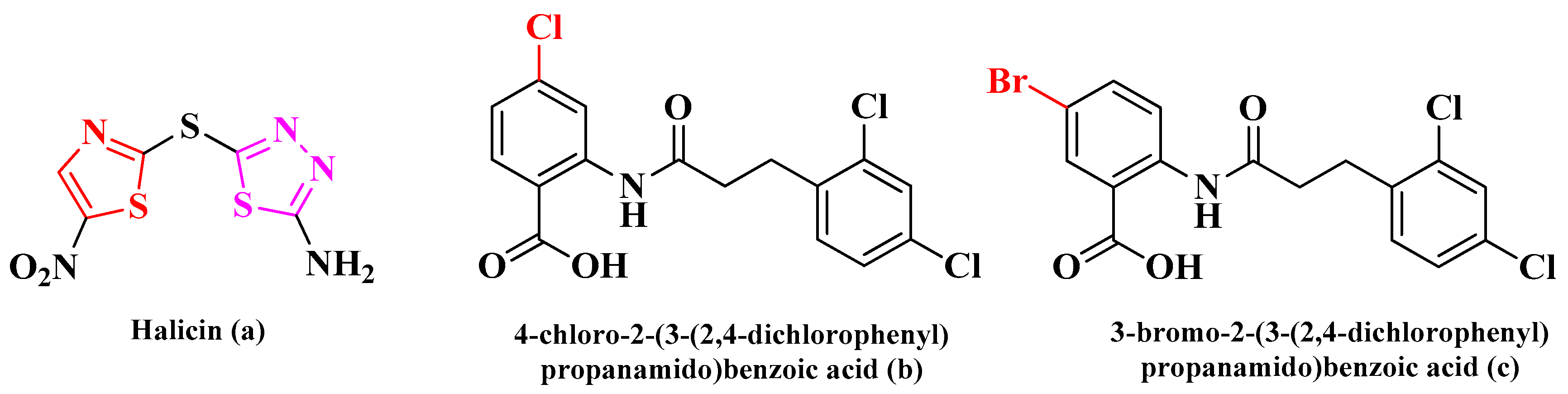
Besides the traditional strategies applied in medicinal chemistry for AMR, such as the total synthesis of new compounds, the optimization of already existing drugs, or the targeting of various virulence factors, a new powerful tool has emerged and that is artificial intelligence (AI) [3,4]. AI has the advantage of rapid virtual screening of thousands of compounds from various databases and identifies only a few compounds that are the most promising candidates for the development of novel antimicrobials or other drugs, depending on the case. Among the most notable examples of antimicrobials discovered through deep learning approaches are halicin (a), a repurposed antidiabetic as antibacterial, and two propanamido-benzoic acid derivatives (b and c) as potent antibacterials against methicillin-resistant Staphylococcus aureus (MRSA) and vancomycin-resistant enterococci. In both cases, the compounds were selected from large compound libraries (Figure 1) [5,6].
Halicin (a) is a siderophore with broad antibacterial activity against a large variety of bacterial strains, including S. aureus ATCC BA A-977, Escherichia coli ATCC 25922, Acinetobacter baumannii ATCC BAA-747, ATCC 19606, and MDR 3086, Pseudomonas aeruginosa ATCC 27853, or MRSA ATCC 43300 and BNCC 337371 [4,7,8]. Structurally, it is a hybrid compound containing a 5-nitrothiazole and a 2-amino-1,3,4-thiadiazole moiety, linked through a sulfur bond.
Besides the significant antimicrobial activity, there are several reports in the literature that have also evaluated the antibiofilm potential of halicin. It showed antibiofilm activity against mature and immature S. aureus biofilms, along with potent activity against some biofilms of antimicrobial resistant bacterial strains like A. baumannii and E. coli. Moreover, halicin maintained its antibiofilm activity on orthopedically relevant biofilm surfaces such as muscles, bones, alloys, and polymers [9,10,11].
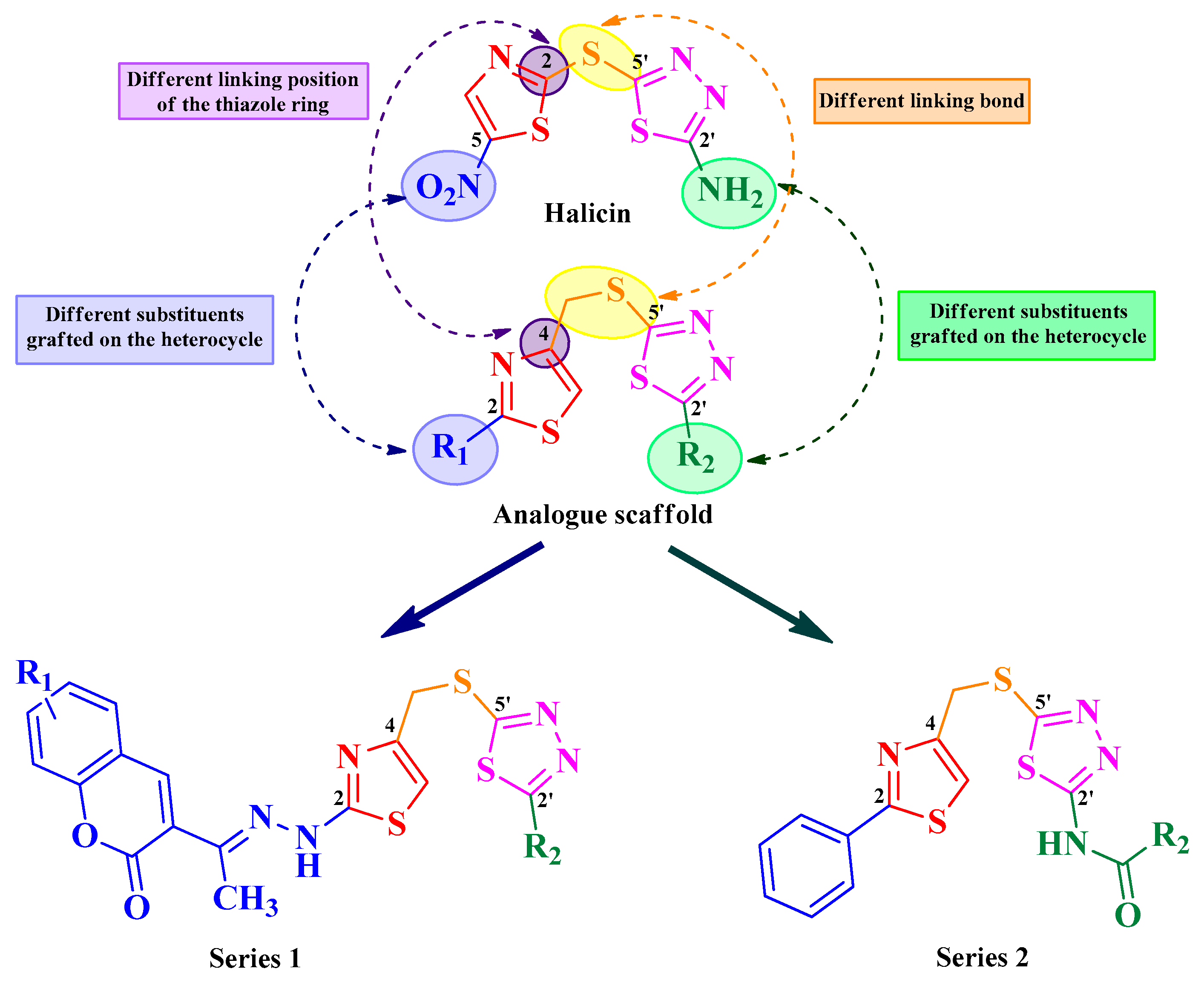
Taking into consideration the broad spectrum of a structurally simple molecule, the aim of this paper was to design two novel series of antimicrobial and antibiofilm drugs as analogues of halicin. The differences between the two scaffolds are the linking positions of the thiazole to the thiadiazole ring and the substituents grafted on both heterocycles. In halicin, the heterocycles are linked by a 2-5′ sulfur bridge and the thiazole heterocycle is 5-nitro substituted, while the thiadiazole is 2′-amino substituted.
Our main scaffold is represented by a thiazole linked to the thiadiazole heterocycle by a 4-5′-methylene-thio linker. Notable antimicrobials that contain a thiazole heterocycle linked in position 4 to the rest of the structure include aztreonam, several cephalosporins (ceftriaxone, cefixime, cefditoren, ceftazidime, cefdinir, cefiderocol), and several antifungals (abafungin, isavuconazole, and ravuconazole) [12]. The introduction of a coumarin heterocycle in the first series of compounds brings additional value due to its antimicrobial properties [13,14]. We kept the position 2 from thiazole and position 2′ from thiadiazole as substituting positions. Therefore, two series were developed: series 1 as coumarinyl-thiazolyl-methylthio-thiadiazoles and series 2 as phenyl-thiazolyl-methylthio-thiadiazoles (Figure 2).
Herein, we present the design, chemical synthesis, in silico and in vitro evaluation, and QSAR of two series of thiazolyl-methylthio-1,3,4-thiadiazole hybrid compounds. In silico evaluations of these compounds included druggability, ADMETox predictions, and molecular docking. The antimicrobial potential was evaluated against Gram-positive and Gram-negative bacterial strains, Candida, and Aspergillus strains. The antibiofilm potential was tested against several bacterial biofilms. A quantitative structure–relationship (QSAR) study using the 2D-QSAR Free-Wilson model was performed for the antimicrobial activity. In the end, the results were compared to halicin, to see if the scaffold had a contribution to the activity or it was mostly influenced by the grafted substituents.

2. Results

2.1. Chemical Synthesis

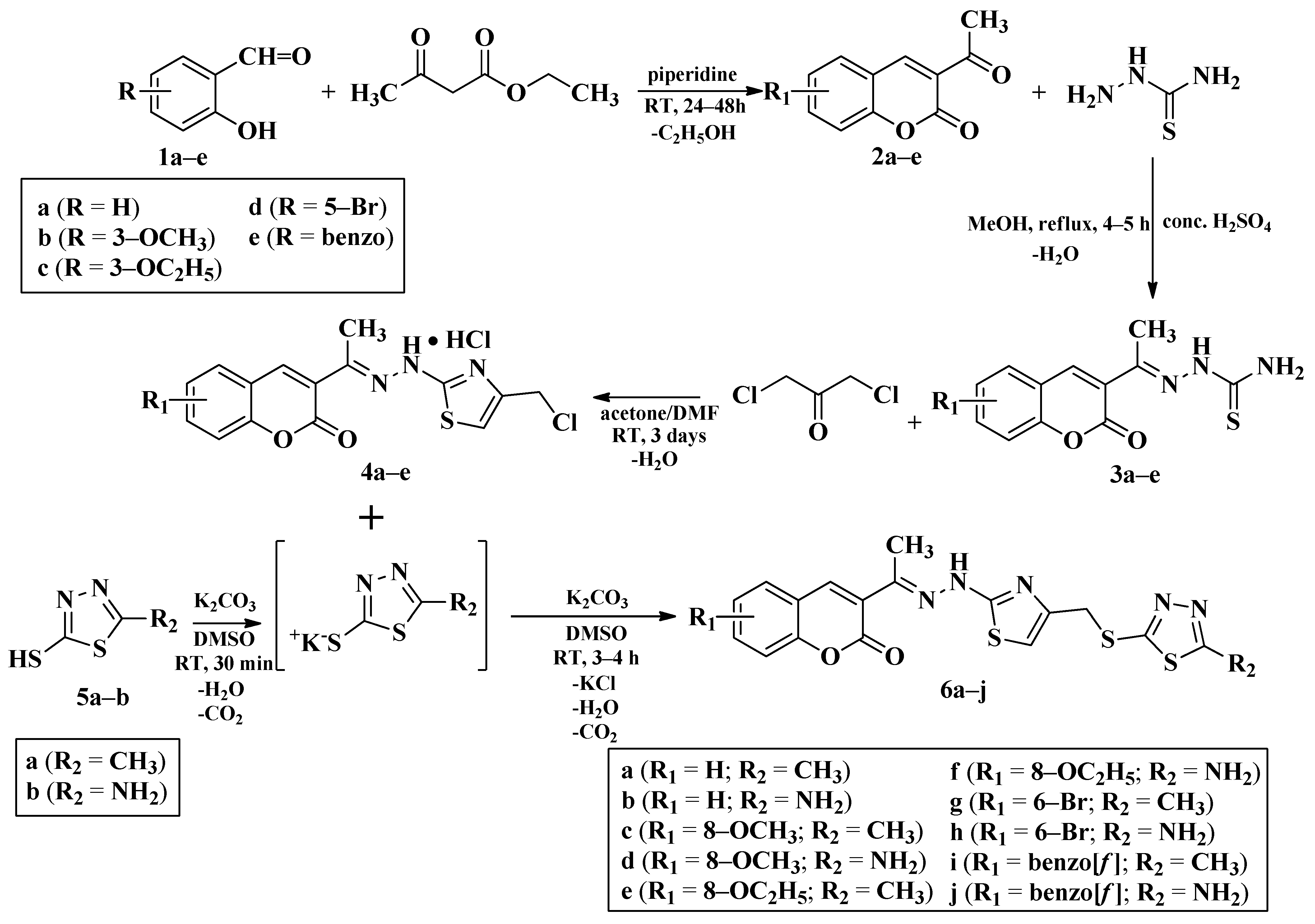
A total of 20 final compounds, divided into two series 6aj and 8aj, were obtained through two different chemical processes. The synthesis of the first series 6aj started with the condensation of ethyl acetoacetate with salicylaldehydes 1ae, followed by further derivatization of the resulting 3-acetylcoumarins 2ae with thiosemicarbazide. The coumarin-3-yl-thiosemicarbazones 3ae were then condensed with 1,3-dichloroacetone. Finally, the newly obtained 2-(coumarin-3-yl)-hydrazono-4-chloromethylthiazole salts 4ae were condensed with the potassium salts of 5-methyl-1,3,4-thiadiazole-2-thiol (5a) or 5-amino-1,3,4-thiadiazole-2-thiol (5b), to obtain the coumarinyl-hydrazono-thiazolyl-methylthio-5-thiadiazoles (6aj) (Figure 3).
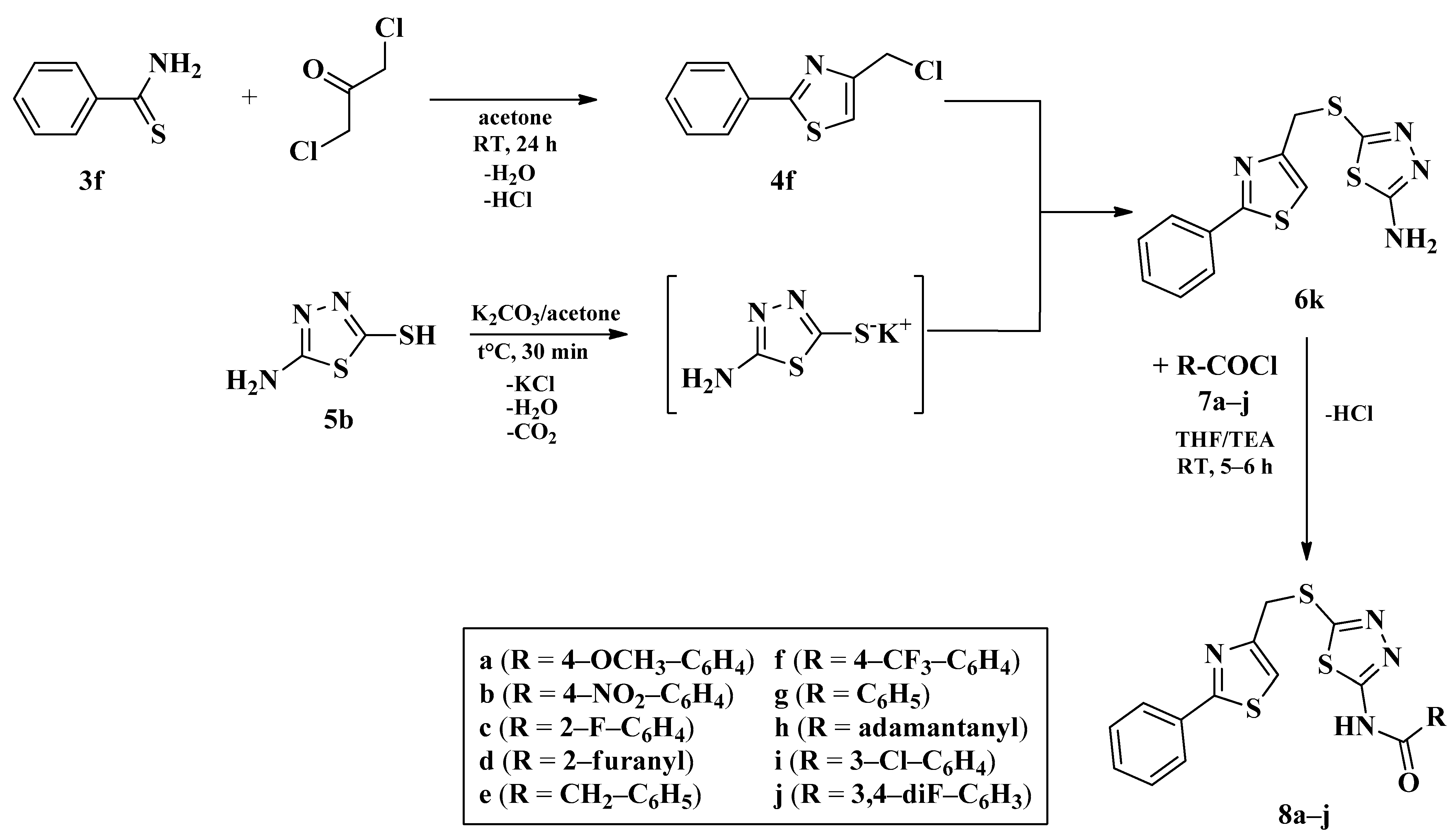
The second series (compounds 8aj) was obtained starting from the condensation of thiobenzamide 3f with 1,3-dichloroacetone, which yielded 2-phenyl-4-chloromethylthiazole 4f. This intermediate was next derivatized to 4-(2-phenyl)-thiazolyl-methylthio-5′-aminothiadiazole 6k, through condensation in basic conditions with the potassium salt of 5b. In the final step, the amino group of the thiazolyl-methylthio-thiadiazole 6k was then acylated with various acyl chlorides (7aj) to compounds 8aj (Figure 4).
The novel compounds were obtained in various yields (15–94%) and their structural identity was confirmed through IR, MS, 1H-, and 13C-NMR spectral analysis. The progress of reactions was monitored using thin layer chromatography (TLC) and retardation factors (Rf).
The graphical presentations of all recorded spectra for the compounds 6aj, 8aj, and their intermediates are illustrated in Figures S1–S104 from the Supplementary Materials.

2.2. In Silico Evaluation

2.2.1. Druggability and ADMETox Predictions

Early stages of drug design benefit from the virtual prediction of the druggability, and the pharmacokinetic and toxicological properties of potential candidates, providing a time sparing method to select and eliminate unsuitable compounds [15].
The considered physicochemical descriptors to determine the druggability of compounds 6aj and 8aj were molecular weight (MW), number of rotatable bonds (RB), number of hydrogen bond acceptors (HBA), number of hydrogen bond donors (HBD), topological surface area (TPSA), octanol–water partition coefficient implemented by Moriguchi (MLogP), estimated solubility (ESOL), and number of violations of Lipinski’s rule of five (Table 1) [16,17,18,19,20,21].
The pharmacokinetic descriptors computed for compounds 6aj and 8aj were gastrointestinal (GI) absorption, blood–brain barrier (BBB) permeation, P-glycoprotein (P-gp) substrate, and inhibition potential of several cytochrome P450 (CYP450) isoenzymes, particularly CYP1A2, CYP2C19, CYP2C9, CYP2D6, and CYP3A4 [22,23].
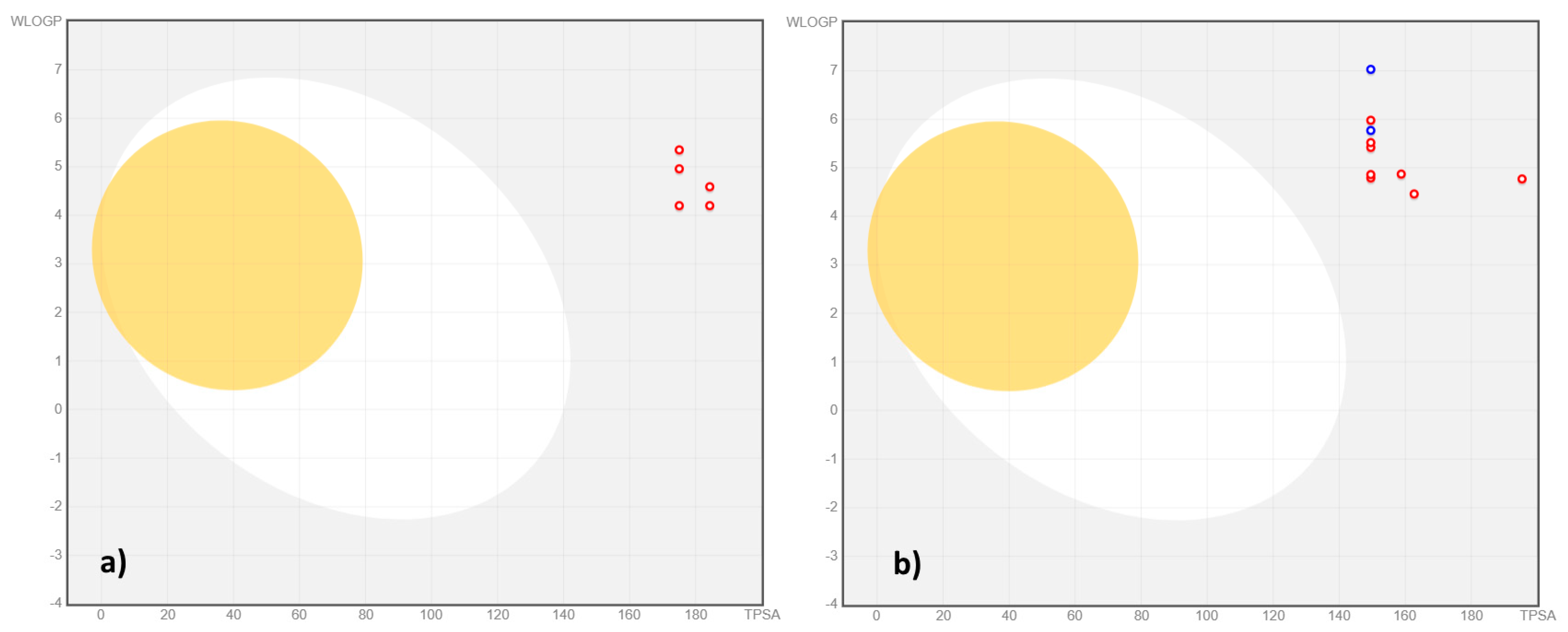
The toxicological descriptors computed for compounds 6aj and 8aj were carcinogenicity, eye and skin irritation, hepatotoxicity, respiratory toxicity, reproductive toxicity, mitochondrial toxicity, nephrotoxicity, and acute oral toxicity [24,25,26,27,28,29,30,31]. Two BOILED-Egg graphs (Figure 5) were generated to illustrate the prediction of GI absorption and BBB permeation of compounds 6aj and 8aj.
All compounds 6aj and 8aj were predicted to have low GI absorption and BBB permeation capacity (Figure 5). None of the compounds, excepting 8f and 8h, were predicted as a potential P-gp substrate (Figure 5). Regarding the inhibition potential of CYP450 isoenzymes, the computed descriptors revealed the following predictions: compounds 8ce, 8g, 8i, 8j as CYP1A2 inhibitors; all compounds, excepting 6e and 6h, as CYP2C19 inhibitors; compounds 8a and 8cj as CYP2D6 inhibitors; all compounds 6aj and 8aj as CYP2C9 and CYP3A4 inhibitors (Table S1 from the Supplementary Materials).
According to the computed toxicological descriptors, none of the compounds were predicted to cause skin irritation. With some exceptions, compounds 6aj and 8aj were not predicted to cause carcinogenicity (excepting 8b), respiratory toxicity (excepting 8h) and reproductive toxicity (excepting 8a and 8h). On the other hand, all compounds were predicted as hepatotoxic and with high acute oral toxicity (class III). Most of the compounds could cause eye irritation (excepting 8ac, 8e, 8f, and 8i) and could be nephrotoxic (excepting 8a, 8e, and 8h) (Table S2 from the Supplementary Materials).
According to the Cramer rules, the class III acute oral toxicity was attributed to the presence or absence of the following functional groups in the tested compounds: lactone fused to another ring (compounds 6af, 6i, and 6j), bromine substitution (compounds 6g and 6h), lack of sufficient sulphonate groups (compounds 8a, 8d, 8e, 8g, and 8h), nitro substitution (compound 8b), fluorine substitutions (compounds 8c, 8f, and 8j), and chlorine substitution (compound 8i) [31]. Hepatotoxicity is a model-based in silico alert and cannot be assigned to a specific functional group [27,30].

2.2.2. Density Functional Theory (DFT) Calculations

DFT studies are important in medicinal chemistry since they can be used to predict several electronic properties of potential drug candidates, such as conformational energies, electronic affinities, binding and ionization energies, or molecular geometrics [32,33]. Herein, to explain at electronic level the obtained protein–ligand complexes observed in the following molecular docking study, we conducted some DFT calculations, using the energies of the frontier molecular orbitals HOMO (Highest Occupied Molecular Orbital) and LUMO (Lowest Unoccupied Molecular Orbital). HOMO energies refer to the tendency of a compound to donate electrons, while LUMO energies refer to its tendency to accept electrons [34,35]. The energy levels of HOMO and LUMO in vacuum, nonpolar solvent, polar solvent, and water are presented in Table 2. The HOMO and LUMO visualizations, along with the electrostatic potential map for each of the compounds 6aj and 8aj are available in the Supplementary Materials (Tables S3 and S4).

2.2.3. Molecular Docking Studies

The molecular docking study was performed on the ATPase domain of the bacterial DNA gyrase subunit B (GyrB) 24 kDa from E. coli. The selection of this target was motivated by the structural similarity of compounds 6aj with novobiocin, which was a potent GyrB inhibitor, both containing an aminocoumarin moiety. Moreover, there are literature reports of azole compounds that can target DNA gyrase as a purposed mechanism of action [36,37]. Additionally, the lack of authorized antibacterial GyrB inhibitors makes this target promising against bacterial strains that have developed antimicrobial resistance against common drugs, such as fluoroquinolones [38,39].
The results of the predicted binding affinity (BA) of compounds 6aj and 8aj to the ATPase domain of GyrB are presented in Table 3.
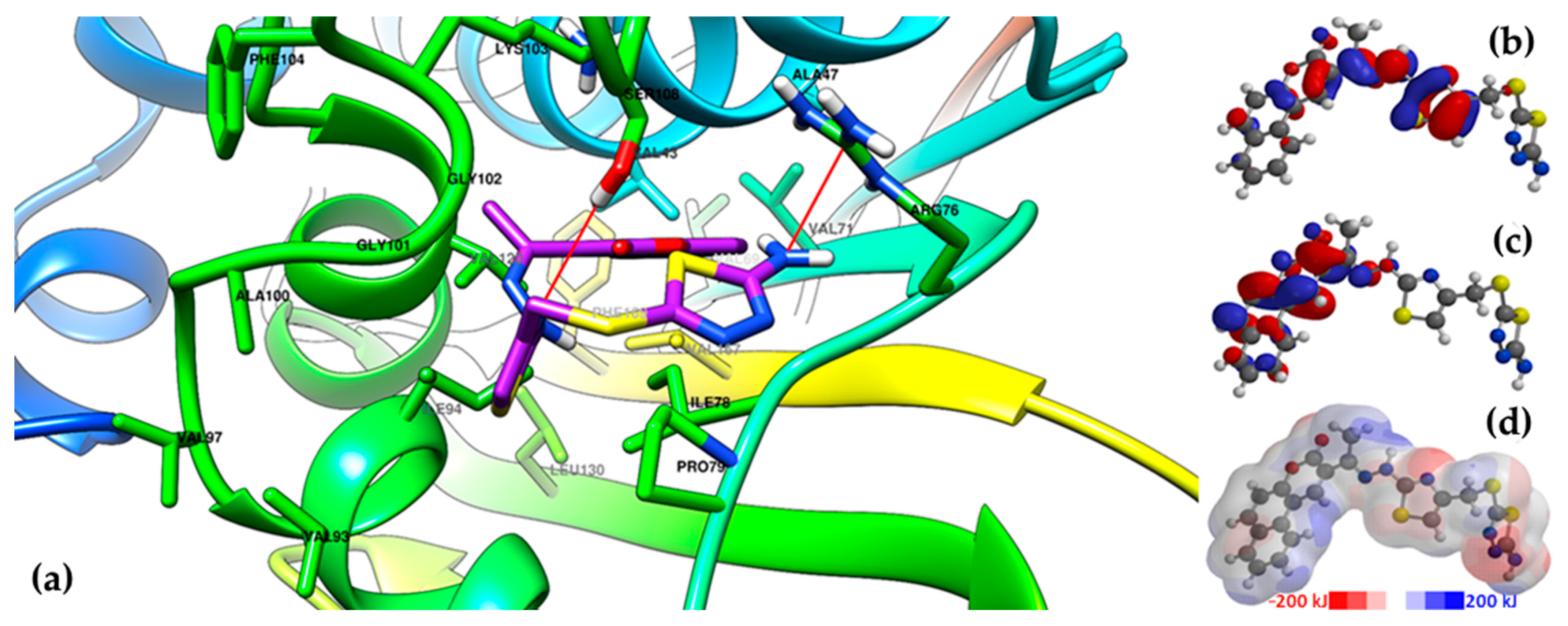
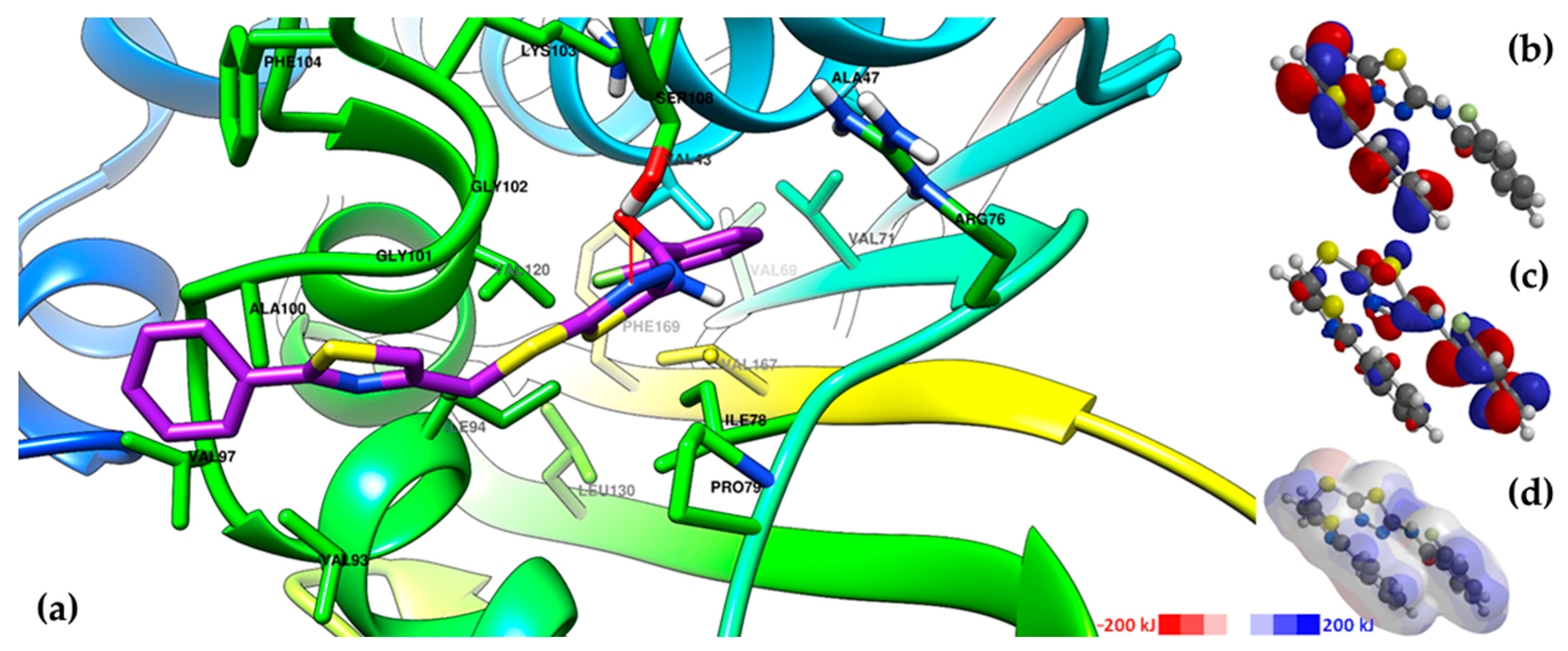
The graphical depiction of the interaction between compounds 6j and 8c, which were the compounds with the best binding affinities, and the ATPase domain of GyrB is presented in Figure 6 and Figure 7. Additional graphical depictions for the compounds 6i and 8f, which also registered some of the best binding affinities, are presented in Figures S105 and S106 from the Supplementary Materials.
The graphical depiction of compounds 6i, 6j, 8c, and 8f in the active site of the ATPase domain of GyrB displayed as surfaces is illustrated in Figures S107–S110 from the Supplementary Materials.

2.3. Antimicrobial Evaluation

Compounds 6aj and 8aj were tested for their antimicrobial activity, quantified as minimal inhibitory concentrations (MICs). The antibacterial activity was tested against Gram-negative bacterial strains, such as E. coli (ATCC 25922), Salmonella enteritidis (ATCC 13076), S. typhimurium (ATCC 14028), S. typhimurium (isolated from food source), S. derby (isolated from food source), and P. aeruginosa (ATCC 27853), and Gram-positive bacterial strains like Enterococcus faecalis (ATCC 29212) and S. aureus (ATCC 6538P), using ciprofloxacin as antibacterial reference. The antifungal activity was tested against C. albicans (ATCC 102321) and A. brasiliensis (ATCC 16404), using fluconazole as antifungal reference. The results are presented in Table 4 and Table 5.

2.4. Antibiofilm Activity

This assay reflects the inhibition of biofilm formation. Twelve compounds with the most notable antibacterial activity (6b, 6c, 6i, 6j, 8a, 8b, and 8ej) were further tested against E. faecalis (ATCC 29212), P. aeruginosa (ATCC 27853), E. coli (ATCC 25922), and S. typhimurium (ATCC 14028) bacterial biofilms, using gentamicin as reference. The selection of these compounds was primarily based on the obtained results in the MIC assay against P. aeruginosa (ATCC 27853). The activity was quantified as percentage (%) of biofilm (BF) inhibition and the results are presented in Table 6.

2.5. 2D-QSAR Studies

Free-Wilson 2D-QSAR Model

QSAR is one of the oldest and most used instruments to examine the correlation between the biological activity of a compound and its molecular structure. 2D-QSAR models are based on the molecular properties derived from the whole structure of compounds. The Free-Wilson 2D-QSAR model studies the detailed relationship between the biological activity and the small changes in the compounds’ substituents [40,41]. In this model, the contribution to the biological activity of the scaffold and the substituents is quantified using Equation (1):
Log E = Cs + xij + yij
The obtained activity was expressed as log E, where E represents the inversed value of the activity, Cs represents the contribution of the scaffold to the activity, xij and yij represent the sums of contributions of the substituents. The equation is obtained after applying multiple linear regression on a matrix with a number of lines equal to the number of compounds and a number of columns equal to the number of substituents. The presence of a compound is quantified with “1” and its absence with “0” (Table S5 from the Supplementary Materials). Each compound is described by an equation (for example, the equation for compound 6a would be: Log E = Cs + x1 + y1).
The obtained equations in the Free-Wilson 2D-QSAR model for the antimicrobial activities against all tested strains, following the multiple linear regression analysis are presented in Table 7. Compound 6a was identified as an outlier in the equation for the activity against E. coli and was eliminated to increase the goodness of fit of the equation. This is because the activity of compound 6a against E. coli was markedly lower compared to the other compounds. Similar behavior was observed in the other equations, except for those describing the activity against S. aureus, C. albicans, and A. brasiliensis. In those cases, the differences between compound 6a and the remaining compounds were less pronounced and therefore did not significantly affect the goodness of fit of the corresponding equations.
For the activity against S. enteritidis, S. typhimurium, and E. faecalis, respectively for the activity against S. typhimurium (food isolate) and S. derby (food isolate), the same equations that correlate the structure–activity relationship were obtained. The codification of the substituents is presented in Section 4.
The mathematical models were validated through the leave-one-out cross-validation (LOOCV) statistical method. The cross-validation coefficients (ΔCV, Table 7) varied between 0.0003579 and 0.1191464, thus indicating the obtained models have a good predictability.
The calculated log E (lg E) values using the obtained equations are presented in Table 8. In all cases, the p values resulting from the comparison between the two observed/calculated log E values, using the two-sample assuming equal variances t-test, were between 0.923979 and 0.999758. Therefore, no statistically significant differences (p > 0.05) were observed between the two log E values in every case.

3. Discussion

3.1. Chemical Synthesis

Intermediate compounds 2ae, 3ae, 4a, 4f, and 6k were previously reported in the literature [35,42,43,44,45,46,47,48,49,50,51,52,53]. According to the Reaxys database, intermediate compounds 4be and the final products 6aj and 8aj were not previously reported.
The 4-thiazolylchloromethyl derivatives 4ae were confirmed by extended spectral analysis. Based on the IR spectra, the intermediates had an additional band for the C-Cl in the fingerprint region, between 702 cm−1 and 713 cm−1. The intermediates were further confirmed by the MS spectra, following the identification of the corresponding molecular peaks. The corresponding signals for the proton and carbon atoms were identified in the expected regions of the 1H- and 13C-NMR spectra.
The final products 6aj were confirmed by extended spectral analysis. According to the IR spectra, the same bands were observed as for the intermediates 3ae, except for the C-Cl band. The corresponding molecular peaks were identified in the MS spectra and the corresponding signals for the proton and carbon atoms were identified in the expected regions of the 1H- and 13C-NMR spectra. The presence of the deshielded N-H proton signal at chemical shifts ranging between 11.36 and 11.46 ppm confirmed that compounds 6aj were mainly obtained in the E configuration, according to the literature data, which is also the most energy-favorable configuration [35,54,55].
The obtained intermediates 4f and 6k were previously synthesized by our research group and reconfirmed this time through IR and MS analysis [45,56]. Regarding intermediate 6k, the presence of wide νN-H stretching band at 3414 cm−1 in the IR spectrum confirmed the condensation successfully. The corresponding molecular peak was identified in the MS spectra.
The final compounds 8aj were confirmed through extended spectral analysis. Based on the IR spectra, two wide νC=O stretching bands corresponding to the amide bond could be observed for all compounds in the range between 1691 cm−1 and 1601 cm−1. The corresponding molecular peaks were identified in the MS spectra and the corresponding signals for the proton and carbon atoms were identified in the expected regions of the 1H- and 13C-NMR spectra.

3.2. In Silico Evaluation

3.2.1. Druggability and ADMETox Predictions

The molecular weight for every compound was between 400.50 g/mol and 509.42 g/mol and the number of rotatable bonds between 6 and 8. Each compound had 4–7 HBAs and 1–2 HBDs, while the value of TPSA was between 149.55 Å2 and 210.30 Å2. The computed MLogP for every compound had a positive value between 1.37 and 3.76, while the ESOL was predicted to be between 1.13 µg/mL and 8.28 µg/mL. A total of 18 out of the 20 screened compounds respected the Lipinski’s rule of five, which means that they have a molecular weight lower than 500 g/mol, a number of HBA (O and N atoms) lower than 10, a number of HBD (NH and OH groups) lower than 5, and a value of MLogP lower than 4.15. Compounds 6g and 6h had one violation of Lipinski’s rule of five due to their molecular weight being higher than the threshold. Overall, the presented compounds had good druggability properties [19,20].
Based on the computed pharmacokinetic descriptors, all compounds were predicted to have low GI absorption, making them suitable for the treatment of enteric infections. In terms of CYP450 isoenzymes inhibition, all compounds were predicted to inhibit CYP3A4 and CYP2C9 isoenzymes, thus representing an increased potential of drug interactions. Compounds 6ac, 6eg, 6ij, and 8aj were predicted as potential CYP2C19 inhibitors, while compounds 8ce, 8g, and 8ij as potential CYP1A2 inhibitors. None of the 6aj compounds were predicted as CYP2D6 inhibitors, suggesting that the coumarin moiety may not have affinity for this isoenzyme. The same observation may be valid also for the CYP1A2 inhibition. In terms of affinity for the P glycoprotein, only compounds 8f (4-trifluorophenyl substituted) and 8h (adamantanyl substituted) were predicted as substrates. However, the reduced predicted absorption rate could significantly limit the risk of pharmacokinetic drug–drug interactions.
Regarding the toxicological properties, on one hand, most of the compounds were predicted to produce no skin irritation, carcinogenicity, and nephrotoxicity. On the other hand, they were predicted to possess hepatotoxicity and acute oral toxicity. Only compound 8b was predicted as potential carcinogenic, while 8h was the only compound predicted to possess respiratory toxicity. Compound 8a and 8h were the only compounds predicted to produce reproductive toxicity. Compounds 8a, 8e, and 8h were not predicted to be nephrotoxic agents. While low predicted GI absorption may reduce systemic exposure, it does not eliminate safety concerns, notably hepatotoxicity and high acute oral toxicity (class III). Therefore, the pharmaceutical potential of these compounds should be interpreted cautiously and supported by experimental toxicological profiling. Notably, many authorized antimicrobials have recognized safety liabilities, examples including the aminoglycoside-induced nephrotoxicity and ototoxicity, azole-induced hepatotoxicity, or vancomycin-induced red man syndrome, highlighting the need for experimental validation of the in silico alerts [57,58,59,60].

3.2.2. DFT Calculations

Across compounds 6aj, a consistent solvent effect was observed for both methyl- and amine-substituted thiadiazole-derived compounds. Moving from vacuum to solvated environments, it led to a modest stabilization of the HOMO, between 0.05 and 0.15 eV. This stabilization increased slightly with the solvent polarity, but it was largely saturated between polar solvent and water.
In compounds 6aj the HOMO was localized over the hydrazone-thiazole region of the compounds, while the LUMO was localized over the coumarin heterocycle (Table S3 from the Supplementary Materials).
Within each pair, amino-thiadiazole compounds (6b, 6d, 6f, 6h, and 6j) generally exhibited slightly lower HOMO levels compared to their methyl analogues (6a, 6c, 6e, 6g, and 6i), particularly when solvated. This trend reflected the stronger interaction of the polar amine group with the solvent, but the amplitude of this effect remained moderate, because the HOMO was found across the hydrazone-thiazole region (Table S3 from the Supplementary Materials). The methyl or amino substitution occurs at a site distant from the HOMO region, and the thiazole and thiadiazole rings are connected through a sp3-hybridized carbon atom. This linkage substantially limited electronic communication, thereby reducing the ability of the thiadiazole moiety to influence the electronic properties of the hydrazone–thiazole fragment where the HOMO was localized. On the other hand, substitution of the coumarin core with various substituents did not significantly affect the HOMO energy level, because the oxygen atoms within the coumarin structure are located much closer to the HOMO region and have contributed predominantly to its electronic character. Consequently, the electronic effects of the variable substituents from coumarin became negligible.
The LUMO energies in compounds 6aj showed a more pronounced sensitivity to both substitution and solvent polarity. For most compounds, the transition from vacuum to solvents resulted in a stabilization of approximately 0.05–0.20 eV. This effect was particularly obvious for compounds 6gj, where the LUMO was significantly lowered in polar environments. Because LUMO was found on the coumarin moiety (Table S3 from the Supplementary Materials), the variable substitution of the coumarin influenced the LUMO levels. A significant influence was identified for the alkoxy electron donating substitution with methoxy and ethoxy groups in compounds 6cf, which had higher energy when compared to the brominated derivatives 6g and 6h. As expected, the amino or methyl substitution of the thiadiazole heterocycle had no significant effect on LUMO levels, because the respective substitution was found on the other end of the molecules, with no possible way to directly influence the electron density on the coumarin heterocycle.
In compounds 8aj the HOMO was localized on the phenyl-thiazole region, while the LUMO was localized either on the R-substituted phenyl ring directly linked to the amide or on the phenyl-thiazole region, overlapping the HOMO, depending on the electronic nature of the substituents grafted on the R-substituted phenyl ring (Table S3 from the Supplementary Materials).
In compounds 8aj, the HOMO energies had a broader range when compared to compounds 6aj, reflecting the diverse electronic effects due to the nature of the attached functional groups. The solvent effect on the HOMO was generally modest, with typical shifts below 0.2 eV from vacuum to water. In several cases (compounds 8a and 8h), the HOMO energy was insensitive to the solvent polarity, indicating a limited orbital–solvent interaction. The HOMO was predominantly localized on the phenyl-thiazole fragment, spatially distant from the variable substituents (Table S3 from the Supplementary Materials). Nevertheless, the conformational folding induced by the flexible thioether linker, which acts as a molecular hinge, allowed the substituents to indirectly affect the HOMO energy levels.
Regarding the distribution of the LUMO, an interesting observation was worth making. In compounds where the substitution of the amide was made with electron donating groups (8a, R = 4-methoxy), furanyl (8d), benzyl (8e), adamantanyl (8h), the LUMO was found on the phenyl-thiazole region (Table S3 from the Supplementary Materials), while in the compounds substituted with electron withdrawing groups (8b − R = 4-nitro, 8c − R = 2-fluoro, 8f − R = 4-trifluoromethyl, 8i − R = 3-chloro, and 8j − R = 3,4-difluoro), it was found on the R-substituted phenyl ring directly linked to the amide bond (Table S3 from the Supplementary Materials).
Compared to compounds 6aj, the compounds 8aj showed a larger dispersion of LUMO energies, indicating that functional groups changes were a dominant factor in influencing the electron distribution across the compounds.
Taken together, these results demonstrated that solvent polarity consistently stabilized both HOMO and LUMO energies, with a stronger effect on the LUMO. Substitution with the amine group in compounds 6aj enhanced solvent sensitivity relative to methyl substitution, particularly for unoccupied orbitals. In contrast, for compounds 8aj it was shown that the functional group was the dominant factor governing frontier orbital energies, while solvent effects acted as a secondary, but still significant factor.

3.2.3. Molecular Docking Studies

All compounds registered binding affinities between −9.4 and −7.7 kcal/mol (Table 3). Overall, compounds 6aj had better affinities compared to compounds 8aj. In the first series of compounds, the highest binding affinity was registered by compounds 6i and 6j (BA = −9.4 kcal/mol). In the second series of compounds, the highest BA was registered by compounds 8c and 8f (BA = −8.9 kcal/mol).
According to the graphical depictions of compounds 6i, 6j, 8c, and 8f in the ATPase domain of GyrB (Figure 6 and Figure 7, Figures S105 and S106 from the Supplementary Materials), the sidechain of Ser108 is predicted to act as a HBD to one of the available nitrogen atoms in the compounds, either the thiadiazole heterocycle (8c, and 8f, Figure 7 and Figure S106 from the Supplementary Materials), the 5-amino group of the thiadiazole heterocycle (6i, Figure S105 from the Supplementary Materials), or the hydrazone linker (6j, Figure 6). Parts of the compounds also fit in a hydrophobic binding pocket comprising various amino acids: the benzo[f]coumarin heterocycle of compounds 6i and 6j in a pocket comprising Val71, Val69, Val43, Phe169, Val167, and Val 120 (Figure 6 and Figure S105 from the Supplementary Materials), respectively, and the phenyl-thiazole region of compounds 8c and 8f in a pocket comprising Val97, Val93, Ile94, Phe104, and Ala100 (Figure 7 and Figure S106 from the Supplementary Materials). Moreover, it was observed that the positively charged Arg76 sidechain is predicted to be involved in a polar contact with one of the nitrogen atoms of the thiadiazole heterocycle in compound 6j (Figure 6).
The predicted binding poses could be supplementarily explained by the DFT calculations. The regions in the compounds where the HOMO was localized (the hydrazone-thiazole and phenyl-thiazole regions) interacted primarily with the supposed regions of the protein where the LUMO was localized [61]. The electrostatic potential maps (Table S4 from the Supplementary Materials, Figure 6 and Figure 7, Figures S105 and S106 from the Supplementary Materials) provided further insight into predicting the binding of these compounds to the protein, based on their electronic densities. The white regions around the aromatic rings (for example, the coumarin and benzo[f]coumarin heterocycles in compounds 6aj or the 2-phenyl ring in compounds 8aj) confirmed their nonpolar and hydrophobic characteristics, which are important for the interaction with the protein through π-π stacking, van der Waals interactions, and other types of noncovalent interactions [62]. The red areas corresponded to the electron-rich regions, which can overlap the HOMO in some cases, and can interact with the protein through electron donation (for example, the 5-amino group in compound 6j, Figure 6). The blue areas corresponded to electron-deficient regions, which can overlap the LUMO in some cases, for example the benzamide moiety substituted with electron-withdrawing groups in compounds 8aj (Table S3 from the Supplementary Materials, Figure 6 and Figure 7, Figures S105 and S106 from the Supplementary Materials) [63].

3.3. Antimicrobial Evaluation

All tested compounds 6aj and 8aj showed antibacterial activity in different potencies against the tested bacterial strains [64]. Overall, the antibacterial activity was better in the 8aj series than in the 6aj series.
All compounds 8aj were active on E. coli (MIC = 15.62 μg/mL) and E. faecalis (MICs = 31.25–62.50 μg/mL), the activity being similar or superior to ciprofloxacin (Table 4). The activity against E. coli also correlates with the results obtained in the molecular docking study on the ATPase domain of the GyrB 24 kDa from E. coli (Table 3). Nevertheless, this mechanism should be regarded as tentative, given that the study relied solely on molecular docking. Compounds 8ej also showed superior activity to ciprofloxacin against S. derby (MIC = 31.25 μg/mL). The activity against the other strains was inferior to ciprofloxacin (Table 4).
Compounds 6dh showed superior activity to ciprofloxacin against S. derby (MIC = 31.25 μg/mL) and E. faecalis (MIC = 62.50 μg/mL). Additionally, compounds 6b, 6c, and 6i were more potent than ciprofloxacin against E. faecalis. The activity against the other strains was inferior to ciprofloxacin (Table 4).
The lowest antibacterial activity was registered for compounds 6a and 6j (except against E. coli). None of the tested compounds showed significant activity against S. aureus (Table 4).
The promising antibacterial activity against the tested Enterobacteriaceae strains (E. coli and Salmonella spp.) and E. faecalis, coupled with the low GI absorption predicted in silico, make compounds 6aj and 8aj good candidates for the development of novel antibacterials in enteric infections.
All tested compounds 6aj and 8aj showed antifungal activity in different potencies against the tested strains. The activity against C. albicans was similar to fluconazole (MIC = 15.62 μg/mL) in most cases, except for compounds 6c, 6h, 8a, 8c, and 8d (MIC = 31.25 μg/mL) (Table 5). The antifungal activity was less potent against A. brasiliensis (MICs = 31.25–62.50 μg/mL) compared to C. albicans (Table 5).
Overall, the activity profile was not uniform across the tested strains. In contrast to the generally better activity observed for several Gram-negative strains and for C. albicans, the activity against S. aureus was consistently less favorable. This difference may reflect species-specific factors that influence effective exposure to the compounds [65,66].

3.4. Antibiofilm Activity

All tested compounds 6b, 6c, 6i, 6j, 8a, 8b, and 8ej showed antibiofilm activity with different potencies against the tested biofilms. Except for the inactive compounds 8b and 8ej against E. faecalis BF, activity was registered in each of the other cases.
Gentamicin was used as a reference to compare the antibiofilm activity of the tested compounds primarily due to its ability to disrupt bacterial virulence factors, thus including biofilms [38,67].
Some concentration–response profiles were non-monotonic. This behavior may reflect the intrinsic biological complexity of biofilm formation and differential responses at sub-inhibitory concentrations [38,68,69,70].
The activity against E. faecalis BF was weak in all instances, including gentamicin (Table 6). The highest inhibition percentages were registered by compounds 6j (27.75–23.05%) and 8a (24.61–21.47%) at concentrations of 500–125 μg/mL, which were either superior or equal to gentamicin at the same concentrations (23.04–19.90%).
The most effective antibiofilm activity was observed against P. aeruginosa BF, where all tested compounds showed BF inhibitions over 50% at concentrations between 500 and 31.25 μg/mL. All compounds, except for compound 8b, were still active at the lowest concentration, with superior BF inhibition (72.33–7.73%) compared to gentamicin (3.77%) (Table 6). The most potent compounds, with inhibition percentages over 50%, were 8e (72.33%), 8h (71.23%), 6i (70.97%), 6b (70.45%), 8j (61.70%), and 6j (52.57%).
The activity against E. coli BF was comparable to that of gentamicin at 500–62.50 μg/mL for all tested compounds, except for compounds 6i (inactive at 62.50 μg/mL) and 8a (38.01%—weak inhibition at 62.50 μg/mL). Compound 8b showed additional weak BF inhibition percentages (12.08–4.30%) at 31.25–7.81 μg/mL (Table 6).
All tested compounds were regarded as weak inhibitors against S. typhimurium BF. None of the compounds (maximum inhibition percentage 39.37%) nor gentamicin (maximum inhibition percentage 45.09%) showed inhibition over 50% (Table 6). Compounds 6i, 8a, and 8gj kept their activity until 0.10 μg/mL (14.20–0.48%), although inferior to gentamicin (27.93%).
There was a more potent BF inhibition at 125 μg/mL than at higher concentrations against E. coli and S. typhimurium BFs. The activity of compound 8j was superior to gentamicin against E. coli BF at this concentration (Table 6).
The antibiofilm activity against the tested BFs varied in the following order P. aeruginosa > E. coli > S. typhimurium > E. faecalis. A total of 10 out of 12 compounds were more active than gentamicin against P. aeruginosa BF at the lowest tested concentration. In the case of E. coli BF, no effective inhibitors were observed at concentrations under 62.50 μg/mL. Many compounds were active against S. typhimurium BF until the lowest concentration, but they were weak inhibitors at all tested concentrations. Finally, the activity against E. faecalis BF was the weakest, with compounds 8b and 8ej completely inactive.
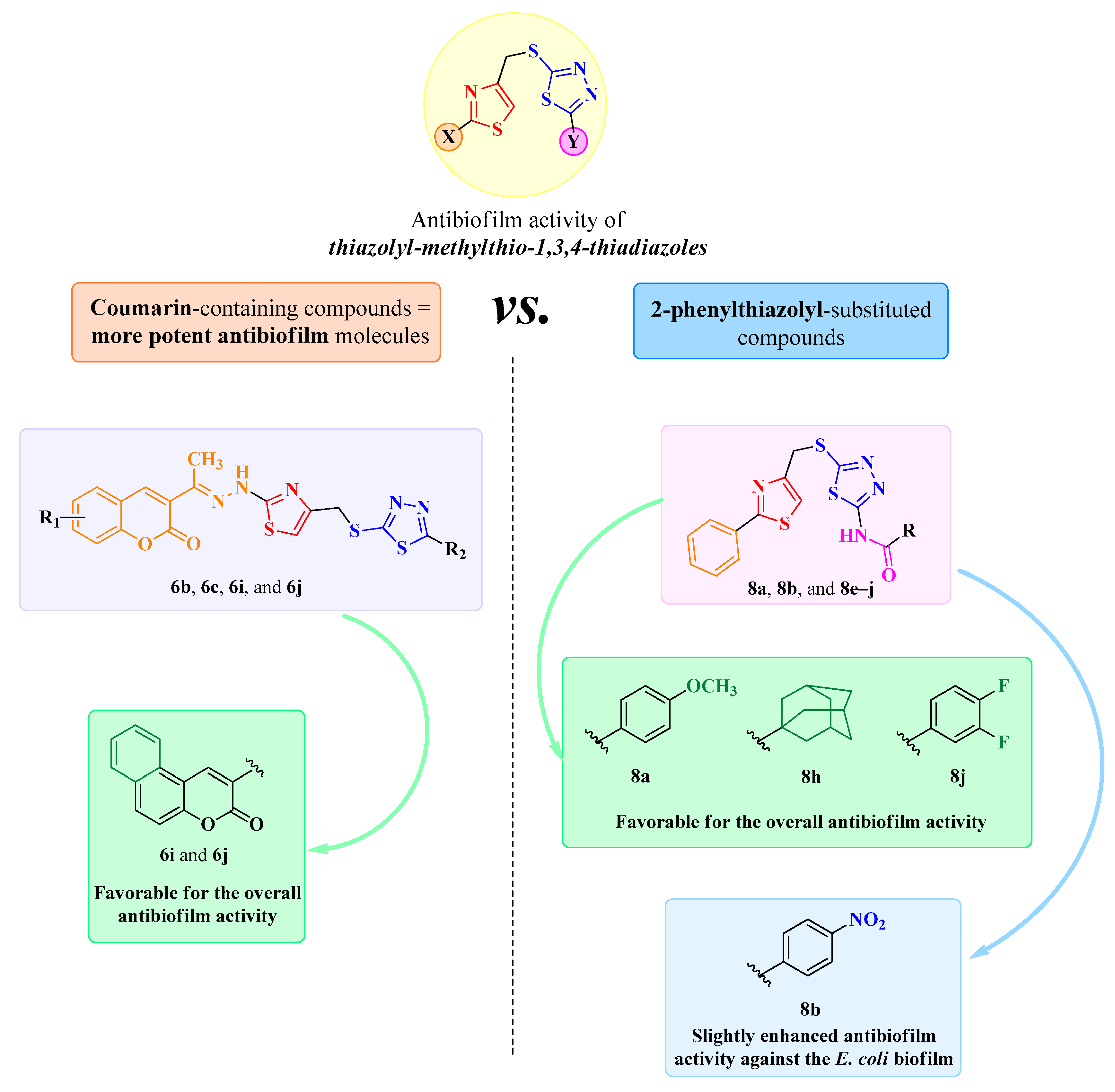
Based on the qualitative structure–activity relationship (SAR) studies in these compounds, it could be observed that compounds containing the coumarin heterocycle (6b, 6c, 6i, and 6j) were more potent in many instances compared to the 2-phenylthiazolyl-substituted compounds (8a, 8b, and 8ej).
The annulation of a supplementary ring to the existing coumarin heterocycle was favorable for the overall activity of the benzo[f]coumarin compounds 6i and 6j. A similar trend was observed in a previous antibiofilm study reported by our research group [38].
With respect to the 2-phenylthiazolyl compounds 8a, 8b, and 8ej, the most favorable substitutions for the overall antibiofilm activity were 4-methoxyphenyl (8a), adamantanyl (8h), and 3,4-difluorophenyl (8j). Additionally, the substitution with 4-nitrophenyl was responsible for maintaining compound 8b active at 31.25–7.81 μg/mL against the E. coli BF.
The qualitative SAR study of the antibiofilm activity for the compounds 6b, 6c, 6i, 6j, 8a, 8b, and 8ej is illustrated in Figure 8.

3.5. 2D-QSAR Studies

Based on the obtained equations from the Free-Wilson models of each antimicrobial activity against the tested strains, the contributions to the activity of the scaffold and each substituent are presented in Table 9. According to the obtained models, the contributions of x2 (8-ethoxycoumarinyl-hydrazonoethyl), x6 (phenyl), and y1 (methyl) substituents to the activity against the tested strains, excepting E. coli, were null. Similarly, the contribution of y2 (amino) substituent to the activity against E. coli was null. The codification of the substituents is presented in Section 4.
According to the ranking for the antibacterial activity against E. coli, the highest contribution to the activity was brought by the scaffold itself (Cs = 2.850). The similarity to halicin may be an explanation for this outcome, as this drug is considered potent against this strain (MICs = 8–32 µg/mL) [7,8].
The scaffold brought the most important contribution (Cs = 0.866) to the antibacterial activity against S. enteritidis, S. typhimurium, and E. faecalis, which was quantified by the same equation. The similarity to halicin may be an explanation for this outcome, as this drug is considered potent against these strains (MICs = 4–16 µg/mL), similarly to the previous case [7,71].
The substitution with 3,4-difluorobenzamide (8j, y12 = 0.289) and phenylacetamide (8e, y7 = 0.267) substituents in position 5 of the thiadiazole ring was the most favorable for the activity against S. enteritidis, S. typhimurium, and E. faecalis, both of which share a similar steric volume. Additionally, the most advantageous substituent (x4 = 0.044) in the position 2 of the thiazole ring was the 6-bromocoumarin-3-yl moiety (6gh).
On the other hand, the benzamide derivatives para- or meta-substituted with large substituents like p-nitro (8b, y4 = −0.004), m-chloro (8i, y11 = −0.014) or p-methoxy (8a, y3 = −0.018) had lower activity. Ortho substitution (8c, y5 = −0.632) and furanyl bioisosteric substitution (8d, y6 = −0.662) were the most unfavorable for the activity against S. enteritidis, S. typhimurium, and E. faecalis. A large polycyclic substituent like benzo[f]coumarin-3-yl (6ij) on the second position of the thiazole ring was also unfavorable for the activity (x5 = −0.283).
Additionally, the unsubstituted coumarin moiety in position 2 of the thiazole ring (6ab, x1 = −0.330) and the unsubstituted benzamide moiety in position 5 of the thiazole ring (8g, y9 = −0.049) were unfavorable for the activity against S. enteritidis, S. typhimurium, and E. faecalis. Therefore, it was implied that the presence of a substituent on these aromatic moieties is necessary for the activity.
Similar to the previously mentioned model, the scaffold brought the highest contribution to the activity against S. typhimurium and S. derby food isolates (Cs = 0.987), while the ranking for the contribution of the substituents from position 2 of the thiazole ring was kept the same.
The most favorable substituents from position 5 of the thiadiazole ring for the activity against S. typhimurium and S. derby food isolates were the polyfluorinated ones (8f − y8 = 0.198 and 8j − y12 = 0.168) and adamantanoylamide (8h, y10 = 0.189). The furanoylamide (8d, y6 = −0.782) and o-fluorobenzamide (8c, y5 = −0.753) substituents were again the most unfavorable for the activity.
In a similar manner as the previous cases, the scaffold brought the most important contribution to the activity against P. aeruginosa (Cs = 0.686), once again the explanation for this outcome being the similarity to the halicin, which showed similar potency against P. aeruginosa according to the literature [7].
Referring to substituents, the highest contribution to the activity was brought by the substituents from position 5 of the thiadiazole ring, namely 3,4-difluorobenzamide (8j, y12 = 0.469) and phenylacetamide (8e, y7 = 0.447), which are similar in terms of steric volume. The most favorable substituent grafted in position 2 of the thiazole ring was benzo[f]coumarin-3-yl (6ij, x5 = 0.169), underlining the importance of a large polycyclic substituent for the activity against P. aeruginosa.
On the other hand, the activity was decreased when the compounds were substituted with 6-bromocoumarin-3-yl (6gh, x4 = −0.107), 8-ethoxycoumarin-3-yl (6ef, x3 = −0.137), coumarin-3-yl (6ab, x1 = −0.180), 2-fluorobenzamide (8c, y5 = −0.452), and 2-furanoylamide (8d, y6 = −0.481).
According to the ranking, the highest contribution to the activity against S. aureus was brought by the substituents inserted into position 5 of the thiadiazole ring, particularly p-trifluoromethylbenzamide (8f, y8 = 0.620), p-methoxyphenylbenzamide (8a, y3 = 0.584), phenylacetamide (8e, y7 = 0.568), and benzamide (8g, y9 = 0.553).
In the case of this model, the contribution of the scaffold towards the activity was unfavorable (Cs = −0.037). This comes in contradiction with the data available regarding the antibacterial activity of halicin against S. aureus, which is a potent agent against this bacteria (MICs = 2–8 µg/mL) [7,8,72].
Based on the model, unfavorable contributions to the activity against S. aureus were brought by the substituents in compounds with inferior activity (MIC = 500 µg/mL) to ciprofloxacin (MIC = 125 µg/mL). Because of this difference in the activity, the contributions to the log E values are close to one another, from −0.004 to −0.060, and do not reflect properly the negative influence of these substituents towards the activity.
According to the ranking, the most important contribution to the activity against C. albicans was brought by the scaffold (Cs = 1.318). However, this time it cannot be compared to halicin because this drug was not tested on fungal strains.
All the coumarin substituents were favorable for the activity, while the benzamide substituents decreased the activity against C. albicans. The antifungal potential of coumarin-containing compounds is documented in the literature and, therefore, it explains the obtained results [73].
Similar to the previous model for the antifungal activity, the scaffold brought the most important contribution to the activity against A. brasiliensis (Cs = 1.047).
The importance of the coumarin moiety for designing antifungal compounds was observable again. However, the brominated substituent (6gh, x4 = −0.107) decreased the activity. The most favorable substituents for the activity inserted in position 5 of the thiadiazole ring were p-trifluoromethylbenzamide (8e, y8 = 0.138), adamantanoylamide (8h, y10 = 0.129), and 3,4-difluorobenzamide (8j, y12 = 0.108). The most unfavorable substituents for the activity against A. brasiliensis were o-fluorobenzamide (8c, y5 = −0.211) and 2-furanoylamide (8d, y6 = −0.240).
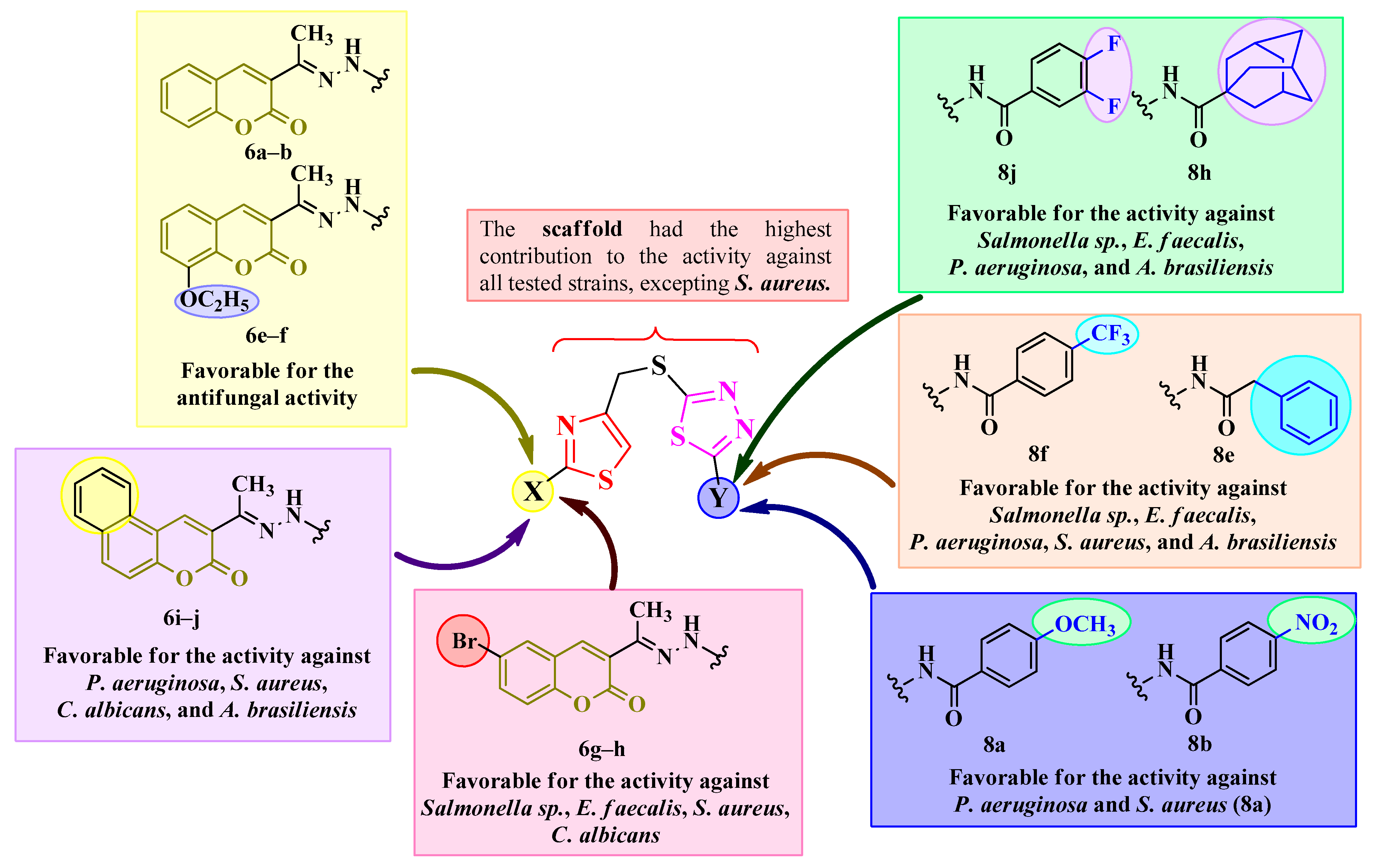
As a general conclusion of the 2D-QSAR analysis, the scaffold brought the highest contribution to the activity against all tested strains, except on S. aureus, while the coumarin substituents were the most favorable for the antifungal activity, especially against C. albicans, and the benzamide substituents had mostly influenced the antibacterial activity.
The equations obtained in the Free-Wilson model can predict the compounds with the best biological activity by combining the substituents with the best contribution to the desired final effect. Based on the obtained Free-Wilson models, each substituent had a different contribution to the antimicrobial activity against a particular bacterial or fungal strain. A summary of the observed QSAR is illustrated in Figure 9.
One limitation of the present 2D-QSAR study is the relatively small dataset used for model development. In addition, the MIC values obtained for several tested strains are clustered into a limited number of repeated values. Consequently, while the QSAR analysis supports the structure–activity investigation, its predictive applicability is reduced.

4. Materials and Methods

4.1. Chemistry

The necessary reagents, solvents, and laboratory glassware were purchased from the local suppliers.
The reactions’ progress was verified using thin layer chromatography (TLC), employing silicagel 60 F254 as stationary phase and ethyl acetate:heptane 7:1 mixture as mobile phase.
The melting point (mp) was determined through the glass capillary method using an MPM-H1 (Schropp Gerätetechnik, Überlingen, Germany) melting point device.
All intermediate compounds were confirmed using infrared (IR) and mass spectral (MS) analysis, while the compounds 4ae and the final compounds were supplementarily confirmed by proton nuclear magnetic resonance (1H NMR) and carbon magnetic resonance (13C NMR) spectral analysis. The samples for the IR spectral analysis were prepared in KBr tablets under vacuum, while the analysis was performed on a FT/IR 61600 spectrometer (Jasco, Cremella, Italy). The samples for the MS analysis were dissolved in a mixture of acetonitrile and dimethylsulfoxide (DMSO) and the spectra were recorded using negative ionization modes on an Agilent 1100 series device, connected to an Agilent Ion Trap SL mass spectrometer (Agilent Technologies, Santa Clara, CA, USA). The samples for the NMR spectral analysis were dissolved in DMSO-d6 and the spectra were recorded using an Avance NMR spectrometer (Bruker, Karlsruhe, Germany), while tetramethylsilane (TMS) was used for calibration. The TMS peak was used as reference for the chemical shifts (ppm) calculation, which were reported in δ units. The identified signal multiplicity was presented using abbreviations for the peak patterns: app—apparent, s—singlet, d—doublet, dd—double doublet, t—triplet, q—quartet, and m—multiplet. To identify an atom in a specific region of the molecule, the following abbreviations were used: Adm—adamantane, Ar—phenyl, Cou—coumarin, Fur—furan, Tdz—thiadiazole, and Th—thiazole.

4.1.1. Synthesis of Compounds 2ae and 3ae

The synthesis of compounds 2ae and 3ae was previously reported by other research groups [42,46,47,48,49,50,51,52,53]. The compounds were also previously resynthesized by our research group [35].

4.1.2. Synthesis of Compounds 4af

In order to obtain compounds 4ae, 15 mmol of compounds 3ae were mixed with 15 mL of anhydrous acetone and 5 mL of N,N-dimethylformamide (DMF), followed by the addition of 15 mmol of 1,3-dichloracetone. The mixture was stirred for approximately 30 min and left to sit for 3 days at room temperature. The progress of the reaction was frequently monitored through TLC. When the reaction was finished, the mixture was vacuum filtered and the obtained precipitate was abundantly washed with anhydrous acetone and left to dry. Finally, the precipitate was recrystallized in hot absolute methanol. This protocol represents a slightly adapted version of a previously reported method [74]. Compound 4a was previously reported by another research group [43].
In order to obtain compound 4f, the original protocol was employed in which 6 g (43.73 mmol) of thiobenzamide (3f) were dissolved in 30 mL of anhydrous acetone, followed by the dissolution of 5.56 g (43.79 mmol) of 1,3-dichloracetone. The mixture was stirred for 24 h at room temperature, followed by vacuum filtration and washing with diethyl ether. The obtained precipitate was slowly poured over 15 mL of concentrated sulfuric acid, with constant stirring and cooling in an ice bath. The mixture was left to sit for 2 h and then it was poured over ice with constant stirring. The obtained product was filtered and abundantly washed with water until it was free of acid. This intermediate was previously reported by another research group [44].
  • (E)-1-(4-(Chloromethyl)thiazol-2-yl)-2-(1-(2-oxo-2H-chromen-3-yl)ethylidene)hydrazin-1-ium chloride (4a): yellow solid; mp = 114–115 °C (no reported mp value in [43]); yield = 66%; FTIR (KBr) νmax (cm−1): 3413 (N-H), 1708 (C=O), 1604 (C=C), 1568 (C=N), 1520 (C-N), 1234 (C-O), 759 (C-S), 705 (C-Cl); ESI+-MS: m/z 334.3 ([M+H]+); 1H-NMR (DMSO-d6, 500 MHz) δ (ppm): 8.66 (s, 1H, N-H), 8.21 (s, 1H, Cou), 7.85–7.84 (d, 1H, Cou, J = 8 Hz), 7.65–7.62 (app t, 1H, Cou, J ≈ 9.0 Hz), 7.44–7.42 (d, 1H, Cou, J = 8 Hz), 7.39–7.37 (app t, 1H, Cou, J ≈ 7.0 Hz), 7.02 (s, 1H, Th), 4.67 (s, 2H, -CH2-), 2.27 (s, 3H, -CH3); 13C-NMR (DMSO-d6, 125 MHz) δ (ppm): 169.3 (Th), 159.1 (C=O), 153.3 (Cou), 141.0 (Th), 132.3 (Cou), 129.1 (Cou), 126.2 (Cou), 124.7 (Cou), 118.8 (Cou), 116.1 (Cou), 115.9 (Cou), 109.1 (Cou), 47.1 (-CH2-), 16.3 (-CH3).
  • (E)-1-(4-Chloromethyl)thiazol-2-yl)-2-(1-(8-methoxy-2-oxo-2H-chromen-3-yl)ethylidene)hydrazin-1-ium chloride (4b): yellow-white solid; mp = carbonization over 159 °C; yield = 23%; FTIR (KBr) νmax (cm−1): 3451 (N-H), 1707 (C=O), 1610 (C=C), 1578 (C=N), 1507 (C-N), 1285 (C-O ether), 1234 (C-O ester), 771 (C-S), 702 (C-Cl); ESI+-MS: m/z 364.4 ([M+H]+); 1H-NMR (DMSO-d6, 500 MHz) δ (ppm): 8.14 (s, 1H, Cou), 7.40–7.29 (m, 2H, Cou), 7.00 (s, 1H, Th), 4.60 (s, 2H, -CH2-), 3.92 (s, 3H, -OCH3), 2.26 (s, 3H, -CH3); 13C-NMR (DMSO-d6, 125 MHz) δ (ppm): 169.4 (Th), 158.8 (C=O), 146.2 (Cou), 142.6 (Cou), 141.0 (Th), 126.4 (Cou), 124.6 (Cou), 120.2 (Cou), 119.4 (Cou), 114.4 (Cou), 109.0 (Cou), 56.1 (-CH3), 41.4 (-CH2-), 16.2 (-CH3).
  • (E)-1-(4-(Chloromethyl)thiazol-2-yl)-2-(1-(8-ethoxy-2-oxo-2H-chromen-3-yl)ethylidene)hydrazin-1-ium chloride (4c): yellow crystals; mp = carbonization over 178 °C; yield = 73%; FTIR (KBr) νmax (cm−1): 3411 (N-H), 1713 (C=O), 1608 (C=C), 1574 (C=N), 1515 (C-N), 1276 (C-O ether), 1234 (C-O ester), 772 (C-S), 703 (C-Cl); ESI+-MS: m/z 378.8 ([M+H]+); 1H-NMR (DMSO-d6, 500 MHz) δ (ppm): 8.13 (s, 1H, Cou), 7.38–7.27 (m, 3H, Cou), 7.00 (s, 1H, Th), 4.66 (s, 2H, -CH2-), 4.20–4.16 (q, 2H, -CH2-, J = 7 Hz), 2.26 (s, 3H, -CH3), 1.42–1.39 (t, 3H, -CH3, J = 7 Hz); 13C-NMR (DMSO-d6, 125 MHz) δ (ppm): 169.4 (Th), 158.9 (C=O), 145.4 (Cou), 142.7 (Cou), 141.0 (Th), 126.4 (Cou), 124.6 (Cou), 120.1 (Cou), 119.5 (Cou), 115.3 (Cou), 109.0 (Cou), 64.4 (-OCH2-), 41.4 (-CH2-), 16.2 (-CH3), 14.6 (-CH3-).
  • (E)-2-(1-(6-Bromo-2-oxo-2H-chromen-3-yl)ethylidene-1-(4-(chloromethyl)thiazol-2-yl)hydrazin-1-ium chloride (4d): yellow-white solid; mp = carbonization over 175 °C; yield = 60%; FTIR (KBr) νmax (cm−1): 3442 (N-H), 1731 (C=O), 1611 (C=C), 1571 (C=N), 1507 (C-N), 1237 (C-O), 777 (C-S), 704 (C-Cl), 660 (C-Br); ESI+-MS: m/z 412.3 ([M+H]+); 1H-NMR (DMSO-d6, 500 MHz) δ (ppm): 8.14 (s, 1H, Cou), 8.13 (s, 1H, Cou), 7.79–7.76 (dd, 1H, Cou, J = 6.5, 2 Hz), 7.42–7.40 (d, 1H, Cou, J = 9 Hz), 7.00 (s, 1H, Th), 4.65 (s, 2H, -CH2-), 2.24 (s, 3H, -CH3); 13C-NMR (DMSO-d6, 125 MHz) δ (ppm): 169.4 (Th), 158.6 (C=O), 152.3 (Cou), 139.3 (Th), 134.4 (Cou), 131.0 (Cou), 127.4 (Cou), 120.8 (Cou), 118.2 (Cou), 116.2 (Cou), 109.0 (Cou), 41.5 (-CH2-), 16.1 (-CH3).
  • (E)-1-(4-Chloromethyl)thiazol-2-yl)-2-(1-(3-oxo-3H-benzo[f]chromen-2-yl)ethylidene)hydrazin-1-ium chloride (4e): yellow solid; mp = carbonization over 228 °C; yield = 30%; FTIR (KBr) νmax (cm−1): 3445 (N-H), 1709 (C=O), 1628 (C=C), 1594 (C=N), 1507 (C-N), 1236 (C-O), 777 (C-S), 713 (C-Cl); ESI+-MS: m/z 406.2 ([M+H]+); 1H-NMR (DMSO-d6, 500 MHz) δ (ppm): 8.91 (s, 1H, Cou), 8.55–8.53 (d, 1H, Cou, J = 8.5 Hz), 8.21–8.19 (d, 1H, Cou, J = 9 Hz), 8.06–8.05 (d, 1H, Cou, J = 8 Hz), 7.76–7.73 (app t, 1H, Cou, J ≈ 7.8 Hz), 7.64–7.61 (t, 1H, Cou, J = 7 Hz), 7.59–7.57 (d, 1H, Cou, J = 9.5 Hz), 7.04 (s, 1H, Th), 4.69 (s, 2H, -CH2-), 2.35 (s, 3H, -CH3-); 13C-NMR (DMSO-d6, 125 MHz) δ (ppm): 169.4 (Th), 159.0 (C=O), 153.2 (Cou), 136.8 (Th), 133.6 (Cou), 129.9 (Cou), 128.9 (Cou), 128.8 (Cou), 128.5 (Cou), 126.2 (Cou), 125.2 (Cou), 122.1 (Cou), 116.4 (Cou), 112.8 (Cou), 109.3 (Cou), 41.0 (-CH2-), 16.4 (-CH3).
  • 4-(Chloromethyl)-2-phenylthiazole (4f): light brown solid; mp = 48 °C (lit. mp = 51 °C [44]); yield = 87%; FTIR (KBr) νmax (cm−1): 1601 (C=N), 1512 (C-N), 754 (C-S), 713 (C-Cl); ESI+-MS: m/z 209.9 ([M+H]+).

4.1.3. Synthesis of Compounds 6ak

To obtain compounds 6aj, 2 mmol of 5-methyl-1,3,4-thiadiazole-2-thiol (5a) or 2 mmol of 5-amino-1,3,4-thiadiazole-2-thiol (5b) were dissolved in 10 mL of DMSO in a beaker, followed by the addition of 6 mmol of anhydrous potassium carbonate. The mixture was stirred for 30 min at room temperature and then 2 mmol of compounds 4ae were added to the reaction. The obtained mixture was energetically stirred for 3–4 h at room temperature until it changed its color to dark orange or red. The progress of the reaction was monitored through TLC. When the reaction was finished, the mixture was poured over ice under constant stirring. The suspension was neutralized with a hydrochloric acid 10% solution and some crystals of sodium chloride were added to accelerate the flocculation and precipitation of the final product. Finally, the suspension was vacuum filtered, washed with water, and dried. The final products were recrystallized in hot absolute methanol. This protocol represents a slightly adapted version of a previously reported method by our research group [75,76,77].
In order to obtain compound 6k, the original method was employed in which 10 mmol of 5b were dissolved in 25 mL of anhydrous acetone and 5 mL of DMF into a flask, followed by the addition of 20 mmol of potassium carbonate. The mixture was refluxed for 30 min using a water bath at 45 °C. Over the boiling mixture, 10 mmol of compound 4f were added and the mixture was left to boil for one more hour, using TLC to monitor the progress. When the reaction was finished, the mixture was cooled on ice and then vacuum filtered. The obtained precipitate was constantly washed with cold water until it was free of any salts. The final product was recrystallized in hot absolute methanol. This intermediate was previously reported by our research group [45].
  • (E)-3-(1-(2-(4-(((5-Methyl-1,3,4-thiadiazol-2-yl)thio)methyl)thiazol-2-yl)hydrazono)ethyl)-2H-chromen-2-one (6a): yellow solid; mp = 207–208 °C; yield = 36%; FTIR (KBr) νmax (cm−1): 3411 (N-H), 1719 (C=O), 1609 (C=C), 1567 (C=N), 1532 (C-N), 1236 (C-O), 753 (C-S); ESI+-MS: m/z 430.0 ([M+H]+), 452.0 ([M+Na]+); 1H-NMR (DMSO-d6, 500 MHz) δ (ppm): 11.36 (s, 1H, N-H), 8.13 (s, 1H, Cou), 7.85–7.83 (dd, 1H, Cou, J = 6.5, 1.5 Hz), 7.66–7.62 (m, 1H, Cou), 7.44–7.43 (d, 1H, Cou, J = 8 Hz), 7.40–7.37 (td, 1H, Cou, J = 6.5, 1 Hz), 6.84 (s, 1H, Th), 4.44 (s, 2H, -CH2-S-), 2.68 (s, 3H, -CH3), 2.24 (s, 3H, -CH3); 13C-NMR (DMSO-d6, 125 MHz) δ (ppm): 169.5 (Th), 159.1 (C=O), 153.3 (Tdz), 140.6 (Th), 132.1 (Cou), 129.0 (Cou), 126.5 (Cou), 124.7 (Cou), 118.8 (Cou), 115.9 (Cou), 34.1 (-CH2-), 16.1 (-CH3), 15.2 (-CH3).
  • (E)-3-(1-(2-(4-(((5-Amino-1,3,4-thiadiazol-2-yl)thio)methyl)thiazol-2-yl)hydrazono)ethyl)-2H-chromen-2-one (6b): yellow-green solid; mp = 199 °C; yield = 47%; FTIR (KBr) νmax (cm−1): 3413 (N-H), 1723 (C=O), 1604 (C=C), 1569 (C=N), 1507 (C-N), 1233 (C-O), 755 (C-S); ESI+-MS: m/z 431.0 ([M-H]+); 1H-NMR (DMSO-d6, 500 MHz) δ (ppm): 11.37 (s, 1H, N-H), 8.13 (s, 1H, Cou), 7.85–7.83 (dd, 1H, Cou, J = 6.5, 1.5 Hz), 7.65–7.62 (m, 1H, Cou), 7.44–7.42 (d, 1H, Cou, J = 8 Hz), 7.39–7.36 (td, 1H, Cou, J = 6.5, 1 Hz), 6.72 (s, 1H, Th), 4.19 (s, 2H, -CH2-S-), 2.24 (s, 3H, -CH3); 13C-NMR (DMSO-d6, 125 MHz) δ (ppm): 170.1 (Tdz), 169.4 (Th), 159.1 (C=O), 153.2 (Tdz), 149.2 (Cou), 140.6 (Th), 132.1 (Cou), 129.0 (Cou), 126.5 (Cou), 124.7 (Cou), 118.8 (Cou), 115.9 (Cou), 35.1 (-CH2-), 16.1 (-CH3).
  • (E)-8-Methoxy-3-(1-(2-(4-(((5-methyl-1,3,4-thiadiazol-2-yl)thio)methyl)thiazol-2-yl)hydrazono)ethyl)-2H-chromen-2-one (6c): yellow solid; mp = 224 °C; yield = 43%; FTIR (KBr) νmax (cm−1): 3449 (N-H), 1718 (C=O), 1627 (C=C), 1572 (C=N), 1533 (C-N), 1275 (C-O ether), 1236 (C-O ester), 782 (C-S); ESI+-MS: m/z 460.3 ([M+H]+); 1H-NMR (DMSO-d6, 500 MHz) δ (ppm): 11.36 (s, 1H, N-H), 8.09 (s, 1H, Cou), 7.38–7.36 (m, 1H, Cou), 7.33–7.30 (m, 2H, Cou), 6.83 (s, 1H, Th), 4.44 (s, 2H, -CH2-S-), 3.92 (s, 3H, -OCH3), 2.68 (s, 3H, -CH3), 2.24 (s, 3H, -CH3); 13C-NMR (DMSO-d6, 125 MHz) δ (ppm): 169.5 (Tdz), 165.6 (Th), 158.8 (C=O), 146.2 (Cou), 142.5 (Th), 140.8 (Cou), 126.6 (Cou), 124.6 (Cou), 120.1 (Cou), 119.4 (Cou), 114.4 (Th), 56.0 (-OCH3), 34.2 (-CH2-), 16.0 (-CH3), 15.2 (-CH3).
  • (E)-3-(1-(2-(((5-Amino-1,3,4-thiadiazol-2-yl)thio)methyl)thiazol-2-yl)hydrazono)ethyl)-8-methoxy-2H-chromen-2-one (6d): dark yellow solid; mp = carbonization over 215 °C, yield = 19%; FTIR (KBr) νmax (cm−1): 3425 (N-H), 1709 (C=O), 1623 (C=C), 1570 (C=N), 1508 (C-N), 1274 (C-O ether), 1236 (C-O ester), 771 (C-S); ESI+-MS: m/z 461.2 ([M+H]+); 1H-NMR (DMSO-d6, 500 MHz) δ (ppm): 11.37 (s, 1H, N-H), 8.10 (s, 1H, Cou), 7.39–7.29 (m, 3H, Cou), 6.72 (s, 1H, Th), 4.19 (s, 2H, -CH2-S-), 3.92 (s, 3H, -OCH3), 2.24 (s, 3H, -CH3); 13C-NMR (DMSO-d6, 125 MHz) δ (ppm): 169.6 (Tdz), 163.4 (Th), 158.8 (C=O), 146.2 (Cou), 142.5 (Th), 140.8 (Cou), 124.6 (Cou), 120.1 (Cou), 119.4 (Cou), 114.4 (Cou), 113.3 (Cou), 103.0 (Th), 56.1 (-OCH3), 35.1 (-CH2-), 16.0 (-CH3).
  • (E)-8-Ethoxy-3-(1-(2-(4-(((5-methyl-1,3,4-thiadiazol-2-yl)thio)methyl)thiazol-2-yl)hydrazono)ethyl)-2H-chromen-2-one (6e): yellow solid; mp = 200–201 °C; yield = 69%; FTIR (KBr) νmax (cm−1): 3413 (N-H), 1706 (C=O), 1609 (C=C), 1557 (C=N), 1505 (C-N), 1274 (C-O ether), 1236 (C-O ester), 769 (C-S); ESI+-MS: m/z 474.4 ([M+H]+); 1H-NMR (DMSO-d6, 500 MHz) δ (ppm): 11.36 (s, 1H, N-H), 8.08 (s, 1H, Cou), 7.37–7.35 (dd, 1H, Cou, J = 5, 2 Hz), 7.31–7.26 (m, 2H, Cou), 6.83 (s, 1H, Th), 4.44 (s, 2H, -CH2-S-), 4.20–4.16 (q, 2H, -CH2-, J = 7 Hz), 2.68 (s, 3H, -CH3), 2.24 (s, 3H, -CH3), 1.42–1.39 (t, 3H, -CH3, J = 7 Hz); 13C-NMR (DMSO-d6, 125 MHz) δ (ppm): 169.5 (Tdz), 165.6 (Th), 164.3 (Tdz), 158.9 (C=O), 145.4 (Cou), 142.6 (Th), 140.8 (Cou), 126.5 (Cou), 124.6 (Cou), 120.1 (Cou), 119.5 (Cou), 115.2 (Cou), 107.8 (Th), 64.3 (-OCH2-), 34.2 (-CH2-), 16.1 (-CH3), 15.2 (-CH3), 14.5 (-CH3).
  • (E)-3-(1-(2-(4-(((5-Amino-1,3,4-thiadiazol-2-yl)thio)methyl)thiazol-2-yl)hydrazono)ethyl)-8-ethoxy-2H-chromen-2-one (6f): yellow-green solid; mp = 208 °C; yield = 71%; FTIR (KBr) νmax (cm−1): 3408 (N-H), 1702 (C=O), 1609 (C=C), 1568 (C=N), 1510 (C-N), 1277 (C-O ether), 1232 (C-O ester), 773 (C-S); ESI+-MS: m/z 475.3 ([M+H]+); 1H-NMR (DMSO-d6, 500 MHz) δ (ppm): 11.37 (s, 1H, N-H), 8.08 (s, 1H, Cou), 7.37–7.35 (m, 1H, Cou), 7.30–7.29 (m, 2H, Cou), 6.71 (s, 1H, Th), 4.20–4.16 (m, 4H, -O-CH2- and -CH2-S-), 2.24 (s, 3H, CH3), 1.42–1.39 (t, 3H, -CH3, J = 7 Hz); 13C-NMR (DMSO-d6, 125 MHz) δ (ppm): 170.1 (Tdz), 169.4 (Th), 158.9 (C=O), 158.7 (C=N), 149.2 (Tdz), 145.4 (Cou), 142.6 (Th), 140.8 (Cou), 126.6 (Cou), 124.6 (Cou), 120.3 (Cou), 120.1 (Cou), 119.5 (Cou), 115.2 (Cou), 64.4 (-OCH2-), 30.7 (-CH2-), 16.1 (-CH3), 14.6 (-CH3).
  • (E)-6-Bromo-3-(1-(2-(4-(((5-methyl-1,3,4-thiadiazol-2-yl)thio)methyl)thiazol-2-yl)hydrazono)ethyl)-2H-chromen-2-one (6g): yellow solid; mp = 207 °C; yield = 15%; FTIR (KBr) νmax (cm−1): 3436 (N-H), 1733 (C=O), 1631 (C=C), 1573 (C=N), 1510 (C-N), 1233 (C-O), 778 (C-S), 622 (C-Br); ESI+-MS: m/z 508.2 ([M+H]+); 1H-NMR (DMSO-d6, 500 MHz) δ (ppm): 11.40 (s, 1H, N-H), 8.12–8.12 (d, 1H, Cou, J = 2.5 Hz), 8.09 (s, 1H, Cou), 7.78–7.76 (dd, 1H, Cou, J = 6, 2.5 Hz), 7.41–7.39 (d, 1H, Cou, J = 9 Hz), 6.85 (s, 1H, Th), 4.44 (s, 2H, -CH2-S-), 2.68 (s, 3H, -CH3), 2.23 (s, 3H, -CH3); 13C-NMR (DMSO-d6, 125 MHz) δ (ppm): 165.6 (Tdz), 164.3 (Th), 158.6 (C=O), 152.2 (Tdz), 139.2 (Th), 139.1 (Cou), 134.3 (Cou), 130.9 (Cou), 127.5 (Cou), 120.8 (Cou), 118.1 (Cou), 116.2 (Cou), 34.2 (-CH2-), 16.0 (-CH3), 15.2 (-CH3).
  • (E)-3-(1-(2-(4-(((5-Amino-1,3,4-thiadiazol-2-yl)thio)methyl)thiazol-2-yl)hydrazono)ethyl)-6-bromo-2H-chromen-2-one (6h): dark yellow solid; mp = 206 °C; yield = 46%; FTIR (KBr) νmax (cm−1): 3421 (N-H), 1714 (C=O), 1622 (C=C), 1573 (C=N), 1507.10 (C-N), 1230 (C-O), 780 (C-S), 657 (C-Br); ESI+-MS: m/z 509.2 ([M+H]+); 1H-NMR (DMSO-d6, 500 MHz) δ (ppm): 11.41 (s, 1H, N-H), 8.11–8.11 (d, 1H, Cou, J = 2.5 Hz), 8.09 (s, 1H, Cou), 7.77–7.75 (dd, 1H, Cou, J = 6, 2.5 Hz), 7.40–7.38 (d, 1H, Cou, J = 9 Hz), 6.72 (s, 1H, Th), 4.19 (s, 2H, -CH2-S-), 2.23 (s, 3H, -CH3); 13C-NMR (DMSO-d6, 125 MHz) δ (ppm): 170.4 (Tdz), 170.1 (Th), 158.6 (C=O), 158.5 (C=N), 152.2 (Tdz), 149.2 (Cou), 139.7 (Th), 139.2 (Cou), 134.3 (Cou), 131.2 (Cou), 130.9 (Cou), 127.5 (Cou), 120.8 (Cou), 118.1 (Cou), 116.2 (Th), 30.6 (-CH2-), 16.0 (-CH3).
  • (E)-2-(1-(2-(4-(((5-Methyl-1,3,4-thiadiazol-2-yl)thio)methyl)thiazol-2-yl)hydrazono)ethyl)-3H-benzo[f]chromen-3-one (6i): yellow solid; mp = 235 °C; yield = 74%; FTIR (KBr) νmax (cm−1): 3445 (N-H), 1719 (C=O), 1629 (C=C), 1576 (C=N), 1529 (C-N), 1235 (C-O), 783 (C-S); ESI+-MS: m/z 480.1 ([M+H]+), 502.1 ([M+Na]+); 1H-NMR (DMSO-d6, 500 MHz) δ (ppm): 11.45 (s, 1H, N-H), 8.89–8.88 (d, 1H, Cou, J = 6 Hz), 8.55–8.53 (d, 1H, Cou, J = 8.5 Hz), 8.24–8.22 (d, 1H, Cou, J = 9 Hz), 8.10–8.08 (d, 1H, Cou, J = 8.5 Hz), 7.79–7.76 (app t, 1H, Cou, J ≈ 7.2 Hz), 6.86 (s, 1H, Th), 4.46 (s, 2H, -CH2-S-), 2.69 (s, 3H, -CH3), 2.32 (s, 3H, -CH3); 13C-NMR (DMSO-d6, 125 MHz) δ (ppm): 173.8 (Tdz), 167.9 (Tdz), 164.8 (Th), 142.9 (Th), 139.3 (Cou), 136.5 (Cou), 133.5 (Cou), 129.9 (Cou), 129.4 (Cou), 128.9 (Cou), 128.5 (Cou), 126.2 (Cou), 125.2 (Cou), 123.2 (Cou), 122.5 (Cou), 122.0 (Cou), 116.4 (Cou), 112.9 (Cou), 107.3 (Th), 31.0 (-CH2-), 16.0 (-CH3), 15.2 (-CH3).
  • (E)-2-(1-(2-(4-(((5-Amino-1,3,4-thiadiazol-2-yl)thio)methyl)thiazol-2-yl)hydrazono)ethyl)-3H-benzo[f]chromen-3-one (6j): dark yellow solid; mp = 230 °C; yield = 55%; FTIR (KBr) νmax (cm−1): 3430 (N-H), 1715 (C=O), 1626 (C=C), 1572 (C=N), 1507 (C-N), 1234 (C-O), 780 (C-S); ESI+-MS: m/z 481.0 ([M+H]+); 1H-NMR (DMSO-d6, 500 MHz) δ (ppm): 11.46 (s, 1H, N-H), 8.85 (s, 1H, Cou), 8.51–8.50 (d, 1H, Cou, J = 8.5 Hz), 8.21–8.19 (d, 1H, Cou, J = 9 Hz), 8.07–8.06 (d, 1H, Cou, J = 8.5 Hz), 7.77–7.74 (t, 1H, Cou, J = 8 Hz), 7.65–7.58 (m, 2H, Cou), 6.73 (s, 1H, Th), 4.21 (s, 2H, -CH2-S-), 2.32 (s, 3H, -CH3); 13C-NMR (DMSO-d6, 125 MHz) δ (ppm): 170.1 (Tdz), 159.0 (C=O), 153.1 (Cou), 149.2 (Th), 136.3 (Cou), 133.4 (Cou), 129.9 (Cou), 128.9 (Cou), 128.8 (Cou), 128.5 (Cou), 126.1 (Cou), 125.5 (Cou), 122.0 (Cou), 116.3 (Cou), 112.8 (Th), 30.6 (-CH2-), 16.0 (-CH3).
  • 5-(((2-Phenylthiazol-4-yl)methyl)thio)-1,3,4-thiadiazol-2-amine (6k): white-green crystals; mp = 183 °C (lit. mp = 71–73 °C [45]); yield = 88%; FTIR (KBr) νmax (cm−1): 3414 (N-H), 1626 (C=N), 1514 (C-N), 760 (C-S); ESI+-MS: m/z 307.0 ([M+H]+).

4.1.4. Synthesis of Compounds 8aj

To obtain compounds 8aj, 2 mmol of 6k were added in a beaker with 5 mL of tetrahydrofuran (THF), using 2.15 mmol of triethylamine as a catalyst. Then, 2 mmol of variously substituted acyl chlorides (7aj) were added to the reaction. The mixture was kept cool and stirred for 5–6 h until the reaction was finished, which was confirmed via TLC. The excess solvent was left to evaporate and the precipitate was suspended in water and vacuum filtered. The obtained precipitate was washed with more water and left to dry. Finally, it was recrystallized in hot absolute methanol.
  • 4-Methoxy-N-(5-(((2-phenylthiazol-4-yl)methyl)thio-1,3,4-thiadiazol-2-yl)benzamide (8a): white solid; mp = 248 °C; yield = 20%; FTIR (KBr) νmax (cm−1): 3439 (N-H), 1658 (C=O amide I), 1604 (C=O amide II), 1578 (C=N), 1512 (C-N), 1265 (C-O), 780 (C-S); ESI+-MS: m/z 441.2 ([M+H]+); 1H-NMR (DMSO-d6, 500 MHz) δ (ppm): 12.94 (s, 1H, N-H), 8.13–8.11 (d, 2H, Ar, J = 8 Hz), 7.93 (m, 2H, Ar), 7.64 (s, 1H, Th), 7.49 (m, 3H, Ar), 7.10–7.08 (d, 2H, Ar, J = 8 Hz), 4.65 (s, 2H, -CH2-), 3.86 (s, 3H, -CH3); 13C-NMR (DMSO-d6, 125 MHz) δ (ppm): 167.3 (C=O), 163.0 (Tdz), 152.1 (Tdz), 132.7 (Th), 130.5 (Ar), 130.3 (Ar), 129.2 (Ar), 126.0 (Ar), 118.0 (Ar), 113.9 (Th), 55.5 (-CH3), 33.5 (-CH2-).
  • 4-Nitro-N-(5-(((2-phenylthiazol-4-yl)methyl)thio)-1,3,4-thiadiazol-2-yl)benzamide (8b): pale yellow solid; mp = 258 °C; yield = 49%; FTIR (KBr) νmax (cm−1): 3453 (N-H), 1655 (C=O amide I), 1604 (C=O amide II), 1574 (C=N), 1528 (N-O), 1513 (C-N), 1346 (N-O), 762 (C-S); ESI+-MS: m/z 456.0 ([M+H]+); 1H-NMR (DMSO-d6, 500 MHz) δ (ppm): 13.54 (s, 1H, N-H), 8.38–8.36 (d, 2H, Ar, J = 9 Hz), 8.31–8.30 (d, 2H, Ar, J = 9 Hz), 7.93–7.92 (m, 2H, Ar), 7.66 (s, 1H, Th), 7.50–7.48 (m, 3H, Ar), 4.67 (s, 2H, -CH2-); 13C-NMR (DMSO-d6, 125 MHz) δ (ppm): 167.3 (C=O), 152.0 (Tdz), 149.8 (Ar), 132.7 (Th), 130.3 (Ar), 129.9 (Ar), 129.2 (Ar), 126.0 (Ar), 123.6 (Ar), 118.1 (Th), 33.5 (-CH2-).
  • 2-Fluoro-N-(5-(((2-phenylthiazol-4-yl)methyl)thio)-1,3,4-thiadiazol-2-yl)benzamide (8c): yellow crystals; mp = 174 °C; yield = 65%; FTIR (KBr) νmax (cm−1): 3451 (N-H), 1679 (C=O amide I), 1614 (C=O amide II), 1543 (C=N), 1521 (C-N), 1307 (C-F), 752 (C-S); ESI+-MS: m/z 429.3 ([M+H]+); 1H-NMR (DMSO-d6, 500 MHz) δ (ppm): 13.16 (s, 1H, N-H), 7.94–7.92 (m, 2H, Ar), 7.78–7.75 (app t, 1H, Ar, J ≈ 7 Hz), 7.68–7.64 (m, 2H, Ar and Th), 7.51–7.49 (m, 3H, Ar), 7.41–7.34 (m, 2H, Ar), 4.66 (s, 2H, -CH2-); 13C-NMR (DMSO-d6, 125 MHz) δ (ppm): 167.3 (C=O), 160.4 (Tdz), 158.4 (Tdz), 152.1 (Ar), 134.1 (Th), 134.0 (Ar), 132.7 (Ar), 130.3 (Ar), 129.2 (Ar), 126.0 (Ar), 124.6 (Ar), 118.1 (Ar), 116.4 (Ar), 116.3 (Th), 33.6 (-CH2-).
  • N-(5-(((2-Phenylthiazol-4-yl)methyl)thio)-1,3,4-thiadiazol-2-yl)furan-2-carboxamide (8d): white crystals; mp = 197 °C; yield = 72%; FTIR (KBr) νmax (cm−1): 3452 (N-H), 1673 (C=O amide I), 1604 (C=O amide II), 1543 (C=N), 1521 (C-N), 1310 (C-O), 754 (C-S); ESI+-MS: m/z 401.2 ([M+H]+); 1H-NMR (DMSO-d6, 500 MHz) δ (ppm): 13.11 (s, 1H, N-H), 8.05 (s, 1H, Fur), 7.93–7.91 (m, 2H, Ar), 7.71 (s, 1H, Fur), 7.64 (s, 1H, Th), 7.50–7.48 (m, 3H, Ar), 6.77 (s, 1H, Fur), 4.65 (s, 2H, -CH2-); 13C-NMR (DMSO-d6, 125 MHz) δ (ppm): 167.3 (C=O), 152.1 (Tdz), 147.8 (Fur), 132.7 (Th), 130.3 (Ar), 129.2 (Ar), 126.0 (Ar), 118.1 (Th), 117.5 (Ar), 112.4 (Fur), 33.5 (-CH2-).
  • 2-Phenyl-N-(5-(((2-phenylthiazol-4-yl)methyl)thio)-1,3,4-thiadiazol-2-yl)acetamide (8e): white crystals; mp = 192–193 °C; yield = 66%; FTIR (KBr) νmax (cm−1): 3450 (N-H), 1691 (C=O amide I), 1634 (C=O amide II), 1572 (C=N), 1510 (C-N), 764 (C-S); ESI+-MS: m/z 425.2 ([M+H]+); 1H-NMR (DMSO-d6, 500 MHz) δ (ppm): 12.88 (s, 1H, N-H), 7.90–7.88 (m, 2H, Ar), 7.61 (s, 1H, Th), 7.47–7.46 (m, 3H, Ar), 7.37–7.32 (m, 5H, Ar), 4.60 (s, 2H, -CH2-), 3.82 (s, 2H, -CH2-); 13C-NMR (DMSO-d6, 125 MHz) δ (ppm): 169.5 (C=O), 167.2 (Th), 159.2 (Tdz), 157.8 (Tdz), 134.4 (Th), 132.7 (Ar), 130.3 (Ar), 129.2 (Ar), 129.1 (Ar), 128.4 (Ar), 126.9 (Ar), 126.0 (Ar), 118.0 (Th), 41.3 (CH2), 33.5 (CH2).
  • N-(5-(((2-Phenylthiazol-4-yl)methyl)thio)-1,3,4-thiadiazol-2-yl)-4-(trifluoromethyl)benzamide (8f): white crystals; mp = 220 °C; yield = 85%; FTIR (KBr) νmax (cm−1): 3448 (N-H), 1657 (C=O amide I), 1604 (C=O amide II), 1543 (C=N), 1512 (C-N), 1323 (C-F), 759 (C-S); ESI+-MS: m/z 479.2 ([M+H]+); 1H-NMR (DMSO-d6, 500 MHz) δ (ppm): 13.40 (s, 1H, N-H), 8.28–8.27 (d, 2H, Ar, J = 8 Hz), 7.92–7.91 (d, 2H, Ar, J = 8 Hz), 7.64 (s, 1H, Th), 7.50–7.47 (m, 3H, Ar), 4.66 (s, 2H, -CH2-); 13C-NMR (DMSO-d6, 125 MHz) δ (ppm): 167.3 (C=O), 158.5 (Tdz), 152.1 (Tdz), 135.2 (Th), 132.7 (Ar), 132.5 (Ar), 132.3 (Ar), 132.0 (Ar), 130.3 (Ar), 129.3 (Ar), 129.1 (Ar), 126.9 (Ar), 126.0 (Ar), 125.5 (Ar), 124.7 (Ar), 122.6 (-CF3), 120.4 (Ar), 118.0 (Th), 33.5 (-CH2-).
  • N-(5-(((2-Phenylthiazol-4-yl)methyl)thio)-1,3,4-thiadiazol-2-yl)benzamide (8g): white solid; mp = 157–158 °C; yield = 91%; FTIR (KBr) νmax (cm−1): 3446 (N-H), 1676 (C=O amide I), 1636 (C=O amide II), 1558 (C=N), 1507 (C-N), 765 (C-S); ESI+-MS: m/z 411.1 ([M+H]+); 1H-NMR (DMSO-d6, 500 MHz) δ (ppm): 13.13 (s, 1H, N-H), 8.12–8.10 (d, 2H, Ar, J = 7.5 Hz), 7.94–7.92 (m, 2H, Ar), 7.69–7.65 (m, 2H, Th + Ar), 7.58–7.55 (m, 2H, Ar), 7.52–7.49 (m, 3H, Ar), 4.66 (s, 2H, -CH2-); 13C-NMR (DMSO-d6, 125 MHz) δ (ppm): 167.3 (C=O), 152.1 (Tdz), 133.0 (Th), 132.7 (Ar), 130.3 (Ar), 129.2 (Ar), 128.6 (Ar), 128.3 (Ar), 126.0 (Ar), 118.1 (Th), 33.5 (CH2).
  • (3r,5r,7r)-N-(5-(((2-Phenylthiazol-4-yl)methyl)thio-1,3,4-thiadiazol-2-yl)adamantane-1-carboxamide (8h): white solid; mp = 202 °C; yield = 26%; FTIR (KBr) νmax (cm−1): 3445 (N-H), 1662 (C=O amide I), 1601 (C=O amide II), 1581 (C=N), 1530 (C-N), 765 (C-S); ESI+-MS: m/z 469.2 ([M+H]+); 1H-NMR (DMSO-d6, 500 MHz) δ (ppm): 12.24 (s, 1H, N-H), 7.92–7.90 (m, 2H, Ar), 7.62 (s, 1H, Th), 7.49–7.48 (m, 3H, Ar), 4.60 (s, 2H, -CH2-), 2.00–1.92 (m, 10H, Adm), 1.68 (m, 5H, Adm); 13C-NMR (DMSO-d6, 125 MHz) δ (ppm): 176.0 (C=O), 167.2 (Th), 160.0 (Tdz), 157.5 (Tdz), 152.2 (Th), 132.7 (Ar), 130.3 (Ar), 129.1 (Ar), 126.0 (Ar), 117.9 (Th), 45.3 (-CH2-), 40.5 (-CH2-), 38.4 (-CH2-), 37.4 (-CH2-), 36.0 (-CH2-), 35.6 (-CH2-), 33.5 (-CH2-), 27.3 (CH).
  • 3-Chloro-N-(5-(((2-phenylthiazol-4-yl)methyl)thio)-1,3,4-thiadiazol-2-yl)benzamide (8i): white solid; mp = 219 °C; yield = 94%; FTIR (KBr) νmax (cm−1): 3449 (N-H), 1654 (C=O amide I), 1602 (C=O amide II), 1573 (C=N), 1534 (C-N), 756 (C-S), 683 (C-Cl); ESI+-MS: m/z 445.2 ([M+H]+); 1H-NMR (DMSO-d6, 500 MHz) δ (ppm): 13.24 (s, 1H, N-H), 8.17–8.16 (m, 1H, Ar), 8.05–8.04 (d, 1H, Ar, J = 8 Hz), 7.94–7.92 (m, 2H, Ar), 7.75–7.73 (d, 1H, Ar, J = 10 Hz), 7.65 (s, 1H, Th), 7.61–7.58 (m, 1H, Ar), 7.51–7.49 (m, 3H, Ar), 4.66 (s, 2H, -CH2-); 13C-NMR (DMSO-d6, 125 MHz) δ (ppm): 167.3 (C=O), 152.1 (Tdz), 133.4 (Th), 132.7 (Ar), 130.3 (Ar), 129.2 (Ar), 128.1 (Ar), 127.1 (Ar), 126.0 (Ar), 118.1 (Th), 33.5 (-CH2-).
  • 3,4-Difluoro-N-(5-(((2-phenylthiazol-4-yl)methyl)thio)-1,3,4-thiadiazol-2-yl)benzamide (8j): white solid; mp = 221 °C; yield = 35%; FTIR (KBr) νmax (cm−1): 3441 (N-H), 1650 (C=O amide I), 1602 (C=O amide II), 1558 (C=N), 1530 (C-N), 1302 (C-F), 765 (C-S); ESI+-MS: m/z 446.9 ([M+H]+); 1H-NMR (DMSO-d6, 500 MHz) δ (ppm): 13.24 (s, 1H, N-H), 8.20–8.16 (m, 1H, Ar), 8.02–7.99 (m, 1H, Ar), 7.93–7.91 (m, 2H, Ar), 7.67–7.62 (m, 2H, Th + Ar), 7.50–7.48 (m, 3H, Ar), 4.66 (s, 2H, -CH2-); 13C-NMR (DMSO-d6, 125 MHz) δ (ppm): 167.3 (C=O), 153.4 (Tdz), 152.1 (Th), 151.4 (Tdz), 150.2 (Ar), 148.2 (Ar), 132.7 (Th), 130.3 (Ar), 129.2 (Ar), 126.0 (Ar), 118.1 (Th), 33.5 (-CH2-).

4.2. In Silico Evaluation

4.2.1. ADMETox in Silico Studies

The in silico prediction of the pharmacokinetic and toxicologic profiles of the compounds 6aj and 8aj was performed using SwissADME and admetSAR 2.0 web tools, and Toxtree 3.1.0 open-source software [22,30,31,78]. Toxtree 3.1.0 software was used to predict the acute oral toxicity, using the revised Cramer decision tree method [31].

4.2.2. DFT Calculations

The calculations for the studied compounds 6aj and 8aj were performed using Spartan24 (Wavefunction, Irvine, CA, USA) at the M06-2X level of theory with the 6-311++G(D,P) basis set on an AMD Ryzen9 7900 (Advanced Micro Devices, Inc., Santa Clara, CA, USA).
To evaluate how the polarity of the solvent affects the structural features of the compounds influencing their electronic and molecular properties, the calculations were conducted with vacuum, nonpolar solvent (ε = 7.43), polar solvent (ε = 37.22), and water as environments.

4.2.3. Molecular Docking

The binding affinity of compounds 6aj and 8aj to the ATPase domain of DNA Gyrase B was evaluated using AutoDock Vina 1.1.2 [79,80]. The target macromolecule was obtained from Protein Data Bank (PDB ID: 5MMN) [39,81]. The search space was set as a cube with sides equal to 20 for each site, with Cartesian coordinates of the center of the searching space as x = 0.912, y = 5.895, z = −10.141, centered on the previously crystallized ligand, and the binding site confirmed by performing a supplementary BLAST (Basic Local Alignment Search Tool) using BLAST+ 2.17.0 (National Institutes of Health, Bethesda, MD, USA), which indicated the amino acids involved in ATP binding [82]. The preparation of the ligands and target was made using AutoDockTools 4.2.6 according to the previously reported protocol [80,83,84,85]. The target protein was preliminarily modeled to complete missing residues using SWISS-MODEL [86,87]. The visualization of the results of the molecular docking study was performed using Chimera 1.10.2 [88].

4.3. Antimicrobial Evaluation

The determination of the antimicrobial activity of compounds 6aj and 8aj was performed using the MIC method, according to a previously reported protocol by our research group [38].

4.4. Antibiofilm Evaluation

The determination of the antibiofilm activity of compounds 6b, 6c, 6i, 6j, 8a, 8b, and 8ej was performed according to a previously reported protocol by our research group [38].

4.5. 2D-QSAR Studies

Free-Wilson 2D-QSAR Model

The matrix creation and the two-sample assuming equal variances t-test were performed using Microsoft Excel 2021 software (Microsoft, Redmond, WA, USA). The multiple linear regression was performed using IBM SPSS Statistics 29.0.2.0 software (IBM, Armonk, NY, USA).
A 21x19 matrix was built after each compound was coded as “xnyn”, where “x” represents the substituents on the second position of the thiazole ring and “y” represents the substituents on the second position of the thiadiazole ring. In total, there were six distinctive “x” substituents and 12 “y” substituents. For each compound, the line in the matrix was completed with “1” if a specific substituent was present in the structure of the compound or “0” if it was absent (Table 10 and Table S5 from the Supplementary Materials). Additionally, a final column was added to the matrix containing the obtained antimicrobial activity expressed as log E, where E represents the inversed MIC (µM/mL). Each compound was defined by an equation, based on Equation (1). LOOCV analysis was performed using RStudio version 2023.12.1 build 402 (Posit PBC, Boston, MA, USA) [89].
Once the matrix was completed, it was imported into IBM SPSS Statistics software and multiple linear regression analysis was performed. Following this analysis, the obtained coefficients were extracted and used to calculate a new log E. The two log E values were compared using the two-sample assuming equal variances t-test [41,90].

5. Conclusions

The current study focused on the chemical design and synthesis of 20 novel thiazolyl-methyltio-1,3,4-thiadiazole hybrid compounds, followed by in silico and in vitro studies to evaluate their antimicrobial and antibiofilm activities. Further insight into the antimicrobial activity of these compounds was acquired through a 2D-QSAR study, using the Free-Wilson model.
The chemical design of compounds 6aj and 8aj stemmed from the structural analogy of the scaffold of these compounds with halicin, a potent promising antibacterial compound repurposed through AI from an antidiabetic compound, which was also demonstrated to possess antibiofilm potential. The synthesis of these compounds consisted of multiple condensation steps. All intermediate and final compounds were confirmed through spectral analysis.
The in silico studies aimed to evaluate the predictions regarding the druggability and ADMETox properties of these compounds. A molecular docking study was performed on the ATPase domain of the GyrB subunit from E. coli to benefit the assayed in vitro antibacterial activity. DFT calculations were performed to explore the electronic properties of compounds 6aj and 8aj and to gain insight into the predicted binding poses to the selected target. Based on the predicted druggability properties, all compounds had overall good potential to be further evaluated into drug development, with only two compounds (6g and 6h) having one violation of Lipinski’s rule of five. According to the ADMETox predicted properties, the compounds had reduced GI absorption and BBB permeation capacity, which could limit the risk of pharmacokinetic drug–drug interactions and possible adverse effects. However, the predicted hepatotoxicity and high acute oral toxicity represent important liabilities that warrant further experimental validation before considering pharmaceutical development. DFT calculations revealed the localization of the frontier molecular orbitals across the two series of compounds and helped identifying the electronic densities in these compounds. Finally, the molecular docking study showed that compounds 6i, 6j, 8c, and 8f had the best binding affinities.
Based on the results obtained in the antimicrobial in vitro assay, all compounds showed both antibacterial and antifungal activities with different potencies. The overall antibacterial activity was better in compounds 8aj than 6aj. All compounds 8aj showed similar or superior activity to ciprofloxacin against E. coli and E. faecalis, with the in silico results from the molecular docking being correlated to the in vitro results. Compounds 6dh showed superior activity to ciprofloxacin against S. derby and E. faecalis. The antifungal activity was similar to fluconazole in most cases, while the activity against A. brasiliensis was less potent than that against C. albicans.
All tested compounds showed antibiofilm activity against the tested biofilms. The best activity was registered against the P. aeruginosa BF, where all tested compounds showed BF inhibitions over 50% at concentrations between 500 and 31.25 μg/mL and almost all tested compounds were more potent than gentamycin at 0.1 μg/mL.
The 2D-QSAR study conducted for the antimicrobial activity revealed that the thiazolyl-methylthio-thiadiazole scaffold provided the highest contribution to activity in almost all cases, except for the activity against S. aureus, where the highest contribution was provided by the p-trifluoromethylbenzamide substituent.
The investigated compounds are important for current research due to their analogue structure to halicin, the impact of the structural modulations of the scaffold and the substituents on the biological activity, compared to halicin.

Supplementary Materials

The following supporting information can be downloaded at: https://www.mdpi.com/article/10.3390/antibiotics15050448/s1, Figures S1–S27: The IR spectra for compounds 4af, 6ak, and 8aj; Figures S28–S54: The MS spectra for compounds 4af, 6ak, and 8aj; Figures S55–S79: The 1H-NMR spectra for compounds 4ae, 6aj, and 8aj; Figures S80–S104: The 13C-NMR spectra for compounds 4ae, 6aj, and 8aj; Figures S105 and S106: The graphical depictions of the interaction between compounds 6i and 8f and the ATPase domain of the GyrB subunit; Figures S107–S110: The graphical depictions of compounds 6i, 6j, 8c, and 8f in the active site of the ATPase domain of the GyrB subunit displayed as surfaces; Tables S1 and S2: The computed in silico pharmacokinetic and toxicologic descriptors of compounds 6aj and 8aj; Table S3: The graphical depictions of the localization of the HOMO and LUMO frontier molecular orbitals in compounds 6aj and 8aj; Table S4: The graphical depictions of the electrostatic potential maps for compounds 6aj and 8aj. Table S5: The matrix of the thiazolyl-methylthio-thiadiazole compounds.

Author Contributions

Conceptualization, D.U., G.M., B.T. and O.O.; methodology, D.U., G.M., M.N.D., D.C.V., L.V., A.P. and B.T.; software, G.M., L.V. and A.P.; validation, D.U., G.M., M.N.D., D.C.V., G.-A.M., L.V., A.P., B.T. and O.O.; formal analysis, D.U., G.M., M.N.D., D.C.V., G.-A.M., B.T., C.M., I.I., A.S., I.O. and O.O.; investigation, D.U., G.M., M.N.D., D.C.V., G.-A.M., L.V., A.P. and B.T.; resources, D.U., G.M., M.N.D., D.C.V., L.V. and A.P.; data curation, D.U., G.M., M.N.D., D.C.V., G.-A.M., B.T., C.M., I.I., A.S., I.O. and O.O.; writing—original draft preparation, D.U., G.M., D.C.V. and O.O.; writing—review and editing, D.U., G.M., B.T., C.M., I.I., A.S., I.O. and O.O.; visualization, D.U., G.M. and B.T.; supervision, O.O.; project administration, D.U. and O.O.; funding acquisition, D.U., G.M. and A.P. All authors have read and agreed to the published version of the manuscript.

Funding

This research was funded by: “Iuliu Hațieganu” University of Medicine and Pharmacy, Cluj-Napoca, Romania, grant numbers PCD 771/77/11.01.2023, PCD 647/68/11.01.2024, and PCD 776/64/13.01.2025; the “Nucleu” Program within the National Research Development and Innovation Plan 2022–2027, Romania, carried out with the support of MEC, project no. 27N/03.01.2023, component project code PN 23 24 01 05, and through the Installations and Special Objectives of National Interest (IOSIN), IZOSTAB; and the National Multidisciplinary Research Centre of Excellence for Drug-Resistant Infections (ARES), project code PN-IV-P6-6.1-CoEx-2024-0196, financed by MEC. This article was also supported by project no. 100418/29.08.2025, SMIS code 350525, financed by the Ministry of Investments and European Projects, through the Health Program.

Institutional Review Board Statement

Not applicable.

Informed Consent Statement

Not applicable.

Data Availability Statement

The data presented in this study are available in this article.

Conflicts of Interest

The authors declare no conflicts of interest.

References

  1. Allel, K.; Day, L.; Hamilton, A.; Lin, L.; Furuya-Kanamori, L.; Moore, C.E.; Van Boeckel, T.; Laxminarayan, R.; Yakob, L. Global Antimicrobial-Resistance Drivers: An Ecological Country-Level Study at the Human–Animal Interface. Lancet Planet. Health 2023, 7, e291–e303. [Google Scholar] [CrossRef]
  2. Ahmed, S.K.; Hussein, S.; Qurbani, K.; Ibrahim, R.H.; Fareeq, A.; Mahmood, K.A.; Mohamed, M.G. Antimicrobial Resistance: Impacts, Challenges, and Future Prospects. J. Med. Surg. Public Health 2024, 2, 100081. [Google Scholar] [CrossRef]
  3. Walesch, S.; Birkelbach, J.; Jézéquel, G.; Haeckl, F.P.J.; Hegemann, J.D.; Hesterkamp, T.; Hirsch, A.K.H.; Hammann, P.; Müller, R. Fighting Antibiotic Resistance—Strategies and (Pre)Clinical Developments to Find New Antibacterials. EMBO Rep. 2023, 24, EMBR202256033. [Google Scholar] [CrossRef]
  4. Ungureanu, D.; Tiperciuc, B.; Nastasă, C.; Ionuț, I.; Marc, G.; Oniga, I.; Oniga, O. An Overview of the Structure–Activity Relationship in Novel Antimicrobial Thiazoles Clubbed with Various Heterocycles (2017–2023). Pharmaceutics 2024, 16, 89. [Google Scholar] [CrossRef]
  5. Stokes, J.M.; Yang, K.; Swanson, K.; Jin, W.; Cubillos-Ruiz, A.; Donghia, N.M.; MacNair, C.R.; French, S.; Carfrae, L.A.; Bloom-Ackerman, Z.; et al. A Deep Learning Approach to Antibiotic Discovery. Cell 2020, 180, 688–702.e13. [Google Scholar] [CrossRef]
  6. Wong, F.; Zheng, E.J.; Valeri, J.A.; Donghia, N.M.; Anahtar, M.N.; Omori, S.; Li, A.; Cubillos-Ruiz, A.; Krishnan, A.; Jin, W.; et al. Discovery of a Structural Class of Antibiotics with Explainable Deep Learning. Nature 2024, 626, 177–185. [Google Scholar] [CrossRef]
  7. Zhang, M.; Lin, S.; Han, L.; Zhang, J.; Liu, S.; Yang, X.; Wang, R.; Yang, X.; Yi, Y. Safety and Efficacy Evaluation of Halicin as an Effective Drug for Inhibiting Intestinal Infections. Front. Pharmacol. 2024, 15, 1389293. [Google Scholar] [CrossRef] [PubMed]
  8. Booq, R.Y.; Tawfik, E.A.; Alfassam, H.A.; Alfahad, A.J.; Alyamani, E.J. Assessment of the Antibacterial Efficacy of Halicin against Pathogenic Bacteria. Antibiotics 2021, 10, 1480. [Google Scholar] [CrossRef] [PubMed]
  9. Higashihira, S.; Simpson, S.J.; Morita, A.; Suryavanshi, J.R.; Arnold, C.J.; Natoli, R.M.; Greenfield, E.M. Halicin Remains Active against Staphylococcus Aureus in Biofilms Grown on Orthopaedically Relevant Substrates. Bone Jt. Res. 2024, 13, 101–109. [Google Scholar] [CrossRef]
  10. Higashihira, S.; Simpson, S.J.; Collier, C.D.; Natoli, R.M.; Kittaka, M.; Greenfield, E.M. Halicin Is Effective Against Staphylococcus Aureus Biofilms In Vitro. Clin. Orthop. Relat. Res. 2022, 480, 1476–1487. [Google Scholar] [CrossRef] [PubMed]
  11. van Gent, M.E.; van der Reijden, T.J.K.; Lennard, P.R.; de Visser, A.W.; Schonkeren-Ravensbergen, B.; Dolezal, N.; Cordfunke, R.A.; Drijfhout, J.W.; Nibbering, P.H. Synergism between the Synthetic Antibacterial and Antibiofilm Peptide (SAAP)-148 and Halicin. Antibiotics 2022, 11, 673. [Google Scholar] [CrossRef] [PubMed]
  12. Ungureanu, D.; Oniga, O.; Moldovan, C.; Ionuț, I.; Marc, G.; Stana, A.; Pele, R.; Duma, M.; Tiperciuc, B. An Insight into Rational Drug Design: The Development of In-House Azole Compounds with Antimicrobial Activity. Antibiotics 2024, 13, 763. [Google Scholar] [CrossRef]
  13. Annunziata, F.; Pinna, C.; Dallavalle, S.; Tamborini, L.; Pinto, A. An Overview of Coumarin as a Versatile and Readily Accessible Scaffold with Broad-Ranging Biological Activities. Int. J. Mol. Sci. 2020, 21, 4618. [Google Scholar] [CrossRef]
  14. Todorov, L.; Saso, L.; Kostova, I. Antioxidant Activity of Coumarins and Their Metal Complexes. Pharmaceuticals 2023, 16, 651. [Google Scholar] [CrossRef]
  15. Nastasă, C.; Tamaian, R.; Oniga, O.; Tiperciuc, B. 5-Arylidene(Chromenyl-Methylene)-Thiazolidinediones: Potential New Agents against Mutant Oncoproteins K-Ras, N-Ras and B-Raf in Colorectal Cancer and Melanoma. Medicina 2019, 55, 85. [Google Scholar] [CrossRef] [PubMed]
  16. Ertl, P.; Rohde, B.; Selzer, P. Fast Calculation of Molecular Polar Surface Area as a Sum of Fragment-Based Contributions and Its Application to the Prediction of Drug Transport Properties. J. Med. Chem. 2000, 43, 3714–3717. [Google Scholar] [CrossRef]
  17. Moriguchi, I.; Hirono, S.; Liu, Q.; Nakagome, I.; Matsushita, Y. Simple Method of Calculating Octanol/Water Partition Coefficient. Chem. Pharm. Bull. 1992, 40, 127–130. [Google Scholar] [CrossRef]
  18. Moriguchi, I.; Hirono, S.; Nakagome, I.; Hirano, H. Comparison of Reliability of Log P Values for Drugs Calculated by Several Methods. Chem. Pharm. Bull. 1994, 42, 976–978. [Google Scholar] [CrossRef]
  19. Lipinski, C.A.; Lombardo, F.; Dominy, B.W.; Feeney, P.J. Experimental and Computational Approaches to Estimate Solubility and Permeability in Drug Discovery and Development Settings. Adv. Drug Deliv. Rev. 2001, 46, 3–26. [Google Scholar] [CrossRef]
  20. Lipinski, C.A. Lead- and Drug-like Compounds: The Rule-of-Five Revolution. Drug Discov. Today Technol. 2004, 1, 337–341. [Google Scholar] [CrossRef]
  21. Delaney, J.S. ESOL: Estimating Aqueous Solubility Directly from Molecular Structure. J. Chem. Inf. Comput. Sci. 2004, 44, 1000–1005. [Google Scholar] [CrossRef]
  22. Daina, A.; Michielin, O.; Zoete, V. SwissADME: A Free Web Tool to Evaluate Pharmacokinetics, Drug-Likeness and Medicinal Chemistry Friendliness of Small Molecules. Sci. Rep. 2017, 7, 42717. [Google Scholar] [CrossRef]
  23. Daina, A.; Zoete, V. A BOILED-Egg To Predict Gastrointestinal Absorption and Brain Penetration of Small Molecules. ChemMedChem 2016, 11, 1117–1121. [Google Scholar] [CrossRef]
  24. Li, X.; Du, Z.; Wang, J.; Wu, Z.; Li, W.; Liu, G.; Shen, X.; Tang, Y. In Silico Estimation of Chemical Carcinogenicity with Binary and Ternary Classification Methods. Mol. Inform. 2015, 34, 228–235. [Google Scholar] [CrossRef] [PubMed]
  25. Wang, Q.; Li, X.; Yang, H.; Cai, Y.; Wang, Y.; Wang, Z.; Li, W.; Tang, Y.; Liu, G. In Silico Prediction of Serious Eye Irritation or Corrosion Potential of Chemicals. RSC Adv. 2017, 7, 6697–6703. [Google Scholar] [CrossRef]
  26. Di, P.; Yin, Y.; Jiang, C.; Cai, Y.; Li, W.; Tang, Y.; Liu, G. Prediction of the Skin Sensitising Potential and Potency of Compounds via Mechanism-Based Binary and Ternary Classification Models. Toxicol. Vitr. 2019, 59, 204–214. [Google Scholar] [CrossRef]
  27. Mulliner, D.; Schmidt, F.; Stolte, M.; Spirkl, H.-P.; Czich, A.; Amberg, A. Computational Models for Human and Animal Hepatotoxicity with a Global Application Scope. Chem. Res. Toxicol. 2016, 29, 757–767. [Google Scholar] [CrossRef]
  28. Wang, Z.; Zhao, P.; Zhang, X.; Xu, X.; Li, W.; Liu, G.; Tang, Y. In Silico Prediction of Chemical Respiratory Toxicity via Machine Learning. Comput. Toxicol. 2021, 18, 100155. [Google Scholar] [CrossRef]
  29. Jiang, C.; Yang, H.; Di, P.; Li, W.; Tang, Y.; Liu, G. In Silico Prediction of Chemical Reproductive Toxicity Using Machine Learning. J. Appl. Toxicol. 2019, 39, 844–854. [Google Scholar] [CrossRef] [PubMed]
  30. Yang, H.; Lou, C.; Sun, L.; Li, J.; Cai, Y.; Wang, Z.; Li, W.; Liu, G.; Tang, Y. AdmetSAR 2.0: Web-Service for Prediction and Optimization of Chemical ADMET Properties. Bioinformatics 2019, 35, 1067–1069. [Google Scholar] [CrossRef]
  31. Patlewicz, G.; Jeliazkova, N.; Safford, R.J.; Worth, A.P.; Aleksiev, B. An Evaluation of the Implementation of the Cramer Classification Scheme in the Toxtree Software. SAR QSAR Environ. Res. 2008, 19, 495–524. [Google Scholar] [CrossRef] [PubMed]
  32. Tandon, H.; Chakraborty, T.; Suhag, V. A Brief Review on Importance of DFT in Drug Design. Res. Med. Eng. Sci. 2019, 7, 791–795. [Google Scholar] [CrossRef]
  33. Sabe, V.T.; Ntombela, T.; Jhamba, L.A.; Maguire, G.E.M.; Govender, T.; Naicker, T.; Kruger, H.G. Current Trends in Computer Aided Drug Design and a Highlight of Drugs Discovered via Computational Techniques: A Review. Eur. J. Med. Chem. 2021, 224, 113705. [Google Scholar] [CrossRef]
  34. Correa-Basurto, J.; Ramos-Morales, F.R.; Matus, M.H.; Rosales-Hernandez, M.C.; Mancilla-Percino, T.; Trujillo-Ferrara, J.; Ilizaliturri-Flores, I. Docking and DFT Studies to Explore the Topoisomerase II ATP Pocket Employing 3-Substituted 2,6- Piperazindiones for Drug Design. Mol. Simul. 2012, 38, 1072–1084. [Google Scholar] [CrossRef]
  35. Ungureanu, D.; Marc, G.; Tiperciuc, B.; Moldovan, C.; Ionuț, I.; Stana, A.; Oniga, I.; Vlase, L.; Pîrnău, A.; Oniga, O. Novel 3,4-Dihydroxyphenyl-Thiazole-Coumarin Hybrid Compounds: Synthesis, In Silico and In Vitro Evaluation of Their Antioxidant Activity. Antioxidants 2025, 14, 636. [Google Scholar] [CrossRef]
  36. Omar, M.A.; Masaret, G.S.; Abbas, E.M.H.; Abdel-Aziz, M.M.; Harras, M.F.; Farghaly, T.A. Novel Anti-Tubercular and Antibacterial Based Benzosuberone-Thiazole Moieties: Synthesis, Molecular Docking Analysis, DNA Gyrase Supercoiling and ATPase Activity. Bioorg. Chem. 2020, 104, 104316. [Google Scholar] [CrossRef] [PubMed]
  37. Vaghasiya, M.D.; Mendapara, J.V.; Ahmad, I.; Patel, H.; Rajani, D.P.; Kumari, P. Development of Novel Thiazole-Based Hybrids as DNA Gyrase Inhibitors: Design, Synthesis, in Silico and in Vitro Antibacterial Evaluation. J. Iran. Chem. Soc. 2024, 21, 1531–1545. [Google Scholar] [CrossRef]
  38. Ungureanu, D.; Marc, G.; Duma, M.N.; Tamaian, R.; Vodnar, D.C.; Tiperciuc, B.; Moldovan, C.; Ionuț, I.; Stana, A.; Oniga, O. Antimicrobial and Antibiofilm Activities of Some Antioxidant 3,4-Dihydroxyphenyl-Thiazole-Coumarin Hybrid Compounds: In Silico and In Vitro Evaluation. Antibiotics 2025, 14, 943. [Google Scholar] [CrossRef] [PubMed]
  39. Panchaud, P.; Bruyère, T.; Blumstein, A.-C.; Bur, D.; Chambovey, A.; Ertel, E.A.; Gude, M.; Hubschwerlen, C.; Jacob, L.; Kimmerlin, T.; et al. Discovery and Optimization of Isoquinoline Ethyl Ureas as Antibacterial Agents. J. Med. Chem. 2017, 60, 3755–3775. [Google Scholar] [CrossRef]
  40. Du, Q.; Huang, R.; Wei, Y.; Pang, Z.; Du, L.; Chou, K. Fragment-based Quantitative Structure–Activity Relationship (FB-QSAR) for Fragment-based Drug Design. J. Comput. Chem. 2009, 30, 295–304. [Google Scholar] [CrossRef]
  41. Free, S.M.; Wilson, J.W. A Mathematical Contribution to Structure-Activity Studies. J. Med. Chem. 1964, 7, 395–399. [Google Scholar] [CrossRef] [PubMed]
  42. Vekariya, R.H.; Patel, K.D.; Rajani, D.P.; Rajani, S.D.; Patel, H.D. A One Pot, Three Component Synthesis of Coumarin Hybrid Thiosemicarbazone Derivatives and Their Antimicrobial Evolution. J. Assoc. Arab Univ. Basic Appl. Sci. 2017, 23, 10–19. [Google Scholar] [CrossRef]
  43. Alsolimani, A.K.; Ali, T.E.; Assiri, M.A.; Shati, A.A.; Alfaifi, M.Y.; Elbehairi, S.E.I. Novel Coumarin-Pyrazole-Thiazoles Hybrids: Synthesis, Anticancer Activity, Molecular Docking and In Silico ADMET Prediction Studies. ChemistrySelect 2024, 9, e202401738. [Google Scholar] [CrossRef]
  44. Suter, C.M.; Johnson, T.B. The Use of Sym-dichloracetone for the Preparation of Thiazoles, III. Recl. Trav. Chim. Pays-Bas 1930, 49, 1066–1068. [Google Scholar] [CrossRef]
  45. Rad, O.; Rosza, T.; Duma, M.; Vlase, L.; Pîrnău, A.; Tiperciuc, B.; Ionuţ, I.; Oniga, O. Synthesis and Antimicrobial Activity of Some 5-Amino-2-Mercapto-1,3,4-Thiadiazole Derivatives Thioeters and Schiff Bases. Stud. Univ. Babes-Bolyai Chem. 2016, 61, 17–31. [Google Scholar]
  46. Stanchev, S.; Momekov, G.; Jensen, F.; Manolov, I. Synthesis, Computational Study and Cytotoxic Activity of New 4-Hydroxycoumarin Derivatives. Eur. J. Med. Chem. 2008, 43, 694–706. [Google Scholar] [CrossRef]
  47. Basavarajappa, K.V.; Nayaka, Y.A.; Yathisha, R.O.; Manjunatha, P. Synthesis, Characterization, Optical, Electrochemical and Current-Voltage Characteristics of Coumarin Dyes. J. Fluoresc. 2019, 29, 1201–1211. [Google Scholar] [CrossRef]
  48. Korgavkar, N.N.; Samant, S.D. Development of Hydrogelator-Based Gel-Entrapped Base Catalysts (GEBCs) as Heterogeneous Basic Catalysts for the Synthesis of 3-Acetylcoumarins. New J. Chem. 2017, 41, 12422–12428. [Google Scholar] [CrossRef]
  49. Hasanen, J.A. Synthesis and Mass Spectra of Some New 3-Substituted Coumarin Derivatives. Der Pharma Chem. 2012, 4, 1923–1934. [Google Scholar]
  50. Kalaiarasi, G.; Rex Jeya Rajkumar, S.; Aswini, G.; Dharani, S.; Fronczek, F.R.; Prabhakaran, R. 3-Acetyl-8-Methoxy-2[H]-Chromen-2-One Derived Schiff Bases as Potent Antiproliferative Agents: Insight into the Influence of 4(N)-Substituents on the in Vitro Biological Activity. Spectrochim. Acta Part A Mol. Biomol. Spectrosc. 2018, 200, 246–262. [Google Scholar] [CrossRef]
  51. Jadhav, P.M.; Kantevari, S.; Tekale, A.B.; Bhosale, S.V.; Pawar, R.P.; Tekale, S.U. A Review on Biological and Medicinal Significance of Thiazoles. Phosphorus Sulfur Silicon Relat. Elem. 2021, 196, 879–895. [Google Scholar] [CrossRef]
  52. Refat, M.S.; El-Deen, I.M.; Anwer, Z.M.; El-Ghol, S. Bivalent Transition Metal Complexes of Coumarin-3-Yl Thiosemicarbazone Derivatives: Spectroscopic, Antibacterial Activity and Thermogravimetric Studies. J. Mol. Struct. 2009, 920, 149–162. [Google Scholar] [CrossRef]
  53. Hassan, S.S.; Gomha, S.M. Novel Functionalized Thiosemicarbazone Ligands and Their Pd(II) Complexes: Synthesis, Characterization, Antibacterial and Cytotoxic Activities. Chem. Pap. 2019, 73, 331–344. [Google Scholar] [CrossRef]
  54. Georgiou, N.; Katsogiannou, A.; Skourtis, D.; Iatrou, H.; Tzeli, D.; Vassiliou, S.; Javornik, U.; Plavec, J.; Mavromoustakos, T. Conformational Properties of New Thiosemicarbazone and Thiocarbohydrazone Derivatives and Their Possible Targets. Molecules 2022, 27, 2537. [Google Scholar] [CrossRef] [PubMed]
  55. Hałdys, K.; Goldeman, W.; Anger-Gora, N.; Rossowska, J.; Latajka, R. Monosubstituted Acetophenone Thiosemicarbazones as Potent Inhibitors of Tyrosinase: Synthesis, Inhibitory Studies, and Molecular Docking. Pharmaceuticals 2021, 14, 74. [Google Scholar] [CrossRef]
  56. Silberg, A.; Simiti, I.; Mantsch, H. Contributions to the Study of Thiazoles. I. On the Preparation and Properties of 2-Aryl-4-Halogenmethyl-Thiazoles. Chem. Berichte 1961, 94, 2887–2894. [Google Scholar] [CrossRef]
  57. Humes, H.D. Aminoglycoside Nephrotoxicity. Kidney Int. 1988, 33, 900–911. [Google Scholar] [CrossRef]
  58. Rakhshan, A.; Rahmati Kamel, B.; Saffaei, A.; Tavakoli-Ardakani, M. Hepatotoxicity Induced by Azole Antifungal Agents: A Review Study. Iran. J. Pharm. Res. 2023, 22, e130336. [Google Scholar] [CrossRef] [PubMed]
  59. Alvarez-Arango, S.; Ogunwole, S.M.; Sequist, T.D.; Burk, C.M.; Blumenthal, K.G. Vancomycin Infusion Reaction—Moving beyond “Red Man Syndrome”. N. Engl. J. Med. 2021, 384, 1283–1286. [Google Scholar] [CrossRef]
  60. Rizzi, M.D.; Hirose, K. Aminoglycoside Ototoxicity. Curr. Opin. Otolaryngol. Head Neck Surg. 2007, 15, 352–357. [Google Scholar] [CrossRef]
  61. Pang, X.; Zhou, L.; Zhang, M.; Zhang, L.; Xu, L.; Xie, F.; Yu, L.; Zhang, X. Two Rules on the Protein-Ligand Interaction. Open Conf. Proc. J. 2012, 3, 70–80. [Google Scholar] [CrossRef]
  62. Pele, R.; Marc, G.; Tiperciuc, B.; Ionuț, I.; Stana, A.; Moldovan, C.; Tatomir, C.; Dragostin, O.M.; Pîrnău, A.; Vlase, L.; et al. New Quinazolin-4(3H)-One Derivatives as Potential Antitumoral Compounds: Synthesis, In Vitro Cytotoxicity Against the HepG2 Cell Line, and In Silico VEGFR-2 Targeting-Based Studies. Molecules 2025, 30, 4719. [Google Scholar] [CrossRef]
  63. Akash, S.; Aovi, F.I.; Azad, M.A.K.; Kumer, A.; Chakma, U.; Islam, M.R.; Mukerjee, N.; Rahman, M.M.; Bayıl, I.; Rashid, S.; et al. A Drug Design Strategy Based on Molecular Docking and Molecular Dynamics Simulations Applied to Development of Inhibitor against Triple-Negative Breast Cancer by Scutellarein Derivatives. PLoS ONE 2023, 18, e0283271. [Google Scholar] [CrossRef]
  64. Kowalska-Krochmal, B.; Dudek-Wicher, R. The Minimum Inhibitory Concentration of Antibiotics: Methods, Interpretation, Clinical Relevance. Pathogens 2021, 10, 165. [Google Scholar] [CrossRef]
  65. Rajput, P.; Nahar, K.S.; Rahman, K.M. Evaluation of Antibiotic Resistance Mechanisms in Gram-Positive Bacteria. Antibiotics 2024, 13, 1197. [Google Scholar] [CrossRef]
  66. Wu, X.; Han, J.; Gong, G.; Koffas, M.A.G.; Zha, J. Wall Teichoic Acids: Physiology and Applications. FEMS Microbiol. Rev. 2021, 45, fuaa064. [Google Scholar] [CrossRef]
  67. Hemmati, F.; Salehi, R.; Ghotaslou, R.; Kafil, H.S.; Hasani, A.; Gholizadeh, P.; Rezaee, M.A. The Assessment of Antibiofilm Activity of Chitosan-Zinc Oxide-Gentamicin Nanocomposite on Pseudomonas Aeruginosa and Staphylococcus Aureus. Int. J. Biol. Macromol. 2020, 163, 2248–2258. [Google Scholar] [CrossRef] [PubMed]
  68. Cordisco, E.; Serra, D.O. Moonlighting Antibiotics: The Extra Job of Modulating Biofilm Formation. Trends Microbiol. 2025, 33, 459–471. [Google Scholar] [CrossRef]
  69. Sung, K.; Park, M.; Chon, J.; Kweon, O.; Khan, S.A.; Shen, A.; Paredes, A. Concentration-Dependent Global Quantitative Proteome Response of Staphylococcus Epidermidis RP62A Biofilms to Subinhibitory Tigecycline. Cells 2022, 11, 3488. [Google Scholar] [CrossRef] [PubMed]
  70. Majtán, J.; Majtánová, Ľ.; Xu, M.; Majtán, V. In Vitro Effect of Subinhibitory Concentrations of Antibiotics on Biofilm Formation by Clinical Strains of Salmonella Enterica Serovar Typhimurium Isolated in Slovakia. J. Appl. Microbiol. 2008, 104, 1294–1301. [Google Scholar] [CrossRef] [PubMed]
  71. Wang, S.; Zhao, K.; Chen, Z.; Liu, D.; Tang, S.; Sun, C.; Chen, H.; Wang, Y.; Wu, C. Halicin: A New Horizon in Antibacterial Therapy against Veterinary Pathogens. Antibiotics 2024, 13, 492. [Google Scholar] [CrossRef]
  72. Li, H.; Xu, L.; Liu, Y.; She, P.; Wu, Y. Antibacterial Effects of Small Molecule Antidiabetic Agent Halicin against Staphylococcus Aureus. Chin. J. Lab. Med. 2021, 44, 1029–1034. [Google Scholar] [CrossRef]
  73. Prusty, J.S.; Kumar, A. Coumarins: Antifungal Effectiveness and Future Therapeutic Scope. Mol. Divers. 2020, 24, 1367–1383. [Google Scholar] [CrossRef]
  74. Hantzsch, A.; Weber, J.H. Ueber Verbindungen Des Thiazols (Pyridins Der Thiophenreihe). Berichte Dtsch. Chem. Ges. 1887, 20, 3118–3132. [Google Scholar] [CrossRef]
  75. Stana, A.; Tiperciuc, B.; Duma, M.; Pîrnău, A.; Verité, P.; Oniga, O. Synthesis and Antimicrobial Activity of Some New N-(Aryl-Oxo-Alkyl)-5-Arylidene-Thiazolidine-2,4-Diones. J. Serbian Chem. Soc. 2014, 79, 115–123. [Google Scholar] [CrossRef]
  76. Marc, G.; Araniciu, C.; Oniga, S.D.; Vlase, L.; Pîrnau, A.; Duma, M.; Marutescu, L.; Chifiriuc, M.C.; Oniga, O. New N-(Oxazolylmethyl)-Thiazolidinedione Active against Candida Albicans Biofilm: Potential Als Proteins Inhibitors. Molecules 2018, 23, 2522. [Google Scholar] [CrossRef] [PubMed]
  77. Marc, G.; Stana, A.; Oniga, S.D.; Pîrnau, A.; Vlase, L.; Oniga, O. New Phenolic Derivatives of Thiazolidine-2,4-Dione with Antioxidant and Antiradical Properties: Synthesis, Characterization, in Vitro Evaluation, and Quantum Studies. Molecules 2019, 24, 2060. [Google Scholar] [CrossRef]
  78. Cheng, F.; Li, W.; Zhou, Y.; Shen, J.; Wu, Z.; Liu, G.; Lee, P.W.; Tang, Y. AdmetSAR: A Comprehensive Source and Free Tool for Assessment of Chemical ADMET Properties. J. Chem. Inf. Model. 2012, 52, 3099–3105. [Google Scholar] [CrossRef] [PubMed]
  79. Trott, O.; Olson, A.J. AutoDock Vina: Improving the Speed and Accuracy of Docking with a New Scoring Function, Efficient Optimization, and Multithreading. J. Comput. Chem. 2010, 31, 455–461. [Google Scholar] [CrossRef]
  80. Morris, G.M.; Huey, R.; Lindstrom, W.; Sanner, M.F.; Belew, R.K.; Goodsell, D.S.; Olson, A.J. AutoDock4 and AutoDockTools4: Automated Docking with Selective Receptor Flexibility. J. Comput. Chem. 2009, 30, 2785–2791. [Google Scholar] [CrossRef] [PubMed]
  81. Berman, H.M.H.M.; Westbrook, J.; Feng, Z.; Gilliland, G.; Bhat, T.N.N.; Weissig, H.; Shindyalov, I.N.I.N.; Bourne, P.E.P.E. The Protein Data Bank. Nucleic Acids Res. 2000, 28, 235–242. [Google Scholar] [CrossRef]
  82. Altschul, S.F.; Madden, T.L.; Schaffer, A.A.; Zhang, J.; Zhang, Z.; Miller, W.; Lipman, D.J. Gapped BLAST and PSI-BLAST: A New Generation of Protein Database Search Programs. Nucleic Acids Res. 1997, 25, 3389–3402. [Google Scholar] [CrossRef]
  83. Manolov, S.; Bojilov, D.; Ivanov, I.; Marc, G.; Bataklieva, N.; Oniga, S.; Oniga, O.; Nedialkov, P. Synthesis, Molecular Docking, Molecular Dynamics Studies, and In Vitro Biological Evaluation of New Biofunctional Ketoprofen Derivatives with Different N-Containing Heterocycles. Processes 2023, 11, 1837. [Google Scholar] [CrossRef]
  84. Stoica, C.I.; Marc, G.; Pîrnău, A.; Vlase, L.; Araniciu, C.; Oniga, S.; Palage, M.; Oniga, O. Thiazolyl-Oxadiazole Derivatives Targeting Lanosterol 14α-Demethylase as Potential Antifungal Agents: Design, Synthesis and Molecular Docking Studies. Farmacia 2016, 64, 390–397. [Google Scholar]
  85. Hanwell, M.D.; Curtis, D.E.; Lonie, D.C.; Vandermeersch, T.; Zurek, E.; Hutchison, G.R. Avogadro: An Advanced Semantic Chemical Editor, Visualization, and Analysis Platform. J. Cheminform. 2012, 4, 17. [Google Scholar] [CrossRef] [PubMed]
  86. Waterhouse, A.; Bertoni, M.; Bienert, S.; Studer, G.; Tauriello, G.; Gumienny, R.; Heer, F.T.; De Beer, T.A.P.; Rempfer, C.; Bordoli, L.; et al. SWISS-MODEL: Homology Modelling of Protein Structures and Complexes. Nucleic Acids Res. 2018, 46, 296–303. [Google Scholar] [CrossRef]
  87. Bienert, S.; Waterhouse, A.; de Beer, T.A.P.; Tauriello, G.; Studer, G.; Bordoli, L.; Schwede, T. The SWISS-MODEL Repository—New Features and Functionality. Nucleic Acids Res. 2017, 45, D313–D319. [Google Scholar] [CrossRef]
  88. Pettersen, E.F.; Goddard, T.D.; Huang, C.C.; Couch, G.S.; Greenblatt, D.M.; Meng, E.C.; Ferrin, T.E. UCSF Chimera—A Visualization System for Exploratory Research and Analysis. J. Comput. Chem. 2004, 25, 1605–1612. [Google Scholar] [CrossRef]
  89. Posit Team RStudio: Integrated Development for R. Available online: http://www.posit.co/ (accessed on 3 February 2026).
  90. Tiperciuc, B.; Zaharia, V.; Campean, R.; Curticapean, M.; Costescu, A.; Diudea, M.V. A QSAR Study on Antimicrobial Activity of Some New Sulfonylhydrazinothiazoles. Match 2008, 60, 985–996. [Google Scholar]
Figure 1. Examples of compounds discovered through deep learning approaches using AI.
Antibiotics 15 00448 g001
Figure 2. The development of series 1 and 2 of compounds starting from halicin.
Antibiotics 15 00448 g002
Figure 3. The general synthetic process for compounds 6aj. Legend: RT—room temperature; MeOH—methanol; conc.—concentrated; DMF—dimethylformamide; DMSO—dimethyl sulfoxide. R and R1 denote the same set of substituents, assigned to different positions.
Antibiotics 15 00448 g003
Figure 4. The general synthetic process for compounds 8aj. Legend: THF—tetrahydrofuran; TEA—triethylamine.
Antibiotics 15 00448 g004
Figure 5. BOILED-Egg graphs for the prediction of GI absorption and BBB penetration capacity. The yolk represents BBB penetration capacity, while the egg white represents the GI absorption: (a) prediction for compounds 6aj (red circles—no P-gp substrates); (b) prediction for compounds 8aj (blue circles—P-gp substrates).
Antibiotics 15 00448 g005
Figure 6. (a) The predicted binding pose of compound 6j in the ATPase domain of GyrB. The sidechain of Ser108 is predicted to act as a HBD (red line) to one of the nitrogen atoms of the hydrazone linker, while the benzo[f]coumarin fits in a hydrophobic binding pocket comprising Val71, Val69, Val43, Phe169, Val167, and Val120. The positively charged Arg76 sidechain is predicted to be involved in a polar contact (red line) with the nitrogen atom of the 5-amine group from the thiadiazole heterocycle. The following coloring scheme was used: purple for carbon atoms, red for oxygen atoms, blue for nitrogen atoms, white for hydrogen atoms, and yellow for sulfur atoms; (b) graphical depiction of the localization of the HOMO frontier orbital in compound 6j; (c) graphical depiction of the localization of the LUMO frontier orbital in compound 6j; and (d) graphical depiction of the electrostatic potential map of compound 6j. Red represents the electron-rich regions, while blue represents the electron-depleted regions.
Antibiotics 15 00448 g006
Figure 7. (a) The predicted binding pose of compound 8c in the ATPase domain of GyrB. The sidechain of Ser108 is predicted to act as a HBD (red line) to one of the nitrogen atoms of the thiadiazole heterocycle. The phenyl-thiazole (left side) is located in a hydrophobic region comprising Val97, Val93, Ile94, Phe104, and Ala100. The following coloring scheme was used: purple for carbon atoms, red for oxygen atoms, blue for nitrogen atoms, white for hydrogen atoms, and yellow for sulfur atoms; (b) graphical depiction of the localization of the HOMO frontier orbital in compound 8c; (c) graphical depiction of the localization of the LUMO frontier orbital in compound 8c; and (d) graphical depiction of the electrostatic potential map of compound 8c. Red represents the electron-rich regions, while blue represents the electron-depleted regions.
Antibiotics 15 00448 g007
Figure 8. Qualitative SAR study of the antibiofilm activity of the novel thiazolyl-methylthio-1,3,4-thiadiazole hybrid compounds.
Antibiotics 15 00448 g008
Figure 9. Summary of the quantitative structure–activity relationship in the antimicrobial compounds 6aj and 8aj.
Antibiotics 15 00448 g009
Table 1. The computed in silico physicochemical descriptors of compounds 6aj and 8aj with high significance for their pharmacokinetics. The prediction was done using SwissADME web tool [22].
CompoundMW (g/mol)No. RBNo. HBANo. HBDTPSA (Å2)MLogPESOL (µg/mL)No. Lipinski Violations
6a429.54661175.051.991.370
6b430.53662201.071.644.020
6c459.56771184.281.711.260
6d460.55772210.301.373.700
6e473.59871184.281.937.500
6f474.58872210.301.602.200
6g508.44661175.052.611.131
6h509.42662201.072.275.911
6i479.60661175.052.721.150
6j480.59662201.072.393.370
8a440.56851159.782.341.450
8b455.53861195.371.741.540
8c428.53751149.553.041.130
8d400.50751162.691.684.210
8e424.56841149.552.881.750
8f478.53871149.553.482.610
8g410.54741149.552.921.550
8h468.66741149.553.763.370
8i444.98741149.553.154.320
8j446.52761149.553.428.280
Table 2. The energy levels of HOMO and LUMO for compounds 6aj and 8aj (eV).
CompoundVacuumNonpolar Solvent
(ε = 7.43)
Polar Solvent
(ε = 37.22)
Water
HOMOLUMOHOMOLUMOHOMOLUMOHOMOLUMO
6a−7.02−1.57−7.08−1.49−7.10−1.48−7.10−1.48
6b−7.10−1.59−7.16−1.51−7.15−1.49−7.13−1.48
6c−6.96−1.47−7.06−1.46−7.10−1.46−7.10−1.46
6d−6.96−1.47−7.14−1.48−7.12−1.46−7.12−1.46
6e−6.96−1.44−7.07−1.44−7.10−1.45−7.10−1.45
6f−6.91−1.43−7.05−1.45−7.08−1.45−7.09−1.46
6g−7.10−1.81−7.10−1.66−7.10−1.64−7.10−1.64
6h−7.10−1.81−7.18−1.67−7.15−1.63−7.15−1.62
6i−6.95−1.68−7.01−1.62−7.02−1.61−7.03−1.61
6j−6.94−1.70−7.07−1.66−7.05−1.64−7.04−1.63
8a−7.66−1.04−7.66−1.01−7.66−1.01−7.66−1.01
8b−7.91−1.99−7.70−2.07−7.67−2.10−7.66−2.10
8c−7.64−1.20−7.61−1.24−7.61−1.26−7.61−1.26
8d−7.70−1.13−7.64−1.10−7.63−1.12−7.63−1.13
8e−7.64−1.02−7.61−1.00−7.61−0.99−7.61−0.99
8f−7.88−1.45−7.72−1.33−7.70−1.32−7.69−1.32
8g−7.73−1.12−7.70−1.06−7.69−1.07−7.69−1.07
8h−7.71−1.00−7.71−0.97−7.71−0.97−7.71−0.97
8i−7.77−1.20−7.71−1.17−7.70−1.18−7.70−1.18
8j−8.11−1.13−7.95−1.15−7.92−1.16−7.91−1.17
Table 3. The results of the molecular docking of compounds 6aj and 8aj to the ATPase domain of GyrB expressed as the variation in Gibbs free energy (ΔG kcal/mol).
CompoundBinding AffinityCompoundBinding Affinity
6a−8.48a−8.0
6b−8.38b−8.3
6c−8.78c−8.9
6d−8.58d−8.7
6e−8.88e−8.7
6f−8.68f−8.9
6g−8.28g−8.6
6h−8.28h−8.6
6i−9.48i−7.7
6j−9.48j−8.8
Table 4. The MIC (μg/mL) values of compounds 6aj and 8aj against the tested bacterial strains.
CompoundE. coli
(ATCC 25922)
S. enteritidis (ATCC 13076)S.
typhimurium (ATCC 14028)
S.
typhimurium (Food Isolate)
S. derby
(Food Isolate)
P. aeruginosa (ATCC 27853)E. faecalis (ATCC 29212)S. aureus (ATCC 6538P)
6a250250250250250250250500
6b15.6262.5062.5062.5062.5062.5062.50500
6c15.6262.5062.5062.5062.5062.5062.50500
6d31.2562.5062.5031.2531.2512562.50500
6e31.2562.5062.5031.2531.2512562.50500
6f31.2562.5062.5031.2531.2512562.50500
6g31.2562.5062.5031.2531.2512562.50500
6h31.2562.5062.5031.2531.2512562.50500
6i15.6262.5062.5062.5062.5062.5062.50500
6j31.2525025025025062.50250500
8a15.6262.5062.5062.5062.5062.5062.50125
8b15.6262.5062.5062.5062.5062.5062.50500
8c15.6225025025025025062.50500
8d15.6225025025025025062.50500
8e15.6231.2531.2531.2531.2531.2562.50125
8f15.6262.5062.5031.2531.2562.5062.50125
8g15.6262.5062.5031.2531.2562.5062.50125
8h15.6262.5062.5031.2531.2562.5062.50500
8i15.6262.5062.5031.2531.2562.5062.50500
8j15.6262.5062.5031.2531.2531.2531.25500
DMSOBacterial growth in all wells
Ciprofloxacin15.6215.6215.6215.6262.5031.2512515.62
Table 5. The MIC (μg/mL) values of compounds 6aj and 8aj against the tested fungal strains.
CompoundMIC (µg/mL)
C. albicans
(ATCC 10231)
A. brasiliensis
(ATCC 16404)
6a15.6231.25
6b15.6231.25
6c31.2531.25
6d15.6262.50
6e15.6231.25
6f15.6231.25
6g15.6262.50
6h31.2562.50
6i15.6231.25
6j15.6231.25
8a31.2562.50
8b15.6262.50
8c31.2562.50
8d31.2562.50
8e15.6231.25
8f15.6231.25
8g15.6231.25
8h15.6231.25
8i15.6231.25
8j15.6231.25
DMSOFungal growth in all wells
Fluconazole15.62>250
Table 6. Percentage (%) of BF inhibition of compounds 6b, 6c, 6i, 6j, 8a, 8b, and 8ej against the tested bacterial biofilms.
Concentration
(μg/mL)
C1 =
500
C2 =
250
C3 =
125
C4 =
62.50
C5 =
31.25
C6 =
15.62
C7 =
7.81
C8 =
2.60
C9 =
1.30
C10 =
0.60
C11 =
0.20
C12 =
0.10
CompoundBF inhibition (%)—E. faecalis ATCC 29212
6b15.1819.9019.90
6c4.194.1913.61
6i16.7521.4718.32
6j27.7526.1823.04
8a24.6121.4721.47
8b
8e
8f
8g
8h
8i2.62
8j5.76
Gentamicin23.0421.4719.9015.18
BF inhibition (%)—P. aeruginosa ATCC 27583
6b96.6396.3796.5090.4180.2462.0972.1465.7270.9776.4877.1370.45
6c95.7996.1896.2490.0279.726.6979.7273.6971.4272.5912.207.73
6i95.9896.5096.5092.5579.5261.7077.7146.1540.6424.0673.8970.97
6j96.4496.7096.5796.3788.4765.5360.2830.8665.5974.2164.6252.57
8a94.1796.6396.7696.3183.2842.8564.6864.3633.4561.9075.5736.43
8b94.6995.2096.0595.4681.7969.48
8e95.7995.8596.4493.5283.9368.7055.68
8f95.4095.8596.2490.0972.5960.3431.6467.2840.8468.8372.33
8g95.0195.2796.1882.8963.0064.4356.7853.9936.6966.2460.8636.04
8h95.0195.7296.3786.2654.6454.2564.2359.7055.5537.4771.23
8i96.0595.6696.0580.5676.8767.4752.6352.1867.2152.2471.1044.66
8j96.4495.6696.3794.4963.0666.3046.8748.1661.2552.0565.5361.70
Gentamicin96.5096.7096.7096.5788.7394.9595.7995.2094.9596.1150.823.77
BF inhibition (%)—E. coli ATCC 25922
6b84.9585.2186.2577.95
6c82.1082.8883.6669.65
6i85.7385.7385.21
6j85.4786.7786.2583.40
8a86.2585.9984.6938.01
8b81.3283.1484.1784.9512.084.30
8e83.6685.9985.4770.17
8f82.3684.1785.9978.99
8g81.5883.4086.7768.61
8h80.5481.5886.7771.47
8i83.4083.4085.7377.69
8j84.4385.4787.0356.17
Gentamicin85.9987.0386.7787.0382.8885.2183.4083.4084.4379.2580.2815.71
BF inhibition (%)—S. typhimurium ATCC 14028
6b30.2232.5132.5122.218.4819.9215.3514.2014.2023.36
6c21.0718.7830.2221.073.916.2013.0613.0615.3526.7914.20
6i26.7930.2233.6527.9322.2117.6419.9222.2119.9238.2311.923.91
6j31.3635.9435.9435.947.348.4816.4914.2022.2122.2116.49
8a37.0837.0839.3732.518.4817.6424.5015.3518.7834.8022.213.91
8b16.4925.6425.640.488.4815.3510.77
8e19.9227.9326.7926.7918.7810.7715.3513.0615.3522.218.48
8f8.4826.7927.9318.781.6217.643.9122.217.3419.92
8g1.6223.3631.3632.512.7616.4925.6417.6410.7725.643.910.48
8h27.9332.5133.6515.3513.0621.0719.9218.7822.212.766.20
8i9.6318.7823.3626.7911.9218.7831.3623.3618.7825.6417.6414.20
8j25.6417.6421.0727.9316.4917.6425.6427.9318.7829.0819.9213.06
Gentamicin43.9538.2345.0940.5143.9535.9441.6638.2339.3739.3729.0827.93
Table 7. The Free-Wilson 2D-QSAR model.
StrainEquationR2ΔCV
E. colilog E = 2.850 − 1.410 × x11.600 × x21.743 × x3 1.710 × x41.580 × x5 0.550 × x6 + 0.150 × y1 0.850 × y30.830 × y40.860 × y50.890 × y60.860 × y70.810 × y80.880 × y9 0.820 × y100.840 × y110.840 × y120.8400.0003579
S. enteritidis
S. typhimurium
E. faecalis
log E = 0.866 − 0.330 × x1 + 0.013 × x3 + 0.044 × x40.283 × x5 + 0.001 × y20.018 × y30.004 × y40.632 × y50.662 × y6 + 0.267 × y7 + 0.018 × y80.049 × y9 + 0.009 × y100.014 × y11 + 0.289 × y120.7670.1191464
S. typhimurium
(food isolate)
S. derby
(food isolate)
log E = 0.987 − 0.481 × x1 + 0.164 × x3 + 0.194 × x40.433 × x5 + 0.061 × y20.139 × y30.124 × y40.753 × y50.782 × y6 + 0.146 × y7 + 0.198 × y8 + 0.132 × y9 + 0.189 × y10 + 0.167 × y11 + 0.168 × y120.8450.0966689
P. aeruginosalog E = 0.686 − 0.180 × x10.137 × x30.107 × x4 + 0.169 × x5 + 0.061 × y2 + 0.162 × y3 + 0.177 × y40.452 × y50.481 × y6 + 0.447 × y7 + 0.198 × y8 + 0.132 × y9 + 0.189 × y10 + 0.167 × y11 + 0.469 × y120.8430.1179366
S. aureus log E = −0.037 − 0.029 × x1 + 0.013 × x3 + 0.044 × x4 + 0.019 × x5 + 0.001 × y2 + 0.584 × y30.004 × y40.030 × y50.060 × y6 + 0.568 × y7 + 0.620 × y8 + 0.553 × y9 + 0.009 × y100.014 × y110.013 × y121.0000.0709040
C. albicanslog E = 1.318 + 0.121 × x1 + 0.164 × x3 + 0.044 × x4 + 0.169 × x5 + 0.001 × y21.072 × y30.455 × y40.482 × y50.511 × y60.486 × y70.434 × y80.501 × y9 0.443 × y100.466 × y110.163 × y120.9620.0844221
A. brasiliensis log E = 1.047 + 0.121 × x1 + 0.164 × x30.107 × x4 + 0.169 × x50.059 × y20.199 × y30.184 × y40.211 × y50.240 × y6 + 0.086 × y7 + 0.138 × y8 + 0.071 × y9 + 0.129 × y10 + 0.106 × y11 + 0.108 × y120.9140.0202790
Legend: R2—coefficient of determination; ΔCV—coefficient of cross-validation. Color legend: Negative contributions to the activity were represented in the red color, while positive contributions in the green color.
Table 8. The observed and calculated lg E values for the antimicrobial activity of compounds 6aj and 8aj.
Comp.E. coli (ATCC 25922)S.
enteritidis
(ATCC 13076)
S.
typhimurium (ATCC 14028)
S.
typhimurium (Food
Source)
S. derby
(Food
Source)
P.
aeruginosa
(ATCC 27853)
E. faecalis
(ATCC 29212)
S. aureus
(ATCC 6358P)
C. albicans
(ATCC 10231)
A.
brasiliensis
(ATCC 16404)
lg E
obs/calc
lg E
obs/calc
lg E
obs/calc
lg E
obs/calc
lg E
obs/calc
lg E
obs/calc
lg E
obs/calc
lg E
obs/calc
lg E
obs/calc
lg E
obs/calc
6a0.2350.2350.5360.2350.5360.2350.5060.2350.5060.2350.5060.2350.536−0.066−0.0661.4391.4391.1381.168
6b1.4401.4400.8380.5370.8380.5370.8380.5670.8380.5670.8380.5670.8380.537−0.065−0.0651.4401.4401.1391.109
6c1.4691.4000.8660.8660.8660.8660.8660.9870.8660.9870.8660.6860.8660.866−0.037−0.0371.1671.3181.1671.047
6d1.1681.2500.8670.8670.8670.8671.1681.0481.1681.0480.5660.7470.8670.867−0.036−0.0361.4701.3190.8670.988
6e1.1811.2600.8800.8790.8800.8791.1811.1511.1811.1510.5780.5490.8800.879−0.024−0.0241.4821.4821.1811.211
6f1.1811.1100.8800.8800.8800.8801.1811.2121.1811.2120.5790.6100.8800.880−0.023−0.0231.4831.4831.1811.152
6g1.2111.2900.9100.9100.9100.9101.2111.1811.2111.1810.6090.5790.9100.9100.0070.0071.5131.3620.9100.940
6h1.2121.1400.9110.9110.9110.9111.2121.2421.2121.2420.6100.6400.9110.9110.0080.0081.2121.3630.9110.881
6i1.4871.4200.8850.5830.8850.5830.8850.5540.8850.5540.8850.8550.8850.583−0.018−0.0181.4871.4871.1861.216
6j1.1871.2700.2840.5840.2840.5840.2840.6150.2840.6150.8860.9160.2840.584−0.017−0.0171.4881.4881.1871.157
8a1.4501.4500.8480.8480.8480.8480.8480.8480.8480.8480.8480.8480.8480.8480.5470.5470.2460.2460.8480.848
8b1,4651.4700.8630.8620.8630.8620.8630.8630.8630.8630.8630.8630.8630.862−0.040−0.0410.8630.8630.8630.863
8c1.4381.4400.2340.2340.2340.2340.2340.2340.2340.2340.2340.2340.8360.836−0.067−0.0670.8360.8360.8360.836
8d1.4091.4100.2050.2040.2050.2040.2050.2050.2050.2050.2050.2050.8070.806−0.096−0.0970.8070.8070.8070.807
8e1.4341.4401.1331.1331.1331.1331.1331.1331.1331.1331.1331.1330.8320.8320.5310.5310.8320.8321.1331.133
8f1.4861.4900.8840.8840.8840.8841.1851.1851.1851.1850.8840.8840.8840.8840.5830.5830.8840.8841.1851.185
8g1.4201.4200.8170.8170.8170.8171.1191.1191.1191.1190.8170.8260.8170.8170.5160.5160.8170.8171.1191.118
8h1.4771.4800.8750.8750.8750.8751.1761.1761.1761.1760.8750.8840.8750.875−0.028−0.0280.8750.8751.1761.176
8i1.4551.4600.8520.8520.8520.8521.1531.1541.1531.1540.8520.8610.8520.852−0.051−0.0510.8520.8521.1531.153
8j1.4561.4601.1551.1551.1551.1551.1551.1551.1551.1551.1551.1551.1551.155−0.049−0.0501.1551.1551.1551.155
Legend: “–” signifies that compound 6a was an outlier in the equation for the activity against E. coli.
Table 9. Contribution of the scaffold and of each substituent to the antimicrobial activity against the tested microbial strains.
SubstituentContribution
E. coli (ATCC 25922)S.
enteritidis
(ATCC 13076)
S.
typhimurium (ATCC 14028)
S.
typhimurium (Food
Source)
S. derby
(Food
Source)
P.
aeruginosa
(ATCC 27853)
E. faecalis
(ATCC 29212)
S. aureus
(ATCC 6358P)
C. albicans
(ATCC 10231)
A.
brasiliensis
(ATCC 16404)
CS2.8500.8660.8660.9870.9870.6860.866−0.0371.3181.047
x1−1.410−0.330−0.330−0.481−0.481−0.180−0.330−0.0290.1210.121
x2−1.600
x3−1.7400.0130.0130.1640.164−0.1370.0130.0130.1640.164
x4−1.7100.0440.0440.1940.194−0.1070.0440.0440.044−0.107
x5−1.580−0.283−0.283−0.433−0.4330.169−0.2830.0190.1690.169
x6−0.550
y10.150
y20.0010.0010.0610.0610.0610.0010.0010.001−0.059
y3−0.850−0.018−0.018−0.139−0.1390.162−0.0180.584−1.072−0.199
y4−0.830−0.004−0.004−0.124−0.1240.177−0.004−0.004−0.455−0.184
y5−0.860−0.632−0.632−0.753−0.753−0.452−0.632−0.030−0.482−0.211
y6−0.890−0.662−0.662−0.782−0.782−0.481−0.662−0.060−0.511−0.240
y7−0.8600.2670.2670.1460.1460.4470.2670.568−0.4860.086
y8−0.8100.0180.0180.1980.1980.1980.0180.620−0.4340.138
y9−0.880−0.049−0.0490.1320.1320.132−0.0490.553−0.5010.071
y10−0.8200.0090.0090.1890.1890.1890.0090.009−0.4430.129
y11−0.840−0.014−0.0140.1670.1670.167−0.014−0.014−0.4660.106
y12−0.8400.2890.2890.1680.1680.4690.289−0.013−0.1630.108
Legend: “–” signifies no contribution in the 2D-QSAR model.
Table 10. The general structure of the thiazolyl-methylthio-1,3,4-thiadiazoles and the substituents available in the tested compounds.
Antibiotics 15 00448 i001
CodeSubstituentCodeSubstituent
x1Antibiotics 15 00448 i002y4Antibiotics 15 00448 i003
x2Antibiotics 15 00448 i004y5Antibiotics 15 00448 i005
x3Antibiotics 15 00448 i006y6Antibiotics 15 00448 i007
x4Antibiotics 15 00448 i008y7Antibiotics 15 00448 i009
x5Antibiotics 15 00448 i010y8Antibiotics 15 00448 i011
x6Antibiotics 15 00448 i012y9Antibiotics 15 00448 i013
y1CH3y10Antibiotics 15 00448 i014
y2NH2y11Antibiotics 15 00448 i015
y3Antibiotics 15 00448 i016y12Antibiotics 15 00448 i017
Disclaimer/Publisher’s Note: The statements, opinions and data contained in all publications are solely those of the individual author(s) and contributor(s) and not of MDPI and/or the editor(s). MDPI and/or the editor(s) disclaim responsibility for any injury to people or property resulting from any ideas, methods, instructions or products referred to in the content.