A Cross-Sectional Analysis of Clinical and Biological Characteristics of Inpatients with Complicated Acute Pyelonephritis

 ,
,  ,
,  ,
,  and
and
Abstract
1. Introduction
2. Results
2.1. Group Characteristics
2.2. General Inflammatory Profile
2.3. Coagulation and Endothelial Activation Markers
2.4. Renal and Hepatic Involvement
2.5. Urinary Sediment and Dipstick Findings
2.6. Biological Differences According to AMR Pathogen Status
2.7. Multivariable Analysis
2.8. Microbiological Spectrum
3. Discussion
3.1. Systemic Inflammatory Response in Complicated AP
3.2. CRP and Fibrinogen as Markers of Disease Severity
3.3. D-Dimer Elevation and Prothrombotic Implications
3.4. Renal and Hepatic Dysfunction as Secondary Targets
3.5. Biological Predictors of AMR Organism Infections
3.6. Microbiological Profile of Complicated AP
3.7. Clinical Implications
3.8. Limitations
4. Materials and Methods
4.1. Study Design
4.2. Study Setting
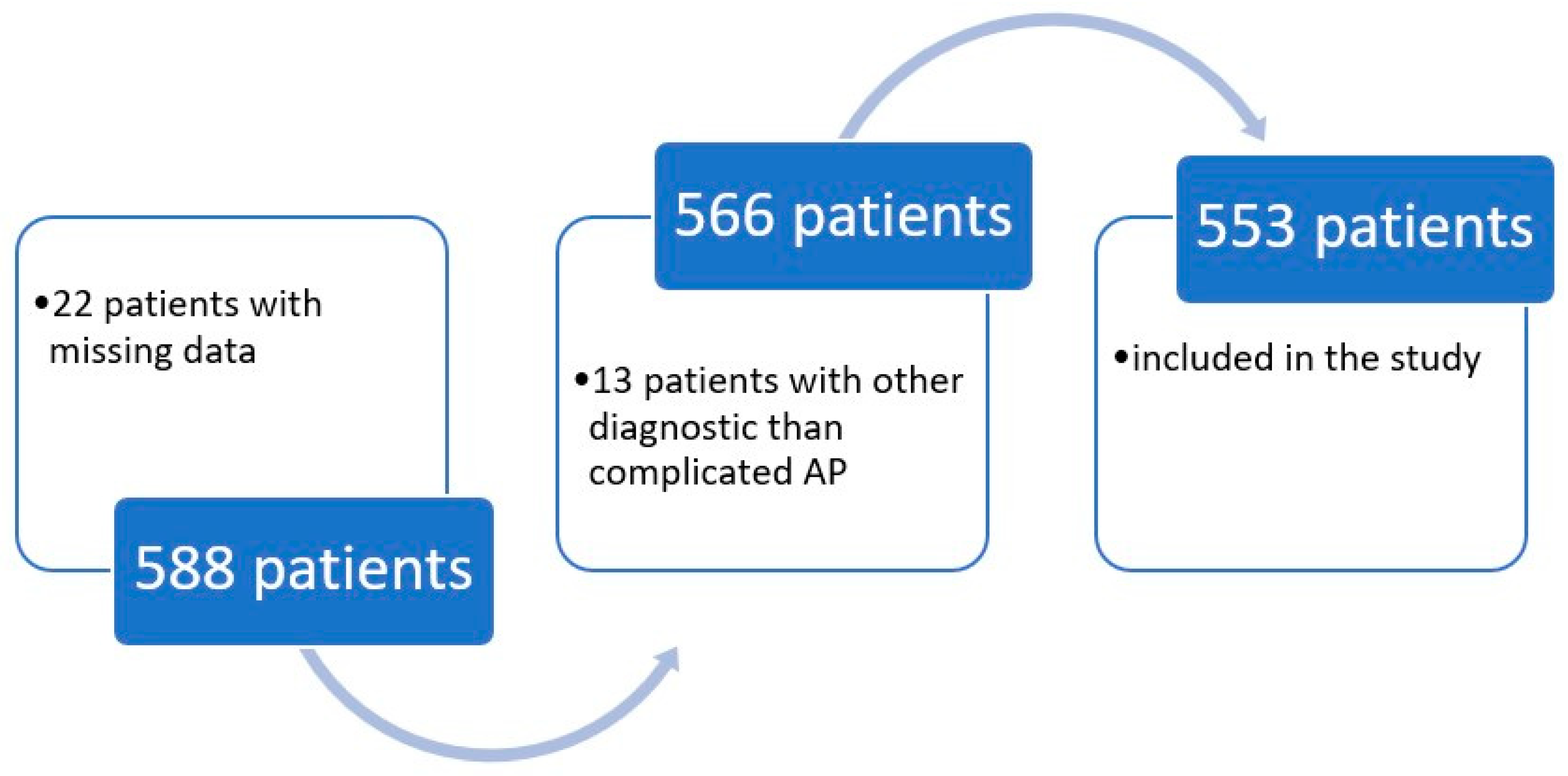
4.3. Study Participants
4.4. Quantitative Variables
4.5. Statistical Analysis
5. Conclusions
Author Contributions
Funding
Institutional Review Board Statement
Informed Consent Statement
Data Availability Statement
Conflicts of Interest
Abbreviations
| ALT | Alanine aminotransferase |
| AMR | Antimicrobial-resistant |
| AOP | Acute obstructive pyelonephritis |
| AP | Acute pyelonephritis |
| AST | Aspartate aminotransferase |
| BP | Blood pressure |
| CRP | C-reactive protein |
| E. coli | Escherichia coli |
| ESBL | Extended-spectrum β-lactamase |
| GGT | Gamma-glutamyl transferase |
| HR | Heart rate |
| uNGAL | Urine neutrophil gelatinase-associated lipocalin |
| UTIs | Urinary tract infections |
| WBC | White blood cells |
References
- Hooton, T.M. Uncomplicated urinary tract infection. N. Engl. J. Med. 2012, 366, 1028–1037. [Google Scholar] [CrossRef]
- Nicolle, L.E. Urinary tract infection. Crit. Care Clin. 2013, 29, 699–715. [Google Scholar] [CrossRef]
- Ashraf, M.S.; Gaur, S.; Bushen, O.Y.; Chopra, T.; Chung, P.; Clifford, K.; Hames, E.; Hertogh, C.M.; Krishna, A.; Mahajan, D.; et al. Diagnosis, Treatment, and Prevention of Urinary Tract Infections in Post-Acute and Long-Term Care Settings: A Consensus Statement. J. Am. Med. Dir. Assoc. 2020, 21, 12–24. [Google Scholar] [CrossRef] [PubMed]
- Horcajada, J.P.; Montero, M.; Oliver, A.; Sorlí, L.; Luque, S.; Gómez-Zorrilla, S.; Benito, N.; Grau, S. Epidemiology and treatment of multidrug-resistant and extensively drug-resistant Pseudomonas aeruginosa infections. Clin. Microbiol. Rev. 2013, 26, 690–719. [Google Scholar] [CrossRef]
- Barber, A.E.; Norton, J.P.; Spivak, A.M.; Mulvey, M.A. Urinary tract infections: Current and emerging management strategies. Clin. Infect. Dis. 2013, 57, 719–724. [Google Scholar] [CrossRef]
- Foxman, B. Epidemiology of urinary tract infections: Incidence, morbidity, and economic costs. Dis. Mon. 2003, 49, 53–70. [Google Scholar] [CrossRef]
- Gupta, K.; Hooton, T.M.; Naber, K.G.; Wullt, B.; Colgan, R.; Miller, L.G.; Moran, G.J.; Nicolle, L.E.; Raz, R.; Schaeffer, A.J.; et al. International clinical practice guidelines for the treatment of acute uncomplicated cystitis and pyelonephritis in women. Clin. Infect. Dis. 2011, 52, e103–e120. [Google Scholar] [CrossRef]
- Johnson, J.R.; Russo, T.A. Acute pyelonephritis in adults. N. Engl. J. Med. 2018, 378, 48–59. [Google Scholar] [CrossRef] [PubMed]
- Flores-Mireles, A.L.; Walker, J.N.; Caparon, M.; Hultgren, S.J. Urinary tract infections: Epidemiology, mechanisms of infection and treatment options. Nat. Rev. Microbiol. 2015, 13, 269–284. [Google Scholar] [CrossRef] [PubMed]
- Tandogdu, Z.; Wagenlehner, F.M.E. Global epidemiology of urinary tract infections. Curr. Opin. Infect. Dis. 2016, 29, 73–79. [Google Scholar] [CrossRef]
- Bruins, M.J.; Eijkelkamp-Biesterbos, L.; Meutstege, A.M.; Dos Santos, C.O. Escherichia coli antimicrobial resistance in acute urinary tract infection lower than reported in Dutch national surveillance database. PLoS ONE 2025, 20, e0334222. [Google Scholar] [CrossRef]
- Mazzariol, A.; Bazaj, A.; Cornaglia, G. Multi-drug-resistant Gram-negative bacteria causing urinary tract infections: A review. J. Chemother. 2017, 29, 2–9. [Google Scholar] [CrossRef]
- Pietropaolo, A. Urinary Tract Infections: Prevention, Diagnosis, and Treatment. J. Clin. Med. 2023, 12, 5058. [Google Scholar] [CrossRef]
- Kumar, A.; Roberts, D.; Wood, K.E.; Light, B.; Parrillo, J.E.; Sharma, S.; Suppes, R.; Feinstein, D.; Zanotti, S.; Taiberg, L.; et al. Duration of hypotension before initiation of effective antimicrobial therapy is the critical determinant of survival in human septic shock. Crit. Care Med. 2006, 34, 1589–1596. [Google Scholar] [CrossRef] [PubMed]
- Zilberberg, M.D.; Shorr, A.F.; Micek, S.T.; Vazquez-Guillamet, C.; Kollef, M.H. Multi-drug resistance, inappropriate initial antibiotic therapy and mortality in Gram-negative severe sepsis. Crit. Care 2014, 18, 596. [Google Scholar] [CrossRef] [PubMed]
- Magiorakos, A.P.; Srinivasan, A.; Carey, R.B.; Carmeli, Y.; Falagas, M.E.; Giske, C.G.; Harbarth, S.; Hindler, J.F.; Kahlmeter, G.; Olsson-Liljequist, B.; et al. Multidrug-resistant, extensively drug-resistant and pandrug-resistant bacteria: An international expert proposal for interim standard definitions for acquired resistance. Clin. Microbiol. Infect. 2012, 18, 268–281. [Google Scholar] [CrossRef]
- Kofoed, K.; Andersen, O.; Kronborg, G.; Tvede, M.; Petersen, J.; Eugen-Olsen, J.; Larsen, K. Use of plasma C-reactive protein, procalcitonin, neutrophils, macrophage migration inhibitory factor, soluble urokinase-type plasminogen activator receptor, and soluble triggering receptor expressed on myeloid cells-1 in combination to diagnose infections: A prospective study. Crit. Care 2007, 11, R38. [Google Scholar]
- Belyayeva, M.; Leslie, S.W.; Rout, P.; Jeong, J.M. Acute Pyelonephritis; StatPearls: Treasure Island, FL, USA, 2025. Available online: https://www.ncbi.nlm.nih.gov/books/NBK519537 (accessed on 21 February 2026).
- Gürol, G.; Çiftci, İ.H.; Terizi, H.A.; Atasoy, A.R.; Ozbek, A.; Köroğlu, M. Are there standardized cutoff values for neutrophil-lymphocyte ratios in bacteremia or sepsis? J. Microbiol. Biotechnol. 2015, 25, 521–525. [Google Scholar] [CrossRef]
- Cîmpeanu, R.C.; Boldeanu, M.V.; Ahrițculesei, R.-V.; Ciobanu, A.E.; Cristescu, A.-M.; Forțofoiu, D.; Siloși, I.; Pirici, D.-N.; Cazacu, S.-M.; Boldeanu, L.; et al. Correlation between Neurotransmitters (Dopamine, Epinephrine, Norepinephrine, Serotonin), Prognostic Nutritional Index, Glasgow Prognostic Score, Systemic Inflammatory Response Markers, and TNM Staging in a Cohort of Colorectal Neuroendocrine Tumor Patients. Int. J. Mol. Sci. 2024, 25, 6977. [Google Scholar] [CrossRef] [PubMed]
- Truong, M.H.; Ngo, T.Q.; Nguyen, Q.T.; To, P.T.; Tran, P.T.; Le, H.D. The value of hematological indices as predictors of septic shock in acute obstructive pyelonephritis. Biomed. Res. Ther. 2024, 11, 6488–6493. [Google Scholar] [CrossRef]
- Mustață, M.-L.; Neagoe, C.-D.; Rădulescu, V.-M.; Dragne, I.-G.; Cîmpeanu, R.-C.; Radu, L.; Ahrițculesei, R.-V.; Forțofoiu, D.; Predoi, M.-C.; Ianoși, S.-L. Association Between Systemic Inflammation, Metabolic Syndrome and Quality of Life in Psoriasis Patients. Life 2025, 15, 212. [Google Scholar] [CrossRef]
- Min, K.; Kim, B.S.; Ha, Y.S.; Chung, J.W.; Jang, G.; Noh, M.G.; Ahn, H.; Lee, J.N.; Kim, H.T.; Yoo, E.S.; et al. Predicting septic shock in obstructive pyelonephritis associated with ureteral stones: A retrospective study. Medicine 2024, 103, e38950. [Google Scholar] [CrossRef] [PubMed]
- Hertz, M.A.; Johansen, I.S.; Rosenvinge, F.S.; Brasen, C.L.; Andersen, E.S.; Heltborg, A.; Skovsted, T.A.; Petersen, E.R.B.; Cartuliares, M.B.; Nielsen, S.L.; et al. The Diagnostic Accuracy of Procalcitonin, Soluble Urokinase-Type Plasminogen Activator Receptors, and C-Reactive Protein in Diagnosing Urinary Tract Infections in the Emergency Department—A Diagnostic Accuracy Study. J. Clin. Med. 2024, 13, 1776. [Google Scholar] [CrossRef] [PubMed]
- Salmen, B.-M.; Pietrosel, V.-A.; Durdu, C.-E.; Salmen, T.; Diaconu, C.T.; Bica, I.-C.; Potcovaru, C.G.; Gherghiceanu, F.; Stoica, R.-A.; Pantea Stoian, A. Evaluating the Adipose Tissue Depth as a Predictor Factor for Gestational Diabetes in Later Pregnancy—A Systematic Review. Biomedicines 2023, 11, 1492. [Google Scholar] [CrossRef]
- Shaikh, N.; Borrell, J.L.; Evron, J.; Leeflang, M.M. Procalcitonin, C-reactive protein, and erythrocyte sedimentation rate for the diagnosis of acute pyelonephritis in children. Cochrane Database Syst. Rev. 2015, 1, CD009185. [Google Scholar] [CrossRef]
- van Nieuwkoop, C.; Bonten, T.N.; van’t Wout, J.W.; Kuijper, E.J.; Groeneveld, G.H.; Becker, M.J.; Koster, T.; Wattel-Louis, G.H.; Delfos, N.M.; Ablij, H.C.; et al. Procalcitonin reflects bacteremia and bacterial load in urosepsis syndrome: A prospective observational study. Crit. Care 2010, 14, R206. [Google Scholar] [CrossRef] [PubMed]
- Baboudjian, M.; Gondran-Tellier, B.; Di Bisceglie, M.; Abdallah, R.; Michel, F.; Sichez, P.C.; Al-Balushi, K.; Akiki, A.; Gaillet, S.; Delaporte, V.; et al. The prognostic value of serum procalcitonin in acute obstructive pyelonephritis. World J. Urol. 2021, 39, 1583–1589. [Google Scholar] [CrossRef]
- Smolkin, V.; Koren, A.; Raz, R.; Colodner, R.; Sakran, W.; Halevy, R. Procalcitonin as a marker of acute pyelonephritis in infants and children. Pediatr. Nephrol. 2002, 17, 409–412. [Google Scholar] [CrossRef] [PubMed]
- Bobircă, A.; Musetescu, A.E.; Bordianu, A.; Pantea Stoian, A.; Salmen, T.; Marinescu, D.-C.; Alexandru, C.; Florescu, A.; Radu, R.; Isac, S.; et al. Novel Biomarkers Predictive of Diabetic Charcot Foot—An Overview of the Literature. Life 2022, 12, 1944. [Google Scholar] [CrossRef]
- Tambo, M.; Taguchi, S.; Nakamura, Y.; Okegawa, T.; Fukuhara, H. Presepsin and procalcitonin as predictors of sepsis based on the new Sepsis-3 definitions in obstructive acute pyelonephritis. BMC Urol. 2020, 20, 23. [Google Scholar] [CrossRef]
- Yamamoto, A.; Nakayama, S.; Wakabayashi, Y.; Yoshino, Y.; Kitazawa, T. Urine neutrophil gelatinase-associated lipocalin as a biomarker of adult pyelonephritis. J. Infect. Chemother. 2023, 29, 508–512. [Google Scholar] [CrossRef] [PubMed]
- Cox, A.; Golda, N.; Nadeau, G.; Nickel, J.C.; Carr, L.; Corcos, J.; Teichmann, J. CUA Guideline: Diagnosis and Treatment of Interstitial Cystitis/Bladder Pain Syndrome. Can. Urol. Assoc. J. 2016, 10, 136–155. [Google Scholar] [CrossRef]
- Chițu, M.-C.; Salmen, T.; Răducanu, P.-R.; Pălimariu, C.-M.; Salmen, B.-M.; Stoian, A.P.; Jinga, V.; Mischianu, D.L.D. Clinical Characteristics, Microbiological Spectrum, Biomarkers, and Imaging Insights in Acute Pyelonephritis and Its Complicated Forms—A Systematic Review. Medicina 2026, 62, 222. [Google Scholar] [CrossRef]
- Oweis, A.O.; Zeyad, H.N.; Alshelleh, S.A.; Alzoubi, K.H. Acute Kidney Injury Among Patients with Multi-Drug Resistant Infection: A Study from Jordan. J. Multidiscip. Healthc. 2022, 15, 2759–2766. [Google Scholar] [CrossRef] [PubMed]
- Chu, C.M.; Lowder, J.L. Diagnosis and treatment of urinary tract infections across age groups. Am. J. Obstet. Gynecol. 2018, 219, 40–51. [Google Scholar] [CrossRef]
- Shahid, A.; Chambers, S.; Scott-Thomas, A.; Bhatia, M. Gut microbiota and liver dysfunction in sepsis: The role of inflammatory mediators and therapeutic approaches. Int. J. Mol. Sci. 2024, 25, 13415. [Google Scholar] [CrossRef]
- Hooton, T.M.; Bradley, S.F.; Cardenas, D.D.; Colgan, R.; Geerlings, S.E.; Rice, J.C.; Saint, S.; Schaeffer, A.J.; Tambayh, P.A.; Tenke, P.; et al. Diagnosis, Prevention, and Treatment of Catheter-Aassociated Urinary Tract Infection in Adults: 2009 International Clinical Practice Guidelines from the Infectious Diseases Society of America. Clin. Infect. Dis. 2010, 50, 625–663. [Google Scholar] [CrossRef]
- Tamma, P.D.; Heil, E.L.; Justo, J.A.; Mathers, A.J.; Satlin, M.J.; Bonomo, R.A. Infectious Diseases Society of America 2024 Guidance on the Treatment of Antimicrobial-Resistant Gram-Negative Infections. Clin. Infect. Dis. 2024; ahead of print. [CrossRef] [PubMed]
- Kaye, K.S.; Gupta, V.; Mulgirigama, A.; Joshi, A.V.; Scangarella-Oman, N.E.; Yu, K.; Watts, J.; Mitrani-Gold, F.S. Co-resistance among Escherichia coli and Klebsiella pneumoniae urine isolates from female outpatients with presumed urinary tract infection: A retrospective US cohort study. Infect. Dis. Ther. 2024, 13, 1715–1722. [Google Scholar] [CrossRef] [PubMed]
- Almutawif, Y.A.; Eid, H.M.A. Prevalence and antimicrobial susceptibility pattern of bacterial uropathogens among adult patients in Madinah, Saudi Arabia. BMC Infect. Dis. 2023, 23, 582. [Google Scholar] [CrossRef]
- Khalid, F.; Aljohani, W.J.; Akram, A.; Bukhari, A.; Khojah, O.T. Epidemiology and Antimicrobial Resistance of Uropathogens in a Tertiary Care Center in Riyadh, Saudi Arabia: A One-Year Retrospective Analysis. Pathogens 2025, 14, 1254. [Google Scholar] [CrossRef]
- Bayaba, S.; Bayaba, S.; Founou, R.C.; Tchouangueu, F.T.; Dimani, B.D.; Mafo, L.D.; Nkengkana, O.A.; Founou, L.L.; Noubom, M. High prevalence of multidrug resistant and extended-spectrum β-lactamase-producing Escherichia coli and Klebsiella pneumoniae isolated from urinary tract infections in the West region, Cameroon. BMC Infect. Dis. 2025, 25, 115. [Google Scholar] [CrossRef] [PubMed]
- Tumbarello, M.; Trecarichi, E.M.; De Rosa, F.G.; Giannella, M.; Giacobbe, D.R.; Bassetti, M.; Losito, A.R.; Bartoletti, M.; Del Bono, V.; Corcione, S.; et al. Infections caused by KPC-producing Klebsiella pneumoniae: Differences in therapy and mortality in a multicentre study. J. Antimicrob. Chemother. 2015, 70, 2133–2143. [Google Scholar] [CrossRef] [PubMed]
- Tsai, Y.-C.; Huang, Y.-H.; Niu, K.-Y.; Tsai, Y.-C.; Chen, C.-B.; Yen, C.-C. Development of a Predictive Nomogram for Sepsis in Patients with Urolithiasis-Related Obstructive Pyelonephritis. Medicina 2024, 60, 1113. [Google Scholar] [CrossRef] [PubMed]


| Characteristic | n = 553 |
|---|---|
| Age (mean ± SD) | 63.82 ± 15.67 years |
| Female gender | 63% |
| Obstruction causes | |
| 489, 88.42% |
| 58, 10.49% |
| 6, 1.09% |
| WBC (mean ± SD) | 15,608.64 ± 5815.80/dL |
| Neutrophile (mean ± SD) | 10,082.82 ± 4717.65/dL |
| CRP (median, (IQR)) | 43.2, (60.54, 94.75) mg/L |
| D-Dimer (mean ± SD) | 1286.84 ± 638.19 |
| Fibrinogen (mean ± SD) | 747.06 ± 145.28 |
| Creatinine (mean ± SD) | 1.69 ± 0.76 mg/dL |
| Urea (mean ± SD) | 50.36 ± 23.90 mg/dL |
| TGO/AST (mean ± SD) | 68.08 ± 34.58 mg/dL |
| TGP/ALT (mean ± SD) | 80.13 ± 40.43 mg/dL |
| Parameter | AMR Pathogens (n = 109) | Non-AMR Pathogens (n = 444) | p Value |
|---|---|---|---|
| Leukocytes (cells/µL) | 15,789.61 ± 5515.49 | 15,564.22 ± 5892.33 | 0.707 |
| Neutrophils (cells/µL) | 10,314.15 ± 4441.86 | 10,026.02 ± 4786.02 | 0.551 |
| CRP (mg/L) | 110.37 ± 95.62 | 119.97 ± 111.51 | 0.366 |
| Procalcitonin (ng/mL) | 5.48 ± 2.46 | 5.68 ± 2.67 | 0.472 |
| D-dimer (ng/mL) | 1258.48 ± 649.94 | 1293.81 ± 635.83 | 0.610 |
| Fibrinogen (mg/dL) | 747.36 ± 155.46 | 746.99 ± 142.87 | 0.982 |
| Creatinine (mg/dL) | 1.63 ± 0.74 | 1.71 ± 0.77 | 0.300 |
| Urea (mg/dL) | 51.39 ± 23.99 | 50.11 ± 23.90 | 0.618 |
| Parameter | Odds Ratio | 95% Confidence Interval | p Value |
|---|---|---|---|
| Leukocytes | 0.99999 | 0.99994–1.00005 | 0.845 |
| Neutrophils | 1.00002 | 0.99995–1.00009 | 0.587 |
| C-reactive protein | 0.9988 | 0.9965–1.0011 | 0.294 |
| Procalcitonin | 0.970 | 0.895–1.052 | 0.460 |
| D-dimer | 0.99988 | 0.99954–1.00022 | 0.480 |
| Fibrinogen | 1.00008 | 0.99862–1.00153 | 0.917 |
| Creatinine | 0.861 | 0.642–1.154 | 0.317 |
| Urea | 1.0047 | 0.995–1.014 | 0.339 |
| Pathogen | n | % |
|---|---|---|
| Escherichia coli | 259 | 46.8 |
| Enterococcus faecalis | 76 | 13.7 |
| Klebsiella pneumoniae | 64 | 11.6 |
| Pseudomonas aeruginosa | 40 | 7.2 |
| Streptococcus group B | 20 | 3.6 |
| Proteus mirabilis | 18 | 3.3 |
| Enterococcus faecium | 13 | 2.4 |
| Enterobacter cloacae | 12 | 2.2 |
| Morganella morganii | 9 | 1.6 |
| Klebsiella oxytoca | 5 | 0.9 |
| Citrobacter koseri | 4 | 0.7 |
| Staphylococcus aureus | 4 | 0.7 |
| Klebsiella aerogenes | 3 | 0.5 |
| Candida tropicalis | 3 | 0.5 |
| Acinetobacter baumannii | 3 | 0.5 |
| Citrobacter freundii | 3 | 0.5 |
| Other pathogens | 17 | 3.1 |
Disclaimer/Publisher’s Note: The statements, opinions and data contained in all publications are solely those of the individual author(s) and contributor(s) and not of MDPI and/or the editor(s). MDPI and/or the editor(s) disclaim responsibility for any injury to people or property resulting from any ideas, methods, instructions or products referred to in the content. |
© 2026 by the authors. Licensee MDPI, Basel, Switzerland. This article is an open access article distributed under the terms and conditions of the Creative Commons Attribution (CC BY) license.
Share and Cite
Chițu, M.-C.; Pălimariu, C.-M.; Salmen, T.; Nicodin, T.-P.; Reurean-Pintilei, D.; Spînu, D.-A.; Jinga, V.; Pantea Stoian, A.; Mischianu, D.L.D. A Cross-Sectional Analysis of Clinical and Biological Characteristics of Inpatients with Complicated Acute Pyelonephritis. Antibiotics 2026, 15, 363. https://doi.org/10.3390/antibiotics15040363
Chițu M-C, Pălimariu C-M, Salmen T, Nicodin T-P, Reurean-Pintilei D, Spînu D-A, Jinga V, Pantea Stoian A, Mischianu DLD. A Cross-Sectional Analysis of Clinical and Biological Characteristics of Inpatients with Complicated Acute Pyelonephritis. Antibiotics. 2026; 15(4):363. https://doi.org/10.3390/antibiotics15040363
Chicago/Turabian StyleChițu, Marius-Costin, Carmen-Marina Pălimariu, Teodor Salmen, Tudor-Petru Nicodin, Delia Reurean-Pintilei, Dan-Arsenie Spînu, Viorel Jinga, Anca Pantea Stoian, and Dan Liviu Dorel Mischianu. 2026. "A Cross-Sectional Analysis of Clinical and Biological Characteristics of Inpatients with Complicated Acute Pyelonephritis" Antibiotics 15, no. 4: 363. https://doi.org/10.3390/antibiotics15040363
APA StyleChițu, M.-C., Pălimariu, C.-M., Salmen, T., Nicodin, T.-P., Reurean-Pintilei, D., Spînu, D.-A., Jinga, V., Pantea Stoian, A., & Mischianu, D. L. D. (2026). A Cross-Sectional Analysis of Clinical and Biological Characteristics of Inpatients with Complicated Acute Pyelonephritis. Antibiotics, 15(4), 363. https://doi.org/10.3390/antibiotics15040363