Antimicrobial Susceptibility of Pseudomonas aeruginosa from Elderly Patients in Intensive Care Units of United States Medical Centers (2021–2025)

Abstract
1. Introduction
2. Results
3. Discussion
4. Methods
4.1. Organism Collection
4.2. Susceptibility Testing
4.3. Statistical Analysis
5. Conclusions
Author Contributions
Funding
Institutional Review Board Statement
Informed Consent Statement
Data Availability Statement
Acknowledgments
Conflicts of Interest
References
- Meletis, G.; Karastergiou, E. Resistance mechanisms and therapeutic strategies for Pseudomonas aeruginosa infections. Ther. Adv. Infect. Dis. 2025, 12, 20499361251388382. [Google Scholar] [CrossRef] [Scilit]
- Schwartz, B.; Klamer, K.; Zimmerman, J.; Kale-Pradhan, P.B.; Bhargava, A. Multidrug resistant Pseudomonas aeruginosa in clinical settings: A review of resistance mechanisms and treatment strategies. Pathogens 2024, 13, 975. [Google Scholar] [CrossRef] [Scilit]
- Bassetti, M.; Kanj, S.S.; Kiratisin, P.; Rodrigues, C.; Van Duin, D.; Villegas, M.V.; Yu, Y. Early appropriate diagnostics and treatment of MDR Gram-negative infections. JAC Antimicrob. Resist. 2022, 4, dlac089. [Google Scholar] [CrossRef] [Scilit]
- Lodise, T.P.; Berger, A.; Altincatal, A.; Wang, R.; Bhagnani, T.; Gillard, P.; Bonine, N.G. Antimicrobial resistance or delayed appropriate therapy-does one influence outcomes more than the other among patients with serious infections due to carbapenem-resistant versus carbapenem-susceptible Enterobacteriaceae? Open Forum Infect. Dis. 2019, 6, ofz194. [Google Scholar] [CrossRef] [Scilit]
- Paramythiotou, E.; Routsi, C. Association between infections caused by multidrug-resistant gram-negative bacteria and mortality in critically ill patients. World J. Crit. Care Med. 2016, 5, 111–120. [Google Scholar] [CrossRef] [Scilit]
- Horcajada, J.P.; Gales, A.C.; Isler, B.; Kaye, K.S.; Kwa, A.; Landersdorfer, C.B.; Montero, M.M.; Oliver, A.; Pogue, J.M.; Shields, R.K.; et al. Current and future options for the treatment of serious infections due to carbapenem-resistant Pseudomonas aeruginosa. Clin. Microbiol. Rev. 2025, 38, e0023324. [Google Scholar] [CrossRef] [Scilit]
- Heffernan, A.J.; Sime, F.B.; Lipman, J.; Dhanani, J.; Andrews, K.; Ellwood, D.; Grimwood, K.; Roberts, J.A. Intrapulmonary pharmacokinetics of antibiotics used to treat nosocomial pneumonia caused by Gram-negative bacilli: A systematic review. Int. J. Antimicrob. Agents 2019, 53, 234–245. [Google Scholar] [CrossRef] [Scilit]
- Tamma, P.D.; Heil, E.L.; Justo, J.A.; Mathers, A.J.; Satlin, M.J.; Bonomo, R.A. Infectious Diseases Society of America 2024 Guidance on the treatment of antimicrobial-resistant Gram-Negative Infections. Clin. Infect. Dis. 2024, ciae403. [Google Scholar] [CrossRef] [Scilit] [PubMed]
- Castanheira, M.; Kimbrough, J.H.; Lindley, J.; Doyle, T.B.; Ewald, J.M.; Sader, H.S. In vitro development of resistance against antipseudomonal agents: Comparison of novel β-lactam/β-lactamase inhibitor combinations and other β-lactam agents. Antimicrob. Agents Chemother. 2024, 68, e0136323. [Google Scholar] [CrossRef] [Scilit] [PubMed]
- Zhanel, G.G.; Lawson, C.D.; Adam, H.; Schweizer, F.; Zelenitsky, S.; Lagacé-Wiens, P.R.S.; Denisuik, A.; Rubinstein, E.; Gin, A.S.; Hoban, D.J.; et al. Ceftazidime-avibactam: A novel cephalosporin/beta-lactamase inhibitor combination. Drugs 2013, 73, 159–177. [Google Scholar] [CrossRef] [Scilit] [PubMed]
- Zhanel, G.G.; Chung, P.; Adam, H.; Zelenitsky, S.; Denisuik, A.; Schweizer, F.; Lagacé-Wiens, P.R.S.; Rubinstein, E.; Gin, A.S.; Walkty, A.; et al. Ceftolozane/tazobactam: A novel cephalosporin/beta-lactamase inhibitor combination with activity against multidrug-resistant gram-negative bacilli. Drugs 2014, 74, 31–51. [Google Scholar] [CrossRef] [Scilit]
- Campanella, T.A.; Gallagher, J.C. A clinical review and critical evaluation of imipenem-relebactam: Evidence to date. Infect. Drug Resist. 2020, 13, 4297–4308. [Google Scholar] [CrossRef] [Scilit]
- Sader, H.S.; Kimbrough, J.H.; Doyle, T.B.; Winkler, M.L.; Castanheira, M. Frequency, Antimicrobial susceptibility, and molecular characterization of carbapenem-resistant Enterobacterales stratified by United States Census Divisions: Results from the INFORM Program (2018–2022). Open Forum Infect. Dis. 2025, 12, ofaf005. [Google Scholar] [CrossRef] [Scilit]
- Sader, H.S.; Castanheira, M.; Duncan, L.R.; Flamm, R.K. Antimicrobial susceptibility of Enterobacteriaceae and Pseudomonas aeruginosa Isolates from United States medical centers stratified by infection type: Results from the International Network for Optimal Resistance Monitoring (INFORM) Surveillance Program, 2015–2016. Diagn. Microbiol. Infect. Dis. 2018, 92, 69–74. [Google Scholar] [CrossRef] [Scilit] [PubMed]
- Qiang, C.; Liu, X.; Qin, P.; Wen, H.; Li, Z.; Yang, J.; Niu, Y.; Wang, W.; Ouyang, Z.; Zhao, M.; et al. Multicenter surveillance of Pseudomonas aeruginosa isolates from blood: Clinical distribution characteristics and antibiotic resistance trends in Hebei Province, China (2016–2021). J. Infect. Drug Resist. 2025, 18, 703–713. [Google Scholar] [CrossRef] [Scilit] [PubMed]
- Mesquita, G.P.; Costa, M.C.C.; Silva, M.A.; Araújo, L.G.; Vila Nova, B.G.; Castro, É.J.M.; Branco, L.C.; da Silva, R.; Marques, S.; Abreu, A. Antimicrobial resistance of Pseudomonas aeruginosa isolated from patients with pneumonia during the COVID-19 pandemic and pre-pandemic periods in Northeast Brazil. Braz. J. Med. Biol. Res. 2023, 56, e12726. [Google Scholar] [CrossRef] [Scilit]
- Golli, A.L.; Zlatian, O.M.; Popa, S.G.; Turcu, F.L.; Balasoiu, A.T. Trends in the antimicrobial resistance pattern of bacterial gram-negative pathogens in elderly patients admitted to the intensive care unit. Microorganisms 2025, 13, 2330. [Google Scholar] [CrossRef] [Scilit]
- Sader, H.S.; Mendes, R.E.; Kimbrough, J.H.; Hubler, C.M.; Castanheira, M. Activity of aztreonam/avibactam and recently approved beta-lactamase inhibitor combinations against Enterobacterales and Pseudomonas aeruginosa from intensive care unit and non-intensive care unit patients. Antibiotics 2024, 13, 564. [Google Scholar] [CrossRef] [Scilit] [PubMed]
- Qin, J.; Zou, C.; Tao, J.; Wei, T.; Yan, L.; Zhang, Y.Z.; Wang, H. Carbapenem resistant Pseudomonas aeruginosa infections in elderly patients: Antimicrobial resistance profiles, risk factors and impact on clinical outcomes. Infect. Drug Resist. 2022, 15, 2301–2314. [Google Scholar] [CrossRef] [Scilit]
- CLSI M07Ed12; Methods for Dilution Antimicrobial Susceptibility Tests for Bacteria that Grow Aerobically. Clinical Laboratory Standard Institute: Berwyn, PA, USA, 2024.
- CLSI M100Ed35; Performance Standards for Antimicrobial Susceptibility Testing. 35th Informational Supplement; Clinical Laboratory Standard Institute: Berwyn, PA, USA, 2025.
- EUCAST. Breakpoint Tables for Interpretation of MICs and Zone Diameters; Version 15.0; European Committee on Antimicrobial Susceptibility Testing: Vaxjo, Sweden, 2025. [Google Scholar]
- Magiorakos, A.-P.; Srinivasan, A.; Carey, R.B.; Carmeli, Y.; Falagas, M.E.; Giske, C.G.; Harbarth, S.; Hindler, J.F.; Kahlmeter, G.; Olsson-Liljequist, B.; et al. Multidrug-resistant, extensively drug-resistant and pandrug-resistant bacteria: An international expert proposal for interim standard definitions for acquired resistance. Clin. Microbiol. Infect. 2012, 18, 268–281. [Google Scholar] [CrossRef] [Scilit]
- Tamma, P.D.; Aitken, S.L.; Bonomo, R.A.; Mathers, A.J.; van Duin, D.; Clancy, C.J. Infectious Diseases Society of America 2022 guidance on the treatment of extended-spectrum beta-lactamase producing Enterobacterales (ESBL-E), carbapenem-resistant Enterobacterales (CRE), and Pseudomonas aeruginosa with difficult-to-treat resistance (DTR-P. aeruginosa). Clin. Infect. Dis. 2022, 75, 187–212. [Google Scholar] [PubMed]



| P. aeruginosa Subset/ | % Susceptible (No. of Isolates Tested) a | ||
|---|---|---|---|
| Antimicrobial Agent | Elderly | Adults | |
| ICU | Non-ICU | ICU | |
| All P. aeruginosa | (999) | (2027) | (1022) |
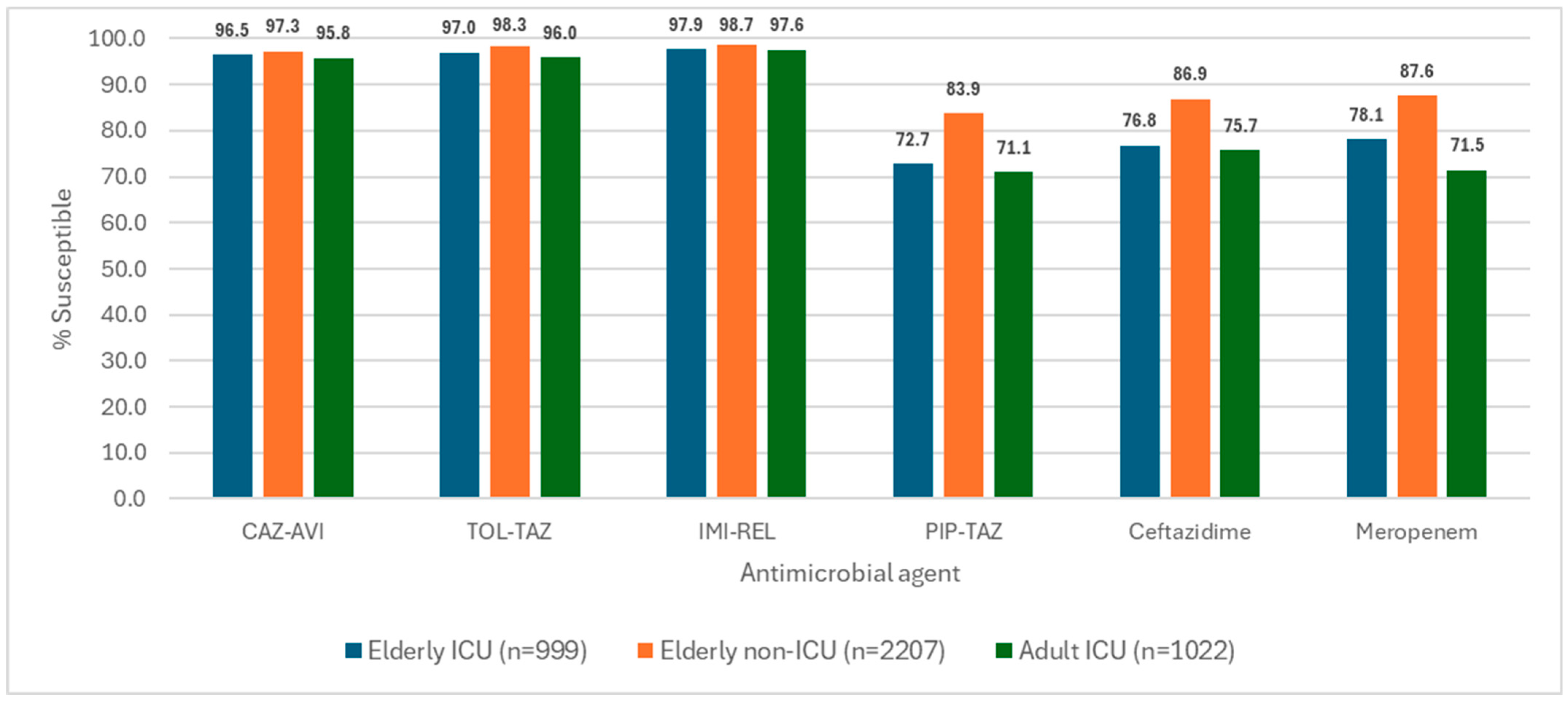
| Ceftazidime-avibactam | 96.5 | 97.3 | 95.8 |
| Ceftolozane-tazobactam | 97.0 | 98.3 | 96.0 |
| Imipenem-relebactam | 97.9 | 98.7 | 97.6 |
| Meropenem-vaborbactam b | 91.8 b | 95.4 b | 87.9 b |
| Piperacillin-tazobactam | 72.7 | 83.9 | 71.1 |
| Ceftazidime | 76.8 | 86.9 | 75.7 |
| Cefepime | 81.2 | 88.8 | 79.1 |
| Meropenem | 78.1 | 87.6 | 71.5 |
| Imipenem | 78.3 | 85.5 | 72.4 |
| Levofloxacin | 76.4 | 77.3 | 68.3 |
| Tobramycin | 93.9 | 94.7 | 91.4 |
| Isolates from pneumonia | (790) | (821) | (826) |
| Ceftazidime-avibactam | 96.6 | 95.1 | 96.2 |
| Ceftolozane-tazobactam | 96.3 | 96.7 | 96.2 |
| Imipenem-relebactam | 97.9 | 98.5 | 97.4 |
| Meropenem-vaborbactam b | 91.5 b | 93.4 b | 87.2 b |
| Piperacillin-tazobactam | 71.4 | 78.9 | 70.1 |
| Ceftazidime | 75.9 | 81.5 | 74.6 |
| Cefepime | 79.9 | 84.1 | 77.9 |
| Meropenem | 76.2 | 83.6 | 69.6 |
| Imipenem | 77.3 | 81.5 | 70.1 |
| Levofloxacin | 76.1 | 76.0 | 66.8 |
| Tobramycin | 93.4 | 92.3 | 90.3 |
| MDR P. aeruginosa | (184) | (223) | (229) |
| Ceftazidime-avibactam | 81.0 | 77.1 | 81.7 |
| Ceftolozane-tazobactam | 83.7 | 84.7 | 82.1 |
| Imipenem-relebactam | 88.8 | 89.4 | 89.1 |
| Meropenem-vaborbactam b | 62.0 b | 64.6 b | 55.5 b |
| Piperacillin-tazobactam | 12.0 | 13.5 | 13.5 |
| Ceftazidime | 20.7 | 27.4 | 30.1 |
| Cefepime | 27.7 | 29.6 | 28.8 |
| Meropenem | 17.9 | 27.4 | 16.2 |
| Imipenem | 28.3 | 34.5 | 27.1 |
| Levofloxacin | 31.5 | 23.3 | 25.8 |
| Tobramycin | 76.1 | 74.4 | 73.8 |
| DTR P. aeruginosa | (21) | (25) | (37) |
| Ceftazidime-avibactam | 71.4 | 60.0 | 62.2 |
| Ceftolozane-tazobactam | 85.7 | 80.0 | 70.3 |
| Imipenem-relebactam | 71.4 | 72.7 | 68.8 |
| Meropenem-vaborbactam b | 42.9 | 32.0 | 24.3 |
| Tobramycin | 81.0 | 60.0 | 67.6 |
| Patient Group/ | % Susceptible per CLSI (No. of Isolates) | ||||
|---|---|---|---|---|---|
| Antimicrobial Agent | 2021 | 2022 | 2023 | 2024 | 2025 |
| ICU Elderly Patients | (196) | (178) | (219) | (205) | (201) |
| Ceftazidime-avibactam | 97.4 | 97.2 | 96.3 | 95.1 | 96.5 |
| Ceftolozane-tazobactam | 98.5 | 97.8 | 95.0 | 95.6 | 98.5 |
| Imipenem-relebactam | 95.3 | 98.3 | 98.6 | 99.5 | 97.5 |
| Piperacillin-tazobactam | 73.0 | 82.0 | 69.9 | 72.2 | 67.7 |
| Meropenem | 77.0 | 79.2 | 74.4 | 80.5 | 79.6 |
| Non-ICU Elderly Patients | (441) | (439) | (399) | (344) | (404) |
| Ceftazidime-avibactam | 97.3 | 97.7 | 97.5 | 98.0 | 96.0 |
| Ceftolozane-tazobactam | 97.5 | 98.6 | 98.7 | 99.1 | 97.5 |
| Imipenem-relebactam | 98.2 | 98.6 | 99.2 | 99.4 | 98.0 |
| Piperacillin-tazobactam | 85.7 | 84.5 | 83.7 | 81.1 | 83.7 |
| Meropenem | 89.1 | 86.6 | 87.5 | 86.9 | 87.6 |
| ICU Adult Patients | (222) | (188) | (236) | (208) | (168) |
| Ceftazidime-avibactam | 94.1 | 94.7 | 96.6 | 98.1 | 95.2 |
| Ceftolozane-tazobactam | 95.9 | 94.7 | 96.6 | 96.6 | 95.8 |
| Imipenem-relebactam | 94.3 | 98.4 | 98.3 | 98.6 | 98.2 |
| Piperacillin-tazobactam | 73.4 | 75.5 | 69.5 | 66.8 | 70.8 |
| Meropenem | 71.2 | 71.8 | 78.8 | 70.7 | 62.5 |
| Patient Group/ | Frequency (No. of Isolates Tested) | |||||
|---|---|---|---|---|---|---|
| Resistant Subset | 2021 | 2022 | 2023 | 2024 | 2025 | Overall |
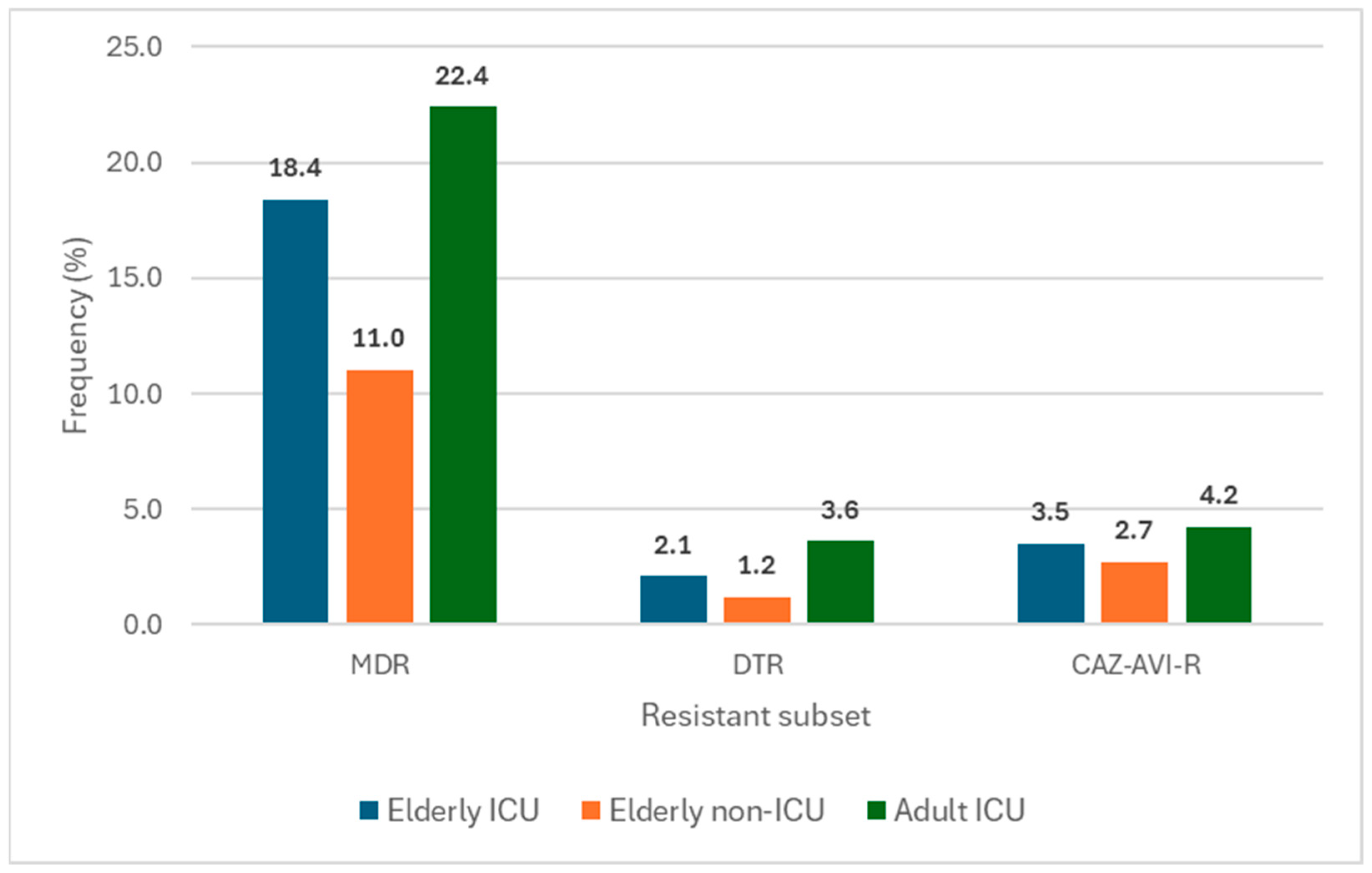
| ICU Elderly Patients | (196) | (178) | (219) | (205) | (201) | (999) |
| MDR | 18.4 | 13.5 | 21.0 | 17.6 | 20.9 | 18.4 |
| DTR | 2.0 | 1.7 | 1.4 | 1.5 | 4.0 | 2.1 |
| Non-ICU Elderly Patients | (441) | (439) | (399) | (344) | (404) | (2027) |
| MDR | 9.3 | 12.1 | 11.0 | 10.8 | 11.9 | 11.0 |
| DTR | 1.6 | 1.8 | 1.3 | 0.9 | 0.5 | 1.2 |
| ICU Adult Patients | (222) | (188) | (236) | (208) | (168) | (1022) |
| MDR | 23.0 | 17.0 | 20.3 | 26.0 | 26.2 | 22.4 |
| DTR | 6.8 | 3.7 | 2.1 | 2.9 | 2.4 | 3.6 |
| % Susceptible by Resistance Phenotype (No. of Isolates) | |||
|---|---|---|---|
| Antimicrobial Agent | Ceftazidime-Avibactam Resistant (90) a | Ceftolozane-Tazobactam Nonsusceptible (65) a | Imipenem-Relebactam Nonsusceptible (44) a |
| Ceftazidime-avibactam | 0.0 | 33.8 | 59.1 |
| Ceftolozane-tazobactam | 52.2 | 0.0 | 60.5 |
| Imipenem-relebactam | 79.3 | 72.1 | 0.0 |
Disclaimer/Publisher’s Note: The statements, opinions and data contained in all publications are solely those of the individual author(s) and contributor(s) and not of MDPI and/or the editor(s). MDPI and/or the editor(s) disclaim responsibility for any injury to people or property resulting from any ideas, methods, instructions or products referred to in the content. |
© 2026 by the authors. Licensee MDPI, Basel, Switzerland. This article is an open access article distributed under the terms and conditions of the Creative Commons Attribution (CC BY) license.
Share and Cite
Sader, H.S.; Mendes, R.E.; Doyle, T.B.; Winkler, M.L.; Castanheira, M. Antimicrobial Susceptibility of Pseudomonas aeruginosa from Elderly Patients in Intensive Care Units of United States Medical Centers (2021–2025). Antibiotics 2026, 15, 361. https://doi.org/10.3390/antibiotics15040361
Sader HS, Mendes RE, Doyle TB, Winkler ML, Castanheira M. Antimicrobial Susceptibility of Pseudomonas aeruginosa from Elderly Patients in Intensive Care Units of United States Medical Centers (2021–2025). Antibiotics. 2026; 15(4):361. https://doi.org/10.3390/antibiotics15040361
Chicago/Turabian StyleSader, Helio S., Rodrigo E. Mendes, Timothy B. Doyle, Marisa L. Winkler, and Mariana Castanheira. 2026. "Antimicrobial Susceptibility of Pseudomonas aeruginosa from Elderly Patients in Intensive Care Units of United States Medical Centers (2021–2025)" Antibiotics 15, no. 4: 361. https://doi.org/10.3390/antibiotics15040361
APA StyleSader, H. S., Mendes, R. E., Doyle, T. B., Winkler, M. L., & Castanheira, M. (2026). Antimicrobial Susceptibility of Pseudomonas aeruginosa from Elderly Patients in Intensive Care Units of United States Medical Centers (2021–2025). Antibiotics, 15(4), 361. https://doi.org/10.3390/antibiotics15040361