Article

Occurrence of Antimicrobial Resistance in Indicator Bacteria and Campylobacter spp. Isolated from Commercial Raw-Meat-Based Food for Dogs and Cats in Belgium


1
Veterinary Epidemiology Unit, Faculty of Veterinary Medicine, Ghent University, Salisburylaan 133, 9820 Merelbeke, Belgium
2
Veterinary Bacteriology Service, Department of Infectious Diseases in Animals, Sciensano, Juliette Wytsmanstraat 14, 1050 Brussels, Belgium
3
Foodborne Pathogens Service, Department of Human Infectious Diseases, Sciensano, Juliette Wytsmanstraat 14, 1050 Brussels, Belgium
4
Department of Pathobiology, Pharmacology and Zoological Medicine, Faculty of Veterinary Medicine, Ghent University, 9820 Merelbeke, Belgium
*
Authors to whom correspondence should be addressed.
These authors contributed equally to this work.
Antibiotics 2026, 15(3), 282; https://doi.org/10.3390/antibiotics15030282
Submission received: 30 January 2026 / Revised: 19 February 2026 / Accepted: 24 February 2026 / Published: 10 March 2026

Abstract

Background: Raw-meat-based diets (RMBDs) for companion animals have gained popularity but may serve as vehicles for antimicrobial-resistant (AMR) bacteria, posing risks to animal and public health. This study investigated the occurrence and risk factors of AMR in indicator bacteria (Escherichia coli, Enterococcus faecalis, Enterococcus faecium) and Campylobacter spp. from commercial RMBD products. Methods: In 2023, 50 RMBD samples were collected in Belgium, representing 21 brands from five countries. After both selective and non-selective isolation and MALDI-TOF identification, antimicrobial susceptibility testing of the isolates was performed using broth microdilution. Results: From non-selective media, E. coli was found in 45 samples (90.0%), E. faecalis in 31 samples (62.0%), E. faecium in 23 samples (46.0%), and Campylobacter spp. in 3 samples (6.0%). Among these, one E. faecalis strain with acquired resistance to vancomycin and daptomycin was isolated. Multidrug resistance (MDR) was identified in 17 isolates from 15 samples (30.0%), including 14 MDR E. coli, 1 MDR E. faecalis, and 2 MDR E. faecium. From selective media, presumptive ESBL/AmpC-producing E. coli were detected in 17 samples (34.0%), and 5 E. faecium from linezolid-supplemented media were confirmed by the broth microdilution method. Samples from Belgian origin showed significantly higher E. faecium prevalence (76.5%) compared to Dutch samples (21.4%) (OR = 11.9, p < 0.001). Minor livestock sources were associated with increased MDR risk (OR = 5.52, p = 0.016). Conclusions: Commercial RMBDs in Belgium exhibit widespread bacterial contamination with concerning AMR patterns. These findings highlight the need for improved production standards in the RMBD industry and the need to raise awareness in pet owners.

1. Introduction

The emergence and spread of antimicrobial-resistant (AMR) bacteria pose a significant threat to animal and public health. The World Health Organization (WHO) has identified AMR as one of the top ten global public health threats facing humanity [1]. For the monitoring of antimicrobial resistance, the AMR occurrence in Escherichia coli (E. coli) is recognized as an indicator of the level of AMR in Gram-negative bacteria, while Enterococcus faecalis (E. faecalis) and Enterococcus faecium (E. faecium) are used as indicators of AMR in Gram-positive bacteria [2]. The AMR level of Campylobacter spp. (in particular C. coli and C. jejuni) is also monitored at the European level, as it is an important foodborne zoonotic agent [2]. These indicator and pathogenic bacteria have the ability to acquire and disseminate resistance genes, which could lead to difficult-to-treat infections in both humans and animals [3,4].
Raw-meat-based diets (RMBDs) for companion animals, such as dogs and cats, have gained popularity among pet owners [5]. These diets are often perceived as more natural and healthier alternatives to conventional pet foods. However, the raw nature of these products presents multiple risks, including that they may serve as vehicles for importing AMR pathogens into household environments. As a matter of fact, a landmark study from the Netherlands found that 80% of commercial raw pet foods contained extended-spectrum β-lactamase-producing E. coli [6] and a cluster of four Shiga toxin-producing Escherichia coli (STEC) O157:H7 infections in the UK, including one fatal case of haemolytic uraemic syndrome, was epidemiologically linked to the handling of raw pet food [7]. More recently, a Salmonella outbreak in Canada (37 illnesses, 8 hospitalizations) was associated with raw pet food [8]. In addition, a previous study has shown that up to 70% of raw-meat products did not meet European Union hygiene standards, particularly regarding acceptable levels of Enterobacteriaceae, E. coli, and Salmonella contamination [9]. Unlike heat-treated pet foods, raw-meat products provide optimal conditions for bacterial survival and growth, as pathogenic bacteria are not eliminated during processing, which can then be transmitted to humans through direct contact with pets, handling of pet food, or environmental contamination [10,11,12]. Previous research has indicated that E. coli and Campylobacter jejuni are commonly found in RMBDs [13], while E. faecalis and E. faecium have also been detected in such products [14]. Moreover, studies have identified the presence of AMR bacteria in RMBDs, not only Enterobacteriaceae [9] but also Campylobacter spp. [15] and Enterococcus species [16,17], suggesting a potential transmission pathway to pets and their human contacts. According to 2022 data, over 50% of European families raise at least one pet, with dogs and cats representing the majority of pets [18]. This raises concerns about cross-species transmission and the broader implications for antimicrobial resistance, leading to higher morbidity, mortality, and healthcare costs [19,20]. Therefore, this study aims to investigate the occurrence of AMR in indicator bacteria (E. coli, E. faecium, and E. faecalis) and Campylobacter spp., as a major foodborne pathogen with zoonotic potential, isolated from commercial raw-meat-based pet food products in Belgium, and the potential associated risk factors. Risk factors investigated included production location, animal source, and tissue type, as these factors reflect differences in regulatory frameworks, antimicrobial usage patterns, and biosecurity levels across production systems that may influence AMR occurrence [21,22,23,24].

2. Results

2.1. Sample Collection and Properties

A total of 703 products were identified based on a search in physical and online pet shops. Out of these, 148 contained insects or seafood as primary ingredients and were excluded, leaving 555 eligible products. From these 555 eligible products, a total of 50 samples were selected through proportional random sampling of products purchased from 13 stores, including 8 shops (35 samples) with frozen-chain delivery service and the remaining 15 samples of products from 5 stores where the samples were picked up by the first author.
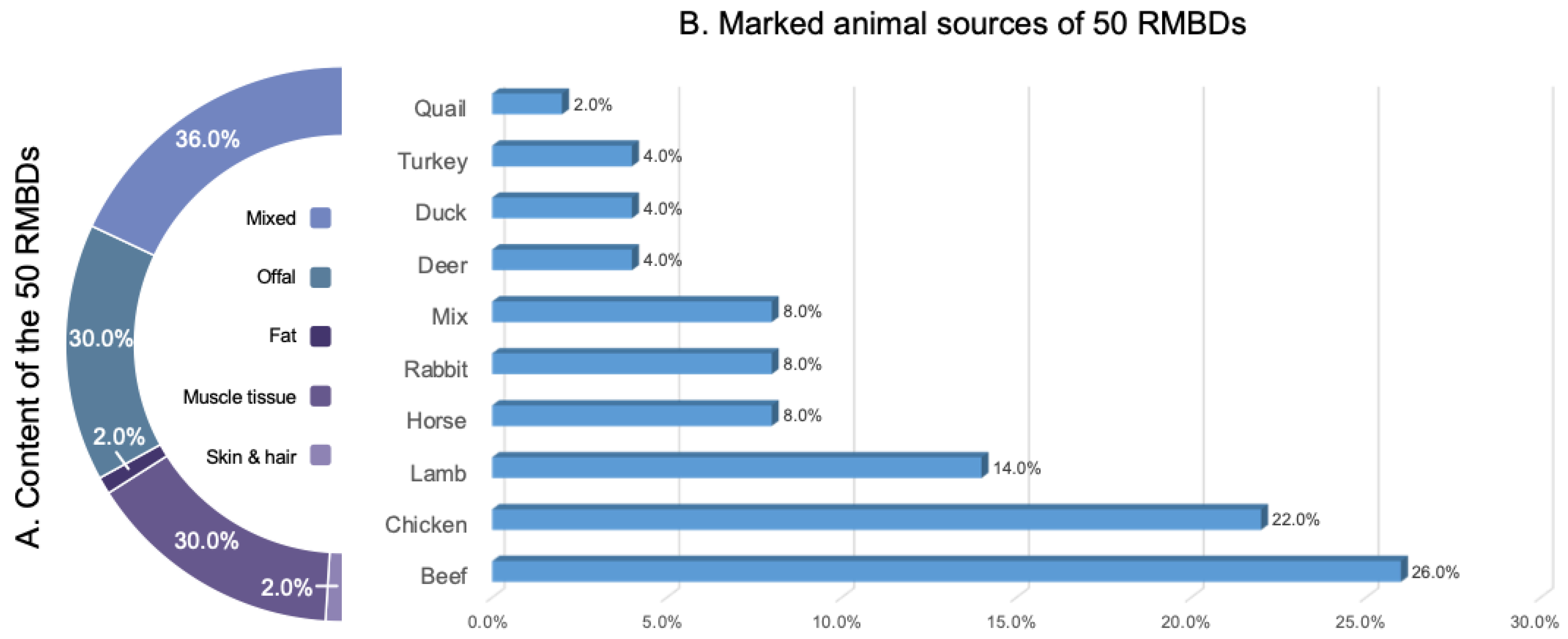
According to the information marked on the product, these 50 samples represented 21 different brands and were produced in five countries: Belgium (17/50, 34.0%), the Netherlands (28/50, 56.0%), France (1/50, 2.0%), Germany (3/50, 6.0%), and Spain (1/50, 2.0%). The marked animal sources included quail (1/50 sample, 2.0%), turkey (2/50, 4.0%), duck (2/50, 4.0%), deer (2/50, 4.0%), rabbit (4/50, 8.0%), horse (4/50, 8.0%), lamb (7/50, 14.0%), chicken (11/50, 22.0%), beef (13/50, 26.0%), and mixed species (4/50, 8.0%) (Figure 1). In terms of content, the products included different parts of the animals, such as muscle tissues (15/50, 30.0%), offal (heart, liver, kidney, intestines, stomach and other edible organ tissues) (15/50, 30.0%), fat (1/50, 2.0%), and skin with hair (1/50, 2.0%), some products consisted of mixtures of different tissues (18/50, 36.0%) (Figure 1).

2.2. Detection of Bacteria

Out of the 50 collected RMBD samples, E. coli was isolated from 45 samples (90.0%), E. faecalis from 31 samples (62.0%), E. faecium from 23 samples (46.0%), and Campylobacter spp. from 3 samples (6.0%). In one sample, all four targeted bacterial species were isolated, whereas in 11 samples (22.0%), three bacterial species were isolated; in 28 samples (56.0%), two species were isolated; in 9 samples (18.0%), only one species was isolated; and in only one sample, none of the bacterial species were isolated.

Selective Isolation of Resistant Strains

Additionally, 17 E. coli isolates were obtained from MacConkey agar plates supplemented with 1 mg/L cefotaxime. Three E. faecalis and five E. faecium strains were isolated from Slanetz–Bartley agar plates supplemented with 4 mg/L linezolid and were further tested by the broth microdilution method to confirm them as non-wild-type for linezolid.

2.3. Antimicrobial Susceptibility Results

Results of the antimicrobial susceptibility testing (minimum inhibitory concentrations (MICs) distributions) are summarized in Table 1, Table 2 and Table 3 for E. coli, E. faecalis, and E. faecium isolated from non-antibiotic-supplemented agar, respectively.
Among the 45 E. coli isolates obtained from RMBDs, 37.8% (17/45) exhibited acquired resistance to ampicillin, and 31.1% (14/45) showed acquired resistance to tetracycline. Acquired resistance was also observed against sulfamethoxazole (26.7%, 12/45), cefotaxime and ceftazidime (both 24.4%, 11/45), and trimethoprim and ciprofloxacin (both 15.6%, 7/45), while lower percentages were found for nalidixic acid (11.1%, 5/45), chloramphenicol (6.7%, 3/45), colistin (4.4%, 2/45) and gentamicin (2.2%, 1/45). All E. coli isolates obtained from non-selective supplemented agar belonged to the wild-type population for amikacin, azithromycin, meropenem and tigecycline (Table 1).
E. faecalis is intrinsically resistant to quinupristin/dalfopristin, with 90.3% (28/31) showing MIC values above the EFSA ECOFF set for data reporting purposes [2]. For tetracycline, 51.6% (16/31) exhibited acquired resistance, whereas for erythromycin this was 25.8% (8/31). Acquired resistance was also found for ampicillin, daptomycin and vancomycin (all 3.2%, 1/31). All these 31 E. faecalis isolates belonged to the wild-type population for chloramphenicol, ciprofloxacin, gentamicin, linezolid, teicoplanin, and tigecycline (Table 2).
Out of the 23 E. faecium isolates, 60.9% (14/23) showed acquired resistance to quinupristin/dalfopristin, 30.4% (7/23) to tetracycline and 13.0% (3/23) to erythromycin. Lower percentages of resistance were found for ampicillin, ciprofloxacin (both 8.7%, 2/23), chloramphenicol and linezolid (both 4.3%, 1/23). All these 23 E. faecium isolates belonged to the wild-type population for daptomycin, gentamicin, teicoplanin, vancomycin, and tigecycline (Table 3).
Three Campylobacter spp. isolates were obtained from the 50 samples: two Campylobacter jejuni and one Campylobacter coli. The two C. jejuni showed the same resistance profiles—both showed acquired resistance to ertapenem and ciprofloxacin, and belonged to the wild-type population for other tested antibiotics (chloramphenicol, erythromycin, gentamicin, and tetracycline). The only C. coli exhibited acquired resistance to ertapenem and was wild-type for ciprofloxacin, chloramphenicol, erythromycin, gentamicin, and tetracycline.
Out of the 45 E. coli strains isolated from non-selective media, 14 of them exhibited acquired multidrug resistance (MDR), more specifically, acquired resistance to 3–7 antibiotic classes (antimicrobial categories considered for MDR classes were summarized in Supplementary Material Table S1). Among the 31 E. faecalis and 23 E. faecium isolates, 3 strains exhibited acquired MDR: 1 E. faecalis strain and 2 E. faecium strains. In total, 17 MDR isolates were identified from the non-selective media in this study, distributed across 15 samples. “EC07”, “EFS1” and “EFM2” were isolated from the same sample. Their resistance profiles are listed in Table 4.
Regarding the 17 E. coli strains isolated from MacConkey agar plates supplemented with 1 mg/L cefotaxime, the MICs detailed in the Supplementary Material Table S2 indicate presumptive ESBL/AmpC phenotypes for all these isolates.
Three E. faecalis strains initially grown on Slanetz–Bartley agar plates supplemented with 4 mg/L linezolid could not be confirmed as non-wild-type for linezolid by the broth microdilution method with both 24 h and 48 h incubation (MIC ≤ 4 mg/L).
For E. faecium, after 24 h of incubation of the broth microdilution plates, three out of the five E. faecium grown on Slanetz–Bartley supplemented with linezolid exhibited an MIC above the linezolid ECOFF (Supplementary Table S3), while after 48 h, all five E. faecium isolates were above the ECOFF for linezolid (>4 mg/L). For chloramphenicol, after 24 h of incubation, two out of the five E. faecium strains were above the ECOFF, while after 48 h, all but one strain were above the chloramphenicol ECOFF (>32 mg/L).

2.4. Risk Factors

Risk factor analysis was conducted to study factors influencing the prevalence of E. coli, E. faecalis, and E. faecium, and the detection of MDR. Campylobacter spp. could not be included in the risk factor analysis due to there being insufficient positive samples.
For this, the production location was categorized as Belgium (BE), Netherlands (NL), and others, to ensure sufficient observations in each category. For animal source classification, this study categorized products into three groups based on production systems and biosecurity control levels: Conventional Livestock (beef, lamb, chicken, turkey), representing primary livestock species with standardized production systems and regulatory oversight; Minor Livestock (duck, quail, horse, rabbit) comprised smaller production systems in the countries of origin; and Wild-Sourced Animals (deer, wild animals) included products from natural environments with minimal biosecurity control and no standardized health monitoring. The contingency table and the results of the univariate risk factors analysis are presented in Table 5.
For E. coli, production location was a significant risk factor. As no other variables were statistically associated with the prevalence of E. coli, no multivariable models were made for E. coli.
For E. faecium, production location was identified as a significant protective factor; an attempted multivariable model was performed but could not be reliably fitted due to quasi-complete separation in the data when including other variables, so the reported association is based on the univariable analysis in Table 5.
Multivariable logistic regression was attempted for “MDR samples”, including production location (forced entry due to prior hypotheses) and animal source categories as covariates; the multivariable outcomes were not reliably fitted due to quasi-complete separation in the data categorical predictors containing small cell counts. Therefore, the reported associations are based primarily on univariable analysis in Table 5.
Multivariate logistic regression analysis was performed for the E. faecalis strains presented, including production location (forced entry), conventional livestocks and wild-sourced animal origin as covariates. After adjusting for other variables, both of the animal origins showed strong protective trends against E. faecalis presence, though these did not reach statistical significance (Conventional livestock: adjusted OR[aOR] = 0.1214, 95% CI: 0.014–1.068, p = 0.057; Wild Animal: aOR = 0.053, 95% CI: 0.003–1.071, p = 0.055). In contrast, the production location showed no significant association with E. faecalis present risk (p = 0.345).

3. Discussion

3.1. The Prevalence of Indicator Bacteria and the Occurrence of AMR Patterns

The high isolation rates of indicator bacteria from RMBDs in this study align with previous research but exceed some reported rates in comparable studies. The near-universal presence of E. coli (90.0%) suggests widespread contamination, consistent with the inherent risks of unprocessed animal products. This rate was slightly higher than the one observed from another study (86%) in Dutch commercial raw-meat diets [6]. Interestingly, our findings align closely with a study from Italy (98.2%) [25], although no products from that country were included in our study. The persistently high recovery rates across studies in different countries suggest that E. coli contamination is an intrinsic characteristic of raw pet food products rather than a region-specific quality issue.
The detection of presumptive ESBL/AmpC-producing E. coli in 17 samples (34%, 17/50) represents a significant finding that warrants careful consideration within the broader context of antimicrobial resistance surveillance. This prevalence rate substantially exceeds baseline levels reported in European food production systems, where ESBL/AmpC-producing E. coli detection rates from caecal or meat samples averaged 14.3% (338/2370) in the 2021 EU surveillance study [26]. Similarly, the prevalence of ESBL/AmpC E. coli in fresh meat from Portugal was 17.1% (109/638) [27], and German meat products (primarily from conventional livestock sources) showed ESBL/AmpC-producing E. coli prevalence of 21.2% (304/1435) [28]. However, our findings align more closely with resistance patterns observed in companion animals themselves. Studies from Portugal and the UK reported ESBL/AmpC-positive Enterobacteriaceae prevalence rates of 55.8% (24/43) and 36.4% (8/22) respectively in pets [29]. While these findings suggest a potential association between RMBD contamination and companion animal carriage of resistant bacteria, further research is needed to establish causal relationships and determine the relative contribution of different transmission pathways.
The prevalence of enterococci (E. faecalis 62.0%, E. faecium 46.0%) observed in this study highlights potential microbial risks associated with raw-pet-food consumption. The overall enterococcal prevalence aligns with the 54% reported in Portuguese pet foods across various product types [16]. Notably, when considering only raw frozen products in their study, a 100% enterococci contamination rate was observed (n = 14). Additionally, preliminary screening on 4 mg/L linezolid medium obtained five E. faecium strains from different RMBDs (10%, n = 5/50) was also worrisome.
The relatively low prevalence of Campylobacter spp. (6.0%) in this study was unexpected, given previous reports of C. jejuni in 22% of commercial raw pet foods in New Zealand [15] and its common occurrence in raw meat intended for human consumption, where prevalence rates can exceed 30% in poultry products [30,31,32]. This discrepancy may relate to manufacturing and storage processes, as, for example, freezing can significantly reduce Campylobacter spp. survival [33]. Indeed, in the study in New Zealand, raw pet food was a freshly purchased, non-frozen product, while in the current study, all RMBD samples were frozen products, which likely contributed to the lower detection rates compared to studies examining fresh or refrigerated products. However, this finding is consistent with some studies that detected no Campylobacter in commercial raw pet foods [34,35]. This represents a limitation of our study design, as frozen storage may have reduced the viability of Campylobacter and potentially underestimated its true prevalence in fresh RMBD products; it may also indicate that frozen RMBDs pose less risk in this regard. Consistent with the known epidemiology of these pathogens, two out of the three Campylobacter spp. isolates originated from products containing poultry meat (both were Campylobacter jejuni), while the Campylobacter coli isolate originated from a product containing lamb.
The widespread bacterial contamination across different animal sources and product types in our study demonstrates that bacterial presence is not confined to specific meat categories but rather represents an inherent characteristic of raw pet food products, regardless of product composition. This finding aligns with previous research showing no significant differences in bacterial contamination rates across different meat types in raw pet diets [36], suggesting that contamination occurs at multiple points throughout the production and distribution chain rather than being source-specific.

3.2. Antimicrobial Resistance Patterns Observed

The antimicrobial resistance patterns observed in our isolates raise substantial concerns about RMBDs as potential vehicles of AMR bacteria.
High acquired-resistance rates were observed among E. coli isolates to several antibiotics, particularly ampicillin (37.8%), tetracycline (31.1%), sulfamethoxazole (26.7%), and third-generation cephalosporins (cefotaxime 24.4%, ceftazidime 24.4%). Resistance to third-generation cephalosporins is an indication of potential ESBL/AmpC activity, as these enzymes are known to hydrolyze these β-lactam antibiotics while remaining susceptible to β-lactamase inhibitors [37].
In addition, the observed prevalence rate of presumptive ESBL/AmpC-producing E. coli in RMBDs (34%, 17/50) in our study, based on the selective isolation, aligns with high contamination levels consistently reported in European RMBD investigations. Swiss commercial raw pet foods showed 62.7% AMR bacteria prevalence, with the majority resistant to third-generation cephalosporins due to ESBL production [9]. Dutch RMBD studies documented ESBL-producing E. coli in 80% (28/35) of products [6]. In Sweden, ESC-resistant E. coli carrying pAmpC (bla_CMY-2) was detected in 23% (9/39) of raw food diets containing poultry [38]. Similarly, American studies reported ESBL-producing Enterobacteriaceae in 42% (10/24) of raw diets [39], demonstrating that high ESBL prevalence in RMBDs is not limited to European production systems. This consistently high prevalence across different countries and manufacturers suggests that ESBL contamination represents an inherent characteristic of raw-pet-food production rather than isolated quality control failures. By comparison, conventional meat products intended for human consumption show variable ESBL rates (4–75% depending on meat type and processing), indicating that the absence of heat-treatment and potential concentration effects during RMBD processing may contribute to elevated resistance burdens in raw pet foods [21,22,23]. Also noteworthy, among the 17 presumptive ESBL/AmpC producing E. coli strains isolated through the selective isolation in our study, nearly half (47.1%) showed NWT for ciprofloxacin. This rate of ciprofloxacin resistance among presumptive ESBL/AmpC E. coli aligns with the rate observed among such isolates from livestock and conventional meat in Europe (48.7%) [26].
Among the 45 E. coli isolates analyzed, 31.1% (n = 14) exhibited multidrug resistance. Notably, one strain (EC14 in Table 4) demonstrated acquired resistance to multiple classes of critically important antimicrobials, including to third-generation cephalosporins (ceftazidime), fluoroquinolones (ciprofloxacin), and polymyxins (colistin). The MDR occurrence (31.1%) observed in our study is lower than MDR rates reported in Portuguese studies examining raw pet meat products, which found 71% [40] and 91% [27] MDR rates among E. coli isolates. Interestingly, a study of dogs consuming RMBDs versus non-raw diets found a significant difference: 24.6% vs. 3.9% MDR E. coli, respectively, in their fecal sample [41]. While these observations do not establish direct causality, it suggests that RMBDs may serve as reservoirs for multidrug-resistant bacteria within the broader antimicrobial resistance ecosystem of the One Health framework [41].
Colistin resistance in 4.4% of E. coli isolates is also a matter of concern given colistin’s status as a last-resort antibiotic. This finding aligns with global reports of colistin resistance in pet-associated bacteria across multiple countries [9,42], including direct detection in raw-meat-based diets for pets [40].
High resistance rates were observed among enterococci isolates, particularly to erythromycin (25.8% in E. faecalis), tetracycline (51.6% in E. faecalis and 30.4% in E. faecium), and quinupristin/dalfopristin (60.9% in E. faecium; intrinsic resistance in E. faecalis). Resistance to these antimicrobial classes is commonly observed in isolates from food-producing animals in Belgium [43].
The multidrug resistance occurrence in Enterococcus spp. varies considerably among studies. Our study identified MDR rates of 3.2% in E. faecalis and 8.7% in E. faecium, contrasting with European reports exceeding 30% for both species in similar food matrices [16,17], yet slightly surpassing US pet food (1.7%; [44]. The observed linezolid resistance rates (E. faecalis 0.0%, E. faecium 4.3%) were substantially lower than those reported in Portuguese industrial raw dog food (23%; [16]). In the preliminary screening stage, the occurrence of E. faecium grown on linezolid-supplemented media was 10% (5/50 RMBDs), confirming the enhanced detection observed with such selective isolation. Notably, for the five E. faecium strains grown on media supplemented with linezolid, the results of MICs after 48 h of incubation compared to 24 h of incubation for linezolid and chloramphenicol are in agreement with observations from a previous study [45]. Based on these observations, all five of these E. faecium strains could be considered as non-wild-type for linezolid if the 48 h of incubation is used for final classification.
Another finding is the E. faecalis isolate with acquired resistance to vancomycin and daptomycin, two antibiotics categorized as to be “avoided” in veterinary medicine according to the European medicine agency classification [46].

3.3. Risk Factors

An interesting finding of this study is the association between production location and bacterial contamination patterns, particularly for E. faecium. Samples produced in Belgium demonstrated a higher prevalence of E. faecium (76.5%) compared to Dutch samples (21.4%). These differences may be due to production practices, regulatory oversight, or supply chain management between countries. Regulatory frameworks governing raw-pet-food production vary across European Union member states, with some countries implementing more stringent microbiological criteria and hazard analysis critical-control point requirements than others [24,47]. Additionally, differences in antimicrobial usage patterns in livestock production between countries could influence the occurrence of resistant bacteria in the food chain, subsequently affecting raw pet food products derived from these sources [48,49,50]. However, no statistical difference in the detection of MDR indicator bacteria was observed when comparing different production locations.
Products containing skin and hair components showed a lower prevalence of E. faecium. However, these findings are constrained by incomplete product labelling information and the fact that most products contained multiple tissue types rather than single components. The risk factor analysis could only determine whether products contained specific components, not their relative proportions or processing methods. Additionally, the small sample sizes in some categories (n = 6 for skin and hair products) limit the statistical power. Therefore, future studies with detailed compositional analysis and larger sample sizes are needed to validate these preliminary findings.
Analysis of animal source categories revealed only one association between production systems and bacterial contamination patterns. Minor livestock sources were associated with increased multidrug resistance risk. It is difficult to provide a clear explanation for this finding.
The high occurrence of AMR bacteria in commercial RMBDs may pose significant public health risks through multiple transmission pathways. Pet owners may face direct exposure during food handling, preparation, and serving processes, with contaminated hands, utensils, and surfaces serving as potential vectors for bacterial transmission [23]. Additional risks may arise from indirect contact through contaminated feeding equipment, pet saliva, and household surfaces. These findings underscore the need for enhanced consumer education regarding safe handling practices for raw pet foods, including proper hand hygiene, surface disinfection, and separation from human food preparation areas [49]. The integration of RMBD safety into broader One Health surveillance frameworks is essential for monitoring and mitigating AMR transmission risks at the human–animal interface [20].

3.4. Study Limitations and Future Research

Several limitations should be acknowledged when interpreting these findings. The relatively small sample size of 50 products may limit generalizability and statistical power for detecting associations. Risk factor analysis was constrained by sample size, particularly for variables with small cell counts. On top of that, given the relatively small sample size and the considerable heterogeneity across brands, batches, and retail sources, the number of samples per cluster was generally too small for reliable variance estimation at the cluster level. Broad categorization of production locations due to limited numbers may have obscured country-specific patterns. The cross-sectional design provides only a snapshot of contamination patterns and cannot establish causal relationships. A significant limitation relates to sample handling and potential contamination during the supply chain. For products obtained through online retailers with delivery services (35/50 samples), contamination during merchant storage and cold-chain delivery could not be controlled or assessed. Similarly, original product packaging integrity and its role in preventing or facilitating contamination was not systematically evaluated. Furthermore, the study relied on product labelling for categorizing animal sources and production locations, which may not accurately reflect actual product composition. Lastly, frozen storage of the products investigated in this study may have reduced the viability of Campylobacter and potentially underestimated its true prevalence in fresh RMBD products.

4. Materials and Methods

4.1. Sampling Methods

RMBD products were collected between May and August 2023 at various retail sources in Belgium, including physical pet supply stores or authorized online retailers that provide delivery services within Belgium. All available RMBD products were identified through information provided by the merchants and basic product details. Only products consisting exclusively of raw meat were included; products containing processed ingredients or preservation additive were excluded. All products that fulfilled the selection criteria were categorized by labelled animal source (bovine, porcine, poultry, and other livestock) to ensure representation across different animal species. To focus on terrestrial-animal-derived raw-meat products, products containing insects or seafood as primary ingredients were excluded. Following this, the remaining eligible products were stratified by the marked animal sources, and a proportional random selection was performed. Subsequently, the selected products were purchased. For purchases made at physical pet supply stores, samples were collected in sterile containers and transported to the laboratory under refrigerated conditions (2–8 °C) within 24 h of collection. For purchases made through online retailers, merchants provided cold-chain delivery to the researcher’s private address, where samples were stored in sterile containers and subsequently transported under refrigeration (2–8 °C) to the laboratory within 24 h. For each eligible product, comprehensive metadata were documented, including brand name, manufacturer details, production date and batch number.

4.2. Bacterial Isolation and Identification

Upon arrival at the laboratory, each sample was assigned a unique identifier code, thawed at room temperature (20–25 °C) in a separate homogenizing bag and subsequently homogenized using a laboratory blender (Homogenizer Laboratory Blender, Thermo Scientific, Oxoid™, Basingstoke, UK) for 2 min. A 25 g portion of the sample was aseptically transferred to 225 mL of Buffered Peptone Water (BPW, Biorad, Lokeren, Belgium) and, for incubation, two aliquots were prepared from each sample, one for the isolation of E. coli, E. faecalis, E. faecium, and the other for the isolation of Campylobacter spp.

4.2.1. E. coli Isolation

BPW homogenous solution was incubated for 18–22 h at 37 °C. Following the incubation, 10 µL of the enriched solution was streaked onto MacConkey agar (Thermo Scientific™ Oxoid™, Basingstoke, UK) plates using a sterile inoculating loop and incubated aerobically for 18–20 h at 37 °C. Colonies displaying typical E. coli morphology (pink to rosy colonies, 2–3 mm diameter) were selected for further purification. Suspected colonies were first streaked onto Tryptone Bile X-glucuronide (TBX, Merck, Darmstadt, Germany) agar to confirm β-glucuronidase activity (blue-green colonies), followed by subculture on Nutrient Agar (Thermo Scientific™ Oxoid™, Basingstoke, UK) to obtain pure colonies for identification. Both plates were incubated aerobically at 37 °C for 18–20 h and 16–24 h, respectively. Bacterial identification was performed using Matrix-Assisted Laser Desorption/Ionization–Time of Flight (MALDI-TOF) mass spectrometry (Bruker MALDI Biotyper, Bruker Daltonics, Bremen, Germany) with the MBT Compass Library (version 2023, encompassing 4320 species across 712 microorganism genera), with a score value ≥ 2.0 considered as reliable species identification.

4.2.2. E. faecalis and E. faecium Isolation

BPW homogenous solution was incubated for 18–22 h at 37 °C. Following the incubation, 10 µL of the enriched solution was streaked onto Slanetz–Bartley agar (Thermo Scientific™ Oxoid™, Basingstoke, UK) plates using a sterile inoculating loop and incubated aerobically at 42 °C for 44–48 h. Colonies displaying typical enterococcal morphology (red, maroon or pink colonies) were selected for further purification on Columbia Agar with 5% sheep blood (CSB agar, Biorad, Lokeren, Belgium) at 37 °C for 16–24 h. Identification was performed using MALDI-TOF mass spectrometry, with a score value ≥ 2.0 considered as reliable species identification, referenced to the MBT Compass Library (version 2023).

4.2.3. Selective Isolation of Resistant Strains

In addition to the standard isolation procedures, selective pressure screening was performed in parallel. For E. coli, MacConkey agar plates (Thermo Scientific™ Oxoid™, Basingstoke, UK) supplemented with 1 mg/L cefotaxime (Merck Life Science, Hoeilaart, Belgium) (incubated at 37 °C for 18–22 h) were used to isolate third-generation cephalosporin-resistant strains. For enterococci, Slanetz–Bartley agar plates (Thermo Scientific™ Oxoid™, Basingstoke, UK) supplemented with 4 mg/L linezolid (Selleckchem, Houston, TX, USA) were employed to detect linezolid-resistant E. faecalis and E. faecium. All isolates from selective media underwent the same purification and identification procedures as described above.

4.2.4. Campylobacter spp. Isolation

BPW homogenous solution was incubated for 4–6 h at 37 °C. After the initial incubation, the enriched solution was transferred to a microaerophilic environment (6.5% O2, 5.5%CO2) and further incubated at 42 °C for 48 h. Subsequently, 100 µL of the enriched solution was streaked onto modified Charcoal Cefoperazone Deoxycholate Agar (m-CCDA, Thermo Scientific, Waltham, MA, USA) and Campyfood Agar (CFA, bioMérieux, Marcy-l’Étoile, France), using a sterile cell spreader and incubated under microaerophilic conditions at 42 °C for 40–48 h. Colonies exhibiting typical Campylobacter morphology (small, grey, flat or slightly raised colonies [50]) were selected for further purification on CSB agar (Biorad, Lokeren, Belgium) at 42 °C for 44–48 h under microaerophilic conditions. Identification was performed using MALDI-TOF mass spectrometry, using the MBT Compass Library (version 2023), with biochemical confirmation (oxidase test and hippurate hydrolysis) performed when MALDI-TOF scores were between 1.7 and 2.0. All bacterial isolates were temporarily stored at 2–8 °C on their plate for subsequent antimicrobial susceptibility testing.

4.3. Antimicrobial Susceptibility

From each sample, one bacterial isolate from each bacterial species and from each standard and selective isolation was randomly selected to conduct antimicrobial susceptibility testing.
The antimicrobial susceptibility testing of these isolated strains was conducted using the broth microdilution method in agreement with the reference method ISO 20776-1:2019 [51]. For quality control purposes, reference strains were included in each test run: E. coli ATCC 25922 for E. coli isolates, E. faecalis ATCC 29212 for both E. faecalis and E. faecium isolates, and C. jejuni ATCC 33560 for Campylobacter spp. isolates.
The isolated E. coli strains were tested against amikacin, ampicillin, azithromycin, cefotaxime, ceftazidime, chloramphenicol, ciprofloxacin, colistin, gentamicin, meropenem, nalidixic acid, sulfamethoxazole, tetracycline, trimethoprim, and tigecycline using EUVSEC 3 SensititreTM plates (Trek Diagnostic Systems; Thermo Scientific, Waltham, MA, USA) antimicrobial panels according to the manufacturer’s guidelines.
The isolated E. faecalis and E. faecium strains were tested against ampicillin, chloramphenicol, ciprofloxacin, daptomycin, erythromycin, gentamicin, linezolid, quinupristin/dalfopristin, teicoplanin, tetracycline, tigecycline, and vancomycin using EUVENC SensititreTM plates (Trek Diagnostic Systems; Thermo Scientific, Waltham, MA, USA). For enterococci strains grown on media supplemented with linezolid, MIC24h was compared with measures after 24 h of additional incubation (MIC48h) to assess whether any differences would be observed for linezolid and chloramphenicol, taking into account the potential inducibility of these resistances [45].
The isolated Campylobacter jejuni and Campylobacter coli strains were tested against chloramphenicol, ciprofloxacin, erythromycin, gentamicin, tetracycline, and ertapenem using EUCAMP3 SensititreTM plates (Trek Diagnostic Systems; Thermo Scientific, Waltham, MA, USA).
The epidemiological cut-off values (ECOFFs) used for the interpretation as either wild-type (WT) or non-wild-type (NWT) isolates followed the EFSA manual for reporting AMR data [2] and are summarized in Supplementary Materials (Supplementary Material Table S1). Isolates with an MIC strictly higher than the EUCAST ECOFFs [2] were referred to as NWT isolates or as isolates with phenotypically detectable acquired resistance.

4.4. Data Analysis

4.4.1. Statistical Methods

Descriptive statistics were calculated to summarize the sample characteristics, including production location, animal species, and meat type (e.g., muscle tissue, bones, fat, organs, and skin and hair). For mixed animal species and mixed meat types, including the partial or whole body, samples were labelled as mix/mixed in the descriptive statistics. The prevalence of Escherichia coli, Enterococcus faecalis, Enterococcus faecium, and Campylobacter spp. in the sampled raw-meat products (RMBDs) was described, along with the frequency distributions of categorical variables. Data were entered into Microsoft Excel (version 16.98).

4.4.2. Risk Factors

The association between potential risk factors (production location, meat components, and animal sources) and bacterial presence and MDR detection) was analyzed by means of logistic regression. Separate models were developed for each bacterial species (E. coli, E. faecalis, E. faecium, and Campylobacter spp.) and MDR, as long as there were sufficient positive samples. The dependent variable in each model was the presence or absence of the specific bacterial species or the detection of MDR bacteria. First, univariate analysis was conducted to examine associations between potential risk factors and bacterial presence or the detection of MDR indicator isolates. Considering the sample size (N = 50) and the type of variables (categorical variables), the univariate analysis used was Fisher’s exact test. For the multivariate analysis, variables with a p < 0.2 in the univariate analysis were incorporated into the binary logistic regression models. Production location was forced into all models to correct for potential confounding. Model selection employed an ENTER approach. The Hosmer–Lemeshow test was used to assess model fit, and the area under the receiver operating characteristic (ROC) curve was calculated to evaluate model discrimination. All results were expressed as odds ratios (OR) with 95% confidence intervals (CI), with statistical significance set at p < 0.05.
All data analysis was performed in IBM SPSS Statistics (version 30.0, IBM Corporation, Armonk, NY, USA).

5. Conclusions

This study revealed widespread bacterial contamination in commercial raw-meat-based diets for pets in Belgium, with 90% of samples containing E. coli. Notably, multidrug-resistant isolates were detected in 30% of the RMBDs, and isolates exhibiting last-resort antimicrobial resistance were observed, including one E. faecalis strain with acquired resistance to vancomycin and daptomycin. These findings highlight the need for improved production standards and enhanced regulatory oversight in the raw-pet-food industry and the need to raise awareness in pet owners.

Supplementary Materials

The following supporting information can be downloaded at: https://www.mdpi.com/article/10.3390/antibiotics15030282/s1. Supplementary Material Table S1: Antimicrobial categories considered for MDR classes and ECOFFs (EFSA, 2025) for E. coli, E. faecalis, E. faecium, C. jejuni and C. coli. Supplementary Material Table S2: The distribution of MIC values of 17 strains of E. coli isolated from selective agar plates supplemented with 1 mg/L cefotaxime from RMBDs. Supplementary Material Table S3: The MIC24h/48h values of E. faecium isolated from selective agar plates supplemented with 4 mg/L linezolid from RMBDs.

Author Contributions

Conceptualization, J.H., I.C., M.R., C.B. and J.D.; methodology, J.H., F.B., I.C., C.G.-G., C.B. and J.D.; validation, J.H., I.C., C.G.-G., J.D. and C.B.; formal analysis, J.H., I.C., C.G.-G., C.B. and J.D.; investigation, J.H., M.R. and J.D.; resources, J.H., C.G.-G., M.R., S.D., J.D. and C.B.; data curation, J.H. and C.B.; writing—original draft preparation, J.H.; writing—review and editing, J.H., I.C., C.G.-G., M.R., F.B., S.D., J.D. and C.B.; visualization, J.H. and M.R.; supervision, I.C., C.G.-G., C.B. and J.D.; funding acquisition, C.G.-G., F.B., J.D. and C.B.; Project administration: J.D. and C.B. All authors have read and agreed to the published version of the manuscript.

Funding

The research that yielded these results was funded by the Belgian Federal Public Service of Health, Food Chain Safety and Environment through the contract RT 21/1 PET-AMR 1. Financial support for author J.H. was provided by the Chinese Scholarship Council.

Institutional Review Board Statement

Not applicable.

Informed Consent Statement

Not applicable.

Data Availability Statement

The raw data supporting the conclusions of this article will be made available by the authors on request.

Acknowledgments

The authors thank Alexandru Radu and Marwa Rabhi for their technical assistance. We acknowledge the technological assistance of lab technicians of the Human Bacterial Diseases unit in generating MALDI-TOF-based identifications.

Conflicts of Interest

The authors declare no conflicts of interest.

References

  1. WHO. WHO Bacterial Priority Pathogens List, 2024: Bacterial Pathogens of Public Health Importance to Guide Research, Development and Strategies to Prevent and Control Antimicrobial Resistance; World Health Organization (WHO): Geneva, Switzerland, 2024. [Google Scholar]
  2. European Food Safety Authority (EFSA); Amore, G.; Beloeil, P.-A.; Fierro, R.G.; Rizzi, V.; Stoicescu, A.-V. Manual for Reporting 2024 Antimicrobial Resistance Data Under Directive 2003/99/EC and Commission Implementing Decision (EU) 2020/1729. EFSA Support. Publ. 2025, 22, 9238E. [Google Scholar] [CrossRef]
  3. CDC. Antibiotic Resistance Threats in the United States; Department of Health and Human Services, CDC: Atlanta, GA, USA, 2019.
  4. European Food Safety Authority; European Centre for Disease Prevention and Control. The European Union Summary Report on Antimicrobial Resistance in Zoonotic and Indicator Bacteria from Humans, Animals and Food in 2017/2018. EFSA J. 2020, 18, e06007. [Google Scholar] [CrossRef]
  5. Morelli, G.; Bastianello, S.; Catellani, P.; Ricci, R. Raw Meat-Based Diets for Dogs: Survey of Owners’ Motivations, Attitudes and Practices. BMC Vet. Res. 2019, 15, 74. [Google Scholar] [CrossRef] [PubMed]
  6. van Bree, F.P.J.; Bokken, G.C.A.M.; Mineur, R.; Franssen, F.; Opsteegh, M.; van der Giessen, J.W.B.; Lipman, L.J.A.; Overgaauw, P.A.M. Zoonotic Bacteria and Parasites Found in Raw Meat-Based Diets for Cats and Dogs. Vet. Rec. 2018, 182, 50. [Google Scholar] [CrossRef] [PubMed]
  7. Kaindama, L.; Jenkins, C.; Aird, H.; Jorgensen, F.; Stoker, K.; Byrne, L. A Cluster of Shiga Toxin-Producing Escherichia coli O157:H7 Highlights Raw Pet Food as an Emerging Potential Source of Infection in Humans. Epidemiol. Infect. 2021, 149, e124. [Google Scholar] [CrossRef] [PubMed]
  8. Public Health Agency of Canada. Public Health Notice: Outbreak of Salmonella Infections Linked to Dog Food and Treats. Available online: https://www.canada.ca/en/public-health/services/public-health-notices/2025/outbreak-salmonella-infections-dog-food-treats.html (accessed on 11 February 2026).
  9. Nüesch-Inderbinen, M.; Treier, A.; Zurfluh, K.; Stephan, R. Raw Meat-Based Diets for Companion Animals: A Potential Source of Transmission of Pathogenic and Antimicrobial-Resistant Enterobacteriaceae. R. Soc. Open Sci. 2019, 6, 191170. [Google Scholar] [CrossRef]
  10. Boerlin, P.; Eugster, S.; Gaschen, F.; Straub, R.; Schawalder, P. Transmission of Opportunistic Pathogens in a Veterinary Teaching Hospital. Vet. Microbiol. 2001, 82, 347–359. [Google Scholar] [CrossRef]
  11. Freeman, L.M.; Chandler, M.L.; Hamper, B.A.; Weeth, L.P. Current Knowledge about the Risks and Benefits of Raw Meat-Based Diets for Dogs and Cats. J. Am. Vet. Med. Assoc. 2013, 243, 1549–1558. [Google Scholar] [CrossRef]
  12. KuKanich, K.S.; Ghosh, A.; Skarbek, J.V.; Lothamer, K.M.; Zurek, L. Surveillance of Bacterial Contamination in Small Animal Veterinary Hospitals with Special Focus on Antimicrobial Resistance and Virulence Traits of Enterococci. J. Am. Vet. Med. Assoc. 2012, 240, 437–445. [Google Scholar] [CrossRef]
  13. Davies, R.H.; Lawes, J.R.; Wales, A.D. Raw Diets for Dogs and Cats: A Review, with Particular Reference to Microbiological Hazards. J. Small Anim. Pract. 2019, 60, 329–339. [Google Scholar] [CrossRef]
  14. Hathcock, T.; Raiford, D.; Conley, A.; Barua, S.; Murillo, D.F.B.; Prarat, M.; Kaur, P.; Scaria, J.; Wang, C. Antimicrobial-Resistant Escherichia coli, Enterobacter cloacae, Enterococcus faecium, and Salmonella kentucky Harboring Aminoglycoside and Beta-Lactam Resistance Genes in Raw Meat-Based Dog Diets, USA. Foodborne Pathog. Dis. 2023, 20, 477–483. [Google Scholar] [CrossRef]
  15. Bojanić, K.; Midwinter, A.C.; Marshall, J.C.; Rogers, L.E.; Biggs, P.J.; Acke, E. Isolation of Campylobacter spp. from Client-Owned Dogs and Cats, and Retail Raw Meat Pet Food in the Manawatu, New Zealand. Zoonoses Public Health 2017, 64, 438–449. [Google Scholar] [CrossRef]
  16. Finisterra, L.; Duarte, B.; Peixe, L.; Novais, C.; Freitas, A.R. Industrial Dog Food Is a Vehicle of Multidrug-Resistant Enterococci Carrying Virulence Genes Often Linked to Human Infections. Int. J. Food Microbiol. 2021, 358, 109284. [Google Scholar] [CrossRef]
  17. Freitas, A.R.; Finisterra, L.; Tedim, A.P.; Duarte, B.; Novais, C.; Peixe, L. from the ESCMID Study Group on Food- and Water-borne Infections (EFWISG) Linezolid- and Multidrug-Resistant Enterococci in Raw Commercial Dog Food, Europe, 2019–2020. Emerg. Infect. Dis. 2021, 27, 2221–2224. [Google Scholar] [CrossRef]
  18. FEDIAF. Statistics. Available online: https://europeanpetfood.org/about/statistics/ (accessed on 7 August 2024).
  19. Joosten, P.; Ceccarelli, D.; Odent, E.; Sarrazin, S.; Graveland, H.; Van Gompel, L.; Battisti, A.; Caprioli, A.; Franco, A.; Wagenaar, J.A.; et al. Antimicrobial Usage and Resistance in Companion Animals: A Cross-Sectional Study in Three European Countries. Antibiotics 2020, 9, 87. [Google Scholar] [CrossRef]
  20. Pomba, C.; Rantala, M.; Greko, C.; Baptiste, K.E.; Catry, B.; van Duijkeren, E.; Mateus, A.; Moreno, M.A.; Pyörälä, S.; Ružauskas, M.; et al. Public Health Risk of Antimicrobial Resistance Transfer from Companion Animals. J. Antimicrob. Chemother. 2017, 72, 957–968. [Google Scholar] [CrossRef]
  21. More, S.J. European Perspectives on Efforts to Reduce Antimicrobial Usage in Food Animal Production. Ir. Vet. J. 2020, 73, 2. [Google Scholar] [CrossRef] [PubMed]
  22. Caekebeke, N.; Jonquiere, F.J.; Ringenier, M.; Tobias, T.J.; Postma, M.; van den Hoogen, A.; Houben, M.A.M.; Velkers, F.C.; Sleeckx, N.; Stegeman, J.A.; et al. Comparing Farm Biosecurity and Antimicrobial Use in High-Antimicrobial-Consuming Broiler and Pig Farms in the Belgian-Dutch Border Region. Front. Vet. Sci. 2020, 7, 558455. [Google Scholar] [CrossRef] [PubMed]
  23. Rousham, E.K.; Unicomb, L.; Islam, M.A. Human, Animal and Environmental Contributors to Antibiotic Resistance in Low-Resource Settings: Integrating Behavioural, Epidemiological and One Health Approaches. Proc. Biol. Sci. 2018, 285, 20180332. [Google Scholar] [CrossRef] [PubMed]
  24. EU Pet Food Regulations: Resources. Available online: https://americanpetproducts.org/law-library/eu-pet-food-regulations-resources (accessed on 5 January 2026).
  25. Bacci, C.; Vismarra, A.; Dander, S.; Barilli, E.; Superchi, P. Occurrence and Antimicrobial Profile of Bacterial Pathogens in Former Foodstuff Meat Products Used for Pet Diets. J. Food Prot. 2019, 82, 316–324. [Google Scholar] [CrossRef]
  26. Brouwer, M.S.M.; Zandbergen Van Essen, A.; Kant, A.; Rapallini, M.; Harders, F.; Bossers, A.; Wullings, B.; Wit, B.; Veldman, K.T. Implementation of WGS Analysis of ESBL-Producing Escherichia coli within EU AMR Monitoring in Livestock and Meat. J. Antimicrob. Chemother. 2023, 78, 1701–1704. [Google Scholar] [CrossRef]
  27. Clemente, L.; Leão, C.; Moura, L.; Albuquerque, T.; Amaro, A. Prevalence and Characterization of ESBL/AmpC Producing Escherichia coli from Fresh Meat in Portugal. Antibiotics 2021, 10, 1333. [Google Scholar] [CrossRef]
  28. Kaesbohrer, A.; Bakran-Lebl, K.; Irrgang, A.; Fischer, J.; Kämpf, P.; Schiffmann, A.; Werckenthin, C.; Busch, M.; Kreienbrock, L.; Hille, K. Diversity in Prevalence and Characteristics of ESBL/pAmpC Producing E. coli in Food in Germany. Vet. Microbiol. 2019, 233, 52–60. [Google Scholar] [CrossRef] [PubMed]
  29. Menezes, J.; Frosini, S.-M.; Weese, S.; Perreten, V.; Schwarz, S.; Amaral, A.J.; Loeffler, A.; Pomba, C. Transmission Dynamics of ESBL/AmpC and Carbapenemase-Producing Enterobacterales Between Companion Animals and Humans. Front. Microbiol. 2024, 15, 1432240. [Google Scholar] [CrossRef] [PubMed]
  30. Kelbert, L.; Barmettler, K.; Horlbog, J.A.; Stevens, M.J.A.; Cernela, N.; Nüesch-Inderbinen, M.; Stephan, R. Campylobacter in Raw Chicken Meat at Retail Level: Quantitative and Qualitative Assessment, Genomic Profiling, and Comparison with Isolates from Human Infections. J. Food Prot. 2025, 88, 100540. [Google Scholar] [CrossRef] [PubMed]
  31. Korsak, D.; Maćkiw, E.; Rożynek, E.; Żyłowska, M. Prevalence of Campylobacter spp. in Retail Chicken, Turkey, Pork, and Beef Meat in Poland Between 2009 and 2013. J. Food Prot. 2015, 78, 1024–1028. [Google Scholar] [CrossRef]
  32. Andritsos, N.D.; Tzimotoudis, N.; Mataragas, M. Prevalence and Distribution of Thermotolerant Campylobacter Species in Poultry: A Comprehensive Review with a Focus on the Factors Affecting the Detection and Enumeration of Campylobacter jejuni and Campylobacter coli in Chicken Meat. Appl. Sci. 2023, 13, 8079. [Google Scholar] [CrossRef]
  33. Sampers, I.; Habib, I.; De Zutter, L.; Dumoulin, A.; Uyttendaele, M. Survival of Campylobacter spp. in poultry meat Preparations Subjected to Freezing, Refrigeration, Minor Salt Concentration, and Heat Treatment. Int. J. Food Microbiol. 2010, 137, 147–153. [Google Scholar] [CrossRef]
  34. Kananub, S.; Pinniam, N.; Phothitheerabut, S.; Krajanglikit, P. Contamination Factors Associated with Surviving Bacteria in Thai Commercial Raw Pet Foods. Vet. World 2020, 13, 1988–1991. [Google Scholar] [CrossRef]
  35. Solís, D.; Toro, M.; Navarrete, P.; Faúndez, P.; Reyes-Jara, A. Microbiological Quality and Presence of Foodborne Pathogens in Raw and Extruded Canine Diets and Canine Fecal Samples. Front. Vet. Sci. 2022, 9, 799710. [Google Scholar] [CrossRef]
  36. Schmidt, M.; Unterer, S.; Suchodolski, J.S.; Honneffer, J.B.; Guard, B.C.; Lidbury, J.A.; Steiner, J.M.; Fritz, J.; Kölle, P. The Fecal Microbiome and Metabolome Differs between Dogs Fed Bones and Raw Food (BARF) diets and Dogs Fed Commercial Diets. PLoS ONE 2018, 13, e0201279. [Google Scholar] [CrossRef]
  37. Paterson, D.L.; Bonomo, R.A. Extended-Spectrum β-Lactamases: A Clinical Update. Clin. Microbiol. Rev. 2005, 18, 657–686. [Google Scholar] [CrossRef] [PubMed]
  38. Nilsson, O. Hygiene Quality and Presence of ESBL-Producing Escherichia coli in Raw Food Diets for Dogs. Infect. Ecol. Epidemiol. 2015, 5, 28758. [Google Scholar] [CrossRef]
  39. Fisher, C.D.; Call, D.R.; Omulo, S. Detection of Antibiotic Resistant Enterobacterales in Commercial Raw Pet Food: A Preliminary Study. Front. Vet. Sci. 2024, 11, 1294575. [Google Scholar] [CrossRef] [PubMed]
  40. Ribeiro-Almeida, M.; Mourão, J.; Magalhães, M.; Freitas, A.R.; Novais, C.; Peixe, L.; Antunes, P. Raw Meat-Based Diet for Pets: A Neglected Source of Human Exposure to Salmonella and Pathogenic Escherichia coli Clones Carrying Mcr, Portugal, September 2019 to January 2020. Euro Surveill. 2024, 29, 2300561. [Google Scholar] [CrossRef] [PubMed]
  41. Groat, E.F.; Williams, N.J.; Pinchbeck, G.; Warner, B.; Simpson, A.; Schmidt, V.M. UK Dogs Eating Raw Meat Diets Have Higher Risk of Salmonella and Antimicrobial-Resistant Escherichia coli Faecal Carriage. J. Small Anim. Pract. 2022, 63, 435–441. [Google Scholar] [CrossRef]
  42. Lei, L.; Wang, Y.; He, J.; Cai, C.; Liu, Q.; Yang, D.; Zou, Z.; Shi, L.; Jia, J.; Wang, Y.; et al. Prevalence and Risk Analysis of Mobile Colistin Resistance and Extended-Spectrum β-Lactamase Genes Carriage in Pet Dogs and Their Owners: A Population Based Cross-Sectional Study. Emerg. Microbes Infect. 2021, 10, 242–251. [Google Scholar] [CrossRef]
  43. Garcia-Graells, C.; Bricteux, F.; Van Damme, I.; Boland, C.; Kowalewicz, C.; Fretin, D.; Van Hoorde, K. Antimicrobial Resistance in ESBL and Indicator E. coli, Campylobacter spp., Salmonella spp., Methicillin-Resistant Staphylococcus aureus (MRSA) and Enterococcus faecalis and Faecium Isolated from Food and Food-Producing Animals (Primary Production) in 2023; National Reference Laboratory for Antimicrobial Resistance: Brussels, Belgium, 2024. [Google Scholar]
  44. Ge, B.; Domesle, K.J.; Gaines, S.A.; Lam, C.; Bodeis Jones, S.M.; Yang, Q.; Ayers, S.L.; McDermott, P.F. Prevalence and Antimicrobial Susceptibility of Indicator Organisms Escherichia coli and Enterococcus spp. Isolated from U.S. Animal Food, 2005-2011. Microorganisms 2020, 8, 1048. [Google Scholar] [CrossRef]
  45. Timmermans, M.; Bogaerts, B.; Vanneste, K.; De Keersmaecker, S.C.J.; Roosens, N.H.C.; Kowalewicz, C.; Simon, G.; Argudín, M.A.; Deplano, A.; Hallin, M.; et al. Large Diversity of Linezolid-Resistant Isolates Discovered in Food-Producing Animals Through Linezolid Selective Monitoring in Belgium in 2019. J. Antimicrob. Chemother. 2021, 77, 49–57. [Google Scholar] [CrossRef]
  46. EMA. Categorisation of Antibiotics in the European Union—Answer to the Request from the European Commission for Updating the Scientific Advice on the Impact on Public Health and Animal Health of the Use of Antibiotics in Animals; European Medicines Agency (EMA): Amsterdam, The Netherlands, 2019.
  47. FEDIAF. Legislation. Available online: https://europeanpetfood.org/self-regulation/legislation/ (accessed on 5 January 2026).
  48. Gunjan; Himanshu; Mukherjee, R.; Vidic, J.; Manzano, M.; Leal, E.; Raj, V.S.; Pandey, R.P.; Chang, C.-M. Comparative Meta-Analysis of Antimicrobial Resistance from Different Food Sources along with One Health Approach in the Egypt and UK. BMC Microbiol. 2023, 23, 291. [Google Scholar] [CrossRef]
  49. Djordjevic, S.P.; Jarocki, V.M.; Seemann, T.; Cummins, M.L.; Watt, A.E.; Drigo, B.; Wyrsch, E.R.; Reid, C.J.; Donner, E.; Howden, B.P. Genomic Surveillance for Antimicrobial Resistance—A One Health Perspective. Nat. Rev. Genet. 2024, 25, 142–157. [Google Scholar] [CrossRef]
  50. ISO 10272-1:2017; Microbiology of the Food Chain—Horizontal Method for Detection and Enumeration of Campylobacter spp. ISO: Geneva, Switzerland, 2017. Available online: https://www.iso.org/standard/63225.html (accessed on 2 January 2026).
  51. ISO 20776-1:2019; Susceptibility Testing of Infectious Agents and Evaluation of Performance of Antimicrobial Susceptibility Test Devices. ISO: Geneva, Switzerland, 2019.
Figure 1. Types of products and animal sources of 50 RMBDs.
Antibiotics 15 00282 g001
Table 1. Distribution of MIC values of 45 strains of E. coli isolated from RMBDs.
Antimicrobial AgentNumber of Strains with MIC (mg/L) and Tested RangeWild-TypeNon-Wild-Type
0.0150.030.060.1250.250.51248163264128256512[n][%][n][%]
Amikacin 4500000 45100.0%00.0%
Gentamicin 3770001 4497.8%12.2%
Ampicillin 210142017 2862.2%1737.8%
Azithromycin 41922000 45100.0%00.0%
Cefotaxime 340128 3475.6%1124.4%
Ceftazidime 3402126 3475.6%1124.4%
Chloramphenicol 42003 4293.3%36.7%
Ciprofloxacin36204200001 3884.4%715.6%
Nalidixic Acid 391014 4088.9%511.1%
Colistin 430002 4395.6%24.4%
Meropenem 44010000000 45100.0%00.0%
Sulfamethoxazole 15152100123373.3%1226.7%
Trimethoprim 172100007 3884.4%715.6%
Tetracycline 3100014 3168.9%1431.1%
Tigecycline 4410000 45100.0%00.0%
The | in the table represent ECOFFs [2] used to interpret MICs of E. coli; the grey-shadow background in the table above represents the test ranges of the antibiotics; the leftmost cell of each grey-background row means that it is less than or equal to the corresponding tested value, and the rightmost cell of each grey-background row means that it is greater than the corresponding tested value.
Table 2. Distribution of MIC values of 31 strains of E. faecalis isolated from RMBDs.
Antimicrobial AgentNumber of Strains with MIC (mg/L) and Tested RangeWild-TypeNon-Wild-Type
0.030.060.1250.250.51248163264128[n][%][n][%]
Ampicillin 515910001 3096.8%13.2%
Chloramphenicol 524200031100.0%00.0%
Ciprofloxacin 003223300 31100.0%00.0%
Daptomycin 002163100 3096.8%13.2%
Erythromycin 12110110062374.2%825.8%
Gentamicin 191200031100.0%00.0%
Linezolid 042610000 31100.0%00.0%
Quinupristin/Dalfopristin 1201141300 39.7%2890.3%
Teicoplanin 310000000 31100.0%00.0%
Vancomycin 1776100003096.8%13.2%
Tetracycline 1500002951548.4%1651.6%
Tigecycline5131210000 31100.0%00.0%
The | in the table represent ECOFFs [2] used to interpret MICs of E. faecalis. E. faecalis is intrinsically resistant to quinupristin/dalfopristin. The grey-shadow background in the table represents the test ranges of the antibiotics; the leftmost cell of each grey-background row means that it is less than or equal to the corresponding tested value, and the rightmost cell of each grey-background row means that it is greater than the corresponding tested value. The range of gentamicin extended up to 1024 mg/L, but no values were observed above 128 mg/L.
Table 3. Distribution of MIC values of 23 strains of E. faecium isolated from RMBDs.
Antimicrobial AgentNumber of Strains with MIC (mg/L) and Tested RangeWild-TypeNon-Wild-Type
0.030.060.1250.250.51248163264128[n][%][n][%]
Ampicillin 281011001 2191.3%28.7%
Chloramphenicol 71401102295.7%14.3%
Ciprofloxacin 01346720 2191.3%28.7%
Daptomycin 011912000 23100.0%00.0%
Erythromycin 1262100022087.0%313.0%
Gentamicin 21200023100.0%00.0%
Linezolid 002111000 2295.7%14.3%
Quinupristin/Dalfopristin 543101000 939.1%1460.9%
Teicoplanin 221000000 23100.0%00.0%
Vancomycin 18320000023100.0%00.0%
Tetracycline 1600001241669.6%730.4%
Tigecycline381020000 23100.0%00.0%
The | in the table represent ECOFFs [2] used to interpret MICs of E. faecium. The grey-shadow background in the table represents the test ranges of the antibiotics; the leftmost cell of each grey-background row means that it is less than or equal to the corresponding tested value, and the rightmost cell of each grey-background row means that it is greater than the corresponding tested value. The range of gentamicin extended up to 1024 mg/L, but no values were observed above 128 mg/L.
Table 4. Resistance Profiles of 17 acquired MDR strains isolated on non-selective medium.
IsolatesAntibiotic Resistance ProfilesNo. of Antibiotic (Sub)-Class Resistances
E. coli
EC01CTX-CAZ-CIP-NAL-COL3
EC02AMP-CHL-SXT-TET-TMP5
EC03AMP-CTX-CAZ-CHL-CIP-NAL-TET-TMP6
EC04AMP-SXT-TET-TMP4
EC05AMP-CTX-CAZ-SXT-TET4
EC06AMP-CTX-CAZ-SXT-TET4
EC07AMP-CTX-SXT3
EC08AMP-SXT-TMP3
EC09GEN-AMP-CTX-CAZ-CIP-SXT-TET-TMP7
EC10AMP-CTX-CAZ-TET3
EC11AMP-CTX-CAZ-TET3
EC12AMP-CTX-CAZ-CHL-SXT-TET-TMP6
EC13AMP-CIP-NAL-SXT-TET-TMP5
EC14CAZ-CIP-NAL-COL-SXT4
E. faecalis
EFS1AMP-ERY-QD-TET3 *
E. faecium
EFM1CHL-ERY-LZD-QD-TET5
EFM2AMP-CIP-ERY-QD-TET5
* E. faecalis has the intrinsic resistance to quinupristin/dalfopristin, not taken into account in the number of antibiotic class resistances. AMP: Ampicillin, CAZ: Ceftazidime, CHL: Chloramphenicol, CIP: Ciprofloxacin, COL: Colistin, CTX: Cefotaxime, ERY: Erythromycin, GEN: Gentamicin, LZD: Linezolid, NAL: Nalidixic Acid, QD: Quinupristin/Dalfopristin, SXT: Sulfamethoxazole, TET: Tetracycline, TMP: Trimethoprim. The classification of antibiotics is shown in Supplemental Material Table S2.
Table 5. Contingency table of categorical univariable.
E. coli (N = 45)E. faecalis (N = 31)E. faecium (N = 23)Samples with MDR Indicator Strains
(N = 15)
Variable[N]Present [n/N][%]OR
(95% CI)
p-ValPresent [n/N][%]OR
(95% CI)
p-ValPresent [n/N][%]OR
(95% CI)
p-ValDetected
[n/N]
[%]OR
(95% CI)
p-Val
Production
Location
Belgium1717/17100.0N/A0.2798/1747.10.42
(0.12–1.45)
0.21613/1776.511.9
(2.83–50.25)
<0.0016/1735.31.36
(0.38–4.95)
0.744
Netherlands2825/2889.31.00 (ref)-19/2867.91.00 (ref)-6/2821.41.00 (ref) 8/2828.61.00 (ref)
Others53/5600.18
(0.02–1.55)
0.1554/580.01.90
(0.18–19.48)
1.0004/58014.67
(1.37–156.89)
0.0211/5200.63
(0.60–6.49)
1.000
Overall test 0.032 0.320 <0.001 0.905
Muscle tissuePresent3329/3387.90.45
(0.05–4.01)
0.65018/3354.6 0.37
(0.10–1.37)
0.21815/3345.50.94
(0.29–3.03)
1.00012/3336.4 2.68
(0.64–11.12)
0.209
Absent1716/17 94.113/1776.5 8/1747.13/1717.6
OffalPresent2221/2295.53.50
(0.36–33.82)
0.36814/2263.6 1.13
(0.35–3.59)
1.0008/2236.40.51
(0.16–1.55)
0.2645/2222.7 0.53
(0.15–1.87)
0.367
Absent2824/2885.717/2860.7 15/2853.610/2835.7
BonesPresent1613/1681.30.27
(0.04–1.81)
0.31111/1668.8 1.54
(0.44–5.42)
0.5496/1637.50.60
(0.18–2.02)
0.5464/1625.0 0.70
(0.18–2.66)
0.746
Absent3432/3494.120/3458.8 17/345011/3432.4
FatPresent66/6100N/A1.0004/666.7 1.26
(0.21–7.64)
1.0001/616.70.20
(0.22–1.854)
0.1991/616.7 0.43
(0.05–4.02)
0.654
Absent4439/4488.627/4461.4 22/445014/4431.8
Skin and HairPresent66/6100N/A1.0004/666.7 1.26
(0.21–7.64)
1.0000/60N/A0.0251/616.7 0.43
(0.05–4.02)
0.654
Absent4439/4488.627/4461.4 23/4452.314/4431.8
Conventional LivestockPresent3633/3691.71.83
(0.27–12.38)
0.61120/3655.60.34
(0.08–1.43)
0.11817/3647.21.19
(0.34–4.14)
0.5179/3625.00.44
(0.12–1.63)
0.185
Absent1412/1485.711/1478.66/1442.96/1442.9
Minor
Livestock
Present1412/1485.7%0.55
(0.08–3.67)
0.61110/1471.41.79
(0.47–6.79)
0.5227/1450.01.25
(0.36–4.31)
0.7618/1457.15.52
(1.43–21.14)
0.016
Absent3633/3691.7%21/3658.316/3644.47/3619.4
Wild
Animals
Present44/4100N/A0.6471/425.00.18
(0.02–1.85)
0.1473/475.03.90
(0.38–40.37)
0.2462/450.02.54
(0.32–19.96)
0.346
Absent4641/4689.130/4665.220/4643.513/4628.3
N/A: Not available; the odds ratio (OR) could not be calculated precisely or tends toward infinity due to the presence of zero cell(s) in the contingency table.
Disclaimer/Publisher’s Note: The statements, opinions and data contained in all publications are solely those of the individual author(s) and contributor(s) and not of MDPI and/or the editor(s). MDPI and/or the editor(s) disclaim responsibility for any injury to people or property resulting from any ideas, methods, instructions or products referred to in the content.