Article

Heterologous Substitution of Mycobacterium tuberculosis rRNA in Mycobacterium smegmatis and Its Impact on Antimicrobial Susceptibility

by
Qianwen Yue
1,
Chan Shan
1,
Arslan Habib
2,
Guoping Zhao
1,* and
Xiaoming Ding
1,*
1
Collaborative Innovation Center for Genetics and Development, State Key Laboratory of Genetic Engineering, Department of Microbiology, School of Life Sciences, Fudan University, Shanghai 200438, China
2
Laboratory of Molecular Immunology, State Key Laboratory of Genetic Engineering, School of Life Sciences, Fudan University, Shanghai 200438, China
*
Authors to whom correspondence should be addressed.
Antibiotics 2026, 15(1), 30; https://doi.org/10.3390/antibiotics15010030
Submission received: 3 December 2025 / Revised: 24 December 2025 / Accepted: 30 December 2025 / Published: 31 December 2025
(This article belongs to the Section Antibiotic Therapy in Infectious Diseases)

Abstract

Background: The global incidence of multidrug-resistant and extensively drug-resistant tuberculosis continues to rise. The ribosome serves as a target for multiple antimicrobials, making functional research on it hold great significance. Methods: Using homologous recombination combined with a multiple serine integrase-mediated site-specific recombination system, we replaced the two endogenous rRNA operons in Mycobacterium smegmatis MC2 155 with a single copy of the single rRNA operon from Mycobacterium tuberculosis H37Rv, constructing the M. smegmatis BRkoA strain. We assessed growth kinetics at 37 °C, cold sensitivity at lower temperatures, transcriptional levels by RT-qPCR, 70S ribosome integrity through cryo-EM, and antimicrobial susceptibility by microdilution assays. Results: The BRkoA strain was successfully constructed. It exhibited markedly slower growth compared to the wild-type strain. Cold-sensitivity assays indicated potential ribosome assembly defects, while transcriptional analysis suggested altered rRNA processing and modification. Cryo-EM analysis further demonstrated the absence of specific ribosomal proteins in the BRkoA 70S ribosome. Moreover, BRkoA displayed reduced susceptibility tendency to several ribosome-targeting antibiotics, including kanamycin, amikacin, paromomycin, gentamicin, and linezolid. Conclusions: Replacement of the two endogenous rrn operons in M. smegmatis with a single copy of the single M. tuberculosis rrn operon using a serine integrase-mediated recombination system caused growth impairment and decreased sensitivity tendency to several ribosome-targeting antimicrobials. These findings suggest that ribosome structural variation contributes to intrinsic drug resistance mechanisms.

1. Introduction

Mycobacterium tuberculosis is the etiological agent of tuberculosis, a disease that remains one of the top 10 causes of infectious mortality worldwide, claiming approximately 1.23 million lives annually [1,2]. Drug-resistant TB has emerged as a major global health challenge with increasing cases of multidrug-resistant (MDR) strains that resist the most effective anti-tuberculosis drugs [2]. Understanding the mechanisms underlying drug resistance and developing new therapeutic strategies are therefore an urgent research priority for TB control.
Ribosomes are the targets of many drugs, such as kanamycin, amikacin, gentamicin, and linezolid, which are amino-glycoside-like antibiotics that acts on ribosomes. Research on the structure and function of ribosomes, especially ribosomes of pathogenic bacteria M. tuberculosis, has important implications for developing new anti-tuberculosis drugs and conducting tuberculosis prevention and treatment. At the same time, the ribosome is a highly conserved complex responsible for protein synthesis in all living organisms [3,4,5]. Research on them will also allow us to have a further understanding of the specific details of the pathogen translation process, helping to increase our understanding of the Mycobacterium pathogen mechanisms and drug resistance mechanisms [6].
The pathogenic M. tuberculosis grows slowly, and its cultivation requires special conditions such as P3 laboratory. The genetic modification methods available for it are also relatively limited [7]. In contrast, Mycobacterium smegmatis MC2 155 is a non-pathogenic [8], fast-growing mycobacterial species [9,10] that shares many physiological characteristics with the pathogenic M. tuberculosis [11,12]. Consequently, M. smegmatis serves as a widely used surrogate model for studying M. tuberculosis biology and drug responses [13]. By utilizing synthetic biology approaches, if we take M. smegmatis as the host and assemble all the ribosomal genes of M. tuberculosis into a functional module to replace the endogenous ribosomes of M. smegmatis, it may be possible to construct a new chassis host that better mimics the protein synthesis machinery of M. tuberculosis. This would lead to a deeper understanding of ribosomal function in M. tuberculosis and hold significant implications for the screening of novel antitubercular drugs and the study of drug resistance mechanisms in Mycobacterium.
Bacterial ribosomes consist of ribosomal proteins (RPs) and ribosomal RNA (rRNA), forming the 70S particle composed of a 50S large subunit and a 30S small subunit. The 30S subunit contains the 16S rRNA and over 21 RPs, while the 50S subunit contains 5S rRNA and 23S rRNA along with more than 34 RPs [14,15,16]. RPs assist in rRNA folding and structural stability, whereas rRNA plays central roles in mRNA and tRNA recognition and catalysis during protein synthesis. The number of rRNA (rrn) operons is species-specific: M. smegmatis contains two rrn operons (rrnA and rrnB), whereas M. tuberculosis has only one. Comparative sequence analysis showed that one M. smegmatis operon closely resembles the rrnAs of slow-growing mycobacteria and was designated rrnAf (“f” for fast-grower), while the second operon, rrnBf, is more distantly related to the slow-grower rrnAs operon [17].
The aim of this study is to investigate whether a single copy of the single rrn operon from M. tuberculosis can fully substitute the two endogenous rrn operons from M. smegmatis strains functionally, and its impact on antimicrobial susceptibility.

2. Results

2.1. Construction and Validation of M. smegmatis BRkoA Strain

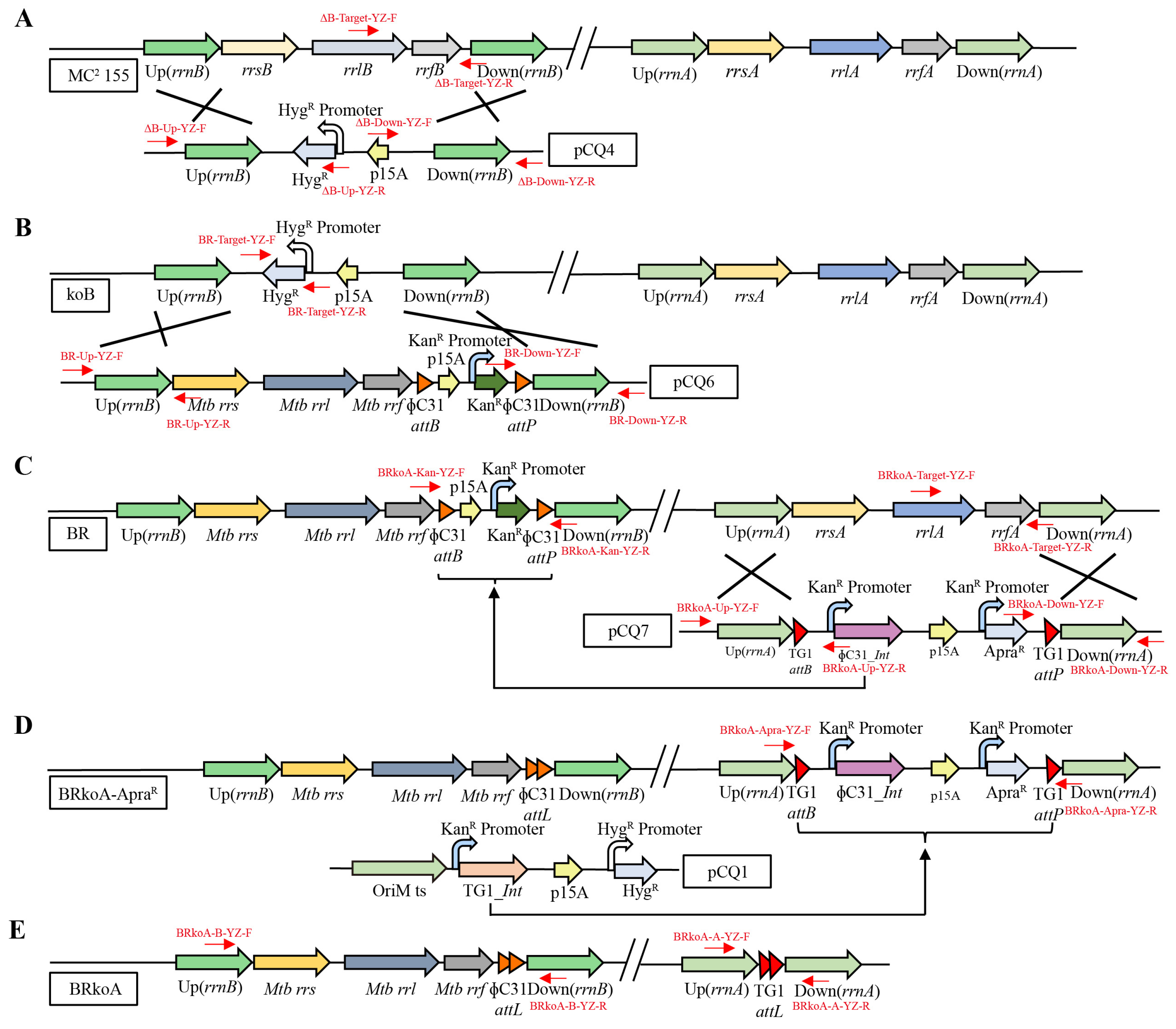
To construct the M. smegmatis BRkoA strain, we employed an efficient circular gene knockout system [18] combined with homologous recombination and a multiple serine integrase-mediated site-specific recombination strategy [19] to replace both endogenous rrn operons of M. smegmatis MC2 155 with the rrn operon from M. tuberculosis H37Rv. A schematic overview of the strain construction workflow is shown in Figure 1. In the first step, M. smegmatis MC2 155 was transformed with plasmid pCQ4 to disrupt the native rrnB operon, generating the knockout strain koB (Figure 1A). In the second step, plasmid pCQ6 was introduced into the koB strain, resulting in strain BR, which contained one native rrnA operon and one M. tuberculosis rrn operon (Figure 1B). Subsequently, plasmid pCQ7 was used to replace the remaining native rrnA operon, yielding the BRkoA-ApraR strain that carried only the M. tuberculosis rrn operon (Figure 1C). In the fourth step, pCQ1 was introduced to excise the antibiotic resistance cassette, producing the BRkoA-HygR strain (Figure 1D). Finally, heat-induced plasmid curing was performed to remove pCQ1, generating the final BRkoA strain, which harbors the M. tuberculosis rrn operon without any antibiotic marker (Figure 1E). Together, these genetic manipulations successfully replaced both endogenous rrn operons of M. smegmatis with the M. tuberculosis rrn operon, resulting in the construction of the marker-free BRkoA strain.
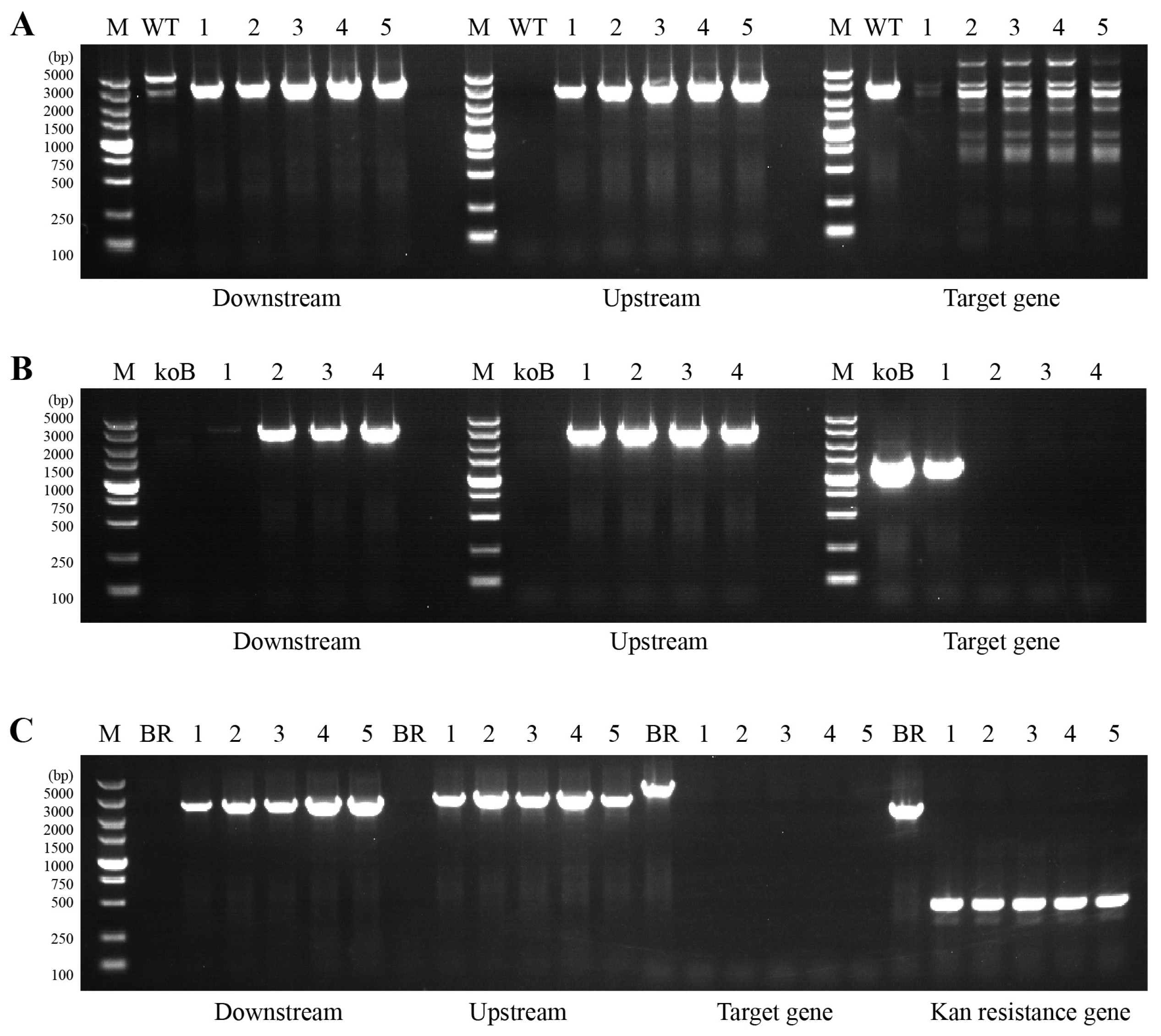
The M. smegmatis derivative strains were verified through PCR amplification using primer sets targeting the upstream and downstream homologous arm exchange regions, internal regions of the target genes, and both ends of the integrase recognition sites. Compared with the wild-type (WT) strain, PCR analysis confirmed successful deletion of the rrnB operon in M. smegmatis MC2 155 for knockout clones 1 to 5 (Figure 2A). When compared with the rrnB knockout (koB) strain, the rrn operon from M. tuberculosis H37Rv was successfully integrated and complemented in BR strains 2 to 4, as verified by PCR amplification (Figure 2B). Subsequently, deletion of the rrnA operon from M. smegmatis MC2 155 in the complemented BR background was achieved, resulting in the BRkoA-ApraR strains (clones 1–5), which were validated by PCR using the same primer strategy (Figure 2C).
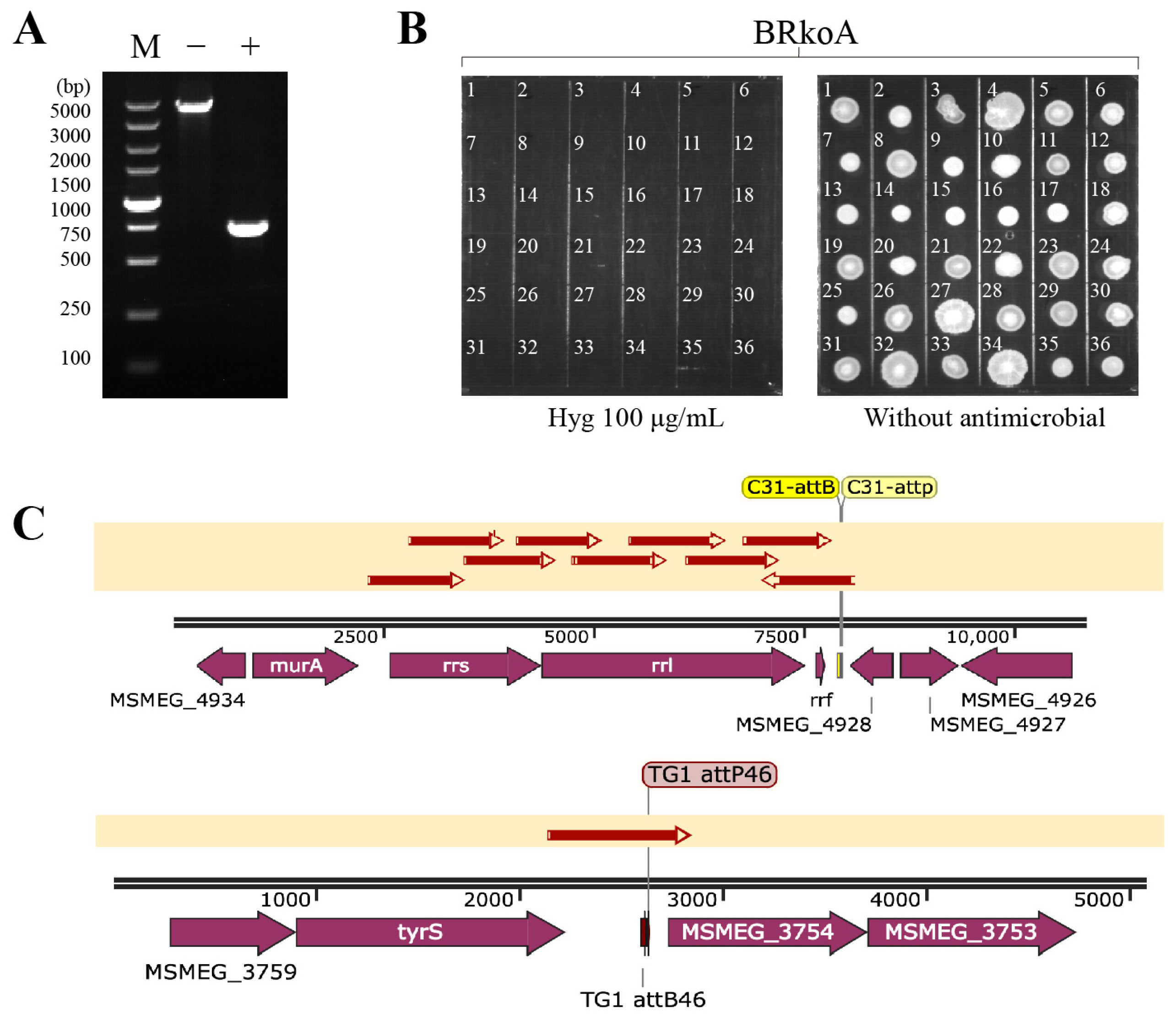
Following the removal of the apramycin resistance cassette, PCR analysis confirmed successful excision of the ApraR marker in the BRkoA-HygR strain (Figure 3A). The elimination of hygromycin resistance was further verified phenotypically: BRkoA colonies (1–36) were able to grow on 7H10 agar plates without antibiotics but failed to grow on plates supplemented with hygromycin B (Figure 3B), confirming the loss of hygromycin resistance. Finally, the correct genomic arrangement of the BRkoA strain was validated by Sanger sequencing, confirming precise recombination at the expected loci (Figure 3C). Together, these results demonstrate the successful construction of an M. smegmatis BRkoA strain harboring a heterologous M. tuberculosis rrn operon, thereby generating a strain with hybrid ribosomal composition.

2.2. Growth Characteristics of the M. smegmatis BRkoA Strain

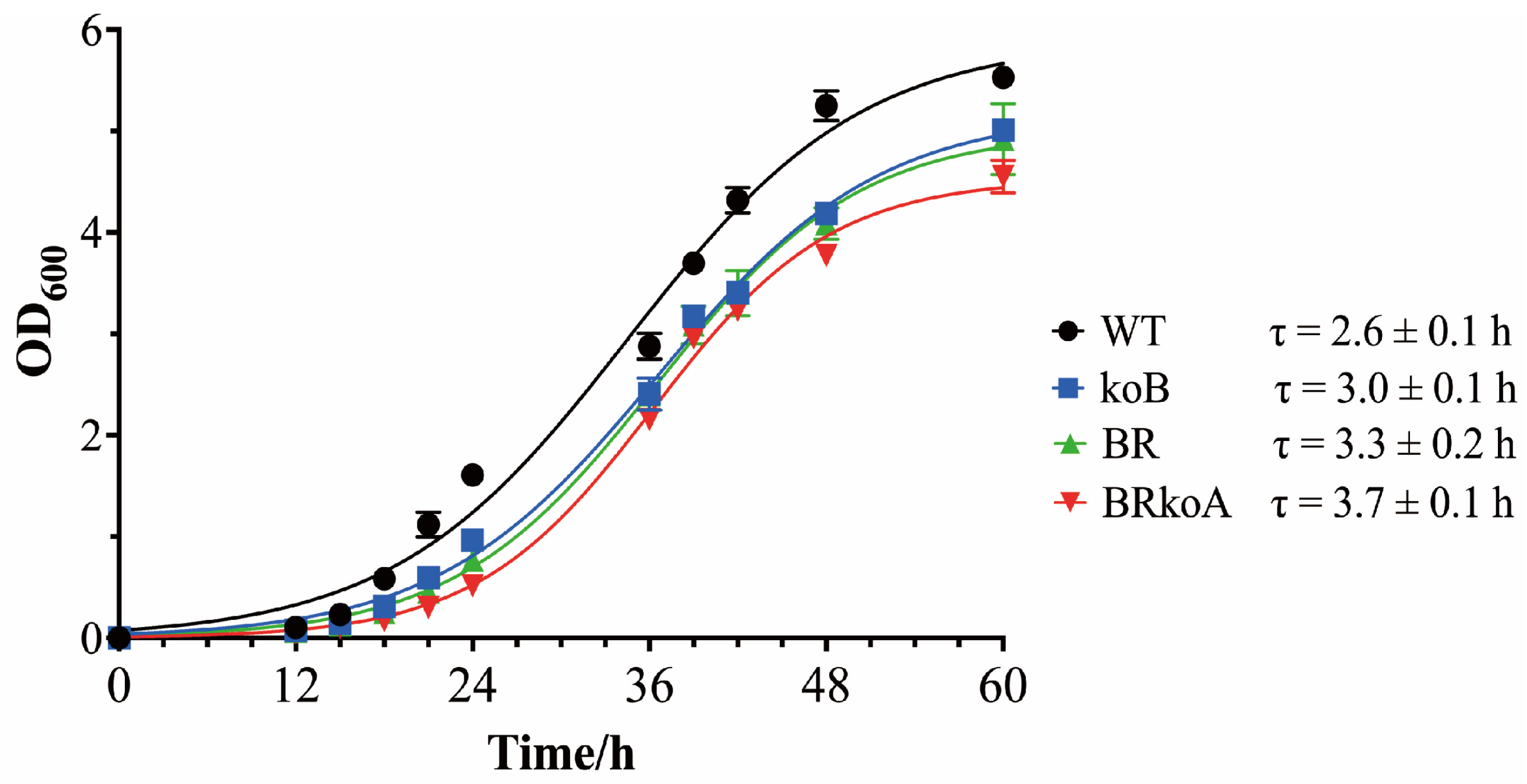
To evaluate the impact of rrn replacement on cellular growth, we monitored the OD600 of all strains cultured in 7H9 medium. The WT strain exhibited the fastest growth, reaching stationary phase earlier and achieving the highest final biomass. Both koB and BR strains demonstrated moderate growth attenuation relative to WT but were nearly indistinguishable from each other, indicating that the presence of a single rrnA operon either alone (koB) or coexisting with an additional M. tuberculosis rrn operon (BR) is sufficient to maintain near-normal growth (Figure 4).
In contrast, the BRkoA strain grew substantially more slowly across all time points. Because BRkoA depends exclusively on the M. tuberculosis rrn operon for rRNA synthesis, these data suggest that the heterologous rrn operon alone cannot fully support optimal ribosome production and cellular proliferation in M. smegmatis.

2.3. Transcriptional Level of M. smegmatis BRkoA Strain

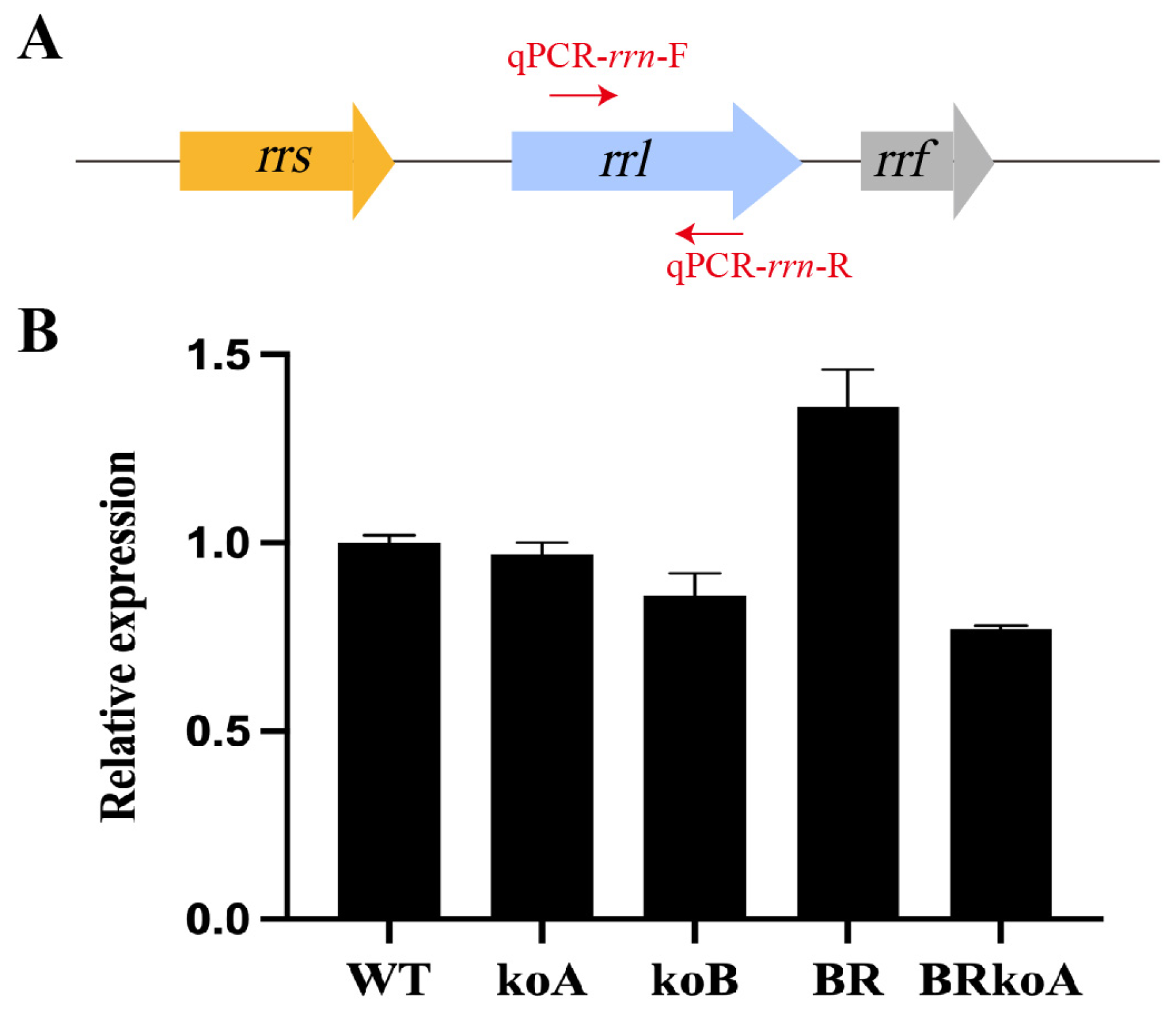
The rrn between M. smegmatis MC2 155 and M. tuberculosis H37Rv share high sequence identity (~91.2%), primers (qPCR-rrn-F and qPCR-rrn-R) targeting a conserved region of rrl shared by both species were designed to assess the rRNA level (Figure 5A). qPCR analysis revealed distinct expression patterns in WT and rrn-modified derivative strains (Figure 5B). After normalizing to WT, rRNA levels were slightly reduced in koB (0.86-fold) and marginally reduced in koA (0.97-fold), which only contained one native operon. In contrast, rRNA levels were modestly elevated in BR (1.36-fold), which contained the native M. smegmatis rrnA operon and the M. tuberculosis rrn operon.
Notably, BRkoA exhibited a moderate reduction in rRNA level (0.77-fold) compared to WT and koA, consistent with the slowed growth phenotype and suggesting that the heterologous rrn operon alone does not fully sustain the optimal rRNA supply required for rapid proliferation.

2.4. Cold Sensitivity of M. smegmatis BRkoA Strain

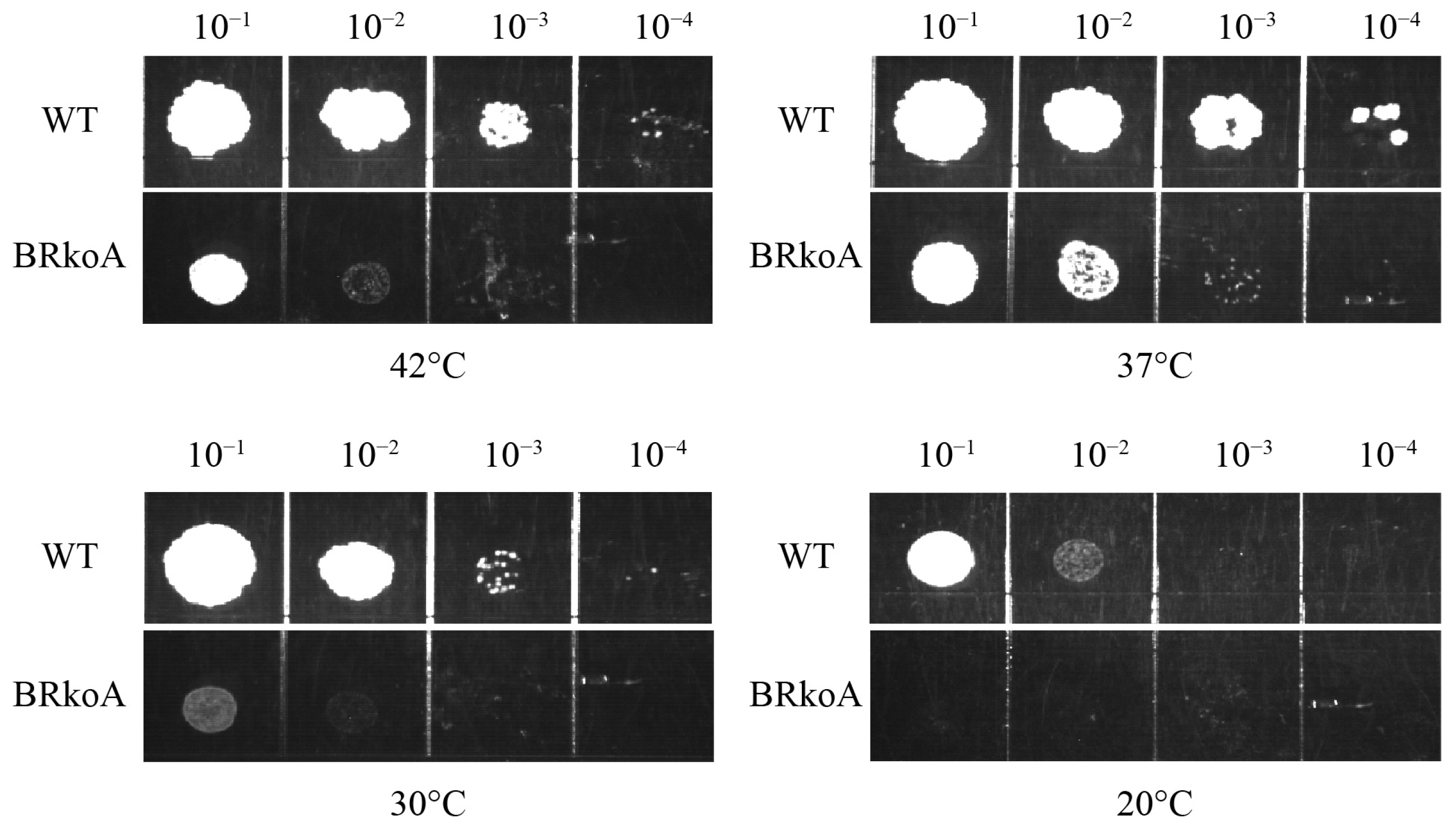
Mutations that impair ribosome assembly often confer temperature-sensitive growth defects, particularly at lower temperatures [20,21]. To determine whether the BRkoA affects ribosome biogenesis, we evaluated the temperature-dependent growth of the BRkoA and WT M. smegmatis using serial dilution spot assays. Cultures were incubated at 42 °C, 37 °C, 30 °C, and 20 °C (Figure 6).
At the best growth temperature of 37 °C, BRkoA already exhibited a slight reduction in colony formation compared with WT. Growth impairment became more pronounced at non-optimal temperatures. At 30 °C, BRkoA displayed a substantial decrease in viability, whereas at 20 °C, growth was nearly abolished, indicating a strong cold-sensitive phenotype. A large reduction in growth was also observed at 42 °C, suggesting sensitivity to both heat and cold stress. These findings indicate that rRNA is important for maintaining normal ribosome function across temperature ranges, and the pronounced cold sensitivity of the mutant is consistent with a defect in ribosomal assembly or maturation.

2.5. 70S Ribosome Structure of the M. smegmatis BRkoA Strain

To assess whether heterologous replacement of the rrn operon alters ribosome architecture in Mycobacterium, we visualized the 70S ribosomes from the M. smegmatis BRkoA strain. Sucrose gradient analysis of BRkoA showed that at a high Mg2+ concentration most of the ribosomal material sedimented as a 70S peak and a 50S peak (Figure S1). Ribosomes of the 70S peak were collected from sucrose gradients and analyzed by cryogenic electron microscopy (cryo-EM). The structure of the BRkoA 70S ribosome was resolved at 2.8 Å, allowing comparison with previously determined ribosome structures.
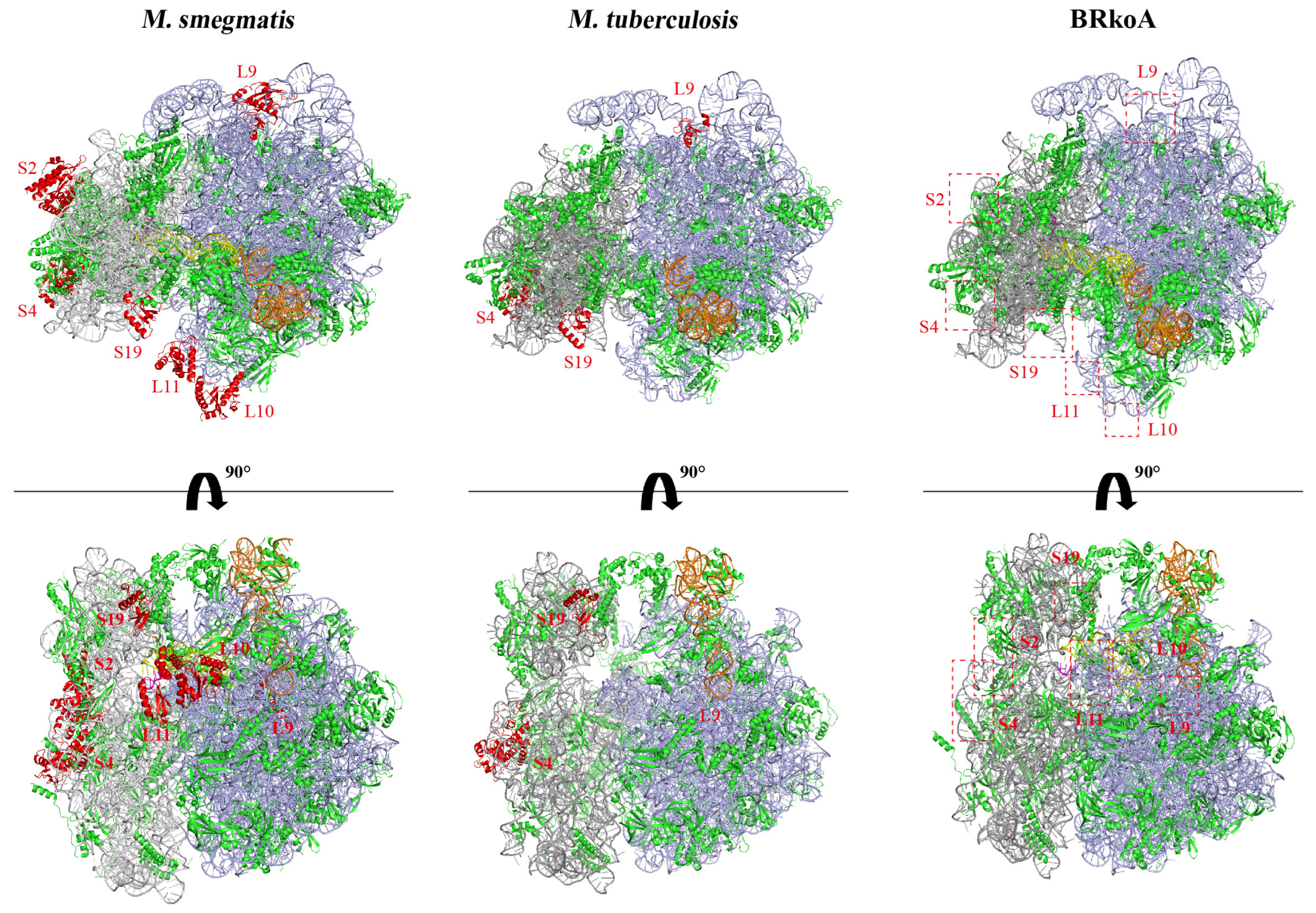
Relative to the native M. smegmatis 70S ribosome, several ribosomal proteins were absent in the BRkoA map, including L9, L10, and L11 on the large subunit and S2, S4, and S19 on the small subunit. When compared with the M. tuberculosis 70S ribosome, the BRkoA structure similarly lacked L9, S4, and S19. These missing densities correspond to flexible peripheral proteins and may reflect either increased disorder or reduced occupancy in the engineered ribosomes (Figure 7). Overall, the structural analysis indicates that the heterologous M. tuberculosis-derived ribosome expressed in the BRkoA strain is highly similar to the native M. tuberculosis 70S ribosome, while differing more substantially from the endogenous M. smegmatis ribosome.

2.6. Susceptibility Profiles of M. smegmatis BRkoA Strain

To assess whether heterogeneous rRNA influence the susceptibility of the M. smegmatis BRkoA strain to ribosome-targeting antimicrobial agents, we first determined the minimal inhibitory concentrations (MICs) for M. smegmatis MC2 155 and BRkoA. The MICs for MC2 155 were: 1 μg/mL for kanamycin, 1 μg/mL for amikacin, 2 μg/mL for paromomycin, 2 μg/mL for gentamicin, and 2 μg/mL for linezolid. In comparison, the BRkoA strain exhibited MICs of 2 μg/mL for kanamycin, 1 μg/mL for amikacin, 4 μg/mL for paromomycin, 4 μg/mL for gentamicin, and 4 μg/mL for linezolid (Table 1).
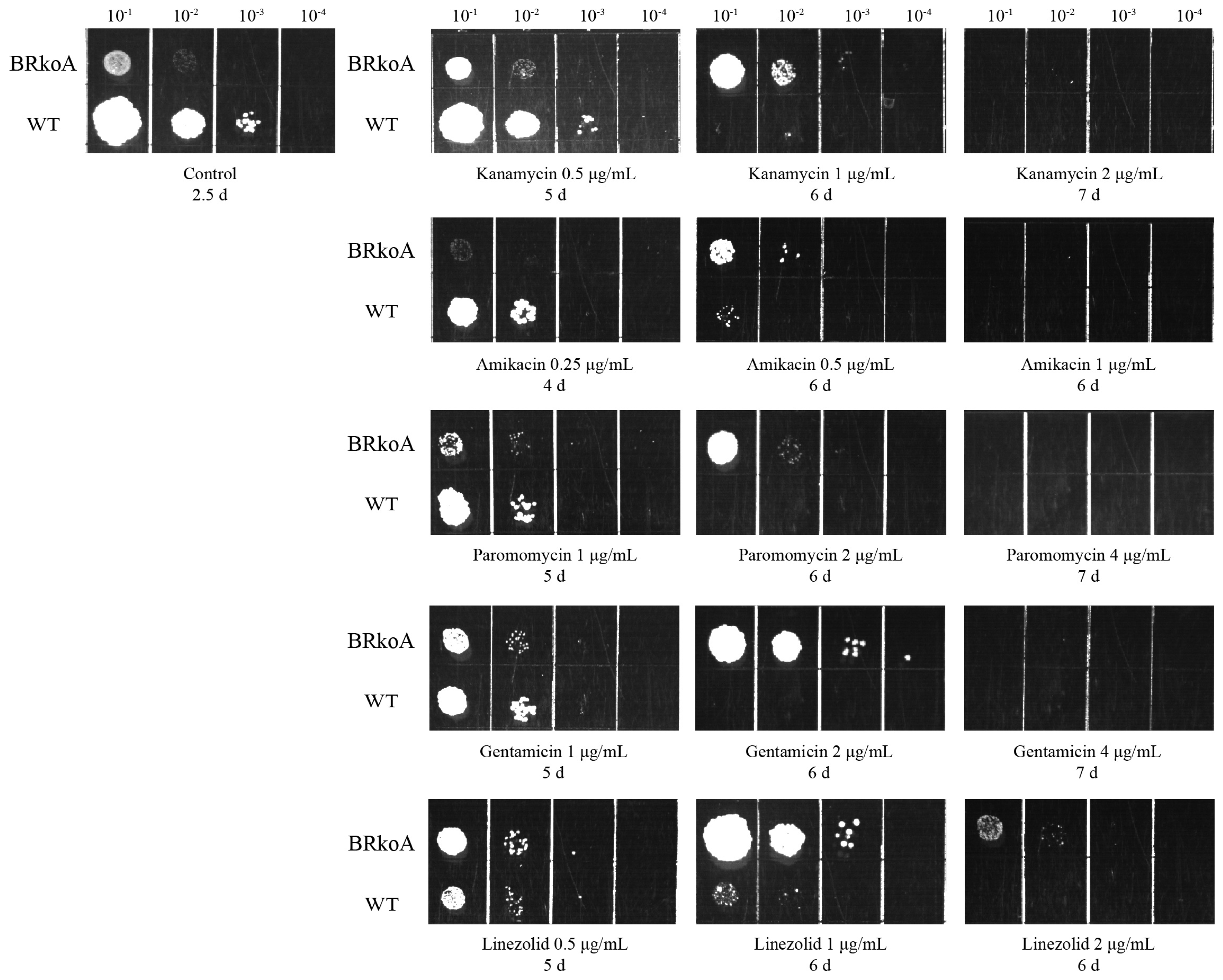
We next compared the growth of M. smegmatis MC2 155 and BRkoA across serial dilutions when exposed to each antibiotic (Figure 8). Under control conditions, both strains grew comparably at all dilutions. However, upon antibiotic exposure, BRkoA consistently showed greater survival than WT, particularly at higher concentrations and longer incubation times. For example, WT growth was nearly abolished at 1 μg/mL kanamycin by day 6, whereas BRkoA retained visible colonies at 10−2 and 10−3 dilutions. A similar trend was observed for amikacin, paromomycin, gentamicin, and linezolid: at concentrations corresponding to or exceeding the WT MICs, BRkoA maintained growth at multiple dilutions where WT growth was completely inhibited. These results demonstrated that the BRkoA strain exhibits reduced sensitivity tendency to kanamycin, amikacin, paromomycin, gentamicin, and linezolid, consistent with the elevated MICs observed.

3. Discussion

The ribosome is composed of ribosomal proteins and rRNA, and rRNA serving as the structural scaffold of the ribosome plays an essential role in its architecture and function [22]. In this study, we used a homologous recombination strategy combined with a multiple serine integrase-mediated site-specific recombination system to construct the M. smegmatis BRkoA strain, which contains a heterologous ribosome composed of M. tuberculosis H37Rv rRNA and M. smegmatis MC2 155 ribosomal proteins [18]. By comparing the growth curves of the koB, BR, and BRkoA strains, we found that both deletion of the native rrn operon in M. smegmatis and complementation with the M. tuberculosis rrn operon significantly affected bacterial growth.
The koB strain exhibited slower growth, possibly due to differences in promoter number and regulatory strength between the rrnB and rrnA operons. The rrnB operon is driven by three promoters, whereas rrnA has only one [17]. With only the rrnA operon remaining in the koB strain, transcriptional regulation becomes limited, insufficient to maintain rRNA levels comparable to the WT strain, resulting in reduced growth. Complementation with the M. tuberculosis rrn operon in the BR strain did not restore growth to wild-type levels; instead, its growth resembled that of koB. This may reflect suboptimal assembly or functionality of the heterologous ribosomes, leading to reduced fitness relative to WT. When the M. smegmatis rrnA operon was additionally deleted to generate the BRkoA strain, growth was further impaired, indicating that dependence on the heterologous M. tuberculosis rRNA alone exacerbates the growth defect.
The operons encode large primary transcripts that are processed and chemically modified, and then assembled into ribosomes with ribosomal proteins in a multi-step process [23]. To further investigate the relative expression of the rrn operons, we used qPCR primers designed within a homologous region of rrl shared by both species, the rRNA levels were slightly reduced in koB (0.86-fold) and modestly elevated in BR (1.36-fold). Notably, BRkoA exhibited a moderate reduction in rRNA level (0.77-fold) compared to WT and koA, indicating that heterologous substitution of rRNA altered rRNA processing.
Defects in ribosome biogenesis are frequently associated with cold-sensitive phenotypes [20,21]. Consistent with this, the M. smegmatis BRkoA strain harboring heterogeneous rRNA exhibited growth at 37 °C but failed to form colonies at 30 °C. This cold sensitivity suggests that ribosomes assembled from M. tuberculosis rRNA and M. smegmatis ribosomal proteins may be compromised in assembly or stability under sub-optimal temperatures. To further investigate these defects, we examined the structure of the 70S ribosome from the BRkoA strain using cryo-EM. Compared with the M. smegmatis 70S structure, ribosomal proteins L9, L10, L11, S2, S4, and S19 were absent in the BRkoA ribosome. When compared with the M. tuberculosis 70S ribosome, proteins L9, S4, and S19 were absent. These structural differences indicate incomplete or altered assembly of the heterologous ribosome. Nevertheless, the overall architecture of the BRkoA 70S ribosome more closely resembled that of M. tuberculosis, consistent with its rRNA origin. Mass-spectrometry can be used for further quantitative proteomics analysis the presence of individual ribosomal proteins in BRkoA.
The ribosome is one of the primary targets of antibacterial agents, with many antibiotics exerting their effects by interfering with either the small 30S or the large 50S subunit [24,25]. In this study, we observed that the M. smegmatis BRkoA strain exhibited reduced sensitivity tendency to kanamycin, amikacin, paromomycin, gentamicin, and linezolid. Kanamycin, amikacin, paromomycin, and gentamicin belong to the aminoglycoside class. Kanamycin exerts an influence that diminishes the accuracy of mRNA translation by interacting with the 16S rRNA helix 44 [26]. Amikacin is derived of kanamycin, interacts with the 30S small subunit and suppresses the assembly of the initiation complex; additionally, it promotes mistranslation during the elongation phase and blocks peptide release during termination, thereby preventing ribosome recycling [27]. Paromomycin and gentamicin also bind near the top of helix 44, inducing conformational rearrangements of A1492 and A1493 that facilitate binding of non-cognate tRNAs to the A site and increase miscoding [28]. Linezolid, an oxazolidinone antibiotic, binds to a pocket within domain V of the 23S rRNA peptidyl transferase center and prevents peptide transfer during protein synthesis [14]. Given these mechanisms, the reduced susceptibility tendency of the BRkoA strain suggests that the heterologous ribosome composed of M. tuberculosis rRNA assembled with M. smegmatis ribosomal proteins undergoes structural alterations that may impact antibiotic binding sites. Such changes in spatial conformation could diminish the ability of multiple ribosome-targeting antibiotics to correctly recognize or interact with their binding regions, thereby contributing to the observed phenotype of reduced drug sensitivity tendency. Amikacin is derived of kanamycin, obtained through acetylation with the L(-)-gamma-amino-alpha-hydroxybutyryl side chain at the C-1 amino group of the deoxystreptamine moiety and its antibacterial activity is generally equal to or greater than that of kanamycin against sensitive organisms [29]. The MIC of amikacin in BRkoA remained unchanged, likely due to its alpha-hydroxyl group and terminal basic function in the side chain overcoming modifications and maintain stable target binding.
The possession of a fully assembled ribosome containing all ribosomal proteins and rRNAs are critical for bacterial survival and function [23,30]. As the core machinery for protein synthesis, the ribosome’s integrity directly determines a bacterium’s ability to efficiently and accurately translate mRNA into functional protein. A complete ribosome comprises not only rRNA and ribosomal proteins but also requires precise processing and assembly steps to form an active structure. Defects in rRNA process can disrupt ribosome assembly, leading to reduced protein synthesis rates, slowed cell growth, and even metabolic dysregulation or impaired stress responses. The BRkoA strain grew substantially more slowly compared to WT, therefore necessitates sufficient pre-experimental incubation time to achieve appropriate cell density. Notably, the parental strain of BRkoA is non-pathogenic, and the engineering only heterologous substitution of rRNA without introducing virulence genes, ensuring strain safety. Furthermore, antibiotic susceptibility experiments further demonstrate that BRkoA serves as a promising novel research chassis, exhibiting significant potential in drug screening. Looking forward, the BRkoA strain is expected to become a tool used for the high-throughput discovery of ribosome-targeting antibiotics. Expanding the scope, the heterologous substitution of rRNA along with the strategies presented herein might act as alternative entry points for uncovering and facilitating the laboratory evolution of unprecedented translational properties.

4. Materials and Methods

4.1. Bacterial Strains and Culturing Conditions

The characteristics of the bacterial strains used in this study are listed in Table S1. Escherichia coli DH10B was grown either in Luria–Bertani (LB) broth or on LB solid media at 37 °C for 12–16 h. M. smegmatis MC2 155 and its derivative strains were grown either in Middlebrook 7H9 broth (BD Difco, Sparks, MD, USA) supplemented with 10% OADC (Oleic Albumin Dextrose Catalase) growth supplement (100 mL OADC containing 12 µL oleic acid, 5 g albumin, 2 g glucose, 0.03 g catalase, and 0.85 g NaCl) and 0.05% Tween-80 at 37 °C for 1–3 days or on Middlebrook 7H10 solid media (BD Difco, Sparks, MD, USA) supplemented with 10% OADC and 0.4% glycerol at 37 °C for 2–7 days. The gene SacB was employed for negative selection, and 10% sucrose was added to 7H9-OADC broth or 7H10-OADC solid media when required. Antibiotic was added to LB broth, LB solid media, 7H9-OADC broth or 7H10-OADC solid media at the following final concentrations when appropriate: kanamycin (50 µg/mL), ampicillin (100 µg/mL), hygromycin B (100 µg/mL), and apramycin (50 µg/mL), respectively.

4.2. Construction of Plasmids

The plasmids used in this study are summarized in Table S2, and the primers are listed in Table S3. The construction of plasmids was carried out as follows. First, target PCR products list in Table S3 were amplified using specific primers and High-Fidelity DNA Polymerase (Vazyme, Nanjing, China) following the manufacturer’s instructions on VeritiTM (Applied Biosystems, Waltham, MA, USA). Products pCQ1-oriMts and pCQ1-TGint-ori p15A-Hyg were used to construct pCQ1; pCQ4-ΔB-left flank, pCQ4-ΔB-right flank, pCQ4-ΔB-SacB, pCQ4-ΔB-Amp, pCQ4-ΔB-ori p15A&Hyg were used to construct pCQ4; pCQ6-BR-left flank, pCQ6-BR-right flank, pCQ6-BR-SacB, pCQ6-BR-Mt rrn, pCQ6-BR-ori p15A&Kan were used to construct pCQ6; pCQ7-ΔA-left flank, pCQ7-ΔA-right flank, pCQ7-ΔA-SacB&Amp, pCQ7-ΔA-ϕC31-ori p15A&Apar were used to construct pCQ7. PCR products were then analyzed by agarose gel electrophoresis and purified using an Agarose Gel DNA Extraction Kit (Vazyme, Nanjing, China) following the manufacturer’s instructions. Next, purified PCR fragments were seamlessly ligated using a NovoRec® plus One step PCR Cloning Kit (Novoprotein, Suzhou, China) and subsequently transformed into E. coli DH10B competent cells following the manufacturer’s instructions. The plasmids were extracted from bacterial clones using a Plasmid Preparation Kit and the recombinant constructs were verified by restriction endonuclease digestion (Thermo Fisher Scientific, Waltham, MA, USA) and confirmed through Sanger sequencing (Tsingke, Beijing, China).

4.3. Bacterial Growth Curve

M. smegmatis BRkoA and MC2 155 control strains were initially cultured on 7H10-OADC plates and incubated at 37 °C until visible colonies appeared (approximately 3 days). Then, individual colonies were selected and inoculated into 3 mL of 7H9-OADC liquid medium, which was then cultured for 1–2 days to generate seed cultures. Each seed culture was subsequently diluted with 7H9-OADC medium to an OD600 of 1. The diluted cultures were further inoculated at 1% (v/v) into 100 mL of 7H9-OADC medium in conical flasks, with each experimental group performed in biological triplicate. The OD600 of each culture was measured 12 h post-inoculation, then every 3 h during logarithmic growth, every 6 h in the late logarithmic phase, and every 12 h upon reaching the stationary phase. Growth data were fitted using the logistic growth model in GraphPad PRISM 8.0.2. Growth curves were plotted with time as the x-axis and the mean OD600 of each group as the y-axis. The doubling time of each culture was calculated using the Growthcurver package v0.3.0 in R v3.5.2.

4.4. Cold Sensitivity Experiment

The growth patterns of the M. smegmatis MC2 155 and BRkoA were compared by monitoring OD600 at regular intervals. For the cold sensitivity assay, mid-log phase cultures (OD600 ≈ 1.0) were harvested and diluted 1:10 with 1× PBS to achieve an OD600 of 0.1. Subsequently, 100 μL dilution was further serially diluted by 900 μL PBS to prepare 10-fold serial dilutions ranging from 10−1 to 10−4. Aliquots of 5 μL from each dilution were then spotted on 7H10 plates and incubated at 42 °C, 37 °C, 30 °C, and 20 °C for 3 days.

4.5. RT-qPCR

Primers used for qPCR are listed in Table S4. To assess the transcript levels of rrn, M. smegmatis MC2 155 and BRkoA were grown at 37 °C in Middlebrook 7H9 medium until reaching an OD600 of 0.8. Total RNA was extracted using RNAprep Pure Cell/Bacteria Kit (TIANGEN, Beijing, China). Briefly, 20 mL of bacterial culture was harvested by centrifugation at 4500 rpm for 10 min, and the pellet was resuspended in 1 mL of lysis buffer RL on ice. Cells were disrupted using acid-washed glass beads (Sigma-Aldrich, St. Louis, MO, USA) in a Tissue Lyser (Wonbio, Shanghai, China) at 50 Hz for 60 s, followed by cooling at −80 °C for 60 s. This cycle was repeated six times to ensure thorough cell lysis. Subsequent steps were performed to obtain RNA following the manufacturer’s protocol, taking care to avoid RNase contamination. RNA amount and purity was checked using Nano drop 2000 (Thermo Fisher Scientific, Waltham, MA, USA).
cDNA synthesis was performed using HiScript Q RT SuperMix for PCR (Vazyme, Nanjing, China) following the manufacturer’s instructions. RT-qPCR was carried out using HiScript III RT SuperMix for qPCR (+gDNA wiper) (Vazyme, Nanjing, China) on a Bio-Rad Real-Time PCR System (Bio-Rad, Hercules, CA, USA). The qPCR program was 95 °C for 30 s, followed by 40 cycles (95 °C for 10 s, 60 °C for 30 s), then 95 °C for 15 s, 60 °C for 5 s, 95 °C for 15 s. Each reaction was performed in duplicate using three independent cDNA preparations. Gene expression levels were normalized to the housekeeping gene sigA, and relative expression was calculated using the 2−ΔΔCt method.

4.6. Sucrose Gradient Analysis of Ribosomes

Bacterial cells were harvested from 200 mL cultures at OD600 ≈ 1.0 by centrifugation at 4000× g for 5 min at 4 °C. Cell pellets were resuspended in 30 mL of ice-cold resuspension buffer (20 mM Tris-HCl, pH 8.0, 100 mM NH4Cl, 12 mM MgCl2, and 6 mM β-mercaptoethanol) and collected again by centrifugation at 4000× g for 15 min at 4 °C. Pellets were then resuspended in 1 mL of ice-cold lysis buffer (1 mM PMSF, 0.5 U/mL RNase inhibitor and 10 U/mL DNase I).
Cells were disrupted using acid-washed glass beads (Sigma-Aldrich, St. Louis, MO, USA) in a Tissue Lyser (Wonbio, Shanghai, China) at 70 Hz for 60 s, followed by cooling at −80 °C for 60 s. This cycle was repeated six times to ensure thorough lysis. Lysates were clarified by centrifugation at 15,000× g for 15 min at 4 °C. The supernatants were loaded onto 12 mL of 10–50% linear sucrose gradients prepared in resuspension buffer. Gradients were centrifuged at 39,000 rpm for 4 h at 4 °C in an SW41 rotor (Beckman Coulter, Brea, CA, USA), and fractionated using a gradient fractionator (BioComp, Fredericton, NB, Canada). Fractions containing 70S ribosomes were pooled, buffer-exchanged into ice-cold resuspension buffer, and stored at −80 °C.

4.7. Cryo-EM Analysis of 70S Ribosomes

Cryo-EM grids were prepared by applying 5 μL of sample onto freshly glow-discharged R2/1 holey carbon grids (Quantifoil Micro Tools, Jena, Germany) and allowing the sample to adsorb for 8 s in a chamber maintained at 100% humidity and 4 °C. Grids were then blotted and plunge-frozen into liquid ethane cooled by liquid nitrogen using a Vitrobot Mark IV (Thermo Fisher Scientific, Waltham, MA, USA).
Frozen grids were loaded into a Titan Krios G3i transmission electron microscope (Thermo Fisher Scientific, Waltham, MA, USA). Data acquisition was performed using EPU software (v2.2.2.10REL), collecting image stacks of 40 frames at a total electron dose of 50 e2, a defocus range of −0.5 to −2.5 μm, and a total exposure time of 3.02 s.
Raw micrographs were motion-corrected using MotionCor2 to compensate for drift and beam-induced motion [31]. Contrast transfer function (CTF) parameters were estimated using Gctf_v1.06. Subsequent data processing, including several iterations of 2D and 3D classification, was performed in cryoSPARC v2, followed by masked local refinement in RELION v3.0 to generate the final 3D reconstruction [32,33].
For model building, the structure of M. smegmatis and M. tuberculosis ribosome were rigid-body docked into the cryo-EM density using UCSF Chimera v1.14 [34]. The model was further adjusted in COOT and real-space refined in Phenix v1.19.2 [35]. Figures were generated using PyMOL v2.4.1.

4.8. Antimicrobial Susceptibility Testing

The seed culture underwent dilution to achieve an OD600 of approximately 0.1. MICs were determined using the microdilution method [36]. Briefly, a volume of 50 μL of bacterial suspension, with an approximate concentration of 5 × 10⁵ CFU, was put into each well of sterile, flat-bottom 96-well plates (Sangon Biotech, Shanghai, China) containing antimicrobial agents at 2-fold serial dilutions. The agents tested included kanamycin, amikacin, paromomycin, gentamicin, and linezolid, with concentrations ranging from 0.125 to 64 μg/mL. Plates were incubated at 37 °C for 1.5 days, with growth in wells without antimicrobial agents serving as the positive control.
For the dilution dot assay, seed cultures (OD600~0.1) were further diluted in 10−1 to 10−4 gradients. Aliquots of 5 μL from each dilution were spotted onto plates with or without antimicrobial agents at various concentrations. Plates were incubated until colonies emerged.

5. Conclusions

We successfully constructed the M. smegmatis BRkoA strain harboring a heterologous ribosome, in which the two endogenous rrn operons of M. smegmatis MC2 155 were replaced with a single copy rrn operon from M. tuberculosis H37Rv. The BRkoA strain exhibited ribosome assembly defects, likely due to altered rRNA processing and the absence of specific ribosomal proteins. Moreover, BRkoA displayed reduced sensitivity tendency to multiple antibiotics, including kanamycin, amikacin, paromomycin, gentamicin, and linezolid.

Supplementary Materials

The following supporting information can be downloaded at: https://www.mdpi.com/article/10.3390/antibiotics15010030/s1, Figure S1: Sucrose gradient separation of the ribosomal material from M. smegmatis BRkoA, Table S1: Strains used in this study; Table S2: Plasmids used in this study; Table S3: Primers used in this study for construct the corresponding plasmids or Sanger sequencing; Table S4: Primers used in this study for construct the corresponding strains or Sanger sequencing.

Author Contributions

Conceptualization, Q.Y.; Methodology, Q.Y., X.D. and G.Z.; Validation and formal analysis, Q.Y., C.S. and A.H.; Writing—original draft, Q.Y. and A.H.; Writing—review and editing, X.D. and A.H.; Supervision, X.D. and G.Z. All authors have read and agreed to the published version of the manuscript.

Funding

This work was supported by the National Key Research and Development Program of China (2020YFA0908300) and the National Natural Science Foundation of China (31970049).

Institutional Review Board Statement

Not applicable.

Informed Consent Statement

Not applicable.

Data Availability Statement

The original contributions presented in this study are included in the article and Supplementary Materials. Further inquiries can be directed to the corresponding author.

Acknowledgments

We express our gratitude to Guoliang Lu and Zhaoli Yu, School of Life Sciences, Fudan University for their support and assistance in the structural studies of ribosomes.

Conflicts of Interest

The authors declare no conflicts of interest.

References

  1. Koch, A.; Mizrahi, V. Mycobacterium tuberculosis. Trends Microbiol. 2018, 26, 555–556. [Google Scholar] [CrossRef]
  2. WHO. Global Tuberculosis Report 2025; World Health Organization: Geneva, Switzerland, 2025. [Google Scholar]
  3. Green, R.; Noller, H.F. Ribosomes and translation. Annu. Rev. Biochem. 1997, 66, 679–716. [Google Scholar] [CrossRef]
  4. Steitz, T.A. A structural understanding of the dynamic ribosome machine. Nat. Rev. Mol. Cell Biol. 2008, 9, 242–253. [Google Scholar] [CrossRef] [PubMed]
  5. Ramakrishnan, V. The ribosome emerges from a black box. Cell 2014, 159, 979–984. [Google Scholar] [CrossRef]
  6. Gomez, J.E.; Kaufmann-Malaga, B.B.; Wivagg, C.N.; Kim, P.B.; Silvis, M.R.; Renedo, N.; Ioerger, T.R.; Ahmad, R.; Livny, J.; Fishbein, S.; et al. Ribosomal mutations promote the evolution of antibiotic resistance in a multidrug environment. eLife 2017, 6, e20420. [Google Scholar] [CrossRef] [PubMed]
  7. Choudhary, E.; Lunge, A.; Agarwal, N. Strategies of genome editing in mycobacteria: Achievements and challenges. Tuberculosis 2016, 98, 132–138. [Google Scholar] [CrossRef]
  8. Sundarsingh, T.J.A.; Ranjitha, J.; Rajan, A.; Shankar, V. Features of the biochemistry of Mycobacterium smegmatis, as a possible model for Mycobacterium tuberculosis. J. Infect. Public Health 2020, 13, 1255–1264. [Google Scholar] [CrossRef]
  9. Reyrat, J.M.; Kahn, D. Mycobacterium smegmatis: An absurd model for tuberculosis? Trends Microbiol. 2001, 9, 472–474. [Google Scholar] [CrossRef]
  10. Shiloh, M.U.; Champion, P.A.D. To catch a killer. What can mycobacterial models teach us about Mycobacterium tuberculosis pathogenesis? Curr. Opin. Microbiol. 2010, 13, 86–92. [Google Scholar] [CrossRef] [PubMed]
  11. Chaturvedi, V.; Dwivedi, N.; Tripathi, R.P.; Sinha, S. Evaluation of Mycobacterium smegmatis as a possible surrogate screen for selecting molecules active against multi-drug resistant Mycobacterium tuberculosis. J. General. Appl. Microbiol. 2007, 53, 333–337. [Google Scholar] [CrossRef]
  12. Mamadou, D.; Marie-Ange, D.; Nicole, G. The cell envelope of Mycobacterium smegmatis: Cytochemistry and architectural implications. FEMS Microbiol. Lett. 1989, 52, 89–93. [Google Scholar] [CrossRef] [PubMed]
  13. Lelovic, N.; Mitachi, K.; Yang, J.; Lemieux, M.R.; Ji, Y.; Kurosu, M. Application of Mycobacterium smegmatis as a surrogate to evaluate drug leads against Mycobacterium tuberculosis. J. Antibiot. 2020, 73, 780–789. [Google Scholar] [CrossRef]
  14. Hentschel, J.; Burnside, C.; Mignot, I.; Leibundgut, M.; Boehringer, D.; Ban, N. The Complete Structure of the Mycobacterium smegmatis 70S Ribosome. Cell Rep. 2017, 20, 149–160. [Google Scholar] [CrossRef]
  15. Yang, K.; Chang, J.Y.; Cui, Z.; Li, X.; Meng, R.; Duan, L.; Thongchol, J.; Jakana, J.; Huwe, C.M.; Sacchettini, J.C.; et al. Structural insights into species-specific features of the ribosome from the human pathogen Mycobacterium tuberculosis. Nucleic Acids Res. 2017, 45, 10884–10894. [Google Scholar] [CrossRef]
  16. Kushwaha, A.K.; Bhushan, S. Unique structural features of the Mycobacterium ribosome. Prog. Biophys. Mol. Biol. 2020, 152, 15–24. [Google Scholar] [CrossRef]
  17. Gonzalez, Y.M.J.A.; Colston, M.J.; Cox, R.A. The rRNA operons of Mycobacterium smegmatis and Mycobacterium tuberculosis: Comparison of promoter elements and of neighbouring upstream genes. Microbiology 1996, 142, 667–674. [Google Scholar] [CrossRef][Green Version]
  18. Lei, X.; Fan, Q.; Huang, T.; Liu, H.; Zhao, G.; Ding, X. Efficient circular gene knockout system for Burkholderiales strain DSM 7029 and Mycobacterium smegmatis mc2 155. Acta Biochim. Biophys. Sin. 2019, 51, 697–706. [Google Scholar] [CrossRef]
  19. Hmelo, L.R.; Borlee, B.R.; Almblad, H.; Love, M.E.; Randall, T.E.; Tseng, B.S.; Lin, C.; Irie, Y.; Storek, K.M.; Yang, J.J.; et al. Precision-engineering the Pseudomonas aeruginosa genome with two-step allelic exchange. Nat. Protoc. 2015, 10, 1820–1841. [Google Scholar] [CrossRef] [PubMed]
  20. Dammel, C.S.; Noller, H.F. A cold-sensitive mutation in 16S rRNA provides evidence for helical switching in ribosome assembly. Genes. Dev. 1993, 7, 660–670. [Google Scholar] [CrossRef]
  21. Connolly, K.; Culver, G. Deconstructing ribosome construction. Trends Biochem. Sci. 2009, 34, 256–263. [Google Scholar] [CrossRef] [PubMed]
  22. Steitz, T.A.; Moore, P.B. RNA, the first macromolecular catalyst: The ribosome is a ribozyme. Trends Biochem. Sci. 2003, 28, 411–418. [Google Scholar] [CrossRef] [PubMed]
  23. Giuliano, M.G.; Engl, C. Wellcome Trust–Funded Monographs and Book Chapters. The Lifecycle of Ribosomal RNA in Bacteria. In RNA Damage and Repair; Kotta-Loizou, I., Ed.; Springer Nature: Cham, Switzerland, 2021. [Google Scholar]
  24. Lin, J.; Zhou, D.; Steitz, T.A.; Polikanov, Y.S.; Gagnon, M.G. Ribosome-Targeting Antibiotics: Modes of Action, Mechanisms of Resistance, and Implications for Drug Design. Annu. Rev. Biochem. 2018, 87, 451–478. [Google Scholar] [CrossRef]
  25. Wilson, D.N. Ribosome-targeting antibiotics and mechanisms of bacterial resistance. Nat. Rev. Microbiol. 2014, 12, 35–48. [Google Scholar] [CrossRef]
  26. Watanabe, S.; Matsumura, K.; Iwai, H.; Funatogawa, K.; Haishima, Y.; Fukui, C.; Okumura, K.; Kato-Miyazawa, M.; Hashimoto, M.; Teramoto, K.; et al. A Mutation in the 16S rRNA Decoding Region Attenuates the Virulence of Mycobacterium tuberculosis. Infect. Immun. 2016, 84, 2264–2273. [Google Scholar] [CrossRef]
  27. Maus, C.E.; Plikaytis, B.B.; Shinnick, T.M. Molecular analysis of cross-resistance to capreomycin, kanamycin, amikacin, and viomycin in Mycobacterium tuberculosis. Antimicrob. Agents Chemother. 2005, 49, 3192–3197. [Google Scholar] [CrossRef] [PubMed]
  28. Carter, A.P.; Clemons, W.M.; Brodersen, D.E.; Morgan-Warren, R.J.; Wimberly, B.T.; Ramakrishnan, V. Functional insights from the structure of the 30S ribosomal subunit and its interactions with antibiotics. Nature 2000, 407, 340–348. [Google Scholar] [CrossRef]
  29. Kawaguchi, H. Discovery, chemistry, and activity of amikacin. J. Infect. Dis. 1976, 134, S242–S248. [Google Scholar] [CrossRef]
  30. Pertschy, B.; Zierler, I. Ribosomal Proteins in Ribosome Assembly. Biomolecules 2024, 15, 13. [Google Scholar] [CrossRef]
  31. Zheng, S.Q.; Palovcak, E.; Armache, J.P.; Verba, K.A.; Cheng, Y.; Agard, D.A. MotionCor2: Anisotropic correction of beam-induced motion for improved cryo-electron microscopy. Nat. Methods 2017, 14, 331–332. [Google Scholar] [CrossRef]
  32. Punjani, A.; Rubinstein, J.L.; Fleet, D.J.; Brubaker, M.A. cryoSPARC: Algorithms for rapid unsupervised cryo-EM structure determination. Nat. Methods 2017, 14, 290–296. [Google Scholar] [CrossRef] [PubMed]
  33. Zivanov, J.; Nakane, T.; Forsberg, B.O.; Kimanius, D.; Hagen, W.J.; Lindahl, E.; Scheres, S.H. New tools for automated high-resolution cryo-EM structure determination in RELION-3. eLife 2018, 7, e42166. [Google Scholar] [CrossRef]
  34. Pettersen, E.F.; Goddard, T.D.; Huang, C.C.; Couch, G.S.; Greenblatt, D.M.; Meng, E.C.; Ferrin, T.E. UCSF Chimera—A visualization system for exploratory research and analysis. J. Comput. Chem. 2004, 25, 1605–1612. [Google Scholar] [CrossRef] [PubMed]
  35. Liebschner, D.; Afonine, P.V.; Baker, M.L.; Bunkóczi, G.; Chen, V.B.; Croll, T.I.; Hintze, B.; Hung, L.W.; Jain, S.; McCoy, A.J.; et al. Macromolecular structure determination using X-rays, neutrons and electrons: Recent developments in Phenix. Acta Crystallogr. D Struct. Biol. 2019, 75, 861–877. [Google Scholar] [CrossRef] [PubMed]
  36. Wiegand, I.; Hilpert, K.; Hancock, R.E. Agar and broth dilution methods to determine the minimal inhibitory concentration (MIC) of antimicrobial substances. Nat. Protoc. 2008, 3, 163–175. [Google Scholar] [CrossRef] [PubMed]
Figure 1. Construction workflow of the M. smegmatis BRkoA strain. (A) The rrnB of M. smegmatis MC2 155 was disrupted via homologous recombination, generating the koB strain carrying hygromycin B resistance. (B) The disrupted operon was complemented with the rrn operon from M. tuberculosis, producing the BR strain containing one native rrnA operon and one M. tuberculosis rrn operon, along with kanamycin resistance. (C) The remaining native rrnA operon in the BR strain was deleted, and kanamycin resistance was excised, resulting in the BRkoA-ApraR strain carrying apramycin resistance. (D) The apramycin resistance marker was removed and an exit plasmid was introduced, generating the BRkoA-HygR strain with hygromycin B resistance. (E) The exit plasmid was cured by elevating the culture temperature, yielding the final BRkoA strain with no antibiotic resistance markers. Red arrows indicate primer positions used for strain validation.
Antibiotics 15 00030 g001
Figure 2. Validation of M. smegmatis MC2 155 derivative strains by PCR analysis. (A) PCR verification of rrnB knockout (koB) strains. Lanes 1–5 correspond to individual knockout clones. The expected PCR fragment sizes for the downstream homologous arm, upstream homologous arm, and target gene regions are 3144 bp, 2785 bp, and 2499 bp, respectively. (B) PCR verification of rrn operon complementation in BR strains. Lanes 1–4 represent independent complemented clones. The expected PCR fragment sizes for the downstream homologous arm, upstream homologous arm, and target gene regions are 3065 bp, 2819 bp, and 1186 bp, respectively. (C) PCR verification of rrnA knockout in the complemented BR background (BRkoA-ApraR strains). Lanes 1–5 correspond to verified knockout clones. The expected PCR fragment sizes for the downstream homologous arm, upstream homologous arm, target gene, and kanamycin resistance gene (present or excised) are 2523 bp, 2862 bp, 3826 bp, and 2409 bp or 456 bp, respectively. All positive PCR products were confirmed by Sanger sequencing and compared using SnapGene v3.2.1.
Antibiotics 15 00030 g002
Figure 3. Verification of the BRkoA strain construction and marker excision. (A) PCR verification of the BRkoA-HygR strain following apramycin resistance marker removal. The expected PCR fragment sizes for the ApraR gene (present) and after excision (absent) are 4605 bp and 745 bp, respectively. (B) Confirmation of plasmid curing in the BRkoA strain. BRkoA clones were tested for growth on 7H10 agar with or without hygromycin B to verify the loss of the exit plasmid. (C) Sanger sequencing confirmation of the BRkoA strain. Lane M: DL 5000 DNA ladder; Lane WT: PCR product of wild-type M. smegmatis MC2 155. All positive PCR products were confirmed by Sanger sequencing and compared using SnapGene v3.2.1.
Antibiotics 15 00030 g003
Figure 4. Growth dynamics of the wild-type M. smegmatis MC2 155 and rrn-modified derivative strains. OD600 values were recorded over time in 7H9 medium. Data represent the means from three biological replicates, with error bars showing standard deviations. τ indicate doubling time of the strains.
Antibiotics 15 00030 g004
Figure 5. Transcriptional analysis of the M. smegmatis MC2 155 strain and its derived rrn-modified strains. (A) Schematic representation of the primer design used to distinguish transcripts originating from the M. smegmatis and M. tuberculosis rrn operons. (B) The relative transcription levels of rrn measured using primers targeting a conserved region of rrl. All experiments were performed in three independent biological replicates, and error bars represent the standard deviations of the means.
Antibiotics 15 00030 g005
Figure 6. Cold sensitivity of cells expressing wild-type and BRkoA ribosomes. Serial dilution spot assays of WT and BRkoA M. smegmatis strains grown at 42 °C, 37 °C, 30 °C, and 20 °C. The BRkoA strain shows reduced growth at non-optimal temperatures, indicating a temperature-sensitive phenotype consistent with impaired ribosome function.
Antibiotics 15 00030 g006
Figure 7. The structure of the Mycobacterium 70S ribosome. (Left) The M. smegmatis ribosome structure [14] (Protein Data Bank (PDB) ID: 5O61). (Middle) The M. tuberculosis ribosome [15] (PDB ID: 5V93). (Right) The BRkoA ribosome. Ribosomal proteins L9, L10, L11, S2, S4, and S19 are highlighted in bright red, and positions where these proteins are missing in BRkoA are indicated by red dashed boxes. The remaining ribosomal proteins in green, 23S rRNA is shown in blue-purple, 16S rRNA in gray, 5S rRNA in orange, tRNA in yellow, mRNA in rose red.
Antibiotics 15 00030 g007
Figure 8. The M. smegmatis BRkoA strain exhibits reduced sensitivity tendency to kanamycin, amikacin, paromomycin, gentamicin, and linezolid.
Antibiotics 15 00030 g008
Table 1. Determination of MICs of WT and BRkoA strain.
Antimicrobial AgentsWT MIC (μg/mL)BRkoA MIC (μg/mL)
Kanamycin12
Amikacin11
Paromomycin24
Gentamicin24
Linezolid24
Disclaimer/Publisher’s Note: The statements, opinions and data contained in all publications are solely those of the individual author(s) and contributor(s) and not of MDPI and/or the editor(s). MDPI and/or the editor(s) disclaim responsibility for any injury to people or property resulting from any ideas, methods, instructions or products referred to in the content.