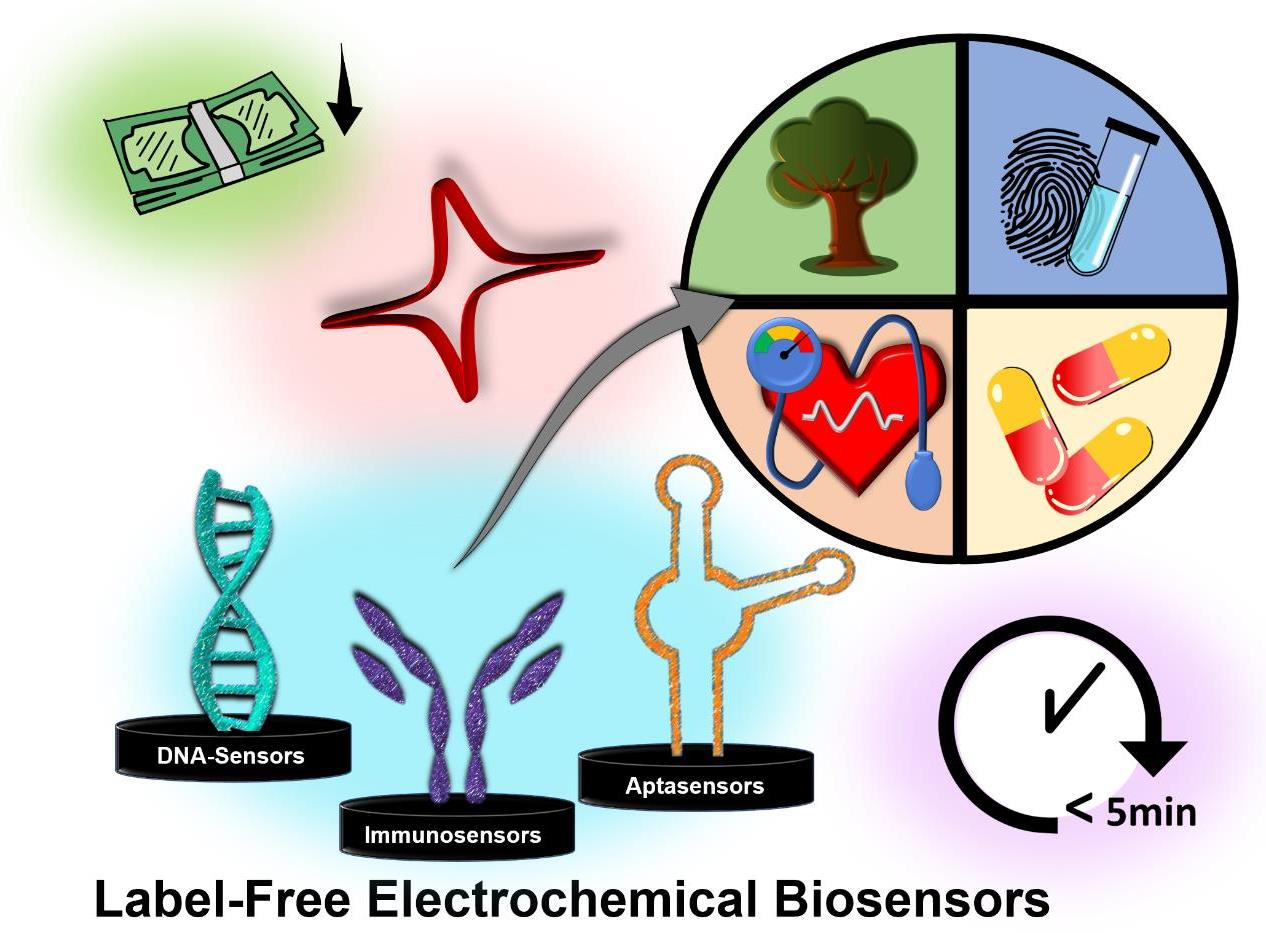
Label-Free Electrochemical Biosensors: An Updated Perspective Focused on Genosensing, Multiplexing, and Commercial Potential

 , , , and
Abstract
1. Introduction

| Disease Target | Strategy Type | Sensitivity | Specificity Compared to: | Reproducibility (RSD) | Linear Range | LOD | Ref. |
|---|---|---|---|---|---|---|---|
| Alpha-fetoprotein (cancer) | Label-free | High sensitivity, but without showing the calculated value. | Prostate-specific antigen, carcinoembryonic antigen, ascorbic acid | <6% (n = 4) | 0.01 to 500 ng mL−1 | 0.007 ng mL−1 | [14] |
| Labeled | Human serum albumin, BSA, human chorionic gonadotropin, hepatitis B surface antigen, and carcinoembryonic antigen | 3.68% (n = 6) | 0.005 to 100 ng mL−1 | 0.0022 ng mL−1 | [15] | ||
| Dengue non-structural protein 1 (NS1 DENV) | Label-free | 0.044 μA∙mL∙ng−1 | Fibrinogen, BSA, human serum albumin | 5.1% (n = 3) | 10 to 100 ng mL−1 | 8.23 ng mL−1 | [16] |
| Labeled | High sensitivity, but relating to the value obtained by the calculated LOD. | Norovirus-like particles, inactivated Influenza virus A/H1N1 and A/H3N2 | 10.2% (n = not informed) | 0.001 to 1.0 ng mL−1 | 30 fg mL−1 | [17] | |
| SARS-CoV-2 (COVID-19) | Label-free | High sensitivity: the authors indicate this property by the behavior of the rate of decrease in the current increasing with increasing protein concentrations. | Human IgG, SARS spike glycoprotein, COVID-19 nucleocapsid protein | 3.88% (n = 5) | 0.001 to 10 ng mL−1 | 0.003 ng mL−1 | [18] |
| Labeled | High sensitivity attributed to the excellent signal amplification effect of the secondary probes. | Mutant SARS-CoV-2 spike protein, non-target coronavirus spike proteins, BSA. | 10% (n = 3) | 0.0001 to 1000 ng mL−1 | 0.0005 ng mL−1 | [19] | |
| Superoxide dismutase 1 (neurodegenerative diseases) | Label-free | highlights the high sensitivity to the presence of added palladium nanoparticles as an alternative to AuNPs. | Glucose and saturated salts | 8.03% (n = 6) | 1.0 to 100 ng mL−1 | 0.72 ng mL−1 | [20] |
| Labeled | High sensitivity considering the LOD value. | Horseradish peroxidase, alkaline phosphatase, alanine, arginine, glutathione, others. | 2.58% (n = 11) | 0.1 to 1.0 μg mL−1 | 0.03 μg mL−1 | [21] | |
| Phosphorylated tau 181 (p-tau181) (Alzheimer’s disease) | Label-free | High sensitivity based on estimated plasma p-tau181 levels analyzed in patients. | Human amyloid beta 1–40, human amyloid beta 1–42 | Not informed | 0.001 to 1000 pg mL−1 | 0.92 fg mL−1 | [22] |
| Labeled | High sensitivity demonstrated by showing a lower LOD than the ELISA assay. | β-amyloid monomers, β-amyloid oligomers, BSA, human serum albumin | 1.4% (n= not informed) | 6.97 fg mL−1 to 100 ng mL−1 | 1.91 fg mL−1 | [23] | |
| Cardiac troponin I | Label-free | High sensitivity considering the LOD value. | Epidermal growth factor receptor, epithelial cell adhesion molecule, human epidermal growth factor receptor 2, programmed death ligand 1 | 0.24% (n = 5) | 0.001 to 10 ng mL−1 | 0.00008 ng mL−1 | [24] |
| Labeled | High sensitivity related to the generation of active sites for antibody immobilization 2 | Insulin, carcinoembryonic antigen, prostate-specific antigen and squamous cell carcinoma antigen. | 2.22% (n = 5) | 0.0005 to 10 ng mL−1 | 0.00017 ng mL−1 | [25] |
2. Origin and Early Development of Label-Free Electrochemical Biosensors
2.1. Bioreceptor Immobilization Strategies for Label-Free Devices
2.2. Electrochemical Devices in Label-Free Biosensors
3. Label-Free Genosensor
4. Multiplex Assays by Using Label-Free Electrochemical Biosensors
5. New Applications of Label-Free Devices for Medical Diagnosis
6. Commercial Potential for Label-Free Devices
7. Conclusions and Perspectives
- The first is the need to reconcile large-scale production, bioreceptor stability and the logistics of transport and storage in a way that guarantees device quality and applicability for end users. For most emerging platforms, the storage of new electrochemical devices and their reliable performance in real samples remain stages that require substantial progress.
- A second key point is the integration of technologies that allow for PoC testing without relying on specialized benchtop instrumentation, with real potential for the use of smartphones and artificial intelligence-based software for signal processing and data analysis. In recently published works included in this review, the analytical capabilities of label-free biosensors are demonstrated; however, the integrated PoC system is not fully addressed. Nevertheless, it is important to highlight that devices already exist that offer a microstation or the potential for smartphone use, contributing to the advancement of this area of PoC, but data interpretation and manipulation by non-specialized personnel require further development [169,170,171,172,173].
- Third, increased robustness and accessibility are essential to ensure effective application in clinical analyses. This includes not only intrinsic analytical robustness, but also validation in real matrices, interlaboratory comparability and cost structures compatible with routine diagnostics. In this sense, some recent studies propose promising alternatives, but they are still far from representing the dominant trend in the field.
- Finally, expanding device architectures for simultaneous detection of multiple markers in multiplex systems remains a critical frontier. Such systems could support PoC diagnosis for different diseases or multiple biomarkers of a single disease within one platform. We have observed initial growth in this area, but substantial room remains for innovation in electrode design, signal deconvolution and data handling.
Author Contributions
Funding
Institutional Review Board Statement
Informed Consent Statement
Data Availability Statement
Conflicts of Interest
References
- Foreman, K.J.; Marquez, N.; Dolgert, A.; Fukutaki, K.; Fullman, N.; McGaughey, M.; Pletcher, M.A.; Smith, A.E.; Tang, K.; Yuan, C.-W. Forecasting life expectancy, years of life lost, and all-cause and cause-specific mortality for 250 causes of death: Reference and alternative scenarios for 2016–40 for 195 countries and territories. Lancet 2018, 392, 2052–2090. [Google Scholar] [CrossRef]
- Amin, N.; Torralba, A.S.; Álvarez-Diduk, R.; Afkhami, A.; Merkoçi, A. Lab in a tube: Point-of-care detection of Escherichia coli. Anal. Chem. 2020, 92, 4209–4216. [Google Scholar] [CrossRef] [PubMed]
- Yetisen, A.K.; Akram, M.S.; Lowe, C.R. Based microfluidic point-of-care diagnostic devices. Lab A Chip 2013, 13, 2210–2251. [Google Scholar] [CrossRef] [PubMed]
- Nasseri, B.; Soleimani, N.; Rabiee, N.; Kalbasi, A.; Karimi, M.; Hamblin, M.R. Point-of-care microfluidic devices for pathogen detection. Biosens. Bioelectron. 2018, 117, 112–128. [Google Scholar] [CrossRef] [PubMed]
- Andryukov, B.G.; Besednova, N.N.; Romashko, R.V.; Zaporozhets, T.S.; Efimov, T.A. Label-Free Biosensors for Laboratory-Based Diagnostics of Infections: Current Achievements and New Trends. Biosensors 2020, 10, 11. [Google Scholar] [CrossRef]
- Sumitha, M.S.; Xavier, T.S. Recent advances in electrochemical biosensors—A brief review. Hybrid Adv. 2023, 2, 100023. [Google Scholar] [CrossRef]
- Li, S.; Zhang, H.; Zhu, M.; Kuang, Z.; Li, X.; Xu, F.; Miao, S.; Zhang, Z.; Lou, X.; Li, H.; et al. Electrochemical Biosensors for Whole Blood Analysis: Recent Progress, Challenges, and Future Perspectives. Chem. Rev. 2023, 123, 7953–8039. [Google Scholar] [CrossRef]
- Samuel, V.R.; Rao, K.J. A review on label free biosensors. Biosens. Bioelectron. X 2022, 11, 100216. [Google Scholar] [CrossRef]
- Rahn, K.L.; Peramune, U.; Zhang, T.; Anand, R.K. Label-Free Electrochemical Methods for Disease Detection. Annu. Rev. Anal. Chem. 2023, 16, 49–69. [Google Scholar] [CrossRef]
- Cancelliere, R.; Paialunga, E.; Grattagliano, A.; Micheli, L. Label-free electrochemical immunosensors: A practical guide. TrAC Trends Anal. Chem. 2024, 180, 117949. [Google Scholar] [CrossRef]
- Syahir, A.; Usui, K.; Tomizaki, K.-y.; Kajikawa, K.; Mihara, H. Label and Label-Free Detection Techniques for Protein Microarrays. Microarrays 2015, 4, 228–244. [Google Scholar] [CrossRef]
- Chieng, A.; Wan, Z.; Wang, S. Recent Advances in Real-Time Label-Free Detection of Small Molecules. Biosensors 2024, 14, 80. [Google Scholar] [CrossRef] [PubMed]
- Al-Younis, Z.K.; Almajidi, Y.Q.; Mansouri, S.; Ahmad, I.; Turdialiyev, U.; Alsaab, H.O.; Ramadan, M.F.; Joshi, S.K.; Alawadi, A.H.; Alsaalamy, A. Label-Free Field Effect Transistors (FETs) for Fabrication of Point-of-Care (POC) Biomedical Detection Probes. Crit. Rev. Anal. Chem. 2025, 55, 1368–1389. [Google Scholar] [CrossRef] [PubMed]
- Li, J.; Liu, D.; Zhou, D.; Shao, L.; Chen, X.; Song, H. Label-free photoelectrochemical biosensor for alpha-fetoprotein detection based on Au/CsxWO3 heterogeneous films. Talanta 2021, 225, 122074. [Google Scholar] [CrossRef] [PubMed]
- Xiao, H.; Wei, S.; Gu, M.; Chen, Z.; Cao, L. A sandwich-type electrochemical immunosensor using rGO-TEPA-Thi-Au as sensitive platform and CMK-3@AuPtNPs as signal probe for AFP detection. Microchem. J. 2021, 170, 106641. [Google Scholar] [CrossRef]
- Sirivibulkovit, K.; Voelkle, J.; Windisch, D.J.; Muttenthaler, M.; Lieberzeit, P.A.; Saetear, P. Electrochemical dengue sensor based on NS1 epitope-imprinted polymers. Biosens. Bioelectron. 2025, 289, 117915. [Google Scholar] [CrossRef]
- Khoris, I.M.; Nasrin, F.; Chowdhury, A.D.; Park, E.Y. Advancement of dengue virus NS1 protein detection by 3D-nanoassembly complex gold nanoparticles utilizing competitive sandwich aptamer on disposable electrode. Anal. Chim. Acta 2022, 1207, 339817. [Google Scholar] [CrossRef]
- Zhai, Q.; Wang, X.; Hu, C.; Zhu, L.; Zhang, C.; Dai, L. Label-free electrochemical immunosensor for highly sensitive COVID-19 spike protein detection. Sens. Actuators Rep. 2022, 4, 100124. [Google Scholar] [CrossRef]
- Kim, H.-M.; Park, J. Sensitive Detection of SARS-CoV-2 Spike Protein Using an Aptamer Sandwich Assay-Based Electrochemical Biosensor. BioChip J. 2024, 18, 622–632. [Google Scholar] [CrossRef]
- Carvalho, J.H.S.; Faria, B.S.; Freitas, R.C.; Brazaca, L.C.; Janegitz, B.C. Paper-Based Electrochemical Device Modified with Palladium: Sensor for the Detection of Serotonin and an Immunosensor for the Detection of SOD1. ACS Omega 2025, 10, 55887–55897. [Google Scholar] [CrossRef]
- Liu, Y.; Jiang, K.; Nie, Y.; Guo, Y.; Ma, Q. A visual electrochemiluminescence biosensor based on CuInZnS quantum dots for superoxide dismutase detection. Anal. Bioanal. Chem. 2020, 412, 1893–1899. [Google Scholar] [CrossRef] [PubMed]
- Tieu, M.-V.; Choi, S.H.; Le, H.T.N.; Cho, S. Electrochemical impedance-based biosensor for label-free determination of plasma P-tau181 levels for clinically accurate diagnosis of mild cognitive impairment and Alzheimer’s disease. Anal. Chim. Acta 2023, 1273, 341535. [Google Scholar] [CrossRef] [PubMed]
- Luo, C.; Zhu, X.; Zhang, Y.; Wen, Y.; Wan, L.; Qian, Z. Competitive electrochemical immunosensor for trace phosphorylated Tau181 analysis in plasma: Toward point-of-care technologies of Alzheimer’s disease. Talanta 2025, 292, 128009. [Google Scholar] [CrossRef] [PubMed]
- Chen, X.; Li, Y.; Chen, L.; Tu, J.; Pan, J.; Zeng, X.; Fu, Y.; Sun, D. Label-free electrochemiluminescence aptasensor for rapid and accurate detection of cardiac troponin I. Talanta 2025, 294, 128160. [Google Scholar] [CrossRef]
- Zhang, T.; Ma, N.; Ali, A.; Wei, Q.; Wu, D.; Ren, X. Electrochemical ultrasensitive detection of cardiac troponin I using covalent organic frameworks for signal amplification. Biosens. Bioelectron. 2018, 119, 176–181. [Google Scholar] [CrossRef]
- Green, M.J.; Hill, H.A.O.; Tew, D.G.; Walton, N.J. An opsonised electrode: The direct electrochemical detection of superoxide generated by human neutrophils. FEBS Lett. 1984, 170, 69–72. [Google Scholar] [CrossRef]
- Wang, J.; Jiang, M.; Fortes, A.; Mukherjee, B. New label-free DNA recognition based on doping nucleic-acid probes within conducting polymer films. Anal. Chim. Acta 1999, 402, 7–12. [Google Scholar] [CrossRef]
- Soler, M.; Lechuga, L.M. Biochemistry strategies for label-free optical sensor biofunctionalization: Advances towards real applicability. Anal. Bioanal. Chem. 2022, 414, 5071–5085. [Google Scholar] [CrossRef]
- Eissa, S.; N’diaye, J.; Brisebois, P.; Izquierdo, R.; Tavares, A.C.; Siaj, M. Probing the influence of graphene oxide sheets size on the performance of label-free electrochemical biosensors. Sci. Rep. 2020, 10, 13612. [Google Scholar] [CrossRef]
- Kalyani, T.; Sangili, A.; Kotal, H.; Kaushik, A.; Chaudhury, K.; Jana, S.K. Ultra-sensitive label-free detection of haptoglobin using Au-rGO decorated electrochemical sensing platform: Towards endometriosis diagnostic application. Biosens. Bioelectron. X 2023, 14, 100353. [Google Scholar] [CrossRef]
- Alsabbagh, K.; Hornung, T.; Voigt, A.; Sadir, S.; Rajabi, T.; Länge, K. Microfluidic Impedance Biosensor Chips Using Sensing Layers Based on DNA-Based Self-Assembled Monolayers for Label-Free Detection of Proteins. Biosensors 2021, 11, 80. [Google Scholar] [CrossRef]
- Qiu, J.; Wu, Y.; Wang, Y.; Wang, C.; Cho, S.-Y.; Huang, H.; Zhang, Y.; Han, L. High-throughput exosomes analysis for ovarian cancer screening based on a double-positive surface marker detection biochip. BMEMat 2025, 3, e70015. [Google Scholar] [CrossRef]
- Alsadig, A.; Abbasgholi-Na, B.; Vondracek, H.; Medagli, B.; Fortuna, S.; Posocco, P.; Parisse, P.; Cabrera, H.; Casalis, L. DNA-Directed Protein Anchoring on Oligo/Alkanethiol-Coated Gold Nanoparticles: A Versatile Platform for Biosensing Applications. Nanomaterials 2023, 13, 78. [Google Scholar] [CrossRef] [PubMed]
- Naresh, V.; Lee, N. A Review on Biosensors and Recent Development of Nanostructured Materials-Enabled Biosensors. Sensors 2021, 21, 1109. [Google Scholar] [CrossRef] [PubMed]
- Ran, G.; Wu, F.; Ni, X.; Li, X.; Li, X.; Liu, D.; Sun, J.; Xie, C.; Yao, D.; Bai, W. A novel label-free electrochemical aptasensor with one-step assembly process for rapid detection of lead (II) ions. Sens. Actuators B Chem. 2020, 320, 128326. [Google Scholar] [CrossRef]
- Li, L.; Chen, Z. Electrochemical aptamer biosensor for DNA detection based on label-free aptamers. Bioelectrochemistry 2023, 153, 108494. [Google Scholar] [CrossRef]
- Feng, D.; Su, J.; He, G.; Xu, Y.; Wang, C.; Zheng, M.; Qian, Q.; Mi, X. Electrochemical DNA Sensor for Sensitive BRCA1 Detection Based on DNA Tetrahedral-Structured Probe and Poly-Adenine Mediated Gold Nanoparticles. Biosensors 2020, 10, 78. [Google Scholar] [CrossRef]
- Shayesteh, O.H.; Khosroshahi, A.G. A polyA aptamer-based label-free colorimetric biosensor for the detection of kanamycin in human serum. Anal. Methods 2020, 12, 1858–1867. [Google Scholar] [CrossRef]
- Mahjub, R.; Shayesteh, O.H.; Derakhshandeh, K.; Ranjbar, A.; Mehri, F.; Heshmati, A. A novel label-free colorimetric polyA aptasensing approach based on cationic polymer and silver nanoparticles for detection of tobramycin in milk. Food Chem. 2022, 382, 132580. [Google Scholar] [CrossRef]
- Liao, X.; Ge, K.; Cai, Z.; Qiu, S.; Wu, S.; Li, Q.; Liu, Z.; Gao, F.; Tang, Q. Hybridization chain reaction triggered poly adenine to absorb silver nanoparticles for label-free electrochemical detection of Alzheimer’s disease biomarkers amyloid β-peptide oligomers. Anal. Chim. Acta 2022, 1192, 339391. [Google Scholar] [CrossRef]
- Sanko, V.; Kuralay, F. Label-Free Electrochemical Biosensor Platforms for Cancer Diagnosis: Recent Achievements and Challenges. Biosensors 2023, 13, 333. [Google Scholar] [CrossRef]
- Yoo, H.; Jo, H.; Oh, S.S. Detection and beyond: Challenges and advances in aptamer-based biosensors. Mater. Adv. 2020, 1, 2663–2687. [Google Scholar] [CrossRef]
- Rhouati, A.; Zourob, M. Development of a Multiplexed Electrochemical Aptasensor for the Detection of Cyanotoxins. Biosensors 2024, 14, 268. [Google Scholar] [CrossRef]
- Eteya, M.M.; Rounaghi, G.H.; Deiminiat, B. Label-Free Determination of Atrazine Using a Novel Electrochemical Aptasensor Based on Multiwalled Carbon Nanotube/Graphene Oxide Nanocomposite and Chitosan. Electrocatalysis 2024, 15, 384–393. [Google Scholar] [CrossRef]
- Merkoçi, A.; Li, C.-z.; Lechuga, L.M.; Ozcan, A. COVID-19 biosensing technologies. Biosens. Bioelectron. 2021, 178, 113046. [Google Scholar] [CrossRef]
- Silva, L.R.G.; Stefano, J.S.; Orzari, L.O.; Brazaca, L.C.; Carrilho, E.; Marcolino-Junior, L.H.; Bergamini, M.F.; Munoz, R.A.A.; Janegitz, B.C. Electrochemical Biosensor for SARS-CoV-2 cDNA Detection Using AuPs-Modified 3D-Printed Graphene Electrodes. Biosensors 2022, 12, 622. [Google Scholar] [CrossRef] [PubMed]
- Stefano, J.S.; Guterres, E.S.L.R.; Rocha, R.G.; Brazaca, L.C.; Richter, E.M.; Abarza Muñoz, R.A.; Janegitz, B.C. New conductive filament ready-to-use for 3D-printing electrochemical (bio)sensors: Towards the detection of SARS-CoV-2. Anal. Chim. Acta 2022, 1191, 339372. [Google Scholar] [CrossRef] [PubMed]
- Wang, A.; You, X.; Liu, H.; Zhou, J.; Chen, Y.; Zhang, C.; Ma, K.; Liu, Y.; Ding, P.; Qi, Y.; et al. Development of a label free electrochemical sensor based on a sensitive monoclonal antibody for the detection of tiamulin. Food Chem. 2022, 366, 130573. [Google Scholar] [CrossRef]
- Sethi, J.; Van Bulck, M.; Suhail, A.; Safarzadeh, M.; Perez-Castillo, A.; Pan, G. A label-free biosensor based on graphene and reduced graphene oxide dual-layer for electrochemical determination of beta-amyloid biomarkers. Microchim. Acta 2020, 187, 1–10. [Google Scholar] [CrossRef]
- Li, Y.; Luo, L.; Kong, Y.; Li, Y.; Wang, Q.; Wang, M.; Li, Y.; Davenport, A.; Li, B. Recent advances in molecularly imprinted polymer-based electrochemical sensors. Biosens. Bioelectron. 2024, 249, 116018. [Google Scholar] [CrossRef]
- Rebelo, T.S.C.R.; Miranda, I.M.; Brandão, A.T.S.C.; Sousa, L.I.G.; Ribeiro, J.A.; Silva, A.F.; Pereira, C.M. A Disposable Saliva Electrochemical MIP-Based Biosensor for Detection of the Stress Biomarker α-Amylase in Point-of-Care Applications. Electrochem 2021, 2, 427–438. [Google Scholar] [CrossRef]
- Chenani, H.; Saeidi, M.; Rastkhiz, M.A.; Bolghanabadi, N.; Aghaii, A.H.; Orouji, M.; Hatamie, A.; Simchi, A. Challenges and advances of hydrogel-based wearable electrochemical biosensors for real-time monitoring of biofluids: From lab to market. A Review. Anal. Chem. 2024, 96, 8160–8183. [Google Scholar] [CrossRef] [PubMed]
- Khorsandi, D.; Yang, J.-W.; Jenson, S.; Kajino, T.; Maity, S.; Salih, A.R.C.; Jucaud, V.; Dokmeci, M.R. Lab-on-a-Chip: Unit Operations to Scale-Up Strategies; Royal Society of Chemistry: London, UK, 2024. [Google Scholar]
- Khorshed, A.A.; Jiang, T.; Chen, J. A label-free point-of-care electrochemical biosensor for early and accurate detection of monkeypox. Biosens. Bioelectron. 2025, 278, 117337. [Google Scholar] [CrossRef] [PubMed]
- Atabay, S.A.; Ahmadzadeh, H.; Norouzi, P.; Dianat, S.; Dashtian, K. Development of a sensitive antibody-based label-free electrochemical immunosensors for breast cancer diagnosis. Sens. Bio-Sens. Res. 2025, 48, 100793. [Google Scholar] [CrossRef]
- Sciurti, E.; Signore, M.A.; Velardi, L.; Di Corato, R.; Blasi, L.; Campa, A.; Martucci, M.C.; Siciliano, P.A.; Francioso, L. Label-free electrochemical biosensor for direct detection of Oncostatin M (OSM) inflammatory bowel diseases (IBD) biomarker in human serum. Talanta 2024, 271, 125726. [Google Scholar] [CrossRef]
- Arishi, W.A.; Eissa, S.; Al-Kattan, K.; Zourob, M. Aptamer-based label-free electrochemical biosensors for the diagnosis of sickle cell anemia. Biosens. Bioelectron. X 2023, 14, 100389. [Google Scholar] [CrossRef]
- Ghalkhani, M.; Sohouli, E.; Khaloo, S.S.; Vaziri, M.H. Architecting of an aptasensor for the staphylococcus aureus analysis by modification of the screen-printed carbon electrode with aptamer/Ag–Cs-Gr QDs/NTiO2. Chemosphere 2022, 293, 133597. [Google Scholar] [CrossRef]
- Tao, D.; Shui, B.; Gu, Y.; Cheng, J.; Zhang, W.; Jaffrezic-Renault, N.; Song, S.; Guo, Z. Development of a Label-Free Electrochemical Aptasensor for the Detection of Tau381 and its Preliminary Application in AD and Non-AD Patients’ Sera. Biosensors 2019, 9, 84. [Google Scholar] [CrossRef]
- Akbarzadeh, S.; Khajehsharifi, H.; Hajihosseini, S. Detection of Oxytetracycline Using an Electrochemical Label-Free Aptamer-Based Biosensor. Biosensors 2022, 12, 468. [Google Scholar] [CrossRef]
- Kongintr, U.; Lertanantawong, B.; Promptmas, C. A Label-Free Electrochemical Biosensor for Homocysteine Detection Using Molecularly Imprinted Polymer and Nanocomposite-Modified Electrodes. Polymers 2023, 15, 2241. [Google Scholar] [CrossRef]
- Wang, Z.; Chen, Z.; Ma, Z.; Han, H. Label-Free Mode Based on Ferrocene/PEDOT:PSS–PPy for Molecularly Imprinted Electrochemically Ultrasensitive Detection of Amino Acids. Anal. Chem. 2024, 96, 14298–14305. [Google Scholar] [CrossRef] [PubMed]
- Panicker, L.R.; Joy, A.; Anusree, P.R.; Kadian, S.; Narayan, R.; Padmesh, A.; Kotagiri, Y.G. Molecular imprinted polymer based microneedle-strip electrochemical sensor for label-free dopamine monitoring: Advancing neurological disorder Diagnostics. Chem. Eng. J. 2025, 516, 163870. [Google Scholar] [CrossRef]
- Garg, S.; Singla, P.; Kaur, S.; Crapnell, R.D.; Banks, C.E.; Seyedin, S.; Peeters, M. Electroactive Molecularly Imprinted Polymer Nanoparticles (eMIPs) for Label-free Detection of Glucose: Toward Wearable Monitoring. Small 2024, 20, e2403320. [Google Scholar] [CrossRef] [PubMed]
- Sanchez-Almirola, J.; Gage, A.; Lopez, R.; Yapell, D.; Mujawar, M.; Kamat, V.; Kaushik, A. Label and bio-active free electrochemical detection of testosterone hormone using MIP-based sensing platform. Mater. Sci. Eng. B 2023, 296, 116670. [Google Scholar] [CrossRef]
- Goyal, A.; Sakata, T. Development of a Redox-Label-Doped Molecularly Imprinted Polymer on β-Cyclodextrin/Reduced Graphene Oxide for Electrochemical Detection of a Stress Biomarker. ACS Omega 2022, 7, 33491–33499. [Google Scholar] [CrossRef]
- Bazin, I.; Tria, S.A.; Hayat, A.; Marty, J.-L. New biorecognition molecules in biosensors for the detection of toxins. Biosens. Bioelectron. 2017, 87, 285–298. [Google Scholar] [CrossRef]
- Labib, M.; Sargent, E.H.; Kelley, S.O. Electrochemical Methods for the Analysis of Clinically Relevant Biomolecules. Chem. Rev. 2016, 116, 9001–9090. [Google Scholar] [CrossRef]
- Jafari-Kashi, A.; Rafiee-Pour, H.-A.; Shabani-Nooshabadi, M. A new strategy to design label-free electrochemical biosensor for ultrasensitive diagnosis of CYFRA 21–1 as a biomarker for detection of non-small cell lung cancer. Chemosphere 2022, 301, 134636. [Google Scholar] [CrossRef]
- Rabbani, G.; Khan, M.E.; Khan, A.U.; Ali, S.K.; Zamzami, M.A.; Ahmad, A.; Bashiri, A.H.; Zakri, W. Label-free and ultrasensitive electrochemical transferrin detection biosensor based on a glassy carbon electrode and gold nanoparticles. Int. J. Biol. Macromol. 2024, 256, 128312. [Google Scholar] [CrossRef]
- Chrouda, A.; Sbartai, A.; Baraket, A.; Renaud, L.; Maaref, A.; Jaffrezic-Renault, N. An aptasensor for ochratoxin A based on grafting of polyethylene glycol on a boron-doped diamond microcell. Anal. Biochem. 2015, 488, 36–44. [Google Scholar] [CrossRef]
- Braiek, M.; Yang, Y.; Farre, C.; Chaix, C.; Bessueille, F.; Baraket, A.; Errachid, A.; Zhang, A.; Jaffrezic-Renault, N. Boron-doped Diamond Electrodes Modified with Fe3O4@ Au Magnetic Nanocomposites as Sensitive Platform for Detection of a Cancer Biomarker, Interleukin-8. Electroanalysis 2016, 28, 1810–1816. [Google Scholar] [CrossRef]
- Que, H.; Zhang, D.; Guo, B.; Wang, T.; Wu, H.; Han, D.; Yan, Y. Label-free and ultrasensitive electrochemical biosensor for the detection of EBV-related DNA based on AgDNCs@DNA/AgNCs nanocomposites and lambda exonuclease-assisted target recycling. Biosens. Bioelectron. 2019, 143, 111610. [Google Scholar] [CrossRef] [PubMed]
- Zhang, Y.; Wang, X.; Fang, X.; Yuan, X.; Yang, H.; Kong, J. Label-free electrochemical immunoassay for detecting CYFRA 21-1 using poly(ε-caprolactone)-b-poly(ethylene oxide) block copolymer. Microchem. J. 2021, 165, 106119. [Google Scholar] [CrossRef]
- Liang, K.-Z.; Qi, J.-S.; Mu, W.-J.; Chen, Z.-G. Biomolecules/gold nanowires-doped sol–gel film for label-free electrochemical immunoassay of testosterone. J. Biochem. Biophys. Methods 2008, 70, 1156–1162. [Google Scholar] [CrossRef]
- Blasques, R.V.; de Oliveira, P.R.; Kalinke, C.; Brazaca, L.C.; Crapnell, R.D.; Bonacin, J.A.; Banks, C.E.; Janegitz, B.C. Flexible Label-Free Platinum and Bio-PET-Based Immunosensor for the Detection of SARS-CoV-2. Biosensors 2023, 13, 190. [Google Scholar] [CrossRef]
- Suhanto, R.N.; Harimurti, S.; Septiani, N.L.W.; Utari, L.; Anshori, I.; Wasisto, H.S.; Suzuki, H.; Suyatman; Yuliarto, B. Sonochemical synthesis of magnetic Fe3O4/graphene nanocomposites for label-free electrochemical biosensors. J. Mater. Sci. Mater. Electron. 2020, 31, 15381–15393. [Google Scholar] [CrossRef]
- Gangwar, R.; Subrahmanyam, C.; Vanjari, S.R.K. Facile, Label-Free, Non-Enzymatic Electrochemical Nanobiosensor Platform as a Significant Step towards Continuous Glucose Monitoring. ChemistrySelect 2021, 6, 11086–11094. [Google Scholar] [CrossRef]
- Vu, Q.K.; Tran, Q.H.; Vu, N.P.; Anh, T.-L.; Dang, T.T.L.; Matteo, T.; Nguyen, T.H.H. A label-free electrochemical biosensor based on screen-printed electrodes modified with gold nanoparticles for quick detection of bacterial pathogens. Mater. Today Commun. 2021, 26, 101726. [Google Scholar] [CrossRef]
- Gao, H.; Bai, Y.; He, B.; Tan, C.S. A Simple Label-Free Aptamer-Based Electrochemical Biosensor for the Sensitive Detection of C-Reactive Proteins. Biosensors 2022, 12, 1180. [Google Scholar] [CrossRef]
- Arshavsky-Graham, S.; Enders, A.; Ackerman, S.; Bahnemann, J.; Segal, E. 3D-printed microfluidics integrated with optical nanostructured porous aptasensors for protein detection. Microchim. Acta 2021, 188, 67. [Google Scholar] [CrossRef]
- Duarte, L.C.; Figueredo, F.; Ribeiro, L.E.B.; Cortón, E.; Coltro, W.K.T. Label-free counting of Escherichia coli cells in nanoliter droplets using 3D printed microfluidic devices with integrated contactless conductivity detection. Anal. Chim. Acta 2019, 1071, 36–43. [Google Scholar] [CrossRef]
- Karachaliou, C.-E.; Livaniou, E. Immunosensors for Autoimmune-Disease-Related Biomarkers: A Literature Review. Sensors 2023, 23, 6770. [Google Scholar] [CrossRef] [PubMed]
- Police Patil, A.V.; Chuang, Y.-S.; Li, C.; Wu, C.-C. Recent Advances in Electrochemical Immunosensors with Nanomaterial Assistance for Signal Amplification. Biosensors 2023, 13, 125. [Google Scholar] [CrossRef] [PubMed]
- Zhang, X.; Su, Y.; Ao, D.; Hong, Y.; Zou, M.; Xie, J.; Zhou, Q.; Wang, Y.; He, W.; Chen, Y. Label-free electrochemical immunosensor based on AuNPs/coiled carbon nanotubes/chitosan-nanocomposites for detection of carcinoembryonic antigen. J. Appl. Electrochem. 2025, 55, 1557–1569. [Google Scholar] [CrossRef]
- Chaturvedi, M.; Patel, M.; Mondal, D.P.; Srivastava, A.K.; Dwivedi, N.; Dhand, C. Bio-inspired graphene nanocomposite enabled electrochemical immunosensor for detection and quantification of NS1 protein of dengue virus. Electrochim. Acta 2024, 475, 143630. [Google Scholar] [CrossRef]
- Adu, D.K.; Nate, Z.; Alake, J.; Ike, B.W.; Mahlalela, M.C.; Mohite, S.B.; Mokoena, S.; Chauhan, R.; Karpoormath, R. Rapid and label-free A2 peptide epitope decorated CoFe2O4-C60 nanocomposite-based electrochemical immunosensor for detecting Visceral Leishmaniasis. Bioelectrochemistry 2024, 157, 108662. [Google Scholar] [CrossRef]
- Carneiro, P.; Loureiro, J.A.; Delerue-Matos, C.; Morais, S.; Pereira, M.d.C. Nanostructured label–free electrochemical immunosensor for detection of a Parkinson’s disease biomarker. Talanta 2023, 252, 123838. [Google Scholar] [CrossRef]
- Evdokimov, A.A.; Baldina, A.A.; Nikitina, A.A.; Aliev, T.A.; Zenkin, A.M.; Zhukov, M.V.; Pantyukhin, I.S.; Skorb, E.V.; Muravev, A.A. A portable electrochemical immunosensor for detection of S. aureus based on polyelectrolyte-modified screen-printed carbon electrode. Sens. Bio-Sens. Res. 2025, 47, 100744. [Google Scholar] [CrossRef]
- Inlumphan, S.; Wongwiriyapan, W.; Khemasiri, N.; Rattanawarinchai, P.; Leepheng, P.; Luengrojanakul, P.; Wuttikhun, T.; Obata, M.; Fujishige, M.; Takeuchi, K.; et al. Laser-induced graphene electrochemical immunosensors for rapid and sensitive serological detection: A case study on dengue detection platform. Sens. Actuators Rep. 2025, 9, 100276. [Google Scholar] [CrossRef]
- Ben Messaoud, N.; Barreiros dos Santos, M.; Trocado, V.; Nogueira-Silva, C.; Queirós, R. A novel label-free electrochemical immunosensor for detection of surfactant protein B in amniotic fluid. Talanta 2023, 251, 123744. [Google Scholar] [CrossRef]
- Wang, L.; Pang, Y.; Zhang, Z.; Li, S.; Jaffrezic-Renault, N.; Liu, K.; Guo, Z. Highly sensitive electrochemical Osteoprotegerin (OPG) immunosensor for assessing fracture healing and evaluating drug efficacy. Bioelectrochemistry 2025, 163, 108884. [Google Scholar] [CrossRef]
- Kalinke, C.; De Oliveira, P.R.; Banks, C.E.; Janegitz, B.C.; Bonacin, J.A. 3D-printed immunosensor for the diagnosis of Parkinson’s disease. Sens. Actuators B Chem. 2023, 381, 133353. [Google Scholar] [CrossRef]
- Silva, L.R.G.; Stefano, J.S.; Crapnell, R.D.; Banks, C.E.; Janegitz, B.C. Additive manufacturing of carbon black immunosensors based on covalent immobilization for portable electrochemical detection of SARS-CoV-2 spike S1 protein. Talanta Open 2023, 8, 100250. [Google Scholar] [CrossRef]
- Hussain, K.K.; Hopkins, R.; Yeoman, M.S.; Patel, B.A. 3D printed skyscraper electrochemical biosensor for the detection of tumour necrosis factor alpha (TNFα) in faeces. Sens. Actuators B Chem. 2024, 410, 135694. [Google Scholar] [CrossRef]
- Hai, X.; Li, Y.; Zhu, C.; Song, W.; Cao, J.; Bi, S. DNA-based label-free electrochemical biosensors: From principles to applications. TrAC Trends Anal. Chem. 2020, 133, 116098. [Google Scholar] [CrossRef]
- Fuku, X.; Bilibana, M.P.; Iwuoha, E. Genosensor design and strategies towards electrochemical deoxyribonucleic acid (DNA) signal transduction: Mechanism of interaction. J. Mol. Struct. 2022, 1269, 133810. [Google Scholar] [CrossRef]
- Pividori, M.I.; Merkoçi, A.; Alegret, S. Electrochemical genosensor design: Immobilisation of oligonucleotides onto transducer surfaces and detection methods. Biosens. Bioelectron. 2000, 15, 291–303. [Google Scholar] [CrossRef]
- Hua, Y.; Ma, J.; Li, D.; Wang, R. DNA-based biosensors for the biochemical analysis: A review. Biosensors 2022, 12, 183. [Google Scholar] [CrossRef]
- Kavita, V. DNA biosensors—A review. J. Bioeng. Biomed. Sci 2017, 7, 222. [Google Scholar]
- Rafique, B.; Iqbal, M.; Mehmood, T.; Shaheen, M.A. Electrochemical DNA biosensors: A review. Sens. Rev. 2019, 39, 34–50. [Google Scholar] [CrossRef]
- Brazaca, L.C.; Bramorski, C.B.; Cancino-Bernardi, J.; Janegitz, B.C.; Zucolotto, V. A genosensor for sickle cell anemia trait determination. Electroanalysis 2017, 29, 773–777. [Google Scholar] [CrossRef]
- Liu, B.; Lu, W.; Huang, Y.; Zhang, X.; Yuan, X. A label-free electrochemical sensor for the detection of two kinds of targets based on CRISPR/Cas12a system. Sens. Actuators B Chem. 2024, 406, 135406. [Google Scholar] [CrossRef]
- Kappo, D.; Shurpik, D.; Padnya, P.; Stoikov, I.; Rogov, A.; Evtugyn, G. Electrochemical DNA sensor based on carbon black—poly (Methylene blue)—poly (Neutral red) composite. Biosensors 2022, 12, 329. [Google Scholar] [CrossRef] [PubMed]
- Xue, Y.; Wang, Y.; Feng, S.; Yan, M.; Huang, J.; Yang, X. Label-free and sensitive electrochemical biosensor for amplification detection of target nucleic acids based on transduction hairpins and three-leg DNAzyme walkers. Anal. Chem. 2021, 93, 8962–8970. [Google Scholar] [CrossRef]
- Weng, C.; Li, X.; Lu, Q.; Yang, W.; Wang, J.; Yan, X.; Li, B.; Sakran, M.; Hong, J.; Zhu, W. A label-free electrochemical biosensor based on magnetic biocomposites with DNAzyme and hybridization chain reaction dual signal amplification for the determination of Pb2+. Microchim. Acta 2020, 187, 575. [Google Scholar] [CrossRef]
- Tran, L.T.; Tran, H.V.; Tran, T.; Nguyen, N.T.; Van Bui, D.; Tran, P.Q.; Van Chu, T. A highly sensitive electrochemical DNA sensor based on nanostructured electrode of multi-walled carbon nanotubes/manganese dioxide nano-flowers-like/polyaniline nanowires nanocomposite. J. Electrochem. Soc. 2021, 168, 057518. [Google Scholar] [CrossRef]
- Pothipor, C.; Aroonyadet, N.; Bamrungsap, S.; Jakmunee, J.; Ounnunkad, K. A highly sensitive electrochemical microRNA-21 biosensor based on intercalating methylene blue signal amplification and a highly dispersed gold nanoparticles/graphene/polypyrrole composite. Analyst 2021, 146, 2679–2688. [Google Scholar] [CrossRef]
- Wei, X.; Zhang, Z.; Wang, X.; Lenhart, B.; Gambarini, R.; Gray, J.; Liu, C. Insight into the effects of electrochemical factors on host-guest interaction induced signature events in a biological nanopore. Nanotechnol. Precis. Eng. 2019, 3, 2–8. [Google Scholar] [CrossRef]
- Abedi, R.; Raoof, J.B.; Hashkavayi, A.B.; Asghary, M. Highly sensitive and label-free electrochemical biosensor based on gold nanostructures for studying the interaction of prostate cancer gene sequence with epirubicin anti-cancer drug. Microchem. J. 2021, 170, 106668. [Google Scholar] [CrossRef]
- Richard, Y.A.; Lincy, S.A.; Piraman, S.; Dharuman, V. Label-free electrochemical detection of cancer biomarkers DNA and anti-p53 at tin oxide quantum dot-gold-DNA nanoparticle modified electrode. Bioelectrochemistry 2023, 150, 108371. [Google Scholar] [CrossRef]
- Sedlackova, E.; Bytesnikova, Z.; Birgusova, E.; Svec, P.; Ashrafi, A.M.; Estrela, P.; Richtera, L. Label-free DNA biosensor using modified reduced graphene oxide platform as a DNA methylation assay. Materials 2020, 13, 4936. [Google Scholar] [CrossRef]
- Prakash, J.; Dey, A.; Uppal, S.; Alexander, R.; Kaushal, A.; Misra, H.S.; Dasgupta, K. Label-free rapid electrochemical detection of DNA hybridization using ultrasensitive standalone CNT aerogel biosensor. Biosens. Bioelectron. 2021, 191, 113480. [Google Scholar] [CrossRef] [PubMed]
- Zhao, L.-L.; Pan, H.-Y.; Zhang, X.-X.; Zhou, Y.-L. Ultrasensitive detection of microRNA based on a homogeneous label-free electrochemical platform using G-triplex/methylene blue as a signal generator. Anal. Chim. Acta 2020, 1116, 62–69. [Google Scholar] [CrossRef] [PubMed]
- Song, Z.; Song, J.; Gao, F.; Chen, X.; Wang, Q.; Zhao, Y.; Huang, X.; Yang, C.; Wang, Q. Novel electroactive ferrocene-based covalent organic frameworks towards electrochemical label-free aptasensors for the detection of Cardiac Troponin I. Sens. Actuators B Chem. 2022, 368, 132205. [Google Scholar] [CrossRef]
- Wei, J.; Qiu, Z.; Yu, D.; Yin, Y.; Tang, Q.; Liao, X.; Zhang, G.; Liu, Z.; Gao, F. DNAzyme-driven tripedal DNA walker triggered hybridization chain reaction for label-free electrochemical detection of Alzheimer’s tau protein. Sens. Actuators B Chem. 2023, 384, 133656. [Google Scholar] [CrossRef]
- Han, S.; Liu, W.; Zheng, M.; Wang, R. Label-free and ultrasensitive electrochemical DNA biosensor based on urchinlike carbon nanotube-gold nanoparticle nanoclusters. Anal. Chem. 2020, 92, 4780–4787. [Google Scholar] [CrossRef]
- Gong, Y.; Fu, M.; Li, L.; Yin, Y.; Tang, Q.; Zhou, W.; Zhang, G.; Liao, X.; Gao, F. DNAzyme-driven tripedal DNA walker mediated signal-on and label-free for electrochemical detection of α-synuclein oligomers. Sens. Actuators B Chem. 2023, 378, 133150. [Google Scholar] [CrossRef]
- Hatami, Z.; Ragheb, E.; Jalali, F.; Tabrizi, M.A.; Shamsipur, M. Zinc oxide-gold nanocomposite as a proper platform for label-free DNA biosensor. Bioelectrochemistry 2020, 133, 107458. [Google Scholar] [CrossRef]
- Farshchi, F.; Saadati, A.; Fathi, N.; Hasanzadeh, M.; Samiei, M. Flexible paper-based label-free electrochemical biosensor for the monitoring of miRNA-21 using core–shell Ag@ Au/GQD nano-ink: A new platform for the accurate and rapid analysis by low cost lab-on-paper technology. Anal. Methods 2021, 13, 1286–1294. [Google Scholar] [CrossRef]
- Hassani Moghadam, F.; Taher, M.A.; Karimi-Maleh, H. Doxorubicin anticancer drug monitoring by ds-DNA-based electrochemical biosensor in clinical samples. Micromachines 2021, 12, 808. [Google Scholar] [CrossRef]
- Yi, K.; Xu, S.; Cheng, H.; Chen, S.; Jiang, S.; Tu, J. A label-free sensor based on a carbon nanotube-graphene platform for the detection of non-Hodgkin lymphoma genes. Alex. Eng. J. 2023, 84, 93–99. [Google Scholar] [CrossRef]
- Mahato, K.; Wang, J. Electrochemical sensors: From the bench to the skin. Sens. Actuators B Chem. 2021, 344, 130178. [Google Scholar] [CrossRef]
- Sharafeldin, M.; Rusling, J.F. Multiplexed electrochemical assays for clinical applications. Curr. Opin. Electrochem. 2023, 39, 101256. [Google Scholar] [CrossRef] [PubMed]
- Garrote, B.L.; Santos, A.; Bueno, P.R. Perspectives on and precautions for the uses of electric spectroscopic methods in label-free biosensing applications. ACS Sens. 2019, 4, 2216–2227. [Google Scholar] [CrossRef]
- Sampaio, I.; Quatroni, F.D.; Yamauti Costa, J.N.; Zucolotto, V. Electrochemical detection of Zika and Dengue infections using a single chip. Biosens. Bioelectron. 2022, 216, 114630. [Google Scholar] [CrossRef]
- Yokus, M.A.; Songkakul, T.; Pozdin, V.A.; Bozkurt, A.; Daniele, M.A. Wearable multiplexed biosensor system toward continuous monitoring of metabolites. Biosens. Bioelectron. 2020, 153, 112038. [Google Scholar] [CrossRef]
- Timilsina, S.S.; Jolly, P.; Durr, N.; Yafia, M.; Ingber, D.E. Enabling Multiplexed Electrochemical Detection of Biomarkers with High Sensitivity in Complex Biological Samples. Acc. Chem. Res. 2021, 54, 3529–3539. [Google Scholar] [CrossRef]
- Hosnedlova, B.; Werle, J.; Cepova, J.; Narayanan, V.H.B.; Vyslouzilova, L.; Fernandez, C.; Parikesit, A.A.; Kepinska, M.; Klapkova, E.; Kotaska, K.; et al. Electrochemical Sensors and Biosensors for Identification of Viruses: A Critical Review. Crit. Rev. Anal. Chem. 2025, 55, 1203–1232. [Google Scholar] [CrossRef]
- Cogan, J.E.; World Health Organization (WHO). Dengue and Severe Dengue. 2024. Available online: https://www.who.int/news-room/fact-sheets/detail/dengue-and-severe-dengue (accessed on 24 April 2025).
- Bangruwa, N.; Bhartiya, P.k.; Mishra, D. A novel spin-based label-free electrochemical dna hybridization biosensor and its applications for dengue virus detection. Sens. Actuators B Chem. 2023, 382, 133447. [Google Scholar] [CrossRef]
- Wu, C.-C.; Yen, H.-Y.; Lai, L.-T.; Perng, G.-C.; Lee, C.-R.; Wu, S.-J. A Label-Free Impedimetric Genosensor for the Nucleic Acid Amplification-Free Detection of Extracted RNA of Dengue Virus. Sensors 2020, 20, 3728. [Google Scholar] [CrossRef]
- Mendonça, P.D.; Santos, L.K.B.; Foguel, M.V.; Rodrigues, M.A.B.; Cordeiro, M.T.; Gonçalves, L.M.; Marques, E.T.A.; Dutra, R.F. NS1 glycoprotein detection in serum and urine as an electrochemical screening immunosensor for dengue and Zika virus. Anal. Bioanal. Chem. 2021, 413, 4873–4885. [Google Scholar] [CrossRef]
- Mathieu, E.; Ritchie, H.; Rodés-Guirao, L.; Appel, C.; Gavrilov, D.; Giattino, C.; Hasell, J.; Macdonald, B.; Dattani, S.; Beltekian, D.; et al. COVID-19 Pandemic. Available online: https://ourworldindata.org/coronavirus (accessed on 24 April 2025).
- World Health Organization. Number of COVID-19 Cases Reported to WHO; WHO: Geneva, Switzerland, 2024; Available online: https://data.who.int/dashboards/covid19/cases?n=c (accessed on 24 April 2025).
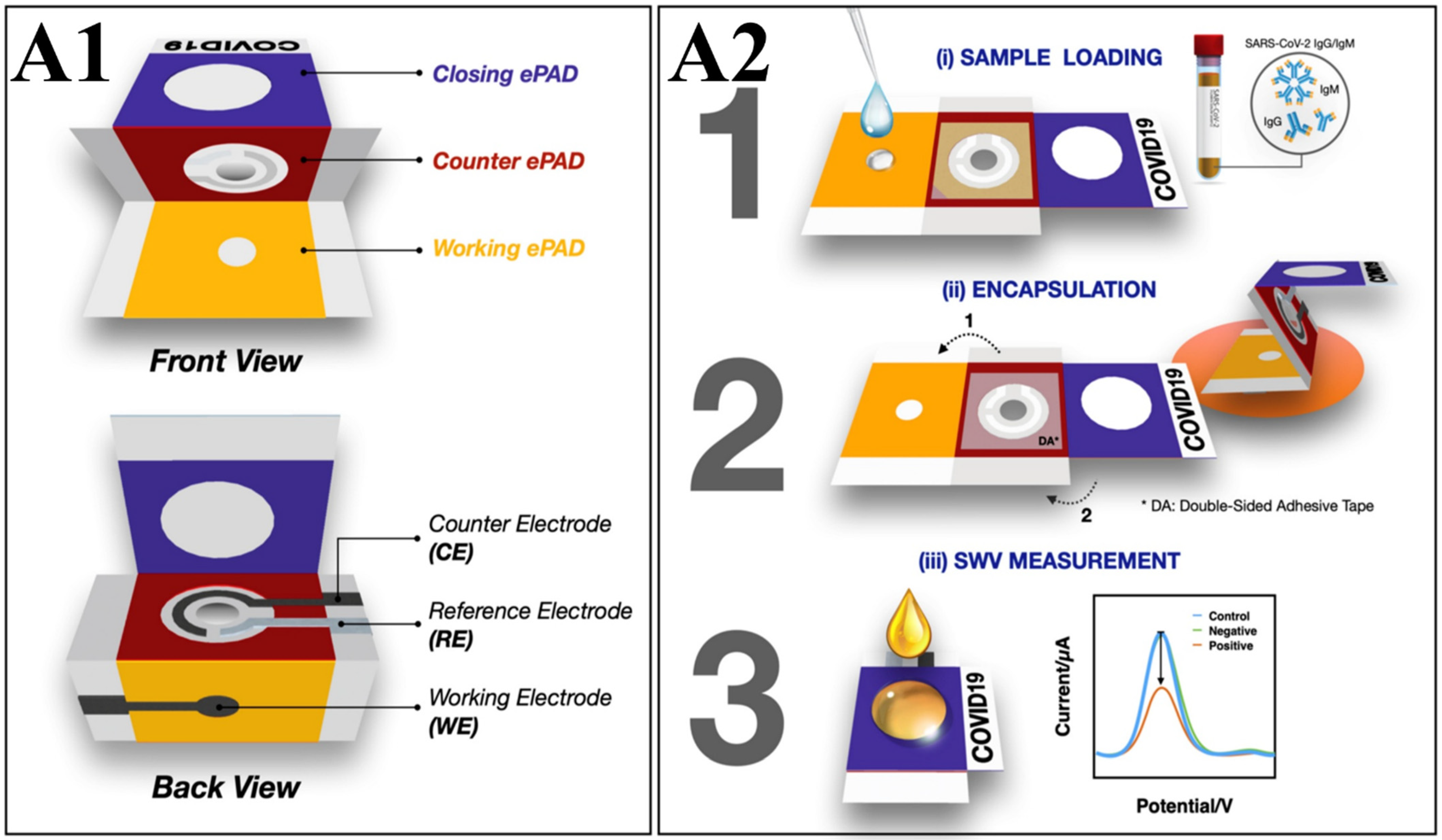
- Yakoh, A.; Pimpitak, U.; Rengpipat, S.; Hirankarn, N.; Chailapakul, O.; Chaiyo, S. Paper-based electrochemical biosensor for diagnosing COVID-19: Detection of SARS-CoV-2 antibodies and antigen. Biosens. Bioelectron. 2021, 176, 112912. [Google Scholar] [CrossRef] [PubMed]
- Casali, P. IgM. In Encyclopedia of Immunology, 2nd ed.; Delves, P.J., Ed.; Elsevier: Oxford, UK, 1998; pp. 1212–1217. [Google Scholar]
- Nezlin, R. CHAPTER 1—General Characteristics of Immunoglobulin Molecules. In The Immunoglobulins; Nezlin, R., Ed.; Academic Press: New York, NY, USA, 1998; pp. 3–73. [Google Scholar]
- Burrell, C.J.; Howard, C.R.; Murphy, F.A. Chapter 6—Adaptive Immune Responses to Infection. In Fenner and White’s Medical Virology, 5th ed.; Burrell, C.J., Howard, C.R., Murphy, F.A., Eds.; Academic Press: London, UK, 2017; pp. 65–76. [Google Scholar]
- Boonkaew, S.; Teengam, P.; Jampasa, S.; Rengpipat, S.; Siangproh, W.; Chailapakul, O. Cost-effective paper-based electrochemical immunosensor using a label-free assay for sensitive detection of ferritin. Analyst 2020, 145, 5019–5026. [Google Scholar] [CrossRef] [PubMed]
- Shoute, L.C.T.; Charlton, C.L.; Kanji, J.N.; Babiuk, S.; Babiuk, L.; Chen, J. Faradaic Impedimetric Immunosensor for Label-Free Point-of-Care Detection of COVID-19 Antibodies Using Gold-Interdigitated Electrode Array. Biosensors 2024, 14, 6. [Google Scholar] [CrossRef] [PubMed]
- Dijksma, M.; Boukamp, B.A.; Kamp, B.; van Bennekom, W.P. Effect of Hexacyanoferrate(II/III) on Self-Assembled Monolayers of Thioctic Acid and 11-Mercaptoundecanoic Acid on Gold. Langmuir 2002, 18, 3105–3112. [Google Scholar] [CrossRef]
- Asefifeyzabadi, N.; Durocher, G.; Tshilenge, K.-T.; Alam, T.; Ellerby, L.M.; Shamsi, M.H. PNA microprobe for label-free detection of expanded trinucleotide repeats. RSC Adv. 2022, 12, 7757–7761. [Google Scholar] [CrossRef]
- Zhang, C. Novel functions for small RNA molecules. Curr. Opin. Mol. Ther. 2009, 11, 641–651. [Google Scholar]
- Adil, O.; Eddington, S.B.; Gagnon, K.T.; Shamsi, M.H. Microprobes for Label-Free Detection of Short Tandem Repeats: An Insight into Alleviating Secondary Structure Effects. Anal. Chem. 2023, 95, 13528–13536. [Google Scholar] [CrossRef]
- Qaanei, M.; Taheri, R.A.; Eskandari, K. Electrochemical aptasensor for Escherichia coli O157:H7 bacteria detection using a nanocomposite of reduced graphene oxide, gold nanoparticles and polyvinyl alcohol. Anal. Methods 2021, 13, 3101–3109. [Google Scholar] [CrossRef]
- WHO. Parkinson Disease; WHO: Geneva, Switzerland, 2023; Available online: https://www.who.int/news-room/fact-sheets/detail/parkinson-disease#:~:text=Parkinson%20disease%20(PD)%20is%20a,muscle%20contractions%20and%20difficulty%20speaking (accessed on 24 April 2025).
- Kenny, A.; McArdle, H.; Calero, M.; Rabano, A.; Madden, S.F.; Adamson, K.; Forster, R.; Spain, E.; Prehn, J.H.M.; Henshall, D.C.; et al. Elevated Plasma microRNA-206 Levels Predict Cognitive Decline and Progression to Dementia from Mild Cognitive Impairment. Biomolecules 2019, 9, 734. [Google Scholar] [CrossRef]
- Carrico, A.; Cumba, L.R.; Medina, M.; Engel, T.; Forster, R.J. Ultrasensitive, label-free, electrochemical detection of miRNA-206 in human plasma: A potential biomarker associated with Alzheimer’s disease. Electrochem. Commun. 2024, 162, 107704. [Google Scholar] [CrossRef]
- Chang, C.; Wang, Q.-F.; Guo, J.-C.; Li, D.-D.; Fan, Y.-B.; Wen, J.-M. The Biomechanical Relationship between Hallux Valgus Deformity and Metatarsal Pain. J. Healthc. Eng. 2020, 2020, 8929153. [Google Scholar] [CrossRef] [PubMed]
- Twohig, P.L. “Everything Possible Is Being Done”: Labour, Mobility, and the Organization of Health Services in Mid-20th Century Newfoundland. Can. Bull. Med. Hist. 2019, 36, 1–26. [Google Scholar] [CrossRef] [PubMed]
- Navay Baghban, H.; Hasanzadeh, M.; Liu, Y.; Seidi, F. Efficient Entrapment of Alpha-Synuclein Biotinylated Antibody in KCC-1-NH-CS2 and Application for the Sensitive Diagnosis of Parkinson’s Using Recognition of Biomarker: An Innovative Electrochemical Label-Free Immunosensor for the Biomedical Analysis of Neurodegenerative Diseases. Biosensors 2022, 12, 911. [Google Scholar] [CrossRef]
- Abdolrahim, M.; Rabiee, M.; Alhosseini, S.N.; Tahriri, M.; Yazdanpanah, S.; Tayebi, L. Development of optical biosensor technologies for cardiac troponin recognition. Anal. Biochem. 2015, 485, 1–10. [Google Scholar] [CrossRef]
- Cao, J.-T.; Ma, Y.; Lv, J.-L.; Ren, S.-W.; Liu, Y.-M. A potentiometric resolved photoelectrochemical system based on CdS nanowires and SnNb2O6 nanosheets: A case application for dual biomarker analysis. Chem. Commun. 2020, 56, 1513–1516. [Google Scholar] [CrossRef]
- de Araujo Andrade, T.; Ribeiro, I.S.; Silva, T.A.; de Souza, L.K.A.; Coltro, W.K.T.; Borges, L.P.; Silva, D.M.R.R.; de Tarso Garcia, P.; de Jesus, J.R. Diagnosis of viral infectious diseases through sensitive detection of human serum antibodies using a modified label-free electrochemical biosensor. Anal. Bioanal. Chem. 2024, 416, 6345–6355. [Google Scholar] [CrossRef]
- Ropero-Vega, J.L.; Redondo-Ortega, J.F.; Galvis-Curubo, Y.J.; Rondón-Villarreal, P.; Flórez-Castillo, J.M. A Bioinspired Peptide in TIR Protein as Recognition Molecule on Electrochemical Biosensors for the Detection of E. coli O157:H7 in an Aqueous Matrix. Molecules 2021, 26, 2559. [Google Scholar] [CrossRef]
- Hou, Y.-H.; Wang, J.-J.; Jiang, Y.-Z.; Lv, C.; Xia, L.; Hong, S.-L.; Lin, M.; Lin, Y.; Zhang, Z.-L.; Pang, D.-W. A colorimetric and electrochemical immunosensor for point-of-care detection of enterovirus 71. Biosens. Bioelectron. 2018, 99, 186–192. [Google Scholar] [CrossRef]
- Ricci, S.; Casalini, S.; Parkula, V.; Selvaraj, M.; Saygin, G.D.; Greco, P.; Biscarini, F.; Mas-Torrent, M. Label-free immunodetection of α-synuclein by using a microfluidics coplanar electrolyte-gated organic field-effect transistor. Biosens. Bioelectron. 2020, 167, 112433. [Google Scholar] [CrossRef]
- Hou, F.; Fu, X.-L.; Hu, X.-B.; Cao, J.-T.; Ma, S.-H.; Liu, Y.-M. Label-Free Electrochemiluminescence Immunosensor for the Determination of Cardiac Troponin I Using a Cadmium Sulfide–Molybdenum (IV) Sulfide Nanocomposite Modified Glassy Carbon Electrode. Anal. Lett. 2020, 53, 1416–1427. [Google Scholar] [CrossRef]
- Liu, L.; Sheng, X.; Xue, Y.; Ma, Z.; Zhang, L.; Liu, B.; Cao, X. Ultrasensitive Electrochemical Immunosensor for Multiplex Sandwich Bioassaying Based on the Functional Antibodies. ACS Omega 2024, 9, 14249–14254. [Google Scholar] [CrossRef]
- Zhang, P.; Wang, R. Label-Free Biosensor. Biosensors 2023, 13, 556. [Google Scholar] [CrossRef] [PubMed]
- Li, T.; Ou, G.; Chen, X.; Li, Z.; Hu, R.; Li, Y.; Yang, Y.; Liu, M. Naked-eye based point-of-care detection of E.coli O157: H7 by a signal-amplified microfluidic aptasensor. Anal. Chim. Acta 2020, 1130, 20–28. [Google Scholar] [CrossRef] [PubMed]
- Baker, R.E.; Mahmud, A.S.; Miller, I.F.; Rajeev, M.; Rasambainarivo, F.; Rice, B.L.; Takahashi, S.; Tatem, A.J.; Wagner, C.E.; Wang, L.-F.; et al. Infectious disease in an era of global change. Nat. Rev. Microbiol. 2022, 20, 193–205. [Google Scholar] [CrossRef] [PubMed]
- Zhang, Y.; Zhu, Y.; Zheng, S.; Zhang, L.; Shi, X.; He, J.; Chou, X.; Wu, Z.-S. Ink formulation, scalable applications and challenging perspectives of screen printing for emerging printed microelectronics. J. Energy Chem. 2021, 63, 498–513. [Google Scholar] [CrossRef]
- Campuzano, S.; Pedrero, M.; Gamella, M.; Serafín, V.; Yáñez-Sedeño, P.; Pingarrón, J.M. Beyond Sensitive and Selective Electrochemical Biosensors: Towards Continuous, Real-Time, Antibiofouling and Calibration-Free Devices. Sensors 2020, 20, 3376. [Google Scholar] [CrossRef]
- Islam, M.R.; Serpe, M.J. Polymer-based devices for the label-free detection of DNA in solution: Low DNA concentrations yield large signals. Anal. Bioanal. Chem. 2014, 406, 4777–4783. [Google Scholar] [CrossRef]
- Martins, G.; Gogola, J.L.; Budni, L.H.; Janegitz, B.C.; Marcolino-Junior, L.H.; Bergamini, M.F. 3D-printed electrode as a new platform for electrochemical immunosensors for virus detection. Anal. Chim. Acta 2021, 1147, 30–37. [Google Scholar] [CrossRef]
- Takekawa, V.S.; Marques, L.A.; Strubinger, E.; Segato, T.P.; Bogusz Junior, S.; Brazaca, L.C.; Carrilho, E. Development of low-cost planar electrodes and microfluidic channels for applications in capacitively coupled contactless conductivity detection (C4D). Electrophoresis 2021, 42, 1560–1569. [Google Scholar] [CrossRef]
- Chandra, P. Miniaturized label-free smartphone assisted electrochemical sensing approach for personalized COVID-19 diagnosis. Sens. Int. 2020, 1, 100019. [Google Scholar] [CrossRef]
- Khonyoung, S.; Mangkronkaew, P.; Klayprasert, P.; Puangpila, C.; Palanisami, M.; Arivazhagan, M.; Jakmunee, J. Point-of-Care Detection of Carcinoembryonic Antigen (CEA) Using a Smartphone-Based, Label-Free Electrochemical Immunosensor with Multilayer CuONPs/CNTs/GO on a Disposable Screen-Printed Electrode. Biosensors 2024, 14, 600. [Google Scholar] [CrossRef]
- Liu, G.; Wu, Y.; Wang, Y.; Ye, W.; Wu, M.; Liu, Q. Smartphone-Based Portable Sensing Systems for Point-of-Care Detections. In Portable and Wearable Sensing Systems; Wiley-VCH GmbH: Weinheim, Germany, 2024; pp. 89–110. [Google Scholar]
- Sajeevan, A.; Sukumaran, R.A.; Panicker, L.R.; Kotagiri, Y.G. Trends in ready-to-use portable electrochemical sensing devices for healthcare diagnosis. Microchim. Acta 2025, 192, 80. [Google Scholar] [CrossRef]
- Zhang, F.; Liu, Y.; Wang, J.; Zhang, H.; Yu, W.; Sang, Y.; Liu, Y.; Yang, G.; Gao, F.; Wang, S.; et al. An automated microfluidic biosensor with bispecific rabbit monoclonal antibody and nanozyme-bioenzyme composite for dual antibiotic detection. BMEMat 2025, e70039. [Google Scholar] [CrossRef]


| Bioreceptors | Targets | Detection Range | LOD | Ref. |
|---|---|---|---|---|
| Antibodies | plasma-based Aβ1–42 | 11 pmol L−1 to 55 nmol L−1 | 2.398 pmol L−1 | [49] |
| S1 protein | 5.0 to 75.0 nmol L−1 | 1.36 nmol L−1 | [47] | |
| S1 protein | 1.0 to 75.0 nmol L−1 | 0.30 µmol L−1 | [46] | |
| Tiamulin (TML) | 0.01 to 1000 ng mL−1 | 0.003 ng mL−1 | [48] | |
| A29 protein | 1.8 to 100 ng mL−1 | 0.48 ng mL−1 | [54] | |
| human epidermal growth factor receptor 2 | 0.1 to 100 nmol L−1 | 0.23 fmol L−1 | [55] | |
| Oncostatin M | 37 to 1000 pg mL−1 | 2.86 pg mL−1 | [56] | |
| Aptamers | Microcystin-LR (MC-LR), Cylindrospermopsin (CYL), anatoxin-α, saxitoxin, and okadaic acid (OA). | 0.073–150 nmol L−1, 0.018 to 200 nmol L−1, 0.018 to 200 nmol L−1, 0.018 to 200 nmol L−1, 0.018 to 200 nmol L−1, respectively | 0.0033, 0.0045, 0.0034, 0.0053, and 0.0048 nmol L−1, respectively | [43] |
| Atrazine | 1.0 to 250 nmol L−1 | 0.06 nmol L−1 | [44] | |
| hemoglobin A | 13.5 to 150 nmol L−1 | 0.85 pg mL−1 | [57] | |
| S. aureus | 10 to 108 CFU mL−1 | 3.0 CFU mL−1 | [58] | |
| Tau381 | 1.0 to 100 pmol L−1 | 0.7 pmol L−1 | [59] | |
| Oxytetracycline | 1.0 to 540 nmol L−1 | 30 pmol L−1 | [60] | |
| MIPs | α-amylase | 6.0 × 10⁻⁶ to 0.60 mg mL−1 | <3.0 × 10⁻⁴ mg mL−1 | [51] |
| Homocysteine | 5.0 to 150 µmol L−1 | 1.2 µmol L−1 | [61] | |
| L-tyrosine | 100 pmol L−1 to 5 mmol L−1 | 10 pmol L−1 | [62] | |
| Dopamine | 0.005 to 100 μmol L−1 | 0.0006 μmol L−1 | [63] | |
| Glucose | 0.001 to 10 mmol L−1 | 0.26 nmol L−1 | [64] | |
| Testosterone | 1.0 to 25 ng dL−1 | 1.0 ng dL−1 | [65] | |
| cortisol | 0.005 to 5000 ng mL−1 | 0.019 pmol L−1 | [66] |
| Type of Device | Immunosensor | Target | Technique | Linear Range | LOD | Samples | Possible Portability? | Ref. |
|---|---|---|---|---|---|---|---|---|
| GCE | AuNPs/CCNTs/CS nanocomposite | carcinoembryonic antigen | CV and SWV | 0.001–400 ng mL−1 | ~1 pg mL−1 | Real human serum | No | [85] |
| AuNPs/pDa/rGO | NS1 | DPV | 0.001–100 μg mL−1 | 0.001 μg mL−1 | not tested | No | [86] | |
| COFe2O4-C60NP | Anti-A2 | DPV | 0.1 fg mL−1–0.1 μg mL−1 | 0.1 fg mL−1 | sheep blood serum | No | [87] | |
| SPE | ESPEC | A-synuclein | SWV and EIS | 0.01–100 ng mL−1 | 4.1 pg mL−1 | Fetal bovine serum | Yes | [88] |
| PEI/ABsa/PSS | S. aureus | EIS | 104–107 CFU mL−1 | 1000 CFU mL−1 | Spiked PBS | Yes, and they tested the portability. | [89] | |
| LIG immunosensor | DENV | DPV | 25–2000 ng mL−1 | 17.40 ng mL−1 | Real human serum | yes | [90] | |
| GE | Sulfo-LC-SPDP | SPB | EIS and CV | 2–2000 ng mL−1 | 0.1 ng mL−1 | Real Amniotic Fluid | yes | [91] |
| COOH-CNF/Ti3C2TxMXene/PANI-AgNPs | OPG | DPV | 0.01–1000 fg mL−1 | 0.00194 fg mL−1 | Real human serum | No | [92] | |
| 3D | PLA-G | PARK7/DJ-1 | EIS and CV | 5.0–200 μg mL−1 | 1.01 μg mL−1 | Commercial Human serum and synthetic cerebrospinal fluid | No | [93] |
| CB-PLA | S1 protein | CV | 0.01–4.5 nmol mL−1 | 2.7 pmol mL−1 | Commercial human serum and synthetic saliva | Yes | [94] | |
| CB-PLA Protopasta | TNFα | DPV | 160–1820 pg mL−1 | 44.5 pg mL−1 | Real faecal pellets | No | [95] |
| Types of Mediators and Amplifiers | Modifiers | Targets | Detection Range | LOD | Ref. |
|---|---|---|---|---|---|
| Genosensor | DNA capture sequence and 2-mercaptoethanol | SCA sequence gene | 0.1–7.5 μmol L−1 | 7.0 nmol L−1 | [102] |
| Redox mediators | Methylene blue | MicroRNA let-7a | 0.001–1000 pmol L−1 | 0.45 fmol L−1 | [114] |
| Ferrocene | cTnI | 10 fg mL−1–10 ng mL−1 | 2.6 fg mL−1 | [115] | |
| Mimetic enzymes | Tripedal DNA walker (MB1, MB2, MB3) | Tau protein | 0.1 fmol L−1–1.0 nmol L−1 | 0.43 fmol L−1 | [116] |
| Tripedal DNA walker (HP1, HP2,HP3) | α-synuclein oligomer | 1.0 fmol L−1–10 pmol L−1 | 0.46 fmol L−1 | [118] | |
| Nanomaterials | Gold nanocubes | Prostate cancer gene short sequence and EPI anti-cancer drug | 0.04–0.8 μmol L−1 0.8–20 μmol L−1 | 0.01 μmol L−1 | [110] |
| Zinc oxide and AuNPs | Mycobacterium tuberculosis-DNA | 2.5–250 pmol L−1 | 1.8 pmol L−1 | [119] | |
| Carbon nanomaterials | Single-wall carbon nanotubes | Doxorucibin | 1.0 nmol L−1–20 μmol L−1 | <0.6 nmol L−1 | [121] |
| Nanocomposite of graphene and MWCNTs | Oligonucleotide/NHL gene | 1.0 fmol L−1–1.0 nmol L−1 | 0.5 fmol L−1 | [122] | |
| Hybrid nanocomposites | Nanoclusters of AuNPs and CNTs | DNA hybridization | 0.1 pmol L−1–10 nmol L−1 | 5.2 fmol L−1 | [117] |
| Core–shell silver and AuNPs electrodeposited on a graphene quantum dot nanoink | miRNA-21 | 5.0 pmol L−1–5.0 μmol L−1 | - | [120] |
| Diseases | Target | LOD | Linear Range | Discussing the Potential for PoC? | Ref. |
|---|---|---|---|---|---|
| Dengue | Virus genomic sequence | 0.12 pmol L−1 | - | No | [131] |
| Dengue and Zika | NS1 | 6.8 ng mL−1 | 20–800 ng mL−1 | Yes | [133] |
| Dengue and Zika | NS1ZV NS1DV | 0.54ng mL−1(Zika) 1.17 ng mL−1(Dengue) | 15.62–1000.00 ng mL−1 15.62–500.00 ng mL−1 | Yes | [126] |
| Dengue | DENV1 RNA | 20 PFU mL−1 | 102 to 105 PFU mL−1 | No | [132] |
| COVID-19 | IgG | 0.2 ng mL−1 | 1.37–145 ng mL−1 | Yes | [155] |
| COVID-19 | IgG IgM S1 protein | 0.96 ng mL−1 0.14 ng mL−1 0.11 ng mL−1 | - - 1–1000 ng mL−1 | Yes | [136] |
| COVID-19 | SARS-CoV-2 Antibody | 21 ng mL−1 | 50–105 ng mL−1 | Yes | [141] |
| E. coli | O157:H7 | 9.34 CFU mL−1 | 9.2–9.2 × 10⁸ CFU mL−1 | No | [146] |
| E. coli | O157:H7 | 2 CFU mL−1 | 10–1000 CFU mL−1 | No | [156] |
| Enterovirus 71 | EV71 | 0.1 ng mL−1 | 0.1–6000 ng mL−1 | Yes | [157] |
| Huntington | Repeated sequences of CAG | 1 pmol L−1 | 1–100 pM | No | [143] |
| Huntington | Repeated sequences of CAG | 100 amol L−1 | 100 amol L−1–100 amol L−1 | Yes | [152] |
| Alzheimer and Parkinson | α-synuclein | 0.25 pmol L−1 | 0.25 pmol L−1–250 nmol L−1 | Yes | [158] |
| Alzheimer | MiRNA-206 | 0.15 amol L−1 | 1 µm to 1 amol L−1 | Yes | [149] |
| Parkinson | α-synuclein | 0.02 ng mL−1 | 0.02–64 ng mL−1 | Yes | [152] |
| Acute myocardial infarction | cTnI | 1.0 pg mL−1 | 5.0 pg mL−1–100.0 ng mL−1 | No | [159] |
| Acute myocardial infarction | cTnI | 20 fg mL−1–2 ng mL−1 | 1.07 fg mL−1 | No | [160] |
Disclaimer/Publisher’s Note: The statements, opinions and data contained in all publications are solely those of the individual author(s) and contributor(s) and not of MDPI and/or the editor(s). MDPI and/or the editor(s) disclaim responsibility for any injury to people or property resulting from any ideas, methods, instructions or products referred to in the content. |
© 2026 by the authors. Licensee MDPI, Basel, Switzerland. This article is an open access article distributed under the terms and conditions of the Creative Commons Attribution (CC BY) license.
Share and Cite
Carvalho, J.H.S.; Catai, M.A.S.; Bertolim, L.V.; Freitas, R.C.; Camargo, J.R.; Brazaca, L.C.; Janegitz, B.C. Label-Free Electrochemical Biosensors: An Updated Perspective Focused on Genosensing, Multiplexing, and Commercial Potential. Biosensors 2026, 16, 98. https://doi.org/10.3390/bios16020098
Carvalho JHS, Catai MAS, Bertolim LV, Freitas RC, Camargo JR, Brazaca LC, Janegitz BC. Label-Free Electrochemical Biosensors: An Updated Perspective Focused on Genosensing, Multiplexing, and Commercial Potential. Biosensors. 2026; 16(2):98. https://doi.org/10.3390/bios16020098
Chicago/Turabian StyleCarvalho, Jefferson H. S., Marcus A. S. Catai, Lucas V. Bertolim, Rafaela C. Freitas, Jessica R. Camargo, Laís C. Brazaca, and Bruno C. Janegitz. 2026. "Label-Free Electrochemical Biosensors: An Updated Perspective Focused on Genosensing, Multiplexing, and Commercial Potential" Biosensors 16, no. 2: 98. https://doi.org/10.3390/bios16020098
APA StyleCarvalho, J. H. S., Catai, M. A. S., Bertolim, L. V., Freitas, R. C., Camargo, J. R., Brazaca, L. C., & Janegitz, B. C. (2026). Label-Free Electrochemical Biosensors: An Updated Perspective Focused on Genosensing, Multiplexing, and Commercial Potential. Biosensors, 16(2), 98. https://doi.org/10.3390/bios16020098