Correction

Correction: Li et al. Magnetic SERS Strip Based on 4-mercaptophenylboronic Acid-Modified Fe3O4@Au for Active Capture and Simultaneous Detection of Respiratory Bacteria. Biosensors 2023, 13, 210


1
Beijing Institute of Microbiology and Epidemiology, Beijing 100071, China
2
Department of Clinical Laboratory, Beijing Ditan Hospital, Capital Medical University, Beijing 100015, China
3
Beijing Institute of Radiation Medicine, Beijing 100850, China
*
Authors to whom correspondence should be addressed.
These authors contributed equally to this work.
Biosensors 2026, 16(2), 91; https://doi.org/10.3390/bios16020091
Submission received: 14 January 2026 / Accepted: 16 January 2026 / Published: 2 February 2026
(This article belongs to the Section Biosensors and Healthcare)

Figure/Table Correction

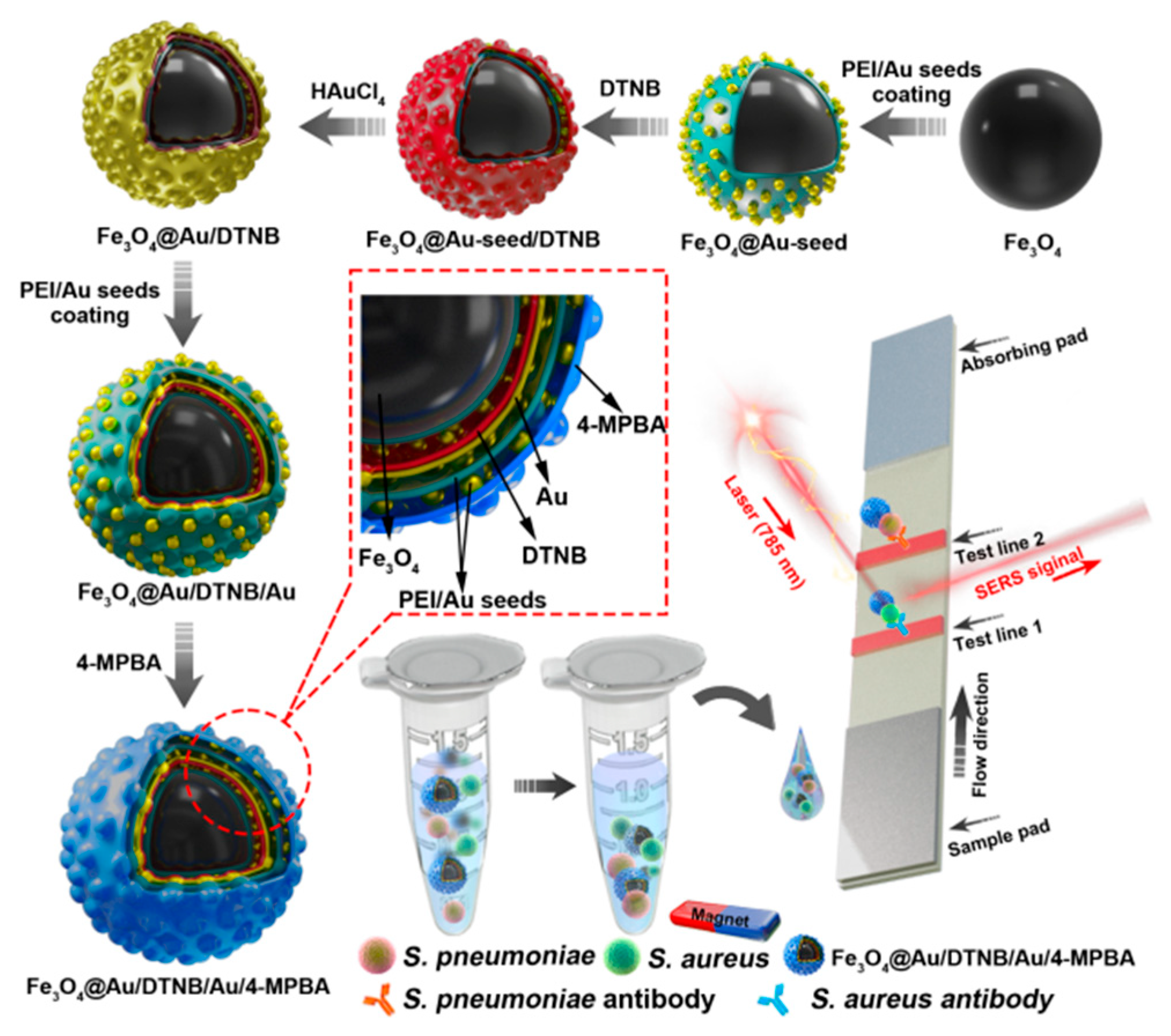
Due to an error in the original publication [1], a correction has been made in Scheme 1, “Absorbing line” has been changed to “Absorbing pad”, and the position of the compounds on test line 1 (below, S. aureus) and test line 2 (above, S. pneumoniae) has been changed. There was an error in Figure 3 as published due to an error when the paper was uploaded. In view of the subtle changes in the sensitivity results, in order to be consistent with the sensitivity, we have made corresponding changes to the reproducibility, specificity, and recovery rate experiments. The corrected figures and table appear below.
Scheme 1. Fabrication of Fe3O4@Au/DTNB/Au/4-MPBA and schematic diagram of Fe3O4@Au/DTNB/Au/4-MPBA SERS strip for detecting two respiratory bacteria.
Biosensors 16 00091 sch001
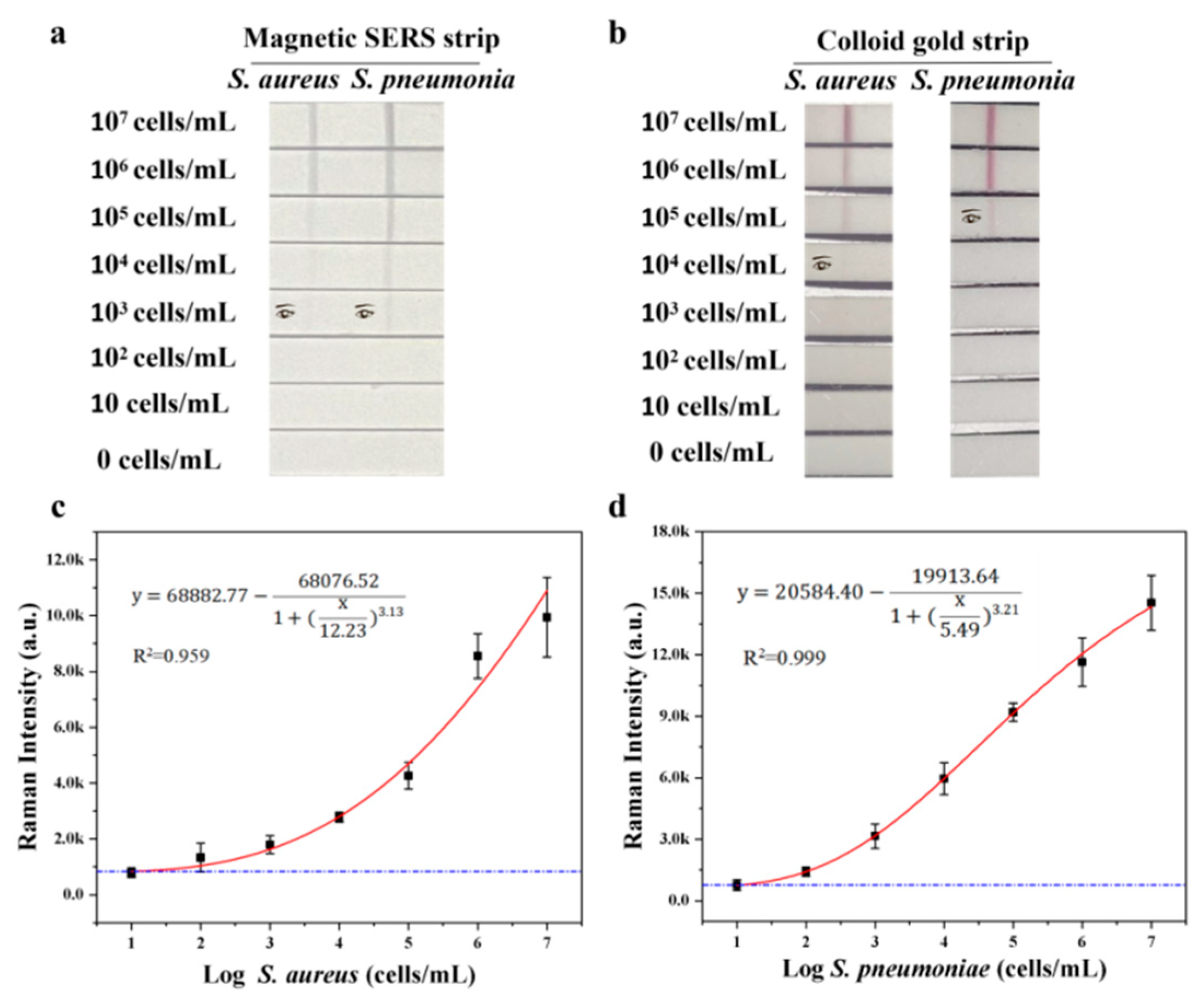
Figure 3. (a) Photographs of Fe3O4@Au/DTNB/Au/4-MPBA-based LFA strips for the detection at different concentrations of target bacteria. The visualization concentrations of target bacteria are both 103 cells mL−1. (b) Photographs of colloidal gold-based LFA strips for target bacteria detection. The visualization concentrations of S. aureus and S. pneumoniae are 104 and 105 cells mL−1 for AuNP−LFA strip detection, respectively. (c,d) Corresponding calibration curves of target bacteria for Fe3O4@Au/DTNB/Au/4-MPBA-based LFA strips.
Biosensors 16 00091 g003
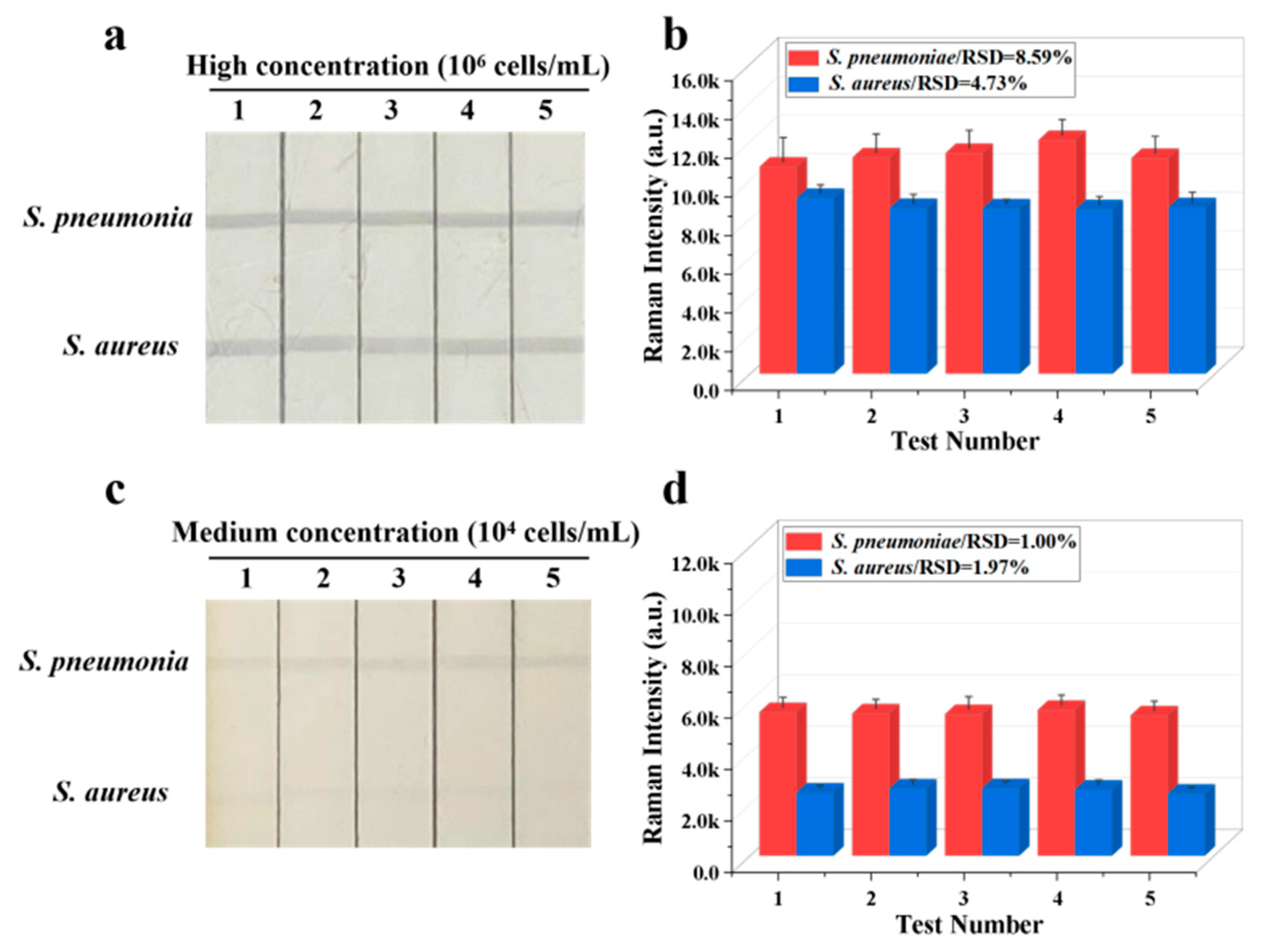
Figure 4. Reproducibility of Fe3O4@Au/DTNB/Au/4-MPBA-LFA strips for target bacteria at concentrations of (a) 106 and (c) 104 cells mL−1, respectively, and corresponding SERS intensities (b,d) on the test lines.
Biosensors 16 00091 g004
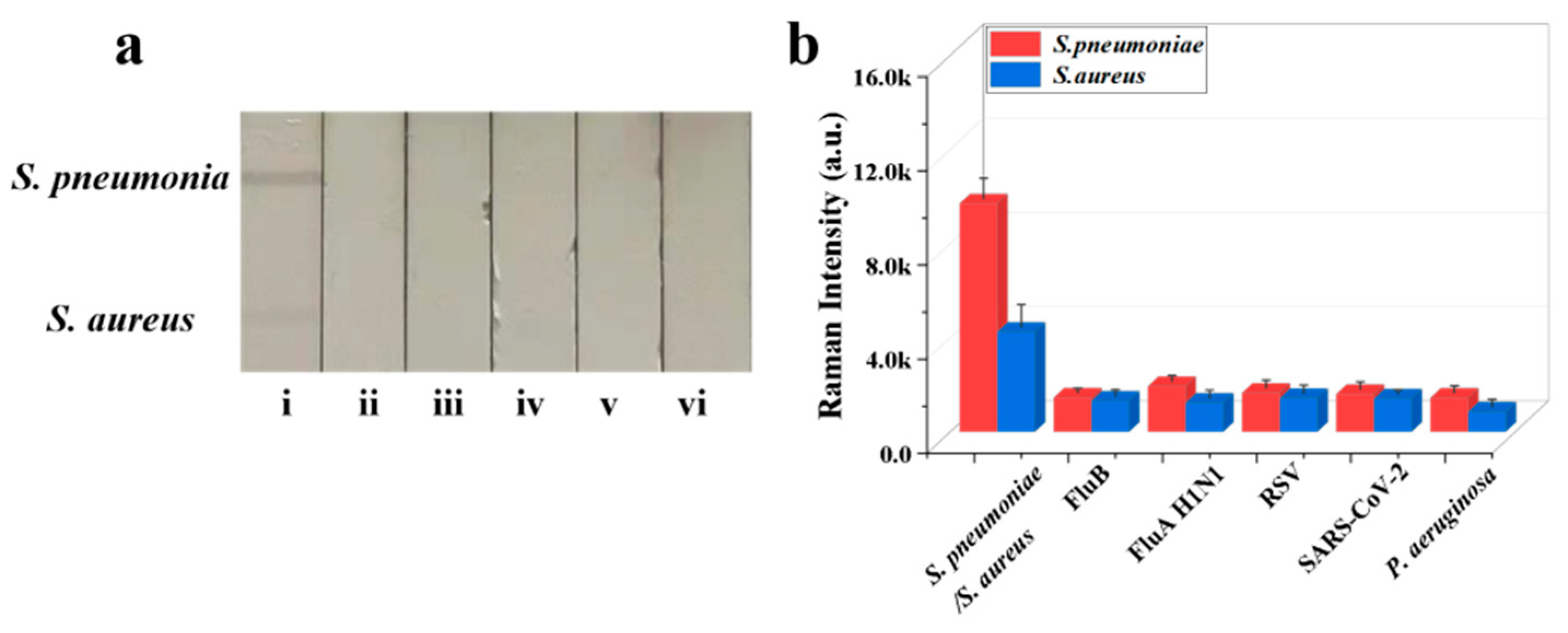
Figure 5. (a) Specificity of Fe3O4@Au/DTNB/Au/4-MPBA-LFA strips for target bacteria at concentration of 105 cells mL−1: (i) S. pneumoniae/S. aureus; (ii) FluB; (iii) FluA H1N1; (iv) RSV; (v) SARS-CoV-2; and (vi) P. aeruginosa. (b) Corresponding SERS intensities for S. aureus, S. pneumoniae, and other negative samples.
Biosensors 16 00091 g005
Table 1. Results of the recovery test in the sputum specimens (n = 3).
StrainSpiked
(cells/mL)
Detected
(cells/mL)
Recovery
(%)
RSD
(%)
S. pneumoniae1 × 1069.27 × 10592.73.04
1 × 1031.115 × 103111.58.59
S. aureus1 × 1061.065 × 106106.56.22
1 × 1031.04 × 103104.28.26

Text Correction

There were some errors in the original publication. The limits of detection, correlation coefficients, and relative standard deviation need to be corrected. The corrections are as follows:
Abstract
“the limits of detection for S. aureus and S. pneumoniae were as low as 8 and 13 CFU mL−1, respectively” is replaced by “the limits of detection for S. aureus and S. pneumoniae were as low as 12 and 11 CFU mL−1, respectively”.
1. Introduction
Paragraph 4: “as low as 8 and 13 CFU mL−1” is replaced by “as low as 12 and 11 CFU mL−1”.
3. Results and Discussion
3.4. Analytical Performance of Fe3O4@Au/DTNB/Au/4-MPBA-Based LFA
Paragraph 1: “were 10 and 103 cells mL−1” is replaced by “were both 103 cells mL−1”; “the correlation coefficients (R2) were 0.994 and 0.995” is replaced by “the correlation coefficients (R2) were 0.959 and 0.999”; and “8 and 13 cells mL−1 for S. aureus and S. pneumoniae” is replaced by “12 and 11 cells mL−1 for S. aureus and S. pneumoniae”.
Paragraph 2: “relative standard deviation (RSD) of 6.32% and 5.12%” is replaced by ”relative standard deviation (RSD) of 8.59% and 4.73%”; “RSD of 9.43% and 8.63%” is replaced by “RSD of 1.00% and 1.97%”; and “ranged from 92.3% to 105.2%” is replaced by “ranged from 92.7% to 111.5%”.
4. Conclusions
“as low as 8 and 13 CFU mL−1” is replaced by “as low as 12 and 11 CFU mL−1”.
Furthermore, in the original publication, the word “cells” is missing in the caption of Figure 2. A correction “(iv) 0, 0 cells mL−1” has been made to the caption of Figure 2.

Reference

  1. Li, J.; Chen, J.; Dai, Y.; Liu, Z.; Zhao, J.; Liu, S.; Xiao, R. Magnetic SERS Strip Based on 4-mercaptophenylboronic Acid-Modified Fe3O4@Au for Active Capture and Simultaneous Detection of Respiratory Bacteria. Biosensors 2023, 13, 210. [Google Scholar] [CrossRef] [PubMed]
Disclaimer/Publisher’s Note: The statements, opinions and data contained in all publications are solely those of the individual author(s) and contributor(s) and not of MDPI and/or the editor(s). MDPI and/or the editor(s) disclaim responsibility for any injury to people or property resulting from any ideas, methods, instructions or products referred to in the content.