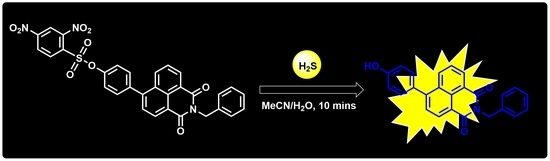
Development of a Rapid-Response Fluorescent Probe for H2S: Mechanism Elucidation and Biological Applications

 , and
, and 
Abstract
Share and Cite
Dvorak, T.; Hernandez-Sandoval, H.; Cheku, S.; Mora Valencia González, M.; Borer, L.; Grieser, R.; Carlson, K.A.; Cao, H. Development of a Rapid-Response Fluorescent Probe for H2S: Mechanism Elucidation and Biological Applications. Biosensors 2025, 15, 174. https://doi.org/10.3390/bios15030174
Dvorak T, Hernandez-Sandoval H, Cheku S, Mora Valencia González M, Borer L, Grieser R, Carlson KA, Cao H. Development of a Rapid-Response Fluorescent Probe for H2S: Mechanism Elucidation and Biological Applications. Biosensors. 2025; 15(3):174. https://doi.org/10.3390/bios15030174
Chicago/Turabian StyleDvorak, Trevor, Haley Hernandez-Sandoval, Sunayn Cheku, Marijose Mora Valencia González, Linus Borer, Riley Grieser, Kimberly A. Carlson, and Haishi Cao. 2025. "Development of a Rapid-Response Fluorescent Probe for H2S: Mechanism Elucidation and Biological Applications" Biosensors 15, no. 3: 174. https://doi.org/10.3390/bios15030174
APA StyleDvorak, T., Hernandez-Sandoval, H., Cheku, S., Mora Valencia González, M., Borer, L., Grieser, R., Carlson, K. A., & Cao, H. (2025). Development of a Rapid-Response Fluorescent Probe for H2S: Mechanism Elucidation and Biological Applications. Biosensors, 15(3), 174. https://doi.org/10.3390/bios15030174