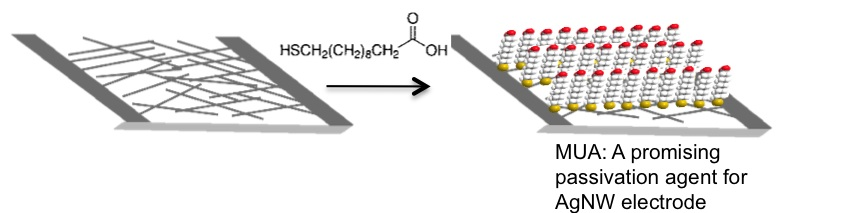
Increasing Silver Nanowire Network Stability through Small Molecule Passivation

Abstract
Share and Cite
Madeira, A.; Plissonneau, M.; Servant, L.; Goldthorpe, I.A.; Tréguer-Delapierre, M. Increasing Silver Nanowire Network Stability through Small Molecule Passivation. Nanomaterials 2019, 9, 899. https://doi.org/10.3390/nano9060899
Madeira A, Plissonneau M, Servant L, Goldthorpe IA, Tréguer-Delapierre M. Increasing Silver Nanowire Network Stability through Small Molecule Passivation. Nanomaterials. 2019; 9(6):899. https://doi.org/10.3390/nano9060899
Chicago/Turabian StyleMadeira, Alexandra, Marie Plissonneau, Laurent Servant, Irene A. Goldthorpe, and Mona Tréguer-Delapierre. 2019. "Increasing Silver Nanowire Network Stability through Small Molecule Passivation" Nanomaterials 9, no. 6: 899. https://doi.org/10.3390/nano9060899
APA StyleMadeira, A., Plissonneau, M., Servant, L., Goldthorpe, I. A., & Tréguer-Delapierre, M. (2019). Increasing Silver Nanowire Network Stability through Small Molecule Passivation. Nanomaterials, 9(6), 899. https://doi.org/10.3390/nano9060899