Review

Nanotechnology for Drought Mitigation and Water Conservation: Opportunities and Limitations

1
Soil and Water Department, Faculty of Agriculture, Kafrelsheikh University, Kafr El-Sheikh 33516, Egypt
2
Nanofood Laboratory, Department of Animal Husbandry, Faculty of Agricultural and Food Sciences and Environmental Management, Institute of Animal Science, Biotechnology and Nature Conservation, University of Debrecen, 138 Boszormenyi Street, 4032 Debrecen, Hungary
3
Microbiology Department, Soil, Water and Environment Research Institute, Sakha Agricultural Research Station, Agriculture Research Center, Kafr El-Sheikh 33717, Egypt
4
Plant Biotechnology Department, Biotechnology Research Institute, National Research Centre, 33 El Buhouth St., Dokki, Giza 12622, Egypt
5
Chemistry of Natural Compounds Department, Pharmaceutical and Drug Industries Research Institute, National Research Centre, 33 El Buhouth St., Dokki, Giza 12622, Egypt
*
Authors to whom correspondence should be addressed.
Nanomaterials 2026, 16(9), 523; https://doi.org/10.3390/nano16090523
Submission received: 29 March 2026 / Revised: 18 April 2026 / Accepted: 24 April 2026 / Published: 26 April 2026

Abstract

Water scarcity is becoming an increasingly critical global challenge, driven by climate change, rapid population growth, pollution, and unsustainable water use. Drought further intensifies this crisis by reducing water availability across agricultural, environmental, and socio-economic systems. In this context, nanotechnology has emerged as a promising tool for improving water management and enhancing drought resilience. This review examines the role of nanotechnology in drought mitigation and water conservation through multiple pathways, including the enhancement of plant drought tolerance, improvement in soil water retention, the development of smart irrigation and nano-sensing systems, and the expansion of water resources through purification, desalination, and wastewater reuse. In addition, the broader drought–water nexus is discussed to position nano-enabled approaches within existing water management strategies. While numerous studies report improvements in water-use efficiency, stress tolerance, and treatment performance under controlled conditions, significant limitations remain. These include concerns related to environmental safety, nanotoxicity, scalability, cost, and the gap between laboratory findings and field-level applications. Overall, nanotechnology should be considered a complementary approach rather than a stand-alone solution for addressing water scarcity under drought conditions. Future research should focus on long-term environmental impacts, techno-economic feasibility, and large-scale field validation to support the safe and effective integration of nanotechnology into sustainable water management systems.

1. Introduction

The global water crisis has become one of the most pressing challenges of the twenty-first century, driven by climate change, increasing pollution, inefficient water use, and rapid population growth. This challenge is particularly severe in arid and semi-arid regions, where water resources are already limited and highly vulnerable to climatic variability. This crisis refers to the significant decline in the availability, accessibility, and quality of freshwater resources, leading to serious consequences for human health, economic development, and environmental sustainability [1]. Climate change accelerates drought intensity by increasing temperature, enhancing evapotranspiration, and altering precipitation patterns, thereby directly amplifying water scarcity [2]. Water consumption varies widely across regions, with a global average of approximately 4000–5000 m3 per person per year, compared to about 720 m3 per person per year in the Middle East and less than 200 m3 per person per year in severely water-scarce countries such as Jordan and Yemen [3]. These combined effects demonstrate that drought is not only a climatic phenomenon but also a key driver of the global water crisis, linking environmental stress with agricultural and socio-economic vulnerability. Projections indicate that global water demand may increase by 20–30% by 2050 relative to current levels [4]. In addition to water scarcity, declining water quality further complicates access to safe and clean water for agricultural, domestic, and industrial uses [5]. Consequently, the global water crisis is increasingly recognized as a critical environmental and societal issue [6]. Among the key drivers of this crisis, drought represents one of the most critical and recurring stressors affecting water availability worldwide.
Drought plays a significant role in intensifying this crisis, particularly under changing climatic conditions. As one of the most severe natural hazards, drought is associated with increased evaporation, reduced precipitation, and greater pressure on already limited water resources [2]. Its impacts are especially evident in agriculture, where water shortages directly affect crop productivity and food security, particularly in regions that rely heavily on irrigation [7]. Addressing drought requires a combination of mitigation strategies aimed at reducing its adverse effects on water resources, ecosystems, and human communities [8]. These strategies include nature-based solutions, integrated water resource management, technological innovations, and agricultural adaptation to increasingly frequent and severe drought events [8,9,10,11]. However, despite their effectiveness, these strategies are often limited by high implementation costs, technological complexity, and limited scalability, particularly in developing and water-scarce regions.
Nature-based solutions involve approaches such as ecosystem restoration, green infrastructure, and enhancement of soil ecosystem services [12,13,14]. Technological innovations, on the other hand, include tools such as artificial intelligence and machine learning for drought forecasting, remote sensing technologies, and probabilistic modeling techniques [15,16,17]. In parallel, agricultural adaptation focuses on the development of drought-resilient crops and improved management practices to sustain productivity under water-limited conditions [18]. Consequently, there is an increasing need for innovative and efficient approaches that can complement existing strategies and enhance water-use efficiency under drought conditions.
In recent years, nanotechnology has emerged as a promising approach for addressing drought and improving water management. Several studies have demonstrated that nanotechnology can contribute to drought mitigation through mechanisms such as nanoparticle-mediated enhancement of plant stress tolerance and the development of nano-enabled irrigation systems [19,20]. These approaches can support multiple aspects of agricultural systems, including soil health improvement, precision agriculture, and the enhancement of plant physiological responses under stress conditions [21,22,23]. In this context, nano-based strategies can complement existing approaches, including nature-based solutions and advanced water management techniques, to improve water-use efficiency and reduce drought impacts [9,20,24]. In addition, farmer behavior and decision-making play an important role in the successful adoption of drought adaptation strategies, contributing to sustainable agricultural development [25]. Nevertheless, the application of nanotechnology remains associated with several challenges, including concerns related to environmental safety, nanotoxicity, cost, and the limited validation of results under field conditions.
Therefore, this review aims to critically examine the global water crisis and its relationship with drought, with particular emphasis on the role of nanotechnology in water conservation. The review discusses the impacts of drought on agriculture, ecosystems, and society, and examines both nature-based and nano-enabled strategies for drought mitigation and adaptation. It also highlights current limitations and identifies future research directions for the effective and sustainable application of nanotechnology in water management under drought conditions.

2. Global Water Crisis: Causes and Drivers

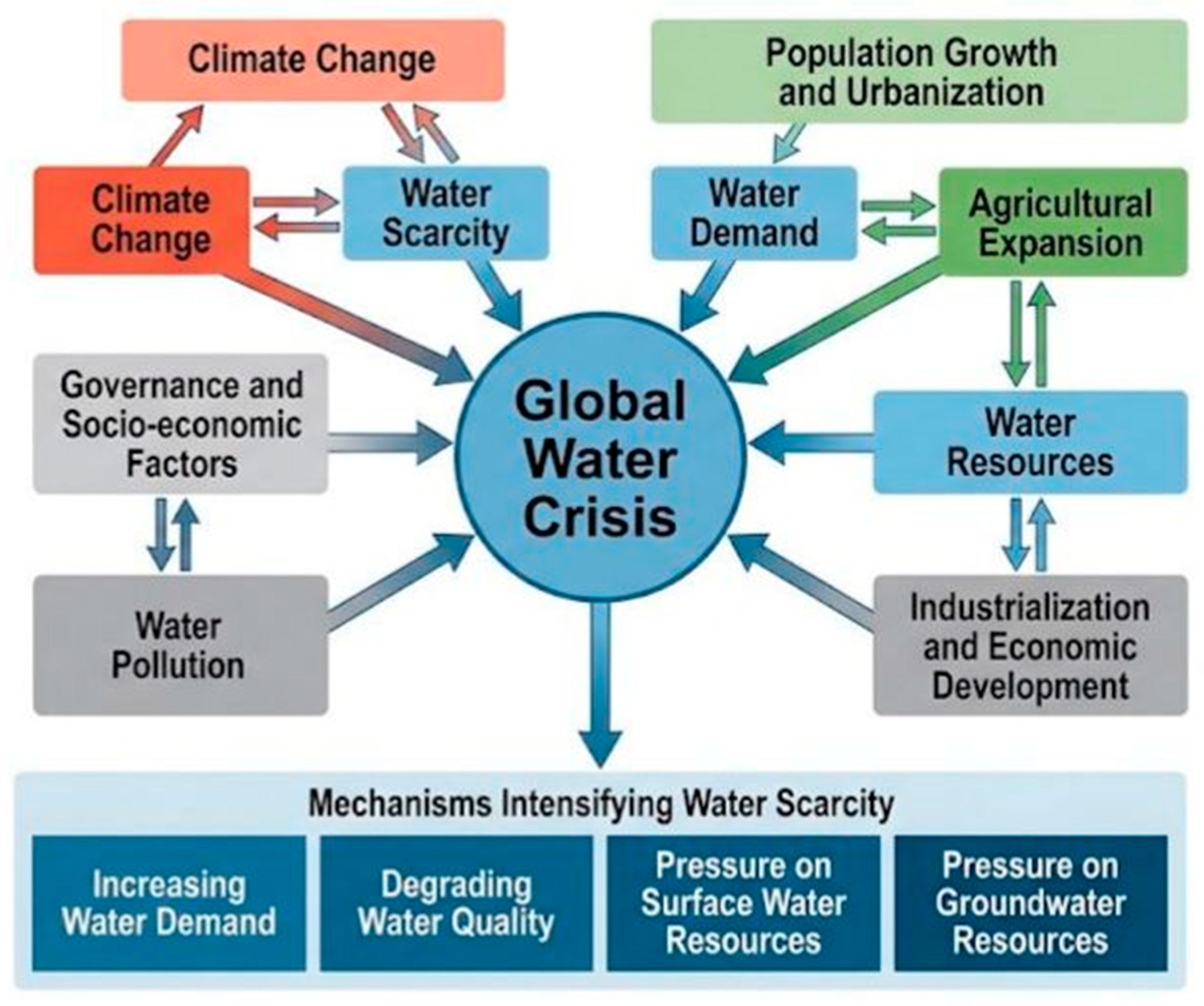
The global water crisis is a multi-dimensional problem driven by interconnected climatic, environmental, socio-economic, technological, and governance-related factors. The major causes, drivers, and potential solutions are summarized in Figure 1. Among these drivers, climate change is one of the most consistently documented contributors to water scarcity. It alters precipitation patterns, increases the frequency and intensity of droughts and floods, and enhances evaporation rates, thereby reducing water availability [26]. In addition, climate-induced changes in recharge patterns increase reliance on groundwater resources, leading to aquifer depletion and intensified groundwater stress [27]. Extreme climatic variability further exacerbates water scarcity and contributes to the emergence of water conflict hotspots [28]. Population growth is another major driver of the global water crisis, significantly increasing water demand across domestic, agricultural, and industrial sectors. Rapid urbanization places substantial pressure on municipal water systems, often resulting in shortages and unequal distribution. It is projected that the number of people living in urban water-scarce conditions may nearly double by 2050, while high population densities in megacities accelerate groundwater depletion and water stress [29].
Agriculture remains the largest consumer of freshwater globally, accounting for approximately 70% of total freshwater withdrawals. However, inefficient irrigation practices can result in the loss of more than 50% of water in some regions. This overuse contributes significantly to groundwater depletion and intensifies blue-water scarcity across many river basins [30]. In parallel, industrialization and economic development further increase water demand and pollution. Industrial activities, particularly those associated with thermal power generation, require substantial water for cooling processes, thereby increasing pressure on water resources. Moreover, industrial discharge contributes to surface and groundwater contamination, reducing the availability of usable freshwater [31,32]. Water pollution is a critical factor contributing to the decline in water quality and the reduction in usable freshwater supplies. Pollution originating from agricultural, industrial, and domestic sources restricts water availability, while chemical contaminants such as salinity, nutrients, and toxic compounds further exacerbate water scarcity. In addition, emerging pollutants and inadequate wastewater management practices increase risks to water security [33].
Groundwater depletion represents another major dimension of the global water crisis. Groundwater provides approximately 50% of drinking water worldwide and supports significant portions of industrial and agricultural activities. However, excessive extraction driven by population growth, agricultural demand, and climate-related pressures has led to widespread depletion of aquifers [34]. Governance-related challenges also play a crucial role in intensifying the global water crisis. Poor water management practices, inadequate infrastructure, and ineffective or inequitable policies often result in inefficient water allocation and distribution failures. In addition, transboundary water conflicts and weak institutional cooperation further increase risks associated with water scarcity. These governance deficiencies can significantly amplify the likelihood of water-related conflicts [35,36]. Socio-economic inequality and cultural factors further contribute to water scarcity by increasing vulnerability to water-related shocks. Poverty limits access to reliable water resources, while cultural and institutional practices can influence water-use behavior in ways that are not always sustainable. As a result, marginalized communities are disproportionately affected by water scarcity and its associated impacts [37].
Recent studies have examined the global water crisis from various perspectives, highlighting its complexity and multi-sectorial nature. These include investigations into the role of bioenergy carbon capture and storage in water resource security [38], potable water safety challenges [39], fluoride contamination as a public health concern in Africa [40], the potential of nanofertilizers as a strategy for sustainable agriculture under water stress [41], the impacts of microplastic and nanoplastic pollution in marine ecosystems [42], and the role of microplastic pollution as an emerging environmental threat to water security in the Global South [33].

3. Drought and Global Water Crisis

This section highlights drought and its contribution to the global water crisis, how drought drives the global water crisis, the main mechanisms or pathways of such impacts and the major adaptation or/and mitigation strategies. Drought and the global water crisis are deeply interconnected, mutually reinforcing challenges driven by climate change, unsustainable water use, and socio-economic pressures. Drought can also emerge as both a direct climatic driver of water scarcity and a societally amplified stressor that interacts with land-use change and growing water demand. Droughts can reduce water availability across surface and groundwater systems, intensify competition between users, and accelerate the transition from physical scarcity to full-scale water crises [43,44]. The main drought drivers under global water scarcity may include climate change and hydrological, ecological, socio-economic and human drivers. Climate change might induce drought, increasing long-term water stress. Rising temperatures intensify atmospheric evaporative demand and increase hydrological and agricultural drought severity across multiple regions. Climate change alters precipitation patterns and increases extreme events (both floods and droughts), and future projections show heightened drought frequency, including rapid-onset flash droughts across 74% of regions [45,46,47].
The global water crisis could be intensified by five major interacting drivers, including population and economic growth, climate change, agricultural expansion, pollution, and geopolitical tensions. These drivers collectively worsen scarcity, degrade quality, and destabilize water governance. There are seven types of adaptation and mitigation strategies, including (1) integrated drought management by multi-index monitoring, early warnings, and risk governance frameworks [1,7]; (2) agricultural adaptation by applying drip irrigation, agronomic adjustments, drought-tolerant crops, soil moisture conservation, and climate-smart agriculture (CSA) adoption [48]; (3) nature-based solutions and ecosystem resilience through vegetation restoration and green infrastructure for urban drought resilience [49]; (4) groundwater management by monitoring, AI-based forecasting, policies to reduce over-extraction [50]; (5) water conservation and demand management through behavioral responses to scarcity and societal adoption of water conservation narratives [51]; (6) policy and institutional measures by drought policies, common agricultural policy (CAP) reforms in the EU, and improving governance structures [52]; and (7) technological innovations using machine learning (ML) and deep learning (DL) forecasting, remote sensing, and cyber-infrastructure for drought data [53,54].
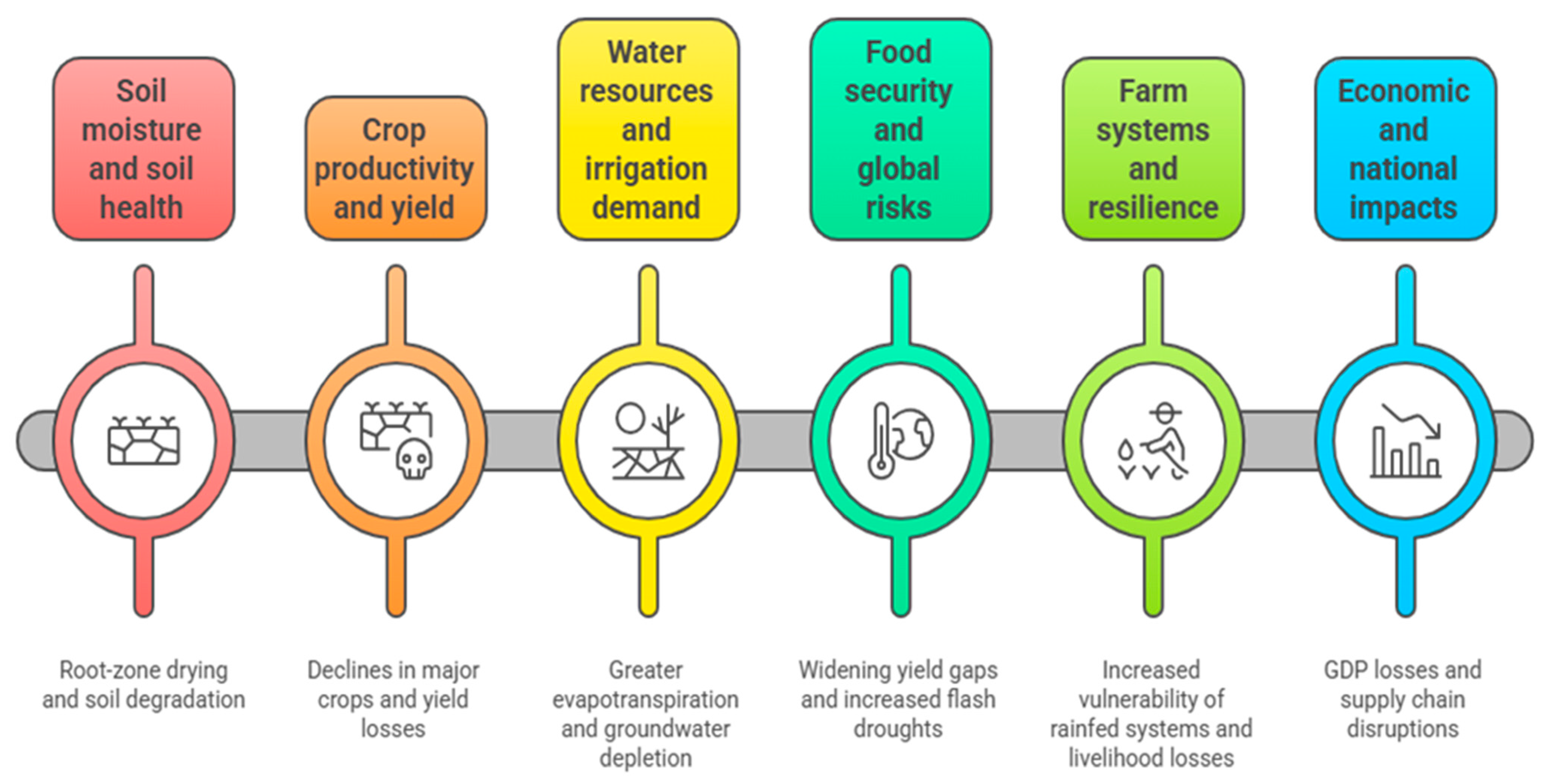
It is well known that drought emerges as one of the most damaging climate-related hazards for agriculture, affecting food security, crop yields, agricultural economics, irrigation demand, and farming systems (Figure 2). Extreme drought can cause severe reductions in crop yields by 20–50% [55,56], reduced soil moisture and health [57,58], reduced soil water availability, soil degradation and reduced microbial activity [59], increased evapotranspiration, groundwater depletion, higher irrigation demand and water-use efficiency changes [60,61], increased vulnerability of rainfed systems, crop pattern shifts [62,63], reduced crop productivity, widened yield gaps, increased frequency of flash droughts [64,65,66], and losses to agricultural GDP, employment, and household income [67].
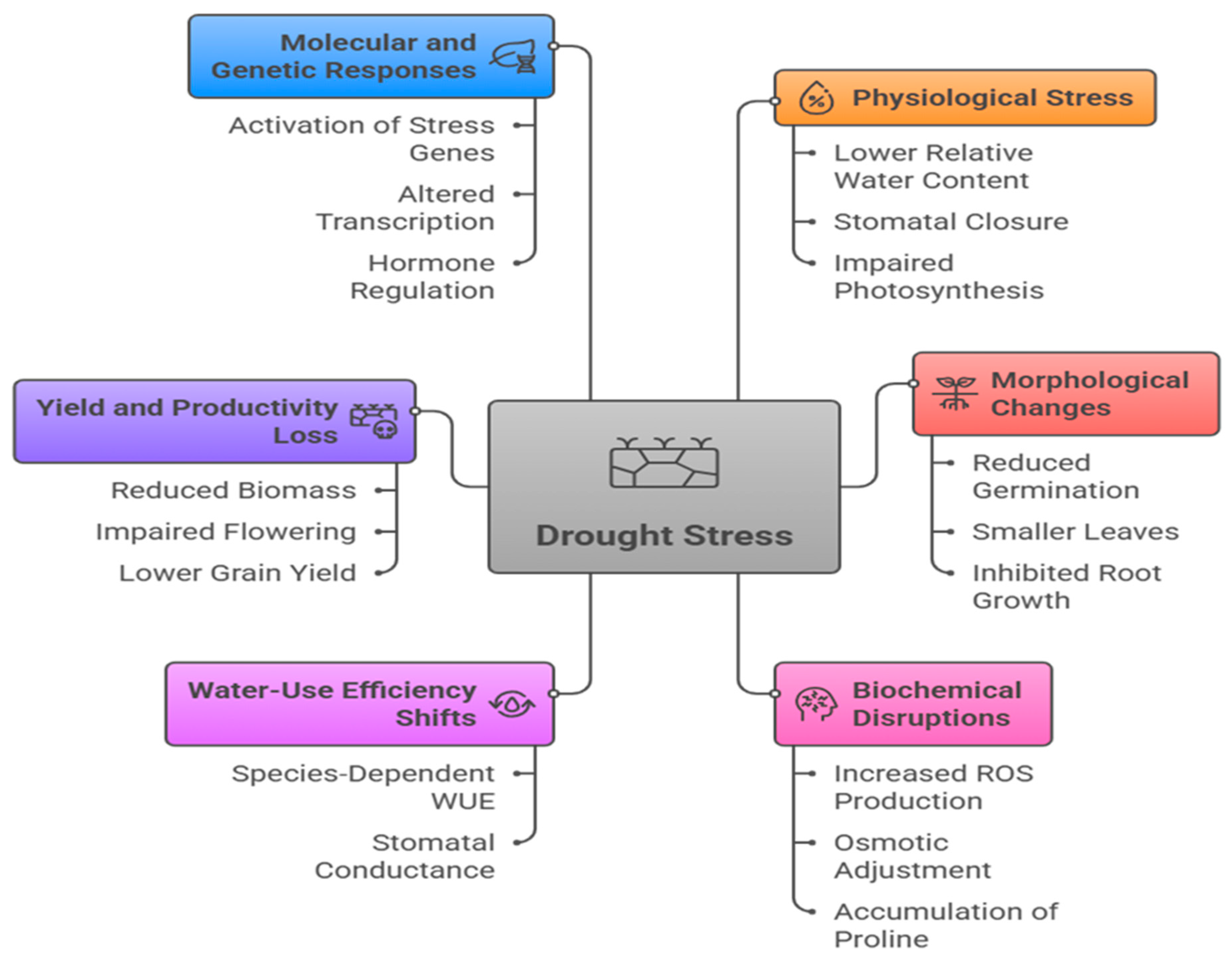
The impact of drought on the agricultural sector is an important issue that may lead to a global water crisis. This is confirmed by several recent publications, which focused on different themes such as the monitoring of drought using remote sensing [68], real-world agricultural drought records and machine learning [69], multi-timescale drought indices [70], atmospheric dryness and flash drought [71], explainable machine learning algorithms [61], a self-organizing agricultural drought index [72], and a multi-modal ensemble approach for forecasting agricultural droughts [73]. The impact of drought on cultivated plants is considered one of the most important issues in the agricultural sector. Drought can reduce plant growth and productivity through interconnected physiological, morphological, biochemical, molecular, and metabolic disruptions (Figure 3). These effects arise from water deficit, osmotic imbalance, oxidative stress, and altered hormonal signaling. Morphological, physiological, molecular and hormonal impacts in plants under drought were reported by several investigators [74,75,76,77,78,79,80,81,82].
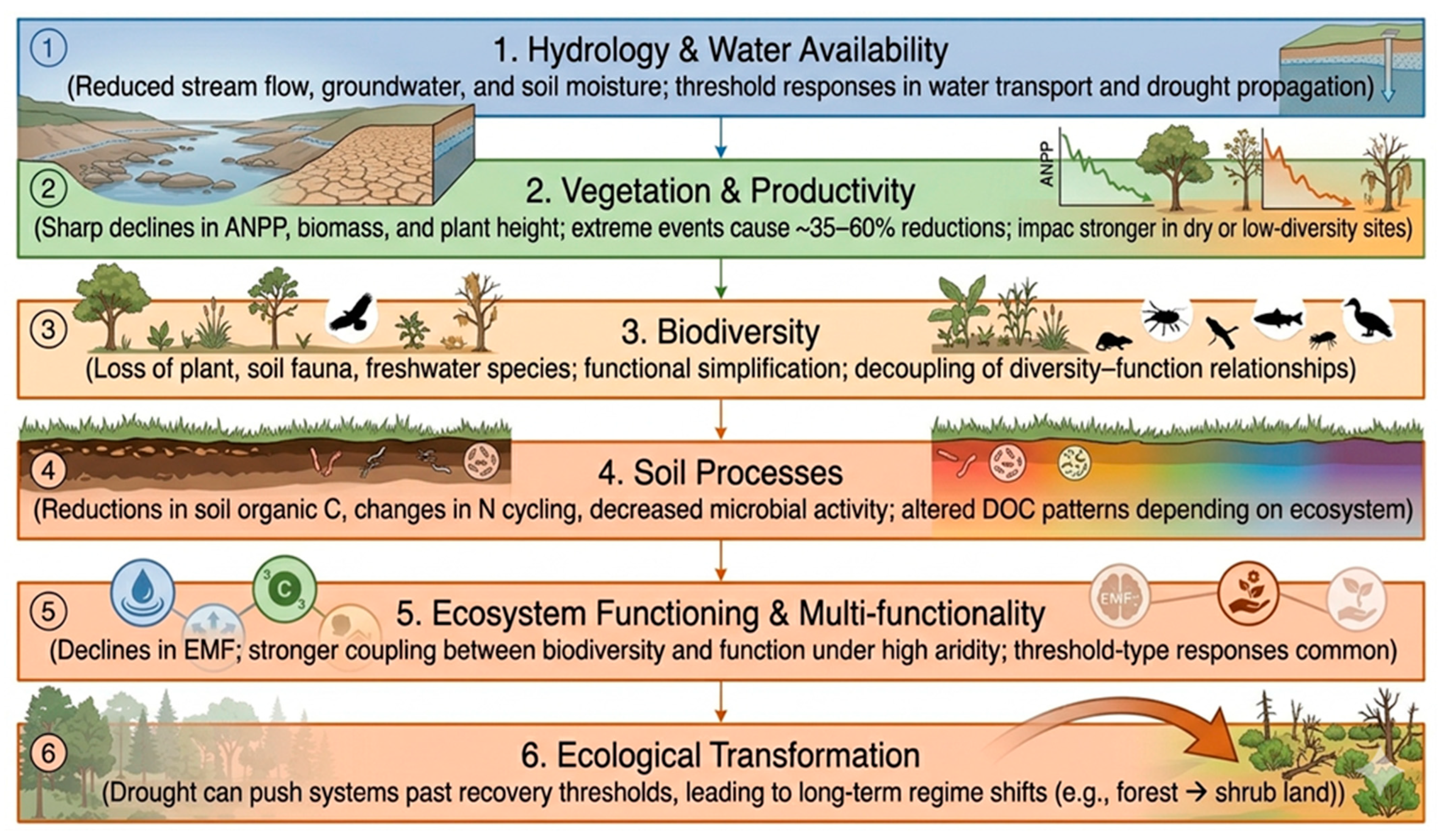
Drought emerges as a major ecological disturbance that affects ecosystem functions, biodiversity, species interactions, soil processes, and long-term ecosystem resilience. The impacts of drought are widespread across grasslands, forests, freshwater systems, lakes, and soil-based ecosystems (Figure 4). Biodiversity loss and species shifts might lead to the elimination of drought-intolerant species, a reduction in above- and below-ground biodiversity, an increase in plankton dissimilarity, alterations in species composition, and increased fish mortality in heat-amplified droughts [83,84]. Reducing vegetation and productivity by 21–35% in grasslands/shrub lands due to extreme drought reduces productivity, and concurrent droughts drive significant global net primary production loss. Several studies have been published about the impacts of drought on different ecosystems [85,86,87,88,89,90,91,92,93,94,95,96,97]. Drought affects society through intertwined social, economic, and health pathways, often reinforcing existing vulnerabilities on both global and national levels. The impacts of drought on public health may include increased infant mortality, malnutrition, cholera risk, poor sanitation, women’s and children’s health deterioration, mental health decline, reduced water quality, reduced wellbeing, and water-, food-, and vector-borne diseases [98,99,100,101,102]. Drought consistently undermines agricultural output, which increases food prices and reduces incomes for farmers and farm-dependent communities. Economic consequences appear on the global level depending on the country’s development level through impacts on water, energy, and industrial sectors, with variable effects on gross domestic product as well as more stress on social stability and inequality [103,104,105,106].

4. Nature-Based Drought Solutions

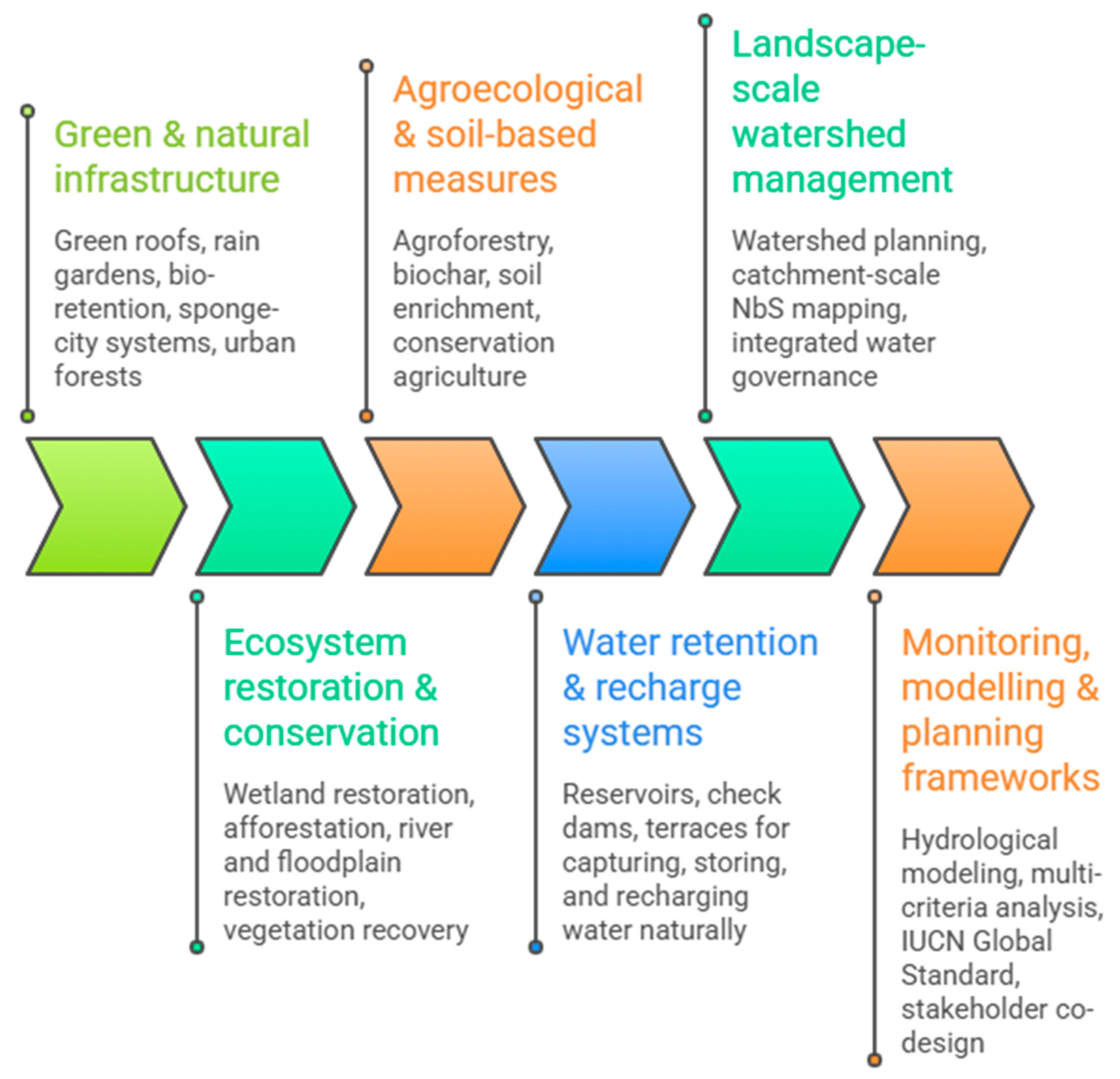
What do nature-based solutions mean, and how can they mitigate drought? What are the types of nature-based drought solutions, and what can they achieve? The concept of “nature-based solutions” was developed during the United Nations Framework Convention on Climate Change (UNFCCC) negotiations in 2009 and was introduced in the 2013–2016 International Union for Conservation of Nature (IUCN) Global Program. Nature-based solutions (NbSs) can be defined as actions that protect, restore, or sustainably manage ecosystems to address societal challenges such as biodiversity loss, climate change, urban resilience and water security [107]. NbSs are considered effective for climate adaptation through reducing climate-related risks (erosion, drought, floods and heat) across multiple ecosystems [108]. Nature-based drought solutions broadly aim to restore ecosystems, enhance water retention, improve landscape hydrology, strengthen resilience, and provide co-benefits for biodiversity and communities [109,110]. Suggested nature-based drought solutions are presented in Figure 5. For the restoration of ecosystems (e.g., grassland, forest, and peat land), nature-based drought solutions are useful for improving biodiversity, soil stability, ecosystem resilience, and carbon sequestration [111,112]. Water-focused nature-based solutions (e.g., wetlands, recharge channels, rainwater harvesting, and watershed restoration) can enhance water availability, regulate runoff, improve water quality, and increase climate resilience [113,114,115,116,117,118]. Nature-based solutions for agricultural land-use harness ecological processes (through soil formation, biodiversity, water regulation and nutrient cycling) to improve resilience, restore productivity, and address climate, water, and soil challenges. This can increase soil health and water quality, supporting sustainable livelihoods [119,120].

5. Drought–Water–Nanotechnology Nexus

In general, the drought–water and nanomaterials nexus refers to how nanotechnology intervenes simultaneously in drought mitigation and water conservation, linking plant-level drought tolerance, soil water retention, and nano-enabled water treatment. Nanomaterials (NMs) have the ability to reduce agricultural water demand, increase supply through purification/reuse, and enhance resource-use efficiency. Nanomaterials can also act on this nexus through three interconnected domains: (i) drought mitigation in crops, (ii) soil water retention and water delivery systems, and (iii) water treatment, reuse, and desalination. What about the nexus mapping, and how nanomaterials can interlink drought and water systems? This could be achieved by NMs enhancing plant drought tolerance by improving NMs to water status, antioxidant defense, photosynthesis, and osmotic balance across diverse crops (e.g., nano-enabled osmotic adjustment, NPs of metals). Applying NMs in soil water retention and conservation can increase the water availability to crops and reduce irrigation demand (e.g., cellulose nano-fibers, nano-enabled drip irrigation, carbon nano-fibers, etc.). On the other hand, nanotechnology can be applied for water treatment, reuse, and desalination [121,122]. NMs expand water supply through purification, desalination, and recycling using nano-enabled membranes, and microbial–nanotechnology systems enable bioremediation and nano-assisted pollutant removal.

6. Nano-Mitigation for Drought

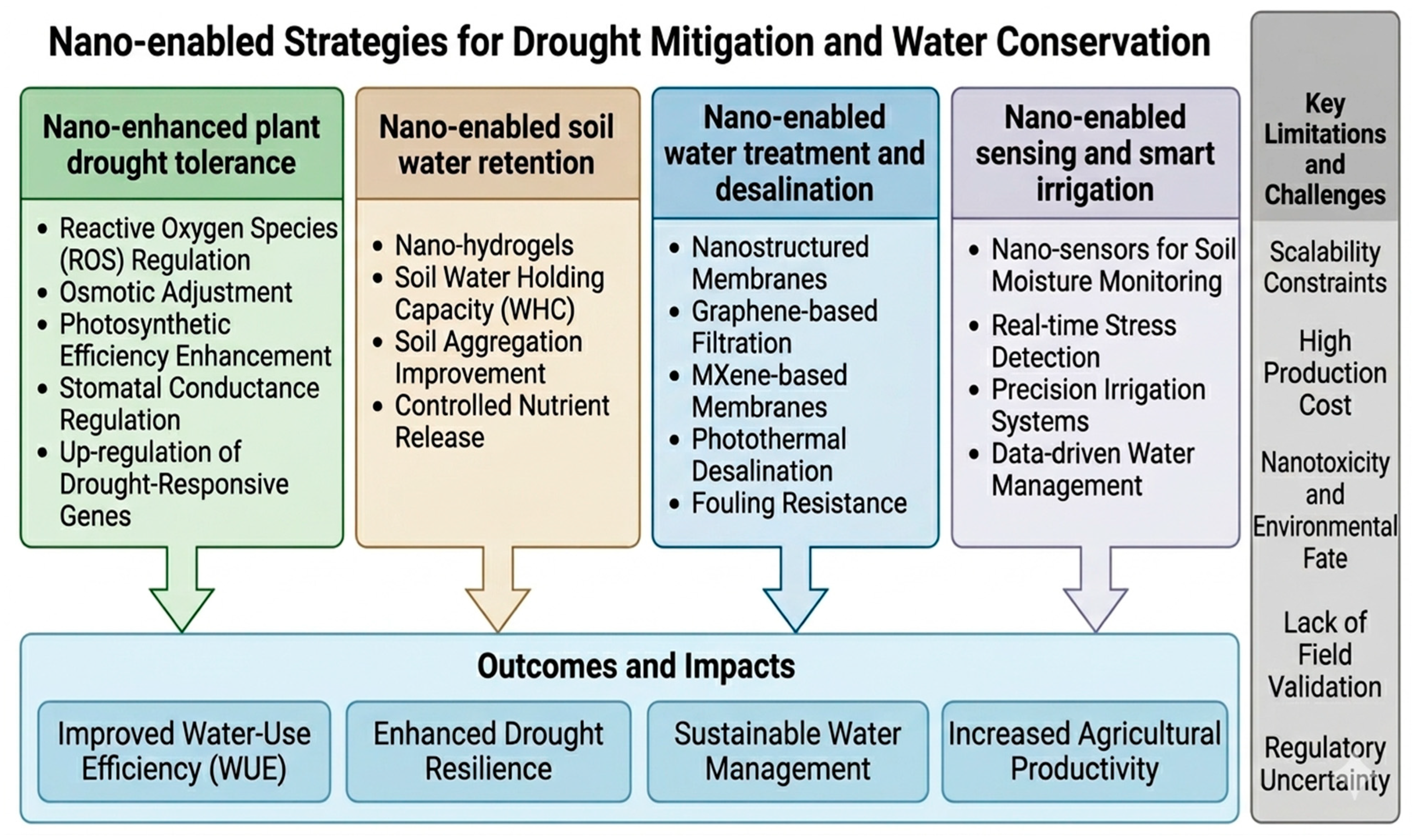
Nanotechnology has emerged as a promising approach for mitigating drought stress and improving water-use efficiency through multiple interconnected physiological, biochemical, and technological pathways. These include the enhancement of plant drought tolerance, improvement in soil water retention, development of smart irrigation systems, and advancement of water treatment technologies. However, despite these advances, most reported benefits remain derived from controlled laboratory conditions and are often influenced by nanoparticle type, concentration, plant species, and environmental context. How can nanotechnology mitigate drought? Different types of nanoparticles (NPs), nano-structured hydrogels and nano-enabled materials can improve crop performance under drought stress through multiple interconnected mechanisms [123]. Nanotechnology offers multiple complementary pathways to mitigate drought stress in plants and soils and can mitigate such stress primarily by improving soil water retention, enhancing plant stress tolerance by improving plant water-use efficiency and physiological resilience, delivering nutrients more efficiently under water deficit, and supporting soil–microbe–plant interactions that strengthen drought tolerance [20,124]. These nano-solutions operate through water retention, controlled nutrient delivery, plant physiological enhancement, and smart irrigation/monitoring (Table 1). Despite these promising outcomes, it is important to note that the majority of reported benefits are derived from controlled laboratory and greenhouse experiments, often conducted under simplified and highly regulated conditions. Such environments do not fully capture the complexity and variability of field conditions, including soil heterogeneity, climatic fluctuations, and biotic interactions. Consequently, the reproducibility and scalability of these results under real agricultural systems remain uncertain (Figure 6).

6.1. Nano-Enhanced Plant Drought Tolerance

Nanomaterials (NMs) enhance plant tolerance to drought stress through multiple interconnected physiological, biochemical, and molecular mechanisms. These mechanisms collectively improve plant water status, stress resilience, and productivity under water-deficit conditions, while remaining highly dependent on nanoparticle properties and application conditions. Applied NMs can mitigate drought stress through the following key mechanisms: improvement in plant water relations by enhancing plant water status through increasing water-use efficiency (WUE), relative water content (RWC), and root hydraulic conductance, thereby improving water uptake and retention under drought conditions [123]; the regulation of oxidative stress and reactive oxygen species (ROS) and enhancing antioxidant defense systems, leading to decreased lipid peroxidation (MDA) and hydrogen peroxide accumulation [136]—for example, carbon quantum dots (CQDs) have been shown to activate antioxidant enzymes and improve redox homeostasis under drought stress [137]; the enhancement of photosynthesis and gas exchange or the support of photosynthetic activity by restoring chlorophyll content, improving stomatal conductance, and stabilizing electron transport processes, thereby maintaining carbon assimilation under drought conditions [138]; osmotic adjustment via osmolyte accumulation and using NPs to promote the accumulation of osmolytes such as proline and soluble sugars, helping to maintain cell turgor and osmotic balance under water-deficit conditions [137]; the up-regulation of drought-responsive genes and hormonal signaling, where NPs activate stress-responsive genes and influence hormonal pathways, particularly abscisic acid (ABA)-mediated signaling, thereby strengthening intrinsic drought-response mechanisms and regulating stomatal behavior [139,140]; the enhancement of nutrient uptake and improvement in the acquisition of essential nutrients by NPs, including nitrogen, phosphorus, and micronutrients, which are often limited under drought conditions, thereby supporting plant growth and metabolic activity [141]; and the modulation of the rhizosphere microbiome, influencing rhizospheric microbial communities via NPs and improving nutrient availability and water uptake efficiency through enhanced plant–microbe interactions [142]. Commonly studied NMs include ZnO, SiO2, TiO2, and carbon-based nanomaterials, which have demonstrated varying effectiveness in improving drought tolerance [143]. However, these responses are strongly dose-dependent and species-specific, with experimental studies highlighting optimal concentration thresholds and potential toxicity at higher doses [137]. Therefore, standardized dose–response relationships and cross-species validation remain critical research priorities. While these mechanisms are well-documented, most supporting evidence originates from short-term experiments under controlled conditions. Field-based validation across different crops, soil types, and climatic zones remains limited. This gap raises important questions regarding the long-term stability, optimal dosing, and consistency of nanoparticle performance under practical agricultural conditions.

6.2. Nano-Enabled Soil and Water Retention

Nano-enabled hydrogels and soil conditioners represent an important pathway for improving soil water retention and mitigating drought stress. Superabsorbent hydrogels can significantly enhance soil moisture availability by reducing evaporation losses and maintaining water supply within the rhizosphere [144]. In addition to improving water retention, these materials influence soil microbial activity and nutrient cycling by modifying soil physical and chemical properties. Hydrogels can also function as slow-release carriers for nutrients and agrochemicals, thereby improving nutrient-use efficiency and reducing leaching losses [140]. Despite these advantages, most evidence remains limited to laboratory and small-scale studies. Field-scale validation is still scarce, and long-term impacts related to biodegradability, soil structure, and ecological interactions remain insufficiently understood. These uncertainties highlight the need for multi-season field trials and lifecycle assessments. However, the reported improvements in soil water retention are largely based on laboratory-scale studies or controlled pot experiments. The long-term behavior of nano-enabled hydrogels under repeated wetting–drying cycles, their interactions with native soil microbiota and their persistence under field conditions remain insufficiently explored.

6.3. Nano-Enabled Irrigation and Sensing Systems

Nano-sensor technologies provide advanced tools for monitoring soil moisture and plant stress, enabling more precise and efficient irrigation management. Nano-enhanced sensors offer high sensitivity and spatial resolution, supporting real-time decision-making and improved water-use efficiency [132]. In addition to soil moisture monitoring, nano-sensors can detect early physiological indicators of drought stress, such as changes in plant metabolites and sap composition, allowing for timely intervention before visible symptoms occur. Integration of these sensors with automated irrigation systems can further optimize water application. However, practical implementation remains limited due to challenges related to sensor calibration, durability, maintenance, and integration with existing agricultural infrastructure [140]. Large-scale adoption therefore requires further technological refinement and cost reduction. Despite the rapidly expanding body of literature reporting the benefits of nanotechnology for drought mitigation, the robustness and real-world applicability of these findings remain a critical concern. A substantial proportion of reported improvements in plant drought tolerance, water-use efficiency, and soil-related functions are derived from controlled laboratory or greenhouse experiments conducted under simplified and highly regulated conditions. For instance, Kah et al. [145] and Lowry et al. [146] highlighted that many nano-enabled agricultural studies rely on short-term assays that do not adequately capture environmental variability, soil heterogeneity, or long-term ecological interactions. Moreover, Zhai et al. [147] emphasized that nanoparticle behavior, stability, and bioavailability can vary significantly under field conditions due to fluctuations in pH, salinity, and organic matter content. These factors collectively limit the direct translation of laboratory-scale efficiencies into consistent field performance, highlighting the urgent need for long-term, multi-location validation studies under realistic agricultural conditions.

7. Nanotechnology for Water Conservation

Similar challenges are evident in nano-enabled water treatment and desalination systems, where high removal efficiencies and flux rates are often achieved under controlled experimental conditions using simplified or synthetic water matrices. Foundational work by Shannon et al. [148] and Qu et al. [149] demonstrated the potential of nanomaterials in water purification; however, translating these results to real-world applications remains constrained by operational complexity and environmental variability. In addition, several critical barriers limit large-scale implementation, including the high cost and energy demand associated with nanomaterial synthesis, challenges related to material stability and recyclability, and uncertainties surrounding nanotoxicity and environmental fate, as discussed by Keller et al. [150] and Gottschalk et al. [151]. Addressing these constraints requires standardized evaluation frameworks, long-term performance assessments, and integration with existing water management systems to bridge the persistent gap between laboratory innovation and practical deployment. Nanotechnology can support water-saving through three major pathways: (1) nano-enabled filtration and purification; (2) smart, sensor-driven irrigation systems; and (3) nano-biostimulants that increase plant water-use efficiency. Nanotechnology contributes to water conservation by improving purification efficiency, enabling low-energy desalination, supporting water reuse, and reducing water losses. This contribution could be achieved through the following water conservation mechanisms: (I) Increased usable water supply by increasing efficient pollutant removal, enhancing selectivity and then increasing safe water supply. Nanomaterials such as carbon nanotubes, graphene, and metal oxides show high adsorption capacity, reactivity, and selectivity, enabling the removal of heavy metals, dyes, pharmaceuticals, pathogens, and nutrients [152]. (II) Nanomaterials have a high ability to enhance wastewater recycling through advanced filtration systems [20]. Expanded freshwater can be produced from desalination using nano-fluids, nano-filtration through nano-composite layers and 2D materials like graphene and hydrogels. These innovations lower energy demands, reduce salt fouling, and support off-grid desalination—especially valuable in water-scarce regions [153]. (III) Reducing water consumption reuse through rapid pollutant degradation, disinfection, catalytic nanomaterials using Zwitter-ionic hydrogels, TiO2 systems, and magnetic-NPs [154,155]. (IV) Lower operational water losses through fouling-resistant, durable membranes by using 2D MXene-polymer membrane nano-composites [156,157,158]. (V) Sustainable, decentralized purification by low-cost solar evaporation and nano-composite evaporators using graphene oxide-layered molybdenum boride (rGO-MBene) [159].

7.1. Nanomaterials for Water Purification

Emerging NMs can provide advanced solutions for water purification because of their large surface area, tunable surface chemistry, and strong catalytic and adsorption performance [160,161]. However, practical deployment remains constrained by challenges related to cost, scalability, durability, material recovery, and potential environmental risks. So, green synthesis, AI-assisted material design and lifecycle assessment are suggested approaches for improving sustainability and accelerating the translation to real-world applications [162]. The results of nano-enabled water purification technologies are distinguished and high-performance under laboratory conditions compared with real-world feasibility. The reasons may relate to using synthetic or ideal wastewater conditions; operating under controlled pH, temperature, and ionic strength; producing milligram-scale batches of NMs with precise structure and purity; and avoiding harsh cleaning regimes and multi-month continuous operation. This may explain why nano-membranes, nano-adsorbents, and nano-photocatalysts regularly achieve ultrafast flux >90–98% pollutant removal during laboratory trials. The main barriers preventing large-scale implementation might involve fabrication cost and economic barriers, long-term stability issues, manufacturing reproducibility and scale-up challenges. The common advanced NMs with strong lab performance but limited real-world feasibility are MXenes (2D carbides/nitrides), graphene and graphene oxide, metal–organic frameworks (MOFs), plasmonic NMs (Au, Ag), hybrid 2D/polymer nano-composite membranes, and biopolymer nano-composites and hydrogels [163,164].

7.2. Nanomaterials for Water Desalination

Nanotechnology plays a key role in enhancing water desalination processes through nano-structured membranes. Nano-structured membranes based on graphene, carbon nanotubes (CNTs), and MXenes have demonstrated superior permeability and selectivity compared to conventional membranes. These improvements are attributed to mechanisms such as size exclusion, controlled interlayer spacing, and Donnan exclusion, which enhance ion separation efficiency [165]. Surface functionalization further improves fouling resistance by reducing foulant adhesion and internal concentration polarization [160]. In addition, thin-film nano-composite membranes incorporating MXene interlayers have shown promising performance in groundwater desalination applications [166]. Despite these advances, several challenges limit practical implementation. These include fabrication complexity, material instability, high production costs, and a lack of standardized manufacturing protocols [161]. Furthermore, long-term environmental impacts and the recyclability of nanomaterials remain insufficiently understood. The major classes of NMs for water desalination that are used to enhance membrane and solar desalination systems might include carbon-based NMs (CNTs, graphene, activated carbon, carbon nano-fibers), metal and metal-oxide NMs, zeolites and nano-porous ceramics, electrospun nano-fibers and polymer nano-composites. The main advantages of laboratory-scale performance are higher water flux up to 100–110 L m−2·h−1 at high salt rejection, improved salt rejection, enhanced antifouling and antimicrobial behavior, high solar evaporation rates, and energy reduction. Many practical barriers limit large-scale implementation, such as high fabrication costs, long-term operational stability, reproducibility and manufacturing challenges, fouling and chlorine-induced degradation, and environmental and human-health risks [167,168].

7.3. Nano-Enabled Strategies in Water Management

Recent research has explored the integration of nanotechnology with alternative desalination and water treatment systems, including solar-driven desalination, capacitive deionization, and hybrid membrane processes. These approaches offer potential for energy-efficient and decentralized water treatment solutions [165]. Nano-enabled membranes can be incorporated into hybrid systems to enhance process efficiency and reduce energy consumption. However, most studies remain at the laboratory scale, and there is limited evidence on full-scale implementation and infrastructure integration [161,165]. In addition, integration with nature-based solutions and smart water management systems remains largely unexplored, highlighting a critical gap between technological potential and real-world application.
Two questions should be answered to explain the nano-enabled strategies: what nano-enabled strategies address drought mitigation, water conservation, and water/wastewater treatment, and how can these strategies be systematically classified, based strictly on the supplied literature? Multi-tiered classification of nano-enabled approaches for water-saving can be discussed based on their applications, mechanisms, and material platforms. Because no single source provides a unified taxonomy, this synthesis constructs an evidence-grounded classification from the explicit categories and technologies described across the retrieved documents. The first classification of nano-enabled strategies: these NMs could be classified into NMs for agricultural drought mitigation strategies for enhancing drought tolerance (like nano-priming), NMs for soil water conservation (e.g., nano-hydrogels, nano-biochar, and NPs-enhanced microbial biofertilizer), NMs for water treatment and purification to enable advanced treatment (nano-bioremediation, nano-filtration, and nano-membranes), and NMs for integrated water management and circularity (like nano-adsorbents) [169,170,171].
The second classification is based on the approaches for water-saving to be included photo-thermal/solar-driven interfacial evaporation technologies, such as enabling low-energy desalination and freshwater production (carbon-based photothermal absorbers, polymer–NP hybrids); nano-enabled membrane to modify or construct membranes to increase permeability, selectivity, antifouling, or stability, enabling water-saving through more efficient treatment or reuse (e.g., nano-porous membranes and nano-reinforced polymeric membranes incorporating CNTs); nano-enabled adsorption and sorption for efficient pollutant removal, reducing treatment time, chemical use, and water losses (e.g., nano-adsorbents, bio-nano hybrids combining biochar/biopolymers); nano-catalytic advanced oxidation processes to accelerate pollutant degradation (e.g., MOF-based catalysts, MOF-derived carbons, nano-confined catalytic membranes); nano-enhanced atmospheric water harvesting to capture water vapor from air with high efficiency (e.g., super-hygroscopic nano-hydrogels); nano-enabled demulsification and oily wastewater treatment to enhance the separation of oil–water emulsions, improving industrial water recycling (e.g., nano-adsorbents and nano-catalysts, magnetic nano-adsorbents); hybrid and intelligent nano-systems to maximize water-saving (e.g., nano-biohybrid systems for treatment, AI- and nano-enabled intelligent water-saving systems) [172,173,174].

7.4. Economic Feasibility of Nano-Applications

The cost and scalability of NMs for water-saving technologies are important, along with energy demand and maintenance requirements of NM-based water-saving/desalination systems and benchmarking them against conventional technologies. The economic feasibility of this nexus depends mainly on high initial investment, high synthesis costs, maintenance costs, potential cost reduction and economic uncertainty. The main factors limiting the costs and scalability of NMs for water-saving technologies are that many NMs require expensive precursors, energy-intensive synthesis, or multistep fabrication (CNTs, GO, MOFs and metal NPs often cost USD 10,000–100,000 per ton). Energy consumption accounts for up to 91% of total production cost in some NM classes. Reductions in performance are expected when moving from ideal batch lab conditions to real wastewater conditions due to the complex mixtures and ionic strength. On the other hand, green and waste-derived NMs can improve the cost profiles, as waste-derived precursors or agricultural residues can reduce costs and align with circular economy principles, lower costs and improved scalability [152,175,176,177]. The cost and scalability assessment is summarized in the following Table 2.

7.5. Nanotoxicity and Safety of Nanomaterials

The nanotoxicity and safety of NMs (e.g., carbon-based and metal-based NMs) for water-saving applications are a crucial issue, as they can pose different environmental risks, and regulatory frameworks shape their deployment in water-saving and water treatment systems. Carbon NMs may leach into treated water or concentrate in brines in desalination membranes, hydrogels, and evaporators. Their mobility and persistence mean they require strong containment and recovery strategies as they have risk profiles driven mainly by persistence, mobility, and structure-dependent toxicity. Carbon NMs can accumulate in aquatic systems, with concerns about bioaccumulation and toxicity to fish, microbes, and other aquatic species. So, C-NM regulatory assessments highlight the need for lifecycle analysis, mobility reduction via surface functionalization, and monitoring of discharge and persistence. Metal-based NMs (e.g., Ag, ZnO, TiO2, Fe/Mn oxides) used in water treatment and water-saving systems (e.g., solar desalination, fouling-resistant membranes, antimicrobial coatings) pose risks primarily via ion dissolution and reactive oxygen species (ROS). Metal-oxide NMs exhibit ROS-mediated toxicity, iono-regulatory stress, and developmental effects in fish and crustaceans. Metal-based NMs also show higher acute ecotoxicity and must therefore be carefully monitored for release or leaching during desalination or filtration operations. The main differences between carbon-based and metal-based NMs may be that carbon-based NMs cause oxidative stress and persistent, mobile, and multi-trophic toxicity, disrupt microbial metabolism, and need mobility-limiting functionalization, whereas metal-based NMs have high acute toxicity via ion metal release, ROS generation, and impacts on algae, fish, and crustaceans, and transformation alters the toxicity. Regulatory frameworks affecting deployment in water-saving technologies mainly depend on regulations from the USA (EPA, FDA) and the EU (REACH, Drinking Water Directive), as well as global frameworks (OECD, WHO, Asia-Pacific). Major risks of NMs in water-saving applications could be identified by several recurring ecological, health, and operational risks, such as (1) the nanotoxicity and ecological harm of metal-based NPs, carbon-based NMs, nano-adsorbents, and nano-catalysts; (2) environmental release and fate uncertainty; (3) human exposure risks; and (4) operational and process risks [178,179,180].

8. Limitations, Regulatory Challenges, and Research Gaps

Despite the growing interest in nanotechnology for drought mitigation and water conservation, several critical limitations constrain its practical application. The current body of literature, as reflected in recent reviews and experimental studies, highlights substantial gaps related to environmental safety, scalability, real-world validation, and regulatory frameworks. One of the primary concerns associated with nanotechnology is the potential for nanotoxicity and bioaccumulation. Existing studies emphasize that engineered nanomaterials may pose risks to non-target organisms, soil biota, and aquatic systems, particularly due to their high reactivity and persistence [140]. Furthermore, uncertainties remain regarding their long-term environmental fate, transport, and transformation in soil–water systems. These unresolved issues complicate risk assessment and raise concerns about potential human exposure through food and water pathways. Another key limitation involves the stability and durability of nanomaterials under environmental conditions. Reviews consistently report uncertainties related to the long-term chemical and structural stability of nanomaterials, particularly under varying pH, salinity, and temperature conditions [161,165]. In addition, questions regarding recyclability, degradation pathways, and lifecycle impacts remain insufficiently addressed. These factors significantly affect techno-economic feasibility and sustainability assessments.
Although NMs demonstrate promising performance at the laboratory scale, their large-scale production and application remain challenging. Fabrication complexity, high costs of nanomaterial synthesis (e.g., graphene, MXenes), and a lack of standardized production protocols limit their commercial viability [161,165]. These economic barriers are particularly critical in agricultural systems, where cost-effectiveness is essential for adoption by farmers. A major limitation highlighted across the literature is the discrepancy between laboratory findings and field performance. Most reported benefits of nanotechnology—such as enhanced plant growth, improved water-use efficiency, and increased stress tolerance—are derived from controlled experiments [140,144]. However, there is a lack of long-term, multi-site field studies that account for environmental variability, soil heterogeneity, and climate interactions. As a result, the reproducibility and scalability of these technologies under real-world conditions remain uncertain. Future work should focus on long-term field trials, standardized ecotoxicological assessments, dose–response relationships, lifecycle and techno-economic analyses, and integration with sustainable and nature-based solutions. Table 3 summarizes a list of some case studies on the role of nanomaterials for the mitigation of drought stress.
For nano-enabled systems such as nano-sensors and advanced membranes, technical limitations related to durability, calibration, and system integration remain significant. For example, nano-sensor networks require robust calibration, maintenance, and compatibility with existing irrigation infrastructure, which are not yet fully developed [140]. Similarly, while nano-structured membranes show enhanced performance in controlled settings, their integration into full-scale water treatment systems remains limited. The regulatory landscape for nanotechnology applications in agriculture and water systems is still evolving. The current literature highlights the absence of standardized testing protocols, safety guidelines, and regulatory benchmarks necessary for large-scale deployment [165]. In addition, trans-disciplinary coordination between scientific, industrial, and policy sectors remains insufficient, hindering the development of clear governance frameworks. Another important limitation is the lack of empirical data on public acceptance and stakeholder perception of nanotechnology in water and agricultural applications. Existing studies provide limited evidence regarding how farmers, consumers, and policymakers perceive potential risks associated with nanomaterials. This gap may hinder adoption, particularly in regions where trust in emerging technologies is low. A key cross-cutting limitation identified throughout this review is the persistent gap between laboratory-scale performance and real-world applicability, which remains one of the most critical barriers to the adoption of nano-enabled solutions in water and agricultural systems

9. Research Priorities and Future Directions

The lab-to-field gap in nanotechnology application is a real problem, as a large body of evidence across the retrieved references shows that nanotechnology for saving water faces a persistent lab-to-field gap. This gap is driven by three clusters of barriers: regulatory hurdles, farmer adoption challenges, and nanomaterial stability and behavior in real environments. Concerning the regulatory hurdles, there are many examples that could be mentioned in this context, such as hydrogel-based water-saving systems, which face unclear regulatory pathways and barriers related to safety testing and registration due to the lack of standardized protocols for assessing stability, leaching, and reuse, which regulators require before field deployment; regulatory frameworks for nano-agri-inputs remain fragmented, causing delays and uncertainty in commercializing nano-enabled water-saving products. Regarding farmer adoption challenges, farmer adoption is restricted if nanomaterials are expensive or difficult to apply due to high cost and complexity, limiting the adoption of nano-enabled water-retention systems; the high production costs of NMs (e.g., CNTs, graphene oxide) used for water treatment and retention limit practical field use; and many nano-based soil amendments (e.g., polymer nano-composites for water retention) still require industrial-scale dispersion control and manufacturing capacity not available to most farmers. Farmers often lack understanding of the performance, safety, or application methods for nano-enabled systems, slowing real-world uptake. Environmental stability barriers are common due to NMs losing performance under realistic water and soil chemistry and the instability of NMs in real water/soil environments, directly limiting water-saving functionality (e.g., graphene oxide). Many water treatment NMs show aggregation, fouling, or loss of activity under variable pH, temperature, and ionic strength typical of agricultural water sources. Under field conditions, soils can alter the behavior of NPs, reducing water-saving efficacy as soil-water interactions cause NP aggregation, passivation, or mobility loss, leading to unpredictable water-retention performance in field conditions. The recovery of NMs from water systems remains unsolved as NMs can escape into water streams, posing ecological risks; recovery requires additional filtration steps during disinfection or soil water retention enhancement [190,191,192].
The role of nanotechnology in drought mitigation and water conservation was discussed by several studies with a focus on the possible research priorities and future directions. These span plant-focused nano-interventions, soil/water system innovations, and cross-cutting issues such as scalability, safety, and regulatory readiness. To address these limitations, future research should focus on enhancing plant drought tolerance mechanistically through quantifying the relative contributions of NP-driven mechanisms (ROS scavenging vs. osmoregulation vs. nutrient biofortification), and understanding crop- and genotype-specific NP responses, including hormetic effects and toxicity thresholds [58]. Next-generation nano-formulations should be validated at the field scale under diverse agro-climatic conditions, along with the development of multifunctional nano-formulations in water retention, nutrient delivery and bio-protection [19]. Nanotechnology for water conservation and management should be developed by scaling nano-enabled water treatment to cost-effective, energy-efficient systems and the development of biodegradable or safer-by-design nanoparticles to mitigate toxicity concerns [193]. Nanotechnology–microbiome synergy is needed via the integration of NPs with PGPR to improve nutrient uptake, proline/sugar accumulation, and antioxidant defense under drought, along with developing nano-formulated microbial inoculants for improved stability and colonization [48]. Soil health, water retention and conservation, as important issues, should be investigated by focusing on soil–nano interactions across soil types and climatic regions, and long-term ecological impacts on soil microbiota. Advanced sensing and early stress detection are crucial, using nano-enabled sensors for the real-time monitoring of soil moisture, plant stress signals, and water quality, as well as integration with AI-driven decision-making for drought management and non-invasive, field-deployable nano-sensors for early drought stress detection. More research priorities could be listed as follows:
  • Long-term, multi-site field trials to validate laboratory findings.
  • Standardized ecotoxicological and risk assessment frameworks.
  • Comprehensive lifecycle and environmental impact analyses.
  • Development of cost-effective and scalable production methods.
  • Integration of nanotechnology with nature-based and conventional solutions.
  • Strengthening regulatory frameworks and stakeholder engagement.

10. Conclusions

Under a changing world, the global water crisis is a serious challenge facing all nations sooner or later. This challenge could be exaggerated by climate change and global drought. The impacts of drought on the global water crisis were reported to have reached the agricultural and industrial sectors, along with ecosystem and socio-economic issues. Nature-based drought solutions are effective strategies for facing such a crisis, along with nanotechnology. NMs can support wastewater recycling through nano-adsorbents and nano-filtration membranes that remove agrochemical residues, heavy metals, and pathogens, thereby promoting circular water use in farming systems. Nano-mitigation for drought is an essential strategy that can be achieved by enhancing plant stress tolerance, improving soil water retention, delivering nutrients more efficiently under water deficit, and supporting soil–microbe–plant interactions that strengthen drought tolerance. Nanotechnology for water conservation is also considered a crucial issue that can be adapted mainly in both agricultural and industrial sectors. Further deep research is needed in this very vital area for more sustainable and nature-based solutions with a focus on long-term, multi-site field trials, standardized ecotoxicological and risk assessment frameworks, comprehensive lifecycle and environmental impact analyses, and the integration of nanotechnology with nature-based and conventional solutions.

Author Contributions

H.E.-R. and J.P., conceptualization and investigation; N.A., T.E., H.I.A.-A. and D.S., validation, data curation and software; T.E., N.A. and H.E.-R., first draft and reviewing. Funding: H.E.-R., J.P. and H.I.A.-A. All authors have read and agreed to the published version of the manuscript.

Funding

The University of Debrecen provides open-access financing. The Program for Scientific Publication supported the study. This research was also supported by the University of Debrecen Scientific Research Bridging Fund (DETKA). The authors extend their gratitude to the Tempus Public Foundation, Hungarian Bilateral State Scholarships (AK-00108-003/2025) for their support of this study.

Data Availability Statement

No new data were created or analyzed in this study.

Acknowledgments

The authors thank their institutions for the great support and help in achieving this work.

Conflicts of Interest

The authors declare no conflicts of interest.

References

  1. Soomro, S.; Boota, M.W.; Guo, J.; Li, Y.; Qin, H.; Meahrayen, M.A.; Hu, C.; Gu, J.; Chen, J. Drought management for long-term water sustainability and resilience. Mar. Freshw. Res. 2025, 76, MF24210. [Google Scholar] [CrossRef]
  2. Haile, G.G.; Tang, Q.; Li, W.; Liu, X.; Zhang, X. Drought: Progress in broadening its understanding. WIREs Water 2020, 7, e1407. [Google Scholar] [CrossRef]
  3. Al-Taani, A.A.; Nazzal, Y.; Howari, F.M. Groundwater scarcity in the Middle East. In Global Groundwater: Source, Scarcity, Sustainability, Security, and Solutions; Mukherjee, A., Scanlon, B.R., Aureli, A., Langan, S., Guo, H., McKenzie, A.A., Eds.; Elsevier: Amsterdam, The Netherlands, 2021; pp. 163–175. [Google Scholar] [CrossRef]
  4. Pardo, M.A.; Pérez-Montes, A.; Moya-Llamas, M.J. Using reclaimed water in dual pressurized water distribution networks. Cost analysis. J. Water Process Eng. 2021, 40, 101766. [Google Scholar] [CrossRef]
  5. Salah, W.; Djeridi, W.; Houas, A.; Elsellami, L. Synergy between activated carbon and ZnO: A powerful combination for selective adsorption and photocatalytic degradation. Mater. Adv. 2024, 5, 1667–1675. [Google Scholar] [CrossRef]
  6. Chou Chau, Y.-F. Plasmonics-enabled advanced technologies for water purification, desalination, and environmental monitoring. Process Saf. Environ. Prot. 2026, 207, 108420. [Google Scholar] [CrossRef]
  7. Rahman, G.; Jung, M.-K.; Kim, T.-W.; Kwon, H.-H. Drought impact, vulnerability, risk assessment, management and mitigation under climate change: A comprehensive review. KSCE J. Civ. Eng. 2025, 29, 100120. [Google Scholar] [CrossRef]
  8. Wang, L.; Ren, W. Drought in agriculture and climate-smart mitigation strategies. Cell Rep. Sustain. 2025, 2, 100386. [Google Scholar] [CrossRef]
  9. Eslamian, S.; Eslamian, F. Handbook of Nature-Based Drought Solutions; Elsevier: Amsterdam, The Netherlands, 2025. [Google Scholar] [CrossRef]
  10. Jahanbakhsh, M.; Akhoondzadeh, M. Monitoring and forecasting agricultural drought in Golestan Province, Iran (2001–2028): An integrated approach using remote sensing and machine learning. Adv. Space Res. 2026, 77, 4222–4246. [Google Scholar] [CrossRef]
  11. Liao, Z.; Boubakri, H.; Chen, B.; Farooq, M.; Lai, Z.; Kou, H.; Fan, J. Biofertilizers as an eco-friendly approach to combat drought stress in plants. Biocatal. Agric. Biotechnol. 2025, 64, 103510. [Google Scholar] [CrossRef]
  12. Moazeni, S.; Salajegheh, A.; Khalighi-Sigaroodi, S.; Golkarian, A.; Cerda, A. Effectiveness of watershed management on water balance components—A review. Phys. Chem. Earth 2026, 143, 104277. [Google Scholar] [CrossRef]
  13. Andrusenko, E.; van der Werf, J.A.; van der Hoek, J.P.; Langeveld, J.G. Estimating the impact of blue-green infrastructure on household water demand. Water Sci. Technol. 2025, 92, 96–111. [Google Scholar] [CrossRef]
  14. Blanco-Canqui, H. Assessing the potential of nature-based solutions for restoring soil ecosystem services in croplands. Sci. Total Environ. 2024, 921, 170854. [Google Scholar] [CrossRef] [PubMed]
  15. Melese, T.; Assefa, G.; Terefe, B.; Belay, T.; Bayable, G.; Senamew, A. Machine learning-based drought prediction using Palmer Drought Severity Index and TerraClimate data in Ethiopia. PLoS ONE 2025, 20, e0326174. [Google Scholar] [CrossRef] [PubMed]
  16. Bhattacharjee, S.; Basavareddy; Rajput, V.D.; Majumder, D.; Panja, A.; Kashyap, S.; Kumar, R. Assessing land degradation and drought vulnerability in the Trans-Gangetic Plains using Google Earth Engine and remote sensing for SDG 15.3.1 monitoring. Environ. Monit. Assess. 2025, 197, 920. [Google Scholar] [CrossRef] [PubMed]
  17. Yang, L.; He, W.; Zou, X.; Wang, J.; Xia, H.; Jahangir, M.S.; Adamowski, J.; Feng, Q. A probabilistic approach to enhance drought modelling in alpine regions: Transition from meteorological to hydrological droughts. J. Environ. Manag. 2025, 390, 126297. [Google Scholar] [CrossRef]
  18. Parmar, H.; Goel, A.; Gelaw, T.A.; Reddy, M.K. Enhancing drought resilience in crops: Mechanistic approaches in the face of climate challenge. Plant Mol. Biol. 2025, 115, 82. [Google Scholar] [CrossRef]
  19. Choudhary, Y.; Rani, N.; Boora, M.; Devi, S.; Kumar, A.; Kumari, S.; Grewal, S. Chitosan nanoparticles and their conjugates in drought stress management: A cutting-edge strategy for crop resilience. Plant Nano Biol. 2026, 15, 100251. [Google Scholar] [CrossRef]
  20. Mustapha, L.S.; Obayomi, O.V.; Lau, S.Y.; Obayomi, K.S. The role of nanotechnology in agricultural systems with emphasis on water management. Inorg. Chem. Commun. 2025, 182, 115507. [Google Scholar] [CrossRef]
  21. Mana, A.A.; Allouhi, A.; Hamrani, A.; Rehman, S.; Jamaoui, I.; Jayachandran, K. Sustainable AI-based production agriculture: Exploring AI applications and implications in agricultural practices. Smart Agric. Technol. 2024, 7, 100416. [Google Scholar] [CrossRef]
  22. Noman, M.; Ijaz, U.; Ahmed, T.; Hao, Z.; Wang, J.; Cai, Y.; Wang, Y.; Islam, M.S.; White, J.C.; Wang, J. Nanohybrid-enabled smart platforms for biostimulation and immunoengineering of plants. Mater. Today Bio 2025, 33, 101989. [Google Scholar] [CrossRef]
  23. Franco-Navarro, J.D.; Padilla, Y.G.; Álvarez, S.; Calatayud, Á.; Colmenero-Flores, J.M.; Gómez-Bellot, M.J.; Hernández, J.A.; Martínez-Alcalá, I.; Penella, C.; Pérez-Pérez, J.G.; et al. Advancements in water-saving strategies and crop adaptation to drought: A comprehensive review. Physiol. Plant. 2025, 177, e70332. [Google Scholar] [CrossRef] [PubMed]
  24. Li, L.; Chan, F.; Cheshmehzangi, A. Nature-based solutions and sponge city for urban water management. In Adapting the Built Environment for Climate Change; Pacheco-Torgal, F., Granqvist, C.-G., Eds.; Woodhead Publishing Series in Civil and Structural Engineering; Woodhead Publishing: Cambridge, UK, 2023; pp. 371–402. [Google Scholar] [CrossRef]
  25. Moridi, M.; Rahimian, M.; Movahed, R.G.; Molavi, H.; Gholamrezai, S.; Payamani, K. Policy insights for drought adaptation: Farmers’ behavior and sustainable agricultural development. Environ. Sustain. Indic. 2025, 26, 100603. [Google Scholar] [CrossRef]
  26. Chandra Garg, M.C.; Kumari, S.; Chowdhry, J.; Agarwal, S. Introduction to the Global Water Crisis. In The Handbook of AI for Clean Water: Innovations in Treatment and Monitoring; Agarwal, S., Garg, M.C., Eds.; CRC Press: Boca Raton, FL, USA, 2025. [Google Scholar]
  27. Matta, G.; Pant, G.; Kumar, P.; Pal, R. Navigating water scarcity for global climate change and ramifications. World Water Policy 2026. [Google Scholar] [CrossRef]
  28. Naderi, L.; Karamidehkordi, E.; Badsar, M.; Moghadas, M. Impact of climate change on water crisis and conflicts: Farmers’ perceptions at the ZayandehRud Basin in Iran. J. Hydrol. Reg. Stud. 2024, 54, 101878. [Google Scholar] [CrossRef]
  29. Bamgboye, T.T.; Avellán, T.; Klöve, B.; Haghighi, A.T. Compounding impacts of climate change and urbanisation on water-energy-food Nexus in global south countries. A systematic review. Environ. Sustain. Indic. 2025, 27, 100791. [Google Scholar] [CrossRef]
  30. Boloorani, A.D.; Papi, R.; Soleimani, M.; Samany, N.N.; Al-Hemoud, A.; Bakhtiari, M.; Nasiri, N.; Mirzaei, S.; Huete, A. Human interventions and climate change trigger water crisis in the Tigris and Euphrates Basin. Environ. Sci. Policy 2026, 177, 104300. [Google Scholar] [CrossRef]
  31. Dalstein, F.; Naqvi, A. 21st Century water withdrawal decoupling: A pathway to a more water-wise world? Water Resour. Econ. 2022, 38, 100197. [Google Scholar] [CrossRef]
  32. Hait, M.; Kashyap, N.K.; Bhardwaj, A.K. Emerging pollutants from urbanization and industrialization in the global south. In Biomonitoring of Pollutants in the Global South; Izah, S.C., Ogwu, M.C., Hamidifar, H., Eds.; Springer: Singapore, 2024; pp. 23–48. [Google Scholar] [CrossRef]
  33. Saadat, A.M.; Emami, S.K.; Hamidifar, H.; Shilsar, M.J.F. Microplastic pollution in water systems of the global south: A review. J. Contam. Hydrol. 2026, 276, 104729. [Google Scholar] [CrossRef]
  34. Lancia, M.; Yao, Y.; Andrews, C.B.; Wang, X.; Kuang, X.; Ni, J.; Gorelick, S.M.; Scanlon, B.R.; Wang, Y.; Zheng, C. The China groundwater crisis: A mechanistic analysis with implications for global sustainability. Sustain. Horiz. 2022, 4, 100042. [Google Scholar] [CrossRef]
  35. Ainzúa, J.; Donoso, G. Global drivers of water conflicts: A systematic literature review and territorial analysis. Ambio 2026, 55, 497–514. [Google Scholar] [CrossRef]
  36. Qu, J.; Qin, C.; Wang, H.; Zhao, Y.; He, F.; Guan, Z.; Chang, H.; Shi, L. Water stress evolution and redistribution pathways under global inequality in consumption. Water Res. 2026, 291, 125112. [Google Scholar] [CrossRef]
  37. Rahmati, O.; Melesse, A.M.; Naghibi, A. Water scarcity crisis: Overview of challenges and solutions. In Water Scarcity Management: Toward the Application of Artificial Intelligence and Earth Observation Data; Rahmati, O., Melesse, A.M., Naghibi, A., Eds.; Elsevier: Amsterdam, The Netherlands, 2026; pp. 1–12. [Google Scholar] [CrossRef]
  38. Hu, B.; Zhang, Y.; Li, Y.; Teng, Y.; Yue, W. Can bioenergy carbon capture and storage aggravate global water crisis? Sci. Total Environ. 2020, 714, 136856. [Google Scholar] [CrossRef] [PubMed]
  39. Salehi, M. Global water shortage and potable water safety; Today’s concern and tomorrow’s crisis. Environ. Int. 2022, 158, 106936. [Google Scholar] [CrossRef] [PubMed]
  40. Hossein, M.; Rwiza, M.J.; Nyanza, E.C.; Bakari, R.; Ripanda, A.; Nkrumah, S.; Selemani, J.R.; Machunda, R.L. Fluoride contamination a silent global water crisis: A case of Africa. Sci. Afr. 2024, 26, e02485. [Google Scholar] [CrossRef]
  41. Ahmed, A.R.; Mohamed, H.I. Nanofertilizers: Smart solutions for sustainable agriculture and the global water crisis. Planta 2025, 262, 26. [Google Scholar] [CrossRef]
  42. Nawaz, F.; Islam, Z.U.; Ghori, S.A.; Bahadur, A.; Ullah, H.; Ahmad, M.; Khan, G.U. Microplastic and nanoplastic pollution: Assessing translocation, impact, and mitigation strategies in marine ecosystems. Water Environ. Res. 2025, 97, e70032. [Google Scholar] [CrossRef]
  43. Mohammed, S.; Elbeltagi, A.; Bashir, B.; Alsafadi, K.; Alsilibe, F.; Alsalman, A.; Zeraatpisheh, M.; Széles, A.; Harsányi, E. A comparative analysis of data mining techniques for agricultural and hydrological drought prediction in the eastern Mediterranean. Comput. Electron. Agric. 2022, 197, 106925. [Google Scholar] [CrossRef]
  44. Zhang, Y.; Bao, Z.; Wang, J.; Meng, X. Climate warming shortens the propagation time from meteorological drought to groundwater drought over 1960–2100. J. Hydrol. 2026, 664, 134429. [Google Scholar] [CrossRef]
  45. Vicente-Serrano, S.M.; Beguería, S.; Tomas-Burguera, M.; Gimeno, L.; Nieto, R.; El Kenawy, A. Severe and long-lasting meteorological drought events develop from precipitation deficits of mixed continental and oceanic origin. Commun. Earth Environ. 2024, 5, 580. [Google Scholar] [CrossRef]
  46. Eiras-Barca, J.; Gimeno-Sotelo, L.; Nieto, R.; Vicente-Serrano, S.M.; Gimeno, L. Revisiting the impact of moisture transport deficit on droughts: Prospective climate change analysis and emerging hypotheses. WIREs Clim. Change 2025, 16, e70030. [Google Scholar] [CrossRef]
  47. Gebrechorkos, S.H.; Sheffield, J.; Vicente-Serrano, S.M.; Funk, C.; Miralles, D.G.; Peng, J.; Dyer, E.; Talib, J.; Beck, H.E.; Singer, M.B.; et al. Warming accelerates global drought severity. Nature 2025, 642, 628–635. [Google Scholar] [CrossRef] [PubMed]
  48. Tripathi, S.; Dabral, S.; Kundu, S.; Saini, D.K.; Jamal, H.; Meena, R.K.; Somayanda, I.; Varma, A.; Bahuguna, R.N.; Jagadish, S.V.K. Harnessing the plant-associated microbiome: A sustainable solution for enhancing crop resilience to abiotic stresses and problematic soils. Plant Stress 2025, 18, 101033. [Google Scholar] [CrossRef]
  49. Debsarma, C.; Sahu, P. Enhancement of urban drought resilience using green infrastructural strategies. In Handbook of Nature-Based Drought Solutions; Eslamian, S., Eslamian, F., Eds.; Elsevier: Amsterdam, The Netherlands, 2025; pp. 231–252. [Google Scholar] [CrossRef]
  50. Elsaidy, A.; Yimer, E.A.; Mogheir, Y.; Huysmans, M.; Villani, L.; van Griensven, A. Groundwater drought and anthropogenic amplifiers: A review of assessment and response strategies in arid and semi-arid areas. Sci. Total Environ. 2025, 978, 179406. [Google Scholar] [CrossRef] [PubMed]
  51. Veloso, S.; Tam, C.; Oliveira, T. Effects of extreme drought and water scarcity on consumer behaviour—The impact of water consumption awareness and consumers’ choices. J. Hydrol. 2024, 639, 131574. [Google Scholar] [CrossRef]
  52. Tripathi, P.M.; Agarwal, V.; Mishra, V.; Singh, B. Options and strategies for managing droughts: Case studies from agro-ecological regions. In Water Sustainability and Hydrological Extremes: Quantity, Quality, and Security; Kumar, M., Agarwal, V., Panday, D.P., Eds.; Elsevier: Amsterdam, The Netherlands, 2025; pp. 315–331. [Google Scholar] [CrossRef]
  53. Mallick, J.; Alqadhi, S.; Alsubih, M.; Alkahtanis, M. Integrating traditional and advanced technologies for drought monitoring and management: A systematic review of global methodologies and applications. Theor. Appl. Climatol. 2025, 156, 246. [Google Scholar] [CrossRef]
  54. Talha, M.; Nejadhashemi, A.P.; Moller, K. Soft computing paradigm for climate change adaptation and mitigation in Iran, Pakistan, and Turkey: A systematic review. Heliyon 2025, 11, e41974. [Google Scholar] [CrossRef]
  55. Prodhan, F.A.; Zhang, J.; Pangali Sharma, T.P.; Nanzad, L.; Zhang, D.; Seka, A.M.; Ahmed, N.; Hasan, S.S.; Hoque, M.Z.; Mohana, H.P. Projection of future drought and its impact on simulated crop yield over South Asia using ensemble machine learning approach. Sci. Total Environ. 2022, 807, 151029. [Google Scholar] [CrossRef]
  56. Xiang, K.; Wang, B.; Liu, D.L.; Chen, C.; Ji, F.; Chen, F.; Yao, S.; Li, S.; Huete, A.; Li, Y.; et al. Projecting shifts in drought-induced thresholds for wheat yield loss under climate change in southeastern Australia. Agric. For. Meteorol. 2026, 378, 111003. [Google Scholar] [CrossRef]
  57. Chen, X.; Wang, L.; Cao, Q.; Sun, J.; Niu, Z.; Yang, L. Response of global agricultural productivity anomalies to drought stress in irrigated and rainfed agriculture. Sci. China Earth Sci. 2024, 67, 3579–3592. [Google Scholar] [CrossRef]
  58. Li, H.; Wang, Z.; Zhou, C.; Wang, H.; Chen, L.; Yang, H.; Liu, D. Harnessing nanoparticles to enhance crop production under drought stress: A quantitative meta-analysis. Agric. Water Manag. 2025, 315, 109550. [Google Scholar] [CrossRef]
  59. Maidment, R.I.; Quaife, T.; Pinnington, E.; Black, E.; Ejigu, A.; Kumar, D.; Thomas, S. A new, long-term root zone soil moisture dataset for operational agricultural drought monitoring over Africa. Sci. Data 2026, 13, 260. [Google Scholar] [CrossRef]
  60. Tian, X.; Dong, J.; Jin, S.; He, H.; Yin, H.; Chen, X. Climate change impacts on regional agricultural irrigation water use in semi-arid environments. Agric. Water Manag. 2023, 281, 108239. [Google Scholar] [CrossRef]
  61. Rudra, R.R.; Rabbi, F.; Ibne Hossain, N.U.; Sarkar, S.K. Unraveling the climate induced drought impacts on crop pattern distribution using explainable machine learning algorithms. Environ. Dev. 2026, 58, 101397. [Google Scholar] [CrossRef]
  62. Kumar, A.; Kothari, M.; Singh, P.K.; Singh, M.; Sharma, R.K.; Meena, S.S. Drought: A critical review of different perspectives under changing climate. Sci. Total Environ. 2025, 985, 179741. [Google Scholar] [CrossRef] [PubMed]
  63. Torkaman Pary, A.; Rastgoo, P.; Zeuss, D.; Abera, T.A. Trends of rainfed and irrigated crop yield influenced more by increased cultivated area than drought in Iran. Reg. Environ. Change 2026, 26, 47. [Google Scholar] [CrossRef]
  64. Baker, N.; Kang, Y.; Makabila, G.; Tadesse, S.; Doocy, S. Prevalence and risk factors for severe food insecurity and poor food consumption during a drought emergency in Ethiopia. PLoS Glob. Public Health 2025, 5, e0004636. [Google Scholar] [CrossRef]
  65. Kraklow, V.A.; Paff, K.; Comeau, D.; Solander, K.; Pitts, T.R.; Price, S.F.; Xu, C. Impact of drought on global food security by 2050. Nat. Commun. 2025, 17, 1099. [Google Scholar] [CrossRef]
  66. Roy, D.; Gillespie, S.A.; Hossain, M.S. Social-ecological systems modeling for drought-food security nexus. Sustain. Dev. 2025, 33, 1333–1353. [Google Scholar] [CrossRef]
  67. Wang, X.; Lin, Q.; Wu, Z.; Zhang, Y.; Li, C.; Liu, J.; Zhang, S.; Li, S. Agricultural GDP exposure to drought and its machine learning-based prediction in the Jialing River Basin, China. Agric. Water Manag. 2025, 307, 109265. [Google Scholar] [CrossRef]
  68. Xing, X.; Wei, S.; Chen, X.; Qian, J.; Peng, S.; Sun, J.; Sun, B.; Chen, C. A deep learning-based composite agricultural drought index for monitoring and impact assessment in Central Asia. Agric. Water Manag. 2026, 323, 110043. [Google Scholar] [CrossRef]
  69. Zhou, K.; Li, J.; Zhang, T.; Shi, X.; Feng, P. An impact-based drought classification method using real-world agricultural drought records and explainable automated machine learning. J. Hydrol. 2026, 669, 135078. [Google Scholar] [CrossRef]
  70. Bozorgi, M.; Cristóbal, J.; Casadesús, J. Assessing the performance of multi-timescale drought indices for monitoring agricultural drought impacts on wheat yield. Agric. Water Manag. 2026, 323, 110092. [Google Scholar] [CrossRef]
  71. Hu, C.; She, D.; Zhang, L.; Wang, G.; Jing, Z.; Hong, S.; Xia, J. Atmospheric dryness and flash drought severity drive the shifts of different flash drought types into agricultural droughts. Agric. Water Manag. 2026, 323, 110109. [Google Scholar] [CrossRef]
  72. Abdelrahim, N.A.M.; Jin, S. Agricultural drought monitoring in Africa based on Self-Organizing Agricultural Drought Index. Adv. Space Res. 2026, 77, 4450–4473. [Google Scholar] [CrossRef]
  73. Katambo, J.; Iyawa, G.; Ribbe, L.; Kongo, V. Forecasting agricultural drought using a multi-modal ensemble approach. Next Res. 2026, 7, 101473. [Google Scholar] [CrossRef]
  74. Mukhtiar, A.; Naqve, M.; Mahmood, A.; Zia, M.A.; Javaid, M.M.; Asghar, S. Water stress and crop productivity in the water-limited environment. In Climate-Resilient Agriculture; Hasanuzzaman, M., Ed.; Springer: Cham, Switzerland, 2023; Volume 1, pp. 267–296. [Google Scholar] [CrossRef]
  75. Cevher-Keskin, B.; Yıldızhan, Y.; Sekmen, A.H.; Fayetorbay, R.; Sezerman, O.U.; Özer, B.; Onarıcı, S.; Türkan, İ.; Tör, M. Deciphering drought-response in wheat (Triticum aestivum): Physiological, biochemical, and transcriptomic insights into tolerant and sensitive cultivars under dehydration shock. Front. Plant Sci. 2025, 16, 1649378. [Google Scholar] [CrossRef]
  76. Song, F.; Yang, Q.; Huang, J.; Guo, Z.; Li, Y.; Deng, W. Plant drought stress: Physiological, biochemical and molecular mechanisms. Plant Stress 2026, 19, 101153. [Google Scholar] [CrossRef]
  77. Zarif, H.; Fan, C.; Yuan, G.; Zhou, R.; Chang, Y.; Sun, J.; Lu, J.; Liu, J.; Wang, C. Drought stress in roses: A comprehensive review of morphophysiological, biochemical, and molecular responses. Int. J. Mol. Sci. 2025, 26, 4272. [Google Scholar] [CrossRef]
  78. Li, F.; Xin, Q.; Yi, C.; Kannenberg, S.A.; Green, J.K.; Migliavacca, M.; Moore, D.J.P.; Kemanian, A.R.; Gentine, P.; Stoy, P.C.; et al. Limited regulation of canopy water use efficiency by stomatal behavior under drought propagation. Glob. Chang. Biol. 2025, 31, e70381. [Google Scholar] [CrossRef]
  79. Guan, Y.; Lu, L.; Liu, J.; Lyu, M.; Xu, X.; Xing, Y.; Feng, Z.; Liu, C.; Xie, H.; Ni, W.; et al. Zinc promotes nitrogen uptake and plant growth by regulating the antioxidant system and carbon-nitrogen metabolism under drought condition in apple plants. Plant Physiol. Biochem. 2025, 221, 109619. [Google Scholar] [CrossRef]
  80. Majeed, N.; Iqbal, A.; Sehar, S.; Sanaullah, M.; Athar, M.; Ali, A.; Imran, M. The impact of drought stress on plant disease dynamics. In Drought Stress; Chaudhry, U.K., Öztürk, Z.N., Gökçe, A.F., Eds.; Springer: Cham, Switzerland, 2025; pp. 89–112. [Google Scholar] [CrossRef]
  81. Park, J.; Lee, S.H.; Lee, J.; Wi, S.H.; Seo, T.C.; Moon, J.H.; Jang, S. Growing vegetables in a warming world—A review of crop response to drought stress, and strategies to mitigate adverse effects in vegetable production. Front. Plant Sci. 2025, 16, 1561100. [Google Scholar] [CrossRef]
  82. Patial, D.; Yadav, S.; Kumar, A. Beneficial bacteria in regulating drought stress in plants. In Microbial Biostimulants for Plant Growth and Abiotic Stress Amelioration; Chauhan, P.S., Bisht, N., Agarwal, R., Eds.; Biostimulants and Protective Biochemical Agents; Elsevier: Amsterdam, The Netherlands, 2024; pp. 109–123. [Google Scholar] [CrossRef]
  83. Cardoso, M.M.L.; Sousa, W.; Brasil, J.; Costa, M.R.A.; Becker, V.; Attayde, J.L.; Menezes, R.F. Prolonged drought increases environmental heterogeneity and plankton dissimilarity between and within two semiarid shallow lakes over time. Hydrobiologia 2022, 849, 3995–4014. [Google Scholar] [CrossRef]
  84. Bittlingmaier, M.; Séjalon-Delmas, N.; Goldmann, K.; Johnson, D.; Huys, R.; Freschet, G.T. Plant and soil biodiversity sustain root mycorrhizal fungal richness under drought stress. ISME J. 2025, 19, wraf102. [Google Scholar] [CrossRef]
  85. Smith, M.D.; Wilkins, K.D.; Holdrege, M.C.; Wilfahrt, P.; Collins, S.L.; Knapp, A.K.; Sala, O.E.; Dukes, J.S.; Phillips, R.P.; Yahdjian, L.; et al. Extreme drought impacts have been underestimated in grasslands and shrublands globally. Proc. Natl. Acad. Sci. USA 2024, 121, e2309881120. [Google Scholar] [CrossRef] [PubMed]
  86. Ma, Z.; Chen, D.; Sun, P.; Liu, Y.; Ye, L. Actual evapotranspiration dominated net primary productivity loss caused by concurrent droughts. Ecol. Indic. 2025, 176, 113645. [Google Scholar] [CrossRef]
  87. Wang, L.; Zhuang, Z.; Su, Z.; Li, W.; Wang, Q.; Chen, X.; Liu, R.; Lu, H.; Chen, Y. Root traits predict the soil functional responses of subtropical plant species to experimental drought. Ecol. Evol. 2026, 16, e73048. [Google Scholar] [CrossRef] [PubMed]
  88. Moss, W.E.; Crausbay, S.D.; Rangwala, I.; Wason, J.W.; Trauernicht, C.; Stevens-Rumann, C.S.; Sala, A.; Rottler, C.M.; Pederson, G.T.; Miller, B.W.; et al. Drought as an emergent driver of ecological transformation in the twenty-first century. BioScience 2024, 74, 524–538. [Google Scholar] [CrossRef]
  89. Sadiqi, S.S.J.; Hong, E.M.; Nam, W.H.; Kim, T. Review: An integrated framework for understanding ecological drought and drought resistance. Sci. Total Environ. 2022, 846, 157477. [Google Scholar] [CrossRef]
  90. Sun, X.; Armstrong, M.; Moradi, A.; Bhattacharya, R.; Antão-Geraldes, A.M.; Munthali, E.; Grossart, H.P.; Matsuzaki, S.S.; Kangur, K.; Dunalska, J.A.; et al. Impacts of climate-induced drought on lake and reservoir biodiversity and ecosystem services: A review. Ambio 2025, 54, 488–504. [Google Scholar] [CrossRef]
  91. Luan, J.; Li, S.; Liu, S.; Wang, Y.; Ding, L.; Lu, H.; Chen, L.; Zhang, J.; Zhou, W.; Han, S.; et al. Biodiversity mitigates drought effects in the decomposer system across biomes. Proc. Natl. Acad. Sci. USA 2024, 121, e2313334121. [Google Scholar] [CrossRef]
  92. Zhang, L.; Deng, C.; Kang, R.; Yin, H.; Xu, T.; Kaufmann, H.J. Assessing the responses of ecosystem patterns, structures and functions to drought under climate change in the Yellow River Basin, China. Sci. Total Environ. 2024, 929, 172603. [Google Scholar] [CrossRef] [PubMed]
  93. Lai, H.; Yan, S.; Gao, S.; Men, R.; Wang, F.; Du, M.; Feng, K.; Li, Y.; Guo, W.; Yang, H. Identification of spatiotemporal changes and driving factors of ecological drought during 1982–2024 across the mainland China. Agric. Water Manag. 2026, 323, 110079. [Google Scholar] [CrossRef]
  94. Sinasson, S.G.K.; Shackleton, C.M. The concurrent impacts of drought and leaf harvesting on two traditional African vegetable non-timber forest product species. PLoS ONE 2023, 18, e0283900. [Google Scholar] [CrossRef] [PubMed]
  95. Li, X.; Du, H.; Mao, F.; Xuan, J.; Zhao, Y.; Huang, Z.; Yu, J.; Lv, L. Disentangling the effects of drought on bamboo forest ecosystem productivity in China over the last six decades. Agric. For. Meteorol. 2026, 376, 110934. [Google Scholar] [CrossRef]
  96. Liu, X.; Lai, Q.; Yin, S.; Gao, R. Assessing the impact of drought on water use efficiency among ecosystems on the Mongolian Plateau. Energy Nexus 2026, 21, 100664. [Google Scholar] [CrossRef]
  97. Wang, F.; Men, R.; Zhang, Y.; Yan, S.; Gao, S.; Lai, H.; Du, M.; Yu, W.; Feng, K.; Li, Y.; et al. Evolution characteristics and driving mechanisms of ecological drought from a terrestrial ecosystem perspective. J. Hydrol. Reg. Stud. 2026, 64, 103287. [Google Scholar] [CrossRef]
  98. He, Y.; Cao, S.; Yan, H.; Zhang, L.; Filonchyk, M. Increased sensitivity of ecosystem to meteorological drought reduces carbon uptake in the Yellow River Basin. J. Hydrol. 2026, 666, 134788. [Google Scholar] [CrossRef]
  99. Etesami, H.; Otabek, U.; Zahro, B.; Laziz, Y.; Sevara, N. Arbuscular mycorrhizal fungi in desert ecosystems: Adaptive mechanisms to co-occurring drought, temperature, and salinity stress. Fungal Biol. Rev. 2026, 55, 100472. [Google Scholar] [CrossRef]
  100. Lin, Y.; Li, J.; Jin, Y.; Liu, Y.; Song, Q.; Zhang, Y. Effects of precipitation changes and drought events on sap flow density of Lannea coromandelica in a savanna ecosystem in Southwest China. J. Hydrol. Reg. Stud. 2026, 64, 103220. [Google Scholar] [CrossRef]
  101. Hu, Z.; Pang, S.; Chen, S.; Hao, R.; Liu, M.; Mao, R.; Zhang, Y.; Goncharov, A.A.; Zhang, X. Extreme drought decouples nematode diversity from soil function in grassland ecosystems, Northern China. Appl. Soil Ecol. 2026, 220, 106890. [Google Scholar] [CrossRef]
  102. Carter, C.A.; Mulcahy, E.R.; Platt, T.; Kastner, J. The health-related consequences of drought in the Po and Colorado River Basins. J. Environ. Health 2025, 87, 8–18. [Google Scholar] [CrossRef]
  103. Mishra, A.; Delk, J.; Zilberman, D. Drought has varying impacts on the national economy. Stoch. Environ. Res. Risk Assess. 2025, 39, 925–936. [Google Scholar] [CrossRef]
  104. Kchouk, S.; Ribeiro Neto, G.; Melsen, L.A.; Walker, D.W.; Cavalcante, L.; Gondim, R.; van Oel, P.R. Drought-impacted communities in social-ecological systems: Exploration of different system states in Northeast Brazil. Int. J. Disaster Risk Reduct. 2023, 97, 104026. [Google Scholar] [CrossRef]
  105. Hussain, Y.R.; Mukhopadhyay, P. Impact of natural disasters on educational attainment in India: A panel data analysis. Discov. Sustain. 2024, 5, 279. [Google Scholar] [CrossRef]
  106. Pérez, P.A.; Quiroz, W.; Echeveste, P. Coupled pollution and water scarcity heighten ecological degradation and social vulnerability in global dryland rivers. Environ. Res. 2026, 293, 123708. [Google Scholar] [CrossRef]
  107. Yang, C.; Wang, J.; Zhang, X.; Li, W. Research on frontier advances and implementation pathway of ecological conservation and restoration with Nature-based Solutions. J. Nat. Resour. 2024, 39, 2753–2767. [Google Scholar] [CrossRef]
  108. Ghaedi, Z.; Santos, C.; Monteiro, C. Nature-Based solutions, climate change, and biodiversity: A systematic review of opportunities and risks. Nat.-Based Solut. 2026, 9, 100302. [Google Scholar] [CrossRef]
  109. Kalantari, Z.; Ferreira, C.S.S.; Pan, H.; Pereira, P. Nature-based solutions to global environmental challenges. Sci. Total Environ. 2023, 880, 163227. [Google Scholar] [CrossRef]
  110. da Silva Bezerra, D. Nature-based solutions to climate change. Sci. Rep. 2025, 15, 22095. [Google Scholar] [CrossRef]
  111. Barbosa-Dias, L.G.; Silveira, F.A.O.; De Marco Júnior, P.; Padilha, D.L. Open ecosystems restoration: A global review shows biases and mismatches between theory and practice. Restor. Ecol. 2025, 33, e14307. [Google Scholar] [CrossRef]
  112. Zheng, W.; Shi, S.; Askari, K.; Roig, F.A.; Liu, X.; Liu, W.; Wang, F. Vegetation restoration mitigates meteorological drought on the Loess Plateau. J. Hydrol. 2026, 668, 135012. [Google Scholar] [CrossRef]
  113. Şamiloğlu, B.; Baba, A.; Marijuan Cuevas, R.; Gündüz, O. Nature-based solutions in island water management: A case study from Bozcaada (Türkiye). J. Environ. Manag. 2025, 394, 127348. [Google Scholar] [CrossRef] [PubMed]
  114. Rey, F.; Bertrand-Krajewski, J.-L.; Fernandez, S.; Guerrin, J.; Herivaux, C.; Lafforgue, M.; Le Coent, P.; Pons, M.-N.; Rulleau, B. Nature-based solutions for water management: Pluridisciplinary state-of-the-art and research needs. Ecol. Eng. 2026, 225, 107887. [Google Scholar] [CrossRef]
  115. Monteiro, C.M.; Mendes, A.M.; Santos, C. Green roofs as an urban NbS strategy for rainwater retention: Influencing factors—A review. Water 2023, 15, 2787. [Google Scholar] [CrossRef]
  116. Senadheera, S.S.; Withana, P.A.; Lim, J.Y.; You, S.; Chang, S.X.; Wang, F.; Rhee, J.H.; Ok, Y.S. Carbon negative biochar systems contribute to sustainable urban green infrastructure: A critical review. Green Chem. 2024, 26, 10634–10660. [Google Scholar] [CrossRef]
  117. Moraes, R.P.L.; Reguero, B.G.; Mazarrasa, I.; Ricker, M.; Juanes, J.A. Nature-based solutions in coastal and estuarine areas of Europe. Front. Environ. Sci. 2022, 10, 829526. [Google Scholar] [CrossRef]
  118. Filz, P.; Beas-Luna, R.; Rindi, L.; Lorda, J.; Freiwald, J.; Malpica-Cruz, L. Coastal resilience could be enhanced by co-interventions and synergistic Nature-based Solutions. Nat.-Based Solut. 2025, 8, 100244. [Google Scholar] [CrossRef]
  119. Fonseca, K.; Acero Triana, J.S.; Ramírez, M.; Martínez, W.; Ilbay, M.; Espitia-Sarmiento, E.; Breuer, L. Assessing the potential of nature-based solutions as sustainable land and water management strategies in the high tropical Andean páramo ecosystem. J. Environ. Manag. 2024, 372, 123350. [Google Scholar] [CrossRef]
  120. Corami, A.; Hursthouse, A. Nature-Based Solutions (NbS) in agricultural soils for greenhouse gas mitigation. Agronomy 2026, 16, 360. [Google Scholar] [CrossRef]
  121. Arkas, M.; Anastopoulos, I.; Giannakoudakis, D.A.; Pashalidis, I. Nanoscale Materials for Water Purification and Catalysis. Nanomaterials 2025, 15, 1019. [Google Scholar] [CrossRef]
  122. Hussein, E.B.; Rasheed, F.A.; Mohammed, A.S.; Kayani, K.F. Emerging nanotechnology approaches for sustainable water treatment and heavy metals removal: A comprehensive review. RSC Adv. 2025, 15, 41061–41107. [Google Scholar] [CrossRef]
  123. Chen, L.; Huang, F.; Liu, J.; Yang, R.; Hu, Q.; Li, T.; Zeng, Y.; Dai, W.; Qiu, T.; White, J.C.; et al. Engineered nanomaterials enhance crop drought resistance for sustainable agriculture. J. Agric. Food Chem. 2025, 73, 8715–8728. [Google Scholar] [CrossRef] [PubMed]
  124. Liu, Y.; Wu, T.; Wang, K.; He, J.; Li, J.; Wang, Y.; Xu, C.; Dong, K. Bifunctional pectin-silica nanocomposites for mitigating drought stress and promoting ginseng growth. Int. J. Biol. Macromol. 2026, 335, 149329. [Google Scholar] [CrossRef] [PubMed]
  125. Irewale, A.T.; Elemike, E.E.; Dimkpa, C.O.; Oguzie, E.E. Nano-enabled Soil Amendments: Revolutionizing Soil Health and Crop Productivity for Sustainable Agriculture. In Application of Nanotechnology for Sustainable Agriculture and Food Security Volume 2: Innovations in Pre- and Post-Harvest Crop Management; ACS Symposium Series 1510; American Chemical Society: Washington, DC, USA, 2025; pp. 199–215. [Google Scholar] [CrossRef]
  126. Ashok Kumar, S.S.; Kandiah, K.K.; Loh, K.H.; Liew, J.; Goh, Z.L.; Ramesh, K.; Ramesh, S.; Tiong, S.K. Review: The revolutionary solutions of graphene-based nanomaterials for desalination and water purification membranes and its applications. J. Mater. Sci. 2025, 60, 6454–6476. [Google Scholar] [CrossRef]
  127. Abd El-Moaty, H.I.; El-Dissouky, A.; Elhusseiny, A.F.; Farag, K.M.; Abu-Khudir, R.; Alkuwayti, M.A.; Al Abdulsalam, N.K.; Abdel Rahman, S.M. Low-cost nano biochar: A sustainable approach for drought stress mitigation in faba bean (Vicia faba L.). Front. Plant Sci. 2024, 15, 1438893. [Google Scholar] [CrossRef]
  128. Sammar, R.M.A.; Shah, A.N.; Shahid, M.A.; Nawaz, M.; Ibrahim, M.A.; Iqbal, R.; Aslam, M.U.; Ercisli, S.; Ali, Q. Nano-biochar enhances wheat crop productivity by vindicating the effects of drought: In relation to physiological and phenological stages. ACS Omega 2023, 8, 37808–37819. [Google Scholar] [CrossRef]
  129. Munir, J.; Nazim, M.; Sultan, H. Synergistic role of foliar-applied nano-fertilizer enhances drought tolerance in cluster bean (Cyamopsis tetragonoloba L.). Plant Nano Biol. 2025, 13, 100185. [Google Scholar] [CrossRef]
  130. Wei, J.; Liu, L.; Wei, Z.; Qin, Q.; Bai, Q.; Zhao, C.; Zhang, S.; Wang, H. Silicon nano-fertilizer-enhanced soybean resilience and yield under drought stress. Plants 2025, 14, 751. [Google Scholar] [CrossRef]
  131. Ahmad, S.A.; Hassim, M.F.N. Effects of silica nanoparticles on morpho-histological and antioxidant activities of rice seedlings under drought stress. S. Afr. J. Bot. 2024, 168, 497–508. [Google Scholar]
  132. Raza, A.; Charagh, S.; Salehi, H.; Abbas, S.; Saeed, F.; Poinern, G.E.J.; Siddique, K.H.M.; Varshney, R.K. Nano-enabled stress-smart agriculture: Can nanotechnology deliver drought and salinity-smart crops? J. Sustain. Agric. Environ. 2023, 2, 189–214. [Google Scholar] [CrossRef]
  133. Khan, S.U.; Khan, M.S.; Wang, H.; Qian, M.; Javed, T.; Fahad, S.; Lu, K. Harnessing nanobiotechnology for drought stress: Transforming agriculture’s future; What, why and how? Environ. Sci. Nano 2024, 11, 2861–2884. [Google Scholar] [CrossRef]
  134. Chandrashekar, H.K.; Singh, G.; Kaniyassery, A.; Thorat, S.A.; Nayak, R.; Murali, T.S.; Muthusamy, A. Nanoparticle-mediated amelioration of drought stress in plants: A systematic review. 3 Biotech 2023, 13, 336. [Google Scholar] [CrossRef] [PubMed]
  135. Jayasudha, M.N.; Reddy, M.K.; Madhavi, A. Enhancing drought resilience and sustainability in Solanum lycopersicum L cultivation: Synergistic effects of nano-fertilizer and hydrogels. J. Appl. Nat. Sci. 2025, 17, 753–759. [Google Scholar] [CrossRef]
  136. Ding, M.; Xiao, C.; Li, S.; Liu, J.; Kong, Y.; Zhang, C.; Li, H.; Yang, Y.; Liu, K.; Rehman, M.; et al. Effects of iron, zinc, and silicon nanoparticles on morpho-physiological growth, yield, and quality of wheat (Triticum aestivum L.) under drought stress. J. Hazard. Mater. Adv. 2025, 19, 100789. [Google Scholar] [CrossRef]
  137. Zhao, Y.; Zhang, J.; Zhang, F.; Qiu, Y.; Zhang, R.; Xie, W. Carbon quantum dots priming alleviate drought stress in Elymus sibiricus by enhancing photosynthesis and carbohydrate metabolism. Plant Physiol. Biochem. 2026, 232, 111197. [Google Scholar] [CrossRef]
  138. Hirapara, K.M.; Gajera, H.P.; Hirpara, D.G.; Savaliya, D.D. Deciphering metabolomic responses and signaling pathways for augmented osmotic stress tolerance under nanosilicon influence in chickpea (Cicer arietinum L.). S. Afr. J. Bot. 2024, 171, 768–779. [Google Scholar] [CrossRef]
  139. Boora, R.; Sheoran, P.; Rani, N.; Kumari, S.; Thakur, R.; Grewal, S. Biosynthesized silica nanoparticles (Si NPs) helps in mitigating drought stress in wheat through physiological changes and upregulation of stress genes. Silicon 2023, 15, 5565–5577. [Google Scholar] [CrossRef]
  140. Shahid, S.; Khan, M.S.; Kumar, A.; Rahman, S.; Arshad, M.; Kaushik, P.; Saini, P.; El-Khawaga, A.M. Role of nanomaterials in sustainable agriculture. In Sustainable Nanomaterials: Synthesis and Environmental Applications; Springer: Singapore, 2024; pp. 227–248. [Google Scholar]
  141. Alizadeh, R.; Jalali, M.; Valizadeh-Rad, K.; Etesami, H. Enhancing water deficit tolerance in canola (Brassica napus L.) through the synergistic application of nano-silicon and sulfur. BMC Plant Biol. 2025, 25, 486. [Google Scholar] [CrossRef]
  142. Meel, S.; Saharan, B.S. Enhancing crop resilience towards drought: By integrating nanotechnology, microbiomes, and growth-promoting rhizobacteria. Discov. Agric. 2024, 2, 112. [Google Scholar] [CrossRef]
  143. Alam, M.W.; Junaid, P.M.; Gulzar, Y.; Abebe, B.; Awad, M.; Quazi, S.A. Advancing agriculture with functional NM: Pathways to sustainable and smart farming technologies. Discover Nano 2024, 19, 197. [Google Scholar] [CrossRef]
  144. Patra, S.K.; Poddar, R.; Brestic, M.; Acharjee, P.U.; Bhattacharya, P.; Sengupta, S.; Pal, P.; Bam, N.; Biswas, B.; Barek, V.; et al. Prospects of hydrogels in agriculture for enhancing crop and water productivity under water deficit condition. Int. J. Polym. Sci. 2022, 2022, 4914836. [Google Scholar] [CrossRef]
  145. Kah, M.; Kookana, R.S.; Gogos, A.; Bucheli, T.D. A critical evaluation of nanopesticides and nanofertilizers against their conventional analogues. Nat. Nanotechnol. 2018, 13, 677–684. [Google Scholar] [CrossRef] [PubMed]
  146. Lowry, G.V.; Avellan, A.; Gilbertson, L.M. Opportunities and challenges for nanotechnology in the agri-tech revolution. Nat. Nanotechnol. 2019, 14, 517–522. [Google Scholar] [CrossRef] [PubMed]
  147. Zhai, Y.; Wang, Z.; Wang, G.; Peijnenburg, W.J.G.M.; Vijver, M.G. The fate and toxicity of Pb-based perovskite nanoparticles on soil bacterial community: Impacts of pH, humic acid, and divalent cations. Chemosphere 2020, 249, 126564. [Google Scholar] [CrossRef]
  148. Shannon, M.A.; Bohn, P.W.; Elimelech, M.; Georgiadis, J.G.; Mariñas, B.J.; Mayes, A.M. Science and technology for water purification in the coming decades. Nature 2008, 452, 301–310. [Google Scholar] [CrossRef]
  149. Qu, X.; Alvarez, P.J.J.; Li, Q. Applications of nanotechnology in water and wastewater treatment. Water Res. 2013, 47, 3931–3946. [Google Scholar] [CrossRef]
  150. Keller, A.A.; McFerran, S.; Lazareva, A.; Suh, S. Global life cycle releases of engineered nanomaterials. J. Nanopart. Res. 2013, 15, 1692. [Google Scholar] [CrossRef]
  151. Gottschalk, F.; Sun, T.; Nowack, B. Environmental concentrations of engineered nanomaterials: Review of modeling and analytical studies. Environ. Pollut. 2013, 181, 287–300. [Google Scholar] [CrossRef]
  152. Ijimdiya, S.J.; Ijimdiya, R.U.; Ajala, A.; Abdullahi, N.I. A comprehensive review of the innovations, applications, and future prospects of nanomaterials in water treatment. Nano-Struct. Nano-Objects 2025, 44, 101583. [Google Scholar] [CrossRef]
  153. Tang, Z.; Hu, S.; Chu, D.; Yang, F.; Qu, S.; Yao, P. Al-foam-based solar interfacial evaporator prepared by picosecond laser combined with fire burning used for high-efficiency solar desalination, water purification, and salt resistance. ACS Appl. Mater. Interfaces 2025, 17, 53648–53658. [Google Scholar] [CrossRef]
  154. Zhang, Z.; Ahmed, A.I.S.; Malik, M.Z.; Ali, N.; Khan, A.; Ali, F.; Hassan, M.O.; Mohamed, B.A.; Zdarta, J.; Bilal, M. Cellulose/inorganic nanoparticles-based nano-biocomposite for abatement of water and wastewater pollutants. Chemosphere 2023, 313, 137483. [Google Scholar] [CrossRef] [PubMed]
  155. Ma, X.; Xu, L. Mixed magnetic nanomaterials for enhancing photocatalytic degradation of organic pollutants in wastewater. J. Mol. Struct. 2026, 1352, 144419. [Google Scholar] [CrossRef]
  156. Hashmi, Z.; Idriss, I.M.; Gapsari, F.; Samsuddin, N.; Bilad, M.R. The role of nanomaterials in enhancing membrane-based treatment for emerging contaminants: A review. Sustain. Chem. Clim. Action 2025, 7, 100092. [Google Scholar] [CrossRef]
  157. Akinnawo, S.O.; Ediagbonya, T.F. Advances on modification of photocatalyst for degradation/removal of organic pollutants from water. Clean. Chem. Eng. 2025, 11, 100176. [Google Scholar] [CrossRef]
  158. Rahbari-Sisakht, M.; Ismail, A.F.; Goh, P.S.; Abdullah, M.S.; Raharjo, Y. Two-dimensional nanomaterials in membrane-based water purification: Advances, challenges, and future perspectives. Desalination 2026, 625, 119935. [Google Scholar] [CrossRef]
  159. Chang, M.; Yang, R.; Lai, X.; Wang, X.; Jiang, J. Porous rGO-MBene monolith: A highly efficient solar evaporator for salt-resistant desalination and multitasking water purification. Desalination 2024, 592, 118164. [Google Scholar] [CrossRef]
  160. Li, Z.; Tian, Y. Recent advances in graphene oxide membranes for water desalination. In E3S Web of Conferences; EDP Sciences: Les Ulis, France, 2021; Volume 308, p. 01023. [Google Scholar]
  161. Ali, A.; Memon, A.A.; Yang, J.; Akhtar, J.; Thebo, K.H. Novel Materials and Water PurificationTowards a Sustainable Future; Kyriakopoulos, G.L., Zamparas, M.G., Eds.; Royal Society of Chemistry: London, UK, 2024; Chapter 3; pp. 49–65. [Google Scholar]
  162. Kesarwani, S.; Tripathy, D.B.; Verma, R.; Hung, Y.T. Emerging Nanomaterials for Advanced Water Decontamination: Opportunities and Challenges. Water Environ. Res. 2026, 98, e70358. [Google Scholar] [CrossRef]
  163. Chakraborty, D.; Yurdusen, A.; Mouchaham, G.; Nouar, F.; Serre, C. Large-Scale Production of Metal–Organic Frameworks. Adv. Funct. Mater. 2024, 34, 2309089. [Google Scholar] [CrossRef]
  164. Khdair, A.I.; Aburumman, G.A.; Gholipour, S.; Afrand, M. Nanoparticles in water purification: Multifunctional roles, challenges, and sustainable applications. Environ. Sci. Nano 2025, 12, 3871–3895. [Google Scholar] [CrossRef]
  165. Ajith, S.; Almomani, F.; Qiblawey, H. Emerging 2D MXene-based polymeric membranes for water treatment and desalination. J. Environ. Chem. Eng. 2024, 12, 112078. [Google Scholar] [CrossRef]
  166. Yogarathinam, L.T.; Baig, N.; Younas, H.; Falca, G.; Aljundi, I.H. Engineered thin film nanocomposite membranes with a polyethyleneimine interlayered sulfonated MXene for superior groundwater desalination. New J. Chem. 2024, 48, 19574–19588. [Google Scholar] [CrossRef]
  167. Javaid, R.; Qazi, U.Y. Nanomaterials in Water Desalination. In Nanoscience and Soil-Water Interaction in Agroecosystem; CRC Press: Boca Raton, FL, USA, 2025; pp. 62–78. [Google Scholar]
  168. Singh, S.; Gupta, K.; Sharma, M.; Kaur, H.; Sharma, N.K. Desalination of Wastewater Using Bio-nanomaterials. In Bio-Nanomaterials in Environmental Remediation; Wiley: Hoboken, NJ, USA, 2025; pp. 105–132. [Google Scholar] [CrossRef]
  169. Waqas Mazhar, M.; Ishtiaq, M.; Hussain, I.; Parveen, A.; Hayat Bhatti, K.; Azeem, M.; Thind, S.; Ajaib, M.; Maqbool, M.; Sardar, T.; et al. Seed nano-priming with Zinc Oxide nanoparticles in rice mitigates drought and enhances agronomic profile. PLoS ONE 2022, 17, e0264967. [Google Scholar] [CrossRef] [PubMed]
  170. Chauhan, U.; Bawra, S.; Aloo, B.N.; Pant, G.; Tripathi, V. Nano-bioremediation of polluted soil with xenobiotic compounds. In Nano-Bioinoculants; Academic Press: Cambridge, MA, USA, 2025; pp. 253–264. [Google Scholar]
  171. Ye, X.; Song, R.; Qi, J. Physiological Mechanisms of Nano-CeO2 and Nano-TiO2 as Seed-Priming Agents in Enhancing Drought Tolerance of Barley Seedlings. Agronomy 2026, 16, 316. [Google Scholar] [CrossRef]
  172. Bharti, M.; Kumar, S.; Purkait, M.K. A Sustainable Approach to Wastewater Remediation Using Nano-adsorbents. In Nanomaterials in Wastewater Research: Progress and Challenges; Springer Nature: Singapore, 2025; pp. 259–283. [Google Scholar]
  173. Chai, L.; Li, R.; Sun, Y.; Zhou, K.; Pan, J. MOF-derived carbon-based materials for energy-related applications. Adv. Mater. 2025, 37, 2413658. [Google Scholar] [CrossRef]
  174. Singh, N.B.; Chaudhary, R.G.; Singh, N. Nano-Based Adsorbents for Wastewater Treatment. In Nanotechnology: Applications for Environmental Protection and Sustainability; Springer: Cham, Switzerland, 2025; pp. 265–286. [Google Scholar]
  175. Sossou, K.; Mayabi, A.O.; Cheruiyot, C.K.; Kahsay, Z.N. Adsorptive nanomaterials for multi-contaminant removal from water. Environ. Nanotechnol. Monit. Manag. 2026, 25, 101140. [Google Scholar] [CrossRef]
  176. Ramli, R.A.; Abd El-Fattah, W.; Sillanpää, M.; Guesmi, A.; Ben Hamadi, B. Polysaccharide-based biodegradable hydrogel adsorbents for sustainable water treatment: Functional enhancements and environmental sustainability—A critical review. Int. J. Biol. Macromol. 2026, 351, 151028. [Google Scholar] [CrossRef]
  177. Zahid, A.; Mazhar, H.; Mujtaba, G.; Al-Mahmodi, A.F.; Qudoos, A.; Bangash, A.B.; Abdul Karim, M.; Khan, H.; Ali, S.A. Biomass-modified nanoparticles for photocatalytic dye degradation: A sustainable roadmap toward a cleaner Future–Review. Biomass Bioenergy 2026, 205, 108492. [Google Scholar] [CrossRef]
  178. Singh, S.; Prasad, S.M.; Bashri, G. Fate and toxicity of nanoparticles in aquatic systems. Acta Geochim. 2023, 42, 63–76. [Google Scholar] [CrossRef]
  179. Ayanda, O.S.; Mmuoegbulam, A.O.; Okezie, O.; Durumin Iya, N.I.; Mohammed, S.A.; James, P.H.; Muhammad, A.B.; Unimke, A.A.; Alim, S.A.; Yahaya, S.M.; et al. Recent progress in carbon-based nanomaterials: Critical review. J. Nanopart. Res. 2024, 26, 106. [Google Scholar] [CrossRef]
  180. de Lima Rordrigues, A.S.; Malafaia, G. Carbon-Based Nanomaterials in Aquatic Organisms: Occurrence, Behavior, and Ecotoxicity. In Aquatic Ecotoxicology of Legacy Pollutants and Emerging Contaminants: Concepts, Occurrence, and Challenges; Springer: Cham, Switzerland, 2025; pp. 73–104. [Google Scholar]
  181. Mubashir, A.; Nisa, Z.; Shah, A.A.; Kiran, M.; Hussain, I.; Ali, N.; Zhang, L.; Madnay, M.M.Y.; Alsiary, W.A.; Korany, S.M.; et al. Effect of foliar application of nano-nutrients solution on growth and biochemical attributes of tomato (Solanum lycopersicum) under drought stress. Front. Plant Sci. 2023, 13, 1066790. [Google Scholar] [CrossRef]
  182. Haydar, M.S.; Kundu, S.; Kundu, S.; Mandal, P.; Roy, S. Zinc oxide nano-flowers improve the growth and propagation of mulberry cuttings grown under different irrigation regimes by mitigating drought-related complications and enhancing zinc uptake. Plant Physiol. Biochem. 2023, 202, 107910. [Google Scholar] [CrossRef]
  183. Rezagholi, M.; Fard, J.R.; Darvishzadeh, R. Selenium nanoparticles mitigates drought stress in E. purpurea by enhancing morpho-physiological characteristics and gene expression related to the phenylpropanoid pathway. Ind. Crops Prod. 2025, 227, 120833. [Google Scholar] [CrossRef]
  184. Hanif, S.; Nawaz, M.; Azeem, M.; Mozuratis, R.; Khan, J.; Zia, M. Proline and betaine enriched nano zinc fertilizer for growth and seed quality enhancement in drought exposed coriander. Ind. Crops Prod. 2025, 230, 121136. [Google Scholar] [CrossRef]
  185. Wang, S.; Zhao, M.; Zhu, L.; Sun, H.; Zhang, K.; Zhang, Y.; Wang, G.; Bai, Z.; Tian, L.; Li, C.; et al. Nano-zinc oxide safeguards the chloroplast ultrastructure and enhances hydraulic traits for drought adaptation in cotton. Ind. Crops Prod. 2025, 235, 121671. [Google Scholar] [CrossRef]
  186. Zhu, J.; Shangguan, Y.; Dai, H.; Guo, Q.; Li, C.; Yu, L. Application of nano-selenium to tea plants under various nitrogen circumstances improves tea quality and drought resistance. Plant Stress 2025, 18, 101139. [Google Scholar] [CrossRef]
  187. Bilge, U.; Rajput, V.D.; Eren, A.; Yalcin, M.; Habib, Y.; Faizan, M. Unveiling the ameliorative effects of soil-mediated nano-biochar and calcium oxide nanoparticles on drought tolerance in Oryza sativa: Insights into biochemical responses, reactive oxygen species, photosynthetic pigments and nutrient homeostasis. Physiol. Mol. Biol. Plants 2026, 32, 261–283. [Google Scholar] [CrossRef]
  188. Wang, X.; Yi, Z.; Jiang, W.; Li, X.; Liu, L.; Dong, S. Mitigative effects and toxic risks of nano-zinc oxide on soybean under drought stress. Ind. Crops Prod. 2026, 240, 122591. [Google Scholar] [CrossRef]
  189. Ayyaz, A.; Batool, I.; Xu, M.; Li, Y.; Qin, T.; Hannan, F.; Farooq, M.A.; Zhou, W.; Wang, Y.; Xu, L. Proteomic and physiological insights into drought mitigation by exogenously applied calcium nanoparticles in Brassica napus. Plant Stress 2026, 19, 101179. [Google Scholar] [CrossRef]
  190. Bhattacharya, B.; Roy, P.; Bhattacharya, S.; Prasad, B.; Mandal, A.K. Nanotechnology and sustainable development: Overcoming the obstacles by adopting ethical practices for future farming. In Engineered Nanomaterials for Sustainable Agricultural Production, Soil Improvement and Stress Management; Academic Press: Cambridge, MA, USA, 2023; pp. 431–445. [Google Scholar]
  191. Dada, M.A.; Oliha, J.S.; Majemite, M.T.; Obaigbena, A.; Nwokediegwu, Z.Q.; Daraojimba, O.H. Review of nanotechnology in water treatment: Adoption in the USA and Prospects for Africa. World J. Adv. Res. Rev. 2024, 21, 1412–1421. [Google Scholar] [CrossRef]
  192. Devarajan, Y. Investigation of emerging technologies in agriculture: An in-depth look at smart farming, nano-agriculture, AI, and big data. J. Biosyst. Eng. 2025, 50, 170–192. [Google Scholar]
  193. Jackson, J.S.; Kantamaneni, K.; Ganeshu, P.; Sunkur, R.; Rathnayake, U. Assessment of the role of nanotechnology in water sector: An expert opinion. Int. J. Energy Water Resour. 2025, 9, 1645–1667. [Google Scholar] [CrossRef]
Figure 1. Conceptual framework illustrating the major drivers of the global water crisis. The interconnected roles of climate change, population growth and urbanization, agricultural expansion, industrialization and economic development, water pollution, and governance and socio-economic factors are presented. These drivers collectively intensify water scarcity by increasing water demand, degrading water quality, and placing additional pressure on surface and groundwater resources. Interactions among these factors, particularly the feedback between climate change and water scarcity, further amplify the complexity and severity of the global water crisis.
Nanomaterials 16 00523 g001
Figure 2. Key impacts of drought on soil systems, crop productivity, water resources, and socio-economic stability. The cascading effects of drought include degradation of soil moisture and soil health, reductions in crop yield, increased irrigation demand and groundwater depletion, and broader consequences for food security, farm resilience, and national economies. These interconnected impacts highlight the multi-scale influence of drought on agricultural systems and global sustainability.
Nanomaterials 16 00523 g002
Figure 3. Physiological, morphological, biochemical and molecular responses of plants to drought stress. The multi-level effects of drought, including physiological stress (e.g., reduced water status and photosynthesis), morphological changes (e.g., inhibited growth and leaf development), biochemical disruptions (e.g., oxidative stress and osmotic adjustment), and shifts in water-use efficiency, yield and productivity losses, as well as molecular and genetic responses. These interconnected processes collectively determine plant performance and adaptation under drought conditions.
Nanomaterials 16 00523 g003
Figure 4. Cascading impacts of drought on ecosystem structure and functioning across multiple scales. Impacts of drought on hydrology and water availability can lead to declines in vegetation productivity and biodiversity, alterations in soil processes, and reductions in ecosystem functioning and multi-functionality. These interconnected responses may ultimately drive ecological transformation, pushing ecosystems beyond recovery thresholds and resulting in long-term regime shifts.
Nanomaterials 16 00523 g004
Figure 5. Nature-based and ecosystem-based solutions for drought mitigation and sustainable water management. A range of integrated approaches is presented, including green and natural infrastructure, ecosystem restoration and conservation, agro-ecological and soil-based practices, water retention and recharge systems, landscape-scale watershed management, and monitoring and planning frameworks. Together, these strategies enhance water retention, improve ecosystem resilience, and support adaptive, sustainable responses to drought across multiple spatial scales.
Nanomaterials 16 00523 g005
Figure 6. Nano-enabled strategies for drought mitigation and water conservation.
Nanomaterials 16 00523 g006
Table 1. Main nano-enabled drought mitigation strategies.
Nano-Mitigation PathwaySuggested MechanismsSuggested EffectsRefs.
Nano-enhanced plant drought toleranceROS scavenging, osmotic adjustment, improved photosynthesis and nutrient uptakeIncreased WUE up to 52% and relative water content; reduced oxidative damage and improved growth and yield[123]
Nano-soil conditioners and hydrogelsIncreased water retention, porous nano-structures, enhanced soil aggregationHigher soil water retention (up to 150% compared to control), improved porosity, reduced drought-induced stress[125]
Nano-based water purification and desalinationPhoto-thermal conversion, nano-fluids, nano-porous membranes, MXenes and grapheneHigher freshwater yield, improved solar desalination efficiency, enhanced salt resistance[126]
Nano-enabled water management systemSmart irrigation, nano-filtration, nano-sensorsMore efficient water use, improved reclaimed-water quality[20]
Nano-biochar and nano-claysHigh porosity enhances water holding, reduces salinity, improves moisture in coarse soilsNano-biochar boosts water retention and plant resilience; nano-clay increases soil WHC[127,128]
Nano-fertilizers (NFs)Controlled nutrient release and water retention through porous carriersNFs retain moisture 60–72% longer than controls; can raise soil WHC up to 80%[129]
Metal and silica nanoparticlesActivate antioxidant enzymes, maintain membrane stability, increase RWC, regulate photosynthesisSi, Zn, Fe, Mg nanoparticles enhance drought tolerance via ROS suppression and gene expression[130,131]
Smart nano-enabled irrigationNano-sensors monitor soil moisture; nano-carriers deliver water and nutrients on demandWireless nano-sensors and nano-fertigation improve water-use efficiency[132]
Plant physiological nano-enhancersImprove osmolyte accumulation, stomatal regulation, antioxidant activityNPs up-regulate drought-responsive genes and improve water relations[133,134]
Combined nano-fertilizer and hydrogel systemsSynergistic moisture retention and nutrient efficiencyNano-DAP and hydrogels increased soil WHC to ~79% and improved plant productivity[135]
Table 2. The cost and scalability assessment of nano-applications for water desalination.
Nano-ApplicationFeasibilityCost ProfileKey Limitations
Nano-membranes (RO/NF)Medium–highHigh capex, lower OPEXHigh material cost, scaling-up issues
Solar nano-evaporatorsHigh (small scale)Low OPEX, modest CAPEXNano-fluid instability at scale
Nano-confined AOPsMedium60–75% cheaper than conventional AOPsNeeds pilot-scale validation
Microbial desalination cellsMediumLower operational costHigh material costs
MXene/graphene membranesLow–mediumVery high costPoor large-scale viability
Coal-/biomass-derived nanomaterialsHighLow cost, scalableLower performance ceiling
Abbreviations: RO = Reverse Osmosis; NF = Nanofiltration; AOPs = Advanced Oxidation Processes; OPEX = Operational Expenditure; CAPEX = Capital Expenditure.
Table 3. A survey on some recent publications focused on nano-mitigation for drought.
Plant SpeciesNanomaterial InfoDrought DetailsMain MechanismRefs.
Wheat (Triticum aestivum L.)Bio-Si-NPs (30, 60, 90, and 120 ppm)Irrigation regimes with 100 and 50% soil moisture contentMitigates the physiological changes and up-regulation of stress genes[139]
Tomato (Solanum lycopersicum L.)Nano-biochar (1, 3 and 5% w/w)Irrigation at 100 and 60% field capacityImproved biochemical attributes by 1% nano-biochar[181]
Mulberry (Morus alba L.)ZnO-NPs at 5, 10 and 50 mg/kg soilIrrigation regime: every 2, 4, 6, 8 and 10 daysInduced growth by enzymatic and non-enzymatic antioxidants[182]
Rose Carmine (Echinacea purpurea L.)Foliar Se-NPs at four doses (0, 5, 10, and 20 mg L−1)Drought stress: at four levels (20, 40, 60, and 100% of field capacity)Enhanced morpho-physiological attributes and gene expression related to the phenyl–propanoid pathway[183]
Coriander (Coriandrum sativum L.)ZnO-NPs at 50 and 100 mg kg−1 primed with proline betaineControl (unstressed) and irrigation upon wilting (stressed plants)Accumulation of various phyto-chemicals and quenching of oxidative stress in plants under stress [184]
Cluster bean (Cyamopsis tetragonoloba L.)Foliar nano-K, Zn and B (2470, 1235, and 930 g ha−1)Normal and skipped irrigation (starting from 41 days after sowing)Nano-fertilizers improved growth, physiology, and yield and enhanced nutrient uptake[129]
Cotton (Gossypium hirsutum L.)Foliar ZnO-NPs at 25, 50, 100 and 200 mg L−1Water regime: 75 and 50% soil relative water contentZnO-NPs preserve chloroplast integrity and improve cotton leaf hydraulic traits[185]
Tea (Camellia sinensis (L.) O. Kuntze)Applied foliar of 0.1 mM nano-selenium (8 ppm)Well-watered at 80% FC; drought stress at 35% field capacity (FC)Enhanced N-translocation uptake rates; increased amino acids, soluble sugars and polyphenols[186]
Rice (Oryza sativa L.)Nano-biochar (1.0% w/w)Drought stress at 20% of PEG 6000Improving physiological and biochemical traits[187]
Soybean (Glycine max L.)Foliar ZnO-NPs at 50, 100, 200, and 400 mg L−1Drought stress: nutrient solution containing 10% (w/v) PEG-6000Low-dose ZnO-NPs (<200 ppm) enhanced photosynthetic efficiency (49.1%), while higher doses (>200 ppm) reduced it by 66.3%[188]
Rapeseed (Brassica napus L.)Foliar Ca-NPs at 100 mg L−1Drought stress: nutrient solution containing 15% (w/v) PEG-6000Ca-NPs up-regulated proteins associated with carbon fixation and chlorophyll metabolism[189]
Abbreviation: PEG: Polyethylene Glycol.
Disclaimer/Publisher’s Note: The statements, opinions and data contained in all publications are solely those of the individual author(s) and contributor(s) and not of MDPI and/or the editor(s). MDPI and/or the editor(s) disclaim responsibility for any injury to people or property resulting from any ideas, methods, instructions or products referred to in the content.