Article

Hybrid Junction-Enabled Biomimetic Human Eye Structure for Large Dynamic Range Vision Sensor

1
Siyuan Laboratory, Guangdong Provincial Engineering Technology Research Center of Vacuum Coating Technologies and New Energy Materials, Department of Physics, Jinan University, Guangzhou 510632, China
2
Instrumental Analysis & Research Center, Sun Yat-sen University, Guangzhou 510275, China
3
Department of Medical Devices, Guangdong Food and Drug Vocational College, Guangzhou 510520, China
4
Guangdong Provincial Key Laboratory of Optical Fiber Sensing and Communications, Jinan University, Guangzhou 510632, China
*
Authors to whom correspondence should be addressed.
Nanomaterials 2026, 16(9), 498; https://doi.org/10.3390/nano16090498
Submission received: 18 March 2026 / Revised: 18 April 2026 / Accepted: 20 April 2026 / Published: 22 April 2026
(This article belongs to the Section Biology and Medicines)

Abstract

The responsive light intensity dynamic range (DR) of the human eye far exceeds that of existing visual systems, and the development of a biomimetic retinal detecting unit is currently an important challenge in the field of machine vision. Here, a two-terminal Au-contacted VO2/WSe2 heterojunction photodetector with the same adaptive DR as retinal cells is developed. It is revealed that the VO2/WSe2 heterojunction part-mimics the cone cell for strong light detection with photoresponsivity (R) of 320 mA W−1 and the Au/WSe2 Schottky contact part-mimics the rod cell for weak light detection with an R of 217 A W−1 and noise equivalent power (NEP) as low as 248.2 fW/ H z . The dual-mode photodetector shows a fast response speed of less than 39.28 μs. Image fusion by the cone mode and rod mode shows enhanced recognition. These results demonstrate that contact engineering enables a photodetector with the functionality of both rod and cone cells, and the resulting visual imaging system can achieve performance comparable to that of the human eye in certain operating conditions.

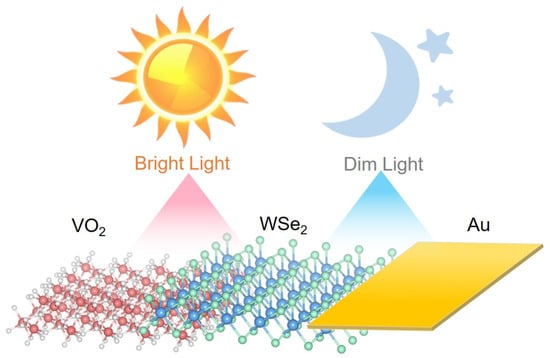
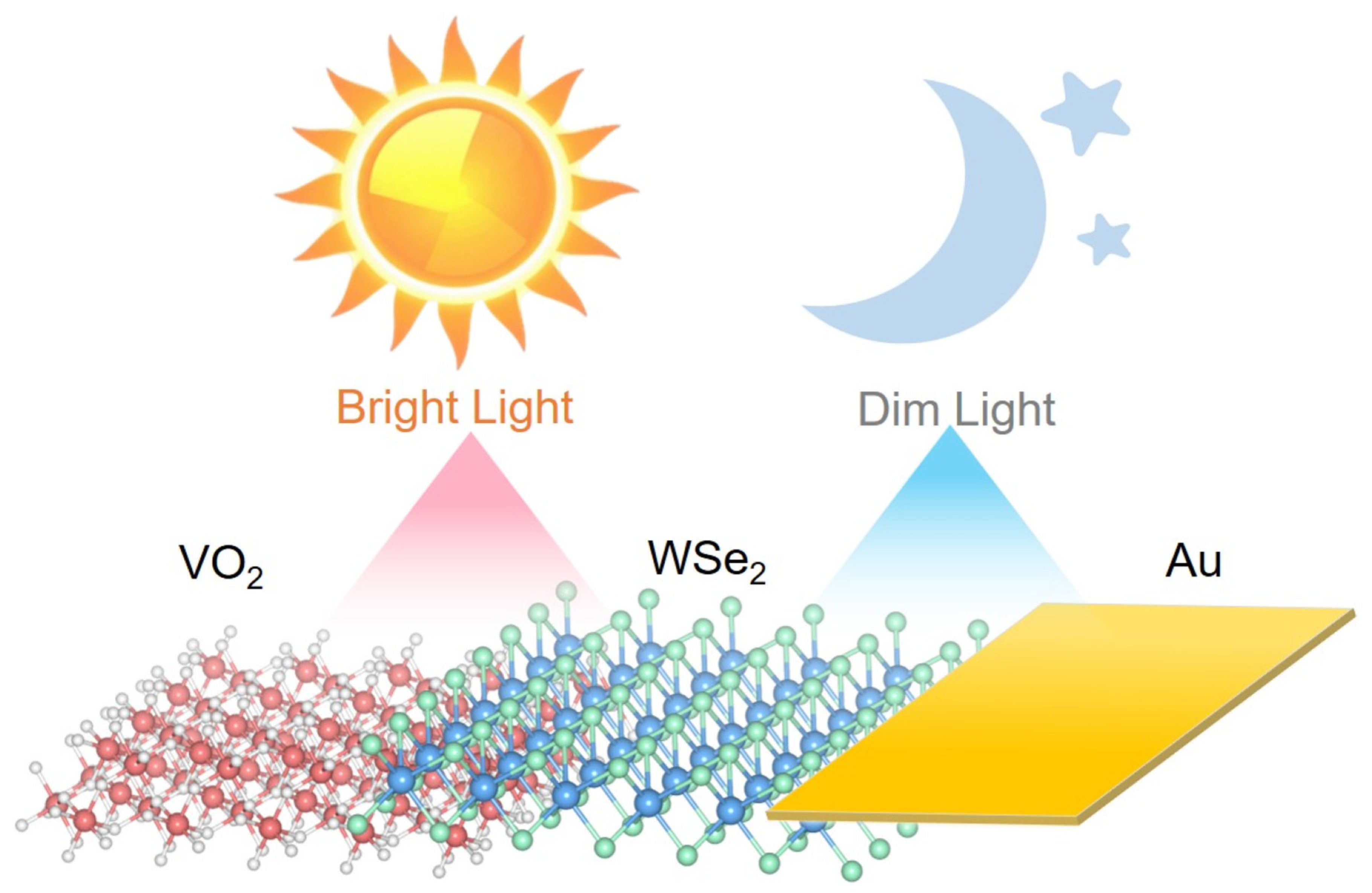
Graphical Abstract

1. Introduction

Machine vision systems used in applications such as unmanned aerial vehicles, smart cars and intelligent robots are required to complete tasks such as object detection and recognition in a broad light intensity range [1,2,3,4,5]. Traditional complementary metal oxide semiconductor imagers sense light intensity with a small dynamic range (DR) of 60–70 dB in natural light, with a broad DR of 280 dB [6,7,8]. In illumination conditions with a large DR, the traditional imager captures bright light information at the expense of weak light information, and vice versa [9,10,11]. In contrast, the visual cell of human eyes is composed of a strong light-sensitive cone cell and a weak light-sensitive rod cell. Light intensity adaptation and image fusion by both cone and rod cells expand the detection and recognition of DR to 140 dB [12,13,14]. The realization of a basic unit with biomimetic hybrid sensing and image fusion functionality in human eyes is a challenging topic [15,16,17,18].
In recent years, several bio-inspired device structures and mechanisms have been proposed to mimic the retinal cells [11,19,20]. For instance, Zhong et al. proposed an ion/electron-tuned CuInP2S6 visual sensor, which achieves regulation through the coupling of ion migration and electron photogeneration processes. It exhibits a dependency on current and time, as well as light intensity, and can independently achieve visual adaptation and target extraction in different light intensity scenarios without relying on post-processing equipment [12]. Liu et al. proposed a self-powered wide-spectrum bionic visual sensor based on multi-layer γ-InSe, which achieved dynamic adaptive behavior in response to continuous and constant light stimulation through the pyroelectric effect [13]. Although these outstanding advances have brought new ideas to the development of novel machine vision devices and laid the foundation for subsequent research and development, they did not show the dynamic range of the devices, which is one of the key parameters in visual sensors. To explore the specific dynamic ranges, Liao et al. introduced charge trapping states in a molybdenum disulfide phototransistor and switched between negative and positive gate bias to mimic the rod and cone behavior. The device successfully realizes the visual adaptation behavior of human eyes with a perception DR of 199 dB [9]. Zhou et al. proposed switching between photoconductive (rod) and photodiode (cone) mode through band alignment tuning by both gate and source/drain bias in a silicon/graphene phototransistor. The device is not self-adaptive but combines both modes to produce DR of 170 dB [8]. To further simplify the device structure, two-terminal photoconductive/diode devices with structures more analogous to the human eye have also been developed. Ran et al. proposed a biomimetic dual-mode visual sensor based on Cd (S, Se) nanowires, in which sulfur vacancy-induced trap states enable spontaneous switching between transient and persistent photoconductive behaviors. The device achieved a dynamic range of 198 dB, demonstrating that two-terminal devices can mimic the fundamental operating principles of the human eye [6]. It can be deemed that tentative investigation has been done to mimic the functions of the human eye in different ways; however, the device structure, mechanism, performance, control methods, etc., still require intense exploration to bring the visual sensor into use.
In this work, we demonstrate a simple two-terminal Au-contacted VO2/WSe2 heterojunction device to mimic the structure of the retinal cell. In the device, the photoresponsive area switches between the VO2/WSe2 heterojunction and the WSe2/Au Schottky junction with the VO2/Au as a non-responsive Ohmic contact area. The heterojunction and Schottky junction mimic the cone cell and the rod cell respectively, extending the sensing range to 146.66 dB with a response speed of 27.77 μs. The low-bias rod mode and zero-bias cone mode offer the advantage of low-power operation for machine vision.

2. Experimental Section

Preparation of materials: VO2 crystals were prepared by chemical vapor deposition (CVD). Vanadium pentoxide (V2O5) powder was used as the reaction source. A total of 0.07 g of V2O5 powder was weighed and placed in a circular crucible, spread evenly and put into a tube furnace. The growth temperature was 850 °C and the holding time was 150 min [21,22]. Finally, the grown VO2 was subjected to a 4 h annealing process at 400 degrees Celsius in a nitrogen atmosphere to further enhance the crystal quality [23]. The final VO2 optical microscopic images and XRD are shown in Figure S1. The WSe2 crystals were purchased from HQ Company, and the nanosheets were obtained through mechanical exfoliation and dry transfer methods.
Construction of the device: The specific process of device fabrication is shown in Figure S2. Firstly, the grown VO2 crystals were transferred onto the SiO2 (300 nm)/Si substrate using polydimethylsiloxane (PDMS). Then, thinner WSe2 nanosheets were obtained by mechanical exfoliation and precisely stacked on VO2 crystals. Subsequently, a mask of appropriate size was used for masking, and finally, Au electrodes were deposited by thermal evaporation.
Characterization and testing: The optical microscope (LABIV-6H, IVTEST, Foshan, China) was used to characterize the surface morphology. Raman and PL spectra were measured by confocal Raman microscopy (Alpha300R, RENISHAW, Gloucestershire, UK) using a 532 nm laser as the excitation source. The photoelectric response characteristics of the device were characterized using a semiconductor parameter analyzer with a semiconductor laser (FS-PRO, PRIMARIUS, Shanghai, China). The photoresponse characteristics of the device were measured using a 405 nm semiconductor laser (LE-LS-VIS, Leo-photoelectric, Shenzhen, China), and the corresponding light intensity was calibrated with an optical power meter (GCI080302, Daheng Optics, Nanjing, China). AFM (Ntegra Prima, NT-MDT, Moscow, Russia) and KPFM modes were integrated for the analysis of morphology and surface potential. All the above measurements were completed at room temperature and in an ambient environment.

3. Results and Discussion

3.1. Design Principles and Characterization

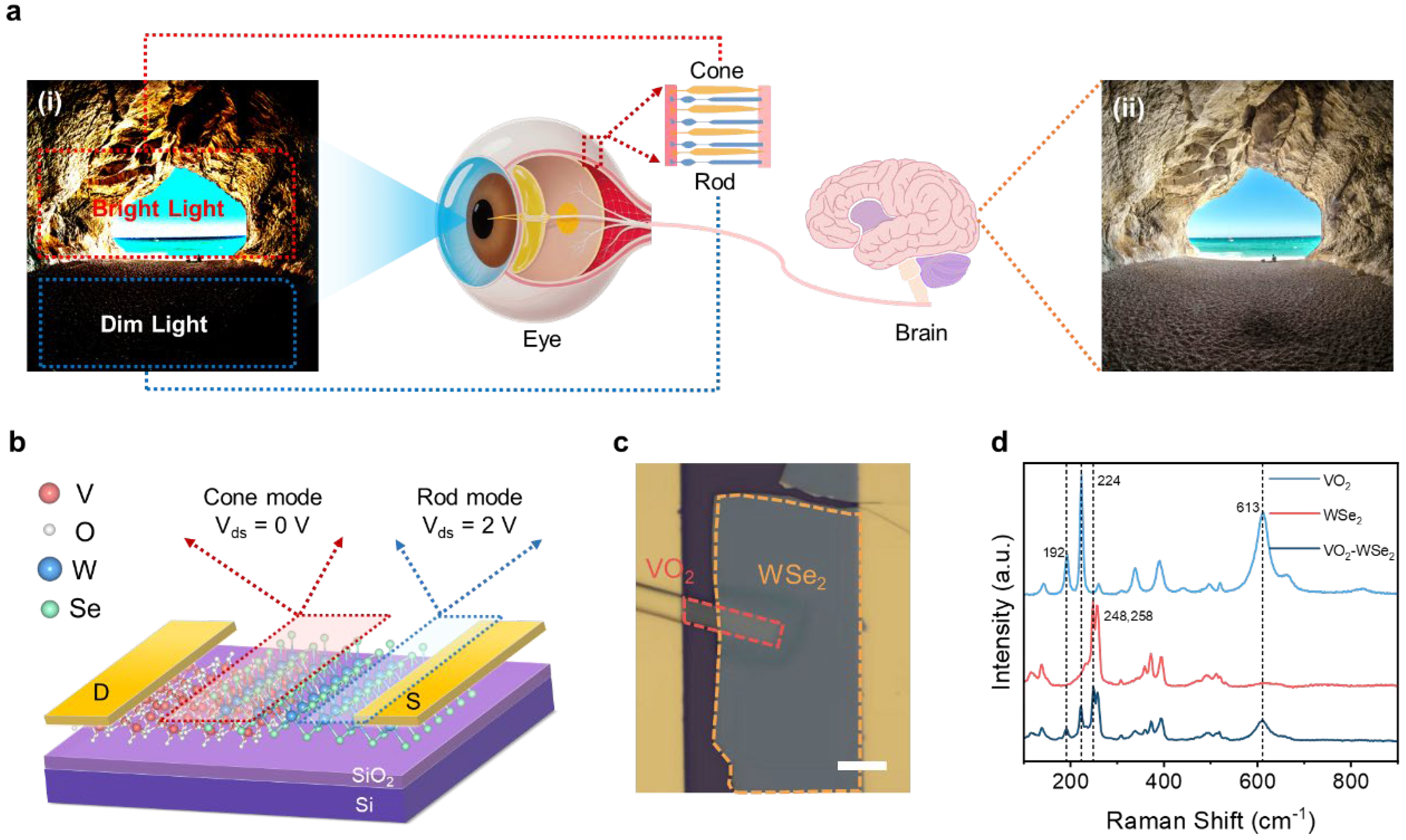
Figure 1a schematically shows the imaging process of human eyes. Both the rod cells and cone cells capture the natural scene with great light intensity difference, and the visual information is input into the cerebral cortex, eventually generating an image with adaptive contrast for the recognition of objects in both dim and strong illumination conditions [14,24,25,26]. Inspired by the dynamic tuning mechanism of cone cells and rod cells in the human retina, a heterojunction photodetector with both bright and dim light-sensitive structures to simulate the adaptive fusion in the human retina is designed, as schematically shown in Figure 1b. The device is composed of a VO2 belt and WSe2 nanosheet stacked through van der Waals interaction, and Au is used as a contact electrode. At 0 V bias voltage, the VO2/WSe2 heterojunction region outlined by a red rectangular dotted line behaves as a cone cell, while at 2 V bias voltage, the detector switches to rod cell mode, and the active region changes to the WSe2/Au Schottky interface outlined by a blue rectangular dotted line.
Details of the preparation of VO2/WSe2 and fabrication of the device are shown in Figures S1 and S2. The optical image of the as-prepared VO2/WSe2 heterojunction photodetector is shown in Figure 1c. The morphology of the heterojunction was analyzed using an atomic force microscope as shown in Figure S3a. The thicknesses of VO2 and WSe2 are 590 nm and 54 nm, respectively. The Raman spectra of VO2 in Figure 1d show typical peaks at 192 cm−1 and 224 cm−1, corresponding to the V-V key vibration of M1 phase VO2, while the peak of 613 cm−1 corresponds to the vibration of the V-O key [27,28,29]. The Raman peak of WSe2 at 248 cm−1 corresponds to the Se-Se key in-plane vibration (E2g) and the Raman peak at 258 cm−1 corresponds to the W-Se key out-of-plane vibration (A1g), identifying the good quality of transferred WSe2 [30,31,32]. The heterojunction region exhibited all the Raman peaks of the two materials, which indicates that our heterojunction has been well constructed. Figure S3b shows the exciton emission peak at 774 nm and the indirect bandgap emission peak at 910 nm in WSe2 [33,34,35]. The PL peak in the heterojunction region is weaker than that in WSe2, which indicates that there is an interlayer coupling of excitons in the heterojunction region [34,36,37]. The results of both Raman and PL spectra indicate that the material quality of the device we constructed is excellent.

3.2. Device Performance

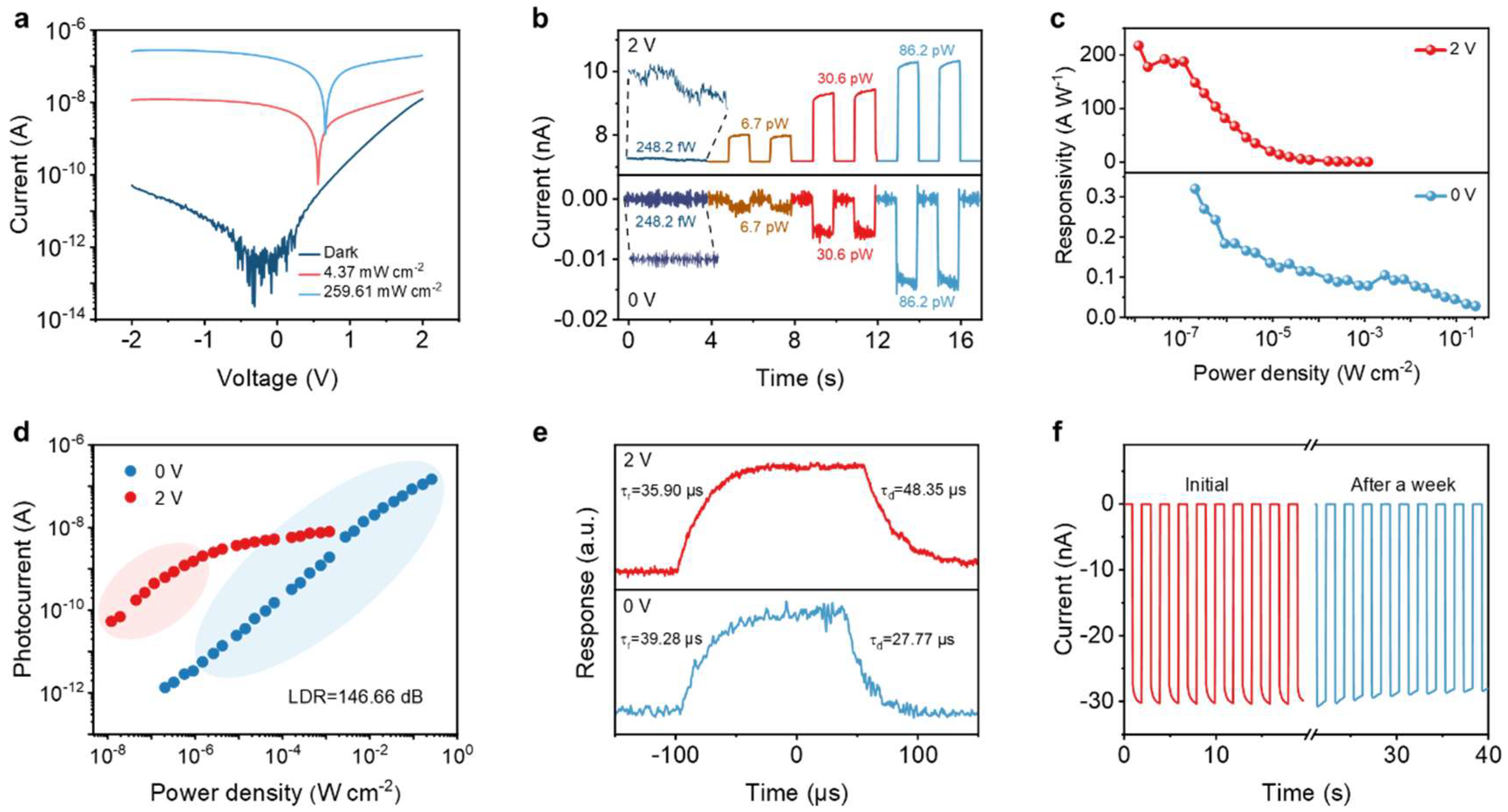
We used a semiconductor laser with a wavelength of 405 nm as the light source to test the photoelectric response performance of the device. The intensity of the light was calibrated using a light power meter. The optoelectrical characteristics of the as-prepared VO2/WSe2 heterojunction photodetector are shown in Figure 2 and Figure S5. The I–V characteristic curves of the device under different light intensities are shown in Figure 2a. The rectification ratio of the device in the dark state exceeds 102, and the maximum light on/off ratio exceeds 103. These results indicate that the VO2/WSe2 heterojunction exhibits the characteristics of a photodiode. Typical photosensitive performances at Vds = 2 V and Vds = 0 V are compared as the voltages are at both sides of the voltage of minimum photocurrent in Figure 2a. First, the sensitivity of a photodetector is characterized by the noise equivalent power (NEP), which is defined as the incident light power required when the signal-to-noise ratio (SNR) is 1 [38,39]. NEP can be determined by adjusting the current–time curves under different light intensity modulations [40,41]. As shown in Figure 2b, the NEP of the device at Vds = 2 V is 248.2 fW/ H z , which is much better than 6.7 pW/ H z at Vds = 0 V. This indicates that the detector can detect even weaker light intensities at 2 V. This phenomenon can be explained using photoconductive gain, with G = τ n τ t [42,43]. τ n and τ t represent the lifetime and transit time of the carriers respectively. When τ n > τ t , each photon absorbed by the detector enables multiple electrons to continue passing through the two electrodes. When the applied voltage is V, the transit time τ t = l 2 μ n V , where μ n is the electron mobility, l is the distance between the electrodes, and G = τ n μ n V l 2 . Therefore, adding a bias voltage will be beneficial for detecting even weaker light signals. Figure 2c shows that the maximum photoresponsivity is 217 A W−1 at 2 V, about 700 times that at 0 V. Second, the photoresponsivity at 2 V decreases rapidly with increasing light intensity. The intensity-dependent photoresponse in Figure S5a shows that the device operating at 2 V is less sensitive when the illumination intensity is higher than 8.85 μW cm−2. As a consequence, R decreases to 20.2 A W−1 in Figure 2c, which limits its DR to 41.82 dB as shown in Figure S5c. In contrast, the device operating at 0 V effectively responses to strong illumination up to 259.6 mW cm−2 in Figure S5b, enabling a larger DR of 122.03 dB as shown in Figure S5d. Compared to the human eye, it can be seen that the as-prepared photodetector operating at 2 V is more sensitive to a weak light signal while less responsive to a strong one, enabling the effective function of the retinal rod cell (rod mode). When operating at 0 V, the broader photoresponse to strong light signals enables the simulation of the retinal cone cell (cone mode). As shown in Figure 2d, the combined DR of the photodetector is 146.66 dB.
As another crucial parameter for evaluating the performance of photodetectors, the response time includes the rise time (tr) and the fall time (tf). The rise time is defined as the time to rise from 10% to 90% of the photocurrent, and the fall time is defined as the time to fall from 90% to 10% of the photocurrent [44,45]. Figure 2e shows that the rise time and fall time at 0 V are 39.28 μs and 27.77 μs respectively, while the rise/fall time at 2 V are 35.9 μs and 48.35 μs. Such response speed is at a relatively high level. The specific detectivity at 2 V is approximately 1.1 × 10 9 Jones, and the specific detectivity at 0 V voltage is approximately 1.08 × 10 7 Jones. Furthermore, the device shows good ambient stability. After being stored at room temperature in an air environment for a week, the device still maintained a stable, rapid and repeatable photoresponse as shown in Figure 2f. Table S1 shows that our device shows a relatively high level among two-dimensional material photodetectors.
Finally, we compared the VO2/WSe2 visual sensor with recently reported bio-inspired human-eye visual sensors, as summarized in Table 1. In terms of device architecture, field-effect transistor structures were the earliest biomimetic human-eye configurations to be explored. More recently, however, simpler two-terminal photoconductive/diode devices, whose structures are more analogous to that of the human eye, have emerged. Regarding operating mechanisms, a defect charge-mediated self-adaptation strategy can deliver a larger dynamic range (DR), but usually at the expense of a substantial reduction in response speed and adaption speed to more than one second. In contrast, the switching between devices with different response behaviors generally yields a relatively smaller DR, while enabling response and adaption speed to be achieved in less than a millisecond. Both our device and the recently reported Cd (S, Se) visual sensor [6] demonstrate that two-terminal device architectures can mimic the fundamental operating principles of the human eye and achieve a DR comparable to that of the human eye in different ways. Moreover, our device further shows that a single heterojunction photodiode is able to mimic the rod- and cone-like structure by simply switching the bias, highlighting the significant potential for device design in the development of bio-inspired visual sensors.

3.3. Photoresponse Mechanism

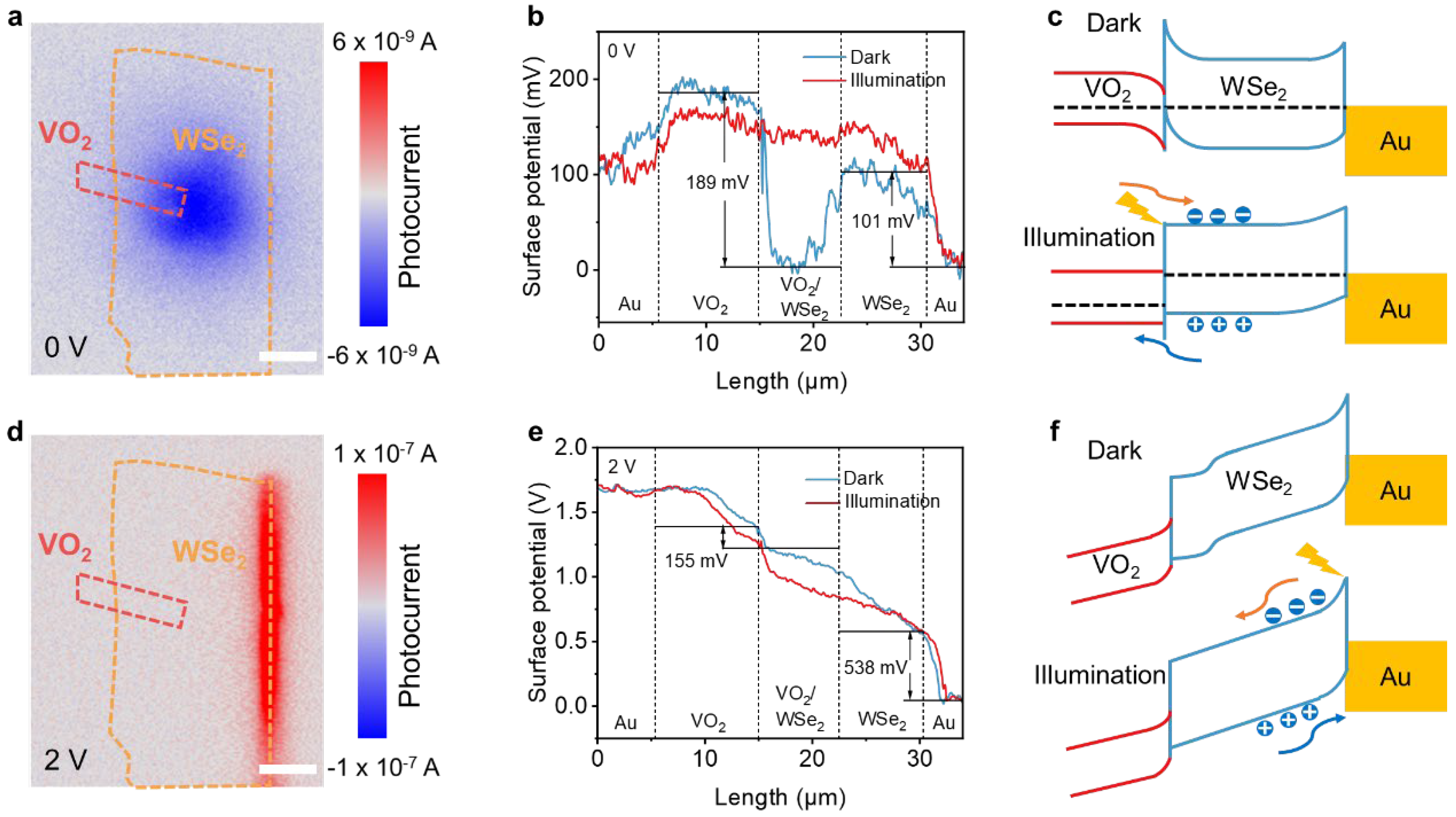
To reveal the retina-like working mechanism of the photodetector, scanning photocurrent imaging is carried out in Figure 3a,d. It was found that at 0 V, the blue-contrast photoactive region locates around the VO2/WSe2 heterojunction in Figure 3a, with a negative photocurrent of around 6 nA. When the device operates at 2 V, the VO2/WSe2 heterojunction is deactivated, while the red-contrast region generates at the WSe2/Au interface in Figure 3d, showing a positive photocurrent of around 1000 nA. This confirms that switching the bias leads to a spatial shifting in the photoresponse area, corresponding to the design concept, as illustrated in Figure 1b, that VO2/WSe2 mimics the cone cell and WSe2/Au mimics the rod cell.
To further reveal the photoresponse-switching mechanism, surface potential profiles along the device were scanned using a Kelvin probe force microscope (KPFM) (Figure S6). As our KPFM works at the tip-biased mode, a lower surface potential implies a larger work function, and the real energy band bending is opposite to the change in surface potential [46,47,48]. As shown in Figure 3b, there is a 189 mV surface potential difference between the WSe2 and VO2, which is higher than the 101 mV of WSe2/Au. As a result, the WSe2/VO2 heterojunction plays the dominating role. Figure 3c schematically illustrates the energy band alignment according to the KPFM result, where electrons in the WSe2 flow into the VO2, leading to an electron depletion and upward band bending that forms a stronger built-in electric field. Under the illumination, excited electrons and holes are mainly separated by the built-in electric field to the WSe2 and VO2 sides, respectively. The interfacial energy band is then lifted and the surface potential recovers close to the flat band state as shown in red profile in Figure 3b, and the shifting of band alignment is shown in the illuminated diagram in Figure 3c.
Under 2 V bias, the external bias leads to a strong bending of the energy band, and thus a strong tilting of surface potential in Figure 3e. As the external field is opposite to the built-in electric field within the heterojunction, while coinciding with the electric field of the WSe2/Au Schottky junction, the potential difference in the heterojunction is then weakened from 189 mV to 155 mV, while the potential difference in the Schottky contact is enhanced from 101 mV to 538 mV. This change leads to a shifting in the carrier separation area of the WSe2/Au Schottky junction as shown in Figure 3f. It can be seen that under illumination, the voltage further drops on the Schottky junction, which makes it the major area for photoresponse. From the above band picture, it can be inferred that in dim light, the applied bias leads to more voltage drop on the Schottky junction which induces a more sensitive photoresponse than that at 0 V. However, the applied bias would lead to a more severe injection screening effect at high light intensities, causing the saturation of photoresponse as shown in Figure 2d. Figure 3e also shows that there is negligible voltage drop at the Au/VO2 contact, which means that it forms Ohmic contact and shows no contribution to the photoresponse.

3.4. Imaging Demonstration

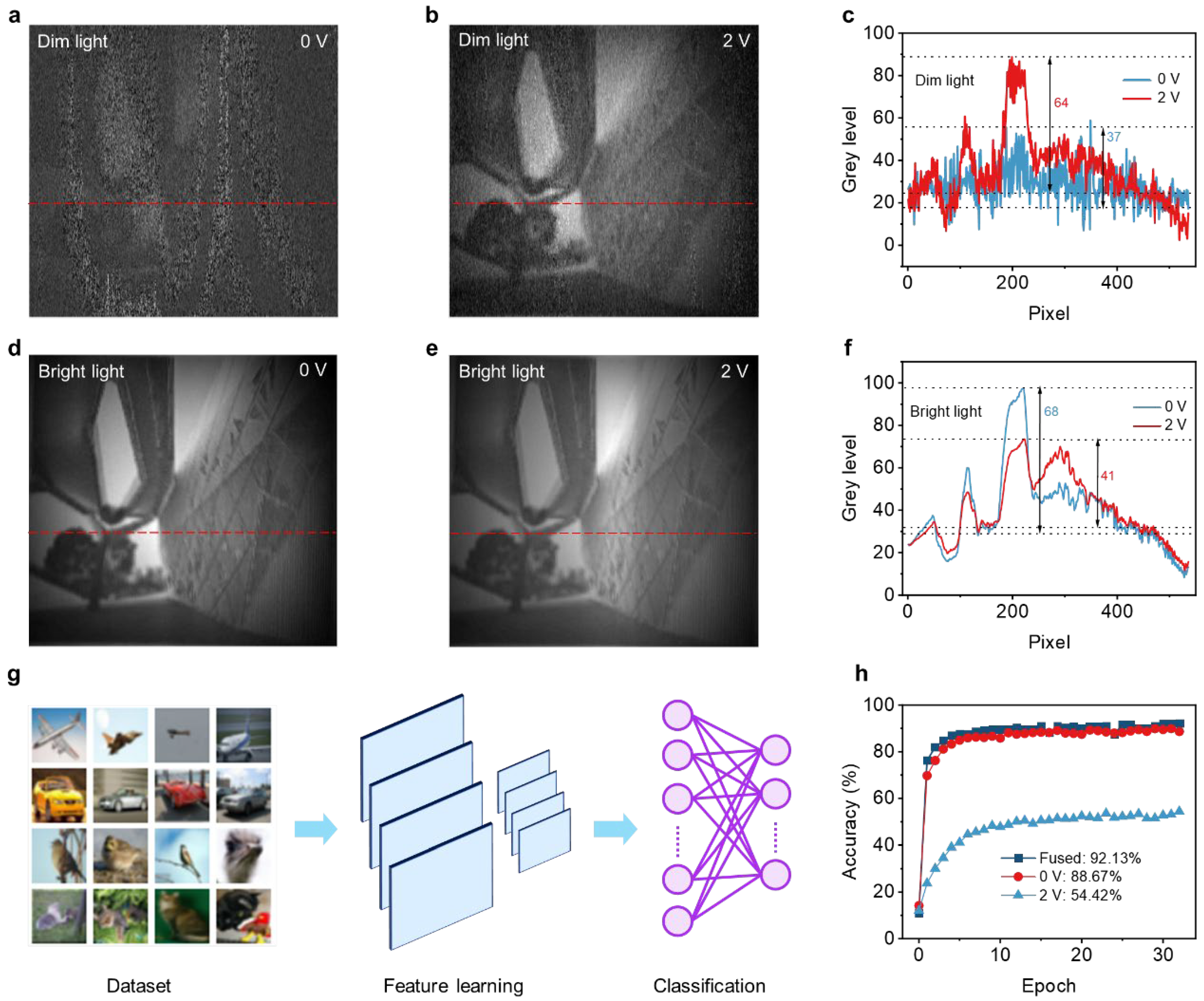
To demonstrate the ability to mimic the visual imaging function of the human eye, an imaging system in Figure S7a was set up for single-pixel imaging using the VO2/WSe2 heterojunction photodetector and a transparent architectural film was used as the imaging object in Figure S7b. An illumination of 27 μW cm−2 was used as the dim condition while an optical illumination of 2 mW cm−2 was used as the bright condition. The images formed in the 0 V mode and the 2 V mode under dim light conditions are shown in Figure 4a and Figure 4b respectively. The images captured in the 2 V mode have less noise and clearly display the image details, while in the 0 V mode, only the blurry outlines can be seen. The corresponding pixel differences are shown in Figure 4c. The pixel difference in the image captured in the 2 V mode is as high as 64, while that of the image captured in the 0 V mode is as low as 37. This is because the 2 V mode has a lower NEP compared to the 0 V mode. On the contrary, the images formed in the 0 V mode and the 2 V mode under the bright light condition are shown in Figure 4d and Figure 4e respectively. As shown in Figure 4f, the pixel difference in the image captured in the 0 V mode is as high as 68, while the pixel difference in the image captured in the 2 V mode is only 41. This indicates that the image captured in the 0 V mode has clearer details. This is because the 0 V mode still maintains a good linear response even under strong light conditions, while the 2 V mode exhibits a response characteristic of photoelectric current saturation under strong light. Therefore, the imaging results demonstrate that our device can effectively capture information in weak light in the 2 V mode, and can effectively capture information in strong light in the 0 V mode. In order to further demonstrate the characteristics of our device, we constructed a convolutional neural network as shown in Figure 4g. We used the CIFAR database as the dataset, which contains 60,000 32 × 32 color images divided into 10 categories, with 6000 images in each category. A total of 50,000 images were used for training and 10,000 images for testing. Using the VGG16 network of MATLAB (R2024b) to classify the CIFAR dataset, the specific process of image recognition is shown in Figure S8. The results are shown in Figure 4h. After 32 epochs, the recognition accuracy of the 0 V mode and 2 V mode was 88.67% and 54.42% respectively, while the image recognition rate when combining the two modes was 92.13%. This is because the dynamic range of the single 2 V mode (41.82 dB) and 0 V mode (122.03 dB) is small, which cannot accurately capture the image information. However, combining the two detection modes will achieve a larger dynamic range (146.66 dB). These results indicate that using the 0 V mode and 2 V mode of the VO2/WSe2 van der Waals heterojunction photodetector will effectively improve the ability to capture image information.

4. Conclusions

In conclusion, this study introduces a VO2/WSe2 van der Waals heterojunction photodetector where asymmetric contacts enable a dual-mode photoresponse for adaptive machine vision. At 0 V bias, this device operates in the cone mode and is capable of capturing optical information under strong light (5.4 μW). At 2 V bias, the device operates in the rod cell mode and is able to capture optical information under weak light (248.2 fW). A dynamic range of 146.66 dB was achieved through this dynamically switching detection mode, which is comparable to the level of the human eye. The fabrication of our VO2/WSe2 heterojunction by mechanical exfoliation and dry-transfer processes has demonstrated the feasibility of fabricating visual sensors. Further scaling-up requires the growth of large-scale 2D materials combined with a microfabrication process. This paves the way for the development of high-performance vision sensors.

Supplementary Materials

The following supporting information can be downloaded at: https://www.mdpi.com/article/10.3390/nano16090498/s1, Figure S1 Growth of VO2: (a) VO2 micron band crystal optical image. (b) XRD spectrum of VO2 crystal. Figure S2 Device fabrication: schematic diagram of the VO2/WSe2 van der Waals heterojunction fabrication process. Figure S3 Material characterization: (a) AFM images of the VO2/WSe2 heterojunction. (b) PL at different positions of heterojunctions. Figure S4 Noise-current variation of VO2/WSe2 with frequency under different bias voltages. Figure S5. Photoresponse characterization: (a,b) Current-time curves of heterojunction under 2 V and 0 V bias voltages. (c,d) Current-optical power density curve of heterojunction under 2 V and 0 V bias voltages. Figure S6 Working mechanism characterization: (a) KPFM images of the device under dark and light conditions with a 0 V bias voltage. (b) KPFM images of the device under dark and light conditions with a 2 V bias voltage. Figure S7 Imaging application characterization: (a) Schematic representation of the imaging process. (b) The architectural images used as masks during the imaging process. Figure S8 Current-light power density curve obtained after logarithmically compressing the raw data of the device in Figure 2d. Table S1. DR Comparison of 2D Materials and Their Heterojunctions. Refs. [15,38,39,46,49,50,51,52,53,54,55,56,57,58,59,60] are cited in the supplementary materials.

Author Contributions

Conceptualization, D.C., Y.L., Z.Z., Y.H., Z.W., J.C., Q.C., Y.Z. and W.X.; Methodology, D.C., Y.L., Z.Z., Y.H., Z.W., J.C., Q.C., Y.Z. and W.X.; Software, D.C., Y.L., Z.Z., Y.H., Z.W., J.C., Q.C., Y.Z. and W.X.; Validation, D.C., Y.L., Z.Z., Y.H., Z.W., J.C., Q.C., Y.Z. and W.X.; Formal analysis, D.C., Y.L., Z.Z., Y.H., Z.W., J.C., Q.C., Y.Z. and W.X.; Investigation, D.C., Y.L., Z.Z., Y.H., Z.W., J.C., Q.C., Y.Z. and W.X.; Resources, J.C., Q.C., Y.Z. and W.X.; Data curation, D.C., Y.L., Z.Z., Y.H., Z.W., J.C., Q.C., Y.Z. and W.X.; Writing—original draft, D.C., Y.L., Z.Z., Y.H., Z.W., Y.Z. and W.X.; Writing—review & editing, D.C., Y.L., Z.Z., Y.Z. and W.X.; Visualization, D.C., Y.L., Z.Z., Y.H., Z.W., J.C., Q.C., Y.Z. and W.X.; Supervision, D.C., Y.L., Z.Z., Y.H., Z.W., J.C., Q.C., Y.Z. and W.X.; Project administration, D.C., Y.L., Z.Z., Y.H., Z.W., J.C., Q.C., Y.Z. and W.X.; Funding acquisition, Y.Z. and W.X. All authors have read and agreed to the published version of the manuscript.

Funding

This work was financially supported by the National Natural Science Foundation of China (Grants Nos. 62174072, 52402187), and the Research Foundation of the Department of Education of Guangdong Province (Grants Nos. 2025ZDZX2101, 2025KCXTD078).

Data Availability Statement

The data that support the findings of this study are available from the corresponding author upon reasonable request.

Conflicts of Interest

No conflict of interest is declared by the authors.

References

  1. Mennel, L.; Symonowicz, J.; Wachter, S.; Polyushkin, D.K.; Molina-Mendoza, A.J.; Mueller, T. Ultrafast Machine Vision with 2D Material Neural Network Image Sensors. Nature 2020, 579, 62–66. [Google Scholar] [CrossRef] [PubMed]
  2. Wang, T.; Sohoni, M.M.; Wright, L.G.; Stein, M.M.; Ma, S.-Y.; Onodera, T.; Anderson, M.G.; McMahon, P.L. Image Sensing with Multilayer Nonlinear Optical Neural Networks. Nat. Photonics 2023, 17, 408–415. [Google Scholar] [CrossRef]
  3. Wan, T.; Shao, B.; Ma, S.; Zhou, Y.; Li, Q.; Chai, Y. In-Sensor Computing: Materials, Devices, and Integration Technologies. Adv. Mater. 2023, 35, 2203830. [Google Scholar] [CrossRef]
  4. Choi, C.; Lee, G.J.; Chang, S.; Song, Y.M.; Kim, D.-H. Nanomaterial-Based Artificial Vision Systems: From Bioinspired Electronic Eyes to In-Sensor Processing Devices. ACS Nano 2024, 18, 1241–1256. [Google Scholar] [CrossRef]
  5. Tan, H.; Van Dijken, S. Dynamic Machine Vision with Retinomorphic Photomemristor-Reservoir Computing. Nat. Commun. 2023, 14, 2169. [Google Scholar] [CrossRef]
  6. Ran, W.; Ding, Q.; Wang, Z.; Shen, G. Bioinspired Dual-Mode Nanowire Photodetector with High Responsivity for Wide Dynamic Range Image Sensing. Adv. Funct. Mater. 2026, 36, e24536. [Google Scholar] [CrossRef]
  7. Wang, H.; Sun, B.; Ge, S.S.; Su, J.; Jin, M.L. On Non-von Neumann Flexible Neuromorphic Vision Sensors. NPJ Flex. Electron. 2024, 8, 28. [Google Scholar] [CrossRef]
  8. Zhou, S.; Fan, H.; Wen, S.; Wei, Y.; Chen, H.; Zhang, Y.; Zou, T.; Gao, P.; Wei, D.; Yin, Y.; et al. Dual-Mode Photodetectors Mimicking Retinal Rod and Cone Cells for High Dynamic Range Image Sensor. Laser Photonics Rev. 2025, 19, 2402192. [Google Scholar] [CrossRef]
  9. Liao, F.; Zhou, Z.; Kim, B.J.; Chen, J.; Wang, J.; Wan, T.; Zhou, Y.; Hoang, A.T.; Wang, C.; Kang, J.; et al. Bioinspired In-Sensor Visual Adaptation for Accurate Perception. Nat. Electron. 2022, 5, 84–91. [Google Scholar] [CrossRef]
  10. Shao, H.; Wang, W.; Zhang, Y.; Gao, B.; Jiang, C.; Li, Y.; Xie, P.; Yan, Y.; Shen, Y.; Wu, Z.; et al. Adaptive In-Sensor Computing for Enhanced Feature Perception and Broadband Image Restoration. Adv. Mater. 2025, 37, 2414261. [Google Scholar] [CrossRef]
  11. Zhang, J.; Zhao, Y.; Liu, G.; Wang, G.; Chen, L.; Shang, C.; Li, J.; Zhou, N.; Xu, H.; Yang, R.; et al. Ultrabroadband Detection and Self-Powered Functionality in Quasi-One-Dimensional Nb3Se12I Nanowire Photodetectors for Bionic Vision Applications. ACS Appl. Mater. Interfaces 2025, 17, 21448–21458. [Google Scholar] [CrossRef]
  12. Zhong, Z.; Zhuang, Y.; Cheng, X.; Zheng, J.; Yang, Q.; Li, X.; Chen, Y.; Shen, H.; Lin, T.; Shi, W.; et al. Ionic-Electronic Photodetector for Vision Assistance with in-Sensor Image Processing. Nat. Commun. 2025, 16, 7096. [Google Scholar] [CrossRef] [PubMed]
  13. Liu, W.; Yang, X.; Wang, Z.; Li, Y.; Li, J.; Feng, Q.; Xie, X.; Xin, W.; Xu, H.; Liu, Y. Self-Powered and Broadband Opto-Sensor with Bionic Visual Adaptation Function Based on Multilayer γ-InSe Flakes. Light Sci. Appl. 2023, 12, 180. [Google Scholar] [CrossRef]
  14. Azimipour, M.; Valente, D.; Vienola, K.V.; Werner, J.S.; Zawadzki, R.J.; Jonnal, R.S. Optoretinogram: Optical Measurement of Human Cone and Rod Photoreceptor Responses to Light. Opt. Lett. 2020, 45, 4658. [Google Scholar] [CrossRef]
  15. Wen, S.; Zhou, S.; Gong, Y.; Zhang, R.; Jia, X.; Kong, L.; Fan, H.; Yin, Y.; Lan, C.; Li, C.; et al. An Ultra-Fast WSe2 Homojunction Photodiode with a Large Linear Dynamic Range towards in-Sensor Image Processing. Nanoscale Horiz. 2025, 10, 885–895. [Google Scholar] [CrossRef] [PubMed]
  16. Li, C.; Wang, H.; Wang, F.; Li, T.; Xu, M.; Wang, H.; Wang, Z.; Zhan, X.; Hu, W.; Shen, L. Ultrafast and Broadband Photodetectors Based on a Perovskite/Organic Bulk Heterojunction for Large-Dynamic-Range Imaging. Light Sci. Appl. 2020, 9, 31. [Google Scholar] [CrossRef]
  17. Xiong, Q.; Ren, X.; Yin, H.; Jiang, L.; Wang, C.; Wang, Z. SFDA-MEF: An Unsupervised Spacecraft Feature Deformable Alignment Network for Multi-Exposure Image Fusion. Remote Sens. 2025, 17, 199. [Google Scholar] [CrossRef]
  18. Liu, Y.; Ji, Z.; Cen, G.; Sun, H.; Wang, H.; Zhao, C.; Wang, Z.L.; Mai, W. Perovskite-Based Color Camera Inspired by Human Visual Cells. Light Sci. Appl. 2023, 12, 43. [Google Scholar] [CrossRef]
  19. Hong, S.; Choi, S.H.; Park, J.; Yoo, H.; Oh, J.Y.; Hwang, E.; Yoon, D.H.; Kim, S. Sensory Adaptation and Neuromorphic Phototransistors Based on CsPb(Br1−x Ix)3 Perovskite and MoS2 Hybrid Structure. ACS Nano 2020, 14, 9796–9806. [Google Scholar] [CrossRef]
  20. Choi, C.; Lee, G.J.; Chang, S.; Song, Y.M.; Kim, D.-H. Inspiration from Visual Ecology for Advancing Multifunctional Robotic Vision Systems: Bio-Inspired Electronic Eyes and Neuromorphic Image Sensors. Adv. Mater. 2024, 36, 2412252. [Google Scholar] [CrossRef]
  21. Liu, J.; Lai, H.; Huang, X.; Chen, Q.; Xie, W. Temperature Dependent Photoresponse of MoS2/VO2 Heterojunction. Mater. Lett. 2023, 341, 134303. [Google Scholar] [CrossRef]
  22. Wu, J.M.; Chang, W.E. Ultrahigh Responsivity and External Quantum Efficiency of an Ultraviolet-Light Photodetector Based on a Single VO2 Microwire. ACS Appl. Mater. Interfaces 2014, 6, 14286–14292. [Google Scholar] [CrossRef] [PubMed]
  23. Bae, S.; Lee, S.; Koo, H.; Lin, L.; Jo, B.H.; Park, C.; Wang, Z.L. The Memristive Properties of a Single VO2 Nanowire with Switching Controlled by Self-Heating. Adv. Mater. 2013, 25, 5098–5103. [Google Scholar] [CrossRef]
  24. Acharya, U.R.; Yun, W.L.; Ng, E.Y.K.; Yu, W.; Suri, J.S. Imaging Systems of Human Eye: A Review. J. Med. Syst. 2008, 32, 301–315. [Google Scholar] [CrossRef] [PubMed]
  25. Grimes, W.N.; Songco-Aguas, A.; Rieke, F. Parallel Processing of Rod and Cone Signals: Retinal Function and Human Perception. Annu. Rev. Vis. Sci. 2018, 4, 123–141. [Google Scholar] [CrossRef] [PubMed]
  26. Simon Chane, C.; Ieng, S.-H.; Posch, C.; Benosman, R.B. Event-Based Tone Mapping for Asynchronous Time-Based Image Sensor. Front. Neurosci. 2016, 10, 391. [Google Scholar] [CrossRef]
  27. Shvets, P.; Dikaya, O.; Maksimova, K.; Goikhman, A. A Review of Raman Spectroscopy of Vanadium Oxides. J. Raman Spectrosc. 2019, 50, 1226–1244. [Google Scholar] [CrossRef]
  28. Wang, L.; Deng, M.; Xu, X.; Hou, Z.; Li, M.; Chen, L.; Cui, A.; Jiang, K.; Shang, L.; Chu, J.; et al. High-Sensitivity Adjustable Operating Modes Multifunctional Detector Based on InSe/VO2 Heterojunction for Light and Electric Field Perception. Adv. Opt. Mater. 2023, 11, 2300854. [Google Scholar] [CrossRef]
  29. Luo, H.; Wang, B.; Wang, E.; Wang, X.; Sun, Y.; Li, Q.; Fan, S.; Cheng, C.; Liu, K. Phase-Transition Modulated, High-Performance Dual-Mode Photodetectors Based on WSe2/VO2 Heterojunctions. Appl. Phys. Rev. 2019, 6, 041407. [Google Scholar] [CrossRef]
  30. Shin, G.H.; Park, C.; Lee, K.J.; Jin, H.J.; Choi, S.-Y. Ultrasensitive Phototransistor Based on WSe2–MoS2 van Der Waals Heterojunction. Nano Lett. 2020, 20, 5741–5748. [Google Scholar] [CrossRef]
  31. Zheng, T.; Yang, M.; Pan, Y.; Zheng, Z.; Sun, Y.; Li, L.; Huo, N.; Luo, D.; Gao, W.; Li, J. Self-Powered Photodetector with High Efficiency and Polarization Sensitivity Enabled by WSe2/Ta2NiSe5/WSe2 van Der Waals Dual Heterojunction. ACS Appl. Mater. Interfaces 2023, 15, 29363–29374. [Google Scholar] [CrossRef] [PubMed]
  32. Sun, Y.; Zhu, J.; Luo, Y.; Chen, J.; Sun, Y.; Zhang, M.; Lei, W.; Yang, C.Y.; Zhou, C. Boosting the Self-Driven Properties of 2D Photodetectors through Synergistic Asymmetrical Effects. ACS Appl. Mater. Interfaces 2025, 17, 48650–48657. [Google Scholar] [CrossRef]
  33. Chen, J.; Wang, Q.; Sheng, Y.; Cao, G.; Yang, P.; Shan, Y.; Liao, F.; Muhammad, Z.; Bao, W.; Hu, L.; et al. High-Performance WSe2 Photodetector Based on a Laser-Induced p–n Junction. ACS Appl. Mater. Interfaces 2019, 11, 43330–43336. [Google Scholar] [CrossRef] [PubMed]
  34. Xu, B.; Guo, D.; Dong, W.; Gao, H.; Zhu, P.; Wang, Z.; Watanabe, K.; Taniguchi, T.; Luo, Z.; Zheng, F.; et al. Gap State-Modulated Van Der Waals Short-Term Memory with Broad Band Negative Photoconductance. Small 2024, 20, 2309626. [Google Scholar] [CrossRef]
  35. Li, Z.; Yang, S.; Dhall, R.; Kosmowska, E.; Shi, H.; Chatzakis, I.; Cronin, S.B. Layer Control of WSe2 via Selective Surface Layer Oxidation. ACS Nano 2016, 10, 6836–6842. [Google Scholar] [CrossRef]
  36. Liu, H.; Zhu, X.; Sun, X.; Zhu, C.; Huang, W.; Zhang, X.; Zheng, B.; Zou, Z.; Luo, Z.; Wang, X.; et al. Self-Powered Broad-Band Photodetectors Based on Vertically Stacked WSe2/Bi2Te3 p–n Heterojunctions. ACS Nano 2019, 13, 13573–13580. [Google Scholar] [CrossRef]
  37. Varghese, A.; Saha, D.; Thakar, K.; Jindal, V.; Ghosh, S.; Medhekar, N.V.; Ghosh, S.; Lodha, S. Near-Direct Bandgap WSe2/ReS2 Type-II Pn Heterojunction for Enhanced Ultrafast Photodetection and High-Performance Photovoltaics. Nano Lett. 2020, 20, 1707–1717. [Google Scholar] [CrossRef]
  38. Wang, F.; Zhang, T.; Xie, R.; Wang, Z.; Hu, W. How to Characterize Figures of Merit of Two-Dimensional Photodetectors. Nat. Commun. 2023, 14, 2224. [Google Scholar] [CrossRef]
  39. Wang, Q.; Zhang, Y.; Wei, Z. Recent Progress on Organic Near-Infrared Photodetectors: Mechanism, Devices, and Applications. Chin. J. Chem. 2023, 41, 958–978. [Google Scholar] [CrossRef]
  40. Zhou, S.; Zhang, X.; Wang, Y.; Lin, D.; Zou, S.; Wang, J.; Xiao, L.; Zhang, D.; Jiang, J.; Zhang, P.; et al. Opto-Electrical Decoupled Phototransistor for Starlight Detection. Adv. Mater. 2025, 37, 2413247. [Google Scholar] [CrossRef] [PubMed]
  41. Liu, X.; Gu, L.; Zhang, Q.; Wu, J.; Long, Y.; Fan, Z. All-Printable Band-Edge Modulated ZnO Nanowire Photodetectors with Ultra-High Detectivity. Nat. Commun. 2014, 5, 4007. [Google Scholar] [CrossRef]
  42. Long, M.; Wang, P.; Fang, H.; Hu, W. Progress, Challenges, and Opportunities for 2D Material Based Photodetectors. Adv. Funct. Mater. 2019, 29, 1803807. [Google Scholar] [CrossRef]
  43. Tang, Y.; Wu, F.; Chen, F.; Zhou, Y.; Wang, P.; Long, M.; Zhou, W.; Ning, Z.; He, J.; Gong, F.; et al. A Colloidal-Quantum-Dot Infrared Photodiode with High Photoconductive Gain. Small 2018, 14, 1803158. [Google Scholar] [CrossRef] [PubMed]
  44. Zhang, Y.; Ma, K.; Zhao, C.; Hong, W.; Nie, C.; Qiu, Z.-J.; Wang, S. An Ultrafast WSe2 Photodiode Based on a Lateral p-i-n Homojunction. ACS Nano 2021, 15, 4405–4415. [Google Scholar] [CrossRef] [PubMed]
  45. Yan, X.; Yan, T.; Li, L.; Cao, Y.; Wang, X.; Wang, J.; Tao, A.; Yao, T.; Jiang, Y.; Hu, W.; et al. Ferroelectric Ultraviolet Photodetector Material with Ultrafast Response Speed. Nat. Commun. 2025, 17, 1304. [Google Scholar] [CrossRef]
  46. Lu, Y.; Zhan, Z.; Tan, J.; Lai, H.; Liu, P.; Zhou, Y.; Xie, W. High-performance MoS2 Homojunction Photodiode Enabled by Facile Van Der Waals Contacts with 2D Perovskite. Laser Photonics Rev. 2024, 18, 2300941. [Google Scholar] [CrossRef]
  47. Lai, H.; Lu, Z.; Lu, Y.; Yao, X.; Xu, X.; Chen, J.; Zhou, Y.; Liu, P.; Shi, T.; Wang, X.; et al. Fast, Multi-Bit, and Vis-Infrared Broadband Nonvolatile Optoelectronic Memory with MoS2/2D-Perovskite Van Der Waals Heterojunction. Adv. Mater. 2023, 35, 2208664. [Google Scholar] [CrossRef]
  48. Zhou, H.; Lai, H.; Sun, X.; Zhang, N.; Wang, Y.; Liu, P.; Zhou, Y.; Xie, W. Van Der Waals MoS2/Two-Dimensional Perovskite Heterostructure for Sensitive and Ultrafast Sub-Band-Gap Photodetection. ACS Appl. Mater. Interfaces 2022, 14, 3356–3362. [Google Scholar] [CrossRef]
  49. Nashashibi, S.; Koepfli, S.M.; Schwanninger, R.; Baumann, M.; Doderer, M.; Bisang, D.; Fedoryshyn, Y.; Leuthold, J. Engineering Graphene Phototransistors for High Dynamic Range Applications. ACS Nano 2024, 18, 12760–12770. [Google Scholar] [CrossRef]
  50. Zhong, J.; Wu, B.; Madoune, Y.; Wang, Y.; Liu, Z.; Liu, Y. PdSe2/MoSe2 Vertical Heterojunction for Self-Powered Photodetector with High Performance. Nano Res. 2022, 15, 2489–2496. [Google Scholar] [CrossRef]
  51. Yu, M.; Hu, Y.; Gao, F.; Dai, M.; Wang, L.; Hu, P.; Feng, W. High-Performance Devices Based on InSe–In1−xGaxSe Van Der Waals Heterojunctions. ACS Appl. Mater. Interfaces 2020, 12, 24978–24983. [Google Scholar] [CrossRef]
  52. Jiang, J.; Xu, W.; Guo, F.; Yang, S.; Ge, W.; Shen, B.; Tang, N. Polarization-Resolved Near-Infrared PdSe2 p-i-n Homojunction Photodetector. Nano Lett. 2023, 23, 9522–9528. [Google Scholar] [CrossRef]
  53. Lu, Y.; Zhan, Z.; Tan, J.; Weng, Z.; Chen, J.; Zhou, Y.; Xie, W. Defect-Mediated Exciton Dissociation in α-In2Se3 for Photodetection with High-Efficiency Carrier Collection. ACS Photonics 2025, 12, 6438–6447. [Google Scholar] [CrossRef]
  54. Xie, C.; Zeng, L.; Zhang, Z.; Tsang, Y.-H.; Luo, L.; Lee, J.-H. High-Performance Broadband Heterojunction Photodetectors Based on Multilayered PtSe2 Directly Grown on a Si Substrate. Nanoscale 2018, 10, 15285–15293. [Google Scholar] [CrossRef]
  55. Lee, H.S.; Ahn, J.; Shim, W.; Im, S.; Hwang, D.K. 2D WSe2/MoS2 van Der Waals Heterojunction Photodiode for Visible-near Infrared Broadband Detection. Appl. Phys. Lett. 2018, 113, 163102. [Google Scholar] [CrossRef]
  56. Zhou, S.; Wen, S.; Fan, H.; Wei, Y.; Yin, Y.; Lan, C.; Li, C.; Liu, Y. PtTe2/WS2/Pyramidal-Si van Der Waals Heterojunction with Semiconformal Interfaces toward High-Performance Photodetectors. ACS Photonics 2024, 11, 1810–1820. [Google Scholar] [CrossRef]
  57. Guan, H.; Liu, F.; He, Z.; Xie, H.; Xie, M.; Fang, Z.; Yang, M.; Chen, B.; Liang, X.; Li, F.; et al. Efficient Electrical Extraction of Nonlinear Response and Large Linear Dynamic Range Implementation in MoS2/BaTiO3 Hetero-Integrated Photodetector. Laser Photonics Rev. 2024, 18, 2400445. [Google Scholar] [CrossRef]
  58. Lu, Y.; Sun, X.; Zhou, H.; Lai, H.; Liu, R.; Liu, P.; Zhou, Y.; Xie, W. A High-Performance and Broadband Two-Dimensional Perovskite-Based Photodetector via van Der Waals Integration. Appl. Phys. Lett. 2022, 121, 161104. [Google Scholar] [CrossRef]
  59. Liu, X.; Deng, C.; Wei, H.; Fang, M.; Yan, B.; Zhu, T.; Luo, S.; Peng, G.; Cai, W.; Long, M.; et al. High-Sensitive Uncooled Mid-Wave Infrared Photodetector Based on PtSe2/MoTe2 Heterojunction with Fast Speed. Adv. Funct. Mater. 2025, 35, 2423102. [Google Scholar] [CrossRef]
  60. Teng, F.; Hu, K.; Ouyang, W.; Fang, X. Photoelectric Detectors Based on Inorganic p-Type Semiconductor Materials. Adv. Mater. 2018, 30, 1706262. [Google Scholar] [CrossRef]
Figure 1. Device design principles and characterization: (a) Schematic diagram of the human visual mechanism. (i) is an optical image of the cave, conceptually representing the image captured by the human eye and highlighting the light perception characteristics of rod cells and cone cells. (ii) is the schematic diagram of the image when the human brain fuses the information captured by rod cells and cone cells. (b) Schematic diagram of the structure of Au-contacted VO2/WSe2 heterojunction photodetector. The 0 V bias simulates the cone cells of the human eye, and the 2 V bias simulates the rod cells of the human eye. (c) Optical image of the VO2/WSe2 heterojunction photodetector. Scale bar, 9 μm. (d) Raman spectra at different positions of the heterojunction.
Nanomaterials 16 00498 g001
Figure 2. Dual-mode photoresponse performance: (a) current–voltage curves of VO2/WSe2 van der Waals heterojunction photodetectors under different optical powers. (b) Current–time curves of heterojunction under 2 V and 0 V bias voltages. (c) The variations in the responsivity of heterojunction with the optical power density under the bias voltages of 2 V and 0 V. (d) Current–optical power density curves of heterojunction under 2 V and 0 V bias voltages. (e) The response speeds of heterojunction at 2 V and 0 V bias voltages. (f) The current–time curve of heterojunction after being placed in the air for a week.
Nanomaterials 16 00498 g002
Figure 3. Retina-like working mechanism: (a,d) scanning photocurrent imaging of the device at bias voltages of 0 V and 2 V respectively. Scale bar, 9 μm. (b,e) Surface potential line profiles along the device under dark and illumination conditions at bias voltages of 0 V and 2 V respectively. (c,f) Energy band alignment in the device under dark and illumination conditions at bias voltages of 0 V and 2 V respectively.
Nanomaterials 16 00498 g003
Figure 4. Demonstration of bionic visual imaging: (a,b) images of architectural film imaging in the 0 V mode (Vds = 0 V) and the 2 V (Vds = 2 V) respectively under dim light conditions. The red dotted line indicates the position where pixel values are extracted. (c) The pixel values of (a,b). (d,e) Images of architectural film imaging in 0 V mode and 2 V mode respectively under bright light conditions. The red dotted line indicates the position where pixel values are extracted. (f) The pixel values of (d,e). (g) Workflow diagram of convolutional neural network. (h) The recognition accuracy rates achieved by using different modes of the detector.
Nanomaterials 16 00498 g004
Table 1. Comparison of bio-inspired human-eye visual sensors.
Device TypeWorking MechanismDRResponse TimeReferencePublished Time
Bilayer MoS2
(FET)
Defect adaptation199 dB5–120 s[9]2022
Cd (S, Se)
(Photodiode)
Defect adaptation193 dB0.017/~18 s[6]2025
Si/Gr
(FET)
Gate modulation170 dB5 ns/6 μs[8]2025
VO2/WSe2
(Photodiode)
Voltage modulation146.66 dB35.9/48.35 μsOur work
Disclaimer/Publisher’s Note: The statements, opinions and data contained in all publications are solely those of the individual author(s) and contributor(s) and not of MDPI and/or the editor(s). MDPI and/or the editor(s) disclaim responsibility for any injury to people or property resulting from any ideas, methods, instructions or products referred to in the content.