


Abstract
A terahertz multifunctional metasurface based on vanadium dioxide (VO2) and graphene that can switch between waveplate and absorber functionalities is proposed. As the temperature is below 300 K, by electrically controlling the Femi energy of the graphene it can realize half-wave plate (HWP) and quarter-wave plate (QWP) functionalities in the operating bandwidths of both 1.39–2.34 THz and 0.92–2.68 THz, respectively. While the temperature is above 340 K, the dipole resonance between VO2 and a gold reflector induces absorption. Furthermore, by applying the voltage to graphene, dual-parameter modulation of the amplitude of the transverse electric (TE) waves and the resonance frequency of the transverse magnetic (TM) waves is achieved, the absorption bandwidths of which are 3.65–3.78 THz and 1.41–3.12 THz, respectively. The operating frequencies for HWP, QWP, TE and TM waves can be tuned by changing the electrical field and working temperature. In addition, the incident angles are not sensitive to the performance of the metasurface, confirming its effectiveness even under large-angle incidence. The metasurface with simplicity in design, mature fabrication processes, and comprehensive functionality, has certain promising applications in terahertz optical switches, terahertz spectroscopy systems, modulators, and communication systems.
1. Introduction
In recent times, terahertz technology has generated substantial interest in applications such as detection [1], imaging [2], sensing [3,4,5], spectroscopy [6], and security devices [7]. Because of the lack of natural materials interacting directly with terahertz waves, multifunctional devices based on metamaterials have held promise and vast prospects for the development of terahertz technology, such as filters [8], modulators [9], waveplates [10], and so on. Among these investigations, terahertz waveplates and intensity modulators have emerged as particularly crucial components for applications in the terahertz regime. The generation of terahertz waves in lasers often results in waves with a single linearly polarized direction, whereas circularly polarized (CP) light is often more stable for imaging or transmission. Consequently, research on linear-to-circular (LTC) polarization conversion, cross-polarization conversion and amplitude conversion becomes essential in the context of terahertz applications in modulators and polarizers [11,12,13,14,15,16,17,18].
Integrating multiple functions into one device is in line with the further development trend. One approach is to combine the metasurface with both a two-dimensional material and a phase-change material for device design and thus the performance of the device can be tuned by applying external excitation. Metamaterials such as graphene [19,20,21,22,23,24], vanadium dioxide (VO2) [11,25,26,27,28], photosensitive silicon [29,30,31,32], and liquid crystals [33] have been utilized to create actively tunable devices through methods such as optical pumping, applied voltage and temperature modulation, thereby adjusting the material’s conductivity for terahertz applications [34,35]. By contrast, graphene has attracted increased attention from researchers due to its superior performance and its currently relatively mature production processes. Additionally, the optical property of graphene can be easily controlled by the gate voltage. This optical tunability enables the application of the graphene in terahertz modulators as an active layer. The high carrier mobility on the order of 106 cm/Vs allows fast responses to electromagnetic fields [22]. Therefore, it serves as an excellent choice for integration into active metasurfaces. In 2023, Qingge Li et al. proposed a graphene-based absorptive metasurface in the gigahertz range with independent amplitude and frequency tuning. This metasurface allows dual-parameter modulation of both amplitude and frequency by adjusting the bias voltage applied to the graphene [23]. In 2021, W. Liu et al. proposed a dual-tunable metamaterial absorber based on a hybrid structure of VO2 and graphene, which can realize the transition between broadband and narrowband absorption [30]. Among the phase-change materials, VO2 is an exceptional material with a short response time, large modulation depth and various modulation approaches including electrical, thermal or optical excitation. Additionally, its electrical conductivity can be varied from 20 S/m to 2 × 10⁵ S/m by adjusting its temperature from 300 K to 340 K. In 2022, Lili Liu et al. proposed a tunable metasurface based on a VO2 layer and experimentally demonstrated its functionality in the terahertz band, achieving an absorption peak at 7.71 THz with potential applications in liquid and temperature sensing [28]. In 2023, Zhen Peng et al. reported a broadband absorption and polarization conversion switchable terahertz metamaterial device based on VO2 [11]. It is evident that the use of various actively tunable materials facilitates the integration of multiple functionalities within the same device, gradually becoming a prospective approach for the metasurface design of multifunctional terahertz devices, which is still significant in exploring how to fully exploit the structures of actively controlled materials and how to combine various active materials to achieve different functionalities.
In this paper, a metamaterial based on grating graphene and rectangular aperture VO2 structures for joint terahertz modulation is proposed. It can switch from a broadband absorber functionality to a multiple-waveplate functionality. Moreover, when the temperature exceeds 340 K, it can also simultaneously adjust both the amplitude of the TE polarization light and the resonant frequency of the TM polarization light by changing the bias voltage. The designed metasurface can not only act as a multiple-function terahertz device with absorber, half-wave plate and quarter-wave plate functionalities, but also realize dual-parameter modulation such as for amplitude and frequency.
2. Design and Simulation
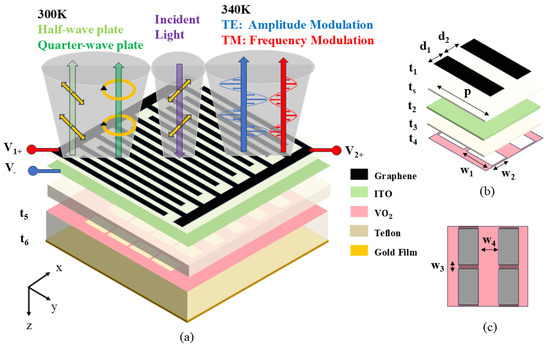
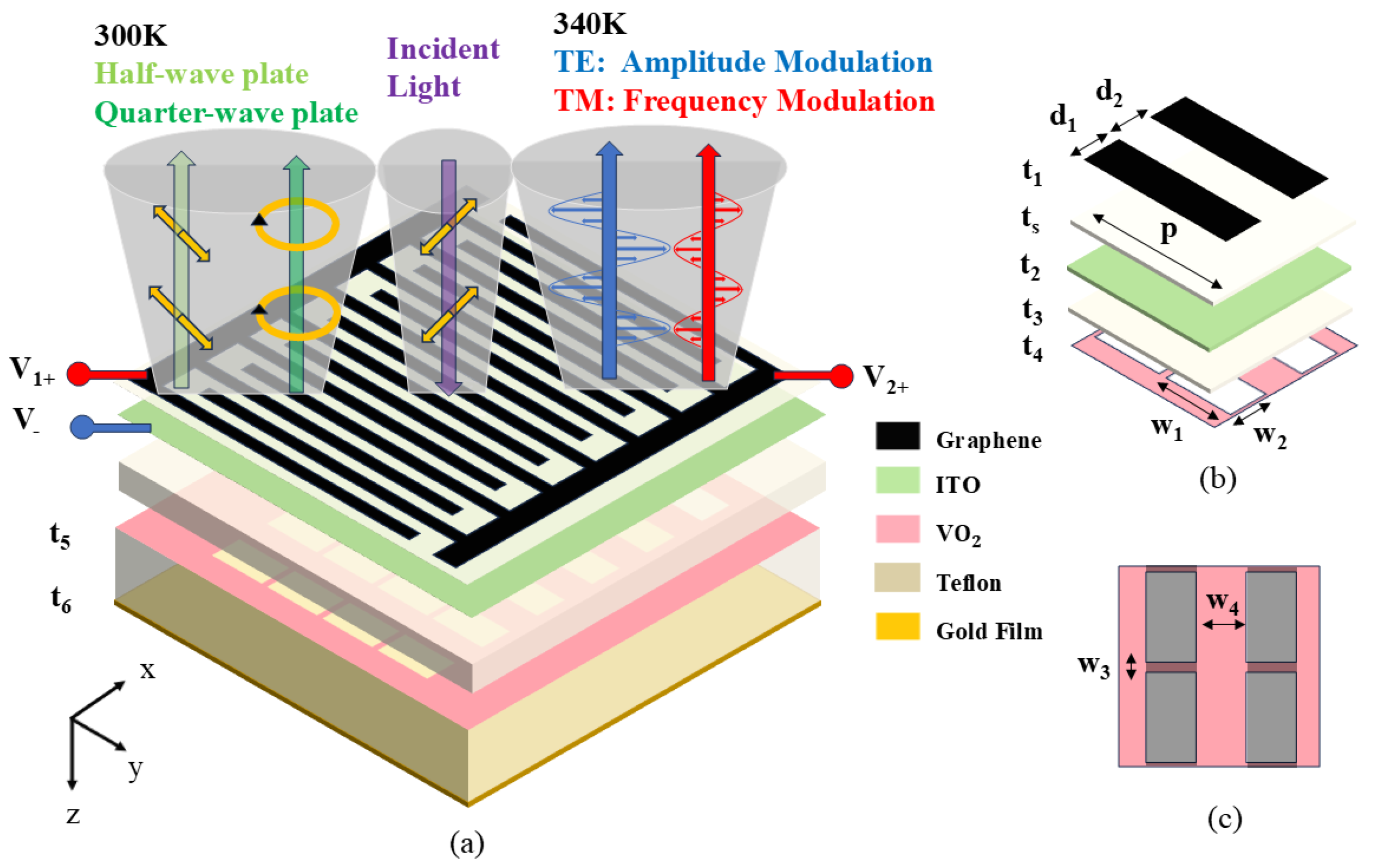
The proposed multifunctional metasurface comprises a seven-layer structure arranged from top to bottom as follows: a four-layer graphene grating, silicon dioxide, indium tin oxide (ITO), polytetrafluoroethylene (PTFE), rectangular-aperture VO2, PTFE, and a gold reflective film. Their thicknesses are: t1 = 1.34 nm, ts = 0.01 μm, t2 = 0.01 μm, t3 = 24.4 μm, t4 = 0.4 μm, t5 = 25 μm and t6 = 0.2 μm, respectively, as illustrated in Figure 1a. In Figure 1b, the distances between the adjacent graphene ribbons a-re set as d1 = d2 = 16 μm, with a single unit cell period p = 64 μm. The dimensions of the VO2 rectangular aperture are specified as follows: the length w1 = 28.8 μm, the width w2 = 16 μm, w3 = 3.2 μm and w4 = 16 μm. Figure 1c illustrates the relative positions of the graphene ribbons and rectangular apertures of VO2 in the same unit. In Figure 1a, the incident waves are set to propagate along the z-axis with the TE direction aligned with the x-axis or 45-degree angle along the positive x-axis directions. When the temperature is below 300 K, the modulator functions as a waveplate, enabling switching between a half-wave plate and a quarter-wave plate at the different bias voltages. However, it can be utilized as a dual-parameter modulator, modulating the amplitude of the TE waves and the absorption frequency of the TM waves as the temperature exceeds 340 K. Moreover, the designed graphene ribbons and rectangular apertures of VO2 have a mature production processes, making the fabrication relatively simple.
Figure 1.
(a) Macroscopic schematic of a multifunctional terahertz modulator based on graphene and VO2. (b) Unit structure diagram. (c) Schematic diagram illustrating the relative positions of the graphene ribbons and VO2 in a unit cell.
To facilitate the application of the different bias voltages to adjacent graphene ribbons, a staggered comb-like structure is designed for the graphene, allowing for flexible adjustment of the graphene layer’s periodicity. This structure is experimentally feasible via standard micro–nano fabrication processes: interdigital electrodes are patterned by photolithography, adjacent graphene ribbons are electrically isolated by dry etching, and the ITO layer acts as a common ground electrode for independent bias voltage application to each ribbon. In the terahertz range, the contribution of the intraband electrons plays a dominant role in the surface conductivity of graphene based on the Pauli exclusion principle, while the electronic interband transition is negligibly small when the Fermi energy EF ≫ kBT, here , and T are the Boltzmann constant and the temperature of the graphene. Therefore the conductivity of the graphene can be simplified as the Drude model [36]:
where , τ are, respectively, the angular frequency, electron charge, reduced Planck’s constant and the carrier relaxation time. Moreover, τ is the core loss parameter of graphene, determining the real/imaginary parts of σ and further modulating the reflection coefficients; increasing τ can reduce intraband loss to broaden the waveplate bandwidth. In this study, the ambient temperature T = 300 K and the carrier relaxation time τ = 0.1 ps. The chemical potential of graphene can be controlled by applying the bias voltage Vg as expressed in Refs. [12,15]:
where and are the relative permittivity of the substrate and vacuum and the Fermi velocity (1.1 × 10⁶ m/s) in graphene, respectively. The substrate dielectric used is silicon dioxide, with a thickness ts of 0.1 μm, a dielectric constant of 3.75, and a loss tangent of 0.0004. Using Formula (2), when the Fermi level is 0.9 eV, the required maximum bias voltage is calculated to be 28.7 V, which is within the normal range achievable in a laboratory setting. A thin layer of the transparent conductive oxide (TCO) is applied on the PTFE to serve as the negative electrode of the capacitor structure. Since TCO is extremely thin, its impact in simulations can be negligible [12]. Due to the need for graphene lithography on a corrosion-resistant material, a thin film of silicon dioxide is evaporated onto ITO by electron-beam technology. The modulation of the graphene conductivity can be achieved by applying bias voltage, which can inject both electrons and holes into graphene, allowing for a wide adjustment range of the EF.
Moreover, the broadband absorption effect is achieved through the plasmonic resonance of VO2 and the gold reflective film. By altering the EF of graphene, the resonant period can be modified, allowing for modulation of both the amplitude and frequency for the absorption spectra. When the temperature is below 300 K, VO2 has a monoclinic crystal structure with high resistivity and insulation properties and its conductivity can be entirely restored to its initial state [37]. When the temperature T > 340 K, VO2 transforms into a cubic rutile structure with metal properties and its electrical conductivity will increase by 4~5 orders of magnitude in a small change range of the temperature. The phase transition of VO2 is reversible. Additionally, its dielectric constant in the terahertz band is also shown by the Drude model [26]:
where the permittivity at infinite frequency , collision frequency and plasma frequency and [11]. Additionally, γ is the intrinsic loss parameter of metallic VO2, governing the dipole resonance damping and total reflection coefficient R; reducing γ weakens resonance loss to expand the absorption bandwidth. In this work, the conductivities of VO2 in the broadband absorber and polarization converter modes were and , respectively.
Based on the commercial CST software, the reflected wave can be decomposed into the x-component and the y-component reflection:
To describe the reflected wave and its polarization state, the Stokes parameters are introduced as Refs. [11,12]:
The Stokes parameters S0, S1, S2 and S3 stand, respectively, for the total reflection, the horizontal and vertical linear polarization (LP) state of the reflection, the linear +45-degree or −45-degree polarization state of the reflection, and the CP state. The polarization conversion efficiency (PCR) and the polarization conversion capability characterized by the ellipticity e are defined, respectively, as [11]:
In general, the degree of linear polarization (DoLP) is used to describe the conversion of CP light into LP light, which can be calculated as [11,38]
In studying the polarization conversion characteristics, for computational convenience, the direction of the TE wave is set at +45 degrees along the positive x-axis.
3. Results and Discussion
3.1. Functionality Switching Between HWP and QWP
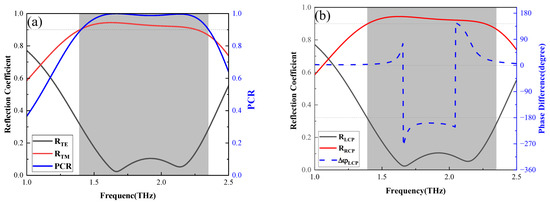
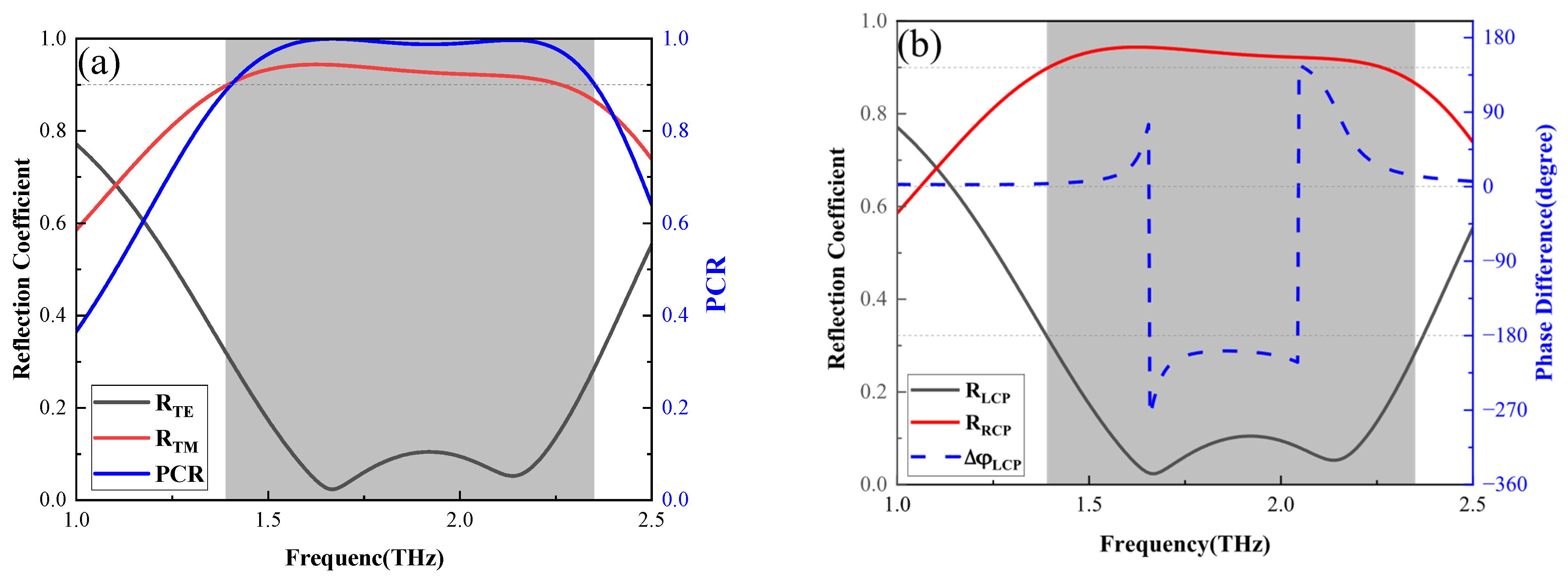
When the temperature is below 300 K, the multifunctional metasurface can switch between HWP and QWP by adjusting the EF of the graphene. As the EF of graphene is set to 0.9 eV, the designed multifunctional metasurface achieves cross-polarization conversion, as shown in Figure 2a. One can see that both the PCR in the range of 1.39–2.34 THz and the reflectance of TM waves in the range of 1.39–2.26 THz are greater than 90%. This indicates that the device maintains high polarization conversion efficiency while minimizing losses. In Figure 2b, when the incident wave is set to left-circularly polarized (LCP) light, efficient conversion to right-circularly polarized (RCP) light is achieved in a frequency range of 1.39 to 2.26 THz, with a phase difference of 0 degrees and −180 degrees. This demonstrates that the device performs a HWP function.
Figure 2.
(a) Reflection coefficients for TE waves and TM waves and PCR when temperature is under 300 K with an EF of 0.9 eV for graphene. (b) The reflection coefficients for LCP and RCP light, as well as the phase difference between them, when the incident wave is LCP light.
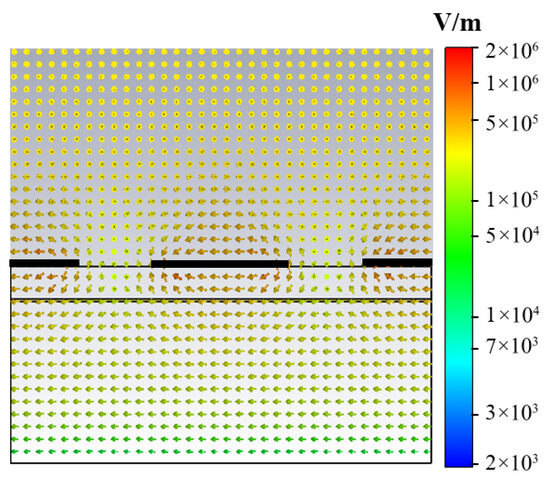
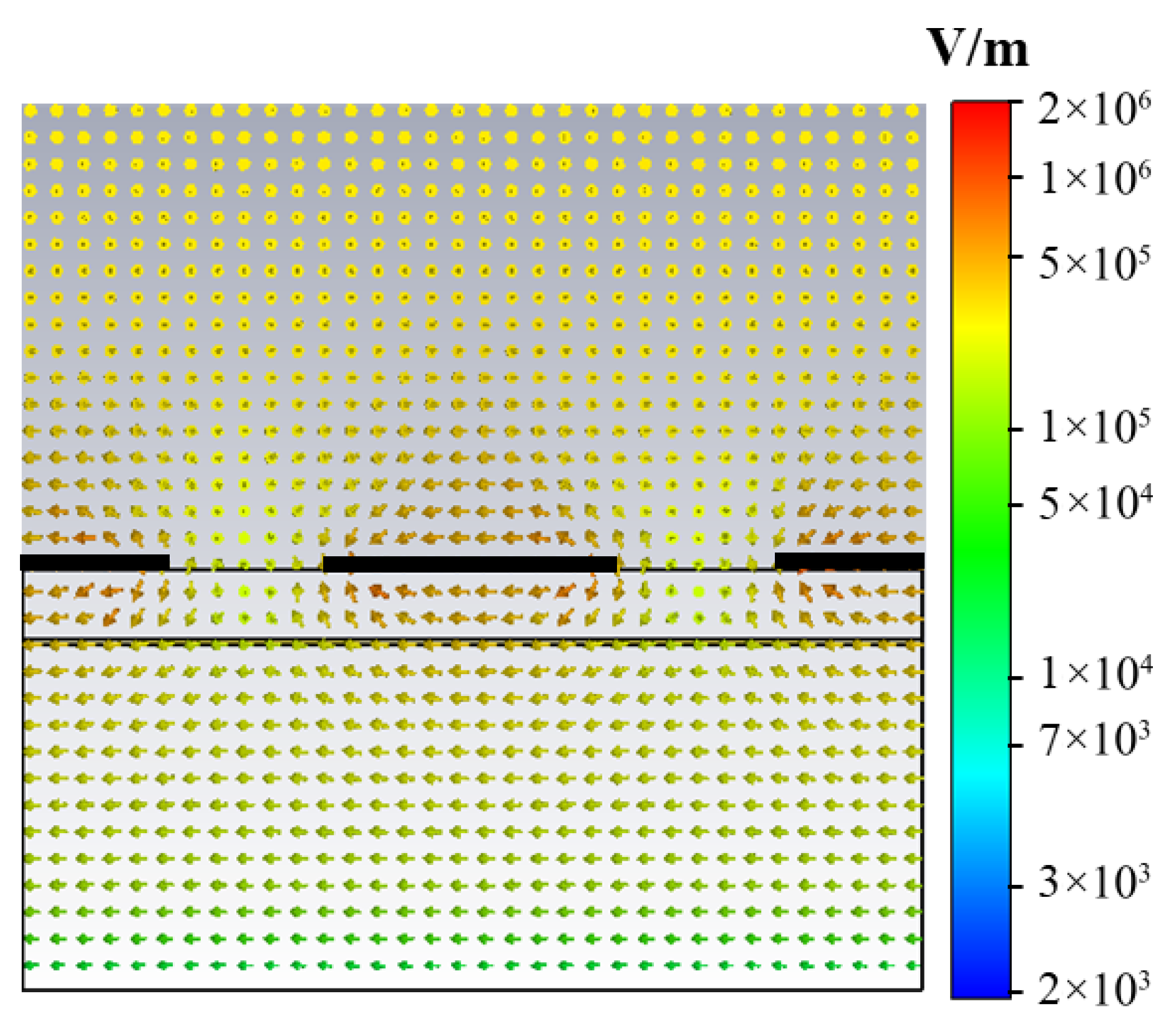
The polarization conversion performance of the designed multifunctional metasurface is generated by the anisotropy of the graphene. When the incident light is TE wave at +45 degrees along the positive x-axis and the Fermi level, EF, of the graphene is 0.9 eV, the direction of the surface electric field in the y-face is as shown in Figure 3. To facilitate observation, the relative position of graphene is specifically depicted with three thick black lines. The three horizontal thin black lines from top to bottom under the thick line represent the graphene structure plane, the vanadium dioxide structure plane, and the gold reflection plane, respectively. The currents are generated between the edges of the adjacent graphene ribbons, causing the conversion of TE waves into TM waves, which can illustrate that the device can function as a half-wave plate.
Figure 3.
Side view of the current direction for the unit in the y-face, when the TE wave is incident at +45 degrees along the positive x-axis.
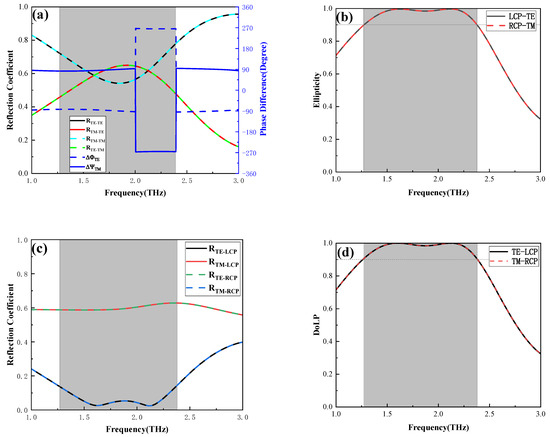
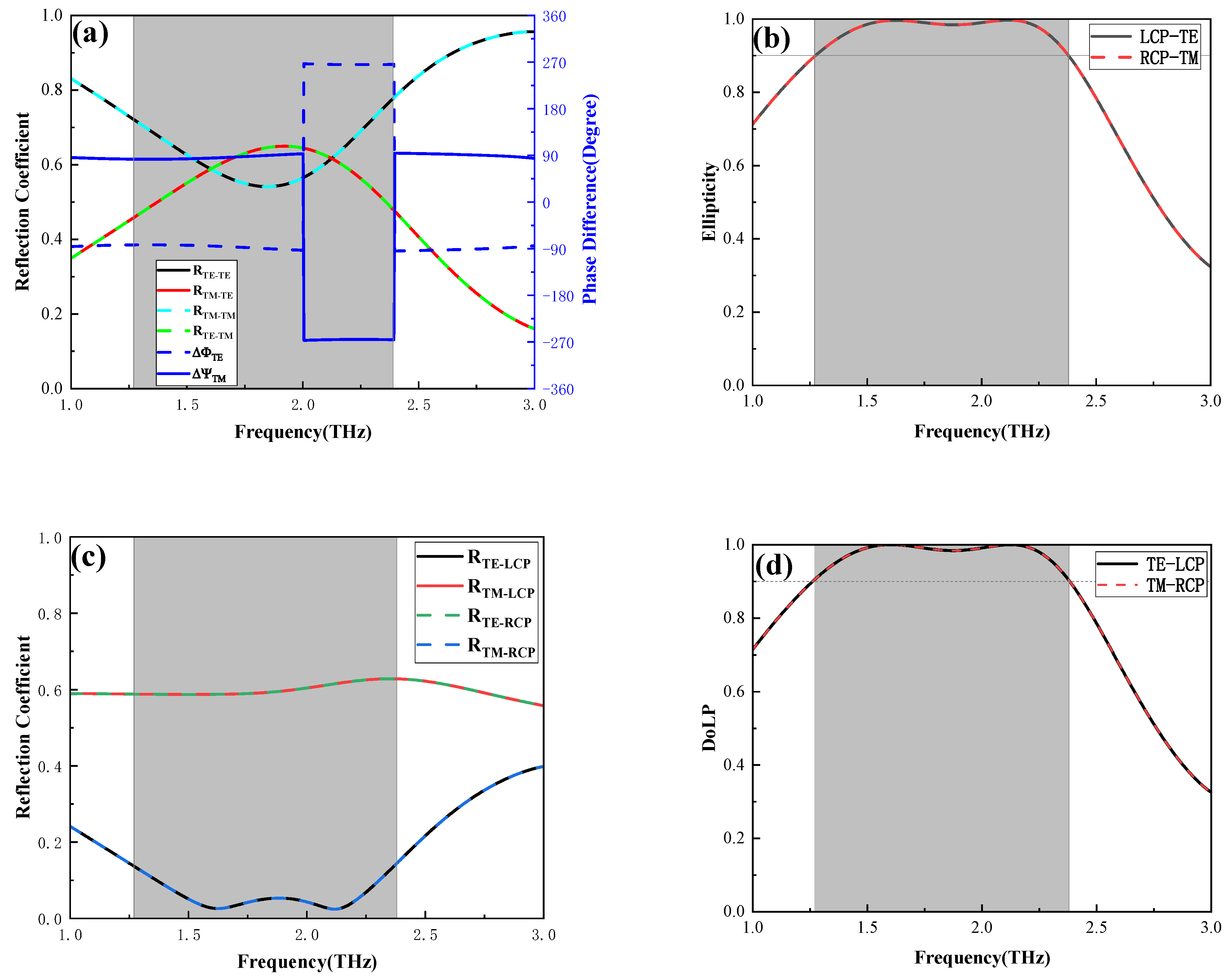
Moreover, when the EF of adjacent graphene ribbons is set to 0.9 eV and 0.1 eV, the designed multifunctional metasurface achieves LTC polarization conversion. The conversion of TE waves to TM waves results in the magnitudes of the TE and TM waves both approaching 0.5, with their phase difference close to ±90 degrees or ±270 degrees, facilitating effective conversion to LTC polarization as shown in Figure 4a. At the frequency between 1.27 and 2.38 THz, the ellipticity of the outgoing light exceeds 90% and is close to 1, demonstrating successful LTC polarization conversion in Figure 4b. As shown in Figure 4c,d, when the incident light is LCP, the TM component of the transmitted light approaches 0, resulting in a DoLP greater than 0.9 in the same frequency band. This shows that the designed device can effectively function as a QWP in the frequency range of 1.27–2.38 THz.
Figure 4.
Reflection coefficients, phase difference (a) between TE and TM waves and the ellipticity (b) of the outgoing light when the incident light is LP and the EF of the adjacent graphene ribbons is 0.1 eV and 0.6 eV. Reflection coefficients (c) for outgoing TE and TM waves and the DoLP (d) when the incident wave is CP light.
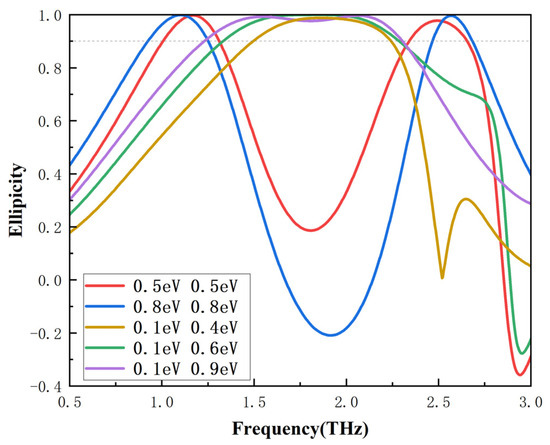
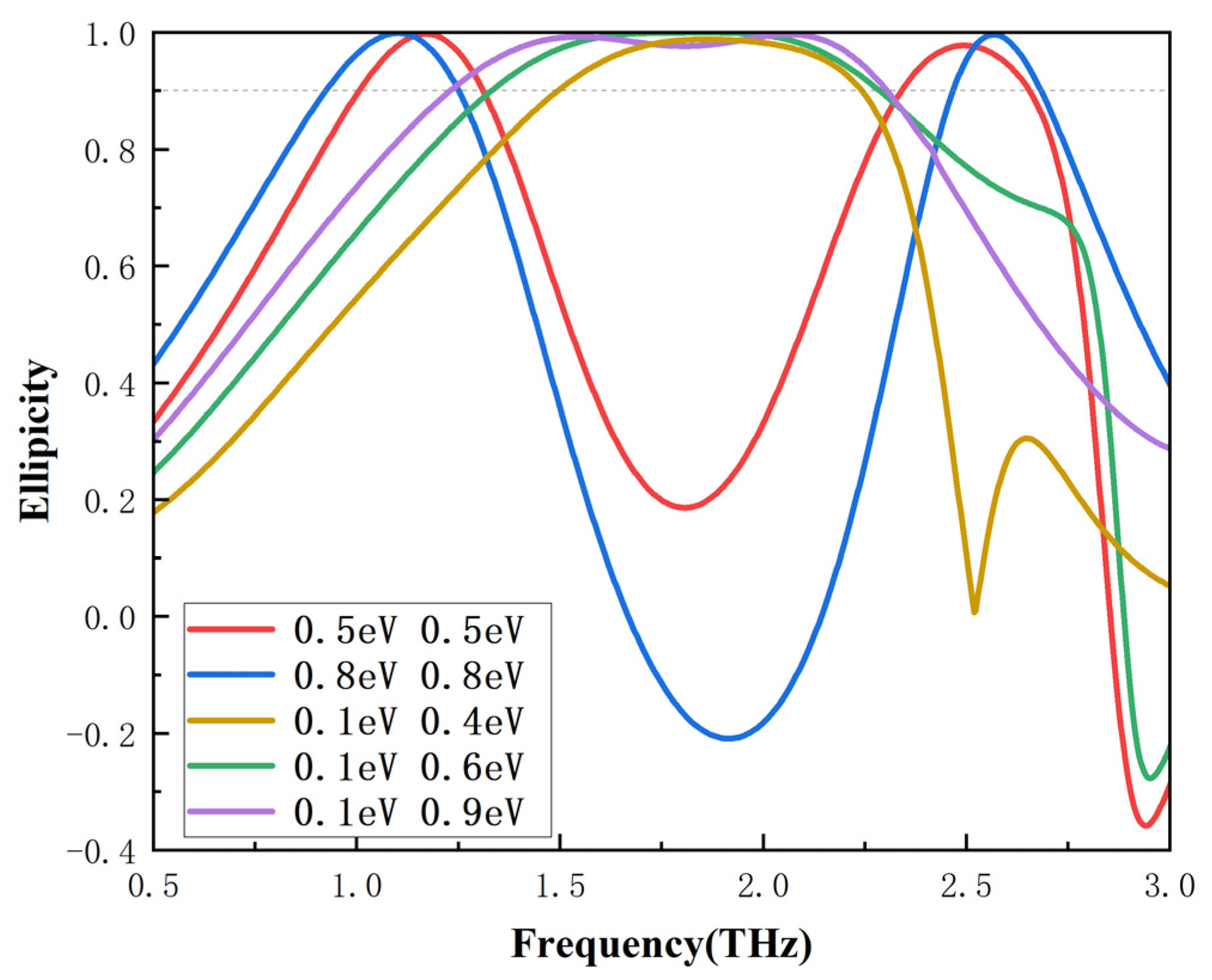
When the incident light is TE wave, under the conditions of adjacent graphene layers with five sets of different Fermi levels, the ellipticity of the outgoing light will change from a double peak to a single peak, as illustrated in Figure 5. As the Fermi levels of the adjacent graphene strips are set as 0.5 eV and 0.5 eV and 0.8 eV and 0.8 eV, respectively, the ellipticity curves with double peaks are shown with red and blue lines. However, when the Fermi levels of the adjacent graphene strips are chosen as 0.1 eV and 0.4 eV, 0.1 eV and 0.6 eV, and 0.1 eV and 0.9 eV, respectively, the ellipticity curves with a broadband single peak are shown with yellow, green and purple lines; the purple line has a broader operating bandwidth. For the various designed graphene periods, by adjusting the Fermi level of the graphene, one can obtain the nearly complete coverage of 90% LTC polarization conversion in the frequency range from 0.92 to 2.68 THz, which demonstrates the significant practical value of the designed graphene structure.
Figure 5.
The ellipticity of the outgoing light for graphene at different EF values of adjacent graphene ribbons.
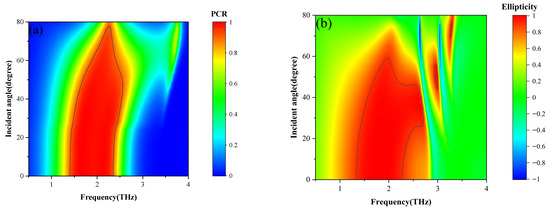
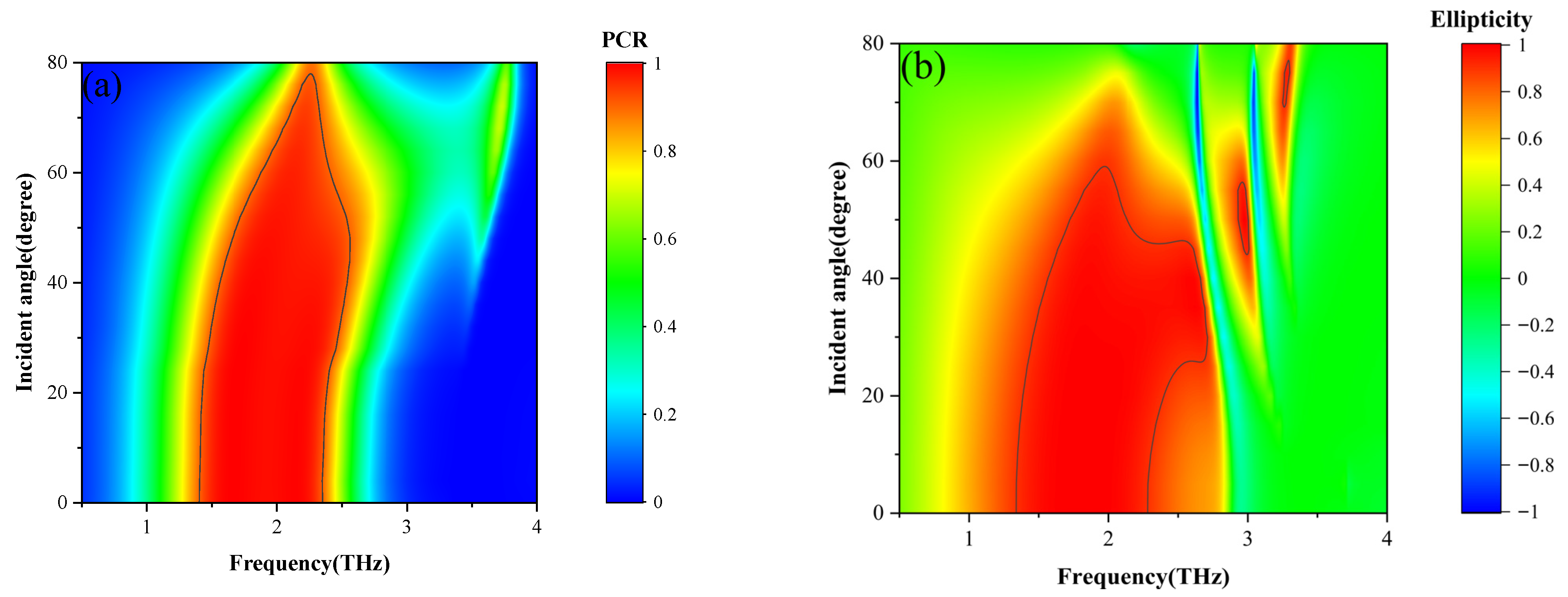
In addition, the impact of incident angle on the waveplate performance of the multifunctional metasurface is also studied. As shown in Figure 6a,b, the PCR and ellipticity at different frequencies are given as the incident angle increases from 0 to 80 degrees. Within the bandwidth indicated by the black lines, both PCR and e exceed 0.9, which clearly illustrates that the waveplate performance of the device maintains a high operational bandwidth even under large incident angles of about 50 degrees.
Figure 6.
The PCR at different incident angles when the device operates as a HWP (a) and the ellipticity at different incident angles when the device operates as a QWP (b).
3.2. Broadband Switchable Absorber
When the temperature is above 340 K, the VO2 layer plays a major role and electric dipole resonance occurs between the VO2 layer and the gold layer, leading to absorption effects. In the study of the absorption effects of the multifunctional metasurface, the TE wave direction is parallel to the positive direction of the x-axis. By using a bias voltage to tune the conductivity of graphene, the resonance structure of vanadium dioxide can be changed. This can not only decrease the resonance of the TE wave but also alter the resonance period of the TM wave, causing a red shift in the TM wave’s resonance frequency.
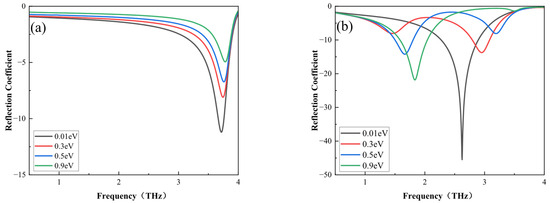
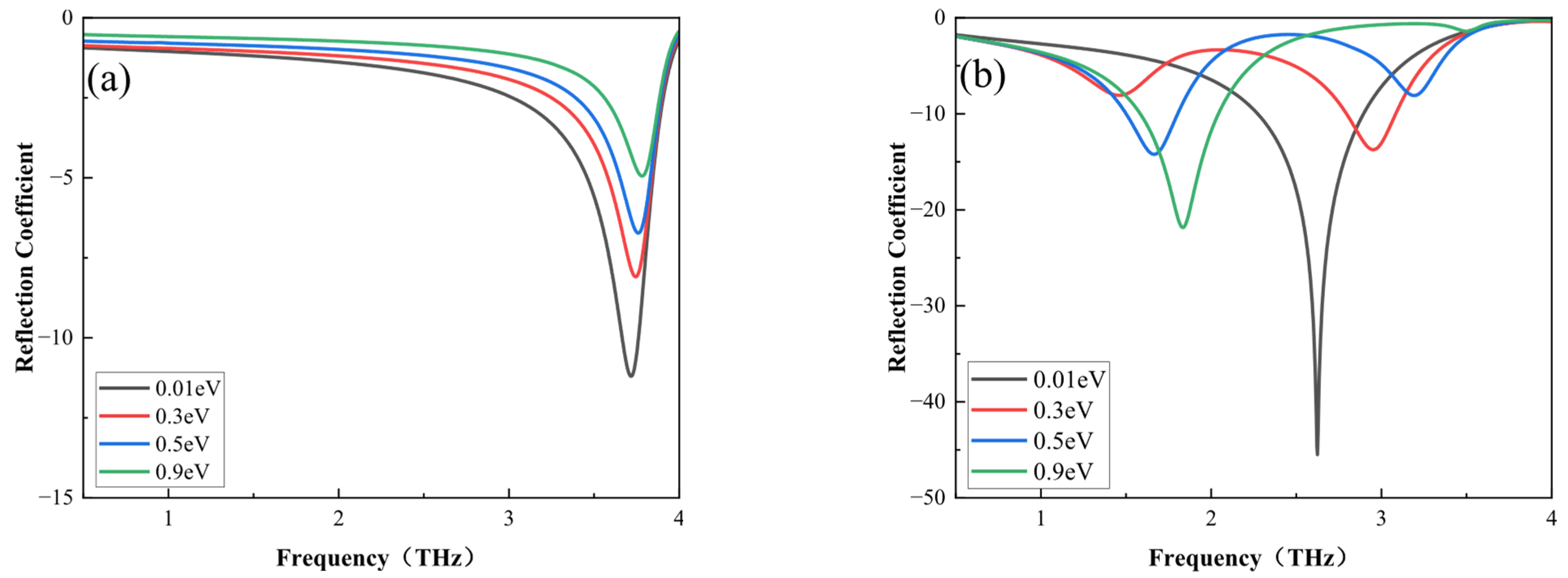
The reflection coefficients were logarithmically transformed with a base of 10 and then multiplied by 20. In Figure 7a, the amplitude of the TE-polarized waves increases from −11.32 dB to −4.90 dB with the rise in the EF. In Figure 7b, the amplitude of the TM-polarized waves increases, and the resonance frequency gradually red-shifts from 2.61 THz to 1.81 THz with an increase in the EF. The modulation depth is defined as MD = (Ton−Toff)/Ton [22]. If we assume the on and off states to be EF = 0.9 and 0.01 eV, respectively, the proposed modulator achieves a high modulation depth of 96.9% at 2.61 THz, indicating substantial potential for the device as an amplitude modulator. In Figure 7, one can ascertain that the bandwidth of the absorptivity exceeding 90% for TM waves gradually transitions from 2.28–3.12 THz to 1.41–2.04 THz. Furthermore, the absorptivity can exceed 90% at the frequency between 1.41 and 3.12 THz by adjusting various graphene bias voltages, suggesting wideband functionality. However, the absorptivity for TE waves can exceed 90% in the 3.65–3.78 THz range.
Figure 7.
Reflection coefficients for TE waves (a) and TM waves (b) versus the EF of graphene at T = 340 K.
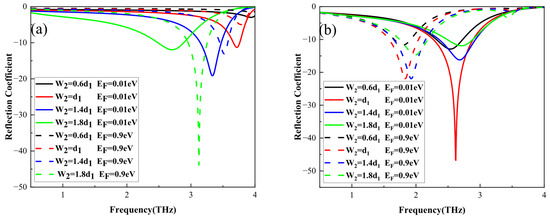
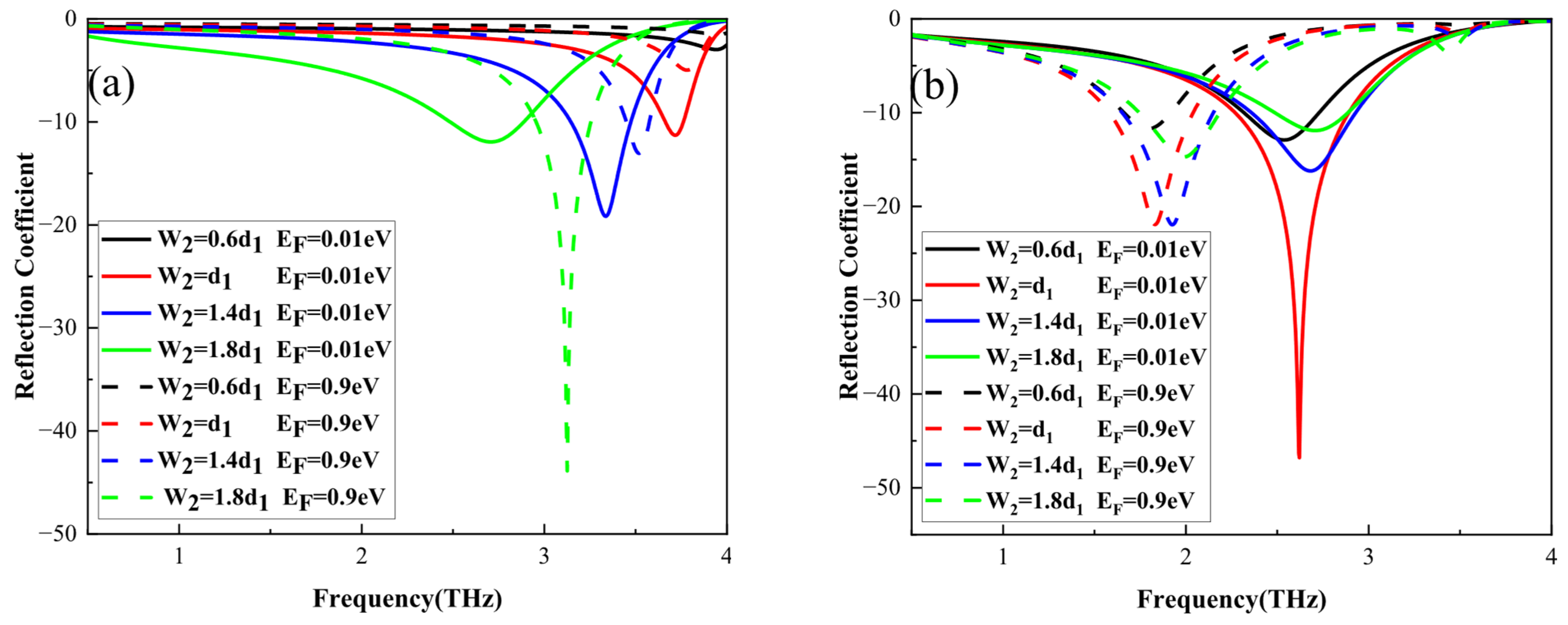
By optimization when w1 = 1.8d1 = 28.8 μm, the effects of the width w2 and EF of graphene on the reflection coefficients of the TE waves and TM waves are also analyzed, as shown in Figure 8. One can see that the reflection coefficients of the TM waves at EF = 0.01 eV and 0.9 eV and the reflection coefficients of the TE waves at EF = 0.01 eV decrease initially, then increase with an increase in w2, while the reflection coefficients of the TE waves at EF = 0.9 eV always decrease. In Figure 8a, the resonant frequency of the absorption peak for the TE waves indicates a gradual red shift as w2 increases, while the absorption frequency displays a gradual blue shift as EF increases. However, in Figure 8b, the change in the resonant frequency for the TM waves with the increase in w2 and EF is the opposite of the TE waves and is not much. Thus, one can also see that the optimal modulation depth and maximum absorptivity are 96.9% and 99.6% at w2 = d1, because of the electric dipole resonance between the VO2 layer and the gold reflective film.
Figure 8.
The reflection coefficients of TE waves (a) and TM waves (b) under the different w2 and graphene EF values when w1 = 1.8d1 = 28.8 μm.
3.3. The z-Component Distribution of the Surface Electric Field
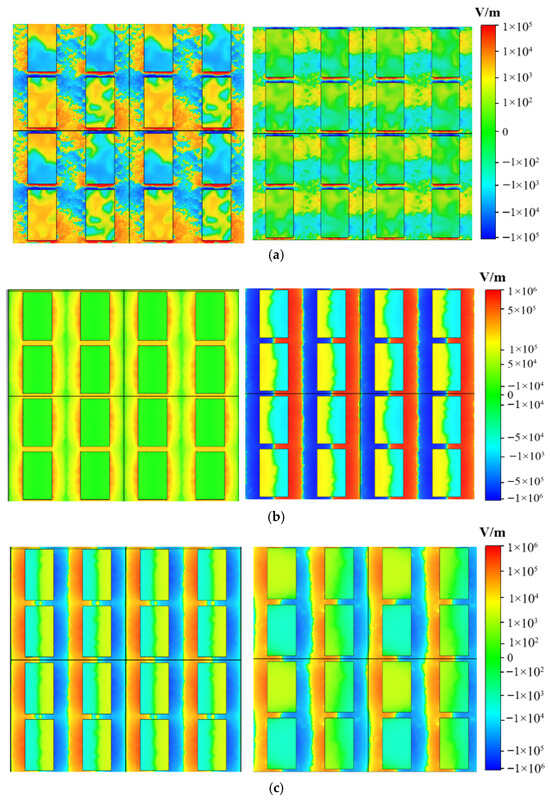
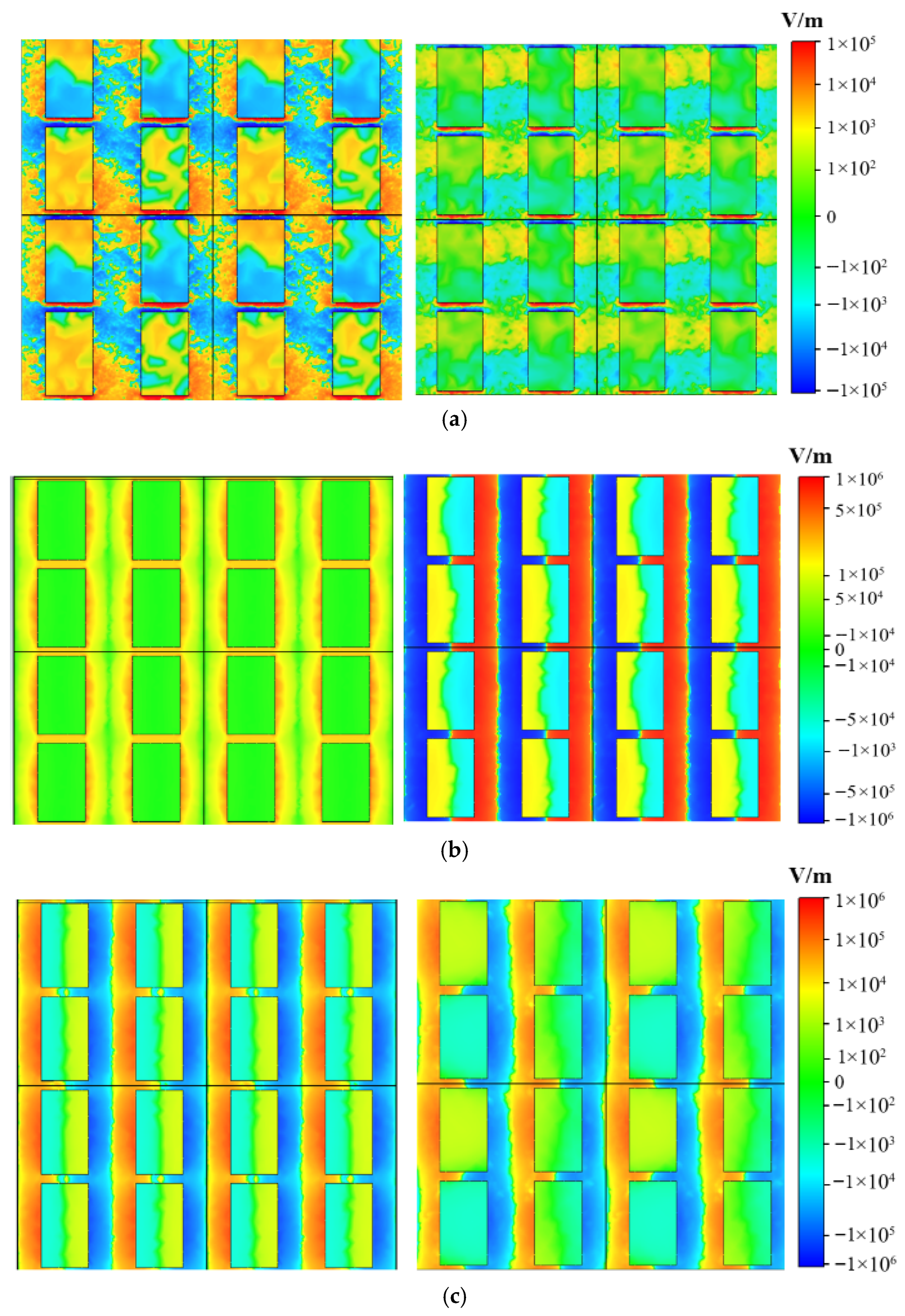
The z-component of the surface electric field of VO2 at 3.72 THz for TE-polarized wave incidence is depicted in Figure 9a. On the left and right sides, the EF values of the graphene are 0.01 eV and 0.9 eV, respectively. It is observed that the electric field primarily concentrates on the upper and lower ends of the unit rectangle, with the opposite polarities at the top and bottom. This results from the dipole resonance of the rectangular aperture VO2 and the gold reflective film, leading to an absorption peak. Similarly, Figure 9b,c illustrates the distribution of the z-component of the surface electric field for the TM-polarized waves at 2.61 THz and 1.81 THz, respectively. It is evident that the device absorptivity for multiple-frequency bands can be adjusted under the control of the bias voltage.
Figure 9.
The z-component of the surface electric field of VO2 at different absorption peaks when the EF of graphene varies from 0.01 eV (left) to 0.9 eV (right) at 3.72 THz (a), 2.61 THz (b), and 1.81 THz (c).
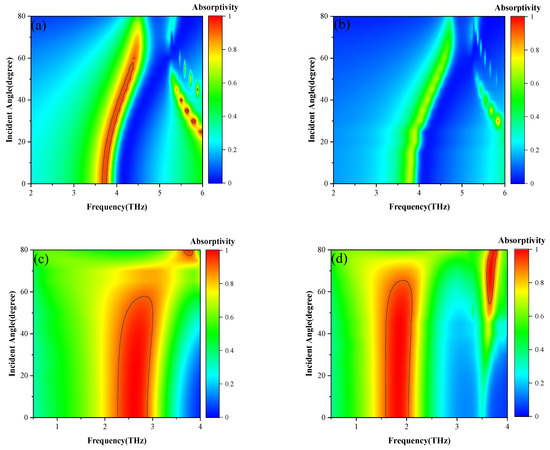
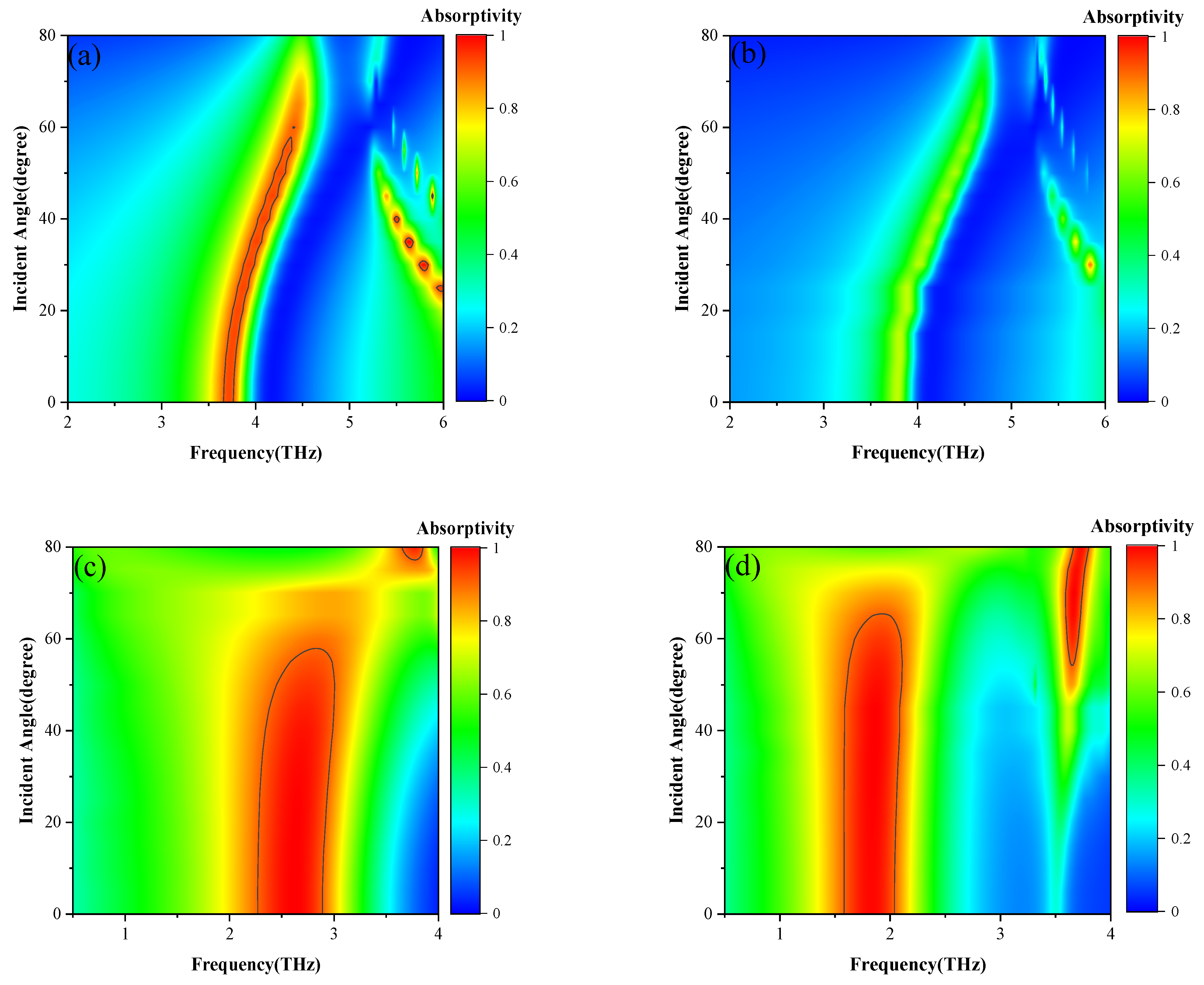
Simultaneously, the impact of the incident angle on the dual-parameter absorption of the multifunctional metasurface is also investigated. The absorptivity can be directly calculated as [11]. Figure 10 illustrates the peak absorption spectra of TE waves and TM waves for the metasurface device when the EF of the graphene is 0.01 eV and 0.9 eV, respectively. It can be observed in Figure 10a,b that the absorptivity of the TE waves remains high at incident angles less than 50°, while it decreases sharply at angles larger than 50°. The absorption at the higher angles is reduced due to the broken phase-matching of VO2–gold dipole resonance and anisotropic propagation of graphene SPPs, and the higher EF of 0.9 eV increases graphene surface reflection, leading to the lower overall absorptivity. While in Figure 10c,d, one can see that after the modulation of the graphene, the absorption band of the TM waves undergoes a red shift, satisfying the conditions for large-angle incidence.
Figure 10.
The absorptivity of TE waves when EF is 0.01 eV (a) and 0.9 eV (b) and the absorptivity of TM waves when EF is 0.01 eV (c), and 0.9 eV (d).
3.4. Performance Comparison
Finally, our designed metasurface is compared with the recently reported works in Table 1. Most of them exhibit high performance in the individual functionalities, and some have specific manipulation characteristics, but not within this terahertz frequency band. The proposed metasurface features a relatively simple structural design, and achieves three distinct functionalities of HWP, QWP, and absorber. Moreover, all these functionalities can be rapidly modulated through bias voltage, indicating promising prospects for broader applications.
Table 1.
The comparison between our work and the other reports.
4. Conclusions
In this study, we propose a multifunctional terahertz metasurface device based on graphene, capable of transitioning between waveplates and absorbers by changing the bias voltage and temperature. When the temperature is below 300 K and EF = 0.9 eV, the device functions as a HWP, achieving a PCR greater than 90% in the range of 1.39–2.34 THz. With adjacent graphene bands at EF values of 0.1 eV and 0.9 eV, the device operates as a QWP, exhibiting ellipticity greater than 90% in the range of 1.27–2.38 THz. Moreover, at the different EF values, the device almost universally achieves QWP functionality in the range of 0.92–2.68 THz. Under conditions of temperature exceeding 340 K, the device switches to an absorber, allowing the dual modulations of TE wave amplitude and TM wave resonance frequency. As the EF transitions from 0.01 eV to 0.9 eV, the TE wave at 3.72 THz undergoes absorption modulation from −11.32 dB to −4.9 dB, while the TM wave resonance frequency shifts from 2.61 THz to 1.81 THz, achieving a modulation depth of 96.9% at 2.61 THz. Therefore, this versatile metasurface with a broad operating frequency bandwidth and high efficiency can be employed in constructing terahertz communication systems, polarizing devices, and modulators.
Author Contributions
Conceptualization, H.S.; Software, C.Z.; Formal analysis, G.L. and W.C.; Investigation, T.H. and G.L.; Data curation, T.H. and S.F.; Writing—original draft, H.S.; Writing—review & editing, S.F., S.W. and W.C.; Visualization, T.H., J.Z. and H.L.; Supervision, M.Z. and S.W.; Project administration, L.L. and H.L.; Resources, J.Z., C.Z., M.Z. and L.L. All authors have read and agreed to the published version of the manuscript.
Funding
This work was supported in part by Guangdong Basic and Applied Basic Research Foundation under Grant Nos. 2022A1515011389 and 2022A1515011383.
Data Availability Statement
The data presented in this study are available on request from the corresponding author due to privacy restrictions of the research group. If there are any questions about the data shown in the manuscript, please contact the corresponding authors.
Conflicts of Interest
The authors declare no conflicts of interest.
References
- Stantchev, R.I.; Yu, X.; Blu, T.; Pickwell-Macpherson, E. Real-time terahertz imaging with a single-pixel detector. Nat. Commun. 2020, 11, 2535. [Google Scholar] [CrossRef] [Scilit]
- Chan, W.L.; Deibel, J.; Mittleman, D.M. Imaging with terahertz radiation. Rep. Prog. Phys. 2007, 70, 1325–1379. [Google Scholar] [CrossRef] [Scilit]
- Chen, T.; Li, S.; Sun, H. Metamaterials Application in Sensing. Sensors 2012, 12, 2742–2765. [Google Scholar] [CrossRef] [Scilit] [PubMed]
- Tselikov, G.I.; Danilov, A.; Shipunova, V.O.; Deyev, S.M.; Kabashin, A.V.; Grigorenko, A.N. Topological Darkness: How to Design a Metamaterial for Optical Biosensing with Ultrahigh Sensitivity. ACS Nano 2023, 17, 19338–19348. [Google Scholar] [CrossRef] [Scilit] [PubMed]
- Chen, M.; Singh, L.; Xu, N.; Singh, R.; Zhang, W.; Xie, L. Terahertz sensing of highly absorptive water-methanol mixtures with multiple resonances in metamaterials. Opt. Express 2017, 25, 14089–14097. [Google Scholar] [CrossRef] [Scilit]
- Li, Q.; Lei, T.; Sun, D.W. Analysis and detection using novel terahertz spectroscopy technique in dietary carbohydrate-related research: Principles and application advances. Crit. Rev. Food Sci. Nutr. 2023, 63, 1793–1805. [Google Scholar] [CrossRef] [Scilit]
- Cai, X.; Sushkov, A.B.; Suess, R.J.; Jadidi, M.M.; Jenkins, G.S.; Nyakiti, L.O.; Myers-Ward, R.L.; Li, S.; Yan, J.; Gaskill, D.K.; et al. Sensitive room-temperature terahertz detection via the photothermoelectric effect in graphene. Nat. Nanotechnol. 2014, 9, 814–819. [Google Scholar] [CrossRef] [Scilit]
- Chen, Z.; Cai, P.; Wen, Q.; Chen, H.; Tang, Y.; Yi, Z.; Wei, K.; Li, G.; Tang, B.; Yi, Y. Graphene Multi-Frequency Broadband and Ultra-Broadband Terahertz Absorber Based on Surface Plasmon Resonance. Electronics 2023, 12, 2655. [Google Scholar] [CrossRef] [Scilit]
- Zhang, Y.; Feng, Y.; Zhu, B.; Zhao, J.; Jiang, T. Graphene based tunable metamaterial absorber and polarization modulation in terahertz frequency. Opt. Express 2014, 22, 22743–22752. [Google Scholar] [CrossRef] [Scilit]
- Zhang, Z.; Gong, Y.D.; Li, K. Research Progress of Terahertz Waveplate Based on Metasurface. Laser Optoelectron. Prog. 2022, 59, 1300001. [Google Scholar]
- Xie, Q.; Sun, J.; Su, C.; Xia, F.; Wang, M.; Zhang, K.; Yun, M. Multifunctional metasurface for broadband absorption and polarization conversion based on graphene-VO2. Diam. Relat. Mater. 2023, 137, 110119. [Google Scholar] [CrossRef] [Scilit]
- Barkabian, M.; Sharifi, N.; Granpayeh, N. Multi-functional high-efficiency reflective polarization converter based on an ultra-thin graphene metasurface in the THz band. Opt. Express 2021, 29, 20160–20174. [Google Scholar] [CrossRef] [Scilit]
- Peng, Z.; Zheng, Z.; Yu, Z.; Lan, H.; Zhang, M.; Wang, S.; Li, L.; Liang, H.; Su, H. Broadband absorption and polarization conversion switchable terahertz metamaterial device based on vanadium dioxide. Opt. Laser Technol. 2023, 157, 108723. [Google Scholar] [CrossRef] [Scilit]
- Quader, S.; Zhang, J.; Akram, M.R.; Zhu, W. Graphene-Based High-Efficiency Broadband Tunable Linear-to-Circular Polarization Converter for Terahertz Waves. IEEE J. Sel. Top. Quantum Electron. 2020, 26, 1–8. [Google Scholar] [CrossRef] [Scilit]
- Guan, S.; Cheng, J.; Chen, T.; Chang, S. Bi-functional polarization conversion in hybrid graphene-dielectric metasurfaces. Opt. Lett. 2019, 44, 5683–5686. [Google Scholar] [CrossRef] [Scilit]
- Yue, Z.; Li, J.; Zheng, C.; Li, J.; Chen, M.; Hao, X.; Xu, H.; Wang, Q.; Zhang, Y.; Yao, J. Manipulation of polarization conversion and multiplexing via all-silicon phase-modulated metasurfaces. Chin. Opt. Lett. 2022, 20, 043601. [Google Scholar] [CrossRef] [Scilit]
- Cheng, Y.; Wang, J. Tunable terahertz circular polarization convertor based on graphene metamaterial. Diam. Relat. Mater. 2021, 119, 108559. [Google Scholar] [CrossRef] [Scilit]
- Kumar Ghosh, S.; Das, S.; Bhattacharyya, S. Graphene-based dual functional metadevice in the THz gap. Appl. Opt. 2021, 60, 11247–11255. [Google Scholar] [CrossRef] [Scilit]
- Sensale-Rodriguez, B.; Yan, R.; Kelly, M.M.; Fang, T.; Tahy, K.; Hwang, W.S.; Jena, D.; Liu, L.; Xing, H.G. Broadband graphene terahertz modulators enabled by intraband transitions. Nat. Commun. 2012, 3, 780. [Google Scholar] [CrossRef] [Scilit]
- Liu, J.; Dai, H.; Ju, J.; Cheng, K. Perfect absorber with high sensitivity based on hexagonal star graphene surface. Surf. Interfaces 2023, 39, 102985. [Google Scholar] [CrossRef] [Scilit]
- Gong, Y.; Hu, F.; Jiang, M.; Zhang, L.; Zou, Y.; Jiang, G.; Liu, Y. Terahertz binary coder based on graphene metasurface. Carbon 2021, 184, 167–176. [Google Scholar] [CrossRef] [Scilit]
- Kim, M.; Kim, S.-H.; Kang, C.; Kim, S.; Kee, C.-S. Highly efficient graphene terahertz modulator with tunable electromagnetically induced transparency-like transmission. Sci. Rep. 2023, 13, 6680. [Google Scholar] [CrossRef] [Scilit]
- Li, Q.; Zhang, J.; Rukhlenko, I.D.; Zhu, W. Graphene-enabled metasurface with independent amplitude and frequency controls in orthogonal polarization channels. Carbon 2023, 206, 260–267. [Google Scholar] [CrossRef] [Scilit]
- Kumar, P.; Rai, S.; Bhattacharyya, S.; Lakhtakia, A.; Jain, P.K. Graphene-sandwich metasurface as a frequency shifter, switch, and isolator at terahertz frequencies. Opt. Eng. 2020, 59, 110501. [Google Scholar] [CrossRef] [Scilit]
- Huang, J.; Li, J.; Yang, Y.; Li, J.; Li, J.; Zhang, Y.; Yao, J. Broadband terahertz absorber with a flexible, reconfigurable performance based on hybrid-patterned vanadium dioxide metasurfaces. Opt. Express 2020, 28, 17832–17840. [Google Scholar] [CrossRef] [Scilit] [PubMed]
- Zheng, Z.; Luo, Y.; Yang, H.; Yi, Z.; Zhang, J.; Song, Q.; Yang, W.; Liu, C.; Wu, X.; Wu, P. Thermal tuning of terahertz metamaterial absorber properties based on VO2. Phys. Chem. Chem. Phys. 2022, 24, 8846–8853. [Google Scholar] [CrossRef] [Scilit] [PubMed]
- Wen, Q.-Y.; Zhang, H.-W.; Yang, Q.-H.; Xie, Y.-S.; Chen, K.; Liu, Y.-L. Terahertz metamaterials with VO2 cut-wires for thermal tunability. Appl. Phys. Lett. 2010, 97, 021111. [Google Scholar] [CrossRef] [Scilit]
- Liu, L.; Chen, C.; Jiang, Y.; Shu, C.; He, C. Active modulation of absorption in terahertz hybrid metal-vanadium dioxide metasurface. J. Alloy. Compd. 2022, 906, 163913. [Google Scholar] [CrossRef] [Scilit]
- Zhou, Q.; Li, Y.; Wu, T.; Qiu, Q.; Duan, J.; Jiang, L.; Mao, W.; Yao, N.; Huang, Z. Terahertz Metasurface Modulators Based on Photosensitive Silicon. Laser Photonics Rev. 2023, 17, 2200808. [Google Scholar] [CrossRef] [Scilit]
- Wang, J.; Yang, R.; Li, Z.; Tian, J. Reconfigurable multifunctional polarization converter based on asymmetric hybridized metasurfaces. Opt. Mater. 2022, 124, 111953. [Google Scholar] [CrossRef] [Scilit]
- Zhang, X.; Wang, G.; Liu, J.; Zuo, S.; Li, M.; Yang, S.; Jia, Y.; Gao, Y. Switchable and Tunable Terahertz Metamaterial Based on Vanadium Dioxide and Photosensitive Silicon. Nanomaterials 2023, 13, 2144. [Google Scholar] [CrossRef] [Scilit] [PubMed]
- Dong, T.; Zhang, Y.; Li, Y.; Tang, Y.; He, X. Dual-function switchable terahertz metamaterial device with dynamic tuning characteristics. Results Phys. 2023, 45, 106246. [Google Scholar] [CrossRef] [Scilit]
- Tonouchi, M. Cutting-edge terahertz technology. Nat. Photonics 2007, 1, 97–105. [Google Scholar] [CrossRef] [Scilit]
- Lim, W.X.; Manjappa, M.; Pitchappa, P.; Singh, R. Shaping High-Q Planar Fano Resonant Metamaterials toward Futuristic Technologies. Adv. Opt. Mater. 2018, 6, 1800502. [Google Scholar] [CrossRef] [Scilit]
- Sreekanth, K.V.; Mahalakshmi, P.; Han, S.; Mani Rajan, M.S.; Choudhury, P.K.; Singh, R. Brewster Mode-Enhanced Sensing with Hyperbolic Metamaterial. Adv. Opt. Mater. 2019, 7, 1900680. [Google Scholar] [CrossRef] [Scilit]
- Cao, G.; Li, H.; Deng, Y.; Zhan, S.; He, Z.; Li, B. Systematic Theoretical Analysis of Selective-Mode Plasmonic Filter Based on Aperture-Side-Coupled Slot Cavity. Plasmonics 2014, 9, 1163–1169. [Google Scholar] [CrossRef] [Scilit]
- Niu, J.; Yao, Q.; Mo, W.; Li, C.; Zhu, A. Switchable bi-functional metamaterial based on vanadium dioxide for broadband absorption and broadband polarization in terahertz band. Opt. Commun. 2023, 527, 128953. [Google Scholar] [CrossRef] [Scilit]
- Cao, W.; Yang, X.; Gao, J. Broadband polarization conversion with anisotropic plasmonic metasurfaces. Sci. Rep. 2017, 7, 8841. [Google Scholar] [CrossRef] [Scilit] [PubMed]
- Zhang, H.; He, X.; Zhang, D.; Zhang, H. Multitasking device with switchable and tailored functions of ultra-broadband absorption and polarization conversion. Opt. Express 2022, 30, 23341–23358. [Google Scholar] [CrossRef] [Scilit] [PubMed]
- Song, Z.; Zhang, J. Achieving broadband absorption and polarization conversion with a vanadium dioxide metasurface in the same terahertz frequencies. Opt. Express 2020, 28, 12487–12497. [Google Scholar] [CrossRef] [Scilit]
- Yan, D.; Meng, M.; Li, J.; Li, J.; Li, X. Vanadium dioxide-assisted broadband absorption and linear-to-circular polarization conversion based on a single metasurface design for the terahertz wave. Opt. Express 2020, 28, 29843–29854. [Google Scholar] [CrossRef] [Scilit] [PubMed]

Disclaimer/Publisher’s Note: The statements, opinions and data contained in all publications are solely those of the individual author(s) and contributor(s) and not of MDPI and/or the editor(s). MDPI and/or the editor(s) disclaim responsibility for any injury to people or property resulting from any ideas, methods, instructions or products referred to in the content. |
© 2026 by the authors. Licensee MDPI, Basel, Switzerland. This article is an open access article distributed under the terms and conditions of the Creative Commons Attribution (CC BY) license.