Article

Green Supercritical CO2 Ion-Exchange Strategy for Cation Engineering in Polyheptazine Imides Towards Efficient Photoreduction CO2 to C2H4

1
School of Chemistry and Chemical Engineering, Henan University of Science and Technology, Luoyang 471000, China
2
Henan Provincial Key Laboratory of Nanocomposites and Applications, Institute of Nanostructured Functional Materials, Huanghe Science and Technology College, Zhengzhou 450006, China
*
Authors to whom correspondence should be addressed.
Nanomaterials 2026, 16(8), 489; https://doi.org/10.3390/nano16080489
Submission received: 17 March 2026 / Revised: 10 April 2026 / Accepted: 12 April 2026 / Published: 20 April 2026
(This article belongs to the Section Energy and Catalysis)

Abstract

Photocatalytic reduction of carbon dioxide (CO2) into high-value multicarbon products, such as ethylene (C2H4), remains a significant challenge due to the difficult C-C coupling process. Potassium poly(heptazine imide) (K-PHI) is a promising photocatalyst, yet efficiently exchanging its interlayer cations to tune catalytic selectivity without causing structural degradation is difficult. Herein, an efficient and green supercritical CO2 (SC CO2) assisted ion-exchange strategy was developed to successfully prepare a series of mono-/di-/trivalent cation-doped M-PHI photocatalysts (M = H+, Na+, Sr+, Ca2+, Co2+, Fe3+). Systematic characterizations confirmed that the SC-CO2 treatment successfully achieved in-depth cation substitution without destroying the intrinsic heptazine framework, effectively regulating the interlayer structure and significantly optimizing the photoelectrochemical charge separation. Among the prepared samples, H-PHI exhibited the optimal photocatalytic CO2 reduction performance with an outstanding selectivity toward C2H4 generation. Under simulated sunlight irradiation for 3 h, the yields of CO, CH4, and C2H4 C2H4 C2H4 reached 3564.87, 807.32, and 40.00 μmol·g−1, respectively, significantly outperforming pristine K-PHI and other metal-doped samples. Crucially, isotope-tracing experiments utilizing a SC CO2-DCl treatment detected deuterated CH4 and C2H4 products, providing direct evidence that the hydrogen in the carbon products originates from the introduced protons, thereby elucidating the precise reaction pathway for C-C coupling. This study provides a green and efficient supercritical CO2 ion exchange strategy for the cation engineering of crystalline carbon nitride, and also offers new ideas and methods for designing high-activity photocatalysts for photocatalytic CO2 reduction.

1. Introduction

Photocatalytic conversion of carbon oxide (CO2) into high-added solar fuels has emerged as a promising strategy to address both the energy crisis and environment issues [1,2,3]. While significant progress has been made in generating C1 products (such as CO and CH4), the reduction of CO2 to multicarbon (C2) products, particularly ethylene (C2H4), remains a formidable challenge [4]. C2H4 is a highly desirable chemical feedstock with immense economic value, yet its generation is severely thermodynamically and kinetically limited by sluggish multi-electron transfer steps and the difficult C-C coupling process [5,6,7]. Therefore, designing advanced photocatalysts capable of enriching active protons to steer the reaction pathway toward efficient C-C coupling is of great significance.
Potassium polyheptazine imide (K-PHI), a crystalline and long-range ordered allotrope of polymeric carbon nitride, stands out as an excellent photocatalyst due to its robust conjugated π structure and abundant surface active sites [8,9,10]. Crucially, the K+ ions within its extended in-plane cavities are highly exchangeable, making cation engineering an effective means to regulate its electronic structure and catalytic properties [11]. However, conventional aqueous or organic solvent ion exchange methods have the disadvantages of limited permeability, non-uniform ion exchange, easy cation agglomeration and long reaction time, and it is difficult to realize the micro-regulation of the skeleton structure, which restricts the improvement effect of cation doping on the catalytic performance of PHI [12,13,14]. To overcome these limitations, we introduce supercritical CO2 SC CO2 as a green reaction medium. Supercritical CO2 has both the high permeability of gas and the high solubility of liquid. Its low viscosity and high diffusivity enable it to easily penetrate into the micropores or dense structures of materials to achieve efficient mass transfer and reaction [15,16,17,18]. Meanwhile, the strong swelling effect of supercritical CO2 on the polymer skeleton can loosen the arrangement of triazine rings, expand the lattice interlayer distance, provide more active sites for ion exchange, and effectively avoid the agglomeration of cations in the skeleton [19].
In this work, we develop a SC CO2-assisted ion-exchange method to achieve deep and uniform cation substitution in PHI. A series of M-PHI photocatalysts were prepared by realizing the efficient exchange of K-PHI with monovalent (H+, Na+, Sr+), divalent (Ca2+, Co2+) and trivalent (Fe3+) cations via the supercritical CO2-assisted ion exchange method. Systematic structural and photoelectrochemical characterizations confirmed that the SC CO2 treatment achieved deep cation substitution and significantly optimized charge separation while preserving the intrinsic heptazine framework. Remarkably, the protonated sample (H-PHI) exhibits the highest photocatalytic CO2 re-duction activity, with a unique and strongly enhanced selectivity toward C2H4 in addition to CO and CH4.
Herein, we demonstrate for the first time that SC CO2-assisted cation engineering can overcome the limitations of conventional ion-exchange methods for PHI, enabling deep proton exchange that significantly promotes C–C coupling to ethylene; using a designed SC CO2-DCl isotopic labeling experiment [20,21,22], we provide direct evidence that the hydrogen atoms in hydrocarbon products (including C2H4) originate from the introduced protons, thereby offering mechanistic insight into the proton-driven C–C coupling pathway. These findings not only establish an effective modification strategy for crystalline carbon nitrides but also provide direct experimental evidence for the reaction mechanism of CO2 photoreduction toward C2 products.

2. Materials and Methods

2.1. Materials

All chemical reagents were of analytical grade and utilized without additional puri-fication. Melamine (99%, Aladdin reagent Co., Shanghai, China), potassium chloride (99.5%, 3Achem, Anqing, China), po-tassium Thiocyanate (99%, Aladdin reagent Co., Shanghai, China), sodium chloride (AR 99.5%, Aladdin reagent Co., Shanghai, China), trolamine (AR, Aladdin reagent Co., Shanghai, China), hydrochloric acid (37%, Xilong Scientific Co., Ltd., Shantou, China), cobalt(II) acetylacetonate (98%, Aladdin reagent Co., Shanghai, China), sodium ethoxide (98%, Aladdin reagent Co., Shanghai, China), strontium chloride (99.5%, Aladdin reagent Co., Shanghai, China), iron acety-lacetonate (98%, Aladdin reagent Co., Shanghai, China), calcium chloride (98%, Aladdin reagent Co., Shanghai, China), Co-baltous chloride (97%, Aladdin reagent Co., Shanghai, China).

2.2. Synthesis of Photocatalyst

2.2.1. Synthesis of K-PHI Photocatalyst

Melamine (C3H6N6) (2 g) and potassium chloride (2 g) were weighed, placed in a quartz agate mortar, and ground to homogeneity. The mixture was then transferred into a covered alumina crucible. Thermal polycondensation was carried out at 550 °C with a heating rate of 5 °C min−1 for 3 h. After the reaction, the resulting solid powder was collected, washed four times with ultrapure water, centrifuged, and dried in an oven. After drying, 1.5 g of the obtained solid powder was ground with 3 g of potassium thiocyanate (KSCN) until thoroughly mixed. The mixture was placed back into an alumina crucible and heat-treated under a nitrogen atmosphere. The thermal treatment consisted of two stages: the temperature was first raised to 400 °C at a rate of 30 °C min−1 and held for 1 h, then further increased to 550 °C at the same heating rate and maintained for 30 min. After the sample was naturally cooled to room temperature, it was washed repeatedly with deionized water to remove residual salts. Finally, the sample was placed in a vacuum oven at 60 °C overnight to obtain the final K-PHI material.

2.2.2. Synthesis of Cation-Doped Heptazine Imide (M-PHI) Photocatalyst

First, 50 mg of the as-prepared K-PHI was dispersed in 5 mL of ethanol and sonicated for 1 h to form a uniform dispersion. Then, 0.5 mmol of strontium chloride (SrCl2·6H2O) (0.1333 g) was dissolved in 5 mL of ethanol and magnetically stirred until homogeneous, after which it was added to the as-prepared K-PHI dispersion. The resulting mixture was transferred to a supercritical CO2 apparatus for cation exchange reaction. The reaction was conducted at 40 °C and 20 MPa with stirring for 8 h. After naturally cooling to room temperature, the CO2 gas was slowly released, and the liquid in the reactor was centrifuged three times to collect the solid sample. The obtained sample was dried in a vacuum oven at 70 °C overnight to afford the desired Sr-PHI catalyst.
For the preparation of other cation-doped PHI catalysts, the following steps were fol-lowed: 0.5 mL of concentrated hydrochloric acid was dissolved in 2.5 mL of water; 0.5 mmol of iron(III) acetylacetonate, 0.5 mmol of cobalt(II) acetylacetonate, 0.5 mmol of so-dium ethoxide, and 0.5 mmol of calcium chloride were each dissolved in 5 mL of ethanol, respectively. Each solution was then added to a uniformly dispersed K-PHI suspension. The remaining reaction procedures were identical to those described in the second step, yielding the corresponding catalysts: H-PHI, Fe-PHI, Co-PHI, Na-PHI, and Ca-PHI.

3. Results

3.1. Structural Characterization of M-PHI Catalysts Constructed by Supercritical CO2-Assisted Ion Exchange

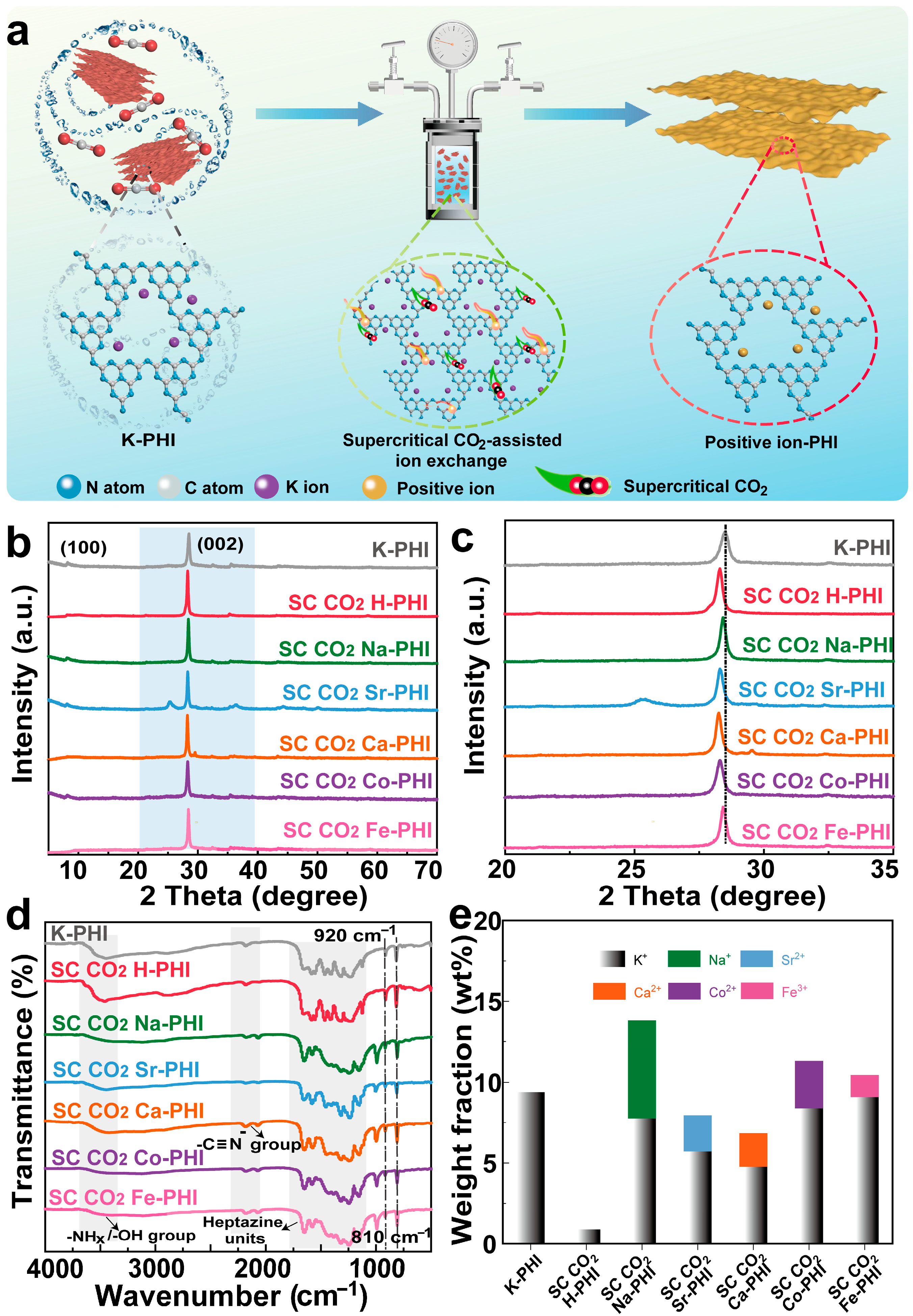
Figure 1a illustrates the preparation process of M-PHI via the supercritical CO2-assisted ion exchange method. Firstly, the highly crystalline K-PHI was synthesized using a traditional KCl molten salt method. Subsequently, the target cations of different valences were introduced into the K-PHI framework. Benefiting from the gas–liquid-like dual characteristics, low viscosity and high diffusivity of supercritical CO2, the target cations were efficiently transported deep into the interlayer cavities to uniformly replace K+ ions, yielding a series of M-PHI catalysts (SC CO2 M-PHI). Compared to conventional aqueous or solvent-based methods, this SC CO2 ion exchange strategy significantly shortens the reaction time and ensures uniform ion dispersion, effectively preventing the agglomeration of substituted cations within the PHI framework. Furthermore, the unique swelling effect of SC CO2 gently loosens the heptazine skeleton. This non-destructive expansion not only facilitates a more thorough ion-exchange process but also helps construct a porous structure, thereby increasing the specific surface area and exposing more accessible active sites for subsequent photocatalytic reactions.
Figure 1b,c show the X-ray diffraction (XRD) patterns of the pristine K-PHI and the prepared SC CO2 M-PHI samples. For K-PHI, a characteristic diffraction peak at 8.2° was observed, corresponding to the (100) plane of the in-plane repeating motifs [23]. However, this diffraction peak disappears in the SC CO2 Ca-PHI and SC CO2 Fe-PHI, indicating a partial loss of long-range in-plane structural order. This is likely due to the strong coordination and structural distortion induced by these multivalent cations during the exchange process. Furthermore, pristine K-PHI exhibited a prominent peak at around 28.2°, corresponding to the (002) plane derived from the periodic interlayer stacking of the conjugated aromatic rings. In contrast, this characteristic peak shifted to a lower angle of roughly 27.0° for the prepared SC CO2 M-PHI samples, accompanied by peak broadening. This noticeable downshift explicitly demonstrates that the cation substitution effectively expanded the lattice interlayer distance, while preserving the fundamental heptazine-based polymeric backbone. Such an expanded interlayer spacing is highly advantageous, as it not only facilitates the efficient interlayer migration of photogenerated charges but also provides enlarged spatial channels for the adsorption and activation of CO2 molecules.
Figure 1d shows the FTIR spectra of K-PHI and the prepared SC CO2 M-PHI samples. The absorption peak at 810 cm−1 and 1100~1500 cm−1 were attributed to the breathing vibration and the stretching vibration of the heptazine skeleton, the characteristic peak at 2000~2250 cm−1 was the stretching vibration of terminal cyano groups. In addition, the broad absorption band at 3000~3500 cm−1 originated from the N-H/O-H stretching vibration. All the prepared SC CO2 M-PHI samples retain the characteristic absorption peaks of the heptazine ring, confirming that the introduction of cations with different valences does not destroy the heptazine ring skeleton of PHI [24].
Inductively coupled plasma optical emission spectrometry (ICP) was employed to quantify the metal content in the prepared SC CO2 M-PHI samples. As shown in Figure 1e, the K+ content in pristine K-PHI was 9.389 wt%. After the SC CO2-assisted ion-exchange treatment, part of the K+ ions were replaced by mono-, di-, and trivalent cations, resulting in a significant decrease in the residual K+ content. Among the investigated cations, monovalent ions with ionic radii and valence states similar to K+ exhibit relatively higher substitution efficiency. In contrast, divalent (SC CO2 Ca-PHI, SC CO2 Co-PHI) and trivalent (SC CO2 Fe-PHI) cations show lower exchange efficiency, which can be attributed to their higher charge density and different ionic radii, making it more difficult for them to diffuse into and occupy the interlayer cavities of the heptazine framework. Notably, the SC CO2 Fe-PHI sample showed the lowest metal incorporation and the highest residual K+ content. These results suggest that the ionic radius and charge density of the cations significantly influence the substitution efficiency of K+ under the supercritical CO2-assisted ion-exchange conditions.

3.2. Photoelectrochemical Characterization of M-PHI Catalysts Constructed by Supercritical CO2-Assisted Ion Exchange

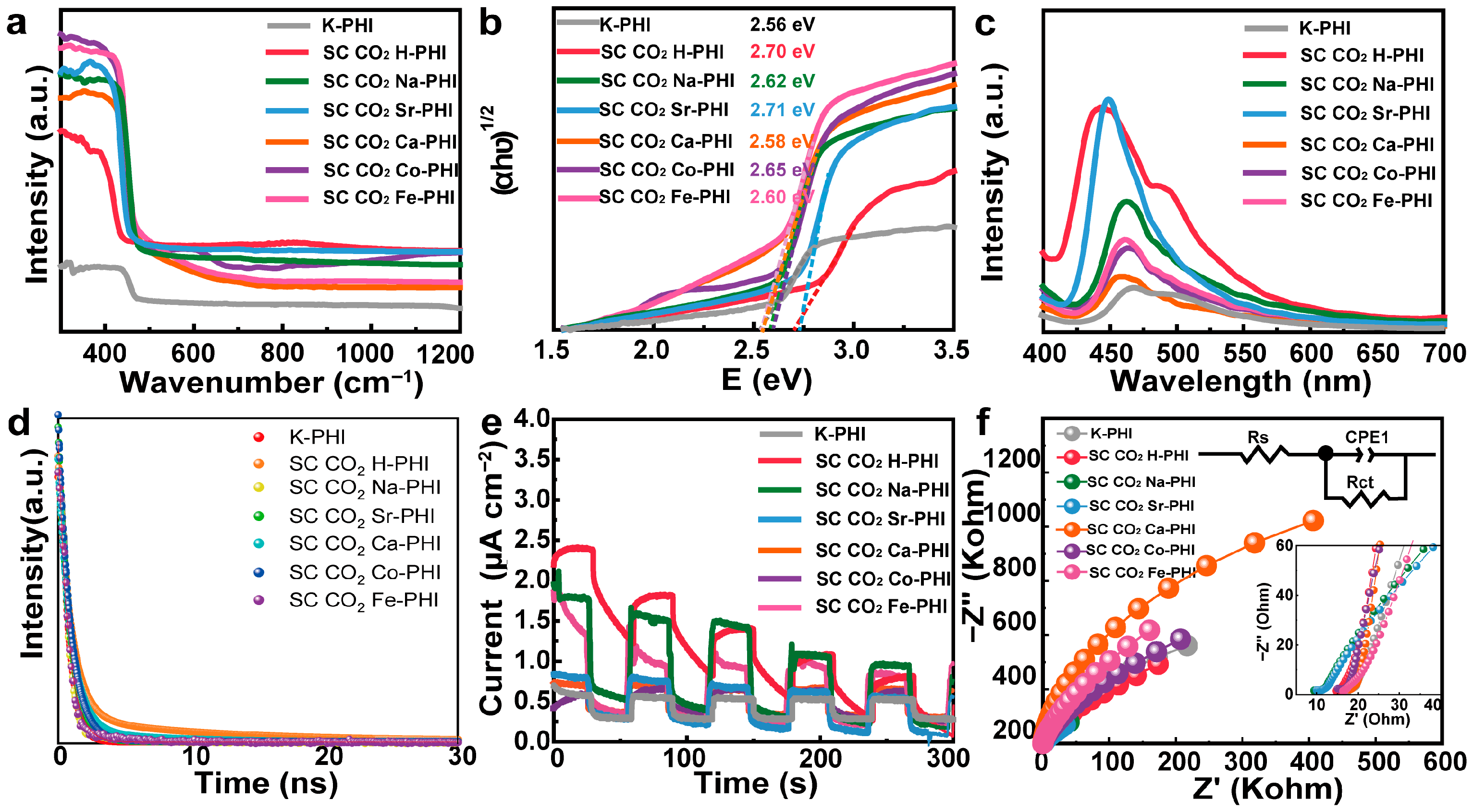
The optical absorption properties of the samples were investigated by UV-Vis diffuse reflectance spectroscopy (UV-Vis DRS,) as shown in Figure 2a. All sample exhibited a sharp absorption edge at approximately 400~800 nm. The corresponding optical band gaps of the prepared samples were estimated by Tauc plots (Figure 2b) [25,26]. The calculated band gaps of the SC CO2 M-PHI sample ranged from 2.58 to 2.71 eV, slightly larger than that of pristine K-PHI (2.56 eV). Among them, SC CO2 H-PHI and SC CO2 Sr-PHI exhibited relatively wider band gaps, indicating that cation exchange can subtly modulate the electronic structure of PHI. Such band structure modulation may influence the redox ability of photogenerated carriers and subsequently affect the photocatalytic CO2 reduction performance.
Photoluminescence (PL) spectroscopy was used to investigate the recombination behavior of photogenerated carriers in the samples (Figure 2c). K-PHI exhibited a strong PL emission peak around 460 nm, indicating a high recombination rate of photogenerated electron-hole pairs [27]. After supercritical CO2-assisted ion exchange, the PL intensities of all SC CO2 M-PHI samples decreased to varying degrees, suggesting that cation exchange effectively suppresses the recombination of photogenerated carriers. Among the modified samples, SC CO2 H-PHI showed the most significant quenching of PL intensity, indicating the most efficient inhibition of charge carrier recombination. In addition, slight shifts in the emission peak positions (around 450–470 nm) were observed for the SC CO2 M-PHI samples, which might be associated with changes in the local electronic structure induced by cation substitution. These results demonstrate that the supercritical CO2-assisted ion exchange strategy effectively regulates the charge carrier dynamics of K-PHI, thereby facilitating charge separation and potentially enhancing photocatalytic CO2 reduction performance.
Time-resolved photoluminescence (TRPL) measurements were further conducted to investigate the charge carrier dynamics of the samples (Figure 2d) [28]. The average lifetime (τavg) of pristine K-PHI is 0.77 ns, indicating rapid recombination of photogenerated carriers. After supercritical CO2-assisted ion exchange, noticeable changes in carrier lifetimes were observed. The τavg values of the modified samples were 5.43 ns for SC CO2 H-PHI, 0.85 ns for SC CO2 Sr-PHI, 2.994 ns for SC CO2 Ca-PHI, 0.74 ns for SC CO2 Na-PHI, 0.90 ns for SC CO2 Co-PHI, and 0.75 ns for SC CO2 Fe-PHI (Table S1). Among them, SC CO2 H-PHI exhibited the longest carrier lifetime, which was nearly seven times that of pristine K-PHI. This result indicates that protonation via the supercritical CO2 ion-exchange process effectively suppresses the recombination of photogenerated electron–hole pairs and prolongs the carrier lifetime, thereby facilitating charge separation during the photocatalytic reaction.
Transient photocurrent response and electrochemical impedance spectroscopy (EIS) were further employed to evaluate the charge separation and interfacial charge transfer behavior of the prepared SC CO2 M-PHI (Figure 2e,f) [29,30]. As shown in the transient photocurrent curves, SC CO2 H-PHI exhibited a photocurrent intensity approximately two times higher than that of K-PHI, indicating that the supercritical CO2-assisted ion exchange enhances the separation efficiency of electron-hole pairs. The Nyquist plots of EIS showed that the SC CO2 H-PHI, SC CO2 Na-PHI and SC CO2 Sr-PHI exhibited the lowest interfacial resistance, indicating more efficient charge separation and migration. These results collectively suggest that the supercritical CO2-assisted cation exchange effectively improves the photoelectrochemical properties of PHI, while protonation modification plays a particularly important role in promoting carrier separation and facilitating charge transfer during photocatalytic CO2 reduction.

3.3. Band Structure Characterization of M-PHI Catalysts Constructed by Supercritical CO2-Assisted Ion Exchange

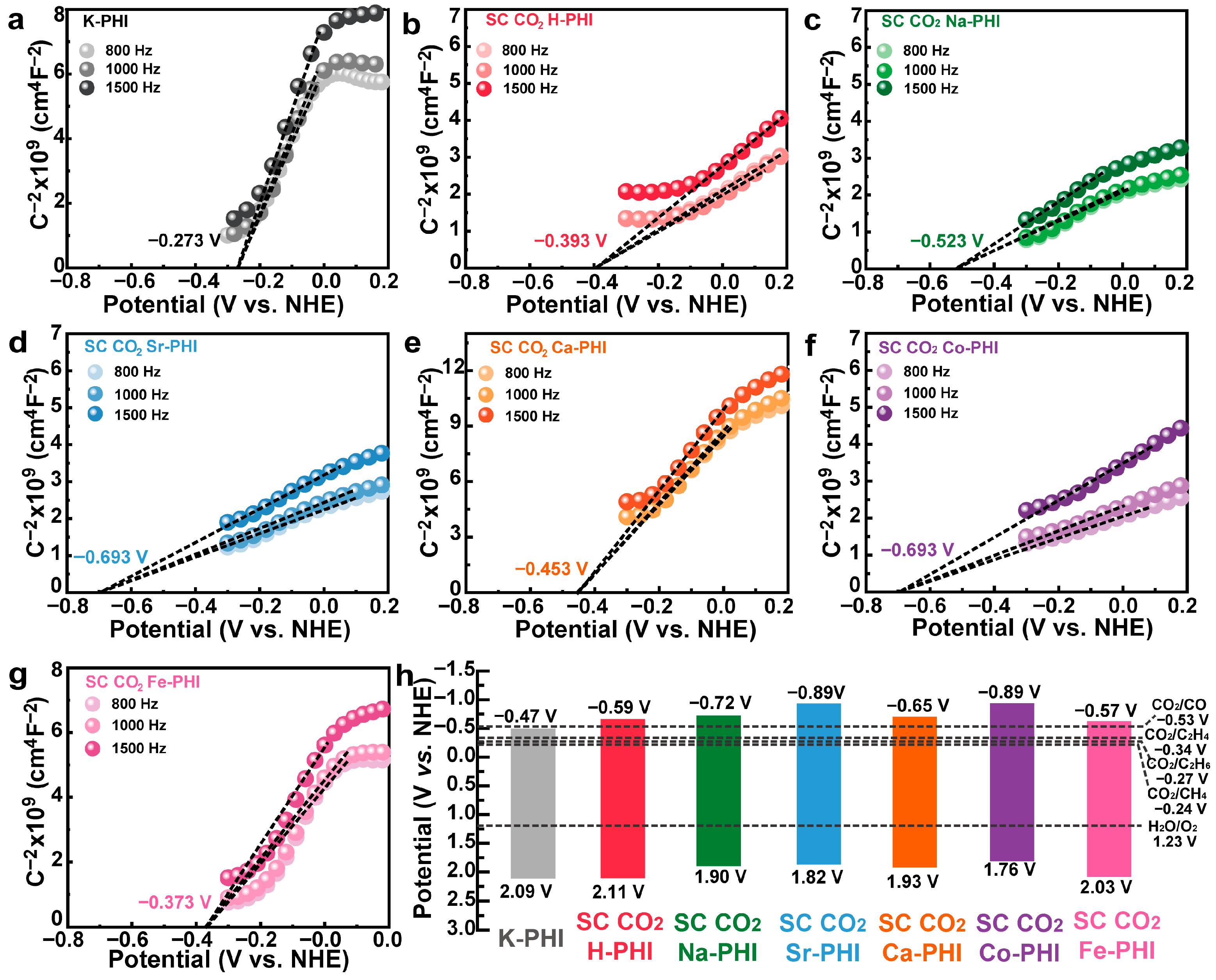
Figure 3a–g present the Mott-Schottky (M-S) curves of K-PHI and SC CO2 M-PHI samples. All samples exhibited positive slopes, confirming n-type semiconductors. The flat band potentials relative to the normal hydrogen electrode (NHE) calculated from the intercepts of the M-S curves are as follows: K-PHI (−0.273 V), SC CO2 H-PHI (−0.393 V), SC CO2 Na-PHI (−0.523 V), SC CO2 Sr-PHI (−0.693 V), SC CO2 Ca-PHI (−0.453 V), SC CO2 Co-PHI (−0.693 V) and SC CO2 Fe-PHI (−0.373 V). Based on the band gap and the flat band potentials derived from the M-S plots, the band structure diagram of the samples was constructed (Figure 3h). The CBM positions of all samples are more negative than the reduction potentials of CO2/CH4 (−0.27 V vs. NHE) and CO2/CO (−0.53 V vs. NHE), indicating that these photocatalysts possess sufficient thermodynamic driving force for the photocatalytic reduction of CO2 to CO, CH4 and C2H4. These results demonstrate that cation exchange via the supercritical CO2 strategy effectively tunes the electronic band structure of PHI, which is expected to influence the photocatalytic CO2 reduction behavior.

3.4. Photocatalytic CO2 Reduction Performance

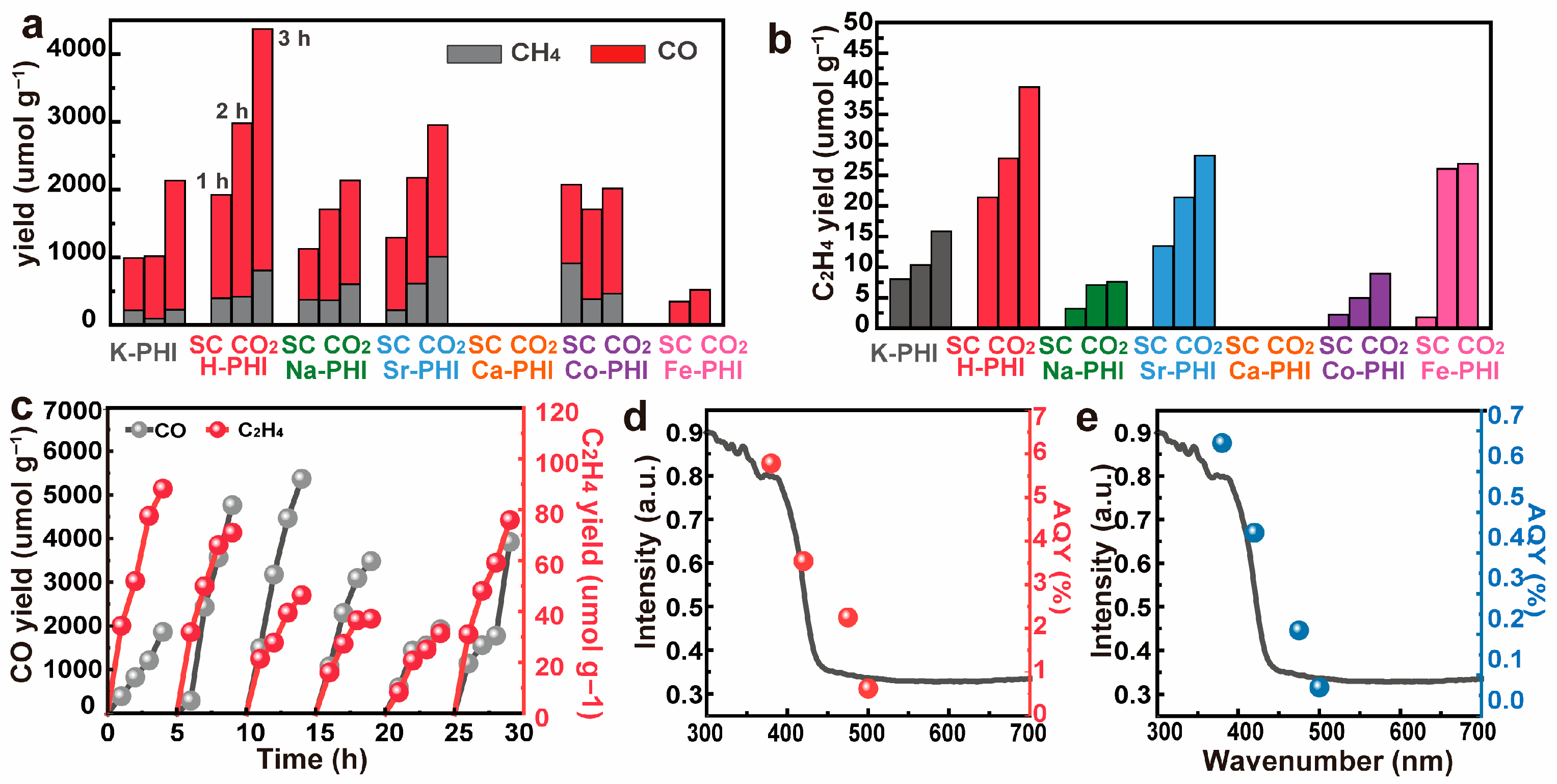
The photocatalytic CO2 reduction performance of the catalysts was evaluated in a gas–solid two-phase reaction system, and the results are presented in Figure 4a. Among the investigated samples, SC CO2 H-PHI exhibits the highest catalytic activity, with CH4 and CO yields reaching 807.32 μmol·g−1 and 3564.87 μmol·g−1, respectively, after 3 h of simulated sunlight irradiation. In comparison, SC CO2 Na-PHI and SC CO2 Sr-PHI show moderate production of CH4 and CO, whereas no detectable CH4 or CO formation is observed for SC CO2 Ca-PHI. Overall, photocatalysts doped with monovalent cations (SC CO2 H-PHI, SC CO2 Na-PHI, SC CO2 Sr-PHI) exhibit significantly higher CO2 reduction activity than those doped with divalent (SC CO2 Ca-PHI, SC CO2 CO-PHI) and trivalent (SC CO2 Fe-PHI) cations, suggesting that the valence state and ionic characteristics of the introduced cations play an important role in regulating the photocatalytic activity of PHI. Figure 4b further compared the formation of the C2 product (C2H4). Consistent with the trend observed for C1 products, SC CO2 H-PHI exhibits the highest C2H4 yield, reaching approximately 40 μmol·g−1 after 3 h of photocatalysis. In contrast, the C2H4 yields of K-PHI, SC CO2 Na-PHI, SC CO2 Sr-PHI, SC CO2 Ca-PHI, SC CO2 Co-PHI, and SC CO2 Fe-PHI are 15.85, 7.59, 28.26, 0, 8.93, and 26.88 μmol·g−1, respectively. Furthermore, we conducted blank experiments under three conditions: without catalyst, without light, and in an Ar atmosphere. The results showed that the yield was 0 in all cases (Table S2).
To evaluate the catalytic stability of SC CO2 H-PHI, recycling experiments were performed under identical reaction conditions (Figure 4c). The results showed that after six cycles, the photocatalyst still maintained stable catalytic activity without noticeable deactivation. The yields of CO and C2H4 remained at 3925.36 μmol·g−1 and 75.85 μmol·g−1, respectively, demonstrating the excellent durability of SC CO2 H-PHI for continuous photocatalytic CO2 reduction. Figure 4d,e present the apparent quantum yields (AQY) of SC CO2 H-PHI at different wavelengths. The maximum AQY values for CO and C2H4 production reach 5.78% and 0.67% at 380 nm, respectively. Notably, the AQY spectrum shows a similar trend to the UV–Vis diffuse reflectance absorption profile of the catalyst, indicating that the photocatalytic activity originates from the photoexcitation of SC CO2 H-PHI. These results further confirm the efficient light utilization and stable photocatalytic performance of the catalyst.
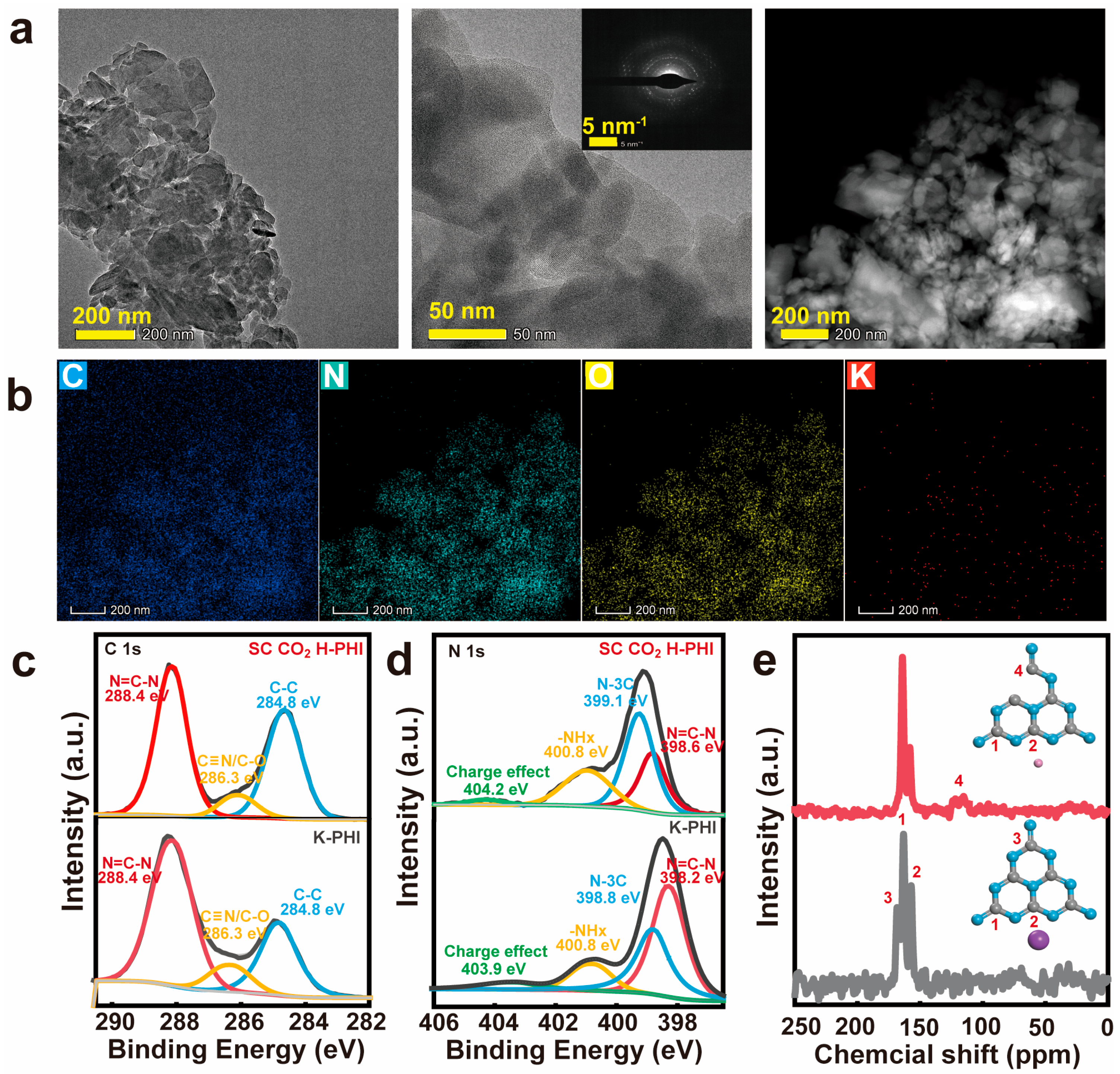
Since SC CO2 H-PHI exhibited the highest photocatalytic CO2 reduction activity, it was selected as a representative sample for further structural characterization in order to understand the origin of its enhanced photocatalytic performance. The SEM and elemental mapping images of the other samples are shown in Figures S1–S6. TEM and HADDF images of SC CO2 H-PHI (Figure 5a,b) revealed a typical two-dimensional layered structure with C, N and O elements uniformly dispersed on the stacked nanosheets, while the K element content was extremely low. This observation indicates that the supercritical CO2-assisted ion exchange process effectively removes interlayer K+ ions and leads to the formation of protonated PHI.
To further investigate the chemical environment of the catalyst, X-ray photoelectron spectroscopy (XPS) analysis was performed. The survey spectra (Table S3) showed that both K-PHI and SC CO2 H-PHI consisted mainly of C, N, O elements. Notably, after the supercritical CO2 treatment, the content of K 2p decreased significantly from 17.36% to 0%, indicating the complete removal of K+ ions from the PHI framework [31]. The high-resolution C 1s spectrum of K-PHI can be deconvoluted into three characteristic peaks located at 284.8 eV, 286.3 eV and 288.0 eV, corresponding to surface defects, edge C≡N groups, and in-ring N–C=N species, respectively (Figure 5c). After the supercritical CO2-HCl treatment, the binding energies remained almost unchanged, suggesting that the fundamental heptazine framework was preserved. The N 1s spectrum further provided insight into the structural evolution of PHI. The peaks located at 398.2 eV, 398.8 eV and 400.8 eV corresponding to C–N=C, N–C3, and edge –NHx species, respectively (Figure 5d). Compared with K-PHI, the peaks of C–N=C and N–C3 shifted slightly to higher binding energies, suggesting a redistribution of electron density in the PHI framework after protonation. Meanwhile, the ratio of C–N=C/N–C3 decreased from 0.94 to 0.71 (Table S4), indicating the formation of nitrogen defects during the supercritical CO2-HCl treatment. In addition, a weak π–π satellite peak at 404.0 eV is observed, further confirming the modification of the electronic structure of the heptazine units.
Solid-state 13C NMR spectroscopy was further employed to investigate the structural evolution of PHI after the supercritical CO2 treatment (Figure 5e). For pristine K-PHI, three dominant resonance peaks were observed at approximately 150~160 ppm, corresponding to the sp2 carbon atoms in the N–C=N units of the heptazine ring and the bridging carbon atoms in the tri-s-triazine framework, respectively. After the supercritical CO2–HCl treatment, SC CO2 H-PHI still exhibits the characteristic resonances of the heptazine framework, indicating that the fundamental polymeric structure of PHI is preserved during the ion-exchange process. However, an additional signal located at around 120 ppm becomes more pronounced, which can be attributed to the formation of cyano (-C≡N) groups or edge carbon species [32]. To evaluate the structural robustness of the catalyst, TEM, XRD, and XPS analyses were conducted on the used SC CO2 H-PHI sample after the photocatalytic CO2 reduction reaction. As shown in Figure S7, the TEM image of the spent catalyst retains the typical lamellar morphology with no observable structural collapse or particle aggregation, indicating good morphological stability. The XRD pattern in Figure S8 displays characteristic diffraction peaks consistent with those of the fresh SC CO2 H-PHI, confirming that the crystalline heptazine-based framework remains intact during the reaction. Furthermore, the high-resolution C 1s and N 1s XPS spectra of the used catalyst (Figure S9) exhibit nearly identical binding energies and peak shapes to those of the fresh sample, demonstrating that the chemical environments of carbon and nitrogen species are well preserved. Collectively, these results evidence the outstanding structural, morphological, and chemical stability of the SC CO2 H-PHI catalyst under the reaction conditions.

3.5. Mechanism Investigation

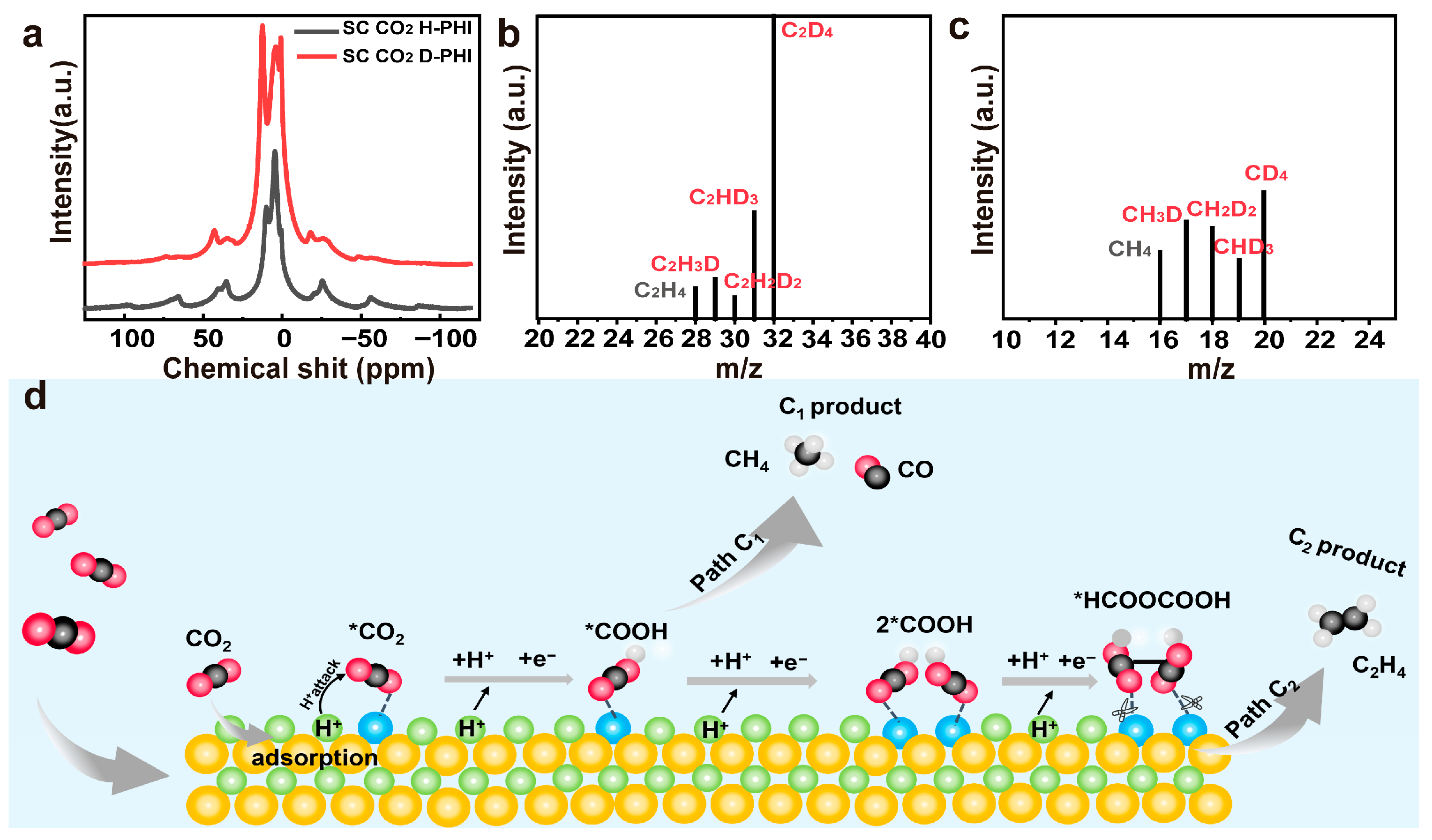
To further clarify the photocatalytic mechanism of SC CO2 H-PHI, isotope-labeling experiments were conducted. A deuterated catalyst (SC CO2 D-PHI) was prepared using a supercritical CO2–DCl system, and the formation of N–D species was verified by solid-state 2H MAS NMR spectroscopy (Figure 6a). A clear resonance signal appears in the range of 0~20 ppm, which is characteristic of deuterons bonded to nitrogen atoms. When DCl is used instead of HCl, the intensity of this signal increases markedly, confirming the successful incorporation of deuterium species into the PHI framework. To verify whether these deuterium species participate in the reaction, the photocatalytic products generated by SC CO2 D-PHI were analyzed by GC–MS (Figure 6b,c). Besides the normal products C2H4 and CH4, a series of deuterated hydrocarbons including C2H3D, C2H2D2, C2HD3, C2D4 and CH3D, CH2D2, CHD3, CD4 were detected. The formation of these deuterated products clearly demonstrates that the hydrogen atoms involved in CO2 reduction can originate from the surface-adsorbed water and proton species of SC CO2 H-PHI. Therefore, SC CO2 H-PHI can act as an intrinsic proton reservoir that continuously supplies active hydrogen species during photocatalytic CO2 reduction.
Based on the structural and isotopic evidence, the reaction mechanism of the highly productive SC CO2 H-PHI is shown in Figure 6d. Upon light irradiation, the CO2 molecules were strongly adsorbed and activated on the surface of SC CO2 H-PHI. Crucially, the protons (H+) anchored within the PHI framework act as an intrinsic proton reservoir. Instead of relying on the sluggish proton transfer from bulk water, these endogenous protons directly and rapidly attack the activated CO2 molecules via a highly efficient proton-coupled electron transfer (PCET) process. This localized, abundant proton supply rapidly generates a high surface coverage of *COOH intermediates. Consequently, the physical proximity and high concentration of these intermediates significantly lower the kinetic barrier for the critical C–C coupling step. Adjacent *COOH species readily dimerize to form *HCOOCOOH, which subsequently undergoes continuous reduction and deoxygenation to yield C2H4. In essence, the synergy between the defect-mediated CO2 activation and the endogenous proton supply structurally steers the reaction pathway toward multi-carbon (C2) products.

4. Conclusions

In summary, a facile supercritical CO2-assisted ion exchange strategy is initially developed to construct a series of cation-modified PHI (SC CO2 M-PHI) photocatalysts. And the evaluations of photocatalytic CO2 reduction performance revealed a striking structure–activity relationship among the prepared variants. Notably, the protonated catalyst (SC CO2 H-PHI) stood out, exhibiting remarkably enhanced catalytic activity and selectivity, particularly towards the generation of the C2 product (C2H4). This exceptional performance leap suggests that the SC CO2–HCl treatment does not merely alter the physical structure of the framework. More importantly, the successfully introduced H+ species transform the PHI framework into an endogenous proton reservoir. Rather than relying solely on the sluggish proton transfer from the external solvent, this self-supplied proton microenvironment is hypothesized to play a pivotal role in accelerating the subsequent proton-coupled electron transfer (PCET) and C–C coupling steps during CO2 photoreduction.

Supplementary Materials

The following supporting information can be downloaded at: https://www.mdpi.com/article/10.3390/nano16080489/s1.

Author Contributions

X.P. Visualization, Investigation, Data curation, Validation, Writing—original draft. L.D. Writing—original draft, Visualization, Methodology, Investigation, Data curation, Conceptualization, Supervision. G.F. Conceptualization, Supervision, Investigation. S.Z. Conceptualization, Writing—original draft. J.M. Investigation, Methodology, Writing—Reviewing and Editing. All authors have read and agreed to the published version of the manuscript.

Funding

This work was financially supported by Henan Province science and technology research project (242102231044 to Du), Henan Provincial Science Foundation Project (232300420338 to Du, 242300420343 to Fu), the special fund project of Zhengzhou basic and applied basic research (ZZSZX202001, ZZSZX202002), Postgraduate Education Reform and Quality Improvement Project of Henan Province (YJS2022JD50), Program for Science & Technology Innovation Talents in Universities of Henan Province (24HASTIT002).

Data Availability Statement

The original contributions presented in this study are included in the article/Supplementary Materials. Further inquiries can be directed to the corresponding authors.

Acknowledgments

Generative AI tools were used solely for language editing to correct grammatical and typographical errors in the manuscript. No AI tools were used for data analysis, results generation, scientific interpretation, or reference management. The authors remain fully responsible for the content and integrity of the submitted work.

Conflicts of Interest

The authors declare no conflicts of interest.

References

  1. Zhou, D.; Chen, Q.; Zhang, J.; Wang, T.; Liu, Z.Q. Ether-Embedded Covalent Organic Frameworks Enable Efficient Photocatalytic CO2 Reduction. Angew. Chem. Int. Ed. 2025, 64, e202500329. [Google Scholar] [CrossRef]
  2. Shen, Y.; Ren, C.; Zheng, L.; Xu, X.; Long, R.; Zhang, W.; Yang, Y.; Zhang, Y.; Yao, Y.; Chi, H.; et al. Room-temperature Photosynthesis of Propane from CO2 with Cu Single Atoms on Vacancy-rich TiO2. Nat. Commun. 2023, 14, 1117. [Google Scholar] [CrossRef]
  3. Li, X.; Wan, Y.; Xie, Y.; Fu, Y.; Deng, F.; Zhou, Y.; Luo, Y.; Han, L.; Ma, J.; Dong, F.; et al. Synergistic Atomic-Vacancy Engineering in Bi2S3-δ/Co-N-C. Boosting Photoelectrocatalytic Hydrogen Production via Formaldehyde Oxidation. Adv. Funct. Mater. 2025, 21, e23047. [Google Scholar] [CrossRef]
  4. Li, M.; Han, Z.; Hu, Q.; Fan, W.; Hu, Q.; He, D.; Chen, Q.; Jiao, X.; Xie, Y. Recent Progress in Solar-driven CO2 Reduction to Multicarbon Products. Chem. Soc. Rev. 2024, 53, 9964–9975. [Google Scholar] [CrossRef] [PubMed]
  5. Zhu, H.W.; Guo, R.T.; Liu, C.; Cui, H.F.; Liu, M.Y.; Pan, W.G. Recent Progress on Photocatalytic Reduction of CO2 to C2+ Products. J. Mater. Chem. A 2024, 12, 21677–21703. [Google Scholar] [CrossRef]
  6. Tang, Z.; Wang, Y.; Qin, T.; Wei, Y.; Xiong, J.; Wang, X.; Li, X.; Liu, M.; Liu, Y.; Liu, X.; et al. Near-unity CO2-to-ethylene Photoconversion over Low Coordination Single-atom Catalysts. Nat. Commun. 2026, 17, 2081. [Google Scholar] [CrossRef]
  7. Du, H.; Fu, Y.; Shi, R.; Cao, Z.; Zhang, S.; Liu, K.; Wang, J.; Jiang, B.; Li, H. Spatially Separated C-C Coupling and Protonation on Cl-Bridged Ti-Ag Dual-Site Catalysts for Efficient Photocatalytic CO2 Reduction to C2H4. Angew. Chem. Int. Ed. 2026, 65, e20354. [Google Scholar] [CrossRef] [PubMed]
  8. Yang, J.; Zeng, X.; Zhu, B.; Rahman, S.; Bie, C.; Yong, M.; Sun, K.; Tebyetekerwa, M.; Wang, Z.; Guo, L.; et al. Self-Trapped Excitons Activate Pseudo-Inert Basal Planes of 2D Organic Semiconductors for Improved Photocatalysis. Adv. Mater. 2025, 37, e2505653. [Google Scholar] [CrossRef]
  9. Li, H.; Zhang, G.; He, C.; Zhang, P.; Mi, H. In-situ Construction of Bulk and Surface Defects to Activate the Near-infrared Photocatalytic Activity of Poly(heptazine imide). Appl. Catal. B Environ. 2025, 365, 124910. [Google Scholar] [CrossRef]
  10. Jing, L.; Li, Z.; Chen, Z.; Li, R.; Hu, J. Engineering Polyheptazine and Polytriazine Imides for Photocatalysis. Angew. Chem. Int. Ed. 2024, 63, e202406398. [Google Scholar] [CrossRef]
  11. Hajiahmadi, Z.; Lo Presti, A.; Naghavi, S.S.; Antonietti, M.; Pelicano, C.M.; Kuhne, T.D. Theory-Guided Discovery of Ion-Exchanged Poly(heptazine imide) Photocatalysts Using First-Principles Many-Body Perturbation Theory. J. Am. Chem. Soc. 2026, 148, 2165–2174. [Google Scholar] [CrossRef] [PubMed]
  12. Sheng, F.; Wu, B.; Zhu, D.; Xia, Y.; Huang, C.; Xu, T.; Ge, L.; Wu, L.; Li, X.; Xu, T. Solvation-Mediated Assembly for Large-Scale Synthesis of Covalent Organic Framework Membranes. Angew. Chem. Int. Ed. 2026, 138, e25844. [Google Scholar] [CrossRef]
  13. Li, Y.; Chen, G.; Fei, L.; Zhou, W.; Shao, Z. Designing Better Electrocatalysts via Ion Exchange for Water Splitting. Adv. Funct. Mater. 2024, 13, 2417880. [Google Scholar] [CrossRef]
  14. Feng, Y.; Tian, X.; Zhu, Y.; Fang, Q.; Cantu, R.; Shin, B.; Huang, X.; Weng, X.; Zhang, X.; Zhang, Y.; et al. Mechanically Strengthened Graphene Oxide: Covalent Organic Framework Membranes for Monovalent/Divalent Cation Selectivity via Electrodialysis. ACS Nano 2026, 20, 3632–3641. [Google Scholar] [CrossRef]
  15. Sun, Z.; Fan, Q.; Zhang, M.; Liu, S.; Tao, H.; Texter, J. Supercritical Fluid-Facilitated Exfoliation and Processing of 2D Materials. Adv. Sci. 2019, 6, 1901084. [Google Scholar] [CrossRef] [PubMed]
  16. Padmajan Sasikala, S.; Poulin, P.; Aymonier, C. Prospects of Supercritical Fluids in Realizing Graphene-Based Functional Materials. Adv. Mater. 2016, 28, 2663–2691. [Google Scholar] [CrossRef]
  17. Nikolai, P.; Rabiyat, B.; Aslan, A.; Ilmutdin, A. Supercritical CO2, Properties and Technological Applications—A Review. J. Therm. Sci. 2019, 28, 394–430. [Google Scholar] [CrossRef]
  18. Liu, W.; Zheng, X.; Xu, Q. Supercritical CO2 Directional-Assisted Synthesis of Low-Dimensional Materials for Functional Applications. Small 2023, 19, e2301097. [Google Scholar] [CrossRef]
  19. Yuan, F.; Zhang, L.; Jiang, H.; Zhou, Y.; Yin, H.; Zhu, T.; Yang, B.; Zhang, S.; Ma, J.; Du, L. Heterogeneous Photocatalytic Synthesis of Sulfenamides with Carbon Doped Potassium Poly(heptazine imide) through Effective Electron Delocalization. Green Chem. 2024, 26, 8785–8793. [Google Scholar] [CrossRef]
  20. Zhang, J.; Zhang, C.; Wang, M.; Mao, Y.; Wu, B.; Yang, Q.; Wang, B.; Mi, Z.; Zhang, M.; Ling, N.; et al. Isotopic labelling of Water Reveals the Hydrogen Transfer Route in Electrochemical CO2 Reduction. Nat. Chem. 2025, 17, 334–343. [Google Scholar] [CrossRef]
  21. Yin, S.; Zhou, Y.; Liu, Z.; Wang, H.; Zhao, X.; Zhu, Z.; Yan, Y.; Huo, P. Elucidating Protonation Pathways in CO2 Photoreduction Using the Kinetic Isotope Effect. Nat. Commun. 2024, 15, 437. [Google Scholar] [CrossRef]
  22. Wang, S.; Jiang, B.; Henzie, J.; Xu, F.; Liu, C.; Meng, X.; Zou, S.; Song, H.; Pan, Y.; Li, H.; et al. Designing Reliable and Accurate Isotope-tracer Experiments for CO2 Photoreduction. Nat. Commun. 2023, 14, 2534. [Google Scholar] [CrossRef]
  23. Wang, W.; Shu, Z.; Zhou, J.; Tang, H.; Li, T.; Meng, D. Optimizing the Optical Absorption of Poly(heptazine imide) by the n → π* Electron Transition for Improved Photocatalytic H2 Evolution. ACS Appl. Mater. Interfaces 2022, 14, 41131–41140. [Google Scholar] [CrossRef]
  24. Chen, Z.; Savateev, A.; Pronkin, S.; Papaefthimiou, V.; Wolff, C.; Willinger, M.G.; Willinger, E.; Neher, D.; Antonietti, M.; Dontsova, D. “The Easier the Better” Preparation of Efficient Photocatalysts-Metastable Poly(heptazine imide) Salts. Adv. Mater. 2017, 32, 1700555. [Google Scholar] [CrossRef] [PubMed]
  25. Mahmud, R.A.; Shafawi, A.N.; Ahmed Ali, K.; Putri, L.K.; Md Rosli, N.I.; Mohamed, A.R. Graphene Nanoplatelets with Low Defect Density as a Synergetic Adsorbent and Electron Sink for ZnO in The Photocatalytic Degradation of Methylene Blue under UV–vis irradiation. Mater. Res. Bull. 2020, 128, 110876. [Google Scholar] [CrossRef]
  26. Chen, H.; Wang, H.; Liu, J.; Cheng, Q.; Chen, X.; Ye, F. Association of Base Excision Repair Gene hOGG1 Ser326Cys Polymorphism with Susceptibility to Cervical Squamous Cell Carcinoma and High-Risk Human Papilloma Virus Infection in a Chinese Population. Genet. Test. Mol. Biomark. 2019, 23, 138–144. [Google Scholar] [CrossRef]
  27. Chen, D.; Dai, H.; Wang, W.; Cai, Y.; Mou, X.; Zou, J.; Shao, J.; Mao, Z.; Zhong, L.; Dong, X.; et al. Proton-Driven Transformable 1O2 -Nanotrap for Dark and Hypoxia Tolerant Photodynamic Therapy. Adv. Sci. 2022, 9, e2200128. [Google Scholar] [CrossRef]
  28. Luo, L.; Zeng, H.; Wang, Z.; Li, M.; You, S.; Chen, B.; Maxwell, A.; An, Q.; Cui, L.; Luo, D.; et al. Stabilization of 3D/2D Perovskite Heterostructures Via Inhibition of Ion Diffusion by Cross-linked Polymers for Solar Cells with Improved Performance. Nat. Energy 2023, 8, 294–303. [Google Scholar] [CrossRef]
  29. Zhu, Z.; Xing, X.; Qi, Q.; Shen, W.; Wu, H.; Li, D.; Li, B.; Liang, J.; Tang, X.; Zhao, J.; et al. Fabrication of Graphene Modified CeO2/g-C3N4 Heterostructures for Photocatalytic Degradation of Organic Pollutants. Chin. J. Struct. Chem. 2023, 12, 100194. [Google Scholar] [CrossRef]
  30. Lv, Q.; Lu, H.; Wang, X.; Wang, Z.; Ding, G.; Feng, Y.; Wang, P.; Li, Q.; Gao, H.; Liao, G. Photocatalysis over CdS Quantum dots/oxygen Doped g-C3N4 Z-scheme Heterojunction: Revealing the Synergistic Effects of Quantum Confinement Effect, Defect Engineering, and Z-scheme Mechanism. Chem. Eng. J. 2025, 524, 169496. [Google Scholar] [CrossRef]
  31. Xu, Y.; He, X.; Zhong, H.; Singh, D.J.; Zhang, L.; Wang, R. Solid salt confinement effect: An Effective Strategy to Fabricate High Crystalline Polymer Carbon Nitride for Enhanced Photocatalytic Hydrogen Evolution. Appl. Catal. B Environ. 2019, 246, 349–355. [Google Scholar] [CrossRef]
  32. Ren, S.; Yang, X.; Liao, L.; Hu, W.; Liang, Z.; Wang, S.; Zhou, W. Revealing the Nature of Cyano Groups Modified K, O Codoped Graphitic Carbon Nitride Toward Optimized Photocatalytic H2 and H2O2 Evolution. Small 2025, 21, e2409352. [Google Scholar] [CrossRef] [PubMed]
Figure 1. (a) Schematic diagram of the process for constructing M-PHI photocatalyst using supercritical CO2; (b,c) XRD spectrum of M-PHI photocatalyst; (d) FTIR spectrum of M-PHI photocatalyst; (e) ICP test of the metal content of M-PHI photocatalyst.
Nanomaterials 16 00489 g001
Figure 2. (a) Solid UV-vis spectrum; (b) Corresponding Tauc’s band gap diagram; (c) PL fluorescence spectrum; (d) Transient fluorescence lifetime spectrum; (e) On-off light response current curve; (f) Impedance spectrum (measurement parameters: frequency range from 105 Hz to 0.01 Hz and an Amplitude of 5 mV at the open-circuit potential (OCP).
Nanomaterials 16 00489 g002
Figure 3. (ag) Mott–Schottky curves of the SC CO2 M-PHI catalyst (a) K-PHI; (b) SC CO2 H-PHI; (c) SC CO2 Na-PHI; (d) SC CO2 Sr-PHI; (e) SC CO2 Ca-PHI; (f) SC CO2 Co-PHI; (g) SC CO2 Fe-PHI; (h) band structure diagram.
Nanomaterials 16 00489 g003
Figure 4. Construction of M-PHI Catalyst for CO2 Photoreduction by Supercritical CO2 Ion Exchange Method (a,b) Plot of the yield of CH4, CO and C2H4 as products of M-PHI photo-reduction of CO2 in (a,b) supercritical CO2; (c) Product diagram of the photocatalytic cycle of H-PHI photocatalyst; (d) Apparent quantum yield (AQY) of CO generated by H-PHI photocatalyst; (e) Apparent quantum yield (AQY) of C2H4 generated by H-PHI photocatalyst.
Nanomaterials 16 00489 g004
Figure 5. (a,b) SC CO2 H-PHI TEM and its corresponding HADDF image; (c) K-PHI and SC CO2 H-PHI C 1s spectra; (d) K-PHI and SC CO2 H-PHI N 1s spectra; (e) K-PHI and SC CO2 H-PHI solid 13C NMR spectra.
Nanomaterials 16 00489 g005
Figure 6. (a) 2H NMR spectrum of the solid D-PHI catalyst prepared under the supercritical CO2-DCl conditions; (b,c) Isotope gas chromatography-mass spectrometry (GC-MS) analysis of the photo-reduction of CO2; (d) Schematic illustration of the photocatalytic CO2 reduction mechanism over SC CO2 H-PHI prepared by supercritical CO2-assisted ion exchange. * represents the activated free radical intermediate.
Nanomaterials 16 00489 g006
Disclaimer/Publisher’s Note: The statements, opinions and data contained in all publications are solely those of the individual author(s) and contributor(s) and not of MDPI and/or the editor(s). MDPI and/or the editor(s) disclaim responsibility for any injury to people or property resulting from any ideas, methods, instructions or products referred to in the content.