Advances and Challenges in Pulsed Lasers Based on Low-Dimensional Material Saturable Absorbers

Abstract
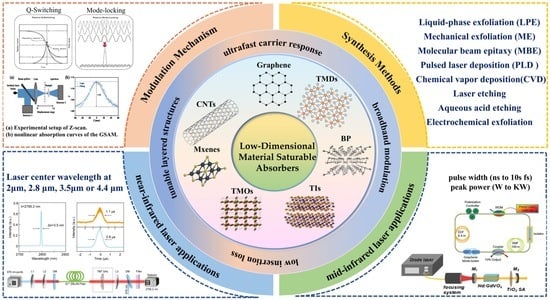
1. Introduction
2. Passive Modulation Mechanism of SAs
2.1. Passive Q-Switching
2.2. Passive Mode-Locking
3. Research Progress on LDM SAs
3.1. Graphene

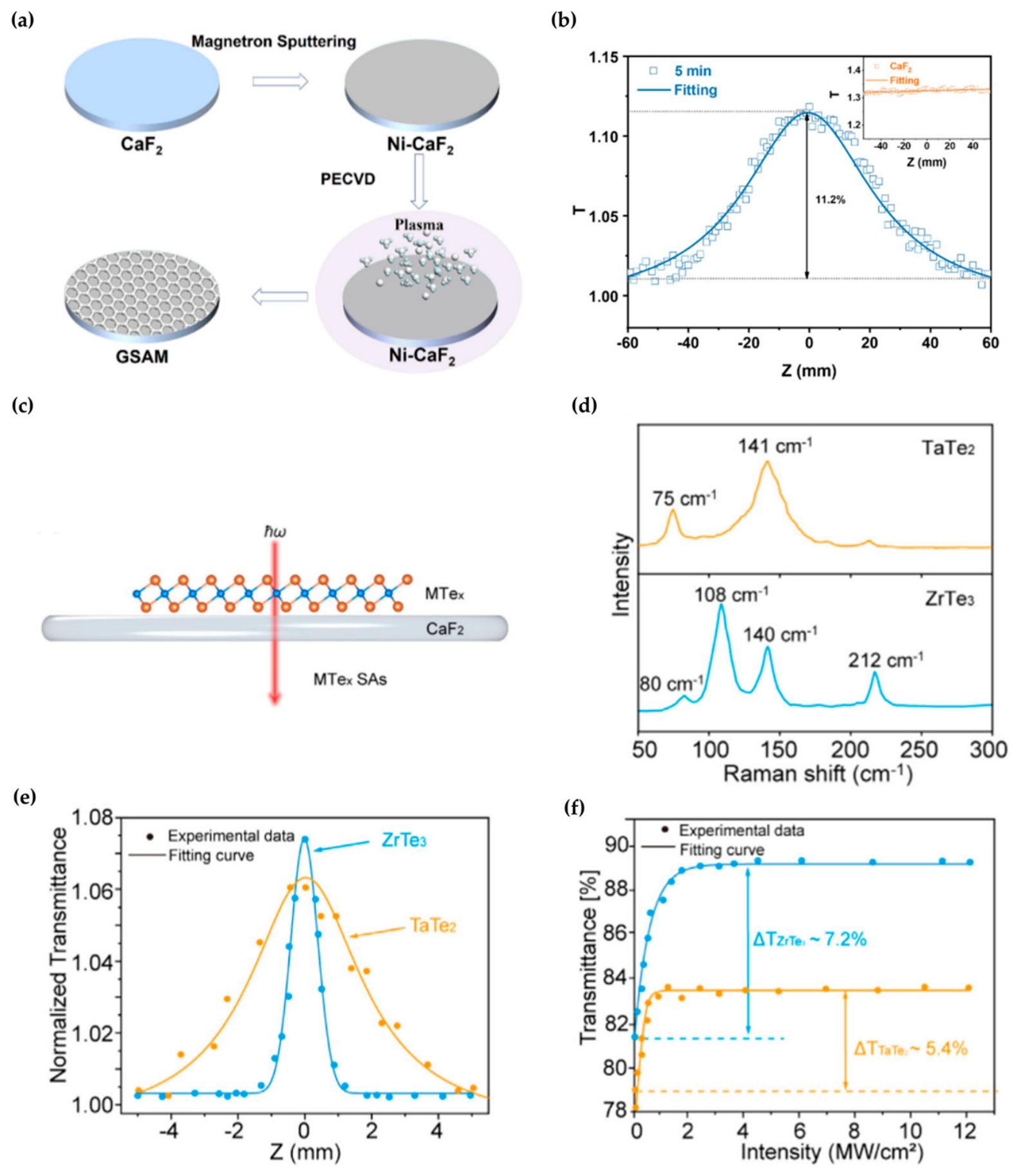
3.2. Transition Metal Dichalcogenides


| SA | Gain Medium | λ0 (nm) | τp (ps) | frep (KHz) | Ep (nJ) | Pave (mW) | Thickness | References |
|---|---|---|---|---|---|---|---|---|
| MoS2 | Yb3+ silica fiber | 1029.8 | 13.8 | 22,440 | - | 34.6 | few-layer | [105] |
| MoS2 | Yb3+ silica fiber | 1042.6 | 656 | 6740 | - | 25 | 0.6~2.1 nm | [94] |
| MoS2 | Nd3+: GdVO4 | 1060 | 9.7 × 10⁵ | 732 | 310 | 227 | few-layer | [93] |
| Nd3+: YGG | 1420 | 7.29 × 10⁵ | 77 | 670 | 52 | |||
| Tm3+: Ho3+: YGG | 2100 | 4.1 × 10⁵ | 149 | 1380 | 206 | |||
| MoS2 | Yb3+ silica fiber | 1070 | 2.88 × 10⁶ | 74 | 100 | 9.36 | 2~4 nm | [91] |
| MoS2 | Er3+ silica fiber | 1568.9 | 1.28 | 8288 | - | - | 3.42 nm | [92] |
| MoS2 | Tm3+ silica fiber | 1905 | 843 | 9670 | 15.5 | 150 | 4 layers | [98] |
| MoS2 | Tm3+ silica fiber | 1927 | 1.51 | 13,900 | - | 5 | 1.86 nm | [121] |
| MoS2 | Tm3+/Ho3+ silica fiber | 1979 | 1.97 | 9120 | 2.2 | 20 | 5~6 layers | [122] |
| MoS2 | Er3+: ZBLAN | 2754 | 8.06 × 10⁵ | 70 | 2000 | 140 | 4 layers | [123] |
| MoS2 | Er3+: Lu2O3 | 2840 | 3.35 × 10⁵ | 121 | 8500 | 1030 | 4~10 layers | [100] |
| MoS2 | Er3+ silica fiber | 1560 | 1.35 × 10⁷ | 41.452 | 184.7 | 0.77 | 1~5 layers | [97] |
| MoSe2 | 1559 | 6.5 × 10⁶ | 66.847 | 369.5 | 2.45 | |||
| WS2 | 1562 | 6.7 × 10⁶ | 77.925 | 1179.4 | 6.41 | |||
| WSe2 | 1561 | 9.18 × 10⁶ | 85.365 | 484.8 | 3.16 | |||
| MoS2 | Er3+ silica fiber | 1569.4 | 0.47 | 22,380 | - | 5.63 | 31 nm | [119] |
| MoSe2 | 1568 | 0.639 | 22,310 | - | 7.1 | 25 nm | ||
| MoSe2 | Nd3+: GdVO4 | 1340 | 4.2 × 10⁵ | 238 | 227 | 52.6 | 10 layers | [124] |
| MoSe2 | Tm3+/Ho3+ silica fiber | 1912 | 0.92 | 18,210 | - | - | 52 nm | [125] |
| MoSe2 | Tm3+ silica fiber | 1945.35 | 0.98 | 23,530 | 0.39 | 8.2 | - | [126] |
| MoSe2 | Tm3+/Ho3+ silica fiber | 1982 | 4300/3800 | 2200 | 2.31 | 5.1 | 7 nm | [127] |
| VSe2 | Tm3+/Ho3+ silica fiber | 1912 | 1.4 | 11,600 | - | 0.8 | - | [110] |
| WTe2 | Tm3+/Ho3+ silica fiber | 1909.8 | 1.77 | 11,540 | 0.304 | 3.51 | 6 layers | [128] |
| WTe2 | Tm3+ silica fiber | 1915.5 | 1.25 | 18,720 | 2.13 | 39.9 | 290 nm | [103] |
| WTe2 | Tm3+ silica fiber | 1951.5 | 1.31 | 13,070 | 8.26 | 108.1 | 166 nm | [129] |
| WTe2 | Er3+ silica fiber | 1560.5 | 1.77 × 10⁶ | 55.56 | 18.09 | 1.01 | 213.6 nm | [130] |
| WS2 | Er3+ silica fiber | 1540 | 0.067 | 135,000 | - | - | - | [101] |
| WS2 | Tm3+/Ho3+ silica fiber | 1910 | 0.825 | 15,490 | 0.0182 | 2.82 | 6 nm | [131] |
| WS2 | Tm3+/Ho3+ silica fiber | 1925 | 1.3 | 34,800 | 0.017 | 0.6 | 6 nm | [99] |
| WS2 | Tm3+: LuAG | 2012.9 | 6.6 × 10⁵ | 63 | 17,000 | 1080 | 4 nm | [132] |
| WS2 | Er3+: Y2O3 | 2716.3 | 7.2 × 10⁵ | 29.4 | 7920 | 233.5 | 5.52 nm | [7] |
| WSe2 | Er3+ silica fiber | 1552.6 | 0.39 | 24,500 | 0.042 | 1.03 | 0.8 nm | [133] |
| WSe2 | Er3+ silica fiber | 1555 | 0.7 | 23,950 | 0.21 | 5.28 | - | [134] |
| WSe2 | Er3+ silica fiber | 1556.4 | 0.477 | 14,020 | - | - | 1~3 layers | [102] |
| Tm3+ silica fiber | 1886.2 | 1.18 | 11,,360 | - | 32.5 | |||
| WSe2 | Er3+: CaF2 | 2756.8 | 8.4 × 10⁵ | 46 | 2750 | 104 | 0.73 nm | [135] |
| ReSe2 | Er3+ silica fiber | 1559.8 | 0.992 | 28,179 | 0.02 | 0.58 | - | [113] |
| MoWSe2 | Er3+ silica fiber | 1531.8 | - | 4360 | 0.109 | 0.47 | 1.8 nm | [120] |
| MoWSe2 | Er3+ silica fiber | 1554 | 1.9 × 10⁶ | 48 | 11.8 | 1.1 | few-layer | [116] |
| Tm3+ silica fiber | 1964 | 2.4 × 10⁶ | 61.5 | 85.3 | 5.2 | |||
| TiS2 | Er3+ silica fiber | 1569.5 | 1.04 | 5340 | 5.05 | - | 9 nm | [136] |
| PtS2 | Er3+ silica fiber | 1530 | 1.17 | 5120 | 0.368 | 1.86 | - | [137] |
| PtSe2 | Er3+: ZrF4 | 2783.2 | 1.04 × 10⁶ | 93.1 | 10,020 | 932.7 | 61.9~101.2 nm | [138] |
| NiS2 | Er3+ silica fiber | 1560.2 | 0.524 | 21,100 | 1.86 | 39.2 | 3~6 layers | [139] |
| NiTe2 | Er3+ silica fiber | 1567.3 | 1.07 | 22,450 | 0.176 | 3.96 | 5 nm | [140] |
| Tm3+ silica fiber | 1966 | 3.38 | 20,660 | 0.415 | 8.59 | |||
| NbS2 | Er3+ silica fiber | 1565.5 | 0.753 | 22,730 | - | 1.45 | 10 nm | [141] |
| Tm3+ silica fiber | 1961.4 | 5.77 | 20,230 | 0.275 | 5.56 | |||
| HfS2 | Tm3+/Ho3+ silica fiber | 1916.3 | 1.509 | 11,100 | 0.05 | 0.56 | few-layer | [108] |
| HfSe2 | Er3+ silica fiber | 1557 | 0.75 | 14,800 | 0.139 | 2.1 | few-layer | [118] |
| Tm3+/Ho3+ silica fiber | 1912 | 1.15 | 12,500 | 0.108 | 1.36 | |||
| HfSe2 | Tm3+ silica fiber | 1963.4 | 1.53 | 8910 | 0.252 | 2.25 | 65 nm | [109] |
| VTe2 | Tm3+: YLF | 1907.1 | 5.63 × 10⁵ | 62.5 | 3790 | 237 | 25 nm | [111] |
| Er3+: ZBLAN | 2795.9 | 7.49 × 10⁵ | 129.8 | 3100 | 402.8 | |||
| MoTe2 | Er3+ silica fiber | 1559.5 | 0.229 | 26,601 | 2.14 | 57 | 11.6 nm | [104] |
| Tm3+ silica fiber | 1934.8 | 1.3 | 15,370 | 13.8 | 212 | |||
| MoTe2 | Tm3+ silica fiber | 1930 | 0.952 | 14,353 | 2.56 | 36.7 | 6.8 nm | [142] |
| 1T′-MoTe2 | Er3+ silica fiber | 1595 | 1.3 × 10⁶ | 135 | - | 8.45 | 6.1 nm | [143] |
| 2H-MoTe2 | 0.537 | 32,800 | - | 2.5 | ||||
| Mo0.5W0.5S2 | Tm3+: YAP | 1936 | 6.33 × 10⁵ | 146.82 | 21,800 | 3255 | 5.3 nm | [117] |
| PdTe2 | Er3+ silica fiber | 1559.6 | 0.57 | 12,070 | 0.043 | 0.524 | 13.1 nm | [115] |
| Tm3+ silica fiber | 1896.4 | 1.59 | 14,950 | 0.63 | 9.39 | |||
| PdSe2 | Er3+ silica fiber | 1557 | 1.31 | 12,560 | - | 1.8 | 10 nm | [114] |
| ZrSe2 | Er3+ silica fiber | 1561.8 | 12.5 | 21,220 | 0.54 | 11.37 | few-layer | [106] |
| ZrTe2 | Er3+ silica fiber | 1560.7 | 37,500 | 1220 | 42.6 | 52 | 4.8 nm | [107] |
| TaTe2 | Er3+: ZBLAN | 2795 | 6.8 × 10⁵ | 188.9 | - | 550 | 30 nm | [112] |
| ZrTe3 | 3.13 × 10⁵ | 196.2 | - | 630 |
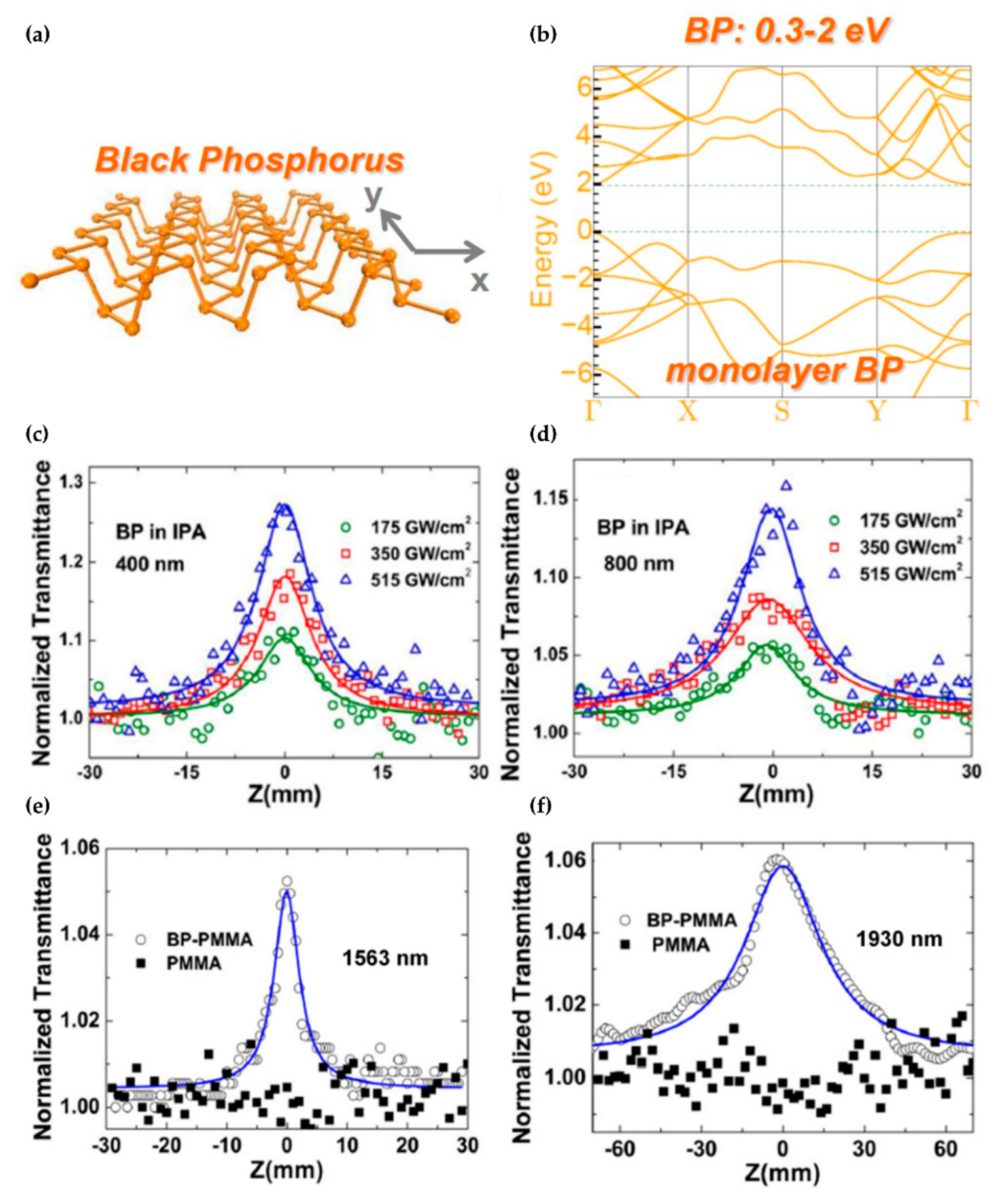
3.3. Black Phosphorus

| SA | Gain Medium | λ0 (nm) | τp (ps) | frep (KHz) | Ep (nJ) | Pave (mW) | Thickness | References |
|---|---|---|---|---|---|---|---|---|
| BP | Yb3+: CYA | 1046 | 6.2 × 10⁵ | 113.6 | - | 37 | 3~9 nm | [151] |
| BP | Yb3+: Lu3+: CALGO | 1053.4 | 0.272 | 23,800 | 6.48 | 23.8 | 5 nm | [153] |
| BP | Nd3+: YVO4 | 1064.1 | 6.1 | 140,000 | 3.29 | 460 | 5 nm | [154] |
| BP | Nd3+: GdVO4 | 1342 | 9.42 | 58,140 | 3 | 350 | 5 nm | [162] |
| BP | Er3+ silica fiber | 1532~1570 | 0.94 | 4960 | - | 5.6 | 0.6~2 nm | [148] |
| BP | Er3+ silica fiber | 1542.4 | 1 × 10⁷ | 18.5 | 90 | 1.4 | 15~20 nm | [163] |
| 1543.2 | 1.2 × 10⁷ | 9.4 | 135 | 1.35 | ||||
| BP | Er3+ silica fiber | 1555 | 0.102 | 23,900 | 0.071 | 1.7 | 3.37 | [159] |
| BP | Er3+ silica fiber | 1558 | 2.18 | 15,590 | - | 0.077 | 10 nm | [164] |
| BP | Er3+ silica fiber | 1559.5 | 0.67 | 8770 | - | 53 | 2.8~3.8 nm | [165] |
| BP | Er3+ silica fiber | 1560.7 | 0.57 | 6880 | 0.74 | 5.1 | 200 nm | [166] |
| BP | Er3+ silica fiber | 1561 | 2.66 | 1000 | 7.35 | 7.38 | 4~5 nm | [167] |
| BP | Er3+ silica fiber | 1561~1564 | 2.98 × 10⁶ | 30.098 | 283.91 | 8.545 | few-layer | [168] |
| BP | Er3+ silica fiber | 1563 | 1.32 × 10⁷ | 10.42 | 58 | 0.6 | 25 layers | [145] |
| 1571 | 0.946 | 5960 | - | - | 15 layers | |||
| BP | Zr4+/Er3+ silica fiber | 1602 | 3.46 | 1000 | 9.89 | 9.89 | few-layer | [169] |
| BP | Er3+: YAG | 1645 | 2.8 × 10⁶ | 34 | 10,000 | 330 | 4~7 nm | [170] |
| BP | Tm3+ silica fiber | 1859 | 0.139 | 20,950 | 0.97 | 20.4 | 3.4 nm | [157] |
| BP | Tm3+/Ho3+ silica fiber | 1898 | 1.58 | 19,200 | - | 2.25 | 50 nm | [171] |
| BP | Tm3+ silica fiber | 1910 | 0.739 | 36,800 | 0.04 | 1.5 | 300 nm | [146] |
| BP | Tm3+ silica fiber | 1941 | 4.38 × 10⁶ | 27.82 | 500 | 14 | 8.88 nm | [172] |
| BP | Tm3+ silica fiber | 1948 | 5.6 × 10⁶ | 28.1 | 130 | 3.8 | - | [173] |
| BP | Tm3+: YAP | 1969/1979 | 1.81 × 10⁵ | 81 | 39,500 | 3100 | 10 nm | [160] |
| BP | Tm3+ silica fiber | 2009 | 3.12 × 10⁶ | 11.6 | 3320 | 38.5 | - | [155] |
| BP | Ho3+ silica fiber | 2094 | 1.3 | 29,100 | 0.379 | 11 | 16~25 nm | [161] |
| BP | Cr2+: ZnSe | 2400 | 1.89 × 10⁵ | 176 | 205 | 36 | 6~8 nm | [156] |
| BP | Er3+: ZBLAN | 2779 | 1180 | 63 | 7600 | 485 | 5~20 nm | [147] |
| BP | Er3+: SrF2 | 2790 | 7.02 × 10⁵ | 77.03 | 2340 | 180 | 3~9 nm | [174] |
| BP | Er3+: CaF2 | 2793.8 | 9.548 × 10⁵ | 41.93 | 4250 | - | 3~9 nm | [175] |
3.4. Other Low-Dimensional Materials
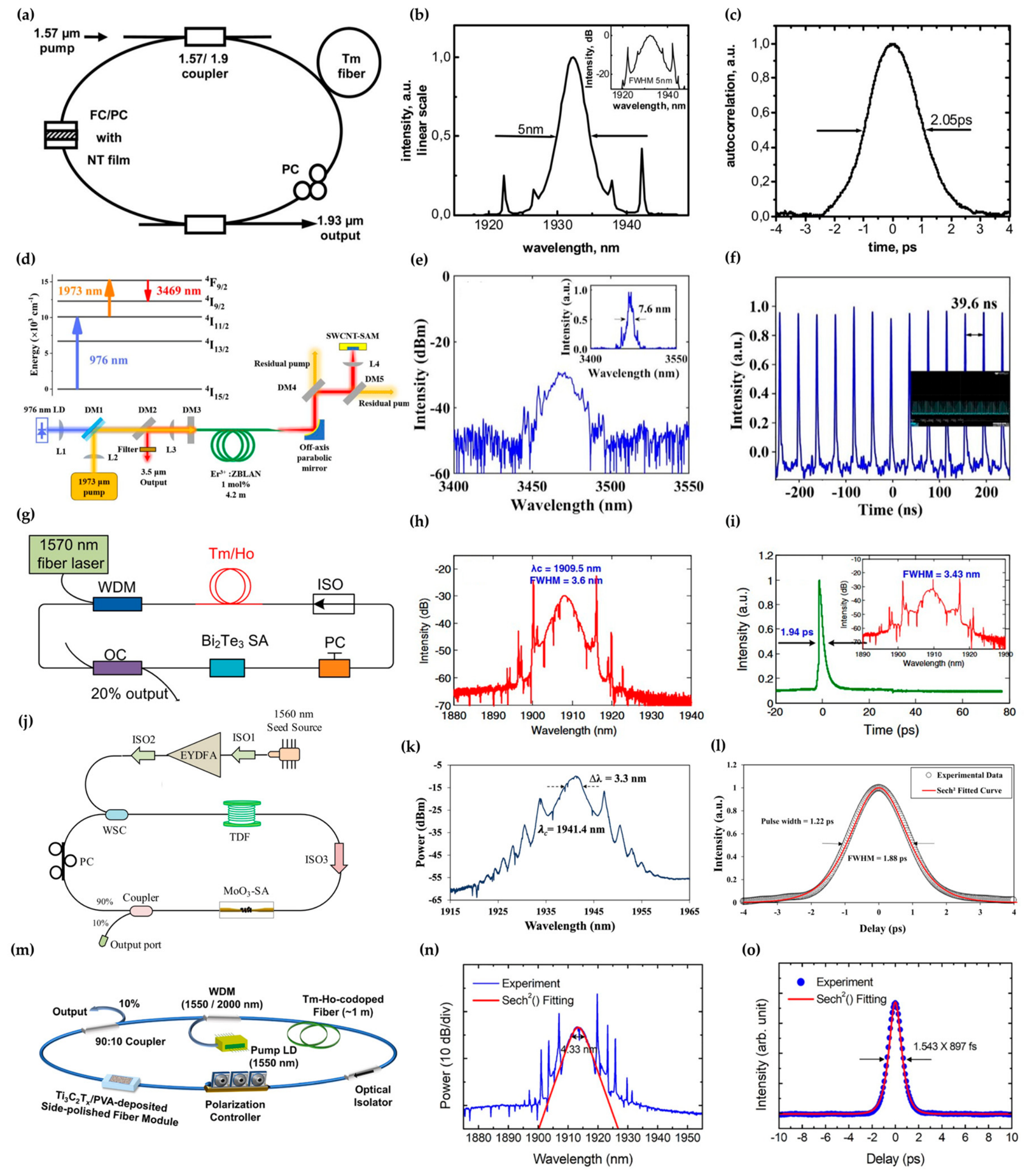
| SA | Gain Medium | λ0 (nm) | τp (ps) | frep (KHz) | Ep (nJ) | Pave (mW) | Thickness | References |
|---|---|---|---|---|---|---|---|---|
| CNT | Yb3+: CLNGG | 1049 | 0.09 | 83,000 | - | 90 | single-wall | [179] |
| CNT | Nd3+: YVO4 | 1064 | 3.1 | 167,000 | 16.1 | 2700 | single-wall | [180] |
| CNT | Er3+ silica fiber | 1560 | 0.178 | 22,800 | 0.068 | 1.55 | 35 μm | [177] |
| CNT | Tm3+ silica fiber | 1870 | 0.45 | 45,000 | 0.4 | 18 | 10 μm | [200] |
| CNT | Tm3+ silica fiber | 1895 | 0.56 | - | 1.66 | 99.4 | 50 μm | [201] |
| CNT | Tm3+ silica fiber | 1928 | 0.501 | - | 0.5 | - | 100 nm | [202] |
| CNT | Tm3+ silica fiber | 1927 | 0.152 | 25,760 | 0.19 | - | 30 μm | [203] |
| CNT | Tm3+ silica fiber | 1932 | 1.32 | 37,000 | - | 3.4 | single-wall | [178] |
| CNT | Tm3+ silica fiber | 1947 | 2.3 | 6710 | 0.45 | 3 | single-wall | [204] |
| CNT | Tm3+ silica fiber | 1941.6 | 3.7 | 17,640 | - | - | single-wall | [205] |
| CNT | Tm3+ silica fiber | 1950 | 0.972 | 21,050 | 0.109 | 2.3 | single-wall | [206] |
| CNT | Tm3+/Ho3+ silica fiber | 1860~2010 | 2.38~2.83 | 18,400 | - | - | 20 μm | [207] |
| CNT | Ho3+ silica fiber | 2079 | 0.683 | 54,520 | 0.376 | 20.5 | 400 nm | [208] |
| CNT | Er3+: ZBLAN | 3470 | 1.66 | 25,200 | 0.98 | 25 | 1 μm | [181] |
| Bi2Te3 | Tm3+/Ho3+ silica fiber | 1909.5 | 1.26 | 21,500 | - | 2.3 | 20 nm | [185] |
| Bi2Te3 | Tm3+/Ho3+ silica fiber | 1935 | 0.795 | 27,900 | - | 20 | 30 μm | [184] |
| Bi2Se3 | Tm3+/Ho3+ silica fiber | 1912 | 0.853 | 18,370 | - | - | 15 μm | [209] |
| Cd3As2 | Ho3+/Pr3+: ZBLAN | 2864.3 | 6.3 | 14,280 | - | - | 400 nm | [187] |
| CoSb3 | Tm3+/Ho3+ silica fiber | 1913 | 0.838 | 16,930 | - | - | 6 μm | [210] |
| Sb2Se3 | Er3+ silica fiber | 1560 | 2.1 × 10⁶ | 62.5 | 2.104 | 1.15 | 3~4 nm | [211] |
| Sb2Se3 | Er3+ silica fiber | 1562 | 16,500 | 3540 | 0.9 | 3.1 | 25 μm | [212] |
| Sb2Se3 | Er3+ silica fiber | 1562.4 | 0.63 | 22,600 | 0.0156 | - | 4 nm | [213] |
| Sb2Se3 | Tm3+ silica fiber | 1961 | 0.89 | 22,360 | - | - | 125 nm | [214] |
| Sb2Te3 | Er3+ silica fiber | 1542 | 0.07 | 95,400 | - | 63 | - | [186] |
| Sb2Te3 | Er3+ silica fiber | 1558 | 1.9 | 3750 | - | - | 80 nm | [215] |
| Sb2Te3 | Er3+ silica fiber | 1565.5 | 0.452 | 20,100 | 0.091 | 1.82 | 18 nm | [216] |
| Sb2Te3 | Tm3+: YAG | 2012.6 | 3.82 × 10⁵ | 56.67 | 4800 | 272 | 70 nm | [217] |
| Sb2Te3 | Ho3+ silica fiber | 2081.9 | 1.85 | 13,410 | - | 0.77 | - | [218] |
| Bi2Te3 | Er3+ silica fiber | 1560.8 | 0.286 | 18,550 | 0.027 | 0.5 | 670 nm | [219] |
| Bi2Se3 | Er3+ silica fiber | 1564.6 | 1.57 | 1210 | - | - | - | [220] |
| GaSb | Er3+ silica fiber | 1559 | 0.308 | 15,280 | 0.98 | 17.82 | 103 nm | [187] |
| Tm3+ silica fiber | 1902 | 0.585 | 19,720 | 1.37 | 64.69 | |||
| Er3+: ZBLAN | 2783 | 4.99 × 10⁵ | 137 | 3070 | 420 | |||
| Te | Er3+: ZBLAN | 2782.3 | 4.57 × 10⁵ | 116.98 | 3050 | 357 | 40.7 nm | [221] |
| TiO2 | Tm3+/Ho3+ silica fiber | 1979 | 10.29 | 9000 | 1.66 | - | 30 μm | [189] |
| TiO2 | Tm3+ silica fiber | 1925.6 | 1.5 | 11,530 | 11 | 126.8 | - | [222] |
| Fe3O4 | Er3+ silica fiber | 1560 | 3.2 × 10⁶ | 33.3 | 24 | 0.8 | 20 μm | [188] |
| Fe3O4 | Dy3+: ZBLAN | 2931.2 | 1.25 × 10⁶ | 123 | 900 | 111 | - | [190] |
| Co3O4 | Tm3+ silica fiber | 1958 | 1.39 | 11,360 | 0.023 | 0.26 | - | [223] |
| ZnO | Tm3+ silica fiber | 1945 | 1.395 | 11,360 | 0.056 | 0.64 | 45 μm | [224] |
| MoOx | Tm3+/Ho3+ silica fiber | 1937.1 | 1.64 | 11,500 | - | 1.3 | - | [225] |
| WO3 | Tm3+ silica fiber | 1941.4 | 1.22 | 10,840 | 0.68 | - | - | [191] |
| BiVO4 | Er3+ silica fiber | 1563.3 | 2.67 × 10⁶ | 76.28 | 330.76 | 25.23 | - | [226] |
| Ti3C2Tx | Yb3+ silica fiber | 1065.9 | 480 | 18,960 | - | - | - | [193] |
| Er3+ silica fiber | 1555 | 0.159 | 7280 | - | - | |||
| Ti3C2Tx | Tm3+/Ho3+ silica fiber | 1914 | 0.897 | 16,770 | - | - | 80~800 nm | [196] |
| Ti3C2Tx | Tm3+ silica fiber | 1891.8 | 2.18 | 5970 | - | 57.6 | 3~12 nm | [195] |
| Er3+: ZBLAN | 2788 | 6.4 × 10⁵ | 122.9 | 1850 | 227 | |||
| Ti2C | Tm3+/Ho3+ silica fiber | 1933.8 | 1.655 | 11,560 | - | 50.9 | - | [227] |
| Ti2AlC | 1894.5 | 1.382 | 12,400 | - | 20.4 | 5 μm | ||
| Ti3CN | Er3+ silica fiber | 1557 | 0.66 | 15,400 | - | 0.05 | 4~6 μm | [192] |
| Nb2C | Er3+ silica fiber | 1559 | 0.77 | 14,120 | 0.213 | 3.04 | - | [198] |
| V2C | Tm3+/Ho3+ silica fiber | 1937 | 1.68 | 11,520 | 0.235 | - | - | [228] |
| V2C | Tm3+/Ho3+ silica fiber | 1900 | 0.843 | 18,290 | - | - | 11 nm | [31] |
| Ni-MOF | Er3+ silica fiber | 1563 | 0.384 | 17,000 | - | - | 4.2 nm | [35] |
| Tm3+ silica fiber | 1882 | 1.3 | 13,900 | - | - |
3.5. Heterostructures


3.6. Summary
4. Synthesis Methods for LDM SAs
5. Conclusions and Outlooks
Funding
Data Availability Statement
Conflicts of Interest
References
- Kopyeva, M.S.; Filatova, S.A.; Kamynin, V.A.; Trikshev, A.I.; Kozlikina, E.I.; Astashov, V.V.; Loschenov, V.B.; Tsvetkov, V.B. Ex-Vivo Exposure on Biological Tissues in the 2-μm Spectral Range with an All-Fiber Continuous-Wave Holmium Laser. Photonics 2021, 9, 20. [Google Scholar] [CrossRef]
- Xue, Z.; Shen, F.; Li, J.; Liu, X.; Wang, J.; Wang, G.; Liu, K.; Gao, X.; Tan, T. A MEMS modulator-based dual-channel mid-infrared laser heterodyne radiometer for simultaneous remote sensing of atmospheric CH4, H2O and N2O. Opt. Express 2022, 30, 31828–31839. [Google Scholar] [PubMed]
- Mingareev, I.; Weirauch, F.; Olowinsky, A.; Shah, L.; Kadwani, P.; Richardson, M. Welding of polymers using a 2 μm thulium fiber laser. Opt. Laser Technol. 2012, 44, 2095–2099. [Google Scholar]
- Pal, A.; Sen, R.; Bremer, K.; Yao, S.; Lewis, E.; Sun, T.; Grattan, K.T.V. “All-fiber” tunable laser in the 2 μm region, designed for CO2 detection. Appl. Opt. 2012, 51, 7011. [Google Scholar] [CrossRef] [PubMed]
- Li, W.; Chen, B.; Meng, C.; Fang, W.; Xiao, Y.; Li, X.; Hu, Z.; Xu, Y.; Tong, L.; Wang, H.; et al. Ultrafast All-Optical Graphene Modulator. Nano Lett. 2014, 14, 955–959. [Google Scholar] [CrossRef] [PubMed]
- Cao, H.; Ding, M.; Chen, H.; Liu, C.; Yu, L.; Zhu, M.; Zhao, W.; Guo, J.; Li, H.; Yu, Z.; et al. High-Efficiency All-Optical Modulator Based on Ultra-Thin Silicon/Graphene Hybrid Waveguides. Adv. Opt. Mater. 2024, 12, 2301549. [Google Scholar] [CrossRef]
- Guan, X.; Wang, J.; Zhang, Y.; Xu, B.; Luo, Z.; Xu, H.; Cai, Z.; Xu, X.; Zhang, J.; Xu, J. Self-Q-switched and wavelength-tunable tungsten disulfide-based passively Q-switched Er:Y2O3 ceramic lasers. Photonics Res. 2018, 6, 830–836. [Google Scholar] [CrossRef]
- Fecko, C.J.; Loparo, J.J.; Tokmakoff, A. Generation of 45 femtosecond pulses at 3 μm with a KNbO3 optical parametric amplifier. Opt. Commun. 2004, 241, 521–528. [Google Scholar] [CrossRef]
- Simon, J. GaInAsP semiconductor laser amplifiers for single-mode fiber communications. J. Light. Technol. 1987, 5, 1286–1295. [Google Scholar] [CrossRef]
- Yu, L.; Zeng, Q.; Wang, S.; Liang, J.; Wang, J.; Wang, J.; Luo, X.; Yan, P.; Dong, F.; Liu, X.; et al. Mid-infrared ultrashort pulses generated from a hybrid mode-locked Er:ZBLAN fiber laser. Opt. Express 2023, 31, 2261. [Google Scholar] [CrossRef] [PubMed]
- Peng, R.; Khaliji, K.; Youngblood, N.; Grassi, R.; Low, T.; Li, M. Midinfrared Electro-optic Modulation in Few-Layer Black Phosphorus. Nano Lett. 2017, 17, 6315–6320. [Google Scholar] [CrossRef] [PubMed]
- Kim, J.; Koo, J.; Lee, J.H. All-fiber acousto-optic modulator based on a cladding-etched optical fiber for active mode-locking. Photonics Res. 2017, 5, 391–395. [Google Scholar] [CrossRef]
- Shu, H.; Su, Z.; Huang, L.; Wu, Z.; Wang, X.; Zhang, Z.; Zhou, Z. Significantly High Modulation Efficiency of Compact Graphene Modulator Based on Silicon Waveguide. Sci. Rep. 2018, 8, 991. [Google Scholar] [CrossRef] [PubMed]
- Zhang, Y.; Wu, K.; Guang, Z.; Guo, B.; Qiao, D.; Wei, Z.; Yang, H.; Wang, Q.; Li, K.; Copner, N.; et al. Advances and Challenges of Ultrafast Fiber Lasers in 2–4 µm Mid-Infrared Spectral Regions. Laser Photonics Rev. 2024, 18, 2300786. [Google Scholar] [CrossRef]
- Zeng, Q.; Tang, Z.; Ouyang, D.; Yu, L.; Wang, J.; Luo, X.; Dong, W.; Yan, P.; Wang, J.; Wang, P.; et al. Wavelength-tunable spatiotemporal mode-locking in a large-mode-area Er:ZBLAN fiber laser at 2.8 µm. Opt. Lett. 2024, 49, 1117–1120. [Google Scholar] [CrossRef] [PubMed]
- Pang, L.; Zhao, M.; Zhao, Q.; Li, L.; Wang, R.; Wu, R.; Lv, Y.; Liu, W. GaSb Film is a Saturable Absorber for Dissipative Soliton Generation in a Fiber Laser. ACS Appl. Mater. Interfaces 2022, 14, 55971–55978. [Google Scholar] [CrossRef] [PubMed]
- Ma, X.; Wang, C.; Zhang, J.; Wang, T.; Wang, A.; Wang, S.; Jia, Z.; Zhang, B.; He, J.; Van Smaalen, S.; et al. Broadband BiOCl Nonlinear Saturable Absorber for Watt-Level Passively Q-Switched Yb:LuAG Single Crystal Fiber Laser. Adv. Opt. Mater. 2022, 10, 2201087. [Google Scholar] [CrossRef]
- Zhang, K.; Feng, M.; Yang, J.; Li, Y.; Xie, J.; Li, Y.; Han, D.; Song, F.; Huang, W. Niobium tellurium as a novel broadband saturable absorber for pulsed fiber lasers. J. Mater. Chem. C 2022, 10, 13201–13209. [Google Scholar] [CrossRef]
- Sorokin, P.P.; Luzzi, J.J.; Lankard, J.R.; Pettit, G.D. Ruby Laser Q-Switching Elements Using Phthalocyanine Molecules in Solution. IBM J. Res. Dev. 1964, 8, 182–184. [Google Scholar] [CrossRef]
- Kück, S. Laser-related spectroscopy of ion-doped crystals for tunable solid-state lasers. Appl. Phys. B 2001, 72, 515–562. [Google Scholar] [CrossRef]
- Hultzsch, R. Passive Q-switching of the ruby laser by means of colour centres in SrF2. Phys. Status Solidi A 1978, 47, 415–423. [Google Scholar] [CrossRef]
- Keller, U.; Miller, D.A.B.; Boyd, G.D.; Chiu, T.H.; Ferguson, J.F.; Asom, M.T. Solid-state low-loss intracavity saturable absorber for Nd:YLF lasers: An antiresonant semiconductor Fabry–Perot saturable absorber. Opt. Lett. 1992, 17, 505–507. [Google Scholar] [CrossRef] [PubMed]
- Nadimi, M.; Waritanant, T.; Major, A. Passively mode-locked high power Nd:GdVO4 laser with direct in-band pumping at 912 nm. Laser Phys. Lett. 2018, 15, 015001. [Google Scholar] [CrossRef]
- Diebold, A.; Emaury, F.; Schriber, C.; Golling, M.; Saraceno, C.J.; Südmeyer, T.; Keller, U. SESAM mode-locked Yb:CaGdAlO4 thin disk laser with 62 fs pulse generation. Opt. Lett. 2013, 38, 3842–3845. [Google Scholar] [CrossRef] [PubMed]
- Waritanant, T.; Major, A. High efficiency passively mode-locked Nd:YVO4 laser with direct in-band pumping at 914 nm. Opt. Express 2016, 24, 12851–12855. [Google Scholar] [CrossRef] [PubMed]
- Bao, Q.; Zhang, H.; Wang, Y.; Ni, Z.; Yan, Y.; Shen, Z.X.; Loh, K.P.; Tang, D.Y. Atomic-Layer Graphene as a Saturable Absorber for Ultrafast Pulsed Lasers. Adv. Funct. Mater. 2009, 19, 3077–3083. [Google Scholar] [CrossRef]
- Lu, S.B.; Miao, L.L.; Guo, Z.N.; Qi, X.; Zhao, C.J.; Zhang, H.; Wen, S.C.; Tang, D.Y.; Fan, D.Y. Broadband nonlinear optical response in multi-layer black phosphorus: An emerging infrared and mid-infrared optical material. Opt. Express 2015, 23, 11183–11194. [Google Scholar] [CrossRef] [PubMed]
- Wang, K.; Wang, J.; Fan, J.; Lotya, M.; O’Neill, A.; Fox, D.; Feng, Y.; Zhang, X.; Jiang, B.; Zhao, Q.; et al. Ultrafast Saturable Absorption of Two-Dimensional MoS2 Nanosheets. ACS Nano 2013, 7, 9260–9267. [Google Scholar] [CrossRef] [PubMed]
- Wang, K.; Fang, J.; Wang, D. NiTe2-Based Saturable Absorber for a Passively Q-Switched Ytterbium-Doped Fiber Laser. Materials 2026, 19, 500. [Google Scholar] [CrossRef] [PubMed]
- Zhang, Q.; Hu, Z.; Hu, X.; Zeng, G.; He, P.; Tao, L. Metallic TaS2: A newly found transition metal dichalcogenide for Yb-doped mode-locked fiber laser. Opt. Fiber Technol. 2025, 93, 104209. [Google Scholar] [CrossRef]
- Lee, J.; Kwon, S.-Y.; Lee, J.H. Investigation on the nonlinear optical properties of V2C MXene at 1.9 μm. J. Mater. Chem. C 2021, 9, 15346–15353. [Google Scholar] [CrossRef]
- Zhang, X.; Chu, H.; Li, Y.; Zhao, S.; Li, D. Diameter-selected single-walled carbon nanotubes for the passive Q-switching operation at 2 μm. Opt. Mater. 2020, 100, 109627. [Google Scholar] [CrossRef]
- Huang, D.; Zheng, C.; Huang, L.; Wu, X.; Chen, L. Linear and nonlinear optical properties of ultrafine WO3 nanorods. Optik 2018, 156, 994–998. [Google Scholar] [CrossRef]
- Zhao, C.; Zhang, H.; Qi, X.; Chen, Y.; Wang, Z.; Wen, S.; Tang, D. Ultra-short pulse generation by a topological insulator based saturable absorber. Appl. Phys. Lett. 2012, 101, 211106. [Google Scholar] [CrossRef]
- Zhang, Q.; Jiang, X.; Zhang, M.; Jin, X.; Zhang, H.; Zheng, Z. Wideband saturable absorption in metal–organic frameworks (MOFs) for mode-locking Er- and Tm-doped fiber lasers. Nanoscale 2020, 12, 4586–4590. [Google Scholar] [CrossRef] [PubMed]
- Chen, K.-Y.; Wang, H.-S.; Su, S.-P.; Kuo, S.-W.; Lee, C.-K.; EL-Mahdy, A.F.M. Π-Electron-Extended Porphyrin-Linked Covalent Organic Framework for a Q-Switched All-Solid-State Laser. Adv. Photonics Res. 2023, 4, 2200145. [Google Scholar] [CrossRef]
- McClung, F.J.; Hellwarth, R.W. Giant Optical Pulsations from Ruby. J. Appl. Phys. 1962, 33, 828–829. [Google Scholar] [CrossRef]
- Keller, U. Recent developments in compact ultrafast lasers. Nature 2003, 424, 831–838. [Google Scholar] [CrossRef] [PubMed]
- Set, S.Y.; Yaguchi, H.; Tanaka, Y.; Jablonski, M. Laser Mode Locking Using a Saturable Absorber Incorporating Carbon Nanotubes. J. Light. Technol. 2004, 22, 51–56. [Google Scholar] [CrossRef]
- Xia, F.; Wang, H.; Xiao, D.; Dubey, M.; Ramasubramaniam, A. Two-dimensional material nanophotonics. Nat. Photonics 2014, 8, 899–907. [Google Scholar] [CrossRef]
- Li, G.; Bao, H.; Peng, Y.; Fu, X.; Liao, W.; Xiang, C. Strain controllable band alignment and the interfacial and optical properties of tellurene/GaAs van der Waals heterostructures. Phys. Chem. Chem. Phys. 2024, 26, 16327–16336. [Google Scholar] [CrossRef] [PubMed]
- Dai, M.; Set, S.Y.; Yamashita, S. Ultrafast fiber lasers mode-locked by carbon nanotube and graphene saturable absorbers: Review and prospects [Invited]. Opt. Mater. Express 2026, 16, 375. [Google Scholar] [CrossRef]
- Koski, K.J.; Wessells, C.D.; Reed, B.W.; Cha, J.J.; Kong, D.; Cui, Y. Chemical Intercalation of Zerovalent Metals into 2D Layered Bi2 Se3 Nanoribbons. J. Am. Chem. Soc. 2012, 134, 13773–13779. [Google Scholar] [CrossRef] [PubMed]
- Li, L.; Yu, Y.; Ye, G.J.; Ge, Q.; Ou, X.; Wu, H.; Feng, D.; Chen, X.H.; Zhang, Y. Black Phosphorus Field-effect Transistors. Nat. Nanotechnol. 2014, 9, 372–377. [Google Scholar] [CrossRef] [PubMed]
- Wang, F.; Di Valentin, C.; Pacchioni, G. Electronic and Structural Properties of WO3: A Systematic Hybrid DFT Study. J. Phys. Chem. C 2011, 115, 8345–8353. [Google Scholar] [CrossRef]
- Chen, X.; Wang, Y.; Shen, D.; Zhang, M.; Zhao, Y.; Zhou, L.; Qin, Q.; Zhang, Q.; He, N.; Wang, M.; et al. First-Principles Calculation and Experimental Investigation of a Three-Atoms-Type MXene V2C and Its Effects on Memristive Devices. IEEE Trans. Nanotechnol. 2021, 20, 512–516. [Google Scholar] [CrossRef]
- Geim, A.K.; Novoselov, K.S. The rise of graphene. Nat. Mater. 2007, 6, 183–191. [Google Scholar] [CrossRef] [PubMed]
- Dawlaty, J.M.; Shivaraman, S.; Chandrashekhar, M.; Rana, F.; Spencer, M.G. Measurement of Ultrafast Carrier Dynamics in Epitaxial Graphene. Appl. Phys. Lett. 2008, 92, 042116. [Google Scholar] [CrossRef]
- Neto, A.H.C.; Guinea, F.; Peres, N.M.R.; Novoselov, K.S.; Geim, A.K. The electronic properties of graphene. Rev. Mod. Phys. 2009, 81, 109. [Google Scholar] [CrossRef]
- Tan, W.D.; Su, C.Y.; Knize, R.J.; Xie, G.Q.; Li, L.J.; Tang, D.Y. Mode locking of ceramic Nd:yttrium aluminum garnet with graphene as a saturable absorber. Appl. Phys. Lett. 2010, 96, 031106. [Google Scholar] [CrossRef]
- Ma, J.; Xie, G.Q.; Lv, P.; Gao, W.L.; Yuan, P.; Qian, L.J.; Yu, H.H.; Zhang, H.J.; Wang, J.Y.; Tang, D.Y. Graphene mode-locked femtosecond laser at 2 μm wavelength. Opt. Lett. 2012, 37, 2085–2087. [Google Scholar] [CrossRef] [PubMed]
- Zhang, M.; Kelleher, E.J.R.; Torrisi, F.; Sun, Z.; Hasan, T.; Popa, D.; Wang, F.; Ferrari, A.C.; Popov, S.V.; Taylor, J.R. Tm-doped fiber laser mode-locked by graphene-polymer composite. Opt. Express 2012, 20, 25077. [Google Scholar] [CrossRef] [PubMed]
- Zen, D.I.M.; Saidin, N.; Damanhuri, S.S.A.; Harun, S.W.; Ahmad, H.; Ismail, M.A.; Dimyati, K.; Halder, A.; Paul, M.C.; Das, S.; et al. Mode-locked thulium–bismuth codoped fiber laser using graphene saturable absorber in ring cavity. Appl. Opt. 2013, 52, 1226–1229. [Google Scholar] [CrossRef] [PubMed]
- Wang, Q.; Chen, T.; Zhang, B.; Li, M.; Lu, Y.; Chen, K.P. All-fiber passively mode-locked thulium-doped fiber ring laser using optically deposited graphene saturable absorbers. Appl. Phys. Lett. 2013, 102, 131117. [Google Scholar] [CrossRef]
- Sotor, J.; Sobon, G.; Pasternak, I.; Krajewska, A.; Strupinski, W.; Abramski, K.M. Simultaneous mode-locking at 1565 nm and 1944 nm in fiber laser based on common graphene saturable absorber. Opt. Express 2013, 21, 18994–19002. [Google Scholar] [CrossRef] [PubMed]
- Cizmeciyan, M.N.; Kim, J.W.; Bae, S.; Hong, B.H.; Rotermund, F.; Sennaroglu, A. Graphene mode-locked femtosecond Cr:ZnSe laser at 2500 nm. Opt. Lett. 2013, 38, 341–343. [Google Scholar] [CrossRef] [PubMed]
- Wei, C.; Zhu, X.; Wang, F.; Xu, Y.; Balakrishnan, K.; Song, F.; Norwood, R.A.; Peyghambarian, N. Graphene Q-switched 2.78 μm Er3+-doped fluoride fiber laser. Opt. Lett. 2013, 38, 3233–3236. [Google Scholar] [CrossRef] [PubMed]
- Tang, Y.; Yu, X.; Li, X.; Yan, Z.; Wang, Q.J. High-power thulium fiber laser Q switched with single-layer graphene. Opt. Lett. 2014, 39, 614–617. [Google Scholar] [CrossRef] [PubMed]
- Choi, S.Y.; Jeong, H.; Hong, B.H.; Rotermund, F.; Yeom, D.-I. All-fiber dissipative soliton laser with 10.2 nJ pulse energy using an evanescent field interaction with graphene saturable absorber. Laser Phys. Lett. 2014, 11, 015101. [Google Scholar] [CrossRef]
- Sobon, G.; Sotor, J.; Pasternak, I.; Krajewska, A.; Strupinski, W.; Abramski, K.M. Multilayer graphene-based saturable absorbers with scalable modulation depth for mode-locked Er- and Tm-doped fiber lasers. Opt. Mater. Express 2015, 5, 2884–2894. [Google Scholar] [CrossRef]
- Sotor, J.; Pasternak, I.; Krajewska, A.; Strupinski, W.; Sobon, G. Sub-90 fs a stretched-pulse mode-locked fiber laser based on a graphene saturable absorber. Opt. Express 2015, 23, 27503–27508. [Google Scholar] [CrossRef] [PubMed]
- Purdie, D.G.; Popa, D.; Wittwer, V.J.; Jiang, Z.; Bonacchini, G.; Torrisi, F.; Milana, S.; Lidorikis, E.; Ferrari, A.C. Few-cycle pulses from a graphene mode-locked all-fiber laser. Appl. Phys. Lett. 2015, 106, 253101. [Google Scholar] [CrossRef]
- Jin, M.; Chang, K.; Li, C.; Zhang, R.; Li, Z.; Wang, X.; Chen, K. PECVD-derived graphene saturable absorber mirror for 2.8 μm pulsed Er:ZBLAN fiber laser. J. Phys. Appl. Phys. 2022, 55, 424007. [Google Scholar] [CrossRef]
- Sobon, G.; Sotor, J.; Przewolka, A.; Pasternak, I.; Strupinski, W.; Abramski, K. Amplification of noise-like pulses generated from a graphene-based Tm-doped all-fiber laser. Opt. Express 2016, 24, 20359–20364. [Google Scholar] [CrossRef] [PubMed]
- Chen, H.-R.; Tsai, C.-Y.; Cheng, H.-M.; Lin, K.-H.; Chen, C.-H.; Hsieh, W.-F. High-power passively continuous-wave and Q-switching mode-locked Nd:LuVO4 laser by few-layer graphene-oxide films. Opt. Mater. Express 2016, 6, 3927. [Google Scholar] [CrossRef]
- Zhu, G.; Zhu, X.; Wang, F.; Xu, S.; Li, Y.; Guo, X.; Balakrishnan, K.; Norwood, R.A.; Peyghambarian, N. Graphene Mode-Locked Fiber Laser at 2.8 μm. IEEE Photonics Technol. Lett. 2016, 28, 7–10. [Google Scholar] [CrossRef]
- Pawliszewska, M.; Martynkien, T.; Przewłoka, A.; Sotor, J. Dispersion-managed Ho-doped fiber laser mode-locked with a graphene saturable absorber. Opt. Lett. 2018, 43, 38. [Google Scholar] [CrossRef] [PubMed]
- Pushkin, A.V.; Migal, E.A.; Tokita, S.; Korostelin, Y.V.; Potemkin, F.V. Femtosecond graphene mode-locked Fe:ZnSe laser at 4.4 µm. Opt. Lett. 2020, 45, 738–741. [Google Scholar] [CrossRef] [PubMed]
- Lau, K.Y.; Zulkifli, M.Z. 1.56 µm and 1.93 µm synchronized mode-locked fiber laser with graphene saturable absorber. Infrared Phys. Technol. 2021, 112, 103606. [Google Scholar] [CrossRef]
- Xu, J.-L.; Li, X.-L.; Wu, Y.-Z.; Hao, X.-P.; He, J.-L.; Yang, K.-J. Graphene saturable absorber mirror for ultra-fast-pulse solid-state laser. Opt. Lett. 2011, 36, 1948–1950. [Google Scholar] [CrossRef] [PubMed]
- Li, X.; Wang, D.N.; Hua, K.; Chen, Q.; Ge, Y.; Xia, Q.K. Saturable absorber based on graphene for a hybrid passive mode-locked erbium-doped fiber laser. Opt. Fiber Technol. 2022, 70, 102867. [Google Scholar] [CrossRef]
- Ahmad, H.; Aidit, S.N.; Ooi, S.I.; Rezayi, M.; Tiu, Z.C. Passively Q-switched and mode-locked erbium doped fiber laser based on N-doped graphene saturable absorber. Laser Phys. 2017, 27, 105302. [Google Scholar] [CrossRef]
- Popa, D.; Sun, Z.; Torrisi, F.; Hasan, T.; Wang, F.; Ferrari, A.C. Sub 200fs pulse generation from a graphene mode-locked fiber laser. Appl. Phys. Lett. 2010, 97, 203106. [Google Scholar] [CrossRef]
- Muhammad, F.D.; Azis, R.S.; Latif, A.A.; Nor Asri, N.A.; Adnan, N.N.; Ahmad, H. Harmonic soliton mode-locked zirconia-based erbium-doped fiber laser with graphene saturable absorber. Laser Phys. 2026, 36, 015104. [Google Scholar] [CrossRef]
- Hua, K.; Wang, D.N. Coupling scheme for graphene saturable absorber in a linear cavity mode-locked fiber laser. Opt. Lett. 2021, 46, 4362–4365. [Google Scholar] [CrossRef] [PubMed]
- Tarka, J.; Boguslawski, J.; Sobon, G.; Pasternak, I.; Przewloka, A.; Strupinski, W.; Sotor, J.; Abramski, K.M. Power Scaling of an All-PM Fiber Er-Doped Mode-Locked Laser Based on Graphene Saturable Absorber. IEEE J. Sel. Top. Quantum Electron. 2017, 23, 60–65. [Google Scholar] [CrossRef]
- Luo, Z.; Zhou, M.; Weng, J.; Huang, G.; Xu, H.; Ye, C.; Cai, Z. Graphene-based passively Q-switched dual-wavelength erbium-doped fiber laser. Opt. Lett. 2010, 35, 3709–3711. [Google Scholar] [CrossRef] [PubMed]
- Zhang, H.; Tang, D.Y.; Zhao, L.M.; Bao, Q.L.; Loh, K.P. Large energy mode locking of an erbium-doped fiber laser with atomic layer graphene. Opt. Express 2009, 17, 17630–17635. [Google Scholar] [CrossRef] [PubMed]
- Sobon, G.; Sotor, J.; Pasternak, I.; Krajewska, A.; Strupinski, W.; Abramski, K.M. All-polarization maintaining, graphene-based femtosecond Tm-doped all-fiber laser. Opt. Express 2015, 23, 9339–9346. [Google Scholar] [CrossRef] [PubMed]
- Li, X.; Yu, X.; Sun, Z.; Yan, Z.; Sun, B.; Cheng, Y.; Yu, X.; Zhang, Y.; Wang, Q.J. High-power graphene mode-locked Tm/Ho co-doped fiber laser with evanescent field interaction. Sci. Rep. 2015, 5, 16624. [Google Scholar] [CrossRef] [PubMed]
- Yang, G.; Liu, Y.; Wang, Z.; Lou, J.; Wang, Z.; Liu, Z. Broadband wavelength tunable mode-locked thulium-doped fiber laser operating in the 2 μm region by using a graphene saturable absorber on microfiber. Laser Phys. Lett. 2016, 13, 065105. [Google Scholar] [CrossRef]
- Jeong, H.; Choi, S.Y.; Kim, M.H.; Rotermund, F.; Cha, Y.-H.; Jeong, D.-Y.; Lee, S.B.; Lee, K.; Yeom, D.-I. All-fiber Tm-doped soliton laser oscillator with 6 nJ pulse energy based on evanescent field interaction with monoloayer graphene saturable absorber. Opt. Express 2016, 24, 14152–14158. [Google Scholar] [CrossRef] [PubMed]
- Sotor, J.; Bogusławski, J.; Martynkien, T.; Mergo, P.; Krajewska, A.; Przewłoka, A.; StrupiŃski, W.; SoboŃ, G. All-polarization-maintaining, stretched-pulse Tm-doped fiber laser, mode-locked by a graphene saturable absorber. Opt. Lett. 2017, 42, 1592–1595. [Google Scholar] [CrossRef] [PubMed]
- Zuikafly, S.N.F.; Ahmad, H.; Nawawi, W.M.F.W.; Yahaya, H.; Ibrahim, M.H.; Latif, A.A.; Ahmad, F. Graphene-chitin bio-composite polymer based mode locker at 2 micron region. Optik 2021, 245, 167710. [Google Scholar] [CrossRef]
- Lin, W.; Duan, X.; Cui, Z.; Yao, B.; Dai, T.; Li, X. A passively Q-switched Ho:YVO4 Laser at 2.05 μm with Graphene Saturable Absorber. Appl. Sci. 2016, 6, 128. [Google Scholar] [CrossRef]
- Kawase, H.; Uehara, H.; Chen, H.; Yasuhara, R. Passively Q-switched 2.9 μm Er:YAP single crystal laser using graphene saturable absorber. Appl. Phys. Express 2019, 12, 102006. [Google Scholar] [CrossRef]
- Shi, A.; Bai, Z.; Qi, Y.; Wang, Y.; Huang, F.; Ding, J.; Lu, Z. Utilizing of new transition metal dihalide saturable absorbent materials for ultrashort pulse lasers development. Opt. Laser Technol. 2025, 186, 112739. [Google Scholar] [CrossRef]
- Splendiani, A.; Sun, L.; Zhang, Y.; Li, T.; Kim, J.; Chim, C.-Y.; Galli, G.; Wang, F. Emerging Photoluminescence in Monolayer MoS2. Nano Lett. 2010, 10, 1271–1275. [Google Scholar] [CrossRef] [PubMed]
- Wang, K.; Feng, Y.; Chang, C.; Zhan, J.; Wang, C.; Zhao, Q.; Coleman, J.N.; Zhang, L.; Blau, W.J.; Wang, J. Broadband ultrafast nonlinear absorption and nonlinear refraction of layered molybdenum dichalcogenide semiconductors. Nanoscale 2014, 6, 10530–10535. [Google Scholar] [CrossRef] [PubMed]
- Zhang, H.; Lu, S.B.; Zheng, J.; Du, J.; Wen, S.C.; Tang, D.Y.; Loh, K.P. Molybdenum disulfide (MoS2) as a broadband saturable absorber for ultra-fast photonics. Opt. Express 2014, 22, 7249–7260. [Google Scholar] [CrossRef] [PubMed]
- Woodward, R.I.; Kelleher, E.J.R.; Howe, R.C.T.; Hu, G.; Torrisi, F.; Hasan, T.; Popov, S.V.; Taylor, J.R. Tunable Q-switched fiber laser based on saturable edge-state absorption in few-layer molybdenum disulfide (MoS2). Opt. Express 2014, 22, 31113–31122. [Google Scholar] [CrossRef] [PubMed]
- Xia, H.; Li, H.; Lan, C.; Li, C.; Zhang, X.; Zhang, S.; Liu, Y. Ultrafast erbium-doped fiber laser mode-locked by a CVD-grown molybdenum disulfide (MoS2) saturable absorber. Opt. Express 2014, 22, 17341–17348. [Google Scholar] [CrossRef] [PubMed]
- Wang, S.; Yu, H.; Zhang, H.; Wang, A.; Zhao, M.; Chen, Y.; Mei, L.; Wang, J. Broadband Few-Layer MoS2 Saturable Absorbers. Adv. Mater. 2014, 26, 3538–3544. [Google Scholar] [CrossRef] [PubMed]
- Du, J.; Wang, Q.; Jiang, G.; Xu, C.; Zhao, C.; Xiang, Y.; Chen, Y.; Wen, S.; Zhang, H. Ytterbium-doped fiber laser passively mode locked by few-layer Molybdenum Disulfide (MoS2) saturable absorber functioned with evanescent field interaction. Sci. Rep. 2014, 4, 6346. [Google Scholar] [CrossRef] [PubMed]
- Khazaeizhad, R.; Kassani, S.H.; Jeong, H.; Yeom, D.-I.; Oh, K. Mode-locking of Er-doped fiber laser using a multilayer MoS2 thin film as a saturable absorber in both anomalous and normal dispersion regimes. Opt. Express 2014, 22, 23732–23742. [Google Scholar] [CrossRef] [PubMed]
- Xu, B.; Cheng, Y.; Wang, Y.; Huang, Y.; Peng, J.; Luo, Z.; Xu, H.; Cai, Z.; Weng, J.; Moncorgé, R. Passively Q-switched Nd:YAlO3 nanosecond laser using MoS2 as saturable absorber. Opt. Express 2014, 22, 28934–28940. [Google Scholar] [CrossRef] [PubMed]
- Chen, B.; Zhang, X.; Wu, K.; Wang, H.; Wang, J.; Chen, J. Q-switched fiber laser based on transition metal dichalcogenides MoS2, MoSe2, WS2, and WSe2. Opt. Express 2015, 23, 26723–26737. [Google Scholar] [CrossRef] [PubMed]
- Tian, Z.; Wu, K.; Kong, L.; Yang, N.; Wang, Y.; Chen, R.; Hu, W.; Xu, J.; Tang, Y. Mode-locked thulium fiber laser with MoS2. Laser Phys. Lett. 2015, 12, 065104. [Google Scholar] [CrossRef]
- Jung, M.; Lee, J.; Park, J.; Koo, J.; Jhon, Y.M.; Lee, J.H. Mode-locked, 1.94-μm, all-fiberized laser using WS2-based evanescent field interaction. Opt. Express 2015, 23, 19996–20006. [Google Scholar] [CrossRef] [PubMed]
- Fan, M.; Li, T.; Zhao, S.; Li, G.; Ma, H.; Gao, X.; Kränkel, C.; Huber, G. Watt-level passively Q-switched Er:Lu2O3 laser at 2.84 μm using MoS2. Opt. Lett. 2016, 41, 540–543. [Google Scholar] [CrossRef] [PubMed]
- Liu, W.; Pang, L.; Han, H.; Liu, M.; Lei, M.; Fang, S.; Teng, H.; Wei, Z. Tungsten disulfide saturable absorbers for 67 fs mode-locked erbium-doped fiber lasers. Opt. Express 2017, 25, 2950–2959. [Google Scholar] [CrossRef] [PubMed]
- Yin, J.; Li, J.; Chen, H.; Wang, J.; Yan, P.; Liu, M.; Liu, W.; Lu, W.; Xu, Z.; Zhang, W.; et al. Large-area highly crystalline WSe2 atomic layers for ultrafast pulsed lasers. Opt. Express 2017, 25, 30020–30031. [Google Scholar] [CrossRef] [PubMed]
- Wang, J.; Jiang, Z.; Chen, H.; Li, J.; Yin, J.; Wang, J.; He, T.; Yan, P.; Ruan, S. Magnetron-sputtering deposited WTe2 for an ultrafast thulium-doped fiber laser. Opt. Lett. 2017, 42, 5010–5013. [Google Scholar] [CrossRef] [PubMed]
- Wang, J.; Jiang, Z.; Chen, H.; Li, J.; Yin, J.; Wang, J.; He, T.; Yan, P.; Ruan, S. High energy soliton pulse generation by a magnetron-sputtering-deposition-grown MoTe2 saturable absorber. Photonics Res. 2018, 6, 535–541. [Google Scholar] [CrossRef]
- Lv, R.; Chen, Z.; Liu, S.; Wang, J.; Li, Y.; Wang, Y.; Wang, Y. Optical properties and applications of molybdenum disulfide/SiO2 saturable absorber fabricated by sol-gel technique. Opt. Express 2019, 27, 6348–6356. [Google Scholar] [CrossRef] [PubMed]
- Wang, M.; Zheng, Y.; Guo, L.; Chen, X.; Zhang, H.; Li, D. Nonlinear Optical Properties of Zirconium Diselenide and Its Ultra-Fast Modulator Application. Nanomaterials 2019, 9, 1419. [Google Scholar] [CrossRef] [PubMed]
- Sheng, Q.; Tang, S.; Ye, F.; Lu, C.; Wang, G.; Zhang, H.; Bai, C.; Zhang, W. Generation of dual large energy pulses in Er3+-doped fiber lasers based on ZrTe2 saturable absorber via polarization manipulation. Opt. Laser Technol. 2024, 169, 110117. [Google Scholar] [CrossRef]
- Ahmad, H.; Kahar, N.H.A.; Yusoff, N.; Reduan, S.A. Thulium-holmium doped fiber laser mode-locking with hafnium disulfide (HfS2) coated on D-shaped fiber. Optik 2021, 246, 167785. [Google Scholar] [CrossRef]
- Ahmad, H.; Azali, N.A.; Yusoff, N. Liquid phase exfoliation of hafnium diselenide and its role in initiating the mode-locked pulse laser at eye-safe wavelength region. Opt. Mater. 2022, 123, 111933. [Google Scholar] [CrossRef]
- Ahmad, H.; Ariffin, N.A.M.; Aidit, S.N.; Ooi, S.I.; Yusoff, N.; Zamzuri, A.K. 1.9 μm mode-locked fiber laser based on evanescent field interaction with metallic vanadium diselenide (VSe2). Optik 2021, 230, 166280. [Google Scholar] [CrossRef]
- Zhang, W.; Liang, Y.; Gan, Y.; Huang, H.; Liang, G.; Kang, Q.; Leng, X.; Jing, Q.; Wen, Q. VTe2: Broadband Saturable Absorber for Passively Q-Switched Lasers in the Near- and Mid-Infrared Regions. ACS Appl. Mater. Interfaces 2023, 15, 57475–57485. [Google Scholar] [CrossRef] [PubMed]
- Liu, W.; Liu, K.; Feng, F.; Li, R.; Zhang, W.; Wang, X.; Liu, J.; Chen, K. Atomic Oxygen-Passivated 2D Zr/Ta Telluride Crystals as Saturable Absorbers for High Power Mid-Infrared Pulse Generation. Adv. Funct. Mater. 2025, 36, e30237. [Google Scholar] [CrossRef]
- Sun, S.; Zhao, Z.; Fu, S. Conventional and bound-state solitons generation in erbium-doped fiber lasers based on saturable absorbers of ReSe2. Opt. Fiber Technol. 2025, 94, 104365. [Google Scholar] [CrossRef]
- Xu, N.; Shang, X.; Yang, F.; Sui, Z.; Zhang, H.; Li, D. Nonlinear photoresponse of PdSe2 nanosheets for soliton operations in passive mode-locked Er-doped fiber lasers. Infrared Phys. Technol. 2023, 131, 104626. [Google Scholar] [CrossRef]
- Cheng, P.K.; Ahmed, S.; Qiao, J.; Wong, L.W.; Yuen, C.F.; Saleque, A.M.; Ivan, M.N.A.S.; Hani, S.U.; Hossain, M.I.; Zhao, J.; et al. Nonlinear optical properties of two-dimensional palladium ditelluride (PdTe2) and its application as aerosol jet printed saturable absorbers for broadband ultrafast photonics. Appl. Mater. Today 2022, 26, 101296. [Google Scholar] [CrossRef]
- Ahmad, H.; Reduan, S.A.; Aidit, S.N.; Yusoff, N.; Maah, M.J.; Ismail, M.F.; Tiu, Z.C. Ternary MoWSe2 alloy saturable absorber for passively Q-switched Yb-, Er- and Tm-doped fiber laser. Opt. Commun. 2019, 437, 355–362. [Google Scholar] [CrossRef]
- Wang, H.; He, X.; Hao, Q.; Zhou, Y.; Li, L. High average power passively Q-switched 2-μm laser with Mo0.5W0.5S2 as a saturable absorber. Opt. Mater. 2024, 155, 115827. [Google Scholar] [CrossRef]
- Ahmad, H.; Hidayah Abdul Kahar, N.; Yusoff, N.; Izzat Mohd Hanafi, A.; Ramli, R.; Wadi Harun, S.; Aisyah Reduan, S. Passively mode-locked laser using HfSe2 as saturable absorber at 1.5 μm and 2.0 μm. Opt. Laser Technol. 2022, 155, 108397. [Google Scholar] [CrossRef]
- Chen, J.; Xie, Z.; Huang, J.; Hu, Z.; Zhao, Y.; Zheng, Z.; He, J.; Long, H.; Tao, L. Unveiling the modulation potential: Comparison of MoS2 and MoSe2 as saturable absorbers in ultrafast fiber lasers. Opt. Laser Technol. 2024, 177, 111166. [Google Scholar] [CrossRef]
- Wang, F.; Sun, S.; Zhang, X.; Tan, H.; Zhu, G.; Xu, W.; Huang, Y.; Sun, M.; Jia, Y.; Li, Z.; et al. Passively mode-locking fiber lasers for generating high repetition frequency pulse based on MoWSe2 saturable absorbers. Opt. Mater. 2025, 164, 117054. [Google Scholar] [CrossRef]
- Cao, L.; Li, X.; Zhang, R.; Wu, D.; Dai, S.; Peng, J.; Weng, J.; Nie, Q. Tm-doped fiber laser mode-locking with MoS2-polyvinyl alcohol saturable absorber. Opt. Fiber Technol. 2018, 41, 187–192. [Google Scholar] [CrossRef]
- Latiff, A.A.; Cheng, X.S.; Rusdi, M.F.M.; Paul, M.C.; Harun, S.W.; Ahmad, H. Molybdenum disulfide saturable absorber for eye-safe mode-locked fiber laser generation. J. Nonlinear Opt. Phys. Mater. 2018, 27, 1850010. [Google Scholar] [CrossRef]
- Wang, S.; Tang, Y.; Yang, J.; Zhong, H.; Fan, D. MoS2 Q-switched 2.8 µm Er:ZBLAN fiber laser. Laser Phys. 2019, 29, 025101. [Google Scholar] [CrossRef]
- Dong, L.; Li, D.; Pan, H.; Li, Y.; Zhao, S.; Li, G.; Chu, H. Pulse characteristics from a MoSe2 Q-switched Nd:GdVO4 laser at 1.3 µm. Appl. Opt. 2019, 58, 8194–8199. [Google Scholar] [CrossRef] [PubMed]
- Lee, J.; Koo, J.; Lee, J.; Jhon, Y.M.; Lee, J.H. All-fiberized, femtosecond laser at 1912 nm using a bulk-like MoSe2 saturable absorber. Opt. Mater. Express 2017, 7, 2968–2979. [Google Scholar] [CrossRef]
- Wu, M.; Li, X.; Wu, K.; Wu, D.; Dai, S.; Xu, T.; Nie, Q. All-fiber 2 μm thulium-doped mode-locked fiber laser based on MoSe2-saturable absorber. Opt. Fiber Technol. 2019, 47, 152–157. [Google Scholar] [CrossRef]
- Wang, X.; Han, H.; Liu, D. Generation of Bright-Dark Soliton Pairs in Mode-Locked Fiber Laser Based on Molybdenum Diselenide. IEEE Access 2020, 8, 160427–160432. [Google Scholar] [CrossRef]
- Ahmad, H.; Ramli, R.; Samion, M.Z.; Yusoff, N. Mode-locked thulium/holmium co-doped fiber laser using WTe2-covered tapered fiber. Optik 2021, 245, 167723. [Google Scholar] [CrossRef]
- Zheng, Z.; Wang, J.; Yin, J.; Ouyang, D.; Ren, X.; Yan, P.; Wang, J.; Pei, J.; Lue, Q.; Ruan, S. High-power mode-locked thulium-doped fiber laser with tungsten ditelluride as saturable absorber. Appl. Opt. 2020, 59, 196. [Google Scholar] [CrossRef] [PubMed]
- Ahmad, H.; Albaqawi, H.S.; Yusoff, N.; Yi, C.W. 56 nm Wide-Band Tunable Q-Switched Erbium Doped Fiber Laser with Tungsten Ditelluride (WTe2) Saturable Absorber. Sci. Rep. 2020, 10, 9860. [Google Scholar] [CrossRef] [PubMed]
- Yu, H.; Zheng, X.; Yin, K.; Cheng, X.; Jiang, T. All-fiber thulium/holmium-doped mode-locked laser by tungsten disulfide saturable absorber. Laser Phys. 2017, 27, 015102. [Google Scholar] [CrossRef]
- Luan, C.; Yang, K.; Zhao, J.; Zhao, S.; Song, L.; Li, T.; Chu, H.; Qiao, J.; Wang, C.; Li, Z.; et al. WS2 as a saturable absorber for Q-switched 2 micron lasers. Opt. Lett. 2016, 41, 3783–3786. [Google Scholar] [CrossRef] [PubMed]
- Chen, S.; Wang, F.; Kuang, F.; Kang, S.; Liang, H.; Zheng, L.; Guan, L.; Wu, Q. Femtosecond Pulsed Fiber Laser by an Optical Device Based on NaOH-LPE Prepared WSe2 Saturable Absorber. Nanomaterials 2022, 12, 2747. [Google Scholar] [CrossRef] [PubMed]
- Zou, D.; Yan, M.; Chai, L.; Song, Y.; Hu, M. (INVITED)A diverse set of soliton molecules generation in a passively mode-locked Er-doped fiber laser with a saturable absorber of WSe2 nanofilm. Results Opt. 2022, 7, 100225. [Google Scholar] [CrossRef]
- Zheng, J.; Zong, M.; Ye, K.; Feng, X.; Liu, J.; Liu, J.; Liu, D.; Liu, Z. Monolayer WSe2 Film as Saturable Absorbers for Mid-Infrared Passive Q-Switching. Microw. Opt. Technol. Lett. 2025, 67, e70119. [Google Scholar] [CrossRef]
- Ge, Y.; Zhu, Z.; Xu, Y.; Chen, Y.; Chen, S.; Liang, Z.; Song, Y.; Zou, Y.; Zeng, H.; Xu, S.; et al. Broadband Nonlinear Photoresponse of 2D TiS2 for Ultrashort Pulse Generation and All-Optical Thresholding Devices. Adv. Opt. Mater. 2018, 6, 1701166. [Google Scholar] [CrossRef]
- He, Y.; Wang, L.; Li, S.; Tang, Y.; Lu, C.; Zhang, W.; Wang, G.; Bai, C.; Li, Z.; Zhang, H.; et al. Correlation between soliton state and power in erbium-doped fiber lasers based on PtS2 saturable absorbers. Opt. Mater. 2024, 157, 116214. [Google Scholar] [CrossRef]
- Jiang, S.; Wei, C.; Zheng, L.; Zhou, H.; Liu, W.; Zhang, J.; Zhang, H.; Liu, Y. PtSe2 as a Wideband Saturable Absorber for Passively Q-Switched High-Power Mid-Infrared Fiber Laser. IEEE Photonics Technol. Lett. 2022, 34, 181–184. [Google Scholar] [CrossRef]
- Wang, P.; Zhang, H.; Yin, Y.; Ouyang, Q.; Chen, Y.; Lewis, E.; Farrell, G.; Tokurakawa, M.; Wadi Harun, S.; Wang, C.; et al. NiS2 as a broadband saturable absorber for ultrafast pulse lasers. Opt. Laser Technol. 2020, 132, 106492. [Google Scholar] [CrossRef]
- He, J.; Lu, H.; Tao, L.; Zhao, Y.; Zheng, Z.; Zhou, B. Novel two-dimensional semi-metallic NiTe2 based saturable absorber for ultrafast mode-locked fiber laser. Infrared Phys. Technol. 2022, 123, 104195. [Google Scholar] [CrossRef]
- Hu, Z.; Hu, X.; He, P.; Chen, J.; Huang, J.; Xie, Z.; Zhao, Y.; Tao, L.; Hao, M.; He, J. NbS2-nanosheet-based saturable absorber for 1.5 µm and 2 µm ultrafast fiber lasers. Photonics Nanostruct.-Fundam. Appl. 2023, 54, 101117. [Google Scholar] [CrossRef]
- Wang, J.; Chen, H.; Jiang, Z.; Yin, J.; Wang, J.; Zhang, M.; He, T.; Li, J.; Yan, P.; Ruan, S. Mode-locked thulium-doped fiber laser with chemical vapor deposited molybdenum ditelluride. Opt. Lett. 2018, 43, 1998–2001. [Google Scholar] [CrossRef] [PubMed]
- Debnath, P.C.; Kim, H.; Yim, J.H.; Ha, S.; Ryu, S.; Min, T.; Yoo, Y.; Yeom, D.-I. Phase-Engineered MoTe2 Saturable Absorbers for Diverse Fiber Pulse Laser Operations. J. Light. Technol. 2026, 44, 273–279. [Google Scholar] [CrossRef]
- Wang, Y.; Huang, G.; Mu, H.; Lin, S.; Chen, J.; Xiao, S.; Bao, Q.; He, J. Ultrafast recovery time and broadband saturable absorption properties of black phosphorus suspension. Appl. Phys. Lett. 2015, 107, 091905. [Google Scholar] [CrossRef]
- Chen, Y.; Jiang, G.; Chen, S.; Guo, Z.; Yu, X.; Zhao, C.; Zhang, H.; Bao, Q.; Wen, S.; Tang, D.; et al. Mechanically exfoliated black phosphorus as a new saturable absorber for both Q-switching and Mode-locking laser operation. Opt. Express 2015, 23, 12823–12833. [Google Scholar] [CrossRef] [PubMed]
- Sotor, J.; Sobon, G.; Kowalczyk, M.; Macherzynski, W.; Paletko, P.; Abramski, K.M. Ultrafast thulium-doped fiber laser mode locked with black phosphorus. Opt. Lett. 2015, 40, 3885–3888. [Google Scholar] [CrossRef] [PubMed]
- Qin, Z.; Xie, G.; Zhang, H.; Zhao, C.; Yuan, P.; Wen, S.; Qian, L. Black phosphorus as saturable absorber for the Q-switched Er:ZBLAN fiber laser at 2.8 μm. Opt. Express 2015, 23, 24713–24718. [Google Scholar] [CrossRef] [PubMed]
- Luo, Z.-C.; Liu, M.; Guo, Z.-N.; Jiang, X.-F.; Luo, A.-P.; Zhao, C.-J.; Yu, X.-F.; Xu, W.-C.; Zhang, H. Microfiber-based few-layer black phosphorus saturable absorber for ultra-fast fiber laser. Opt. Express 2015, 23, 20030–20039. [Google Scholar] [CrossRef] [PubMed]
- Mu, H.; Lin, S.; Wang, Z.; Xiao, S.; Li, P.; Chen, Y.; Zhang, H.; Lau, S.P.; Pan, C.; Fan, D. Black Phosphorus-Polymer Composites for Pulsed Lasers. Adv. Opt. Mater. 2015, 3, 1447–1453. [Google Scholar] [CrossRef]
- Zhang, R.; Zhang, Y.; Yu, H.; Zhang, H.; Yang, R.; Liu, Z.; Wang, J. Broadband black phosphorus optical modulator in visible to mid-infrared spectral range. Adv. Opt. Mater. 2015, 3, 1787–1792. [Google Scholar] [CrossRef]
- Ma, J.; Lu, S.; Guo, Z.; Xu, X.; Zhang, H.; Tang, D.; Fan, D. Few-layer black phosphorus based saturable absorber mirror for pulsed solid-state lasers. Opt. Express 2015, 23, 22643–22648. [Google Scholar] [CrossRef] [PubMed]
- Lu, D.; Pan, Z.; Zhang, R.; Xu, T.; Yang, R.; Yang, B.; Liu, Z.; Yu, H.; Zhang, H.; Wang, J. Passively Q-switched ytterbium-doped ScBO3 laser with black phosphorus saturable absorber. Opt. Eng. 2016, 55, 081312. [Google Scholar] [CrossRef]
- Su, X.; Wang, Y.; Zhang, B.; Zhao, R.; Yang, K.; He, J.; Hu, Q.; Jia, Z.; Tao, X. Femtosecond solid-state laser based on a few-layered black phosphorus saturable absorber. Opt. Lett. 2016, 41, 1945–1948. [Google Scholar] [CrossRef] [PubMed]
- Zhang, B.; Lou, F.; Zhao, R.; He, J.; Li, J.; Su, X.; Ning, J.; Yang, K. Exfoliated layers of black phosphorus as saturable absorber for ultrafast solid-state laser. Opt. Lett. 2015, 40, 3691–3694. [Google Scholar] [CrossRef] [PubMed]
- Xie, Y.; Kong, L.; Qin, Z.; Xie, G.; Zhang, J. Black phosphorus-based saturable absorber for Q-switched Tm:YAG ceramic laser. Opt. Eng. 2016, 55, 081307. [Google Scholar] [CrossRef]
- Wang, Z.; Zhao, R.; He, J.; Zhang, B.; Ning, J.; Wang, Y.; Su, X.; Hou, J.; Lou, F.; Yang, K.; et al. Multi-layered black phosphorus as saturable absorber for pulsed Cr:ZnSe laser at 2.4 μm. Opt. Express 2016, 24, 1598–1603. [Google Scholar] [CrossRef] [PubMed]
- Zhang, Q.; Jin, X.; Hu, G.; Zhang, M.; Zheng, Z.; Hasan, T. Sub-150 fs dispersion-managed soliton generation from an all-fiber Tm-doped laser with BP-SA. Opt. Express 2020, 28, 34104–34110. [Google Scholar] [CrossRef] [PubMed]
- Qin, Z.; Hai, T.; Xie, G.; Ma, J.; Yuan, P.; Qian, L.; Li, L.; Zhao, L.; Shen, D. Black phosphorus Q-switched and mode-locked mid-infrared Er:ZBLAN fiber laser at 3.5 μm wavelength. Opt. Express 2018, 26, 8224–8231. [Google Scholar] [CrossRef] [PubMed]
- Jin, X.; Hu, G.; Zhang, M.; Hu, Y.; Albrow-Owen, T.; Howe, R.C.T.; Wu, T.-C.; Wu, Q.; Zheng, Z.; Hasan, T. 102 fs pulse generation from a long-term stable, inkjet-printed black phosphorus-mode-locked fiber laser. Opt. Express 2018, 26, 12506–12513. [Google Scholar] [CrossRef] [PubMed]
- Zhang, H.; He, J.; Wang, Z.; Hou, J.; Zhang, B.; Zhao, R.; Han, K.; Yang, K.; Nie, H.; Sun, X. Dual-wavelength, passively Q-switched Tm:YAP laser with black phosphorus saturable absorber. Opt. Mater. Express 2016, 6, 2328–2335. [Google Scholar] [CrossRef]
- Pawliszewska, M.; Ge, Y.; Li, Z.; Zhang, H.; Sotor, J. Fundamental and harmonic mode-locking at 2.1 μm with black phosphorus saturable absorber. Opt. Express 2017, 25, 16916–16921. [Google Scholar] [CrossRef] [PubMed]
- Sun, X.; Nie, H.; He, J.; Zhao, R.; Su, X.; Wang, Y.; Zhang, B.; Wang, R.; Yang, K. Passively mode-locked 1.34 μm bulk laser based on few-layer black phosphorus saturable absorber. Opt. Express 2017, 25, 20025–20032. [Google Scholar] [CrossRef] [PubMed]
- Liu, J.; Chen, Y.; Li, Y.; Zhang, H.; Zheng, S.; Xu, S. Switchable dual-wavelength Q-switched fiber laser using multilayer black phosphorus as a saturable absorber. Photonics Res. 2018, 6, 198–203. [Google Scholar] [CrossRef]
- Park, K.; Lee, J.; Lee, Y.T.; Choi, W.; Lee, J.H.; Song, Y. Black phosphorus saturable absorber for ultrafast mode-locked pulse laser via evanescent field interaction. Ann. Phys. 2015, 527, 770–776. [Google Scholar] [CrossRef]
- Song, Y.; Chen, S.; Zhang, Q.; Li, L.; Zhao, L.; Zhang, H.; Tang, D. Vector soliton fiber laser passively mode locked by few layer black phosphorus-based optical saturable absorber. Opt. Express 2016, 24, 25933–25942. [Google Scholar] [CrossRef] [PubMed]
- Ahmed, M.H.M.; Latiff, A.A.; Arof, H.; Harun, S.W. Ultrafast erbium-doped fiber laser mode-locked with a black phosphorus saturable absorber. Laser Phys. Lett. 2016, 13, 095104. [Google Scholar] [CrossRef]
- Ismail, E.I.; Kadir, N.A.; Latiff, A.A.; Ahmad, H.; Harun, S.W. Black phosphorus crystal as a saturable absorber for both a Q-switched and mode-locked erbium-doped fiber laser. RSC Adv. 2016, 6, 72692–72697. [Google Scholar] [CrossRef]
- Liu, S.; Zhang, Y.; Li, L.; Wang, Y.; Lv, R.; Wang, X.; Chen, Z.; Wei, L. Er-doped Q-switched fiber laser with a black phosphorus/polymethyl methacrylate saturable absorber. Appl. Opt. 2018, 57, 1292–1295. [Google Scholar] [CrossRef] [PubMed]
- Markom, A.M.; Tan, S.J.; Muhammad, A.R.; Paul, M.C.; Dhar, A.; Das, S.; Latiff, A.A.; Harun, S.W. Dark pulse mode-locked fibre laser with zirconia-based erbium-doped fibre (Zr-EDF) and Black phosphorus saturable absorber. Optik 2020, 223, 165635. [Google Scholar] [CrossRef]
- Guo, L.; Li, T.; Zhang, S.; Wang, M.; Yang, K.; Fan, M.; Zhao, S.; Li, M. Black phosphorus saturable absorber for Q-switched Er:YAG laser at 1645 nm. Opt. Laser Technol. 2018, 100, 225–229. [Google Scholar] [CrossRef]
- Yu, H.; Zheng, X.; Yin, K.; Cheng, X.; Jiang, T. Thulium/holmium-doped fiber laser passively mode locked by black phosphorus nanoplatelets-based saturable absorber. Appl. Opt. 2015, 54, 10290–10294. [Google Scholar] [CrossRef] [PubMed]
- Latiff, A.A.; Rusdi, M.F.M.; Jusoh, Z.; Yasin, M.; Ahmad, H.; Harun, S.W. 1941 nm Q-switched thulium-doped fiber laser with a multi-layer black phosphorus saturable absorber. Optoelectron. Adv. Mater.-Rapid Commun. 2016, 10, 801–806. [Google Scholar]
- Wang, Y.; Li, J.; Han, L.; Lu, R.; Hu, Y.; Li, Z.; Liu, Y. Q-switched Tm3+-doped fiber laser with a micro-fiber based black phosphorus saturable absorber. Laser Phys. 2016, 26, 065104. [Google Scholar] [CrossRef]
- Liu, J.; Liu, J.; Guo, Z.; Zhang, H.; Ma, W.; Wang, J.; Su, L. Dual-wavelength Q-switched Er:SrF2 laser with a black phosphorus absorber in the mid-infrared region. Opt. Express 2016, 24, 30289–30295. [Google Scholar] [CrossRef] [PubMed]
- Li, C.; Liu, J.; Guo, Z.; Zhang, H.; Ma, W.; Wang, J.; Xu, X.; Su, L. Black phosphorus saturable absorber for a diode-pumped passively Q-switched Er:CaF2 mid-infrared laser. Opt. Commun. 2018, 406, 158–162. [Google Scholar] [CrossRef]
- Ostojic, G.N.; Zaric, S.; Kono, J.; Strano, M.S.; Moore, V.C.; Hauge, R.H.; Smalley, R.E. Interband Recombination Dynamics in Resonantly Excited Single-Walled Carbon Nanotubes. Phys. Rev. Lett. 2004, 92, 117402. [Google Scholar] [CrossRef] [PubMed]
- Rozhin, A.G.; Sakakibara, Y.; Namiki, S.; Tokumoto, M.; Kataura, H.; Achiba, Y. Sub-200-fs pulsed erbium-doped fiber laser using a carbon nanotube-polyvinylalcohol mode locker. Appl. Phys. Lett. 2006, 88, 051118. [Google Scholar] [CrossRef]
- Solodyankin, M.A.; Obraztsova, E.D.; Lobach, A.S.; Chernov, A.I.; Tausenev, A.V.; Konov, V.I.; Dianov, E.M. Mode-locked 1.93 μm thulium fiber laser with a carbon nanotube absorber. Opt. Lett. 2008, 33, 1336–1338. [Google Scholar] [CrossRef] [PubMed]
- Zhang, Y.; Petrov, V.; Griebner, U.; Zhang, X.; Choi, S.Y.; Gwak, J.Y.; Rotermund, F.; Mateos, X.; Yu, H.; Zhang, H.; et al. 90-fs diode-pumped Yb:CLNGG laser mode-locked using single-walled carbon nanotube saturable absorber. Opt. Express 2014, 22, 5635–5640. [Google Scholar] [CrossRef] [PubMed]
- Tang, C.Y.; Chai, Y.; Long, H.; Tao, L.; Zeng, L.H.; Tsang, Y.H.; Zhang, L.; Lin, X. High-power passively mode-locked Nd:YVO4 laser using SWCNT saturable absorber fabricated by dip coating method. Opt. Express 2015, 23, 4880–4886. [Google Scholar] [CrossRef] [PubMed]
- Wei, J.; Li, P.; Yu, L.; Ruan, S.; Li, K.; Yan, P.; Wang, J.; Wang, J.; Guo, C.; Liu, W.; et al. Mode-locked fiber laser of 3.5 μm using a single-walled carbon nanotube saturable absorber mirror. Chin. Opt. Lett. 2022, 20, 011404. [Google Scholar] [CrossRef]
- Zhang, H.; Liu, C.-X.; Qi, X.-L.; Dai, X.; Fang, Z.; Zhang, S.-C. Topological insulators in Bi2Se3, Bi2Te3 and Sb2Te3 with a single Dirac cone on the surface. Nat. Phys. 2009, 5, 438–442. [Google Scholar] [CrossRef]
- Yu, H.; Zhang, H.; Wang, Y.; Zhao, C.; Wang, B.; Wen, S.; Zhang, H.; Wang, J. Topological insulator as an optical modulator for pulsed solid-state lasers. Laser Photonics Rev. 2013, 7, L77–L83. [Google Scholar] [CrossRef]
- Jung, M.; Lee, J.; Koo, J.; Park, J.; Song, Y.-W.; Lee, K.; Lee, S.; Lee, J.H. A femtosecond pulse fiber laser at 1935 nm using a bulk-structured Bi2Te3 topological insulator. Opt. Express 2014, 22, 7865–7874. [Google Scholar] [CrossRef] [PubMed]
- Yin, K.; Zhang, B.; Li, L.; Jiang, T.; Zhou, X.; Hou, J. Soliton mode-locked fiber laser based on topological insulator Bi2Te3 nanosheets at 2 μm. Photonics Res. 2015, 3, 72–76. [Google Scholar] [CrossRef]
- Liu, W.; Pang, L.; Han, H.; Tian, W.; Chen, H.; Lei, M.; Yan, P.; Wei, Z. 70-fs mode-locked erbium-doped fiber laser with topological insulator. Sci. Rep. 2016, 6, 19997. [Google Scholar] [CrossRef] [PubMed]
- Zhu, C.; Wang, F.; Meng, Y.; Yuan, X.; Xiu, F.; Luo, H.; Wang, Y.; Li, J.; Lv, X.; He, L.; et al. A robust and tuneable mid-infrared optical switch enabled by bulk Dirac fermions. Nat. Commun. 2017, 8, 14111. [Google Scholar] [CrossRef] [PubMed]
- Hou, S.; Lu, C.; Ma, Z.; Kang, L.; Lin, H.; Zhang, M.; Yan, P. Broadband GaSb saturable absorber for pulse generation from C-band to mid-infrared. J. Lumin. 2022, 244, 118716. [Google Scholar] [CrossRef]
- Bai, X.; Mou, C.; Xu, L.; Wang, S.; Pu, S.; Zeng, X. Passively Q-switched erbium-doped fiber laser using Fe3O4-nanoparticle saturable absorber. Appl. Phys. Express 2016, 9, 042701. [Google Scholar] [CrossRef]
- Mohd Rusdi, M.F.; Latiff, A.A.; Paul, M.C.; Das, S.; Dhar, A.; Ahmad, H.; Harun, S.W. Titanium Dioxide (TiO2) film as a new saturable absorber for generating mode-locked Thulium-Holmium doped all-fiber laser. Opt. Laser Technol. 2017, 89, 16–20. [Google Scholar] [CrossRef]
- Yang, J.; Hu, J.; Luo, H.; Li, J.; Liu, J.; Li, X.; Liu, Y. Fe3O4 nanoparticles as a saturable absorber for a tunable Q-switched dysprosium laser around 3 μm. Photonics Res. 2020, 8, 70–77. [Google Scholar] [CrossRef]
- Ahmed, M.H.M.; Mohd Yusoff, N.; Zainol Abidin, N.H.; Lee, H.K.; Alresheedi, M.T.; Abas, A.F.; Goh, C.S.; Mahdi, M.A. Ultrashort pulse thulium-doped fiber laser with molybdenum trioxide on tapered fiber. Optik 2022, 257, 168736. [Google Scholar] [CrossRef]
- Jhon, Y.I.; Koo, J.; Anasori, B.; Seo, M.; Lee, J.H.; Gogotsi, Y.; Jhon, Y.M. Metallic MXene Saturable Absorber for Femtosecond Mode-Locked Lasers. Adv. Mater. 2017, 29, 1702496. [Google Scholar] [CrossRef] [PubMed]
- Jiang, X.; Liu, S.; Liang, W.; Luo, S.; He, Z.; Ge, Y.; Wang, H.; Cao, R.; Zhang, F.; Wen, Q.; et al. Broadband Nonlinear Photonics in Few-Layer MXene Ti3C2Tx (T = F, O, or OH). Laser Photonics Rev. 2018, 12, 1700229. [Google Scholar] [CrossRef]
- Yang, Q.; Zhang, F.; Zhang, N.; Zhang, H. Few-layer MXene Ti3C2Tx (T = F, O, or OH) saturable absorber for visible bulk laser. Opt. Mater. Express 2019, 9, 1795–1802. [Google Scholar] [CrossRef]
- Wang, Z.; Li, H.; Luo, M.; Chen, T.; Xia, X.; Chen, H.; Ma, C.; Guo, J.; He, Z.; Song, Y.; et al. MXene Photonic Devices for Near-Infrared to Mid-Infrared Ultrashort Pulse Generation. ACS Appl. Nano Mater. 2020, 3, 3513–3522. [Google Scholar] [CrossRef]
- Jhon, Y.I.; Lee, J.; Jhon, Y.M.; Lee, J.H. Ultrafast mode-locking in highly stacked Ti3 C2 Tx MXenes for 1.9-μm infrared femtosecond pulsed lasers. Nanophotonics 2021, 10, 1741–1751. [Google Scholar] [CrossRef]
- Gao, L.; Chen, H.; Zhang, F.; Mei, S.; Zhang, Y.; Bao, W.; Ma, C.; Yin, P.; Guo, J.; Jiang, X.; et al. Ultrafast Relaxation Dynamics and Nonlinear Response of Few-Layer Niobium Carbide MXene. Small Methods 2020, 4, 2000250. [Google Scholar] [CrossRef]
- Ahmad, H.; Ramli, R.; Yusoff, N.; Reduan, S.A.; Zamzuri, A.K.; Thambiratnam, K. Performance of Nb2C MXene coated on tapered fiber as saturable absorber for the generation of Mode-Locked Erbium-Doped fiber laser. Infrared Phys. Technol. 2021, 114, 103647. [Google Scholar] [CrossRef]
- Chernysheva, M.A.; Krylov, A.A.; Kryukov, P.G.; Arutyunyan, N.R.; Pozharov, A.S.; Obraztsova, E.D.; Dianov, E.M. Thulium-doped mode-locked all-fiber laser based on NALM and carbon nanotube saturable absorber. Opt. Express 2012, 20, B124–B130. [Google Scholar] [CrossRef] [PubMed]
- Chernysheva, M.; Bednyakova, A.; Al Araimi, M.; Howe, R.C.T.; Hu, G.; Hasan, T.; Gambetta, A.; Galzerano, G.; Rümmeli, M.; Rozhin, A. Double-Wall Carbon Nanotube Hybrid Mode-Locker in Tm-doped Fibre Laser: A Novel Mechanism for Robust Bound-State Solitons Generation. Sci. Rep. 2017, 7, 44314. [Google Scholar] [CrossRef] [PubMed]
- Sobon, G.; Duzynska, A.; Świniarski, M.; Judek, J.; Sotor, J.; Zdrojek, M. CNT-based saturable absorbers with scalable modulation depth for Thulium-doped fiber lasers operating at 1.9 μm. Sci. Rep. 2017, 7, 45491. [Google Scholar] [CrossRef] [PubMed]
- Wang, J.; Liang, X.; Hu, G.; Zheng, Z.; Lin, S.; Ouyang, D.; Wu, X.; Yan, P.; Ruan, S.; Sun, Z.; et al. 152 fs nanotube-mode-locked thulium-doped all-fiber laser. Sci. Rep. 2016, 6, 28885. [Google Scholar] [CrossRef] [PubMed]
- Wang, Q.; Chen, T.; Li, M.; Zhang, B.; Lu, Y.; Chen, K.P. All-fiber ultrafast thulium-doped fiber ring laser with dissipative soliton and noise-like output in normal dispersion by single-wall carbon nanotubes. Appl. Phys. Lett. 2013, 103, 011103. [Google Scholar] [CrossRef]
- Niu, C.; Wang, Z.; Zhang, J.; Yu, T.; Zhou, J.; Li, N.; Qin, G.; Ning, D.; Zhang, F.; Feng, D. Tunable dual-wavelength passively mode-locked thulium-doped fiber laser using carbon nanotube. Opt. Eng. 2016, 55, 106115. [Google Scholar] [CrossRef]
- Chen, Y.; Zhai, J.; Xu, X.; Li, L.; Wang, J.; Zhang, M.; Ruan, S.; Tang, Z. Mode-locked thulium-doped fiber laser based on 0.3 nm diameter single-walled carbon nanotubes at 1.95 μm. Chin. Opt. Lett. 2017, 15, 041403–041406. [Google Scholar] [CrossRef]
- Meng, Y.; Li, Y.; Xu, Y.; Wang, F. Carbon Nanotube Mode-Locked Thulium Fiber Laser with 200 nm Tuning Range. Sci. Rep. 2017, 7, 45109. [Google Scholar] [CrossRef] [PubMed]
- Pawliszewska, M.; Dużyńska, A.; Zdrojek, M.; Sotor, J. Metallic carbon nanotube-based saturable absorbers for holmium-doped fiber lasers. Opt. Express 2019, 27, 11361–11369. [Google Scholar] [CrossRef] [PubMed]
- Lee, J.; Lee, J.H. Femtosecond Tm–Ho co-doped fiber laser using a bulk-structured Bi2 Se3 topological insulator. Chin. Phys. B 2018, 27, 094219. [Google Scholar] [CrossRef]
- Lee, J.; Kim, T.; Lee, J.H. Investigation into nonlinear optical absorption property of CoSb3 skutterudite in the 2 μm spectral region. Opt. Laser Technol. 2020, 129, 106274. [Google Scholar] [CrossRef]
- Haris, H.; Harun, S.W.; Muhammad, A.R.; Anyi, C.L.; Tan, S.J.; Ahmad, F.; Nor, R.M.; Zulkepely, N.R.; Arof, H. Passively Q-switched Erbium-doped and Ytterbium-doped fibre lasers with topological insulator bismuth selenide (Bi2Se3) as saturable absorber. Opt. Laser Technol. 2017, 88, 121–127. [Google Scholar] [CrossRef]
- Guo, B.; Yao, Y.; Yang, Y.-F.; Yuan, Y.-J.; Jin, L.; Yan, B.; Zhang, J.-Y. Dual-wavelength rectangular pulse erbium-doped fiber laser based on topological insulator saturable absorber. Photonics Res. 2015, 3, 94–99. [Google Scholar] [CrossRef]
- Haris, H.; Arof, H.; Muhammad, A.R.; Anyi, C.L.; Tan, S.J.; Kasim, N.; Harun, S.W. Passively Q-switched and mode-locked Erbium-doped fiber laser with topological insulator Bismuth Selenide (Bi2Se3) as saturable absorber at C-band region. Opt. Fiber Technol. 2019, 48, 117–122. [Google Scholar] [CrossRef]
- Ma, X.; Chen, W.; Tong, L.; Liu, S.; Dai, W.; Ye, S.; Zheng, Z.; Wang, Y.; Zhou, Y.; Zhang, W.; et al. Experimental demonstration of harmonic mode-locking in Sb2Se3-based thulium-doped fiber laser. Opt. Laser Technol. 2021, 143, 107286. [Google Scholar] [CrossRef]
- Sotor, J.; Sobon, G.; Macherzynski, W.; Abramski, K.M. Harmonically mode-locked Er-doped fiber laser based on a Sb2Te3 topological insulator saturable absorber. Laser Phys. Lett. 2014, 11, 055102. [Google Scholar] [CrossRef]
- Chen, H.-R.; Tsai, C.-Y.; Cheng, H.-M.; Lin, K.-H.; Yen, P.-H.; Chen, C.-H.; Hsieh, W.-F. High-quality and Large-size Topological Insulator Bi2Te3-Gold Saturable Absorber Mirror for Mode-Locking Fiber Laser. Sci. Rep. 2016, 6, 38444. [Google Scholar] [CrossRef] [PubMed]
- Gao, P.; Huang, H.; Wang, X.; Liu, H.; Huang, J.; Weng, W.; Dai, S.; Li, J.; Lin, W. Passively Q-switched solid-state Tm:YAG laser using topological insulator Bi2Te3 as a saturable absorber. Appl. Opt. 2018, 57, 2020–2024. [Google Scholar] [CrossRef] [PubMed]
- Ahmad, H.; Kamaruzzaman, K.; Samion, M.Z. Mode-Locking and Q-Switching in Holmium Doped Fiber Laser Using Topological Insulator (Sb2Te3) as Saturable Absorber. IEEE J. Quantum Electron. 2024, 60, 1600408. [Google Scholar] [CrossRef]
- Yan, P.; Lin, R.; Ruan, S.; Liu, A.; Chen, H.; Zheng, Y.; Chen, S.; Guo, C.; Hu, J. A practical topological insulator saturable absorber for mode-locked fiber laser. Sci. Rep. 2015, 5, 8690. [Google Scholar] [CrossRef] [PubMed]
- Zhao, C.; Zou, Y.; Chen, Y.; Wang, Z.; Lu, S.; Zhang, H.; Wen, S.; Tang, D. Wavelength-tunable picosecond soliton fiber laser with Topological Insulator: Bi2Se3 as a mode locker. Opt. Express 2012, 20, 27888–27895. [Google Scholar] [CrossRef] [PubMed]
- Zhang, M.; Kang, L.; Ma, Z.; Yan, P.; Hou, S. Te Film as a Saturable Absorber for the Mid-Infrared Er3+-Doped ZBLAN Fiber Laser. Front. Phys. 2022, 10, 943744. [Google Scholar] [CrossRef]
- Ahmed, M.H.M.; Mohd Yusoff, N.; Che Abdullah, C.A.; Alresheedi, M.T.; Rosli, N.S.; Talib, Z.A.; Mahdi, M.A. Nanosized titanium dioxide saturable absorber for soliton mode-locked thulium-doped fiber laser. Results Phys. 2021, 31, 104930. [Google Scholar] [CrossRef]
- Ahmad, H.; Samion, M.Z.; Yusoff, N. Soliton mode-locked thulium-doped fiber laser with cobalt oxide saturable absorber. Opt. Fiber Technol. 2018, 45, 122–127. [Google Scholar] [CrossRef]
- Ahmad, H.; Samion, M.Z.; Kamely, A.A.; Ismail, M.F. Mode-locked thulium doped fiber laser with zinc oxide saturable absorber for 2 μm operation. Infrared Phys. Technol. 2019, 97, 142–148. [Google Scholar] [CrossRef]
- Ahmad, H.; Ismail, N.N.; Aidit, S.N.; Yusoff, N.; Ramli, R.; Zamzuri, A.K. Soliton passively mode-locked pulses generation in thulium-holmium doped fiber laser (THDFL) with molybdenum oxide saturable absorber. Opt. Fiber Technol. 2020, 60, 102344. [Google Scholar] [CrossRef]
- Du, R.; Shi, A.; Lian, Y.; Fang, H.; Qi, Y.; Bai, Z.; Wang, Y.; Huang, F.; Ding, J.; Lu, Z. Nonlinear optical response of BiVO4 and its application for ultrafast pulsed fiber lasers. Opt. Express 2025, 33, 6559–6566. [Google Scholar] [CrossRef] [PubMed]
- Ahmad, H.; Abdul Kahar, N.H.; Ramli, R.; Yusoff, N.; Reduan, S.A.; Ismail, M.F.; Lim, K.S.; Chong, W.Y.; Yasin, M. The performance of Ti2C MXene and Ti2AlC MAX Phase as saturable absorbers for passively mode-locked fiber laser. Opt. Fiber Technol. 2021, 67, 102683. [Google Scholar] [CrossRef]
- Ahmad, H.; Ramli, R.; Reduan, S.A.; Ismail, M.F.; Yasin, M. Mode-locked thulium/holmium-doped fiber laser with vanadium carbide deposited on tapered fiber. Opt. Fiber Technol. 2021, 65, 102589. [Google Scholar] [CrossRef]
- Stankovich, S.; Dikin, D.A.; Dommett, G.H.B.; Kohlhaas, K.M.; Zimney, E.J.; Stach, E.A.; Piner, R.D.; Nguyen, S.T.; Ruoff, R.S. Graphene-based composite materials. Nature 2006, 442, 282–286. [Google Scholar] [CrossRef] [PubMed]
- Chen, H.; Yin, J.; Yang, J.; Zhang, X.; Liu, M.; Jiang, Z.; Wang, J.; Sun, Z.; Guo, T.; Liu, W.; et al. Transition-metal dichalcogenides heterostructure saturable absorbers for ultrafast photonics. Opt. Lett. 2017, 42, 4279. [Google Scholar] [CrossRef] [PubMed]
- Quan, C.; Lu, C.; He, C.; Xu, X.; Huang, Y.; Zhao, Q.; Xu, X. Band Alignment of MoTe2 /MoS2 Nanocomposite Films for Enhanced Nonlinear Optical Performance. Adv. Mater. Interfaces 2019, 6, 1801733. [Google Scholar] [CrossRef]
- Sun, X.; Zhang, B.; Li, Y.; Luo, X.; Li, G.; Chen, Y.; Zhang, C.; He, J. Tunable Ultrafast Nonlinear Optical Properties of Graphene/MoS2 van der Waals Heterostructures and Their Application in Solid-State Bulk Lasers. ACS Nano 2018, 12, 11376–11385. [Google Scholar] [CrossRef] [PubMed]
- Qiao, H.; Yuan, J.; Xu, Z.; Chen, C.; Lin, S.; Wang, Y.; Song, J.; Liu, Y.; Khan, Q.; Hoh, H.Y.; et al. Broadband Photodetectors Based on Graphene–Bi2Te3 Heterostructure. ACS Nano 2015, 9, 1886–1894. [Google Scholar] [CrossRef] [PubMed]
- Long, H.; Hu, J.-W.; Wu, F.-G.; Dong, H.-F. Ultrafast pulse lasers based on two-dimensional nanomaterial heterostructures as saturable absorber. Acta Phys. Sin. 2020, 69, 188102. [Google Scholar] [CrossRef]
- Mu, H.; Wang, Z.; Yuan, J.; Xiao, S.; Chen, C.; Chen, Y.; Chen, Y.; Song, J.; Wang, Y.; Xue, Y.; et al. Graphene–Bi2Te3 Heterostructure as Saturable Absorber for Short Pulse Generation. ACS Photonics 2015, 2, 832–841. [Google Scholar] [CrossRef]
- Gao, L.; Ding, Y.; Zhai, X.; Min, H.; Liu, G.; Lan, R.; Shen, Y. Passively Q-switched 2 μm laser based on graphene/BN heterostructure as saturable absorber. Opt. Laser Technol. 2024, 168, 109852. [Google Scholar] [CrossRef]
- Shao, J.; Yao, G.; Wu, X.; Lin, K.; Zhang, S.; Cheng, X.; Zhong, D.; Liu, C.; Liu, C.; Wang, F.; et al. Robust mode-locking in all-fiber ultrafast laser by nanocavity of two-dimensional heterostructure. Light Sci. Appl. 2025, 14, 301. [Google Scholar] [CrossRef] [PubMed]
- Wang, B.; Liu, P.; Zhang, S.; Cai, E.; Zhang, L.; Tian, Y.; Zhang, J. Passively Q-Switched and Mode-Locked Laser Generation in 3 μm Fluoride Fibers Based on Tellurium/Graphene Heterojunction Saturable Absorber. J. Nonlinear Opt. Phys. Mater. 2025, 2550056. [Google Scholar] [CrossRef]
- Liu, W.; Zhu, Y.-N.; Liu, M.; Wen, B.; Fang, S.; Teng, H.; Lei, M.; Liu, L.-M.; Wei, Z. Optical properties and applications for MoS2-Sb2Te3-MoS2 heterostructure materials. Photonics Res. 2018, 6, 220–227. [Google Scholar] [CrossRef]
- Liu, W.J.; Liu, M.L.; Liu, B.; Quhe, R.G.; Lei, M.; Fang, S.B.; Teng, H.; Wei, Z.Y. Nonlinear optical properties of MoS2-WS2 heterostructure in fiber lasers. Opt. Express 2019, 27, 6689. [Google Scholar] [CrossRef] [PubMed]
- Pang, L.; Jiang, L.; Zhao, M.; Zhang, J.; Zhao, Q.; Li, L.; Wu, R.; Lv, Y.; Liu, W. Ti3C2Tx/CuO heterojunction for ultrafast photonics. J. Mater. Sci. Technol. 2025, 223, 208–216. [Google Scholar] [CrossRef]
- Yang, Y.; Gao, L.; Han, Y.; Gao, Q.; Lan, R.; Shen, Y. Passively Q-switched Tm:YAP laser based on WSe2/CuO heterojunction saturable absorber. Appl. Phys. B 2024, 130, 171. [Google Scholar] [CrossRef]
- Wang, M.; Xia, W.; Wang, J.; Zhang, X.; Guo, Y.; Li, G.; Chen, P.; Song, P.; Zhao, G. Preparation of a 2D WS2 /MoS2 heterostructure via S-vacancy doping and its application in ultrafast laser modulation. J. Mater. Chem. C 2026, 14, 3090–3096. [Google Scholar] [CrossRef]
- Liu, J.; Chen, S.; He, J.; Tao, L.; Zhao, Y. TiO2@Ti3C2Tx Heterostructure as an Environmentally Stable Saturable Absorber for Ultrafast Photonics. Opt. Mater. 2023, 136, 113417. [Google Scholar] [CrossRef]
- Song, Y.; You, K.; Zhao, J.; Huang, D.; Chen, Y.; Xing, C.; Zhang, H. A nano-lateral heterojunction of selenium-coated tellurium for infrared-band soliton fiber lasers. Nanoscale 2020, 12, 15252–15260. [Google Scholar] [CrossRef] [PubMed]
- Pang, Q.; Zhu, X.; Shi, L.; Xu, B.; Weng, R.; Wang, J.; Zhou, C.; Fan, M.; Tang, W.; Xia, W. Generation of Bright-Dark soliton pairs in mode-locked fiber laser based on WSe2/MoSe2 heterojunction. Infrared Phys. Technol. 2024, 136, 105069. [Google Scholar] [CrossRef]
- Wu, Q.; Peng, L.; Zhao, J.; Sun, K.; Chen, S.; Huang, W. MXene Nb2C/MoS2 heterostructure: Nonlinear optical properties and a new broadband saturable absorber for ultrafast photonics. Mater. Today Phys. 2025, 52, 101678. [Google Scholar] [CrossRef]
- Gao, L.; Zhai, X.; Jiang, L.; Sui, Q.; Niu, D.; Zhang, Q.; Lan, R.; Shen, Y. WSe2/BN heterostructure as saturable absorber for a diode-pumped passively Q-switched 2 µm solid-state laser. Opt. Express 2024, 32, 3688–3697. [Google Scholar] [CrossRef] [PubMed]
- Li, H.; Tang, W.; Shan, Y.; Wang, J.; Jiang, K.; Fan, M.; Chen, T.; Zhou, C.; Xia, W. Nonlinear saturable absorption properties of BP/ReS2 heterojunction and its application in 2 μm all-solid-state lasers. Front. Optoelectron. 2025, 18, 14. [Google Scholar] [CrossRef] [PubMed]
- Zhang, L.; Liu, J.; Li, J.; Wang, Z.; Wang, Y.; Ge, Y.; Dong, W.; Xu, N.; He, T.; Zhang, H.; et al. Site-Selective Bi2Te3–FeTe2 Heterostructure as a Broadband Saturable Absorber for Ultrafast Photonics. Laser Photonics Rev. 2020, 14, 1900409. [Google Scholar] [CrossRef]
- Liu, S.; Li, Z.; Ge, Y.; Wang, H.; Yue, R.; Jiang, X.; Li, J.; Wen, Q.; Zhang, H. Graphene/phosphorene nano-heterojunction: Facile synthesis, nonlinear optics, and ultrafast photonics applications with enhanced performance. Photonics Res. 2017, 5, 662–668. [Google Scholar] [CrossRef]
- Li, Q.; Li, H.; Han, M.; Chang, H.; Shu, X. Low threshold Q-switched pulses based on a WTe2-graphene saturable absorber. Opt. Mater. Express 2022, 12, 3946–3956. [Google Scholar] [CrossRef]
- Mu, H.; Tuo, M.; Xu, C.; Bao, X.; Xiao, S.; Sun, T.; Li, L.; Zhao, L.; Li, S.; Ren, W.; et al. Graphene and Mo2C vertical heterostructure for femtosecond mode-locked lasers [Invited]. Opt. Mater. Express 2019, 9, 3268–3276. [Google Scholar] [CrossRef]
- Jiang, Y.; Miao, L.; Jiang, G.; Chen, Y.; Qi, X.; Jiang, X.; Zhang, H.; Wen, S. Broadband and enhanced nonlinear optical response of MoS2/graphene nanocomposites for ultrafast photonics applications. Sci. Rep. 2015, 5, 16372. [Google Scholar] [CrossRef] [PubMed]
- Du, W.; Li, H.; Lan, C.; Li, C.; Li, J.; Wang, Z.; Liu, Y. Graphene/WS2 heterostructure saturable absorbers for ultrashort pulse generation in L-band passively mode-locked fiber lasers. Opt. Express 2020, 28, 11514–11523. [Google Scholar] [CrossRef] [PubMed]
- Zhang, X.; Shi, Y.; Zong, T.; Liu, B.; Mu, Y.; Liu, L. Passive Q-Switched Operation of Tm:YAP Laser with Graphene/WS2 Heterostructure Saturable Absorber. J. Russ. Laser Res. 2023, 44, 673–681. [Google Scholar] [CrossRef]
- Zhai, X.; Ding, Y.; Min, H.; Gao, L.; Liu, G.; Lan, R.; Shen, Y. An infrared passively Q-switched laser based on graphene/BN heterojunction. Infrared Phys. Technol. 2023, 134, 104851. [Google Scholar] [CrossRef]
- Sun, B.; Pang, J.; Cheng, Q.; Zhang, S.; Li, Y.; Zhang, C.; Sun, D.; Ibarlucea, B.; Li, Y.; Chen, D.; et al. Synthesis of Wafer-Scale Graphene with Chemical Vapor Deposition for Electronic Device Applications. Adv. Mater. Technol. 2021, 6, 2000744. [Google Scholar] [CrossRef]
- Zhang, Y.-H.; Smith, D.J. Heterovalent semiconductor structures and devices grown by molecular beam epitaxy. J. Vac. Sci. Technol. A 2021, 39, 030803. [Google Scholar] [CrossRef]
- Li, L.; Zhou, M.; Jin, L.; Liu, L.; Mo, Y.; Li, X.; Mo, Z.; Liu, Z.; You, S.; Zhu, H. Research Progress of the Liquid-Phase Exfoliation and Stable Dispersion Mechanism and Method of Graphene. Front. Mater. 2019, 6, 325. [Google Scholar] [CrossRef]
- Adalati, R.; Kumar, A.; Malik, G.; Chandra, R. Transition metal nitride nanoflake thin film grown by DC-magnetron sputtering for high-performance supercapacitor applications. AIP Conf. Proc. 2020, 2265, 030647. [Google Scholar]
- Deng, Y.; Zhu, C.; Wang, Y.; Wang, X.; Zhao, X.; Wu, Y.; Tang, B.; Duan, R.; Zhou, K.; Liu, Z. Lithography-free, high-density MoTe2 nanoribbon arrays. Mater. Today 2022, 58, 8–17. [Google Scholar] [CrossRef]




| SA | Gain Medium | λ0 (nm) | τp (ps) | frep (KHz) | Ep (nJ) | Pave (mW) | Thickness | References |
|---|---|---|---|---|---|---|---|---|
| Graphene | Nd3+: YAG | 1064 | 4 | 88,000 | - | - | - | [50] |
| Graphene | Nd3+: GdVO4 | 1065 | 16 | 43,000 | 8.4 | 360 | few-layer | [70] |
| Graphene | Er3+ silica fiber | 1545 | 0.088 | 21,150 | 0.071 | 1.5 | 20.4 nm | [61] |
| Graphene | Er3+ silica fiber | 1555 | 0.029 | 18,670 | 2.8 | 52 | 10.2~11.9 nm | [62] |
| Graphene | Er3+ silica fiber | 1558 | 0.605 | 20,800 | 0.013 | 0.2 | few-layer | [71] |
| Graphene | Er3+ silica fiber | 1560 | 0.98 | 28,500 | 0.0275 | - | few-layer | [72] |
| Graphene | Er3+ silica fiber | 1560 | 0.174 | 27,400 | 0.044 | 1.2 | few-layer | [73] |
| Graphene | Er3+ silica fiber | 1563 | 0.74 | 119,900 | 0.1119 | - | - | [74] |
| Graphene | Er3+ silica fiber | 1564.9 | 0.758 | 22,800 | 0.62 | 14.1 | few-layer | [75] |
| Graphene | Er3+ silica fiber | 1565 | 0.756 | 1790 | - | 2 | few-layer | [26] |
| Graphene | Er3+ silica fiber | 1565 | 13.8 | 16,990 | 10.2 | 174 | few-layer | [59] |
| Graphene | Er3+ silica fiber | 1565.3 | 0.148 | 101,320 | 0.025 | 2.5 | 12.6 nm | [76] |
| Graphene | Er3+ silica fiber | 1566~1570 | 3.7 | 3.3~65.9 | 16.7 | 34 | few-layer | [77] |
| Graphene | Er3+ silica fiber | 1576.3 | 0.415 | 6840 | 7.3 | - | few-layer | [78] |
| Graphene | Er3+/Tm3+ silica fiber | 1563 | 0.7 | 12,905 | 24 | 46.1 | 0.34 nm | [69] |
| 1931 | 1.77 | 12,905 | 26 | 55.9 | ||||
| Graphene | Tm3+ silica fiber | 1876 | 0.603 | 41,000 | - | - | 8.2 nm | [79] |
| Graphene | Tm3+/Ho3+ silica fiber | 1879.4 | 4.7 | 7800 | - | 450 | 0.34 nm | [80] |
| Graphene | Tm3+ silica fiber | 1900 | 1.9 | 19,700 | - | 1.96 | 0.34 nm | [81] |
| Graphene | Tm3+/Bi3+ silica fiber | 1902 | 0.37 | 16,700 | - | 1.72 | 0.34 nm | [53] |
| Graphene | Tm3+ silica fiber | 1910 | 0.773 | 19,310 | 6 | 115 | 0.34 nm | [82] |
| Graphene | Tm3+ silica fiber | 1923.3 | 0.737 | 28,250 | - | 1.21 | 8.16 nm | [60] |
| Graphene | Tm3+ silica fiber | 1940 | 3.6 | 6460 | 0.4 | 2 | - | [52] |
| Graphene | Er3+/Tm3+ silica fiber | 1565 | 0.933 | 20,190 | - | 0.5 | 0.68 nm | [55] |
| 1944 | 1.03 | 18,430 | - | 1.3 | ||||
| Graphene | Tm3+ silica fiber | 1945 | 205 | 58,870 | 0.22 | 13 | 11.9 nm | [83] |
| Graphene | Tm3+ silica fiber | 1950 | 0.255 | 23,500 | 51.5 | 1210 | 20.4 nm | [64] |
| Graphene | Tm3+ silica fiber | 1953.3 | 2.1 | 16,937 | 0.08 | 1.41 | 1.36 nm | [54] |
| Graphene | Tm3+ silica fiber | 1983 | 1.88 | 11,350 | 0.3 | 3.43 | few-layer | [84] |
| Graphene | Tm3+ silica fiber | 2005 | 3.2 × 10⁵ | 280 | 18,000 | 5200 | 0.34 nm | [58] |
| Graphene | Tm3+: CLNGG | 2018 | 0.729 | 98,700 | - | 60.2 | 0.34~0.68 nm | [51] |
| Graphene | Ho3+: YVO4 | 2052.1 | 2.65 × 10⁵ | 131.6 | 16,800 | 2200 | 1.02 nm | [85] |
| Graphene | Ho3+ silica fiber | 2060 | 0.19 | 21,130 | 2.55 | 54 | - | [67] |
| Graphene | Cr3+: ZnSe | 2500 | 0.226 | 77,000 | - | 80 | 0.34 nm | [56] |
| Graphene | Er3+: ZBLAN | 2783 | 2.9 × 10⁶ | 37 | 1670 | 62 | few-layer | [57] |
| Graphene | Er3+: ZBLAN | 2784.5 | 42 | 25,400 | 0.7 | 18 | 1.36~2.04 nm | [66] |
| Graphene | Er3+: ZBLAN | 2795.2 | 3 × 10⁵ | 61 | - | 142 | few-layer | [63] |
| Graphene | Er3+: YAP | 2918 | 4.6 × 10⁵ | 114 | 5100 | 1170 | 0.34 nm | [86] |
| Graphene | Fe3+: ZnSe | 4410 | 0.732 | 100,000 | - | 415 | 0.34 nm | [68] |
| SA | Gain Medium | λ0 (nm) | τp (ps) | frep (KHz) | Ep (nJ) | Pave (mW) | Thickness | References |
|---|---|---|---|---|---|---|---|---|
| Te/Se | Er3+ silica fiber | 1500 | 0.889 | 18,500 | - | - | 25~33 nm | [245] |
| Graphene/BP | Er3+ silica fiber | 1529.9 | 0.82 | 7430 | - | - | 4.4~5.4 nm/ 7.9~13.6 nm | [251] |
| 1531 | 0.148 | 7500 | - | - | ||||
| Ti3C2Tx/CuO | Er3+ silica fiber | 1537 | 0.495 | 9210 | - | 3.87 | - | [241] |
| MoS2/Sb2Te3 | Er3+ silica fiber | 1554 | 0.286 | 36,460 | - | 20 | 24 nm | [239] |
| Graphene/WTe2 | Er3+ silica fiber | 1558 | 1.2 × 10⁶ | 56.8 | 3.77 | 3.15 | - | [252] |
| WS2/MoS2 | Yb3+ silica fiber | 1035.07 | 0.748 | 3900 | - | 6.8 | 1.69 nm | [243] |
| Er3+ silica fiber | 1558.6 | 0.682 | 3900 | - | 10.32 | 1.86 nm | ||
| Bi2Te3/FeTe2 | Er3+ silica fiber | 1558.8 | 0.481 | 23,000 | 0.27 | 6.257 | - | [250] |
| Graphene/Mo2C | Er3+ silica fiber | 1559 | 0.723 | 15,320 | 0.713 | 10.93 | monolayer/ 7.8 nm | [253] |
| WS2/MoS2 | Er3+ silica fiber | 1560 | 0.154 | 74,672 | - | 19.8 | 63 nm | [240] |
| WS2/MoS2 | Er3+ silica fiber | 1562.6 | 0.296 | 36,460 | - | 25 | 132.3 nm | [230] |
| WSe2/MoSe2 | Er3+ silica fiber | 1564 | 1100 | 4459 | 0.7 | 3.1 | 2.5 nm | [246] |
| Graphene/ BN/MoS2 | Er3+ silica fiber | 1565.8 | 1.2 | 13,200 | - | - | - | [237] |
| Ti3C2Tx/TiO2 | Er3+ silica fiber | 1565.8 | 0.661 | 22,750 | - | 5.964 | - | [244] |
| Graphene/MoS2 | Er3+ silica fiber | 1567.2 | 9.31 × 10⁶ | 21.9 | 98.6 | 2.16 | - | [254] |
| 1571.8 | 2.2 | 3470 | - | - | ||||
| Graphene/Bi2Te3 | Er3+ silica fiber | 1568 | 0.837 | 17,300 | 0.178 | 3.07 | monolayer/ 8.5 nm | [235] |
| Graphene/WS2 | Er3+ silica fiber | 1593.5 | 1.41 | 3630 | 0.52 | 1.9 | monolayer/ monolayer | [255] |
| 1601.9 | 0.66 | 21,780 | - | - | ||||
| Nb2C/MoS2 | Er3+ silica fiber | 1597.5 | 0.096 | 60,040 | 0.065 | 3.9 | 11.1 nm | [247] |
| Tm3+ silica fiber | 1901.7 | 0.551 | 22,410 | 0.89 | 20 | |||
| BP/ReS2 | Tm3+: YAP | 1932 | 3.66 × 10⁵ | 50 | 0.01 | 528 | 4 nm | [249] |
| Graphene/BN | Tm3+: YAP | 1934.8 | 6.07 × 10⁵ | 188.43 | 19,430 | 2.66 | monolayer/- | [236] |
| Graphene/WS2 | Tm3+: YAP | 1980.1 | 1.16 × 10⁶ | 90.36 | - | 1293 | 7 nm | [256] |
| WSe2/CuO | Tm3+: YAP | 1986.8 | 7.53 × 10⁵ | 68.68 | 33,780 | 2320 | - | [242] |
| WSe2/BN | Tm3+: YAP | 1989.4 | 1.28 × 10⁶ | 43.51 | 19,170 | 834 | - | [248] |
| Graphene/BN | Ho3+: YLF | 2070 | 1.56 × 10⁶ | 52 | 730.36 | 38 | monolayer/- | [257] |
| Graphene/Te | Er3+: ZBLAN | 2776.8 | 12.18 | 41,700 | 3.58 | 149.3 | few-layer | [238] |
Disclaimer/Publisher’s Note: The statements, opinions and data contained in all publications are solely those of the individual author(s) and contributor(s) and not of MDPI and/or the editor(s). MDPI and/or the editor(s) disclaim responsibility for any injury to people or property resulting from any ideas, methods, instructions or products referred to in the content. |
© 2026 by the authors. Licensee MDPI, Basel, Switzerland. This article is an open access article distributed under the terms and conditions of the Creative Commons Attribution (CC BY) license.
Share and Cite
Zhang, W.; Lu, H.; Wu, Y.; Liu, W.; Xing, T.; Wang, X.; Zhang, X.; Chen, K. Advances and Challenges in Pulsed Lasers Based on Low-Dimensional Material Saturable Absorbers. Nanomaterials 2026, 16, 819. https://doi.org/10.3390/nano16130819
Zhang W, Lu H, Wu Y, Liu W, Xing T, Wang X, Zhang X, Chen K. Advances and Challenges in Pulsed Lasers Based on Low-Dimensional Material Saturable Absorbers. Nanomaterials. 2026; 16(13):819. https://doi.org/10.3390/nano16130819
Chicago/Turabian StyleZhang, Wenpei, Haotian Lu, Yunrou Wu, Weitao Liu, Tinglun Xing, Xi Wang, Xin Zhang, and Ke Chen. 2026. "Advances and Challenges in Pulsed Lasers Based on Low-Dimensional Material Saturable Absorbers" Nanomaterials 16, no. 13: 819. https://doi.org/10.3390/nano16130819
APA StyleZhang, W., Lu, H., Wu, Y., Liu, W., Xing, T., Wang, X., Zhang, X., & Chen, K. (2026). Advances and Challenges in Pulsed Lasers Based on Low-Dimensional Material Saturable Absorbers. Nanomaterials, 16(13), 819. https://doi.org/10.3390/nano16130819