1. Introduction
Hydrogen (H
2) has emerged as a promising next-generation energy carrier with significant potential to mitigate climate change and environmental pollution. However, conventional hydrogen production processes are predominantly dependent on fossil fuels, leading to considerable CO
2 emissions and associated environmental concerns [
1,
2]. In this context, renewable-energy-driven water electrolysis has been widely recognized as a sustainable and environmentally friendly route for high-purity green hydrogen production. During water electrolysis, the oxygen evolution reaction (OER) takes place at the anode, whereas the hydrogen evolution reaction (HER) occurs at the cathode. Among these, HER is the key half-reaction directly responsible for hydrogen generation [
3]. Efficient HER electrocatalysts are required to exhibit low overpotential levels and fast reaction kinetics, reflecting both favorable thermodynamics and minimized kinetic barriers [
4,
5].
Platinum group metals (PGMs), including Pt, Ru, Ir, Rh, and Pd, generally demonstrate outstanding catalytic performance for water-splitting reactions. Among them, Pt serves as the benchmark catalyst for the HER due to its favorable hydrogen adsorption energy, excellent electrical conductivity, and outstanding chemical stability [
6]. However, several critical limitations continue to hinder the practical application of Pt despite its significant advantages. These include its high cost, limited natural abundance, low atomic utilization efficiency, and a reduction in the active surface area due to nanoparticle agglomeration [
7,
8,
9]. These challenges pose significant barriers to large-scale production and long-term durability. Therefore, it is essential to develop rational strategies to minimize Pt loading rates while maximizing the atomic utilization efficiency [
3]. Accordingly, extensive research efforts have focused on developing advanced catalyst design strategies to minimize Pt usage while maintaining or even enhancing catalytic performance capabilities.
In this review, we summarize recent advances in Pt-based HER catalysts, with an emphasis on two major design directions: metal-level engineering and support-level engineering. These approaches collectively enable fine regulation of the electronic structure, the dispersion of active sites, and control over the interfacial properties, offering a promising pathway toward next-generation HER electrocatalysts.
2. Fundamentals of the Hydrogen Evolution Reaction (HER)
2.1. HER Mechanism
The hydrogen evolution reaction (HER), which serves as the cathodic half-reaction of electrochemical water splitting, has been one of the most extensively studied reactions in relation to electrocatalysis [
10]. As summarized in
Table 1, the overall reaction proceeds through two principal mechanistic pathways, the Volmer-Heyrovsky and the Volmer-Tafel mechanisms, which share a common initial step involving the adsorption of atomic hydrogen (H*) onto the catalyst surface [
11,
12].
In acidic media, H* is generated via the electrochemical reduction of protons (H+ or H3O+) at the electrode surface (Volmer step). The subsequent desorption of H* to form molecular hydrogen can proceed via either the Tafel step, where two adjacent H* species recombine, or the Heyrovsky step, where H* reacts directly with a proton and an electron. The operative pathway depends primarily on the hydrogen binding energy and the electronic structure of the catalyst surface.
In alkaline media, the mechanistic pathway is fundamentally analogous, proceeding through the same Volmer-Heyrovsky or Volmer-Tafel sequences. However, the absence of free protons necessitates an initial water-dissociation step (H
2O + e
− → H* + OH
−) to generate the H* intermediate prior to the Heyrovsky or Tafel steps, introducing an additional energy barrier. As a consequence, alkaline HER kinetics can generally be two to three orders of magnitude slower than those observed under acidic conditions. The rate-determining step (RDS) is typically inferred from the experimentally measured Tafel slope, with values of approximately 120, 40, and 30 mV dec
−1 corresponding to the Volmer, Heyrovsky, and Tafel steps, respectively [
13]. Together with the overpotential and exchange current density, the Tafel slope constitutes a key kinetic metric for benchmarking electrocatalyst performance outcomes. This mechanistic understanding motivates the use of thermodynamic and electronic structure descriptors as rational design criteria for HER electrocatalysts.
2.2. Theoretical Framework for the HER
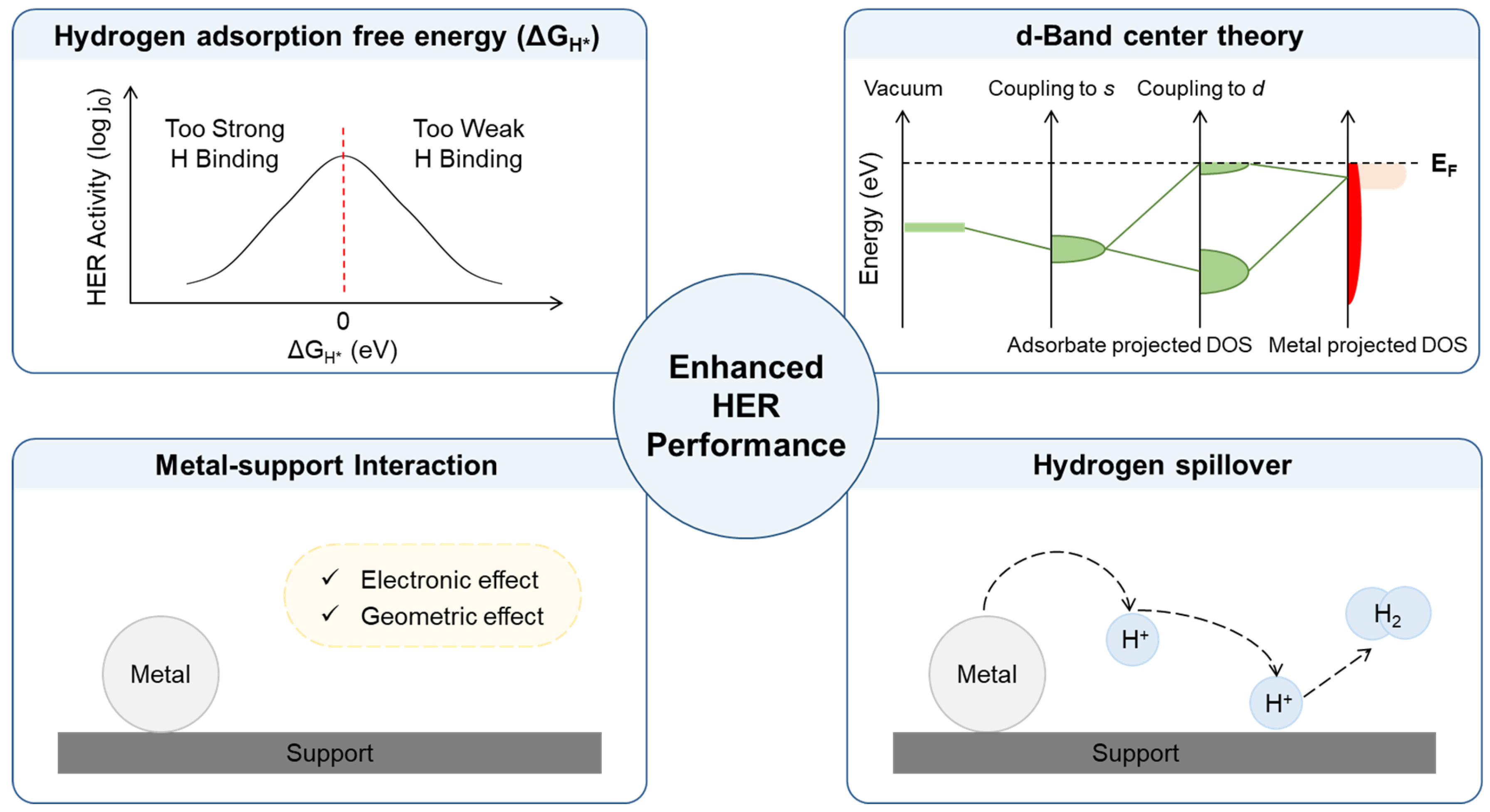
2.2.1. Hydrogen Adsorption Free Energy (ΔGH*)
The hydrogen adsorption free energy (ΔG
H*) is commonly regarded as the key thermodynamic descriptor for HER activity, grounded in the Sabatier principle and visualized through a volcano plot [
14]. Here, we elaborate on the quantitative framework underlying this descriptor and its implications for catalyst design (
Figure 1).
ΔG
H* is defined within the computational hydrogen electrode (CHE) model, in which the chemical potential of a proton-electron pair (H
+ + e
−) is set equal to that of 1/2H
2 under standard conditions (U = 0 V vs. RHE, pH = 0, T = 298 K) [
14]. This approach enables a direct comparison of ΔG
H* across diverse catalyst surfaces from DFT calculations without requiring explicit treatment of the electrochemical interface [
15].
It should be noted that while ΔG
H* ≈ 0 is a necessary condition for high HER activity, it is not always sufficient [
16]. In alkaline media, the Volmer step involves water dissociation rather than proton adsorption, introducing an additional energy barrier, as noted above, that is not captured by ΔG
H* alone [
17]. Accordingly, additional descriptors such as the hydroxyl binding energy (ΔG
OH*) and the water-dissociation barrier have been proposed as complementary metrics for evaluating alkaline HER activity [
18]. Pt exhibits near-thermoneutral ΔG
H* levels, yet further optimization through electronic structure engineering is essential to enhance the activity and reduce the Pt loading level.
2.2.2. d-Band Center Theory
Beyond ΔG
H* as a thermodynamic descriptor, the d-band center (ε
d) provides a complementary electronic structure framework for rationalizing the catalytic behavior of transition-metal electrocatalysts [
19]. The fundamental stages of electrocatalysis inherently involve an electron transfer between transition-metal reactive species and the catalyst surface. In this regard, ε
d governs the strength of these interactions by determining the degree of overlap between metal d-states and adsorbate frontier orbitals.
By precisely adjusting the spatial configuration and energetic distribution of valence electrons on the catalyst surface, one can directly modulate activation energy barriers and thereby influence both the reaction reactivity and selectivity [
19]. Based on d-band theory, an upshift of ε
d toward the Fermi level strengthens the adsorption of hydrogen intermediates on the metal surface. Conversely, a downshift of ε
d weakens this interaction and facilitates hydrogen desorption. Consequently, ε
d serves as a key quantitative descriptor for optimizing ΔG
H* in HER electrocatalysts. Modulation of ε
d has emerged as a primary approach to shifting ΔG
H* toward the thermoneutral optimum [
20].
2.2.3. Metal-Support Interaction
The interaction between metal nanoparticles and their supports is a central determinant of the catalytic activity, selectivity, and stability of HER electrocatalysis. Metal-support interaction (MSI) encompasses various chemical and physical interactions at the metal-support interface, including the charge transfer, interfacial structural reconstruction, nanoparticle morphology regulation, and chemical composition modulation [
21,
22,
23].
MSI influences the HER catalytic performance through two distinct but synergistic mechanisms. The electronic effect refers to interfacial charge transfer between the metal and support, which modifies the electron density of metal active sites and shifts the d-band center, thereby tuning the hydrogen adsorption free energy (ΔGH*) toward the thermoneutral optimum as visualized on a volcano plot. The geometric effect refers to the ability of the support to regulate the nanoparticle size, morphology, dispersion, and exposed facets, thereby controlling the number and nature of accessible active sites and influencing the atomic utilization efficiency. In practice, these two effects operate simultaneously and are difficult to decouple, but their relative contributions depend strongly on the nature of the support material. The synergy between electronic and geometric effects is particularly important for HER catalysis, as electronic effects modulate ΔGH* while geometric effects maximize the exposure and accessibility of active sites. Beyond these two effects, MSI also facilitates hydrogen spillover, where activated H* migrates from metal active sites onto the support surface, providing additional HER reaction pathways. Overall, the rational engineering of MSI represents a versatile and effective approach to optimizing ΔGH*, maximizing the active site density, and enhancing catalyst durability for HER applications.
2.2.4. Hydrogen Spillover
Hydrogen spillover is an interfacial phenomenon in which activated hydrogen species (H*), generated through H* adsorption on a metal surface, migrate onto the support surface, and participate in the subsequent reaction step. Originally identified in thermocatalytic hydrogenation, where supports with strongly negative ΔG
H* render H* migration thermodynamically spontaneous, this phenomenon has more recently been recognized as a significant mechanistic pathway in electrocatalytic HER [
24,
25].
In the electrocatalytic HER, hydrogen spillover provides an alternative design strategy beyond conventional ΔG
H*-based optimization. A bicomponent metal/support electrocatalyst can be designed such that the metal component provides efficient H* generation, while the support offers favorable H* migration pathways and desorption sites. This configuration enables the HER without requiring a single active site to simultaneously satisfy both adsorption and desorption criteria [
24].
Theoretical investigations have demonstrated that the work function difference (ΔΦ) between the metal and support is a critical parameter governing the spillover efficiency. A large ΔΦ induces interfacial charge accumulation, strengthening H* adsorption at the interface and raising the kinetic barrier for spillover. Conversely, a small ΔΦ promotes charge dilution and facilitates efficient H* migration, thereby enhancing the HER kinetics [
25,
26]. Furthermore, recent theoretical work has demonstrated a direct correlation between the free energy difference in hydrogen adsorption on the two components (|ΔG
H(metal) − ΔG
H(support)|) and the kinetic barrier for H* transfer. Minimizing this difference by matching the d-band centers of the two components lowers the spillover barrier and promotes an efficient HER [
27].
It is important to note that spillover contributes positively to the HER only when H* surface migration is kinetically facile. Where spillover is slow, an additional rate-limiting process can be introduced, impeding the overall catalytic performance. In this regard, the MSI-driven modulation of ΔΦ and ΔG
H* compatibility is essential for enabling efficient spillover and maximizing its contribution to HER activity (
Table 2).
3. Design Strategies for HER Electrocatalysts
3.1. Metal Catalysts
3.1.1. Single-Atom Catalysts
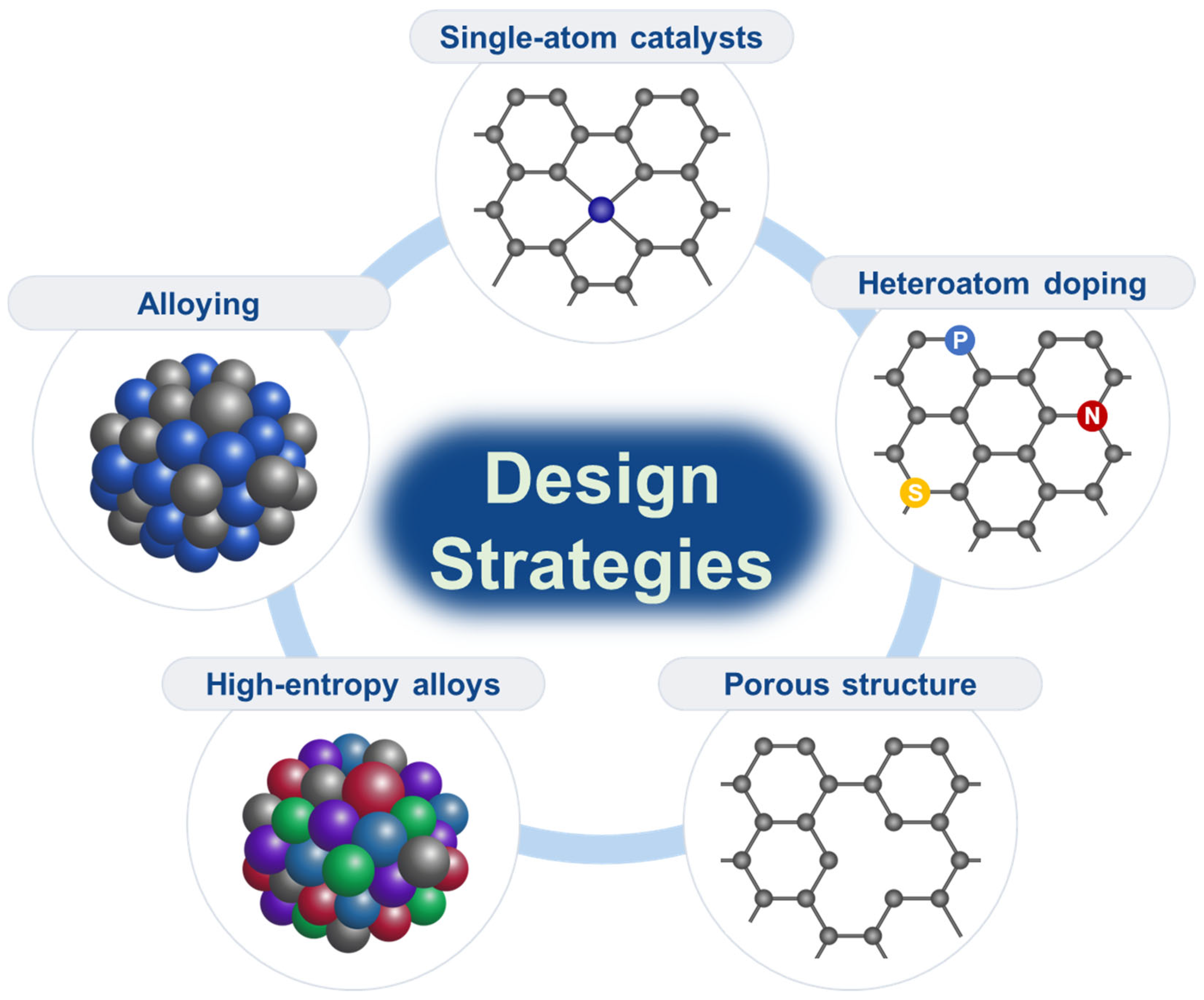
Single-atom catalysts (SACs) represent a class of heterogeneous catalysts in which isolated metal atoms are isolated and stabilized on a solid support, with no direct metal–metal bonding between active sites (
Figure 2) [
56,
57]. Since their first report by Zhang and coworkers [
58], SACs have attracted considerable attention as a powerful approach for bridging homogeneous and heterogeneous catalysis, owing to their well-defined active sites and tunable electronic properties.
Beyond maximizing atomic utilization, SACs exhibit high activity and selectivity during the HER owing to their unique electronic structure arising from the low-coordination environment and strong metal-support interactions [
59,
60]. The individually dispersed active sites allow precise tuning of the coordination environment, including the number, type, and geometry of coordinating atoms, to directly modulate ΔG
H* and optimize HER activity [
61].
Isolated metal atoms in SACs exhibit high chemical activity due to their low-coordination environment, which significantly enhances the mass activity (MA) [
7,
49]. The reduced coordination number leads to unsaturated bonding states, promoting stronger interactions with reactant intermediates and facilitating more favorable H* adsorption energetics. In SAC systems, HER activity is governed by the anchoring capability of the support, the local coordination environment of metal atoms, and the synergistic interactions with neighboring metal atoms or nanoclusters.
Yin et al. demonstrated that the catalytic performance of Pt SACs is highly sensitive to the coordination environment of isolated Pt atoms by preparing two structurally distinct single-atom catalysts anchored on graphdiyne (GDY) [
35]. Pt atoms coordinated with alkynyl C atoms formed either five-coordinated C
1-Pt-Cl
4 species (Pt-GDY1) or four-coordinated C
2-Pt-Cl
2 species (Pt-GDY2), and this subtle difference in coordination geometry led to a significant divergence in catalytic behavior. Pt-GDY2, with its lower coordination number, exhibited a higher unoccupied density of states of the Pt 5d orbital and near-zero ΔG
H*, collectively contributing to superior HER activity. This work provides direct evidence that precise engineering of the coordination environment is an effective approach for optimizing the intrinsic activity of Pt single-atom sites.
Kuang et al. demonstrated that Pt single atoms supported on N-doped mesoporous hollow carbon spheres (Pt
1/NMHCS) achieve outstanding HER activity through precise control of the coordination environment of isolated Pt atoms [
36]. The isolated state of Pt
1 single atoms, stabilized through the synergistic combination of N doping and a 3D hollow structure, generates highly positively charged Pt
1 with an increased density of unoccupied 5d-electron states, which is directly responsible for the enhanced intrinsic site activity. Pt
1/NMHCS delivered superior HER performance relative to both N-free Pt
NP/MHCS and commercial Pt/C (Pt: 20 wt.%), confirming the advantage of single-atom dispersion over nanoparticle counterparts. Notably, the isolated Pt single atoms maintained their atomic dispersion after accelerated durability tests, whereas Pt nanoparticles underwent agglomeration. This highlights the pivotal role of strong metal-support interactions in preserving the single-atom structure during prolonged electrochemical operation.
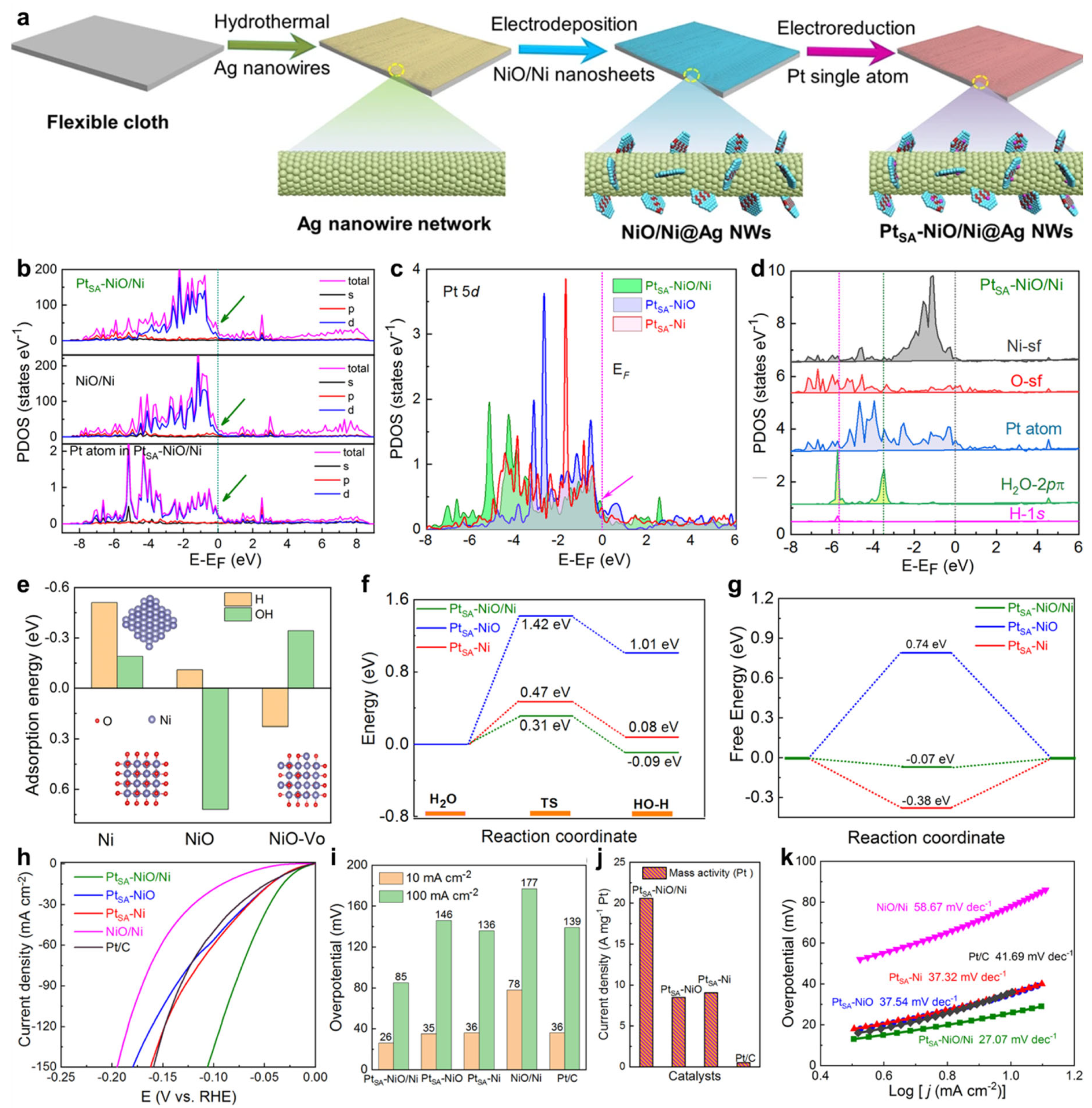
Zhou et al. developed a single-atom Pt (Pt
SA) anchored NiO/Ni heterostructure nanosheet on an Ag nanowire (Ag NW) network nanocomposite (Pt
SA-NiO/Ni) via a facile electrodeposition strategy (
Figure 3) [
4]. Immobilizing Pt single atoms at the NiO/Ni interface elevated the occupation of the Pt 5d orbital at the Fermi level, generating more free electrons on Pt sites and yielding a near-optimal ΔG
H* value of −0.07 eV, compared to −0.38 eV on Ni and 0.74 eV on NiO. This optimized hydrogen binding energy effectively promoted the conversion of H* and desorption of H
2, resulting in enhanced alkaline HER performance.
3.1.2. Alloying
Alloying is one of the most widely employed strategies to enhance the HER performance of Pt-based catalysts while simultaneously reducing noble metal usage [
62]. Upon alloy formation, electrons are redistributed around the constituent atoms due to differences in their chemical properties, modulating the d-band center and thereby lowering the energy barriers associated with intermediate adsorption at active sites [
6,
63]. The formation of alloys optimizes the hydrogen adsorption energy through three cooperative mechanisms.
The ligand effect arises from an electronegativity-driven charge redistribution between the host and neighboring foreign metal atoms, which shifts the d-band center [
64,
65]. The strain effect originates from lattice compression or expansion due to differences in atomic radii among the constituent metals, altering the d-band structure [
66]. The ensemble effect refers to the emergence of new active site configurations upon alloying, enabling reaction pathways inaccessible on pure metal surfaces [
67]. These combined effects collectively shift ΔG
H* toward the thermoneutral optimum, enabling Pt-M alloys to simultaneously reduce the material cost while improving the catalytic activity and cyclic stability [
68,
69].
Yang et al. confined Pt single atoms within a nitrogen-doped porous carbon matrix alongside CoPt alloy nanocrystals (CoPt-Pt
SA/NDPCF), in which the CoPt alloy plays a central role in regulating the electronic properties of the adjacent Pt single atoms [
49]. DFT calculations revealed that the CoPt alloy modulates the d-band occupancy near the Fermi level, generating more free electrons to enhance the conversion of H*. As a result, CoPt-Pt
SA/NDPCF with a low Pt loading of (0.42 wt.% exhibited superior HER performance at a high current density compared to commercial Pt/C (Pt: 10 wt.%) under both acidic and alkaline conditions, along with excellent long-term stability enabled by the protective encapsulated structure.
Kuang et al. demonstrated that intermetallic Pt
3Fe alloy nanoparticles supported on activated N-doped mesoporous carbon spheres (Pt
3Fe/NMCS-A) achieve pH-universal HER activity through the alloy-induced modulation of the electronic structure [
9]. DFT calculations revealed that alloying Fe with Pt lowers the ε
d value of the Pt 5d orbital, reducing the H* adsorption strength and yielding a near-optimal |ΔG
H*| for an acidic HER. Furthermore, the bifunctional nature of the Pt
3Fe alloy, in which Pt and Fe serve as co-adsorption sites for H* and OH* intermediates, respectively, facilitates water dissociation under alkaline and neutral conditions, overcoming the key kinetic barrier of the alkaline HER. As a result, Pt
3Fe/NMCS-A exhibited low overpotentials of 13, 29, and 48 mV at η
10 in 0.5 M aq. H
2SO
4, 1.0 M KOH, and 1.0 M PBS, respectively, along with robust stability across all pH conditions.
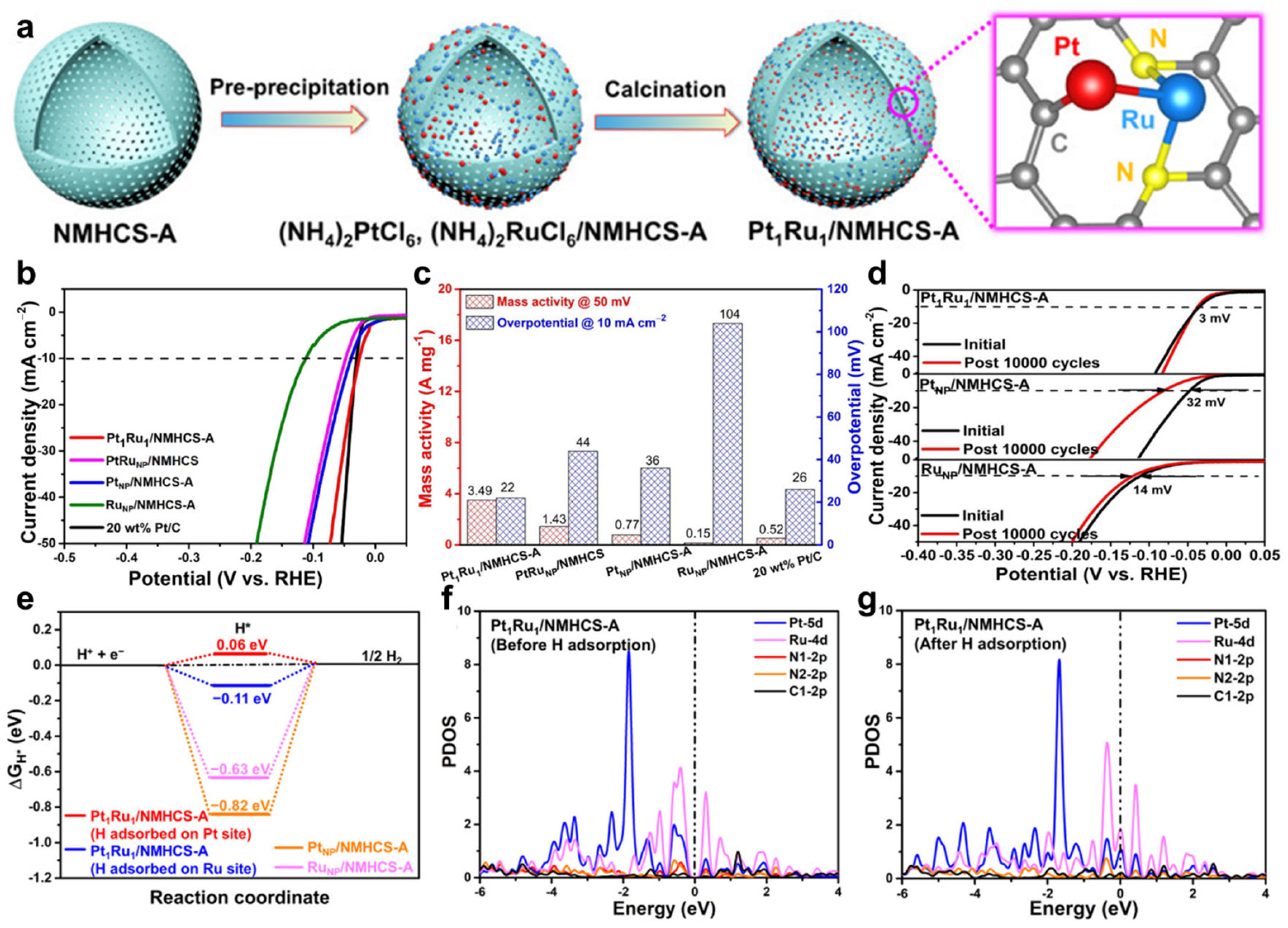
Zhao et al. constructed a dual-atom catalyst composed of Pt-Ru dimers (Pt
1Ru
1) anchored on activated N-doped mesoporous hollow carbon spheres (Pt
1Ru
1/NMHCS-A) (
Figure 4), in which the Pt-Ru dimer plays a crucial role in regulating the electronic structure of the Pt active site through strong metal–metal and metal–support interactions [
39]. Spectroscopic analyses and DFT calculations indicated that the formed C
1-Pt-Ru-N
2 coordination structure induces the redistribution of electrons from Ru to Pt with reinforced interaction between the Pt
1Ru
1 dimer and the NMHCS-A support. In particular, free electrons are transferred from the Ru atom to the Pt atom through the Pt-Ru bond, while the hybridization between the Pt 5d orbital and the H 1s orbital lowers the energy level near the Fermi level, thereby enhancing electron capture and proton reduction capabilities. Pt
1Ru
1/NMHCS-A exhibited significantly enhanced HER activity through the synergistic effect of the Pt-Ru dual-atom structure, providing new insights into rational designs of highly efficient dual-atom catalysts for the HER.
3.1.3. High-Entropy Alloys
While binary and ternary alloys offer effective tuning of HBE, alloying of multicomponents is still highly challenging due to phase segregation driven by the differing miscibility of elements. HEAs are single-phase alloys composed of at least five different elements, with each element contributing between 5% and 35% of the atomic composition [
70,
71]. HEAs have recently emerged as a promising strategy, offering superior catalytic activity and stability even with a low Pt content through synergistic effects among multiple constituent elements [
72]. HEA catalysts, possessing a unique and compelling set of characteristics, have exhibited significant potential for practical applications. High-entropy alloys have recently attracted much attention in the catalysis community as a promising strategy for fine-tuning the hydrogen binding energy (HBE) via multicomponent design approaches. This is attributed to their four core effects of high entropy, lattice distortion, sluggish diffusion, and cocktail effects, which can substantially improve the catalytic activity and stability.
Wang et al. fabricated Ru-doped PtFeNiCuW HEA octahedral nanocrystals supported on carbon nanotubes (Ru-PtFeNiCuW/CNTs), in which a trace amount of Ru played a crucial role in promoting the homogeneous reduction and growth of multi-metallic HEA nanocrystals [
40]. The incorporation of Ru facilitated the concurrent reduction of metal precursors, enabling the formation of uniform octahedral HEA nanocrystals with well-defined (111) facets despite the ultralow Ru content (<1%). Theoretical calculations revealed that W sites accelerated H
2O adsorption and dissociation to generate abundant H* intermediates, while neighboring hollow Cu-Cu-Cu and Cu-Cu-Pt sites promoted efficient H* desorption, resulting in enhanced HER kinetics through a multi-site synergistic effect. Consequently, the Ru-PtFeNiCuW/CNTs catalyst exhibited enhanced intrinsic HER activity by integrating distinct functional active sites within the HEA structure, demonstrating the potential of compositionally complex HEAs as efficient electrocatalysts for the HER.
Feng et al. designed ultrasmall NiCoMoPtRu high-entropy alloy nanoclusters (HEANCs) with an average size of only seven atomic layers [
53]. The high-entropy stabilization effect improved the structural stability and corrosion resistance of the nanoclusters, while in situ growth on carbon supports suppressed nanoparticle agglomeration during the HER. DFT calculations revealed that the optimized electronic structure of the HEANCs facilitated H
2O adsorption and dissociation and reduced the |ΔG
H*| values compared to pure Pt. Specifically, the Pt-5d orbital acted as an electron reservoir, whereas the Ni-3d and Co-3d orbitals near the Fermi level promoted charge redistribution during the HER. This synergistic interaction among the multicomponent active sites accelerates the Volmer step, thereby enhancing both the HER activity and stability of the HEANCs.
Wan et al. demonstrated the potential of high-entropy alloys (HEAs) as a promising platform for HER electrocatalysis by synthesizing a series of HEA@HCS composites with systematically varied compositions, ranging from quaternary PtFeCoNi to quinary and senary systems [
51]. The high configurational entropy of HEA materials promotes the homogeneous distribution of multiple active sites, while electronegativity differences among the constituent elements govern the local electronic configuration to optimize hydrogen adsorption and desorption. DFT calculations revealed that the sequential introduction of Cu and Cr into PtFeCoNi@HCS optimizes the local electronic structure, giving rise to a multi-site synergistic effect that collectively enhances both HER activity and durability. This work highlights the unique ability of HEAs to simultaneously incorporate multiple functional elements, offering a versatile compositional design strategy beyond conventional binary or ternary alloy systems.
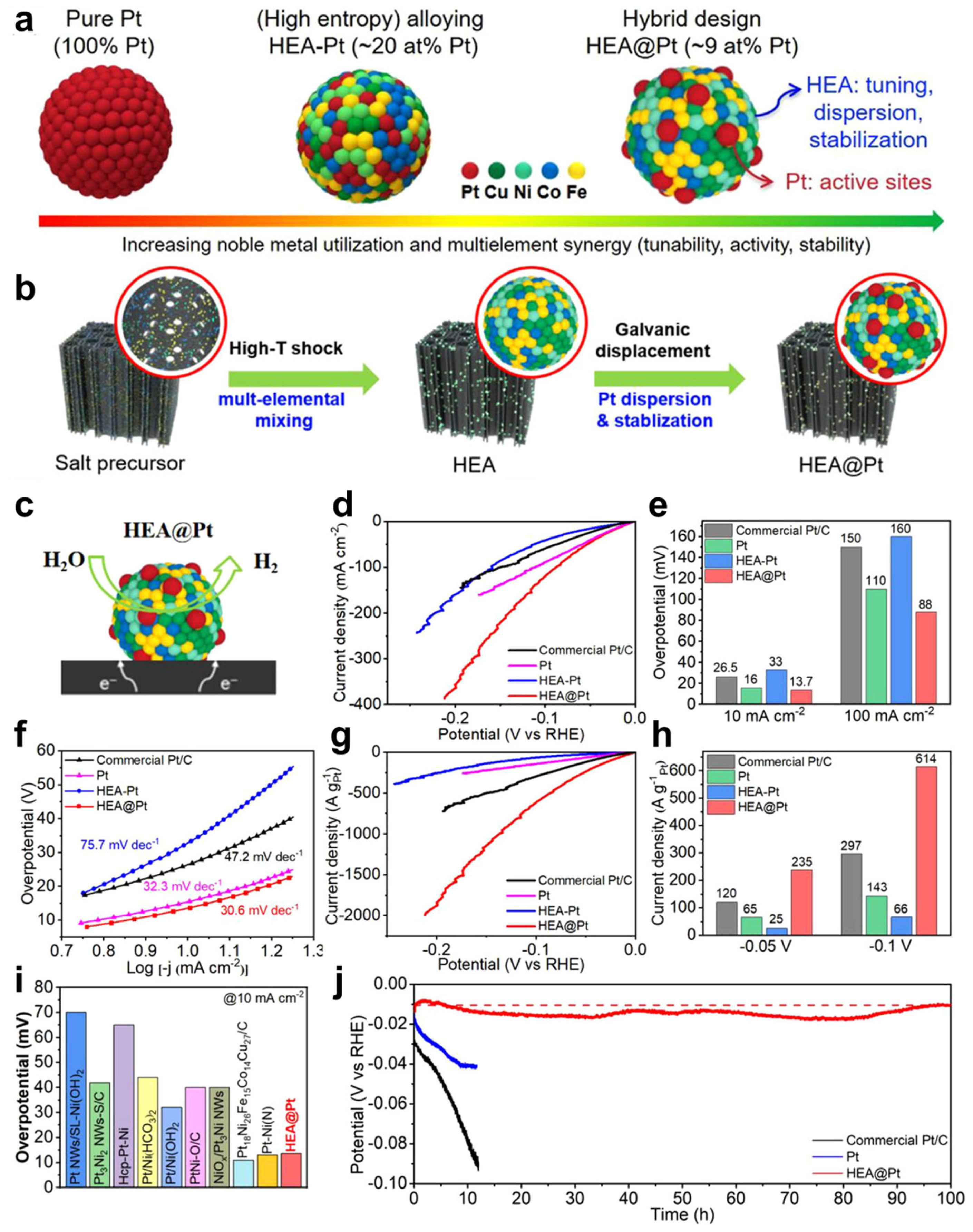
Shi et al. developed HEA@Pt electrocatalyst by anchoring Pt onto FeCoNiCu-based HEA nanoparticles via galvanic displacement after rapid thermal shock treatment (
Figure 5) [
55]. The multielement framework tuned the electronic environment of Pt, leading to enhanced hydrogen adsorption/desorption behavior and improved catalytic efficiency toward HER. Simultaneously, the entropy-driven stabilization effect enabled uniform dispersion of ultrafine Pt clusters while preventing particle coalescence under electrochemical conditions. In addition, the strong interfacial bonding between the HEA nanoparticles and the substrate, promoted by high-temperature synthesis, further improved long-term catalytic durability. Owing to these synergistic features, the HEA@Pt delivered higher activity and durability than commercial Pt/C and single-phase HEA-Pt counterparts.
3.2. Carbon Support
3.2.1. Heteroatom Doping
In Pt-based HER electrocatalysis, carbon supports play a pivotal role not merely as an inert scaffold but as an active participant in determining catalytic performance outcomes. Heteroatom doping of the carbon support through the incorporation of N, S, B, or P into the carbon framework has emerged as a powerful strategy capable of simultaneously enhancing the intrinsic HER activity of the support, strengthening MSI, improving Pt dispersion, and tailoring the electronic structure of supported Pt species. This section discusses the mechanistic basis of heteroatom doping and its role in supporting Pt-based HER catalysts.
Heteroatom-doped carbon nanomaterials have emerged as promising electrocatalysts for the HER owing to their earth-abundance, tunable molecular architecture, excellent electrical conductivity, and remarkable tolerance to both acidic and alkaline environments [
73]. The incorporation of heteroatoms into the carbon framework induces a significant charge redistribution and modulates the local electronic structure of adjacent carbon atoms, thereby generating catalytically active sites and optimizing the adsorption the ΔG
H* [
74,
75].
The introduction of heteroatoms with electronegativity either higher (e.g., N) or lower (e.g., B) than carbon breaks the charge neutrality of the carbon lattice, creating positively charged carbon sites (C
+) that serve as preferential adsorption sites for reaction intermediates including H* [
76]. This doping-induced charge asymmetry effectively lowers the reaction energy barrier and increases the density of active sites, thereby enhancing the HER kinetics [
75].
While single-element doping has demonstrated considerable promise, its capacity to optimize multiple catalytic descriptors simultaneously remains limited. Co-doping strategies, in which two or more heteroatoms are introduced into the carbon framework, have been proposed as a more effective approach to exploit synergistic electronic effects [
73]. Multi-heteroatom doping enables the simultaneous tuning of the electron density and the redistribution of the charge within the porous carbon matrix, providing a greater number of favorable H* adsorption sites and ultimately enhancing the electrocatalytic activity [
76].
Lee et al. demonstrated that heteroatom doping of the carbon support plays a critical role in enhancing HER performance capabilities by preparing Pt nanoparticles supported on triazine graphitic nanoplatelets (Pt@TGNP) [
30]. The incorporation of triazine units into the graphitic framework introduces nitrogen-containing active sites that not only serve as anchoring sites for a uniform and stable distribution of Pt nanoparticles but also modulate the local electronic structure of the support. The high electrical conductivity and mechanical stability of TGNP, preserved through its hexagonal graphene structure, further contribute to efficient charge transfer and long-term structural integrity during the HER.
Yan et al. reported that a sulfur-doped mesoporous carbon (S-C) support plays a crucial role in controlling the electronic structure of Pt atoms and the corresponding HER performance [
33]. Based on spectroscopic characterizations and DFT calculations, they demonstrated that the S-C support captures electrons from Pt single atoms via the strong chemical Pt-S interaction. However, when the Pt size is increased to nanoclusters, the charge transfer direction is reversed from S-C to Pt. These results indicate that the electronic metal-support interaction (EMSI) between Pt and the S-C support can be manipulated through modification of Pt morphologies from single atoms to nanoclusters, highlighting the pivotal role of the S-doped carbon support in tuning the charge transfer behavior and HER performance.
Zhang et al. developed an anchoring-site engineering strategy to construct ultrafine PtMo alloy nanocrystals supported on N-doped carbon (PtMo-NC) for HER electrocatalysis [
54]. The abundant nitrogen sites in the carbon support effectively anchored metal ions and suppressed excessive aggregation during pyrolysis, facilitating the formation of ultrafine PtMo nanocrystals. In addition, the porous structure of the N-doped carbon support promoted efficient electrolyte transport during the HER. The strong interaction between the nitrogen sites and PtMo nanocrystals further enhanced the structural stability of the catalyst and prevented nanoparticle overgrowth during the heat treatment.
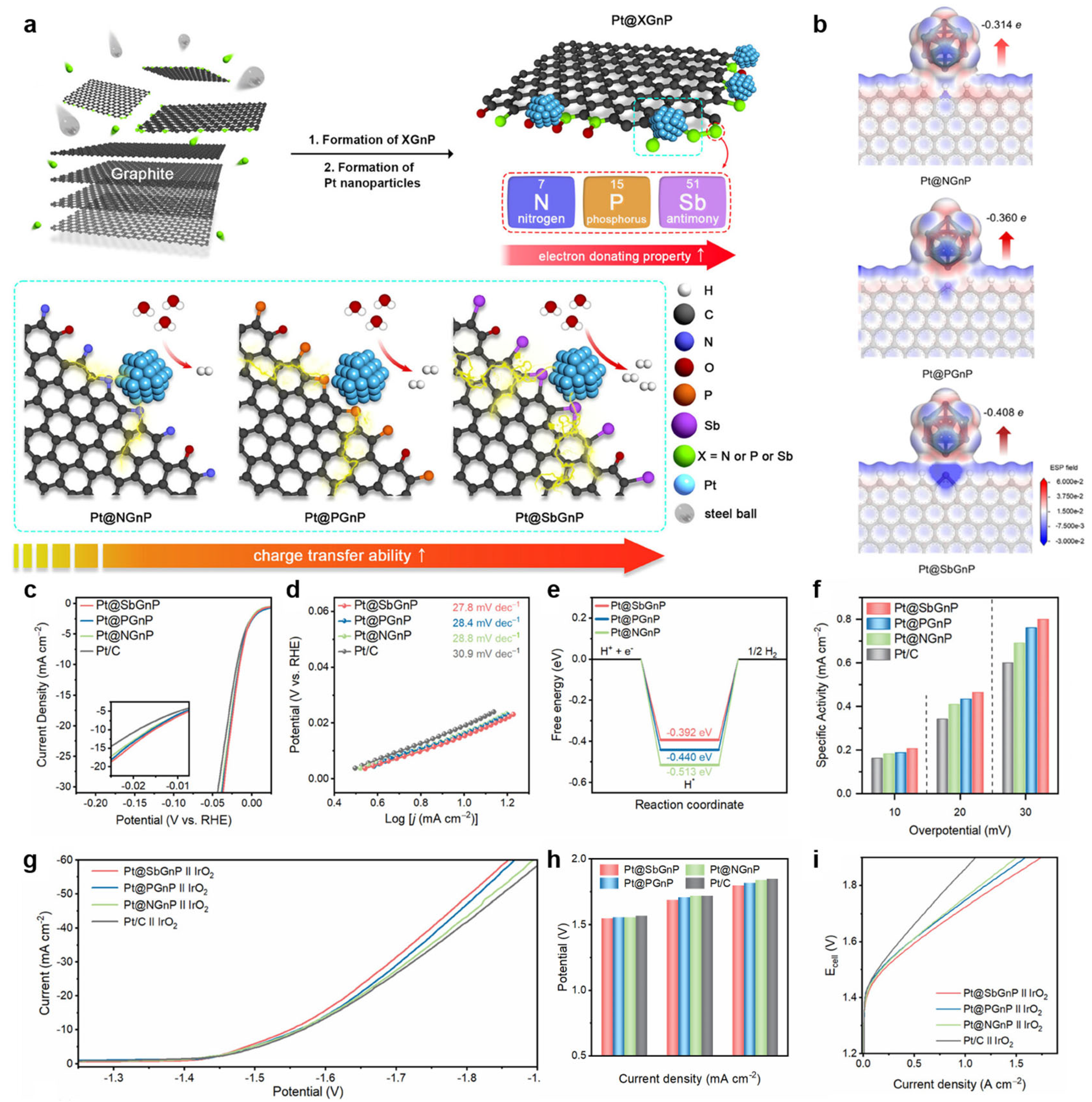
Baek et al. investigated how the choice of dopant heteroatom influences metal-support interactions by preparing Pt nanoparticles supported on graphitic nanoplatelets doped with group VA elements (N, P, or Sb) (
Figure 6) [
32]. As the atomic period of the dopant heteroatom increased, the charge transfer to Pt nanoparticles was progressively enhanced through stronger Pt-X bonding. This led to more pronounced electronic modification of the supported Pt species, directly influencing the catalytic activity of Pt. In particular, Sb doping proved most effective owing to its high electropositivity and larger atomic radius. These properties maximized the charge transfer to Pt and facilitated an optimal Pt dispersion, ultimately boosting the electrochemical surface area through enhanced EMSI. This work establishes heteroatom periodicity as a key design parameter for tuning MSI and optimizing the catalytic performance of heteroatom-doped carbon-supported Pt catalysts.
3.2.2. Porous Structure
Porous carbon substrates have emerged as one of the most effective support platforms for HER electrocatalysts owing to their high specific surface area, tunable pore architecture, and excellent electrical conductivity [
76]. The high surface area promotes the uniform dispersion of catalytically active sites, while the interconnected porous framework provides continuous channels for electrolyte diffusion and an efficient release of evolved H
2 gas, thereby minimizing the mass transport resistance during the HER process [
77,
78,
79].
Beyond their structural role, porous carbon supports actively modulate the catalytic behavior of supported metal species through intrinsic structural defects. Vacancy and topological defects within the carbon matrix function as anchoring sites for metal nanoparticles and promote electron transfers between the metal species and the support, directly tuning the electronic structure of the active sites and reducing the energy barrier for hydrogen adsorption and desorption [
80].
Optimizing the balance between micropores and mesopores is central to maximizing the HER performance. Micropores increase the density of exposed active sites, whereas mesopores serve as open transport channels that facilitate reactant access and product removal. Achieving this dual functionality through controlled synthesis represents the key design principle for porous-carbon-supported HER electrocatalysts [
81].
Zeng et al. synthesized highly dispersed Pt entities supported on mesoporous N-doped carbon (MPNC) nanospheres for enhanced HER performance [
41]. The continuous mesoporous structure and high surface area of the MPNC support effectively suppressed Pt atom diffusion and aggregation during catalyst synthesis, facilitating the formation of highly dispersed Pt single atoms, clusters, and nanoparticles through a mesopore-confinement effect. In addition, the nitrogen functionalities of the MPNC support strongly interacted with Pt species, enabling the anchoring and stabilization of Pt single atoms on the carbon surface. Pt/MPNC exhibited significantly higher HER geometric and Pt mass activities than commercial Pt/C and Pt/CNF catalysts, driven by its large electrochemically active surface area and high density of well-dispersed Pt active sites on the mesoporous N-doped carbon support.
Li et al. developed a low-Pt-content electrocatalyst by depositing Pt nanoparticles onto a three-dimensional tungsten oxide/reduced graphene oxide aerogel (WGA) [
42]. The interconnected porous structure of the WGA support promoted mass transport and electron transfers while providing a large exposed surface area for Pt active sites. In addition, oxygen vacancies introduced into the WO
3-x framework induced electron transfers from WO
3-x to Pt nanoparticles, which optimized the electronic structure of Pt, downshifted the d-band center, and reduced the hydrogen adsorption energy. The strong metal-support interaction further stabilized the Pt nanoparticles and suppressed their aggregation during the HER. Moreover, the hydrogen spillover effect facilitated the migration of adsorbed H* species, accelerating the overall HER kinetics. Accordingly, the Pt/WGA catalyst with only 0.8 wt.% Pt showed enhanced HER activity and stability due to the synergistic effects of the porous aerogel structure and the Pt-WO
3-x electronic interaction.
Kim et al. reported Pt nanoparticles supported on activated phosphorus-doped graphene (A_PGnP) to enhance the HER performance [
31]. The incorporation of phosphorus (P) atoms improves the catalytic performance by modulating the electronic structure between the Pt and P within the carbon matrix. A_PGnP, endowed with abundant active sites, a large surface area, and P doping, improves the performance of the HER under acidic conditions. As a result, Pt/A_PGnP with a lower Pt loading rate (12.75 wt.%) exhibited a comparable overpotential and reduced Tafel slopes while showing superior stability relative to that of commercial Pt/C (Pt: 20 wt.%). Therefore, Pt/A_PGnP exhibited high activity and stability, indicating its potential as a stable HER catalyst.
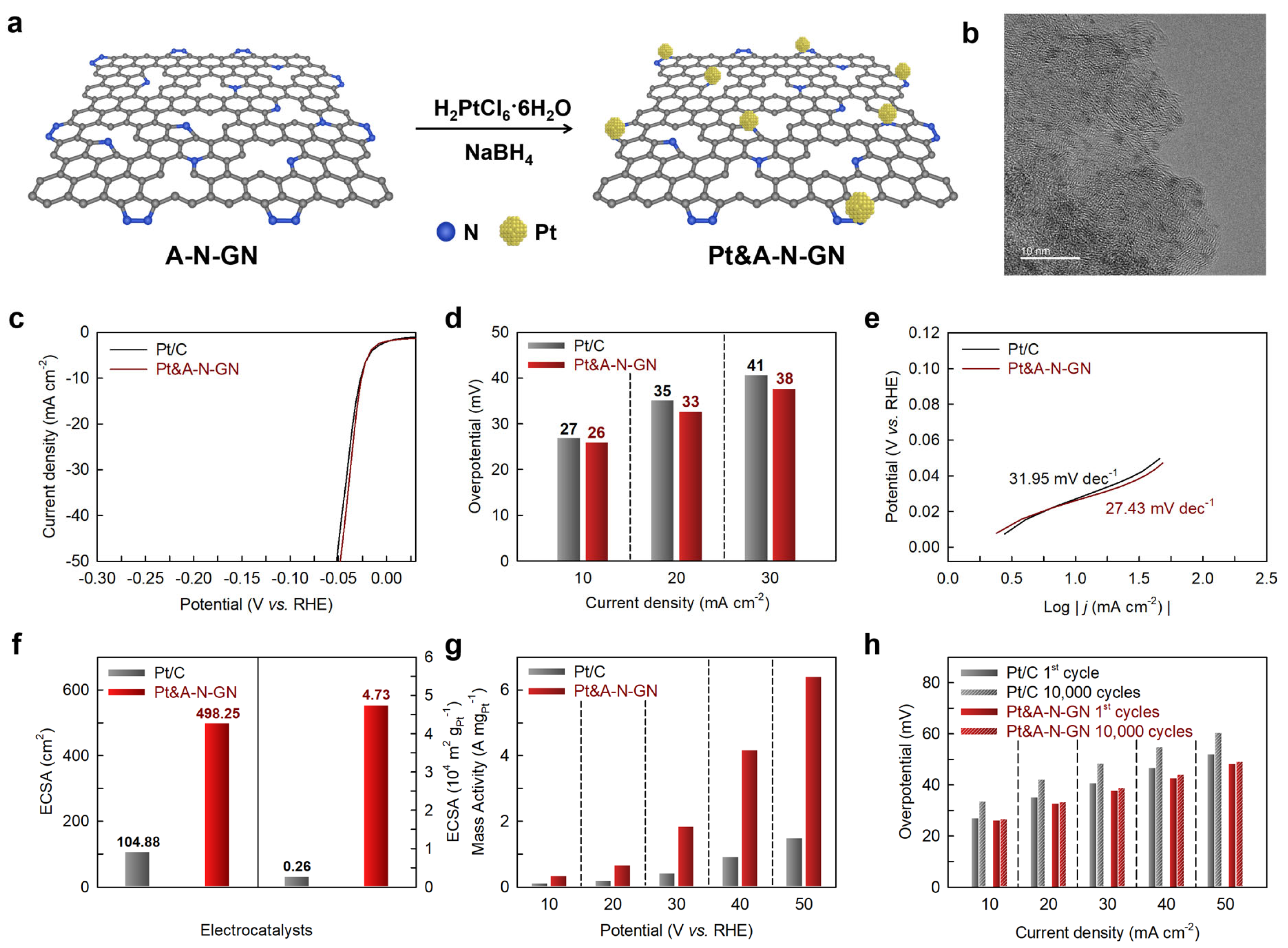
Yoon et al. demonstrated that the porous structure of the carbon support plays a pivotal role in enhancing HER performance capabilities by loading Pt nanoparticles onto activated nitrogen-doped graphitic nanoplatelets (A-N-GN) (
Figure 7) [
28]. The activation process generated additional pores and enlarged the surface area, providing more accessible active sites and improving the mass transport efficiency. As a result, Pt&-N-GN showed superior HER performance in acidic media, surpassing that of commercial Pt/C (Pt: 20 wt.%). These results indicate that rational engineering of the porous structure of the carbon support is a promising strategy for maximizing the utilization of supported Pt nanoparticles and enhancing the overall electrocatalytic activity.
4. Conclusions and Perspectives
In this review, we have discussed rational design strategies for Pt-based HER electrocatalysts, with a focus on metal-level engineering and support-level engineering as two complementary and synergistic approaches to maximizing catalytic performance outcomes while minimizing Pt usage levels.
At the metal level, SACs have demonstrated exceptional atomic utilization efficiency and tunable HER activity through precise control of the local coordination environment and strong metal-support interactions. Alloying strategies, including those that rely on binary alloys, intermetallic compounds, and HEAs, enhance the HER activity by tuning the d-band center through synergistic electronic effects. This modulation optimizes hydrogen adsorption/desorption and accelerates water dissociation during the HER. Despite these advantages, several limitations remain. SACs are still associated with limited long-term stability due to atom migration and aggregation under practical operating conditions. Meanwhile, alloy and HEA systems often exhibit structural complexity and heterogeneous active sites, making precise control of the electronic interactions among multimetallic components difficult. In addition, achieving both high intrinsic activity and long-term durability across a wide pH range remains challenging through metal engineering alone.
To overcome these limitations, increasing attention has been directed toward carbon-support engineering strategies. Heteroatom doping, such as N, P, S, or B incorporation into carbon frameworks, can effectively regulate the electronic structure of Pt-based active sites through charge redistributions and strengthened metal-support interactions. Simultaneously, porous structure engineering provides large surface areas, abundant anchoring sites, and interconnected transport pathways for electrons and electrolytes. These structural advantages suppress nanoparticle aggregation, increase active-site exposure, and facilitate mass and charge transport during the HER. Importantly, the synergistic combination of heteroatom doping and porous carbon architectures enables both electronic and structural optimization of electrocatalysts, offering advantages that cannot be achieved by metal design approaches alone.
Therefore, the rational integration of advanced metal engineering strategies with heteroatom-doped porous carbon supports represents a promising pathway toward highly active, durable, and low-Pt HER electrocatalysts. Looking forward, further advances in operando characterization techniques and computational approaches, including machine-learning-assisted catalyst design, are expected to accelerate our understanding of metal-support interactions and catalytic descriptors. By combining large experimental and computational datasets with high-throughput screening and predictive modeling, machine learning can facilitate the identification of key catalytic descriptors, optimization of Pt utilization, and rational design of catalyst architectures. Continued efforts that elucidate the synergistic mechanisms between active metals and engineered carbon supports will be essential for the development of practical and sustainable HER electrocatalysts for green hydrogen production.
Author Contributions
Conceptualization, I.-Y.J.; writing—original draft preparation, S.J.Y.; writing—review and editing, I.-Y.J.; visualization, S.J.Y.; supervision, I.-Y.J.; project administration, I.-Y.J. All authors have read and agreed to the published version of the manuscript.
Funding
This research received no external funding.
Data Availability Statement
Data presented in this study are available on request from the corresponding authors.
Acknowledgments
This research was supported by the Regional Innovation System & Education (RISE) program through the Jeonbuk RISE Center, funded by the Ministry of Education (MOE) and the Jeonbuk State, Republic of Korea (2026-RISE-13-WKU).
Conflicts of Interest
The authors declare no conflict of interest.
References
- Liang, Z.; Zhang, Y.; Liu, L.; Jiao, M.; Ye, C. Single-Atom Catalysts for Hydrogen Evolution Reaction: The Role of Supports, Coordination Environments, and Synergistic Effects. Nanomaterials 2025, 15, 1175. [Google Scholar] [CrossRef] [Scilit] [PubMed]
- Smiljanić, M.; Panić, S.; Bele, M.; Ruiz-Zepeda, F.; Pavko, L.; Gašparič, L.; Kokalj, A.; Gaberšček, M.; Hodnik, N. Improving the HER Activity and Stability of Pt Nanoparticles by Titanium Oxynitride Support. ACS Catal. 2022, 12, 13021–13033. [Google Scholar] [CrossRef] [Scilit] [PubMed]
- Yasin, M.; Khan, N.; Murad, M.; Ali, K.; Zeb, Z.; Saleem, S.; Ullah, Z. Pt-based electrocatalyst for hydrogen evolution in acidic electrolytes. Electrochem. Commun. 2025, 180, 108057. [Google Scholar] [CrossRef] [Scilit]
- Zhou, K.L.; Wang, Z.; Han, C.B.; Ke, X.; Wang, C.; Jin, Y.; Zhang, Q.; Liu, J.; Wang, H.; Yan, H. Platinum single-atom catalyst coupled with transition metal/metal oxide heterostructure for accelerating alkaline hydrogen evolution reaction. Nat. Commun. 2021, 12, 3783. [Google Scholar] [CrossRef] [Scilit] [PubMed]
- Guo, F.; Macdonald, T.J.; Sobrido, A.J.; Liu, L.; Feng, J.; He, G. Recent Advances in Ultralow-Pt-Loading Electrocatalysts for the Efficient Hydrogen Evolution. Adv. Sci. 2023, 10, 2301098. [Google Scholar] [CrossRef] [Scilit] [PubMed]
- Cui, Z.; Jiao, W.; Huang, Z.; Chen, G.; Zhang, B.; Han, Y.; Huang, W. Design and Synthesis of Noble Metal-Based Alloy Electrocatalysts and Their Application in Hydrogen Evolution Reaction. Small 2023, 19, 2301465. [Google Scholar] [CrossRef] [Scilit] [PubMed]
- Liu, D.; Li, X.; Chen, S.; Yan, H.; Wang, C.; Wu, C.; Haleem, Y.A.; Duan, S.; Lu, J.; Ge, B.; et al. Atomically dispersed platinum supported on curved carbon supports for efficient electrocatalytic hydrogen evolution. Nat. Energy 2019, 4, 512–518. [Google Scholar] [CrossRef] [Scilit]
- Li, Y.; Abbott, J.; Sun, Y.; Sun, J.; Du, Y.; Han, X.; Wu, G.; Xu, P. Ru nanoassembly catalysts for hydrogen evolution and oxidation reactions in electrolytes at various pH values. Appl. Catal. B Environ. 2019, 258, 117952. [Google Scholar] [CrossRef] [Scilit]
- Kuang, P.; Ni, Z.; Zhu, B.; Lin, Y.; Yu, J. Modulating the d-Band Center Enables Ultrafine Pt3Fe Alloy Nanoparticles for pH-Universal Hydrogen Evolution Reaction. Adv. Mater. 2023, 35, 2303030. [Google Scholar] [CrossRef] [Scilit] [PubMed]
- Zeng, M.; Li, Y. Recent advances in heterogeneous electrocatalysts for the hydrogen evolution reaction. J. Mater. Chem. A 2015, 3, 14942–14962. [Google Scholar] [CrossRef] [Scilit]
- Liu, F.; Shi, C.; Guo, X.; He, Z.; Pan, L.; Huang, Z.F.; Zhang, X.; Zou, J.J. Rational Design of Better Hydrogen Evolution Electrocatalysts for Water Splitting: A Review. Adv. Sci. 2022, 9, 2200307. [Google Scholar] [CrossRef] [Scilit] [PubMed]
- Sen, S.; Chatterjee, A.; Maji, P.K. Hydrogen Evolution Reaction: Mechanistic Insights and Emerging Design Strategies for Efficient Catalysis. Adv. Sustain. Syst. 2026, 10, e00959. [Google Scholar] [CrossRef] [Scilit]
- Shinagawa, T.; Garcia-Esparza, A.T.; Takanabe, K. Insight on Tafel slopes from a microkinetic analysis of aqueous electrocatalysis for energy conversion. Sci. Rep. 2015, 5, 13801. [Google Scholar] [CrossRef] [Scilit] [PubMed]
- Nørskov, J.K.; Bligaard, T.; Logadottir, A.; Kitchin, J.R.; Chen, J.G.; Pandelov, S.; Stimming, U. Trends in the Exchange Current for Hydrogen Evolution. J. Electrochem. Soc. 2005, 152, J23–J26. [Google Scholar] [CrossRef] [Scilit]
- Skúlason, E.; Tripkovic, V.; Björketun, M.E.; Gudmundsdóttir, S.; Karlberg, G.; Rossmeisl, J.; Bligaard, T.; Jónsson, H.; Nørskov, J.K. Modeling the Electrochemical Hydrogen Oxidation and Evolution Reactions on the Basis of Density Functional Theory Calculations. J. Phys. Chem. C 2010, 114, 18182–18197. [Google Scholar] [CrossRef] [Scilit]
- Feidenhans’l, A.A.; Regmi, Y.N.; Wei, C.; Xia, D.; Kibsgaard, J.; King, L.A. Precious Metal Free Hydrogen Evolution Catalyst Design and Application. Chem. Rev. 2024, 124, 5617–5667. [Google Scholar] [CrossRef] [Scilit] [PubMed]
- Subbaraman, R.; Tripkovic, D.; Strmcnik, D.; Chang, K.-C.; Uchimura, M.; Paulikas, A.P.; Stamenkovic, V.; Markovic, N.M. Enhancing Hydrogen Evolution Activity in Water Splitting by Tailoring Li+-Ni(OH)2-Pt Interfaces. Science 2011, 334, 1256–1260. [Google Scholar] [CrossRef] [Scilit] [PubMed]
- Zheng, X.; Zhang, B.; De Luna, P.; Liang, Y.; Comin, R.; Voznyy, O.; Han, L.; García de Arquer, F.P.; Liu, M.; Dinh, C.T.; et al. Theory-driven design of high-valence metal sites for water oxidation confirmed using in situ soft X-ray absorption. Nat. Chem. 2018, 10, 149–154. [Google Scholar] [CrossRef] [Scilit] [PubMed]
- Wang, Z.; Shen, S.; Wang, J.; Zhong, W. Modulating the D-Band Center of Electrocatalysts for Enhanced Water Splitting. Chem. Eur. J. 2024, 30, e202402725. [Google Scholar] [CrossRef] [Scilit]
- Hu, J.; Al-Salihy, A.; Zhang, B.; Li, S.; Xu, P. Mastering the D-Band Center of Iron-Series Metal-Based Electrocatalysts for Enhanced Electrocatalytic Water Splitting. Int. J. Mol. Sci. 2022, 23, 15405. [Google Scholar] [CrossRef] [Scilit] [PubMed]
- Leybo, D.; Etim, U.J.; Monai, M.; Bare, S.R.; Zhong, Z.; Vogt, C. Metal–support interactions in metal oxide-supported atomic, cluster, and nanoparticle catalysis. Chem. Soc. Rev. 2024, 53, 10450–10490. [Google Scholar] [CrossRef] [Scilit] [PubMed]
- Luo, Z.; Zhao, G.; Pan, H.; Sun, W. Strong Metal–Support Interaction in Heterogeneous Catalysts. Adv. Energy Mater. 2022, 12, 2201395. [Google Scholar] [CrossRef] [Scilit]
- van Deelen, T.W.; Hernández Mejía, C.; de Jong, K.P. Control of metal-support interactions in heterogeneous catalysts to enhance activity and selectivity. Nat. Catal. 2019, 2, 955–970. [Google Scholar] [CrossRef] [Scilit]
- Li, J.; Ma, Y.; Ho, J.C.; Qu, Y. Hydrogen Spillover Phenomenon at the Interface of Metal-Supported Electrocatalysts for Hydrogen Evolution. Acc. Chem. Res. 2024, 57, 895–904. [Google Scholar] [CrossRef] [Scilit] [PubMed]
- Li, J.; Hu, J.; Zhang, M.; Gou, W.; Zhang, S.; Chen, Z.; Qu, Y.; Ma, Y. A fundamental viewpoint on the hydrogen spillover phenomenon of electrocatalytic hydrogen evolution. Nat. Commun. 2021, 12, 3502. [Google Scholar] [CrossRef] [Scilit] [PubMed]
- Gaur, A.; Sharma, J.; Han, H. Hydrogen Spillover Effect in Electrocatalysis: Delving into the Mysteries of the Atomic Migration. Energy Environ. Mater. 2024, 7, e12761. [Google Scholar] [CrossRef] [Scilit]
- Li, Y.; Li, L.; Xu, S.; Cui, K.; Wang, T.; Jiang, Z.; Li, J. Hydrogen Spillover Mechanism at the Metal–Metal Iinterface in Electrocatalytic Hydrogenation. Angew. Chem. 2024, 136, e202407810. [Google Scholar] [CrossRef] [Scilit]
- Yoon, S.J.; Lee, S.J.; Jeon, I.-Y. Low Pt nanoparticles supported on porous nitrogen-doped graphitic nanoplatelets for high-performance hydrogen evolution reactions. J. Power Sources 2025, 655, 237915. [Google Scholar] [CrossRef] [Scilit]
- Kweon, D.H.; Baek, J.H.; Park, S.O.; Noh, H.J.; Jeon, J.P.; Lee, J.H.; Shin, T.J.; Kwak, S.K.; Jeon, I.Y.; Baek, J.B. Platinum Nanoparticles on Metalloid Antimony Functionalized Graphitic Nanoplatelets for Enhanced Water Electrolysis. Small 2025, 21, 2501408. [Google Scholar] [CrossRef] [Scilit] [PubMed]
- Lee, S.J.; Baek, J.-B.; Jeon, I.-Y. Improving HER activity and stability of Pt nanoparticle on Triazine graphitic nanoplatelets. Mater. Today Sustain. 2024, 28, 100984. [Google Scholar] [CrossRef] [Scilit]
- Kim, M.H.; Kweon, D.H.; Yoon, S.J.; Baek, J.-B.; Jeon, I.-Y. Pt nanoparticles on activated phosphorus-doped graphitic nanoplatelets for high performance hydrogen evolution reaction. Mater. Today Sustain. 2023, 24, 100598. [Google Scholar] [CrossRef] [Scilit]
- Baek, J.H.; Lee, S.J.; Kim, N.H.; Lee, S.M.; Seo, J.M.; Noh, H.J.; Jeon, J.P.; Li, C.; Kwak, S.K.; Kweon, D.H.; et al. High-Period Element Doping as a Key Driver of Hydrogen Evolution in a Proton Exchange Membrane Water Electrolyzer. Small 2025, 21, e07086. [Google Scholar] [CrossRef] [Scilit] [PubMed]
- Yan, Q.-Q.; Wu, D.-X.; Chu, S.-Q.; Chen, Z.-Q.; Lin, Y.; Chen, M.-X.; Zhang, J.; Wu, X.-J.; Liang, H.-W. Reversing the charge transfer between platinum and sulfur-doped carbon support for electrocatalytic hydrogen evolution. Nat. Commun. 2019, 10, 4977. [Google Scholar] [CrossRef] [Scilit] [PubMed]
- Feng, Y.; Xie, Y.; Yu, Y.; Chen, Y.; Liu, Q.; Bao, H.; Luo, F.; Pan, S.; Yang, Z. Electronic Metal-Support Interaction Induces Hydrogen Spillover and Platinum Utilization in Hydrogen Evolution Reaction. Angew. Chem. Int. Ed. 2025, 64, e202413417. [Google Scholar] [CrossRef] [Scilit]
- Yin, X.P.; Wang, H.J.; Tang, S.F.; Lu, X.L.; Shu, M.; Si, R.; Lu, T.B. Engineering the Coordination Environment of Single-Atom Platinum Anchored on Graphdiyne for Optimizing Electrocatalytic Hydrogen Evolution. Angew. Chem. Int. Ed. 2018, 57, 9382–9386. [Google Scholar] [CrossRef] [Scilit] [PubMed]
- Kuang, P.; Wang, Y.; Zhu, B.; Xia, F.; Tung, C.W.; Wu, J.; Chen, H.M.; Yu, J. Pt Single Atoms Supported on N-Doped Mesoporous Hollow Carbon Spheres with Enhanced Electrocatalytic H2-Evolution Activity. Adv. Mater. 2021, 33, 2008599. [Google Scholar] [CrossRef] [Scilit] [PubMed]
- Zhu, J.; Tu, Y.; Cai, L.; Ma, H.; Chai, Y.; Zhang, L.; Zhang, W. Defect-Assisted Anchoring of Pt Single Atoms on MoS2 Nanosheets Produces High-Performance Catalyst for Industrial Hydrogen Evolution Reaction. Small 2022, 18, 2104824. [Google Scholar] [CrossRef] [Scilit] [PubMed]
- Le, T.D.; Kim, D.S.; Tran, T.V.; Urupalli, B.; Shin, G.S.; Oh, G.J.; Yu, Y.T. Electronic Structure Engineering of Pt–Ni Alloy NPs by Coupling of Gold Single Atoms on N-Doped Carbon for Highly Efficient Oxygen Reduction Reaction and Hydrogen Evolution Reaction. Small 2024, 20, 2311971. [Google Scholar] [CrossRef] [Scilit] [PubMed]
- Zhao, W.; Luo, C.; Lin, Y.; Wang, G.-B.; Chen, H.M.; Kuang, P.; Yu, J. Pt–Ru Dimer Electrocatalyst with Electron Redistribution for Hydrogen Evolution Reaction. ACS Catal. 2022, 12, 5540–5548. [Google Scholar] [CrossRef] [Scilit]
- Wang, C.; Zhang, J.; Miao, K.; Long, M.; Lai, S.; Zhao, S.; Kang, X. Octahedral Nanocrystals of Ru-Doped PtFeNiCuW/CNTs High-Entropy Alloy: High Performance Toward pH-Universal Hydrogen Evolution Reaction. Adv. Mater. 2024, 36, 2400433. [Google Scholar] [CrossRef] [Scilit] [PubMed]
- Zeng, Z.; Küspert, S.; Balaghi, S.E.; Hussein, H.E.M.; Ortlieb, N.; Knäbbeler-Buß, M.; Hügenell, P.; Pollitt, S.; Hug, N.; Melke, J.; et al. Ultrahigh Mass Activity Pt Entities Consisting of Pt Single Atoms, Clusters, and Nanoparticles for Improved Hydrogen Evolution Reaction. Small 2023, 19, 2205885. [Google Scholar] [CrossRef] [Scilit] [PubMed]
- Li, Y.; Jiang, K.; Yang, J.; Zheng, Y.; Hübner, R.; Ou, Z.; Dong, X.; He, L.; Wang, H.; Li, J.; et al. Tungsten Oxide/Reduced Graphene Oxide Aerogel with Low-Content Platinum as High-Performance Electrocatalyst for Hydrogen Evolution Reaction. Small 2021, 17, 2102159. [Google Scholar] [CrossRef] [Scilit] [PubMed]
- Tan, H.; Tang, B.; Lu, Y.; Ji, Q.; Lv, L.; Duan, H.; Li, N.; Wang, Y.; Feng, S.; Li, Z.; et al. Engineering a local acid-like environment in alkaline medium for efficient hydrogen evolution reaction. Nat. Commun. 2022, 13, 2024. [Google Scholar] [CrossRef] [Scilit] [PubMed]
- Shen, S.; Li, Q.; Zhang, H.; Yang, D.; Gong, J.; Gu, L.; Gao, T.; Zhong, W. Negative-Valent Platinum Stabilized by Pt—Ni Electron Bridges on Oxygen-Deficient NiFe-LDH for Enhanced Electrocatalytic Hydrogen Evolution. Adv. Mater. 2025, 37, 2500595. [Google Scholar] [CrossRef] [Scilit] [PubMed]
- Lin, Z.; Wang, Z.; Gong, J.; Jin, T.; Shen, S.; Zhang, Q.; Wang, J.; Zhong, W. Reversed Spillover Effect Activated by Pt Atom Dimers Boosts Alkaline Hydrogen Evolution Reaction. Adv. Funct. Mater. 2023, 33, 2307510. [Google Scholar] [CrossRef] [Scilit]
- Yang, W.; Li, M.; Zhang, B.; Liu, Y.; Zi, J.; Xiao, H.; Liu, X.; Lin, J.; Zhang, H.; Chen, J.; et al. Interfacial Microenvironment Modulation Boosts Efficient Hydrogen Evolution Reaction in Neutral and Alkaline. Adv. Funct. Mater. 2023, 33, 2304852. [Google Scholar] [CrossRef] [Scilit]
- Zhou, B.; Wang, J.; Guo, L.; Li, H.; Xiao, W.; Xu, G.; Chen, D.; Li, C.; Du, Y.; Ding, H.; et al. Microwave-Assisted PtRu Alloying on Defective Tungsten Oxide: A Pathway to Improved Hydroxyl Dynamics for Highly-Efficient Hydrogen Evolution Reaction. Adv. Energy Mater. 2024, 14, 2402372. [Google Scholar] [CrossRef] [Scilit]
- Liu, W.; Wang, A.; Zhang, J.; Yu, S.; Wang, M.; Tian, S.; Tang, H.; Zhao, Z.; Ren, X.; Guo, Y.; et al. Pt/α-MoC Catalyst Boosting pH-Universal Hydrogen Evolution Reaction at High Current Densities. ACS Nano 2025, 19, 10038–10047. [Google Scholar] [CrossRef] [Scilit] [PubMed]
- Yang, W.; Cheng, P.; Li, Z.; Lin, Y.; Li, M.; Zi, J.; Shi, H.; Li, G.; Lian, Z.; Li, H. Tuning the Cobalt–Platinum Alloy Regulating Single-Atom Platinum for Highly Efficient Hydrogen Evolution Reaction. Adv. Funct. Mater. 2022, 32, 2205920. [Google Scholar] [CrossRef] [Scilit]
- Yu, S.W.; Kwon, S.; Chen, Y.; Xie, Z.; Lu, X.; He, K.; Hwang, S.; Chen, J.G.; Goddard, W.A., III; Zhang, S. Construction of a Pt-CeOx Interface for the Electrocatalytic Hydrogen Evolution Reaction. Adv. Funct. Mater. 2024, 34, 2402966. [Google Scholar] [CrossRef] [Scilit]
- Wan, Y.; Wei, W.; Ding, S.; Wu, L.; Qin, H.; Yuan, X. A Multi-Site Synergistic Effect in High-Entropy Alloy for Efficient Hydrogen Evolution. Adv. Funct. Mater. 2025, 35, 2414554. [Google Scholar] [CrossRef] [Scilit]
- Liu, S.; Shen, Y.; Zhang, Y.; Cui, B.; Xi, S.; Zhang, J.; Xu, L.; Zhu, S.; Chen, Y.; Deng, Y.; et al. Extreme Environmental Thermal Shock Induced Dislocation-Rich Pt Nanoparticles Boosting Hydrogen Evolution Reaction. Adv. Mater. 2022, 34, 2106973. [Google Scholar] [CrossRef] [Scilit]
- Feng, G.; Pan, Y.; Su, D.; Xia, D. Constructing Fully-Active and Ultra-Active Sites in High-Entropy Alloy Nanoclusters for Hydrazine Oxidation-Assisted Electrolytic Hydrogen Production. Adv. Mater. 2024, 36, 2309715. [Google Scholar] [CrossRef] [Scilit] [PubMed]
- Zhang, H.; Wan, F.; Li, X.; Chen, X.; Xiong, S.; Xi, B. Ultrafine PtMo Nanocrystals Confined on N-Doped CarbonToward Efficient pH-Universal Hydrogen Evolution Reaction. Adv. Funct. Mater. 2023, 33, 2306340. [Google Scholar] [CrossRef] [Scilit]
- Shi, W.; Liu, H.; Li, Z.; Li, C.; Zhou, J.; Yuan, Y.; Jiang, F.; Fu, K.; Yao, Y. High-entropy alloy stabilized and activated Pt clusters for highly efficient electrocatalysis. SusMat 2022, 2, 186–196. [Google Scholar] [CrossRef] [Scilit]
- Pu, Z.; Amiinu, I.S.; Cheng, R.; Wang, P.; Zhang, C.; Mu, S.; Zhao, W.; Su, F.; Zhang, G.; Liao, S.; et al. Single-Atom Catalysts for Electrochemical Hydrogen Evolution Reaction: Recent Advances and Future Perspectives. Nano-Micro Lett. 2020, 12, 21. [Google Scholar] [CrossRef] [Scilit] [PubMed]
- Guo, J.; Liu, H.; Li, D.; Wang, J.; Djitcheu, X.; He, D.; Zhang, Q. A minireview on the synthesis of single atom catalysts. RSC Adv. 2022, 12, 9373–9394. [Google Scholar] [CrossRef] [Scilit] [PubMed]
- Qiao, B.; Wang, A.; Yang, X.; Allard, L.F.; Jiang, Z.; Cui, Y.; Liu, J.; Li, J.; Zhang, T. Single-atom catalysis of CO oxidation using Pt1/FeOx. Nat. Chem. 2011, 3, 634–641. [Google Scholar] [CrossRef] [Scilit] [PubMed]
- Liu, H.; Peng, X.; Liu, X. Single-Atom Catalysts for the Hydrogen Evolution Reaction. ChemElectroChem 2018, 5, 2963–2974. [Google Scholar] [CrossRef] [Scilit]
- Wang, A.; Li, J.; Zhang, T. Heterogeneous single-atom catalysis. Nat. Rev. Chem. 2018, 2, 65–81. [Google Scholar] [CrossRef] [Scilit]
- Lei, Y.; Wang, Y.; Liu, Y.; Song, C.; Li, Q.; Wang, D.; Li, Y. Designing Atomic Active Centers for Hydrogen Evolution Electrocatalysts. Angew. Chem. Int. Ed. 2020, 59, 20794–20812. [Google Scholar] [CrossRef] [Scilit] [PubMed]
- Greeley, J.; Jaramillo, T.F.; Bonde, J.; Chorkendorff, I.; Nørskov, J.K. Computational high-throughput screening of electrocatalytic materials for hydrogen evolution. Nat. Mater. 2006, 5, 909–913. [Google Scholar] [CrossRef] [Scilit] [PubMed]
- Nørskov, J.K.; Rossmeisl, J.; Logadottir, A.; Lindqvist, L.; Kitchin, J.R.; Bligaard, T.; Jónsson, H. Origin of the Overpotential for Oxygen Reduction at a Fuel-Cell Cathode. J. Phys. Chem. B 2004, 108, 17886–17892. [Google Scholar] [CrossRef] [Scilit] [PubMed]
- Lim, C.; Fairhurst, A.R.; Ransom, B.J.; Haering, D.; Stamenkovic, V.R. Role of Transition Metals in Pt Alloy Catalysts for the Oxygen Reduction Reaction. ACS Catal. 2023, 13, 14874–14893. [Google Scholar] [CrossRef] [Scilit] [PubMed]
- Guo, H.; Guo, S. Strain Engineering of Multimetallic Nanomaterials for Advanced Electrocatalysis. CCS Chem. 2025, 7, 326–344. [Google Scholar] [CrossRef] [Scilit]
- Yang, X.; Wang, Y.; Tong, X.; Yang, N. Strain Engineering in Electrocatalysts: Fundamentals, Progress, and Perspectives. Adv. Energy Mater. 2022, 12, 2102261. [Google Scholar] [CrossRef] [Scilit]
- Guo, Y.; Wang, M.; Zhu, Q.; Xiao, D.; Ma, D. Ensemble effect for single-atom, small cluster and nanoparticle catalysts. Nat. Catal. 2022, 5, 766–776. [Google Scholar] [CrossRef] [Scilit]
- Gao, G.; Zhu, G.; Chen, X.; Sun, Z.; Cabot, A. Optimizing Pt-Based Alloy Electrocatalysts for Improved Hydrogen Evolution Performance in Alkaline Electrolytes: A Comprehensive Review. ACS Nano 2023, 17, 20804–20824. [Google Scholar] [CrossRef] [Scilit] [PubMed]
- Pan, Y.; Gao, J.; Lv, E.; Li, T.; Xu, H.; Sun, L.; Nairan, A.; Zhang, Q. Integration of Alloy Segregation and Surface Co-O Hybridization in Carbon-Encapsulated CoNiPt Alloy Catalyst for Superior Alkaline Hydrogen Evolution. Adv. Funct. Mater. 2023, 33, 2303833. [Google Scholar] [CrossRef] [Scilit]
- Fu, X.; Zhang, J.; Zhan, S.; Xia, F.; Wang, C.; Ma, D.; Yue, Q.; Wu, J.; Kang, Y. High-Entropy Alloy Nanosheets for Fine-Tuning Hydrogen Evolution. ACS Catal. 2022, 12, 11955–11959. [Google Scholar] [CrossRef] [Scilit]
- Qi, H.; Lu, F.; Li, Q.; Wu, Q.; Kang, Z.; Hou, Y.; Su, L.; Li, S.; Huang, Z.; Feng, G. Sub-5 nm Ultrasmall High-Entropy Alloy Nanomaterials for Electrocatalysis. Adv. Funct. Mater. 2026, 36, e19434. [Google Scholar] [CrossRef] [Scilit]
- Chen, H.; Guan, C.; Feng, H. Pt-Based High-Entropy Alloy Nanoparticles as Bifunctional Electrocatalysts for Hydrogen and Oxygen Evolution. ACS Appl. Nano Mater. 2022, 5, 9810–9817. [Google Scholar] [CrossRef] [Scilit]
- Qu, K.; Zheng, Y.; Zhang, X.; Davey, K.; Dai, S.; Qiao, S.Z. Promotion of Electrocatalytic Hydrogen Evolution Reaction on Nitrogen-Doped Carbon Nanosheets with Secondary Heteroatoms. ACS Nano 2017, 11, 7293–7300. [Google Scholar] [CrossRef] [Scilit] [PubMed]
- Zhang, J.; Dai, L. Heteroatom-Doped Graphitic Carbon Catalysts for Efficient Electrocatalysis of Oxygen Reduction Reaction. ACS Catal. 2015, 5, 7244–7253. [Google Scholar] [CrossRef] [Scilit]
- Wang, J.; Liao, T.; Wei, Z.; Sun, J.; Guo, J.; Sun, Z. Heteroatom-Doping of Non-Noble Metal-Based Catalysts for Electrocatalytic Hydrogen Evolution: An Electronic Structure Tuning Strategy. Small Methods 2021, 5, 2000988. [Google Scholar] [CrossRef] [Scilit] [PubMed]
- Younis, M.A.; Lyu, S.; Zhao, Q.; Lei, C.; Zhang, P.; Yang, B.; Li, Z.; Lei, L.; Hou, Y.; Feng, X. Noble metal-free two dimensional carbon-based electrocatalysts for water splitting. BMC Mater. 2019, 1, 6. [Google Scholar] [CrossRef] [Scilit]
- Yu, H.; Wu, L.; Ni, B.; Chen, T. Research Progress on Porous Carbon-Based Non-Precious Metal Electrocatalysts. Materials 2023, 16, 3283. [Google Scholar] [CrossRef] [Scilit] [PubMed]
- Zhang, P.; Zhu, H.; Dai, S. Porous Carbon Supports: Recent Advances with Various Morphologies and Compositions. ChemCatChem 2015, 7, 2788–2805. [Google Scholar] [CrossRef] [Scilit]
- Fang, Z.; Peng, L.; Qian, Y.; Zhang, X.; Xie, Y.; Cha, J.J.; Yu, G. Dual Tuning of Ni–Co–A (A = P, Se, O) Nanosheets by Anion Substitution and Holey Engineering for Efficient Hydrogen Evolution. J. Am. Chem. Soc. 2018, 140, 5241–5247. [Google Scholar] [CrossRef] [Scilit] [PubMed]
- Luo, X.; Yuan, P.; Xiao, H.; Li, S.; Luo, J.; Li, J.; Lai, W.; Chen, Y.; Li, D. Effects of Intrinsic Defects in Pt-Based Carbon Supports on Alkaline Hydrogen Evolution Reaction. ACS Appl. Mater. Interfaces 2024, 16, 26044–26056. [Google Scholar] [CrossRef] [Scilit] [PubMed]
- Guo, J.; Huo, J.; Liu, Y.; Wu, W.; Wang, Y.; Wu, M.; Liu, H.; Wang, G. Nitrogen-Doped Porous Carbon Supported Nonprecious Metal Single-Atom Electrocatalysts: From Synthesis to Application. Small Methods 2019, 3, 1900159. [Google Scholar] [CrossRef] [Scilit]
| Disclaimer/Publisher’s Note: The statements, opinions and data contained in all publications are solely those of the individual author(s) and contributor(s) and not of MDPI and/or the editor(s). MDPI and/or the editor(s) disclaim responsibility for any injury to people or property resulting from any ideas, methods, instructions or products referred to in the content. |