Dispersion of Graphene Oxide: Evaluating Ionic Surfactants for Nanocomposite Cement Applications



Abstract
1. Introduction
2. Methodology
2.1. Materials and Reagents
2.2. Experimental Design
2.3. Synthesis of GO
2.4. Characterisation Methods
2.5. Preparation of GO Dispersion
2.6. Zeta Potential and Particle Size Measurements
3. Results
3.1. GO Characterisation
3.1.1. Raman Spectroscopy
3.1.2. X-Ray Diffraction (XRD)
3.1.3. Attenuated Total Reflectance Fourier Transform Infrared Spectroscopy (ATR-FTIR)
3.1.4. Scanning Electron Microscopy (SEM)
3.2. Baseline Dispersion of GO
3.3. Dispersion in Saturated Ca(OH)2
3.4. Effects of Ionic Additives
3.4.1. GO Dispersions with SDBS in Water
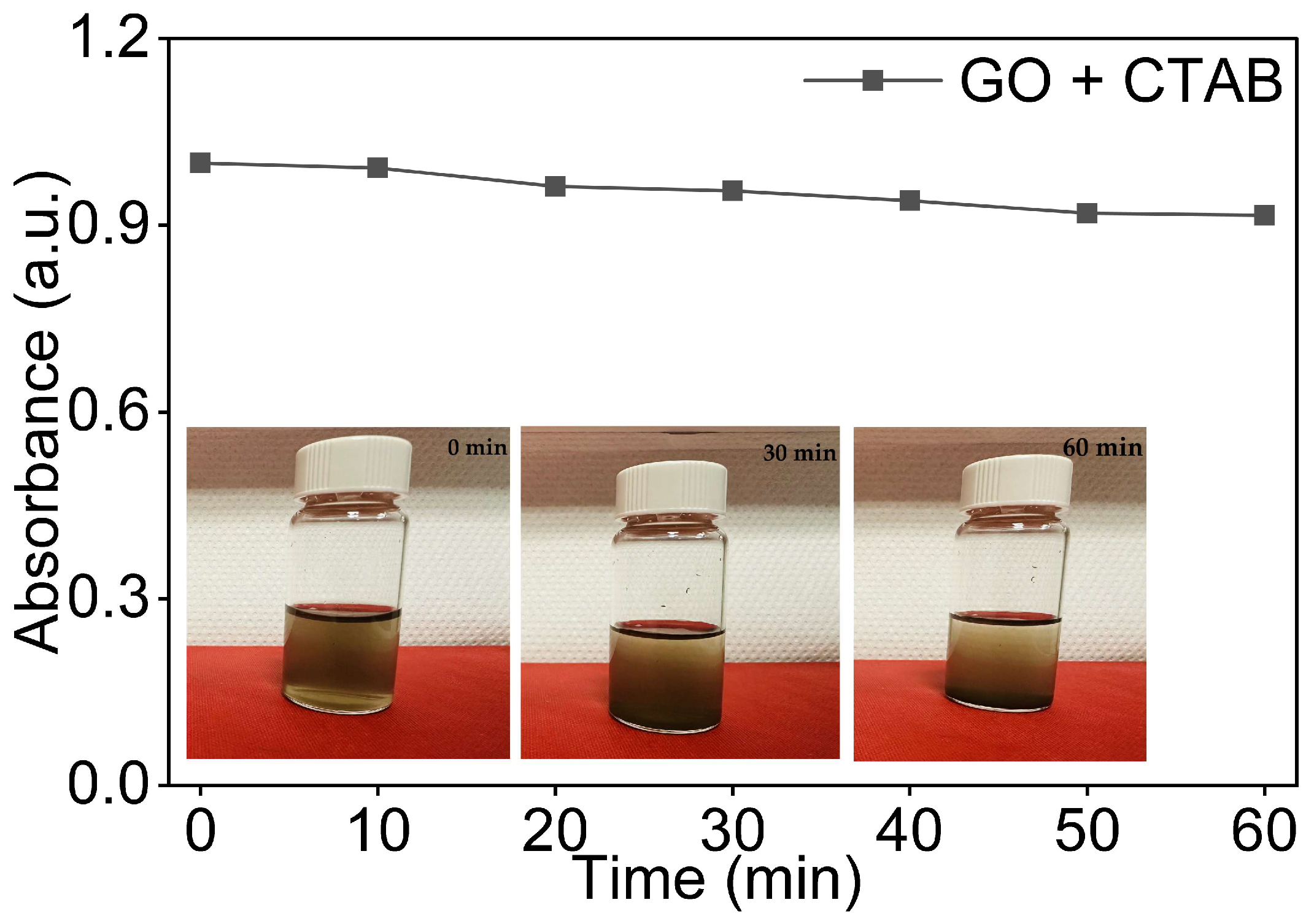
3.4.2. GO Dispersions with CTAB in Water
3.5. Combined Effect of Additives in Saturated Ca(OH)2
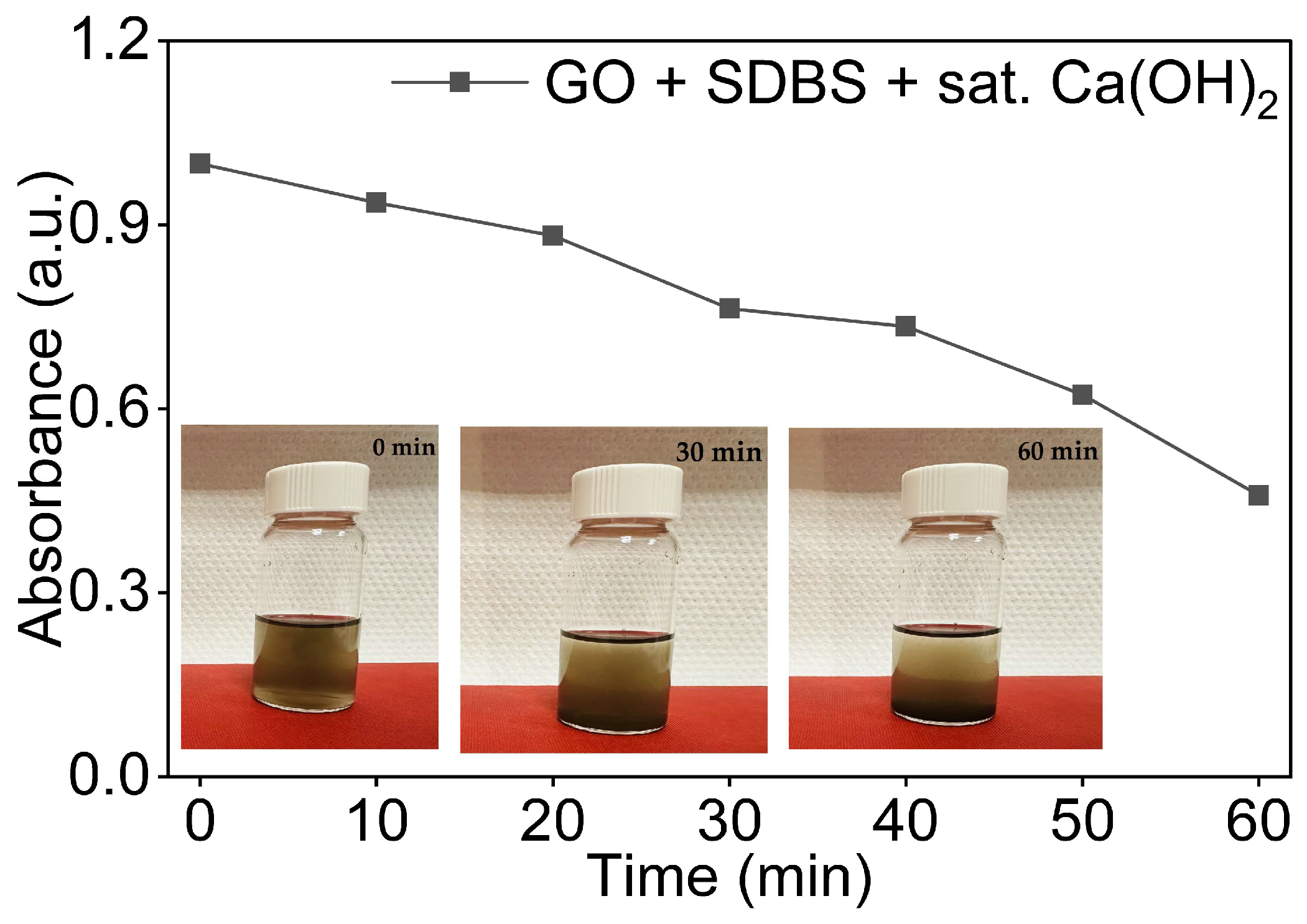
3.5.1. GO Dispersions with SDBS in Sat. Ca(OH)2
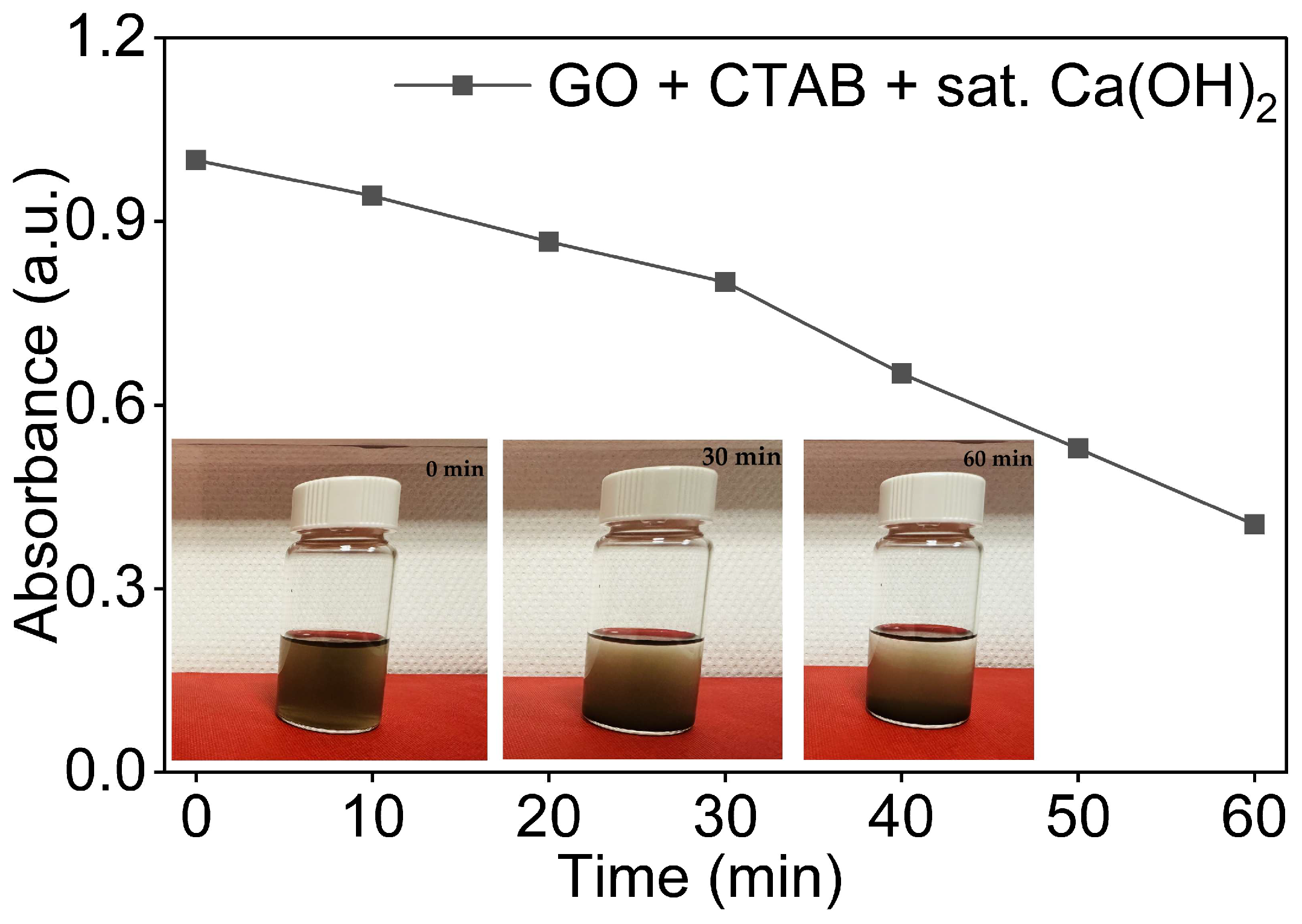
3.5.2. GO Dispersions with CTAB in Saturated Ca(OH)2
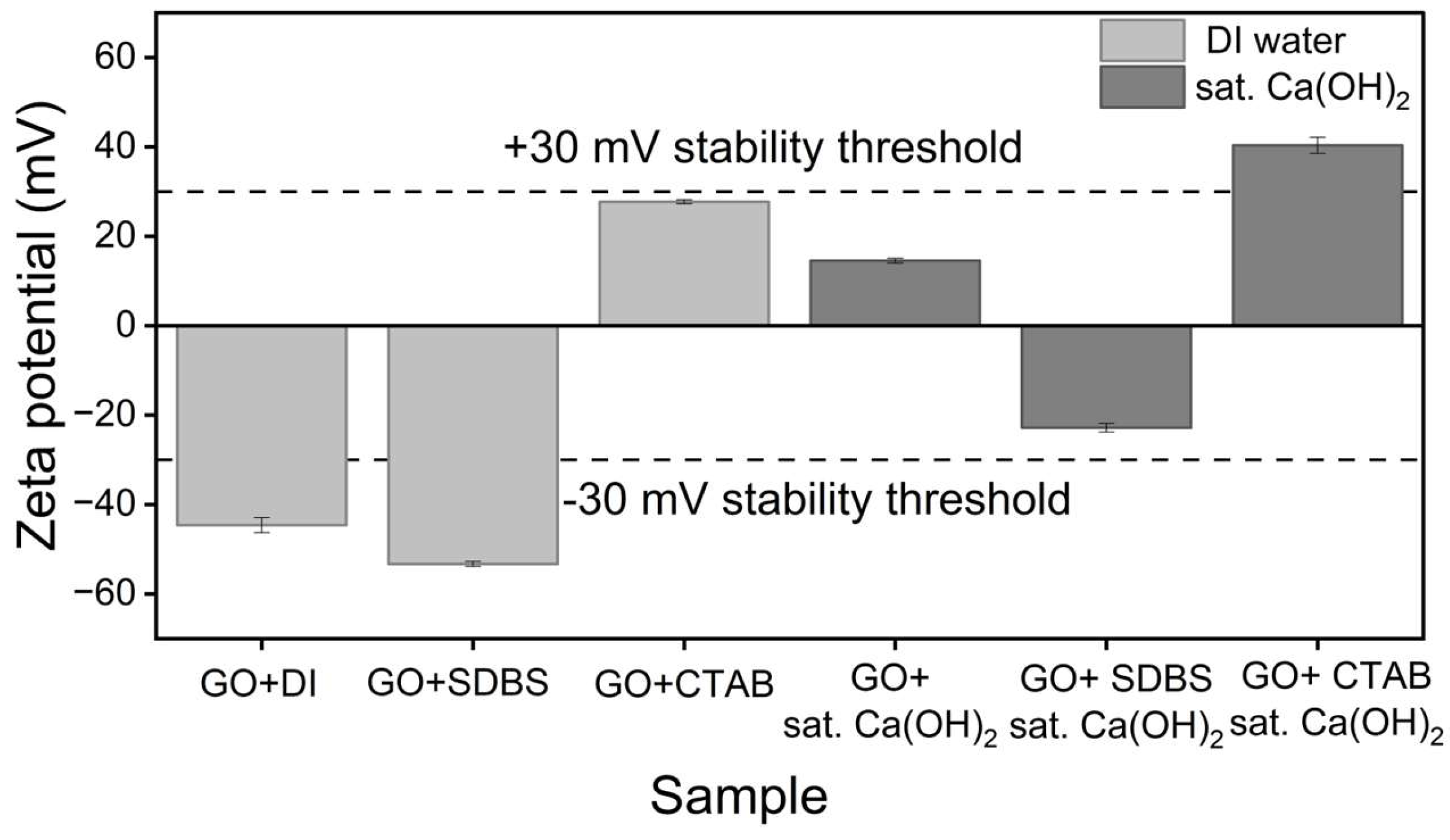
3.6. Zeta Potential and Particle Size of GO Dispersions
3.6.1. Zeta Potential and Particle Size in DI Water
3.6.2. Zeta Potential and Particle Size in Saturated Ca(OH)2
4. Discussion
5. Conclusions
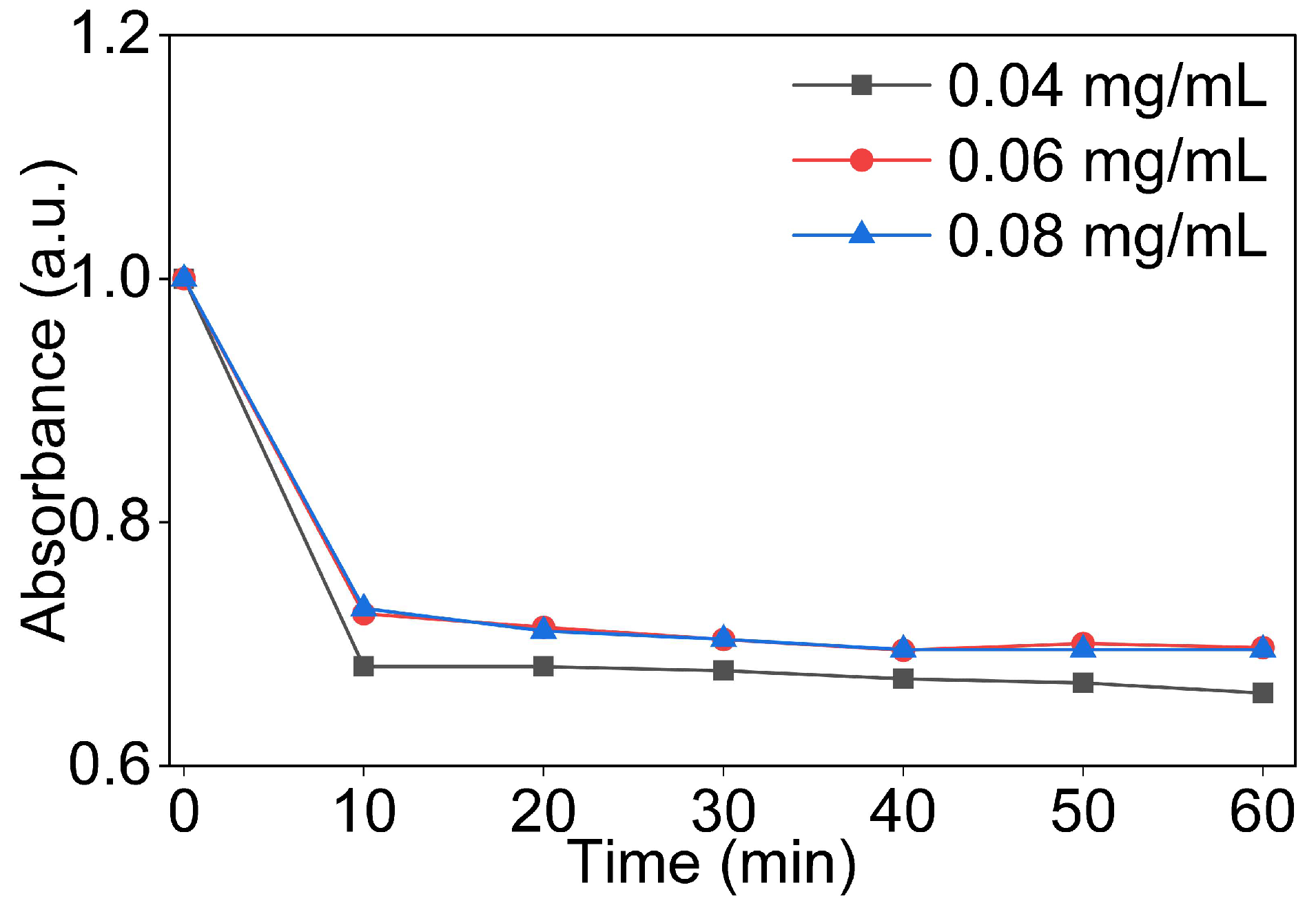
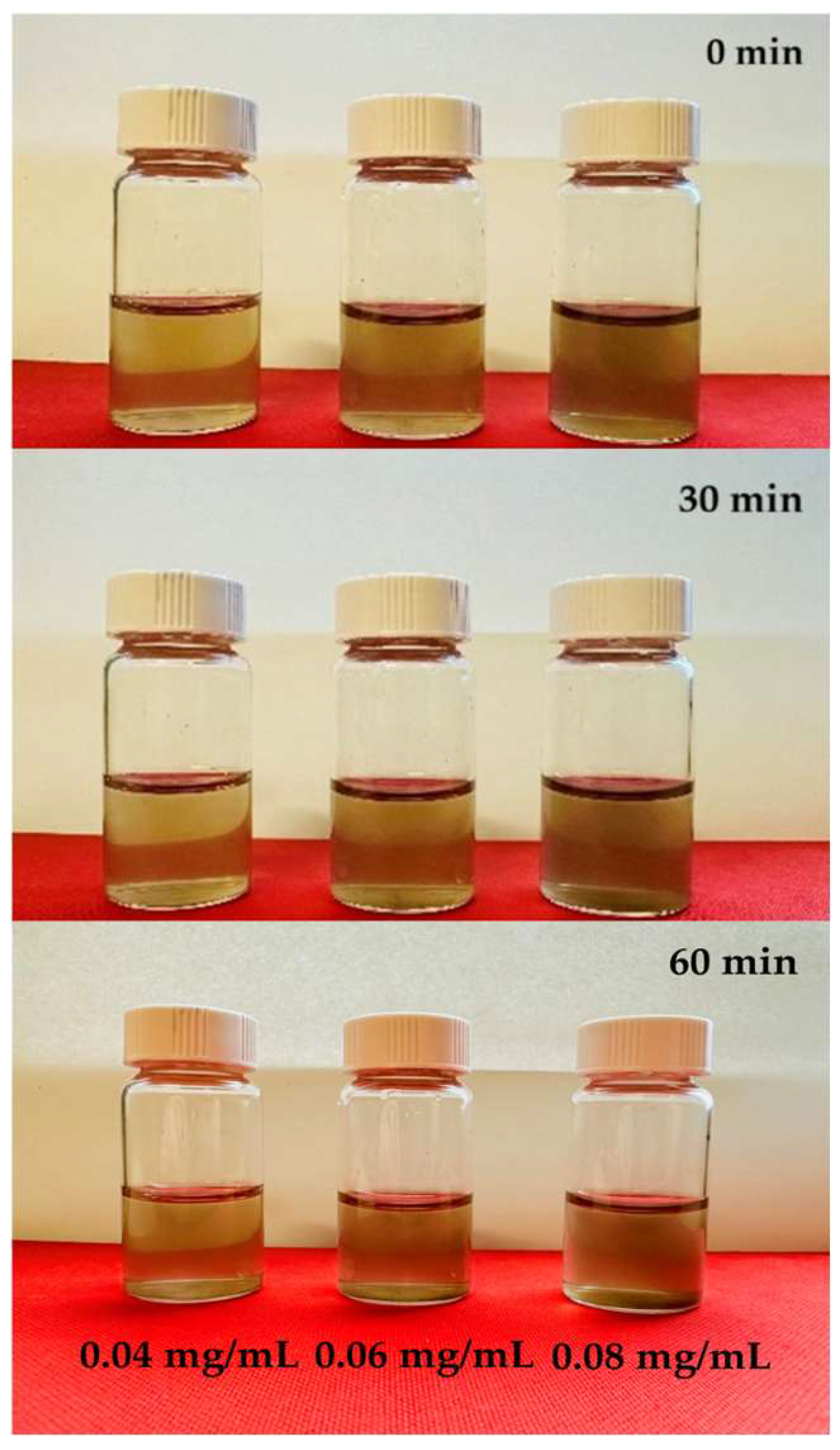
- GO formed stable aqueous dispersions following probe ultrasonication at concentrations of 0.04, 0.06, and 0.08 mg/mL, with all three showing a two-phase profile of rapid initial settling followed by a stable plateau. The 0.08 mg/mL concentration was selected for further investigation.
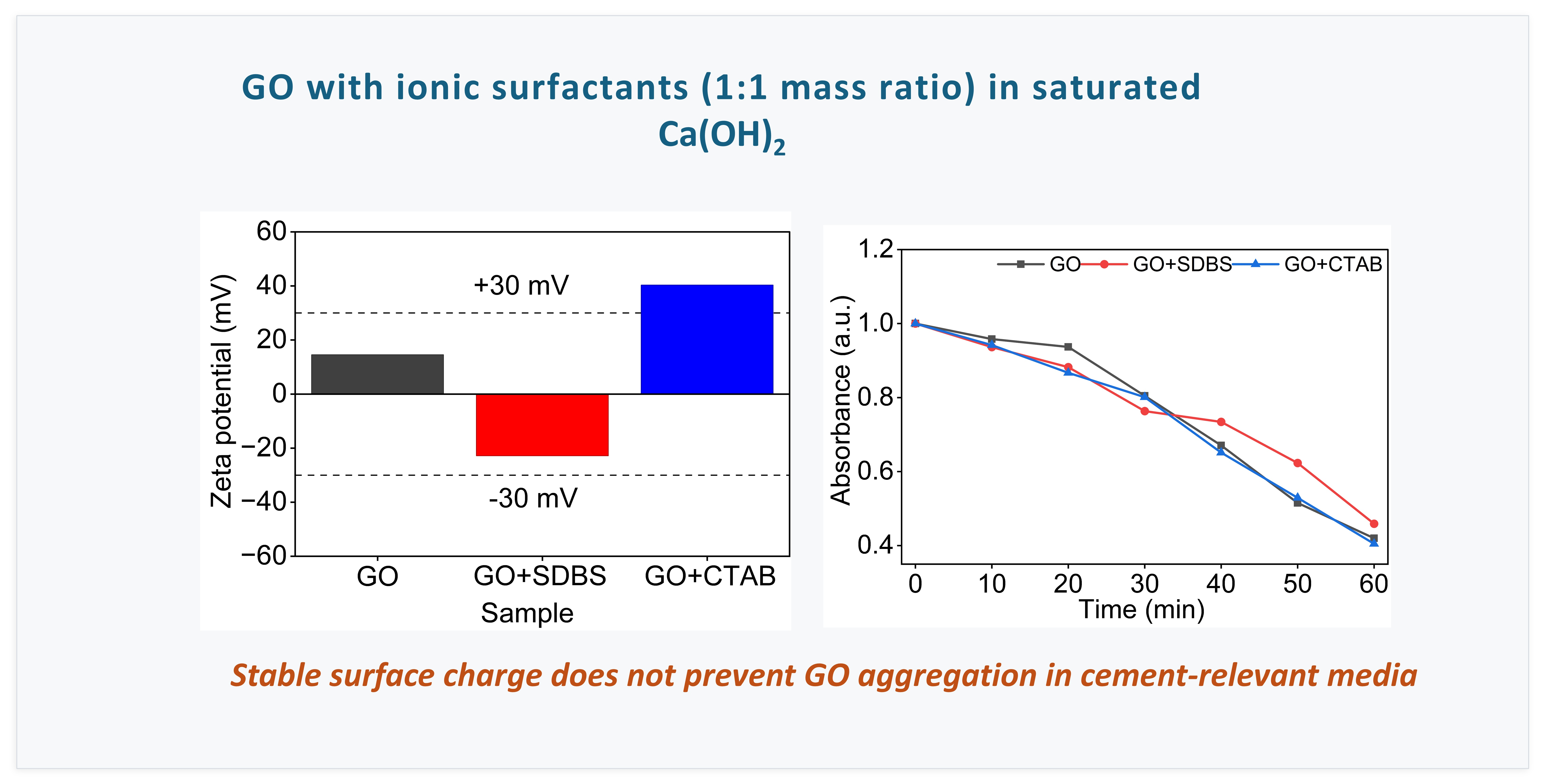
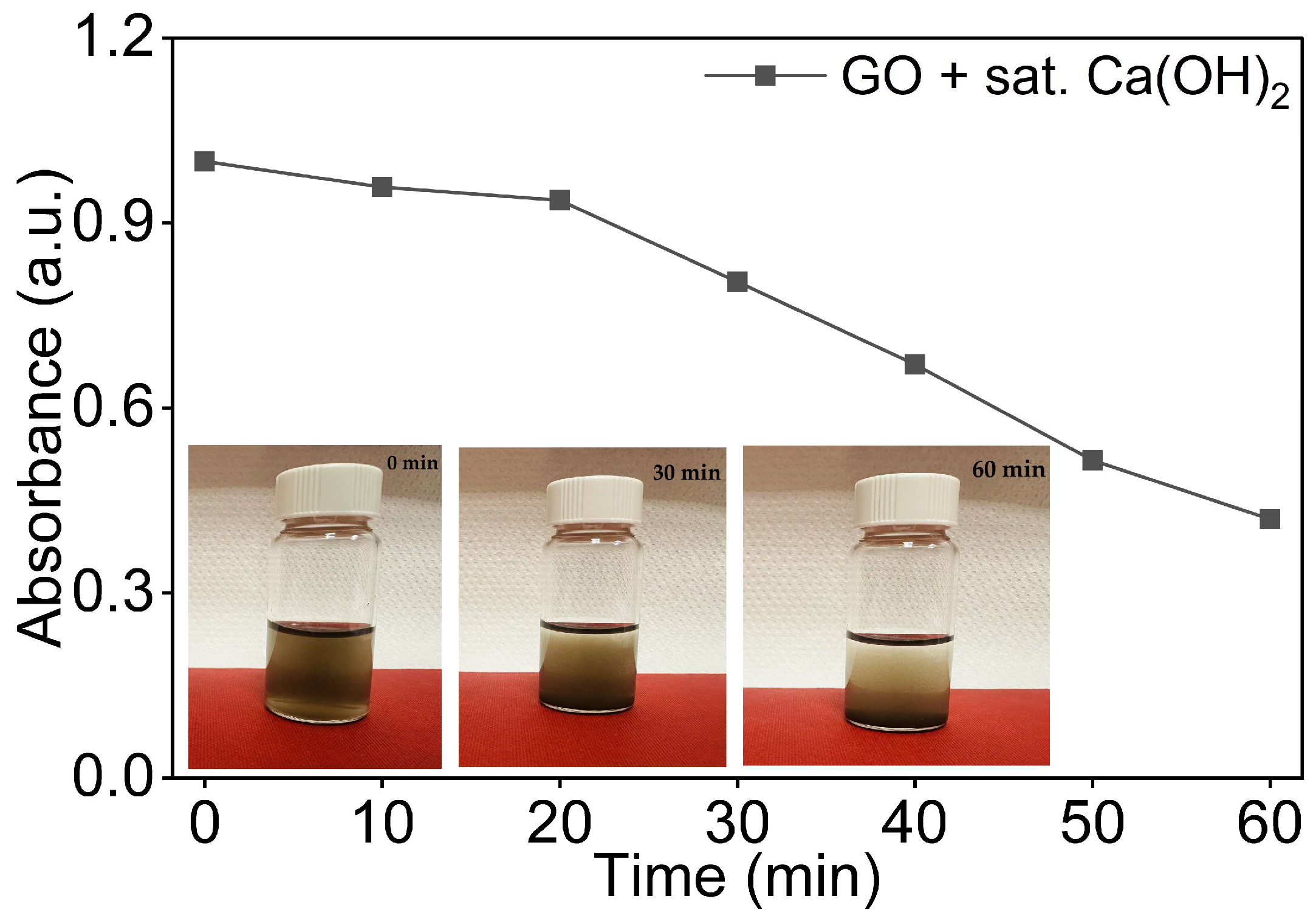
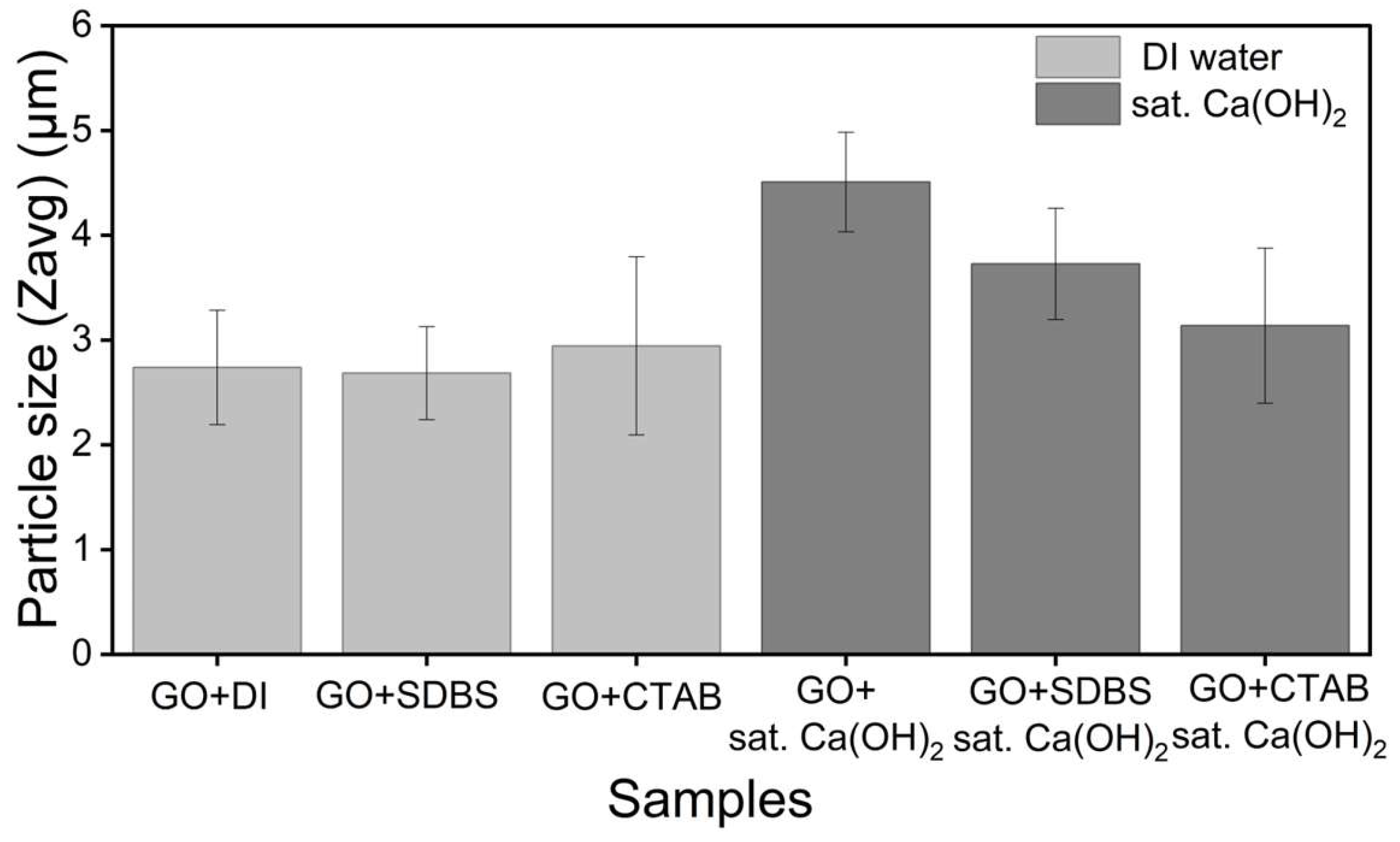
- Saturated Ca(OH)2 markedly reduced GO colloidal stability, with 60 min absorbance retention decreasing from close to 70% in DI water to approximately 40% in saturated Ca(OH)2. The zeta potential of unsupplemented GO underwent a sign reversal from strongly negative in DI water to a small positive value in saturated Ca(OH)2, indicating substantial Ca2+ adsorption on the GO surface.
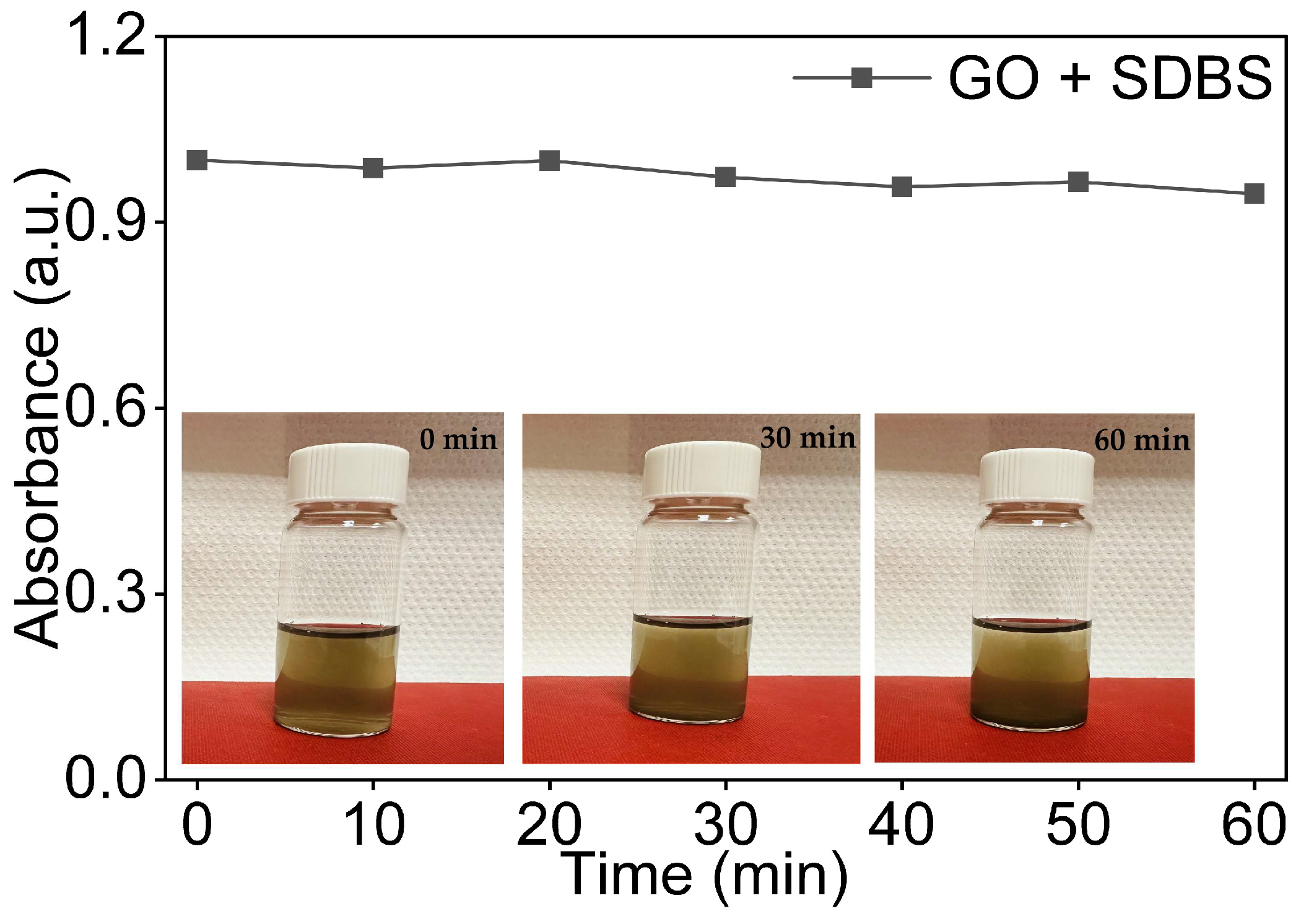
- Both SDBS and CTAB enhanced GO stability in DI water at a 1:1 GO:surfactant mass ratio, with both dispersions retaining above 90% of their initial absorbance at 60 min. The two surfactants modified the GO surface charge in opposite ways: SDBS reinforced the native negative charge to produce a more negative zeta potential, while CTAB inverted the surface charge to a positive value.
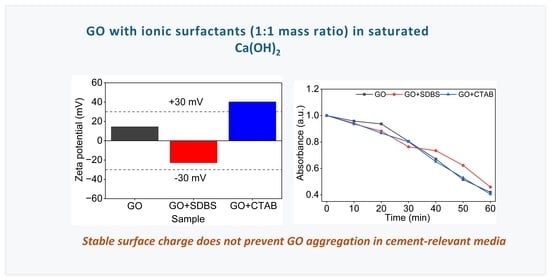
- Neither SDBS nor CTAB maintained GO colloidal stability in saturated Ca(OH)2. Despite producing zeta potentials of moderate to strongly positive magnitude, all three Ca(OH)2 systems retained less than half of their initial absorbance at 60 min. This indicates that aggregation in this environment is not governed by net surface charge alone.
- The combined UV-Vis, zeta potential, and particle size data indicate that the limited effectiveness of ionic surfactants in saturated Ca(OH)2 cannot be explained by the net surface charge alone and is consistent with the established mechanisms of Ca2+ chemical cross-linking of GO carboxyl groups. This is the central mechanistic finding of the present study and indicates that effective dispersants for GO in cement-relevant media must combine electrostatic and steric stabilisation. Future work will extend the present study to polymer-based dispersants and to the incorporation of stabilised GO into cement systems.
Supplementary Materials
Author Contributions
Funding
Data Availability Statement
Acknowledgments
Conflicts of Interest
Abbreviations
| GO | Graphene Oxide; |
| CNTs/CNFs | Carbon nanotubes/carbon nano-fibres; |
| SDBS | Sodium dodecylbenzene sulfonate; |
| CTAB | Cetyltrimethylammonium bromide; |
| UV-Vis | Ultraviolet-visible spectroscopy; |
| SEM | Scanning electron microscopy; |
| XRD | X-ray diffraction; |
| ATR-FTIR | Attenuated total reflectance Fourier transform infrared spectroscopy; |
| DI water | Deionised water; |
| Ca(OH)2 | Calcium hydroxide; |
| C-S-H | Calcium silicate hydrate; |
| Ca2+ | Calcium ion; |
| NaNO3 | Sodium nitrate; |
| KMnO4 | Potassium permanganate; |
| HCL | Hydrochloric acid; |
| H2O2 | Hydrogen peroxide; |
| H2SO4 | Hydrochloric acid; |
| a.u. | Arbitrary units; |
| -COO− | Carboxylate group/ion. |
References
- Neville, A.M. Properties of Concrete, 5th ed.; Pearson: Harlow, UK, 2011. [Google Scholar]
- Hulagabali, M.M.; Vesmawala, G.R.; Patil, Y.D. Synthesis, Characterization, and Application of Graphene Oxide and Reduced Graphene Oxide and Its Influence on Rheology, Microstructure, and Mechanical Strength of Cement Paste. J. Build. Eng. 2023, 71, 106586. [Google Scholar] [CrossRef] [Scilit]
- Alateah, A.H. Graphene Concrete: Recent Advances in Production Methods, Performance Properties, Environmental Impact and Economic Viability. Case Stud. Constr. Mater. 2023, 19, e02653. [Google Scholar] [CrossRef] [Scilit]
- Pei, C.; Kong, S.; Guo, M.-Z.; Zhu, J.-H. Water-Based Graphene Nanofluid Additives: Advancements in Sustainable, Low-Carbon, and High-Performance Nanocarbon-Modified Cementitious Materials. Cem. Concr. Res. 2024, 180, 107505. [Google Scholar] [CrossRef] [Scilit]
- Gholampour, A.; Kiamahalleh, M.V.; Tran, D.N.H.; Ozbakkaloglu, T.; Losic, D. Revealing the Dependence of the Physiochemical and Mechanical Properties of Cement Composites on Graphene Oxide Concentration. RSC Adv. 2017, 7, 55148–55156. [Google Scholar] [CrossRef] [Scilit]
- Chintalapudi, K.; Pannem, R.M.R. The Effects of Graphene Oxide Addition on Hydration Process, Crystal Shapes, and Microstructural Transformation of Ordinary Portland Cement. J. Build. Eng. 2020, 32, 101551. [Google Scholar] [CrossRef] [Scilit]
- Sanchez, F.; Sobolev, K. Nanotechnology in Concrete—A Review. Constr. Build. Mater. 2010, 24, 2060–2071. [Google Scholar] [CrossRef] [Scilit]
- Sobolev, K.; Gutierrez, M.F. How Nanotechnology Can Change the Concrete World. Am. Ceram. Soc. Bull. 2005, 84, 14–18. [Google Scholar]
- Li, H.; Xiao, H.G.; Yuan, J.; Ou, J. Microstructure of Cement Mortar with Nano-Particles. Compos. B Eng. 2004, 35, 185–189. [Google Scholar] [CrossRef] [Scilit]
- Miao, X.; Xing, Y.; Zheng, H.; Liu, Q.; Hu, M.; Guo, J. Effects of Hybrid Graphene Oxide-Nanosilica on Calcium Silicate Hydrate in the Simulation Environment and Cement. ACS Omega 2023, 8, 22975–22983. [Google Scholar] [CrossRef] [Scilit] [PubMed]
- Tsardaka, E.-C.; Tsampali, E.; Stefanidou, M. The Contribution of Nano-Alumina to Ultra-High-Performance Cement-Based Systems. Materials 2024, 17, 4120. [Google Scholar] [CrossRef] [Scilit]
- Szleifer, I.; Yerushalmi-Rozen, R. Polymers and Carbon Nanotubes—Dimensionality, Interactions and Nanotechnology. Polymer 2005, 46, 7803–7818. [Google Scholar] [CrossRef] [Scilit]
- Tyson, B.M.; Al-Rub, R.K.A.; Yazdanbakhsh, A.; Grasley, Z. Carbon Nanotubes and Carbon Nanofibers for Enhancing the Mechanical Properties of Nanocomposite Cementitious Materials. J. Mater. Civ. Eng. 2011, 23, 1028–1035. [Google Scholar] [CrossRef] [Scilit]
- Qiu, L.; Yang, X.; Gou, X.; Yang, W.; Ma, Z.F.; Wallace, G.G.; Li, D. Dispersing Carbon Nanotubes with Graphene Oxide in Water and Synergistic Effects between Graphene Derivatives. Chem. Eur. J. 2010, 16, 10653–10658. [Google Scholar] [CrossRef] [Scilit] [PubMed]
- Geim, A.K.; Novoselov, K.S. The Rise of Graphene. Nat. Mater. 2007, 6, 183–191. [Google Scholar] [CrossRef] [Scilit]
- Schulte, J.; Jiang, Z.; Sevim, O.; Ozbulut, O.E. Graphene-Reinforced Cement Composites for Smart Infrastructure Systems; Butterworth-Heinemann: Oxford, UK, 2022. [Google Scholar]
- Zheng, Q.; Han, B.; Cui, X.; Yu, X.; Ou, J. Graphene-Engineered Cementitious Composites: Small Makes a Big Impact. Nanomater. Nanotechnol. 2017, 7, 1–18. [Google Scholar] [CrossRef] [Scilit]
- Dimov, D.; Amit, I.; Gorrie, O.; Barnes, M.D.; Townsend, N.J.; Neves, A.I.S.; Withers, F.; Russo, S.; Craciun, M.F. Ultrahigh Performance Nanoengineered Graphene–Concrete Composites for Multifunctional Applications. Adv. Funct. Mater. 2018, 28, 1705183. [Google Scholar] [CrossRef] [Scilit]
- Meng, S.; Ouyang, X.; Fu, J.; Niu, Y.; Ma, Y. The Role of Graphene/Graphene Oxide in Cement Hydration. Nanotechnol. Rev. 2021, 10, 768–778. [Google Scholar] [CrossRef] [Scilit]
- Salami, B.A.; Mukhtar, F.; Ganiyu, S.A.; Adekunle, S.; Saleh, T.A. Graphene-Based Concrete: Synthesis Strategies and Reinforcement Mechanisms in Graphene-Based Cementitious Composites (Part 1). Constr. Build. Mater. 2023, 396, 132296. [Google Scholar] [CrossRef] [Scilit]
- Krystek, M.; Pakulski, D.; Patroniak, V.; Górski, M.; Szojda, L.; Ciesielski, A.; Samorì, P.; Krystek, M.; Górski, M.; Szojda, L.; et al. High-Performance Graphene-Based Cementitious Composites. Adv. Sci. 2019, 6, 1801195. [Google Scholar] [CrossRef] [Scilit]
- Krystek, M.; Ciesielski, A.; Samorì, P. Graphene-Based Cementitious Composites: Toward Next-Generation Construction Technologies. Adv. Funct. Mater. 2021, 31, 2101887. [Google Scholar] [CrossRef] [Scilit]
- Shamsaei, E.; de Souza, F.B.; Yao, X.; Benhelal, E.; Akbari, A.; Duan, W. Graphene-Based Nanosheets for Stronger and More Durable Concrete: A Review. Constr. Build. Mater. 2018, 183, 642–660. [Google Scholar] [CrossRef] [Scilit]
- Jing, G.; Wu, J.; Lei, T.; Wang, S.; Strokova, V.; Nelyubova, V.; Wang, M.; Ye, Z. From Graphene Oxide to Reduced Graphene Oxide: Enhanced Hydration and Compressive Strength of Cement Composites. Constr. Build. Mater. 2020, 248, 118699. [Google Scholar] [CrossRef] [Scilit]
- Lin, Y.; Du, H. Graphene Reinforced Cement Composites: A Review. Constr. Build. Mater. 2020, 265, 120312. [Google Scholar] [CrossRef] [Scilit]
- Pan, Z.; He, L.; Qiu, L.; Korayem, A.H.; Li, G.; Zhu, J.W.; Collins, F.; Li, D.; Duan, W.H.; Wang, M.C. Mechanical Properties and Microstructure of a Graphene Oxide–Cement Composite. Cem. Concr. Compos. 2015, 58, 140–147. [Google Scholar] [CrossRef] [Scilit]
- Suo, Y.; Guo, R.; Xia, H.; Yang, Y.; Zhou, B.; Zhao, Z. A Review of Graphene Oxide/Cement Composites: Performance, Functionality, Mechanisms, and Prospects. J. Build. Eng. 2022, 53, 104502. [Google Scholar] [CrossRef] [Scilit]
- Suo, Y.; Guo, R.; Xia, H.; Yang, Y.; Yan, F.; Ma, Q. Study on Modification Mechanism of Workability and Mechanical Properties for Graphene Oxide-Reinforced Cement Composite. Nanomater. Nanotechnol. 2020, 10. [Google Scholar] [CrossRef] [Scilit]
- Fonseka, I.; Mohotti, D.; Wijesooriya, K.; Lee, C.K.; Mendis, P. Influence of Graphene Oxide Properties, Superplasticiser Type, and Dispersion Technique on Mechanical Performance of Graphene Oxide-Added Concrete. Constr. Build. Mater. 2024, 428, 136415. [Google Scholar] [CrossRef] [Scilit]
- Chen, X.; Qu, Z.; Liu, Z.; Ren, G. Mechanism of Oxidization of Graphite to Graphene Oxide by the Hummers Method. ACS Omega 2022, 7, 23503–23510. [Google Scholar] [CrossRef] [Scilit]
- Zhao, L.; Guo, X.; Song, L.; Song, Y.; Dai, G.; Liu, J. An Intensive Review on the Role of Graphene Oxide in Cement-Based Materials. Constr. Build. Mater. 2020, 241, 117939. [Google Scholar] [CrossRef] [Scilit]
- Lv, S.; Ma, Y.; Qiu, C.; Zhou, Q. Regulation of Go on Cement Hydration Crystals and Its Toughening Effect. Mag. Concr. Res. 2013, 65, 1246–1254. [Google Scholar] [CrossRef] [Scilit]
- Lv, S.; Ma, Y.; Qiu, C.; Sun, T.; Liu, J.; Zhou, Q. Effect of Graphene Oxide Nanosheets of Microstructure and Mechanical Properties of Cement Composites. Constr. Build. Mater. 2013, 49, 121–127. [Google Scholar] [CrossRef] [Scilit]
- Liao, C.; Lin, B.; Li, M.; Dai, G.; Hu, S. Synergistic Effects of Graphene Oxide and Fly Ash on Rheology, Mechanical Properties, and Microstructure of Highly-Flowable Cementitious Grouts. J. Build. Eng. 2024, 87, 109038. [Google Scholar] [CrossRef] [Scilit]
- Chen, X.; Park, J.; Ji, W.; Huang, Y.; Lu, J.X.; Hu, Z.; Poon, C.S. Unlocking the Interaction Mechanism of CNTs and C-S-H on Enhancing Elastic and Viscoelastic Properties of Alite Paste. Adv. Sci. 2025, 12, e05876. [Google Scholar] [CrossRef] [Scilit] [PubMed]
- Wei, X.X.; Pei, C.; Zhu, J.H. Towards the Large-Scale Application of Graphene-Modified Cement-Based Composites: A Comprehensive Review. Constr. Build. Mater. 2024, 421, 135632. [Google Scholar] [CrossRef] [Scilit]
- Zhao, L.; Guo, X.; Liu, Y.; Ge, C.; Chen, Z.; Guo, L.; Shu, X.; Liu, J. Investigation of Dispersion Behavior of GO Modified by Different Water Reducing Agents in Cement Pore Solution. Carbon 2018, 127, 255–269. [Google Scholar] [CrossRef] [Scilit]
- Liu, C.; Huang, X.; Wu, Y.Y.; Deng, X.; Zheng, Z.; Xu, Z.; Hui, D. Advance on the Dispersion Treatment of Graphene Oxide and the Graphene Oxide Modified Cement-Based Materials. Nanotechnol. Rev. 2021, 10, 34–49. [Google Scholar] [CrossRef] [Scilit]
- Zhao, L.; Zhu, S.; Wu, H.; Zhang, X.; Tao, Q.; Song, L.; Song, Y.; Guo, X. Deep Research about the Mechanisms of Graphene Oxide (GO) Aggregation in Alkaline Cement Pore Solution. Constr. Build. Mater. 2020, 247, 118446. [Google Scholar] [CrossRef] [Scilit]
- Liu, J.; Fu, J.; Yang, Y.; Gu, C. Study on Dispersion, Mechanical and Microstructure Properties of Cement Paste Incorporating Graphene Sheets. Constr. Build. Mater. 2019, 199, 1–11. [Google Scholar] [CrossRef] [Scilit]
- Lotya, M.; King, P.J.; Khan, U.; De, S.; Coleman, J.N. High-Concentration, Surfactant-Stabilized Graphene Dispersions. ACS Nano 2010, 4, 3155–3162. [Google Scholar] [CrossRef] [Scilit]
- Fernández-Merino, M.J.; Paredes, J.I.; Villar-Rodil, S.; Guardia, L.; Solís-Fernández, P.; Salinas-Torres, D.; Cazorla-Amorós, D.; Morallón, E.; Martínez-Alonso, A.; Tascón, J.M.D. Investigating the Influence of Surfactants on the Stabilization of Aqueous Reduced Graphene Oxide Dispersions and the Characteristics of Their Composite Films. Carbon 2012, 50, 3184–3194. [Google Scholar] [CrossRef] [Scilit]
- Meng, W.; Gall, E.; Ke, F.; Zeng, Z.; Kopchick, B.; Timsina, R.; Qiu, X. Structure and Interaction of Graphene Oxide- Cetyltrimethylammonium Bromide Complexation. J. Phys. Chem. C 2015, 119, 21135–21140. [Google Scholar] [CrossRef] [Scilit]
- Zhang, F.; Li, S.; Zhang, Q.; Liu, J.; Zeng, S.; Liu, M.; Sun, D. Adsorption of Different Types of Surfactants on Graphene Oxide. J. Mol. Liq. 2019, 276, 338–346. [Google Scholar] [CrossRef] [Scilit]
- Chuah, S.; Li, W.; Chen, S.J.; Sanjayan, J.G.; Duan, W.H. Investigation on Dispersion of Graphene Oxide in Cement Composite Using Different Surfactant Treatments. Constr. Build. Mater. 2018, 161, 519–527. [Google Scholar] [CrossRef] [Scilit]
- Jing, G.J.; Ye, Z.M.; Lu, X.L.; Wu, J.M.; Wang, S.X.; Cheng, X. Incorporating Graphene Oxide into Lime Solution: A Study of Flocculation and Corresponding Improvement. Mater. Construcc. 2018, 68, e165. [Google Scholar] [CrossRef] [Scilit]
- Hummers, W.S.; Offeman, R.E. Preparation of Graphitic Oxide. J. Am. Chem. Soc. 1958, 80, 1339. [Google Scholar] [CrossRef] [Scilit]
- Zhou, Y.; Bao, Q.; Tang, L.A.L.; Zhong, Y.; Loh, K.P. Hydrothermal Dehydration for the “Green” Reduction of Exfoliated Graphene Oxide to Graphene and Demonstration of Tunable Optical Limiting Properties. Chem. Mater. 2009, 21, 2950–2956. [Google Scholar] [CrossRef] [Scilit]
- Ferrari, A.C.; Robertson, J. Interpretation of Raman Spectra of Disordered and Amorphous Carbon. Phys. Rev. B 2000, 61, 14095–14107. [Google Scholar] [CrossRef] [Scilit]
- Zhu, Y.; Murali, S.; Cai, W.; Li, X.; Suk, J.W.; Potts, J.R.; Ruoff, R.S. Graphene and Graphene Oxide: Synthesis, Properties, and Applications. Adv. Mater. 2010, 22, 3906–3924. [Google Scholar] [CrossRef] [Scilit]
- Zhang, Z.; Schniepp, H.C.; Adamson, D.H. Characterization of Graphene Oxide: Variations in Reported Approaches. Carbon 2019, 154, 510–521. [Google Scholar] [CrossRef] [Scilit]
- Shahriary, L.; Athawale, A.A. Graphene Oxide Synthesized by Using Modified Hummers Approach. Int. J. Renew. Energy Environ. Eng. 2014, 02, 58–63. [Google Scholar]
- Konios, D.; Stylianakis, M.M.; Stratakis, E.; Kymakis, E. Dispersion Behaviour of Graphene Oxide and Reduced Graphene Oxide. J. Colloid Interface Sci. 2014, 430, 108–112. [Google Scholar] [CrossRef] [Scilit] [PubMed]
- Ayán-Varela, M.; Paredes, J.I.; Guardia, L.; Villar-Rodil, S.; Munuera, J.M.; Díaz-González, M.; Fernández-Sánchez, C.; Martínez-Alonso, A.; Tascón, J.M.D. Achieving Extremely Concentrated Aqueous Dispersions of Graphene Flakes and Catalytically Efficient Graphene-Metal Nanoparticle Hybrids with Flavin Mononucleotide as a High-Performance Stabilizer. ACS Appl. Mater. Interfaces 2015, 7, 10293–10307. [Google Scholar] [CrossRef] [Scilit]
- Lothenbach, B.; Winnefeld, F. Thermodynamic Modelling of the Hydration of Portland Cement. Cem. Concr. Res. 2006, 36, 209–226. [Google Scholar] [CrossRef] [Scilit]
- Dreyer, D.R.; Park, S.; Bielawski, C.W.; Ruoff, R.S. The Chemistry of Graphene Oxide. Chem. Soc. Rev. 2010, 39, 228–240. [Google Scholar] [CrossRef] [Scilit]
- Mohammed, A.; Sanjayan, J.G.; Duan, W.H.; Nazari, A. Incorporating Graphene Oxide in Cement Composites: A Study of Transport Properties. Constr. Build. Mater. 2015, 84, 341–347. [Google Scholar] [CrossRef] [Scilit]
- Lotya, M.; Hernandez, Y.; King, P.J.; Smith, R.J.; Nicolosi, V.; Karlsson, L.S.; Blighe, F.M.; De, S.; Wang, Z.; McGovern, I.T.; et al. Liquid Phase Production of Graphene by Exfoliation of Graphite in Surfactant/Water Solutions. J. Am. Chem. Soc. 2009, 131, 3611–3620. [Google Scholar] [CrossRef] [Scilit]
- Konkena, B.; Vasudevan, S. Understanding Aqueous Dispersibility of Graphene Oxide and Reduced Graphene Oxide through p K a Measurements. J. Phys. Chem. Lett. 2012, 3, 867–872. [Google Scholar] [CrossRef] [Scilit] [PubMed]
- Chen, H.; Wang, D.; Wang, X.; Ye, Z.; Han, L.; Xu, Q. Triple Phase Inversion of Emulsions Stabilized by Amphiphilic Graphene Oxide and Cationic Surfactants. ACS Omega 2020, 5, 23524–23532. [Google Scholar] [CrossRef] [Scilit]
- Park, S.; Lee, K.S.; Bozoklu, G.; Cai, W.; Nguyen, S.B.T.; Ruoff, R.S. Graphene Oxide Papers Modified by Divalent Ions—Enhancing Mechanical Properties via Chemical Cross-Linking. ACS Nano 2008, 2, 572–578. [Google Scholar] [CrossRef] [Scilit] [PubMed]





| Sample | pH | Size (Zavg) (μm) | Zeta Potential (mV) | PDI |
|---|---|---|---|---|
| GO + DI | 4 | 2.7 ± 0.5 | −44.6 ± 1.7 | 0.92 ± 0.12 |
| GO + SDBS | 4 | 2.6 ± 0.4 | −53.3 ± 0.5 | 0.94 ± 0.03 |
| GO + CTAB | 3.9 | 2.9 ± 0.8 | 25.7 ± 0.4 | 0.96 ± 0.06 |
| GO + sat. Ca(OH)2 | 12 | 4.5 ± 0.4 | 14.5 ± 0.5 | 0.35 ± 0.19 |
| GO + SDBS + sat. Ca(OH)2 | 11.6 | 3.7 ± 0.5 | −22.8 ± 1.0 | 0.84 ± 0.26 |
| GO + CTAB + sat. Ca(OH)2 | 11.5 | 3.1 ± 0.7 | 40.3 ± 1.8 | 0.82 ± 0.11 |
Disclaimer/Publisher’s Note: The statements, opinions and data contained in all publications are solely those of the individual author(s) and contributor(s) and not of MDPI and/or the editor(s). MDPI and/or the editor(s) disclaim responsibility for any injury to people or property resulting from any ideas, methods, instructions or products referred to in the content. |
© 2026 by the authors. Licensee MDPI, Basel, Switzerland. This article is an open access article distributed under the terms and conditions of the Creative Commons Attribution (CC BY) license.
Share and Cite
Baral, S.; Raghavendra, R.; Thomas, K.; Das, R. Dispersion of Graphene Oxide: Evaluating Ionic Surfactants for Nanocomposite Cement Applications. Nanomaterials 2026, 16, 632. https://doi.org/10.3390/nano16100632
Baral S, Raghavendra R, Thomas K, Das R. Dispersion of Graphene Oxide: Evaluating Ionic Surfactants for Nanocomposite Cement Applications. Nanomaterials. 2026; 16(10):632. https://doi.org/10.3390/nano16100632
Chicago/Turabian StyleBaral, Sadixa, Ramesh Raghavendra, Ken Thomas, and Raja Das. 2026. "Dispersion of Graphene Oxide: Evaluating Ionic Surfactants for Nanocomposite Cement Applications" Nanomaterials 16, no. 10: 632. https://doi.org/10.3390/nano16100632
APA StyleBaral, S., Raghavendra, R., Thomas, K., & Das, R. (2026). Dispersion of Graphene Oxide: Evaluating Ionic Surfactants for Nanocomposite Cement Applications. Nanomaterials, 16(10), 632. https://doi.org/10.3390/nano16100632