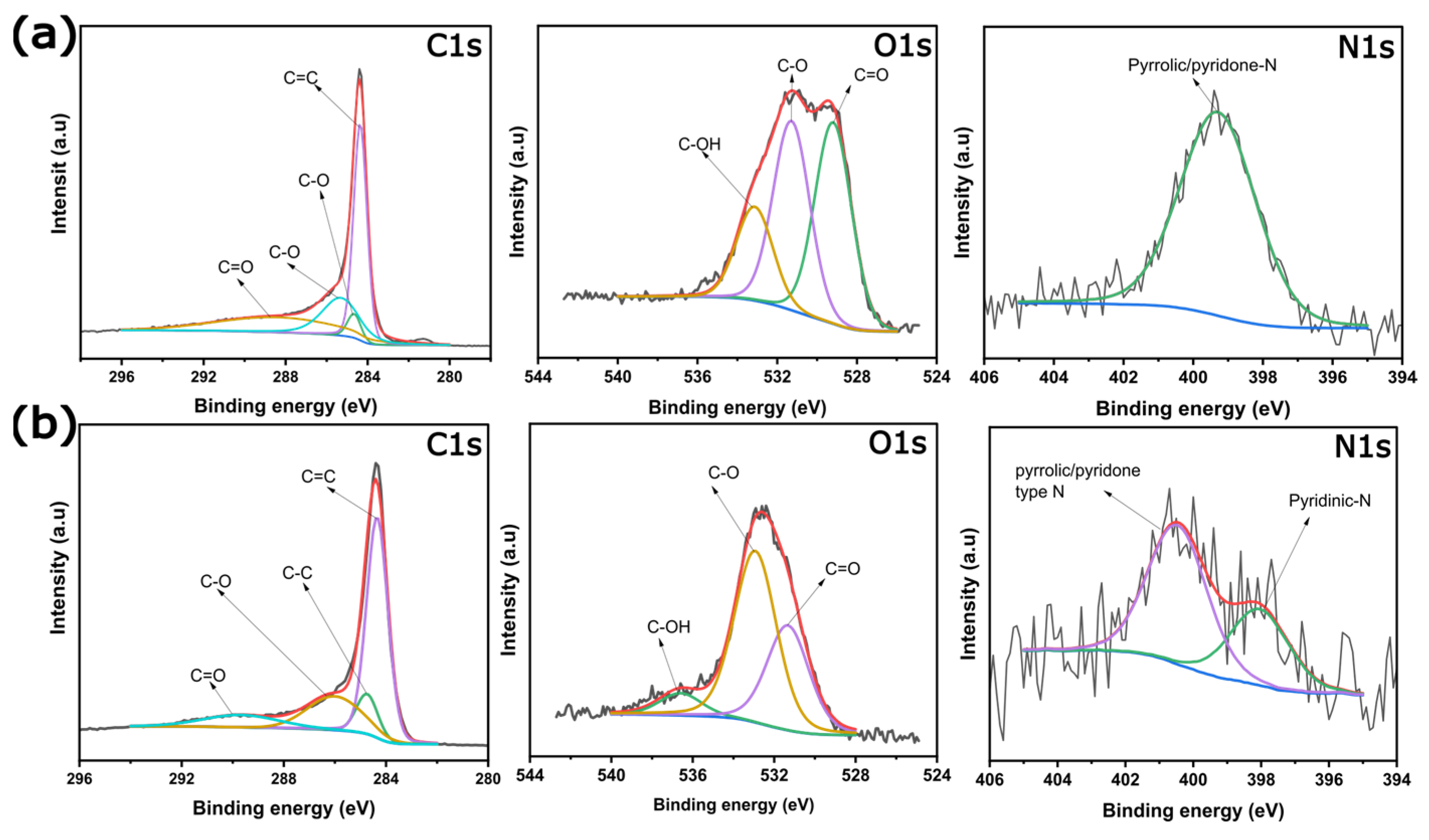
Correction: Lima et al. Facile Synthesis of Sustainable Biomass-Derived Porous Biochars as Promising Electrode Materials for High-Performance Supercapacitor Applications. Nanomaterials 2022, 12, 866


 , and
, and 

References
- Lima, R.M.A.P.; dos Reis, G.S.; Thyrel, M.; Alcaraz-Espinoza, J.J.; Larsson, S.H.; de Oliveira, H.P. Facile Synthesis of Sustainable Biomass-Derived Porous Biochars as Promising Electrode Materials for High-Performance Supercapacitor Applications. Nanomaterials 2022, 12, 866. [Google Scholar] [CrossRef] [Scilit] [PubMed]
- Guy, M.; Mathieu, M.; Anastopoulos, I.P.; Martínez, M.G.; Rousseau, F.; Dotto, G.L.; de Oliveira, H.P.; Lima, E.C.; Thyrel, M.; Larsson, S.H.; et al. Process Parameters Optimization, Characterization, and Application of KOH-Activated Norway Spruce Bark Graphitic Biochars for Efficient Azo Dye Adsorption. Molecules 2022, 27, 456. [Google Scholar] [CrossRef] [Scilit] [PubMed]
- dos Reis, G.S.; Larsson, S.H.; Mathieu, M.; Thyrel, M.; Pham, T.N. Application of design of experiments (DoE) for optimised production of micro- and mesoporous Norway spruce bark activated carbons. Biomass Conv. Bioref. 2023, 13, 10113–10131. [Google Scholar] [CrossRef] [Scilit]

| Parameters. | ZnCl2 Biochar | KOH Biochar |
|---|---|---|
| SSA (m2 g−1) | 1018 | 2209 |
| Mesopore surface area (m2 g−1) | 456 | 449 |
| Mesopore surface area (%) | 46.0 | 22.6 |
| Micropore area (m2 g−1) | 562 | 1710 |
| Micropore area (%) | 54.0 | 77.4 |
| Total pore volume (cm3 g−1) | 0.78 | 1.50 |
| Micropore volume (cm3 g−1) | 0.41 | 0.25 |
| Mesopore volume (cm3 g−1) | 0.37 | 1.25 |
| Average pore size (nm) | 2.21 | 2.70 |
Disclaimer/Publisher’s Note: The statements, opinions and data contained in all publications are solely those of the individual author(s) and contributor(s) and not of MDPI and/or the editor(s). MDPI and/or the editor(s) disclaim responsibility for any injury to people or property resulting from any ideas, methods, instructions or products referred to in the content. |
© 2025 by the authors. Licensee MDPI, Basel, Switzerland. This article is an open access article distributed under the terms and conditions of the Creative Commons Attribution (CC BY) license (https://creativecommons.org/licenses/by/4.0/).
Share and Cite
Lima, R.M.A.P.; dos Reis, G.S.; Thyrel, M.; Alcaraz-Espinoza, J.J.; Larsson, S.H.; de Oliveira, H.P. Correction: Lima et al. Facile Synthesis of Sustainable Biomass-Derived Porous Biochars as Promising Electrode Materials for High-Performance Supercapacitor Applications. Nanomaterials 2022, 12, 866. Nanomaterials 2025, 15, 1794. https://doi.org/10.3390/nano15231794
Lima RMAP, dos Reis GS, Thyrel M, Alcaraz-Espinoza JJ, Larsson SH, de Oliveira HP. Correction: Lima et al. Facile Synthesis of Sustainable Biomass-Derived Porous Biochars as Promising Electrode Materials for High-Performance Supercapacitor Applications. Nanomaterials 2022, 12, 866. Nanomaterials. 2025; 15(23):1794. https://doi.org/10.3390/nano15231794
Chicago/Turabian StyleLima, Ravi Moreno Araujo Pinheiro, Glaydson Simões dos Reis, Mikael Thyrel, Jose Jarib Alcaraz-Espinoza, Sylvia H. Larsson, and Helinando Pequeno de Oliveira. 2025. "Correction: Lima et al. Facile Synthesis of Sustainable Biomass-Derived Porous Biochars as Promising Electrode Materials for High-Performance Supercapacitor Applications. Nanomaterials 2022, 12, 866" Nanomaterials 15, no. 23: 1794. https://doi.org/10.3390/nano15231794
APA StyleLima, R. M. A. P., dos Reis, G. S., Thyrel, M., Alcaraz-Espinoza, J. J., Larsson, S. H., & de Oliveira, H. P. (2025). Correction: Lima et al. Facile Synthesis of Sustainable Biomass-Derived Porous Biochars as Promising Electrode Materials for High-Performance Supercapacitor Applications. Nanomaterials 2022, 12, 866. Nanomaterials, 15(23), 1794. https://doi.org/10.3390/nano15231794