Abstract
Higher-order topological phases (HOTPs) are characterized by symmetry-protected bound states at the corners or hinges of the system. In this work, we reveal a momentum-space counterpart of HOTPs in time-periodic driven systems, which are demonstrated in a two-dimensional extension of the quantum double-kicked rotor. The found Floquet HOTPs are protected by chiral symmetry and characterized by a pair of topological invariants, which could take arbitrarily large integer values with the increase of kicking strengths. These topological numbers are shown to be measurable from the chiral dynamics of wave packets. Under open boundary conditions, multiple quartets Floquet corner modes with zero and quasienergies emerge in the system and coexist with delocalized bulk states at the same quasienergies, forming second-order Floquet topological bound states in the continuum. The number of these corner modes is further counted by the bulk topological invariants according to the relation of bulk-corner correspondence. Our findings thus extend the study of HOTPs to momentum-space lattices and further uncover the richness of HOTPs and corner-localized bound states in continuum in Floquet systems.
1. Introduction
Higher-order topological phases (HOTPs) in D spatial dimensions are characterized by symmetry-protected states localized along its -dimensional boundaries, where [1,2,3,4,5,6,7,8]. The presence of these unique topological matter is usually guaranteed by the coexistence of crystal and non-spatial symmetries, and their classifications go beyond the tenfold way of first-order topological insulators and superconductors [9,10,11,12]. Besides great theoretical efforts in the study of higher-order topological insulators [13,14,15,16,17,18,19,20,21,22,23,24,25,26,27,28,29,30,31,32], superconductors [33,34,35,36,37,38,39,40,41,42,43,44,45,46,47,48] and semimetals [49,50,51,52,53,54], HOTPs have also been observed in solid state materials [55,56,57,58,59], photonic waveguides [60,61,62,63,64,65,66,67], acoustic systems [68,69,70,71,72,73,74,75], electrical circuits [76,77,78,79,80] and superconducting qubits [81], leading to potential applications such as acoustic sensing [68,69] and holonomic quantum computation [48].
In recent years, the study of HOTPs has been generalized to nonequilibrium systems, such as those subject to time-periodic drivings [82,83,84,85,86,87,88,89,90,91,92,93,94] or non-Hermitian effects [95,96,97,98,99,100,101,102,103]. The motivation behind the exploration of HOTPs in periodically driven systems is threefold. First, driving fields could induce symmetries and phase transitions that are unique to Floquet systems [104,105], yielding Floquet HOTPs with topological properties that go beyond any static counterparts [82,93]. Second, periodic driving fields could in general enlarge the range of hoppings in a lattice [106], creating Floquet HOTPs with large topological numbers and many topological corner/hinge modes [82], which have potential applications in the construction of topological time crystals and Floquet quantum computing schemes [83]. Third, under appropriate conditions, certain Floquet systems could form lattice structures in momentum space, whose topological properties are of intrinsic dynamical origins. Intriguing phenomena related to such momentum space topology including the quantized acceleration as an analog of the topological Thouless pump [107] and the integer quantum Hall effects from chaos [108]. The first two aspects have led to the discoveries of various Floquet HOTPs in both Hermitian and non-Hermitian systems [82,83,84,85,86,87,88,89,90,91,92,93,94,95]. However, the momentum-space counterpart of Floquet HOTPs and their topological characterizations have rarely been explored.
In this manuscript, we investigate a periodically kicked rotor in two spatial dimensions, whose momentum space could form a two-dimensional (2D) discrete lattice holding rich Floquet HOTPs. In Section 2, we introduce the Hamiltonian of the system and obtain its Floquet operator under the quantum resonance condition. Based on the symmetry analysis of the model, we construct a pair of integer topological invariants in Section 3, which could fully characterize the Floquet HOTPs that are protected by the chiral symmetry of the system. These Floquet HOTPs are further shown to be able to possess arbitrary large topological numbers with the increase of kicking strengths. In Section 4, we show that these topological invariants could be dynamically probed by measuring the time-averaged mean chiral displacements of wave packets in two-dimension. Under the open boundary conditions, we find many quartets of Floquet corner modes at zero and quasienergies in Section 5. The numbers of these corner modes are predicted by the bulk topological invariants , yielding the bulk-corner correspondence of Floquet HOTPs in momentum space. Moreover, the zero and Floquet corner modes are found to be embedded in the continuous bulk bands of delocalized states, forming corner-localized Floquet bound states in the continuum that are originated from higher-order Floquet topology. We summarize our results and discuss potential future directions in Section 6.
2. Model
In this section, we introduce a representative driven lattice model, which could possess rich Floquet HOTPs in momentum space. Our system can be viewed as a two-dimensional extension of the double kicked rotor (or lattice) model [109,110,111,112], which describes a quantum particle kicked twice by a periodic potential at different times within each driving period. The time-dependent Hamiltonian of the system takes the form
where
and
Here, and are the position and momentum operators of the particle along x and y directions. T is the driving period. controls the time delay between the two kicks inside a driving period. and are kicking strengths of the potentials along x and y directions. describe the phase differences between the kicking potentials applied at and in the ℓ’s driving period. The quantities in Equations (2)–(4) are all set in dimensionless units. In experiments, the model Hamiltonian may be realized in cold atom systems, where the kicking potentials could be implemented by optical-lattice potentials with relative phase shifts [111,112]. Within a given driving period (e.g., from to ), the dynamics of the system is therefore governed by a kick applied at , followed by the free evolution from , a second kick at , and finally the free evolution over a time duration . The Floquet operator, which describes the evolution of the system over such a complete driving period, is then given by
Due to the periodicity of kicking potentials and in and , the eigenvalues of momentum operators take the forms , where , and are the quasimomenta. A Floquet system with periodicity in momentum space is achieved by setting , which maybe realized experimentally by a Bose–Einstein condensate with large coherence width [113,114,115,116]. Under this condition, we can identify the momentum operators in Equation (2) as with integer eigenvalues . The Floquet operator in Equation (5) then takes the explicit form
where we introduce for as rescaled dimensionless kicking strengths. Furthermore, under the quantum resonance condition that has been considered experimentally [113,114,115,116,117,118,119], we obtain the two-dimensional extension of on-resonance double kicked rotor (or lattice) model, whose Floquet operator reads
It is then clear that, once , with p and q being coprime integers, the Floquet operator will have translational symmetries in both and with the common period q, i.e., a periodic crystal structure in the momentum space of the two-dimensional on-resonance double-kicked lattice. In one-dimensional (1D) descendant models of Equation (7), rich first-order Floquet topological phases have been discovered, which are characterized by large Chern (winding numbers), multiple chiral (dispersionless) edge modes and topologically quantized acceleration in momentum space [107,120,121,122,123]. These discoveries further motivate us to explore HOTPs in the 2D on-resonance double-kicked lattice model.
To obtain a minimal version of our model with nontrivial higher-order topology, we choose the time delay between the two kicks to be , which implies that . Moreover, fixing the phase differences at , the Floquet operator of the 2D on-resonance double-kicked lattice reduces to
Since , the 2D on-resonance double-kicked lattice can be viewed as two 1D kicked lattice models lying along two different spatial dimensions, i.e., , where
By solving the Floquet eigenvalue equations and , we could obtain the eigenstates of with eigenphases (quasienergies) mod . This observation immediately allows us to deduce the possible origin of higher-order topology in the 2D on-resonance double-kicked lattice. That is, if and are edge modes of and with eigenphases or , they will be coupled to form a corner mode of with eigenphase , i.e., a Floquet corner zero mode. Similarly, if and are edge modes of and with eigenphases or , they will be coupled to form a corner mode of with eigenphase , i.e., a Floquet corner mode. These are the two types of topological corner modes that could appear in Floquet HOTPs of our model, and their numbers are determined by the numbers of edge modes in the subsystems described by and , which are further determined by the winding numbers of and according to the principle of bulk-edge correspondence [124,125]. In the following section, we construct the bulk topological invariants for Floquet HOTPs in the 2D on-resonance double kicked lattice based on these analysis and establish the bulk topological phase diagram of the system.
3. Topological Invariants and Phase Diagram
Since the Floquet operator in Equation (8) possesses a tensor product structure, its spectrum and eigenstates are known once the eigenvalue equations for are solved. Inserting the identity operators in the momentum space, and performing Fourier transforms from the momentum to quasiposition (the conserved quantity due to the translational symmetry in the momentum lattice) representation, the Floquet operator can be expressed in the form of
where is the eigenbasis of quasiposition with and . Explicitly, the Floquet matrices and are given by
with shorthand notations
Here, and are Pauli matrices acting on two sublattice degrees of freedom along the x and y directions in the momentum lattice (see [121,122] for derivation details of for 1D descendant models of the 2D on-resonance double-kicked lattice). The standard characterization of 1D Floquet topological phases is achieved by introducing a pair of symmetric time frames upon similarity transformations [124,125]. For our model, there are two symmetric time frames for both and . Putting together, there are in total four such time frames for the Floquet matrix of the 2D system. In these time frames, takes the form
where , , and
The auxiliary matrices F, G, and are explicitly given by (see [121,122] for derivation details of these matrices for 1D descendant models of our system)
With these considerations, it is straightforward to verify that possesses the chiral symmetry for all and , in the sense that and
This symmetry then allows us to characterize the Floquet HOTPs of our system by integer topological invariants [121,124,125].
To construct these topological numbers for our system, we take the Taylor expansion for each term of the Floquet matrices in Equations (17) and (18), and recombine the relevant terms. The resulting Floquet matrices take the forms
where and . The eigenphase dispersions and along the two different dimensions are given by
The explicit expressions of unit vectors and are summarized in Appendix B. In the quasiposition representation, the 2D on-resonance double-kicked lattice then possesses four bulk eigenphase (quasienergy) bands, whose dispersion relations are given by
where . The system could undergo topological phase transitions when these bands touch and separate at the quasienergies zero and .
In previous studies [121,122], it has been demonstrated that a 1D system described by the Floquet operator or possesses a topological winding number
where , and the winding angle in the ’s time frame is defined as
Using these winding numbers, we can further construct two pairs of invariants and for the Floquet subsystems described by and , respectively [124,125]. They are related to the values of through the relations
These invariants always take integer quantized values. They provide a complete characterization of the topological phases in 1D Floquet systems with chiral (sublattice) symmetry [124,125]. Moreover, under the open boundary condition, the invariants () and () could predict the numbers of topological edge modes with quasienergies zero and in the subsystem described by () [121,122], and therefore also capturing the bulk-edge correspondence of these Floquet subsystems.
For our 2D system, the Floquet HOTPs can be characterized by appropriate combinations of these 1D topological numbers. Specially, referring to our analysis on how the zero and Floquet edge modes can be coupled to form corner modes in the last section, we introduce a pair of topological invariants for the 2D on-resonance double-kicked lattice, which are defined as
It is clear that due to the quantized nature of and (). Furthermore, as demonstrated in Section 5, the values of and could correctly count the numbers of Floquet corner modes with quasienergies zero and in the momentum space of our system. Therefore, the invariants could provide us with a complete characterization of Floquet HOTPs in the 2D on-resonance double-kicked lattice and other chiral symmetric 2D lattice models whose Floquet operators can be expressed in the form of . We also notice that only when the subsystems described by and are both topologically nontrivial. The Floquet HOTPs of the 2D on-resonance double-kicked lattice are thus originated from the nontrivial cooperation of topological natures of the two subsystems in lower dimensions.
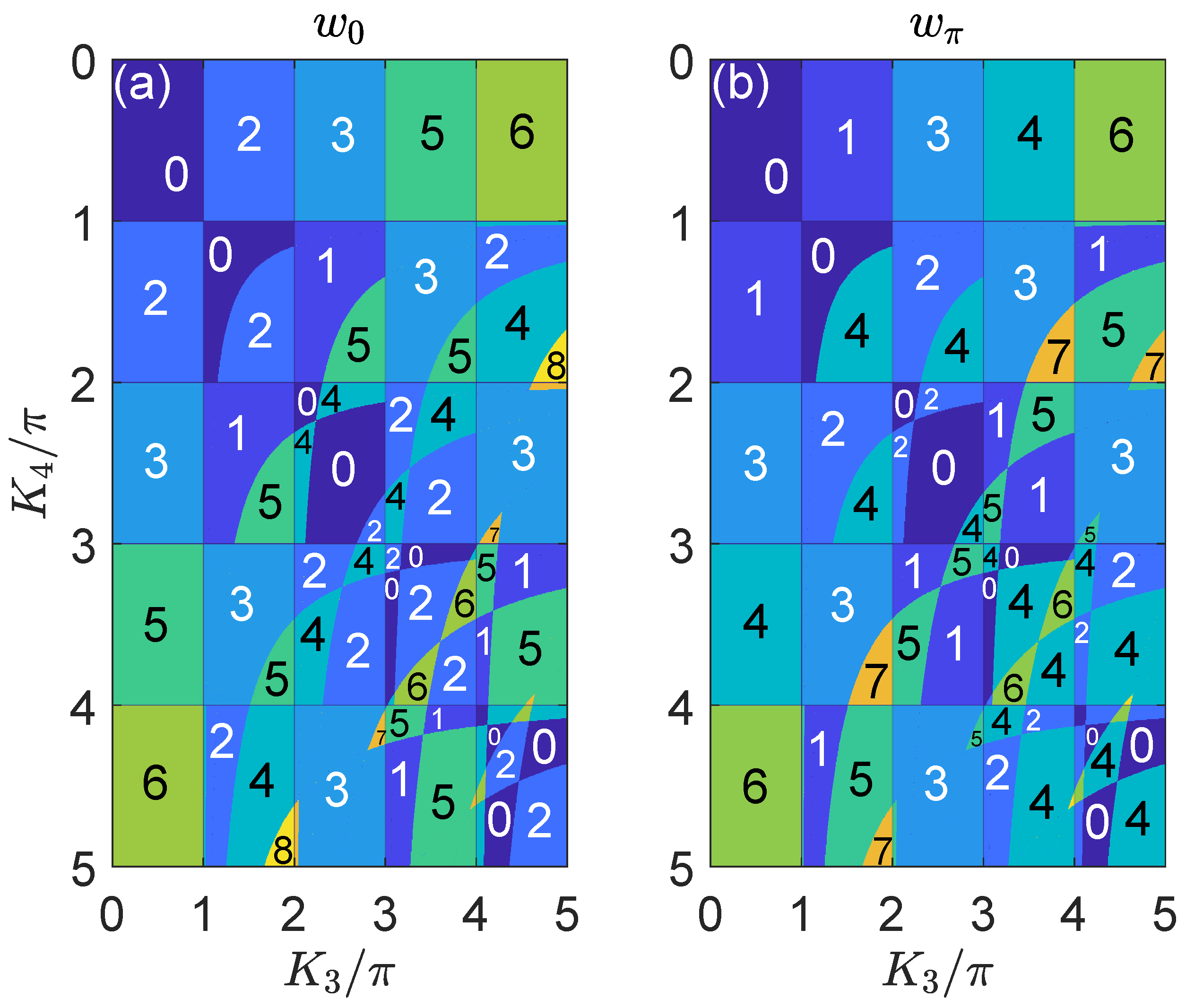
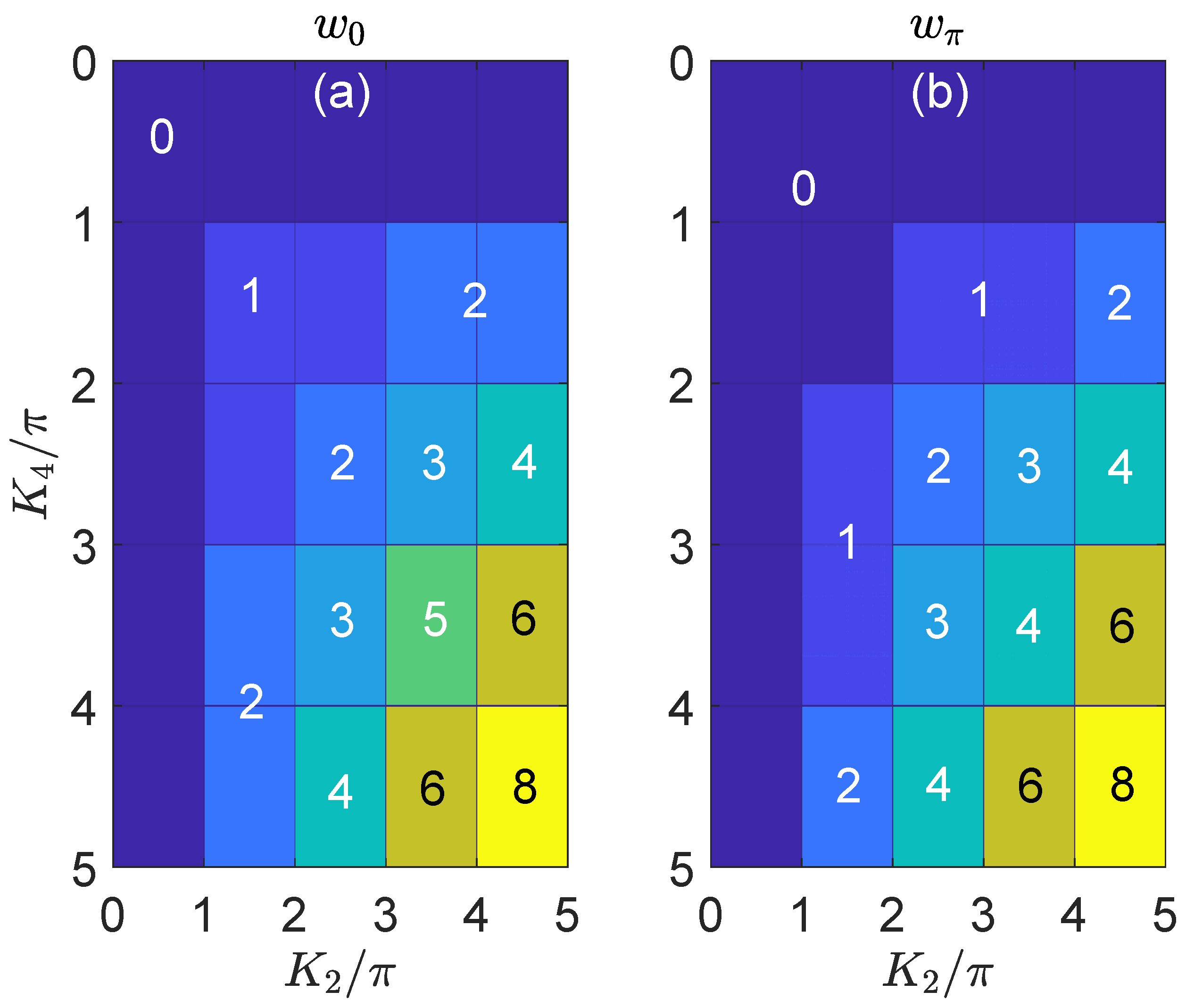
In the remaining part of this section, based on the evaluation of invariants and in Equations (33) and (34), we present topological phase diagrams of the 2D on-resonance double-kicked lattice for two typical situations. In the first case, we show the phase diagram of the system with respect to the kicking strengths in Figure 1. We observe that with the increase of these kicking strengths, a series of topological phase transitions can be induced, which each of them being accompanied by the quantized jump of or . At large values of , we further obtain rich Floquet HOTPs characterized by large values of . It is not hard to verify that there is no upper bound for the values of these invariants if the kicking strengths keep increasing. Therefore, the 2D on-resonance double-kicked lattice serves as a good candidate to generate Floquet second-order topological phases in momentum space with arbitrarily large topological invariants. Besides, according to the tensor product structure of Floquet operator in Equation (16), the boundaries separating different Floquet HOTPs are determined by the gapless conditions along one dimension of the lattice. More explicitly, these phase boundaries are determined by the conditions and , or equivalently
with and for . In Figure 1, our choice of system parameters yield , and the phase boundaries are reduced to straight lines according to Equation (35), which is also consistent with the numerical results.
Figure 1.
Topological phase diagram of the 2D on-resonance double-kicked lattice versus the kicking strengths and . The other system parameters are set as . Different Floquet HOTPs are distinguished by different colors in each panel. The values of () for different topological phases are obtained from Equation (33) [(34)] and denoted explicitly in (a) [(b)].
In the second case, we present the phase diagram of the 2D on-resonance double-kicked lattice versus kicking strengths in Figure 2. With the increase of these kicking strengths, we also observe rich Floquet HOTPs featured by large invariants , together with multiple transitions between these phases followed by quantized changes of . Numerically, we have also checked the phase diagrams of the system versus any one pair of kicking parameters , with the other pair being fixed for , and obtain similar patterns for the topological phases and phase transitions. Therefore, we conclude that the 2D on-resonance double-kicked lattice indeed possesses rich Floquet HOTPs, which are characterized by a pair integer topological invariants . These invariants could not only predict the numbers of Floquet zero and corner modes in the system under open boundary conditions, but also be detectable experimentally from the dynamics of wavepackets, as presented in the following sections.
Figure 2.
Topological phase diagram of the 2D on-resonance double-kicked lattice with respect to the kicking strengths and . The other system parameters are set as . Different Floquet HOTPs are distinguished by different colors in both figure panels. The values of and for each topological phase are obtained from Equations (33) and (34), which are presented explicitly in figure panels (a) and (b), respectively.
4. Mean Chiral Displacements
In this section, we sketch a dynamical approach that can be used to probe the invariants of Floquet HOTPs in our system. This approach is based on the detection of a 2D extension of the time-averaged mean chiral displacement, which is introduced in [82,95]. In a 2D lattice (either in position or in momentum space), we define the chiral displacement operator of the dynamical evolution in the time frame as
Here, t counts the number of evolution periods. The Floquet operator , as defined in Equation (16) for and . and are unit-cell position operators along x and y directions of the lattice. and describe chiral symmetries of the descendant systems and along x and y directions, respectively. For our 2D on-resonance double-kicked lattice, we have and , whose tensor product gives the chiral symmetry operator of the system.
To extract the topological winding numbers of , we initialize the system in a fully polarized state at the central unit cell of the lattice. The initial state vector then takes the form
where () is the eigenstate of () with eigenvalue (). and are the eigenvectors of and with eigenvalues . After the evolution over a number of t’s driving periods in the time frame , the mean chiral displacement of initial state is given by the expectation value
Since is not an eigenstate of , is expected to be an oscillating function of time. To extract the topological information from , we take the average of over many driving periods, which in the long-time limit yields the stroboscopic time-averaged mean chiral displacement
Following the derivation steps as detailed in [82], it can be shown that for and ,
Here, and are the winding numbers defined in Equation (29). With the help of Equations (31) and (32), we can recombine the time-averaged mean chiral displacements to obtain the products of winding numbers , , and , which finally yield the invariants of the Floquet HOTPs. From now on, we denote the recombined time-averaged mean chiral displacements that are related to and as and , respectively (see Appendix C for their explicit expressions).
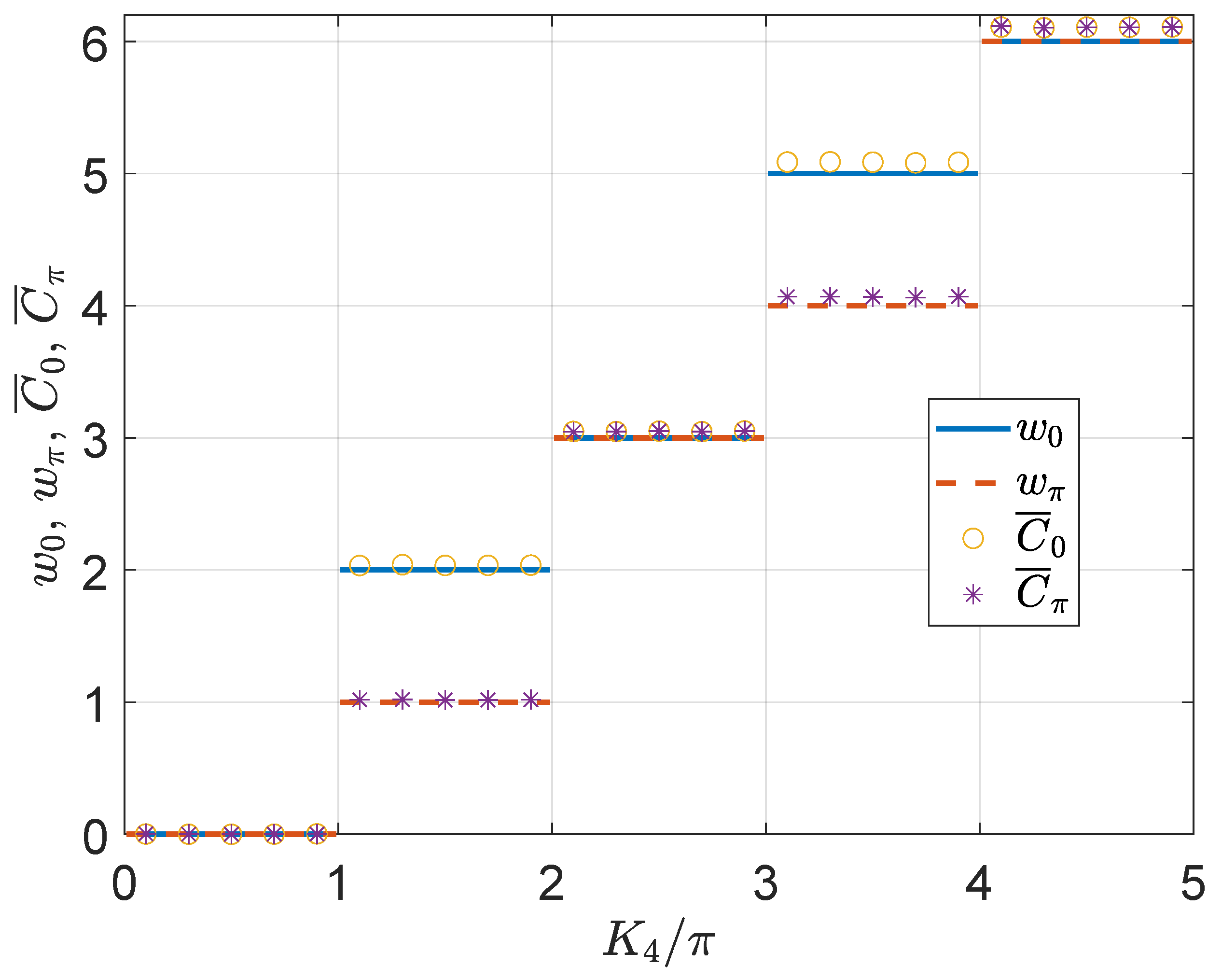
To verify the relations between the time-averaged mean chiral displacements and the topological invariants of the 2D on-resonance double-kicked lattice, we compute and compare and for a typical case in the remaining part of this section. In Figure 3, we present the topological invariants and mean chiral displacements with respect to the kicking strength for evolutions over driving periods. We observe that the time-averaged mean chiral displacements indeed take nearly quantized values in each Floquet HOTPs of the 2D on-resonance double-kicked lattice, which demonstrate the relation between them and the topological invariants of the system, i.e., (see Appendix C for derivation details of this relation). Besides, the values of also possess quantized jumps around all topological phase transition points ( in Figure 3). Therefore, the mean chiral displacements could also serve as a dynamical prob to the phase transitions between different Floquet HOTPs. The deviations of from quantization are due to finite-time effects, which will gradually go to zero with the increase of the number of driving periods t. Numerically, we checked that the time-averaged mean chiral displacements remain close to quantization for driving periods, which should be within reach in current or near-term experiments in photonic [126,127] and cold atom [128,129] systems.
Figure 3.
Topological invariants and time-averaged mean chiral displacements of the 2D on-resonance double-kicked lattice versus the kicking strength . The other system parameters are set as , and . The mean chiral displacements are averaged over driving periods to generate the results for .
In the following section, we demonstrate another topological signature of Floquet HOTPs, i.e., the symmetry protected bound states localized around the corners of the momentum-space lattice, and relate their numbers to the topological invariants of the system.
5. Floquet Topological Corner Bound States in Continuum
A defining feature of HOTPs in D spatial dimensions is symmetry-protected states localized along its -dimensional boundaries, where . For a 2D lattice studied in this work, such bound states could appear at the geometric corners of the system. Moreover, since the Floquet bands of a chiral symmetric system come in positive and negative pairs , they could touch and separate at the quasienergies zero and . Therefore, in principle, there could be two distinct types of Floquet corner modes appearing at these quasienergies, which are called Floquet zero and corner modes. In the 2D on-resonance double-kicked lattice described by , since these corner modes are formed by the coupling between doubly degenerate edge modes of 1D descendant systems and , their numbers are always integer multiples of four. Furthermore, the numbers of Floquet zero and corner modes tend to be connected with the topological invariants of the bulk through the relation
Equation (41) thus establishes the bulk-corner correspondence of Floquet HOTPs in our model and other chiral symmetric systems, whose Floquet operators can be expressed in the tensor product form of . The implication of Equation (41) is demonstrated in the following with explicit numerical examples.
To investigate the spectrum and states of the system under open boundary conditions, we express the operators in Equations (9) and (10) in momentum lattice representations as (see Appendix A for details)
The quasienergies E and Floquet eigenstates of the system are then obtained by solving the eigenvalue equation , where the diagonalization of can be performed separately for and due to the tensor product structure of the Floquet operator .
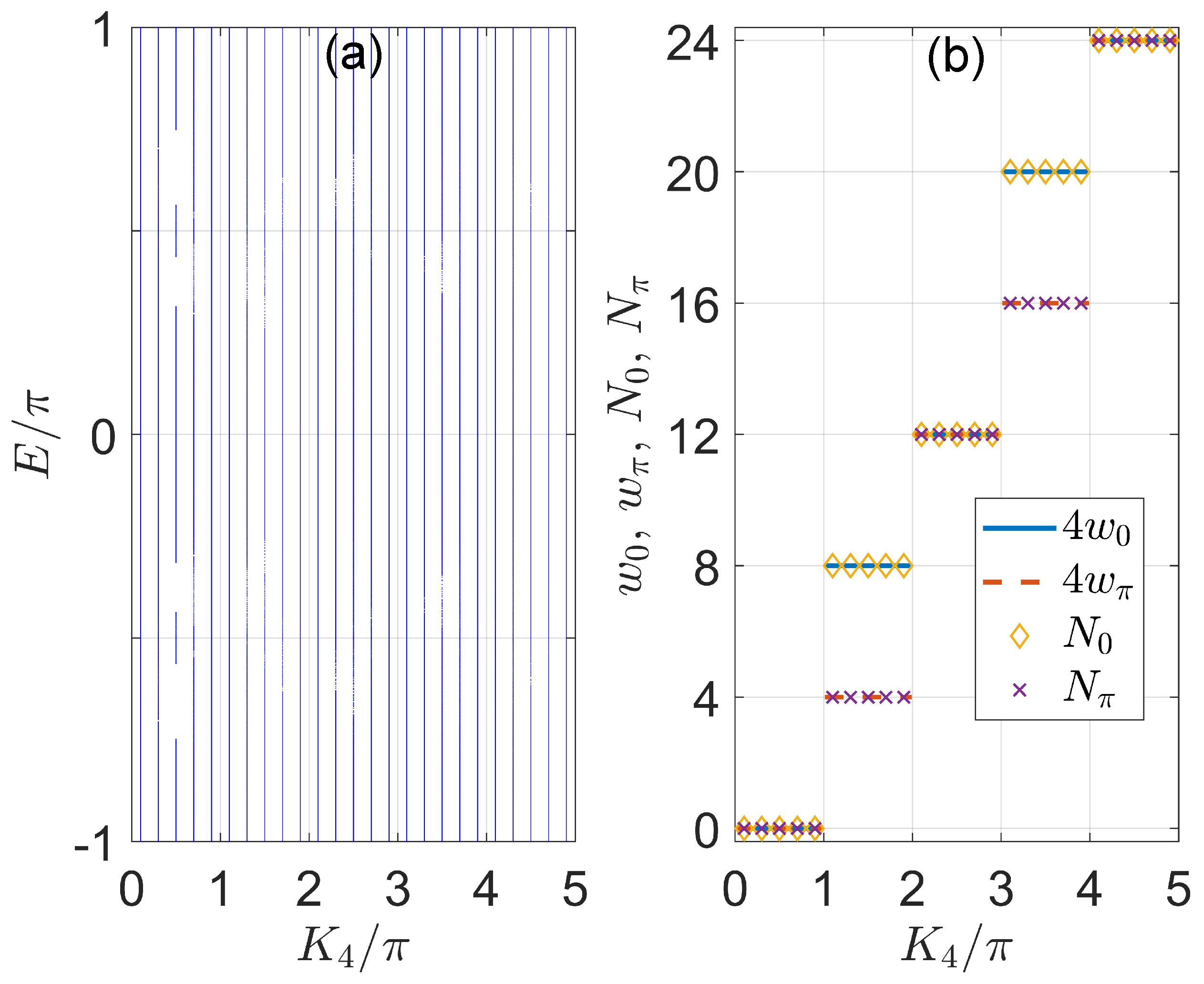
In Figure 4, we present the quasienergy spectrum E and number of Floquet corner modes and at zero and quasienergies in the momentum space of our model. In Figure 4a, we observe an almost continuous Floquet spectrum with no gaps around the quasienergies and . This is different from the situations usually observed in 2D static and Floquet HOTPs, where corner modes are separated from bulk states by spectral gaps. However, by evaluating the inverse participation ratio
for all the Floquet eigenstates of , we find different numbers of corner modes and at the quasienergies zero and in distinct Floquet HOTPs of the system. Their numbers are presented together with the topological invariants and in Figure 4b. Note that the inverse participation ratio of corner modes differ from bulk and 1D edge states of the system in their order of magnitudes, and can thus be numerically distinguished from one another. Furthermore, we observe that the relation holds throughout the considered parameter regime, validating the bulk-corner correspondence of our model as established in Equation (41). Besides, with the increase of , the system undergoes a series of topological phase transitions, yielding Floquet HOTPs with more and more zero and corner modes. The 2D on-resonance double-kicked lattice thus provides us with a nice platform to investigate Floquet HOTPs with multiple corner states and strong topological signatures in momentum space. For completeness, we also checked the quasienergy spectrum and corner modes in other parameter regions of the system and obtained results that are consistent with the above descriptions.
Figure 4.
Floquet spectrum E in panel (a) and number of corner modes in panel b of the 2D on-resonance double−kicked lattice versus the kicking strength . The other system parameters are set as . The size of the lattice is . In panel (b), and are plotted together with the bulk topological invariants and as obtained from Equations (33) and (34).
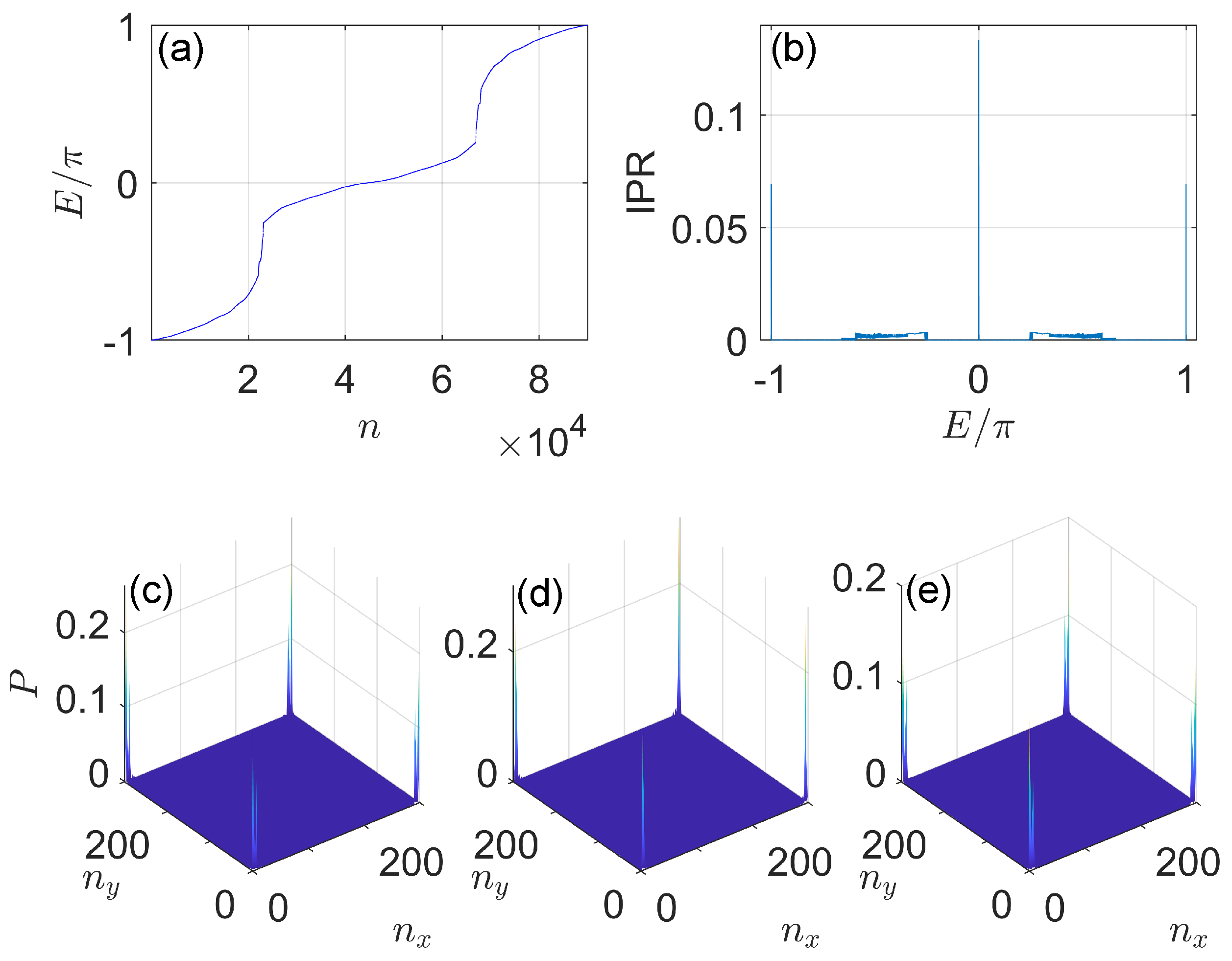
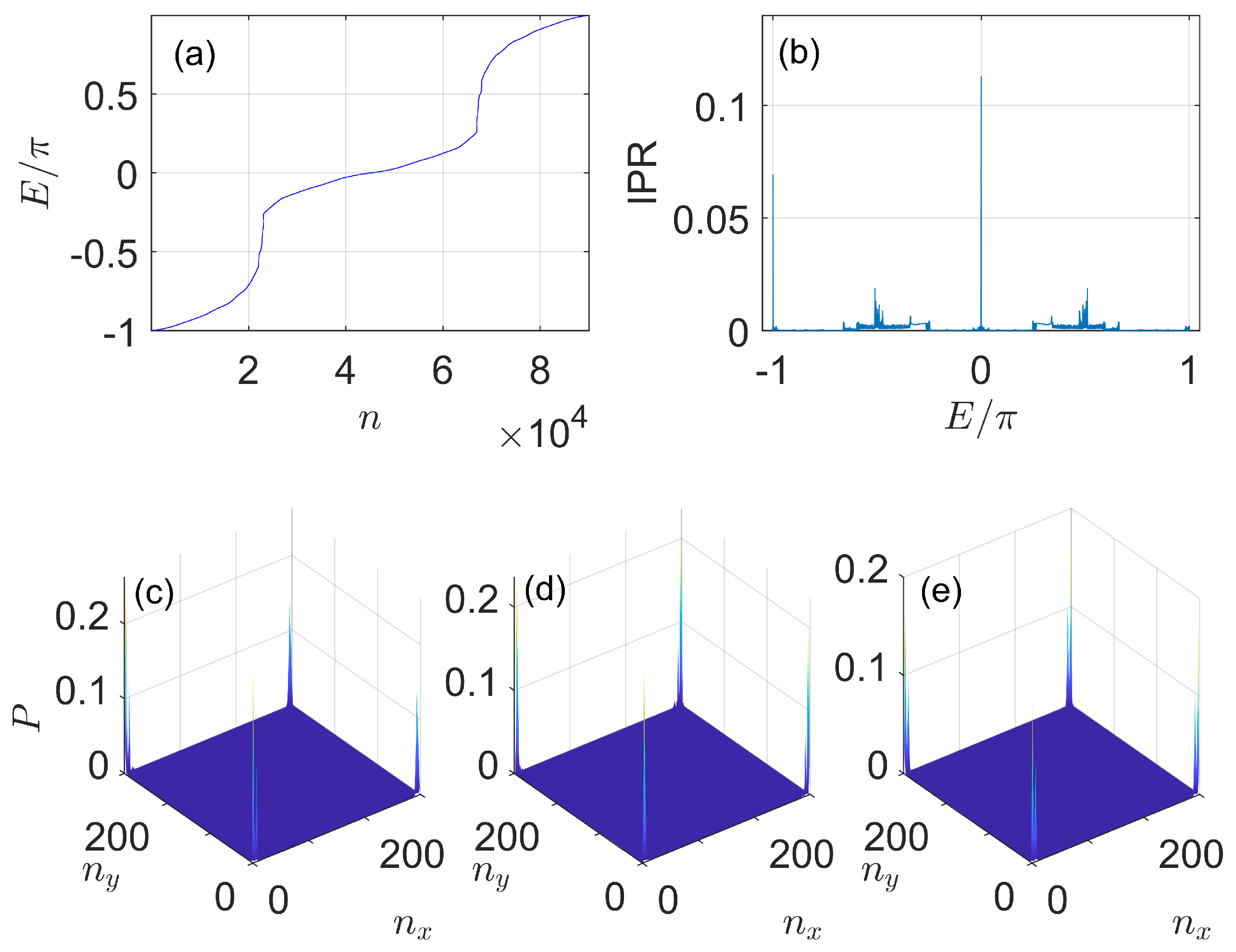
In Figure 5, we present the quasienergy spectrum, inverse participation ratio and corner modes of the system for a typical situation. In Figure 5a, we observe that the Floquet spectrum E spread throughout the first quasienergy Brillouin zone, and no gaps can be observed around . However, in Figure 5b, we find three clear peaks in the inverse participation ratio versus the quasienergy E around and , which indicates the existence of localized bound states in the system at these quasienergies. By investigating the data, we obtain eight (four) such bound states at (), with their probability distributions shown explicitly in Figure 5d,e [Figure 5c]. We see that all of these bound states are indeed localized around the corners of the system, and their numbers are determined precisely by the bulk-corner correspondence relation in Equation (41) for the given set of system parameters. Therefore, these corner states originate from the higher-order topology of our system. They represent topologically degenerate corner modes in momentum space of the system, which are protected by the chiral symmetry . Besides, these corner modes coexist with extended bulk states at the same quasienergies. We therefore refer to them as corner-localized Floquet topological bound states in continuum, in the sense that they do not hybridize with the surrounding bulk states even without a bulk band gap. This observation also extends the scope of bulk-corner correspondence of Floquet HOTPs to more general situations, in which the symmetry-protected corner modes can not only be found in spectral gaps, but also appear within topological Floquet bands. Note in passing that the corner-localized bound states in continuum with zero energy have been discovered before in static HOTPs [130,131,132]. By contrast, the corner-localized Floquet bound states in continuum subject to different topological characterizations, and the corner bound states in continuum with quasienergy are unique to Floquet HOTPs found in this work. Experimentally, the implementation of open boundary conditions might be achieved in Bose–Einstein condensates by a setup similar to the one employed in the realization of topological quantum walk in momentum space [129]. Meanwhile, by applying the mapping introduced in [121] from momentum to position space lattices, the 2D on-resonance double-kicked lattice may also be realized in real space, and the corner modes may then be probed in setups such as photonic waveguide arrays [132].
Figure 5.
Quasienergy spectrum, inverse participation ratio and Floquet zero/ corner modes of the 2D on−resonance double−kicked lattice. System parameters are set as , , and . The size of the lattice is . (a) n denotes the index of the state. The peaks around () in (b) correspond to the inverse participation ratio of zero () Floquet corner modes, whose probability distributions are shown in panels (c–e).
To demonstrate the robustness of Floquet second-order topological phases found in our system, we add disorder to the nearest neighbor hopping amplitudes in the momentum lattice, i.e., by letting the kicking strengths and to be dependent on the lattice site indices and . Here, and are uniformly distributed random numbers in the range at different site indices . In numerical calculations, we set as the strength of disorder and present a representative example of the Floquet spectrum and corner states with such hopping disorder in Figure 6. We observe that with disorder, the Floquet corner modes are still preserved, as shown in Figure 6c–e, and their quasienergies are also pinned at and . They are thus well-defined Floquet zero and corner modes and their presence demonstrate the robustness of Floquet second-order topological phases of our system with disorder. Furthermore, the total number of corner modes with quasienergy zero () is eight (four), as shown in Figure 6c–e, which is precisely predicted by the bulk-corner correspondence relation in Equation (41). Therefore, the bulk topological invariants and introduced in Equations (33) and (34) could also describe the Floquet second-order topological phases of our system in the presence of weak hopping disorder.
Figure 6.
Quasienergy spectrum, inverse participation ratio and Floquet zero/ corner modes of the 2D on−resonance double−kicked lattice with hopping disorder. System parameters are set as , , and , where () take random values in the range with at different nearest neighbor bonds along () direction. The size of the lattice is . (a) n denotes the index of the state. The peaks around () in (b) correspond to the inverse participation ratio of zero () Floquet corner modes in the presence of disorder, whose probability distributions are shown in (c–e).
6. Conclusions
In this work, we find rich Floquet second-order topological phases in a two-dimensional extension of the on-resonance double kicked rotor. Each of the Floquet phases is characterized by a pair of integer topological invariants , which can be extracted from the dynamics of the system in four distinct symmetric time frames. The values of invariants and take quantized jumps whenever the system undergoes a transition between different phases. Furthermore, Floquet second-order topological phases characterized by arbitrarily large can be found in principle with the increase of kicking strengths. Experimentally, the invariants could also be obtained by measuring the time-averaged mean chiral displacements of initially localized wavepackets in different time frames. Under open boundary conditions, corner-localized modes with quasienergies zero and are found to be coexisting with extended bulk states at the same quasienergies, realizing second-order Floquet topological bound states in continuum. The numbers of these corner modes are further determined by the bulk topological invariants , leading to the bulk-corner correspondence of Floquet second-order topological phases. Experimentally, the proposed model may also be engineered in two-dimensional photonic or cold atom systems, where the Floquet corner modes could be imaged either in real-space [132] or in momentum space [129]. Putting together, we uncover a unique set of Floquet second-order topological phases in momentum space, which are featured by large topological invariants, rich phase diagrams and multiple Floquet topological corner bound states in continuum. In future studies, it would be interesting to extend our results to Floquet HOTPs in higher dimensions, different symmetry classes and superconducting systems. The possibility of realizing topological time crystals by superposing the zero and Floquet corner modes and the potential applications of these corner bound states in Floquet quantum computing tasks also deserve more systematic explorations.
Funding
This research was funded by the National Natural Science Foundation of China (Grant No. 11905211), the China Postdoctoral Science Foundation (Grant No. 2019M662444), the Fundamental Research Funds for the Central Universities (Grant No. 841912009), the Young Talents Project at Ocean University of China (Grant No. 861801013196) and the Applied Research Project of Postdoctoral Fellows in Qingdao (Grant No. 861905040009).
Acknowledgments
L.Z. acknowledges Jiangbin Gong for helpful comments.
Conflicts of Interest
The author declares no conflict of interest.
Appendix A. Floquet Operator in Momentum Representation
In this appendix, we give the expressions of Floquet operators and in Equations (9) and (10) in the momentum-lattice representation and further derive their forms in the symmetric time frames.
In the momentum basis , we can express each term in Equation (9) of the main text as
where we insert the identity in order to arrive at each expression, as well as write the basis with even and odd lattice indices separately.
Since Equation (9) is invariant under the translation over two sites in , we could decompose the momentum space lattice into two chains containing only odd and even sites, denoted by sublattice indices A (for odd sites) and B (for even sites). A unit cell of the momentum space lattice now contains two sublattice sites. We can then introduce Pauli matrices in the sublattice representation as
The raising and lowering operators in sublattice basis can also be written as
In such a bipartite lattice representation, Equations (A1)–(A3) can be expressed as
where is the unit cell index along -direction in momentum space, and we make the identifications
for . In momentum space, we can then write Equation (9) as
Following the same procedure, we can also express Equation (10) in momentum representation as
where
with and being Pauli matrices acting in the subspace of the two sublattices along -direction. The Floquet operators in quasiposition representations, as given by Equations (12) and (13) of the main text, can further be obtained by performing the Fourier transform , with being the number of unit cells along - and -directions.
Appendix B. Components of the Effective Hamiltonian
In this appendix, we summarize the explicit expressions of unit vectors and for and in Equations (24) and (25) of the main text, respectively. Following the derivation steps as sketched in the main text and detailed in [121,122] for 1D descendant models of the 2D on-resonance double-kicked lattice, the components of these unit vectors are found to be
and
Here, and are given by Equations (14) and (15) of the main text, respectively.
Appendix C. Relations between Mean Chiral Displacements and Topological Invariants
In this appendix, we present the explicit relationship between the time-averaged mean chiral displacements and the topological invariants of our model. Following Equations (31), (32) and (40) in the main text, it is straightforward to verify the following equalities between the time-averaged mean chiral displacements and winding numbers in different combinations of symmetric frames
Combining these equations with the definitions of and in Equations (33) and (34) of the main text, we find
Therefore, by measuring the time-averaged mean chiral displacements for and , we could obtain the invariants of Floquet HOTPs from the wavepacket dynamics in different time frames.
References
- Benalcazar, W.A.; Bernevig, B.A.; Hughes, T.L. Quantized Electric Multipole Insulators. Science 2017, 357, 61. [Google Scholar] [CrossRef] [PubMed]
- Benalcazar, W.A.; Bernevig, B.A.; Hughes, T.L. Electric multipole moments, topological multipole moment pumping, and chiral hinge states in crystalline insulators. Phys. Rev. B 2017, 96, 245115. [Google Scholar] [CrossRef]
- Song, Z.; Fang, Z.; Fang, C. (d − 2)-Dimensional Edge States of Rotation Symmetry Protected Topological States. Phys. Rev. Lett. 2017, 119, 246402. [Google Scholar] [CrossRef] [PubMed]
- Langbehn, J.; Peng, Y.; Trifunovic, L.; von Oppen, F.; Brouwer, P.W. Reflection-Symmetric Second-Order Topological Insulators and Superconductors. Phys. Rev. Lett. 2017, 119, 246401. [Google Scholar] [CrossRef]
- Hashimoto, K.; Wu, X.; Kimura, T. Edge states at an intersection of edges of a topological material. Phys. Rev. B 2017, 95, 165443. [Google Scholar] [CrossRef]
- Schindler, F.; Cook, A.M.; Vergniory, M.G.; Wang, Z.; Parkin, S.S.P.; Bernevig, B.A.; Neupert, T. Higher-order topological insulators. Sci. Adv. 2018, 4, eaat0346. [Google Scholar] [CrossRef]
- Liu, F.; Wakabayashi, K. Novel Topological Phase with a Zero Berry Curvature. Phys. Rev. Lett. 2017, 118, 076803. [Google Scholar] [CrossRef]
- Slager, R.-J.; Rademaker, L.; Zaanen, J.; Balents, L. Impurity-bound states and Green’s function zeros as local signatures of topology. Phys. Rev. B 2015, 92, 085126. [Google Scholar] [CrossRef]
- Khalaf, E.; Po, H.C.; Vishwanath, A.; Watanabe, H. Symmetry Indicators and Anomalous Surface States of Topological Crystalline Insulators. Phys. Rev. X 2018, 8, 031070. [Google Scholar] [CrossRef]
- Cornfeld, E.; Chapman, A. Classification of crystalline topological insulators and superconductors with point group symmetries. Phys. Rev. B 2019, 99, 075105. [Google Scholar] [CrossRef]
- Trifunovic, L.; Brouwer, P.W. Higher-Order Topological Band Structures. Phys. Status Solidi B 2020, 2000090. [Google Scholar] [CrossRef]
- Kruthoff, J.; de Boer, J.; van Wezel, J.; Kane, C.L.; Slager, R.-J. Topological Classification of Crystalline Insulators through Band Structure Combinatorics. Phys. Rev. X 2017, 7, 041069. [Google Scholar] [CrossRef]
- Franca, S.; Brink, J.v.; Fulga, I.C. An anomalous higher-order topological insulator. Phys. Rev. B 2018, 98, 201114(R). [Google Scholar] [CrossRef]
- Ezawa, M. Topological Switch between Second-Order Topological Insulators and Topological Crystalline Insulators. Phys. Rev. Lett. 2018, 121, 116801. [Google Scholar] [CrossRef] [PubMed]
- Khalaf, E. Higher-order topological insulators and superconductors protected by inversion symmetry. Phys. Rev. B 2018, 97, 205136. [Google Scholar] [CrossRef]
- Liu, F.; Deng, H.-Y.; Wakabayashi, K. Helical Topological Edge States in a Quadrupole Phase. Phys. Rev. Lett. 2019, 122, 086804. [Google Scholar] [CrossRef] [PubMed]
- Trifunovic, L.; Brouwer, P.W. Higher-Order Bulk-Boundary Correspondence for Topological Crystalline Phases. Phys. Rev. X 2019, 9, 011012. [Google Scholar] [CrossRef]
- Kunst, F.K.; van Miert, G.; Bergholtz, E.J. Lattice models with exactly solvable topological hinge and corner states. Phys. Rev. B 2018, 97, 241405(R). [Google Scholar] [CrossRef]
- Kudo, K.; Yoshida, T.; Hatsugai, Y. Higher-Order Topological Mott Insulators. Phys. Rev. Lett. 2019, 123, 196402. [Google Scholar] [CrossRef]
- Tuegel, T.I.; Chua, V.; Hughes, T.L. Embedded topological insulators. Phys. Rev. B 2019, 100, 115126. [Google Scholar] [CrossRef]
- Zangeneh-Nejad, F.; Fleury, R. Nonlinear Second-Order Topological Insulators. Phys. Rev. Lett. 2019, 123, 053902. [Google Scholar] [CrossRef] [PubMed]
- Pozo, O.; Repellin, C.; Grushin, A.G. Quantization in Chiral Higher Order Topological Insulators: Circular Dichroism and Local Chern Marker. Phys. Rev. Lett. 2019, 123, 247401. [Google Scholar] [CrossRef] [PubMed]
- Park, M.J.; Kim, Y.; Cho, G.Y.; Lee, S. Higher-Order Topological Insulator in Twisted Bilayer Graphene. Phys. Rev. Lett. 2019, 123, 216803. [Google Scholar] [CrossRef] [PubMed]
- Hwang, Y.; Ahn, J.; Yang, B.-J. Fragile topology protected by inversion symmetry: Diagnosis, bulk-boundary correspondence, and Wilson loop. Phys. Rev. B 2019, 100, 205126. [Google Scholar] [CrossRef]
- Araki, H. ZQ Berry phase for higher-order symmetry-protected topological phases. Phys. Rev. Res. 2020, 2, 012009(R). [Google Scholar] [CrossRef]
- Li, L.; Umer, M.; Gong, J. Direct prediction of corner state configurations from edge winding numbers in two- and three-dimensional chiral-symmetric lattice systems. Phys. Rev. B 2018, 98, 205422. [Google Scholar] [CrossRef]
- Chen, R.; Chen, C.-Z.; Gao, J.-H.; Zhou, B.; Xu, D.-H. Higher-Order Topological Insulators in Quasicrystals. Phys. Rev. Lett. 2020, 124, 036803. [Google Scholar] [CrossRef] [PubMed]
- Li, H.; Sun, K. Pfaffian Formalism for Higher-Order Topological Insulators. Phys. Rev. Lett. 2020, 124, 036401. [Google Scholar] [CrossRef]
- Xu, Y.; Song, Z.; Wang, Z.; Weng, H.; Dai, X. Higher-Order Topology of the Axion Insulator EuIn2As2. Phys. Rev. Lett. 2019, 122, 256402. [Google Scholar] [CrossRef]
- Queiroz, R.; Stern, A. Splitting the Hinge Mode of Higher-Order Topological Insulators. Phys. Rev. Lett. 2019, 123, 036802. [Google Scholar] [CrossRef]
- Kozlovsky, R.; Graf, A.; Kochan, D.; Richter, K.; Gorini, C. Magnetoconductance, Quantum Hall Effect, and Coulomb Blockade in Topological Insulator Nanocones. Phys. Rev. Lett. 2020, 124, 126804. [Google Scholar] [CrossRef] [PubMed]
- Queiroz, R.; Fulga, I.C.; Avraham, N.; Beidenkopf, H.; Cano, J. Partial Lattice Defects in Higher-Order Topological Insulators. Phys. Rev. Lett. 2019, 123, 266802. [Google Scholar] [CrossRef]
- Yan, Z. Higher-Order Topological Odd-Parity Superconductors. Phys. Rev. Lett. 2019, 123, 177001. [Google Scholar] [CrossRef] [PubMed]
- Yan, Z.; Song, F.; Wang, Z. Majorana Corner Modes in a High-Temperature Platform. Phys. Rev. Lett. 2018, 121, 096803. [Google Scholar] [CrossRef] [PubMed]
- Zhang, R.-X.; Cole, W.S.; Wu, X.; Sarma, S.D. Higher-Order Topology and Nodal Topological Superconductivity in Fe(Se,Te) Heterostructures. Phys. Rev. Lett. 2019, 123, 167001. [Google Scholar] [CrossRef]
- Zeng, C.; Stanescu, T.D.; Zhang, C.; Scarola, V.W.; Tewari, S. Majorana Corner Modes with Solitons in an Attractive Hubbard-Hofstadter Model of Cold Atom Optical Lattices. Phys. Rev. Lett. 2019, 123, 060402. [Google Scholar] [CrossRef] [PubMed]
- Geier, M.; Trifunovic, L.; Hoskam, M.; Brouwer, P.W. Second-order topological insulators and superconductors with an order-two crystalline symmetry. Phys. Rev. B 2018, 97, 205135. [Google Scholar] [CrossRef]
- Zhu, X. Second-Order Topological Superconductors with Mixed Pairing. Phys. Rev. Lett. 2019, 122, 236401. [Google Scholar] [CrossRef]
- Ghorashi, S.A.A.; Hu, X.; Hughes, T.L.; Rossi, E. Second-order Dirac superconductors and magnetic field induced Majorana hinge modes. Phys. Rev. B 2019, 100, 020509(R). [Google Scholar] [CrossRef]
- Varjas, D.; Lau, A.; Pöyhönen, K.; Akhmerov, A.R. Topological Phases without Crystalline Counterparts. Phys. Rev. Lett. 2019, 123, 196401. [Google Scholar] [CrossRef]
- Zhang, S.-B.; Trauzettel, B. Detection of second-order topological superconductors by Josephson junctions. Phys. Rev. Res. 2020, 2, 012018(R). [Google Scholar] [CrossRef]
- Franca, S.; Efremov, D.V.; Fulga, I.C. Phase-tunable second-order topological superconductor. Phys. Rev. B 2019, 100, 075415. [Google Scholar] [CrossRef]
- Wang, Q.; Liu, C.-C.; Lu, Y.-M.; Zhang, F. High-Temperature Majorana Corner States. Phys. Rev. Lett. 2018, 121, 186801. [Google Scholar] [CrossRef] [PubMed]
- Hsu, C.-H.; Stano, P.; Klinovaja, J.; Loss, D. Majorana Kramers Pairs in Higher-Order Topological Insulators. Phys. Rev. Lett. 2018, 121, 196801. [Google Scholar] [CrossRef]
- Volpez, Y.; Loss, D.; Klinovaja, J. Second-Order Topological Superconductivity in π-Junction Rashba Layers. Phys. Rev. Lett. 2019, 122, 126402. [Google Scholar] [CrossRef] [PubMed]
- Zhang, R.-X.; Cole, W.S.; Sarma, S.D. Helical Hinge Majorana Modes in Iron-Based Superconductors. Phys. Rev. Lett. 2019, 122, 187001. [Google Scholar] [CrossRef] [PubMed]
- Pan, X.-H.; Yang, K.-J.; Chen, L.; Xu, G.; Liu, C.-X.; Liu, X. Lattice-Symmetry-Assisted Second-Order Topological Superconductors and Majorana Patterns. Phys. Rev. Lett. 2019, 123, 156801. [Google Scholar] [CrossRef] [PubMed]
- Zhang, S.-B.; Rui, W.B.; Calzona, A.; Choi, S.-J.; Schnyder, A.P.; Trauzettel, B. Topological and holonomic quantum computation based on second-order topological superconductors. Phys. Rev. Res. 2020, 2, 043025. [Google Scholar] [CrossRef]
- Lin, M.; Hughes, T.L. Topological quadrupolar semimetals. Phys. Rev. B 2018, 98, 241103(R). [Google Scholar] [CrossRef]
- Calugaru, D.; Juricic, V.; Roy, B. Higher-order topological phases: A general principle of construction. Phys. Rev. B 2019, 99, 041301(R). [Google Scholar] [CrossRef]
- Roy, B. Antiunitary symmetry protected higher-order topological phases. Phys. Rev. Res. 2019, 1, 032048(R). [Google Scholar] [CrossRef]
- Ezawa, M. Higher-Order Topological Insulators and Semimetals on the Breathing Kagome and Pyrochlore Lattices. Phys. Rev. Lett. 2018, 120, 026801. [Google Scholar] [CrossRef]
- Wieder, B.J.; Wang, Z.; Cano, J.; Dai, X.; Schoop, L.M.; Bradlyn, B.; Bernevig, B.A. Strong and fragile topological Dirac semimetals with higher-order Fermi arcs. Nat. Commun. 2020, 11, 627. [Google Scholar] [CrossRef] [PubMed]
- Wang, Z.; Wieder, B.J.; Li, J.; Yan, B.; Bernevig, B.A. Higher-Order Topology, Monopole Nodal Lines, and the Origin of Large Fermi Arcs in Transition Metal Dichalcogenides XTe2(X=Mo,W). Phys. Rev. Lett. 2019, 123, 186401. [Google Scholar] [CrossRef] [PubMed]
- Schindler, F.; Wang, Z.; Vergniory, M.G.; Cook, A.M.; Murani, A.; Sengupta, S.; Kasumov, A.Y.; Deblock, R.; Jeon, S.; Drozdov, I.; et al. Higher-order topology in bismuth. Nat. Phys. 2018, 14, 918–924. [Google Scholar] [CrossRef]
- Kempkes, S.N.; Slot, M.R.; van den Broeke, J.J.; Capiod, P.; Benalcazar, W.A.; Vanmaekelbergh, D.; Bercioux, D.; Swart, I.; Smith, C.M. Robust zero-energy modes in an electronic higher-order topological insulator. Nat. Mater. 2019, 18, 1292–1297. [Google Scholar] [CrossRef]
- Zhang, R.-X.; Wu, F.; Sarma, S.D. Möbius Insulator and Higher-Order Topology in MnBi2nTe3n+1. Phys. Rev. Lett. 2020, 124, 136407. [Google Scholar] [CrossRef] [PubMed]
- Yang, Y.; Jia, Z.; Wu, Y.; Hang, Z.-H.; Jiang, H.; Xie, X.C. Realization of multidimensional sound propagation in 3D acoustic higher-order topological insulator. Sci. Bull. 2020, 65, 531. [Google Scholar] [CrossRef]
- Sheng, X.-L.; Chen, C.; Liu, H.; Chen, Z.; Yu, Z.-M. Two-Dimensional Second-Order Topological Insulator in Graphdiyne. Phys. Rev. Lett. 2019, 123, 256402. [Google Scholar] [CrossRef] [PubMed]
- Serra-Garcia, M.; Peri, V.; Süsstrunk, R.; Bilal, O.R.; Larsen, T.; Villanueva, L.G.; Huber, S.D. Observation of a phononic quadrupole topological insulator. Nature 2018, 555, 342–345. [Google Scholar] [CrossRef] [PubMed]
- Peterson, C.W.; Benalcazar, W.A.; Hughes, T.L.; Bahl, G. A quantized microwave quadrupole insulator with topologically protected corner states. Nature 2018, 555, 346–350. [Google Scholar] [CrossRef] [PubMed]
- Mittal, S.; Orre, V.V.; Zhu, G.; Gorlach, M.A.; Poddubny, A.; Hafezi, M. Photonic quadrupole topological phases. Nat. Photonics 2019, 13, 692–696. [Google Scholar] [CrossRef]
- Hassan, A.E.; Kunst, F.K.; Moritz, A.; Andler, G.; Bergholtz, E.J.; Bourennane, M. Corner states of light in photonic waveguides. Nat. Photonics 2019, 13, 697–700. [Google Scholar] [CrossRef]
- Chen, X.-D.; Deng, W.-M.; Shi, F.-L.; Zhao, F.-L.; Chen, M.; Dong, J.-W. Direct Observation of Corner States in Second-Order Topological Photonic Crystal Slabs. Phys. Rev. Lett. 2019, 122, 233902. [Google Scholar] [CrossRef] [PubMed]
- Xie, B.-Y.; Su, G.-X.; Wang, H.-F.; Su, H.; Shen, X.-P.; Zhan, P.; Lu, M.-H.; Wang, Z.-L.; Chen, Y.-F. Visualization of Higher-Order Topological Insulating Phases in Two-Dimensional Dielectric Photonic Crystals. Phys. Rev. Lett. 2019, 122, 233903. [Google Scholar] [CrossRef] [PubMed]
- Ota, Y.; Liu, F.; Katsumi, R.; Watanabe, K.; Wakabayashi, K.; Arakawa, Y.; Iwamoto, S. Photonic crystal nanocavity based on a topological corner state. Optica 2019, 6, 786–789. [Google Scholar] [CrossRef]
- Wang, Y.; Ke, Y.; Chang, Y.-J.; Lu, Y.-H.; Gao, J.; Lee, C.; Jin, X.-M. Constructing higher-order topological states in higher dimension. arXiv 2020, arXiv:2011.11027. [Google Scholar]
- Xue, H.; Yang, Y.; Gao, F.; Chong, Y.; Zhang, B. Acoustic higher-order topological insulator on a kagome lattice. Nat. Mater. 2019, 18, 108–112. [Google Scholar] [CrossRef]
- Ni, X.; Weiner, M.; Alù, A.; Khanikaev, A.B. Observation of higher-order topological acoustic states protected by generalized chiral symmetry. Nat. Mater. 2019, 18, 113–120. [Google Scholar] [CrossRef]
- Peri, V.; Song, Z.-D.; Serra-Garcia, M.; Engeler, P.; Queiroz, R.; Huang, X.; Deng, W.; Liu, Z.; Bernevig, B.A.; Huber, S.D. Experimental characterization of fragile topology in an acoustic metamaterial. Science 2020, 367, 797–800. [Google Scholar] [CrossRef]
- Zhang, X.; Wang, H.-X.; Lin, Z.-K.; Tian, Y.; Xie, B.; Lu, M.-H.; Chen, Y.-F.; Jiang, J.-H. Second-order topology and multidimensional topological transitions in sonic crystals. Nat. Phys. 2019, 15, 582–588. [Google Scholar] [CrossRef]
- Weiner, M.; Ni, X.; Li, M.; Alù, A.; Khanikaev, A.B. Demonstration of a third-order hierarchy of topological states in a three-dimensional acoustic metamaterial. Sci. Adv. 2020, 6, eaay4166. [Google Scholar] [CrossRef] [PubMed]
- Fan, H.; Xia, B.; Tong, L.; Zheng, S.; Yu, D. Elastic Higher-Order Topological Insulator with Topologically Protected Corner States. Phys. Rev. Lett. 2019, 122, 204301. [Google Scholar] [CrossRef]
- Xue, H.; Yang, Y.; Liu, G.; Gao, F.; Chong, Y.; Zhang, B. Realization of an Acoustic Third-Order Topological Insulator. Phys. Rev. Lett. 2019, 122, 244301. [Google Scholar] [CrossRef] [PubMed]
- Zhang, X.; Lin, Z.-K.; Wang, H.-X.; Xiong, Z.; Tian, Y.; Lu, M.-H.; Chen, Y.-F.; Jiang, J.-H. Theory of topological corner state laser in Kagome waveguide arrays. Nat. Commun. 2020, 11, 65. [Google Scholar] [CrossRef]
- Imhof, S.; Berger, C.; Bayer, F.; Brehm, J.; Molenkamp, L.W.; Kiessling, T.; Schindler, F.; Lee, C.H.; Greiter, M.; Neupert, T.; et al. Topolectrical-circuit realization of topological corner modes. Nat. Phys. 2018, 14, 925–929. [Google Scholar] [CrossRef]
- Serra-Garcia, M.; Süsstrunk, R.; Huber, S.D. Observation of quadrupole transitions and edge mode topology in an LC circuit network. Phys. Rev. B 2019, 99, 020304(R). [Google Scholar] [CrossRef]
- Bao, J.; Zou, D.; Zhang, W.; He, W.; Sun, H.; Zhang, X. Topoelectrical circuit octupole insulator with topologically protected corner states. Phys. Rev. B 2019, 100, 201406(R). [Google Scholar] [CrossRef]
- Zhang, W.; Zou, D.; He, W.; Bao, J.; Pei, Q.; Sun, H.; Zhang, X. Topolectrical-circuit realization of a four-dimensional hexadecapole insulator. Phys. Rev. B 2020, 102, 100102(R). [Google Scholar] [CrossRef]
- Wu, J.; Huang, X.; Lu, J.; Wu, Y.; Deng, W.; Li, F.; Liu, Z. Observation of corner states in second-order topological electric circuits. Phys. Rev. B 2020, 102, 104109. [Google Scholar] [CrossRef]
- Niu, J.; Yan, T.; Zhou, Y.; Tao, Z.; Li, X.; Liu, W.; Zhang, L.; Liu, S.; Yan, Z.; Chen, Y.; et al. Simulation of Higher-Order Topological Phases and Related Topological Phase Transitions in a Superconducting Qubit. arXiv 2020, arXiv:2001.03933. [Google Scholar]
- Bomantara, R.W.; Zhou, L.; Pan, J.; Gong, J. Coupled-wire construction of static and Floquet second-order topological insulators. Phys. Rev. B 2019, 99, 045441. [Google Scholar] [CrossRef]
- Bomantara, R.W.; Gong, J. Measurement-only quantum computation with Floquet Majorana corner modes. Phys. Rev. B 2020, 101, 085401. [Google Scholar] [CrossRef]
- Peng, Y.; Refael, G. Floquet Second-Order Topological Insulators from Nonsymmorphic Space-Time Symmetries. Phys. Rev. Lett. 2019, 123, 016806. [Google Scholar] [CrossRef]
- Hu, H.; Huang, B.; Zhao, E.; Liu, W.V. Dynamical Singularities of Floquet Higher-Order Topological Insulators. Phys. Rev. Lett. 2020, 124, 057001. [Google Scholar] [CrossRef] [PubMed]
- Nag, T.; Juricic, V.; Roy, B. Out of equilibrium higher-order topological insulator: Floquet engineering and quench dynamics. Phys. Rev. Res. 2019, 1, 032045(R). [Google Scholar] [CrossRef]
- Rodriguez-Vega, M.; Kumar, A.; Seradjeh, B. Higher-order Floquet topological phases with corner and bulk bound states. Phys. Rev. B 2019, 100, 085138. [Google Scholar] [CrossRef]
- Seshadri, R.; Dutta, A.; Sen, D. Generating a second-order topological insulator with multiple corner states by periodic driving. Phys. Rev. B 2019, 100, 115403. [Google Scholar] [CrossRef]
- Plekhanov, K.; Thakurathi, M.; Loss, D.; Klinovaja, J. Floquet second-order topological superconductor driven via ferromagnetic resonance. Phys. Rev. Res. 2019, 1, 032013(R). [Google Scholar] [CrossRef]
- Peng, Y. Floquet higher-order topological insulators and superconductors with space-time symmetries. Phys. Rev. Res. 2020, 2, 013124. [Google Scholar] [CrossRef]
- Ghosh, A.K.; Paul, G.C.; Saha, A. Higher order topological insulator via periodic driving. Phys. Rev. B 2020, 101, 235403. [Google Scholar] [CrossRef]
- Bomantara, R.W. Time-induced second-order topological superconductors. Phys. Rev. Res. 2020, 2, 033495. [Google Scholar] [CrossRef]
- Zhang, R.-X.; Yang, Z.-C. Theory of Anomalous Floquet Higher-Order Topology: Classification, Characterization, and Bulk-Boundary Correspondence. arXiv 2020, arXiv:2010.07945. [Google Scholar]
- Zhu, W.; Chong, Y.D.; Gong, J. Floquet higher-order topological insulator in a periodically driven bipartite lattice. Phys. Rev. B 2021, 103, 041402. [Google Scholar] [CrossRef]
- Pan, J.; Zhou, L. Non-Hermitian Floquet second order topological insulators in periodically quenched lattices. Phys. Rev. B 2020, 102, 094305. [Google Scholar] [CrossRef]
- Liu, T.; Zhang, Y.-R.; Ai, Q.; Gong, Z.; Kawabata, K.; Ueda, M.; Nori, F. Second-Order Topological Phases in Non-Hermitian Systems. Phys. Rev. Lett. 2019, 122, 076801. [Google Scholar] [CrossRef]
- Zhang, Z.; López, M.R.; Cheng, Y.; Liu, X.; Christensen, J. Non-Hermitian Sonic Second-Order Topological Insulator. Phys. Rev. Lett. 2019, 122, 195501. [Google Scholar] [CrossRef]
- Luo, X.-W.; Zhang, C. Higher-Order Topological Corner States Induced by Gain and Loss. Phys. Rev. Lett. 2019, 123, 073601. [Google Scholar] [CrossRef] [PubMed]
- Lee, C.H.; Li, L.; Gong, J. Hybrid Higher-Order Skin-Topological Modes in Nonreciprocal Systems. Phys. Rev. Lett. 2019, 123, 016805. [Google Scholar] [CrossRef]
- Ezawa, M. Non-Hermitian higher-order topological states in nonreciprocal and reciprocal systems with their electric-circuit realization. Phys. Rev. B 2019, 99, 201411(R). [Google Scholar] [CrossRef]
- Ezawa, M. Non-Hermitian boundary and interface states in nonreciprocal higher-order topological metals and electrical circuits. Phys. Rev. B 2019, 99, 121411(R). [Google Scholar] [CrossRef]
- Edvardsson, E.; Kunst, F.K.; Bergholtz, E.J. Non-Hermitian extensions of higher-order topological phases and their biorthogonal bulk-boundary correspondence. Phys. Rev. B 2019, 99, 081302(R). [Google Scholar] [CrossRef]
- Yoshida, A.; Otaki, Y.; Otaki, R.; Fukui, T. Edge states, corner states, and flat bands in a two-dimensional PT-symmetric system. Phys. Rev. B 2019, 100, 125125. [Google Scholar] [CrossRef]
- Sato, S.A.; McIver, J.W.; Nuske, M.; Tang, P.; Jotzu, G.; Schulte, B.; Hübener, H.; De Giovannini, U.; Mathey, L.; Sentef, M.A.; et al. Microscopic theory for the light-induced anomalous Hall effect in graphene. Phys. Rev. B 2019, 99, 214302. [Google Scholar] [CrossRef]
- McIver, J.W.; Schulte, B.; Stein, F.-U.; Matsuyama, T.; Jotzu, G.; Meier, G.; Cavalleri, A. Light-induced anomalous Hall effect in graphene. Nat. Phys. 2020, 16, 38–41. [Google Scholar] [CrossRef] [PubMed]
- Tong, Q.-J.; An, J.-H.; Gong, J.; Luo, H.-G.; Oh, C.H. Generating many Majorana modes via periodic driving: A superconductor model. Phys. Rev. B 2013, 87, 201109(R). [Google Scholar] [CrossRef]
- Ho, D.Y.H.; Gong, J. Quantized Adiabatic Transport In Momentum Space. Phys. Rev. Lett. 2012, 109, 010601. [Google Scholar] [CrossRef]
- Chen, Y.; Tian, C. Planck’s Quantum-Driven Integer Quantum Hall Effect in Chaos. Phys. Rev. Lett. 2014, 113, 216802. [Google Scholar] [CrossRef]
- Wang, J.; Gong, J.B. Quantum ratchet accelerator without a bichromatic lattice potential. Phys. Rev. E 2008, 78, 036219. [Google Scholar] [CrossRef]
- Wang, J.; Gong, J.B. Butterfly Floquet Spectrum in Driven SU(2) Systems. Phys. Rev. A 2008, 77, 031405. [Google Scholar] [CrossRef]
- Jones, P.H.; Stocklin, M.M.; Hur, G.; Monteiro, T.S. Atoms in Double-δ-Kicked Periodic Potentials: Chaos with Long-Range Correlations. Phys. Rev. Lett. 2004, 93, 223002. [Google Scholar] [CrossRef]
- Creffield, C.E.; Hur, G.; Monteiro, T.S. Localization-Delocalization Transition in a System of Quantum Kicked Rotors. Phys. Rev. Lett. 2006, 96, 024103. [Google Scholar] [CrossRef]
- Dana, I.; Ramareddy, V.; Talukdar, I.; Summy, G.S. Experimental Realization of Quantum-Resonance Ratchets at Arbitrary Quasimomenta. Phys. Rev. Lett. 2008, 100, 024103. [Google Scholar] [CrossRef]
- Sadgrove, M.; Horikoshi, M.; Sekimura, T.; Nakagawa, K. Rectified Momentum Transport for a Kicked Bose-Einstein Condensate. Phys. Rev. Lett. 2007, 99, 043002. [Google Scholar] [CrossRef] [PubMed]
- Ryu, C.; Andersen, M.F.; Vaziri, A.; d’Arcy, M.B.; Grossman, J.M.; Helmerson, K.; Phillips, W.D. High-Order Quantum Resonances Observed in a Periodically Kicked Bose-Einstein Condensate. Phys. Rev. Lett. 2006, 96, 160403. [Google Scholar] [CrossRef]
- Talukdar, I.; Shrestha, R.; Summy, G.S. Sub-Fourier Characteristics of a δ-kicked-rotor Resonance. Phys. Rev. Lett. 2010, 105, 054103. [Google Scholar] [CrossRef] [PubMed]
- Moore, F.L.; Robinson, J.C.; Bharucha, C.F.; Sundaram, B.; Raizen, M.G. Atom Optics Realization of the Quantum δ-Kicked Rotor. Phys. Rev. Lett. 1995, 75, 4598. [Google Scholar] [CrossRef] [PubMed]
- Kanem, J.F.; Maneshi, S.; Partlow, M.; Spanner, M.; Steinberg, A.M. Observation of High-Order Quantum Resonances in the Kicked Rotor. Phys. Rev. Lett. 2007, 98, 083004. [Google Scholar] [CrossRef] [PubMed]
- Ullah, A.; Hoogerland, M.D. Experimental observation of Loschmidt time reversal of a quantum chaotic system. Phys. Rev. E 2011, 83, 046218. [Google Scholar] [CrossRef] [PubMed]
- Wang, H.; Ho, D.Y.H.; Lawton, W.; Wang, J.; Gong, J. Kicked-Harper model versus on-resonance double-kicked rotor model: From spectral difference to topological equivalence. Phys. Rev. E 2013, 88, 052920. [Google Scholar] [CrossRef]
- Ho, D.Y.H.; Gong, J. Topological effects in chiral symmetric driven systems. Phys. Rev. B 2014, 90, 195419. [Google Scholar] [CrossRef]
- Zhou, L.; Pan, J. Non-Hermitian Floquet topological phases in the double-kicked rotor. Phys. Rev. A 2019, 100, 053608. [Google Scholar] [CrossRef]
- Zhou, L.; Gong, J. Floquet topological phases in a spin-1/2 double kicked rotor. Phys. Rev. A 2018, 97, 063603. [Google Scholar] [CrossRef]
- Asbóth, J.K. Symmetries, topological phases, and bound states in the one-dimensional quantum walk. Phys. Rev. B 2012, 86, 195414. [Google Scholar] [CrossRef]
- Asbóth, J.K.; Obuse, H. Bulk-boundary correspondence for chiral symmetric quantum walks. Phys. Rev. B 2013, 88, 121406(R). [Google Scholar] [CrossRef]
- Cardano, F.; Errico, A.D.; Dauphin, A.; Maffei, M.; Piccirillo, B.; de Lisio, C.; Filippis, G.D.; Cataudella, V.; Santamato, E.; Marrucci, L.; et al. Detection of Zak phases and topological invariants in a chiral quantum walk of twisted photons. Nat. Commun. 2017, 8, 15516. [Google Scholar] [CrossRef]
- D’Errico, A.; Di Colandrea, F.; Barboza, R.; Dauphin, A.; Lewenstein, M.; Massignan, P.; Marrucci, L.; Cardano, F. Bulk detection of time-dependent topological transitions in quenched chiral models. Phys. Rev. Res. 2020, 2, 023119. [Google Scholar] [CrossRef]
- Meier, E.J.; An, F.A.; Dauphin, A.; Maffei, M.; Massignan, P.; Hughes, T.L.; Gadway, B. Observation of the topological Anderson insulator in disordered atomic wires. Science 2018, 362, 929. [Google Scholar] [CrossRef]
- Xie, D.; Deng, T.-S.; Xiao, T.; Gou, W.; Chen, T.; Yi, W.; Yan, B. Topological Quantum Walks in Momentum Space with a Bose-Einstein Condensate. Phys. Rev. Lett. 2020, 124, 050502. [Google Scholar] [CrossRef]
- Chen, Z.-G.; Xu, C.; Jahdali, R.A.; Mei, J.; Wu, Y. Corner states in a second-order acoustic topological insulator as bound states in the continuum. Phys. Rev. B 2019, 100, 075120. [Google Scholar] [CrossRef]
- Benalcazar, W.A.; Cerjan, A. Bound states in the continuum of higher-order topological insulators. Phys. Rev. B 2020, 101, 161116(R). [Google Scholar] [CrossRef]
- Cerjan, A.; Jürgensen, M.; Benalcazar, W.A.; Mukherjee, S.; Rechtsman, M.C. Observation of a Higher-Order Topological Bound State in the Continuum. Phys. Rev. Lett. 2020, 125, 213901. [Google Scholar] [CrossRef]
Publisher’s Note: MDPI stays neutral with regard to jurisdictional claims in published maps and institutional affiliations. |
© 2021 by the author. Licensee MDPI, Basel, Switzerland. This article is an open access article distributed under the terms and conditions of the Creative Commons Attribution (CC BY) license (https://creativecommons.org/licenses/by/4.0/).