



Cellular Responses at the Zirconia Dental Implant Interface: A Comprehensive Review


Abstract
1. Introduction
2. Materials and Methods
2.1. Study Design
2.2. Literature Search
3. Results
3.1. Macrophages
3.1.1. Cell Lines Utilized in Current Evidence
3.1.2. Initial Adhesion and Morphological Dynamics
3.1.3. Impact of Specific Surface Modifications on Macrophage Behavior
3.1.4. Key Remarks
3.2. Mesenchymal Stem Cells
3.2.1. Cell Lines Utilized in Current Evidence
3.2.2. Adhesion, Spreading, and Morphological Dynamics
3.2.3. Proliferation vs. Osteogenic Differentiation
3.2.4. Impact of Specific Surface Modifications on Mesenchymal Stem Cells Behavior
3.2.5. Key Remarks
3.3. Osteoblasts
3.3.1. Cell Lines Utilized in Current Evidence
3.3.2. Adhesion, Spreading, and Morphological Dynamics
3.3.3. Proliferation vs. Osteogenic Differentiation
3.3.4. Impact of Specific Surface Modifications on Osteoblast Behavior
3.3.5. Key Remarks
3.4. Fibroblasts
3.4.1. Cell Lines Utilized in Current Evidence
3.4.2. Adhesion, Spreading, and Morphological Dynamics
3.4.3. Proliferation and Metabolic Activity
3.4.4. Impact of Specific Surface Modifications on Fibroblast Behavior
3.4.5. Key Remarks
3.5. Epithelial Cells
3.5.1. Cell Lines Utilized in Current Evidence
3.5.2. Adhesion, Spreading, and Morphological Dynamics
3.5.3. Migration, Proliferation, Differentiation, and Immunology
3.5.4. Impact of Specific Surface Modifications on Epithelial Cell Behavior
3.5.5. Key Remarks
4. Summary of Current Evidence
5. Limitations and Future Directions
Author Contributions
Funding
Institutional Review Board Statement
Informed Consent Statement
Data Availability Statement
Acknowledgments
Conflicts of Interest
Abbreviations
| 3D-PIMM | Three-dimensional peri-implant mucosal models |
| AgNP | Silver nanoparticles |
| ALP | Alkaline phosphatase |
| APTES | (3-Aminopropyl) triethoxysilane |
| Ar | Argon |
| ATP | Adenosine triphosphate |
| BMZ | Blank-machined nanostructured zirconia |
| C60 | Fullerene |
| CaP | Calcium phosphate |
| CeO2 | Cerium dioxide |
| CF4 | Carbon tetrafluoride |
| CO2 | Carbon dioxide |
| DLP | Digital light processing |
| ECM | Extracellular matrix |
| FAK | Focal adhesion kinase |
| FALPs | focal adhesion linker proteins |
| FAs | Focal adhesions |
| FFF | Fused filament fabrication |
| FLIM | Fluorescence lifetime imaging microscopy |
| GK | Gingival keratinocytes |
| HA | Hydroxyapatite |
| hADMSCs | Human adipose-derived mesenchymal stem cells |
| HGFs | Human gingival fibroblasts |
| HGK | Human gingival keratinocytes |
| hMSCs | Human mesenchymal stem cells |
| HOK | Human oral keratinocytes |
| IL-10 | Interleukin-10 |
| IL-1β | Interleukin-1beta |
| IL-6 | Interleukin-6 |
| JE | Junctional epithelium |
| KRT19 | Keratin 19 |
| KRT5 | Keratin 5 |
| LIPSS | laser-induced nanoripples |
| LPS | Lipopolysaccharide |
| LTD | Low temperature degradation |
| MSCs | Mesenchymal stem cells |
| MTA | Mineral trioxide aggregate |
| N2 | Nitrogen |
| NPs | Nanoparticles |
| O2 | Oxygen |
| ODAM | Odontogenic ameloblast-associated protein |
| PA | Phosphonic acid |
| PAR4 | Protease-activated receptor 4 |
| PDA | Polydopamine |
| PDGF-AB | Platelet-derived growth factor-AB |
| PIE | Peri-implant epithelium |
| PMNs | Polymorphonuclear cells |
| Ra | Roughness Average |
| RGD | Arginine-glycine-aspartic acid motif |
| ROS | Reactive oxygen species |
| Sa | Average Surface Roughness |
| SGZ | Self-glazed zirconia |
| SLA | Stereolithography |
| SLA-like surfaces | Sandblasting followed by acid etching |
| TGF-β | Transforming growth factor-beta |
| Ti | Titanium |
| Ti-6Al-4V | Titanium alloy |
| Ti-Zr | Titanium-zirconium alloy |
| TiO2 | Titanium dioxide |
| TLR4/MyD88/NF-κB | MyD88-dependent Toll-like receptor 4 (TLR4) signaling pathway |
| TNF-α | Tumor necrosis factor-alpha |
| USP | Ultrashort-pulsed |
| UV | Ultraviolet |
| Y-TZP | Yttria-stabilized tetragonal zirconia polycrystal |
| ZLA | Zirconia Large-grit Sandblasted and Acid-etched Surface |
| ZnO | Zinc oxide |
| ZrO2 | Zirconia |
References
- Howe, M.S.; Keys, W.; Richards, D. Long-term (10-year) dental implant survival: A systematic review and sensitivity meta-analysis. J. Dent. 2019, 84, 9–21. [Google Scholar] [CrossRef] [Scilit] [PubMed]
- Sicilia, A.; Cuesta, S.; Coma, G.; Arregui, I.; Guisasola, C.; Ruiz, E.; Maestro, A. Titanium allergy in dental implant patients: A clinical study on 1500 consecutive patients. Clin. Oral Implants Res. 2008, 19, 823–835. [Google Scholar] [CrossRef] [Scilit] [PubMed]
- Ioannidis, A.; Cathomen, E.; Jung, R.E.; Fehmer, V.; Hüsler, J.; Thoma, D.S. Discoloration of the mucosa caused by different restorative materials–a spectrophotometric in vitro study. Clin. Oral Implants Res. 2017, 28, 1133–1138. [Google Scholar] [CrossRef] [Scilit] [PubMed]
- Di Spirito, F.; Lo Giudice, R.; Amato, M.; Di Palo, M.P.; D’Ambrosio, F.; Amato, A.; Martina, S. Inflammatory, Reactive, and Hypersensitivity Lesions Potentially Due to Metal Nanoparticles from Dental Implants and Supported Restorations: An Umbrella Review. Appl. Sci. 2022, 12, 11208. [Google Scholar] [CrossRef] [Scilit]
- Hanawa, T. Zirconia versus titanium in dentistry: A review. Dent. Mater. J. 2020, 39, 24–36. [Google Scholar] [CrossRef] [Scilit] [PubMed]
- Cionca, N.; Hashim, D.; Mombelli, A. Zirconia dental implants: Where are we now, and where are we heading? Periodontol. 2000 2017, 73, 241–258. [Google Scholar] [CrossRef] [Scilit] [PubMed]
- Gautam, C.; Joyner, J.; Gautam, A.; Rao, J.; Vajtai, R. Zirconia based dental ceramics: Structure, mechanical properties, biocompatibility and applications. Dalton Trans. 2016, 45, 19194–19215. [Google Scholar] [CrossRef] [Scilit] [PubMed]
- Kohal, R.J.; Att, W.; Bächle, M.; Butz, F. Ceramic abutments and ceramic oral implants. An update. Periodontol. 2000 2008, 47, 224–243. [Google Scholar] [CrossRef] [Scilit] [PubMed]
- Sanon, C.; Chevalier, J.; Douillard, T.; Cattani-Lorente, M.; Scherrer, S.S.; Gremillard, L. A new testing protocol for zirconia dental implants. Dent. Mater. 2015, 31, 15–25. [Google Scholar] [CrossRef] [Scilit] [PubMed]
- Turon-Vinas, M.; Anglada, M. Strength and fracture toughness of zirconia dental ceramics. Dent. Mater. 2018, 34, 365–375. [Google Scholar] [CrossRef] [Scilit] [PubMed]
- Lughi, V.; Sergo, V. Low temperature degradation -aging- of zirconia: A critical review of the relevant aspects in dentistry. Dent. Mater. 2010, 26, 807–820. [Google Scholar] [CrossRef] [Scilit] [PubMed]
- Yang, H.; Xu, Y.L.; Hong, G.; Yu, H. Effects of low-temperature degradation on the surface roughness of yttria-stabilized tetragonal zirconia polycrystal ceramics: A systematic review and meta-analysis. J. Prosthet. Dent. 2021, 125, 222–230. [Google Scholar] [CrossRef] [Scilit] [PubMed]
- Han, A.; Tsoi, J.K.H.; Lung, C.Y.K.; Matinlinna, J.P. An introduction of biological performance of zirconia with different surface characteristics: A review. Dent. Mater. J. 2020, 39, 523–530. [Google Scholar] [CrossRef] [Scilit] [PubMed]
- Matys, J.; Rygus, R.; Kensy, J.; Okoniewska, K.; Zakrzewski, W.; Kotela, A.; Struzik, N.; Gerber, H.; Fast, M.; Dobrzyński, M. Enhancing Osseointegration of Zirconia Implants Using Calcium Phosphate Coatings: A Systematic Review. Materials 2025, 18, 4501. [Google Scholar] [CrossRef] [Scilit] [PubMed]
- Schünemann, F.H.; Galárraga-Vinueza, M.E.; Magini, R.; Fredel, M.; Silva, F.; Souza, J.C.; Zhang, Y.; Henriques, B. Zirconia surface modifications for implant dentistry. Mater. Sci. Eng. C 2019, 98, 1294–1305. [Google Scholar] [CrossRef] [Scilit] [PubMed]
- Kligman, S.; Ren, Z.; Chung, C.-H.; Perillo, M.A.; Chang, Y.-C.; Koo, H.; Zheng, Z.; Li, C. The Impact of Dental Implant Surface Modifications on Osseointegration and Biofilm Formation. J. Clin. Med. 2021, 10, 1641. [Google Scholar] [CrossRef] [Scilit] [PubMed]
- Sun, L.; Hong, G. Surface Modifications for Zirconia Dental Implants: A Review. Front. Dent. Med. 2021, 2, 733242. [Google Scholar] [CrossRef] [Scilit]
- Pitchai, M.; Ipe, D.; Tadakamadla, S.; Hamlet, S. Titanium Implant Surface Effects on Adherent Macrophage Phenotype: A Systematic Review. Materials 2022, 15, 7314. [Google Scholar] [CrossRef] [Scilit] [PubMed]
- Kozelskaya, A.I.; Bolbasov, E.N.; Golovkin, A.S.; Mishanin, A.I.; Viknianshchuk, A.N.; Shesterikov, E.V.; Ashrafov, A.; Novikov, V.A.; Fedotkin, A.Y.; Khlusov, I.A.; et al. Modification of the Ceramic Implant Surfaces from Zirconia by the Magnetron Sputtering of Different Calcium Phosphate Targets: A Comparative Study. Materials 2018, 11, 1949. [Google Scholar] [CrossRef] [Scilit] [PubMed]
- Desante, G.; Pudełko, I.; Krok-Borkowicz, M.; Pamuła, E.; Jacobs, P.; Kazek-Kęsik, A.; Nießen, J.; Telle, R.; Gonzalez-Julian, J.; Schickle, K. Surface Multifunctionalization of Inert Ceramic Implants by Calcium Phosphate Biomimetic Coating Doped with Nanoparticles Encapsulating Antibiotics. ACS Appl. Mater. Interfaces 2023, 15, 21699–21718. [Google Scholar] [CrossRef] [Scilit] [PubMed]
- Kunrath, M.F.; Gupta, S.; Lorusso, F.; Scarano, A.; Noumbissi, S. Oral Tissue Interactions and Cellular Response to Zirconia Implant-Prosthetic Components: A Critical Review. Materials 2021, 14, 2825. [Google Scholar] [CrossRef] [Scilit] [PubMed]
- Ren, X.; van der Mei, H.C.; Ren, Y.; Busscher, H.J. Keratinocytes protect soft-tissue integration of dental implant materials against bacterial challenges in a 3D-tissue infection model. Acta Biomater. 2019, 96, 237–246. [Google Scholar] [CrossRef] [Scilit] [PubMed]
- Alexander, R.; Liu, X. Soft tissue integration around dental implants: A pressing priority. Biomaterials 2026, 324, 123491. [Google Scholar] [CrossRef] [Scilit] [PubMed]
- Atsuta, I.; Ayukawa, Y.; Kondo, R.; Oshiro, W.; Matsuura, Y.; Furuhashi, A.; Tsukiyama, Y.; Koyano, K. Soft tissue sealing around dental implants based on histological interpretation. J. Prosthodont. Res. 2016, 60, 3–11. [Google Scholar] [CrossRef] [Scilit] [PubMed]
- Rausch, M.A.; Shokoohi-Tabrizi, H.; Wehner, C.; Pippenger, B.E.; Wagner, R.S.; Ulm, C.; Moritz, A.; Chen, J.; Andrukhov, O. Impact of Implant Surface Material and Microscale Roughness on the Initial Attachment and Proliferation of Primary Human Gingival Fibroblasts. Biology 2021, 10, 356. [Google Scholar] [CrossRef] [Scilit] [PubMed]
- Zhao, B.; van der Mei, H.C.; Subbiahdoss, G.; de Vries, J.; Rustema-Abbing, M.; Kuijer, R.; Busscher, H.J.; Ren, Y. Soft tissue integration versus early biofilm formation on different dental implant materials. Dent. Mater. 2014, 30, 716–727. [Google Scholar] [CrossRef] [Scilit] [PubMed]
- Albrektsson, T.; Tengvall, P.; Amengual, L.; Coli, P.; Kotsakis, G.A.; Cochran, D. Osteoimmune regulation underlies oral implant osseointegration and its perturbation. Front. Immunol. 2023, 13, 1056914. [Google Scholar] [CrossRef] [Scilit] [PubMed]
- Shah, F.A.; Thomsen, P.; Palmquist, A. Osseointegration and current interpretations of the bone-implant interface. Acta Biomater. 2019, 84, 1–15. [Google Scholar] [CrossRef] [Scilit] [PubMed]
- Miron, R.J.; Bosshardt, D.D. OsteoMacs: Key players around bone biomaterials. Biomaterials 2016, 82, 1–19. [Google Scholar] [CrossRef] [Scilit] [PubMed]
- Li, Y.; Li, X.; Guo, D.; Meng, L.; Feng, X.; Zhang, Y.; Pan, S. Immune dysregulation and macrophage polarization in peri-implantitis. Front. Bioeng. Biotechnol. 2024, 12, 1291880. [Google Scholar] [CrossRef] [Scilit] [PubMed]
- Amengual-Peñafiel, L.; Córdova, L.A.; Jara-Sepúlveda, M.C.; Brañes-Aroca, M.; Marchesani-Carrasco, F.; Cartes-Velásquez, R. Osteoimmunology drives dental implant osseointegration: A new paradigm for implant dentistry. Jpn. Dent. Sci. Rev. 2021, 57, 12–19. [Google Scholar] [CrossRef] [Scilit] [PubMed]
- Jian, X.-C.; Dong, Y.-L.; Zhang, M.-M.; Guo, Z.-L. Osteoimmune Regulation in Dental Implant Osseointegration: From Foreign Body Response to Therapeutic Immunomodulation—A Narrative Review. Int. J. Nanomed. 2026, 21, 574786. [Google Scholar] [CrossRef] [Scilit] [PubMed]
- Fang, X.; Zhao, J. Macrophages in the process of osseointegration around the implant and their regulatory strategies. Connect. Tissue Res. 2024, 65, 1–15. [Google Scholar] [CrossRef] [Scilit] [PubMed]
- Song, J.; Guo, W.; He, X.; Yang, W.; Yang, Z.; Dong, S.; Ma, Y.; Wang, K. Time-sequentially released bilayer sandwich cerium oxide nanoparticles on femtosecond laser-treated zirconia implant surface for enhanced antibacterial and osseointegration capacity. Mater. Today Bio 2026, 38, 103206. [Google Scholar] [CrossRef] [Scilit] [PubMed]
- Tian, Y.; Song, Y.; Lan, S.; Geng, R.; Wang, M.; Li, S.; Han, J.; Bai, H.; Hong, G.; Li, Y. Ceria-Stabilized Zirconia/Alumina Nanocomposite (NANO-Zr) Surface Enhances Osteogenesis Through Regulation of Macrophage Polarization. Coatings 2024, 14, 1460. [Google Scholar] [CrossRef] [Scilit]
- Wu, J.; Yu, P.; Lv, H.; Yang, S.; Wu, Z. Nanostructured Zirconia Surfaces Regulate Human Gingival Fibroblasts Behavior Through Differential Modulation of Macrophage Polarization. Front. Bioeng. Biotechnol. 2021, 8, 611684. [Google Scholar] [CrossRef] [Scilit] [PubMed]
- Wang, Y.; Zhang, Y.; Sculean, A.; Bosshardt, D.D.; Miron, R.J. Macrophage behavior and interplay with gingival fibroblasts cultured on six commercially available titanium, zirconium, and titanium-zirconium dental implants. Clin. Oral Investig. 2019, 23, 3219–3227. [Google Scholar] [CrossRef] [Scilit] [PubMed]
- Cheng, J.; Dorner-Reisel, A.; Wang, T.; Freiberger, E.; Ritter, U.; Moje, J.; Zhao, M.; Scharff, P.; Tunc, Y.; Binothman, A.H.; et al. Biological characterization of the osteogenic, antibacterial and anti-inflammatory properties of fullerene-modified zirconia and titanium alloy implant surfaces. Diam. Relat. Mater. 2025, 155, 112339. [Google Scholar] [CrossRef] [Scilit]
- Siddiqui, D.A.; Jacob, J.J.; Fidai, A.B.; Rodrigues, D.C. Biological characterization of surface-treated dental implant materials in contact with mammalian host and bacterial cells: Titanium versus zirconia. RSC Adv. 2019, 9, 32097–32109. [Google Scholar] [CrossRef] [Scilit] [PubMed]
- Ciszyński, M.; Chwaliszewski, B.; Simka, W.; Dominiak, M.; Gedrange, T.; Hadzik, J. Zirconia Dental Implant Designs and Surface Modifications: A Narrative Review. Materials 2024, 17, 4202. [Google Scholar] [CrossRef] [Scilit] [PubMed]
- Flamant, Q.; Stanciuc, A.-M.; Pavailler, H.; Sprecher, C.M.; Alini, M.; Peroglio, M.; Anglada, M. Roughness gradients on zirconia for rapid screening of cell-surface interactions: Fabrication, characterization and application. J. Biomed. Mater. Res. Part A 2016, 104, 2502–2514. [Google Scholar] [CrossRef] [Scilit] [PubMed]
- Hirano, T.; Sasaki, H.; Honma, S.; Furuya, Y.; Miura, T.; Yajima, Y.; Yoshinari, M. Proliferation and osteogenic differentiation of human mesenchymal stem cells on zirconia and titanium with different surface topography. Dent. Mater. J. 2015, 34, 872–880. [Google Scholar] [CrossRef] [Scilit] [PubMed]
- Minguela, J.; Müller, D.W.; Mücklich, F.; Llanes, L.; Ginebra, M.P.; Roa, J.J.; Mas-Moruno, C. Peptidic biofunctionalization of laser patterned dental zirconia: A biochemical-topographical approach. Mater. Sci. Eng. C 2021, 125, 112096. [Google Scholar] [CrossRef] [Scilit] [PubMed]
- Garcia-de-Albeniz, N.; Müller, D.W.; Mücklich, F.; Ginebra, M.-P.; Jiménez-Piqué, E.; Mas-Moruno, C. Tailoring Cell Behavior and Antibacterial Properties on Zirconia Biomaterials through Femtosecond Laser-Induced Micropatterns and Nanotopography. ACS Appl. Mater. Interfaces 2025, 17, 29082–29099. [Google Scholar] [CrossRef] [Scilit] [PubMed]
- Rachman, A.; Rantam, F.A.; Bachtiar, I.; Fatchiyah, F.; Hakim, L.; Putri, I.L.; Mooduto, L. Biocompatibility of Yttria-Tetragonal Zirconia Polycrystal Seeded with Human Adipose Derived Mesenchymal Stem Cell. Acta Inform. Med. 2018, 26, 249–253. [Google Scholar] [CrossRef] [Scilit] [PubMed]
- Garcia-de-Albeniz, N.; Ginebra, M.-P.; Jimenez-Piqué, E.; Roa, J.J.; Mas-Moruno, C. Influence of nanosecond laser surface patterning on dental 3Y-TZP: Effects on the topography, hydrothermal degradation and cell response. Dent. Mater. 2024, 40, 139–150. [Google Scholar] [CrossRef] [Scilit] [PubMed]
- Herráez-Galindo, C.; Rizo-Gorrita, M.; Maza-Solano, S.; Serrera-Figallo, M.-A.; Torres-Lagares, D. A Review on CAD/CAM Yttria-Stabilized Tetragonal Zirconia Polycrystal (Y-TZP) and Polymethyl Methacrylate (PMMA) and Their Biological Behavior. Polymers 2022, 14, 906. [Google Scholar] [CrossRef] [Scilit] [PubMed]
- García-de-Albeniz, N.; Jiménez-Piqué, E.; Roa, J.J.; Mas-Moruno, C. A review of surface topographical modification strategies of 3Y-TZP: Effect in the physicochemical properties, microstructure, mechanical reliability, and biological response. J. Eur. Ceram. Soc. 2023, 43, 2977–3004. [Google Scholar] [CrossRef] [Scilit]
- Hotchkiss, K.M.; Reddy, G.B.; Hyzy, S.L.; Schwartz, Z.; Boyan, B.D.; Olivares-Navarrete, R. Titanium Surface Characteristics, Including Topography and Wettability, Alter Macrophage Activation. Acta Biomater. 2016, 31, 425–434. [Google Scholar] [CrossRef] [Scilit] [PubMed]
- Ma, Y.; Wang, S.; Wang, H.; Chen, X.; Shuai, Y.; Wang, H.; Mao, Y.; He, F. Mesenchymal Stem Cells and Dental Implant Osseointegration during Aging: From Mechanisms to Therapy. Stem Cell Res. Ther. 2023, 14, 382. [Google Scholar] [CrossRef] [Scilit] [PubMed]
- Cho, Y.-D.; Shin, J.-C.; Kim, H.-L.; Gerelmaa, M.; Yoon, H.-I.; Ryoo, H.-M.; Kim, D.-J.; Han, J.-S. Comparison of the Osteogenic Potential of Titanium- and Modified Zirconia-Based Bioceramics. Int. J. Mol. Sci. 2014, 15, 4442–4452. [Google Scholar] [CrossRef] [Scilit] [PubMed]
- Gapski, R.; Martinez, E.F. Behavior of MC3T3-E1 Osteoblastic Cells Cultured on Titanium and Zirconia Surfaces: An In Vitro Study. Implant Dent. 2017, 26, 373–377. [Google Scholar] [CrossRef] [Scilit] [PubMed]
- Ghalandarzadeh, A.; Ganjali, M.; Hosseini, M. Effects of Surface Topography through Laser Texturing on the Surface Characteristics of Zirconia-Based Dental Materials: Surface Hydrophobicity, Antibacterial Behavior, and Cellular Response. Surf. Topogr. Metrol. Prop. 2023, 11, 025007. [Google Scholar] [CrossRef] [Scilit]
- Gong, S.-H.; Lee, H.; Pae, A.; Noh, K.; Shin, Y.-M.; Lee, J.-H.; Woo, Y.-H. Gene Expression of MC3T3-E1 Osteoblastic Cells on Titanium and Zirconia Surface. J. Adv. Prosthodont. 2013, 5, 416–422. [Google Scholar] [CrossRef] [Scilit] [PubMed]
- Hadjicharalambous, C.; Prymak, O.; Loza, K.; Buyakov, A.; Kulkov, S.; Chatzinikolaidou, M. Effect of Porosity of Alumina and Zirconia Ceramics toward Pre-Osteoblast Response. Front. Bioeng. Biotechnol. 2015, 3, 175. [Google Scholar] [CrossRef] [Scilit] [PubMed]
- Jha, N.; Choi, J.S.; Kim, J.H.; Jung, R.; Choi, E.H.; Ryu, J.J.; Han, I. Osteogenic Potential of Non-Thermal Biocompatible Atmospheric Pressure Plasma Treated Zirconia: In Vitro Study. J. Biomater. Tissue Eng. 2017, 7, 662–670. [Google Scholar] [CrossRef] [Scilit]
- Kim, J.; Kang, I.-G.; Cheon, K.-H.; Lee, S.; Park, S.; Kim, H.-E.; Han, C.-M. Stable Sol-Gel Hydroxyapatite Coating on Zirconia Dental Implant for Improved Osseointegration. J. Mater. Sci. Mater. Med. 2021, 32, 81. [Google Scholar] [CrossRef] [Scilit] [PubMed]
- Kim, H.; Lee, Y.-H.; Kim, N.-K.; Kang, I.-K. Bioactive Surface of Zirconia Implant Prepared by Nano-Hydroxyapatite and Type I Collagen. Coatings 2022, 12, 1335. [Google Scholar] [CrossRef] [Scilit]
- Munro, T.; Miller, C.M.; Antunes, E.; Sharma, D. Interactions of Osteoprogenitor Cells with a Novel Zirconia Implant Surface. J. Funct. Biomater. 2020, 11, 50. [Google Scholar] [CrossRef] [Scilit] [PubMed]
- Nakai, H.; Inokoshi, M.; Nozaki, K.; Yoshihara, K.; Matsukawa, A.; Nagaoka, N.; Tonprasong, W.; Minakuchi, S. Osteoblast Response of Additively Manufactured Zirconia and Alumina-Toughened Zirconia. Materials 2022, 15, 8685. [Google Scholar] [CrossRef] [Scilit] [PubMed]
- Sun, Y.; Sun, J.; Wu, X.; Li, Y.; Li, X.; Li, R.; Wang, T.; Bi, W.; Cui, W.; Yu, Y. Mechanism of Zirconia Microgroove Surface Structure for Osseointegration. Mater. Today Adv. 2021, 12, 100159. [Google Scholar] [CrossRef] [Scilit]
- Hein, A.T.; Cho, Y.-D.; Jo, Y.-H.; Kim, D.-J.; Han, J.-S. Analysis of Osteogenic Potential on 3 mol% Yttria-Stabilized Tetragonal Zirconia Polycrystals and Two Different Niobium Oxide Containing Zirconia Ceramics. J. Adv. Prosthodont. 2018, 10, 147–154. [Google Scholar] [CrossRef] [Scilit] [PubMed]
- Yamashita, D.; Machigashira, M.; Miyamoto, M.; Takeuchi, H.; Noguchi, K.; Izumi, Y.; Ban, S. Effect of Surface Roughness on Initial Responses of Osteoblast-Like Cells on Two Types of Zirconia. Dent. Mater. J. 2009, 28, 461–470. [Google Scholar] [CrossRef] [Scilit] [PubMed]
- da Cruz, M.B.; Marques, J.F.; Fernandes, B.F.; Pinto, P.; Madeira, S.; Carvalho, Ó.; Silva, F.S.; Caramês, J.M.M.; da Mata, A.D.S.P. Laser Surface Treatment on Yttria-Stabilized Zirconia Dental Implants: Influence on Cell Behavior. J. Biomed. Mater. Res. B Appl. Biomater. 2022, 110, 249–258. [Google Scholar] [CrossRef] [Scilit] [PubMed]
- da Cruz, M.B.; Marques, J.F.; Marques, A.F.S.; Madeira, S.; Carvalho, Ó.; Silva, F.; Caramês, J.; da Mata, A.D.S.P. Modification of Zirconia Implant Surfaces by Nd:YAG Laser Grooves: Does It Change Cell Behavior? Biomimetics 2022, 7, 49. [Google Scholar] [CrossRef] [Scilit] [PubMed]
- Fernandes, B.F.; Silva, N.; Da Cruz, M.B.; Garret, G.; Carvalho, Ó.; Silva, F.; Mata, A.; Francisco, H.; Marques, J.F. Cell Biological and Antibacterial Evaluation of a New Approach to Zirconia Implant Surfaces Modified with MTA. Biomimetics 2024, 9, 155. [Google Scholar] [CrossRef] [Scilit] [PubMed]
- Roser, C.J.; Erber, R.; Zenthöfer, A.; Rues, S.; Lux, C.J.; Nötzel, D.; Eickhoff, R.; Hanemann, T. Biological Response of Osteoblasts to Zirconia Manufactured via FFF, DLP, and Milling. J. Funct. Biomater. 2025, 16, 397. [Google Scholar] [CrossRef] [Scilit] [PubMed]
- Bergemann, C.; Duske, K.; Nebe, J.B.; Schöne, A.; Bulnheim, U.; Seitz, H.; Fischer, J. Microstructured Zirconia Surfaces Modulate Osteogenic Marker Genes in Human Primary Osteoblasts. J. Mater. Sci. Mater. Med. 2015, 26, 5350. [Google Scholar] [CrossRef] [Scilit] [PubMed]
- Jung, S.; Bohner, L.; Hanisch, M.; Kleinheinz, J.; Sielker, S. Influence of Implant Material and Surface on Mode and Strength of Cell/Matrix Attachment of Human Adipose Derived Stromal Cell. Int. J. Mol. Sci. 2020, 21, 4110. [Google Scholar] [CrossRef] [Scilit] [PubMed]
- Rabel, K.; Kohal, R.J.; Steinberg, T.; Rolauffs, B.; Adolfsson, E.; Altmann, B. Human Osteoblast and Fibroblast Response to Oral Implant Biomaterials Functionalized with Non-Thermal Oxygen Plasma. Sci. Rep. 2021, 11, 17302. [Google Scholar] [CrossRef] [Scilit] [PubMed]
- Mohammadnejad, L.; Zafira, W.; Lehmann, N.; Schultheiss, J.; Illing, B.; Kimmerle-Mueller, E.; Schneider, P.; Nedjat, A.; Zoppke, R.; Rupp, F.; et al. Effects of Ar/CF4 Plasma Etching on Physicochemical and Biological Properties of Smooth and Sandblasted Zirconia Surfaces. Ceram. Int. 2026, 52, 16201–16214. [Google Scholar] [CrossRef] [Scilit]
- Mukaddam, K.; Ruggiero, S.; Berger, S.M.; Cholewa, D.; Dekany, G.; Bartenstein, A.; Milošević, M.; Kühl, S.; Bornstein, M.M.; Alhawasli, F.; et al. TNF-α Activates NF-κB Signalling Pathway in MG-63 Cells on Titanium and Zirconia Implant Surfaces. Materials 2025, 18, 884. [Google Scholar] [CrossRef] [Scilit] [PubMed]
- Rohr, N.; Bergemann, C.; Nebe, J.B.; Fischer, J. Crystal Structure of Zirconia Affects Osteoblast Behavior. Dent. Mater. 2020, 36, 905–913. [Google Scholar] [CrossRef] [Scilit] [PubMed]
- Staehlke, S.; Springer, A.; Freitag, T.; Brief, J.; Nebe, J.B. The Anchorage of Bone Cells onto an Yttria-Stabilized Zirconia Surface with Mild Nano-Micro Curved Profiles. Dent. J. 2020, 8, 127. [Google Scholar] [CrossRef] [Scilit] [PubMed]
- Zhao, B.; van der Mei, H.C.; Rustema-Abbing, M.; Busscher, H.J.; Ren, Y. Osteoblast Integration of Dental Implant Materials after Challenge by Sub-Gingival Pathogens: A Co-Culture Study In Vitro. Int. J. Oral Sci. 2015, 7, 250–258. [Google Scholar] [CrossRef] [Scilit] [PubMed]
- Maminskas, J.; Pilipavičius, J.; Staišiūnas, E.; Baranovas, G.; Alksnė, M.; Daugėla, P.; Juodžbalys, G. Novel Yttria-Stabilized Zirconium Oxide and Lithium Disilicate Coatings on Titanium Alloy Substrate for Implant Abutments and Biomedical Application. Materials 2020, 13, 2070. [Google Scholar] [CrossRef] [Scilit] [PubMed]
- Grenade, C.; De Pauw-Gillet, M.; Gailly, P.; Vanheusden, A.; Mainjot, A. Biocompatibility of Polymer-Infiltrated-Ceramic-Network (PICN) Materials with Human Gingival Fibroblasts (HGFs). Dent. Mater. 2016, 32, 1152–1164. [Google Scholar] [CrossRef] [Scilit] [PubMed]
- Rizo-Gorrita, M.; Luna-Oliva, I.; Serrera-Figallo, M.Á.; Gutiérrez-Pérez, J.L.; Torres-Lagares, D. Comparison of Cytomorphometry and Early Cell Response of Human Gingival Fibroblast (HGFs) between Zirconium and New Zirconia-Reinforced Lithium Silicate Ceramics (ZLS). Int. J. Mol. Sci. 2018, 19, 2718. [Google Scholar] [CrossRef] [Scilit] [PubMed]
- Altmann, B.; Rabel, K.; Kohal, R.; Proksch, S.; Tomakidi, P.; Adolfsson, E.; Bernsmann, F.; Palmero, P.; Fürderer, T.; Steinberg, T. Cellular Transcriptional Response to Zirconia-Based Implant Materials. Dent. Mater. 2017, 33, 241–255. [Google Scholar] [CrossRef] [Scilit] [PubMed]
- Palkowitz, A.L.; Tuna, T.; Bishti, S.; Böke, F.; Steinke, N.; Müller-Newen, G.; Wolfart, S.; Fischer, H. Biofunctionalization of Dental Abutment Surfaces by Crosslinked ECM Proteins Strongly Enhances Adhesion and Proliferation of Gingival Fibroblasts. Adv. Healthc. Mater. 2021, 10, 2100132. [Google Scholar] [CrossRef] [Scilit] [PubMed]
- Pae, A.; Lee, H.; Kim, H.S.; Kwon, Y.D.; Woo, Y.H. Attachment and Growth Behaviour of Human Gingival Fibroblasts on Titanium and Zirconia Ceramic Surfaces. Biomed. Mater. 2009, 4, 025005. [Google Scholar] [CrossRef] [Scilit] [PubMed]
- Rabel, K.; Nath, A.J.; Nold, J.; Spies, B.C.; Wesemann, C.; Altmann, B.; Adolfsson, E.; Witkowski, S.; Tomakidi, P.; Steinberg, T. Analysis of Soft Tissue Integration-Supportive Cell Functions in Gingival Fibroblasts Cultured on 3D Printed Biomaterials for Oral Implant-Supported Prostheses. J. Biomed. Mater. Res. A 2024, 112, 1376–1387. [Google Scholar] [CrossRef] [Scilit] [PubMed]
- Palkowitz, A.L.; Tuna, T.; Kaufmann, R.; Buhl, E.M.; Wolfart, S.; Fischer, H. Functionalization of a Zirconia Surface by Covalently Immobilized Fibronectin and Its Effects on Resistance to Thermal, Acid, and Mechanical Exposure. J. Biomed. Mater. Res. B Appl. Biomater. 2024, 112, e35390. [Google Scholar] [CrossRef] [Scilit] [PubMed]
- Mustafa, K.; Wennerberg, A.; Arvidson, K.; Messelt, E.B.; Haag, P.; Karlsson, S. Influence of Modifying and Veneering the Surface of Ceramic Abutments on Cellular Attachment and Proliferation. Clin. Oral Implants Res. 2008, 19, 1178–1187. [Google Scholar] [CrossRef] [Scilit] [PubMed]
- Moon, Y.; Yoon, M.-K.; Moon, J.; Kang, J.; Kim, S.-H.; Yang, H.-S.; Kim, M. Focal Adhesion Linker Proteins Expression of Fibroblast Related to Adhesion in Response to Different Transmucosal Abutment Surfaces. J. Adv. Prosthodont. 2013, 5, 341. [Google Scholar] [CrossRef] [Scilit] [PubMed]
- Peng, T.; Shih, Y.-H.; Hsia, S.; Wang, T.; Li, P.-J.; Lin, D.; Sun, K.-T.; Chiu, K.; Shieh, T. In Vitro Assessment of the Cell Metabolic Activity, Cytotoxicity, Cell Attachment, and Inflammatory Reaction of Human Oral Fibroblasts on Polyetheretherketone (PEEK) Implant–Abutment. Polymers 2021, 13, 2995. [Google Scholar] [CrossRef] [Scilit] [PubMed]
- Rizo-Gorrita, M.; Herráez-Galindo, C.; Torres-Lagares, D.; Serrera-Figallo, M.Á.; Gutiérrez-Pérez, J.L. Biocompatibility of Polymer and Ceramic CAD/CAM Materials with Human Gingival Fibroblasts (HGFs). Polymers 2019, 11, 1446. [Google Scholar] [CrossRef] [Scilit] [PubMed]
- Bottino, M.; Pereira, S.; Amaral, M.; Milhan, N.; Pereira, C.; Camargo, S.; Carvalho, A.; Melo, R. Streptococcus mutans Biofilm Formation and Cell Viability on Polymer-Infiltrated Ceramic and Yttria-Stabilized Polycrystalline Zirconium Dioxide Ceramic. Oper. Dent. 2019, 44, E271–E278. [Google Scholar] [CrossRef] [Scilit] [PubMed]
- Yang, T.; Dai, W.; Zhang, Y.; Li, B. Surface Properties, Biocompatibility, and Bacterial Adherence of Four Zirconia Variants for Aesthetic Zone Abutments. J. Esthet. Restor. Dent. 2025, 37, 2230–2241. [Google Scholar] [CrossRef] [Scilit] [PubMed]
- Cruz, M.; Marques, J.; Peñarrieta-Juanito, G.; Costa, M.M.; Souza, J.C.M.; Magini, R.S.; Miranda, G.; Silva, F.S.; Mata, A.; Caramês, J. Hard and Soft Tissue Cell Behavior on Polyetheretherketone, Zirconia, and Titanium Implant Materials. Int. J. Oral Maxillofac. Implants 2018, 34, 39–46. [Google Scholar] [CrossRef] [Scilit] [PubMed]
- Jennes, M.; Kriegseis, S.; Aretz, L.; Stadie, A.; Gaertner, N.; Mewes, L.; Beuer, F.; Behbahani, M.; Schickle, K.; Schmidt, F. The Influence of ZnO Content in YSZ-ZnO Composite Ceramics on Bacterial Growth and Cell Behaviour for the Prevention of Peri-Implant Inflammation. Dent. Mater. 2025, 41, 584–592. [Google Scholar] [CrossRef] [Scilit] [PubMed]
- Yamada, R.; Yoshihara, K.; Henmi, A.; Toshimitsu, S.; Nozaki, K.; Yoshida, Y.; Nagaoka, N.; Baba, A. Ag Nanoparticle-Coated Zirconia for Antibacterial Prosthesis. J. Mech. Behav. Biomed. Mater. 2017, 74, 312–318. [Google Scholar]
- Takamori, E.R.; Cruz, R.; Gonçalvez, F.; Zanetti, R.V.; Zanetti, A.L.; Granjeiro, J.M. Effect of Roughness of Zirconia and Titanium on Fibroblast Adhesion. Artif. Organs 2008, 32, 305–309. [Google Scholar] [CrossRef] [Scilit] [PubMed]
- Lepekhina, T.B.; Nikolaev, V.V.; Darvin, M.E.; Zuhayri, H.; Snegerev, M.S.; Lozhkomoev, A.S.; Senkina, E.I.; Kokhanenko, A.P.; Lozovoy, K.A.; Kistenev, Y.V. Two-Photon-Excited FLIM of NAD(P)H and FAD—Metabolic Activity of Fibroblasts for the Diagnostics of Osteoimplant Survival. Int. J. Mol. Sci. 2024, 25, 2257. [Google Scholar] [CrossRef] [Scilit] [PubMed]
- Grenade, C.; De Pauw-Gillet, M.-C.; Pirard, C.; Bertrand, V.; Charlier, C.; Vanheusden, A.; Mainjot, A. Biocompatibility of polymer-infiltrated-ceramic-network (PICN) materials with human gingival keratinocytes (HGKs). Dent. Mater. 2017, 33, 333–343. [Google Scholar] [CrossRef] [Scilit] [PubMed]
- Fernandez-de-Mendiola, I.; Irastorza, I.; Martin-Iglesias, S.; Ibarretxe, G.; Unda, F.-J.; Wagner, R.S.; Silvan, U.; Jiménez-Rojo, L. New insights into the influence of surface roughness of titanium and zirconia-based materials in the regenerative behavior of human gingival keratinocytes. J. Oral Biosci. 2026, 68, 100712. [Google Scholar] [CrossRef] [Scilit] [PubMed]
- Chen, C.-Y.; Jang, W.; Kim, D.M.; Nagai, M.; Nagai, S. Establishment of biomimetic soft tissue integration with the surface of zirconia fused with platelet-activating peptide. Materials 2022, 15, 4597. [Google Scholar] [CrossRef] [Scilit] [PubMed]
- Gargallo-Albiol, J.; Fischer, N.G.; Aparicio, C.; Wang, H.-L. Keratinocyte proliferation and hemidesmosome formation on surfaces for dental implants: In vitro study. Int. J. Oral Maxillofac. Implants 2023, 38, 496–502. [Google Scholar] [CrossRef] [Scilit] [PubMed]
- Pabst, A.M.; Walter, C.; Bell, A.; Weyhrauch, M.; Schmidtmann, I.; Scheller, H.; Lehmann, K.M. Influence of CAD/CAM zirconia for implant-abutment manufacturing on gingival fibroblasts and oral keratinocytes. Clin. Oral Investig. 2016, 20, 1101–1108. [Google Scholar] [CrossRef] [Scilit] [PubMed]
- Rigolin, M.S.M.; de Avila, E.D.; Basso, F.G.; Hebling, J.; Costa, C.A.d.S.; Mollo Junior, F.A. Effect of different implant abutment surfaces on OBA-09 epithelial cell adhesion. Microsc. Res. Tech. 2017, 80, 1304–1309. [Google Scholar] [CrossRef] [Scilit] [PubMed]
- Riivari, S.; Närvä, E.; Kangasniemi, I.; Willberg, J.; Närhi, T. Epithelial cell attachment and adhesion protein expression on novel in sol TiO2-coated zirconia and titanium alloy surfaces. J. Biomed. Mater. Res. Part B Appl. Biomater. 2022, 110, 2533–2541. [Google Scholar] [CrossRef] [Scilit] [PubMed]
- Razali, M.; Chai, W.L.; Omar, R.A.; Ngeow, W.C. Contour analysis of three-dimensional peri-implant mucosal model as an endpoint analysis of photofunctionalization effects on implant abutment materials. Materials 2023, 16, 5529. [Google Scholar] [CrossRef] [Scilit] [PubMed]
- Klinge, B.; Meyle, J. Soft-tissue integration of implants: Consensus report of Working Group 2. Clin. Oral Implants Res. 2006, 17, 93–96. [Google Scholar] [CrossRef] [Scilit] [PubMed]
- Choe, S.; Ma, T.; Jones, D.; Shiau, H.J.; Saito, H. Peri-implant mucosal tissue attachment: Narrative review. Dent. Rev. 2024, 4, 100141. [Google Scholar] [CrossRef] [Scilit]
- Suwardi, A.; Wang, F.K.; Xue, K.; Han, M.-Y.; Teo, P.; Wang, P.; Wu, S.; Loh, X.J. Machine Learning-Driven Biomaterials Evolution. Adv. Mater. 2022, 34, 2102703. [Google Scholar] [CrossRef] [Scilit] [PubMed]
- Wu, T.; Zhou, Q.; Hong, G.; Bai, Z.; Bian, J.; Xie, H.; Chen, C. A Chlorogenic Acid-Chitosan Complex Bifunctional Coating for Improving Osteogenesis Differentiation and Bactericidal Properties of Zirconia Implants. Colloids Surf. B Biointerfaces 2023, 230, 113484. [Google Scholar] [CrossRef] [Scilit] [PubMed]
- Zhang, F.; Spies, B.C.; Willems, E.; Inokoshi, M.; Wesemann, C.; Cokic, S.M.; Hache, B.; Kohal, R.J.; Altmann, B.; Vleugels, J.; et al. 3D Printed Zirconia Dental Implants with Integrated Directional Surface Pores Combine Mechanical Strength with Favorable Osteoblast Response. Acta Biomater. 2022, 150, 427–441. [Google Scholar] [CrossRef] [Scilit] [PubMed]
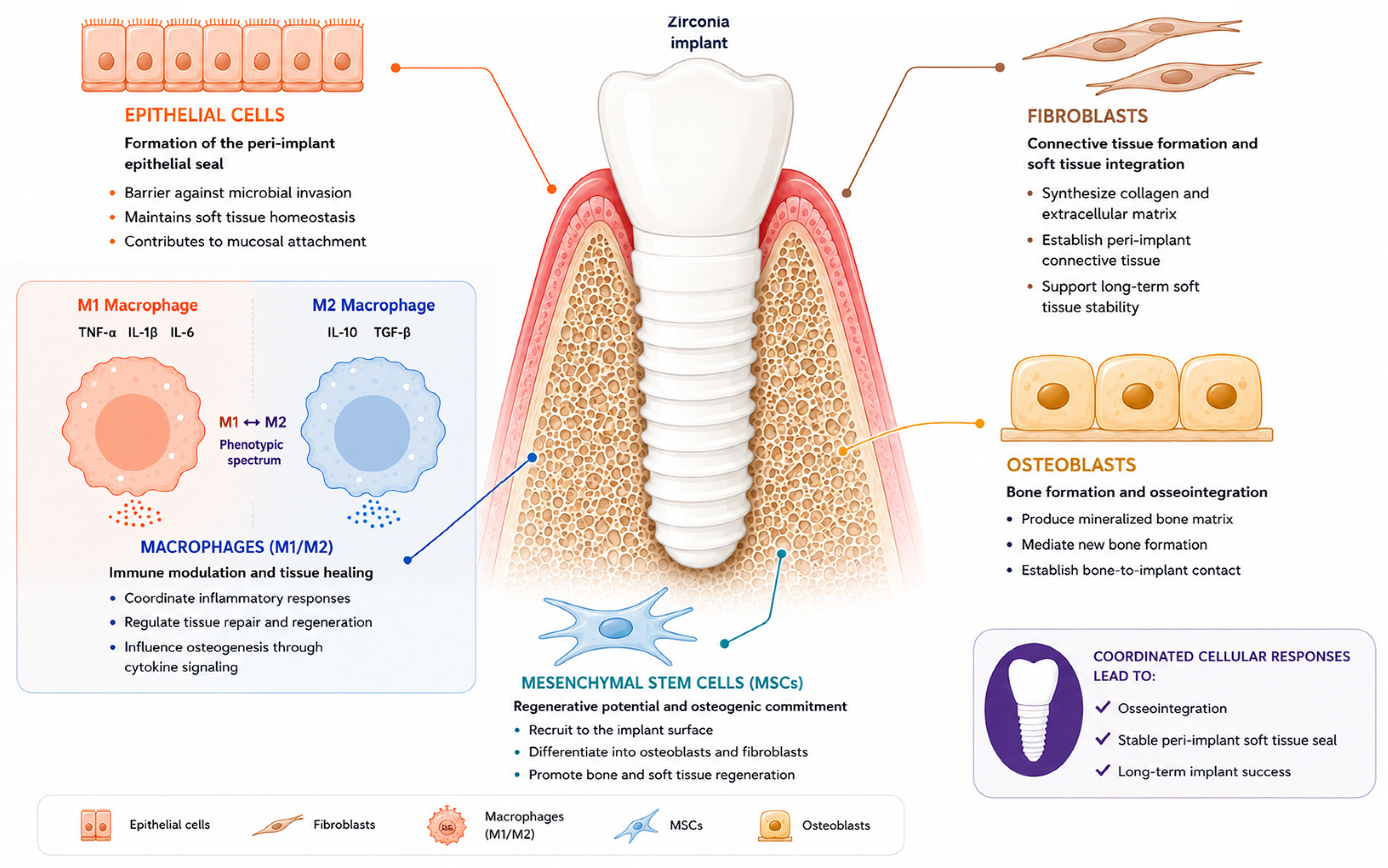

| Cell Type | Preferred Surface Characteristics | Primary Biological Response | Surface Modifications Strategy | Design Challenge |
|---|---|---|---|---|
| Macrophages | Smooth nanostructured surfaces with high bioactivity | M2 polarization, reduced inflammatory cytokine production, osteoimmunomodulation | Fullerene (C60) coatings, CeO2/PDA smart coatings | Minimize pro-inflammatory effects of micro-roughness while preserving osteogenic potential |
| Mesenchymal stem cells | Hierarchical micro-/nanotopography with biochemical guidance | Adhesion, migration, mechanotransduction and osteogenic commitment | SLA-like treatments, USP laser patterning, 3D scaffolds, peptide functionalization (RGD/DWIVA) | Promote osteogenic differentiation without compromising zirconia mechanical stability |
| Osteoblasts | Moderately rough microtopography with bioactive surface chemistry | Matrix mineralization, osteogenic differentiation and osseointegration | Sandblasting/acid etching, laser ablation, additive manufacturing (FFF/DLP), heat treatments, plasma treatments, HA/collagen/MTA coatings | Balance early proliferation with long-term differentiation while maintaining material stability |
| Fibroblasts | Smooth, hydrophilic, high-energy surfaces | Connective tissue attachment, collagen production and mucosal integration | ECM protein coatings (fibronectin/laminin), MTA coatings, AgNP/ZnO antibacterial doping | Excessive roughness compromises fibroblast adhesion and metabolic activity |
| Epithelial cells | Smooth or nanostructured surfaces with high surface energy | Rapid migration, hemidesmosome formation and epithelial sealing | UV photofunctionalization, nanoporous TiO2 coatings, PAR4 peptide functionalization via electrophoretic fusion | Surface properties favorable for epithelial sealing may conflict with osteoblast requirements |
Disclaimer/Publisher’s Note: The statements, opinions and data contained in all publications are solely those of the individual author(s) and contributor(s) and not of MDPI and/or the editor(s). MDPI and/or the editor(s) disclaim responsibility for any injury to people or property resulting from any ideas, methods, instructions or products referred to in the content. |
© 2026 by the authors. Licensee MDPI, Basel, Switzerland. This article is an open access article distributed under the terms and conditions of the Creative Commons Attribution (CC BY) license.
Share and Cite
Milic, M.S.; Simonovic, J.; Todorovic, V.S. Cellular Responses at the Zirconia Dental Implant Interface: A Comprehensive Review. J. Funct. Biomater. 2026, 17, 372. https://doi.org/10.3390/jfb17080372
Milic MS, Simonovic J, Todorovic VS. Cellular Responses at the Zirconia Dental Implant Interface: A Comprehensive Review. Journal of Functional Biomaterials. 2026; 17(8):372. https://doi.org/10.3390/jfb17080372
Chicago/Turabian StyleMilic, Marija S., Jelena Simonovic, and Vladimir S. Todorovic. 2026. "Cellular Responses at the Zirconia Dental Implant Interface: A Comprehensive Review" Journal of Functional Biomaterials 17, no. 8: 372. https://doi.org/10.3390/jfb17080372
APA StyleMilic, M. S., Simonovic, J., & Todorovic, V. S. (2026). Cellular Responses at the Zirconia Dental Implant Interface: A Comprehensive Review. Journal of Functional Biomaterials, 17(8), 372. https://doi.org/10.3390/jfb17080372

