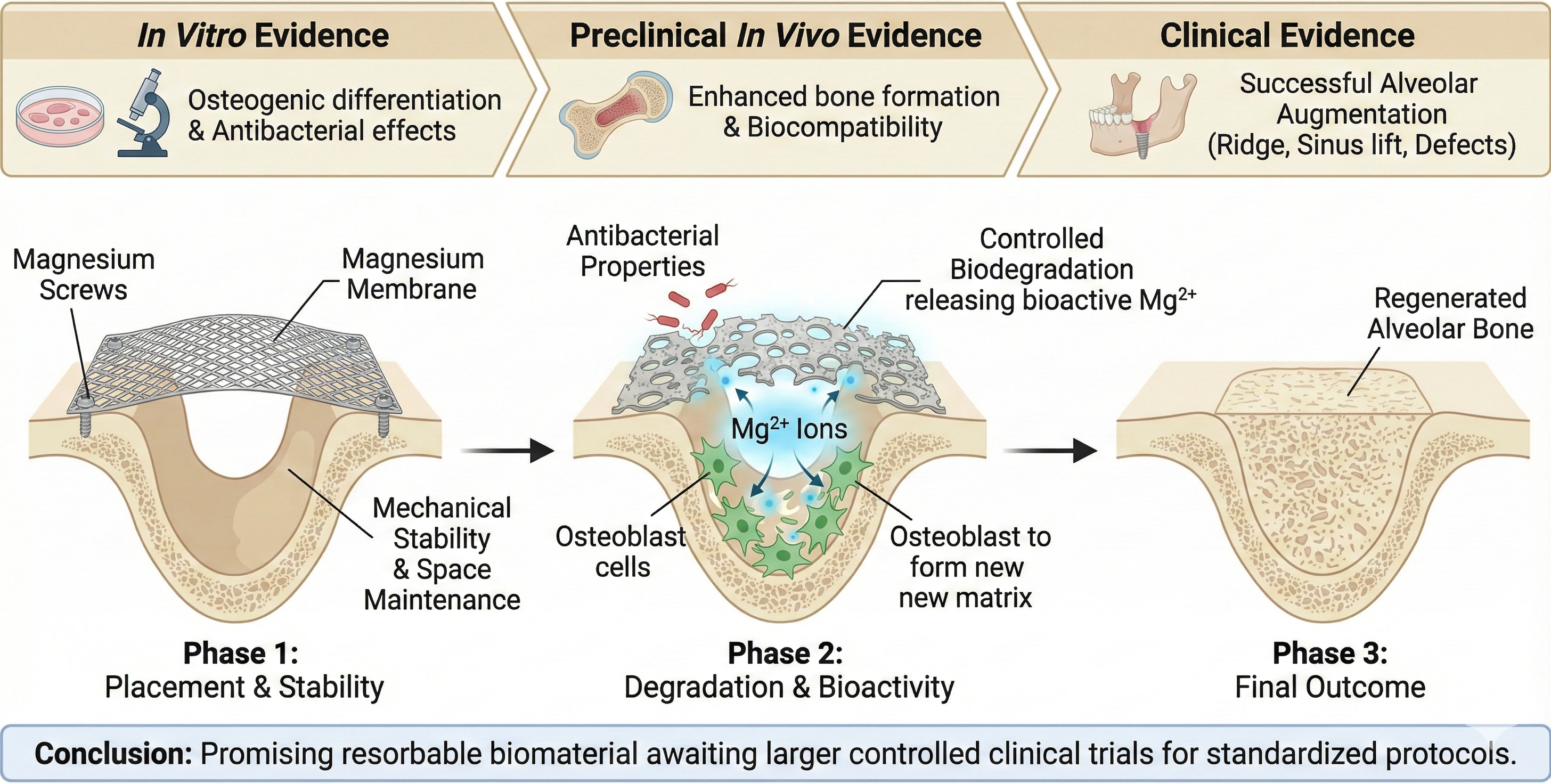

Magnesium-Based Membrane for Alveolar Ridge Regeneration—A Scoping Review




Abstract
1. Introduction
2. Materials and Methods
2.1. Protocol Development and Registration
2.2. Eligibility Criteria
- Population: Patients, animal models, or cell cultures relevant to alveolar ridge defects or alveolar bone regeneration.
- Concept: Use of magnesium-based barrier membranes (pure magnesium, magnesium alloy, or magnesium-reinforced composite membranes), with or without magnesium fixation screws, for guided bone regeneration.
- Context: Oral and maxillofacial surgery, implant dentistry, periodontics, and guided bone regeneration procedures involving the alveolar ridge.
2.2.1. Inclusion Criteria
- Topic: Investigated magnesium-based barrier membranes (pure magnesium, magnesium alloy, or magnesium-reinforced composite membranes), with or without magnesium fixation screws, for alveolar bone regeneration or guided bone regeneration.
- Study design: In vitro studies, preclinical in vivo (animal) studies, clinical studies, and review articles addressing magnesium membranes in alveolar bone regeneration.
- Outcomes: Reported at least one outcome relevant to bone regeneration, membrane degradation, biocompatibility, mechanical properties, or clinical performance.
- Language: Publications written in English.
2.2.2. Exclusion Criteria
- Off-topic studies: Studies not involving magnesium-based membranes.
- Non-relevant anatomical context: Studies focused solely on orthopedic, cardiovascular, or non-alveolar bone applications.
- Non-relevant outcomes: Studies lacking relevant outcome measures for bone regeneration or clinical application.
2.3. Search Strategy
2.4. Quality Assessment
- Level 1: Systematic reviews, meta-analyses, randomized controlled trials.
- Level 2: Cohort studies, low-quality randomized controlled trials.
- Level 3: Case–control studies.
- Level 4: Case series, case reports, and poor-quality cohort/case–control studies.
- Level 5: Expert opinion, mechanism-based reasoning, and clinical guidelines.
2.5. Data Extraction
3. Results
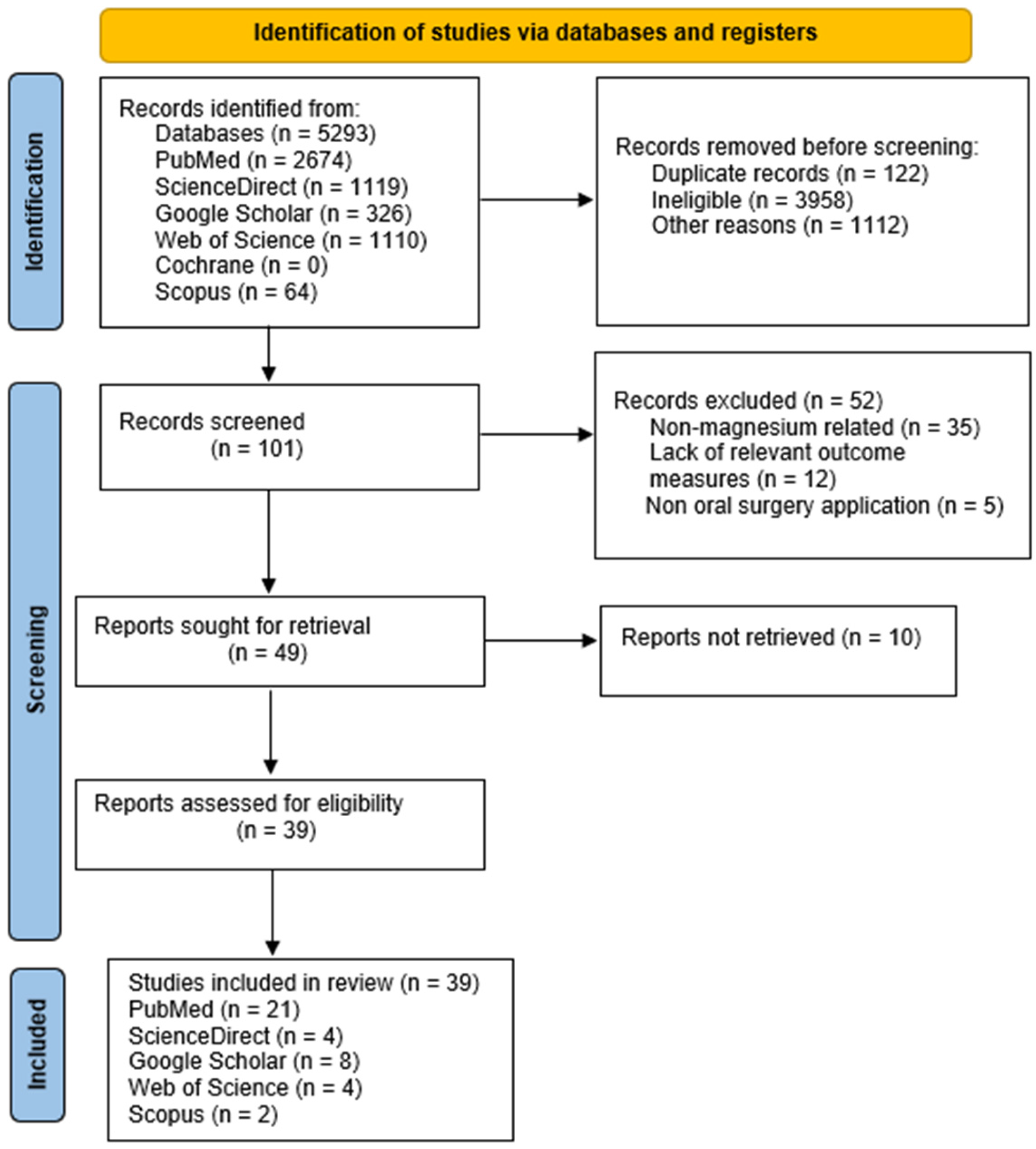
3.1. Study Selection
3.2. Data Synthesis
3.3. Evidence Quality Distribution (Oxford CEBM)
3.4. Study Characteristics
3.4.1. In Vitro Studies
3.4.2. Preclinical In Vivo Studies
3.4.3. Clinical Case Reports and Case Series
3.4.4. Reported Complications
4. Discussion
4.1. Biological Activity and Effect of Magnesium Ion Release
4.2. Degradation Behavior and the Role of the Corrosion Process
4.3. Mechanical Strength, Handling, and Clinical Advantages
4.4. Surface Modifications
4.5. Performance of Magnesium Membranes and Fixation Screws in Bone Regeneration
4.6. Comparative Considerations with Conventional Barrier Materials
4.7. Study Limitations
5. Conclusions
Supplementary Materials
Author Contributions
Funding
Institutional Review Board Statement
Informed Consent Statement
Data Availability Statement
Conflicts of Interest
Abbreviations
| GBR | Guided Bone Regeneration |
| e-PTFE | Expanded Polytetrafluoroethylene |
| HGF-1 | Human Gingival Fibroblast 1 |
| Mpa | Megapascal |
| Mg | Magnesium |
| CT | Computed Tomography |
| PVD | Physical Vapor Deposition |
| MAO | Micro Arc Oxidation |
| DMEM | Dulbecco’s Modified Eagle Medium |
| CBCT | Cone-Beam Computed Tomography |
References
- Covani, U.; Giammarinaro, E.; Marconcini, S. Alveolar socket remodeling: The tug-of-war model. Med. Hypotheses 2020, 142, 109746. [Google Scholar] [CrossRef]
- Araújo, M.G.; Dias, D.R.; Matarazzo, F. Anatomical characteristics of the alveolar process and basal bone that have an effect on socket healing. Periodontology 2000 2023, 93, 277–288. [Google Scholar] [CrossRef]
- Vrotsos, J.A.; Parashis, A.O.; Theofanatos, G.D.; Smulow, J.B. Prevalence and distribution of bone defects in moderate and advanced adult periodontitis. J. Clin. Periodontol. 1999, 26, 44–48. [Google Scholar] [CrossRef] [PubMed]
- Hollý, D.; Klein, M.; Mazreku, M.; Zamborský, R.; Polák, Š.; Danišovič, Ľ.; Csöbönyeiová, M. Stem Cells and Their Derivatives—Implications for Alveolar Bone Regeneration: A Comprehensive Review. Int. J. Mol. Sci. 2021, 22, 11746. [Google Scholar] [CrossRef]
- Ramanauskaite, A.; Becker, K.; Kassira, H.C.; Becker, J.; Sader, R.; Schwarz, F. The dimensions of the facial alveolar bone at tooth sites with local pathologies: A retrospective cone-beam CT analysis. Clin. Oral Investig. 2020, 24, 1551–1560. [Google Scholar] [CrossRef]
- Milinkovic, I.; Cordaro, L. Are there specific indications for the different alveolar bone augmentation procedures for implant placement? A systematic review. Int. J. Oral Maxillofac. Surg. 2014, 43, 606–625. [Google Scholar] [CrossRef] [PubMed]
- Benic, G.I.; Hämmerle, C.H.F. Horizontal bone augmentation by means of guided bone regeneration. Periodontology 2000 2014, 66, 13–40. [Google Scholar] [CrossRef]
- Retzepi, M.; Donos, N. Guided Bone Regeneration: Biological principle and therapeutic applications. Clin. Oral Implant. Res. 2010, 21, 567–576. [Google Scholar] [CrossRef] [PubMed]
- Stevenson, S.; Emery, S.E.; Goldberg, V.M. Factors affecting bone graft incorporation. Clin. Orthop. Relat. Res. 1996, 324, 66–74. [Google Scholar] [CrossRef]
- Hankenson, K.D.; Gagne, K.; Shaughnessy, M. Extracellular signaling molecules to promote fracture healing and bone regeneration. Adv. Drug Deliv. Rev. 2015, 94, 3–12. [Google Scholar] [CrossRef]
- Sanz, M.; Dahlin, C.; Apatzidou, D.; Artzi, Z.; Bozic, D.; Calciolari, E.; De Bruyn, H.; Dommisch, H.; Donos, N.; Eickholz, P.; et al. Biomaterials and regenerative technologies used in bone regeneration in the craniomaxillofacial region: Consensus report of group 2 of the 15th European Workshop on Periodontology on Bone Regeneration. J. Clin. Periodontol. 2019, 46, 82–91. [Google Scholar] [CrossRef] [PubMed]
- Kim, K.; Su, Y.; Kucine, A.J.; Cheng, K.; Zhu, D. Guided Bone Regeneration Using Barrier Membrane in Dental Applications. ACS Biomater. Sci. Eng. 2023, 9, 5457–5478. [Google Scholar] [CrossRef]
- Ma, Y.F.; Yan, X.Z. Periodontal Guided Tissue Regeneration Membranes: Limitations and Possible Solutions for the Bottleneck Analysis. Tissue Eng. Part B Rev. 2023, 29, 532–544. [Google Scholar] [CrossRef] [PubMed]
- Chen, K.; Zhao, L.; Huang, C.; Yin, X.; Zhang, X.; Li, P.; Gu, X.; Fan, Y. Recent Advances in the Development of Magnesium-Based Alloy Guided Bone Regeneration (GBR) Membrane. Metals 2022, 12, 2074. [Google Scholar] [CrossRef]
- Rider, P.; Kačarević, Ž.P.; Elad, A.; Tadic, D.; Rothamel, D.; Sauer, G.; Bornert, F.; Windisch, P.; Hangyási, D.B.; Molnar, B.; et al. Biodegradable magnesium barrier membrane used for guided bone regeneration in dental surgery. Bioact. Mater. 2021, 14, 152–168. [Google Scholar] [CrossRef]
- Zhang, Y.; Xu, J.; Ruan, Y.C.; Yu, M.K.; O’Laughlin, M.; Wise, H.; Chen, D.; Tian, L.; Shi, D.; Wang, J.; et al. Implant-derived magnesium induces local neuronal production of CGRP to improve bone-fracture healing in rats. Nat. Med. 2016, 22, 1160–1169. [Google Scholar] [CrossRef]
- Amberg, R.; Elad, A.; Rothamel, D.; Fienitz, T.; Szakacs, G.; Heilmann, S.; Witte, F. Design of a migration assay for human gingival fibroblasts on biodegradable magnesium surfaces. Acta Biomater. 2018, 79, 158–167. [Google Scholar] [CrossRef]
- Tricco, A.C.; Lillie, E.; Zarin, W.; O’Brien, K.K.; Colquhoun, H.; Levac, D.; Moher, D.; Peters, M.D.J.; Horsley, T.; Weeks, L.; et al. PRISMA Extension for Scoping Reviews (PRISMA-ScR): Checklist and explanation. Ann. Intern. Med. 2018, 169, 467–473. [Google Scholar] [CrossRef]
- Ichikawa, Y.; Watahiki, J.; Nampo, T.; Nose, K.; Yamamoto, G.; Irie, T.; Mishima, K.; Maki, K. Differences in the developmental origins of the periosteum may influence bone healing. J. Periodontal Res. 2015, 50, 468–478. [Google Scholar] [CrossRef]
- Phillips, B.; Thornton, H. The 2011 Oxford CEBM Levels of Evidence (Introductory Document). Oxford Centre for Evidence-Based Medicine. Available online: https://www.cebm.ox.ac.uk/resources/levels-of-evidence/ocebm-levels-of-evidence (accessed on 30 November 2025).
- Haddaway, N.R.; Collins, A.M.; Coughlin, D.; Kirk, S. The role of Google Scholar in evidence reviews and its applicability to grey literature searching. PLoS ONE 2015, 10, e0138237. [Google Scholar] [CrossRef] [PubMed]
- Zhang, Z.; Gong, N.; Wang, Y.; Xu, L.; Zhao, S.; Liu, Y.; Tan, F. Impact of Strontium, Magnesium, and Zinc Ions on the In Vitro Osteogenesis of Maxillary Sinus Membrane Stem Cells. Biol. Trace Elem. Res. 2025, 203, 1922–1933. [Google Scholar] [CrossRef]
- Malaiappan, S.; Harris, J. Osteogenic Potential of Magnesium Oxide Nanoparticles in Bone Regeneration: A Systematic Review. Cureus 2024, 16, e55502. [Google Scholar] [CrossRef]
- Zhang, H.Y.; Jiang, H.B.; Kim, J.E.; Zhang, S.; Kim, K.M.; Kwon, J.S. Bioresorbable magnesium-reinforced PLA membrane for guided bone/tissue regeneration. J. Mech. Behav. Biomed. Mater. 2020, 112, 104061. [Google Scholar] [CrossRef]
- Topuz, M.; Topuz, F.C.; Dikici, B.; Seifzadeh, D. Sustainable walnut shell-filled polylactic acid–hydroxyapatite hybrid coatings for enhanced corrosion resistance and bioactivity of magnesium biomaterials. J. Appl. Polym. Sci. 2025, 142, e57321. [Google Scholar] [CrossRef]
- Karataş, E.; Oter, Ç.; Akınay, Y.; Topuz, M. Ti3C2Tx MXene and CuO modified alginate coatings for enhanced in vitro corrosion resistance, antibacterial behavior, and cytocompatibility of AZ31 Mg alloy. Surf. Interfaces 2026, 87, 108921. [Google Scholar] [CrossRef]
- Rider, P.; Kačarević, Ž.P.; Elad, A.; Rothamel, D.; Sauer, G.; Bornert, F.; Windisch, P.; Hangyási, D.; Molnar, B.; Hesse, B.; et al. Biodegradation of a Magnesium Alloy Fixation Screw Used in a Guided Bone Regeneration Model in Beagle Dogs. Materials 2022, 15, 4111. [Google Scholar] [CrossRef] [PubMed]
- Rider, P.; Kačarević, Ž.P.; Elad, A.; Rothamel, D.; Sauer, G.; Bornert, F.; Windisch, P.; Hangyási, D.; Molnar, B.; Hesse, B.; et al. Analysis of a Pure Magnesium Membrane Degradation Process and Its Functionality When Used in a Guided Bone Regeneration Model in Beagle Dogs. Materials 2022, 15, 3106. [Google Scholar] [CrossRef] [PubMed]
- Barbeck, M.; Kühnel, L.; Witte, F.; Pissarek, J.; Precht, C.; Xiong, X.; Krastev, R.; Wegner, N.; Walther, F.; Jung, O. Degradation, Bone Regeneration and Tissue Response of an Innovative Volume Stable Magnesium-Supported GBR/GTR Barrier Membrane. Int. J. Mol. Sci. 2020, 21, 3098. [Google Scholar] [CrossRef]
- Steigmann, L.; Jung, O.; Kieferle, W.; Stojanovic, S.; Proehl, A.; Görke, O.; Emmert, S.; Najman, S.; Barbeck, M.; Rothamel, D. Biocompatibility and Immune Response of a Newly Developed Volume-Stable Magnesium-Based Barrier Membrane in Combination with a PVD Coating for Guided Bone Regeneration (GBR). Biomedicines 2020, 8, 636. [Google Scholar] [CrossRef] [PubMed]
- Shan, X.; Xu, Y.; Kolawole, S.K.; Wen, L.; Qi, Z.; Xu, W.; Chen, J. Degradable Pure Magnesium Used as a Barrier Film for Oral Bone Regeneration. J. Funct. Biomater. 2022, 13, 298. [Google Scholar] [CrossRef]
- Wang, F.; He, Y.; Xiang, D.; Liu, X.; Yang, F.; Hou, Y.; Wu, W.; Xia, D.; Xu, Y.; Liu, Y. Magnesium-reinforced sandwich structured composite membranes promote osteogenesis. J. Magnes. Alloys 2025, 13, 1561–1578. [Google Scholar] [CrossRef]
- Beitlitum, I.; Rayyan, F.; Slutzkey, G.; Raz, P.; Sarig, R. Magnesium Resorbable Membrane for Guided Bone Regeneration in Critical Size Defect Model in Rabbits—Histomorphometric Analysis. Clin. Implant. Dent. Relat. Res. 2025, 27, e70055. [Google Scholar] [CrossRef]
- Vujović, S.; Desnica, J.; Stanišić, D.; Ognjanović, I.; Stevanovic, M.; Rosic, G. Applications of Biodegradable Magnesium-Based Materials in Reconstructive Oral and Maxillofacial Surgery: A Review. Molecules 2022, 27, 5529. [Google Scholar] [CrossRef] [PubMed]
- Yan, Z.Y.; Zhu, J.H.; Liu, G.Q.; Liu, Z.C.; Guo, C.B.; Cui, N.H.; Han, J.M. Feasibility and efficacy of a degradable magnesium-alloy GBR membrane for bone augmentation in a distal bone-defect model in beagle dogs. Bioinorg. Chem. Appl. 2022, 2022, 4941635. [Google Scholar] [CrossRef]
- Wu, G.; Guo, C.; Han, J. Pure Magnesium GBR Membrane Affects Oral Tissue Regeneration. Int. Dent. J. 2025, 75, 105121. [Google Scholar] [CrossRef]
- Liu, Y.; Du, L.; Song, J.; Zhang, M.; Du, S.; Long, W.; Song, W.; Chang, X.; Li, Z. A 3D printed magnesium ammonium phosphate/polycaprolactone composite membrane for guided bone regeneration. Mater. Des. 2024, 239, 112733. [Google Scholar] [CrossRef]
- Mu, Y.; Du, Z.; Gao, W.; He, Z.; Xiao, L.; Zhou, Y.; Ahmed, I.; Dai, H.; Liu, M.; Liu, J.; et al. Osteoimmunometabolic modulation via hydrogen-self-supplying magnesium-reinforced collagen membrane for enhanced guided bone regeneration. Biomaterials 2026, 329, 123928. [Google Scholar] [CrossRef]
- Blašković, M.; Blašković, D.; Hangyasi, D.B.; Peloza, O.C.; Tomas, M.; Čandrlić, M.; Rider, P.; Mang, B.; Kačarević, Ž.P.; Trajkovski, B. Evaluation between biodegradable magnesium metal GBR membrane and bovine graft with or without hyaluronate. Membranes 2023, 13, 691. [Google Scholar] [CrossRef]
- Elad, A.; Rider, P.; Rogge, S.; Witte, F.; Tadić, D.; Kačarević, Ž.P.; Steigmann, L. Application of Biodegradable Magnesium Membrane Shield Technique for Immediate Dentoalveolar Bone Regeneration. Biomedicines 2023, 11, 744. [Google Scholar] [CrossRef]
- Frosecchi, M. Horizontal and Vertical Defect Management with a Novel Degradable Pure Magnesium Guided Bone Regeneration (GBR) Membrane-A Clinical Case. Medicina 2023, 59, 2009. [Google Scholar] [CrossRef] [PubMed]
- Palkovics, D.; Rider, P.; Rogge, S.; Kačarević, Ž.P.; Windisch, P. Possible Applications for a Biodegradable Magnesium Membrane in Alveolar Ridge Augmentation-Retrospective Case Report with Two Years of Follow-Up. Medicina 2023, 59, 1698. [Google Scholar] [CrossRef]
- Franke, T.; Korzinskas, T. Guided Bone Regeneration in the Posterior Mandible Using a Resorbable Metal Magnesium Membrane and Fixation Screws: A Case Report. Case Rep. Dent. 2024, 2024, 2659893. [Google Scholar] [CrossRef] [PubMed]
- Chaushu, G.; Reiser, V.; Rosenfeld, E.; Masri, D.; Chaushu, L.; Čandrlić, M.; Rider, P.; Kačarević, Ž.P. Use of a Resorbable Magnesium Membrane for Bone Regeneration After Large Radicular Cyst Removal: A Clinical Case Report. Healthcare 2025, 13, 1068. [Google Scholar] [CrossRef]
- Elad, A.; Pul, L.; Rider, P.; Rogge, S.; Witte, F.; Tadić, D.; Mijiritsky, E.; Kačarević, Ž.P.; Steigmann, L. Resorbable magnesium metal membrane for sinus lift procedures: A case series. BMC Oral Health 2023, 23, 1006. [Google Scholar] [CrossRef]
- Lv, Z.; Peng, B.; Ye, Y.; Xu, H.; Cai, X.; Liu, J.; Dai, J.; Bian, Y.; Wen, P.; Weng, X. Bolstered bone regeneration by multiscale customized magnesium scaffolds with hierarchical structures and tempered degradation. Bioact. Mater. 2025, 46, 457–475. [Google Scholar] [CrossRef] [PubMed]
- Hangyasi, D.B.; Körtvélyessy, G.; Blašković, M.; Rider, P.; Rogge, S.; Siber, S.; Kačarević, Ž.P.; Čandrlić, M. Regeneration of Intrabony Defects Using a Novel Magnesium Membrane. Medicina 2023, 59, 2018. [Google Scholar] [CrossRef] [PubMed]
- Blašković, M.; Butorac Prpić, I.; Aslan, S.; Gabrić, D.; Blašković, D.; Cvijanović Peloza, O.; Čandrlić, M.; Perić Kačarević, Ž. Magnesium Membrane Shield Technique for Alveolar Ridge Preservation: Step-by-Step Representative Case Report of Buccal Bone Wall Dehiscence with Clinical and Histological Evaluations. Biomedicines 2024, 12, 2537. [Google Scholar] [CrossRef]
- Blašković, M.; Butorac Prpić, I.; Blašković, D.; Rider, P.; Tomas, M.; Čandrlić, S.; Botond Hangyasi, D.; Čandrlić, M.; Perić Kačarević, Ž. Guided Bone Regeneration Using a Novel Magnesium Membrane: A Literature Review and a Report of Two Cases in Humans. J. Funct. Biomater. 2023, 14, 307. [Google Scholar] [CrossRef]
- Tabanella, G.; Rider, P.; Rogge, S.; Čandrlić, M.; Perić Kačarević, Ž. Open Wound Healing in Guided Bone Regeneration Using a Magnesium Membrane: A Paradigm Shift. J. Biomed. Mater. Res. Part B Appl. Biomater. 2025, 113, e35642. [Google Scholar] [CrossRef]
- Tabanella, G.; Kačarević, Ž.P. The magnesium membrane shield technique: A structured and simplified approach for severe buccal bone deficiency in the aesthetic zones. Clin. Case Rep. 2026, 14, e72443. [Google Scholar] [CrossRef]
- Witte, F. The history of biodegradable magnesium implants: A review. Acta Biomater. 2010, 6, 1680–1692. [Google Scholar] [CrossRef]
- Li, P.; Chen, J.; Schmidt, F.; Dai, J.; Li, J.; Xu, S.; Li, A.; Yu, Z.; Witte, F. Magnesium-based barrier membrane for guided bone regeneration: From bedside to bench and back again. Biomaterials 2025, 328, 123783. [Google Scholar] [CrossRef]
- Felice, P.; Lizio, G.; Marchetti, C.; Checchi, L.; Scarano, A. Magnesium-substituted hydroxyapatite grafting using the vertical inlay technique. Int. J. Periodontics Restor. Dent. 2013, 33, 355–363. [Google Scholar] [CrossRef] [PubMed][Green Version]
- Wu, S.; Jang, Y.S.; Kim, Y.K.; Kim, S.Y.; Ko, S.O.; Lee, M.H. Surface modification of pure magnesium mesh for guided bone regeneration: In vivo evaluation of rat calvarial defect. Materials 2019, 12, 2684. [Google Scholar] [CrossRef] [PubMed]
- Khalili, V.; Virtanen, S.; Boccaccini, A.R. Surface Treatment With Cell Culture Medium: A Biomimetic Approach to Enhance the Resistance to Biocorrosion in Mg and Mg-Based Alloys—A Review. J. Biomed. Mater. Res. Part B Appl. Biomater. 2025, 113, e35617. [Google Scholar] [CrossRef]
- Lacin, N.; Sfeir, C. Magnesium-based resorbable biomaterials: Biological effects to clinical use. J. Dent. Res. 2026, 105, 183–194. [Google Scholar] [CrossRef]
- Hung, C.C.; Chaya, A.; Liu, K.; Verdelis, K.; Sfeir, C. The role of magnesium ions in bone regeneration involves the canonical Wnt signaling pathway. Acta Biomater. 2019, 98, 246–255. [Google Scholar] [CrossRef]
- Duarte, A.S.; Correia, A.; Esteves, A.C. Bacterial collagenases—A review. Crit. Rev. Microbiol. 2016, 42, 106–126. [Google Scholar] [CrossRef] [PubMed]

| Electronic Database | Search Term |
|---|---|
| PubMed | “Bone Regeneration” OR “Alveolar Bone Grafting” OR “Tissue Regeneration” AND “Magnesium”. (“Bone Regeneration” OR “Alveolar Bone Grafting” OR “Tissue Regeneration” OR “Guided Bone Regeneration” OR “GBR” OR “Ridge Augmentation” OR “Alveolar Ridge Augmentation”) AND (“Magnesium” OR “Mg” OR “Magnesium alloy” OR “Magnesium-based”) AND (“Membrane” OR “Barrier Membrane” OR “Resorbable Membrane” OR “Biodegradable Membrane” OR “Barrier” OR “Mesh”). |
| ScienceDirect | “Bone Regeneration” OR “Alveolar Bone Grafting” OR “Tissue Regeneration” AND “Magnesium”. (“Bone Regeneration” OR “Alveolar Bone Grafting” OR “Tissue Regeneration” OR “Guided Bone Regeneration” OR “GBR” OR “Ridge Augmentation” OR “Alveolar Ridge Augmentation”) AND (“Magnesium” OR “Mg” OR “Magnesium alloy” OR “Magnesium-based”) AND (“Membrane” OR “Barrier Membrane” OR “Resorbable Membrane” OR “Biodegradable Membrane” OR “Barrier” OR “Mesh”). |
| Scopus | “Bone Regeneration” OR “Alveolar Bone Grafting” OR “Tissue Regeneration” AND “Magnesium”. (“Bone Regeneration” OR “Alveolar Bone Grafting” OR “Tissue Regeneration” OR “Guided Bone Regeneration” OR “GBR” OR “Ridge Augmentation” OR “Alveolar Ridge Augmentation”) AND (“Magnesium” OR “Mg” OR “Magnesium alloy” OR “Magnesium-based”) AND (“Membrane” OR “Barrier Membrane” OR “Resorbable Membrane” OR “Biodegradable Membrane” OR “Barrier” OR “Mesh”). |
| Web of Science | “Bone Regeneration” OR “Alveolar Bone Grafting” OR “Tissue Regeneration” AND “Magnesium”. (“Bone Regeneration” OR “Alveolar Bone Grafting” OR “Tissue Regeneration” OR “Guided Bone Regeneration” OR “GBR” OR “Ridge Augmentation” OR “Alveolar Ridge Augmentation”) AND (“Magnesium” OR “Mg” OR “Magnesium alloy” OR “Magnesium-based”) AND (“Membrane” OR “Barrier Membrane” OR “Resorbable Membrane” OR “Biodegradable Membrane” OR “Barrier” OR “Mesh”). |
| Cochrane | “Bone Regeneration” OR “Alveolar Bone Grafting” OR “Tissue Regeneration” AND “Magnesium”. (“Bone Regeneration” OR “Alveolar Bone Grafting” OR “Tissue Regeneration” OR “Guided Bone Regeneration” OR “GBR” OR “Ridge Augmentation” OR “Alveolar Ridge Augmentation”) AND (“Magnesium” OR “Mg” OR “Magnesium alloy” OR “Magnesium-based”) AND (“Membrane” OR “Barrier Membrane” OR “Resorbable Membrane” OR “Biodegradable Membrane” OR “Barrier” OR “Mesh”). |
| Google Scholar | “Bone Regeneration” OR “Alveolar Bone Grafting” OR “Tissue Regeneration” AND “Magnesium”. (“Bone Regeneration” OR “Alveolar Bone Grafting” OR “Tissue Regeneration” OR “Guided Bone Regeneration” OR “GBR” OR “Ridge Augmentation” OR “Alveolar Ridge Augmentation”) AND (“Magnesium” OR “Mg” OR “Magnesium alloy” OR “Magnesium-based”) AND (“Membrane” OR “Barrier Membrane” OR “Resorbable Membrane” OR “Biodegradable Membrane” OR “Barrier” OR “Mesh”). |
| Author | Title | Type of Study | CEBM Level | Sample Size | Main Outcome |
|---|---|---|---|---|---|
| Chen et al. (2022) [14] | Recent Advances in the Development of Magnesium-Based Alloy Guided Bone Regeneration (GBR) Membrane | Narrative review | 5 | Magnesium-based membranes offer strength, biodegradability, and osteogenic and antibacterial effects; challenges like rapid corrosion, hydrogen release, and stress corrosion are addressed via alloying and surface modifications. | |
| Rider et al. (2021) [15] | Biodegradable magnesium barrier membrane used for guided bone regeneration in dental surgery | Original research in vivo | 4 | 20 | The pure magnesium membrane-maintained barrier function and space during early healing showed controlled degradation and achieved bone regeneration comparable to collagen membranes without adverse reactions. |
| Amberg et al. (2018) [17] | Design of a migration assay for human gingival fibroblasts on biodegradable magnesium surfaces | In vitro study | 5 | A reproducible assay demonstrated that human gingival fibroblasts attach to and migrate on biodegradable magnesium substrates. | |
| Zhang et al. (2025) [22] | Impact of Strontium, Magnesium, and Zinc Ions on the In Vitro Osteogenesis of Maxillary Sinus Membrane Stem Cells | in vitro study | 5 | Moderate Mg2+ concentrations increased expression of osteogenic differentiation markers in vitro. | |
| Malaiappan et al. (2025) [23] | Osteogenic Potential of Magnesium Oxide Nanoparticles in Bone Regeneration: A Systematic Review | Systematic review | 5 | Reported that MgO nanoparticles might support osteoblast activity and osteogenic gene expression in vitro and promote bone formation, density, and implant integration in vivo, supporting bone regeneration. | |
| Zhang et al. (2020) [24] | Bioresorbable magnesium-reinforced PLA membrane for guided bone/tissue regeneration | Preclinical in vivo and in vitro research | 5 | Improved mechanical strength, controlled degradation, and maintained cytocompatibility | |
| Topuz et al. (2025) [25] | Sustainable walnut shell-filled PLA–HA coatings for Mg biomaterials | in vitro study | 5 | Improved corrosion resistance and bioactivity of Mg biomaterials via hybrid polymer coating | |
| Karataş et al. (2026) [26] | MXene and CuO modified alginate coatings for AZ31 Mg alloy | in vitro study | 5 | Enhanced corrosion resistance, antibacterial activity, and cytocompatibility of Mg alloy | |
| Rider et al. (2022) [27] | Biodegradation of a Magnesium Alloy Fixation Screw Used in a Guided Bone Regeneration Model in Beagle Dogs | Original research in vivo | 5 | 20 | Magnesium screws provided bone regeneration comparable to titanium, with gradual resorption and only transient, non-interfering tissue reactions. |
| Rider et al. (2022) [28] | Analysis of a Pure Magnesium Membrane Degradation Process and Its Functionality When Used in a Guided Bone Regeneration Model in Beagle Dogs | Original research in vivo | 5 | 18 | Micro-CT * showed bone formation comparable to collagen membranes, with controlled magnesium degradation and no long-term adverse tissue reactions. |
| Barbeck et al. (2020) [29] | Tissue Response of an Innovative Volume Stable Magnesium-Supported GBR/GTR Barrier Membrane | Original research in vivo | 5 | The magnesium-supported membrane showed controlled degradation, favorable tissue response, maintained early volume stability, and was associated with bone formation in preclinical model. | |
| Steigmann et al. (2020) [30] | Biocompatibility and Immune Response of a Newly Developed Volume-Stable Magnesium-Based Barrier Membrane in Combination with a PVD Coating for Guided Bone Regeneration (GBR) | Preclinical in vivo and in vitro research | 5 | Despite poor in vitro cytocompatibility, both membranes showed acceptable in vivo biocompatibility; uncoated magnesium elicited a collagen-like immune response, while PVD ** coating showed no added benefit. | |
| Shan et al. (2022) [31] | Degradable Pure Magnesium Used as a Barrier Film for Oral Bone Regeneration | preclinical in vivo and in vitro research | 5 | MAO #-coated magnesium showed controlled degradation, supported osteoblast activity, and achieved bone regeneration comparable to titanium membranes. | |
| Wang et al. (2025) [32] | Magnesium-reinforced sandwich-structured composite membranes promote osteogenesis | Preclinical in vivo and in vitro research | 5 | Magnesium-reinforced sandwich-structured composite membranes provided improved mechanical stability and reported osteoblast activity and osteogenic gene expression through sustained Mg2+ release, supporting bone regeneration in preclinical models. | |
| Beitilitum et al. (2025) [33] | Magnesium Resorbable Membrane for Guided Bone Regeneration in Critical Size Defect Model in Rabbits—Histomorphometric Analysis | Original research in vivo | 5 | 9 | Mg membrane was associated with greater bone formation in rabbit calvarial critical-size defects, with greater histomorphometric new bone compared to non-membrane controls, despite transient gas accumulation due to degradation. |
| Vujović et al. (2022) [34] | Applications of Biodegradable Magnesium-Based Materials in Reconstructive Oral and Maxillofacial Surgery: A Review. | Narrative review | 5 | Mg-based biomaterials show promising biodegradability, mechanical strength, and osteogenic potential in oral and maxillofacial reconstruction, but clinical evidence remains limited. | |
| Yan et al. (2022) [35] | Feasibility and efficacy of a degradable magnesium-alloy GBR membrane for bone augmentation in a distal bone-defect model in beagle dogs | Original research in vivo | 5 | Suggested feasibility and was associated with bone formation in an animal model | |
| Wu et al. (2025) [36] | Pure Magnesium GBR Membrane Affects Oral Tissue Regeneration. | Original research in vivo | 5 | Pure Mg membranes yielded greater bone formation in a preclinical model. | |
| Liu et al. (2024) [37] | A 3D printed magnesium ammonium phosphate/polycaprolactone composite membrane for Guided bone regeneration | Preclinical in vivo and in vitro research | 5 | A 3D-printed magnesium ammonium phosphate/polycaprolactone composite membrane demonstrated acceptable mechanical properties, controlled degradation, and sustained magnesium ion release and showed osteogenic differentiation and bone formation in preclinical models. | |
| Mu et al. (2026) [38] | Osteoimmunometabolic modulation via hydrogen-self-supplying magnesium-reinforced collagen membrane for enhanced GBR | Original research in vivo | 5 | Demonstrated bone regeneration via immunomodulation, ROS scavenging, and macrophage metabolic reprogramming | |
| Blašković et al. (2026) [39] | Evaluation between biodegradable magnesium metal GBR membrane and bovine graft with or without hyaluronate | Case series | 4 | 2 | Bone regeneration was observed, demonstrating compatibility of the Mg membrane with graft materials and hyaluronate |
| Elad et al. (2023) [40] | Application of Biodegradable Magnesium Membrane Shield Technique for Immediate Dentoalveolar Bone Regeneration | Case series | 4 | 4 | All cases demonstrated bone regeneration and soft-tissue healing, with follow-up imaging showing thick cortical bone formation in some sites. The membrane was adaptable to defect shape and could be applied as a single or double layer for mechanical support. Its biodegradable nature eliminated the need for secondary removal surgery. |
| Frosecchi et al. (2023) [41] | Horizontal and Vertical Defect Management with a Novel Degradable Pure Magnesium Guided Bone Regeneration (GBR) Membrane—A Clinical Case | Clinical case | 4 | 1 | Complex defect was augmented with bovine graft and magnesium ‘arch’ membrane; over 8 months, volume was maintained, healing was complication-free, membrane resorbed, and implants successfully placed |
| Palkovics et al. (2023) [42] | Possible Applications for a Biodegradable Magnesium Membrane in Alveolar Ridge Augmentation–Retrospective Case Report with Two Years of Follow-Up | Retrospective case report | 4 | 2 | Magnesium membranes achieved 0.12–0.36 cm3 bone gain with horizontal and vertical improvements; two-year follow-up showed stable volume, no peri-implant bone loss, and effective space maintenance in challenging defects. |
| Franke et al. (2024) [43] | Guided Bone Regeneration in the Posterior Mandible Using a Resorbable Metal Magnesium Membrane and Fixation Screws: A Case Report | Clinical case | 5 | 1 | The membrane supported bone graft consolidation, and at 3 months, sufficient bone volume and quality were observed for implant placement. The membrane fully resorbed, and the augmented site healed without complications, despite minor transient soft-tissue effects. |
| Chaushu et al. (2025) [44] | Use of a Resorbable Magnesium Membrane for Bone Regeneration After Large Radicular Cyst Removal: A Clinical Case Report | Clinical case | 4 | 1 | At 16 months, CBCT ++ showed restored palatal bone and cortical formation; teeth were asymptomatic with healthy tissues. The resorbable magnesium membrane supported graft stability and avoided removal surgery. |
| Elad et al. (2023) [45] | Resorbable magnesium metal membrane for sinus lift procedures: a case series | Case series | 4 | 4 | In all four cases, the magnesium membrane was used to repair or replace the sinus membrane and support bone grafts in the sinus cavity. Healing resulted in newly formed alveolar bone with height gains of 10-20 mm, and the magnesium membrane was fully resorbed. Vertical and horizontal bone augmentation remained stable, providing sufficient regenerated bone to support dental implants. |
| Lv et al. (2025) [46] | Bolstered bone regeneration by multiscale customized magnesium scaffolds with hierarchical structures and tempered degradation | Preclinical in vivo and in vitro research | 5 | The magnesium scaffold provided cancellous bone-like strength, provided osteoconductive support, and increased in vivo bone formation. | |
| Hangyasi et al. (2023) [47] | Regeneration of Intrabony Defects Using a Novel Magnesium Membrane | Case series | 4 | 3 | In all three cases, the magnesium membrane could be easily shaped into customized forms (strip, T-shape, M-shape) to adapt to the specific morphology of each intrabony defect. After 4–6 months of healing, radiological analysis identified bone fill within the treated defects and periodontal probing depth reduction by an average of 1.66 ± 0.29 mm, indicating a gain in bone support. Soft-tissue healing was favorable, and no major complications were reported during the healing period. |
| Blaskovic et al. (2024) [48] | Magnesium Membrane Shield Technique for Alveolar Ridge Preservation: Step-by-Step Representative Case Report of Buccal Bone Wall Dehiscence with Clinical and Histological Evaluations | Clinical case | 4 | 1 | After six months, sufficient bone volume allowed implant placement. Histology showed ~47% new bone, ~19% residual graft, and no inflammation, with active remodeling at the bone-biomaterial interface. Soft tissue healed well, and the final restoration achieved good esthetic and functional outcomes. |
| Blaskovic et al. (2023) [49] | Guided Bone Regeneration Using a Novel Magnesium Membrane: A Literature Review and a Report of Two Cases in Humans | Literature review and clinical cases | 4 | 2 | Magnesium membranes provide strength, biocompatibility, degradability, and barrier function; human cases showed stable grafts, complication-free healing, and complete membrane resorption with satisfactory bone regeneration. |
| Tabanella et al. (2025) [50] | Open Wound Healing in Guided Bone Regeneration Using a Magnesium Membrane: A Paradigm Shift | Case series | 4 | 4 | Despite membrane exposure in all cases, from small to large, none of the patients experienced pain, infection, or other clinical complications. Implant placement was carried out as planned, and importantly, there was no significant bone loss observed despite exposure. The resorbable magnesium membrane maintained its barrier function and preserved the augmented bone volume, even under open-wound healing conditions. |
| Tabanella et al. (2026) [51] | Magnesium membrane shield technique for buccal bone deficiency | Clinical case | 4 | 1 | Successful buccal bone regeneration with favorable aesthetic and functional outcomes |
| Witte et al. (2010) [52] | The history of biodegradable magnesium implants: a review | Narrative review | 5 | Magnesium-based implants show biodegradability and biocompatibility; challenges like corrosion and mechanical strength are partly addressed by alloying and surface treatments. | |
| Li et al. (2025) [53] | Magnesium-based barrier membrane for guided bone regeneration: From bedside to bench and back again | Narrative review | 5 | Mg-based membranes support GBR + principles, promote bone regeneration, prevent bacterial infiltration, enhance clinical safety, and extend use beyond traditional GBR, even in wound complications | |
| Felice et al. (2013) [54] | Magnesium-substituted hydroxyapatite grafting using the vertical inlay technique | Clinical case | 4 | 1 | After three months, vertical bone gain of 4.9 mm was achieved at implant placement. Histology showed that the grafted Mg-HA material was fully infiltrated by new bone, demonstrating integration into living tissue. Implants were restored with provisional and definitive prostheses at four and eight months, respectively, without complications. |
| Wu et al. (2019) [55] | Surface modification of pure magnesium mesh for GBR | Original research in vivo | 5 | Surface-modified Mg mesh was associated with bone formation and acceptable biocompatibility in a preclinical model | |
| Khalil et al. (2025) [56] | Surface Treatment With Cell Culture Medium: A Biomimetic Approach to Enhance the Resistance to Biocorrosion in Mg and Mg-Based Alloys—A Review | Narrative review | 5 | DMEM ## promotes calcium phosphate layer formation on Mg implants, enhancing corrosion resistance and bone-like environments; synthetic buffers accelerate corrosion, and protein media risk contamination. Layer stability depends on fluid dynamics, while long-term mechanical and in vivo effects remain unclear. | |
| Lacin et al. (2026) [57] | Magnesium-based resorbable biomaterials: Biological effects to clinical use | Narrative review | 5 | Summarizes biological effects, degradation behavior, and clinical potential of Mg-based biomaterials |
Disclaimer/Publisher’s Note: The statements, opinions and data contained in all publications are solely those of the individual author(s) and contributor(s) and not of MDPI and/or the editor(s). MDPI and/or the editor(s) disclaim responsibility for any injury to people or property resulting from any ideas, methods, instructions or products referred to in the content. |
© 2026 by the authors. Licensee MDPI, Basel, Switzerland. This article is an open access article distributed under the terms and conditions of the Creative Commons Attribution (CC BY) license.
Share and Cite
Gabrić, D.; Reiser, Y.; Pelivan, I.; Smojver, I.; Marković, L. Magnesium-Based Membrane for Alveolar Ridge Regeneration—A Scoping Review. J. Funct. Biomater. 2026, 17, 293. https://doi.org/10.3390/jfb17060293
Gabrić D, Reiser Y, Pelivan I, Smojver I, Marković L. Magnesium-Based Membrane for Alveolar Ridge Regeneration—A Scoping Review. Journal of Functional Biomaterials. 2026; 17(6):293. https://doi.org/10.3390/jfb17060293
Chicago/Turabian StyleGabrić, Dragana, Yuval Reiser, Ivica Pelivan, Igor Smojver, and Luka Marković. 2026. "Magnesium-Based Membrane for Alveolar Ridge Regeneration—A Scoping Review" Journal of Functional Biomaterials 17, no. 6: 293. https://doi.org/10.3390/jfb17060293
APA StyleGabrić, D., Reiser, Y., Pelivan, I., Smojver, I., & Marković, L. (2026). Magnesium-Based Membrane for Alveolar Ridge Regeneration—A Scoping Review. Journal of Functional Biomaterials, 17(6), 293. https://doi.org/10.3390/jfb17060293