
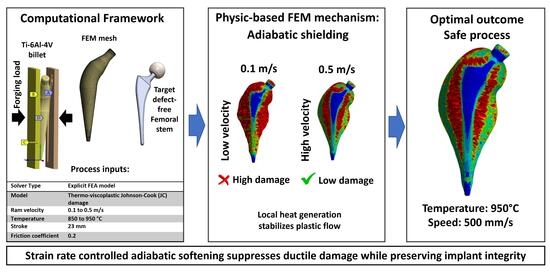
Exploiting Adiabatic Softening for Defect-Free Hot Forging of Ti-6Al-4V Femoral Stems



Abstract
1. Introduction
2. Materials and Methods
2.1. Material Characterization
2.2. Femoral Stem Geometry and Finite Element Modeling Framework
2.3. Parametric Simulation Design and Evaluation Metrics
2.4. Theoretical Justification of the Quasi-Adiabatic Assumption
3. Results and Discussion
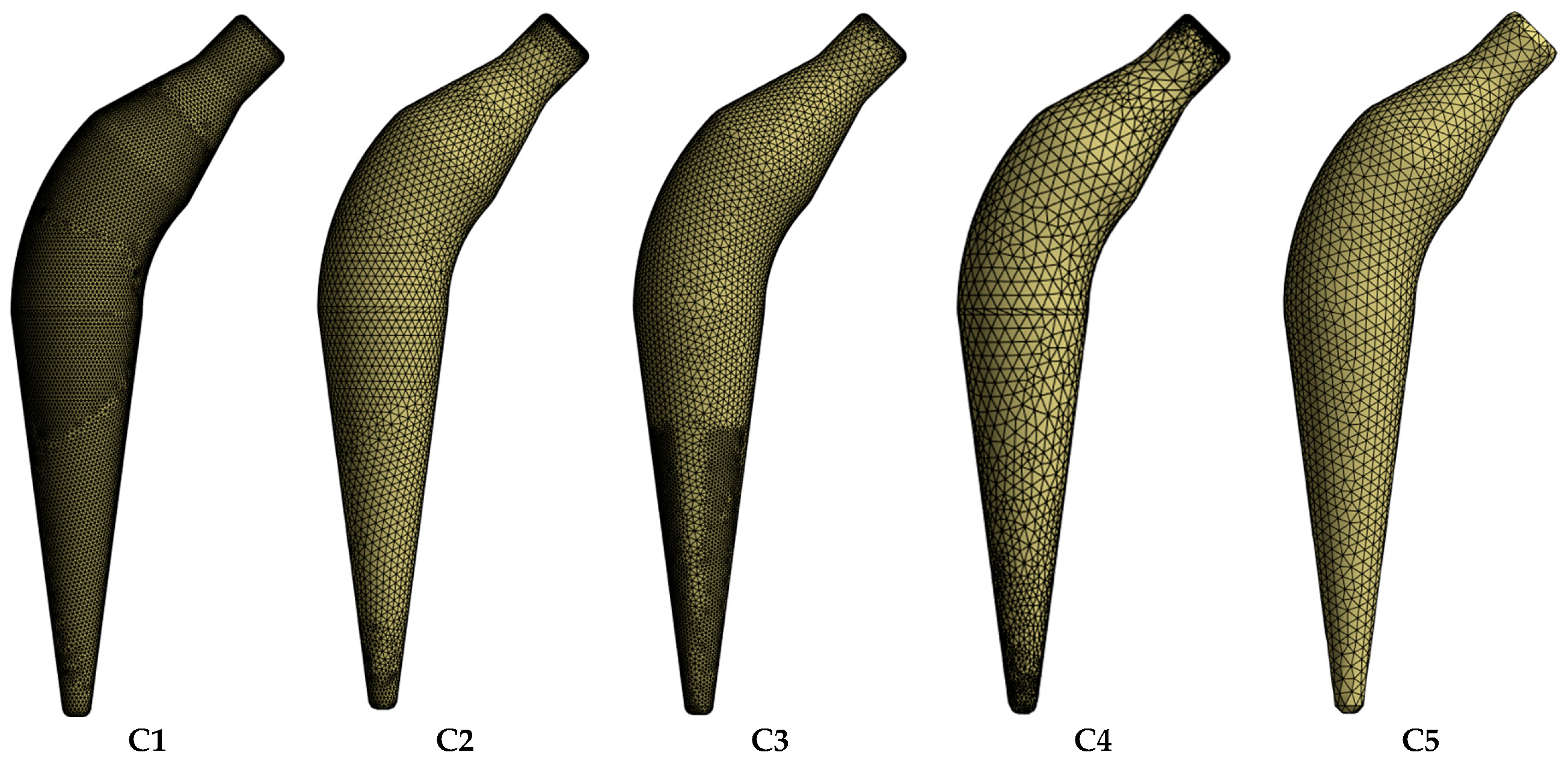
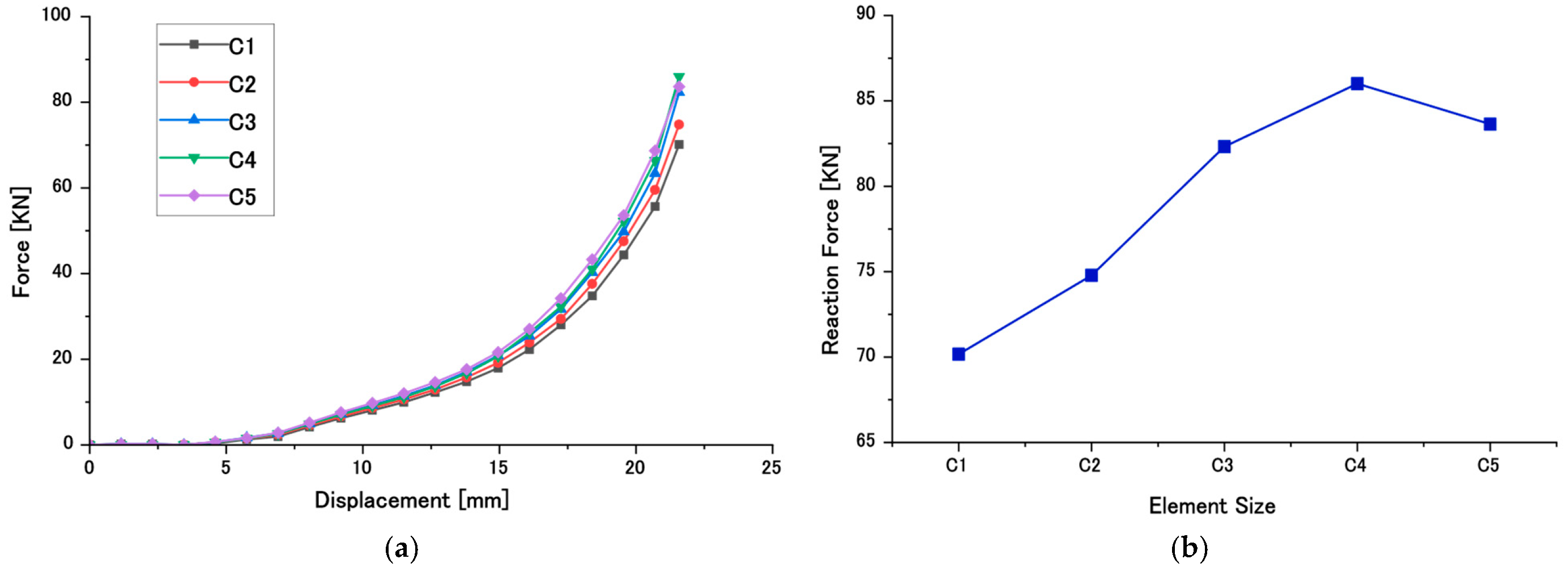
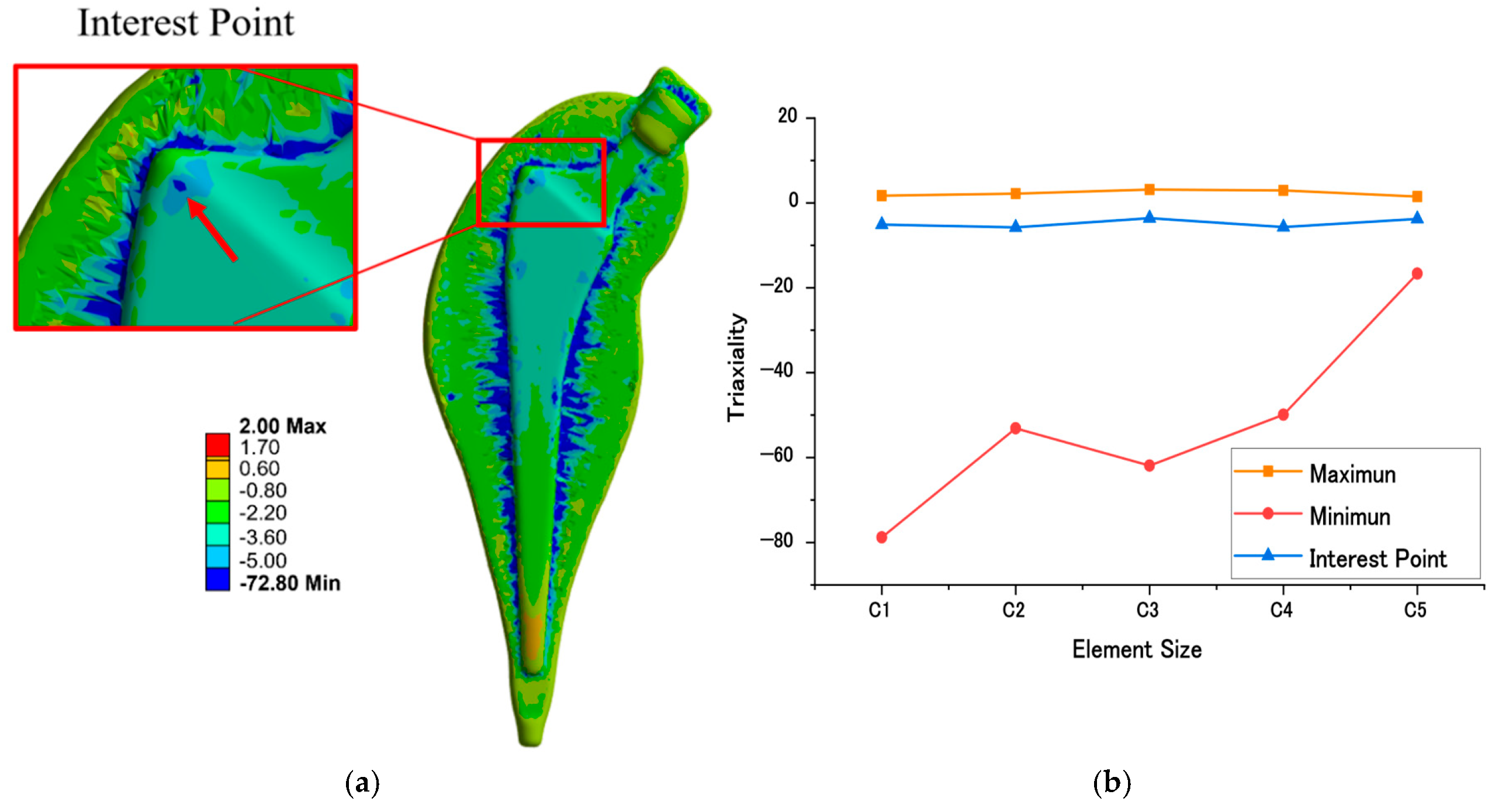
3.1. Mesh Discretization and Convergence Assessment of the Billet
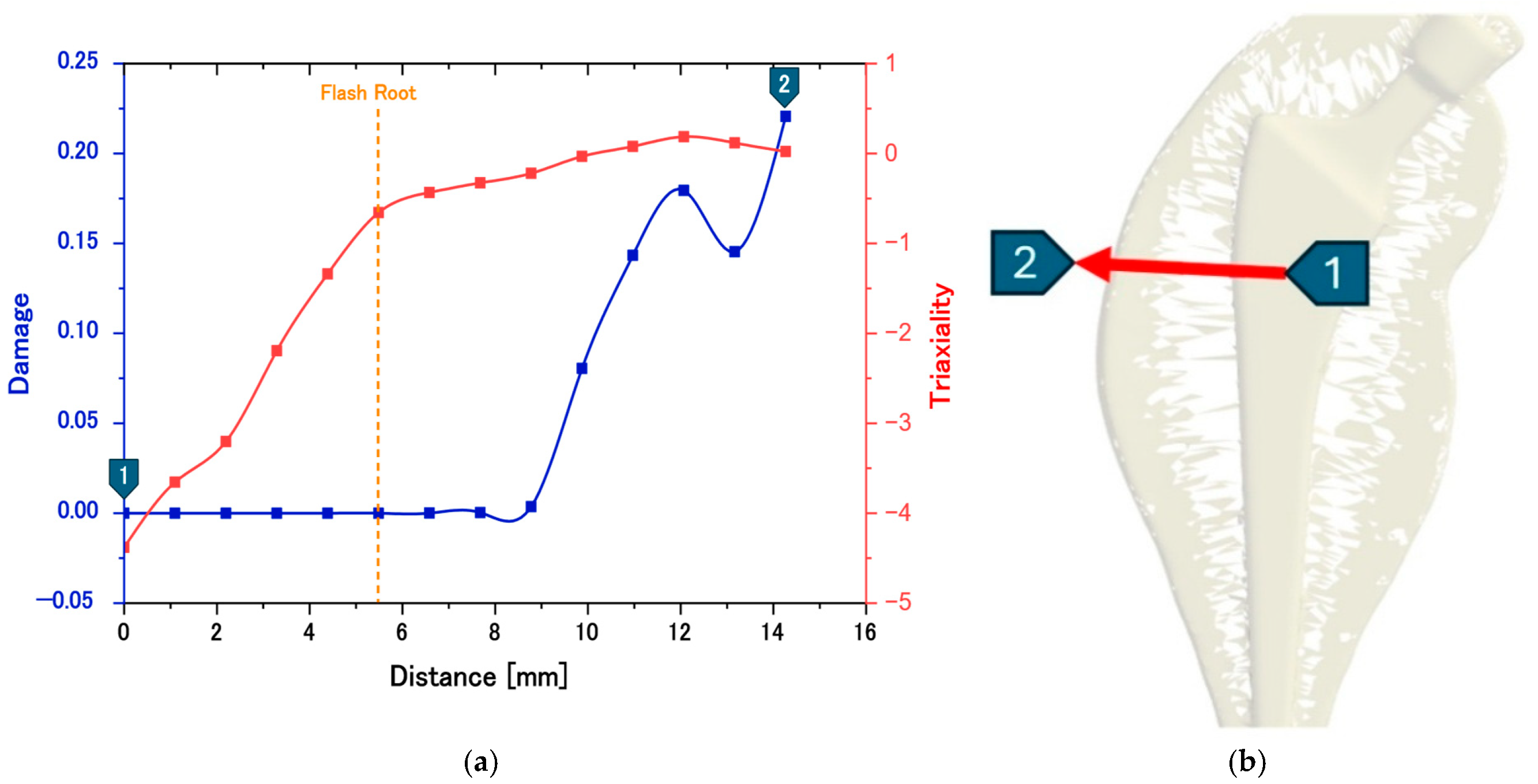
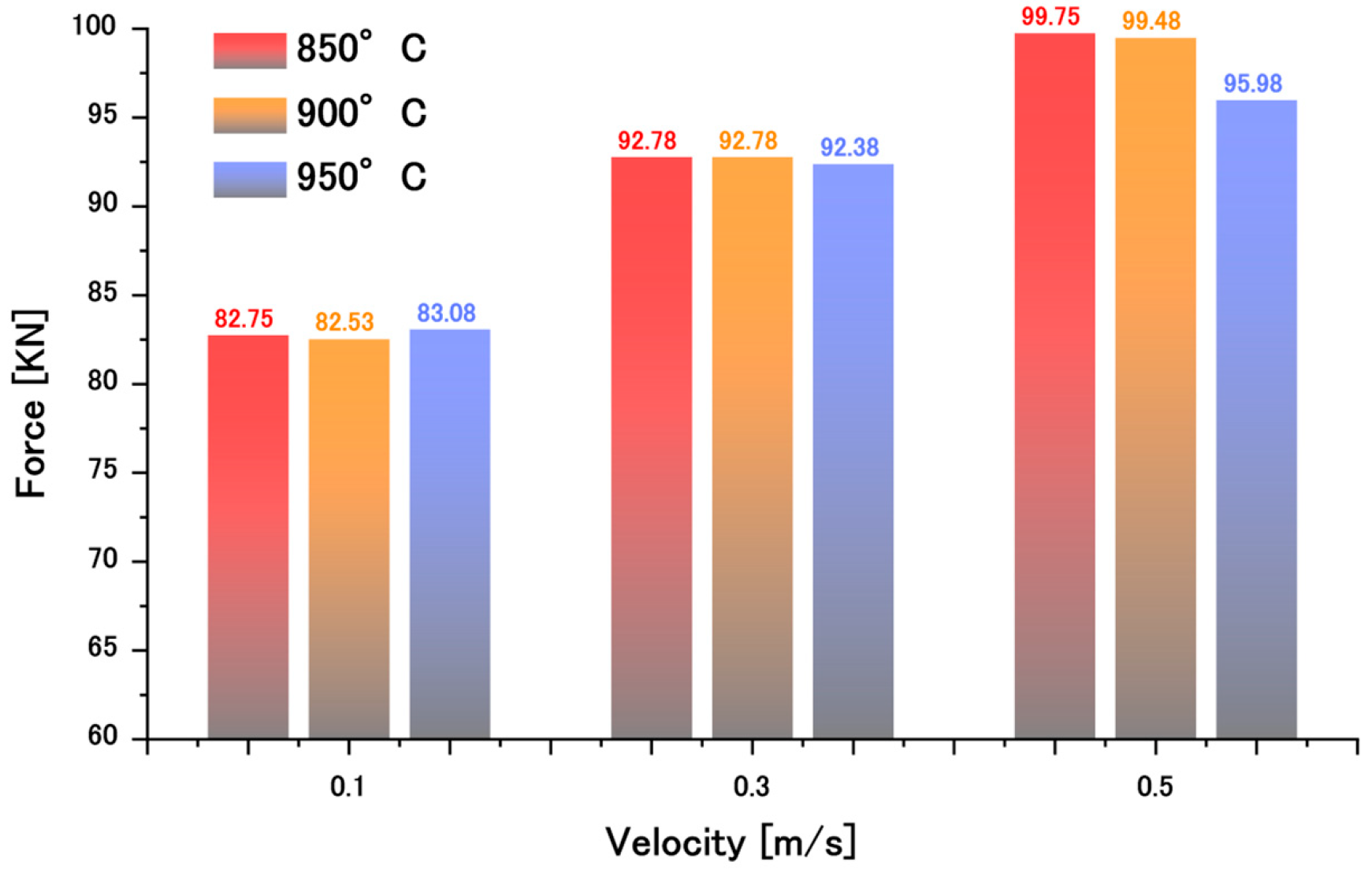
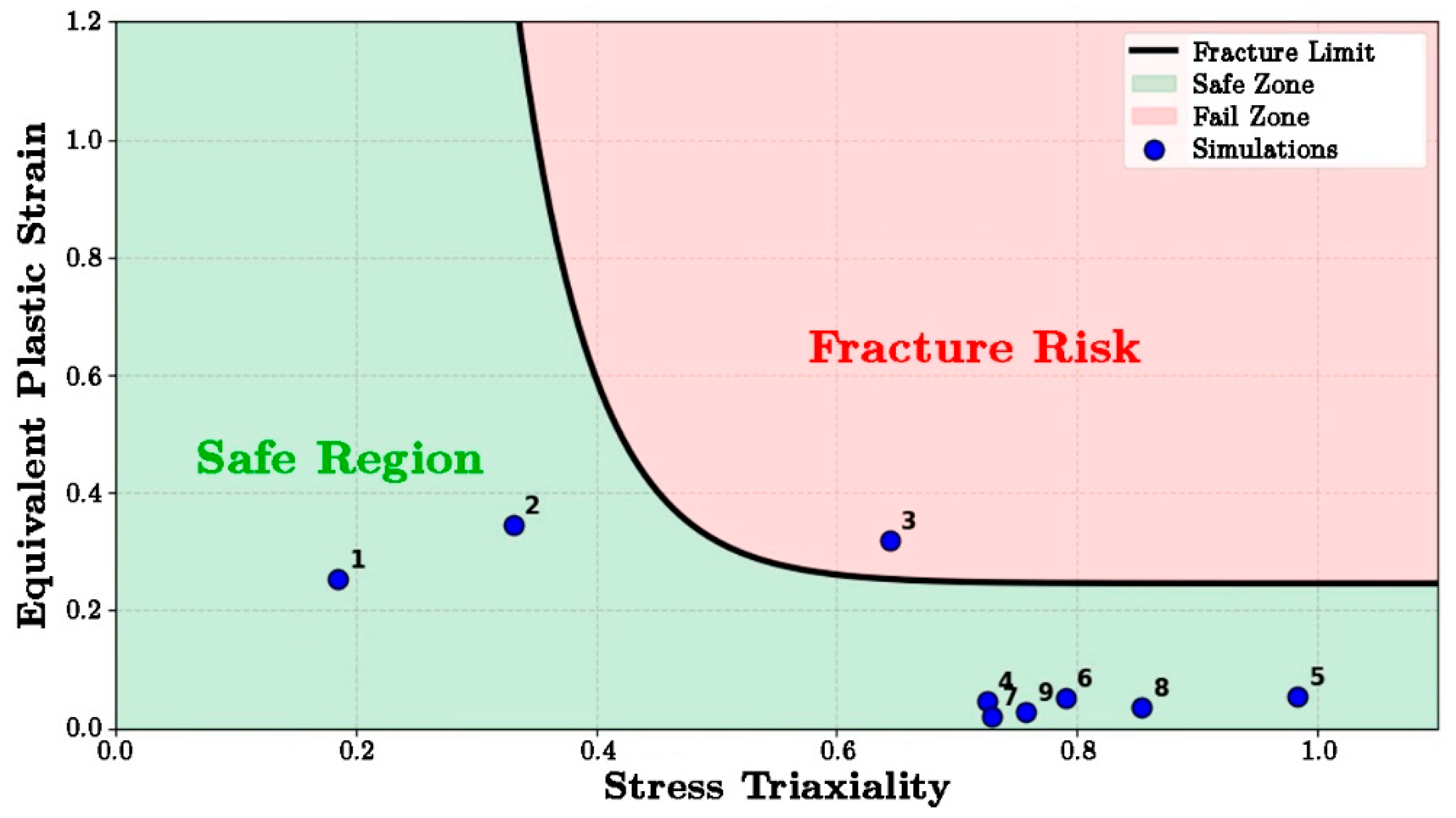
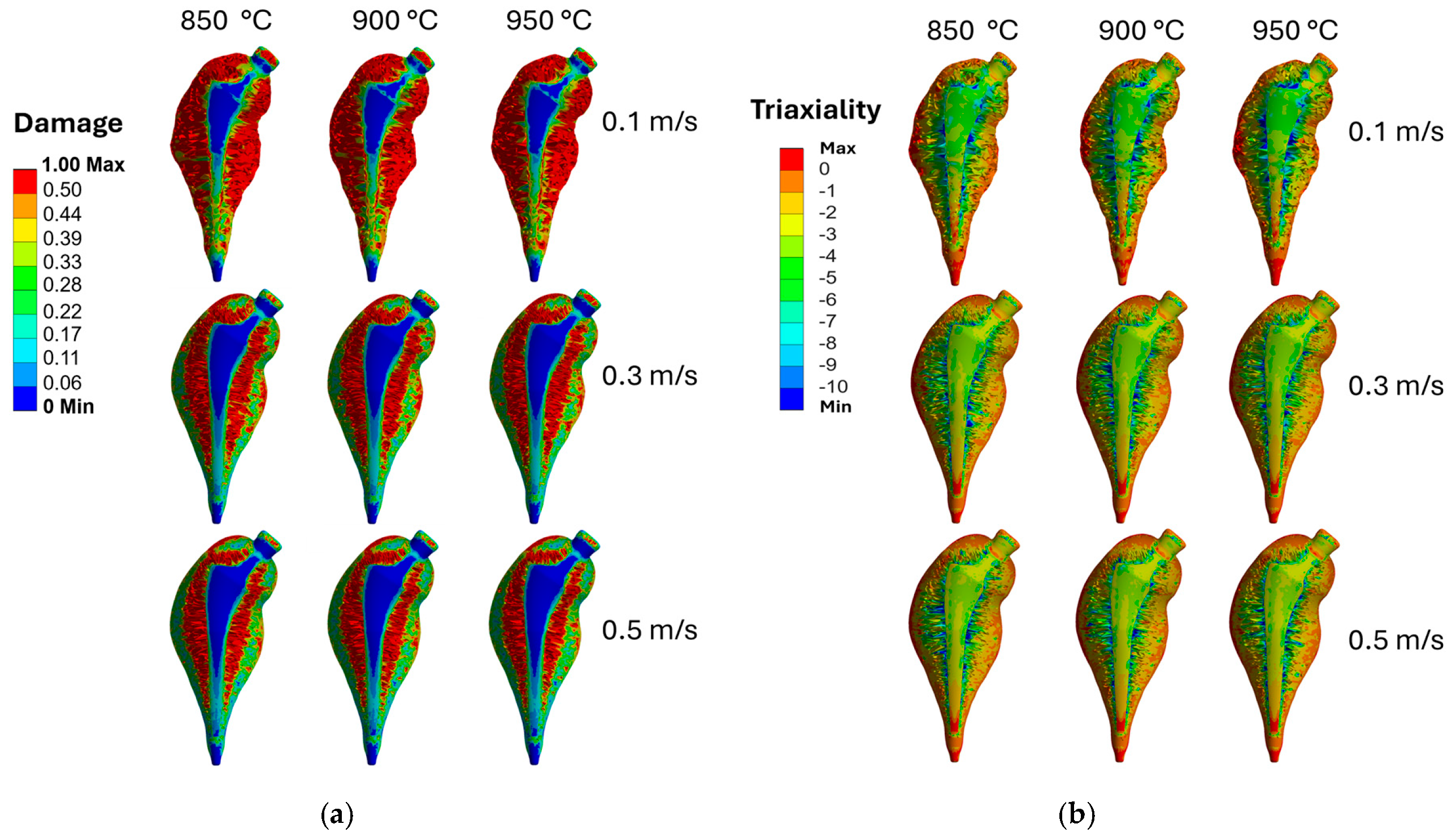
3.2. Effect of Impact Velocity and Billet Temperature on Forging Load and Damage
3.3. Model Limitations, Industrial Implications, and Future Perspectives
4. Conclusions
Author Contributions
Funding
Institutional Review Board Statement
Informed Consent Statement
Data Availability Statement
Conflicts of Interest
References
- Psarommatis, F.; May, G.; Dreyfus, P.-A.; Kiritsis, D. Zero Defect Manufacturing: State-of-the-Art Review, Shortcomings and Future Directions in Research. Int. J. Prod. Res. 2020, 58, 1–17. [Google Scholar] [CrossRef]
- Xu, X.; Lu, Y.; Vogel-Heuser, B.; Wang, L. Industry 4.0 and Industry 5.0—Inception, Conception and Perception. J. Manuf. Syst. 2021, 61, 530–535. [Google Scholar] [CrossRef]
- Lagos, F.; Menacer, B.; Salas, A.; Narayan, S.; Medina, C.; Valle, R.; Garrido, C.; Pincheira, G.; Onate, A.; Hunter-Alarcon, R.; et al. Recent Advances in the Analysis of Functional and Structural Polymer for Wind Turbines. Polymers 2025, 17, 2339. [Google Scholar] [CrossRef] [PubMed]
- Fragkos, P.F.; Theotokoglou, E.E. Computational Analysis of a Wind Turbine Blade for Different Advanced Materials. Materials 2025, 18, 2447. [Google Scholar] [CrossRef] [PubMed]
- Tuninetti, V.; Martínez, D.; Narayan, S.; Menacer, B.; Oñate, A. Design Optimization of a Marine Propeller Shaft for Enhanced Fatigue Life: An Integrated Computational Approach. J. Mar. Sci. Eng. 2024, 12, 2227. [Google Scholar] [CrossRef]
- Marijančević, A.; Braut, S.; Žigulić, R.; Skoblar, A. Fatigue Assessment of Marine Propulsion Shafting due to Cyclic Torsional and Bending Stresses. Machines 2025, 13, 384. [Google Scholar] [CrossRef]
- Cabrera, M.; Coronado, B.; Lizama, B.; Duena, G.; Beecher, C.; Lanziotti, C.; Tuninetti, V.; Onate, A. Lightweight Jet Engine Mount Optimization via Finite Element analysis and Multiscale Characterization. Model. Simul. Mat. Sci. Eng. 2026, 34, 025002. [Google Scholar] [CrossRef]
- Ouma, M.O.; Deng, H.; Xue, C. Research on the Optimization of an Aircraft Engine Mount System for Enhanced Vibration Isolation. Aerospace 2026, 13, 48. [Google Scholar] [CrossRef]
- Venegas, I.; Oñate, A.; Pierart, F.G.; Valenzuela, M.; Narayan, S.; Tuninetti, V. Efficient Mako Shark-Inspired Aerodynamic Design for Concept Car Bodies in Underground Road Tunnel Conditions. Biomimetics 2024, 9, 448. [Google Scholar] [CrossRef]
- Zhang, Z.; Wang, Q.; Zhang, S. Review of Computational Fluid Dynamics Analysis in Biomimetic Applications for Underwater Vehicles. Biomimetics 2024, 9, 79. [Google Scholar] [CrossRef] [PubMed]
- Tuninetti, V.; Castro, J.; Valle, R.; Bustos, F.; Saggionetto, E.; Garrido, C.; Onate, A.; Salas, A.; Lanziotti, C.; Pincheira, G.; et al. Ultrahigh Damping Efficiency in Laser Powder Bed Fusion Kelvin for Hysteretic Applications. Adv. Eng. Mater. 2026, 28, e202502470. [Google Scholar] [CrossRef]
- Tuninetti, V.; Narayan, S.; Rios, I.; Menacer, B.; Valle, R.; Al-lehaibi, M.; Kaisan, M.U.; Samuel, J.; Onate, A.; Pincheira, G.; et al. Biomimetic Lattice Structures Design and Manufacturing for High Stress, Deformation, and Energy Absorption Performance. Biomimetics 2025, 10, 458. [Google Scholar] [CrossRef]
- Ríos, I.; Gómez, Á.; Romero, F.; Salas, A.; Oñate, A.; Lanziotti, C.; Toro, S.A.; Duchêne, L.; Tuninetti, V. Computational Design of High-Performance U-Shaped Seismic Dampers Using Statistical Optimization. Materials 2025, 18, 5403. [Google Scholar] [CrossRef]
- Gomez, A.; Valle, R.; Bustos, F.; Tuninetti, V. A State-of-the-Art Review on Metallic Hysteretic Dampers: Design, Materials, Advanced Modeling, and Future Challenges. Metals 2026, 16, 161. [Google Scholar] [CrossRef]
- Tuninetti, V.; Forcael, D.; Valenzuela, M.; Martínez, A.; Ávila, A.; Medina, C.; Pincheira, G.; Salas, A.; Oñate, A.; Duchêne, L. Assessing Feed-Forward Backpropagation Artificial Neural Networks for Strain-Rate-Sensitive Mechanical Modeling. Materials 2024, 17, 317. [Google Scholar] [CrossRef] [PubMed]
- Tuninetti, V.; Fuentes, G.; Oñate, A.; Narayan, S.; Celentano, D.; García-Herrera, C.; Menacer, B.; Pincheira, G.; Garrido, C.; Valle, R. Computational Shape Design Optimization of Femoral Implants: Towards Efficient Forging Manufacturing. Appl. Sci. 2024, 14, 8289. [Google Scholar] [CrossRef]
- Ceddia, M.; Solarino, G.; Dramisino, P.; De Giosa, G.; Rizzo, S.; Trentadue, B. Comparison of Stress between Three Different Functionally Graded Hip Stem Implants Made of Different Titanium Alloys and Composite Materials. J. Compos. Sci. 2024, 8, 449. [Google Scholar] [CrossRef]
- Kaur, M.; Singh, K. Review on Titanium and Titanium Based Alloys as Biomaterials for Orthopaedic Applications. Mater. Sci. Eng. C 2019, 102, 844–862. [Google Scholar] [CrossRef]
- Cui, Y.-W.; Wang, L.; Zhang, L.-C. Towards Load-Bearing Biomedical Titanium-Based Alloys: From Essential Requirements to Future Developments. Prog. Mater. Sci. 2024, 144, 101277. [Google Scholar] [CrossRef]
- Allwood, J.; Music, O.; Loukaides, E.; Bambach, M. Cut the Scrap: Making More Use of Less Metal. CIRP Ann. 2025, 74, 895–919. [Google Scholar] [CrossRef]
- Feng, W.; Mao, L.; Zhou, M. Effect of Relief-Hole Diameter on Microstructure Evolution of 20CrMnTiH Steel during Hot Upsetting. Procedia Manuf. 2018, 15, 388–395. [Google Scholar] [CrossRef]
- Connolly, D.; Fabris, M.; Sivaswamy, G.; Rahimi, S.; Vorontsov, V. Miniaturised Experimental Simulation and Combined Modelling of Open-Die Forging of Ti-6Al-4V Titanium Alloy. J. Mater. Res. Technol. 2024, 30, 3622–3639. [Google Scholar] [CrossRef]
- Zhang, Z.; Chen, Z.; Xue, Y.; Zhang, X.; Wang, Q. Investigation on Low Hydrostatic Stress Extrusion Technology for Forming of Large Thin-Walled Components with High Ribs. Int. J. Mach. Tools Manuf. 2024, 198, 104149. [Google Scholar] [CrossRef]
- Ishiguro, S.; Aizawa, T.; Funazuka, T.; Shiratori, T. Green Forging of Titanium and Titanium Alloys by Using the Carbon Supersaturated SKD11 Dies. Appl. Mech. 2022, 3, 724–739. [Google Scholar] [CrossRef]
- Aizawa, T.; Kihara, T.; Shiratori, T. Galling-Free Dry Near-Net Forging of Titanium Using Massively Carbon-Supersaturated Tool Steel Dies. Materials 2024, 17, 4849. [Google Scholar] [CrossRef]
- Pimenov, D.Y.; Mia, M.; Gupta, M.K.; Machado, A.R.; Tomaz, Í.V.; Sarikaya, M.; Wojciechowski, S.; Mikolajczyk, T.; Kapłonek, W. Improvement of Machinability of Ti and Its Alloys Using Cooling-Lubrication Techniques: A Review and Future Prospect. J. Mater. Res. Technol. 2021, 11, 719–753. [Google Scholar] [CrossRef]
- Dornfeld, D.A.; Kim, J.S.; Dechow, H.; Hewson, J.; Chen, L.J. Drilling Burr Formation in Titanium Alloy, Ti-6AI-4V. CIRP Ann. 1999, 48, 73–76. [Google Scholar] [CrossRef]
- Kitayama, S. Technical Review on Design Optimization in Forging. Int. J. Adv. Manuf. Technol. 2024, 132, 4161–4189. [Google Scholar] [CrossRef]
- Fernández Silva, B.; Suárez Fernández, D.; Green, I.; Jackson, M. Digital Fingerprints of Microstructural Variation in Titanium Alloy Hip Joint Forgings via Machining Force Feedback Analysis. Mater. Charact. 2022, 192, 112198. [Google Scholar] [CrossRef]
- Liu, M.; Fang, S.; Dong, H.; Xu, C. Review of Digital Twin about Concepts, Technologies, and Industrial Applications. J. Manuf. Syst. 2021, 58, 346–361. [Google Scholar] [CrossRef]
- Wang, B.; Zhou, H.; Li, X.; Yang, G.; Zheng, P.; Song, C.; Yuan, Y.; Wuest, T.; Yang, H.; Wang, L. Human Digital Twin in the Context of Industry 5.0. Robot. Comput. Integr. Manuf. 2024, 85, 102626. [Google Scholar] [CrossRef]
- Salvati, E.; Tognan, A.; Laurenti, L.; Pelegatti, M.; De Bona, F. A Defect-Based Physics-Informed Machine Learning Framework for Fatigue Finite Life Prediction in Additive Manufacturing. Mater. Des. 2022, 222, 111089. [Google Scholar] [CrossRef]
- Zhao, W.; Li, R.; Liu, X.; Yue, C.; Zhao, M. Digital Twin System for Milling Process of Titanium Alloy End Mills: Integration and Performance Enhancement. Int. J. Adv. Manuf. Technol. 2025, 140, 1667–1688. [Google Scholar] [CrossRef]
- Quagliato, L.; Perin, M.; Modanloo, V.; Lee, T. Expert-Informed Neural Network (EINN) for the Forming Depth Prediction from a Small-Scale Sheet Metal Forming Database. In Proceedings of the 28th International ESAFORM Conference on Material Forming, ESAFORM 2025; Association of American Publishers: Paestum, Italy, 2025; Volume 54, pp. 1490–1499. [Google Scholar]
- Zhu, Q.; Liu, Z.; Yan, J. Machine Learning for Metal Additive Manufacturing: Predicting Temperature and Melt Pool Fluid Dynamics Using Physics-Informed Neural Networks. Comput. Mech. 2021, 67, 619–635. [Google Scholar] [CrossRef]
- Miller Branco Ferraz, F.; Buzolin, R.H.; Maßwohl, M.; Shahryari, E.; Krumphals, A.; Poletti, M.C. A Comprehensive Mean-Field Approach to Simulate the Microstructure during the Hot Forming of Ti-17. Mater. Sci. Eng. A 2024, 903, 146645. [Google Scholar] [CrossRef]
- Gao, S.; Sang, Y.; Li, Q.; Sun, Y.; Wu, Y.; Wang, H. Constitutive Modeling and Microstructure Research on the Deformation Mechanism of Ti-6Al-4V Alloy under Hot Forming Condition. J. Alloys Compd. 2022, 892, 162128. [Google Scholar] [CrossRef]
- Kopec, M.; Wang, K.; Politis, D.J.; Wang, Y.; Wang, L.; Lin, J. Formability and Microstructure Evolution Mechanisms of Ti6Al4V Alloy during a Novel Hot Stamping Process. Mater. Sci. Eng. A 2018, 719, 72–81. [Google Scholar] [CrossRef]
- Liu, X.; Kopec, M.; El Fakir, O.; Qu, H.; Wang, Y.; Wang, L.; Li, Z. Characterisation of the Interfacial Heat Transfer Coefficient in Hot Stamping of Titanium Alloys. Int. Commun. Heat Mass Transf. 2020, 113, 104535. [Google Scholar] [CrossRef]
- Teng, X.; Wierzbicki, T. Evaluation of Six Fracture Models in High Velocity Perforation. Eng. Fract. Mech. 2006, 73, 1653–1678. [Google Scholar] [CrossRef]
- Martin, P.; Prillieux, A.; Balcaen, Y.; Hacquin, A.; Saby, M.; Dod, B.; Alexis, J.; Perusin, S. Rheology of Ti-6Al-4V Alloy under Non Equilibrium Conditions during β Forging. J. Mater. Process. Technol. 2024, 327, 118346. [Google Scholar] [CrossRef]
- Kuzman, K. Comments on the Cold Metal Forming Processes Stability Control. J. Mater. Process. Technol. 2007, 185, 132–138. [Google Scholar] [CrossRef]
- Bai, Q.; Lin, J.; Dean, T.A.; Balint, D.S.; Gao, T.; Zhang, Z. Modelling of Dominant Softening Mechanisms for Ti-6Al-4V in Steady State Hot Forming Conditions. Mater. Sci. Eng. A 2013, 559, 352–358. [Google Scholar] [CrossRef]
- Velay, V.; Matsumoto, H.; Vidal, V.; Chiba, A. Behavior Modeling and Microstructural Evolutions of Ti–6Al–4V Alloy under Hot Forming Conditions. Int. J. Mech. Sci. 2016, 108–109, 1–13. [Google Scholar] [CrossRef]
- Alimov, A.; Evdokimov, D.; Evsyukov, S. Temperature and Strain Rate Dependent Friction Model for Hot Forming of Ti-6Al-4V Titanium Alloy. Mater. Today Proc. 2019, 19, 1994–1997. [Google Scholar] [CrossRef]
- Čolić, K.; Kostić, S.M.; Sedmak, S.; Gubeljak, N.; Grbović, A. Structural Integrity and Life Assessment of Ti-6Al-4V Orthopaedic Implants. Metals 2025, 15, 333. [Google Scholar] [CrossRef]
- Ouyang, W.; Zhang, L.; Wu, H.; Wu, D.; Zhang, S.; Qin, X.; Jiang, S.; Li, S.; Zhang, W.; Sheng, L. Optimized Mechanical Properties of the Hot Forged Ti–6Al–4V Alloy by Regulating Multiscale Microstructure via Laser Shock Peening. Int. J. Mach. Tools Manuf. 2024, 201, 104192. [Google Scholar] [CrossRef]
- Qiu, S.; Wang, W.; Chen, S.; Zhang, R.; Chen, C.; Zhang, W.; Yang, F.; Guo, Z. Microstructural Evolution and Spheroidization Mechanism of Powder Metallurgy Ti-6Al-4 V Alloys after High-Temperature Forging. J. Alloys Compd. 2024, 994, 174771. [Google Scholar] [CrossRef]
- Li, Z.; Gou, J.; Gao, J.; Zhu, J.; Kou, W.; Wang, J. Microstructural Evolution and Corrosion Resistance of Additively Manufactured Ti–6Al–4V Alloy Annular Shaped Components Using Multistage Heat Treatment. Mater. Chem. Phys. 2025, 346, 131414. [Google Scholar] [CrossRef]
- Du, S.; Song, Y.; He, Y.; Wei, C.; Chen, R.; Guo, S.; Liang, W.; Lei, S.; Liu, X. Evolution of Microstructure and Mechanical Properties of Ti-6Al-4V Alloy under Heat Treatment and Multi-Axial Forging. Materials 2024, 17, 1060. [Google Scholar] [CrossRef] [PubMed]
- Yapan, Y.F.; Korkmaz, H.G.; Toros, S.; Türköz, M. Experimental and Numerical Investigation of the Damage State of Ti-6Al-4V Alloy Sheet in the Tensile Test, Hydraulic Bulging, and Hydroforming Processes. Int. J. Adv. Manuf. Technol. 2024, 132, 4585–4605. [Google Scholar] [CrossRef]
- Tuninetti, V.; Sepúlveda, H.; Beecher, C.; Rojas-Ulloa, C.; Oñate, A.; Medina, C.; Valenzuela, M. A Combined Experimental and Numerical Calibration Approach for Modeling the Performance of Aerospace-Grade Titanium Alloy Products. Aerospace 2024, 11, 285. [Google Scholar] [CrossRef]
- Beecher, C.; Sepúlveda, H.; Oñate, A.; Habraken, A.M.; Duchêne, L.; Pincheira, G.; Tuninetti, V. Sensitivity Analysis of the Johnson-Cook Model for Ti-6Al-4V in Aeroengine Applications. Aerospace 2025, 12, 3. [Google Scholar] [CrossRef]
- Kuliiev, R.; Keller, S.; Kashaev, N. Identification of Johnson-Cook Material Model Parameters for Laser Shock Peening Process Simulation for AA2024, Ti–6Al–4V and Inconel 718. J. Mater. Res. Technol. 2024, 28, 1975–1989. [Google Scholar] [CrossRef]
- Yuan, M.; Zhao, X.; Yue, Q.; Gu, Y.; Zhang, Z. The Effect of Microstructure on the Very High Cycle Fatigue Behavior of Ti-6Al-4V Alloy. Metals 2024, 14, 254. [Google Scholar] [CrossRef]
- Semiatin, S.L.; Bieler, T.R. The Effect of Alpha Platelet Thickness on Plastic Flow during Hot Working of TI–6Al–4V with a Transformed Microstructure. Acta Mater. 2001, 49, 3565–3573. [Google Scholar] [CrossRef]
- Yuan, Z.; Wei, J.; Li, S.; Cao, S.; Jia, Y.; Qiu, G.; Wang, B.; Han, J.; Wang, T. Research on Process Regulation and Deformation Mechanism of Mg/Al Composite Plates during Hot Bending Forming. J. Mater. Res. Technol. 2026, 42, 1106–1124. [Google Scholar] [CrossRef]
- Hu, D.; Wang, L.; Wang, N.; Chen, M.; Wang, H. Hot Tensile Deformation Behaviors of TA32 Titanium Alloy Based on Back-Propagation Neural Networks and Three-Dimensional Thermal Processing Maps. J. Mater. Res. Technol. 2022, 18, 4786–4795. [Google Scholar] [CrossRef]
- Lin, C.-N.; Tzeng, Y.-C.; Lee, S.-L.; Fuh, Y.-K.; Łukaszek-Sołek, A.; Lin, C.-Y.; Chen, M.-C.; Pan, T.-A. Optimization of Hot Deformation Processing Parameters for As-Extruded 7005 Alloys through the Integration of 3D Processing Maps and FEM Numerical Simulation. J. Alloys Compd. 2023, 948, 169804. [Google Scholar] [CrossRef]
- Guo, R.; Wang, N.; Cheng, M. Hot Deformation Behavior of a Hot-Isostatically Pressed Ti-6Al-4V Alloy from Recycled Powder. Materials 2024, 17, 990. [Google Scholar] [CrossRef] [PubMed]
- Quan, G.; Wang, Y.; Yu, C.; Zhou, J. Hot Workability Characteristics of As-Cast Titanium Alloy Ti–6Al–2Zr–1Mo–1V: A Study Using Processing Map. Mater. Sci. Eng. A 2013, 564, 46–56. [Google Scholar] [CrossRef]
- Kim, Y.; Jeong, H.Y.; Park, J.; Kim, K.; Kwon, H.; Ju, G.; Kim, N. Optimizing Process Parameters for Hot Forging of Ti-6242 Alloy: A Machine Learning and FEM Simulation Approach. J. Mater. Res. Technol. 2023, 27, 8228–8243. [Google Scholar] [CrossRef]
- Öztürk, O.; Aydın, M.; Gökcepınar, Ö.F.; İlbeyli, H.M.; Korkmaz, H.G.; Yapan, Y.F.; Dilmeç, M.; Selçuk Halkacı, H.; Kotan, H.; Livatyalı, H.; et al. Enhancing Formability of Ti-6Al-4V Cylindrical Cups by Pulsating Hydroforming Process: Experimental, Numerical and Microstructural Investigations. Eng. Sci. Technol. Int. J. 2024, 50, 101606. [Google Scholar] [CrossRef]
- Liu, J.; Li, J.; Cui, Z.; Ou, H.; Ruan, L. Material Driven Workability Simulation by FEM Including 3D Processing Maps for Magnesium Alloy. Trans. Nonferrous Met. Soc. China 2013, 23, 3011–3019. [Google Scholar] [CrossRef]
- Pantalé, O.; Rangasamy Mahendren, S.R.; Dalverny, O. Comparative Analysis of Finite Element Formulations for Simulating Hot Forming of Ti-6Al-4V Aerospace Components. Eng 2024, 5, 47. [Google Scholar] [CrossRef]
- Fang, X.; Liu, H.; Liu, J.; Li, H.; Yang, F. Dynamic Design and Application on Ti-6Al-4V of Novel Hybrid Forging System. J. Mech. Sci. Technol. 2025, 39, 201–212. [Google Scholar] [CrossRef]
- Deng, W.; Wang, Z.; He, G.; Zhang, H.; Yu, M.; Jia, D. Multi-Objective Optimisation of Forging Process Parameters of Ti-6Al-4V Alloy Connecting Rod Based on Orthogonal Experiment. Mater. Today Commun. 2025, 42, 111296. [Google Scholar] [CrossRef]
- Abubakr, M.; Abbas, A.T.; Tomaz, I.; Soliman, M.S.; Luqman, M.; Hegab, H. Sustainable and Smart Manufacturing: An Integrated Approach. Sustainability 2020, 12, 2280. [Google Scholar] [CrossRef]
- Pal, S.; Velay, X.; Saleem, W. Finite Element Investigation of Cutting Speed Effects on the Machining of Ti6Al4V Alloy. Discov. Mech. Eng. 2024, 3, 1. [Google Scholar] [CrossRef]
- Fan, Y.; Zhang, H.; Yuan, W. Prediction of Ductile Cracking in the Titanium Alloy Forging Process. Mater. Res. Express 2024, 11, 036517. [Google Scholar] [CrossRef]
- Feng, R.; Chen, M.; Xie, L. Constitutive Relationship and Fracture Mechanism for Wide Stress Triaxiality of Titanium Alloy. Eng. Fract. Mech. 2024, 295, 109804. [Google Scholar] [CrossRef]
- Mashayekhi, M.; Ziaei-Rad, S.; Parvizian, J.; Hadavinia, H. Evaluation of Fracture in a Three Stage Forging Process Using Continuum Damage Mechanics. AIP Conf. Proc. 2007, 908, 1413–1418. [Google Scholar] [CrossRef]
- Zhang, H.-J.; Lin, Y.C.; Wu, G.-C.; Long, J.-C.; He, D.-G. Modeling Deformation Behavior of Ti-6Al-4V Alloy by Considering Microstructure Evolution and Damage Mechanisms in A+β Region. J. Alloys Compd. 2025, 1045, 184732. [Google Scholar] [CrossRef]
- Feng, R.; Chen, M.; Xie, L. Unified Thermomechanical Model of Ti-6Al-4V Titanium Alloy Considering Microstructure Evolution and Damage Fracture under Different Stress States. Int. J. Mater. Form. 2024, 17, 1. [Google Scholar] [CrossRef]
- Chen, X.; Yang, Z.; Zhang, B.; Sun, J.; Su, Z.; Mao, Y. An Inverse Optimization Method for the Parameter Determination of the High-Temperature Damage Model and High-Temperature Damage Graph of Ti6Al4V Alloy. Materials 2023, 16, 4770. [Google Scholar] [CrossRef]
- Akbari, M.; Buhl, S.; Leinenbach, C.; Wegener, K. A New Value for Johnson Cook Damage Limit Criterion in Machining with Large Negative Rake Angle as Basis for Understanding of Grinding. J. Mater. Process. Technol. 2016, 234, 58–71. [Google Scholar] [CrossRef]
- Swarnakar, A.K.; van der Biest, O.; Baufeld, B. Young’s Modulus and Damping in Dependence on Temperature of Ti–6Al–4V Components Fabricated by Shaped Metal Deposition. J. Mater. Sci. 2011, 46, 3802–3811. [Google Scholar] [CrossRef]
- Kuang, K.; Yang, H.; Li, C.; Lu, Y.; Ma, K.; Zhang, H.; Wei, Y. Optimization of the Johnson–Cook Constitutive Model for HRB400 Steel under High Strain Rate and High Temperature Conditions with Multi-Condition Validation. Structures 2025, 80, 110102. [Google Scholar] [CrossRef]
- Li, S.; Hao, P.; Xu, S.; Yang, L.; Fan, Q. Optimization of Johnson-Cook Constitutive Parameters of Titanium Alloy Based on a Machine Learning-Accelerated Genetic Algorithm. Mater. Today Commun. 2025, 49, 114061. [Google Scholar] [CrossRef]
- Shen, X.; Zhang, D.; Yao, C.; Tan, L.; Li, X. Research on Parameter Identification of Johnson–Cook Constitutive Model for TC17 Titanium Alloy Cutting Simulation. Mater. Today Commun. 2022, 31, 103772. [Google Scholar] [CrossRef]
- Oshkour, A.A.; Osman, N.A.A.; Bayat, M.; Afshar, R.; Berto, F. Three-Dimensional Finite Element Analyses of Functionally Graded Femoral Prostheses with Different Geometrical Configurations. Mater. Des. (1980–2015) 2014, 56, 998–1008. [Google Scholar] [CrossRef]
- Kumar, P.; Jain, N.K. Finite Element Analysis of Femoral Prosthesis Using Ti-6Al-4V Alloy and TiNbZrTaFe High Entropy Alloy. Mater. Today Proc. 2021, 44, 1195–1201. [Google Scholar] [CrossRef]
- Warinsiriruk, E.; Thongchuea, N.; Pengrung, N.; Jarungvittayakon, C.; Sa-Ngasoongsong, P.; Chulsomlee, K. Investigation of Mechanical Behavior on the Cement Hip Spacer Geometry under Finite Element Method and Compression Load Test. J. Orthop. 2024, 47, 115–121. [Google Scholar] [CrossRef]
- Galdos, L.; Saenz De Argandoña, E.; Mendiguren, J.; Sethy, R.; Agirre, J. Characterization of Ti64 Forging Friction Factor Using Ceramic Coatings and Different Contact Conditions. Procedia Eng. 2017, 207, 2239–2244. [Google Scholar] [CrossRef]
- Pollard, J.D.; Watford, A.; Jackson, M.; Wynne, B.P. The Modelling of Ring Tests at Elevated Temperatures for the Determination of Friction in Ti-6Al-4V Forgings. Comput. Methods Mater. Sci. 2015, 15, 150–155. [Google Scholar] [CrossRef]
- Rojas-Ulloa, C.; Tuninetti, V.; Sepúlveda, H.; Betaieb, E.; Pincheira, G.; Gilles, G.; Duchêne, L.; Habraken, A.M. Accurate Numerical Prediction of Ductile Fracture and Micromechanical Damage Evolution for Ti6Al4V Alloy. Comput. Mech. 2024, 73, 177–198. [Google Scholar] [CrossRef]
- Tuninetti, V.; Beecher, C.; Arcieri, E.V.; Oñate, A.; García-Herrera, C.; Baragetti, S. Fracture Behavior of Ti-6Al-4V in the Extreme Thermo-Mechanical Environment of Fan Blade-Out. Sci. Rep. 2026, 16, 4962. [Google Scholar] [CrossRef]
- Brünig, M.; Gerke, S.; Schmidt, M. Damage and Failure at Negative Stress Triaxialities: Experiments, Modeling and Numerical Simulations. Int. J. Plast. 2018, 102, 70–82. [Google Scholar] [CrossRef]
- Xiao, Z.; Xie, Q.; Zhang, B.; Ren, B.; Tian, S. Preparation and Properties of a Composite Glass Protective Lubricating Coating for the Forging of Ti-6Al-4V Alloy. Coatings 2025, 15, 792. [Google Scholar] [CrossRef]
- Zhan, H.; Kent, D.; Wang, G.; Dargusch, M.S. The Dynamic Response of a β Titanium Alloy to High Strain Rates and Elevated Temperatures. Mater. Sci. Eng. A 2014, 607, 417–426. [Google Scholar] [CrossRef]
- Kulakov, M.; Silva, L.D.; Andreu, A. Effect of Adiabatic Heating on Microstructure Evolution in Ti-6Al-4V during High Strain Rate Forging. MATEC Web Conf. 2020, 321, 12003. [Google Scholar] [CrossRef]
- Allegheny Technologies Incorporated (ATI) Technical Data Sheet: ATI Ti-6Al-4V, Grade 5 (ATI 6-4). 2012. Available online: https://www.atimaterials.com/Products/Documents/datasheets/titanium/alloyed/ati_6-4_tds_en_v1.pdf (accessed on 1 June 2026).
- Lütjering, G.; Williams, J.C. (Eds.) Titanium, 2nd ed.; Engineering Materials and Processes; Springer: Berlin/Heidelberg, Germany, 2007; ISBN 978-3-540-73036-1. [Google Scholar]
- Gil, F.J.; Planell, J.A. Growth Order and Activation Energies for Grain Growth of Ti6Al4V Alloy in ß Phase. Scr. Metall. Et. Mater. 1991, 25, 2843–2848. [Google Scholar] [CrossRef]




| Strain Rate, ε (s−1) | Young Modulus, E (GPa) | Initial Yield Stress, σ0.2% (MPa) | True Fracture Strain, εf | True Fracture Stress, (MPa) |
|---|---|---|---|---|
| 0.001 | 111 ± 1 | 927 ± 3 | 0.41 ± 0.01 | 1241 ± 8 |
| Temperature (°C) | Young Modulus (GPa) |
|---|---|
| 20 | 118 |
| 100 | 113 |
| 800 | 77 |
| 1000 | 60 |
| Model Constant | Values |
|---|---|
| A (MPa) | 927 |
| B (MPa) | 877.96 |
| C (-) | 0.0137 |
| m (-) | 0.594 |
| n (-) | 0.795 |
| Parameters | Values |
|---|---|
| d1 | 0.246 |
| d2 | 186.0 |
| d3 | −15.7 |
| d4 | 0.2582 |
| d5 | 1.2059 |
| ID | Min and Max Element Size (mm) | Nodes | Elements | Average Element Quality (%) |
|---|---|---|---|---|
| C1 | 0.85–1.23 | 106,497 | 592,658 | 84 |
| C2 | 1.49–2.22 | 17,551 | 90,676 | 82 |
| C3 | 1.63–2.58 | 7350 | 35,396 | 75 |
| C4 | 1.69–3.06 | 9751 | 34,743 | 67 |
| C5 | 2.86–4.86 | 2869 | 10,449 | 72 |
| ID | Avg. Element Size (mm) | Equivalent Plastic Strain [mm/mm] | Stress Triaxiality Factor | Reaction Load (kN) |
|---|---|---|---|---|
| C1 | 1.04 | 0.85709 | −5.11 | 70.17 |
| C2 | 1.86 | 0.72832 | −5.76 | 74.78 |
| C3 | 2.11 | 0.75400 | −3.59 | 82.32 |
| C4 | 2.38 | 1.06570 | −5.67 | 86.01 |
| C5 | 3.86 | 0.78764 | −3.75 | 83.64 |
| Run | Velocity (m/s) | Temperature (°C) | Max Reaction Force (kN) | Max Damage (D) |
|---|---|---|---|---|
| 1 | 0.1 | 850 | 82.75 | 0.45 |
| 2 | 0.1 | 900 | 82.53 | 0.42 |
| 3 | 0.1 | 950 | 83.08 | 0.43 |
| 4 | 0.3 | 850 | 92.78 | 0.33 |
| 5 | 0.3 | 900 | 92.78 | 0.35 |
| 6 | 0.3 | 950 | 92.38 | 0.33 |
| 7 | 0.5 | 850 | 99.75 | 0.33 |
| 8 | 0.5 | 900 | 99.48 | 0.24 |
| 9 | 0.5 | 950 | 95.98 | 0.25 |
Disclaimer/Publisher’s Note: The statements, opinions and data contained in all publications are solely those of the individual author(s) and contributor(s) and not of MDPI and/or the editor(s). MDPI and/or the editor(s) disclaim responsibility for any injury to people or property resulting from any ideas, methods, instructions or products referred to in the content. |
© 2026 by the authors. Licensee MDPI, Basel, Switzerland. This article is an open access article distributed under the terms and conditions of the Creative Commons Attribution (CC BY) license.
Share and Cite
Tuninetti, V.; Castro, J.; Valle, R.; Garrido, C.; Oñate, A. Exploiting Adiabatic Softening for Defect-Free Hot Forging of Ti-6Al-4V Femoral Stems. J. Funct. Biomater. 2026, 17, 292. https://doi.org/10.3390/jfb17060292
Tuninetti V, Castro J, Valle R, Garrido C, Oñate A. Exploiting Adiabatic Softening for Defect-Free Hot Forging of Ti-6Al-4V Femoral Stems. Journal of Functional Biomaterials. 2026; 17(6):292. https://doi.org/10.3390/jfb17060292
Chicago/Turabian StyleTuninetti, Víctor, Josué Castro, Rodrigo Valle, César Garrido, and Angelo Oñate. 2026. "Exploiting Adiabatic Softening for Defect-Free Hot Forging of Ti-6Al-4V Femoral Stems" Journal of Functional Biomaterials 17, no. 6: 292. https://doi.org/10.3390/jfb17060292
APA StyleTuninetti, V., Castro, J., Valle, R., Garrido, C., & Oñate, A. (2026). Exploiting Adiabatic Softening for Defect-Free Hot Forging of Ti-6Al-4V Femoral Stems. Journal of Functional Biomaterials, 17(6), 292. https://doi.org/10.3390/jfb17060292