1. Introduction
Achieving consistent and durable osseointegration at the bone–prosthesis interface remains a major challenge in endoprosthetic reconstruction [
1,
2]. Successful osseointegration is essential to reduce aseptic loosening rates by ensuring the effective transmission of mechanical stresses across the bone–implant interface [
3,
4]. While hydroxyapatite (HA)-coated collars have traditionally been used to promote integration, clinical outcomes have been variable, with relatively low and unpredictable osseointegration rates [
5,
6,
7].
The hydroxyapatite (HA) coating mimics natural bone minerals, promoting direct bone bonding by releasing calcium and phosphate ions that form a biological apatite layer on the implant surface. This bioactive surface enhances protein adsorption and osteoblast adhesion, leading to faster osseointegration without an intervening fibrous tissue layer. Recent advancements in additive manufacturing have opened new possibilities for implant design [
8,
9]. In particular, 3D printing technologies now allow for the fabrication of implants with highly controlled porous architectures that closely replicate the morphology of cancellous bone [
10]. One such innovation is the EPORE
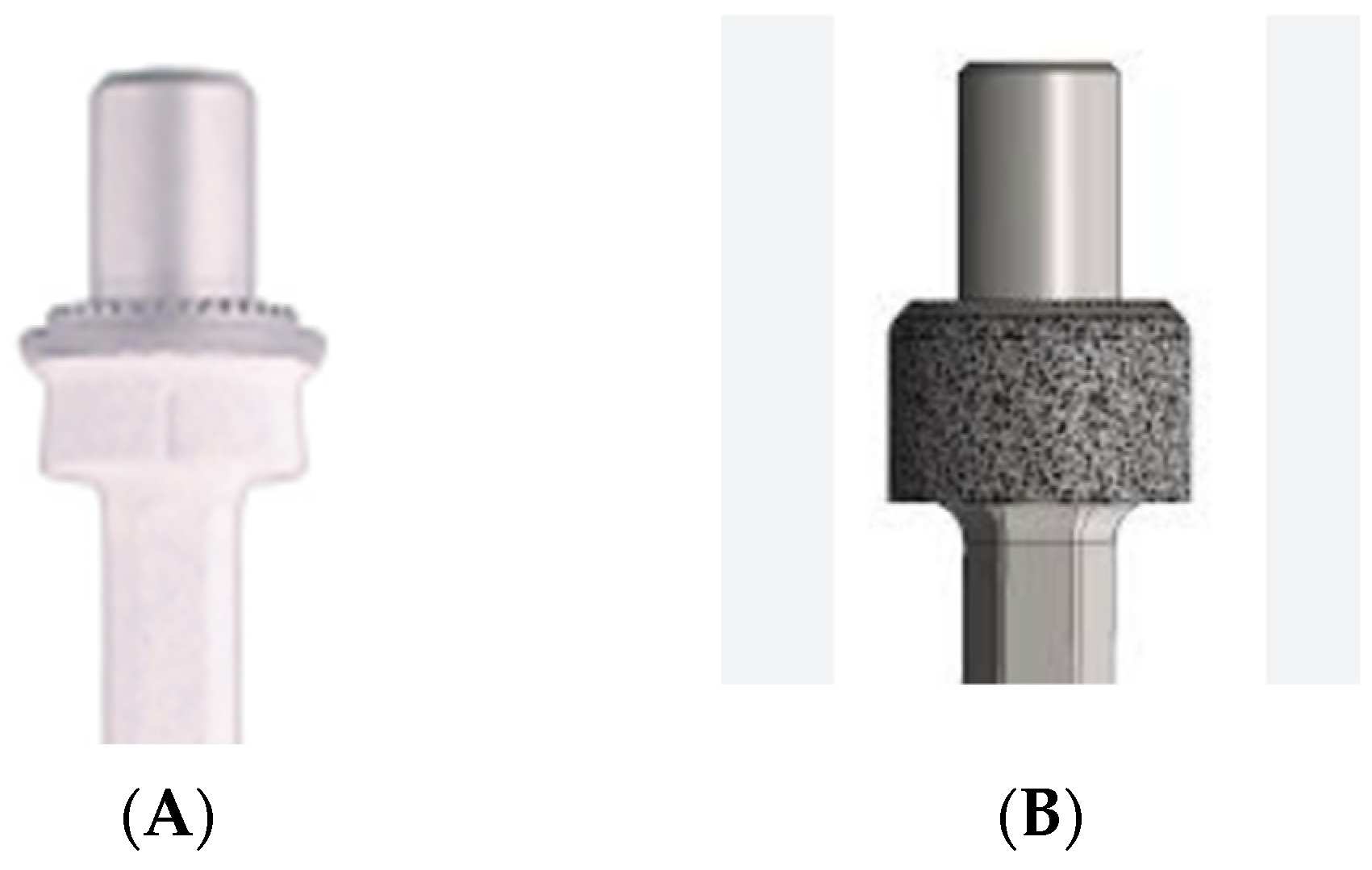
® collar system, which incorporates a titanium scaffold with 100–500 μm interconnected pores, a calcium–phosphate coating and a trabecular-like structure formed by 350 μm titanium rods. These collars are demonstrated later in
Figure 1.
This design is supported by a growing body of evidence suggesting that such microarchitectures enhance biological fixation [
11]. Studies of similar porous implants in revision arthroplasty have reported osseointegration rates of 78–89% at 2-year follow-ups [
12,
13]. Biomechanical evaluations suggest some advantages of this design rationale, including a greater initial stability through mechanical interlocks, enhanced osteoconduction due to optimized pore geometry and long-term fixation through progressive bone ingrowth [
14].
Our initial findings at the one year follow-up confirmed these theoretical benefits, showing faster and more consistent osseointegration with porous collars compared to conventional HA-coated designs [
15]. The primary outcomes of this study were an assessment of aseptic loosening and evidence of radiographic osteointegration, defined as grade 3 and above. What is novel about this study is the evaluation of these outcomes with a longer follow-up, in a higher-risk case mix, and with a systematic analysis of the time to osseointegration, compared with HA-coated collars, thus providing a comprehensive assessment of both the radiographic and clinically relevant implant performance.
2. Methods
This retrospective study included 52 patients (28 in the 3D EPORE group and 24 in the HA collar group) with a minimum follow-up of 2 years. All patients had a regular follow-up with X-rays performed in at least 2 planes post-op. In all cases, fellowship-trained orthopedic surgeons with longstanding experience in the use of endoprostheses for oncology and revision arthroplasty performed the surgery at a single specialist centre. This retrospective analysis was approved by the Royal Orthopedic Hospital and follows up patients from a previous study. All data were anonymized prior to analysis, and no patient-identifiable information was included. Patients provided consent for their data to be used in this study as part of the standard consent process. A waiver had already been obtained for the initial study. Given the retrospective design and relatively small sample size, no formal a priori power calculation was performed. This study should therefore be interpreted as exploratory, with findings requiring validation in larger cohorts.
Osseointegration was graded using a previously published semi-quantitative scale [
5]. Bone ongrowth was assessed by analyzing two bone–collar interfaces on the ap (anteroposterior) and lateral X-rays, respectively. This scale grades the four bone–collar interfaces (two per view) as follows: grade 1 (no visible ongrowth on any interface), grade 2 (bony overgrowth with persistent gap), grade 3 (osseointegration on one or two interfaces), and grade 4 (visible ongrowth on at least three interfaces). The radiographic assessment of osseointegration was performed by two independent, fellowship-trained surgeons who were blinded to implant type, fixation method, and clinical outcomes. Inter-observer reliability for the semi-quantitative ongrowth scale was excellent, with an intraclass correlation coefficient (ICC) of 0.913 {95% confidence interval (CI): 0.847 to 0.952} and a weighted Cohen’s kappa of 0.857 (95% CI: 0.758 to 0.956), indicating almost perfect agreement. The exact agreement between raters was 88.5% (46 of 52 cases). Any discrepancies in scoring were resolved by a consensus review to determine the final grade for analysis.
3. Statistical Analysis
Continuous variables were tested for normality with the Shapiro–Wilk test. Normally distributed variables are reported as mean ± standard deviations and were compared using the independent samples “t-test”; non-normally distributed variables are reported as the median (IQR) and compared using the Mann–Whitney U test. Categorical variables were compared using Chi-squared or Fisher’s exact tests. A two-sided alpha of 0.05 defined significance.
A time-to-event analysis using the Kaplan–Meier method was employed for the implant survival free of aseptic loosening and time to grade 4 radiographic ongrowth, with group comparisons made using the log-rank test. Survival estimates are reported with 95% confidence intervals (CIs). The precision of the 0% aseptic loosening rate in the 3D-printed group is reported with its exact 95% upper confidence bound. The inter-observer reliability for radiographic grading was assessed with the intraclass correlation coefficient (ICC) and weighted Cohen’s kappa (κ). A p value < 0.05 was considered statistically significant for all employed tests. The data was analyzed and visualized using R software, (version 4.5.0; R Foundation for Statistical Computing, Vienna, Austria). SPSS (Version 25.0, IBM, Armonk, NY, USA) and GraphPad Prism (Version 9, GraphPad Software, La Jolla, CA, USA).
4. Results
We included 52 patients in this study, with 24 patients (46.15%) receiving HA-coated prostheses and 28 patients (53.84%) receiving 3D-printed prostheses. Preoperative and perioperative demographic data are presented in
Table 1. The cohort comprised 24 females (46.15%) and 28 males (53.84%), with no statistically significant difference in the sex distribution between groups (HA-coated: 58.33% female; 3D-printed: 35.71% female;
p = 0.11). The median age of the overall cohort was 69 years {interquartile range, (IQR), 57–78}. The median age was comparable between the HA-coated collar group {69 years, (IQR) 56–77} and the 3D-printed collar group (70 years, IQR 57–78), with no statistically significant difference between groups (
p = 0.51). However, the patients in the 3D-printed collar group had a significantly higher BMI compared with the HA-coated group (median 32.5 kg/m
2, range: 20.1–38.7 vs. 28.4 kg/m
2, range: 17.6–37.0;
p = 0.01). The demographic characteristics were otherwise balanced, with no further statistically significant differences observed between cohorts (
Table 1).
The Charlson Comorbidity Index (CCI) served as a valuable tool to objectively quantify and compare baseline comorbidity burdens between our study groups [
16]. As a validated and widely adopted metric in orthopedic and oncologic research, the CCI provided a standardized approach to assess prognostic comorbidities that could influence surgical outcomes. Our analysis revealed well-balanced cohorts, with comparable median CCI scores between the HA-coated(3.6, range 1–6) and 3D-printed collar groups (3.96, range 0–8,
p = 0.43). This similarity in comorbidity profiles strengthens the validity of our comparative outcome analysis, as it suggests that any differences in osseointegration are unlikely to be driven by disparities in patients’ underlying health status. There was a significant difference in the anatomical location of implants (
p = 0.016). The HA-coated collar was used more commonly in proximal femur replacements (66.7%), while the 3D-printed group had more distal femur implants (64.3%). Proximal tibia replacements were rare overall.
The indications for surgery were broadly comparable between the two cohorts, with no statistically significant difference observed (p = 0.21). However, there was a trend toward a higher proportion of revision arthroplasty cases in the 3D-printed collar group (42.86% vs. 25%) and a lower proportion of primary malignancy cases (10.71% vs. 29.16%) compared with the HA-coated cohort. Periprosthetic joint infections remained a major indication for surgery in both groups (35.71% vs. 41.66%).
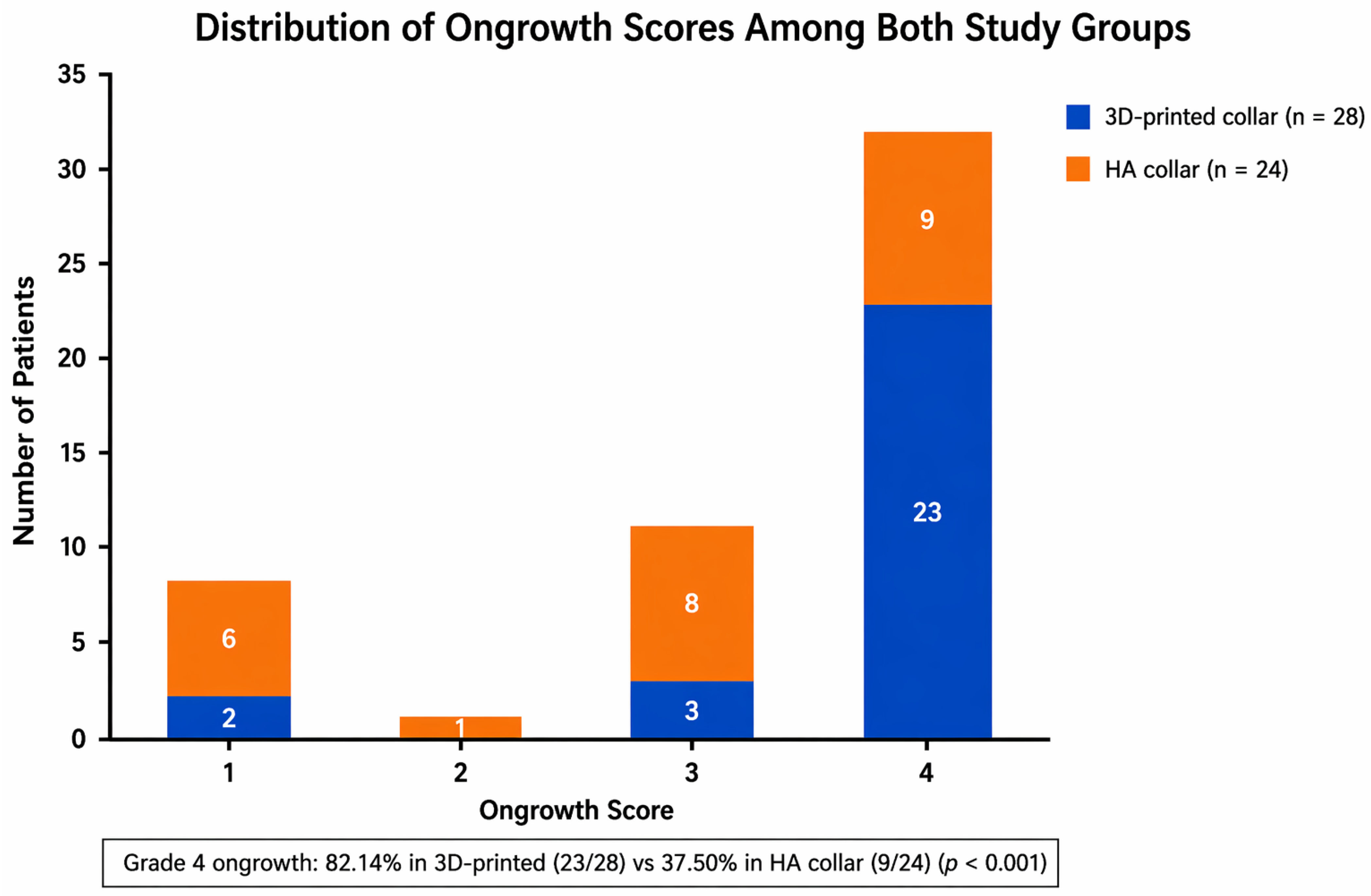
These patterns are clinically relevant, as revision arthroplasty and infection-related reconstructions are typically associated with compromised bone stock, impaired biology, and a higher risk of failure. The fact that the 3D-printed collar cohort included a greater proportion of such challenging cases, yet still demonstrated superior osseointegration and no aseptic loosening, strengthens the argument that the observed benefits are attributable to the implant design rather than the case selection alone. The distribution of ongrowth scores differed significantly between the two groups. The HA-collar cohort had a higher proportion of grade 1 and grade 3 cases, whereas the 3D-printed collar group showed a greater prevalence of grade 4 osseointegration. The difference in the percentage of patients achieving grade 4 ongrowth was statistically significant (82.14% in the 3D-printed group versus 37.5% in the HA-collar group;
p < 0.001), indicating superior bone integration in the 3D-printed collar group compared to the HA-collar group. Post-operative outcomes (
Table 2 and
Figure 2) were consistent with these findings, with the 3D-printed group demonstrating faster time-to-integration and no cases of aseptic loosening during follow-up.
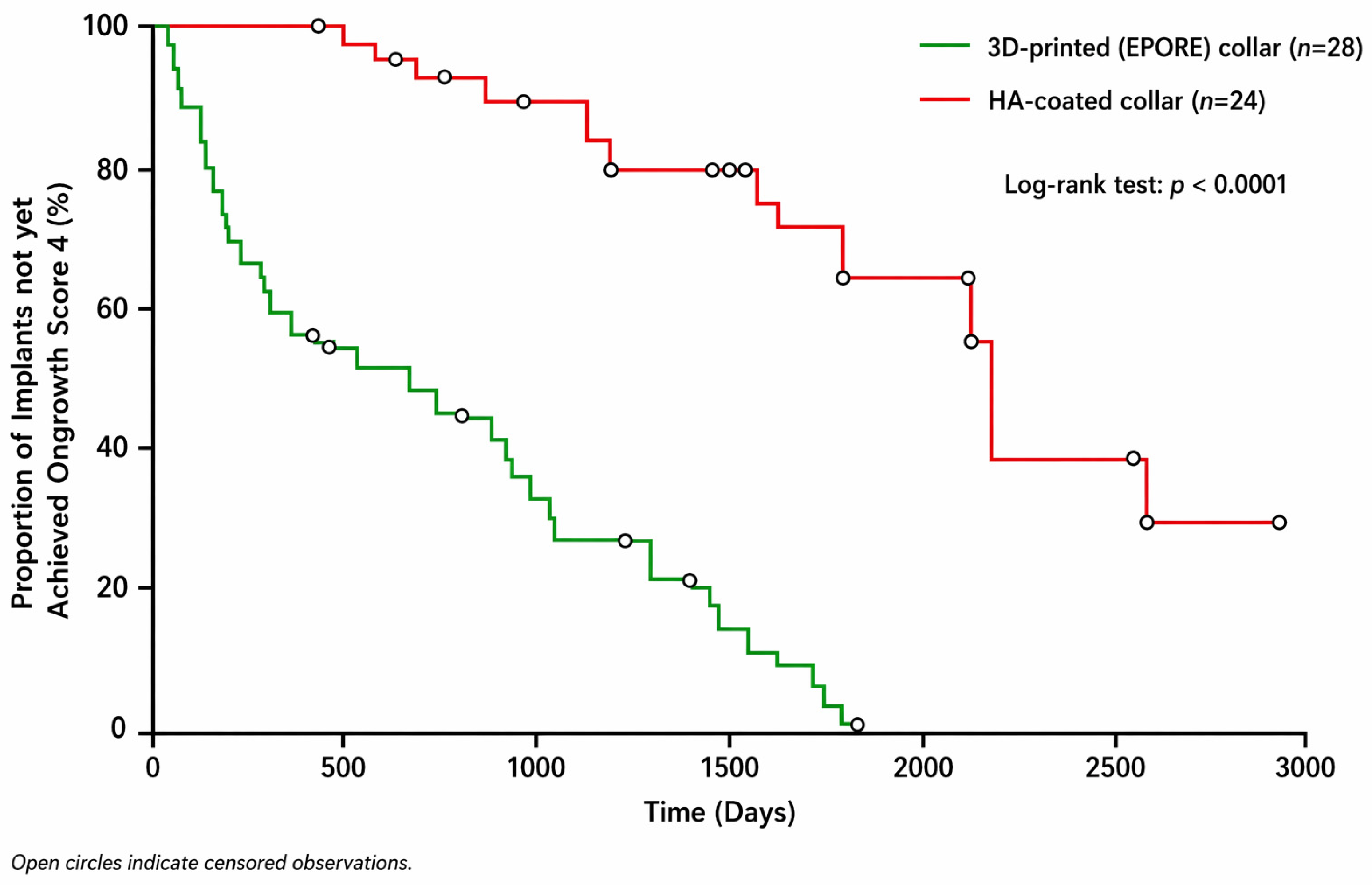
Kaplan–Meier analysis revealed a significantly faster time to achieve grade-4 ongrowth in the 3D-printed EPORE collar group compared to the HA collar group (log-rank
p < 0.05), indicating enhanced osseointegration in the 3D-printed cohort (
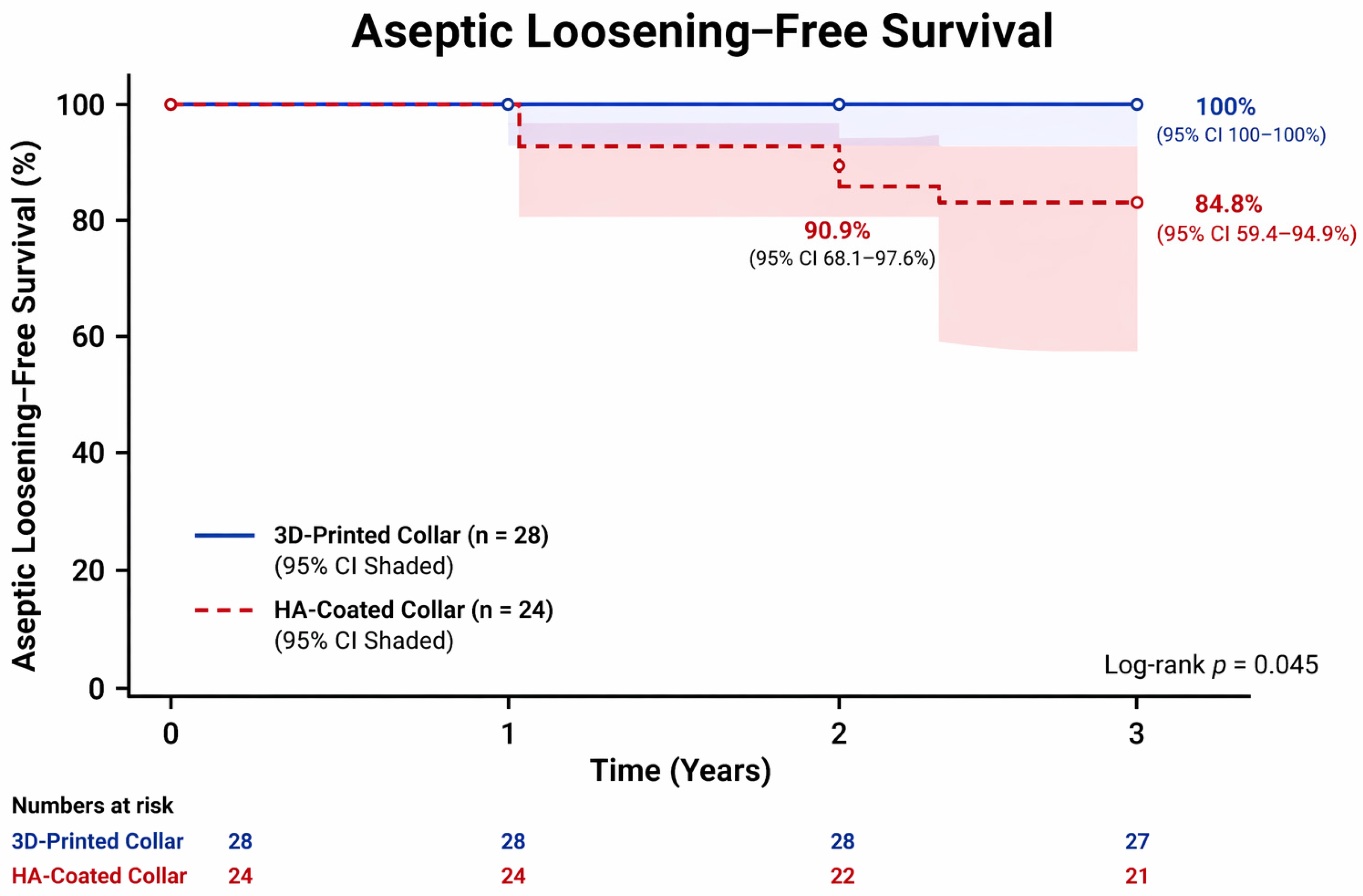
Figure 3). Aseptic-loosening-free survival was 100% in the 3D-printed collar group throughout follow-up, with no recorded aseptic failures, compared to 37.5% achieving grade-4 ongrowth in the HA collar group (
Figure 4;
Table 3).
5. Discussion
To our knowledge, this is the first long-term follow-up study to assess the clinical results and osseointegration capacity of this novel highly porous 3D-printed collar (EPORE®), demonstrating superior osseointegration rates and mechanical stability with the novel design. These implants are often deployed in complex clinical settings, including oncologic resections and revision arthroplasty, where the risk of complications such as aseptic loosening remains high. Despite the inherent complexity of the cases, the 3D-printed collar achieved 92.86% osseointegration, significantly outperforming the HA-coated group (70.83%, p < 0.04). This aligns with our earlier findings at 1 year and reinforces the collar’s capacity to foster robust extracortical bridging, even in biologically challenging scenarios. Notably, the 3D-printed cohort exhibited faster and more complete extracortical osseointegration.
The superior performance in higher-BMI patients (mean 32.51 in 3D-printed group) challenges the conventional wisdom about obesity and implant fixation. Though there have been no formal studies, higher loosening rates have been noted in obese patients with standard arthroplasty implants [
17]. Hence our results suggest that an optimized surface topography may mitigate this risk. This finding warrants further investigation given the increasing prevalence of obesity in patients.
A key limitation of this study is the non-randomized, historical control design, which resulted in a significant difference in the anatomical location of implants between groups. The HA-coated cohort consisted primarily of proximal femoral replacements, a location with a more favorable mechanical environment and historically lower loosening rates. In contrast, the 3D-printed cohort was predominantly composed of distal femoral reconstructions, which are subject to higher bending moments and lever arms, increasing the risk of mechanical failure. The finding that the 3D-printed implants demonstrated superior osseointegration and a significantly lower rate of aseptic loosening despite this unfavorable anatomical distribution is therefore particularly compelling. It suggests that the observed benefits are robust and may be attributable to the implant technology itself—specifically its enhanced porosity and potential for deeper bone ingrowth.
We found six cases of stem loosening in total, two of which were in the 3D collar group in the context of a periprosthetic joint infection requiring further surgical interventions due to the infection. The comparison of the four cases of aseptic loosening in the HA collar group suggests that effective integration reduces aseptic loosening. The absence of aseptic failures in our 3D-printed cohort (with both loosening cases being infection-related) supports the biomechanical advantage offered by the collar design, enhancing extracortical osseointegration and thereby reducing stress concentrations at the stem–cement–bone interface [
18,
19].
The 3D-printed collar group performed well in revision cases and revision arthroplasty as well. Three key findings warrant emphasis: First, the 3D collar’s time-to-integration advantage persisted in the long term, with 82% maintaining grade 4 osseointegration at 2 years versus 37.5% for HA-coated collars (
p < 0.001). This aligns with biomechanical studies showing porous titanium’s superior osteoconductivity, where pore sizes of 100–500 μm promote vascular invasion and bone deposition [
20,
21].
Notably, our results assume significance, as the historical data suggests ≤50% osseointegration with HA collars in revision arthroplasty cases [
5]. The 3D collar achieved 92% integration even in revision arthroplasty—a population where prior studies found only a 27% success rate [
5]. This has important implications for managing these cases and cost savings from avoiding repeat surgeries.
The follow-up discrepancy, which was significant (925 vs. 1326 days, 3D versus HA), reflects the newer technology’s introduction timeline. However, the collars performed significantly better even within the short time frame, and the aseptic-loosening-free survival curve proves that this advantage persists with time. The anatomical distribution difference (more distal femoral replacements in the 3D-printed group) introduces potential confounding. However, as distal femur reconstructions typically experience higher mechanical stresses, the 3D-printed collar’s performance in these theoretically higher-risk cases strengthens the case for using these collars. A key difference between groups was the fixation method. All implants in the 3D-printed collar cohort were cemented, whereas the HA-coated group included both cemented (66.7%) and uncemented stems. This reflects differences based on surgeon choice rather than an intentional selection bias. However, this discrepancy introduces a potential confounding factor, as cemented fixation may influence initial implant stability and load transfer characteristics.
Despite this, the superior osseointegration observed in the 3D-printed collar group is unlikely to be explained solely by the fixation method. Extracortical osseointegration at the collar–bone interface is biologically driven and distinct from stem fixation. Furthermore, HA-coated collars have historically been used with both cemented and uncemented stems yet still demonstrate variable and often inferior rates of extracortical integration in prior studies. Therefore, while the fixation method may contribute to the overall construct stability, the observed differences in the ongrowth and time-to-integration are more plausibly attributable to the enhanced porous architecture of the 3D-printed collar.
As the use of 3D-printed collars becomes more widespread, future prospective studies with larger sample sizes are needed to validate these findings and to further evaluate functional outcomes, implant survivorship, and the independent effect of the implant design through multivariable analyses.
6. Conclusions
The use of a 3D-printed porous collar in endoprosthetic reconstruction demonstrates encouraging mid-term outcomes in our series. The improved implant stability enhanced the biological fixation, and a lower incidence of aseptic loosening was observed, particularly in complex revision settings. These findings suggest that this design may contribute to more durable reconstructions and better functional outcomes. Further long-term studies are warranted to confirm its sustained benefits and broader applicability.
Author Contributions
Conceptualization, H.T.D. and L.M.J.; methodology, H.T.D., T.H. and I.; validation, H.T.D., N.G. and G.M.; formal analysis, H.T.D. and T.H.; investigation, H.T.D., N.G. and G.; resources, R.B. and L.M.J.; data curation, H.T.D. and N.G.; writing—original draft preparation, H.T.D.; writing—review and editing, H.T.D., T.H., I.P., G.M., R.B. and L.M.J.; visualization, H.T.D.; supervision, L.M.J. and R.B.; project administration, H.T.D. and T.H. All authors have read and agreed to the published version of the manuscript.
Funding
This research received no external funding.
Institutional Review Board Statement
Ethical review and approval were waived for this study due to its retrospective analysis.
Informed Consent Statement
Informed consent was obtained from all subjects involved in the study.
Data Availability Statement
Due to ethical and privacy restrictions imposed by the Royal Orthopaedic Hospital and in compliance with UK data protection laws (including the UK GDPR and NHS confidentiality guidelines), the raw data supporting the findings of this study cannot be made publicly available. The data could contain potentially identifiable patient information from a retrospective review of clinical records.
Conflicts of Interest
The authors declare no conflict of interest.
References
- Jeys, L.M.; Kulkarni, A.; Grimer, R.J.; Carter, S.R.; Tillman, R.M.; Abudu, A. Endoprosthetic reconstruction for the treatment of musculoskeletal tumors of the appendicular skeleton and pelvis. J. Bone Jt. Surg. Am. 2008, 90, 1265–1271. [Google Scholar] [CrossRef]
- Myers, G.J.C.; Abudu, A.T.; Carter, S.R.; Tillman, R.M.; Grimer, R.J. Endoprosthetic replacement of the distal femur for bone tumours: Long-term results. J. Bone Jt. Surg. Br. 2007, 89, 521–526. [Google Scholar] [CrossRef]
- Torbert, J.T.; Fox, E.J.; Hosalkar, H.S.; Ogilvie, C.M.; Lackman, R.D. Endoprosthetic reconstructions: Results of long-term followup of 139 patients. Clin. Orthop. Relat. Res. 2005, 438, 51–59. [Google Scholar] [CrossRef]
- Coathup, M.J.; Sanghrajka, A.; Aston, W.J.; Gikas, P.D.; Pollock, R.C.; Cannon, S.R.; Skinner, J.A.; Briggs, T.W.R.; Blunn, G.W. Hydroxyapatite-coated collars reduce radiolucent line progression in cemented distal femoral bone tumor implants. Clin. Orthop. Relat. Res. 2015, 473, 1505–1514. [Google Scholar] [CrossRef]
- Davies, B.; Kaila, R.; Andritsos, L.; Stephens, C.G.; Blunn, G.W.; Gerrand, C.; Gikas, P.; Johnston, A. Osteointegration of hydroxyapatite-coated collars in cemented massive endoprostheses following revision surgery. Bone Jt. Open 2021, 2, 371–379. [Google Scholar] [CrossRef]
- Sankar, B.; Refaie, R.; Murray, S.A.; Gerand, C.H. Bone growth on hydroxyapatite collars in massive tumour endoprostheses. Orthop. Proc. 2012, 94, 26. [Google Scholar]
- Tanzer, M.; Turcotte, R.; Harvey, E.; Bobyn, J.D. Extracortical bone bridging in tumor endoprostheses. Radiographic and histologic analysis. J. Bone Jt. Surg. Am. 2003, 85, 2365–2370. [Google Scholar] [CrossRef] [PubMed]
- England, T.; Pagkalos, J.; Jeys, L.; Botchu, R.; Carey Smith, R. Additive manufacturing of porous titanium metaphyseal components: Early osseointegration and implant stability in revision knee arthroplasty. J. Clin. Orthop. Trauma 2021, 15, 60–64. [Google Scholar] [CrossRef] [PubMed]
- Denehy, K.M.; Abhari, S.; Krebs, V.E.; Higuera-Rueda, C.A.; Samuel, L.T.; Sultan, A.A.; Mont, M.A.; Malkani, A.L. Metaphyseal Fixation Using Highly Porous Cones in Revision Total Knee Arthroplasty: Minimum Two Year Follow up Study. J. Arthroplast. 2019, 34, 2439–2443. [Google Scholar] [CrossRef] [PubMed]
- Meng, M.; Wang, J.; Huang, H.; Liu, X.; Zhang, J.; Li, Z. 3D printing metal implants in orthopedic surgery: Methods, applications and future prospects. J. Orthop. Transl. 2023, 42, 94–112. [Google Scholar] [CrossRef]
- Mumith, A.; Coathup, M.; Chimutengwende-Gordon, M.; Aston, W.; Briggs, T.; Blunn, G. Augmenting the osseointegration of endoprostheses using laser-sintered porous collars: An in vivo study. Bone Jt. J. 2017, 99, 276–282. [Google Scholar] [CrossRef]
- Shichman, I.; Oakley, C.; Willems, J.H.; van Hellemondt, G.G.; Heesterbeek, P.; Rozell, J.; Marwin, S.; Schwarzkopf, R. Novel metaphyseal porous titanium cones allow favorable outcomes in revision total knee arthroplasty. Arch. Orthop. Trauma Surg. 2023, 143, 1537–1547. [Google Scholar] [CrossRef]
- Brown, N.M.; Bell, J.A.; Jung, E.K.; Sporer, S.M.; Paprosky, W.G.; Levine, B.R. The Use of Trabecular Metal Cones in Complex Primary and Revision Total Knee Arthroplasty. J. Arthroplast. 2015, 30, 90–93. [Google Scholar] [CrossRef]
- Wang, X.; Zhang, D.; Peng, H.; Yang, J.; Li, Y.; Xu, J. Optimize the pore size-pore distribution-pore geometry-porosity of 3D-printed porous tantalum to obtain optimal critical bone defect repair capability. Biomater. Adv. 2023, 154, 213638. [Google Scholar] [CrossRef] [PubMed]
- Haider, T.; Pagkalos, I.; Morris, G.; Parry, M.C.; Jeys, L.M. Early radiographic osseointegration of a novel highly porous 3D-printed titanium collar for megaprostheses compared to a previous generation smooth HA-coated collar. Arch. Orthop. Trauma Surg. 2023, 143, 4671–4677. [Google Scholar] [CrossRef] [PubMed]
- Charlson, M.E.; Pompei, P.; Ales, K.L.; MacKenzie, C.R. A new method of classifying prognostic comorbidity in longitudinal studies: Development and validation. J. Chronic Dis. 1987, 40, 373–383. [Google Scholar] [CrossRef] [PubMed]
- Deo, S.D.; Jonas, S.C.; Frcs, J.J. Early Aseptic Tibial Loosening in Total Knee Replacement—A Gender and Obesity Related Complication. Ann. Orthop. Rheumatol. 2022, 9, 1099. [Google Scholar]
- Ward, W.G.; Johnston, K.S.; Dorey, F.J.; Eckardt, J.J. Extramedullary porous coating to prevent diaphyseal osteolysis and radiolucent lines around proximal tibial replacements. A preliminary report. J. Bone Jt. Surg. Am. 1993, 75, 976–987. [Google Scholar] [CrossRef]
- Coathup, M.J.; Batta, V.; Pollock, R.C.; Aston, W.J.; Cannon, S.R.; Skinner, J.A.; Briggs, T.W.R.; Unwin, P.; Blunn, G.W. Long-term survival of cemented distal femoral endoprostheses with a hydroxyapatite-coated collar: A histological study and a radiographic follow-up. J. Bone Jt. Surg. Am. 2013, 95, 1569–1575. [Google Scholar] [CrossRef]
- Jung, A.; Jang, J.; Ban, H.Y.; Kim, H.J.; Gweon, B.; Lim, D. Enhanced biomechanical and biological performance of titanium scaffolds with gradient in pore sizes. J. Mater. Res. Technol. 2025, 34, 2512–2526. [Google Scholar] [CrossRef]
- Stich, T.; Alagboso, F.; Křenek, T.; Kovářík, T.; Alt, V.; Docheva, D. Implant-bone-interface: Reviewing the impact of titanium surface modifications on osteogenic processes in vitro and in vivo. Bioeng. Transl. Med. 2022, 7, e10239. [Google Scholar] [CrossRef]
| Disclaimer/Publisher’s Note: The statements, opinions and data contained in all publications are solely those of the individual author(s) and contributor(s) and not of MDPI and/or the editor(s). MDPI and/or the editor(s) disclaim responsibility for any injury to people or property resulting from any ideas, methods, instructions or products referred to in the content. |




 ,
,