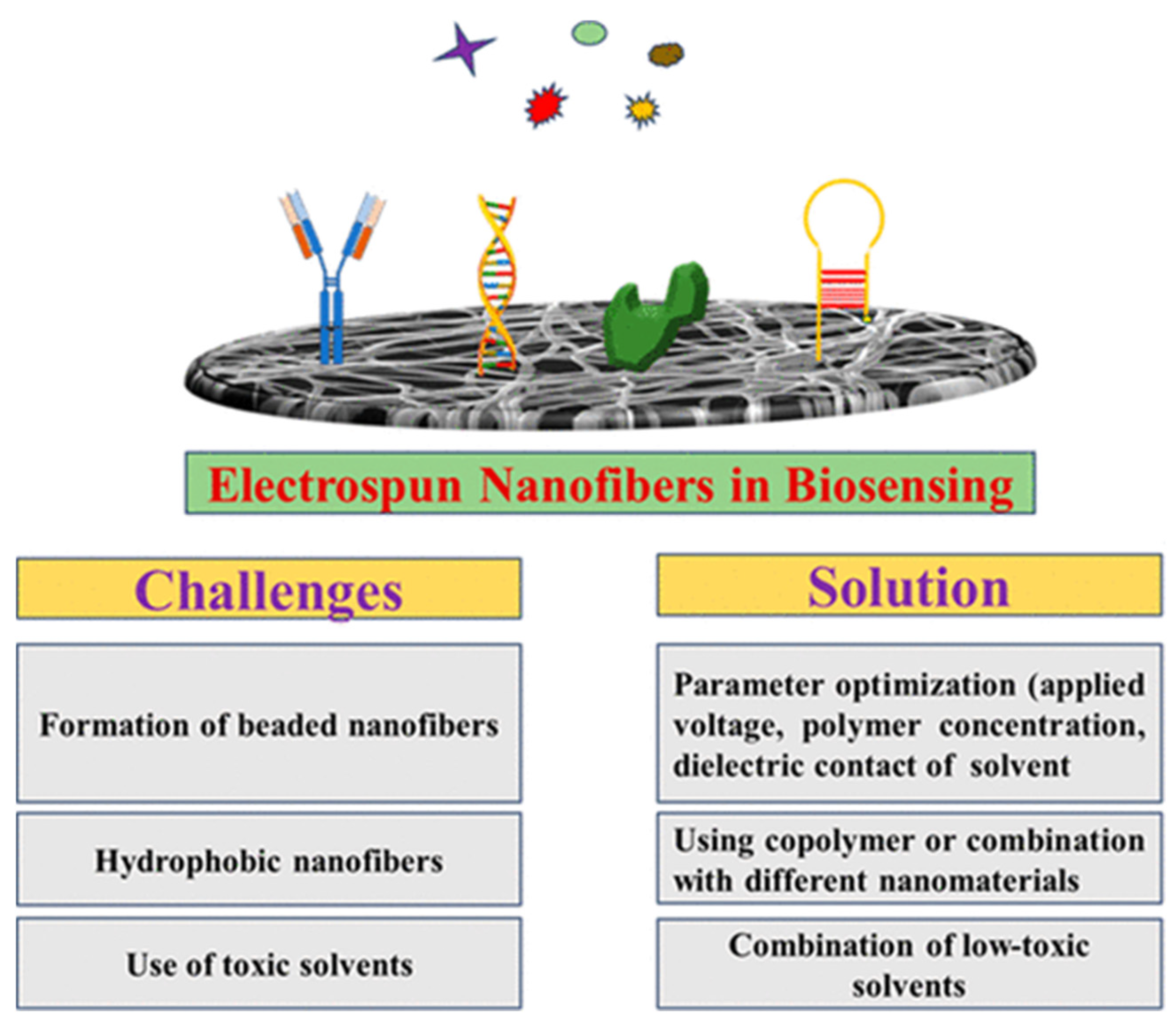


Biocompatible Electrospun Biomaterials for Advancing Thermoregulating Wearable Sensors in Next-Generation Smart Textiles

 ,
,  ,
,
Abstract
1. Introduction
1.1. Rise of Smart Textiles and Wearable Sensors
1.2. Thermal Regulation as a Core Challenge in Long-Term Wearable Comfort
1.3. The Role of Biocompatible Materials and Electrospinning Technology
2. Biocompatibility in Thermoregulating Wearable Sensors
3. Electrospinning of Biomaterials for Thermoregulating Textile Interfaces
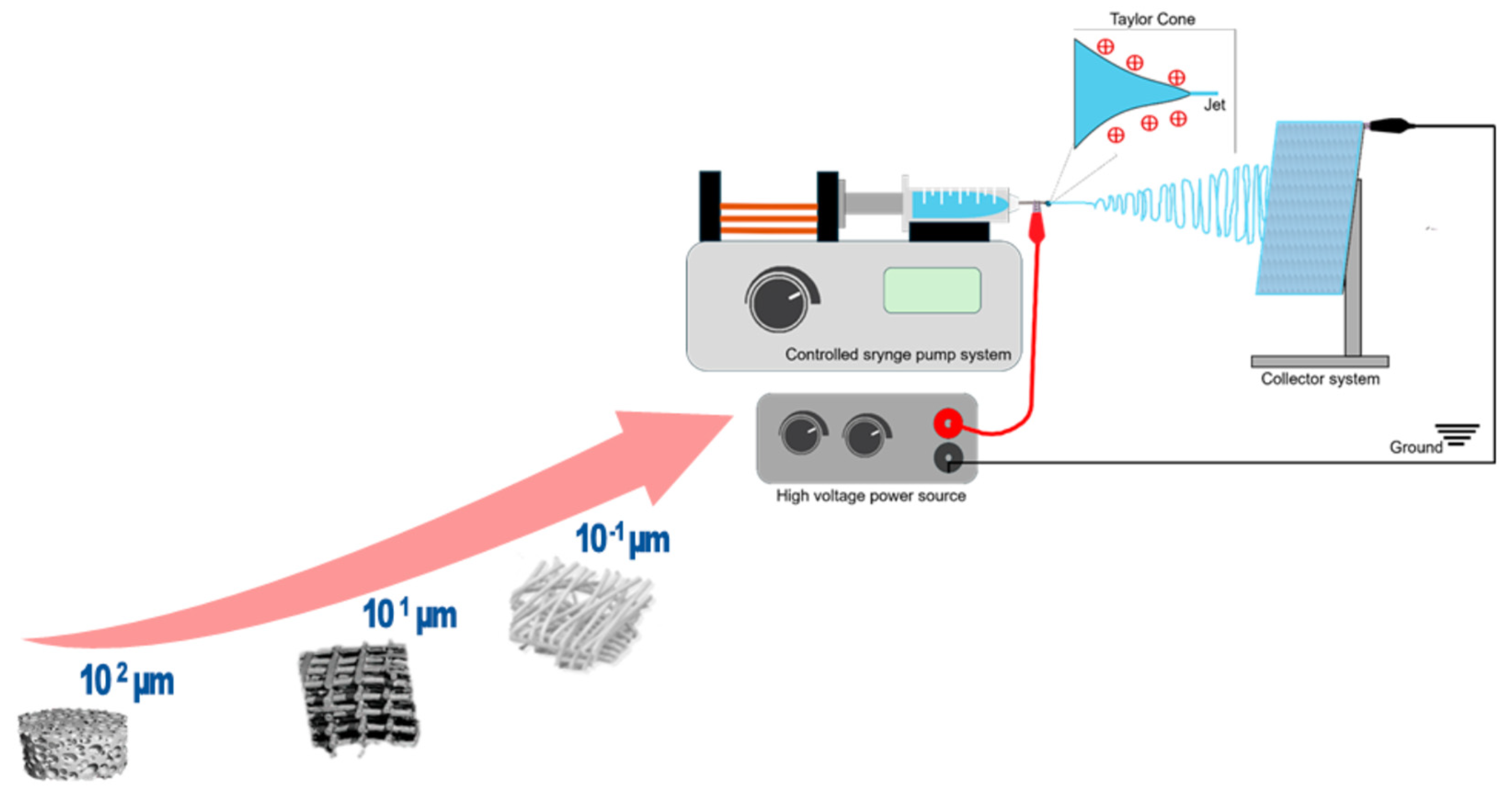
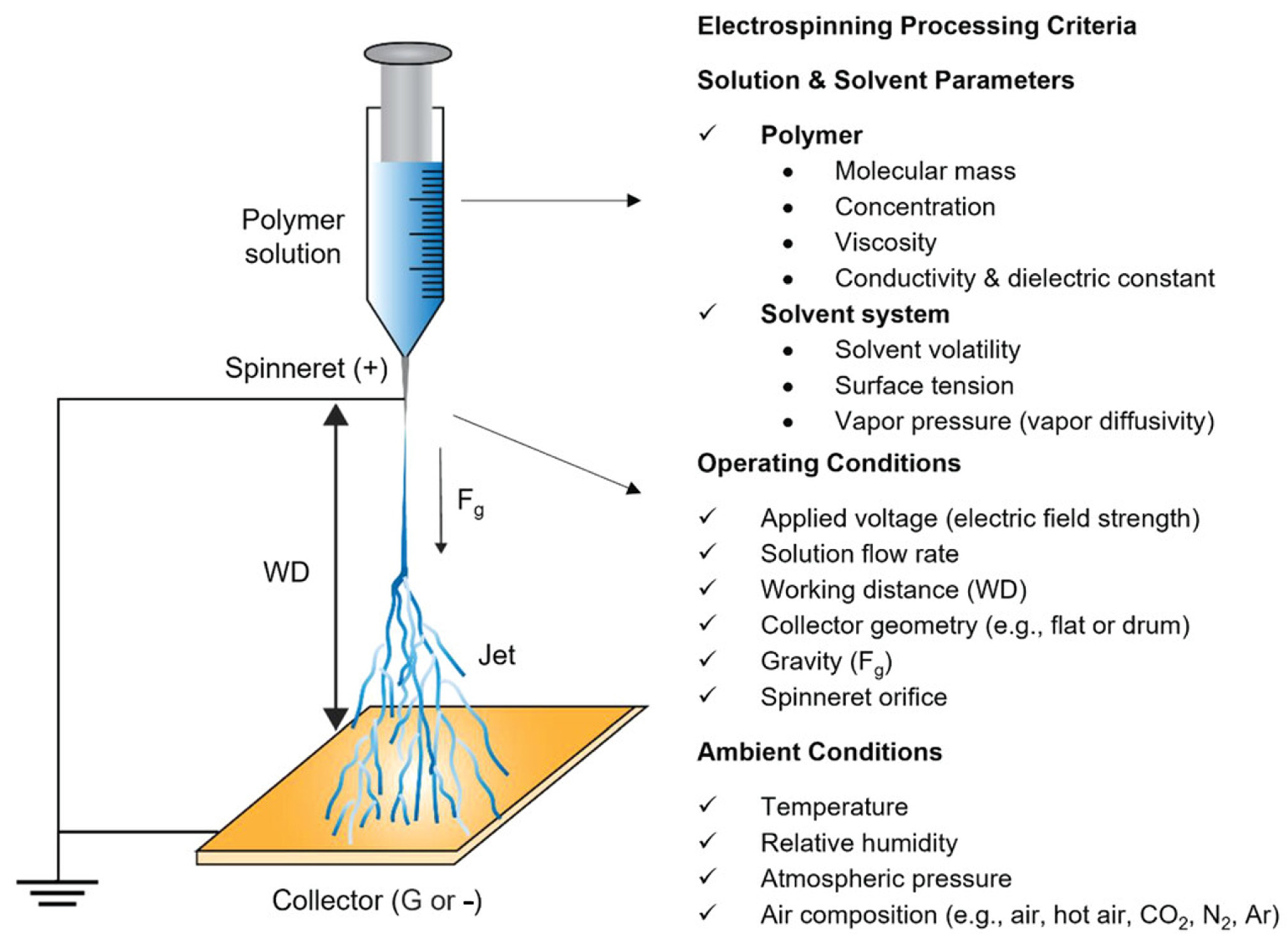
3.1. Principles and Advances in Electrospinning for Functional Fiber Fabrication
3.2. Electrospun Biomaterial Design: Polymers, Solvents, Additives, and Functionalization Strategies
4. Biocompatible Polymers with Thermoregulatory Potential
4.1. Natural Biopolymers for Passive and Active Thermoregulation
4.1.1. Silk Fibroin: High Thermal Conductivity, Breathable and Its Mechanical Properties
4.1.2. Cellulose and Its Derivatives: Porous, Hydrophilic, Moisture-Regulating
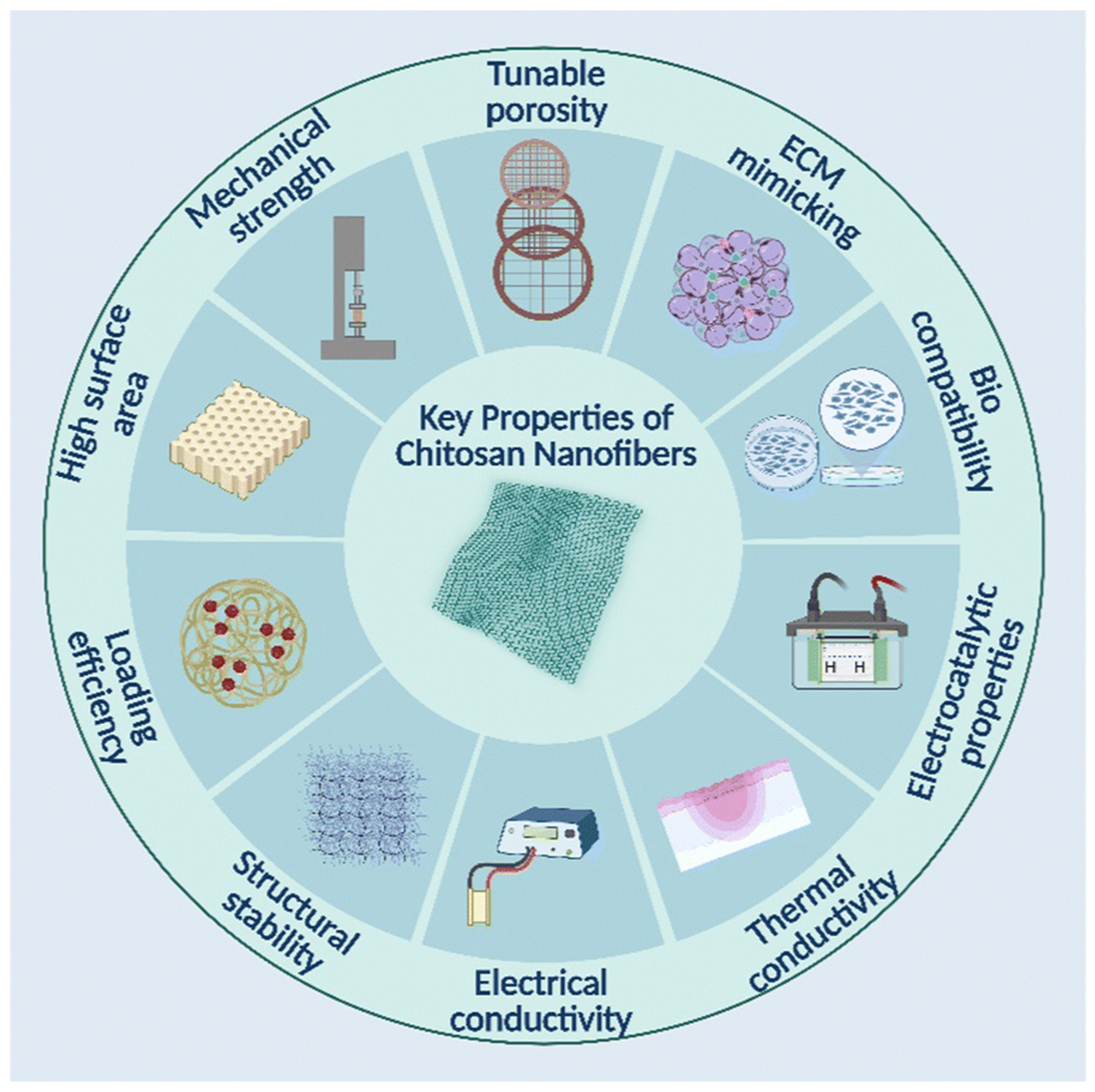
4.1.3. Chitosan and Alginate: Antibacterial, Humidity Buffering, Compatible with Phase-Change Systems
4.2. Synthetic Biopolymers with Enhanced Mechanical and Thermal Properties
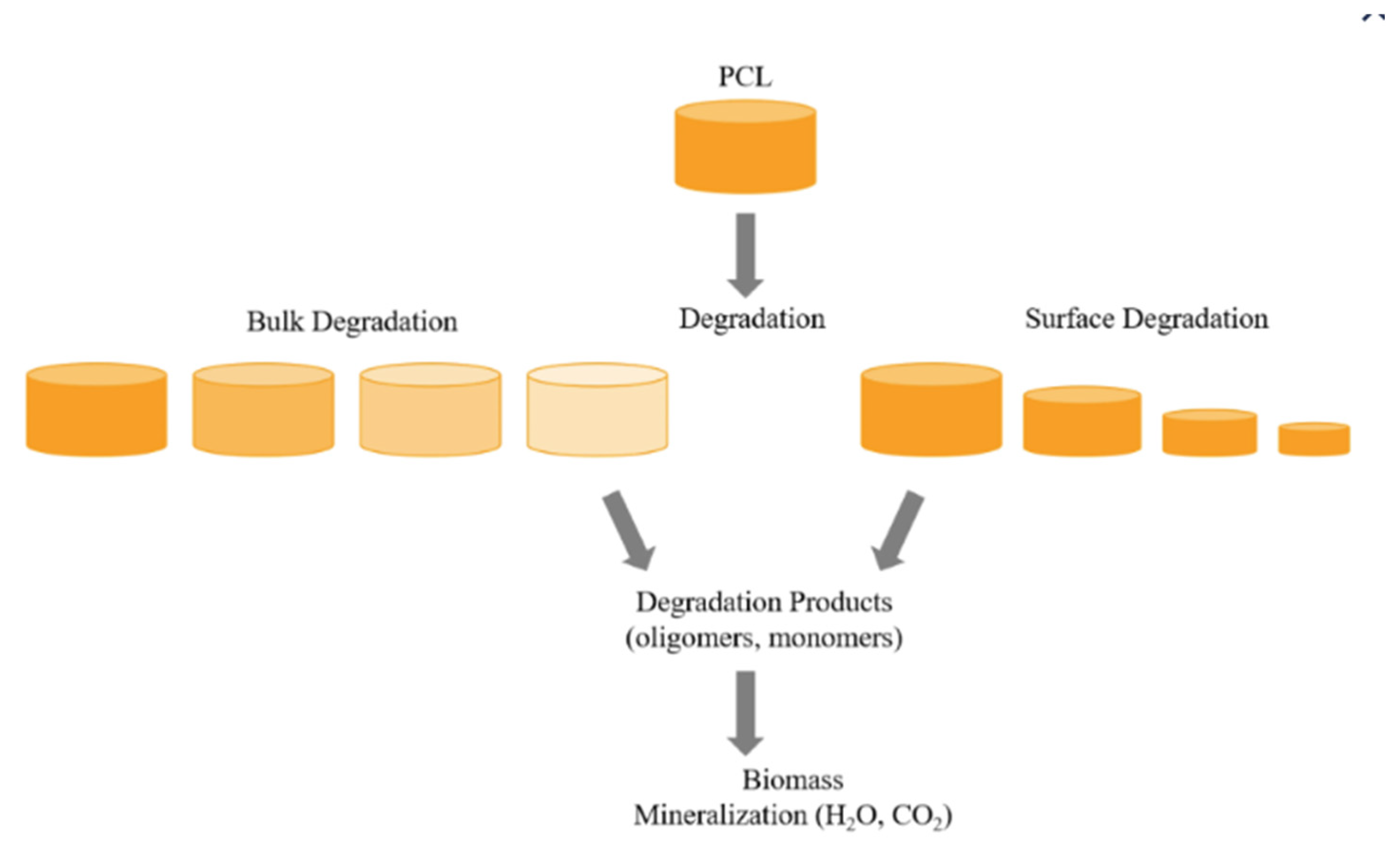
4.2.1. Polycaprolactone (PCL): Flexible Matrix, Blends Well with PCMs or Fillers
4.2.2. Polyurethane (PU): Elastic, Breathable, Comfortable for Skin-Contact Sensors
4.2.3. Polylactic Acid (PLA): Thermally Insulating, Biodegradable, Forms Stable Nanofibers
4.3. Material Comparison and Performance in Thermoregulating Textiles
4.3.1. Biocompatibility vs. Thermal Control Trade-Offs
4.3.2. Blending Strategies (e.g., Natural/Synthetic Hybrids) for Combined Benefits
5. Thermoregulation Strategies Using Electrospun Biomaterials
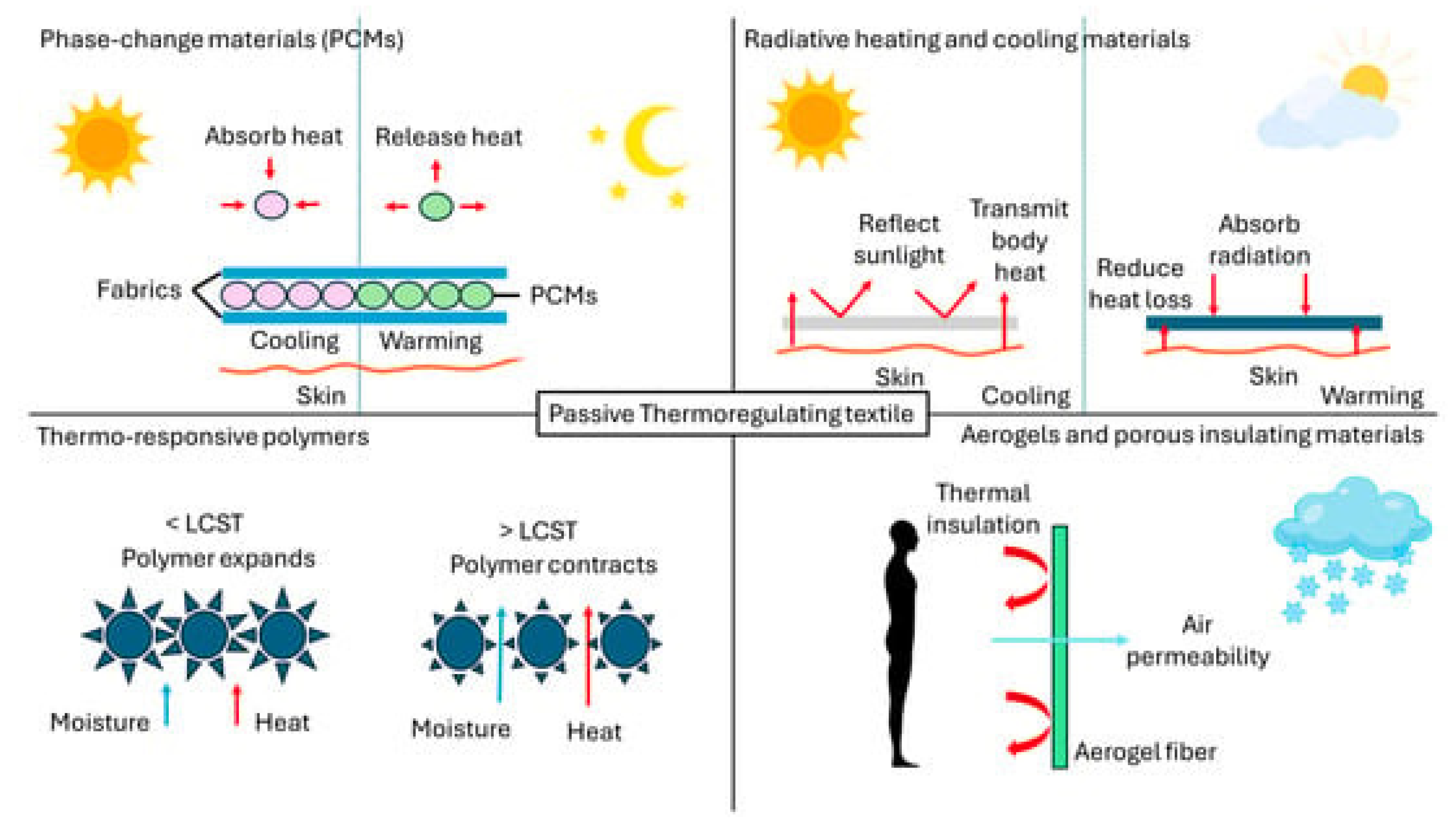
5.1. Passive Thermoregulation via Structural Design
5.2. Moisture-Driven Thermal Management
5.3. Thermoresponsive Electrospun Materials for Active Thermal Regulation
6. Thermally Integrated Multifunctional Sensor Systems
6.1. Conductive Biomaterial-Based Composites for Temperature Sensing
6.2. Simultaneous Antibacterial, Breathable, and Thermal Properties
6.3. Integrated Hybrid Structures for Comfort, Signal Stability, and Skin Health
7. Smart Thermoregulatory Textiles: Use Cases, Challenges, and Future Outlook
7.1. Use Cases
7.2. Challenges
7.3. Future Outlook
8. Conclusions
Author Contributions
Funding
Institutional Review Board Statement
Informed Consent Statement
Data Availability Statement
Conflicts of Interest
References
- Guo, Z.; Yang, Z.; Zhang, Y.; Sun, W.; Liu, H.; Lu, C.; Lan, W.; Liao, Y.; Wu, X.; Liu, Y. Wearable flexible sensors based on electrospun PVDF and its Copolymer nanofibers: Review. J. Mater. Sci. Mater. Electron. 2024, 35, 2011. [Google Scholar] [CrossRef]
- Xia, Z.; Liu, C.; Li, J.; Huang, B.; Pan, C.; Lai, Y.; Liu, Z.; Wu, D.; Liang, S.; Wang, X.; et al. Toward Versatile Transient Electronics: Electrospun Biocompatible Silk Fibroin/Carbon Quantum Dot-Based Green-Emission, Water-Soluble Piezoelectric Nanofibers. Polymers 2025, 17, 1579. [Google Scholar] [CrossRef] [PubMed]
- Du, S.; Tan, Y.; Chen, J.; Wei, Y.; Qu, Z.; Li, J.; Zhang, J.; Zhou, W. Robust and washable silk fiber-based electrochemical biosensor for high-performance sensing of hydrogen peroxide. Compos. Commun. 2024, 52, 102122. [Google Scholar] [CrossRef]
- Zhu, B.; Wang, H.; Leow, W.R.; Cai, Y.; Loh, X.J.; Han, M.; Chen, X. Silk Fibroin for Flexible Electronic Devices. Adv. Mater. 2015, 28, 4250–4265. [Google Scholar] [CrossRef] [PubMed]
- Wang, C.; Xia, K.; Zhang, Y.; Kaplan, D.L. Silk-Based Advanced Materials for Soft Electronics. Acc. Chem. Res. 2019, 52, 2916–2927. [Google Scholar] [CrossRef]
- Wang, R.; Sui, J.; Wang, X. Natural Piezoelectric Biomaterials: A Biocompatible and Sustainable Building Block for Biomedical Devices. ACS Nano 2022, 16, 17708–17728. [Google Scholar] [CrossRef]
- Yucel, T.; Cebe, P.; Kaplan, D.L. Structural Origins of Silk Piezoelectricity. Adv. Funct. Mater. 2011, 21, 779–785. [Google Scholar] [CrossRef]
- Juarez-Navarro, K.J.; Guarino, V.; Alvarez-Perez, M.A. Converging Electrospinning and 3D-Printing Technologies: From Innovative Design for Tissue Engineering to Global Patent Trends and Technology Transfer. Fibers 2025, 13, 83. [Google Scholar] [CrossRef]
- Taniwaki, G. Smart Textiles for Health Monitoring: Development of Flexible, Biocompatible Materials for Wearable Sensors. J. Mater. Sci. Eng. 2024, 13, 682. [Google Scholar] [CrossRef]
- Saqlain, A. Smart Textiles: Integrating Biomaterials for Wearable Health Monitoring. J. Biotechnol. Biomater. 2024, 14, 1000408. [Google Scholar] [CrossRef]
- Rather, H.A.; Dar, M.A. Smart Textiles with Integrated Biosensors for Real-Time Health Monitoring. Biosens. Nanotheranostics 2024, 3, 1–9. [Google Scholar] [CrossRef]
- Park, J.; Lee, Y.; Cho, S.; Choe, A.; Yeom, J.; Ro, Y.G.; Kim, J.; Kang, D.; Lee, S.; Ko, H. Soft sensors and actuators for wearable Human–Machine interfaces. Chem. Rev. 2024, 124, 1464−1534. [Google Scholar] [CrossRef] [PubMed]
- Ponmozhi, J.; Frias, C.; Marques, A.; Frazão, O. Smart sensors/actuators for biomedical applications: Review. Measurement 2012, 45, 1675–1688. [Google Scholar] [CrossRef]
- Smart Textiles and Wearable Technology. Available online: https://www.textileschool.com/9943/smart-textiles-and-wearable-technology/ (accessed on 11 November 2025).
- Motaghedi, F.; Wu, Y.; Carmichael, T.B. Smart from the start: A textile-centric approach to wearable electronics. J. Mater. Res. 2025, 40, 2461–2484. [Google Scholar] [CrossRef]
- Smart Textile Innovations: The Next Wave of IoT Wearables. Available online: https://promwad.com/news/smart-textiles-iot-wearable-tech (accessed on 11 November 2025).
- Jiang, W.; Liu, J.Z.; Wang, Z.; Li, T.; Wang, Y.; Cai, H.; Xie, Z.; Zhuo, M.-P.; Wang, H.; Wang, X.-Q.; et al. Wearable Passive Thermal Management Functional Textiles: Recent Advances in Personal Comfort and Energy Harvesting Applications. Adv. Fiber Mater. 2025, 7, 1677–1717. [Google Scholar] [CrossRef]
- Tang, K.H.D. Advances in Thermoregulating Textiles: Materials, Mechanisms, and Applications. Textiles 2025, 5, 22. [Google Scholar] [CrossRef]
- Zhai, H.; Zhu, C. Advances and Challenges in Thermal Management of Smart Textiles. J. Text. Sci. Fashion Tech. 2025, 11, 1–4. [Google Scholar] [CrossRef]
- Zhao, J.; Zhu, W.; Wang, X.; Liu, L.; Yu, J.; Ding, B. Fluorine-free waterborne coating for environmentally friendly, robustly water-resistant, and highly breathable fibrous textiles. ACS Nano 2019, 14, 1045–1054. [Google Scholar] [CrossRef]
- Park, Y.S.; Lee, J.W.; Nam, Y.S.; Park, W.H. Breathable properties of m-Aramid nanofibrous membrane with high thermal resistance. J. Appl. Polym. Sci. 2015, 132, 41515. [Google Scholar] [CrossRef]
- Troynikov, O.; Wardiningsih, W. Moisture management properties of wool/polyester and wool/bamboo knitted fabrics for the sportswear base layer. Text. Res. J. 2011, 81, 621–631. [Google Scholar] [CrossRef]
- Xie, L.; Yang, K.; Wang, M.; Hou, W.; Ren, Q. Recent advances in flexible materials for wearable optical biosensors. Biosensors 2025, 15, 611. [Google Scholar] [CrossRef] [PubMed]
- Zhang, J.-H.; Sun, X.; Wang, H.; Li, J.; Guo, X.; Li, S.; Wang, Y.; Cheng, W.; Qiu, H.; Shi, Y.; et al. From 1D to 2D to 3D: Electrospun Microstructures Towards Wearable Sensing. Chemosensors 2023, 11, 295. [Google Scholar] [CrossRef]
- Wang, L.; Li, M.; Ya, S.; Tian, H.; Li, K.; Zhang, Q.; Li, Y.; Wang, H.; Hou, C. Ti3c2tx mxene/polyaniline-modified nylon fabric electrode for wearable non-invasive glucose monitoring in sweat. Biosensors 2025, 15, 531. [Google Scholar] [CrossRef] [PubMed]
- Khan, A.; Haque, M.N.; Kabiraz, D.C.; Yeasin, A.; Al Rashid, H.; Sarker, A.C.; Hossain, G. A review on advanced nanocomposites materials based smart textile biosensor for healthcare monitoring from human sweat. Sens. Actuators A Phys. 2023, 350, 114093. [Google Scholar] [CrossRef]
- Peng, X.; Dong, K.; Ye, C.; Jiang, Y.; Wang, Z. A breathable, biodegradable, antibacterial, and self-powered electronic skin based on all-nanofiber triboelectric nanogenerators. Sci. Adv. 2020, 6, 9624. [Google Scholar] [CrossRef]
- Wu, H.; Yang, G.; Zhu, K.; Liu, S.; Guo, W.; Jiang, Z.; Li, Z. Materials, devices, and systems of on-skin electrodes for electrophysiological monitoring and human–machine interfaces. Adv. Sci. 2021, 8, 2001938. [Google Scholar] [CrossRef]
- Liu, S.; Li, L.; Liu, R.; Liu, J.; Zhao, X.; Liao, X. Ultra-flexibility, robust waterproof and breathability of polyvinylidene fluoride membrane blended silver nitrate for electronic skin substrate. J. Phys. D Appl. Phys. 2020, 53, 195403. [Google Scholar] [CrossRef]
- Szewczyk, P.; Kopacz, M.; Krysiak, Z.; Stachewicz, U. Oil-infused polymer fiber membranes as porous patches for long-term skin hydration and moisturization. Macromol. Mater. Eng. 2023, 309, 2300291. [Google Scholar] [CrossRef]
- Maksoud, F.J.; Lameh, M.; Fayyad, S.; Ismail, N.; Tehrani-Bagha, A.R.; Ghaddar, N.; Ghali, K. Electrospun waterproof breathable membrane with a high level of aerosol filtration. J. Appl. Polym. Sci. 2018, 135, 45660. [Google Scholar] [CrossRef]
- McLaren, R.; Joseph, F.; Baguley, C.; Taylor, D. A Review of e-Textiles in Neurological Rehabilitation: How Close Are We? J. Neuroeng. Rehabil. 2016, 13, 59. [Google Scholar] [CrossRef]
- Yaghouti, A.M.; Jahanshahi, A. Advancing wearable bioelectronics in emerging applications: Seamless ECG monitoring through mechanically-supported electrical interconnects. Flex. Print. Electron. 2025, 10, 025001. [Google Scholar] [CrossRef]
- Ding, Y.; Shi, Y.; Yu, D.; Wang, W. All-in-one sandwich-like PVA/PEDOT: PSS/WPU electrodes with low impedance and high stretchability for ECG monitoring. Colloids Surf. A Physicochem. Eng. Asp. 2023, 675, 132060. [Google Scholar] [CrossRef]
- Yin, S.; Yao, D.R.; Song, Y.; Heng, W.; Ma, X.; Han, H.; Gao, W. Wearable and implantable soft robots. Chem. Rev. 2024, 124, 11585–11636. [Google Scholar] [CrossRef] [PubMed]
- Osuagwu, C.U. Design and Optimization of Wearable Sensor Technologies for Real-Time Biomedical Monitoring. Middle East. Res. J. Med. Sci. 2024, 4, 261–274. [Google Scholar] [CrossRef]
- Seesaard, T.; Wongchoosuk, C. Flexible and Stretchable Pressure Sensors: From Basic Principles to State-of-the-Art Applications. Micromachines 2023, 14, 1638. [Google Scholar] [CrossRef]
- Steinberg, C.; Philippon, F.; Sánchez, M.; Fortier-Poisson, P.; O’Hara, G.; Molin, F.; Sarrazin, J.-F.; Nault, I.; Blier, L.; Roy, K.; et al. A novel wearable device for continuous ambulatory ecg recording: Proof of concept and assessment of signal quality. Biosensors 2019, 9, 17. [Google Scholar] [CrossRef]
- Ramasamy, S.; Balan, A. Wearable sensors for ECG measurement: A review. Sens. Rev. 2018, 38, 412–419. [Google Scholar] [CrossRef]
- Dahiya, E.S.; Kalra, A.; Anand, G. Wearable Technology for Monitoring Electrocardiograms (ECGs) in Adults: A Scoping Review. Sensors 2024, 24, 1318. [Google Scholar] [CrossRef]
- Patel, S.; Sharma, S.; Suthar, J.; Suryawanshi, M. Regulatory Concern for Biomaterial and Its Toxicity. In Design and Processing of Green Materials. Biomaterials, Bioengineering and Sustainability, 1st ed.; Faiyazuddin, M., Suryawanshi, M., Eds.; Springer: Cham, Switzerland, 2025; Volume 4, pp. 433–458. [Google Scholar] [CrossRef]
- Sharma, R.; Ahmad, F.; Ghosal, M.; Naik, K.; Lanka, M.; Sachdeva, P.; Singh, G.; Khan, F.A. Materials Testing for Toxicity, Efficacy, Disease Treatment, and Testing for Disease Diagnosis in the Animal Models. In Materials for Medical Applications, 1st ed.; Khan, F.A., Ed.; CRC Press: Boca Raton, FL, USA, 2023; Volume 1, pp. 98–126. [Google Scholar] [CrossRef]
- ISO 10993-5:2009; Biological evaluation of medical devices—Part 5: Tests for in vitro cytotoxicity. International Organization for Standardization: Geneva, Switzerland, 2009.
- ISO 10993-23:2021; Biological evaluation of medical devices—Part 23: Tests for irritation. Organization for Standardization: Geneva, Switzerland, 2021.
- Gruber, S.; Nickel, A. Toxic or not toxic? The specifications of the standard ISO 10993-5 are not explicit enough to yield comparable results in the cytotoxicity assessment of an identical medical device. Front. Med. Technol. 2023, 5, 1195529. [Google Scholar] [CrossRef]
- ISO 10993-23:2021/Amd 1:2025; Biological evaluation of medical devices—Part 23: Tests for irritation. Amendment 1: Additional in vitro reconstructed human epidermis models. Organization for Standardization: Geneva, Switzerland, 2025.
- Liu, J.; Wang, L.; Bai, L.; Wang, W.; Yang, L.; Chen, H.; Yang, H.; Wei, D. Fabrication of nanocomposite hydrogels based on cellulose nanocrystals and multi-walled carbon nanotubes for human motion monitoring. Macromol. Chem. Phys. 2024, 225, 2400207. [Google Scholar] [CrossRef]
- Ereifej, E.S.; Khan, S.; Newaz, G.; Zhang, J.; Auner, G.W.; VandeVord, P.J. Characterization of Astrocyte Reactivity and Gene Expression on Biomaterials for Neural Electrodes. J. Biomed. Mater. Res. A 2011, 99A, 141–150. [Google Scholar] [CrossRef]
- Choi, D.Y.; Kim, M.H.; Oh, Y.S.; Jung, S.H.; Jung, J.H.; Sung, H.J.; Lee, H.W.; Lee, H.M. Highly stretchable, hysteresis-free ionic liquid-based strain sensor for precise human motion monitoring. ACS Appl. Mater. Interfaces 2017, 9, 1770–1780. [Google Scholar] [CrossRef] [PubMed]
- Zhao, Y.; Zhao, H.; Wei, Z.; Yuan, J.; Jian, J.; Kong, F.; Xie, H.; Xiong, X. Silk fibroin-based hydrogel for multifunctional wearable sensors. J. Renew. Mater. 2022, 10, 2729–2746. [Google Scholar] [CrossRef]
- Wang, Y.; Haick, H.; Guo, S.; Wang, C.; Lee, S.; Yokota, T.; Someya, T. Skin bioelectronics towards long-term, continuous health monitoring. Chemi Soc. Rev. 2022, 51, 3759–3793. [Google Scholar] [CrossRef]
- Windmiller, J.R.; Wang, J. Wearable electrochemical sensors and biosensors: A review. Electroanalysis 2013, 25, 29–46. [Google Scholar] [CrossRef]
- Baldo, T.A.; de Lima, L.F.; Mendes, L.F.; de Araujo, W.R.; Paixao, T.R.; Coltro, W.K. Wearable and biodegradable sensors for clinical and environmental applications. ACS Appl. Electron. Mater. 2020, 3, 68–100. [Google Scholar] [CrossRef]
- Sen, R.K.; Prabhakar, P.; Shruti; Verma, P.; Vikram, A.; Mishra, A.; Dwivedi, A.; Gowri, V.S.; Chaurasia, J.P.; Mondal, D.P.; et al. Smart nanofibrous hydrogel wound dressings for dynamic infection diagnosis and control: Soft but functionally rigid. ACS Appl. Bio Mater. 2024, 7, 999–1016. [Google Scholar] [CrossRef]
- Shafique, H.; de Vries, J.; Strauss, J.; Khorrami Jahromi, A.; Siavash Moakhar, R.; Mahshid, S. Advances in the translation of electrochemical hydrogel-based sensors. Adv. Healthc. Mater. 2023, 12, 2201501. [Google Scholar] [CrossRef]
- Krysiak, Z.J.; Abdolmaleki, H.; Agarwala, S.; Stachewicz, U. Inkjet printing of electrodes on electrospun micro-and nanofiber hydrophobic membranes for flexible and smart textile applications. Polymers 2022, 14, 5043. [Google Scholar] [CrossRef]
- Liakos, I.L.; Holban, A.M.; Carzino, R.; Lauciello, S.; Grumezescu, A.M. Electrospun fiber pads of cellulose acetate and essential oils with antimicrobial activity. Nanomaterials 2017, 7, 84. [Google Scholar] [CrossRef]
- Yin, Z.; Jian, M.; Wang, C.; Xia, K.; Liu, Z.; Wang, Q.; Zhang, M.; Wang, H.; Liang, X.; Liang, X.; et al. Splash-resistant and light-weight silk-sheathed wires for textile electronics. Nano Lett. 2018, 18, 7085−7091. [Google Scholar] [CrossRef] [PubMed]
- ISO 20743:2021; Textiles—Determination of antibacterial activity of textile products. Organization for Standardization: Geneva, Switzerland, 2021.
- AATCC TM100-2019; Test Method for Antibacterial Finishes on Textile Materials: Assessment of antimicrobial finishes on textile materials. American Association of Textile Chemists and Colorists: Durham, NC, USA, 2019.
- Iadaresta, F.; Manniello, M.D.; Östman, C.; Crescenzi, C.; Holmbäck, J.; Russo, P. Chemicals from textiles to skin: An in vitro permeation study of benzothiazole. Environ. Sci. Pollut. Res. 2018, 25, 24629–24638. [Google Scholar] [CrossRef] [PubMed]
- He, W.; Wang, C.; Wang, H.; Jian, M.; Lu, W.; Liang, X.; Zhang, X.; Yang, F.; Zhang, Y. Integrated textile sensor patch for real-time and multiplex sweat analysis. Sci. Adv. 2019, 5, eaax0649. [Google Scholar] [CrossRef] [PubMed]
- Armengol, E.S.; Kerezsi, A.B.; Laffleur, F. Allergies caused by textiles: Control, research and future perspective in the medical field. Int. Immunopharmacol. 2022, 110, 109043. [Google Scholar] [CrossRef]
- EN 1811:2023; Testing of Nickel Release Products with Prolonged Skin Contact. European Committee for Standardization: Brussels, Belgium, 2023.
- European Union. Regulation (EC) No 1907/2006 of the European Parliament and of the Council of 18 December 2006 concerning the Registration, Evaluation, Authorisation and Restriction of Chemicals (REACH), establishing a European Chemicals Agency, amending Directive 1999/45/EC and repealing Council Regulation (EEC) No 793/93 and Commission Regulation (EC) No 1488/94 as well as Council Directive 76/769/EEC and Commission Directives 91/155/EEC, 93/67/EEC, 93/105/EC and 2000/21/EC; European Union: Brussels, Belgium, 2006. [Google Scholar]
- Wang, C.; Shirzaei Sani, E.; Shih, C.D.; Lim, C.T.; Wang, J.; Armstrong, D.G.; Gao, W. Wound management materials and technologies from bench to bedside and beyond. Nat. Rev. Mat. 2024, 9, 550–566. [Google Scholar] [CrossRef]
- Wang, L.; Lou, Z.; Wang, K.; Zhao, S.; Yu, P.; Wei, W.; Wang, D.; Han, W.; Jiang, K.; Shen, G. Biocompatible and Biodegradable Functional Polysaccharides for Flexible Humidity Sensors. Research 2020, 2020, 716847. [Google Scholar] [CrossRef]
- Zeybek, B.; Duman, M. Electrospinning of nanofibrous polycaprolactone (PCL) and collagen-blended polycaprolactone for wound dressing and tissue engineering. Usak Univ. J. Mater. Sci. 2014, 3, 121–134. [Google Scholar] [CrossRef]
- Liu, T.; Liu, M.; Dou, S.; Sun, J.; Cong, Z.; Jiang, C.; Du, C.; Pu, X.; Hu, W.; Wang, Z.L. Triboelectric-Nanogenerator-Based Soft Energy-Harvesting Skin Enabled by Toughly Bonded Elastomer/Hydrogel Hybrids. ACS Nano 2018, 12, 2818–2826. [Google Scholar] [CrossRef]
- Tang, Q.; Ke, Q.; Chen, Q.; Zhang, X.; Su, J.; Ning, C.; Fang, L. Flexible, breathable, and self-powered patch assembled of electrospun polymer triboelectric layers and polypyrrole-coated electrode for infected chronic wound healing. ACS Appl. Mater. Interfaces 2023, 15, 17641–17652. [Google Scholar] [CrossRef]
- European Commission. Directive 2011/65/EU of the European Parliament and of the Council of 8 June 2011 on the restriction of the use of certain hazardous substances in electrical and electronic equipment (recast) Text with EEA relevance; European Commission: Brussels, Belgium, 2006. [Google Scholar]
- Xiong, J.; Wang, L.; Liang, F.; Li, M.; Yabuta, Y.; Iqbal, M.A.; Mayakrishnan, G.; Shi, J.; Kim, I.S. Flexible Piezoelectric Sensor Based on Two-Dimensional Topological Network of PVDF/DA Composite Nanofiber Membrane. Adv. Fiber Mater. 2024, 6, 1212–1228. [Google Scholar] [CrossRef]
- Mpofu, N.S.; Blachowicz, T.; Ehrmann, A.; Ehrmann, G. Wearable electrospun nanofibrous sensors for health monitoring. Micro 2024, 4, 798–822. [Google Scholar] [CrossRef]
- Gungordu, E.S.; Kelly, A.; Jayasuriya, S.B.W.; Edirisinghe, M. Nanofiber Based on Electrically Conductive Materials for Biosensor Applications. Biomed. Mater. Devices 2023, 1, 664–679. [Google Scholar] [CrossRef] [PubMed]
- Elfawal, G.F.; Šišková, A.O.; Andicsová, A.E. Electrospinning: A Game-Changer in Fiber Production and Practical Applications. Fibers Polym. 2025, 26, 4133–4160. [Google Scholar] [CrossRef]
- Keirouz, A.; Wang, Z.; Reddy, V.S.; Nagy, Z.K.; Vass, P.; Buzgo, M.; Ramakrishna, S.; Radacsi, N. The History of Electrospinning: Past, Present, and Future Developments. Adv. Mater. Technol. 2023, 8, 2201723. [Google Scholar] [CrossRef]
- Tahir, M.; Vicini, S.; Sionkowska, A. Electrospun Materials Based on Polymer and Biopolymer Blends—A Review. Polymers 2023, 15, 1654. [Google Scholar] [CrossRef]
- Chen, Z.; Guan, M.; Bian, Y.; Yin, X. Multifunctional Electrospun Nanofibers for Biosensing and Biomedical Engineering Applications. Biosensors 2024, 14, 13. [Google Scholar] [CrossRef]
- Zhao, Y.-S.; Huang, J.; Yang, X.; Wang, W.; Yu, D.-G.; He, H.; Liu, P.; Du, K. Electrospun nanofibers and their application as sensors for healthcare. Front. Bioeng. Biotechnol. 2025, 13, 1533367. [Google Scholar] [CrossRef]
- Venmathi Maran, B.A.; Jeyachandran, S.; Kimura, M. A Review on the Electrospinning of Polymer Nanofibers and Its Biomedical Applications. J. Compos. Sci. 2024, 8, 32. [Google Scholar] [CrossRef]
- Bachs-Herrera, A.; Yousefzade, O.; del Valle, L.J.; Puiggali, J. Melt Electrospinning of Polymers: Blends, Nanocomposites, Additives and Applications. Appl. Sci. 2021, 11, 1808. [Google Scholar] [CrossRef]
- Wang, Q.; Ji, P.; Bu, T.; Mao, Y.; He, H.; Ge, N. Recent Progress in the Application of Electrospinning Technology in the Biomedical Field. J. Funct. Biomater. 2025, 16, 266. [Google Scholar] [CrossRef]
- Lv, H.; Yu, D.-G.; Wang, M.; Ning, T. Nanofabrication of Janus Fibers Through Side-by-Side Electrospinning—A Mini Review. Mater. Highlights 2021, 2, 18–22. [Google Scholar] [CrossRef]
- Bakhtiary, N.; Pezeshki-Modaress, M.; Najmoddin, N. Wet-electrospinning of nanofibrous magnetic composite 3-D scaffolds for enhanced stem cells neural differentiation. Chem. Eng. Sci. 2022, 264, 118144. [Google Scholar] [CrossRef]
- Jin, K.Q.; Sun, T.C.; Zhou, Z.X.; Li, J.-D.; Zhao, Y.; Fan, W.-T.; Yan, J.; Huang, G.-Y.; Huang, W.-H.; Liu, Y.-L. A magneto-responsive nanomesh biosensor for simultaneous mechanical stimulation and electrochemical detection. Nat. Commun. 2025, 16, 8203. [Google Scholar] [CrossRef] [PubMed]
- Nazemi, M.M.; Khodabandeh, A.; Hadjizadeh, A. Near-Field Electrospinning: Crucial Parameters, Challenges, and Applications. ACS Appl. Bio. Mater. 2022, 5, 394–412. [Google Scholar] [CrossRef]
- Li, W.; Yin, Y.; Zhou, H.; Fan, Y.; Yang, Y.; Gao, Q.; Li, P.; Gao, G.; Li, J. Recent Advances in Electrospinning Techniques for Precise Medicine. Cyborg Bionic Syst. 2024, 5, 0101. [Google Scholar] [CrossRef]
- Saiz, P.G.; Reizabal, A.; Vilas-Vilela, J.L.; Dalton, P.D.; Lanceros-Mendez, S. Materials and Strategies to Enhance Melt Electrowriting Potential. Adv. Mat. 2024, 36, 2312084. [Google Scholar] [CrossRef]
- Xu, H.; Yagi, S.; Ashour, S.; Du, L.; Hoque, M.E.; Tan, L. A Review on Current Nanofiber Technologies: Electrospinning, Centrifugal Spinning, and Electro-Centrifugal Spinning. Macromol. Mater. Eng. 2023, 308, 2200502. [Google Scholar] [CrossRef]
- Hou, X.; Zhou, Y.; Liu, Y.; Wang, L.; Wang, J. Coaxial electrospun flexible PANI//PU fibers as highly sensitive pH wearable sensor. J. Mater. Sci. 2020, 55, 16033–16047. [Google Scholar] [CrossRef]
- Yin, J.; Xu, L. Novel free surface electrospinning for preparing nanofibers and. Therm. Sci. 2022, 26, 2527–2534. [Google Scholar] [CrossRef]
- Lv, J.; Zhou, Q.; Chen, G.; Guo, X.; Shu, C.; Zhang, L.; Zhou, S. Controllable fabrication of high-quality magnetic nanofiber membranes using variable magnetic field-assisted electrospinning technology. Polymer 2025, 321, 128130. [Google Scholar] [CrossRef]
- Xu, T.; Ji, G.; Li, H.; Li, J.; Chen, Z.; Awuye, D.E.; Huang, J. Preparation and Applications of Electrospun Nanofibers for Wearable Biosensors. Biosensors 2022, 12, 177. [Google Scholar] [CrossRef] [PubMed]
- Subeshan, B.; Atayo, A.; Asmatulu, E. Machine learning applications for electrospun nanofibers: A review. J. Mater. Sci. 2024, 59, 14095–14140. [Google Scholar] [CrossRef]
- Liu, J.; Dong, Z.; Huan, K.; He, Z.; Zhang, Q.; Deng, D.; Luo, L. Application of the Electrospinning Technique in Electrochemical Biosensors: An Overview. Molecules 2024, 29, 2769. [Google Scholar] [CrossRef] [PubMed]
- Yan, T.; Cao, S.; Shi, Y.; Huang, L.; Ou, Y.; Gong, R.H. Multi-Functional Electrospun AgNO3/PVB and Its AgNP/PVB Nanofiber Membrane. Molecules 2023, 28, 6157. [Google Scholar] [CrossRef]
- Omiyale, B.O.; Ogbeyemi, A.; Rasheed, A.A.; Adamolekun, T.M.; Zhang, W.C. Influence of electrospinning parameters on the development of high-quality electrospun nanofibers: A brief critical assessment. Next Nanotechnol. 2025, 8, 100295. [Google Scholar] [CrossRef]
- Guo, F.; Ren, Z.; Wang, S.; Xie, Y.; Pan, J.; Huang, J.; Zhu, T.; Cheng, S.; Lai, Y. Recent Progress of Electrospun Nanofiber-Based Composite Materials for Monitoring Physical, Physiological, and Body Fluid Signals. Nano-Micro Lett. 2025, 17, 302. [Google Scholar] [CrossRef]
- Ahmadi Bonakdar, M.; Rodrigue, D. Electrospinning: Processes, Structures, and Materials. Macromol 2024, 4, 58–103. [Google Scholar] [CrossRef]
- Wróbel, P.; Zwolińska, J.; Szopa, D.; Witek-Krowiak, A. Towards Enhanced Electrospinning of Alginate—Can Recent Strategies Overcome Limitations? A Review. Polymers 2025, 17, 2255. [Google Scholar] [CrossRef]
- Suhas, P.; Mahesh, B.; Divakara, S.G.; Nanjundaswamy, G.S.; Mahadeva Prasad, C.S.; Sionkowska, A.; Popat, K.C.; Gowda, D.C. Synergistic approaches in natural and synthetic polymer blends for biomedical applications-A review. Eur. Polym. J. 2025, 236, 114161. [Google Scholar] [CrossRef]
- Das, M.; Ura, D.P.; Szewczyk, P.K.; Berniak, K.; Knapczyk-Korczak, J.; Marzec, M.M.; Pichor, W.; Stachewicz, U. Thermal energy storage performance of liquid polyethylene glycol in core–shell polycarbonate and reduced graphene oxide fibers. Adv. Compos. Hybrid. Mater. 2024, 7, 123. [Google Scholar] [CrossRef]
- Guo, Y.; Yang, X.; Ruan, K.; Kong, J.; Dong, M.; Zhang, J.; Gu, J.; Guo, Z. Reduced graphene oxide heterostructured silver nanoparticles significantly enhanced thermal conductivities in hot-pressed electrospun polyimide nanocomposites. ACS Appl. Mater. Interfaces 2019, 11, 25465–25473. [Google Scholar] [CrossRef]
- Ben-Shimon, Y.; Ya’akobovitz, A. Flexible and bio-compatible temperature sensors based on carbon nanotube composites. Measurement 2021, 172, 108889. [Google Scholar] [CrossRef]
- Fu, X.; Yang, H.; Li, Z.; Liu, N.C.; Lee, P.S.; Li, K.; Li, S.; Ding, M.; Ho, J.S.; Li, Y.E.; et al. Cation-Induced Assembly of Conductive MXene Fibers for Wearable Heater, Wireless Communication, and Stem Cell Differentiation. ACS Biomater. Sci. Eng. 2023, 9, 2129–2139. [Google Scholar] [CrossRef] [PubMed]
- Li, Q.; Sun, Y.; Zhou, B.; Han, G.; Feng, Y.; Liu, C.; Shen, C. Flexible, stretchable, and transparent MXene nanosheet/thermoplastic polyurethane films for multifunctional heating and electromagnetic interference shielding. ACS Appl. Nano Mater. 2023, 6, 3395–3404. [Google Scholar] [CrossRef]
- Tsai, M.T.; Chang, S.W.; Chen, Y.J.; Chen, H.L.; Chen, H.L. Scalable, flame-resistant, superhydrophobic ceramic metafibers for sustainable all-day radiative cooling. Nano Today 2023, 48, 101745. [Google Scholar] [CrossRef]
- Zhang, Q.; Cheng, H.; Zhang, S.; Li, Y.; Li, Z.; Ma, J.; Liu, X. Advancements and challenges in thermoregulating textiles: Smart clothing for enhanced personal thermal management. Chem. Eng. J. 2024, 488, 151040. [Google Scholar] [CrossRef]
- Han, W.H.; Wang, Q.Y.; Kang, Y.Y.; Zhou, X.; Hao, C.C. Electrospun polymer nanocomposites for thermal management: A review. Nanoscale 2023, 15, 2003–2017. [Google Scholar] [CrossRef]
- Moradi, A.; Stachewicz, U. Enhancing thermal conductivity in electrospun polymerstructures for heat management applications. Small Struct. 2025, 6, 2500102. [Google Scholar] [CrossRef]
- Wijanarko, N.P.; Daniarta, S.; Kolasiński, P. A Systematic review of biopolymer phase change materials for thermal energy storage: Challenges, opportunities, and future direction. Energies 2025, 18, 4262. [Google Scholar] [CrossRef]
- Tong, T.; Li, Y.; Wu, C.; Ma, C.; Yang, J.; Wei, Z. Thermal conductivity of single silk fibroin fibers measured from the 3ω method. Int. J. Therm. Sci. 2023, 185, 108057. [Google Scholar] [CrossRef]
- Linghu, S.; Chen, S.; Cheng, J.; Wang, T.; Bu, Y.; Wang, P.; Chen, L. Biomimetic, mechanically strong silk fibroin/aramid nanofiber composite as piezoresistive sensor with excellent sensitivity and anti-liquid-interfering properties. Compos. Sci. Technol. 2025, 268, 111206. [Google Scholar] [CrossRef]
- Xia, J.; Kong, X.; Li, L.; Zhang, Z.; Chen, Y.; Li, M.; Qin, Y.; Cai, T.; Dai, W.; Fang, S.; et al. High thermal conductivity and radiative cooling designed boron nitride nanosheets/silk fibroin films for personal thermal management. ACS Appl. Mater. Interfaces 2024, 6, 7732–7741. [Google Scholar] [CrossRef] [PubMed]
- Li, G.; Sun, S. Silk fibroin-based biomaterials for tissue engineering applications. Molecules 2022, 27, 2757. [Google Scholar] [CrossRef] [PubMed]
- Tomeh, M.A.; Hadianamrei, R.; Zhao, X. Silk fibroin as a functional biomaterial for drug and gene delivery. Pharmaceutics 2019, 11, 494. [Google Scholar] [CrossRef] [PubMed]
- Zhu, S.; Zhang, Q.; Xu, X.; Liu, Z.; Cheng, G.; Long, D.; Cheng, L.; Dai, F. Recent advances in silk fibroin-based composites for bone repair applications: A Review. Polymers 2025, 17, 772. [Google Scholar] [CrossRef]
- Chen, Q.; Wu, K.; Yao, J.; Shao, Z.; Chen, X. Adhesive silk fibroin/magnesium composite films and their application for removable wound dressing. Biomater. Sci. 2025, 13, 287–298. [Google Scholar] [CrossRef]
- Murphy, A.R.; Kaplan, D.L. Biomedical applications of chemically-modified silk fibroin. J. Mater. Chem. 2009, 19, 6443–6450. [Google Scholar] [CrossRef]
- Chen, J.; Yin, Z.; Tan, G.; Xing, T.; Kundu, S.C.; Lu, S. Research on silk fibroin composite materials for wet environment applications. J. Mech. Behav. Biomed. Mater. 2024, 160, 106777. [Google Scholar] [CrossRef]
- Phengdaam, A.; Chaiyosburana, J.; Hianchasri, W.; Khupsathianwong, N.; Uthaipan, N.; Ekgasit, S. Chemical induces microstructural transformation of pulp fibre to colloidal cellulose for sustainable plant protection. RSC Adv. 2024, 14, 32001–32007. [Google Scholar] [CrossRef]
- Storm, S.L.S.; Krywka, C.; Burghammer, M.; Di Cola, E.; Müller, M. Investigation of native cellulose under high pressure using microfocused synchrotron radiation. Cellulose 2024, 31, 2705–2712. [Google Scholar] [CrossRef]
- Liesiene, J.; Kiselioviene, S.; Maruška, A.S.; Baniukaitiene, O. Preparation and characterization of a highly porous, rigid cellulose-based hydrogel for biomedical and biotechnological applications. New J. Chem. 2025, 49, 6603–6614. [Google Scholar] [CrossRef]
- Xue, Y.; Li, W.; Yang, G.; Lin, Z.; Qi, L.; Zhu, P.; Yu, J.; Chen, J. Strength enhancement of regenerated cellulose fibers by adjustment of hydrogen bond distribution in ionic liquid. Polymers 2022, 14, 2030. [Google Scholar] [CrossRef] [PubMed]
- Liang, C.; Zhang, J.; Fu, G.; Jin, Z.; Lu, Q.; Li, X.; Yue, D. Effect of bonding on the structure and properties of nanocellulose films. BioResources 2022, 17, 6761–6774. [Google Scholar] [CrossRef]
- Sukhodub, L. Chitosan: Antibacterial activity and perspectives of the biomedical. Ann. Mechnikovs Inst. 2020, 3, 8–12. [Google Scholar]
- Sun, B.; Zhang, M.; Shen, J.; He, Z.; Fatehi, P.; Ni, Y. Applications of cellulose-based materials in sustained drug delivery systems. Curr. Med. Chem. 2019, 26, 2485–2501. [Google Scholar] [CrossRef]
- Dang, X.; Li, N.; Yu, Z.; Ji, X.; Yang, M.; Wang, X. Advances in the preparation and application of cellulose-based antimicrobial materials: A review. Carbohydr. Polym. 2024, 342, 122385. [Google Scholar] [CrossRef]
- He, B.; Liu, X.; Qi, S.; Zheng, R.; Chang, M.; Lin, Q.; Ren, J. A Review of water-resistant cellulose-based materials in pharmaceutical and biomedical application. Curr. Med. Chem. 2021, 28, 8296–8318. [Google Scholar] [CrossRef]
- Moreira, R.; Rebelo, R.C.; Coelho, J.F.J.; Serra, A.C. Novel thermally regenerated flexible cellulose-based films. Eur. J. Wood Prod. 2024, 82, 1813–1826. [Google Scholar] [CrossRef]
- Tamilarasi, G.P.; Sabarees, G.; Manikandan, K.; Gouthaman, S.; Alagarsamy, V.; Solomon, V.R. Advances in electrospun chitosan nanofiber biomaterials for biomedical applications. Mater. Adv. 2023, 4, 3114–3139. [Google Scholar] [CrossRef]
- Li, X.; Xia, W. Effects of concentration, degree of deacetylation and molecular weight on emulsifying properties of chitosan. Int. J. Biol. Macromol. 2011, 48, 768–772. [Google Scholar] [CrossRef]
- Gonciarz, W.; Balcerczak, E.; Brzeziński, M.; Jeleń, A.; Pietrzyk-Brzezińska, A.J.; Narayanan, V.H.B.; Chmiela, M. Chitosan-based formulations for therapeutic applications: A recent overview. J. Biomed. Sci. 2025, 32, 62. [Google Scholar] [CrossRef]
- Pramanik, S.; Aggarwal, A.; Kadi, A.; Alhomrani, M.; Alamri, A.S.; Alsanie, W.F.; Koul, K.; Deepak, A.; Bellucci, B. Chitosan alchemy: Transforming tissue engineering and wound healing. RSC Adv. 2024, 14, 19219–19256. [Google Scholar] [CrossRef] [PubMed]
- Zhang, M.; Zhang, F.; Li, C.; An, H.; Wan, T.; Zhang, P. Application of chitosan and its derivative polymers in clinical medicine and agriculture. Polymers 2022, 14, 958. [Google Scholar] [CrossRef] [PubMed]
- Hameed, A.Z.; Raj, S.A.; Kandasamy, J.; Baghdadi, M.A.; Shahzad, M.A. Chitosan: A sustainable material for multifarious applications. Polymers 2022, 14, 2335. [Google Scholar] [CrossRef] [PubMed]
- Szymańska, E.; Winnicka, K. Stability of chitosan—A challenge for pharmaceutical and biomedical applications. Mar. Drugs 2015, 13, 1819–1846. [Google Scholar] [CrossRef]
- Zhang, S.; Dong, J.; Pan, R.; Xu, Z.; Li, M.; Zang, R. Structures, properties, and bioengineering applications of alginates and hyaluronic acid. Polymers 2023, 15, 2149. [Google Scholar] [CrossRef]
- Abka-khajouei, R.; Tounsi, L.; Shahabi, N.; Patel, A.K.; Abdelkafi, S.; Michaud, P. Structures, properties and applications of alginates. Mar. Drugs 2022, 20, 364. [Google Scholar] [CrossRef]
- Ahmad, A.; Mubarak, N.M.; Jannat, F.T.; Ashfaq, T.; Santulli, C.; Rizwan, M.; Najda, A.; Bin-Jumah, M.; Abdel-Daim, M.M.; Hussain, S.; et al. A Critical review on the synthesis of natural sodium alginate based composite materials: An innovative biological polymer for biomedical delivery applications. Processes 2021, 9, 137. [Google Scholar] [CrossRef]
- Gao, S.K.; Yin, R.; Wang, X.C.; Jiang, H.N.; Liu, X.X.; Lv, W.; Ma, Y.; Zhou, Y.X. Structure characteristics, biochemical properties, and pharmaceutical applications of alginate lyases. Mar. Drugs 2021, 19, 628. [Google Scholar] [CrossRef]
- Krumov, N.; Atanasova, N.; Boyadzhieva, I.; Petrov, K.; Petrova, P. Biodegradation of poly(ε-caprolactone): Microorganisms, enzymes, and mechanisms. Int. J. Mol. Sci. 2025, 26, 5826. [Google Scholar] [CrossRef]
- Patwary, M.A.S.; Maraz, K.M.; Shahida, S.; Ahmed, A.; Khan, R.A. A review on the properties and applications of biodegradable polymers. ResGate GSCARR 2021, 9, 13–27. [Google Scholar] [CrossRef]
- Kayan, G.Ö.; Kayan, A. Polycaprolactone composites/blends and their applications especially in water treatment. Chem. Eng. 2023, 7, 104. [Google Scholar] [CrossRef]
- Labet, M.; Thielemans, W. Synthesis of polycaprolactone: A review. Prog. Polym. Sci. 2009, 38, 3484–3504. [Google Scholar] [CrossRef] [PubMed]
- Čubrić, G.; Salopek Čubrić, I.; Rogale, D.; Firšt Rogale, S. Mechanical and thermal properties of polyurethane materials and inflated insulation chambers. Materials 2021, 14, 1541. [Google Scholar] [CrossRef]
- Egorikhina, M.N.; Bokov, A.E.; Charykova, I.N.; Rubtsova, Y.P.; Linkova, D.D.; Kobyakova, I.I.; Farafontova, E.A.; Kalinina, S.Y.; Kolmogorov, Y.N.; Aleynik, D.Y. Biological characteristics of polyurethane-based bone-replacement materials. Polymers 2023, 15, 831. [Google Scholar] [CrossRef]
- Wang, Z.; Xiao, J.; Yao, T.; Wang, M. Recent research progress on polyurethane solid–solid phase change materials. Polymers 2025, 17, 1933. [Google Scholar] [CrossRef]
- Zhang, J.; Yeoh, G.H.; Kabir, I.I. Polyurethane materials for fire retardancy: Synthesis, structure, properties, and applications. Fire 2025, 8, 64. [Google Scholar] [CrossRef]
- Ranakoti, L.; Gangil, B.; Mishra, S.K.; Singh, T.; Sharma, S.; Ilyas, R.; El-Khatib, S. Critical review on polylactic acid: Properties, structure, processing, biocomposites, and nanocomposites. Materials 2022, 15, 4312. [Google Scholar] [CrossRef]
- Dana, H.R.; Ebrahimi, F. Synthesis, properties, and applications of polylactic acid-based polymers. Polym. Eng. Sci. 2023, 63, 22–43. [Google Scholar] [CrossRef]
- Chinh, N.T.; Hoang, T. Polylactic acid: Characteristics, properties and applications in technique fields and biomedicine. Vietnam J. Sci. Technol. 2022, 60, 283–313. [Google Scholar] [CrossRef]
- Barkhad, M.S.; Abu-Jdayil, B.; Mourad, A.H.I.; Iqbal, M.Z. Thermal insulation and mechanical properties of polylactic acid (pla) at different processing conditions. Polymers 2020, 12, 2091. [Google Scholar] [CrossRef]
- Stoyanova, N.; Nachev, N.; Spasova, M. Innovative bioactive nanofibrous materials combining medicinal and aromatic plant extracts and electrospinning method. Membranes 2023, 13, 840. [Google Scholar] [CrossRef] [PubMed]
- Abdullah, K.K.; Molnár, K. Current trends and future prospects of integrating electro-spinning with 3d printing techniques for mimicking bone extracellular matrix scaffolds. J. Polym. Sci. 2025, 63, 1481–1504. [Google Scholar] [CrossRef]
- Marzo, G.; Mastronardi, V.M.; Todaro, M.T.; Blasi, L.; Antonaci, V.; Algieri, L.; Scaraggi, M.; Vittorio, M. Sustainable electronic biomaterials for body-compliant devices: Challenges and perspectives for wearable bio-mechanical sensors and body energy harvesters. Nano Energy 2024, 123, 109336. [Google Scholar] [CrossRef]
- Mesbah, M.R.; Imran, H.M.; Hu, Y. Electrospun TPU nanofibers with natural dyes: Parameter optimization and properties analysis. Fibers Polym. 2025, 26, 4353–4372. [Google Scholar] [CrossRef]
- Qin, Z.; Wang, S.; Wang, L.; Yao, J.; Zhu, G.; Guo, B.; Militky, J.; Venkataraman, M.; Zhang, M. Nanofibrous membranes with antibacterial and thermoregulatory functions fabricated by coaxial electrospinning. J. Ind. Eng. Chem. 2022, 113, 373–379. [Google Scholar] [CrossRef]
- Wang, M.; Liu, H.; Zhao, W.; Wang, H.; Zhuang, Y.; Yang, J.; Liu, Z.; Zhu, J.; Chen, S.; Cheng, J. Design and characterization of curcumin-modified polyurethane material with good mechanical, shape-memory, PH-responsive, and biocompatible properties. Biomolecules 2025, 15, 1070. [Google Scholar] [CrossRef]
- Feng, W.; Zhang, Y.S.; Shao, Y.W.; Huang, T.; Zhang, N.; Yang, J.H.; Qi, X.D.; Wang, Y. Coaxial electrospun membranes with thermal energy storage and shape memory functions for simultaneous thermal/moisture management in personal cooling textiles. Eur. Polym. J. 2021, 145, 110245. [Google Scholar] [CrossRef]
- Jomboh, K.J.; Garkida, A.D.; Alemaka, E.M.; Yakubu, M.K.; Alkali, V.C.; Eze, W.U.; Lawal, N. Properties and applications of natural, synthetic and hybrid fiber reinforced polymer composite: A review. AIMS Mater. Sci. 2024, 11, 774–801. [Google Scholar] [CrossRef]
- Patel, R.; Trivedi, R.; Raj, M.; Raj, L. A brief review of polymeric blends based on natural polymers and synthetic thermoplastics polymers. Chem. Pap. 2024, 78, 665–697. [Google Scholar] [CrossRef]
- Getya, D.; Gitsov, I. Synthesis and applications of hybrid polymer networks based on renewable natural macromolecules. Molecules 2023, 28, 6030. [Google Scholar] [CrossRef] [PubMed]
- Sarmin, S.N. Advanced natural/synthetic polymer hybrid composites. In Green hybrid composite in engineering and non-engineering applications. Composites Science and Technology, 1st ed.; Khan, T., Jawaid, M., Eds.; Springer: Singapore, 2023; Volume 2, pp. 15–29. [Google Scholar] [CrossRef]
- Zhang, D.; Zhang, H.; Xu, Z.; Zhao, Y. Recent Advances in Electrospun Membranes for Radiative Cooling. Materials 2023, 16, 3677. [Google Scholar] [CrossRef] [PubMed]
- Faridul Hasan, K.M.; Chen, J.; Chen, S.; Lin, K.; Wong, M.Y.; Liang, L.; Zhu, Y.; Pan, A.; Minale, Y.F.; Ho, T.C.; et al. Advanced bioinspired personal thermoregulation textiles for outdoor radiative cooling. ACS Appl. Mater. Interfaces 2025, 17, 3436−3447. [Google Scholar] [CrossRef] [PubMed]
- Qi, L.; Cai, W.; Cui, T.; Lin, B.; Feng, Z.; Gao, J.; Jiang, G.; Guo, W.; Wang, C.; Zhu, B.-F.J.; et al. Bioinspired fireproof textiles with hierarchical micropore for radiative cooling and perspiration. Chem. Eng. J. 2024, 497, 154834. [Google Scholar] [CrossRef]
- Gao, Q.; Lauster, T.; Kopera, B.A.F.; Retsch, M.; Agarwal, S.; Greiner, A. Breathable and flexible dual-sided nonwovens with adjustable infrared optical performances for smart textile. Adv. Funct. Mater. 2022, 32, 2108808. [Google Scholar] [CrossRef]
- Zhang, Q.; Yang, D.; An, J.; Wang, X.; Xu, Q.; Wang, Y.; Li, Z.; Chen, J.; Liu, X. Dual-Mode Polyimide Composite Membrane with a Hierarchical Structure for Passive Thermoregulation. ACS Appl. Electron. Mater. 2025, 7, 1914−1920. [Google Scholar] [CrossRef]
- Purushothaman, S.M.; Tronco, M.F.; Kottathodi, B.; Royaud, I.; Ponçot, M.; Kalarikkal, N.; Thomas, S.; Rouxel, D. A review on electrospun PVDF-based nanocomposites: Recent trends and developments in energy harvesting and sensing applications. Polymer 2023, 283, 126179. [Google Scholar] [CrossRef]
- Yang, M.; Lixia, Y.; Chen, Z.; Qiong, W.; Wang, Y.; Liu, T.; Li, M. Flexible Electrospun strawberry-like structure SiO2 aerogel nanofibers for thermal insulation. Ceram. Int. 2023, 49, 9165–9172. [Google Scholar] [CrossRef]
- Zhuo, T.; Xin, B.; Chen, Z.; Xu, Y.; Zhou, X.; Yu, J. Enhanced thermal insulation properties of PI nanofiber membranes achieved by doping with SiO2 nanoparticles. Eur. Polym. J. 2021, 153, 110489. [Google Scholar] [CrossRef]
- Filimon, A.; Serbezeanu, D.; Rusu, D.; Bargan, A.; Lupa, L. Design of High-Performance Electrospun Membranes for Protective Clothing Applications. Membranes 2024, 14, 244. [Google Scholar] [CrossRef]
- Salmani Sangtabi, M.; Kamali Dolatabadi, M.; Gorji, M.; Gharehaghaji, A.A.; Rashidi, A. Hybrid electrospun nanofibrous membranes: Influence of layer arrangement and composition ratio on moisture management behavior. J. Ind. Text. 2019, 50, 1698–1725. [Google Scholar] [CrossRef]
- Sungtaek Ju, Y. Thermal management and control of wearable devices. iScience 2022, 25, 104587. [Google Scholar] [CrossRef] [PubMed]
- Zhao, C.; Yu, Y.; Niu, J.; Zhou, Y.; Fan, J. Exploring the effect of clothing moisture content on heat and moisture transfer from the human body using a sweating thermal manikin. Build. Environ. 2025, 267, 112299. [Google Scholar] [CrossRef]
- Zhong, B.; Jiang, K.; Wang, L.; Shen, G. Wearable Sweat Loss Measuring Devices: From the Role of Sweat Loss to Advanced Mechanisms and Designs. Adv. Sci. 2022, 9, 2103257. [Google Scholar] [CrossRef]
- Zhang, Y.; Du, X.; Huangfu, J.; Chen, K.; Han, X.; Xiao, C.; Huang, Q. Self-cleaning PTFE nanofiber membrane for long-term passive daytime radiative cooling. Chem. Eng. J. 2024, 490, 151831. [Google Scholar] [CrossRef]
- Parisi, G.; Szewczyk, P.K.; Narayan, S.; Stachewicz, U. Photoresponsive Electrospun Fiber Meshes with Switchable Wettability for Effective Fog Water Harvesting in Variable Humidity Conditions. ACS Appl. Mater. Interfaces 2023, 15, 40001−40010. [Google Scholar] [CrossRef]
- Ejaz, U.; Rashid, R.; Ahmed, S.; Narejo, K.K.; Qasim, A.; Sohail, M.; Ali, S.T.; Althakafy, J.T.; Alanazi, A.K.; Abo-Dief, H.M.; et al. Synthesis of methylcellulose-polyvinyl alcohol composite, biopolymer film and thermostable enzymes from sugarcane bagasse. Int. J. Biol. Macromol. 2023, 235, 123903. [Google Scholar] [CrossRef]
- Reinertsen, R.E.; Faerevik, H.; Holbø, K.; Nesbakken, R.; Reitan, J.; Røyset, A.; Suong Le Thi, M. Optimizing the performance of phase-change materials in personal protective clothing systems. Int. J. Occup. Saf. Ergon. 2008, 14, 43–53. [Google Scholar] [CrossRef]
- Ge, M.; Chen, F.; Chen, C.; Cong, H.; Dong, Z.; Ma, P. Large-scale production of a “skin-like” self-pumping fabric for personal sweat management. Chem. Eng. J. 2024, 495, 153098. [Google Scholar] [CrossRef]
- Bongiovanni, R.; Nettis, E.; Vitale, A. Chapter 8—Fluoropolymers for oil/water membrane separation. In Progress in Fluorine Science, Opportunities for Fluoropolymers, Synthesis, Characterization, Processing, Simulation and Recycling, 1st ed.; Ameduri, B., Fomin, S., Eds.; Elsevier: Amsterdam, The Netherlands, 2020; pp. 209–246. [Google Scholar] [CrossRef]
- He, X.; Yang, S.; Pei, Q.; Song, Y.; Liu, C.; Xu, T.; Zhang, X. Integrated Smart Janus Textile Bands for Self-Pumping Sweat Sampling and Analysis. ACS Sens. 2020, 5, 1548−1554. [Google Scholar] [CrossRef]
- Zhang, Y.; Wu, L.; Wang, X.; Yu, J.; Ding, B. Super hygroscopic nanofibrous membrane-based moisture pump for solar-driven indoor dehumidification. Nat. Commun. 2020, 11, 3302. [Google Scholar] [CrossRef]
- Ahn, Y.-H.; DeWitt, S.J.A.; McGuire, S.; Lively, R.P. Incorporation of Phase Change Materials into Fibers for Sustainable Thermal Energy Storage. Ind. Eng. Chem. Res. 2021, 60, 3374−3384. [Google Scholar] [CrossRef]
- Nejman, A.; Cieślak, M.; Gajdzicki, B.; Goetzendorf-Grabowska, B.; Karaszewska, A. Methods of PCM microcapsules application and the thermal properties of modified knitted fabric. Thermochim. Acta 2014, 589, 158–163. [Google Scholar] [CrossRef]
- Zdraveva, E.; Fang, J.; Mijovic, B.; Lin, T. Electrospun poly (vinyl alcohol)/phase change material fibers: Morphology, heat properties, and stability. Ind. Eng. Chem. Res. 2015, 54, 8706–8712. [Google Scholar] [CrossRef]
- Zayed, M.; Abd El-Aziz, E.; Othman, H.A.; Ghazal, H.; Hassabo, A.G. Development of bio-based phase change material composites for thermal regulation of cotton fabrics. Discov. Chem. 2025, 2, 271. [Google Scholar] [CrossRef]
- Fashandi, M.; Leung, S.N. Preparation and characterization of 100% bio-based polylactic acid/palmitic acid microcapsules for thermal energy storage. Mater. Renew. Sustain. Energy 2017, 6, 14. [Google Scholar] [CrossRef]
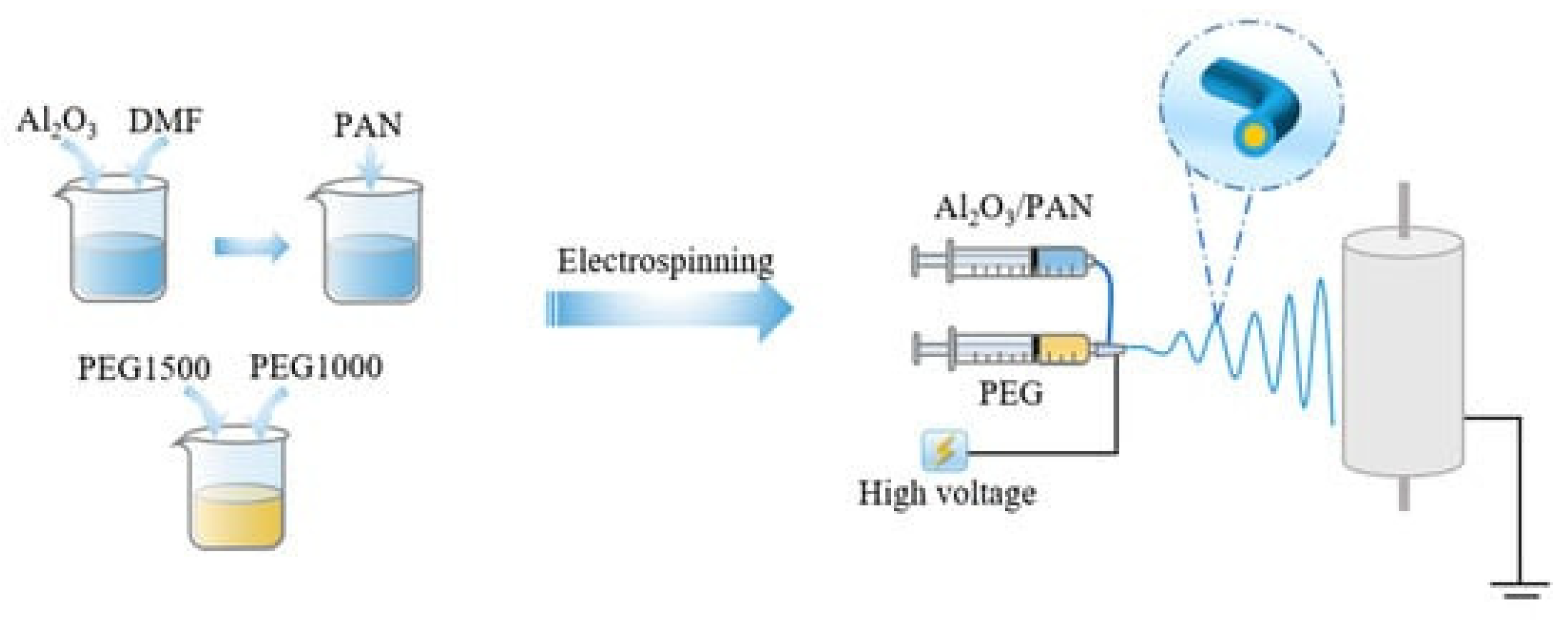
- Huang, L.; Chen, Y.; Xu, Z.; He, C.; Li, Y.; Zhao, J.; Tang, Y. Regulating Al2O3/PAN/PEG nanofiber membranes with suitable phase change thermoregulation features. Nanomaterials 2023, 13, 2313. [Google Scholar] [CrossRef]
- McCord, M.R.Y.; Zimmerman, J.B.; Rojas, O.J. Harnessing multifunctional electrospun nanofibers containing phase change materials for energy-efficient thermal management: A review on recent trends. Nano Energy 2024, 131, 110212. [Google Scholar] [CrossRef]
- Zhang, T.; Liu, M.; Zhang, R.; Guan, F.; Guo, J.; Gao, Y.; Li, M.; Li, Z.; Ji, X.; Zhang, Y. Core-Sheath Nanofibrous Membranes Based on a Phase Change Energy Storage/Radiative Cooling Synergistic Strategy for Personal Thermal Management. Adv. Mater. Technol. 2025, 11, e01251. [Google Scholar] [CrossRef]
- Fredi, G.; Kianfar, P.; Dalle Vacche, S.; Pegoretti, A.; Vitale, A. Electrospun Shape-Stabilized Phase Change Materials Based on Photo-Crosslinked Polyethylene Oxide. Polymers 2021, 13, 2979. [Google Scholar] [CrossRef]
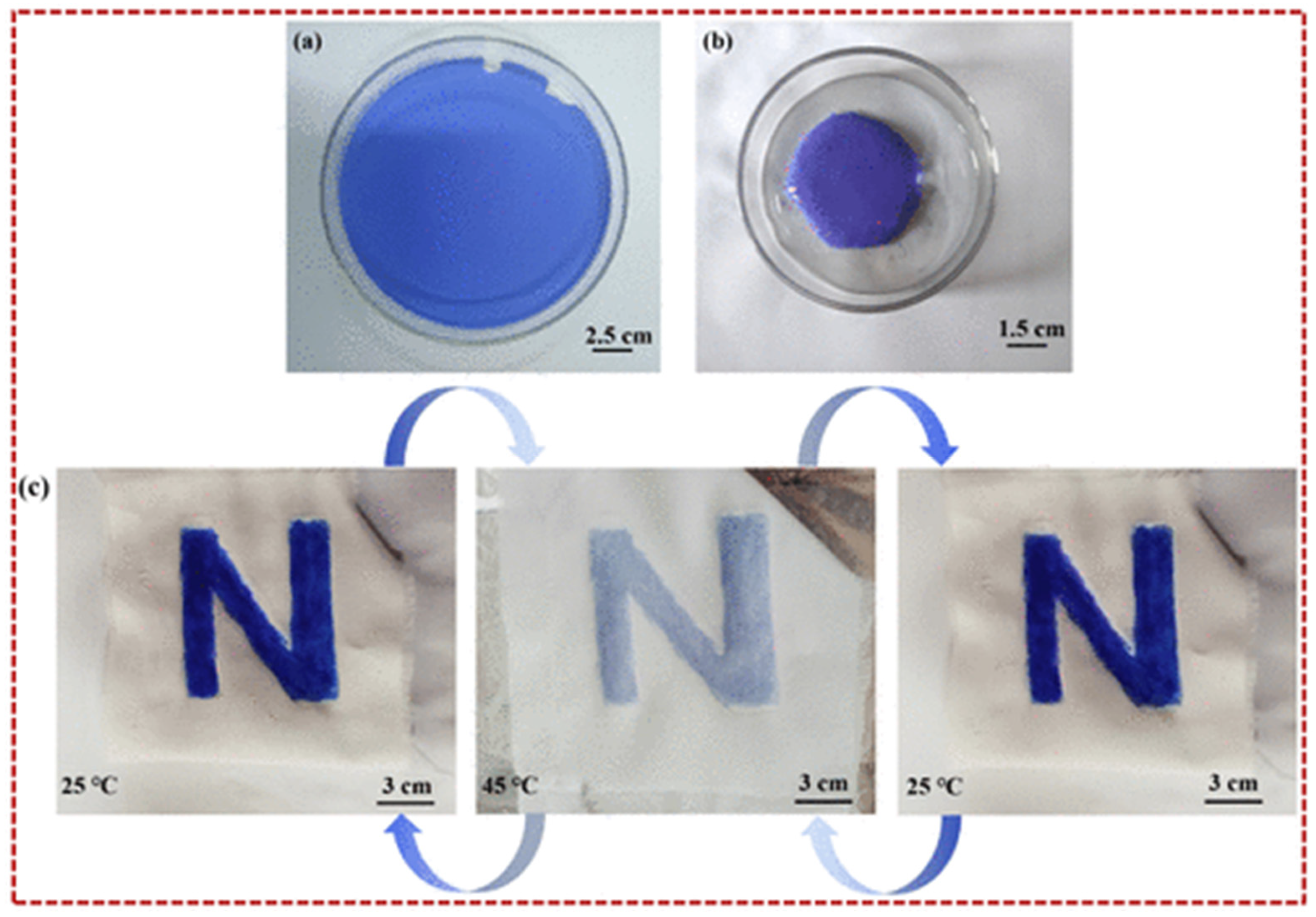
- Lee, C.; Tan, J.; Tang, H.T.; Yu, A.; Tan, J.J.; Lam, N.Y.K.; Tse, K.W. Smart textile-integrated thermochromic display for real-time temperature monitoring in elderly care. Discov. Appl. Sci. 2025, 7, 836. [Google Scholar] [CrossRef]
- Supian, A.B.M.; Asyraf, M.R.M.; Syamsir, A.; Najeeb, M.I.; Alhayek, A.; Al-Dala’ien, R.N.; Manar, G.; Atiqah, A. Thermochromic Polymer Nanocomposites for the Heat Detection System: Recent Progress on Properties, Applications, and Challenges. Polymers 2024, 16, 1545. [Google Scholar] [CrossRef] [PubMed]
- Ma, Q.; Wang, X.; Chen, Y.; Chen, L.; Zhang, L.; Zhao, X.; Bing, N.; Yu, W.; Xie, H. Poly(vinyl alcohol)-Based Nanofibers with Improved Thermal Conductivity and Efficient Photothermal Response for Wearable Thermal Management. ACS Appl. Nano Mater. 2023, 6, 14733–14744. [Google Scholar] [CrossRef]
- Sahebkar, K.; Indrakar, S.; Srinivasan, S.; Thomas, S.; Stefanakos, E. Electrospun microfibers with embedded leuco dye-based thermochromic material for textile applications. J. Ind. Text 2021, 51, 3188S–3200S. [Google Scholar] [CrossRef]
- Howell, C.; Vu, T.L.; Johnson, C.P.; Hou, X.; Ahanotu, O.; Alvarenga, J.; Leslie, D.C.; Uzun, O.; Waterhouse, A.; Kim, P.; et al. Stability of surface-immobilized lubricant interfaces under flow. Chem. Mater. 2015, 27, 1792–1800. [Google Scholar] [CrossRef]
- Lim, T.; Seo, H.S.; Yang, J.; Yang, K.-H.; Ju, S.-M. Reversible thermochromic fibers with excellent elasticity and hydrophobicity for wearable temperature sensors. RSC Adv. 2024, 14, 6156–6164. [Google Scholar] [CrossRef]
- Zhou, Y.; Duan, R. Leak-proof reversible thermochromic microcapsule phase change materials with high latent thermal storage for thermal management. ACS Appl. Energy Mater. 2024, 7, 5944–5956. [Google Scholar] [CrossRef]
- Kou, S.; Chang, S.; Huang, Z.; Min, X.; Zhang, X.; Fang, M.; Hao, L. Flexible Phase Change Composite Fibers for Wearable Applications—A Review. J. Appl. Polym. Sci. 2025, 143, e57962. [Google Scholar] [CrossRef]
- Huang, Y.; Song, M.; LI, X.; Du, Y.; Gao, Z.; Zhao, Y.-Q.; Li, C.; Yan, H.; Mo, X.; Wang, C.; et al. Temperature-responsive self-contraction nanofiber/hydrogel composite dressing facilitates the healing of diabetic-infected wounds. Mater. Today Bio 2024, 28, 101214. [Google Scholar] [CrossRef]
- Xu, Y.; Ajji, A.; Heuzey, M.-C. Response behaviors and mechanical strength of thermal responsive hydrogels fabricated by electrospinning. Polymer 2019, 183, 121880. [Google Scholar] [CrossRef]
- Tang, Q.; Qian, S.; Chen, W.; Song, X.; Huang, J. Preparation and characterization of temperature-responsive Ca–alginate/poly (N-isopropylacrylamide) hydrogel. Polym. Int. 2023, 72, 252–262. [Google Scholar] [CrossRef]
- Liu, X.; Yin, Q.; Wang, C.; Hu, Z.; Cai, Z. Morphology, thermal and mechanical properties of electrospun polyvinylidene/polyethylene glycol composite nanofibers as form-stabilized phase change materials. J. Polym. Eng. 2022, 42, 181–190. [Google Scholar] [CrossRef]
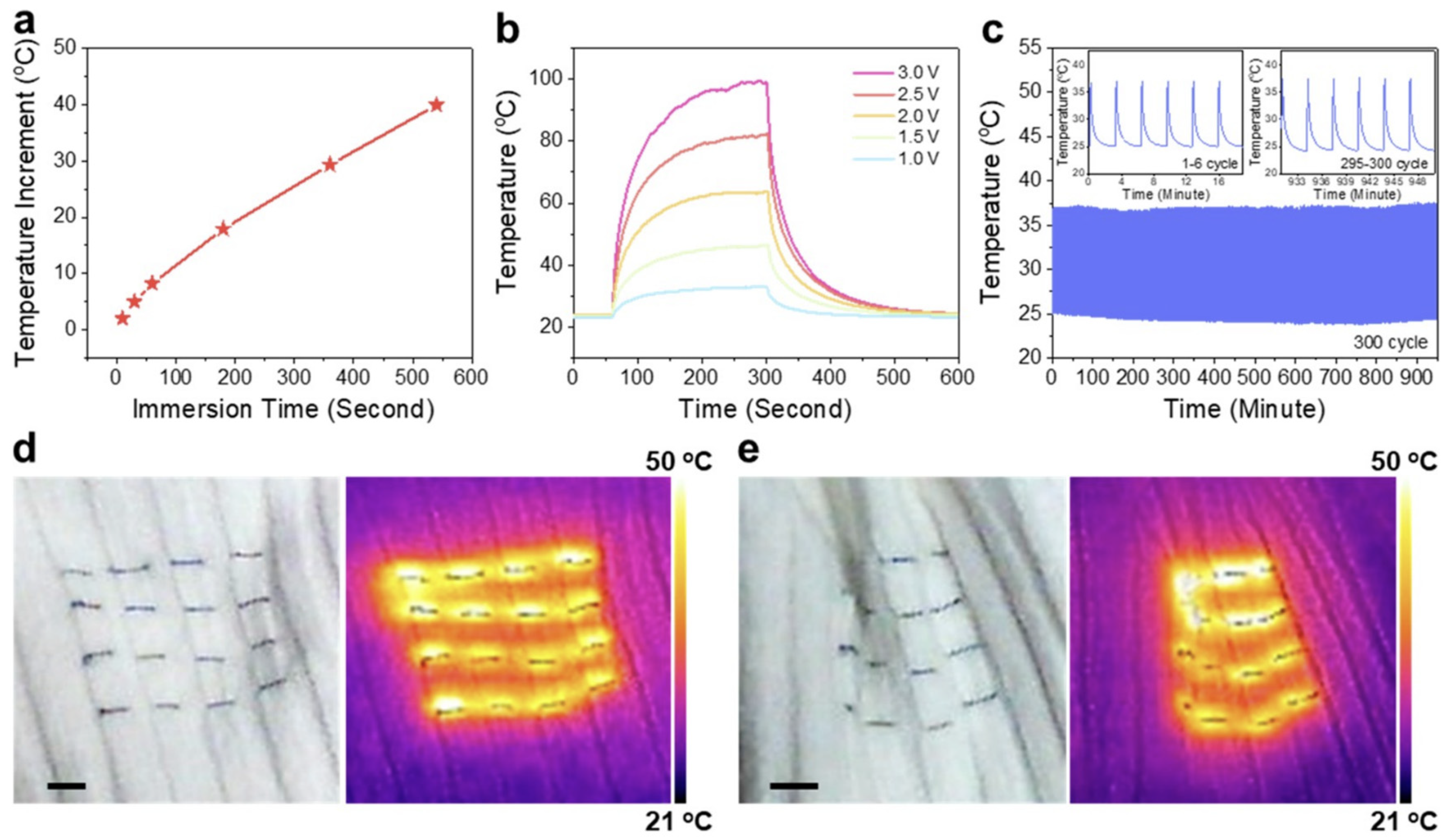
- Jeong, W.; Shin, H.; Kang, D.J.; Jeon, H.; Seo, J.; Han, T.H. Highly Stable Heating Fibers of Ti3C2Tx MXene and Polyacrylonitrile via Synergistic Thermal Annealing. Small Methods 2024, 8, 2400199. [Google Scholar] [CrossRef]
- Grancarić, A.M.; Jerković, I.; Koncar, V.; Cochrane, C.; Kelly, F.M.; Soulat, D.; Legrand, X. Conductive polymers for smart textile applications. J. Ind. Text. 2017, 48, 612–642. [Google Scholar] [CrossRef]
- Fang, Y.; Chen, G.; Bick, M.; Chen, J. Smart textiles for personalized thermoregulation. Chem. Soc. Rev. 2021, 50, 9357–9374. [Google Scholar] [CrossRef] [PubMed]
- Su, W.; Pang, Y.; Chang, Z.; E, Y.; Geng, F.; Yao, X.; Yuan, S.; Ma, M.; Ju, Y.; Wang, K.; et al. A “nanofiber membrane-microarray hydrogel” dual-module structure for thermal-solar-electric energy conversion. Nano Energy 2024, 123, 109408. [Google Scholar] [CrossRef]
- Namsheer, K.; Rout, C.S. Conducting polymers: A comprehensive review on recent advances in synthesis, properties and applications. RSC Adv. 2021, 11, 5659–5697. [Google Scholar] [CrossRef]
- Montoya, C.; Du, Y.; Gianforcaro, A.L.; Orrego, S.; Yang, M.; Lelkes, P.I. On the road to smart biomaterials for bone research: Definitions, concepts, advances, and outlook. Bone Res. 2021, 9, 1–16. [Google Scholar] [CrossRef]
- Teng, Y.; Song, L.; Shi, J.; Lv, Q.; Hou, S.; Ramakrishna, S. Advancing electrospinning towards the future of biomaterials in biomedical engineering. Regen. Biomater. 2025, 12, rbaf034. [Google Scholar] [CrossRef]
- Aaliya, B.; Sunooj, K.V.; Lackner, M. Biopolymer composites: A review. Int. J. Biobased Plast. 2021, 3, 40–84. [Google Scholar] [CrossRef]
- Wang, C.; Yokota, T.; Someya, T. Natural biopolymer-based biocompatible conductors for stretchable bioelectronics. Chem. Rev. 2021, 121, 2109–2146. [Google Scholar] [CrossRef]
- Bhongade, T.; Kumar, K.; Joshi, S. Functionalized biopolymers for renewable energy applications. In Functionalized Biopolymers: Design, Developments, and Applications, 1st ed.; Sharma, S., Nadda, K.A., Deshmukh, K., Hussain, C.M., Eds.; Elsevier: London, UK, 2026; Volume 17, pp. 643–670. [Google Scholar] [CrossRef]
- Lee, J.H.; Chen, H.M.; Kim, E.; Zhang, H.; Wu, K.; Zhang, H.; Shen, X.; Zheng, Q.; Yang, J.; Jeon, S.; et al. Flexible temperature sensors made of aligned electrospun carbon nanofiber films with outstanding sensitivity and selectivity towards temperature. Mater. Horiz. 2021, 8, 1488–1498. [Google Scholar] [CrossRef] [PubMed]
- Jia, S.; Gao, H.; Xue, Z.; Meng, X. Recent advances in multifunctional wearable sensors and systems: Design, fabrication, and applications. Biosensors 2022, 12, 1057. [Google Scholar] [CrossRef] [PubMed]
- Yu, X.; Li, Y.; Wang, X.; Si, Y.; Yu, J.; Ding, B. Thermoconductive, moisture-permeable, and superhydrophobic nanofibrous membranes with interpenetrated boron nitride network for personal cooling fabrics. ACS Appl. Mater. Interfaces 2020, 12, 32078–32089. [Google Scholar] [CrossRef] [PubMed]
- Zhang, Y.; Tang, Q.; Zhou, J.; Zhao, C.; Li, J.; Wang, H. Conductive and eco-friendly biomaterials-based hydrogels for noninvasive epidermal sensors: A review. ACS Biomater. Sci. Eng. 2024, 10, 191–218. [Google Scholar] [CrossRef]
- Khan, M.A.; Cantù, E.; Tonello, S.; Serpelloni, M.; Lopomo, N.F.; Sardini, E. A Review on biomaterials for 3d conductive scaffolds for stimulating and monitoring cellular activities. Appl. Sci. 2019, 9, 961. [Google Scholar] [CrossRef]
- Tadesse, M.G.; Lübben, J.F. Polymer bionanocomposites for sensor and wearable electronic applications. In Woodhead Publishing Series in Composites Science and Engineering, Polymer Nano-Biocomposites, 1st ed.; Lakshminarasimhan, R., Abdellaoui, H., Rangappa, S.M., Siengchin, S., Eds.; Woodhead Publishing Series in Composites Science and Engineering; Woodhead Publishing: Sawston, UK, 2026; Volume 19, pp. 449–472. [Google Scholar] [CrossRef]
- Cai, J.; Du, M.; Li, Z. Flexible temperature sensors constructed with fiber materials. Adv. Mater. Technol. 2022, 7, 2101182. [Google Scholar] [CrossRef]
- Trung, T.Q.; Lee, N.E. Flexible and stretchable physical sensor integrated platforms for wearable human-activity monitoring and personal healthcare. Adv. Mater. 2016, 28, 4338–4372. [Google Scholar] [CrossRef]
- Setnescu, R.; Lungulescu, E.M. Novel ptc composites for temperature sensors (and related applications). In Book Wireless Sensor Networks—Design, Applications and Challenges, 1st ed.; Sen, J., Yi, M., Fenglei Niu, F., Wu, H., Eds.; IntechOpen: London, UK, 2023; Volume 6, pp. 170–470. [Google Scholar] [CrossRef]
- Yang, T.T.; Xie, D.; Li, Z.H.; Zhu, H.V. Recent advances in wearable tactile sensors: Materials, sensing mechanisms, and device performance. Mater. Sci. Eng. 2017, 115, 1–37. [Google Scholar] [CrossRef]
- Shin, J.; Jeong, B.; Kim, J.; Nam, V.B.; Yoon, Y.; Jung, J.; Hong, S.; Lee, H.; Eom, H.; Yeo, J.; et al. Sensitive wearable temperature sensor with seamless monolithic integration. Adv. Mater. 2025, 32, 1905527. [Google Scholar] [CrossRef]
- Abadi, B.; Goshtasbi, N.; Bolourian, S.; Tahsili, J.; Adeli-Sardou, M.; Forootanfar, H. Electrospun hybrid nanofibers: Fabrication, characterization, and biomedical applications. Front. Bioeng. Biotechnol. 2022, 10, 986975. [Google Scholar] [CrossRef] [PubMed]
- Yalcinkaya, B.; Buzgo, M. A Guide for industrial needleless electrospinning of synthetic and hybrid nanofibers. Polymers 2025, 17, 3019. [Google Scholar] [CrossRef] [PubMed]
- Pakdel, E.; Naebe, M.; Lu, S.; Wang, X.A. Advanced Functional Fibrous Materials for Enhanced Thermoregulating Performance. ACS Appl. Mater. Interfaces 2019, 11, 13039–13057. [Google Scholar] [CrossRef] [PubMed]
- Cheng, P.; Tang, Z.; Gao, Y.; Liu, P.; Liu, C.; Chen, X. Flexible engineering of advanced phase change materials. iScience 2022, 25, 104226. [Google Scholar] [CrossRef]
- Kizildag, N. Smart composite nanofiber mats with thermal management functionality. Sci. Rep. 2021, 11, 4256. [Google Scholar] [CrossRef]
- Ravikiran, N.; Padya, B.; Rao, A.; Kali, R.; Jain, P.K. Classification of phase change materials. In Woodhead Publishing Series in Composites Science and Engineering, Multifunctional Phase Change Materials, Fundamentals, Properties and Applications, 1st ed.; Pielichowska, K., Pielichowski, K., Eds.; Woodhead Publishing: Sawston, UK, 2023; Volume 2, pp. 95–112. [Google Scholar] [CrossRef]
- Pielichowska, K.; Pielichowski, K. Phase change materials for thermal energy storage PCMs in biomedical applications. In Woodhead Publishing Series in Composites Science and Engineering, Multifunctional Phase Change Materials, 1st ed.; Woodhead Publishing: Sawston, UK, 2023; Volume 10, pp. 411–444. [Google Scholar] [CrossRef]
- Pielichowska, K.; Pielichowski, K. Phase change materials for thermal energy storage. Prog. Mater. Sci. 2014, 65, 67–123. [Google Scholar] [CrossRef]
- Stramarkou, M.; Tzegiannakis, I.; Christoforidi, E.; Krokida, M. Use of Electrospinning for Sustainable Production of Nanofibers: A Comparative Assessment of Smart Textiles-Related Applications. Polymers 2024, 16, 514. [Google Scholar] [CrossRef]
- Baniasadi, H.; Madani, M.; Seppälä, J.; Zimmerman, J.B.; Yazdani, M.R. Form-stable phase change electrospun nanofibers mat with thermal regulation and biomedical multi-functionalities. J. Energy Storage 2023, 68, 107660. [Google Scholar] [CrossRef]
- Chai, X.; Zhao, T.; Yue, J.; Yang, J.; Zhang, S.; Du, J.; Zhang, A.; Feng, Z. Flexible and degradable polycaprolactone based phase change composites for thermal energy management. React. Funct. Polym. 2022, 181, 105451. [Google Scholar] [CrossRef]
- Wang, H.; Zhou, C.; Wang, Y.; Li, N.; Xiong, J. Phase change composite fiber membranes based on polyurethane/ polyethylene glycol/silica with super-wetting and photothermal properties. J. Energy Storage 2024, 77, 109876. [Google Scholar] [CrossRef]
- Ma, C.; Gao, Y.; Cao, Y.; Yang, Y.; Wang, W.; Wang, J. Hierarchically core-shell nanofiber textiles for personal cooling in hot and humid conditions. Nano Energy 2024, 123, 109400. [Google Scholar] [CrossRef]
- Pan, C.; Fu, F.; Fan, G.; Long, Y.; Yang, H.; Yang, G.; Li, X. A multifunctional flexible composite film with excellent insulation flame retardancy, thermal management and solar-thermal conversion properties based on CNF-modified mica/electrospun fibrous networks structure. Sol. Energy Mater. Sol. Cells 2023, 261, 112530. [Google Scholar] [CrossRef]
- Salimian, S.; Montazer, M.; Rashidi, A.S.; Soleimani, N.; Rezaie, A.B. PCM nanofibrous composites based on PEG/PVA incorporated by TiO2/Ag nanoparticles for thermal energy management. J. Appl. Polym. Sci. 2021, 138, 51357. [Google Scholar] [CrossRef]
- Huang, J.; Yu, H.; Abdalkarim, S.Y.H.; Marek, J.; Militky, J.; Li, Y.; Yao, J. Electrospun polyethylene glycol/polyvinyl alcohol composite nanofibrous membranes as shape-stabilized solid–solid phase change materials. Adv. Fiber Mater. 2020, 2, 167–177. [Google Scholar] [CrossRef]
- Wu, J.; Wang, M.; Dong, L.; Zhu, C.; Shi, J.; Morikawa, H. Ultraflexible, breathable, and form-stable phase change fibrous membranes by green electrospinning for personal thermal management. ACS Sustain. Chem. Eng. 2022, 10, 7873–7882. [Google Scholar] [CrossRef]
- Ji, R.; Zhang, Q.; Zhou, F.; Xu, F.; Wang, X.; Huang, C.; Zhu, Y.; Zhang, H.; Sun, L.; Xia, Y.; et al. Electrospinning fabricated novel poly (ethylene glycol)/graphene oxide composite phase-change nano-fibers with good shape stability for thermal regulation. J. Energy Storage 2021, 40, 102687. [Google Scholar] [CrossRef]
- Moradi, A.; Szewczyk, P.K.; Roszko, A.; Fornalik-Wajs, E.; Stachewicz, U. Unraveling the impact of boron nitride and silicon nitride nanoparticles on thermoplastic polyurethane fibers and mats for advanced heat management. ACS Appl. Mater. Interfaces 2024, 16, 41475–41486. [Google Scholar] [CrossRef]
- Nourani, M.; Jafari, S.M. Electrospun fibers/nanofibers loaded with phase change materials: Characterization, applications and challenges. Polym. Test 2025, 150, 108879. [Google Scholar] [CrossRef]
- Wang, S.X.; Yap, C.C.; He, J.; Chen, C.; Wong, S.Y.; Li, X. Electrospinning: A facile technique for fabricating functional nanofibers for environmental applications. Nanotechnol. Rev. 2016, 5, 51–73. [Google Scholar] [CrossRef]
- Ambekar, R.S.; Kandasubramanian, B. Antimicrobial electrospun materials. In Electrospun Materials and Their Allied Applications, 1st ed.; Boddula, I.R., Ahamed, M.I., Asiri, A.M., Eds.; Scrivener Publishing LLC: Beverly, MA, USA, 2020; Volume 17, pp. 243–263. [Google Scholar] [CrossRef]
- Liu, L.; Xu, W.; Ding, Y.; Agarwal, S.; Greiner, A.; Duan, G. A review of smart electrospun fibers toward textiles. Compos. Commun. 2020, 22, 100506. [Google Scholar] [CrossRef]
- Leng, Q.; Li, Y.; Pang, X.; Wang, B.; Wu, Z.; Lu, Y.; Fu, S. Curcumin nanoparticles incorporated in PVA/collagen composite films promote wound healing. Drug Deliv. 2020, 27, 1676–1685. [Google Scholar] [CrossRef]
- Yakub, G.; Toncheva, A.; Manolova, N.; Rashkov, I.; Danchev, D.; Kussovski, V. Electrospun polylactide-based materials for curcumin release: Photostability, antimicrobial activity, and anticoagulant effect. J. Appl. Polym. Sci. 2016, 133, 42940. [Google Scholar] [CrossRef]
- Castellano, M.; Dodero, A.; Scarfi, S.; Mirata, S.; Pozzolini, M.; Tassara, E.; Sionkowska, A.; Adamiak, K.; Alloisio, M.; Vicini, S. Chitosan–Collagen Electrospun Nanofibers Loaded with Curcumin as Wound-Healing Patches. Polymers 2023, 15, 2931. [Google Scholar] [CrossRef] [PubMed]
- Lin, C.M.; Chang, Y.C.; Cheng, L.C.; Liu, C.H.; Chang, S.C.; Hsien, T.Y.; Wang, D.M.; Hsieh, H.J. Preparation of graphene-embedded hydroxypropyl cellulose/chitosan/polyethylene oxide nanofiber membranes as wound dressings with enhanced antibacterial properties. Cellulose 2020, 27, 2651–2667. [Google Scholar] [CrossRef]
- Khanzada, H.; Salam, A.; Qadir, M.B.; Phan, D.-N.; Hassan, T.; Munir, M.U.; Pasha, K.; Hassan, N.; Khan, M.Q.; Kim, I.S. Fabrication of promising antimicrobial aloe vera/PVA electrospun nanofibers for protective clothing. Materials 2020, 13, 3884. [Google Scholar] [CrossRef] [PubMed]
- Costa, S.M.; Pacheco, L.; Antunes, W.; Vieira, R.; Bem, N.; Teixeira, P.; Fangueiro, R.; Ferreira, D.P. Antibacterial and biodegradable electrospun filtering membranes for facemasks: An attempt to reduce disposable masks use. Appl. Sci. 2022, 12, 67. [Google Scholar] [CrossRef]
- Wang, S.; Chen, W.; Wang, L.; Yao, J.; Zhu, G.; Guo, B.; Militky, J.; Venkataraman, M.; Zhang, M. Multifunctional nanofiber membrane with anti-ultraviolet and thermal regulation fabricated by coaxial electrospinning. J. Ind. Eng. Chem. 2022, 108, 449–455. [Google Scholar] [CrossRef]
- Yi, L.; Wang, S.; Wang, L.; Yao, J.; Marek, J.; Zhang, M. A waterproof and breathable nanofibrous membrane with thermalregulated property for multifunctional textile application. J. Appl. Polym. Sci. 2021, 138, 50391. [Google Scholar] [CrossRef]
- Xu, T.; Zhang, S.; Han, S.; Qin, Y.; Liu, C.; Xi, M.; Yu, X.; Li, N.; Wang, Z. Fast solar-to-thermal conversion/storage nanofibers for thermoregulation, stain-resistant, and breathable fabrics. Ind. Eng. Chem. Res. 2021, 60, 5869–5878. [Google Scholar] [CrossRef]
- Zhang, B.; Li, X.; Lin, Y.; Cheng, N.; Jiao, W.; Wang, X.; Yu, J.; Ding, B. Optimization of bio-based polyurethane elastic nanofibrous membrane via electrospinning for waterproof and breathable applications. Polymers 2025, 17, 486. [Google Scholar] [CrossRef]
- Qiao, J.; He, C.; Guo, Z.; Lin, F.; Liu, M.; Liu, X.; Liu, Y.; Huang, Z.; Mi, R.; Min, X. Flexible highly thermally conductive PCM film prepared by centrifugal electrospinning for wearable thermal management. Materials 2024, 17, 4963. [Google Scholar] [CrossRef] [PubMed]
- Liguori, A.; Pandini, S.; Rinoldi, C.; Zaccheroni, N.; Pierini, F.; Focarete, M.L.; Gualandi, C. Thermoactive Smart Electrospun Nanofibers. Macromol. Rapid Commun. 2022, 43, 2100694. [Google Scholar] [CrossRef] [PubMed]
- Liu, Z.; Ramakrishna, S.; Ahmed, I.; Rudd, C.; Liu, X. Rheological, Surface Tension and Conductivity Insights on the Electrospinnability of Poly(lactic-co-glycolic acid)-hyaluronic Acid Solutions and Their Correlations with the Nanofiber Morphological Characteristics. Polymers 2022, 14, 4411. [Google Scholar] [CrossRef] [PubMed]
- Shu, M.; Chen, M.; Zhang, X.; Liu, H.; Xu, Y.; Tang, Z.; Hang, F.; Hou, J.; Liu, Z.; Zong, P. Show more. Flexible temperature-pressure sensor array based on thermoelectric BiTeSe/carbon paper/BiTeSe films with nano-rice interfaces. Chem. Eng. J. 2025, 522, 168136. [Google Scholar] [CrossRef]
- Chang, Y.; Qi, X.; Wang, L.; Li, C.; Wang, Y. Recent Advances in Flexible Multifunctional Sensors. Micromachines 2023, 14, 2116. [Google Scholar] [CrossRef]
- Huang, X.; Alva, G.; Jia, Y.; Fang, G. Morphological characterization and applications of phase change materials in thermal energy storage: A review. Renew. Sustain. Energy Rev. 2017, 72, 128–145. [Google Scholar] [CrossRef]
- Faraj, K.; Khaled, M.; Faraj, J.; Hachem, F.; Castelain, C. Phase change material thermal energy storage systems for cooling applications in buildings: A review. Renew. Sustain. Energy Rev. 2020, 119, 109579. [Google Scholar] [CrossRef]
- Sharma, S.; Sudhakara, P.; Omran, A.A.B.; Singh, J.; Ilyas, R.A. Recent Trends and Developments in Conducting Polymer Nanocomposites for Multifunctional Applications. Polymers 2021, 13, 2898. [Google Scholar] [CrossRef]
- Fu, W.; Yu, B.; Ji, D.; Zhou, Z.; Li, X.; Wang, R.; Lu, W.; Sun, Y.; Dai, Y. Intelligent fibers and textiles for wearable biosensors. Responsive Mater. 2024, 2, e20240018. [Google Scholar] [CrossRef]
- Azeem, M.; Shahid, M.; Masin, I.; Petru, M. Design and development of textile-based wearable sensors for real-time biomedical monitoring. J. Text. Inst. 2024, 116, 80–95. [Google Scholar] [CrossRef]
- Zhou, L.; Li, C.; Luo, Y.; Liang, Q.; Chen, Y.; Yan, Z.; Qui, L.; He, S. Autonomous fabric electrochemical biosensor for efficient health monitoring. Natl. Sci. Rev. 2025, 12, nwaf155. [Google Scholar] [CrossRef] [PubMed]
- Flexible Electrospun Textile Powers Self-Sustaining Wearable Sensors. Available online: https://materialdistrict.com/article/electrospun-smart-textile-material-enables-self-powered-wearable-sensors/ (accessed on 4 December 2025).
- Zhu, L.; Luan, W.S.; Wei, J.; Yang, Y.; Miao, J. Nanomaterials for smart wearable fibers and textiles: A critical review. iScience 2025, 28, 113126. [Google Scholar] [CrossRef] [PubMed]
- Zhao, R. Multifunctional Application of Electrospun Fiber. Polymers 2025, 17, 2519. [Google Scholar] [CrossRef] [PubMed]
- Asran, A.S.; Salama, M.; Popescu, C.; Michler, G.H. Solvent Influences the Morphology and Mechanical Properties of Electrospun Poly(L-lactic acid) Scaffold for Tissue Engineering Applications. Macromol. Symp. 2010, 294, 153–161. [Google Scholar] [CrossRef]
- Kilic, N.M.; Gelen, S.S.; Zeybekler, S.E.; Odaci, D. Carbon-based nanomaterials decorated electrospun nanofibers in biosensors: A review. ACS Omega 2024, 9, 3−15. [Google Scholar] [CrossRef]
- Chen, X.; Wang, J.; Zhang, J.; Lin, H.; Tian, M.; Li, M.; Tain, Y. Development and application of electrospun fiber-based multifunctional sensors. Chem. Eng. J. 2024, 486, 150204. [Google Scholar] [CrossRef]
- Jayadevan, S.; Aliyana, A.K.; Stylios, G. An overview of advances and challenges in developing nanofiber yarns for wearable technology. Nano Energy 2024, 129, 110034. [Google Scholar] [CrossRef]
- Yin, Y.; Guo, C.; Mu, Q.; Yang, H.; Chen, D. Electrostatically spun nanofiber yarns for textile electronics. Colloid. Interface Sci. Commun. 2023, 56, 100742. [Google Scholar] [CrossRef]
- Islam, S.; Shekhar, R. Smart Textiles and Wearable Technology: Opportunities and Challenges in the Production and Distribution. In Use of Digital and Advanced Technologies in the Fashion Supply Chain, 1st ed.; Nayak, R., Truong, H., Pal, R., Eds.; Springer Series in Fashion Business; Springer: Singapore, 2025; pp. 267–303. [Google Scholar] [CrossRef]
- ISO 14040:2006; Environmental management—Life cycle assessment—Principles and framework. Organization for Standardization: Geneva, Switzerland, 2006.
- ISO 14044:2006; Environmental management—Life cycle assessment—Requirements and guidelines. Organization for Standardization: Geneva, Switzerland, 2006.
- Zhang, J.; Qi, Y.; Shen, Y.; Li, H. Research progress on chemical modification and application of cellulose: A review. Mater. Sci. 2022, 28, 60–67. [Google Scholar] [CrossRef]
- Cho, Y.; Won Baek, J.W.; Sagong, M.; Ahn, S.; Nam, J.S.; Kim, I.-D. Electrospinning and Nanofiber Technology: Fundamentals, Innovations, and Applications. Adv. Mater. 2025, 37, 2500162. [Google Scholar] [CrossRef]
- Shi, J.; Qin, M.; Aftab, W.; Zou, R. Flexible phase change materials for thermal energy storage. Energy Storage Mater. 2021, 41, 321–342. [Google Scholar] [CrossRef]
- Liu, H.; Fu, R.; Su, X.; Wu, B.; Wang, H.; Xu, Y.; Liu, X. MXene confined in shape- stabilized phase change material combining enhanced electromagnetic interference shielding and thermal management capability. Compos. Sci. Technol. 2021, 210, 108835. [Google Scholar] [CrossRef]







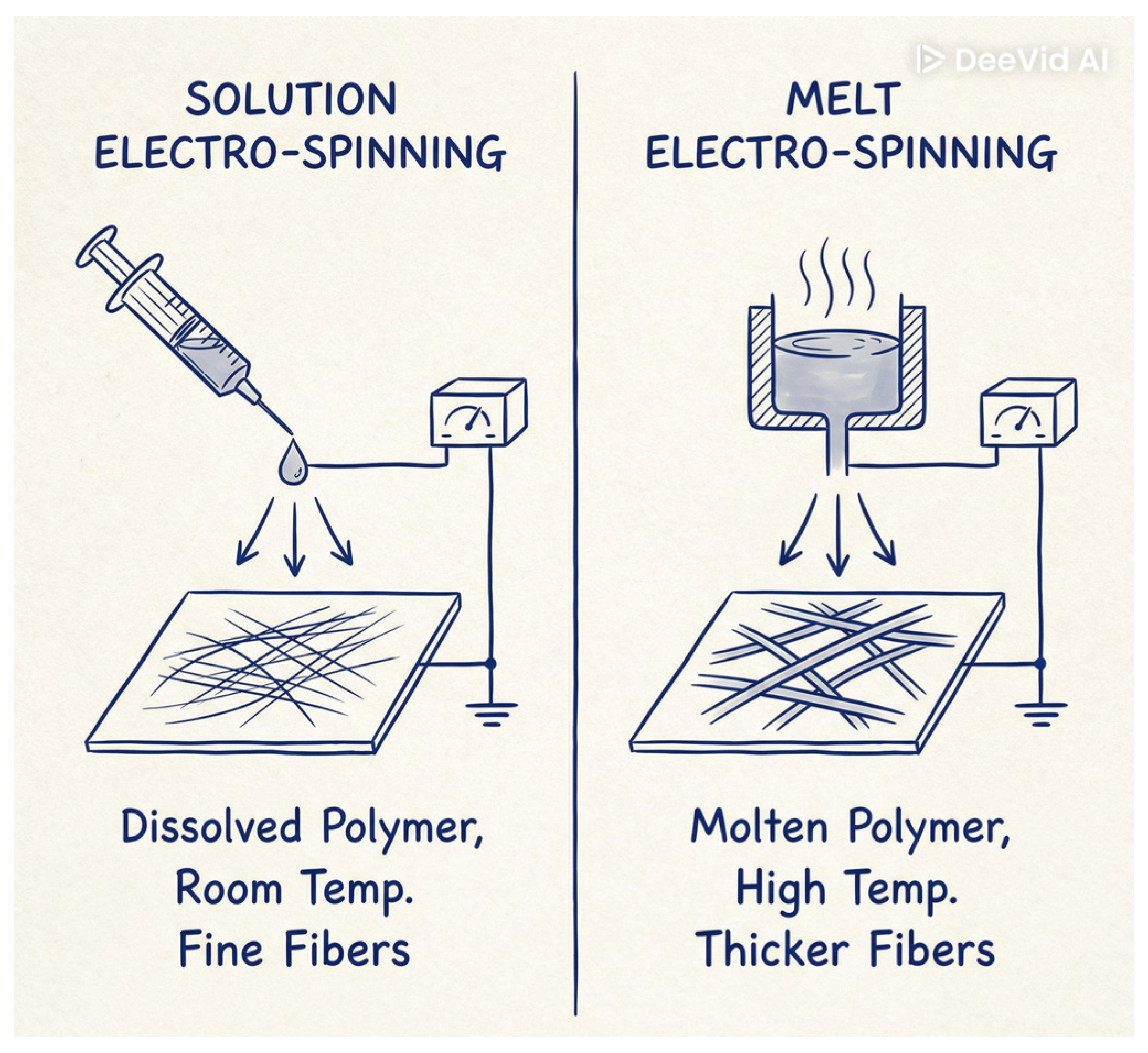
| Parameter | Solution Electrospinning | Melt Electrospinning |
|---|---|---|
| Processing method | Polymer dissolved in solvent | Molten polymer without solvent |
| Fiber diameter | Nanometer to micrometer scale due to strong jet thinning from solvent evaporation | Typically micrometer-scale because no mass loss occurs during jet travel |
| Material compatibility | Extremely broad polymer range including biopolymers, conductive polymers, and composites | Limited to thermoplastic, thermally stable polymers |
| Temperature sensitivity | Low processing temperatures allow incorporation of enzymes, antibodies, and bioactives | High temperatures prevent use of thermally sensitive additives |
| Environmental impact | Solvent use introduces toxicity and VOC concerns | Solvent-free and environmentally friendly |
| Mechanical strength | Dependent on solvent removal and polymer crystallinity | Generally higher strength due to dense melt-state polymer chains |
| Energy consumption | Lower energy demand (no melting required) | Higher energy demand due to heating above melting point |
| Scalability | Widely scalable but requires solvent recovery systems | Highly scalable for industrial production |
| Fiber placement precision | Limited due to jet whipping | High precision possible via melt electrowriting |
| Suitability for smart textiles | Ideal for ultrafine sensing layers and bioactive coatings | Ideal for durable structural layers and patterned conductive paths |
| Fiber Forming Polymer | Solvents | Key Fiber Properties | |
|---|---|---|---|
| Biopolymer | gelatin | acetic acid, formic acid, water/ethanol mixture | Biodegradable, flexible, high surface area; fiber uniformity sensitive to solvent composition |
| collagen | acetic acid, 1,1,1,3,3,3-hexafluoro-2-propanol (HFIP) | Biocompatible, protein-based, tunable porosity | |
| silk fibroin | formic acid, HFIP, water | Strong, elastic, tunable fiber diameter | |
| chitosan | acetic acid, trifluoroacetic acid (TFA), acetic acid | Antimicrobial, hydrophilic, fiber diameter sensitive to concentration | |
| cellulose acetate | acetic acid, acetone, DMF, DCM, | Biodegradable, thermally stable, uniform fibers | |
| Synthetic polymer | poly(vinyl alcohol) (PVA) | water, water/DMSO mixture, water/ethanol mixture | Hydrophilic, water-processable, moderate mechanical strength |
| poly(ε-caprolactone) (PCL) | acetone, chloroform, DMF, DCM/methanol mixture | Flexible, mechanically robust, slow degradation | |
| polyurethane (PU) | DMF, THF, DMF/acetone mixture | Stretchable, elastic, chemical resistant | |
| poly(lactic acid) (PLA) | acetone, chloroform, DMF, DCM | Biodegradable, moderate strength, tunable porosity | |
| polyacrylonitrile (PAN) | DMF, DMSO | High thermal stability, electrically conductive with fillers | |
| Additive Type | Examples | Functional Role in Wearable Textiles | Reference |
|---|---|---|---|
| conductive polymer | PEDOT: PSS, polyaniline (PANI), polypyrrole (PPy) | Provide electrical conductivity, enable flexible circuits, support strain/pressure sensing, facilitate Joule heating for thermal management. | [34,90] |
| carbon-based nanomaterial | graphene, graphene oxide (GO), reduced GO, carbon nanotubes (CNTs), carbon black, etc. | Enhance electrical and thermal conductivity, improve mechanical strength, enable electrochemical and optical sensing, assist in heat dissipation. | [102,103,104] |
| metal nanoparticles (NPs) | silver (AgNPs), gold (AuNPs), platinum (PtNPs), copper (CuNPs) | Impart high electrical conductivity, catalytic activity, antibacterial properties, plasmonic/photothermal effects for adaptive heating and sensing. | [96] |
| inorganic MXenes | Ti3C2Tx and other 2D carbides/nitrides | Provide high electrical and thermal conductivity, electrochemical activity, mechanical reinforcement, and multifunctional sensing capabilities. | [25,105,106] |
| Polymers | Type of Polymer | Advantages | Limitations | Reference |
|---|---|---|---|---|
| Natural electrospun polymer | Silk fibroin, cellulose, chitosan, gelatin | High biocompatibility and comfort; Naturally breathable and moisture-absorbing; Sustainable and biodegradable. | Weaker, sensitive to moisture Less effective in long-term thermal regulation without modification | [112,113,115,117,156] |
| Synthetic electrospun Polymers | Polyurethane, polycaprolactone, polyethylene oxide, polyacrylonitrile | Durability and tunability in fiber diameter, porosity, and crystallinity. Can embed PCMs, conductive fillers, or dyes for precise thermal control. Better mechanical strength and washability. | Lower biocompatibility; often hydrophobic. Environmental concerns (non-biodegradable, microplastic release). Require surface modification for comfort and moisture management | [18,143,157] |
| Method | Polymer/PCM | Additive | Functionalization | Reference |
|---|---|---|---|---|
| Uniaxial/Coaxial electrospinning | PCL/PEG | - | Melting enthalpy: 39.5 × 10³ J/kg; Thermal conductivity: 0.1662 W/mK/Smart fabrics, biosensors | [236] |
| PCL/PEG | Curcumin | Biomedical (drug release and antioxidant activity) | [237] | |
| PCL/PEG | - | The thermal conductivity of PCL@PEG70 could go up to 0.1662 W/mK, increasing by 49.5% compared with that of PCL. | [238] | |
| PU/PEG | SiO2 | Increased visible and near-infrared light reflectance, superwetting, photothermal regulation | [239] | |
| PU/PEG | Si3N4 | High thermal conductivity (4504 mW/m K); Increased solar reflectance (91 %), high infrared emissivity (92 %), | [240] | |
| PU and CNF/Stearic acid | Mica mineral | Enhanced electrical resistivity and UV] reflectance | [241] | |
| PVA/PEG | AgNO3; TiO2 | Enhanced thermal properties (decrease in supercooling effect) | [242] | |
| PVA/Lauric acid (LA)/(PCM) | MWCNTs/ZnO particles coated with a green PDMS layer | Thermal conductivity of PVA -(0.334 W·m–1·K–1); HPCF −0.665 W·m–1·K–5; excellent UV-protection | [197] | |
| PVA/PEG | - | Heat enthalpies of PEG/PVA were 78.806 J/g; Excellent thermal stability; Good thermal regulation. | [243] | |
| PVA/PEG | CNT | Increased mechanical strength and thermal conductivity (64.92 mW/m·K, 40.4 % increase) | [244] | |
| PVA/Paraffin | Polypyrrole (PPy) coating; Silver nanowires (AgNWs) | Increased thermal conduction pathways, photothermal conversion, electrical conductivity (0.148 S/m), piezoresistive response range (440.6 kPa) | [210] | |
| PVP/PEG | GO | Improved thermal conductivity (566.8 mW/m.K) | [245] |
| Challenge | Description | Impact on Commercialization | Reference |
|---|---|---|---|
| Biocompatibility and skin safety | Long-term wear demands biomaterials that are safe, hypoallergenic, breathable, and non-cytotoxic. Balancing performance additives (e.g., conductive or photothermal coatings) with dermatological safety remains nontrivial, as continuous skin contact requires stable finishes that do not cause irritation or adverse reactions. | Limits adoption in healthcare and elder care if safety concerns are not fully addressed. | [18,209,269] |
| Durability and washability | Smart textiles must withstand repeated mechanical stress, bending, sweat exposure, abrasion, and laundering without degradation of thermal or electrical performance. Maintaining sensor accuracy and fiber integrity under these conditions is a persistent hurdle for nanomaterial-laden and electrospun systems. | Reduces product lifespan and consumer confidence in everyday use. | [18,270,273] |
| Power supply and management | Integration of flexible, lightweight, and sustainable energy sources remains a bottleneck. Active heating and closed-loop control require reliable energy delivery, yet energy-harvesting fibers often provide inconsistent output. Efficient storage and integration solutions are needed to support all-day wear. | Restricts continuous operation of sensors and active heating/cooling systems. | [18] |
| Signal stability and data reliability | Ensuring accurate sensor readings under motion, perspiration, and environmental fluctuations is essential. Motion artifacts, sweat interference, and variable fit can compromise data quality, requiring careful co-design of materials and electronics. | Weakens trust in health monitoring and performance feedback applications. | [271,273] |
| Manufacturing scalability and cost | Scaling electrospun and nanocomposite fibers to roll-to-roll production with consistent quality control raises costs and variability. Supply chain limitations and lack of standardization hinder broader adoption, while commercialization requires reproducible, cost-effective manufacturing. | Slows industrial adoption and increases barriers to mass-market entry. | [270,273,280] |
| Standards and interoperability | The absence of uniform testing methods (e.g., thermal emissivity, comfort metrics, bio-safety), certification pathways, and integration protocols with electronics delays regulatory approval and market entry. | Delays regulatory approval and hinders integration into broader wearable ecosystems. | [280] |
| User comfort and experience | Designing textiles that provide accurate on-body temperature sensing across diverse fits and activities, while avoiding bulk, hotspots, or discomfort, requires careful integration of materials, electronics, and ergonomic design. | Impacts consumer acceptance and usability in daily wear. | [18,209] |
Disclaimer/Publisher’s Note: The statements, opinions and data contained in all publications are solely those of the individual author(s) and contributor(s) and not of MDPI and/or the editor(s). MDPI and/or the editor(s) disclaim responsibility for any injury to people or property resulting from any ideas, methods, instructions or products referred to in the content. |
© 2026 by the authors. Licensee MDPI, Basel, Switzerland. This article is an open access article distributed under the terms and conditions of the Creative Commons Attribution (CC BY) license.
Share and Cite
Varnaitė-Žuravliova, S.; Rukuižienė, Ž.; Skurkytė-Papievienė, V.; Bekampienė, P.; Trakšelytė, V.; Baltušnikaitė-Guzaitienė, J. Biocompatible Electrospun Biomaterials for Advancing Thermoregulating Wearable Sensors in Next-Generation Smart Textiles. J. Funct. Biomater. 2026, 17, 100. https://doi.org/10.3390/jfb17020100
Varnaitė-Žuravliova S, Rukuižienė Ž, Skurkytė-Papievienė V, Bekampienė P, Trakšelytė V, Baltušnikaitė-Guzaitienė J. Biocompatible Electrospun Biomaterials for Advancing Thermoregulating Wearable Sensors in Next-Generation Smart Textiles. Journal of Functional Biomaterials. 2026; 17(2):100. https://doi.org/10.3390/jfb17020100
Chicago/Turabian StyleVarnaitė-Žuravliova, Sandra, Žaneta Rukuižienė, Virginija Skurkytė-Papievienė, Paulė Bekampienė, Vykintė Trakšelytė, and Julija Baltušnikaitė-Guzaitienė. 2026. "Biocompatible Electrospun Biomaterials for Advancing Thermoregulating Wearable Sensors in Next-Generation Smart Textiles" Journal of Functional Biomaterials 17, no. 2: 100. https://doi.org/10.3390/jfb17020100
APA StyleVarnaitė-Žuravliova, S., Rukuižienė, Ž., Skurkytė-Papievienė, V., Bekampienė, P., Trakšelytė, V., & Baltušnikaitė-Guzaitienė, J. (2026). Biocompatible Electrospun Biomaterials for Advancing Thermoregulating Wearable Sensors in Next-Generation Smart Textiles. Journal of Functional Biomaterials, 17(2), 100. https://doi.org/10.3390/jfb17020100