Article

Dental Implantation Changes the Bone Morphology and Mineral Density of Human Mandibular Condyle: A Pilot Study

1
Division of Orthodontics, College of Dentistry, The Ohio State University, Columbus, OH 43210, USA
2
Workman School of Dental Medicine, High Point University, High Point, NC 27262, USA
3
Division of Oral and Maxillofacial Pathology, College of Dentistry, The Ohio State University, Columbus, OH 43210, USA
4
Division of Oral and Maxillofacial Surgery and Anesthesiology, College of Dentistry, The Ohio State University, Columbus, OH 43210, USA
5
Division of Restorative and Prosthetic Dentistry, College of Dentistry, The Ohio State University, Columbus, OH 43210, USA
*
Author to whom correspondence should be addressed.
These authors contributed equally to this work.
J. Funct. Biomater. 2026, 17(2), 99; https://doi.org/10.3390/jfb17020099
Submission received: 4 December 2025 / Revised: 13 February 2026 / Accepted: 14 February 2026 / Published: 18 February 2026
(This article belongs to the Special Issue Musculoskeletal Diagnostics, Biomaterials and Bone Regeneration)

Abstract

Dental implantation affects masticatory bite and muscle forces. The temporomandibular joint (TMJ) bears a substantial amount of these masticatory forces. Thus, the objective of the current study was to investigate whether dental implantation alters the human mandibular condyle. Among 556 images, 54 and 22 CBCT scans were successfully identified from 27 patients (10 males and 17 females; 54.93 ± 19.46 years) in the control group and 11 patients (3 males and 8 females; 51.32 ± 13.13 years) in the implant group, respectively. In the control group, CBCT images were obtained longitudinally at the time of implantation and after the post-implantation healing period, both prior to crown placement. In the implant group, CBCT images were obtained at the time of crown placement on a single-tooth implant and after the functional loading period following crown placement. Left and right mandibular condyles were digitally isolated from the images. The bone mineral density (BMD) parameters and morphological changes were assessed using frequency plots of BMD and TMJ osteoarthritis (OA) counts, respectively. In the control group, BMD values were not significantly different between the first and second scans. In contrast, the implant group showed a significant decrease in BMD values, along with a marginal increase in TMJ OA counts after the functional loading period. The TMJ OA counts were highest in the anterior regions, followed by the middle and posterior regions. Most regions showed significantly reduced BMD values, except the antero-lateral and antero-central regions. The current findings give an insight that dental implantation may alter the morphology and BMD of human mandibular condyles. The TMJ OA counts increased, while BMD decreased during the functional loading period of more than 3 months following implantation. Masticatory loading associated with the dental implant likely increases the load on the TMJ, which could stimulate new bone formation to balance the load distribution on the mandibular condyle.

1. Introduction

Dental implants have been used to replace missing teeth. About 5 million dental implantations are performed annually and continue to rise as the elderly population expands [1,2]. It is projected that the prevalence of dental implantation will increase up to 23% of the US population by 2026 [3]. A natural tooth root is surrounded by the periodontal ligament (PDL) that helps dissipate the dynamic impact loading energy of mastication on teeth [4,5,6]. On the other hand, the masticatory force applied on the dental implant is directly transmitted to the peri-implant bone that is contacted on the implant surface by osseointegration [7,8]. As such, the interfacial bone adjacent to the dental implant sustains greater masticatory loading energy than the alveolar bone adjacent to the PDL.
Numerous clinical studies have observed that the placement of dental implants improves masticatory efficiency by increasing bite forces [9,10,11]. Furthermore, when the dental implant system is subjected to excessive load, marginal bone loss is developed due to high stress concentration [8,12,13,14]. In addition, dental implantation has an effect on facial muscle activity during mastication [15,16]. These substantial bite and muscle forces are transmitted to the temporomandibular joint (TMJ) [17,18,19]. However, a lack of knowledge exists about the effects of dental implantation on the TMJ.
Research Diagnostic Criteria (RDC) were used to diagnose TMJ disorders, regarding the biopsychosocial factors of patients [20]. However, only a few diagnostic methodologies have been established to quantify alterations in the TMJ. Recently, a novel approach was suggested to diagnose TMJ osteoarthritis (TMJ OA), which can quantify the morphological alterations in the mandibular condyle using clinical cone beam computed tomography (CBCT) images of patients [21]. The CBCT-based TMJ OA counts were successfully utilized to quantify the differences of mandibular condyle shapes between male and female groups [22]. Furthermore, the previous study quantified the bone mineral density (BMD) of the mandibular condyle using the CBCT images, providing insights into the biological consequences of bony changes [22]. We hypothesize that CBCT-based BMD and morphological analyses may reflect biological bony changes in the TMJ under additional articulating loads induced due to dental implantation. In the current study, CBCT-based TMJ OA counts and the BMD distribution of the human mandibular condyle were compared at the time of crown placement on a single-tooth implant and after the functional loading period following crown placement. These approaches enabled us to address the objective of the current study, which was to investigate whether dental implantation alters the human mandibular condyle.

2. Materials and Methods

2.1. Cone Beam Computed Tomography (CBCT)

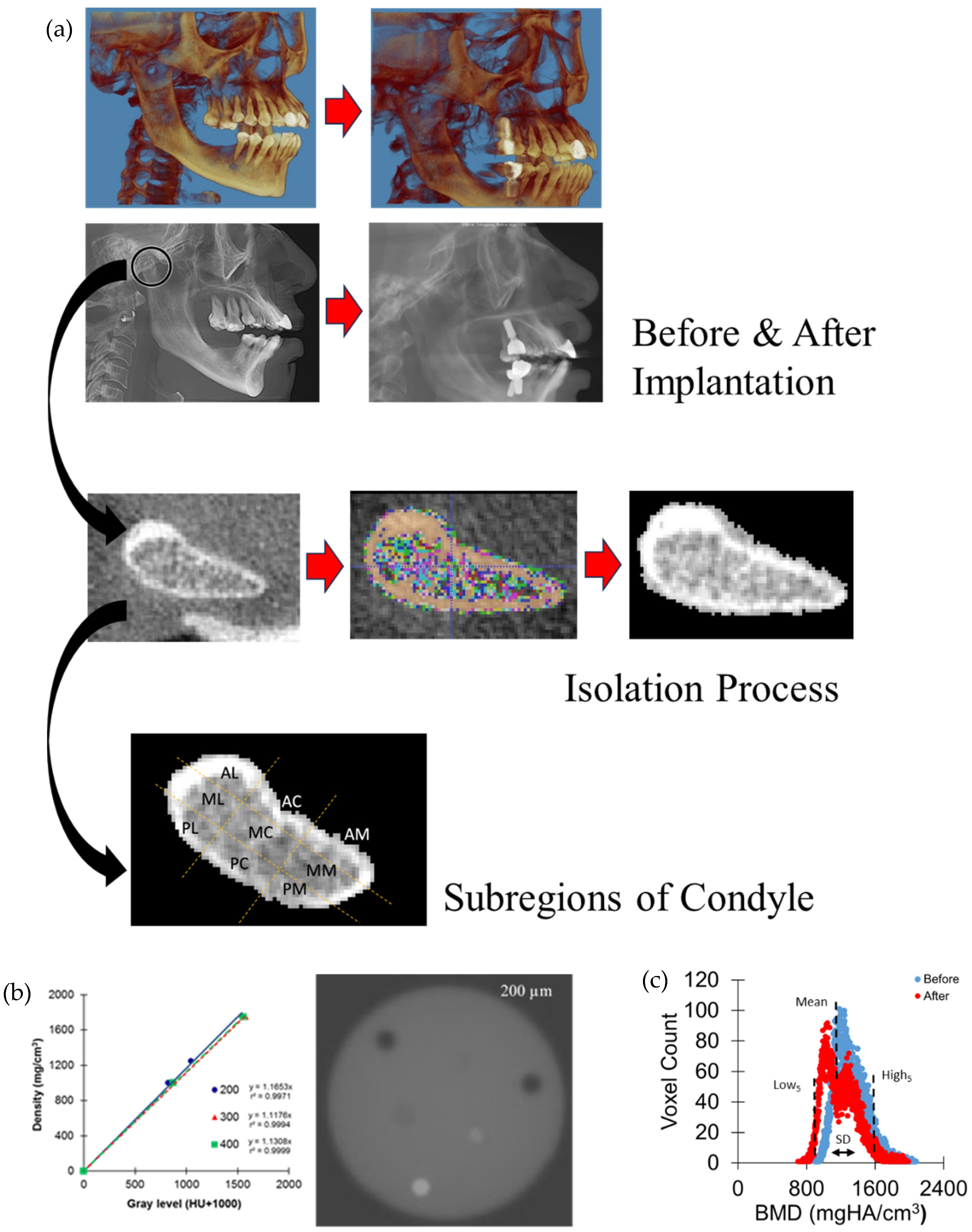
After approval from the Institutional Review Board (IRB) at the Ohio State University (Protocol no. 2011H0128), CBCT images were obtained from the various dental clinics of the College of Dentistry. All patients were scanned using the same CBCT machine (iCAT, Imaging Science International, Hatfield, PA, USA) with identical acquisition parameters routinely used in clinical practice, including a large field of view (FOV), voxel size of 0.3 mm, 120 kV, 5 mA, and a scan time of 8.9 s (Figure 1a).
The sample size was calculated using CBCT-based mean gray values from a previous study that compared pre- and post-treatment outcomes (966.59 ± 106.78 vs. 1060.95 ± 66.01) over 20.05 ± 4.18 months [24]. Based on these data, we determined that a sample size of five CBCT images would provide the minimum number required to achieve statistically significant results (p < 0.05) with 95% statistical power using a paired two-sample t-test. We used the CBCT values from the previous study because it employed longitudinal scanning with follow-up intervals that fell within the current study’s scanning interval (3 to 33.27 months).
Among 556 images, 54 and 22 CBCT scans were successfully identified from 27 patients (10 males and 17 females; 54.93 ± 19.46 years) in the control group and 11 patients (3 males and 8 females; 51.32 ± 13.13 years) in the implant group, respectively. CBCT images were excluded if they demonstrated the presence of surgical reconstructive hardware, incomplete capture of essential TMJ osseous structures, or absence of posterior occlusion.
In the control group, CBCT images were obtained at the time of implantation and after the post-implantation healing period, both prior to crown placement. Therefore, masticatory loading was not directly applied to the implants during the healing period in control patients.
In the implant group, scans were obtained at the time of crown placement on a single-tooth implant (before) and after the functional loading period following crown placement (after). The interval between scans ranged from 3 to 33.27 months (13.68 ± 6.82 months). The duration of the human bone remodeling cycle has been reported to be approximately 120–200 days [25,26]. Therefore, the BMD distribution observed at the 3-month follow-up likely reflects bone modeling and remodeling during the functional loading period following crown placement.
Articulating loads continuously applied to the TMJ can induce bone modeling and remodeling beyond this 3-month period. For the implant group, patients with full arch prostheses, such as an implant-supported or implant-fixed denture, or with a history of any obvious major head and neck surgical procedures, such as orthognathic surgery, were not considered for this study. The locations of single-tooth implants were randomly distributed in the maxilla and mandible, including 3 in the upper right, 1 in the upper left, 5 in the lower right, 3 in the lower left, 5 in the upper anterior, and 2 in the lower anterior regions.

2.2. Temporomandibular Joint Osteoarthritis (TMJ OA) Counts

Right and left mandibular condyles were digitally dissected at 7 mm (23 voxels) down from an apex point of the condylar head in the axial view using imaging software (ImageJ, 1.47v, NIH) (Figure 1a). Twenty-three axial images of the condyle were isolated, ranging from the inferior base of the condyle to the widest portion of the superior aspect of the condyle. These 23 images were then imported into ITK-SNAP software (v3.2, http://www.itksnap.org/pmwiki/pmwiki.php, accessed on 5 December 2025) to segment the mandibular condyle voxels. This program allowed users to change the cross-sectional view of the images to ensure all components of the condyle were included in the analysis. For the implant group, the isolated mandibular condyle image was further divided into 9 sections, including antero-medial (AM), antero-central (AC), antero-lateral (AL), mid-medial (MM), mid-central (MC), mid-lateral (ML), postero-medial (PM), postero-central (PC), and postero-lateral (PL), following the previous study that identified radiographic characteristics related to TMJ OA based on 3D CBCT images [21]. Radiographic characteristics associated with TMJ OA, including flattening, erosions, osteophyte formation, sclerosis, and subchondral cyst formation, were counted by an experienced Oral and Maxillofacial Radiologist (S.K.) using the protocol suggested in the previous study [21]. This study simply aimed to identify any significant osseous changes in the condyle and not necessarily diagnose disease progression.

2.3. Bone Mineral Density (BMD) Distribution

The gray level of each voxel was adjusted to a positive value by adding 1000 because the lowest gray level in the image was −1000 for air voxels. This adjustment enables the comparison of absolute positive gray levels between images. The gray levels of each voxel in the isolated mandibular condyle were proportionally converted to bone mineral density (BMD) to produce a BMD frequency plot (Figure 1b) as established in previous studies [22,23,24,25,26]. It was found that there were strong positive relationships between gray levels and BMDs with r2 > 0.99. The mean BMD value (Mean) was computed by dividing the sum of BMD values by the total voxel counts in the mandibular condyle. Standard deviation (SD) of the frequency plot represents the heterogeneity of the BMD distribution (Figure 1c). Fifth and ninety-fifth percentiles of the frequency plot were also obtained (Low5 and High5, respectively).

2.4. Statistical Analysis

Reliability tests for TMJ OA counts were examined by an intra-class correlation coefficient (ICC) using TMJOA counts assessed by the Oral and Maxillofacial Radiologist (S.K.) from 10 randomly selected condyles. A Shapiro–Wilk test was performed to confirm the normality of TMJ OA counts. If the data distribution was not normal, the Wilcoxon test was used to compare the TMJ OA counts in the first and second images. A paired t-test was used to compare BMD parameters between the left and right sides of the mandibular condyle and its subregions in the first and second CBCT images. A mixed repeated measures analysis of variance (RMANOVA) with an individual patient as a random factor was performed to compare BMD Mean and Low5 values between subregions. Statistical significance was set at p < 0.05.

3. Results

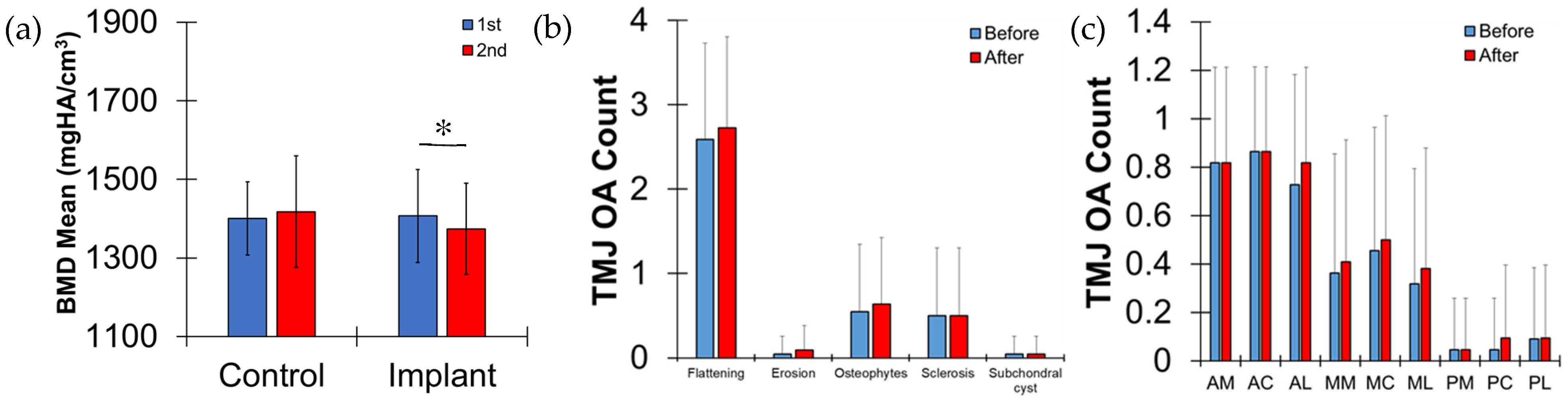
The values of BMD Mean were not significantly different between the first and the second scans for the control group (p = 0.23), but the implant group showed a significant decrease in BMD values (p < 0.025) (Figure 2a). Therefore, the current study focused on analyzing parameters only for the implant group.
No severe TMJ disorder was observed for either the left or right sides of the mandibular condyle. Nine subregions were successfully isolated using individual 3D CBCT images. The ICC for the TMJ OA count was 0.92 (p < 0.001). Flattening was the most frequently observed (Figure 2b). During the functional loading period following crown placement on the implant, the TMJ OA count marginally increased (p = 0.058), while significantly decreasing the values of the BMD Mean and Low5 of the condyle (p < 0.024) (Table 1). The values of BMD Mean and Low5 marginally decreased on the right side of the condyle (p < 0.06), while those on the left side of condyle were not significantly different (p > 0.112). The right side of the condyle had significantly lower values of BMD Mean and Low5 before the functional loading on the implant (p < 0.04) and BMD Low5 after loading (p = 0.016) than the left side of the condyle. All other parameters measured on the condyle were not significantly different between before and after the functional loading on the implant (p > 0.068).
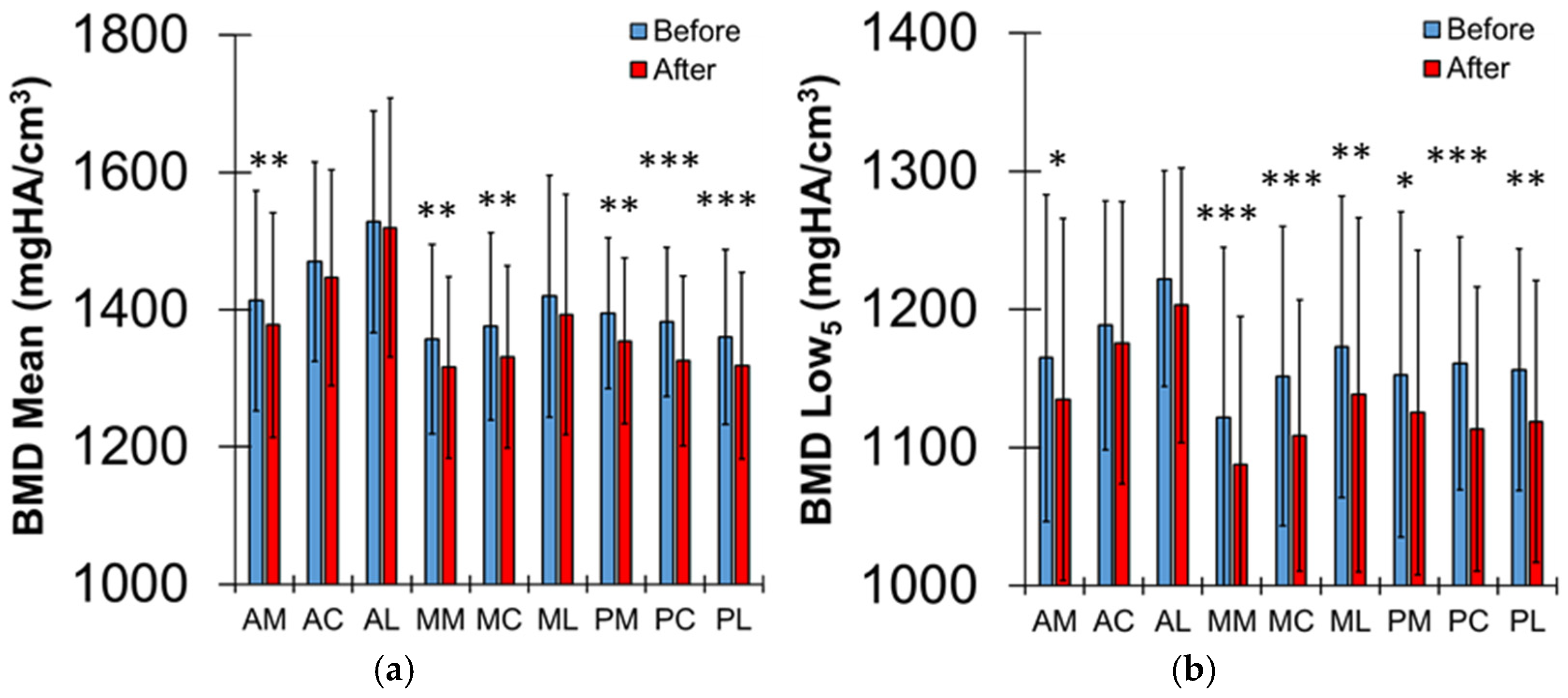
The TMJ OA counts were highest at the anterior regions, followed by the middle and posterior regions (Figure 2c). The AL and AC regions had significantly higher values of BMD Mean than other regions (p < 0.02) and the AC region had significantly higher value of BMD Low5 than other regions (p < 0.011), except the AL (p = 0.597) (Figure 3a,b). The values of BMD Mean and Low5 were significantly reduced at most regions after the functional loading on the implant (p < 0.04), except the AL and AC regions (p > 0.101). Those values decreased for the right-side regions of the condyle (p < 0.063), except the AL, AC, and PM regions (p > 0.101), and those values for the left side of the condyle were not different (p > 0.08) (Table 2 and Table 3).

4. Discussion

The methodology for temporomandibular joint osteoarthritis (TMJ OA) counts was developed to classify the clinical diagnosis of the TMJ condyle using the destructive change index (DCI), based on clinical CBCT images [21]. The number of subregions in the condyle was counted when TMJ OA-related bony changes were present. In the current study, the DCI was modified to quantify the morphological changes in the TMJ condyle using CBCT images from patients. A greater number of bony changes in the condyle were observed after implantation. Flattening was the most frequently observed change in both the right and left condyles before and after dental implantation, compared with erosion, osteophyte formation, sclerosis, and subchondral cyst formation. This result is consistent with the findings reported in other studies. Otterson et al. found that, in a group of nearly 160 older adults, the most common radiographic finding of the condyles on CBCT imaging was flattening, followed by osteophyte formation [27]. Similarly, the current study identified osteophyte formation as the second most prevalent change after condylar flattening.
Among the nine regional areas of the condyles, the three anterior regions (AM, AC, and AL) showed the highest prevalence of TMJ OA counts. These results are supported by the fact that the anterior region of the condyle is most susceptible to alteration during TMJ function, as it plays a critical role in rotation of the condylar head. For example, anterior disc displacement (ADD) is a common form of temporomandibular disorder (TMD) in which the articular disc is displaced toward the anterior surface of the mandibular condyle. ADD is likely to predispose the mandibular condyle to degenerative osseous changes [28].
Loss of teeth generally results in a decrease in biting force and perceived masticatory efficiency, but it may also be associated with effects extending beyond the oral cavity [29]. When missing teeth are restored with dental implants, biting forces return to near-normal levels or may even exceed normal levels [30]. This alteration in loading experienced by the bony structures of the TMJ may help explain the observed increase in the TMJ OA counts in these patients.
Because bone modeling and remodeling contribute to morphological changes, the distribution of BMD also changes. CT attenuation values (gray levels) were converted to BMD using the strong positive relationship with hydroxyapatite phantom densities [23,27,28,31,32]. The alteration in the BMD distribution results from the resorption of more mineralized pre-existing bone tissue followed by the addition of less mineralized newly formed bone tissue. Accordingly, the decrease in Low5 values reflects reduced mineralization associated with active new bone formation, which also lowers the mean BMD value. The frequency plot clearly demonstrated a shift of BMD toward lower values after implantation (Figure 1).
BMD values were higher in the anterior region than in other regions, corresponding with higher TMJ OA counts. These findings suggest that the anterior region of the condyle is dominantly loaded and adapts to increased loading by increasing BMD relative to other regions. Functional loading following crown placement on dental implants did not significantly change BMD in the anterior regions, whereas BMD decreased in the other regions. The reduction in BMD likely occurred because less mineralized newly formed bone tissue was added in those regions, as reflected by decreased Low5 values. These results suggest that functional loading after implantation increases loading on the mandibular condyle, triggering bone formation in regions with lower baseline BMD. This mechanobiological adaptation of condylar bone may help maintain load balance during mastication.
The mean BMD of the right condyle significantly decreased from before to after implantation. Interestingly, the right condyle initially exhibited a lower overall mean BMD and subsequently experienced a significant decrease during the observation period. In contrast, the left condyle did not show a significant change in the overall mean BMD. These findings support the results from Kim et al., who also reported significantly lower mean BMD and Low5 values in the right condyle compared with the left [22], although the underlying reason remains unclear. Increased masticatory function and/or other oral habits may contribute to enhanced bone remodeling on the right side. A strong correlation exists between preferred chewing side and the side with the most efficient chewing; however, previous studies have not demonstrated a consistent preference for chewing on one side [23,27,28,31,32,33]. It is also possible that implant location influenced the increase in right-sided bone remodeling, although the present study found that regions with lower BMD values were generally more susceptible to change.
Many previous studies indicate that mastication transmits greater loads directly to the bone surrounding a dental implant than to natural teeth, which are supported by a periodontal ligament that helps dissipate masticatory forces [4,5,6]. Natural teeth are capable of vertical movement of approximately 25–100 μm and buccolingual movement of 56–108 μm due to the surrounding periodontium, whereas dental implants exhibit only 3–5 μm of vertical movement and 10–50 μm of buccolingual movement [34]. Without periodontal ligament-supported occlusion to dissipate occlusal forces and provide proprioceptive feedback, patients with implant-supported occlusion may be more susceptible to occlusal overload and parafunctional activity [35]. Consequently, TMJ loading may increase following implantation.
Altered articulatory loading continuously stimulates bone modeling and remodeling, resulting in quantitative and qualitative changes in local subchondral bone [36,37,38]. These changes are regulated by osteoclast-mediated resorption and osteoblast-mediated bone formation. The CBCT-based BMD changes observed in this study reflect these biological processes. Because pre-existing bone tissue exhibits higher mineralization than newly formed bone tissue, skeletal adaptation produces a heterogeneous BMD distribution. Therefore, BMD distribution may serve as a surrogate marker for underlying mineralization dynamics [36,39]. Collectively, this study provides evidence-based proof of principle for the influence of dental implantation on the human mandibular condyle and offers baseline clinical data relevant to implant-related skeletal adaptation.
A limitation of the current study is the limited sample size. Among CBCT images obtained from 556 patients, fewer than 2% underwent longitudinal scans both at the time of crown placement on a single-tooth implant and after the functional loading period. Nevertheless, the results demonstrate the significant effects of implantation on the mandibular condyles. Another limitation is that the assessment of mandibular morphology was not feasible, as occlusal relationships were not standardized to centric relation or maximum intercuspation during CBCT image acquisition, resulting in variable degrees of mandibular opening. Growth patterns and facial types, such as mandibular divergence, may provide additional insight into the influence of biting forces and skeletal architecture on condylar BMD. Consequently, spatial relationships between the mandible and other skeletal structures, such as the maxilla or cranial base, could not be adequately evaluated.

5. Conclusions

In conclusion, the current findings show that dental implantation increases TMJ articulating loads during mastication, stimulating new bone formation to balance the load distribution on the mandibular condyle. To our best knowledge, this is the first study to demonstrate the effects of dental implantation on bony change in human TMJ condyles.

Author Contributions

Conceptualization, I.S., H.A.E., L.K. and D.-G.K.; Methodology, I.S., M.F., S.K., J.K., N.J., Z.S. and D.-G.K.; Software, I.S., M.F., S.K., N.J., Z.S. and D.-G.K.; Validation, I.S., M.F., S.K., H.C., H.A.E., L.K. and D.-G.K.; Formal analysis, I.S., M.F. and D.-G.K.; Investigation, I.S., M.F., S.K., J.K., H.C., H.A.E., L.K. and D.-G.K.; Resources, M.F. and D.-G.K.; Data curation, I.S., M.F., S.K., J.K., N.J., Z.S. and D.-G.K.; Writing—original draft, I.S., M.F., S.K., J.K., N.J., Z.S., H.C., H.A.E., L.K. and D.-G.K.; Writing—review & editing, I.S., M.F., S.K., J.K., N.J., Z.S., H.C., H.A.E., L.K. and D.-G.K.; Visualization, I.S., M.F. and D.-G.K.; Supervision, H.A.E., L.K. and D.-G.K.; Project administration, D.-G.K.; Funding acquisition, D.-G.K. All authors have read and agreed to the published version of the manuscript.

Funding

This research received no external funding.

Institutional Review Board Statement

This study was conducted in accordance with the Declaration of Helsinki and approved by the Institutional Review Board of the Ohio State University (Protocol no. 2011H0128) on 6 August 2025.

Informed Consent Statement

Patient consent was waived for this retrospective study.

Data Availability Statement

The original contributions presented in the study are included in the article; further inquiries can be directed to the corresponding author.

Acknowledgments

During the preparation of this work, the authors used ChatGPT 4.0 mini in order to check the grammar and edit the text for clarity during the manuscript’s preparation. After using this tool, the authors reviewed and edited the content as needed and take full responsibility for the content of the publication.

Conflicts of Interest

The authors have no potential conflicts of interest for this research.

References

  1. Chen, Y.-C.; Chen, M.-Y.; Chen, T.-Y.; Chan, M.-L.; Huang, Y.-Y.; Liu, Y.-L.; Lee, P.-T.; Lin, G.-J.; Li, T.-F.; Chen, C.-A.; et al. Improving Dental Implant Outcomes: CNN-Based System Accurately Measures Degree of Peri-Implantitis Damage on Periapical Film. Bioengineering 2023, 10, 640. [Google Scholar] [CrossRef] [PubMed]
  2. Sato, Y.; Kitagawa, N.; Isobe, A. Implant treatment in ultra-aged society. Jpn. Dent. Sci. Rev. 2018, 54, 45–51. [Google Scholar] [CrossRef]
  3. Elani, H.W.; Starr, J.R.; Da Silva, J.D.; Gallucci, G.O. Trends in Dental Implant Use in the U.S., 1999–2016, and Projections to 2026. J. Dent. Res. 2018, 97, 1424–1430. [Google Scholar] [CrossRef] [PubMed]
  4. Huang, L.; Liu, B.; Cha, J.; Yuan, G.; Kelly, M.; Singh, G.; Hyman, S.; Brunski, J.; Li, J.; Helms, J. Mechanoresponsive Properties of the Periodontal Ligament. J. Dent. Res. 2016, 95, 467–475. [Google Scholar] [CrossRef]
  5. Pei, D.; Hu, X.; Jin, C.; Lu, Y.; Liu, S. Energy Storage and Dissipation of Human Periodontal Ligament during Mastication Movement. ACS Biomater. Sci. Eng. 2018, 4, 4028–4035. [Google Scholar] [CrossRef]
  6. Wu, B.; Fu, Y.; Shi, H.; Yan, B.; Lu, R.; Ma, S.; Markert, B. Tensile testing of the mechanical behavior of the human periodontal ligament. BioMed. Eng. OnLine 2018, 17, 172. [Google Scholar] [CrossRef] [PubMed]
  7. Száva, D.T.; Száva, A.; Száva, J.; Gálfi, B.; Vlase, S. Dental Implant and Natural Tooth Micro-Movements during Mastication-In Vivo Study with 3D VIC Method. J. Pers. Med. 2022, 12, 1690. [Google Scholar] [CrossRef] [PubMed]
  8. Kim, Y.; Oh, T.-J.; Misch, C.E.; Wang, H.-L. Occlusal considerations in implant therapy: Clinical guidelines with biomechanical rationale. Clin. Oral Implant. Res. 2005, 16, 26–35. [Google Scholar] [CrossRef]
  9. Rismanchian, M.; Bajoghli, F.; Mostajeran, Z.; Fazel, A.; Eshkevari, P. Effect of Implants on Maximum Bite Force in Edentulous Patients. J. Oral Implant. 2009, 35, 196–200. [Google Scholar] [CrossRef]
  10. Fontijn-Tekampl, E.; Slagter, A.; Hof, M.V.; Geertman, M.; Kalk, W. Bite forces with mandibular implant-retained overdentures. J. Dent. Res. 1998, 77, 1832–1839. [Google Scholar] [CrossRef]
  11. Boven, G.C.; Raghoebar, G.M.; Vissink, A.; Meijer, H.J.A. Improving masticatory performance, bite force, nutritional state and patient’s satisfaction with implant overdentures: A systematic review of the literature. J. Oral Rehab. 2015, 42, 220–233. [Google Scholar] [CrossRef]
  12. Uribe, R.; Peñarrocha, M.; Sanchis, J.M.; García, O. Marginal peri-implantitis due to occlusal overload. A case report. Med. Oral 2004, 9, 160–162. [Google Scholar]
  13. Graves, C.V.; Harrel, S.K.; Rossmann, J.A.; Kerns, D.; Gonzalez, J.A.; Kontogiorgos, E.D.; Al-Hashimi, I.; Abraham, C. The Role of Occlusion in the Dental Implant and Peri-implant Condition: A Review. Open Dent. J. 2016, 10, 594–601. [Google Scholar] [CrossRef] [PubMed]
  14. Di Fiore, A.; Montagner, M.; Sivolella, S.; Stellini, E.; Yilmaz, B.; Brunello, G. Peri-Implant Bone Loss and Overload: A Systematic Review Focusing on Occlusal Analysis through Digital and Analogic Methods. J. Clin. Med. 2022, 11, 4812. [Google Scholar] [CrossRef] [PubMed]
  15. Grigoriadis, A.; Trulsson, M. Excitatory drive of masseter muscle during mastication with dental implants. Sci. Rep. 2018, 8, 8597. [Google Scholar] [CrossRef] [PubMed]
  16. Gartner, J.L.; Mushimoto, K.; Weber, H.-P.; Nishimura, I. Effect of osseointegrated implants on the coordination of masticatory muscles: A pilot study. J. Prosthet. Dent. 2000, 84, 185–193. [Google Scholar] [CrossRef]
  17. Woodford, S.C.; Robinson, D.L.; Abduo, J.; Lee, P.V.S.; Ackland, D.C. Muscle and joint mechanics during maximum force biting following total temporomandibular joint replacement surgery. Biomech. Model. Mechanobiol. 2024, 23, 809–823. [Google Scholar] [CrossRef]
  18. Kogawa, E.M.; Calderon, P.S.; Lauris, J.R.P.; Araujo, C.R.P.; Conti, P.C.R. Evaluation of maximal bite force in temporomandibular disorders patients. J. Oral Rehab. 2006, 33, 559–565. [Google Scholar] [CrossRef]
  19. Zieliński, G.; Ginszt, M.; Zawadka, M.; Rutkowska, K.; Podstawka, Z.; Szkutnik, J.; Majcher, P.; Gawda, P. The Relationship between Stress and Masticatory Muscle Activity in Female Students. J. Clin. Med. 2021, 10, 3459. [Google Scholar] [CrossRef]
  20. Ohrbach, R.; Dworkin, S.F. The Evolution of TMD Diagnosis: Past, Present, Future. J. Dent. Res. 2016, 95, 1093–1101. [Google Scholar] [CrossRef]
  21. Song, H.; Lee, J.Y.; Huh, K.-H.; Park, J.W. Long-term Changes of Temporomandibular Joint Osteoarthritis on Computed Tomography. Sci. Rep. 2020, 10, 6731. [Google Scholar] [CrossRef]
  22. Kim, P.J.; Skabelund, Z.; Kalim, S.; Lee, C.H.; Kim, N.; Nguyen, K.; Emam, H.; Knobloch, L.; Deguchi, T.; Kim, M.; et al. Sex dependent differences of temporomandibular condylar bone mineral density distribution. Cranio 2022, 43, 321–327. [Google Scholar] [CrossRef] [PubMed]
  23. Kim, D.G. Can dental cone beam computed tomography assess bone mineral density? J. Bone Metab. 2014, 21, 117–126. [Google Scholar] [CrossRef] [PubMed]
  24. Huang, H.; Richards, M.; Bedair, T.; Fields, H.W.; Palomo, J.M.; Johnston, W.M.; Kim, D.G. Effects of orthodontic treatment on human alveolar bone density distribution. Clin. Oral Investig. 2013, 17, 2033–2040. [Google Scholar] [CrossRef][Green Version]
  25. Agerbæk, M.O.; Eriksen, E.F.; Kragstrup, J.; Mosekilde, L.; Melsen, F. A reconstruction of the remodelling cycle in normal human cortical iliac bone. Bone Miner. 1991, 12, 101–112. [Google Scholar] [CrossRef] [PubMed]
  26. Kenkre, J.S.; Bassett, J. The bone remodelling cycle. Ann. Clin. Biochem. 2018, 55, 308–327. [Google Scholar] [CrossRef]
  27. Ottersen, M.K.; Larheim, T.A.; Hove, L.H.; Arvidsson, L.Z. Imaging signs of temporomandibular joint osteoarthritis in an urban population of 65-year-olds: A cone beam computed tomography study. J. Oral Rehabil. 2023, 50, 1194–1201. [Google Scholar] [CrossRef]
  28. Li, C.; Liu, X.; Gong, Z.; Jumatai, S.; Ling, B. Morphologic Analysis of Condyle among Different Disc Status in the Temporomandibular Joints by Three-dimensional Reconstructive Imaging: A Preliminary Study. BMC Oral Health 2022, 22, 395. [Google Scholar] [CrossRef]
  29. Bortoluzzi, M.C.; Traebert, J.; Lasta, R.; Da Rosa, T.N.; Capella, D.L.; Presta, A. Tooth loss, chewing ability and quality of life. Contemp. Clin. Dent. 2012, 3, 393–397. [Google Scholar] [CrossRef]
  30. Altayyar, S.; Al-Zordk, W.; Algabri, R.; Rajah, E.; Al-Baadani, A.; Alqutaibi, A.Y.; Madina, M.A.; Ghazy, M.H. Prospective evaluation of implants-supported, tooth-implant supported, and teeth-supported 3-unit posterior monolithic zirconia fixed restorations: Bite force and patient satisfaction. Clin. Exp. Dent. Res. 2023, 9, 810–819. [Google Scholar] [CrossRef]
  31. England, G.M.; Moon, E.-S.; Roth, J.; Deguchi, T.; Firestone, A.R.; Beck, F.M.; Kim, D.-G. Conditions and calibration to obtain comparable grey values between different clinical cone beam computed tomography scanners. Dentomaxillofac. Radiol. 2017, 46, 20160322. [Google Scholar] [CrossRef] [PubMed]
  32. Taylor, T.; Gans, S.; Jones, E.; Firestone, A.; Johnston, W.; Kim, D.-G. Comparison of micro-CT and cone beam CT-based assessments for relative difference of grey level distribution in a human mandible. Dentomaxillofac. Radiol. 2013, 42, 25117764. [Google Scholar] [CrossRef]
  33. Rovira-Lastra, B.; Flores-Orozco, E.I.; Salsench, J.; Peraire, M.; Martinez-Gomis, J. Is the side with the best masticatory performance selected for chewing? Arch. Oral Biol. 2014, 59, 1316–1320. [Google Scholar] [CrossRef]
  34. Gross, M.D. Occlusion in implant dentistry. A review of the literature of prosthetic determinants and current concepts. Aust. Dent. J. 2008, 53, S60–S68. [Google Scholar] [CrossRef]
  35. Meyer, G.; Fanghänel, J.; Proff, P. Morphofunctional aspects of dental implants. Ann. Anat.—Anat. Anz. 2012, 194, 190–194. [Google Scholar] [CrossRef] [PubMed]
  36. Kim, D.G.; Jeong, Y.H.; Kosel, E.; Agnew, A.M.; McComb, D.W.; Bodnyk, K.; Hart, R.T.; Kim, M.K.; Han, S.Y.; Johnston, W.M. Regional variation of bone tissue properties at the human mandibular condyle. Bone 2015, 77, 98–106. [Google Scholar] [CrossRef]
  37. Desai, R.J.; Iwasaki, L.R.; Kim, S.M.; Liu, H.; Liu, Y.; Nickel, J.C. A theoretical analysis of longitudinal temporomandibular joint compressive stresses and mandibular growth. Angle Orthod. 2022, 92, 11–17. [Google Scholar] [CrossRef]
  38. Honda, T.; Fukunaga, T.; Ito, A.; Yoshida, M.; Yasuno, K.; Tsumaki, H.; Yamaguchi, K.; Choi, Y.S.; Mizoguchi, I. Effects of mechanical load on mandibular condylar cartilage and subchondral bone of male rats. Arch. Oral. Biol. 2025, 177, 106341. [Google Scholar] [CrossRef]
  39. Ruffoni, D.; Fratzl, P.; Roschger, P.; Klaushofer, K.; Weinkamer, R. The bone mineralization density distribution as a fingerprint of the mineralization process. Bone 2007, 40, 1308–1319. [Google Scholar] [CrossRef] [PubMed]
Figure 1. (a) Processes for analyzing cone beam computed tomography (CBCT) images and bone mineral density (BMD). Three-dimensional CBCT image of a patient’s mandibular condyle was digitally isolated and divided to subregions of AM (antero-medial), AC (antero-central), AL (antero-lateral), MM (mid-medial), MC (mid-central), ML (mid-lateral), PM (postero-medial), PC (postero-central), and PL (postero-lateral). (b) CBCT gray levels at 3 different resolutions (200, 300, and 400 µm) had strong linear relationships with 3 different densities (1000, 1250, and 1750 mgHA/cm3) of hydroxyapatite (HA) phantoms, which allowed us to convert the gray level to bone mineral density (BMD) (reprinted with unrestricted permission for non-commercial use [23]). (c) BMD parameters in a frequency plot for the mandibular condyle between the time of crown placement on the implant (before) and after the functional loading period following crown placement on the implant (after).
Jfb 17 00099 g001
Figure 2. (a) Comparison of bone mineral density (BMD) mean values for the control and implant groups between the first and second scans. (b) Temporomandibular joint osteoarthritis (TMJ OA) counts for radiographic characteristics (flattening, erosions, osteophyte formation, sclerosis, and subchondral cyst formation), and (c) paired comparisons across subregions (antero-medial (AM), antero-central (AC), antero-lateral (AL), mid-medial (MM), mid-central (MC), mid-lateral (ML), postero-medial (PM), postero-central (PC), and postero-lateral (PL)). Flattening dominated and the three anterior regions (AM, AC, and AL) had a significantly higher prevalence of TMJ OA counts than other regions (p < 0.05). No significant differences were found between the time of crown placement on the implant (before) and after the functional loading period following crown placement on the implant (after) (p > 0.16). *; 0.024.
Jfb 17 00099 g002
Figure 3. Paired comparisons of bone mineral density (BMD) (a) Mean and (b) Low5 values across subregions (antero-medial (AM), antero-central (AC), antero-lateral (AL), mid-medial (MM), mid-central (MC), mid-lateral (ML), postero-medial (PM), postero-central (PC), and postero-lateral (PL)). BMDs in mandibular condyle regions decreased under functional loading after implantation. *; p < 0.05, **; p < 0.03, ***; p < 0.01.
Jfb 17 00099 g003
Table 1. Comparisons of temporomandibular joint osteoarthritis (TMJ OA) counts and bone mineral density (BMD) parameters for the mandibular condyle between the left and right sides, and the time of crown placement on the implant (before) and after the functional loading period following crown placement on the implant (after). Significant (p < 0.05) or marginal (p < 0.07) differences are highlighted in bold.
RegionSideBeforeAfterp Value
TMJOA CountsBoth3.73 ± 1.324 ± 1.410.058
Left3.91 ± 1.224.18 ± 1.080.082
Right3.55 ± 1.443.82 ± 1.530.277
p value
(Left vs. Right)
0.420.531
BMD Mean
(mgHA/cm3)
Both1407.07 ± 118.391373.98 ± 116.330.024
Left1424.89 ± 136.421394.65 ± 134.790.204
Right1389.26 ± 100.631353.3 ± 130.710.058
p value
(Left vs. Right)
0.040.133
BMD SD
(mgHA/cm3)
Both181.28 ± 42.9185.13 ± 45.460.416
Left179.84 ± 35.03181.02 ± 44.710.888
Right182.72 ± 51.32189.24 ± 53.540.205
p value
(Left vs. Right)
0.7470.447
BMD Low5
(mgHA/cm3)
Both1144.82 ± 86.241113.05 ± 86.10.004
Left1169.18 ± 90.521144.82 ± 85.360.112
Right1120.45 ± 78.221081.27 ± 84.020.02
p value
(Left vs. Right)
0.0340.016
BMD High5
(mgHA/cm3)
Both1727.5 ± 163.451703.05 ± 168.480.261
Left1746.55 ± 175.281717.82 ± 201.20.46
Right1708.45 ± 156.791688.27 ± 197.150.381
p value
(Left vs. Right)
0.0680.523
Table 2. Comparisons of regional BMD Mean (mgHA/cm3) between the time of crown placement on the implant (before) and after the functional loading period following crown placement on the implant (after). Significant (p < 0.05) or marginal (p < 0.07) differences are shown.
RegionSideBeforeAfterp Value
AMRight1400.78 ±118.691359.27 ± 124.590.021
MMRight1337.39 ± 113.201289.61 ± 88.020.063
MCRight1359.13 ± 131.921306.34 ± 125.890.041
MLRight1393.69 ± 194.861351.09 ± 206.080.063
PCRight1362.78 ± 86.281288.03 ± 97.520.005
PLRight1344.16 ± 143.421281.96 ± 151.710.034
Table 3. Comparisons of regional BMD Low5 (mgHA/cm3) between the time of crown placement on the implant (before) and after the functional loading period following crown placement on the implant (after). Significant (p < 0.05) differences are shown.
RegionSideBeforeAfterp Value
AMRight1151.82 ± 91.681111.91 ± 117.460.023
MMRight1102.27 ± 103.051059.27 ± 95.640.022
MCRight1127.27 ± 111.021066.09 ± 94.660.008
MLRight1145.55 ± 113.501097.18 ± 151.080.044
PCRight1139.91 ± 89.451065.27 ± 94.160.005
PLRight1148.82 ± 104.761082.30 ± 119.670.014
Disclaimer/Publisher’s Note: The statements, opinions and data contained in all publications are solely those of the individual author(s) and contributor(s) and not of MDPI and/or the editor(s). MDPI and/or the editor(s) disclaim responsibility for any injury to people or property resulting from any ideas, methods, instructions or products referred to in the content.