




The Impact of Coffee, Matcha, Protein Drinks, and Water Storage on the Microhardness and Color Stability of a Nano-Ceramic Hybrid Composite CAD/CAM Blank

Abstract
1. Introduction
2. Materials and Methods
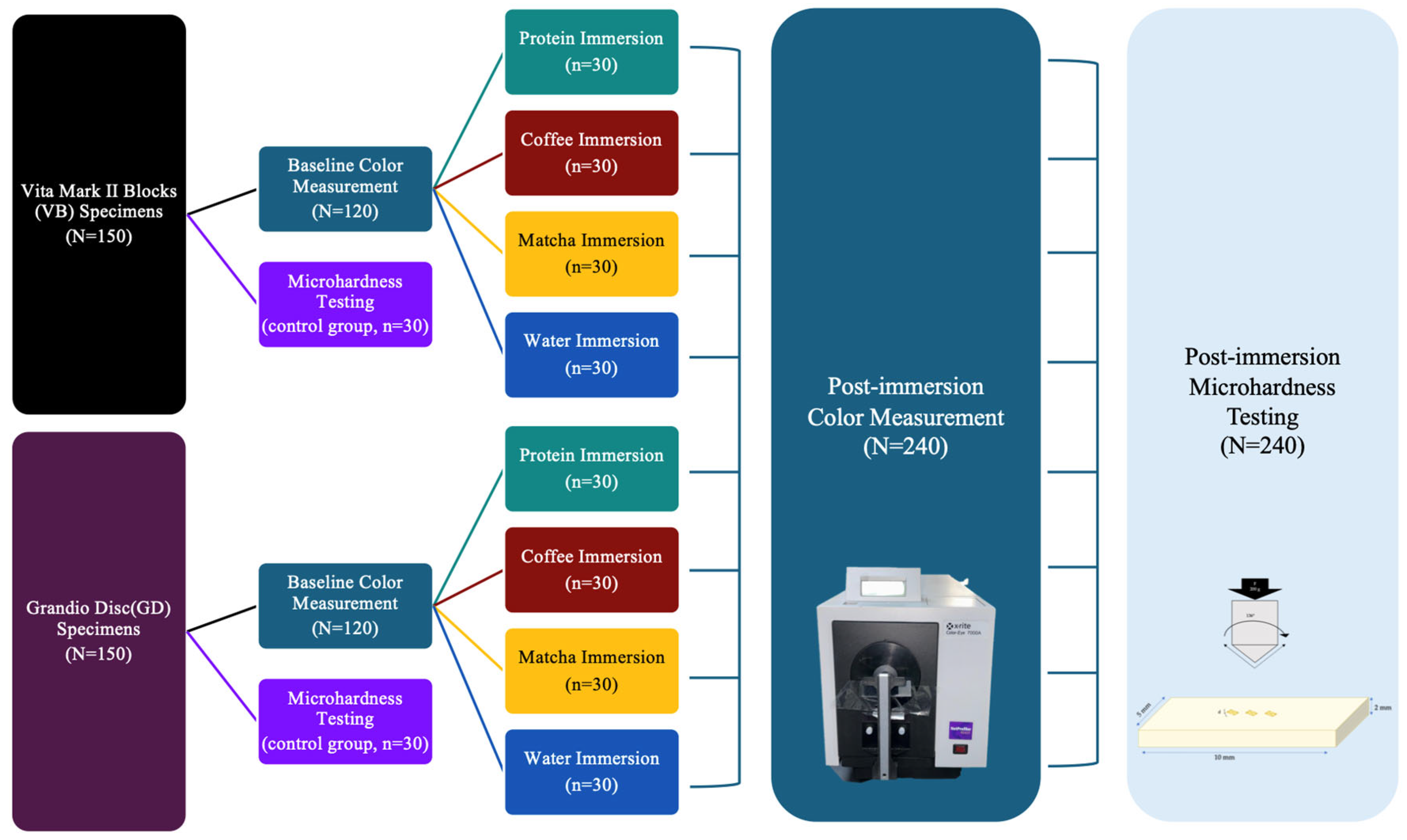
2.1. Specimen Preparation
2.2. Immersion Procedures
- Testing Procedures:
- -
- Microhardness:
- -
- Color Change:
2.3. Statistical Analysis
3. Results
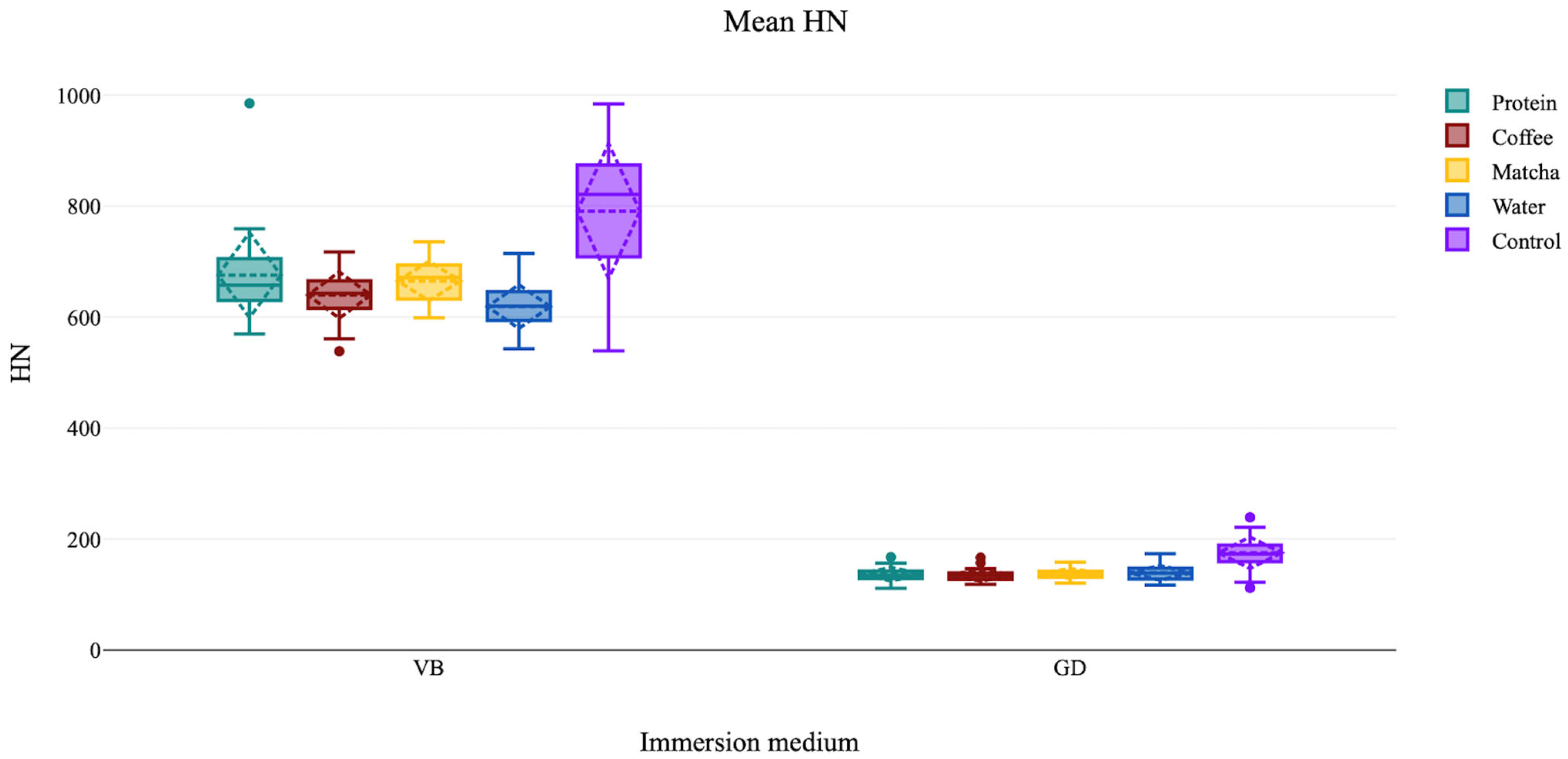
3.1. Microhardness Results
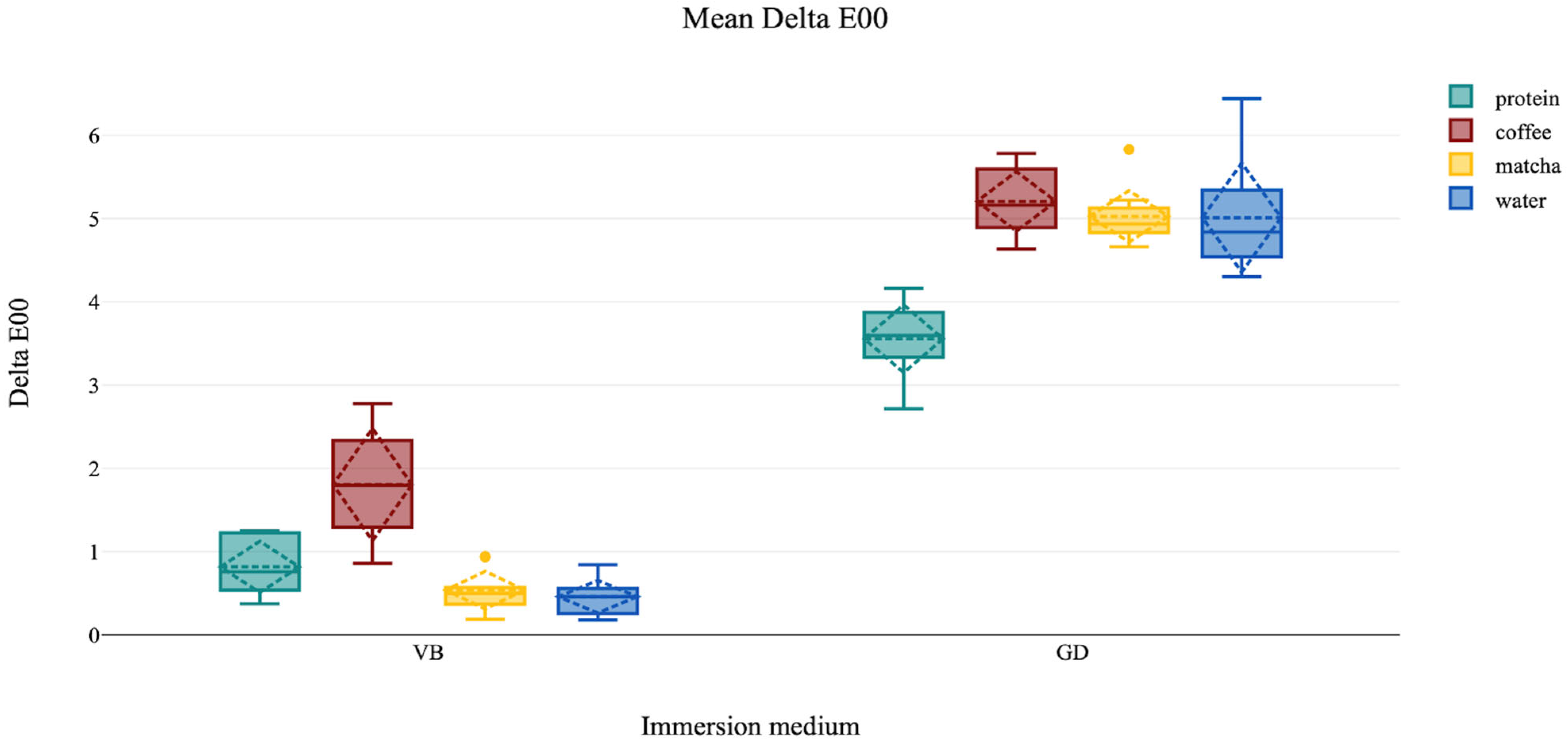
3.2. Color Change Results
4. Discussion
4.1. Discussion of Methodology
4.2. Discussion of Microhardness Results
4.3. Discussion of Color Stability Results
4.4. Clinical Implications, Limitations, and Future Research Directions
5. Conclusions
- -
- The current study demonstrated that the choice of ceramic material for CAD/CAM-fabricated dental restorations might significantly influence their microhardness and color stability, which would therefore consequently impact their durability in response to the consumption of various types of beverages.
- -
- The feldspar glass ceramic (VB) showed superior microhardness and color stability compared to the nano-ceramic hybrid composite (GD), while both materials exhibited varying responses to different immersion media. GD showed good microhardness stability when exposed to various drinks, suggesting its resistance to beverage-induced dissolution.
- -
- Matcha and protein mixed in water might produce a protective effect against glass ceramic material dissolution in aqueous environments; however, further investigation into the specific mechanism and effect on other mechanical properties is warranted.
- -
- Both CAD/CAM materials showed some sensitivity to different immersion media, but the nano-ceramic hybrid composite material maintained consistently high color change values (>3.5) across all conditions. On the other hand, VB glass ceramic material showed more variation in response to different immersion media while maintaining overall superior color stability.
- -
- The study findings highlight the necessity for clinicians to consider the implications of dietary habits on restorative material selection, ensuring that patients receive durable and aesthetically pleasing dental solutions. The findings also reaffirm the need for further research into the long-term effects of various beverages on dental ceramics, as the increasing popularity of health drinks, including matcha and protein beverages, may influence the longevity and performance of dental restorations.
Author Contributions
Funding
Institutional Review Board Statement
Informed Consent Statement
Data Availability Statement
Acknowledgments
Conflicts of Interest
References
- Kermanshah, H.; Ahmadi, E.; Rafeie, N.; Rafizadeh, S.; Ranjbar Omrani, L. Vickers micro-hardness study of the effect of fluoride mouthwash on two types of CAD/CAM ceramic materials erosion. BMC Oral Health 2022, 22, 101. [Google Scholar] [CrossRef]
- Eldwakhly, E.; Ahmed, D.R.M.; Soliman, M.; Abbas, M.M.; Badrawy, W. Color and translucency stability of novel restorative CAD/CAM materials. Dent. Med. Probl. 2019, 56, 349–356. [Google Scholar] [CrossRef] [PubMed]
- Yadav, R.; Sonwal, S.; Sharma, R.P.; Saini, S.; Huh, Y.S.; Brambilla, E.; Ionescu, A.C. Ranking Analysis of Tribological, Mechanical, and Thermal Properties of Nano Hydroxyapatite Filled Dental Restorative Composite Materials Using the R-Method. Polym. Adv. Technol. 2024, 35, e70010. [Google Scholar] [CrossRef]
- Shi, H.Y.; Pang, R.; Yang, J.; Fan, D.; Cai, H.; Jiang, H.B.; Han, J.; Lee, E.S.; Sun, Y. Overview of Several Typical Ceramic Materials for Restorative Dentistry. Biomed. Res. Int. 2022, 2022, 8451445. [Google Scholar] [CrossRef] [PubMed]
- Alghamdi, W.S.; Labban, N.; Maawadh, A.; Alsayed, H.D.; Alshehri, H.; Alrahlah, A.; Alnafaiy, S.M. Influence of Acidic Environment on the Hardness, Surface Roughness and Wear Ability of CAD/CAM Resin-Matrix Ceramics. Materials 2022, 15, 6146. [Google Scholar] [CrossRef] [PubMed]
- Baroudi, K.; Ibraheem, S.N. Assessment of Chair-side Computer-Aided Design and Computer-Aided Manufacturing Restorations: A Review of the Literature. J. Int. Oral Health 2015, 7, 96–104. [Google Scholar] [PubMed]
- Colombo, M.; Poggio, C.; Lasagna, A.; Chiesa, M.; Scribante, A. Vickers Micro-Hardness of New Restorative CAD/CAM Dental Materials: Evaluation and Comparison after Exposure to Acidic Drink. Materials 2019, 12, 1246. [Google Scholar] [CrossRef]
- Ender, A.; Attin, T.; Mehl, A. In vivo precision of conventional and digital methods of obtaining complete-arch dental impressions. J. Prosthet. Dent. 2016, 115, 313–320. [Google Scholar] [CrossRef]
- Ille, C.-E.; Jivănescu, A.; Pop, D.; Stoica, E.T.; Flueras, R.; Talpoş-Niculescu, I.-C.; Cosoroabă, R.M.; Popovici, R.-A.; Olariu, I. Exploring the Properties and Indications of Chairside CAD/CAM Materials in Restorative Dentistry. J. Funct. Biomater. 2025, 16, 46. [Google Scholar] [CrossRef]
- Spitznagel, F.A.; Boldt, J.; Gierthmuehlen, P.C. CAD/CAM Ceramic Restorative Materials for Natural Teeth. J. Dent. Res. 2018, 97, 1082–1091. [Google Scholar] [CrossRef]
- Mascaro, B.A.; Tejada-Casado, M.; Fonseca, R.G.; Reis, J.M.; Pérez, M.M. Exploring the optical behavior and relative translucency parameter of CAD-CAM resin-based composites, polymer-infiltrated ceramic network, and feldspar porcelain. Dent. Mater. 2024, 40, 1954–1961. [Google Scholar] [CrossRef]
- Algharaibeh, S.; Wan, H.; Al-Fodeh, R.; Ireland, A.J.; Zhang, D.; Su, B. Fabrication and mechanical properties of biomimetic nacre-like ceramic/polymer composites for chairside CAD/CAM dental restorations. Dent. Mater. 2022, 38, 121–132. [Google Scholar] [CrossRef]
- Papathanasiou, I.; Kamposiora, P.; Dimitriadis, K.; Papavasiliou, G.; Zinelis, S. In vitro evaluation of CAD/CAM composite materials. J. Dent. 2023, 136, 104623. [Google Scholar] [CrossRef]
- Arocha, M.A.; Basilio, J.; Llopis, J.; Di Bella, E.; Roig, M.; Ardu, S.; Mayoral, J.R. Colour stainability of indirect CAD-CAM processed composites vs. conventionally laboratory processed composites after immersion in staining solutions. J. Dent. 2014, 42, 831–838. [Google Scholar] [CrossRef]
- Yerliyurt, K.; Sarıkaya, I. Color stability of hybrid ceramics exposed to beverages in different combinations. BMC Oral Health 2022, 22, 180. [Google Scholar] [CrossRef]
- Al-Amri, I.; Albounni, R.; Binalrimal, S. Evaluation of the effect of soft drinks on the surface roughness of dental enamel in natural human teeth. F1000Research 2021, 10, 1138. [Google Scholar] [CrossRef] [PubMed]
- Al Amri, M.D.; Labban, N.; Alhijji, S.; Alamri, H.; Iskandar, M.; Platt, J.A. In Vitro Evaluation of Translucency and Color Stability of CAD/CAM Polymer-Infiltrated Ceramic Materials after Accelerated Aging. J. Prosthodont. 2021, 30, 318–328. [Google Scholar] [CrossRef] [PubMed]
- Zafar, M.S.; Amin, F.; Fareed, M.A.; Ghabbani, H.; Riaz, S.; Khurshid, Z.; Kumar, N. Biomimetic Aspects of Restorative Dentistry Biomaterials. Biomimetics 2020, 5, 34. [Google Scholar] [CrossRef] [PubMed]
- Jafari, K.; Hekmatfar, S.; Badakhsh, S. The effect of mouthwashes on surface hardness of dental ceramics. J. Dent. Biomater. 2014, 1, 23–26. [Google Scholar]
- Saati, K.; Khansari, S.; Mahdisiar, F.; Valizadeh, S. Evaluation of Microhardness of Two Bulk-fill Composite Resins Compared to a Conventional Composite Resin on surface and in Different Depths. J. Dent. 2022, 23, 58–64. [Google Scholar]
- Andrade, A.C.M.; Borges, A.B.; Kukulka, E.C.; Moecke, S.E.; Scotti, N.; Comba, A.; Pucci, C.R.; Torres, C.R.G. Optical Property Stability of Light-Cured versus Precured CAD-CAM Composites. Int. J. Dent. 2022, 2022, 2011864. [Google Scholar] [CrossRef] [PubMed]
- Harak, S.S.; Shelke, S.P.; Mali, D.R.; Thakkar, A.A. Navigating nutrition through the decades: Tailoring dietary strategies to women’s life stages. Nutrition 2025, 135, 112736. [Google Scholar] [CrossRef]
- Sokary, S.; Al-Asmakh, M.; Zakaria, Z.; Bawadi, H. The therapeutic potential of matcha tea: A critical review on human and animal studies. Curr. Res. Food Sci. 2023, 6, 100396. [Google Scholar] [CrossRef]
- Rohym, S.; Tawfeek, H.E.M.; Kamh, R. Effect of coffee on color stability and surface roughness of newly introduced single shade resin composite materials. BMC Oral Health 2023, 23, 236. [Google Scholar] [CrossRef]
- Al Wadei, M.H.D. Comparison of the Degree of Staining of Computer-Aided Design-Computer-Aided Manufacture (CAD-CAM) Ceramic Veneers by Green Tea, Coffee, and Coca-Cola Using a Digital Spectrophotometer. Med. Sci. Monit. 2023, 29, e939341. [Google Scholar] [CrossRef]
- Kaur, N.; Nikhil, V. Do whey protein beverages affect the microhardness of composites? A laboratory study. J. Conserv. Dent. 2022, 25, 72–77. [Google Scholar] [CrossRef] [PubMed]
- Abdelhafez, M.; Abu-Eittah, M. Effect of Common Staining Beverages on Color Stability of Polymer-infiltrated Ceramics and Extra Translucent Zirconia: An In Vitro Study. J. Contemp. Dent. Pract. 2024, 25, 411–416. [Google Scholar] [CrossRef] [PubMed]
- Farahat, D.S.; El-Wassefy, N.A. Effects of food-simulating solutions on the surface properties of two CAD/CAM resin composites. J. Clin. Exp. Dent. 2022, 14, e782–e790. [Google Scholar] [CrossRef]
- Alalawi, H.; Al-Qanas, S.; Al-Ghamdi, S.; Al-Fuhaid, R.; Khan, S.; AlGhamdi, M.A.; Almulhim, K.S.; Aljofi, F.E.; Khan, Z.A.; Al-Dulaijan, Y.A. Effect of Dietary Simulating Solvents on the CAD-CAM Provisional Restorative Materials’ Microhardness and Color Stability Properties: An in vitro Study. Clin. Cosmet. Investig. Dent. 2024, 16, 237–248. [Google Scholar] [CrossRef]
- Saba, D.A.; Salama, R.A.; Haridy, R. Effect of different beverages on the color stability and microhardness of CAD/CAM hybrid versus feldspathic ceramic blocks: An in-vitro study. Future Dent. J. 2017, 3, 61–66. [Google Scholar] [CrossRef]
- Quek, S.H.Q.; Yap, A.U.J.; Rosa, V.; Tan, K.B.C.; Teoh, K.H. Effect of staining beverages on color and translucency of CAD/CAM composites. J. Esthet. Restor. Dent. 2018, 30, E9–E17. [Google Scholar] [CrossRef] [PubMed]
- Qaraghuli, A.M.; Signore, A.; Benedicenti, S.; Halawani, M.T.E.; Solimei, L. Comparison and Effect of Common Beverages on Color Stability of Different Esthetic Restorative Materials: An In Vitro Study. J. Contemp. Dent. Pract. 2022, 23, 1085–1090. [Google Scholar]
- Saavedra, G.; Tribst, J.P.M.; Ramos, N.C.; Melo, R.M.; Rodrigues, V.A.; Ramos, G.F.; Bottino, M.A. Feldspathic and Lithium Disilicate Onlays with a 2-Year Follow-Up: Split-Mouth Randomized Clinical Trial. Braz. Dent. J. 2021, 32, 53–63. [Google Scholar] [CrossRef]
- Najman, K.; Sadowska, A.; Wolińska, M.; Starczewska, K.; Buczak, K. The Content of Bioactive Compounds and Technological Properties of Matcha Green Tea and Its Application in the Design of Functional Beverages. Molecules 2023, 28, 7018. [Google Scholar] [CrossRef]
- Xie, A.; Dong, Y.; Liu, Z.; Li, Z.; Shao, J.; Li, M.; Yue, X. A Review of Plant-Based Drinks Addressing Nutrients, Flavor, and Processing Technologies. Foods 2023, 12, 3952. [Google Scholar] [CrossRef]
- Schnell, C.P.; Türp, J.C.; Kessler, P. The influence of carbonated beverages on direct dental restorative materials: A systematic review exemplified on Coca-Cola. SWISS Dent. J. SSO—Sci. Clin. Top. 2025, 135, 38–128. [Google Scholar] [CrossRef]
- Mert Eren, M.; Ozan, G.; Yildirim Bilmez, Z.; Gurcan, A.T.; Yucel, Y.Y. Comparison of restorative materials and surface alterations after prebiotic and probiotic beverages: A nanoindentation and SEM study. Microsc. Res. Tech. 2022, 85, 499–509. [Google Scholar] [CrossRef]
- Bahbishi, N.; Mzain, W.; Badeeb, B.; Nassar, H.M. Color Stability and Micro-Hardness of Bulk-Fill Composite Materials after Exposure to Common Beverages. Materials 2020, 13, 787. [Google Scholar] [CrossRef] [PubMed]
- Chowdhury, D.; Mazumdar, P.; Desai, P.; Datta, P. Comparative evaluation of surface roughness and color stability of nanohybrid composite resin after periodic exposure to tea, coffee, and Coca-cola—An in vitro profilometric and image analysis study. J. Conserv. Dent. 2020, 23, 395–401. [Google Scholar] [CrossRef] [PubMed]
- Ayatollahi, M.R.; Yahya, M.Y.; Karimzadeh, A.; Nikkhooyifar, M.; Ayob, A. Effects of temperature change and beverage on mechanical and tribological properties of dental restorative composites. Mater. Sci. Eng. C Mater. Biol. Appl. 2015, 54, 69–75. [Google Scholar] [CrossRef]
- Kukiattrakoon, B.; Hengtrakool, C.; Kedjarune-Leggat, U. Chemical durability and microhardness of dental ceramics immersed in acidic agents. Acta Odontol. Scand. 2010, 68, 1–10. [Google Scholar] [CrossRef]
- PattersonDental. VITABLOCS® MARK II for CEREC® Materials Science and Clinical Studies; PattersonDental: Houston, TX, USA, 2013. [Google Scholar]
- Grzebieluch, W.; Mikulewicz, M.; Kaczmarek, U. Resin Composite Materials for Chairside CAD/CAM Restorations: A Comparison of Selected Mechanical Properties. J. Healthc. Eng. 2021, 2021, 8828954. [Google Scholar] [CrossRef]
- Yeslam, H.E.; Bakhsh, A.F. Impact of kombucha, coffee, and turmeric beverages on the color stability of a single-shade versus a multi-shade resin-based composite. PeerJ 2025, 13, e19759. [Google Scholar] [CrossRef] [PubMed]
- Luo, M.R. CIELAB. In Encyclopedia of Color Science and Technology; Luo, R., Ed.; Springer: Berlin/Heidelberg, Germany, 2014; pp. 1–7. [Google Scholar]
- Sharma, G.; Wu, W.; Dalal, E.N. The CIEDE2000 color-difference formula: Implementation notes, supplementary test data, and mathematical observations. Color Res. Appl. 2005, 30, 21–30. [Google Scholar] [CrossRef]
- DatatabTeam. DATAtab: Online Statistics Calculator; DATAtab e.U.: Graz, Austria, 2025. [Google Scholar]
- Sikalidis, A.K.; Kelleher, A.H.; Maykish, A.; Kristo, A.S. Non-Alcoholic Beverages, Old and Novel, and Their Potential Effects on Human Health, with a Focus on Hydration and Cardiometabolic Health. Medicina 2020, 56, 490. [Google Scholar] [CrossRef] [PubMed]
- Samman, M.; Kaye, E.; Cabral, H.; Scott, T.; Sohn, W. Dental Erosion: Effect of Diet Drink Consumption on Permanent Dentition. JDR Clin. Trans. Res. 2022, 7, 425–434. [Google Scholar] [CrossRef]
- Cuzic, C.; Rominu, M.; Pricop, A.; Urechescu, H.; Pricop, M.O.; Rotar, R.; Cuzic, O.S.; Sinescu, C.; Jivanescu, A. Clinician’s Guide to Material Selection for All-Ceramics in Modern Digital Dentistry. Materials 2025, 18, 2235. [Google Scholar] [CrossRef]
- Ceren, N.; Turp, V.; Emir, F.; Akgungor, G.; Ayyildiz, S.; Sen, D. Nanoceramics and Hybrid Materials Used in CAD/CAM Systems. Aydın Dent. 2016, 3, 55–62. [Google Scholar]
- Prause, E.; Hey, J.; Beuer, F.; Yassine, J.; Hesse, B.; Weitkamp, T.; Gerber, J.; Schmidt, F. Microstructural investigation of hybrid CAD/CAM restorative dental materials by micro-CT and SEM. Dent. Mater. 2024, 40, 930–940. [Google Scholar] [CrossRef]
- Haddad, C.; Gebran, J.; El Zoghbi, A. Application of non-destructive testing methods for assessing fracture resistance in dental ceramics: The sound harvesting test. Front. Dent. Med. 2024, 5, 1409150. [Google Scholar] [CrossRef]
- Ertas, E.; Guler, A.U.; Yucel, A.C.; Koprulu, H.; Guler, E. Color stability of resin composites after immersion in different drinks. Dent. Mater. J. 2006, 25, 371–376. [Google Scholar] [CrossRef]
- Hassan, A.; Hamdi, K.; Ali, A.I.; Al-Zordk, W.; Mahmoud, S.H. Clinical performance comparison between lithium disilicate and hybrid resin nano-ceramic CAD/CAM onlay restorations: A two-year randomized clinical split-mouth study. Odontology 2024, 112, 601–615. [Google Scholar] [CrossRef]
- Elmoselhy, H.A.S.; Hassanien, O.E.L.S.; Haridy, M.F.; Salam El Baz, M.A.E.; Saber, S. Two-year clinical performance of indirect restorations fabricated from CAD/CAM nano hybrid composite versus lithium disilicate in mutilated vital teeth. A randomized controlled trial. BMC Oral Health 2024, 24, 101. [Google Scholar] [CrossRef]
- Ngoc, H. Treatment outcomes of CAD/CAM hybrid ceramic overlays on posterior teeth. J. Clin. Med.-Hue Cent. Hosp. 2024, 16, 11–16. [Google Scholar]
- AlHabdan, A.; Alsuhaibani, A.; Alomran, L.; Almutib, L. Effect of Staining and External Bleaching on the Color Stability and Surface Roughness of Universal-Shade Resin-Based Composite. Clin. Cosmet. Investig. Dent. 2025, 17, 1–12. [Google Scholar] [CrossRef] [PubMed]
- Yeslam, H.E.; Mohammed, W.H.; Alnemari, Y.M.; Ajaj, R.; Nassar, H.M.; Hasanain, F.A. The Impact of Bleaching and Brushing with a Novel Purple Versus Charcoal Whitening Toothpaste on the Color of a Discolored Single-Shade Polymeric Resin-Based Restorative Material. Appl. Sci. 2025, 15, 8940. [Google Scholar] [CrossRef]
- Gomez-Polo, C.; Portillo Munoz, M.; Lorenzo Luengo, M.C.; Vicente, P.; Galindo, P.; Martin Casado, A.M. Comparison of the CIELab and CIEDE2000 color difference formulas. J. Prosthet. Dent. 2016, 115, 65–70. [Google Scholar] [CrossRef]
- Paravina, R.D.; Perez, M.M.; Ghinea, R. Acceptability and perceptibility thresholds in dentistry: A comprehensive review of clinical and research applications. J. Esthet. Restor. Dent. 2019, 31, 103–112. [Google Scholar] [CrossRef]
- Paravina, R.D.; Ghinea, R.; Herrera, L.J.; Bona, A.D.; Igiel, C.; Linninger, M.; Sakai, M.; Takahashi, H.; Tashkandi, E.; Perez Mdel, M. Color difference thresholds in dentistry. J. Esthet. Restor. Dent. 2015, 27, S1–S9. [Google Scholar] [CrossRef] [PubMed]
- Yeslam, H.E.; Alharbi, S.; Albalawi, W.; Hasanain, F.A. The effect of thermal aging on flexural strength of CAD/CAM hybrid and polymeric materials. Mater. Res. Express 2023, 10, 095402. [Google Scholar] [CrossRef]
- Gracis, S.; Thompson, V.P.; Ferencz, J.L.; Silva, N.R.; Bonfante, E.A. A new classification system for all-ceramic and ceramic-like restorative materials. Int. J. Prosthodont. 2015, 28, 227. [Google Scholar] [CrossRef]
- Ruales-Carrera, E.; Dal Bó, M.; Fernandes das Neves, W.; Fredel, M.C.; Maziero Volpato, C.A.; Hotza, D. Chemical tempering of feldspathic porcelain for dentistry applications: A review. Open Ceram. 2022, 9, 100201. [Google Scholar] [CrossRef]
- Porto, T.S.; Roperto, R.C.; Teich, S.T.; Faddoul, F.F.; Rizzante, F.A.P.; Porto-Neto, S.T.; Campos, E.A. Brittleness index and its relationship with materials mechanical properties: Influence on the machinability of CAD/CAM materials. Braz. Oral Res. 2019, 33, e026. [Google Scholar] [CrossRef]
- VOCO GmbH Knowledge Communication Department. Scientific Reports: GrandioBlocs Flexural Strength and Surface Hardness; VOCO GmbH: Cuxhaven, Germany, 2020. [Google Scholar]
- VOCO GmbH. Grandio Strongest in Its Class; VOCO GmbH: Cuxhaven, Germany, 2020. [Google Scholar]
- Martos, J.; Osinaga, P.W.R.; Oliveira, E.D.; Castro, L.A. Hydrolytic degradation of composite resins: Effects on the microhardness. Mater. Res. 2003, 6, 599–604. [Google Scholar] [CrossRef]
- Moyin, S.; Lahiri, B.; Sam, G.; Nagdev, P.; Kumar, N.N. Evaluation of the impact of acidic drink on the microhardness of different esthetic restorative materials: An in vitro study. J. Contemp. Dent. Pract. 2020, 21, 233–237. [Google Scholar]
- Blagec, T.; Šimunović, L.; Pili Gjumlić, S.; Šutej, I.; Meštrović, S. Influence of pH levels and beverage exposure on force decay and color stability of orthodontic elastomeric chains: An experimental study. Saudi Dent. J. 2024, 36, 308–314. [Google Scholar] [CrossRef] [PubMed]
- Mahrous, A.I.; Salama, A.A.; Shabaan, A.A.; Abdou, A.; Radwan, M.M. Color stability of two different resin matrix ceramics: Randomized clinical trial. BMC Oral Health 2023, 23, 665. [Google Scholar] [CrossRef] [PubMed]
- Arkoy, S.; Ulusoy, M. Effect of Different Surface Treatments on Repair Bond Strength of CAD/CAM Resin-Matrix Ceramics. Materials 2022, 15, 6314. [Google Scholar] [CrossRef]
- Wendler, M.; Stenger, A.; Ripper, J.; Priewich, E.; Belli, R.; Lohbauer, U. Mechanical degradation of contemporary CAD/CAM resin composite materials after water ageing. Dent. Mater. 2021, 37, 1156–1167. [Google Scholar] [CrossRef]
- Cavalcante, L.; Schneider, L.F.; Hammad, M.; Watts, D.; Silikas, N. Degradation resistance of ormocer- and dimethacrylate-based matrices with different filler contents. J. Dent. 2011, 40, 86–90. [Google Scholar] [CrossRef]
- Schussler, V.; Kawakami, D.Y.; Rocha, M.A.G.; Sinhoreti, M.A.C.; Rocha, M.G.; Oliveira, D. Perceptibility and Acceptability Thresholds for Color Differences in Ceramic Shade Tabs: A Comparison Between Dentists and Patients. J. Clin. Exp. Dent. 2024, 16, e1509–e1516. [Google Scholar] [CrossRef] [PubMed]
- Malekipour, M.R.; Sharafi, A.; Kazemi, S.; Khazaei, S.; Shirani, F. Comparison of color stability of a composite resin in different color media. Dent. Res. J. 2012, 9, 441–446. [Google Scholar]
- Lauvahutanon, S.; Takahashi, H.; Shiozawa, M.; Iwasaki, N.; Asakawa, Y.; Oki, M.; Finger, W.J.; Arksornnukit, M. Mechanical properties of composite resin blocks for CAD/CAM. Dent. Mater. J. 2014, 33, 705–710. [Google Scholar] [CrossRef] [PubMed]
- Bozoğulları, H.; Temizci, T. Evaluation of the Color Stability, Stainability, and Surface Roughness of Permanent Composite-Based Milled and 3D Printed CAD/CAM Restorative Materials after Thermocycling. Appl. Sci. 2023, 13, 11895. [Google Scholar] [CrossRef]
- Kim, S.; Son, J.; Larnani, S.; Sim, H.-Y.; Yun, P.-Y.; Kim, Y.-J.; Park, Y.-S. Effects of tea and coffee on tooth discoloration. Ital. J. Food Sci. 2024, 36, 64–71. [Google Scholar] [CrossRef]



| Material | Manufacturer | Type | Composition |
|---|---|---|---|
| Vita Mark II Blocks (VB) | Vita Zahnfabrik GmbH, Bad Säckingen, Germany | Fine-structure feldspar glass ceramic blocks | Feldspathic crystalline particles embedded in a glass matrix. (SiO2 56–64%, Al2O3 20–23%, Na2O 6–9%, K2O 6–8%, CaO 0.3–0.6%, TiO2 0.0–0.1%) [42] |
| Grandio Disc (GD) | VOCO GmbH, Cuxhaven, Germany | 86% filled nano- ceramic hybrid composite CAD/CAM disc | 86% inorganic fillers: barium aluminium borosilicate glass, silicon dioxide. Resin matrix: 14% UDMA + DMA [43] |
| Ceramic Material | Immersion Medium | n | Median HN (Kgf/mm2) | Mean HN (Kgf/mm2) | Std. Dev. | Min. | Max. | 95% Confidence Interval (Kgf/mm2) |
|---|---|---|---|---|---|---|---|---|
| VB | Protein | 30 | 657.5 af | 668.01 | 54.45 | 569.6 | 759.9 | 647.68–688.34 |
| Coffee | 30 | 642.6 e | 639.61 | 42.47 | 538.3 | 717.2 | 623.75–655.47 | |
| Matcha | 30 | 671.25 bd | 665.03 | 36.14 | 598.9 | 735.7 | 651.53–678.53 | |
| Water | 30 | 619.6 abc | 618.8 | 40.21 | 542.7 | 714.6 | 603.79–633.82 | |
| Control | 30 | 821 cdef | 790.8 * | 123.62 | 539 | 984 | 744.64–836.96 | |
| GD | Protein | 30 | 134.45 A | 136.79 | 12.42 | 111.2 | 167.4 | 132.15–141.43 |
| Coffee | 30 | 134.4 B | 134.9 | 10.68 | 118.3 | 166.5 | 130.91–138.89 | |
| Matcha | 30 | 135.85 C | 137.83 | 9.18 | 120.7 | 158.3 | 134.4–141.26 | |
| Water | 30 | 138.55 D | 139.15 | 13.14 | 116.9 | 173.5 | 134.24–144.05 | |
| Control | 30 | 173 ABCD | 175.22 * | 28.95 | 112 | 239 | 164.41–186.03 |
| Material | Immersion Medium | n | Median | Mean | Std. Dev. | Q 1 | Q 3 | 95% Confidence Interval for Mean | |
|---|---|---|---|---|---|---|---|---|---|
| ΔE00 | VB | protein | 30 | 0.76 | 0.82 | 0.31 | 0.54 | 1.22 | 0.7–0.93 |
| coffee | 30 | 1.8 AB | 1.8 | 0.69 | 1.29 | 2.33 | 1.55–2.06 | ||
| matcha | 30 | 0.5 A | 0.54 | 0.23 | 0.37 | 0.57 | 0.45–0.62 | ||
| water | 30 | 0.46 B | 0.46 | 0.2 | 0.26 | 0.56 | 0.38–0.53 | ||
| GD | protein | 30 | 3.59 CDE | 3.56 | 0.41 | 3.34 | 3.87 | 3.4–3.71 | |
| coffee | 30 | 5.16 C | 5.21 | 0.36 | 4.89 | 5.59 | 5.07–5.34 | ||
| matcha | 30 | 4.93 D | 5.03 | 0.31 | 4.83 | 5.12 | 4.91–5.14 | ||
| water | 30 | 4.84 E | 5.01 | 0.67 | 4.54 | 5.34 | 4.76–5.26 | ||
| ΔL | VB | protein | 30 | −0.43 | −0.38 | 0.28 | −0.81 | −0.18 | −0.54–−0.33 |
| coffee | 30 | −1.54 | −1.53 | 0.49 | −2 | −1.21 | −1.73–−1.36 | ||
| matcha | 30 | −0.31 | −0.34 | 0.33 | −0.48 | −0.2 | −0.43–−0.19 | ||
| water | 30 | −0.26 | −0.22 | 0.37 | −0.56 | −0.03 | −0.4–−0.12 | ||
| GD | protein | 30 | −3.76 | −3.93 | 0.53 | −4.13 | −3.39 | −3.95–−3.56 | |
| coffee | 30 | −5.8 | −5.72 | 0.48 | −6.3 | −5.42 | −5.98–−5.62 | ||
| matcha | 30 | −5.37 | −5.27 | 0.35 | −5.45 | −5.16 | −5.5–−5.23 | ||
| water | 30 | −3.78 | −4.95 | 3.81 | −5.17 | −4.77 | −5.21–−2.36 | ||
| Δa | VB | protein | 30 | −0.24 | −0.25 | 0.09 | −0.32 | −0.2 | −0.27–−0.21 |
| coffee | 30 | 0.2 | 0.21 | 0.16 | 0.1 | 0.33 | 0.14–0.26 | ||
| matcha | 30 | −0.18 | −0.17 | 0.05 | −0.18 | −0.15 | −0.2–−0.16 | ||
| water | 30 | 0 | −0.01 | 0.1 | −0.08 | 0.06 | −0.04–0.04 | ||
| GD | protein | 30 | 0.76 | 0.76 | 0.13 | 0.64 | 0.84 | 0.71–0.81 | |
| coffee | 30 | 1.03 | 1.07 | 0.08 | 0.97 | 1.1 | 1.01–1.06 | ||
| matcha | 30 | 0.79 | 0.79 | 0.1 | 0.75 | 0.85 | 0.75–0.83 | ||
| water | 30 | 1.24 | 1.08 | 0.56 | 0.91 | 1.2 | 1.03–1.45 | ||
| Δb | VB | protein | 30 | 0.63 | 0.57 | 0.34 | 0.37 | 0.96 | 0.5–0.76 |
| coffee | 30 | 0.99 | 0.79 | 0.66 | 0.43 | 1.48 | 0.75–1.24 | ||
| matcha | 30 | 0.07 | −0.11 | 0.34 | −0.14 | 0.19 | −0.06–0.19 | ||
| water | 30 | −0.16 | −0.18 | 0.18 | −0.25 | −0.12 | −0.22–−0.09 | ||
| GD | protein | 30 | 1.15 | 1.32 | 0.45 | 0.92 | 1.42 | 0.98–1.31 | |
| coffee | 30 | 0.47 | 0.4 | 0.36 | 0.29 | 0.62 | 0.34–0.61 | ||
| matcha | 30 | 1.81 | 1.97 | 0.39 | 1.58 | 2.06 | 1.66–1.95 | ||
| water | 30 | 1.31 | 1.3 | 0.54 | 0.89 | 1.69 | 1.1–1.51 |
Disclaimer/Publisher’s Note: The statements, opinions and data contained in all publications are solely those of the individual author(s) and contributor(s) and not of MDPI and/or the editor(s). MDPI and/or the editor(s) disclaim responsibility for any injury to people or property resulting from any ideas, methods, instructions or products referred to in the content. |
© 2025 by the authors. Licensee MDPI, Basel, Switzerland. This article is an open access article distributed under the terms and conditions of the Creative Commons Attribution (CC BY) license (https://creativecommons.org/licenses/by/4.0/).
Share and Cite
Yeslam, H.E.; Alkhaldi, A.; Alshehri, G.; Hajjaj, M.S. The Impact of Coffee, Matcha, Protein Drinks, and Water Storage on the Microhardness and Color Stability of a Nano-Ceramic Hybrid Composite CAD/CAM Blank. J. Funct. Biomater. 2025, 16, 444. https://doi.org/10.3390/jfb16120444
Yeslam HE, Alkhaldi A, Alshehri G, Hajjaj MS. The Impact of Coffee, Matcha, Protein Drinks, and Water Storage on the Microhardness and Color Stability of a Nano-Ceramic Hybrid Composite CAD/CAM Blank. Journal of Functional Biomaterials. 2025; 16(12):444. https://doi.org/10.3390/jfb16120444
Chicago/Turabian StyleYeslam, Hanin E., Atheer Alkhaldi, Ghadah Alshehri, and Maher S. Hajjaj. 2025. "The Impact of Coffee, Matcha, Protein Drinks, and Water Storage on the Microhardness and Color Stability of a Nano-Ceramic Hybrid Composite CAD/CAM Blank" Journal of Functional Biomaterials 16, no. 12: 444. https://doi.org/10.3390/jfb16120444
APA StyleYeslam, H. E., Alkhaldi, A., Alshehri, G., & Hajjaj, M. S. (2025). The Impact of Coffee, Matcha, Protein Drinks, and Water Storage on the Microhardness and Color Stability of a Nano-Ceramic Hybrid Composite CAD/CAM Blank. Journal of Functional Biomaterials, 16(12), 444. https://doi.org/10.3390/jfb16120444