
Article

Recent Developments of Noise Attenuation Using Acoustic Barriers for a Specific Edge Geometry

1
Department of Mechanics, University POLITEHNICA of Bucharest, 060042 Bucharest, Romania
2
Authority of Regional Roads Valcea, 240158 Ramnicu Valcea, Romania
*
Author to whom correspondence should be addressed.
Computation 2021, 9(12), 129; https://doi.org/10.3390/computation9120129

Submission received: 31 October 2021 / Revised: 20 November 2021 / Accepted: 28 November 2021 / Published: 2 December 2021

Abstract

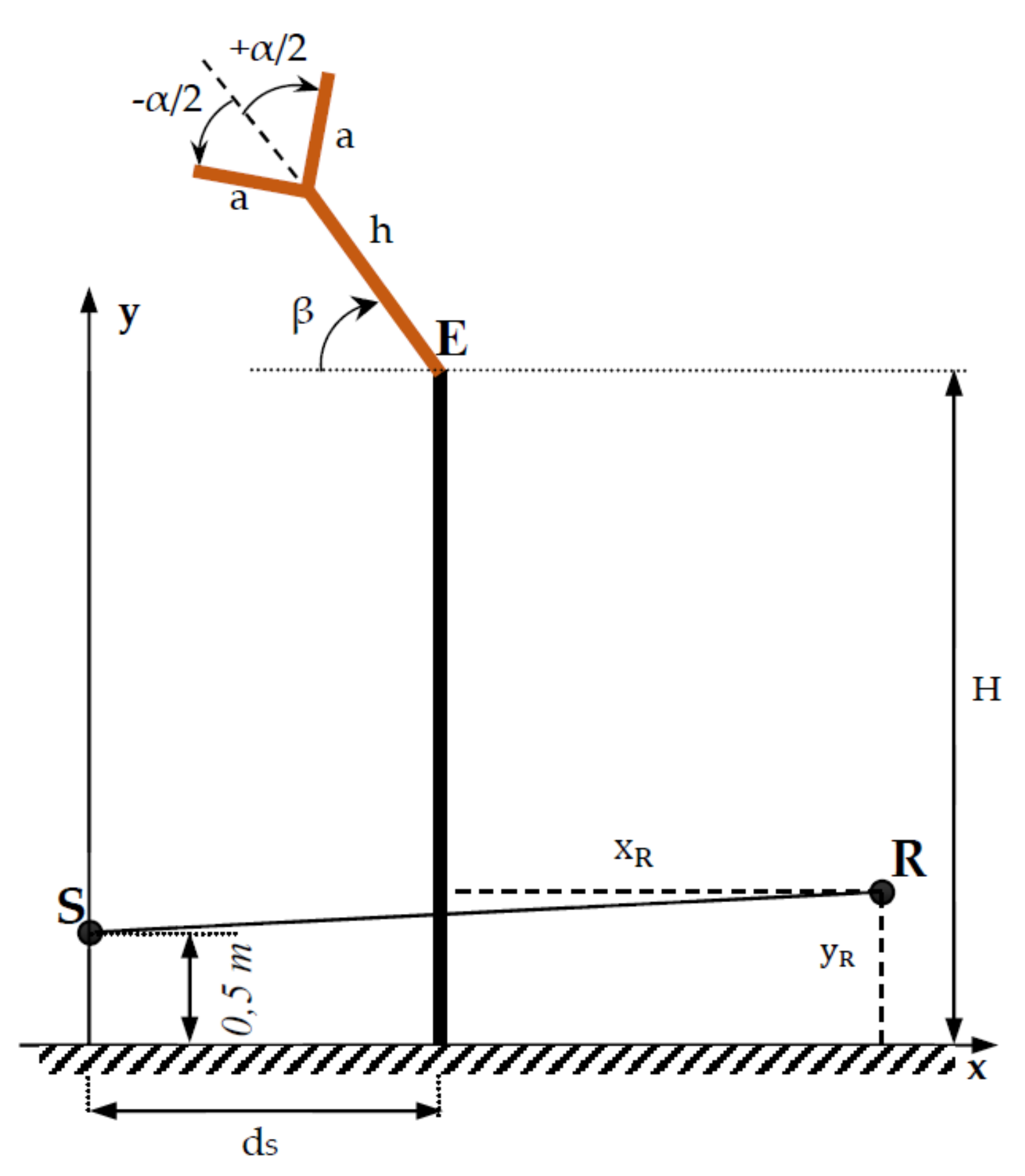
The aim of this research is to provide a better prediction for noise attenuation using thin rigid barriers. In particular, the paper presents an analysis on four methods of computing the noise attenuation using acoustic barriers: Maekawa-Tatge formulation, Kurze and Anderson algorithm, Menounou formulation, and the general prediction method (GPM-ISO 9613). Accordingly, to improve the GPM, the prediction computation of noise attenuation was optimized for an acoustic barrier by considering new effects, such as attenuation due to geometrical divergence, ground absorption-reflections, and atmospheric absorption. The new method, modified GPM (MGPM), was tested for the optimization of an y-shape edge geometry of the noise barrier and a closed agreement with the experimental data was found in the published literature. The specific y-shape edge geometry of the noise barrier contributes to the attenuation due to the diffraction phenomena. This aspect is based on the Kirchhoff diffraction theory that contains the Huygens-Fresnel theory, which is applied to a semi-infinite acoustic barrier. The new method MGPM of predicting the noise attenuation using acoustic barriers takes into consideration the next phenomena: The effect of the relative position of the receiver, the effect of the proximity of the source or receiver to the midplane of the barrier, the effect of the proximity of the receiver to the shadow boundary, the effect of ground absorption-reflections, the effect of atmospheric absorption, and the meteorological effect due to downwind. The conclusion of the paper reveals the optimization of the method for computing the noise attenuation using acoustic barriers, including the necessary corrections for ISO-9613 and the Sound PLAN software, as well as the optimization on a case study of a specific geometry of the edge barrier.
Keywords: noise barriers; noise attenuation; edge diffraction of acoustic barriers noise barriers; noise attenuation; edge diffraction of acoustic barriers