Author Contributions
Conceptualization, D.-F.C. and B.-S.C.; methodology, B.-S.C. and Y.-H.C.; software, B.-S.C.; validation, Y.-H.C. and B.-S.C.; formal analysis, B.-S.C.; investigation, B.-S.C.; resources, D.-F.C.; data curation, B.-S.C. and Y.-H.C.; writing—original draft preparation, B.-S.C.; writing—review and editing, D.-F.C. and B.-S.C.; visualization, B.-S.C.; supervision, D.-F.C.; project administration, B.-S.C. All authors have read and agreed to the published version of the manuscript.
Funding
This research received no external funding.
Institutional Review Board Statement
Not applicable. The study used publicly available or previously anonymized review corpora and did not involve new intervention with human participants.
Informed Consent Statement
Not applicable for the present analysis because no new identifiable human-subject data were collected. Production deployment should provide customer notice or obtain consent where required by the governing platform and jurisdiction.
Data Availability Statement
The source code, configuration files, and workflow definitions for the COFL architecture described in this study are openly available on GitHub at
https://github.com/toyota554/cofl-workspace (accessed on 16 June 2026) under the MIT License. The evaluation dataset was constructed from publicly available e-commerce corpora as described in
Section 3.3 of the manuscript.
Conflicts of Interest
The authors declare no conflicts of interest.
References
- Verhoef, P.C. Understanding the Effect of Customer Relationship Management Efforts on Customer Retention and Customer Share Development. J. Mark. 2003, 67, 30–45. [Google Scholar] [CrossRef]
- Zarkua, M. Personal Data Security in Comparative Perspective: Legal Frameworks and Protections. Eur. Sci. J. 2026, 22, 454. [Google Scholar] [CrossRef]
- Ministry of Justice, Taiwan. Personal Data Protection Act (R.O.C.). Available online: https://law.moj.gov.tw/ENG/LawClass/LawAll.aspx?pcode=I0050021 (accessed on 16 June 2026).
- Tukker, A. Eight types of product–service system: Eight ways to sustainability? Experiences from SusProNet. Bus. Strategy Environ. 2004, 13, 246–260. [Google Scholar] [CrossRef]
- Abuzrieq, Y.; Al-Said Ahmad, A.; Bani Younes, M. An Experimental Performance Evaluation of Cloud-API-Based Applications. Future Internet 2021, 13, 314. [Google Scholar] [CrossRef]
- Dwork, C.; Roth, A. The algorithmic foundations of differential privacy. Found. Trends Theor. Comput. Sci. 2014, 9, 211–407. [Google Scholar] [CrossRef]
- Zhang, Q.; Xin, C.; Wu, H. Privacy-Preserving Deep Learning Based on Multiparty Secure Computation: A Survey. IEEE Internet Things 2021, 8, 10412–10429. [Google Scholar] [CrossRef]
- Oakland, J.S. Total Quality Management and Operational Excellence, 4th ed.; Routledge: London, UK, 2014. [Google Scholar] [CrossRef]
- Woodall, W.H. The Use of Control Charts in Health-Care and Public-Health Surveillance. J. Qual. Technol. 2006, 38, 89–104. [Google Scholar] [CrossRef]
- Ding, F.; Xie, X.M. Adaptive control of a class of nonlinear systems. In Proceedings of the IEEE International Conference on Control and Applications, Vancouver, BC, Canada, 13–16 September 1993; Volume 2, pp. 817–818. [Google Scholar] [CrossRef]
- Sculley, D.; Holt, G.; Golovin, D.; Davydov, E.; Phillips, T.; Ebner, D.; Chaudhary, V.; Young, M.; Crespo, J.F.; Dennison, D. Hidden technical debt in machine learning systems. In Advances in Neural Information Processing Systems; Curran Associates, Inc.: Red Hook, NY, USA, 2015; Volume 28, pp. 2503–2511. [Google Scholar]
- Shi, W.; Cao, J.; Zhang, Q.; Li, Y.; Xu, L. Edge computing: Vision and challenges. IEEE Internet Things J. 2016, 3, 637–646. [Google Scholar] [CrossRef]
- Ye, S.; Ouyang, B.; Qian, T.; Zeng, L.; Li, J.; Du, J. Resource-Efficient Personal Large Language Models Fine-Tuning With Collaborative Edge Computing. IEEE Trans. Parallel Distrib. Syst. 2026, 37, 680–696. [Google Scholar] [CrossRef]
- Frantar, E.; Ashkboos, S.; Hoefler, T.; Alistarh, D. GPTQ: Accurate Post-Training Quantization for Generative Pre-trained Transformers. arXiv 2023, arXiv:2210.17323. [Google Scholar] [CrossRef]
- Dettmers, T.; Pagnoni, A.; Holtzman, A.; Zettlemoyer, L. QLoRA: Efficient Finetuning of Quantized LLMs. arXiv 2023, arXiv:2305.14314. [Google Scholar] [CrossRef]
- Singh, R.; Gill, S.S. Edge AI: A survey. In Internet of Things and Cyber-Physical Systems; KeAi Publishing: Amsterdam, The Netherlands, 2023; Volume 3, pp. 71–92. [Google Scholar] [CrossRef]
- Touvron, H.; Lavril, T.; Izacard, G.; Martinet, X.; Lachaux, M.A.; Lacroix, T.; Rozière, B.; Goyal, N.; Hambro, E.; Azhar, F.; et al. Llama: Open and Efficient Foundation Language Models. arXiv 2023, arXiv:2302.13971. [Google Scholar] [CrossRef]
- Jiang, A.Q.; Sablayrolles, A.; Mensch, A.; Bamford, C.; Chaplot, D.S.; Casas, D.D.L.; Bressand, F.; Lengyel, G.; Lample, G.; Saulnier, L.; et al. Mistral 7B. arXiv 2023, arXiv:2310.06825. [Google Scholar] [CrossRef]
- Shankar, S.; Garcia, R.; Hellerstein, J.; Parameswaran, A. Operationalizing machine learning: An interview study. arXiv 2022, arXiv:2209.09125. [Google Scholar] [CrossRef]
- Theodoropoulos, T.; Rosa, L.; Benzaid, C.; Gray, P.; Marin, E.; Makris, A.; Cordeiro, L.; Diego, F.; Sorokin, P.; Di Girolamo, M.; et al. Security in Cloud-Native Services: A Survey. J. Cybersecur. Priv. 2023, 3, 758–793. [Google Scholar] [CrossRef]
- Shi, Z.; Dong, J.; Gan, Y. Democratizing Digital Transformation: A Multisector Study on Low-Code Development Platforms. Appl. Sci. 2025, 15, 6481. [Google Scholar] [CrossRef]
- Alla, M. Designing High-Throughput FastAPI Gateways for Microservice Communication. J. Comput. Sci. Technol. Stud. 2025, 7, 823–828. [Google Scholar] [CrossRef]
- Saaty, T.L. Decision making with the analytic hierarchy process. Int. J. Serv. Sci. 2008, 1, 83–98. [Google Scholar] [CrossRef]
- Albahri, O.S.; Alsalem, M.A.; Albahri, A.S.; Mahmoud, M.A.; Alzubaidi, L.; Alamoodi, A.H.; Sharaf, I.M. An Improved Best-Worst Method Integrated with Combined Compromise Solution for Evaluating Large Language Models. Int. J. Intell. Syst. 2025, 2025, 2376097. [Google Scholar] [CrossRef]
- Yazgan, H.R.; Boran, S.; Goztepe, K. An ERP software selection process using AHP. Expert Syst. Appl. 2009, 36, 9214–9222. [Google Scholar] [CrossRef]
- Ghosh, N.; Ghosh, S.K.; Das, S.K. SelCSP: A framework to facilitate selection of cloud service providers. IEEE Trans. Cloud Comput. 2015, 3, 66–79. [Google Scholar] [CrossRef]
- Mikalef, P.; Boura, M.; Lekakos, G.; Krogstie, J. Artificial intelligence capability: Conceptualization, measurement calibration, and empirical study on its impact on business performance. Inf. Manag. 2021, 58, 103434. [Google Scholar] [CrossRef]
- Qu, Y.; Dai, Y.; Yu, S.; Tanikella, P.; Pillai, M.; Chen, W.; Xie, J.; Ren, Y.; Wang, D.; Wang, Y.; et al. PrecLLM: A Privacy-Preserving Framework for Efficient Clinical Annotation Extraction from Unstructured EHRs using Small-Scale LLMs. arXiv 2024, arXiv:2412.02868. [Google Scholar] [CrossRef]
- Hutto, C.; Gilbert, E. VADER: A Parsimonious Rule-based Model for Sentiment Analysis of Social Media Text. In Proceedings of the Eighth International Conference on Weblogs and Social Media (ICWSM-14), Ann Arbor, MI, USA, 1–4 June 2014. [Google Scholar] [CrossRef]
- Baccianella, S.; Esuli, A.; Sebastiani, F. SentiWordNet 3.0: An Enhanced Lexical Resource for Sentiment Analysis and Opinion Mining. In Proceedings of the Seventh International Conference on Language Resources and Evaluation (LREC’10), Valletta, Malta, 17–23 May 2010; pp. 2200–2204. [Google Scholar]
- He, R.; McAuley, J. Ups and downs: Modeling the visual evolution of fashion trends with one-class collaborative filtering. In Proceedings of the 25th International Conference on World Wide Web (WWW ‘16), Montreal, QC, Canada, 11–15 April 2016; pp. 507–517. [Google Scholar] [CrossRef]
- Le, H.T.M.; Phan-Thi, T.-A.; Nguyen, B.T.; Nguyen, T.Q. Mining online hotel reviews using big data and machine learning: An empirical study from an emerging country. Ann. Tour. Res. Empir. Insights 2025, 6, 100170. [Google Scholar] [CrossRef]
- Xu, L.; Hu, H.; Zhang, X.; Li, L.; Cao, C.; Li, Y.; Xu, Y.; Sun, K.; Yu, D.; Yu, C.; et al. CLUE: A Chinese Language Understanding Evaluation Benchmark. In Proceedings of the 28th International Conference on Computational Linguistics (COLING 2020), Barcelona, Spain, 8–13 December 2020; pp. 4762–4772. [Google Scholar] [CrossRef]
- Reis, M.J.C.S. Edge-FLGuard+: A Federated and Lightweight Anomaly Detection Framework for Securing 5G-Enabled IoT in Smart Homes. Future Internet 2025, 17, 329. [Google Scholar] [CrossRef]
- Wang, A.; Pruksachatkun, Y.; Nangia, N.; Singh, A.; Michael, J.; Hill, F.; Levy, O.; Bowman, S.R. SuperGLUE: A Stickier Benchmark for General-Purpose Language Understanding Systems. arXiv 2020, arXiv:1905.00537. [Google Scholar] [CrossRef]
- Koo, T.K.; Li, M.Y. A guideline of selecting and reporting intraclass correlation coefficients for reliability research. J. Chiropr. Med. 2016, 15, 155–163. [Google Scholar] [CrossRef] [PubMed]
- Zhang, T.; Kishore, V.; Wu, F.; Weinberger, K.Q.; Artzi, Y. BERTScore: Evaluating Text Generation with BERT. In Proceedings of the 8th International Conference on Learning Representations (ICLR 2020), Addis Ababa, Ethiopia, 26–30 April 2020. [Google Scholar] [CrossRef]
- Popović, M. chrF: Character n-gram F-score for automatic MT evaluation. In Proceedings of the Tenth Workshop on Statistical Machine Translation, Lisbon, Portugal, 17–18 September 2015; pp. 392–395. [Google Scholar] [CrossRef]
- Chatila, R.; Havens, J.C. The IEEE Global Initiative on Ethics of Autonomous and Intelligent Systems. In Robotics and Well-Being; Springer: Cham, Switzerland, 2019; pp. 11–16. [Google Scholar] [CrossRef]
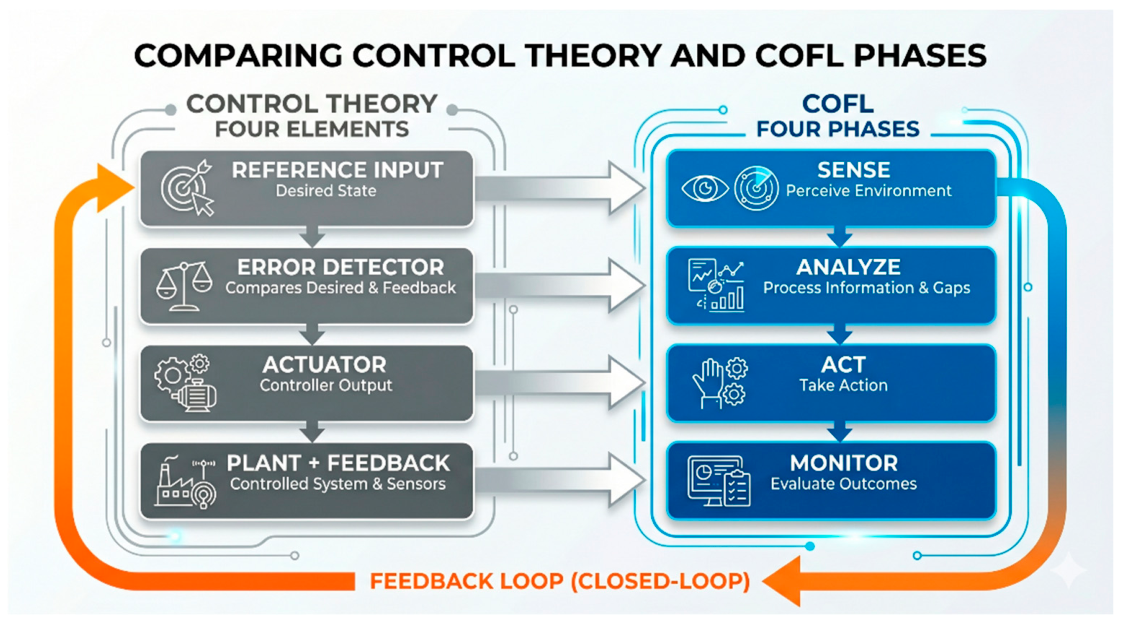
Figure 1.
Conceptual mapping between closed-loop control theory and the COFL commerce architecture.
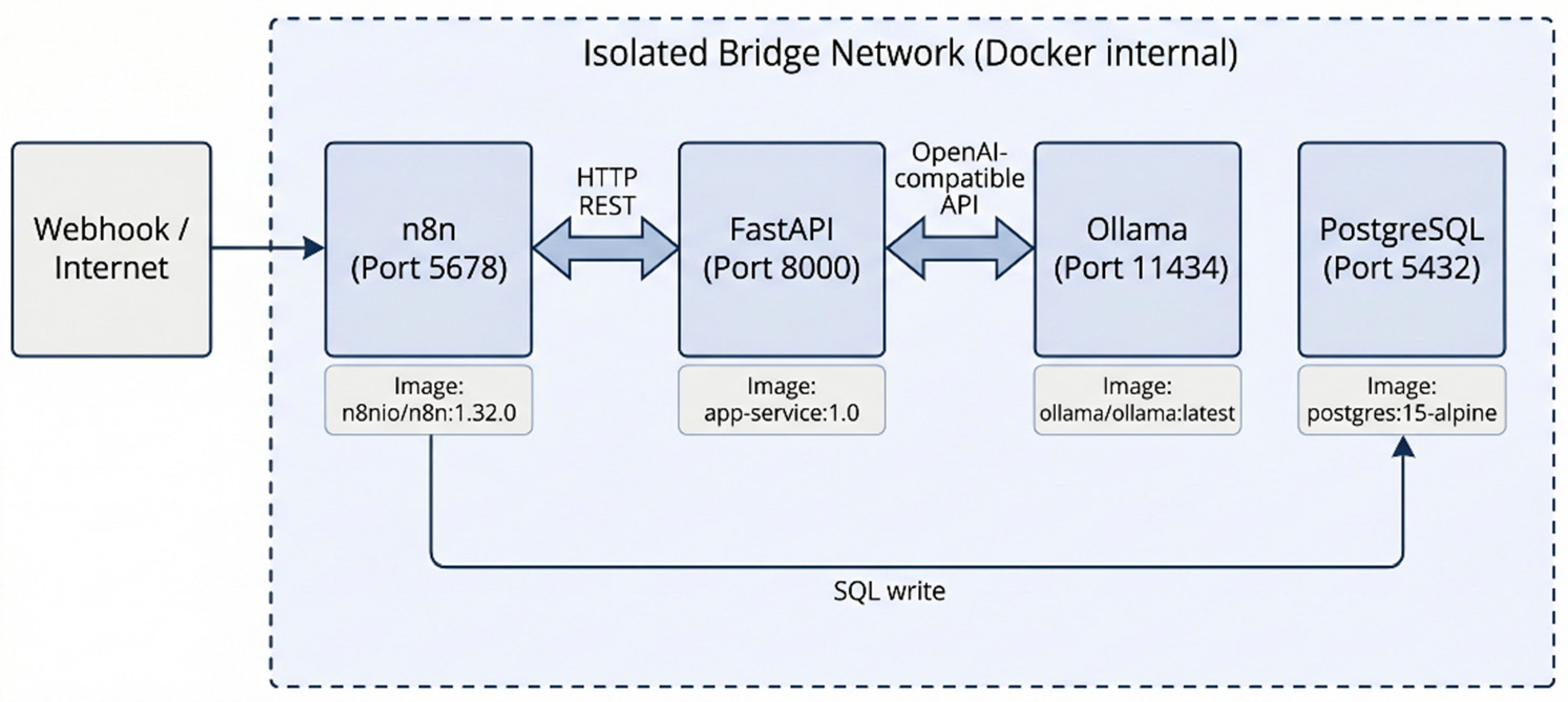
Figure 2.
Docker compose inter-container network topology and service port map.
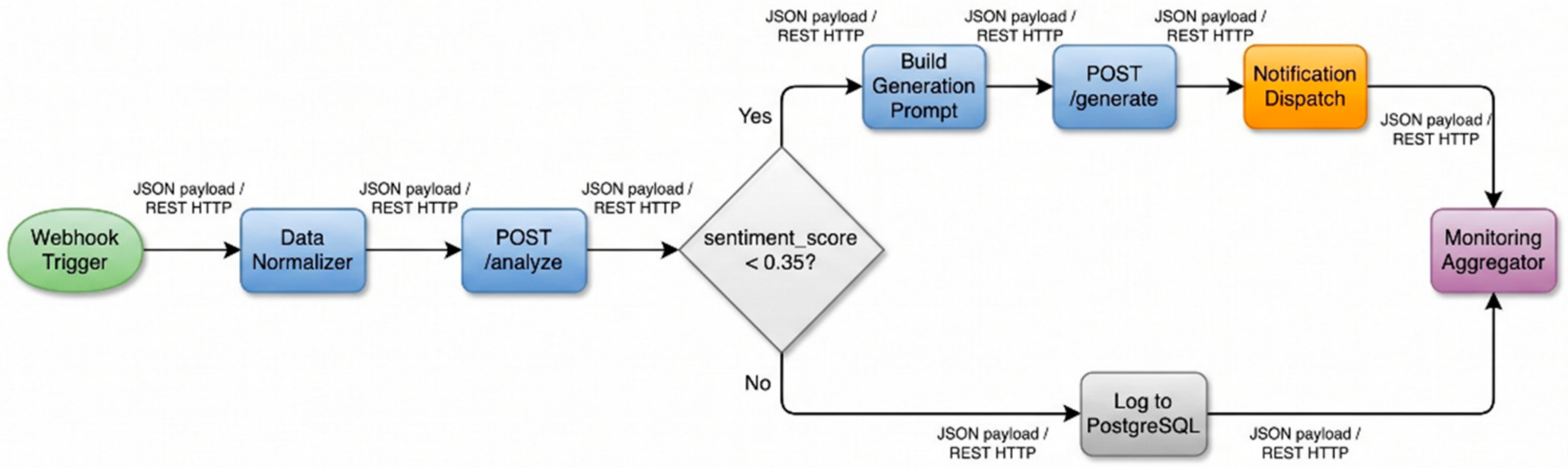
Figure 3.
n8n node graph of the complaint triage and response generation workflow pipeline.
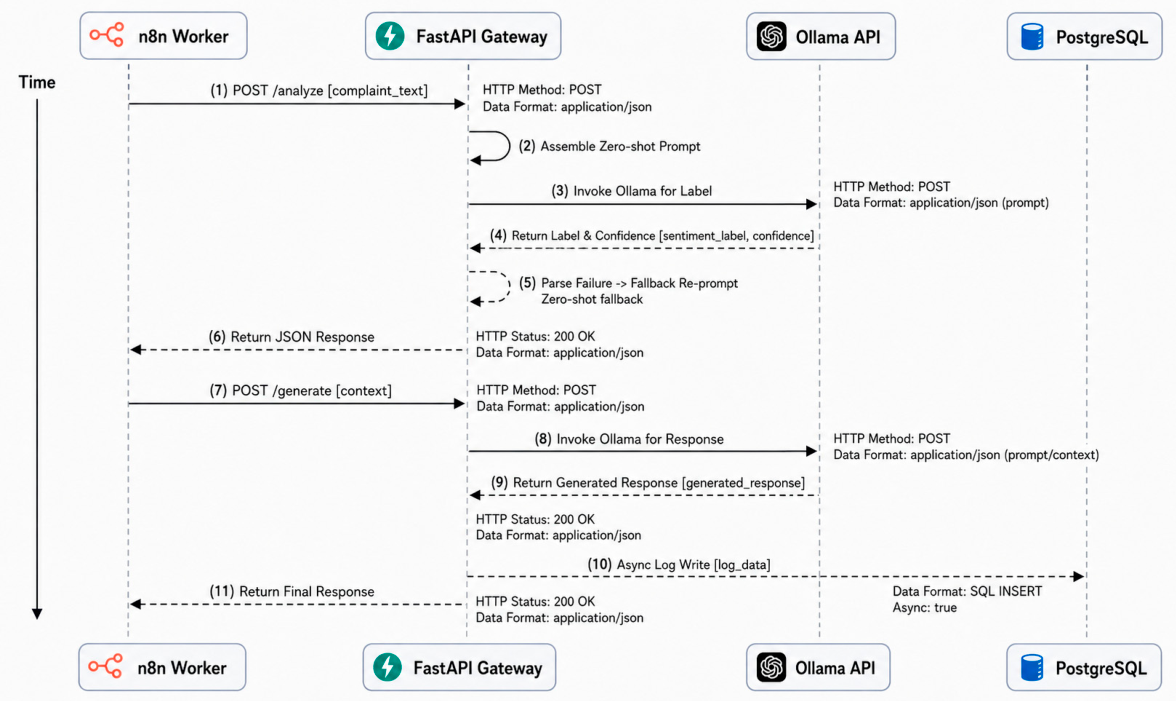
Figure 4.
FastAPI asynchronous request processing sequence diagram (/analyze and /generate Endpoints).
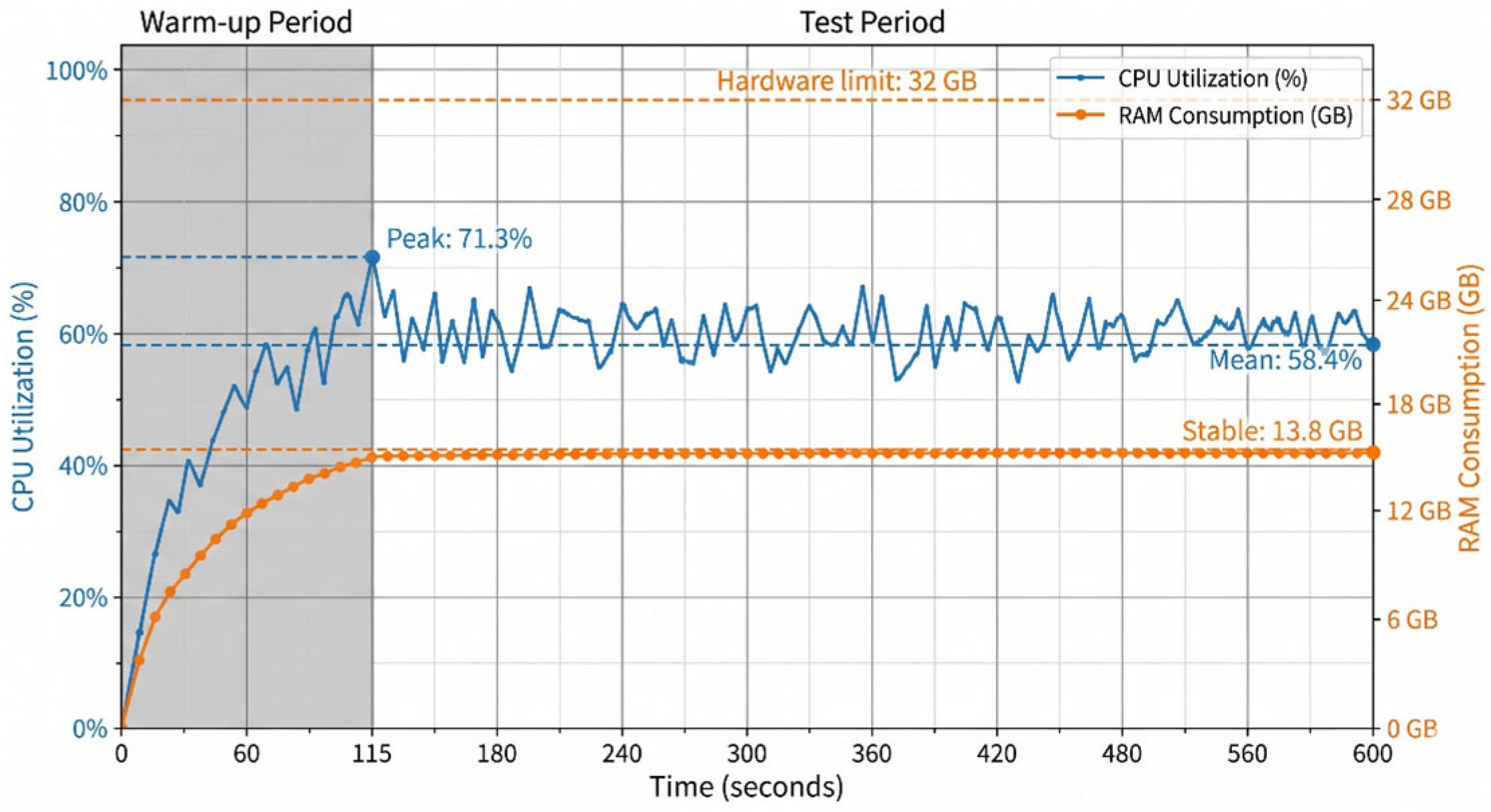
Figure 5.
CPU utilization (%) and RAM consumption (GB) during simulated Peak Traffic (480 events/10 min, sampled at 15 s intervals).
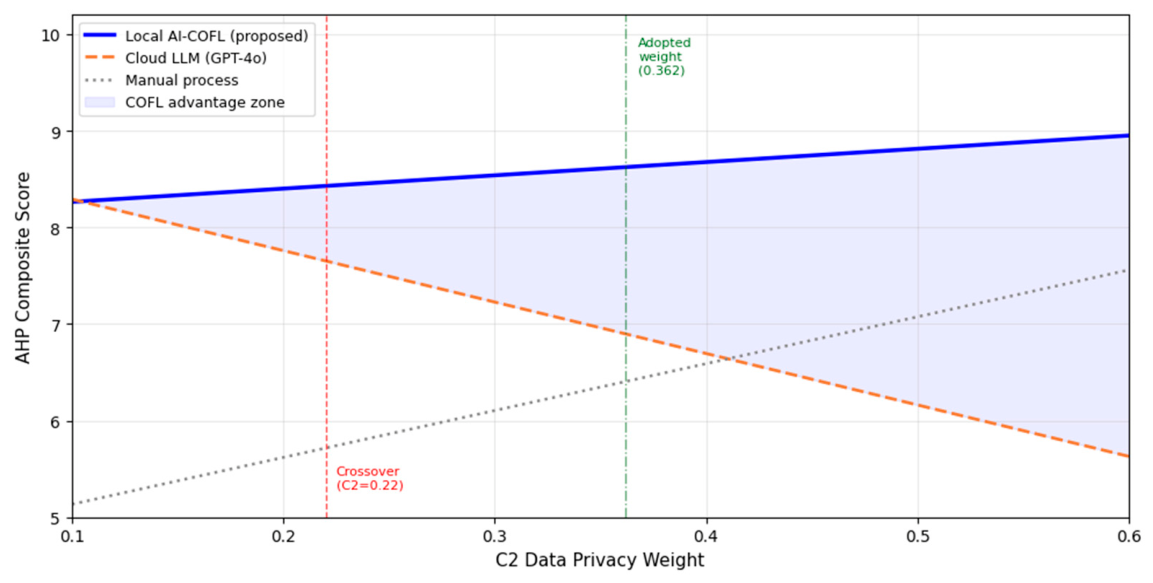
Figure 6.
AHP sensitivity analysis: composite score as a function of data privacy weight C2 ∈ [0.10, 0.60]. The COFL advantage (shaded zone) is maintained across all C2 > 0.22.
Table 1.
Positioning of the COFL architecture relative to representative existing systems.
| System/Study | Deployment | LLM Type | Privacy Model | Evaluation Method | Open-Source |
|---|
| GPT-4o API | Cloud (SaaS) | Proprietary LLM | PII transmitted to vendor | Automated (API) | No |
| Federated Learning [28] | Distributed edge | Small/fine-tuned | Distributed; no central PII | Simulation | Partial |
| DeepSpeed-Inference [11] | GPU cluster | Large (70B+) | On-premise (GPU required) | NLP benchmarks | Yes |
| Wang et al. AHP-TOPSIS [24] | Cloud | Not specified | Not addressed | Expert survey only | No |
| COFL (this work) | CPU edge (~USD 1640) | 8B quantized LLM | 100% local; no transmission | Fully automated metrics | Yes (GitHub) |
Table 2.
Edge AI workstation hardware specification and verified component costs.
| Component | Specification/Details |
|---|
| CPU | Intel Core i5-12400F (6C/12T, 2.5–4.4 GHz, 65 W TDP) |
| RAM | 32 GB DDR4-3200 (2 × 16 GB dual-channel) |
| Storage | 512 GB PCIe 3.0 NVMe SSD |
| GPU | None—CPU-only inference (iGPU disabled) |
| OS | Ubuntu 22.04 LTS (kernel 5.15.0-105) |
| Container Engine | Docker 24.0.5/Docker Compose v2.24.6 |
| LLM Runtime | Ollama v0.1.38 + LLaMA 3 8B Q4_K_M (GGUF, 4.65 GB) |
| Workflow Engine | n8n v1.28.0 (self-hosted, Docker Compose) |
| API Gateway | FastAPI 0.110.0 + Uvicorn 0.29.0 (4 async workers) |
| Database | PostgreSQL 16.2 (event log + metric store) |
| Estimated Build Cost (NT$) | 52,500 (~USD 1640 at April 2024 exchange rate) |
Table 3.
Dataset construction protocol: sources, proportions, and linguistic diversity metrics (N = 1800).
| Category | Count | Proportion | Source Corpus | TTR |
|---|
| Product Defect | 456 | 25% | Amazon Product Reviews [31] | 0.72 |
| Shipping Delay | 408 | 23% | Shopee TW Review Corpus [32] | 0.68 |
| Return/Refund | 336 | 19% | Bilingual e-commerce corpus [33] | 0.65 |
| Neutral Inquiry | 400 | 22% | E-commerce FAQ logs (public) | 0.61 |
| Positive Review | 200 | 11% | Amazon 5-star subset [31] | 0.58 |
| Total | 1800 | 100% | Multi-source | 0.69 (overall) |
Table 4.
AHP pairwise comparison matrix and derived priority weights (literature-grounded; CR = 0.047).
| Criterion | C1 Latency | C2 Privacy | C3 Accuracy | C4 Cost | C5 Scalability | Weight |
|---|
| C1: Latency | 1 | 1/3 | 1/2 | 3 | 2 | 0.143 |
| C2: Data Privacy | 3 | 1 | 2 | 5 | 4 | 0.362 |
| C3: Gen. Accuracy | 2 | 1/2 | 1 | 4 | 3 | 0.249 |
| C4: Cost | 1/3 | 1/5 | 1/4 | 1 | 1/2 | 0.078 |
| C5: Scalability | 1/2 | 1/4 | 1/3 | 2 | 1 | 0.168 |
Table 5.
AHP scoring rubric: instrument-anchored performance indicators (1–10 scale).
| Score | C1: Latency (E2E) | C2: Data Privacy | C3: Accuracy (F1/ROUGE-L) | C4: Cost (NT$/1k req.) |
|---|
| 9–10 | <2.0 s | 100% local; no transmission | F1 ≥ 0.90/ROUGE-L ≥ 0.45 | <1 |
| 7–8 | 2–5 s | Encrypted transit to compliant cloud | F1 0.80–0.89/ROUGE-L 0.35–0.44 | 1–50 |
| 5–6 | 5–15 s | Partial anonymization pre-transmission | F1 0.70–0.79/ROUGE-L 0.25–0.34 | 50–200 |
| 3–4 | 15–60 s | Raw PII transmitted to cloud | F1 0.55–0.69/ROUGE-L 0.15–0.24 | 200–500 |
| 1–2 | >60 s | No privacy controls | F1 < 0.55 | >500 |
Table 6.
End-to-end processing latency with 95% confidence intervals (n = 150 trials per condition).
|
Approach
|
Sentiment Mean (s)
|
95% CI (s)
|
Generation Mean (s)
|
E2E Mean (s)
|
Cost/1k req. (NT$)
|
|---|
| Cloud LLM (GPT-4o API) * | 1.84 | [1.71, 1.97] | 0.93 | 2.77 | ~180 |
| Local AI-COFL (proposed) | 2.13 | [2.01, 2.25] | 1.09 | 3.22 | ~0.9 |
Table 7.
Quantization ablation study: automated performance metrics across six model-quantization configurations.
| Model | Quantization | Size (GB) | Tok/s (CPU) | F1 Macro | BLEU-4 | ROUGE-L | PPL |
|---|
| LLaMA 3 8B | Q4_K_M (selected) | 4.65 | 17.2 | 0.836 | 0.198 | 0.421 | 8.73 |
| LLaMA 3 8B | Q5_K_M | 5.33 | 13.8 | 0.841 | 0.203 | 0.427 | 8.51 |
| LLaMA 3 8B | Q8_0 | 8.54 | 8.4 | 0.847 | 0.209 | 0.433 | 8.12 |
| LLaMA 3 8B | F16 (full) | 15.3 | 3.1 | 0.851 | 0.214 | 0.439 | 7.98 |
| Mistral 7B | Q4_K_M | 4.11 | 19.6 | 0.821 | 0.191 | 0.412 | 9.14 |
| Phi-3 3.8B | Q4_K_M | 2.30 | 24.1 | 0.798 | 0.172 | 0.388 | 10.32 |
Table 8.
Automated generation quality metrics: local AI-COFL vs. cloud LLM baseline (n = 200 stratified test records).
| Approach | F1 Macro | BLEU-4 | ROUGE-L | BERTScore F1 | Format Compliance (%) | Fallback Rate (%) |
|---|
| Local AI-COFL (LLaMA 3 8B Q4_K_M) | 0.836 | 0.198 | 0.421 | 0.874 | 94.3% | 2.3% |
| Cloud LLM (GPT-4o API)—reference | 0.864 | 0.221 | 0.448 | 0.901 | 96.7% | 0.8% |
Table 9.
AHP multi-criteria composite score: local AI-COFL vs. cloud LLM (literature-grounded weights).
| Solution | C1 (w = 0.143) | C2 (w = 0.362) | C3 (w = 0.249) | C4 (w = 0.078) | C5 (w = 0.168) | Composite |
|---|
| Local AI-COFL (Proposed) | 8.2 | 9.5 | 8.0 | 9.1 | 7.8 | 8.89 |
| Cloud LLM (GPT-4o API) | 8.8 | 3.5 | 9.0 | 7.5 | 9.2 | 6.58 |
Table 10.
36-month total cost of ownership comparison (10,000 interactions/month; COFL vs. cloud LLM).
| Cost Component | Local AI-COFL | Cloud LLM (GPT-4o API) |
|---|
| Hardware capital (36-mo. amortization) | NT$52,500 total/NT$1458/mo. | NT$0 |
| Inference/API cost | ≈NT$0.0008/req × 10k ≈ NT$8/mo. (within electricity) | ≈NT$0.14/req × 10k ≈ NT$1400/mo. |
| Electricity (65 W × 720 h/mo. × NT$3/kWh) | NT$140/mo. | NT$0 (cloud-borne) |
| System maintenance (est. 2 h/mo. × NT$600/h) | NT$1200/mo. | NT$0 |
| Data transfer/egress fees | NT$0 (no outbound traffic) | NT$200–500/mo. (est.) |
| Total monthly cost | ≈NT$2800/mo. | ≈NT$1600–1900/mo. |
| 36-month total | ≈NT$101,000 | ≈NT$58,000–68,000 |
| Disclaimer/Publisher’s Note: The statements, opinions and data contained in all publications are solely those of the individual author(s) and contributor(s) and not of MDPI and/or the editor(s). MDPI and/or the editor(s) disclaim responsibility for any injury to people or property resulting from any ideas, methods, instructions or products referred to in the content. |